Call for Papers | Retail Realms in Eighteenth-Century Britain
◊ ◊ ◊ ◊ ◊
From the call for papers:
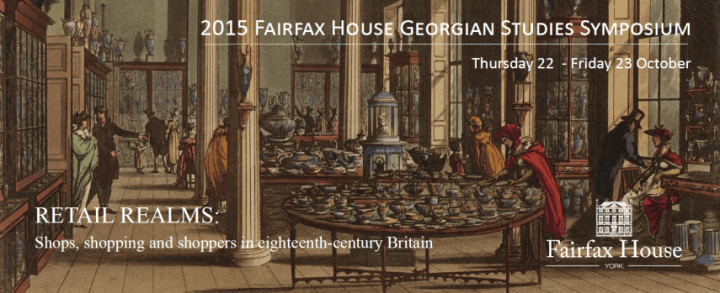
2015 Fairfax House Georgian Studies Symposium
Retail Realms: Shops, Shoppers and Shopping in Eighteenth-Century Britain, c.1680–1830
York Hilton Hotel and Fairfax House, York, 22–23 October 2015
Proposals due by 31 July 2015
The eighteenth century was a transformative age for shops and shopping in Britain. Between the late seventeenth and the early nineteenth centuries far-reaching changes took place in the ways people shopped, the things they bought, the shops themselves and the ways in which they were run, and the systems of distribution and marketing which made possible the shopping experience.
For an increasing portion of Georgian ‘polite society’, shopping, from being primarily a matter of obtaining the necessities of life, became a pleasurable leisure activity in its own right, associated with sociability, sensory experience, the fashioning of selfhood and the expression of individual and collective identities. Many historians who have explored the social and cultural dynamics of shopping in the eighteenth century have argued that this period saw a ‘consumer revolution’.
Theorisations of eighteenth-century consumerism, however, tend to overlook or disregard the materiality and spatiality of the shopping experience: the Georgian retail realm was not just a social or economic process but a place, located in shops, showrooms, markets and high streets, and extending into the assembly rooms and drawing rooms, and indeed the bedrooms and dressing rooms, of polite society. From the packaging of goods and the display of signs and labels, print advertising and the design of shops, to the increasing prominence of shops in towns and cities and the refashioning of the urban environment around the shopping experience, the retail realm was an increasingly important factor in the physical reshaping of eighteenth-century British life.
This symposium, the third Fairfax House Symposium in Georgian Studies, aims to bring together interested parties from curatorial, conservation, academic and other backgrounds with an interest in the history of shops and shopping to explore the nature and significance of the retail realm in the long eighteenth century. The symposium, which is taking place over two days, will be organised around five broad themes:
• A consumer revolution? — the development and transformation of the retail realm in the long eighteenth century
• Shopping outside the shop — publicity, marketing, the retail realm interacting with the urban, rural and domestic realms
• Shopping inside the shop — the design, layout and furnishing of shops, the display of goods, the management of the shopping experience
• The shopper’s realm — shopping as a fashionable/leisure pursuit and a social activity, the sensory/haptic dimensions of shopping
• The retailer’s realm — how retailers perceived shopping and shoppers, new retail arenas and models, the materiality of the retail business
Proposals are invited for symposium contributions not exceeding 20 minutes in length addressing one or more of the themes identified above. Please send outlines of around 200 words, accompanied by a brief one-paragraph biography, to fairfaxhousesymposium@gmail.com by Friday 31 July 2015. Any queries about the symposium should be sent to the same email address.
Call for Papers | Understanding British Portraits
From H-ArtHist:
Understanding British Portraits Annual Seminar
National Portrait Gallery, London, 25 November 2015
Proposals due by 12 June 2015
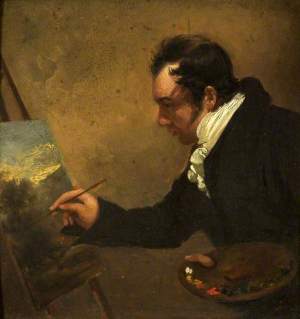
Nathan Cooper Branwhite, Portrait of Reverend John Eagles, ca.1820–25 (Bristol Museum & Art Gallery)
‘Understanding British Portraits’ is an active network with free membership for professionals working with British portraits including curators, museum learning professionals, researchers, academics and conservators. It aims to enhance the knowledge and understanding of portraits in all media in British collections, for the benefit of future research, exhibitions, interpretation, display and learning programmes.
This year’s Annual Seminar will take place on Wednesday 25 November at the National Portrait Gallery, London. It aims to highlight current scholarly research, museum-based learning programmes, conservation discoveries and curatorial practice relating to British portraits of all media and time periods.
We are now inviting proposals for 20-minute papers from museum professionals, scholars, conservators, and independent researchers which focus on these areas and seek to share innovation, challenges, or best practice case studies. Please send your abstract (max. 300 words) with a short biographical note (max. 100 words) in Word format to mail@britishportraits.org.uk before Friday 12 June.
More information is available here»
Call for Submissions | British Art Studies, Issue 2

◊ ◊ ◊ ◊ ◊
British Art Studies, Issue 2 (April 2016)
Papers are due by 1 September 2015
We are currently soliciting submissions of articles for our second issue, which is due for publication in April 2016.
British Art Studies is an online journal published by the Paul Mellon Centre for Studies in British Art, London, and the Yale Center for British Art, New Haven. Launching in the autumn of 2015, the journal will provide an innovative space for new research and scholarship of the highest quality on all aspects of British art. The digital format of the journal offers new opportunities for displaying images alongside text and multimedia content. The editors are open to proposals and ideas from authors to develop innovative and visually stimulating ways to publish art-historical scholarship online.
British Art Studies, which is peer reviewed, encourages submissions on British art, architecture, and visual culture from all periods in their most diverse and international contexts. The journal will reflect the dynamic and broad ranging research cultures of the Paul Mellon Centre and the Yale Center for British Art, as well as the wider field of studies in British art and architecture today.
How to submit an article: Texts of between 5000 and 8000 words in length (although the editors are willing to discuss shorter and longer formats) should be submitted via email in a Word document, together with a document containing low resolution accompanying images (where possible), and a list of proposed images and sources, as outlined in our style guide, available online. The final number of figures and the process of sourcing and commissioning media for articles accepted for publication will be discussed with authors on an individual basis, but we recommend between 5 and 10. British Art Studies will endeavour to meet all reasonable costs and deal with copyright issues for illustrative materials essential to the argument of published text.
How to submit proposals for other formats: proposals are also welcomed for content which presents art-historical scholarship in innovative and dynamic ways using the online format of British Art Studies. Proposals outlining your ideas, use of images and/or multi-media content are encouraged by the Editorial Group.
Deadline for the submission of articles and proposal to be considered for the second issue: 1st September 2015. Contact Hana Leaper (journal@paul-mellon-centre.ac.uk) with any questions or to discuss a potential submission to the journal.
Call for Papers | 2016 Society of Architectural Historians, Pasadena
From SAH:
Society of Architectural Historians 69th Annual Conference
Pasadena/Los Angeles, 6–10 April 2016
Proposals due by 9 June 2015
The Society of Architectural Historians is now accepting abstracts for its 69th Annual International Conference in Pasadena/Los Angeles, April 6–10, 2016. Please submit abstracts no later than June 9, 2015, for one of the 38 thematic sessions, Graduate Student Lightning Talks or for open sessions. The thematic sessions have been selected to cover topics across all time periods and architectural styles. SAH encourages submissions from architectural, landscape, and urban historians; museum curators; preservationists; independent scholars; architects; and members of SAH chapters and partner organizations.
◊ ◊ ◊ ◊ ◊
A selection of sessions that might be relevant to the eighteenth century:
Fiske Kimball and Visual Culture
Session Chair: Marie Frank, University of Massachusetts Lowell, Marie_Frank@uml.edu
2016 marks the centenary anniversary of the publication of Fiske Kimball’s Thomas Jefferson Architect (1916), a seminal book that not only established Jefferson as an architect but also propelled the young Kimball to the forefront of architectural history in the United States. Until his death in 1955, Kimball remained a powerful and influential voice in the arts. As a historian, his pioneering publications earned him the sobriquet “the father of American architectural history.” As an educator, he established the School of Fine Arts at the University of Virginia and laid the groundwork for the Institute of Fine Arts in New York City. As a preservationist, he played a critical role at Monticello, Colonial Williamsburg, Fairmount Park, and numerous other historic sites. As a critic, he wrote regularly on contemporary architecture. As the director of the Philadelphia Museum of Art (1925–55), he oversaw the construction of the new museum, installed period rooms, and built the collection. He practiced architecture throughout his life and had a keen regard for landscape architecture and its history.
The range of Kimball’s activities invites connections between disciplines often studied in isolation. This session therefore seeks to examine Kimball’s contributions as a lens to situate architectural history within the broader context of visual culture in the early twentieth century. Papers on a broad range of topics are welcome. Topics can include studies of individual projects in which Kimball had a presence; or they might provide more synthesizing studies on his methodology and the current state of research; or address the legacy of Kimball-inspired scholarship. Because he spent over half of his professional career as a museum director, papers could also address the role of the architectural historian within museum studies.
◊ ◊ ◊ ◊ ◊
Graduate Student Lightning Talks
Session Chairs: R. Scott Gill, University of Texas at Austin, SAHligtningtalks@gmail.com
This session is composed of approximately 12 five-minute talks that allow graduate students to introduce their current research. We are seeking work in various forms, including a focused summation, concentrated case study, and methodological exegesis. The individual talks are divided into thematic groups with a short question and discussion period following each set of presentations.
Graduate students are invited to submit a concise abstract (under 300 words). Preference will be given to doctoral students, but all graduate students are encouraged to apply, and the Lightning Talks co-chairs welcome geographic and institutional diversity. The Graduate Student Lightning Talks provide graduate students with an invaluable opportunity to test their ideas, refine their thoughts, and enhance their presentation skills among a circle of empathetic and supportive peers.
◊ ◊ ◊ ◊ ◊
History of Heritage Preservation Revisited
Session Chair: Josep-Maria Garcia-Fuentes, Newcastle University, josep.garciafuentes@ncl.ac.uk
Although we should conceptualise medieval relics as the prime forms of Western heritage, it is well known that the modern Western understanding of heritage and preservation have their origin in the debates that took place between the French Revolution and the Industrial Revolution. They were later enriched through different national-building processes during 19th and 20th centuries, and finally spread worldwide after World War II when the United Nations decided to create World Heritage.
This globalization of the modern Western understanding of heritage and preservation has challenged the contemporary notion of heritage and has given rise to dissonances and conflicts around the world. In the emergent interdisciplinary field of heritage studies is widely accepted that Heritage should be understood as a process rather than as an object to be revered and preserved—that is, as the constantly changing outcome of the struggle between those who aspire to capitalize it. This dynamic and creative understanding is rather different from the preservation and conservation paradigm widely assumed within the field of architecture. However, in recent years new attempts by architects and architectural historians have been made to define a novel approach to this discussion.
This session welcomes papers reviewing and examining this dynamic political, social and cultural process from late 18th century up to the present. Innovative research on case studies about the history of preservation and conservation and on the theoretical conceptualization of heritage are particularly welcome, as well as on architects and provocative key case studies ranging in scope from individual architectural works to the urban scale. The ultimate goal is to interconnect existing original research on Heritage and preservation with the aim to contribute to the definition of a new approach to Heritage research grounded on the history of Architecture.
◊ ◊ ◊ ◊ ◊
Reframing Landscape History
Session Chairs: John Beardsley, Dumbarton Oaks, beardsleyj@doaks.org and Anatole Tchikine, Dumbarton Oaks, tchikinea@doaks.org
Originally a subfield of art history, garden and landscape studies is now truly interdisciplinary in scope and objectives, combining a variety of methodologies and perspectives that are no longer peculiar to the humanities. Correspondingly, its focus has evolved from gardens as primarily artistic creations to the more inclusive category of designed landscapes to the still broader study of landscape as a meeting point of environmental, social, and economic histories. While this approach has allowed garden and landscape historians to transcend the boundaries of individual disciplines, it has also posed the challenge of generating constructive cross-disciplinary dialogue. In what ways can practitioners and scholars from divergent disciplinary backgrounds, who are trained to prioritize different sets of data, find a common language of communication? And does this move away from the traditional emphasis on iconography and meaning towards broader concerns with ecology, planning, and sustainability reflect a desire to incorporate new and potentially enriching perspectives—or does it represent a gradual displacement of garden and landscape studies from the domain of the humanities to that of social sciences?
Intended to mark the 75th anniversary of Dumbarton Oaks Research Library and Collection envisaged by its founders as a “home for the humanities,” this session invites papers to reflect on the history and the current disciplinary status of garden and landscape studies addressing the different methodological approaches, institutional frameworks, and individual visions that informed this field’s past and are likely to shape its future. Papers should consider this topic not just as a theoretical or historiographical challenge, but as one to be worked through by a discussion of specific examples of landscape interpretation.
Call for Papers | Women in the Global Eighteenth Century
Women in the Global Eighteenth Century
The 2015 Biennial Conference of The Aphra Behn Society for Women in the Arts, 1660–1830
Seton Hall University, South Orange, New Jersey, 5–6 November 2015
Proposals due by 15 May 2015
In The Global Eighteenth Century, Felicity Nussbaum and her contributors urged scholars to see the eighteenth century as “wide”: a period with a geographical as well as temporal sweep. Such a perspective, Nussbaum contended, would require different, more complex narratives of the people, events, systems, and discourses of the age. In the spirit of our namesake Aphra Behn, whose poetry, drama, plays, and translations reflect a complex awareness of a widening world, The Aphra Behn Society for Women in the Arts, 1660–1830 takes up the challenge posed by The Global Eighteenth Century to invite papers exploring any aspect of women and the arts in this “global eighteenth century.” How does a wider, potentially global, lens change the view of people, places, and things both familiar and strange, domestic and imperial, Us and Other? How does gender affect those views?
The Aphra Behn Society for Women and the Arts invites papers addressing the intersection of gender and the global eighteenth century from a wide variety of disciplines, including but not limited to Literature, History, Art History, Music History, Modern Languages, Philosophy, Religious Studies, and Women and Gender Studies. We welcome papers on this topic from all sub-fields of these disciplines.
Papers might address the following topics:
- Investigations or representations of ‘difference’ in literature and the sister arts
- Representations of social and political authority
- The arts, women, and empire
- Women and the construction of literary, artistic, domestic, public, national, imperial, and colonial spaces
- Women and travel writing
- Women and diaspora
- Women and the metropole
- Women and indigenous knowledge
- Women, genre (textual, visual, musical, etc.), and space/place
- Notions of performance and gender
- Notions of gender and race, class, religion, or other markers, perhaps under pressure in a widening context
- Gender and encountering the Other
- Women, modernity, and post-colonial situations
- Women and the colonial or post-colonial Enlightenment
As always, we also welcome abstracts for papers not related to the conference theme. Please upload 1–2 page abstracts or panels by May 15, 2015. In addition, the Society and its journal, ABO are sponsoring a pre-conference Wikipedia Edit-a-Thon on Wednesday, November 4th, from 12:00 to 5:00 pm at the Grand Summit Hotel. Participation is free and open to everyone, although participants must supply their own laptops. Registration for this event is on the conference registration form.
The registration fee includes all conference events, including the Wikipedia Edit-a-thon, the luncheon, the concluding banquet, a performance by Seton Hall students, and a reception with the rare books librarians and university archivists to view highlights of the university’s collection. The Society also sponsors a graduate student travel award ($150) and a graduate student essay prize ($150 and the possibility of publication in ABO: Interactive Journal for Women in the Arts, 1640–1830). For more information, see the conference website or contact the conference organizers, Dr. Kirsten Schultz at Kirsten.schultz@shu.edu or Dr. Karen Gevirtz at Karen.gevirtz@shu.edu.
Plenary lecture by Dr. Lynn Festa, Associate Professor of English, Rutgers University.
Sponsored by The Aphra Behn Society for Women in the Arts, 1660–1830, the College of Arts and Sciences, and the Women and Gender Studies Program at Seton Hall University.
Call for Papers | CAA in Washington, D.C., 2016
Here’s a reminder that proposals for 2016 CAA panels are due this Friday, May 8. Details on selected sessions relevant to the eighteenth century are available here.
◊ ◊ ◊ ◊ ◊
104th Annual Conference of the College Art Association
Washington, D.C., 3–6 February 2016
Proposals due by 8 May 2015
The 2016 Call for Participation for the 104th Annual Conference, taking place February 3–6 in Washington, D.C., describes many of next year’s sessions. CAA and the session chairs invite your participation: please follow the instructions in the booklet to submit a proposal for a paper or presentation. This publication also includes a call for Poster Session proposals.
Call for Papers | Sculpture and Parisian Decorative Arts in Europe
From H-ArtHist:
The Role of Sculpture in the Design, Production, Collecting,
and Display of Parisian Decorative Arts in Europe, 1715–1815
Mons, Belgium, 29 August 2015
Proposals due by 14 May 2015
An international conference on the occasion of Mons European Capital of Culture 2015 and Waterloo 1815–2015 on Saturday, 29 August 2015
Potential speakers are invited to submit proposals for conference papers. These should be limited to a maximum of 300 words, should be accompanied by a brief CV (no more than a few lines), and should be sent to the Low Countries Sculpture Society (info@lcsculpture.org), arriving no later than Thursday, 14 May 2015. A scientific committee drawn from the Society and invited scholars will make a decision on selected speakers shortly after that date. Proposals must be in English or French, which will be the conference languages. For foreign participants, one hotel night in Mons and modest travel expenses can be covered.
Between 1715 and 1830 Paris gradually became the capital of Europe, “a city of power and pleasure, a magnet for people of all nationalities that exerted an influence far beyond the reaches of France,” as Philip Mansel wrote, or as Prince Metternich phrased it, “When Paris sneezes, Europe catches cold.” Within this historical framework and in a time of profound societal change, the consumption and appreciation of luxury goods reached a peak in Paris. The focus of this one-day international conference will be the role of the sculptor in the design and production processes of Parisian decorative arts—from large-scale furniture and interior decoration projects to porcelain, silver, gilt bronzes, and clocks.
In the last few years a number of studies were carried out under the auspices of decorative arts museums and societies such as the Furniture History Society and the French Porcelain Society. It now seems appropriate to bring some of these together to encourage cross-disciplinary approaches on a European level and discussion between all those interested in the materiality and the three-dimensionality of their objects of study. The relationships between, on the one hand, architects, ornemanistes and other designers, and on the other sculptors, menuisiers, ébénistes, goldsmiths, porcelain manufacturers, bronze casters, and other producers, as well as the marchands merciers, will be at the heart of the studies about the design processes.
A second layer of understanding of the importance of sculpture in the decorative arts will be shown in the collecting and display in European capitals in subsequent generations, particularly those immediately after the French Revolution, as epitomised by King George IV. Overall, the intention of this conference is to shed light on the sculptural aspect of decorative arts produced in Paris in the long 18th century and collected and displayed in the capitals of Europe. Without pretending to be exhaustive, this study day—and its publication—hopes to bring together discussions about the histories and methodologies that could lead to furthering the study of hitherto all too often neglected aspects of the decorative arts.
Research questions may include (non-exhaustive list):
• What are the specificities of the Parisian approach to three-dimensional sculptural design that made it collectable, or was it only collectable in Europe due to its availability at vastly reduced prices when the art market was flooded by the revolutionary auctions?
• What relationships can be established between the ‘Frenchness’ of sculptural designs produced in Paris and the large number of ‘foreign’ designers and craftspeople there (coming in particular from the Low Countries and Germany)?
• What was the impact of public authorities (e.g. guilds and schools), intermediaries (marchands merciers, agents, etc.), private salons, societies, and other networks on the three-dimensional design aspect decorative arts produced in Paris?
• Taste leaders: the role of the monarch, the court, Paris vs. Versailles, and their interest in ‘sculptural’ decorative arts
• Taste disseminators: the role of prints and treatises regarding ‘sculptural’ decorative arts
• The collaborative efforts between architects, designers, sculptors, cabinet makers, ‘porcelainiers’, bronze casters, goldsmiths, engravers, etc.—were they specific to luxury items produced in Paris? Were certain disciplines more appropriate for ‘sculptural design’?
• How do case studies inform us about the role of sculptors in the design and production processes for decorative arts?
• How is sculptural illusionism in painted decorative panels, such as those by Tournai-born Piat-Joseph Sauvage (1744–1818) or in the Casa del Labrador at the royal palace of Aranjuez, related to the design and perception of Parisian decorative arts?
• What was the impact of collectors of old/existing Parisian decorative arts on the design of spaces to display these in European capitals?
• Are centre-periphery theories applicable to the interpretation of decorative arts produced in Paris and its hinterland? Is the work of Abraham Roentgen and his bronze casters an appropriate case study for this?
A dossier exhibition will be especially organised on the occasion of our international conference: Drawn to Be Sculpted: Unknown Designs for 18th-century Decorative Arts / Dessiné pour être sculpté: dessins inconnus du XVIIIe siècle pour les arts décoratifs.
Call for Papers | Antoine Galland et l’Orient des Savants
From H-ArtHist:
Antoine Galland et l’Orient des Savants
Société Asiatique, Paris, 3–4 December 2015
Proposals due by 31 May 2015
Parmi les savants qui ont marqué l’histoire de l’orientalisme, Antoine Galland (1646–1715) représente sans doute l’une des figures les plus remarquables et les plus attachantes. Il a laissé un nombre important de travaux, a tenu au quotidien un journal et accompli de longs voyages dans l’empire ottoman. Mais il suffit ici de rappeler deux écrits, assez différents l’un de l’autre, pour donner une idée de sa culture, de sa vision et de son impact sur ses contemporains: d’une part, son «Discours pour servir de préface», dans la Bibliothèque orientale, ou Dictionnaire universel contenant généralement tout ce qui regarde la connaissance des peuples de l’Orient, ouvrage de référence de Barthélemy d’Herbelot (m. 1695), publié après deux années de travail en 1697 par Antoine Galland (voir http://gallica.bnf.fr/ark:/12148/bpt6k82422h); d’autre part, ses Mille et une nuits, Contes arabes, dont il a assuré la première traduction de 1704 à 1717 dans une langue européenne. Sa participation à la Bibliothèque orientale marque son implication profonde dans le tissu savant de l’époque, et sa préface fournit une très belle synthèse de l’ouvrage encyclopédique, signifiant l’ampleur de son érudition.
Elle indique aussi cependant ses engagements personnels à propos des religions ou de l’histoire de l’humanité, ou plus simplement à propos du rôle de la poésie, comme lorsqu’il écrit : « Et l’on peut compter comme une marque de la délicatesse de leur esprit, le nombre considérable de leurs poètes (…) Car en quelque nation que ce soit, la poésie a cela par-dessus la prose, qu’elle s’exprime plus noblement (…) ». En ce qui concerne sa traduction des Mille et une nuits, il n’est pas besoin de s’étendre sur son impact, qui a affecté très rapidement toute l’Europe du XVIIIe siècle.
Les compétences et les intérêts d’Antoine Galland pour l’Orient ont été en effet multiples, et c’est cette multiplicité que ce colloque entend traiter, non seulement avec le monde arabe, turc ou persan, mais bien au-delà, y compris par exemple le monde grec, à travers les médailles, ou le monde arménien à travers les manuscrits, ou bien encore à travers des phénomènes de société passés d’Orient en Occident, comme le café. Ajoutons à cela que rien ne qualifiait au départ Antoine Galland, né à Rollot en Picardie d’une famille des plus modestes, à devenir au terme de sa carrière professeur au Collège royal et membre de l’Académie.
Cela permet de proposer un certain nombre de thèmes pour intervenir à ce colloque : Devenir orientaliste au XVIIe siècle (qui ? comment ?); les voyages de Galland et son journal ; ses travaux sur les textes narratifs (Kalîla et Dimna, Mille et une nuits) ; ses traités et anthologie (De l’origine et du progrès du café, Les paroles remarquables) ; la collecte des médailles et manuscrits ; la Bibliothèque orientale et l’érudition ; les Académies, les sociétés savantes et leurs organes de diffusion.
Les propositions de communication de dix à vingt lignes, accompagnées d’une brève présentation du conférencier (fonctions, coordonnées, bibliographie), doivent être envoyées sous forme d’un fichier texte word ou équivalent avant le 31 mai sur l’adresse: antoinegalland2015@gmail.com. Elles seront évaluées avant le 30 juin et une réponse sera envoyée au plus tard à cette date à tous les participants. La durée de chaque communication est de 20 mn. Les frais éventuels de transport et de séjour sont à la charge des participants. Pour plus d’informations n’hésitez pas à contacter: antoinegalland2015@gmail.com.
Call for Essays | The Mediality of Sugar
From H-ArtHist:
The Mediality of Sugar
Edited by Nadja Gernalzick, and Joseph Imorde
Proposals due by 1 June 2015; completed essays due by 30 November 2015
“Sugar is not a vegetable.” Other than as a natural substance, sugar—the food—may be conceptualized as a medium, or so the quotation from Gertrude Stein’s Tender Buttons (1914) suggests. This call for contributions proposes a conceptualization of food as medium and takes the mediality of food by the example of sugar as a point of departure. Cane sugar has certainly mediatized and modified many peoples, cultures, and political or economic systems, in colonialism, slavery, capitalism, and in today’s world of a global food industry. In literature or works of the visual arts, sugar has a distinct iconography and is found in manifold metaphorical and figural uses. Examples are James Grainger’s georgic poem The Sugar-Cane of 1764, Phillis Wheatley’s brief “On Being Brought from Africa to America” of 1773, Jean Toomer’s modernist prose Cane of 1923, Edwidge Danticat’s historical novel The Farming of Bones of 1998, or Kara Walker’s sculpture with social intervention A Subtlety; or, The Marvelous Sugar Baby of 2014.
If sugar is read as a medium, the appearance of sugar in a novel, for instance, is a case of intermedial reference. Walker’s sculpture may be media combination, in the media-theoretical differentiations argued by Irina Rajewsky, among others. It may be that it has only become possible to recognize sugar and other foods as media since the technology and design that is part of any agri’culture’ and food production has today become obvious, or, readily observable to the consumer. In a communication studies model of mediality, food may be conceptualized as a message from the producer to the consumer. Sugar, as food, carries manifold significations regarding class, gender, race, sexuality, and other categories of identification. (more…)
Call for Papers | Art, Anatomy, and Medicine since 1700
Art, Anatomy, and Medicine since 1700
Columbia Museum of Art, Columbia, South Carolina, 31 March — 1 April 2016
Proposals due by 1 July 2015
The symposium organizer seeks proposals for papers that address visual, theoretical, cultural, historical and/or contemporary connections, relationships, conflicts and/or collaborations among the visual arts, anatomy/dissection, and medicine from the eighteenth century to the present. Participants may be historians of art, medicine, science or technology, art educators, medical professionals, artists (who may propose to contextualize their own work), etc. Successful papers may also be invited for publication in an edited volume of the same theme.
Broad topics may include (but are certainly not limited to):
· The role of anatomy in artists’ training (past, present and/or future)
· Artists’ roles in the creation/dissemination of anatomical knowledge
· Artistic representation of anatomical and medical professionals
· Anatomical and medical models: from écorché figures to nano-imagery
· Anatomy as art, art as anatomy
· Anatomical displays, exhibitions (e.g. Body Worlds), and collections: from curious to educational to controversial
· Corpses, dissection and grave-robbing in art, literature and medical history
· Imaging bodily surface and anatomical depth: from sculpture to M.R.I.s and beyond
· Beyond human, superhuman, inhuman(e)?: technological ‘improvements’, additions and extensions of human anatomy from prosthetics/implants to Google glasses
· Zombies and vampires, and the creative/fantastic defiance of or resistance to anatomical, medical and worldly reality
· The evolutionary human in art and science: looking backward and looking ahead
· Parts vs. whole: the functions of specificity and generality in aesthetics and visual medical information
Please send cover letter, abstract (no more than 3 pages, double-spaced typed), and CV to:
Dr. Andrew Graciano, Associate Professor of Art History and Associate Director
School of Visual Art & Design
University of South Carolina
Columbia, SC 29208
or by email to: graciano@mailbox.sc.edu










leave a comment