Call for Articles | Art and Art History Libraries
From H-ArtHist:
Art and Art History Libraries
2016 Issue of Perspective: La Revue de l’INHA
Proposals due by 15 June 2015; finished papers due by 1 June 2016
The next special issue of Perspective (the journal of the Institut national d’histoire de l’art) will focus on topics relating to art and art-history libraries and their specificity as bibliographic, artistic, and documentary resources. We will examine these places, which make information pertaining to our discipline available to artists and researchers, while at the same time endeavoring to conserve their collections of texts and images. This double purpose requires examining the practices and profiles of users, the way in which people visit these institutions, either by consulting the images in reading rooms or websites (consultation of reproductions as opposed to reading monographs, digital access to works, etc.), and also a study of their collections: in addition to books and magazines, art libraries also preserve prints, photographs, manuscripts, artist books, etc.
The interest of such a project for an art-historical review lies partly in the difficulty in defining the exact scope of an art library. However, the planned reopening by the INHA in 2016 of the Salle Labrouste, which will house one of the most important art libraries in the world in terms of its number of volumes, its symbolic importance, and its accessibility, offers a unique opportunity for a collective historical and aesthetic reflection on the forms and ambitions of these collections of art and knowledge, past and present. Nevertheless, this issue will not be limited exclusively to the example of the INHA. On the contrary, consistent with the editorial philosophy of Perspective,
the volume will contain articles that cover a historical range in their study of art libraries in general and present the most innovative studies from an international standpoint. At the same time, we aim to publish original papers on the place of the library in the work of artists and architects.
We would like to suggest several potentially interesting paths, without excluding others: issues related to the conservation and dissemination of ephemera and small publications such as invitation cards, almanacs, booklets, announcements, etc.; the study of exceptional bibliophiles such as, for example, Doucet, Wyder, and Oechslin; the correlation between library holdings and research topics (the Mesnil collection given to the Warburg Institute and research projects at University College, London in the 2000s); the study of art libraries during wartime similar to research on artworks plundered during such extreme periods; evaluation of the losses and gains following the merger of disparate collections originally belonging to art schools, museums, universities (for example, the INHA Library); the particular fate of iconographic documentation (Bildarchiv Foto Marburg); the recent foundation of specialized research centers with libraries created from scratch like the Canadian Centre for Architecture in Montreal; and also the inclusion of various media resources, including recordings, such as oral archives at the British Library (artists’ interviews) or performance videos in the Kandinsky Library of the Centre Georges Pompidou. Finally, projects are certainly needed from the perspective of the history of art education, on specialized establishments for art craftsmen such as the Bibliotheque Forney and the Ratti Center at the Metropolitan Museum of Art, without neglecting the opportunity offered by digital technology in new ways of disseminating collections.
The proposals could range from a synthetic short article focusing on a specific aspect of the art library, or on relations between art and the library in a given period and in a particular geographic area (25,000 characters), to a detailed and multidisciplinary study of a moment in art library history, or even the problematization of their absence in time and space (45,000 characters).
The intention of this call for papers is not to cover all possible topics exhaustively: all proposals are welcome. However, within the framework of an art-historical review dedicated to recent international research in the field, we wish to emphasize historical and aesthetic approaches, rather than research relevant to library studies proper. Projects in whatever language—Perspective takes responsibility for translations—will be reviewed by the scientific committee consisting of Laurent Baridon, Ewa Bobrowska, Anne-Élisabeth Buxtorf, Penelope Curtis, Godehard Janzig, Thomas Kirchner, Rémi Labrusse, Anne Lafont, Johanne Lamoureux, Antoinette Le Normand-Romain, Michel Melot, Pierre-Michel Menger, Philippe Saunier, Jean-Claude Schmitt, Valérie Sueur-Hermel, Veerle Thielemans and Bernard Vouilloux.
Please submit your proposals (2000–3000 character summary and a 2–3 line biography) to revue-perspective@inha.fr up to and including June 15, 2015. Full texts of accepted contributions will need to be sent by June 1, 2016.
Call for Panel Proposals | Creating Markets, Collecting Art
From AAH:
Creating Markets, Collecting Art
Christie’s King Street, London, 14–15 July 2016
Proposals due by 1 June 2015
To commemorate the traditional founding date of Christie’s auction house in 1766, a two-day conference, 14–15 July 2016, will be held at Christie’s King Street, focusing on the theme of Creating Markets and Collecting Art.
Christie’s Education is known for its collaborative and cross-disciplinary approach to the study of works of art through its Master’s programmes in the History of Art and its Markets, Art-world Practice and Art, Law and Business internationally. This conference hopes to explore this cross-disciplinary area, looking at the interrelationship of commerce, collecting and the academy.
Sessions should engage with current scholarship on any aspect of the art market, in particular on creating markets, collecting, regulation and cultural heritage, from the eighteenth century to the present day, and in all geographical regions. Session proposals may address the following:
• the role of the intermediary in the structure of art ecosystems
• the economics of taste and its relationship to value(s)
• how artefacts are transformed into works of art by the market and by enthusiasts and collectors
• the role of regulation and the law
• the auction house as cultural space
• current theoretical debates surrounding ‘aura’ and the making/meaning of authenticity
Session proposals should include a title and abstract (maximum 250 words), the contact details of the convenor(s) and a brief biography. Please submit the Session Proposal Form by e-mail to the Conference Secretary (aking@christies.com) by 1st June 2015. This will be followed by a Call for Papers in July 2015.
Call for Papers | CIHA 2016 Session, The Other and the Foreign
Below is the general Call for Papers for the 2016 meeting in Beijing of the Comité International d’Histoire de l’Art (CIHA), along with details for the session on “The Other and the Foreign.” Many of the 21 sessions will be of interest and the full CFPs is available here.
34th CIHA World Congress of Art History: Terms
Beijing, 15–22 September 2016
Proposals due by 30 June 2015
The Chinese CIHA Committee will host the 34th CIHA World Congress of Art History in Beijing and invites art historians from all over the world to attend and discuss Terms. Scholars from a vast cross-section of disciplines and fields of professional interest are called upon to discuss together ways of seeing, describing, analyzing, and classifying art works. The topics are divided into 21 sections. The sections should enable comparisons to be made between different viewpoints and methods. Each panel will compose a program reflecting the CIHA’s commitment to the idea of diversity, which should allow talks on different genres, epochs, and countries to be brought together. Please submit the abstract of your paper directly to the chairs with a copy to info@ciha2016.org before 30 June 2015.
Session 14: The Other and the Foreign: Contact, Curiosity, and Creative Exchange
Session Chairs
Petra Chu, Seton Hall University, New Jersey (petra.chu@shu.ed)
DING Ning, Peking University, Beijing (dingning@pku.edu.cn)
LIANG Shuhan (Junior Chair), Peking Univeristy, Beijing (liangtiantian@hotmail.com)
Respondent
Jennifer Milam, Sydney University (jennifer.milam@sydney.edu.au)
This session is concerned with the representation of the ‘other’ and the ‘foreign’ in art as well as with the reception of ‘other’ and ‘foreign’ art forms. It acknowledges that, in a global world, the notion of ‘othering’ is not restricted to the geographically or ethnically distant (‘foreign’), but occurs within one’s own (geographically defined) culture between different social classes, genders, age groups, and religious affiliations. More generally, the session focuses on the phenomenon of artistic encounter and exchange. While its parameters are worldwide, papers on all topics related to the ‘other’/’foreign’ are solicited in as far as they pertain to the creation and reception of art and/or the transmission of creative ideas. Papers on the contacts between specific regions or the role and place of individual artists in the process of artistic exchange are welcomed.
Questions to be addressed may include but are not limited to the following:
• Can we distinguish universal paradigms for the ways in which ‘the other’ is represented in art, globally?
• In the global history of art, how have animals been used as devices for ‘othering’, not solely as subject matter, but as a means through which artists and their audiences engage with the nature of self—other relationships?
• How can we improve our theoretical models of the reception of foreign and, more generally, ‘other’ art?’
• Are there degrees of ‘otherness,‘ and if so, can we measure them? Can a work produced within one’s own (geographically defined) culture be just as ‘other’ as, or more so than, a work produced in a ‘foreign’ culture?
• How can we theorize ‘artistic exchange?’
• How do we define ‘hybridity’ in art? Is more than one definition possible?
• What is the relation/difference between exchanges between cultural centers and those that happen at peripheries, specifically in connection with ‘hybrid’ art forms?
• To what extent can artistic differences and sameness be accounted for through geography?
Call for Papers | CAA 2016 Session, Eros and Enlightenment
An addition to the CAA 2016 sessions:
ASECS Panel on Eros and Enlightenment at the
104th Annual Conference of the College Art Association
Washington, D.C., 3–6 February 2016
Proposals due by 31 May 2015
Session Chairs:
Nina Dubin, University of Illinois at Chicago (dubin@uic.edu)
Hérica Valladares, University of North Carolina at Chapel Hill (herica.valladares@gmail.com)
What would it mean to consider the eighteenth century through the lens of its evolving discourse on love? The explosion of a novel-reading public; the Enlightenment’s often nervous inquiry into love’s place among the ‘moral sentiments’ and its status in relation to the equally unstable category of friendship; the expansion of epistolary culture and the attendant vogue for love letter pictures; the libertine conceptualization of love as a ‘commerce’; homoeroticism as a cultural leitmotif; the ubiquitous presence of Cupid, even in such unexpected contexts as financial literature; the fixation on ancient notions of eros, from Ovid’s persistently popular Ars Amatoria to the unearthed remains of erotic frescoes: these and other phenomena suggest that love played a central yet complicated role in period self-imaginings, in ways that iconographic accounts of the era’s visual arts have perhaps not fully registered. This ASECS-sponsored panel seeks papers on all aspects of visual and material culture that expand, challenge, and enliven our understanding of eros in the eighteenth century.
Please email a title, abstract (1–2 pages, double-spaced) and brief CV (1–2 pages) to the panel chairs by May 31.
Call for Papers | Visual Print Culture in Europe, 1500–1850
From the University of Warwick:
Visual Print Culture in Europe, 1500–1850: Techniques, Genres, Imagery, and Markets
University of Warwick at Palazzo Pesaro Papafava, Venice, 5–6 December 2015
Proposals due by 1 June 2015
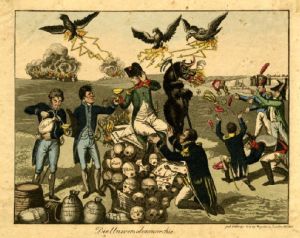 Under Napoleon’s Empire we find London acting as a hub for printing caricatures of Napoleon in a range of languages, and with a number of distinctive styles. The print Die Universalmonarchie (pictured to the right) claims, for example, to have been published by Boydell & Co. in London in 1815, but the Boydells were based at Cheapside, not—as the print states—at Pall Mall (once the location of the late Josiah Boydell’s famous Shakespeare Gallery). The publication information would seem to be spurious, and the British Museum suggests that it was likely published in Paris. Is this print, then, German, French, or even possibly English? Who exactly is its market? How far is its imagery tailored to a particular ‘national’ audience and in what ways might it be distinctively comprehensible to such an audience? Besides London, what other European hubs were important, at what moments and why?
Visual Print Culture in Europe 1500–1850 aims to draw together scholars with a range of disciplinary skills to discuss the methods, representational forms, and distribution of and audience for visual print media in Europe between 1500 and 1850. Its seeks to de-nationalize the study of visual print culture, and to explore the extent to which interactions between engravers and printers, artists and consumers in Europe, and a range of common representational practices produced a genuinely European visual print culture—with local modulations, but nonetheless with a common core.
Papers can draw on a range of disciplinary backgrounds in exploring the exchange of techniques and processes, the analysis of imagery, and the identification of markets, and in analysing the conditions under which particular generic forms crossed or failed to cross national boundaries. Although the emphasis is on European visual print culture, the impact of that culture on, and its interaction with, the wider world is also of interest. The conference language will be English. The conference may be able to provide some financial assistance to those whose home institutions are unable to support their attendance, especially postgraduate students.
The conference organisers—acting under the European History Research Centre—are Mark Philp (History, EHRC Director, Warwick mark.philp@warwick.ac.uk), Kate Astbury (French Studies, Warwick), Mark Knights (History, Warwick), and David Taylor (English, Warwick). Proposals for papers should be submitted to t.smith.2@warwick.ac.uk by June 1st 2015, but please feel free to contact Mark Philp in advance with any queries.
Call for Session Proposals | ASECS 2016, Pittsburgh
2016 American Society for Eighteenth-Century Studies Conference
Pittsburgh, 31 March — 3 April 2016
Session Proposals due by 1 June 2015
Proposals for panels at the at the 47th annual meeting of the American Society for Eighteenth-Century Studies, to take place in Pittsburgh, are now being accepted. Please complete the form (available as a Word document) and email it to asecs@wfu.edu.
Call for Papers | Reconsidering the Rococo: 18th to 21st Centuries
From H-ArtHist:
Reconsidering the Rococo: 18th to 21st Centuries / Penser le Rococo (XVIIIe–XXIe Siècle)
University of Lausanne, 5–6 November 2015
Proposals due by 30 June 2015
This symposium will be held alongside Agents and Agency of Rocaille Ornament (Les acteurs de la rocaille) organised at the Institut national d’histoire de l’art in Paris from 1st to 3rd October 2015.
Despite the scepticism or irony which it provokes, the notion of the Rococo occupies a central position within the historiography of 18th-century art. It structures our understanding of this epoch and determines the way in which we see it. This symposium, planned as an answer to the stimulating research of the last twenty years on the Rococo, aims at an epistemological reflection on a protean notion which was progressively defined as a style during the 19th century.
The Rococo—which is often associated with the supposed frivolity of the 18th century—is regularly described as a capricious, sensual, anti-vitruvian artistic phenomenon without any coherent theoretical grounding. Alternately presented as progressive—even transgressive—or retrograde, profane or religious, the Rococo is always a place of contradictions. In order to avoid its moral, political and cultural connotations, some art historians attempt to define it only by its formal aspects. In the history of styles, the Rococo is often set against Neoclassicism and entertains an unclear relationship with the Baroque. Is it fundamentally different from the latter? Might it be the Baroque’s last phase, its fulfilment or its decline? Its origin is also the object of vivid debate: while it is generally agreed that the Rococo first appeared in France, some authors have stated that it only reached its full development in Germany.
This symposium therefore favours a critical approach to this notion, urging contributors to reconsider how it emerged, how it was formed and diffused. What were the first manifestations of the Rococo, on what preconceived ideas was it founded, and how did it become a formal and aesthetic canon? Which sources did it draw upon? What ideas and categories have been used to structure it? How were the boundaries of the Rococo established? The different objects which have been brought together through this classification can be linked to many discourses of their time, notably those concerning the inventio and the caprice. However, those same objects also caused many reactions: a large proportion of these, from the 18th century on, were negative, as is exemplified in famous texts by Abbé Le Blanc and Cochin. How have art historians interpreted these discourses? What simplifications, anachronisms, projections or prejudices does this attempt to describe 18th-century art reflect? How has the context in which interpreters have written about the Rococo oriented the formulation of narratives during the 19th, 20th and 21st centuries? How have the ideas upon which their work is founded inflected the production of imitations of 18th-century objects? How have these revivals, in turn, acted upon our understanding of the Rococo?
These questions—as well as many other similar ones—can be used as a framework for the presentations. As the reader will have understood by now, this symposium will not attempt to define the characteristics of a style, nor to determine an essence of the Rococo but to reflect on the manner in which a notion has been—and continues to be—perceived. Proposals of up to 300 words—to which a brief resumé and a list of publications should be joined— can be sent to carl.magnusson@unil.ch and paulinart@yahoo.fr until 30th June 2015. Travel and lodging expenses will be covered by the University of Lausanne.
Scientific Organisers
Carl Magnusson (University of Lausanne)
Marie-Pauline Martin (University of Aix-Marseille, CNRS TELEMME UMR 7303)
Scientific Committee
Jan Blanc (University of Geneva)
Frédéric Dassas (Musée du Louvre, Department of Decorative Arts)
Michaël Decrossas (Institut national d’histoire de l’art, Paris)
Peter Fuhring (Custodia Foundation, Paris)
Christian Michel (University of Lausanne)
Call for Articles | Tales from the Crypt: Museum Storage and Meaning
From H-ArtHist:
Collected Essays | Tales from the Crypt: Museum Storage and Meaning
Abstracts due by 15 May 2015 / Final papers due by 15 October 2015
Museums are about display. But are they really? In spite of recent curatorial attempts to exhibit ‘visible storage’, prevailing debates in the history of museums and collecting are mainly centred around questions of exhibiting, display and spectatorship. This kind of discourse, however, distorts the museum in many ways: it ignores the fact that museums do not just consist of exhibition halls but of vast hidden spaces; it leaves millions of objects out of our museum histories; and lastly, it presents the museum as an organized and stable space, in which only museological ‘results’ are visible not the intermediate stage of their coming into being. Display seems to be about the structured, purposeful, strategic gathering of things according to a system, the features of which are clearly defined. What remains out of sight is the fact that the majority of museum objects lie in storage. As a result, not only a vast physical but also important epistemological and semantic aspect of museums and their collections are eliminated from our discussions. The binary between ‘display’ and ‘backstage’ of museums has previously evoked the assumption that the exhibition area functions as a kind of theatre with objects ‘perform’ on stage, while in the back they are processed from their existence as a mere ‘thing’ to a proper artefact. But there is much more to say about museum storage. Backstage areas of museums are not simply areas where potential display objects are kept. They perform functions and fulfill intentions that, when studied, reveal deep purposes of the museum that go well beyond a mere history of display. A history of storage is a thus history of things that are not shown, but also not written about. The understanding of museums and the intellectual histories they encode undergoes a radical shift when we consider what a museum shows alongside the (usually much larger) range of things it stores. These issues may and will be discussed very differently in various parts of the world, which is what this volume intends to address.
Seeking a variety of historical contributions (e.g. with specific case studies), theoretical and philosophical intervention as well as reflections on practical issues, we wish to explore these ‘tales from the crypt’ along the lines of the following themes:
• Storage and canonization
• The politics of collecting
• Power and censorship
• The economic and epistemic value of museum objects
• Ethics and moral aspects of preservation
• Disposal, sale, and de-accessioning
• The (scholarly) uses, necessities and functions of storage
• Curated and un-curated storage
• Visible storage, off-side storage, deep storage, ‘non-museological’ storage
• The politics of displayability
• Storage, the archive and data mining
• Architecture, real estate and the physical spaces of storage
• Issues of access to storage
• Economic aspects of storage
• Storage and digitization
The volume will partly present the results of a workshop (Victoria & Albert Museum, October 2014), organized under the aegis of the India-Europe Advanced Research Network on Museum History that invited a small group of scholars to respond to museum storage—concept and practice—in India and Europe. It is this cross-cultural approach that we wish to take with the volume. We therefore welcome contributions addressing a broad variety of material and theories across all continents. A report of the IEARN workshop can be found here.
Abstracts (max. 300 words) for papers (max. 8000 words) should be sent to mirjam.brusius@history.ox.ac.uk and kavising@gmail.com by May 15, 2015. Authors will be notified in June. The deadline for final papers will be October 15, 2015.
Concept by Mirjam Brusius and Kavita Singh for the Research Group on Museums and History, March 2014 and 2015
Call for Papers | CAA in Washington, D.C., 2016
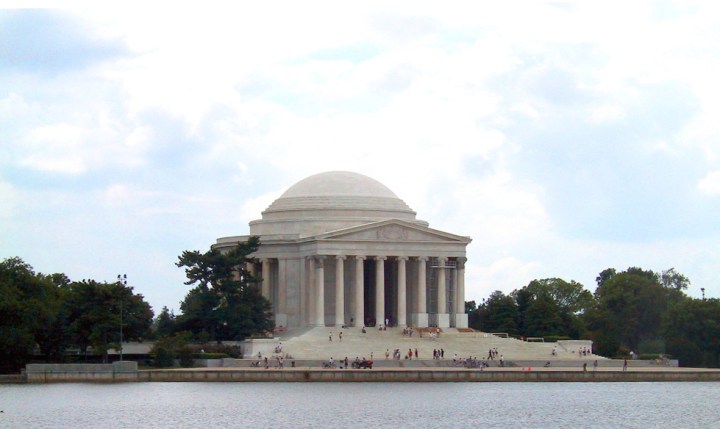
The Jefferson Memorial in Washington, D.C., from across the Tidal Basin of the Potomac River
(Wikimedia Commons, Rdsmith4, 2005)
◊ ◊ ◊ ◊ ◊
The following selection of panels may be of interest for scholars of the eighteenth century, though readers are encouraged to consult the full Call for Papers. HECAA members are asked to pay special attention to the session on pastels chaired by Iris Moon and Esther Bell and the one on Eros and Enlightenment chaired by Nina Dubin and Hérica Valladares. -CH
◊ ◊ ◊ ◊ ◊
104th Annual Conference of the College Art Association
Washington, D.C., 3–6 February 2016
Proposals due by 8 May 2015
The 2016 Call for Participation for the 104th Annual Conference, taking place February 3–6 in Washington, D.C., describes many of next year’s sessions. CAA and the session chairs invite your participation: please follow the instructions in the booklet to submit a proposal for a paper or presentation. This publication also includes a call for Poster Session proposals.
◊ ◊ ◊ ◊ ◊
Historians of Eighteenth-Century Art and Architecture
Pastel: The Moment of a Medium in the Eighteenth Century
Iris Moon, The Metropolitan Museum of Art; and Esther Bell, Fine Arts Museums of San Francisco, imoon.moon@gmail.com and esthersusanbell@gmail.com.
This panel explores pastel as the “medium of the moment” in the long eighteenth century in order to pose questions about the temporality of artistic media and how materially unstable works of art shaped the period’s aesthetic discourse. Described by Denis Diderot as “precious powder that will fly from its support, half of it scattered in the air and half clinging to Saturn’s long feathers,” the volatile matter of pastel provoked a sense of physical movement that transformed the viewing process into a charged moment of encounter. We invite considerations on the making and unmaking of pastel practitioners, the critical language around the medium developed by connoisseurs and collectors, and inquiries that situate pastel’s distinctive properties within debates on color and line, touch and sight, viewer and object.
◊ ◊ ◊ ◊ ◊
American Society for Eighteenth-Century Studies
Eros and Enlightenment
Nina Dubin, University of Illinois at Chicago, dubin@uic.edu; and Hérica Valladares, University of North Carolina at Chapel Hill, herica.valladares@gmail.com
What would it mean to consider the eighteenth century through the lens of its evolving discourse on love? The explosion of a novel-reading public; the Enlightenment’s often nervous inquiry into love’s place among the ‘moral sentiments’ and its status in relation to the equally unstable category of friendship; the expansion of epistolary culture and the attendant vogue for love letter pictures; the libertine conceptualization of love as a ‘commerce’; homoeroticism as a cultural leitmotif; the ubiquitous presence of Cupid, even in such unexpected contexts as financial literature; the fixation on ancient notions of eros, from Ovid’s persistently popular Ars Amatoria to the unearthed remains of erotic frescoes: these and other phenomena suggest that love played a central yet complicated role in period self-imaginings, in ways that iconographic accounts of the era’s visual arts have perhaps not fully registered. This ASECS-sponsored panel seeks papers on all aspects of visual and material culture that expand, challenge, and enliven our understanding of eros in the eighteenth century (due date is 31 May).
◊ ◊ ◊ ◊ ◊
The Modernities of French Art and Its History, 1780 to the Present
Natalie Adamson, University of St Andrews; and Richard Taws, University College London, na14@st-andrews.ac.uk and r.taws@ ucl.ac.uk.
From now-canonical studies that helped lay the methodological foundations of art history as a discipline to the extraordinary popularity of French art and ideas outside of the academy, the history of French art has become an influential tradition that has often been presented as synonymous with modernism itself. This session proposes a critical interrogation of the diverse histories of French art since 1780 to the present day. We welcome papers that look outside of, challenge, or run counter to hegemonic narratives. What critical possibilities (if any) remain for the study of French art’s modernities? We encourage approaches that interrelate the histories of specific images, objects, or narratives with reflection on the writing of those histories, or on broader historiographical tendencies, so that a set of fresh perspectives may emerge on this enduring yet highly mutable relationship between art history and modern France.
◊ ◊ ◊ ◊ ◊
Taking Stock: Future Direction(s) in the Study of Collecting
Christina M. Anderson, University of Oxford, cm.anderson@usa.net.
The study of collecting is at a crossroads. “Collection” has often meant “art collection,” overlooking the broader range of objects and behaviors involved. Fascination with the Wunderkammer has centered attention on European models, even when objects themselves were not European. The rise of museum studies, furthermore, has shifted attention away from the individual practice of collecting to institutional concerns about conservation and deaccession. Recent approaches to collecting, intended to broaden its study, include cross-cultural encounters, the circulation of knowledge, the cultural biographies and social lives of things, the art market, and the collecting practices of particular social groups. This panel explores the current and future states of the field through case studies that utilize innovative and forward- looking methodologies. Presentations may, for example, challenge the dominance of traditional sources such as inventories and biographies; present new interpretations or applications of terms like “connoisseurship”; or explore potential insights offered by the study of synesthesia or semiotics.
◊ ◊ ◊ ◊ ◊
Landscape into History
John Beardsley, Dumbarton Oaks Research Library and Collection; Jennifer Raab, Yale University, beardsleyj@doaks.org and jennifer.raab@yale.edu.
Art history and landscape studies have a common origin and shared scholarly trajectories, yet the extent of their reciprocal influence is by no means certain. This session will look both forward and back, exploring the fluctuating and sometimes problematic historical connections between art history and landscape studies while investigating the potential for more productive interchange between the two disciplines in the future. In what ways could the close attention paid by landscape historians to environment, physical and social experience, spatial analysis, and mapping enhance the methods of art history? How might art-historical emphases on materiality, viewing, cultural context, and artistic process contribute to landscape studies? What models do landscape studies have to offer that could address pressing ecological issues while also engaging with questions of representation and aesthetics? Papers should consider this not just as a theoretical challenge but as one to be worked through by a discussion of specific landscapes.
◊ ◊ ◊ ◊ ◊
Beyond Featherwork: Mexican Visual Identity between Conquest and Independence
Aliza M. Benjamin and Bradley J. Cavallo, Temple University, tua63451@temple.edu and tuc70074@temple.edu.
Colonial Mexican society of ca. 1650–1800 produced a sophisticated aesthetic that blurred distinctions between Old and New World visual identities. Such criollismo transformed indigenous traditions into something independent yet reminiscent of European preferences, a process of incorporation that rarely produced clearly enunciated cases of syncretism. More often, the characteristic signs of the original cultural traces remained present but indistinct, negotiations of the cognitive dissonance experienced by a people acutely aware of their foundation in both Aztec and Spanish pasts. This session examines the multicultural fusion of European and indigenous art-making traditions surviving in the evidence of postconquest, pre-Independence architecture and movable art objects. We invite papers of methodological diversity that illustrate how artists, patrons, and audiences instantiated the era’s newly developing cultural identity within Mexican society or projected it outward as part of the transmission of knowledge about material production and aesthetic processes that developed across the network of transatlantic trade routes.
◊ ◊ ◊ ◊ ◊
The Art of Animal Activism: Critical Parameters
Alan C. Braddock, College of William and Mary; and Keri Cronin, Brock University, acbraddock@wm.edu and keri.cronin@ brocku.ca.
Today nonhuman animals figure more prominently in cultural, ethical, and scientific inquiry than ever before, thanks to recent research that has forced a significant reassessment of human exceptionalism, or speciesism. Lately some art historians have begun to consider these issues as well. All of this has taken place amid growing popular fascination with animals and backlash against their egregious, often concealed abuse in factory farming, entertainment, laboratories, and other areas. Animals have become subjects of vision, imagination, and activism—but also exploitation— like never before. This session examines the critical parameters of animal activism and advocacy in art since the eighteenth century. Papers should address important landmarks and historical contours of such art, assessing creative techniques used to advance particular goals. Consideration of why the discipline of art history has been slow to map this tradition and challenges involved in visualizing the interests of other beings are also encouraged.
◊ ◊ ◊ ◊ ◊
Afrotropes
Huey Copeland and Krista Thompson, Northwestern University, h-copeland@northwestern.edu and krista-thompson@ northwestern.edu.
This session focuses on the aesthetic, historical, and theoretical terrain opened up by the “afrotrope.” This neologism refers to those visual forms that have emerged within and become central to the formation of African diasporic culture and identity in the modern era, from the slave ship icon produced by the Society for Effecting the Abolition of the Slave Trade (1788) to the “I AM A MAN” signs famously held up by striking Memphis sanitation workers (1968). The recurrence of such afrotropes makes palpable how subjects have appropriated widely available representational means only to undo their formal contours or to break apart their significatory logic. The afrotrope thus offers a vital heuristic through which to understand how visual motifs take on flesh over time and to reckon with what remains unknown or cast out of the visual field. We solicit papers that not only identify key afrotropes but also theorize how they elucidate new models of temporality, authorship, and cultural transmission.
◊ ◊ ◊ ◊ ◊
The Meaning of Marginalia in Early Modern Art and Theory, 1500–1800
Stephanie S. Dickey, Queen’s University, dickeys@queensu.ca.
This session seeks case studies exploring the practice of ann tation in early modern art and art criticism. The concern is not with printed marginalia (an established literary form) but with handwritten notes, a record of individual response bridging the published and the private. Artists annotated their own drawings and those of others they acquired. Connoisseurs jotted comments and sketches in the margins of treatises and sale catalogues. Familiar cases range from the postille added by Federico Zuccaro, Annibale Carracci, and other readers to copies of Vasari’s Vite (ca. 1568–1620) to Rembrandt’s inscribed drawing of Raphael’s Portrait of Baldassare Castiglione auctioned in Amsterdam (1639) and Gabriel de Saint-Aubin’s sketches in Basan’s catalogue of the Mariette collection (ca. 1778), but there is much more to discover. How can marginalia contribute to our understanding of specific artists and art lovers: their activities, ideas, networks? How do such notes trace fluctuations in market value or trends in taste and art theory?
◊ ◊ ◊ ◊ ◊
Taking Stock: Early Modern Art Now
Hanneke Grootenboer, University of Oxford; and Amy Knight Powell, University of California, Irvine, hanneke.grootenboer@ rsa.ox.ac.uk and amy.powell@uci.edu.
The relatively recent shift from the period terms “Renaissance” and “Baroque” to the more capacious “early modern” has coincided with an interrogation of the field’s relevance to the present. The new nomenclature insists that early modernity and our own (post-post) modernity share something. Investigation of precisely what they share has been among the most significant undertakings in the field over the past few decades. Far from being a turn away from history, this project of redefinition, at its best, has sought to recuperate the concept of history, wresting it from restrictive forms of historicism. It is now time to take stock of this work. We are particularly interested in projects that move beyond traditional historical paradigms, consider the relationship between history and theory, question modernism’s art-historical narrative, or demonstrate the critical and philosophical potential of early modern works of art.
◊ ◊ ◊ ◊ ◊
Museum Committee
New Studies in Museum, Gallery, and Exhibition History
Antoniette M. Guglielmo, Getty Leadership Institute; and Anne Manning, The Baltimore Museum of Art, toniguglielmo@yahoo.com and AManning@artbma.org
In support of the scholarly mission of the CAA to serve institutions in which art is exhibited, collected, studied, and interpreted, the Museum Committee offers this session for international scholarship addressing the history of museums, galleries, exhibitions, and related topics. This session also presents an opportunity to assess the demand for future sessions on new and emerging scholarship on this topic. We invite papers that explore the history of institutions and exhibitions, the work of individual pioneers in the formation of museums and galleries, and the evolution and professionalization of museum practices. Studies of associated social and cultural phenomena including the history of collecting and philanthropy are encouraged. We also welcome investigations of related entities such as commercial galleries and auction houses, in addition to historiographies of these topics and research questions associated with them. Submissions may be case studies or comparative analyses.
◊ ◊ ◊ ◊ ◊
Copy That: Painted Replicas and Repetitions before the Age of Appropriation
Valerie Hellstein, Willem de Kooning Foundation, vhellstein@gmail.com.
Marcel Duchamp’s Boîtes-en-valise, which contained “authorized ‘original’ copies” of his previous works, makes a farce out of the modern myth of authenticity. We now recognize the critique of originality inherent in the reproducibility and multiplicity of certain media, but what of painting? Artists from Jacques-Louis David and Gilbert Stuart to Henri Matisse and Clyfford Still have copied and made variations of their own paintings. Originals, copies, imitations, replicas, variants, versions all circulate in art-historical discourse, carrying different meaning, significance, and value depending on the time period and area of study. This panel seeks papers on art from any era up to the rise of postmodernity that explore autograph replicas of paintings. In what ways might such an inquiry change ingrained notions of painting? In what ways do the art market and other factors contribute to the production of such copies? How have countries or cultures handled autograph replicas and repetitions differently?
◊ ◊ ◊ ◊ ◊
Design Studies Forum
Design on Display: Staging Objects in the Museum and Beyond
Anca Lasc, Pratt Institute; and Paula Lupkin, University of North Texas, alasc@pratt.edu and Paula.Lupkin@unt.edu.
The theory and practice of object display has a long history, from cathedral crypts and early modern cabinets of curiosities to nineteenth- and twentieth-century museums, universal exhibitions, theme parks, chambers of horror, and department stores. Historians, curators, artists, entrepreneurs, and designers engage in complex experiential, pedagogical, and technological challenges involved in the design of environments for education, entertainment, and consumption. This panel explores evolving practices of presentation and display including but not limited to exhibition, retail and interior design, historical house museums, period rooms, and art installations. Seeking to chart a history of display design, we invite papers that examine the cross-fertilization of ideas and practices related to the display of objects in different historical contexts and spatial layouts. What does the history and theory of presentation and display teach us about the design of interior environments, and what emergent trends might shape the future of display?
◊ ◊ ◊ ◊ ◊
American Society for Hispanic Art Historical Studies
Polychrome Sculpture in Iberia and the Americas, 1200–1800
Ilenia Colón Mendoza, University of Central Florida, Ilenia. ColonMendoza@ucf.edu.
This panel focuses on aspects of polychrome sculpture produced in Iberia and Colonial Latin America from 1200 to 1800 that are specifically related to writing and literature. Of interest is the production and technique of polychrome sculpture in wood, wax, and mixed media through the study of treatises and their relationship to the production of sculpture. Research related to primary-source documentation of contracts and patronage is also welcome. Papers may address how mystical writings and liturgical practices influenced image making and how these images were understood in the context of religious pageantry and procession. Contemporary accounts describing sculpture in literature and plays that reveal the social and cultural status of sculpture are also relevant.
◊ ◊ ◊ ◊ ◊
Connoisseurship—or Connoisseurs?
Catherine B. Scallen, Case Western Reserve University, cbs2@case. edu
Connoisseurship is a practice in the history of art that has been theorized, valorized, vilified, rejected, and renewed. Several sessions at the annual CAA conference over the past twenty years have been devoted to its study. But is it appropriate to discuss connoisseurship as an objectifiable practice when it can be argued that by its very nature it is an individualized pursuit? The problematic nature of group connoisseurship, entered into so optimistically in the 1960s by the Rembrandt Research Project, was demonstrated by the many critiques of the results of this group, its internal discord, and its subsequent reorganization under the leadership of one connoisseur, Ernst van de Wetering. In this session we will consider whether connoisseurship as a practice is best understood through the study of individual connoisseurs, whose connoisseurship can be problematized in light of their relationships with other art-world participants, such as art dealers, museum professionals, private collectors, and art critics.
◊ ◊ ◊ ◊ ◊
The Mystery of Masonry Brought to Light: Freemasonry and Art from the Eighteenth Century until Now
Reva Wolf, State University of New York at New Paltz, wolfr@newpaltz.edu.
Recent studies by the historians Margaret Jacob, Paul Kléber Monad, and others have drawn attention to the significance of Freemasonry, with its unique blend of reason and mystery, in eighteenth-century thought and politics. Art held an important, if as yet underappreciated, position in the evolution of Freemasonry, the very name of which reflects the fundamental place of architecture in its vision. To what effect were the arts enlisted to present Freemasonry’s promotion of constitutional government or to portray its cryptic symbols? Of what consequence were the satires that mocked Freemasonry (including by Hogarth, himself a Freemason)? What impact did Freemasonry’s advocacy of religious tolerance have on art (was Goya a Freemason?)? Proposals are invited for papers exploring the role of art, and of individual artists, in the rise, development, self-image, and/or criticism of Freemasonry, whether in Europe, the Americas, or elsewhere.
◊ ◊ ◊ ◊ ◊
Note (added 2 April 2015) — The original version of this posting did not include the session on Eros and Enlightenment.
Call for Papers | Altarpieces in the Ibero-American Context

◊ ◊ ◊ ◊ ◊
From the conference website:
O Retábulo no espaço Iberoamericano: forma, função e iconografia
Faculdade de Ciências Sociais e Humanas, UNL, Lisbon, 26–27 November 2015
Proposals due by 30 April 2015
O Instituto de História da Arte da Faculdade de Ciências Sociais e Humanas da Universidade Nova de Lisboa encontra-se a organizar o I Simpósio de História da Arte—O Retábulo no espaço Iberoamericano: Forma, função e iconografia, que terá lugar na Faculdade de Ciências Sociais e Humanas, a 26 e 27 de Novembro de 2015.
O Simpósio O Retábulo no espaço Iberoamericano: forma, função e iconografia pretende divulgar a recente investigação desenvolvida em Portugal, Espanha, Brasil, México, Uruguai, Perú e Colômbia. Neste encontro de carácter científico, a eleição das três vertentes de análise—forma, função e iconografia—constituirá o mote para a abordagem histórico-artística da arte retabular. Quem eram os artistas ou oficinas capazes de idealizar as imponentes ‘máquinas’ retabulares que adornam todo o espaço iberoamericano? Quais foram os principais mecenas e agentes do mercado artístico intervenientes na execução das obras? Que materiais estavam disponíveis para a conceção dos retábulos? Que leituras podemos construir perante a complexidade dos seus programas iconográficos? Por conseguinte, o debate contemplará a caracterização da dimensão arquitetónica, ornamental e simbólica do retábulo, procurando salientar as especificidades autóctones e as divergências sócio-culturais, a fim de aferir as transferências artísticas operadas durante o período compreendido entre os séculos XVI–XVIII. (more…)










leave a comment