Call for Articles | ‘The Architectural Review’ Seeks Submissions
From H-ArtHist:
 Does your research into architectural history deserve a wider public? The Architectural Review seeks contributors for its new History section, a 1,200-word feature which aims to bring the unexamined to light and open new perspectives on more familiar questions. Any subject relating to architecture or urbanism will be considered, whether it concerns a practice, person, building, exhibition, event, or a wider theme. However, international topics having current relevance for an audience of architects, historians, and non-specialists alike are particularly welcome. The tone should be witty and engaging, but also informed and authoritative.
Forthcoming examples include essays on British architecture on the eve of the First World War, queer Gothic space, Walter Gropius’s Playboy Club in London, and a postwar estate of Scandinavian-style houses for the intelligentsia in Warsaw.
Abstracts of 200 words maximum, plus a short biography, should be sent to the magazine’s History Editor, Tom Wilkinson, tom.wilkinson@emap.com.
Call for Papers | Domestic Devotions in the Early Modern World
From the project website:
Domestic Devotions in the Early Modern World, 1400–1800
St Catharine’s College, University of Cambridge, 9–11 July 2015
Proposals due by 7 January 2014
Across faiths and regions and throughout the world, the home was a centre for devotion in the early modern period. Holy books, prayer mats, candlesticks, inscriptions, icons, altars, figurines of saints and deities, paintings, prints and textiles all wove religion into the very fabric of the home. While research into religious practice during this period often focuses on institutions and public ceremonies, it is clear that the home played a profound role in shaping devotional experience, as a place for religious instruction, private prayer and contemplation, communal worship, and the performance of everyday rituals.
The ERC-funded research project Domestic Devotions: The Place of Piety in the Italian Renaissance Home will be hosting this three-day international interdisciplinary conference in July 2015. The project team invites proposals for 20-minute papers that explore domestic devotions in the early modern world. Papers may consider this theme from a variety of perspectives, including material culture studies, art and architectural history, gender studies, theology, religious studies, economic and social history, literary studies, musicology, archaeology and anthropology. Topics may include, though are not limited to
• Religion, ritual and belief in the home
• The use of images, objects or books in private devotion
• Daily life and life cycles
• The relationships between collective (e.g. institutional or non-familial) devotion and private devotion
• The role of the senses in spiritual experience
• The production and ownership of religious objects found in the home
• Gender, race or age and devotional life
• Policing and regulating household religion
• Encounters between different faiths and traditions in domestic context
• Domestic devotional spaces
• Music in domestic devotion
• Devotional literature
Plenary speakers will be Debra Kaplan (Bar-Ilan University), Andrew Morrall (Bard Graduate Center) and Virginia Reinburg (Boston College).
Please email abstracts of no more than 300 words to Maya Corry at mc878@cam.ac.uk, Marco Faini at mf531@cam.ac.uk, and Alessia Meneghin at am2253@cam.ac.uk by 7th January 2015. Along with your abstract please include your name, institution, paper title and a brief biography. Successful applicants will be notified by 7th February 2015.
The conference will take place at St Catharine’s College, Cambridge. College accommodation will be bookable nearer the time. Registration fees (tbc) will be kept as low as possible and graduate bursaries will be available to help with costs.
Call for Papers | Scientiae, Toronto 2015
From the conference website:
Scientiae, Toronto 2015
Victoria College, University of Toronto, 27–29 May 2015
Proposals due by 17 November 2014
Keynotes by Anthony Grafton (Princeton) & Peter Dear (Cornell)
 Paper, panel, and round-table proposals are invited for the fourth annual international conference on the emergent knowledge practices of the early-modern period (1450–1750). The major premise of this conference is that knowledge during the period of the Scientific Revolution was inherently interdisciplinary, involving complex mixtures of practices and objects which had yet to be separated into their modern ‘scientific’ hierarchies. Our approach, therefore, needs to be equally wide-ranging, involving Biblical exegesis, art theory, logic, and literary humanism; as well as natural philosophy, alchemy, occult practices, and trade knowledge. Attention is also given to mapping intellectual geographies through the tools of the digital humanities. Always, our focus must be on the subject-matter at hand, rather than on the disciplinary performances by which we access it. Although centred around the emergence of modern natural science, Scientiae is intended for scholars working in any area of early-modern intellectual culture.
Abstracts for individual papers of 20 minutes should be between 250 and 350 words in length. For panel sessions of 1 hour and 30 minutes, a list of speakers and chair (with affiliations), a 500-word panel abstract, and individual abstracts from each speaker are required. Newly at Scientiae 2015, we also invite proposals for a limited number of topic-based roundtable sessions. These should feature brief presentations from 2 or 3 knowledgeable speakers on a defined but broad issue in early-modern intellectual history, with the intention of opening up multilateral discussion from the floor—the main business of the session. All submissions should be made by 17 November 2014 using the online form here.
We are also pleased to announce that Mario Biagioli (UC Davis), Stephen Clucas (Birkbeck), Peter Dear (Cornell), Anthony Grafton (Princeton), and Jonathan Sawday (SLU) have joined the Advisory Board of the Scientiae conferences.
Call for Papers | Entre l’œil et le monde, 1740–1840
From H-ArtHist:
Entre l’œil et le monde: dispositifs et expédients d’une nouvelle
épistémologie visuelle dans les sciences de la nature entre 1740 et 1840
Université de Neuchâtel, 4–7 November 2015
Proposals due by 5 January 2014
I. Contexte de l’événement
Du 6 au 7 novembre 2014 aura lieu à Neuchâtel un colloque intitulé “‘La bêtise des yeux’. Illusions des sens et épistémologie visuelle au XVIIIe siècle” (“‘Der Augen Blödigkeit’. Trugwahrnehmungen und visuelle Epistemologie im 18. Jahrhundert”). Il s’agit de se pencher sur les dimensions physiologique, individuelle et sociale du processus de perception visuelle, tel que le mettent en scène la littérature, les beaux-arts et la philosophie du XVIIIe siècle. Nous avons placé au centre de cette rencontre les expériences visuelles problématiques, qu’elles relèvent de l’illusion ou soulignent la faiblesse des sens, voire le caractère trompeur des informations prodiguées par ceux-ci, relativisant ainsi la valeur d’une connaissance essentiellement fondée sur une ‘idéologie de la lumière et de l’œil’. En novembre 2015, un second volet de cette réflexion sera organisé autour de questions plus spécifiquement liées aux sciences naturelles et expérimentales des années 1740 à 1840. (more…)
Call for Papers | Charles de La Fosse and the Arts in France, ca. 1700
As noted at Le Blog de L’ApAhAu:
Charles de La Fosse et les arts en France autour de 1700
Château de Versailles, 18–19 May 2015
Proposals due by 15 December 2014

Charles de la Fosse, Clitia Changed into a Sunflower, 1688, 128 x 156 cm (Versailles: Châteaux de Versailles et de Trianon)
En complément de l’exposition Charles de La Fosse qui se tiendra au Château de Versailles du 23 février au 24 mai 2015, l’établissement public du château, du musée et du domaine national de Versailles et le centre recherche du Château de Versailles organisent un colloque sur l’artiste, les lundi 18 et mardi 19 mai 2015.
L’exposition, organisée en cinq grandes sections (les commandes pour les maisons royales ; La Fosse dessinateur ; la tradition académique ; le triomphe du coloris ; un précurseur du XVIIIe siècle) sera en effet de l’occasion de faire le point sur un artiste majeur de la seconde moitié du règne de Louis XIV.
Le colloque voudrait être à la fois un approfondissement et un élargissement du propos de l’exposition et permettre de mieux situer La Fosse dans les enjeux de la pratique artistique autour de 1700. Il s’articulera donc en quatre grandes sections, chacune avec plusieurs thématiques possibles (indiquées ici à titre d’exemple), qui pourront accueillir entre trois et cinq communications d’environ 20/25 minutes:
• L’art de La Fosse (la question du dessin; les artistes contemporains élèves ou collaborateurs de La Fosse)
• Le grand décor au temps de La Fosse (quadratura et plafond; le grand décor religieux)
• La mythologie vue par La Fosse et ses contemporains (Apollon- Soleil; Clytie et les fleurs; les amours des dieux)
• La Fosse et le rayonnement des capitales artistiques (Venise à Paris; le séjour Londres; le cercle Crozat)
Toute personne qui souhaiterait présenter une communication doit envoyer un synopsis de celle-ci en 300–500 mots pourvu d’un titre, avec un curriculum vitae d’une page avant le 15 décembre 2015 à
beatrice.sarrazin@chateauversailles.fr et olivier.bonfait@u-bourgogne.fr. Les réponses seront données autour du 10 janvier. Le colloque devrait pouvoir être publié.
Direction scientifique
Béatrice Sarrazin (Conservateur général au Château de Versailles et de Trianon) et Olivier Bonfait (professeur à l’Université de Bourgogne)
Comité scientifique
Olivier Bonfait (professeur à l’Université de Bourgogne), Adeline Collange-Perugi (conservateur au musée des beaux-arts de Nantes), Clémentine Gustin-Gomez (historienne de l’art), Béatrice Sarrazin (Conservateur général au Château de Versailles et de Trianon).
Call for Papers | After Print: Manuscripts in the Eighteenth Century
While this conference falls outside of art history, some readers may find it useful, and it got me thinking, by way of analogy, about the relationship between printed texts and manuscripts, on the one hand, and prints and drawings on the other. Might there be a productive way of thinking about all four together? If someone has just written a brilliant book, dissertation, or article on the topic, I would be glad to learn about it. –CH
◊ ◊ ◊ ◊ ◊
From the ASECS listserv:
After Print: Manuscripts in the Eighteenth Century
The University of California, Santa Barbara, 24 April 2015
Proposals due by 15 December 2014
Co-sponsored by the Mellon Fellowship in Critical Bibliography at Rare Book School and the UCSB Early Modern Center
This one-day conference at UCSB will bring together junior and senior scholars to explore the continued vitality of manuscript publication and circulation in the eighteenth century. Scholars now often take for granted that the eighteenth century constituted an established ‘print culture’, whether that culture was inherent in the technology or forged by its users. By the age of Addison and Pope, this narrative contends, the spread of print and lapse of licensing had rendered superfluous a manuscript world of scurrilous libels, courtly poetry, and weekly newsletters. But a growing body of research is arguing for the ongoing importance of manuscript production and publication into the Romantic period, and for a critical stance that questions the solidity of the print-manuscript binary. In texts from diaries and journals to notes, letters, sheet music, scientific observations, and hybrid multimedia documents, scholars are turning their attention to the manuscript traditions and innovations that were also central to eighteenth-century literature. And they are drawing connections to our own moment of protracted media shift, focusing on aggregative, iterative steps rather than a single ‘revolution’.
After Print will join this exciting subfield by exploring a range of manuscript practices in the long eighteenth century. Margaret Ezell, distinguished professor of English and Sara and John Lindsay Chair of Liberal Arts at Texas A&M University—whose works Social Authorship and the Advent of Print (1999) and The Patriarch’s Wife: Literary Evidence and the History of the Family (1987) have been foundational to the field—will deliver the keynote lecture on Friday evening. Proposals are solicited for papers on any aspect of eighteenth-century studies related to the theme; in particular, proposals are welcomed from junior scholars (graduate students, postdocs, and untenured faculty) for a special panel on new methods. Limited travel support for junior scholars may be available. Please send paper proposals by December 15 to Rachael Scarborough King (Asst. Prof. of English, UCSB), rking@english.ucsb.edu.
Call for Papers | Jean-Pierre Saint-Ours (1752–1809)
As noted at H-ArtHist:
Saint-Ours Aujourd’hui
Geneva, 19–21 November 2015
Proposals due by 30 November 2014
À l’occasion de l’exposition rétrospective consacrée à Jean-Pierre Saint-Ours (1752–1809), le Musée d’art et d’histoire (MAH) et le Département d’histoire de l’art de l’Université de Genève lui consacreront un colloque international, à Genève, du 19 au 21 novembre 2015. Ce colloque souhaiterait faire le point de la recherche, passée et présente, sur l’un des peintres les plus importants de l’histoire des arts à Genève.
Invitant des spécialistes confirmés mais aussi de jeunes chercheurs, ce colloque offrira aussi l’occasion de réinterroger les relations que les peintres genevois ont établies avec les autres artistes européens et la place des arts à Genève à la fin du XVIIIe siècle et au début du XIXe siècle.
Les chercheur-e-s intéressé-e-s sont prié-e-s de transmettre
• le titre envisagé et un résumé de 300 mots de leur conférence
• un bref curriculum-vitae, agrémenté d’une éventuelle liste de publications
à Jan Blanc jan.blanc@unige.ch, avant le 30 novembre 2014
An extended Call for Papers with bibliography is available at Le Blog de L’ApAhAu.
Call for Papers | ISECS 2015 Panel—For the Greater Glory of Portugal

◊ ◊ ◊ ◊ ◊
Now accepting proposals for this panel for next year’s ISECS Congress in Rotterdam:
For the Greater Glory of Portugal: Cultural Policy and Artistic Trade in the Age of João V
ISECS Congress, Rotterdam, 26–31 July 2015
Proposals due by 12 January 2015 (though earlier submissions are very much encouraged)
Organiser: Dr. Pilar Diez del Corral Corredoira, Art History Institute, New University of Lisbon: pilarddcc@gmail.com; pcorral@fcsh.unl.pt
João V (1689–1750) propelled Portugal into the arena of international politics and raised the country’s prestige to new and unprecedented levels. His imperial policies affected vast swathes of territory in Africa, Asia, and Latin America. With his huge spending on art, music, and luxury items—intended to strengthen his position within European—he can be seen as a second Sun King. It is surprising, therefore, that relatively little interest has been shown in his kingship by non-Portuguese historians.
This panel will be devoted to analyzing Joao’s V artistic policy in Europe after the Treaty of Utrecht. One example of this was his massive print collection, intended to cover all areas of knowledge in a kind of Encyclopédie avant la lettre. The king used diplomatic channels to gather this, putting some of his best ambassadors and diplomats in Rome, Paris, London, and The Hague in charge. He was also extremely interested in developing strong ties with the Church in Rome. He supported lavish ambassadorial entrées, made substantial donations to the Pope and became (in absentia) one of the most generous patrons of art in Rome. He commissioned hundreds of masterpieces, namely the magnificent sculptures for his palace in Mafra and the sumptuous chapel of San Rocco in Lisbon, and he and his courtiers became some of the most influential collectors in the new Grand Tour.
Topics might include (but are not restricted to):
• The cultural milieu and artistic trade involving the embassies
• The print collection and the Mariettes
• The Boendermaker Atlas
• The art markets in Rome, Paris, and The Hague
• Collectors and diplomats as trading agents for the king
Call for Papers | Think ‘Small’: Artistic Miniaturization
From the Call for Papers (avec l’Appel à communication en français). . .
Think ‘Small’: Textual Approaches and Practices
of Artistic Miniaturization from Antiquity to the Nineteenth Century
Université de Toulouse – Jean Jaurès, Maison de la recherche, 1–2 October 2015
Proposals due by 15 January 2015
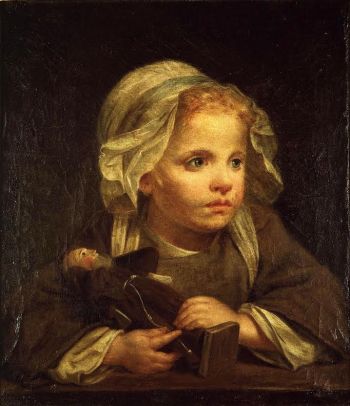
D’après Jean-Baptiste Greuze, Fillette au capucin
(Montauban: Musée Ingres). Commentaire de Diderot sur le tableau original de Greuze, Salon de 1765: “Approchez, voyez-vous cette enfant ? C’est de la chair ; ce capucin, c’est du plâtre. Pour la vérité et la vigueur de coloris, petit Rubens.”
From the Tanagra statuettes to the scientific automata of the industrial age, there are many material manifestations of the ancient fascination with shapes, images, and tiny objects. The examples abound: carved micro-architectures of Gothic buildings, small engravings by Stefano della Bella or Sébastien Leclerc, the objects of vertu of the eighteenth-century upper classes, and the Lilliputian creatures of children’s literature.
Rare, however, are the historical sources that allow us to understand their cultural foundations. While the written sources usually consider the ‘small’ only in its hierarchical relationship to the ‘big’, the analysis of the consumption of these objects reveals a set of practical, symbolic, and artistic skills such as manoeuvrability, mobility, economy, poverty, preciousness, thoroughness, prettiness, and strangeness. Too often, the dominant sources focus on the size of the objects, which diminishes the presence of other considerations. At times miniaturization reduces the scale of a given object, while at other times it may be an independent creation governed by specific criteria. Whatever the case, miniaturization is based on a set of justifications, usages, and judgments that this conference aims to clarify.
This area of research is nourished by recent scientific trends and interest which have benefited the European production of miniatures, notably through the recent conferences: The Gods of Small Things (Reading, 21–22 September 2009); La miniature en Europe, XVIIe–XIXe siècles (Paris, 11–12 October 2012); L’automate: Enjeux historiques, techniques et culturels (Neuchâtel, 6–7 September 2012); and Micro-architecture et figures du bâti: l’échelle à l’épreuve de la matière (Paris, 8–10 December 2014). Our conference will consider the multiple reasons that explain the taste and interest in miniaturization over time, without favouring any particular medium. We will therefore discuss architecture, painting, sculpture, decorative arts, folk art, as well as poems and epigrams. Crossing disciplinary approaches (art history, history, anthropology, philosophy, literature, philology), this conference will focus in the first place on the theoretical reflections underlying the examination of a body of works. Secondly, we will examine those texts that, even if they comment on the ‘small’ in marginal and critical terms, are nonetheless important in the context of an anthology project in which the presenters will participate.
In order to define the ‘small’ in art and question its varied reception through the ages, each presentation, lasting 20 minutes, will explore three registers of perception, by no means reductive:
Consumption and contexts of use
Economic, marketing and circulation (reproducible series or unique work, mobility, swarming); conservation and presentation (curio cabinets, boxes, editing); functionality, usability, destinations and meanings (private / public; domestic / fun / political; secular / sacred / memorial).
Artistic and aesthetic aspects
Ideological tensions between ‘small’ and ‘high’ art; the issue of miniature reproduction of the human figure (dwarf, pygmy, monsters); characters of courtesy, refinement, oddity, impoverishment, etc., specific to the ‘small’; intercultural relations (exchanges and influences between East, the Americas and the West, exotic).
Human and emotional dimensions
Individuals, human categories and social structures involved in the ‘small’ (women, children, ‘ignorant’, princes, peasants, etc.); an attempt at classification; challenges of physical manipulation and microscopic observation; moral criticism (worship and fetishism); imaginary fables and tales and history of mentalities.
Proposals for papers up to one page and a brief bio-bibliographical record in English or French should be sent to Colloque.Petit.Toulouse.2015@gmail.com before January 15, 2015. The proceedings of the symposium will be published along with an anthology of textual sources dealing with the ‘small’; the papers and the list of references and possible sources for the anthology should be sent by December 15, 2015. Languages used in the symposium: French and English.
Organizers
Sophie Duhem (université Toulouse – Jean Jaurès, FRAMESPA UMR 5136); Estelle Galbois (université Toulouse – Jean Jaurès, PLH-CRATA); Anne Perrin Khelissa (université Toulouse – Jean Jaurès, FRAMESPA UMR 5136)
Scientific Committee
Jean-Pierre Albert (EHESS, LISST, Toulouse); Lorine Bost (Centre de recherches en Littérature et Poétique comparées, EA 3931); Quitterie Cazes (université Toulouse – Jean Jaurès, FRAMESPA); Pierre-Olivier Dittmar (EHESS, GAHOM); Jean-Marie Guillouët (université de Nantes); Pascal Julien (université Toulouse – Jean Jaurès, FRAMESPA); Jean-Marc Luce (université Toulouse – Jean Jaurès, PLH-CRATA); Christian Michel (université de Lausanne); Jean Nayrolles (université Toulouse – Jean Jaurès, FRAMESPA); Odile Nouvel (Les Arts décoratifs, Paris); Nathalie Rizzoni (CELLF 17e-18e UMR 8599 CNRS et université Paris – Sorbonne)
Penser le « petit » de l’Antiquité au XIXe siècle.
Approches textuelles et pratiques de la miniaturisation artistique
The Call for Papers in French is available here»
Call for Articles | Irish Fine Art in the Early Modern Period
From the Call for Papers:
Collection of Essays | Irish Fine Art in the Early Modern Period
Proposals due by 12 January 2015
Papers are invited for a forthcoming book which will showcase new scholarship focused on the history of fine art in Ireland in the early modern period (c.1600–c.1815). Publication by Irish Academic Press is due in 2016. Dedicated research in the past decade into Irish fine art of this period has produced some excellent—though isolated—examples in the form of displays, publications, and articles. In notable contrast are coeval fine art studies in Britain which currently enjoy a revival in research funding, museum partnerships, publishing opportunities, exhibitions, and active expertise networks, all of which provide vital scholarly momentum to the field.
While a more sustained format for focused scholarly output in this area remains a desideratum, this project provides an opportunity to draw together and highlight substantial new work on the production and reception of fine art in Ireland in this period and its contemporary discourse. Contributions are warmly welcomed from academics and graduate students working in art history and associated humanities disciplines, curators, and independent scholars actively engaged in related research. Papers should engage with fine art media—painting, drawing, miniatures, sculpture, and print culture—and demonstrate original and previously unpublished research.
Possible topics for papers include, but are not confined to, the following themes as considered in an Irish context:
• Artistic patrons, patronage, and collecting
• Modes of acquisition and display
• The impact of contemporary politics and ethnographic change on artistic production and consumption
• Artistic networks
• Artistic genres
• Artist biographies
• Artistic training and education
• Foreign travel for formal or informal artistic education
• Amateur artists and artistic production
• Fashioning an artistic career: artists’ means of self-promotion and engagement with patrons and the art market
• Art writing, published or otherwise
• Art historiography of the early modern period
Please send an abstract of your proposed paper (approximately 400 words) and a brief biographical note (maximum 200 words) to IrishArtCFP@outlook.com by Monday 12 January 2015. If you have any queries, please address them to the same email. Final papers will be in the region of 9,000 words, but abstracts for shorter papers are also welcome (please indicate if possible when submitting your abstract). Authors are welcome to submit more than one abstract for consideration by the editorial committee, which comprises Dr Jane Fenlon, Dr Ruth Kenny, Caroline Pegum, and Dr Brendan Rooney. Final papers will be peer-reviewed.










leave a comment