Call for Papers | Robert Adam and His Brothers

Information about the chimneypiece is available here
◊ ◊ ◊ ◊ ◊
From the Call for Papers:
Robert Adam and His Brothers: New Light on Britain’s Leading Architectural Family
London, September 2015
Proposals due by 25 December 2014
The Adam style revolution transformed British architecture in the latter half of the eighteenth century. The brothers’ unique and inventive approach to design, based on a modern reinterpretation of the art of antiquity, found widespread popularity and was to have a lasting impact on European and American architecture. The movement and surface variety inherent in their buildings, combined with the lightness and informality of their interiors, set new standards of elegance and were widely imitated.
This two-day symposium aims to highlight important new research and findings on Robert Adam and his brothers across all aspects of their life and work, including architecture, interior decoration, the use of colour, the influence of classical sources, drawing office procedure, the art market, town-planning and building speculation. The conference will present papers from established scholars as well as new research by a younger generation of historians and doctoral students, and is intended to stimulate further study into this most important of British architectural families.
We welcome proposals for 20-minute presentations on any aspect of the Adams’ oeuvre. Please email abstracts of no more than 250 words and a copy of your CV by 25 December 2014 to Colin Thom (Senior Historian, Survey of London) or Geoffrey Tyack (Director, Stanford University Programme, Oxford, and Editor, Georgian Group Journal) at c.thom@ucl.ac.uk and geoffrey.tyack@kellogg.ox.ac.uk. Notifications of acceptance will be sent by 12 January 2015. The symposium is being hosted by the Georgian Group with the support of the Bartlett School of Architecture, University College London, and will be held in London in September 2015. Further details of the symposium dates, venue and programme will follow by 2 February 2015. It is intended that selected papers will be published in an edited volume in 2016.
Call for Articles | Anthology: On the Politics of Ugliness
As noted at H-ArtHist:
Anthology: On the Politics of Ugliness
Chapter proposals due by 15 January 2015
Ugliness is a pejorative marker for bodies, things, and feelings that fall beyond or outside the limits of acceptability. Ugliness has long been indirectly deployed in order to mark, collect, and exclude that which is determined to be aesthetically intolerable (Garland-Thomson; Grealy; Schweik), disgusting (Meagher), dirty (Douglas), abject (Kristeva), monstrous (Braidotti; Haraway; Rai & Puar; Schildrick; Sharpe), revolting (Lebesco), grotesque (Russo), or even simply plain and unaltered (Bartky; Bordo; Morgan; Wolf). While aesthetically ugliness has been positioned both against beauty and as a distinct category for art and art-making (Adorno; Ranciere), there has been little sustained engagement with the ways that ugliness operates alongside identities, bodies, intimacies, practices, and spaces (exceptions include Danticat; Kincaid; Athanassoglou-Kallmyer). Part of the reason for this absence might be that ugliness is at once too broad and too diffuse, serving, as art historian Nina Athanassoglou-Kallmyer has pointed out, as “an all-purpose repository for everything that [does] not quite fit,” a marker of “mundane reality, the irrational, evil, disorder, dissonance, irregularity, excess, deformity, the marginal” (281).
A repository for many socio-cultural feelings and attitudes, ugliness operates in ways that have dangerous and deadly consequences for bodies and those who inhabit them. When a body is labeled or understood as ‘ugly’, it is subsequently positioned as up for expunging, destruction, and affectively motivated terror (Fanon). For example, the ‘ugly laws’ of late nineteenth- and early twentieth-century America demonstrate the visceral discomfort that ‘ugly’ bodies evoke, justifying their exclusion from public spaces on account of their ‘polluting’ effects (Schweik). This demarcation of ugliness is inextricably bound with taken-for-granted ethical, epistemological, and ontological assumptions about the value of bodies. Further, ugliness is infused with dominant discourses of ability, race, heterosexuality, gender, body size, health, and age. At the level of ideas, relations and institutions, deployments of ugliness can have lethal effects on a body’s horizons and the possibilities for visibility, intimacy, and thick life.
On the Politics of Ugliness seeks to provide the first anthology that centralizes ugliness as a political category. It explores the various ways in which ugliness is deployed against those whose bodies, habits, gestures, feelings, expressions, or ways of being deviate from social norms. It argues that ugliness is politicalin at least two ways: (1) it denotes inequalities and hierarchies, often serving as a repository for all that is ‘other’; and (2) it is contingent and relational, taking shape through the comparison and evaluation of bodies. This collection asserts that it is only in facing ugliness as a political category that we can agitate routinely harmful ways of seeing, understanding and relating.
We are seeking an array of contributions that will center the politics of ugliness as it relates to bodies, feelings, gestures, habits, things, spaces, sounds, intimacies and their operations alongside ability, race, gender, class, sexuality, body size, age, health, or animality. Specifically, we invite submissions of academic papers; however, we will also consider art-based work, memoirs, cultural scholars, writers, and artists. We welcome approaches informed by (but not limited to) critical disability studies, critical race and postcolonial studies, feminist theory, literary theory, art history, cultural studies, queer and sexuality studies, science and technology studies, critical psychology, environmental studies, musicology, and performance studies.
Submissions should engage with the politics of ugliness. Topics of inquiry may include
• interrogations of ugliness as violence against bodies
• the ethics of engaging with ugliness
• feminist explorations of ugliness, ‘ugly’ engagements with feminism
• ugly methodologies, reading practices, and modes of inquiry
• representations of ugliness, ‘ugly’ bodies, body parts, and ‘ugly’ behaviors
• phenomenological encounters with ugliness: feeling ugly, being ‘ugly’, embodying ugliness
• ugly intimacies, feelings, and dispositions (e.g., Ngai; Sharpe)
• genealogies, archives, temporalities, and histories of ugliness
• the fashionizing of ugliness, ugly fashion
• ugly development practices, environmental ugliness
• visual, sensorial, and tactile pollution in relation to spaces and geographies
• theoretical considerations of ugliness as a political category
• reclamations and tactical repositionings of ugliness (e.g., Eileraas)
The deadline for chapter proposals (maximum of 500 words) is 15 January 2015. Please forward proposals or questions to Ela Przybylo (przybylo@yorku.ca) and Sara Rodrigues (sararod@yorku.ca) with the subject heading “On the Politics of Ugliness.”
Call for Papers | ISECS 2015 Panel—Alternative Markets in France
Now accepting proposals for this panel for next year’s ISECS Congress in Rotterdam:
Alternative Markets and Visual Culture in Eighteenth-Century France
ISECS Congress, Rotterdam, 26–31 July 2015
Proposals due by 12 January 2015 (though earlier submissions encouraged)
Organiser: Dr. Esther Bell (Curator in Charge, European Paintings, Fine Arts Museums of San Francisco) and Dr. Jessica Fripp (Post-doctoral Fellow in Visual and Material Culture, Parsons The New School for Design)
Academic artistic practice in the eighteenth century was at odds with the growing commercial culture of the period. From its foundation, the Royal Academy prohibited its members from dealing in art, an offense that was deemed cause for expulsion by 1777. Critics similarly looked down on painting for profit. In 1747, La Font de Saint Yenne had harsh words for artists who chose the more financially lucrative practice of portraiture over the more noble art of history painting. Diderot suggested that Fragonard’s turn away from history painting was caused by “l’appas du gain.”
Of course, even artists who appeared to resist the lure of monetary wealth were embedded in complex systems of exchange based on other forms of capital. This panel seeks to explore alternative markets of exchange that developed around the production of eighteenth-century visual culture and the forms of symbolic capital artists could accumulate. Papers might address topic such as: the role of collecting works by one’s contemporaries, friendship networks between artists and artists and patrons, celebrity as currency, gift exchange and favors, artistic dynasties and family allegiances. We especially encourage papers that demonstrate exchange across France’s borders, including its colonies or other European entities.
Information on how to submit abstracts can be found here»
Call for Papers | Interdisciplinary Perspectives on the Domestic Interior
Making A Home: Interdisciplinary Perspectives on the Domestic Interior
University of Sussex, Brighton, 7–8 May 2015
Proposals due by 30 November 2014
Keynote Speaker: Dr. Flora Dennis, Senior Lecturer, Art History, University of Sussex
I believe that one can never leave home. I believe that one carries the shadows, the dreams, the fears and the dragons of home under one’s skin, at the extreme corners of one’s eyes and possibly in the gristle of the earlobe.
—Maya Angelou
The late Maya Angelou once wrote, “The ache for home lives in all of us.” This nostalgia for home—be it a physical space or geographical place, a moment in time, a person / people, or a state of mind—continues to be of central interest to artists, writers, and thinkers. Crossing lines between the private and public spheres, and extending
into important explorations of nationhood and belonging, different areas of research into the home seek to expand our understanding of how physical space has been used, transformed, and conceptualised throughout history. Some aspects of this pursuit include less-tangible features: Interactions between people, objects and spaces; the complex process of memory-making; the role of sentiment; and creating a sense of belonging can transform a dwelling into a home. In turn, these interactions have the power to transform the individual and the home, and to shape a sense of identity, whether as an individual, family, or nation.
This two-day interdisciplinary conference invites proposals from doctoral students and early career researchers for 20-minute papers that explore the question of what makes a home, and how homes make us. Papers may consider homes both past and present and from a variety of perspectives such as material culture studies, art history, gender
studies, anthropology, postcolonial studies, critical race studies, and geography. Topics may include, though are not limited to:
• Historical constructions of home
• Public versus private spaces/spheres
• Domestic production and consumption
• Notions of domesticity, gender and identity
• Representations of home in art, music and literature
• Religion, ritual and belief in the home
• Institutional or non-familial homes
• Historic homes and heritage sites
• Architecture and interior design
• Sociability and sociality
• Ideas of nation / nationhood
• Diaspora and belonging
• Colonial and postcolonial histories
Please email an abstract of no more than 250 words to Michele Robinson and Emma Doubt at MakingAHome2015@gmail.com by 30 November 2014. Along with your abstract please include your name, institution, paper title and brief biography. Successful applicants will be notified by 1 February 2015. All speakers will be invited to attend a complimentary dinner in Brighton the evening of 7 May 2015.
Call for Papers | ISECS 2015 Panel—Pictures in Motion: Portraiture
Now accepting proposals for this panel for next year’s ISECS Congress in Rotterdam:
Pictures in Motion: Portraiture around the World during the Long Eighteenth Century
ISECS Congress, Rotterdam, 26–31 July 2015
Proposals due by 12 January 2015 (though earlier submissions encouraged)
Organiser: Jennifer Germann, jgermann@ithaca.edu
Portraits and portraitists moved between courts, capitals, nations, and colonies in an ebb and flow that followed the tides of imperialism, markets, and diplomacy. Indeed, while portraits were understood as emphasizing the unique individual who could be regarded as a ‘defined location’ at the heart of the image, these representations frequently gesture to the world beyond the sitter to situate and elevate him or her. Portraiture was a dynamic artistic practice throughout the long eighteenth century due, in part, to the various exchanges that portraits occasioned and pictured. This panel turns its attention to the practice of portraiture and to portraits produced during this period with an emphasis on their global circulation. What motivations, rewards, and disincentives existed for artists who traveled for their work? What artistic and cultural exchanges were occasioned by this movement? How were portraits used to facilitate other transactions, whether mercantile or diplomatic? In what sense can we understand portrait production as a global phenomenon, as opposed to an international or cosmopolitan one and distinct from national schools? How does portraiture help us understand what it meant to be global in the eighteenth century? Topics might include the exchange between distinct traditions of portraiture in terms of approaches and conventions, the use of portraits in diplomacy (as, for example, in marriage arrangements), and artists who traveled for and in search of clients. Interdisciplinary papers are welcome with an emphasis on cultural exchange through portraits and global portrait practices. Submissions concentrating on the late seventeenth and first half of the eighteenth century are particularly encouraged.
Call for Papers | Portraiture as Interaction
◊ ◊ ◊ ◊ ◊
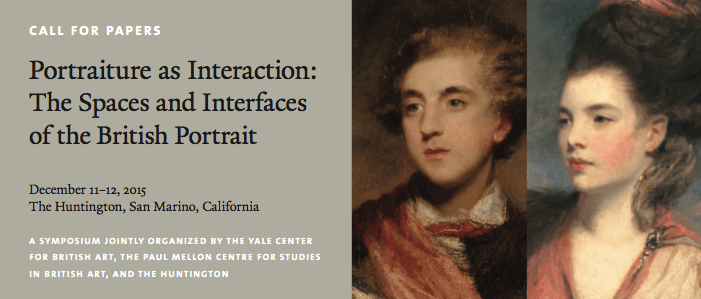
Portraiture as Interaction: The Spaces and Interfaces of the British Portrait
The Huntington, San Marino, California, 11–12 December 2015
Proposals due by 7 November 2014
A symposium jointly organized by the Yale Center for British Art, the Paul Mellon Centre for Studies in British Art, and the Huntington
This symposium has been inspired by the important collections of British portraits at the Huntington Art Gallery and the Yale Center for British Art, and by an upsurge of scholarly interest in the interactive nature of portraiture—both in its intrinsic character and as a curatorial construct.
Portraiture implies an interaction between the sitter and the spectator. It often rehearses an interaction between two or more protagonists and regularly focuses on the interaction between the person(s) represented and his, her, or their surroundings. Portraits—of husbands and wives, sisters and brothers, friends, and colleagues—are often depicted by artists and arranged by curators so as to interact with each other in meaningful ways. As they are created, and once they are completed, portraits (and the figures they represent) interact with their settings: with the studio, the exhibition space, the domestic interior, the public building or square; and with the objects, people, and spaces found in those settings. The same portrait, or portraits of the same sitter, can also find themselves interacting with each other across different media—paint, print, sculpture, and more.
Furthermore, curators are continually thinking about the ways in which the portraits they display—and the individuals these pictures portray—will relate with each other across and around a gallery. The Thornton Portrait Gallery at the Huntington and the galleries at the Yale Center for British Art exemplify portraiture’s continuing forms of interaction: implied and actual, pictorial and physical, and formal and figural.
This two-day international symposium will use the rich collections at the Center and the Huntington Art Gallery and the different concepts of interaction outlined above as points of departure and return, in order to open up new approaches to the history and workings of British portraiture up to the present. Participants will be encouraged to offer original and innovative readings of individual portraits, groups of portraits, portrait galleries, and portraiture as a genre. Talks that respond explicitly to works in the collections of the Huntington and the Center are particularly encouraged.
We invite proposals for thirty-five to forty-minute papers on this theme from scholars working in any discipline. Cross-disciplinary and comparative studies are particularly welcome. Please e-mail abstracts of no more than three hundred words, along with a short CV, to ycba.research@yale.edu. The deadline for proposals is November 7, 2014.
Travel and accommodations will be provided for speakers arriving from outside the Los Angeles area, and meals will be provided for all.
Call for Papers | AAH at the University of East Anglia, 2015
By my hasty count, 11 of the 34 sessions proposed for the Association of Art Historians 2015 conference could include eighteenth-century papers. Be sure to consult the conference website for things I’ve overlooked. –CH
41st Annual AAH Conference and Bookfair
Sainsbury Centre for Visual Arts (SCVA), University of East Anglia, Norwich, 9–11 April 2015
Proposals due by 10 November 2014
The AAH 2015 conference and bookfair will be located in the famous Sainsbury Centre for Visual Arts (SCVA), designed by Norman Foster and a finalist for the museum of the year. It holds a fascinating collection of work and hosts a range of exhibitions. SCVA is part of the University of East Anglia (UEA) and situated on the UEA campus. The conference will start on Thursday 9 April at various venues in Norwich city centre, and then remain at SCVA for Friday and Saturday. The SCVA building will be the main hub of the event, in which registration, refreshments and sessions take place.
Founded in 1965, the Department of Art History and World Art Studies is a member of the Sainsbury Institute for Art at the University of East Anglia. The Department has become known for its commitment to geographical and historical inclusivity, and to collaborative and cross-disciplinary scholarship.
This international conference aims to showcase new research in histories and theories of visual art forms and media, of any period and type (including architecture and design). Academic sessions will engage with current scholarship, and foster discussion and debate, on any aspect of the visual arts from prehistory, Antiquity, the Middle Ages, the Renaissance, the early modern and modern periods, through to the present day.
Academic Sessions Proposals due by Monday, 10 November 2014
If you would like to offer a paper, please email the session convenor(s) direct, providing an abstract of a proposed paper of 30 minutes. Your paper abstract should be no more than 250 words, and include your name and institution affiliation (if any). You should receive an acknowledgement of receipt of your submission within two weeks from the session convenor(s).
Bookfair 2015 will take place on Friday 10 and Saturday 11 April alongside the conference in the Sainsbury Centre for Visual Arts, on the University of East Anglia campus in Norwich.
◊ ◊ ◊ ◊ ◊
Session 3 | The Art History of Architectural History
Session Convenors: Mark Crinson, University of Manchester, mark.crinson@manchester.ac.uk; and Richard Williams, University of Edinburgh, r.j.williams@ed.ac.uk
Art history and architectural history are sister disciplines… or are they? How many art history departments regard architectural history as a core component of their provision? What might art history students miss if architectural history were not part of their curricula? Perhaps art objects and architectural objects are so radically different their study cannot be shared. Or perhaps there are modes of enquiry that can be developed to mutual benefit.
This session reviews the art history/architectural history relationship in several ways. One way is to excavate those moments when art and architectural history were tightly bound together: in the very formation of art history as a discipline, for example, when both art and architecture were natural objects of study.
Other ways might be: investigations of the parallel developments of formalism in art and architectural history; of architectural history’s relation to the ‘new art history’; of the ways in which architectural history might adopt recent developments in object studies, global art history, and art writing.
Academics dealing with contemporary architecture find themselves wrestling with debates that in other disciplines may be more abstract or indirect: How does money or power represent itself in visual form? How does the general public (whoever they may be) understand form? How does government use aesthetics to communicate? All of these things are, and always have been, live in architecture. Perhaps this might be part of a case for making architectural history more central to art history. If so, what implications would it have for our curricula and our pedagogy?
◊ ◊ ◊ ◊ ◊
Session 6 | British Art through Its Exhibition Histories, 1760 to Now
Session Convenors: Mark Hallett, Sarah Victoria Turner, and Martina Droth, The Paul Mellon Centre for Studies in British Art, London and the Yale Center for British Art, New Haven, svturner@paul-mellon-centre.ac.uk
How have histories of British art been shaped, defined and contested by and through exhibitions? Taking a broad historical perspective, and responding to an upsurge of interest in the study of exhibition histories in recent years, this session will explore the varied exhibition cultures of British art from 1760—the year that saw the first annual exhibition of contemporary British painting, sculpture and printmaking—through to today.
This session does not seek to offer a chronological history of exhibitions but rather a series of critical propositions that take exhibitions and exhibition culture as a lens through which to examine the history, presentation, marketing and reception of British art, both in the UK and internationally. How have exhibitions shaped or disputed the artistic canon, defined particular artistic groupings, or articulated distinctive histories of British art? How have they contributed to new kinds of critical and art-historical writing about British painting, sculpture, graphic and multi-media arts?
We welcome proposals that explore exhibitions of British art in a variety of contexts, at either a national or international level, including: case studies of individual exhibitions or series of displays; monographic or thematic exhibitions; the phenomenon of travelling exhibitions, both historically and today; exhibitions in public, private and commercial spaces.
Papers might examine the role of agencies, institutions and funding bodies; exhibitions as a tool for shaping a canon; exhibitions and changing notions of ‘Britishness’; the display of British art and artists in different international contexts. We seek papers that will interrogate and analyse the dynamic, transformative and sometimes challenging relationship of British art to its exhibition histories across different periods.
◊ ◊ ◊ ◊ ◊
Session 13 | Flow in World Art, 1500–1750
Session Convenor: Margit Thøfner, University of East Anglia, m.thofner@uea.ac.uk
This session considers the notion of flow in the early modern period in the broadest possible terms. During this time, most parts of the globe became connected by shipping lanes. The already steady trickle of people, objects and ideas across the continents and oceans became a full flow. That waterways could both conjoin and divide was evident in a manner that it had never been before. At the same time, liquids such as sap, mercury, lava, semen, milk and blood came under intense interrogation, in moral, political, theological and scientific terms.
What consequences did this fascination with fluidity have for the arts? Depicting flow is of necessity an act of fixing runniness. Liquids may work as boundaries but, at the same time, they are boundless. How did early modern artists and artisans address this paradox? How did they show fluidity, whether of persons, ideas or substances?
The aim of this session is to consider, compare and contrast how image-makers from across the world tackled such problems. Our ultimate goal is to determine whether, how and why the concept of flow changed visually under the manifold pressures of early colonialism. We welcome contributions focused anywhere in the world within the given dates and we are particularly interested in examples where two or more pictorial or artefactual traditions are brought together. We hope to publish selected papers from this session in a dedicated issue of the journal World Art.
◊ ◊ ◊ ◊ ◊
Session 14 | From Distaste to Mockery: The City and Its Architectures Ridiculed
Session Convenor: Michela Rosso, Politecnico di Torino, michela.rosso@polito.it
Since the origins of the contemporary age, the rise of a mass public and a reconfigured public sphere, along with the diffusion of the popular press, have deeply affected the way in which the city and its architectures are interpreted and judged. Among the genres addressing the modern city, some emerge that seem to be highly effective in disseminating the architectural culture, displaying its distortions or singling out its vulnerable features through the deployment of humour. As part of a media-saturated public culture, humour is both a practice of social communication and a plausible portrayal of society, illuminating the ambivalences of modern life and uncovering the shock provoked by processes of modernisation.
This session’s aim is to inaugurate a catalogue of the comic as applied to the spatial criticism of the city, its artefacts and its leading professionals—architects, artists and builders. Punch’s sharp satire of the first World Exhibition, William H Robinson’s caricatures of modernist housing, Tati’s parody of the Corbusian villa, and Dunn’s architecturally situated cartoons for The New Yorker are some of the renowned entries in this possible catalogue. By absorbing the disturbing effects of modernisation and turning them into laughter, they give voice to a diverse range of feelings and social reactions, from distaste to overt dissent.
This session invites case studies that explore the reception of architectural facts through the distinct codes of humour, verbal as well as visual, in any place and time, between 1750 and today, and focusing on any medium from literature to cinema, television and cartoons.
◊ ◊ ◊ ◊ ◊
Sesison 17 | Materialising Modern Identities: Architectural Sculpture after 1750
Session Convenors: Katie Faulkner, The Courtauld Institute of Art, London, katie.r.faulkner@gmail.com; and Ayla Lepine, University of Essex, ayla.lepine@gmail.com
In recent years, sculpture studies within art and architectural history have grown exponentially, increasingly taking diverse themes into account including materiality, gender, postcolonialism and affect. In the rapid transformations of state power and imperial activity in the 18th century, through into the post-revolutionary political atmosphere of the 19th century, nations appeared to sponsor the celebration of the public citizen and actively projected imperial stability in the midst of change and resistance. Despite its association with permanence, sculpture was charged with representing change: materialising new identities and formulating representational traditions.
Architectural sculpture in particular marked sites of urban modernity, such as stations, cultural institutions, civic landmarks and sacred structures; these large and prestigious commissions often sparked public debate around identity and artistic production. As the onset and outcomes of the First World War shaped the power and politics of cultural memory, sculpture took centre stage, with new responsibilities amongst global tensions. Interwar architectural sculpture negotiated and articulated increasing anxieties regarding ornament, historicism, modernism and minimalism. With the arrival of modernism worldwide, some believed architectural sculpture was anathema. Others looked to it as the vehicle to facilitate and embody vitality in bold new architectural experimentation. Architectural sculpture was a crucible for artistic and wider cultural dialogue concerning modern life and modern subjects.
We invite proposals for papers that explore architectural sculpture and identity in a global context between 1750 and the present. Potential themes include: collaboration and networks between architects and sculptors; materiality, production and reproduction; modernism and tradition; beauty and ugliness; figuration and abstraction; style and historicism; form, function and ornament; spectacle and the everyday; memory and ritual; nationhood and transnationalism; and empire and its afterlives.
◊ ◊ ◊ ◊ ◊
Session 22 | Navigating the Pacific: Latin America and Asia in Conversation
Session Convenors: Kathryn Santner and Paul Merchant, St. John’s College, University of Cambridge, kathryn.santner@gmail.com and pm437@cam.ac.uk
The critical role of Asia in the history of Latin American art has often been overlooked; recent scholarship has, however, begun to reassess this longstanding cultural engagement. This session will examine the significance of Asia–Latin America exchange from its earliest days via the Manila Galleon and Portuguese trade networks through to the present day.
Iberian trade brought luxury goods—porcelain, lacquerware, folding screens, ivories, and inlaid furniture—to the Americas, where they were adapted and incorporated into local artistic practice, spawning new art forms like the biombo. The decline of the galleon trade after 1815 did not mark the end of this transpacific relationship; ensuing centuries brought successive waves of Asian immigrants to Latin America – notably the Chinese to Peru and the Japanese to Brazil.
In the wake of this diaspora, artists have recently begun to explore Asian identity in Latin America, notably in several successful documentary and fiction film productions from the region. The presence, for the first time, of a Latin American pavilion at the Beijing Art Expo 2013 also points to the increasing recognition of a centuries-old dialogue in the visual arts. So too does the ‘Latin American Artists in Asia’ network, whose members practise in fields from sculpture to photography and digital art. This session will cover a broad historical period, and adopt a variety of methodological approaches. Key issues to be considered include (post) national identity, materiality and its relationship to place, and the opportunities and complications offered by digital technologies.
◊ ◊ ◊ ◊ ◊
Session 23 | Petits-maîtres: ‘Minor’ Genres and Their Meanings in Post-Revolutionary France
Session Convenor: Richard Taws, University College London, r.taws@ucl.ac.uk
While studies of French art of the late 18th and early 19th centuries have historically tended to privilege the work of a few prominent artists, increased attention has been paid more recently to artists working in less prestigious genres, in other media, and to those who helped disseminate their work. This session focuses on, among others, the genre painters and miniaturists, flower and animal painters, landscapists and portraitists, and printmakers of all types who were active in France from the beginning of the French Revolution through to the end of the July Monarchy.
In the aftermath of the Revolution, a diverse range of artists working in ‘minor’ genres negotiated the shifting parameters of artistic practice, documenting (some more explicitly than others) a modern world subject to rapid social and political change. Meanwhile, new venues for the display and dissemination of art, alongside technical innovations in printmaking, created novel opportunities for reproductive image-makers and publishers. Consequently, this session also welcomes papers that address the implications of the circulation, sale and display of prints by, and after, so-called petits-maîtres, the lives of images in reproduction, and the practices of replication, remediation and recontextualisation to which they were subject.
How did the new political, social and commercial circumstances of early 19th-century France enable or constrain artistic practices of this kind, and how might they be understood in terms of evolving hierarchies of class or gender? How did art made during this period relate to other techniques, institutions, spectacles, careers, audiences or social practices?
While this session encourages papers that focus closely on lesser-known artists or works, it is also hoped that speakers will take the opportunity to situate their subjects imaginatively within broader tendencies in early 19th-century visual culture.
◊ ◊ ◊ ◊ ◊
Session 24 | Portraiture and the Unworthy Subject in the Early Modern World
Session Convenor: Carmen Fracchia, Birkbeck, University of London, c.fracchia@bbk.ac.uk
In the early modern period, the production of portraiture was governed by restrictive conventions. According to the first European treatise on portraiture since antiquity (Francisco de Holanda’s Do tirar polo natural [On Taking Portraits from Life], 1548), the essence of the genre was the worthy sitter’s moral or intellectual prestige. Thus, the main function of the portrait image was to immortalise the worthy elite, with the implicit moral understanding that there could be no room for the portrayal of the unworthy subject. What are the political and visual implications of this belief about portraiture? What are the notions of human diversity that prevent the portrayal of undeserving subjects? How are these concepts negotiated in the production of the portrait image outside Europe?
This session aims to build on research by historians of art, literature and the colonial world, and work on slave narratives that illuminate the paradoxical nature of ‘slave portraits’ in the Atlantic World. It intends to explore a wider spectrum of what were considered ‘unworthy subjects’, and the complexity of the mutually exclusive categories of ‘portraiture’ and ‘undeserving subject’. It also seeks to tackle the oxymoronic categories of ‘self-portraiture’ and ‘unworthy subject’, and investigate how notions of human diversity might challenge the boundaries of traditional portraiture and self-portraiture.
Contributions are invited that address the portrayal of ‘undeserving people’ across different media and cultures in the early modern world, as well as the historical context of social inferiority and the ‘undeserving’ between the 15th and the 18th centuries.
◊ ◊ ◊ ◊ ◊
Session 28 | Surface Affects and Shiny Things: Bringing Meaning to Light
Session Convenors: Nic Maffei, Victoria Mitchell and Marcia Pointon, Norwich University of the Arts n.maffei@nua.ac.uk, v.mitchell@nua.ac.uk and m.r.pointon@manchester.ac.uk
The visual qualities of a surface that shines are such as to attract or distract the eyes, which themselves are often attributed with gleaming, shining or glinting. The silkiness of high polish invites tactile attention too, or deters for fear of spoiling. Shine may materialise through use or careful positioning of an object. It is often not inherent in a material but may be derived from working up a shine. Within art, design and architecture, materials (metal, plastic, glass, fabric, wood, paint) and processes, often labour-intensive (polishing, burnishing, glazing), can combine to reveal shine. The manifestations of shininess can imply bodies in motion and individual subjectivity, while the gloss of film or magazines points to a more socially pervasive ‘look’. Although dependent on specular-reflective properties of light and absorbency of materials, reflective patina or sheen is often intentionally sought, in order to generate affect or effect.
This session addresses the cultural, historical, critical and often paradoxical meanings of ‘shine’ as this pertains to the making, using or viewing of objects and surfaces. Depending on context, shininess might suggest religious or poetic allusion, sensory engagement, luminosity, spectacle, desire, cheapness, cleanliness, protection, health, wealth and perhaps also disgust (as in the surface of slime). Shininess was held in high regard in Byzantine and Anglo-Saxon art, as also for many designers of the mid-20th century. Spurred on by fashion, the superficial nature of shininess has been linked to postmodern theory on late-capitalism. We seek papers that engage with such issues in relation to any period, reflecting a range of practices and perspectives.
◊ ◊ ◊ ◊ ◊
Session 29 | Things and Their Ideas: Exchanges in the Visual and Material Cultures of Islamicate Asia
Session Convenors: Sussan Babaie, The Courtauld Institute of Art, sussan.babaie@courtauld.ac.uk; and
Elizabeth Lambourn, De Montfort University, Leicester, elambourn@dmu.ac.uk
In recent decades, the theoretical turn to cross-culturality has produced important reflections on the global in art history. A persistent feature of such trans-regional explorations remains nevertheless rooted in networks that implicate Europe in some prominent way: the Mediterranean exchanges are invariably about Europe and the Muslim cultures, the European interests in chinoiserie that skip the vast inter-Asian land and water routes of exchange, or post-colonial interests that reflect, in the end, more on the European colonist than on the Asian colonised.
This session takes the global from the vantage point of the centrality of the Asian nexus in producing its principal vectors in pre-colonial times. It invites innovative approaches that focus on the specificities of, and excavate deeply into, isolated ‘things’ or a cluster of desirable things. It asks for trans-disciplinary reflections on the mechanisms of exchange and transmission of ideas, through art and material culture, in between the local histories and global networks across regions where Islamic cultural modes were dominant or influential, throughout the Asian landmass. Collecting or commissioning of cut precious stones, of album and manuscript paintings, of embroidered textiles and inlaid objects, of garden designs and tomb edifices, and the collection and circulation of animalia; with such topics, we hope the papers in this session will bring fullness to our understanding of things as a way to access their global implications through an Islamicate Asian lens.
◊ ◊ ◊ ◊ ◊
Session 30 | Thinking Images
Session Convenors: Hanneke Grootenboer, Anita Paz and Lucy Whelan, University of Oxford, lucy.whelan@trinity.ox.ac.uk
This session explores the rising interest in art as a mode of thinking, apparent in academic writing as well as artistic practice. Images have long been seen as thought-provoking or as tools for contemplation. However, recent years have revealed a shift towards giving art works agency to think. Cézanne and Klee famously declared that they thought through painting, while Jean-Luc Godard claimed cinema as a mode of thinking. More recently, Jacques Rancière declared photography as thoughtful, while Ron Burnett’s How Images Think links the digital image’s thinking power to the technology from which it derives.
This session will examine how images might be capable of thinking. Questions to be pursued include: By what mechanisms do images think? What visual language do they use or create? How do they shape thought? How is a mode of thought specific to a particular medium—film (stills), installation art, sculpture—or a particular culture—Chinese Ming painting, Buddhist imagery? What are the political implications of ascribing thought processes to visual materials? This session intends to establish a genealogy of the thinking image, and encourages papers addressing these and related questions through a variety of approaches, media and ideas.
Call for Papers | James Gillray@200: Caricaturist without a Conscience?
From New College, Oxford:
James Gillray@200: Caricaturist without a Conscience?
Ashmolean Museum, Oxford, 28 March 2015
Proposals due by 15 November 2014
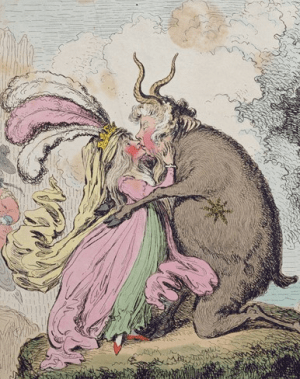 James Gillray’s reputation in the two centuries since his death has been as varied and layered as his prints. Trained at the Royal Academy, he failed at reproductive printmaking, yet became, according to the late-eighteenth-century Weimar journal London und Paris, one of the greatest European artists of the era. Napoleon, from his exile on St Helena, allegedly remarked that Gillray’s prints did more to run him out of power than all the armies of Europe. In England, patriots had hired him to propagandize against the French and touted him as a great national voice, but he was an unreliable gun-for-hire. At a large public banquet, during the heat of anti-Revolutionary war fever, he even raised a toast to his fellow artist, the regicide, Jacques-Louis David. Gillray produced a highly individual, highly schooled, and often outlandish body of work with no clear moral compass that undermines the legend of the caricaturist as the voice and heart of the people, so that the late Richard Godfrey described him as a caricaturist without a conscience. Following 2001 and 2004 retrospectives in London and New York, and fuelled by scholarship of a new generation of thinkers, our era’s Gillray is just now coming into focus.
To commemorate the 200th anniversary of Gillray’s death, and in conjunction with the Ashmolean Museum’s exhibition, Love Bites: Caricatures of James Gillray (26 March – 21 June 2015), based on New College’s outstanding collection, we are organizing a one-day symposium at the Ashmolean Museum to hear and see the latest Gillray scholarship.
We seek proposals papers that address any aspect of Gillray’s work or that consider artistic duty or purposeful negligence of duty in the period around 1800. Comparative, formal, contextual, and theoretical approaches to Gillray and our theme are all welcome. Proposals should be a maximum of 200 words and be accompanied by a short bibliographical statement.
Organised by Todd Porterfield (Université de Montréal), Martin Myrone (Tate Britain), and Michael Burden (New College, Oxford), with Ersy Contogouris (Université de Montréal)
All enquiries should be addressed initially to the New College Dean’s Secretary, Jacqui Julier, jacqui.julier@new.ox.ac.uk, to whom all abstracts should be submitted by 15 November 2014. The programme will be announced on 21 November 2014.
Call for Papers | L’image Railleuse
From INHA:
L’image Railleuse: La satire dans l’art et la culture visuelle, du 18e siècle à nos jours
Institut national d’histoire de l’art, Paris, 25–27 June 2015
Proposals due by 30 October 2014
 Colloque international organisé par l’Institut national d’histoire de l’art, l’Université du Québec à Montréal et le LARHRA UMR 5190 de Lyon
La satire, soit l’attaque moqueuse, contestataire ou réformatrice d’un individu, d’un groupe, d’une époque, voire de toute une culture, constitue l’une des armes privilégiées de la fonction critique des images et, au-delà, de l’ensemble des artefacts visuels. Se constituant en genre littéraire dès l’Antiquité, la satire a gagné les beaux-arts et les arts graphiques à l’âge classique, seule ou en conjonction avec l’écrit. Ce sont toutefois les médias modernes—édition, presse, expositions, télévision, internet—qui, en élargissant progressivement sa sphère d’influence, ont renouvelé ses formes et ses objectifs, et augmenté leur efficacité. Autorisant une diffusion planétaire et presque instantanée des images satiriques, internet et les technologies numériques n’ont pas seulement transformé la matérialité et les moyens d’action de cette imagerie et leurs effets socio-politiques, ils ont aussi affecté les formes de la recherche sur le satirique en donnant accès de plus en plus rapidement à des corpus extrêmement vastes. La satire est ainsi partout, et aucun acteur ni canal de diffusion ne peut prétendre désormais en contrôler ses usages généralisés.
Ce colloque porte sur la satire visuelle du 18e siècle à nos jours, entendue comme genre aussi bien que comme registre, selon que l’on s’intéresse à un type de représentations (caricaturale, en particulier) ou à une veine (le satirique) traversant de multiples champs, parmi lesquels celui de l’art contemporain. Envisagée dans sa visualité même, elle recouvre des objets, particuliers ou partagés, des mécanismes et des effets spécifiques que nous souhaitons interroger à partir des études visuelles.
Les propositions d’intervention de 30 minutes seront adressées avant le 30 octobre 2014 à frederique.desbuissons@inha.fr afin d’être examinées par le comité scientifique. Elles comprendront 500 mots maximum et seront accompagnées d’une courte bio-bibliographie.
Pour lire l’intégralité de l’appel à contributions, cliquez ici.
◊ ◊ ◊ ◊ ◊
Note (added 2 October 2014) — Here’s the English version:
Satire—which can be understood as the mocking, contesting or reforming prosecution of an individual, a group, an era, or an entire culture—is one of the main weapons of the critical function of images and, more broadly, of visual artefacts. Emerging as a literary genre in Antiquity, satire joined the fine arts, and particularly the graphic arts, in the early modern era, either on its own or in connection with the written word. Modern media—publishing, the press, exhibitions, television and the Internet—have progressively widened its sphere of influence, renewing its forms and objectives and increasing its efficacy. Enabling the worldwide and nearly instantaneous dissemination of satiric images, the Internet and digital media have not only transformed the materiality and means of this imagery and its socio-political effects, they have also had an impact on the forms that research can take with respect to the satiric, by giving ever swifter access to an ever-wider range of bodies of work. Satire is thus everywhere, and no actor nor platform of dissemination can now claim to control its generalized usages.
The subject of this conference is visual satire from the eighteenth century to today. Visual satire is understood not only as genre but also as a register, depending on whether one is interested in a type of representation (caricatural, in particular) or as a vein (the satiric) that crosses several fields, among which that of contemporary art. Satire, envisaged in its visuality, ranges across individual or shared objects, specific mechanisms and effects that we hope to question from the perspective of visual studies.
We welcome proposals for papers that address, but that need not necessarily be limited to, the following thematic strands :
1. Historiographical perspectives
How can we think about and construct a history of visual satire within the history of art and visual studies? Studies in caricature and graphic satire have been delineated by a number of (?) researchers and approaches, the limits of which are fairly precise and have contributed to the establishment of a pluridisciplinary set of tools that have tended to become normative. Following the first large inventory projects (Champfleury, Wright, Stephens and George) and studies centred on perception and psychoanalysis (as just one example, Gombrich and Kris), international research, based around the university, the museum, among collectors and archives, has given us results that typically align with a certain range of objectives: the publication of monographs and studies that focus on artistic procedure, on iconology, on political discourse or on the sociology of artists. It might be important to identify the characteristics of this wide range of approaches in order to understand the disciplinary impact they have had. In this international framework, do linguistic, territorial and ideological borders play a role? Beyond this, we might reflect on the impact of this work on our critical and historical consideration of the satiric as it manifests itself in contemporary art. In short: what does satire do, what has satire done to art history—and vice-versa?
2. Norms and inventivity : the creativity of the satirical
While it is possible to understand how the satirical and the caricatural have been used throughout the history of art, the integration of this artistic undertaking—or should we speak of process, mode, genre?—nevertheless sets up certain challenges for research. These challenges arise when we think through artists’ manipulation of cognitive and narrative elements (in the articulation of figural representation with the possibilities of narrative structure, for example). It might be useful, then, to think of visual satire as a form of inventivity that connects to a wider form of social behaviour, one that might index a satiric field in which a number of expressive forms, among them those of the visual arts, have their place. If satire can be linked to the parameters of normativity in a given society or period (parameters that might in turn be malleable according to shifting social contexts), might it be possible to consider the satiric or caricatural endeavour as the site of meta-representational undertakings? Can we connect the satiric endeavour to precise historical conditions?
3. Parody of art and autonomy of the satiric genre
Satire and caricature were part of artists’ graphic practices since well before the eighteenth century. Whether created as exercises or for private recreation, they often represent the personal sphere or the artistic community. Starting in the mid-nineteenth century, the satire of art becomes a genre in its own right and conquers a public that is all the more far-reaching(?) as access to contemporary art becomes democratized. At the same time, it becomes a set of recurring themes and processes, notably at the end of the century and even more so among certain avant-gardes of the twentieth century, modern or post-modern. What is the importance of this phenomenon? What does satire do to art, notably in the eighteenth and nineteenth centuries, and what does art do to satire, especially in the twentieth and twenty-first? What are satire’s objectives, its publics, and to what aims?
4. The satiric body and violence
Satire cannot be reduced to a figure of rhetoric and to visual objects. Because it is a form of social and political action, its efficacy (whether rhetorical, effective or fantasized) makes it a weapon directed towards whatever it mocks. Its violence is deployed on three levels: it is made thematic in its motifs, instrumentalized so that its targets can be attacked, and shared with those who see it. Satire used against real persons, or against targets that are more collective and abstract (institutions, political ideas, social events, etc.) and that are almost always represented by characters or types, affects its spectators before it reaches those it targets. The corporeal dimension thus plays an important role in the workings of satire. It is sometimes put into play by caricature’s expressive deformation, thus leading to a somatism and a materialism of critical laughter. The modalities of this satirical violence will be the starting point for studies that can explore any of the paths it takes, or that can focus on the relationship between the strategies used and their resulting effects, as much for satire’s victim as for its spectator.
5. Materials and dissemination of satire
The efflorescence of the satiric genre is closely linked to the emergence of new means of reproduction and dissemination: engraving in the sixteenth century, the trade in prints, the introduction of lithography and the renewal of wood-engraving at the turn of the nineteenth century, photo-montage, etc. It seems nonetheless useful to develop a critique of the reality of such a deterministic account, both with respect to the periods just mentioned as well as in the case of more recent developments. More importantly, it seems important to measure the effects of dissemination on the modalities of reception. Several contemporary examples have shown the extent to which the Internet platform is itself a component of such a reception. In what terms is it necessary to consider this phenomenon? Does it have an impact on artists working today?
6. The configurations of the visual
Visual satire, as opposed to its literary counterpart, has elicited only too few historical and theoretical studies. What accounts for this contrasted situation? Is it because the reading of an image can be assimilated to that of a text? Is it because its elucidation is often determined by accompanying texts (dialogues, legends and other paratexts)? If so, how can we explain the ambiguity of satiric images, their semantic instability that means that the same figure can lead to highly divergent interpretations? Is this because the phenomenon is of the order of the visual, or is it due to something that might be fundamental to the satiric genre as a whole? These questions could be addressed through the study of visual and discursive configurations that are set in play in the field of satire.
On June 25th, a joint “Bande dessinée and satire” session will be presented in collaboration with the International Bande Dessinée Society and the International Comics and Graphic Novel Society. Proposals for papers, not to exceed 30 minutes, should be sent by October 30, 2014, to frederique.desbuissons@inha.fr in order to be sent to the Conference review board for evaluation. Proposals should be a maximum of 500 words in length and accompanied by a short bio-bibliography.
Call for Papers | Heroes and Things
Heroes – Heroizations – Heroisms
Transformations and Conjunctures from Antiquity to the Modern Day
Freiburg, 19–20 Nov 2015
Proposals due by 15 November 2014
The discussion in history and the cultural sciences usually views heroic figures and their deeds as manifestations of human autonomy and agency. The planned conference confronts this viewpoint with the question of how the heroic is intertwined with material objects across various epochs and cultures. The goal is to gain a new perspective on assumptions concerning heroic agency and inquire into the relevance of current theoretical approaches (such as actor network theory, assemblage theory, new materialism) for discussions on the heroic as well as on the challenge the heroic presents for the material turn.
By virtue of their physicality, heroic figures themselves have a material dimension that influences their actions. But the capacity for heroic agency is also linked to the world of things and determined in a positive and a negative sense by artefacts and other objects, technologies, and media as well as their structures. The basic thesis of the conference is that the capacity for heroic agency manifests itself in charged assemblages of human and nonhuman protagonists, in the complex interactions between heroic figures and the influence of things they make use of, take action against, or even fuse with: from Hercules’ club to “machine heroes.” The conference invites papers focused on history, society, aesthetics, and the media that explore the following central aspects of this premise:
1) Things as conditions, extensions, and potentialisations of heroic agency: How dependent are heroic figures on their material attributes (weapons, armour, other implements)? Are things what make the hero into a hero in the first place? What material attributes are associated with the charisma of heroic figures? How and under what conditions do things and technologies serve to extend or augment the capacity for heroic agency? When and how do such extensions become catalysts for characterising the heroic? Is it possible to make out historical trends for such processes?
2) Things as resistance to and limitation of heroic agency: Under what circumstances are the possibilities of heroic agency limited by material circumstances? What natural objects or artefacts must heroes clash with to prove their exceptional abilities? What does it mean when heroes are confronted with the agency of artefacts or natural objects? How do technological and scientific innovations affect the possibilities of heroic agency (e.g., weapons of mass destruction or surveillance technologies that limit autonomous agency)? Which technologies tend to promote individual heroism and which collective heroism? Under what social or political conditions did or does this happen? Can heroism be paid for or rewarded by material means?
3) Things as modifications, optimisations, or substitutions of the hero’s body: How does the materiality of the hero’s own body limit his or her capacity for agency, and how is it possible to compensate for this limitation through modification of the hero’s body? How far do imagination and reality go in this respect? When and with what consequences for our understanding of the heroic does the body of the hero finally itself become a thing (machine heroes, cyborgisation) and at what point is the hero substituted entirely by things (drones instead of soldiers)?
4) Things as heroes: Can nonhuman agency be heroised or become the hero’s antagonist? Under what circumstances and with what intentions are things themselves heroised in reality or in the imagination?
The conference will be held in English and German (with translations).
Please send your abstract of up to 300 words by 15 November 2014 to info@sfb948.uni-freiburg.de.










leave a comment