Call for Panels, Papers, and Posters | ISECS 2015, Rotterdam
From the Call for Papers:
14th International Congress for Eighteenth-Century Studies (ISECS 2015)
Rotterdam, 26–31 July 2015
Proposals due by 1 September 2014 (Panel Sessions) / 12 January 2015 (Individual Papers and Posters)
The Congress of the International Society for Eighteenth-Century Studies (ISECS) is the world’s largest meeting of specialists on all aspects of the eighteenth century, and takes place every four years. Recent ISECS conferences have been held in Dublin (1999), Los Angeles (2003), Montpellier (2007) and Graz (2011). The 14th ISECS Congress will be organized in Rotterdam, the Netherlands, from 26 to 31 July 2015. It is organized by the Dutch-Belgian Society of Eighteenth-Century Studies (DBSECS – Werkgroep 18e Eeuw) and is hosted by the Erasmus University Rotterdam on Campus Woudestein. We can welcome more than one thousand participants.
The theme of the 14th ISECS Congress is Opening Markets: Trade and Commerce in the 18th Century. The program will include theme-related keynote lectures and sessions, as well as panels and round tables on all topics related to the long eighteenth century (1670–1830). The conference will also facilitate poster presentations. We are looking forward to inspiring lectures, debates and presentations on the conference theme and on all issues regarding the Age of Enlightenment and Sensibility.
Online registration is now open for:
• Submission of proposals for panel sessions and round table sessions. The online Call for Panels is open from February 2014 until September 1, 2014.
• Submission of proposals for individual papers or poster presentations. The online Call for individual Papers & Posters is open from June 2014 until January 12, 2015.
• Pre-registration: You can e-mail the organizers (info@isecs2015.com) a request for pre-registration. By pre-registering, you subscribe to a newsletter that will keep you regularly informed about the organization of the ISECS 2015 Congress, including planned sessions, round tables and other meetings. The online Registration for the ISECS 2015 Congress will open from September 1, 2014 until April 30, 2015.
Don’t hesitate to distribute this call among interested colleagues and networks! If you have any questions in the meantime, please contact the local host committee via info@isecs2015.com or visit the conference website. ISECS 2015 is open to all persons interested in topics and issues having to do with the long eighteenth century and the Age of Enlightenment. Membership of an ISECS constituent or affiliated organization is not necessary for registration. The online Registration for the Early Career Eighteenth-Century Scholar Seminar will open in September 2014.
◊ ◊ ◊ ◊ ◊
Instructions for Panel Session Submissions
Proposals due by 1 September 2014
The ISECS 2015 Committee invites those interested to organize thematic meetings in the program of the Conference to submit proposals for panel sessions and round tables. The submission of proposals for panels will be open until September 1, 2014. Panel organizers are requested to complete the online form. Organizers are asked to supply information about the theme of the proposed panel and the panel members along with an abstract of their contribution to the panel meeting. Panels have a duration of one and a half hours, and should consist of 3–4 speakers (depending on the amount of discussion time the panel organizer wants to provide). It is also possible to submit a panel suggestion without concrete panelists or partly filled with panelists. In the coming months, we will present a list with panels accepting proposals on our website. Open panels will also be promoted through our newsletter.
◊ ◊ ◊ ◊ ◊
Instructions for Individual Paper Proposals
Proposals due by 12 January 2015
The submission of proposals for papers is open until January 12, 2015. Participants in the ISECS 2015 Congress can submit one proposal for an individual paper. In the menu available through the website, you will find a dropdown box with submitted panels that are open for paper submissions. Here, you can indicate which panel your paper could be part of. Paper proposals are reviewed by the scientific committee and by the panel organizers. The ISECS 2015 Scientific Committee is responsible for organizing the panels in which the papers and posters will be presented. Only registered participants can present individual papers and posters. Participants who intend to submit more than one paper proposal are requested to contact the organizers of the ISECS 2015 Conference (info@isecs2015.com).
◊ ◊ ◊ ◊ ◊
Instructions for Poster Proposals
Proposals due by 12 January 2015
Are you involved in an interesting project or in an area of work that you would like to discuss with or show to other Conference attendees? Why not present your work in the ISECS Poster Sessions? Your topic could be described on a printed poster or by photographs, graphics and pieces of text that you attach to the presentation panel. Posters in both English and French are welcome. Presenters of posters will be expected to be present on Tuesday, Wednesday and Thursday, 28–30 July, in order to explain their posters and to hand out any leaflets, or other information materials they have available for viewers. Each presenter can therefore only present one poster. Any organization that submits more than one application should indicate a priority to their submissions.
It is important that applicants describe how they intend to illustrate the project in the poster format. The poster has to be an experience in itself for the one who looks at it and should show awareness of the poster format. Special consideration will be given to ensure that a variety of topics and geographical/cultural range will be represented. The deadline is January 12, 2015. After the deadline, applications will no longer be accepted.
A jury representing the ISECS Organizing Committee will review all submissions and at the Conference they will select the winner of the ISECS Poster Award 2015 based on the criteria below. The topic of the poster should:
• Look lively, interesting and/or inspiring
• Lend itself to a poster session and not be too abstract
• Present new ideas
• Be clearly explained
• Not duplicate another poster, nor have the same presenter as another poster
• A presenter must be present during the poster session to explain the poster to viewers
• Have a relationship to the theme of the 2015 ISECS Conference
• Describe a project that is ongoing or near completion rather than one not yet started
For useful tips and tricks on how to design a poster, see this guide by Aimee Roundtree.
Call for Papers | SCSECS 2015 Session, Devices for Making Art
Paper, Paints, Crayons and Camera Obscura: Devices for Making Art in the Eighteenth Century
Session at the Annual Meeting of the South Central Society for Eighteenth-Century Studies
Marriott Grand, Point Clear, Alabama, 26–28 February 2015
Proposals due by 15 September 2014
Chair: Christina K. Lindeman, clindeman@southalabama.edu
While the focus of art historical study has concentrated on the finished portrait, painting, and print, this panel seeks papers that explore the historical, social and cultural context of the devices, implements, and things that made art in the eighteenth century. Possible paper topics include: new technologies that produced art products; trade and market of materials; art treatises or literary accounts on using devices. Interdisciplinary papers are welcome.
More information about the conference is available from the SCSECS newsletter, available as a PDF file here»
Also see the SCSECS website.
Call for Papers | Arts décoratifs et transmissions des savoirs en France
From ApAhAu:
Arts décoratifs et transmissions des savoirs en France du XVIIe au XXIe siècle
Université Bordeaux Montaigne, 12 March 2015
Proposals due by 26 September 2014
En France, la création de l’Académie Royale de Peinture et de Sculpture en 1648 institutionnalise la primauté des beaux-arts sur les arts dits mécaniques. Alors que l’Académie et ses imitations provinciales instruisent les peintres et les sculpteurs, les artistes/artisans apprennent leurs métiers au sein des corporations, des manufactures ou bien encore des « écoles de dessin » qui se multiplient à partir de 1750. En effet, le dessin est un enjeu majeur dans l’apprentissage de ces arts, dits décoratifs à partir du XIXe siècle. À cette époque, l’ouverture de départements spécialisés dans les musées, l’accroissement du nombre de revues, les réformes pédagogiques au sein des écoles de dessin témoignent d’un désir d’étudier les objets d’art, de reconsidérer la hiérarchie entre arts mineurs et arts majeurs, mais aussi d’en renouveler la production d’un point de vue esthétique et technique. L’idéal de la fusion des arts et celui de l’artisan-créateur sont toutefois confrontés aux nécessités d’une production en série qui réduit la part de créativité d’une main d’œuvre bon marché. La question du statut des arts demeure centrale au XXe siècle, prolongée notamment à travers la notion plus récente de design industriel. Néanmoins, les réflexions entamées au XIXe siècle permettent un élargissement des domaines d’enseignement : vers le costume, l’affiche, le vitrail, l’éclairage autour de 1920 ; ensuite, vers le graphisme, la presse, la publicité ; puis vers l’informatique. Ajoutons enfin, l’entrée timide des arts décoratifs au sein de l’enseignement universitaire de l’histoire de l’art.
L’histoire des arts décoratifs est parcourue de débats et cette notion est en perpétuelle évolution. C’est pourquoi cette journée d’étude propose d’explorer ce domaine comme champ d’un savoir digne d’être l’objet d’une transmission. Il s’agit d’interroger les enjeux de l’enseignement délivré aux élèves et de comprendre, au sein de l’enseignement de l’histoire de l’art, la fonction occupée par les arts dits décoratifs par rapport aux beaux-arts. Les travaux historiographiques sur le sujet étant encore relativement peu nombreux, il serait utile de faire un état de la recherche. Cet appel s’adresse donc à tous les chercheurs et, en particulier, aux étudiants de master, aux doctorants et aux jeunes docteurs. À travers l’étude des sources écrites et des institutions, pourront être abordés le contenu des connaissances délivrées aux artistes ou aux étudiants, les méthodes pédagogiques mises en œuvre, la rhétorique des discours, les politiques éditoriales et les éventuelles récupérations idéologiques à l’œuvre dans la transmission d’un savoir relatif aux arts décoratifs.
La réflexion pourra s’articuler autour des problématiques suivantes, qui ne constituent cependant pas une liste exhaustive: (more…)
Call for Papers | Stitching Together a National Identity
From Colonial Williamsburg:
Stitching Together a National Identity
Colonial Williamsburg, 15–17 March 2015
Proposals due by 1 August 2014
 American home furnishings, quilts, needlework, and clothing reflect great diversity and regional variations that occurred as a result of the ethnic origins of the makers, trade patterns, influential teachers, even climate and geography. This symposium will explore these regional variations in American textiles of the seventeenth, eighteenth, nineteenth, and twentieth centuries through a series of formal lectures and juried papers. Participants are invited to submit 300-word abstract proposals for illustrated oral lectures 25 minutes in length. Paper proposals are due to Colonial Williamsburg for peer review by August 1, 2014; acceptances will be announced by November 1, 2014. Submit abstracts to Textile Symposium Abstracts, attention Kim Ivey, Colonial Williamsburg Foundation, 309 First Street, Williamsburg, VA 23185 or via e-mail at kivey@cwf.org. For general information about the symposium, contact Deb Chapman at dchapman@cwf.org. Those whose papers are accepted will have free registration for the symposium.
We will not be doing the hands-on workshops as part of this upcoming symposium. We hope to get papers on quilts and needlework, as well as clothing, to attract a broad audience.
Call for Papers | ASECS 2015 in Los Angeles
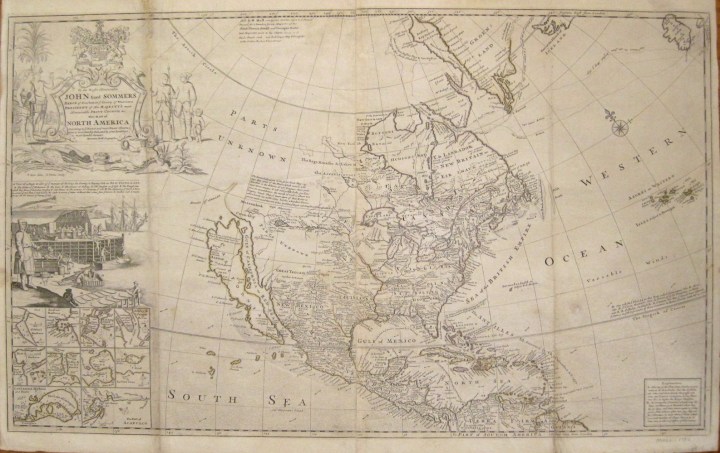
Herman Moll, To the Right Honourable John Lord Sommers…This Map of North America according to ye Newest and most Exact observations, 23 x 38 inches (London: H. Moll, ca. 1715). “California was depicted on maps as an island. . . even after Father Kino established its penisularity about 1705,” The Philadelphia Print Shop. The official date for the founding of the city of Los Angeles is September 4, 1781.
◊ ◊ ◊ ◊ ◊
2015 American Society for Eighteenth-Century Studies Conference
Los Angeles, 19–22 March 2015
Proposals due by 15 September 2014
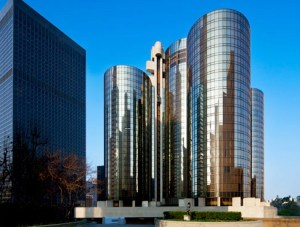
Finished in 1976, the 35-story Westin Bonaventure Hotel is the largest hotel in the city, the work of John Portman, one of the world’s most influential hotel architects.
The 2015 ASECS conference takes place in Los Angeles, 19–22 March, at the Westin Bonaventure Hotel. Along with our annual luncheon and business meeting, HECAA will be represented by two panels chaired by Meredith Martin and Noémie Etienne and Amy Freund. In addition to these, a selection of sessions that might be relevant for HECAA members are included below. Editing the selection seems more difficult each year, but this year was especially so as there are lots of options that will be of interest to members, though specific topics may not be geared exclusively or primarily toward art historical materials. A full list
of panels is available as a PDF file here»
Those attending the conference may also find useful Ben Loeterman’s film John Portman: A Life of Building, which documents the work of the conference hotel’s architect. A less adulatory assessment comes from Edward Soja’s 1989 book, Postmodern Geographies: The Reassertion of Space in Critical Social Theory, quoted in the Wikipedia entry for the Westin Bonaventure.
◊ ◊ ◊ ◊ ◊
Anne Schroder New Scholars’ Session (HECAA)
Amy Freund, Southern Methodist University, Dallas; aefreund@gmail.com
Named in honor of the late Anne Schroder, this seminar will feature outstanding new research by emerging scholars.
◊ ◊ ◊ ◊ ◊
Pilgrim Arts of the Eighteenth Century (HECAA)
Meredith Martin, Dept. of Art History, New York University, 303 Silver Center, 100 Washington Square East, New York, New York 10003; msm240@nyu.edu and Noémie Etienne, Institute of Fine Arts.
Inspired by Robert Finlay’s description of porcelain as the “pilgrim art,” this session aims to track the movement and changing materiality of artworks across time, space, and culture during the long eighteenth century. Materiality, along with an interest in displacements, manipulations, and artisanal practices, plays an essential role in art history today. Examining the way art objects were treated, transported, and transformed helps us to understand how they were perceived and reimagined in new physical and cultural environments. Paying attention to gestures, materials, and techniques—as well as to individuals, such as restorers, who mediated between artworks, artists, and the public, is an efficient way to “repeupler les mondes de l’art,” (“repopulate the worlds of art”), according to Bruno Latour. It also enables us to go further with some traditional art historical questions—such as authorship, expertise, or authenticity—while opening onto new methodological perspectives. Topics may explore any of these issues or introduce new ones related to materiality and mobility. Interdisciplinary and cross-cultural investigations are especially encouraged.
◊ ◊ ◊ ◊ ◊
Defoe and Architecture (Daniel Defoe Society)
Rivka Swenson, Dept. of English, Virginia Commonwealth University, 900 Park Ave., P.O. Box 842005, Richmond, Virginia 23284-2005; rswenson@vcu.edu
An Act of Union like a mighty arch. A three-sided school for women. A basketwork beehive house for multiple families to live in. A house made entirely from china. A history like a maze. Defoe’s ideas and characters and things rarely exist in empty space but are instead articulated within discrete physical (or metaphorically physicalized), indeed architectural, contexts. This Defoe Society panel is devoted to thinking about the ways in which architecture, as both reality and metaphor, figures prominently across Daniel Defoe’s writings; Defoe was as interested in finding the right architectural metaphors to describe a given idea or character or thing as he was in describing how the real world (both material and immaterial) is expressed within specific formal-spatial-architectural contexts. Please send (via email) 500-word abstracts for 20-minute papers.
◊ ◊ ◊ ◊ ◊
Digging Italy (Italian Studies Caucus)
Wendy Wassyng Roworth, Dept. Art and Art History, University of Rhode Island, 112 Slater Avenue, Providence, Rhode Island 02906; wroworth@uri.edu
Digging and documenting the remains of Italy’s past were activities pursued as both scientific and profit-making ventures during the eighteenth century, and ancient sculptures and artifacts were sold and sent abroad by foreigners and Italian dealers. Other aspects of Italian culture were appropriated by foreigners in Italy as well as at home in England, Germany, France, Russia, and elsewhere—Italian opera, music, art, science, and literature—and Italian artists, musicians, and writers traveled to perform or work abroad. Italian culture was enjoyed and appreciated (‘digging it’) yet Italians themselves were often criticized (‘taking a dig’) for their customs, habits, food, etc. This session will explore all aspects of these cultural exchanges and attitudes in the visual arts, literature, criticism, travel accounts and other historical records.
◊ ◊ ◊ ◊ ◊
American Latium: American Artists in and around Rome in the Age of the Grand Tour (Italian Studies Caucus)
Karin Elizabeth Wolfe, Via Alberico II 33, Rome 00193, Italy; karinewolfe@tiscali.it
The Italian Grand Tour of American artists, including painters, architects and sculptors, is generally considered a typically nineteenth-century phenomenon. American Latium intends to analyze the origins and progression of this phenomenon in Rome and Lazio beginning in the 1760s. Specifically, it is hoped to examine the evolution of the figure of the American artist in the cultural context of Grand Tour travelers, ranging from the painters Benjamin West and John Singleton Copley, both still deeply rooted in the system of the British Grand Tour, through personalities such as the architect Charles Bulfinch—in Rome in 1786—up to the landscapist and poet Washington Allston and his contemporaries, who contributed to the creation of an autonomous American Grand Tour identity, later ideally embodied by the émigré American painter and essayist Thomas Cole. Cole’s critical affirmations regarding the profound aesthetic differences between the historicizing landscapes depicting Rome and Lazio and the romantic naturalism inspired by New World landscapes are representative of the culmination and implications of a cultural process of fertile poetic and literary exchange that constitute the thematic threads of this session. Contributors are invited to address not only the fruition of the aesthetic perception of Rome and Lazio on the part of American artists, but moreover to explore the reception of a distinct American national cultural identity on the international society that constituted the Italian Grand Tour.
◊ ◊ ◊ ◊ ◊
Storms: Robust, Turbulent, and Extreme Weather in Art, Science, Literature, Music, and Philosophy (South Central Society for Eighteenth-Century Studies)
Kevin L. Cope, Dept. of English, Louisiana State University, Baton Rouge, Louisiana 70803; jovialintelligence@cox.net or encope@lsu.edu
Favorite riffs, phrases, and motifs such as the ‘light of reason’, ‘the sun king’, and ‘the Enlightenment’ give the impression that the long eighteenth century abounded in fair weather. Had it not been for inclement episodes, however, our world would not have benefited from Ben Franklin’s electrifying kite-and-key experiment, nor would we have given the time of day to Defoe’s and Falconer’s charming stories of tempest-induced shipwrecks. This panel will look at the full range of rough weather, from paintings that reveal the ferocity of the heavens and the seas to the first efforts in meteorology to tympani solos resounding of thunder and on to philosophical speculations on the utility of the acrimonious action of the air. For this topic, the sky’s the limit!
◊ ◊ ◊ ◊ ◊
The Circuit of Apollo: Women’s Tributes to Women in the Long Eighteenth Century (Roundtable) (Women’s Caucus Scholarly Panel)
Laura L. Runge, Dept. of English, CPR107, 4202 E. Fowler Ave., University of South Florida, Tampa, Florida 33620; runge@usf.edu
In honor of the Women’s Caucus 40th anniversary, and the planned celebration honoring the work of our female academic pioneers, the scholarly panel for the Women’s Caucus focuses on eighteenth-century examples of female commemorations. Turning away from the patriarchal, heterosexual paradigm of sexual chastity, this panel puts a twist on eighteenth-century notions of ‘female honor’ and foregrounds memorable or remembered female relationships among women. From the Anne Finch poem of our title, to the Duchess of Portland’s gold and enameled friendship box of miniature portraits, to Austen’s famous commendation of Radcliffe, Edgeworth and Burney in Northanger Abbey, eighteenth-century women participated in a femino-centric discourse of praise and collegiality that bears further scrutiny. Though these examples are from England, the panel is open to commemorations from other national contexts as well. Such tributes include dedications, inscriptions, personal letters, gifts, portraits, poems, songs, and any notable artistic (or otherwise) expression of gratitude, friendship or respect. What forms did female tributes take and how might formal and gender analysis intersect? How might these examples inform our understanding of sociability, sexuality, gender, friendship, professionalism, education, materiality, embodiment or emotion? What does it mean to historicize female tribute and how do we reanimate the objectified emotional bond of the past? This panel seeks to place up to six presenters on the subject of women’s tributes to women. We ask for proposals for 10-minute presentations on the tribute, preferably with some form of representation (visual image, auditory performance, reading, etc.). The organizer requests that presenters distribute their papers in advance of ASECS so she can prepare some framing questions for a lively discussion period.
◊ ◊ ◊ ◊ ◊
Innovative Course Design
ASECS, PO Box 7867, Wake Forest University, Winston-Salem, North Carolina 27109; ASECS@wfu.edu
Proposals should be for a new approach to teaching a unit within a course on the eighteenth century, covering perhaps one to four weeks of instruction, or for an entire new course. For example, participants may offer a new approach to a specific work or theme, a comparison of two related works from different fields (music and history, art and theology), an interdisciplinary approach to a particular social or historical event, new uses of instructional technology (e.g., web sites, internet resources and activities), or a new course that has never been taught or has been taught only very recently for the first time. Participants are encourage to include why books and topics were selected and how they worked. Applicants should submit five (5) copies of a 3- to 5-page proposal (double-spaced) and should focus sharply on the leading ideas distinguishing the unit to be developed. Where relevant, a syllabus draft of the course should also be provided. Only submissions by ASECS members will be accepted. A $500 award will be presented to each of the participants, and they will be invited to submit a twelve-page account of the unit or course, with a syllabus or other supplementary materials for publication on the website.
◊ ◊ ◊ ◊ ◊
Alta and Baja: California in the Eighteenth Century (ASECS Executive Board Sponsored Session)
Karen Stolley, Dept. Of Spanish and Portuguese, Callaway 501N Emory University, Atlanta, Georgia 30322; kstolle@emory.edu
California has a rich and colorful history in the eighteenth century—one whose global dimensions are sometimes overlooked as the focus narrows in the nineteenth century to US national and state histories. This session proposes an exploration of eighteenth-century California (understood to include Alta California and Baja California) that will take advantage of the geographical location of ASECS 2015. Possible topics include negotiations between the region’s various communities—indigenous, Spanish, Anglo; military and political (mis)government; the Camino Real; the establishment of Jesuit and Franciscan missions by Junípero Serra and others; exploration of the California coast; pueblos and presidios; California as an eighteenth-century frontier that symbolized both wealth and privation; the visual arts and ethnomusicology. We encourage proposals that cross disciplines, and we plan to circulate the CFP to local historical societies, colleges and universities in California as well.
◊ ◊ ◊ ◊ ◊
Flipping the Grand Tour: The Italian Response
Blair Davis and Carole Paul, 228 Cantor, Irvine, CA 92620; Dept. of History of Art and Architecture, University of California, Santa Barbara, California 93106-7080; bhixsondavis@gmail.com and paul@arthistory.ucsb.edu
Scholarly literature on the Grand Tour has focused largely on the manifold influence of journeys to Italy on travelers. Less well explored are the numerous ways that Italians actively responded to the growing influx of foreigners in their land during the eighteenth century, forging the beginnings of the modern tourist industry. This session seeks papers that address the Italian side of the experience. Possible topics include, but are not limited to subjects such as the professionalization of tour guides, the creation of public museums, the development of the souvenir industry, and the characterization—and caricaturing—of northern Europeans.
◊ ◊ ◊ ◊ ◊
The Gendering of Space and Architecture
Leah Thomas, 4605 Hanover Avenue, Richmond, Virginia 23226; thomaslm9@vcu.edu
Literature of the long eighteenth century explores frontiers, landscapes, seascapes, gardens, spaces of confinement, such as ships and carriages, and more whether in seduction novels, captivity narratives, or satire. This panel examines the gendering of these spaces especially through, but not limited to, language, imagery, and architectural renderings but also considers larger and more nuanced perspectives on this gendering through blurred boundaries of spaces understood to be gendered and how these spaces are ‘sexed’.
◊ ◊ ◊ ◊ ◊
Scientists, Artists, and Artisans in the Eighteenth Century
Dena Goodman, Women’s Studies Dept., 1122 Lane Hall, University of Michigan, 2014 So. State Street, Ann Arbor, Michigan 48109; goodmand@umich.edu
In the eighteenth century, scientists, artists, and artisans, worked, lived, and interacted together in a variety of ways and spaces. This seminar aims to explore the spaces, practices, products, and implications of those interactions. We are inspired by a symposium held at the Wallace Collection (London) in 2013 on the “Louvre before the Louvre,” in which historians of art and architecture explored the Louvre as space of family, work, and sociability in the two centuries before it became a museum. We propose to expand their inquiry to include two other groups, artisans and scientists, who also lived and worked in the Louvre, and to ask what other spaces in Europe (and the Americas) fostered interactions among them. We encourage papers that focus on the interactions among two of these groups (artists and scientists, scientists and artisans, artisans and artists) rather than on one or the other of them. We recognize also that the lines among these professional classifications and identities were in the process of being drawn in the eighteenth century and hope to stimulate discussion about the changing meanings of art, science, artisanship, technique, and labor and how they were achieved through interaction and in practice through this seminar.
◊ ◊ ◊ ◊ ◊
Educating Women in France, 1780–1814
Melissa Hyde; 1326 NW 12th RD Gainesville, Florida 32605; mlhyde@ymail.com
This session invites papers that deal with any aspect of women’s education during the ‘long eighteenth century’—particularly the years leading up to the French Revolution and the first Empire. Topics of special relevance to this session might include: the establishment of new schools for girls (public and private) and their importance; the role of women as governesses or founders of schools (the examples of Mme Genlis and Mme Campan come to mind); women as teachers or students of art and music; representations of women as teachers or students. Also very welcome will be papers that consider questions about what was at stake philosophically and politically in the education of women for the Republic and then the Empire? In what ways did elite education differ from popular or public education? How did education shape the lives of individual women?
◊ ◊ ◊ ◊ ◊
The Habsburgs, 1740–1792
Rebecca Messbarger, Washington University, 7401 Cromwell Drive, Saint Louis, Missouri 63105; rmessbar@gmail.com
This session is dedicated to an exploration of Habsburg influence on eighteenth-century Europe. From Austria, Hungary, and Bohemia to Spain, France, Portugal and dominant regions of Italy, the Habsburg dynasty has served to define crucial aspects of enlightened absolutism. Papers are invited on any aspect of Habsburg sway in the realms of administrative, social, legal, agricultural, economic, and political reforms as well as the patronage of the arts and modern science.
◊ ◊ ◊ ◊ ◊
Beyond Orientalism: Consumer Agency and Producer Adaptation in Asia-Europe Exchanges
Emily Kugler and Samara Cahill, Kugler: 230 South Main Street, Unit 2, Providence, Rhode Island 02903; and Cahill: 14 Nanyang Drive, HSS-03-73, Singapore 637332; emnkugler@gmail.com and sacahill@ntu.edu.sg
Due to early modern globalization, Chinoiserie, curry, Persian poetry, calicoes, and other ‘exotic’ imports entered European markets, where they were adapted and imitated. In the eighteenth-century world of goods, how did the importation and/or representation of foreign goods reflect cultural exchanges that complicate our ideas of European-Asian relations? As Prasannan Parthasarathi and Brijraj Singh have recently observed (independently), much more research is needed on the reception of European imports in Asia: Europeans were not the only consumers. How were European imports (textile designs, music, painting, fashion) adapted within Asian contexts to suit local tastes? How did Asian technologies advance European industries? This panel is particularly interested in papers and projects that complicate conflations of a colonized East with passivity and imitation.
◊ ◊ ◊ ◊ ◊
Textiles in the Long Eighteenth Century
Heidi Strobel, Associate Professor of Art History, University of Evansville, 1800 Lincoln Ave., Evansville, IN, 47722; hs40@evansville.edu
As material culture has become a more integral part of art history, textiles have increasingly been the focus of scholarly and popular attention. Significant museum exhibitions that have contributed to this change include The Met’s The Worldwide Textile Trade, 1500–1800 (2013–14) and Threads of Feeling: The London Foundling’s Hospitals Textile Tokens 1740–1770, a featured exhibition at the 2014 ASECS conference in Williamsburg, Virginia. This session will focus on textiles in eighteenth-century art or literature. Papers could address textiles and their production, particularly in relation to global trade networks, textiles as an artistic medium, and/or for furniture, interior decoration, or clothing. In particular, papers are encouraged that relate to appropriation through embroidered copies of other media or ones that consider the relationship(s) between textiles and gender. Power point presentations will be the standard format, but the physical presentation of textiles as part of the session will be also welcome.
◊ ◊ ◊ ◊ ◊
A Sum of Its Parts: Symmetry in the Eighteenth Century
Daniella Berman and Charles Kang; daniella.berman@nyu.edu and cdk2118@columbia.edu.
The Encyclopédie defines symmetry as “le rapport, la proportion & la régularité des parties nécessaires pour composer un beau tout.” Although not extensively articulated outside architectural discourses, the notion of symmetry remained integral to a wide variety of eighteenth-century cultural productions. From interior decoration to literary construction, from the arrangement of artworks to the design of parterres, symmetry permeated aesthetics conceptually and practically—as essential to individual objects as to the composition of an overall environment, “un beau tout.” The duality of symmetry as a principle to observe and as a value to contradict resulted in its persistence across media and contexts. This panel invites papers that explore affirmations or negations of symmetry throughout the long eighteenth century. Rather than considering symmetry and asymmetry as binaries, we posit that they are rhetorical byproducts of each other (consider, for example, the self-reflexivity of such decorative elements as the arabesque). Possible topics may include—but are certainly not limited to: axis and composition in painting theory and practice, gender binaries in portraiture, sets and series, architectural distribution and movement through the interior, symmetry and variation in poetry, asymmetry and rococo object/architectural design, arrangement of objects, display of collections, symmetry as mirrored in reproduction/repetition. We welcome papers addressing the notions of symmetry and asymmetry in art historical, architectural, literary, decorative, design, and display contexts across the long eighteenth century.
◊ ◊ ◊ ◊ ◊
Note (added 4 September 2014) — The original version of this posting omitted Heidi Strobel’s session on ‘Textiles in the Long Eighteenth Century’, as well as the panel on symmetry planned by Daniella Berman and Charles Kang. My apologies! -CH
Call for Essays | Art History and Disability Studies
From H-ArtHist:
Edited Volume: Art History and Disability Studies
Proposals due by 15 September 2014
Contributions are sought for an interdisciplinary collection of essays on art history and disability studies for an edited volume to be published by Ashgate Publishing Co., as part of the series Interdisciplinary Disability Studies. Art history has not been as influenced by disability studies as have other disciplines of the humanities. Art historians have analyzed images by and about disabled people without integrating disability studies scholarship, while many disability studies scholars refer to images, but do not necessarily incorporate art historical research and methodology. This edited volume centers on interdisciplinary art history and disability studies scholarship.
Papers may address issues such as the following:
• Specific representations of disability throughout art history, including works by disabled and nondisabled artists
• Portraits of disabled individuals throughout history, with visible and/or invisible impairments
• Scientific, anthropological, and vernacular images of disability and how they have influenced fine art
• Representations that display disability and eroticization
• Performance in the forms of artworks and in the everyday lives of disabled individuals
• Theories and implications of looking/staring versus gazing in disability studies and in art history
• Examples of visual art that represent and/or challenge stereotypes of disability
Submissions due by September 15, 2014. All submissions must represent previously unpublished work. Please send an abstract of no more than 300 words and a CV to Ann Millett-Gallant (amillett@nc.rr.com) and Elizabeth Howie (ehowie@coastal.edu). Selected authors will be notified by October 15, 2014 and will contribute a full length essay of approximately 6000 words by April 1, 2015. All chapters will be reviewed by the editors before submission to the publisher and will be subject to an additional external review.
Call for Papers | Dr Richard Mead: Physician, Philanthropist, Collector
From The Foundling Museum:
Dr Richard Mead: Physician, Philanthropist, Collector
The Foundling Museum, London, 20 October 2014
Proposals due by 15 August 2014

Allan Ramsay, Dr Richard Mead, 1747
(London: The Foundling Museum)
We invite proposals for papers for this cross-disciplinary one day conference hosted by the Foundling Museum. The conference is running in conjunction with the Museum’s autumn exhibition The Generous Georgian: Dr Richard Mead, which runs from 26 September 2014 to 4 January 2015. The exhibition, supported by the Wellcome Trust, the City of London and Verita, will consider the life, work and collections of Richard Mead (1673–1754), one of the founding governors of the Foundling Hospital.
Proposals on a variety of subjects relating to Mead and his context are welcome, including but not limited to the themes of the exhibition: his medical practice, his collecting and connoisseurship and his charitable activities. Proposals from early career professionals and works in progress are welcome.
All enquiries regarding the conference should be addressed to stephanie@foundlingmuseum.org.uk. Please e-mail proposals (approximately 200 words) to stephanie@ foundlingmuseum.org.uk by 15 August, 2014 with a brief biography (no more than 200 words). Some assistance with travel may be available; please indicate your needs when you send in your proposal.
Speakers will include:
Ludmilla Jordanova, Professor of History and Visual Culture at
the University of Durham and advisor to the exhibition
Stephanie Chapman, The Foundling Museum Curator
Call for Papers | Ad Vivum?

As noted at The Early Modern Intelligencer (from the Birkbeck Early Modern Society) . . .
Ad Vivum?
The Courtauld Institute of Art, London, 21–22 November 2014
Proposals due by 15 August 2014
Organised by Joanna Woodall and Thomas Balfe
The term ad vivum and its cognates al vivo, au vif, nach dem Leben and naer het leven have been applied since the thirteenth century to depictions designated as from, to or after (the) life. This one and a half day event will explore the issues raised by this vocabulary in relation to visual materials produced and used in Europe before 1800, including portraiture, botanical, zoological, medical and topographical images, images of novel and newly discovered phenomena, and likenesses created through direct contact with the object being depicted, such as metal casts of animals.
It is has long been recognised that the designation ad vivum was not restricted to depictions made directly after the living model, and that its function was often to advertise the claim of an image to be a faithful likeness or a bearer of reliable information. Viewed as an assertion of accuracy or truth, ad vivum raises a number of fundamental questions about early modern epistemology—questions about the value and prestige of visual and/or physical contiguity between image and original, about the kinds of information which were thought important and dependably transmissible in material form, and about the roles of the artist in this transmission. The recent interest of historians of early modern art in how value and meaning are produced and reproduced by visual materials which do not conform to the definition of art as unique invention, and of historians of science and of art in the visualisation of knowledge, has placed the questions surrounding ad vivum at the centre of their common concerns.
This event will encourage conversation and interchange between different perspectives involving a wide range of participants working in different disciplines, from postgraduate students to established academics. It seeks to encourage dialogue and debate by devoting a portion of its time to sessions comprising short, 10-minute papers, which will allow a variety of ideas and areas of expertise to be drawn into the discussion.
Topics may include, but are not limited to:
• The role of images, including book illustrations, described as ad vivum in early modern natural history, geography, cosmography, medicine and other investigative disciplines
• The meanings of ad vivum in relation to sacred images, portraiture, landscape depiction, animal imagery, and other types of subject matter involving a claim to life-likeness
• The connections between ad vivum and indexical images: death masks; life casts; the moulage; auto-prints made from natural phenomena
• The connections between concepts of ad vivum and graphic media: the print matrix; imitation and reproduction in print; drawings, diagrams which claim to be ad vivum
• The concept of ad vivum in cabinets of curiosities, sets and series, other groupings and collections
• The application of the phrase ad vivum and its cognates to specific images, and usages and discussions of the terminology in early modern texts
• The use of ad vivum in relation to images of the marvellous and the incredible, including monsters and other prodigies of nature
We invite proposals for:
1) 20-minute papers
2) Short, 10-minute (maximum 1,000-word) papers which will address one example or theme, or make one argument persuasively.
Please send proposals of no more than 250 words by 15 August 2014 to joanna.woodall@courtauld.ac.uk and thomas.balfe@courtauld.ac.uk.
The Call for Papers as a PDF file is available here» (from the blog Origins of Science as a Visual Pursuit)
◊ ◊ ◊ ◊ ◊
Note (added 29 July 2014) — The original version of this posting included the original, published dates of November 20–21; those dates, however, have shifted slightly and are reflected above and in the new PDF file with the Call for Papers. The conference is now scheduled for 21–22 November 2014.
Call for Papers | Representing the Habsburg-Lorraine Dynasty
From H-ArtHist (which includes the CFP in German). . .
Representing the Habsburg-Lorraine Dynasty in Musical,
Visual Media, and Architecture, c. 1618–1918
Vienna, 8–10 June 2015
Proposals due by by 31 October 2014
This international conference will take place in Vienna from the 8th to the 10th of June 2015. It will be devoted to the new interdisciplinary research program ‘Representing Habsburg’—one of the main current research fields of the Institute for History of Art and Musicology (IKM) of the Austrian Academy of Sciences focusing on the history of fine arts and music in Austria and Central Europe in their general European context. We invite submissions of papers from all art-related disciplines (history of art, musicology, history, theatre history, cultural studies etc.) to the five panels described below.
Representing the Habsburg-Lorraine Dynasty
The IKM intends to build its new research priority by subjecting the visual and musical culture of the Central European Habsburgs to completely new and extensive scrutiny. In particular, it plans to cast new light on the paradigm of a specifically ‘Habsburg’ representation that research has all but disregarded until now. Hence it is important to judge, on a case by case basis, how representation functioned in the complex relationship between the addresser and the addressee, the sender and the receiver, and which decision-makers favoured which kinds of communication networks. The investigations should also include the estates and social groups (the nobility, the clergy, the guilds and the municipalities) which functioned as the principal addressees of Habsburg activities. Consequently, the new research priority will need to ask how social groups reacted to dynastic activities (e.g. entries into the city, the idolisation of rulers, monuments, imperial and municipal halls containing portraits of regents and sculptural decorations), and how specific forms of representation were expressed in this process.
I. Topics and Media of Representation
On the premise that Habsburg representation was a successful mode of balancing (outward) self-presentation and (inward-looking) self-interpretation, it can be asked whether visual arts and music (as well as theatre) shared similar topics (topoi) and narratives. Is a Habsburg ‘code of virtues’ bound to be considered a compulsory basis for all participating court arts, or are there other social practices or political interests responsible for establishing a canon of subjects (e.g. Christian iconography or Classical mythology)? Are disruptions discernible in the process of actualizing panegyrics through musical and artistic production? How do innovations interact with the traditional representation of potentates? In the light of the courtly arts’ preeminent aim of representing the dynasty or the state, may we perceive any media-specific differences?
II. Ceremonial Spaces and the ‘Public’
Since the early modern period, music, visual arts, architecture and panegyric literature have been used for the plurimedial definition and design of the ceremonial space. The strategies used will be examined in more detail in this section: Are there differences in defining ceremonial space for different kind of publics (public space, sacred space, court space)? The question of how the architectural site related to plurimedially generated ceremonial space is of particular importance. Does immovable architecture only set the boundaries of the ceremonial space, or does it—together with music—constitute this area? This refers to court architecture as well as to sacred and urban architecture. The latter could be examined particularly in the context of the ruler’s ‘adventus’.
III. Dynasty, State and Nation
What was the relationship between the ruling Habsburg dynasty and the concepts of state and/or nation from the 18th century until the collapse of the monarchy? Was a primarily dynastic representation superseded by a state representation and—in the course of time—even pushed aside by concepts of national representations? Taking into consideration a wide range of artistic, architectural and musical genres (including for example, in the case of architecture infrastructural buildings and urbanism, and in the case of music ‘popular’ genres like operettas) we are interested in the structural/institutional characteristics of this kind of political representation, in their impact and intricacies and their intended signifying functions. We also welcome contributions that focus on oppositional representations or exemplify ‘regional’ and/or ‘peripheral’ forms within the empire as well as on a global level (e. g. in relation to associated courts overseas).
IV. Church and Representation
The Counter-Reformation led to a ‘propaganda campaign’, also carried out in the fields of the arts, in which the struggle for the ‘true faith’ and the ‘Pietas Austriaca’ were declared to be the causa prima of the dynasty, also by means of the arts. A crucial issue is the importance of representing religion in general and the Pietas Austriaca in particular at the intersection of court, city and church. How did the Habsburgs utilize the cult for their personal representation? And in contrast, how did religious communities use the dynasty (and even their close relationship with the dynasty) for their own purposes? To what extent was the ‘Pietas Austriaca’ politically deployed as a mode of symbolic communication, and which topoi were used by the (court) arts? Did music and art occupy a specific position in religious rituals such as pilgrimages, processions or services at Stations of the Cross (Stationsgottesdienste), which served to represent the ruler?
V. Decision Makers
If we understand dynastic representation not as a centrally determined top-down strategy but rather as the result of a complex intertwining of particular action and reaction processes, the following questions have to be posed (concerning the monarch’s advisors and decision makers from the institutions involved): What groups (imperial/royal family, court institutions, antiquarians and so on) participated in decisions and why? Is it possible to read their intentions out of historic sources? Are there similarities or differences with strategies of other dynasties? Beyond that, case studies of non-courtly Habsburg representation can be of interest. Analyses of such works should illuminate the circumstances of dynastic representation in the Habsburg monarchy.
Conference language: German and English
Lectures: 20 minutes
Abstracts: max. 2000 characters, CV (max. 500 characters)
Contact:
Univ.-Doz. Dr. Werner Telesko
Österreichische Akademie der Wissenschaften / Austrian Academy of Sciences
Institut für kunst- und musikhistorische Forschungen (IKM), Direktor /
Institute for History of Art and Musicology (IKM), Director
Dr. Ignaz Seipel-Platz 2
A-1010 Wien
werner.telesko@oeaw.ac.at
Call for Papers | River Cities: Historical and Contemporary
From H-ArtHist (with the full call for papers available as a PDF file here). . .
River Cities: Historical and Contemporary
Dumbarton Oaks, Washington, D.C., 8-9 May 2015
Proposals due by 14 September 2014
The dynamic relationships between cities and their rivers, a landscape of potentially critical adaptability and resilience, is the focus of the 2015 Garden and Landscape Studies Symposium at Dumbarton Oaks. Building on the emergence of urban humanities and urban landscape history, we propose to consider the urban river as a city-making landscape deserving of careful reading and analysis: past, present, and future.
The subject of this symposium builds on a new multi-year initiative in urban landscape studies, which Dumbarton Oaks is launching in 2015 with support from the Andrew W. Mellon Foundation. Its principal goal is to create a dialogue between designers and scholars to address the landscape consequences of advancing urbanization. With this task in mind, the 2015 symposium aims to bring together the work of contemporary designers with the historical perspectives of scholars, encouraging practitioners and historians to bridge the gaps between their modes of thinking. We consider historians to include those in art history, urban history, and architectural history among others. We would particularly welcome proposals for collaborative or paired presentations by designers and historians working on similar topics or the same city.
Please submit a 300-word abstract to Thaisa Way (tway@uw.edu) by September 14, 2014 to be considered for the 2015 Dumbarton Oaks Garden and Landscape Studies symposium: River Cities: Historical and Contemporary. If accepted, full papers will be due on March 1, 2015 for presentation in May 2015 (most likely May 8–9, 2015). For more information, contact Thaisa Way, University of Washington, tway@uw.edu.










leave a comment