Call for Articles | Sequitur (Fall 2025): Currents
◊ ◊ ◊ ◊ ◊
From the Call for Papers:
Sequitur, Fall 2025 | Currents
Submissions due by 26 September 2025
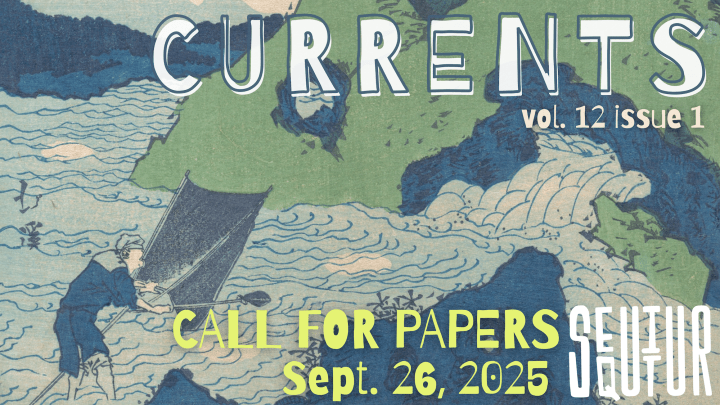
The editors of SEQUITUR, the graduate student journal published by the Department of History of Art & Architecture at Boston University, invite current and recent MA, MFA, and PhD students to submit content on the theme of “Currents” for our Fall 2025 issue.
This issue invites submissions that consider how artistic activity and material culture make visible, help detect, and even resist the invisible forces at work in our world. When used in the scientific fields of meteorology or hydrology, currents describe the perpetual motion of air and water. In the study of the humanities, the term might connote a prevailing trend or the zeitgeist of a particular historical moment.
Furthermore, scholarship in the blue humanities frames oceanic and cultural currents as part of an assemblage, suggesting that the ocean’s liquid perpetual motion and heterogeneous material composition are more than just a backdrop for human culture. At its surface, the ocean has served as a site of imperial conquest, extractivism, and militarization, but is also a site of migration, diaspora, and resistance. Scholars Kimberley Peters and Philip Steinberg even use the concept of the ocean, and all that it intermingles with, as a “Hypersea” to describe how the ocean exceeds its liquid form, perpetual cycles, or a specific body of water by permeating and shaping physical matter, such as the atmosphere and our bodies, but especially our imaginations. Peters and Steinberg’s work provokes further consideration of what art historical scholarship might look like when informed by natural and social currents that exceed their boundaries and inscribe one another.
From 17th-century Dutch still life painters’ fascination with the products of colonial and transoceanic trade to contemporary work such as Hito Stereyl’s Liquidity Inc. (2014), which draws parallels between liquid currents and the fluidity of financial assets, identities, and borders in a digital world, artists, architects, and collectors have responded to the questions and conditions shaped by natural and social currents. This issue seeks to collect scholarship spanning antiquity to the present that grapples with such currents as complex, historical assemblages and asks where art might serve as a tool to interrogate them.
Possible subjects may include, but are not limited to:
• Currents, Movement, and Temporality: Flow; perpetual motion; flux; swell; direction; circulation; pushing and pulling; present; contemporary; prevailing; instant; prediction; ongoing; trends
• Currents and Systems: Weather patterns; transoceanic drift; mapping; hydrocommons; oceanic and atmospheric ecologies; rivers; oceans
• Currents and Culture: (Un)intended distribution (shells, marine salvage, etc.); spirituality and religion (ritual, baptism, purification, etc.); contact zones; migration; undercurrents
• Currents and Scholarship within the Oceanic Turn: transoceanic imaginaries (Elizabeth DeLoughrey); a “poetics of planetary water” (Steve Mentz); tidalectics (Kamau Brathwaite); the Undersea, and other theoretical methods (including works of Stacy Alaimo, Hester Blum, John R. Gillis, Epeli Hau’ofa, Melody Jue, Astrida Neimanis, Serpil Oppermann, or Philip Steinberg, among many others)
SEQUITUR welcomes submissions from graduate students in the disciplines of art history, architecture, archaeology, fine arts, material culture, visual culture, literary studies, queer and gender studies, disability studies, memory studies, and environmental studies, among others. We encourage submissions that take advantage of the digital format of the journal.
Founded in 2014, SEQUITUR is an online biannual scholarly journal dedicated to addressing events, issues, and ideas in art and architectural history. SEQUITUR, edited by graduate students at Boston University, engages with and expands current conversations in the field by promoting the perspectives of graduate students from around the world. It seeks to contribute to existing scholarship by focusing on valuable but often overlooked parts of art and architectural history. Previous issues of SEQUITUR can be found here.
We invite full submissions in the following categories. Please submit your material in full for consideration in the publication:
Feature essays (1,500 words)
Content should present original material that falls within the stipulated word limit (1,500 words). Please adhere to the formatting guidelines available here.
Visual and creative essays (250 words, up to 10 works)
We invite M.Arch. or M.F.A. students to showcase a selection of original work in or reproduced in a digital format. We welcome various kinds of creative projects that take advantage of the online format of the journal, such as works that include sound or video. Submissions should consist of a 250-word artist statement and up to 10 works in JPEG, HTML, or MP4 format. All image submissions must be numbered and captioned and should be of good quality and high resolution.
We invite proposals for the following categories. Please write an abstract of no more than 200 words outlining your intended project:
Exhibition reviews (500 words)
We are especially interested in exhibitions currently on display or very recently closed. We typically prioritize reviews of exhibitions in the Massachusetts and New England area.
Book or exhibition catalog reviews (500 words)
We are especially interested in reviews of recently published (1–3 years old) books and catalogs.
Interviews (750 words)
Please include documentation of the interviewee’s affirmation that they will participate in an interview with you. Plan to provide either a full written transcript or a recording of the interview (video or audio).
Research spotlights (750 words)
Short summaries of ongoing research written in a more casual format than a feature essay or formal paper. For research spotlights, we typically, but not universally, prioritize doctoral candidates who plan to use this platform to share ongoing dissertation research or work of a comparable scale.
To submit, please send the following materials to sequitur@bu.edu:
• Your proposal or submission
• A recent CV
• A brief (50-word) bio
• Your contact information in the body of the email: name, institution, program, year in program, and email address
• ‘SEQUITUR Fall 2025’ and the type of submission/proposal as the subject line
All submissions and proposals are due 26 September 2025. Please remember to adhere to the formatting guidelines available here. Text must be in the form of a Word document, and images should be sent as .jpeg files. While we welcome as many images as possible, at least one must be very high resolution and large format. All other creative media should be sent as weblinks, HTML, or MP4 files if submitting video or other multimedia work. Please note that authors are responsible for obtaining all image copyright releases before publication. Authors will be notified of the acceptance of their submission or proposal the week of 15 October 2025, for publication in January 2026. If you have any questions, please do not hesitate to contact the SEQUITUR editors at sequitur@bu.edu.
The SEQUITUR Editorial Team
Ada, Emma, Hamin, Isabella, Jenna and Megan
Call for Papers | Silver and Furniture
From the Call for Papers:
Silver and Furniture: Aesthetics and Value, from the Middle Ages to Now
The Furniture History Society and The Silver Society Joint Symposium
Victoria & Albert Museum, London, 28 March 2026
Proposals due by 31 August 2025
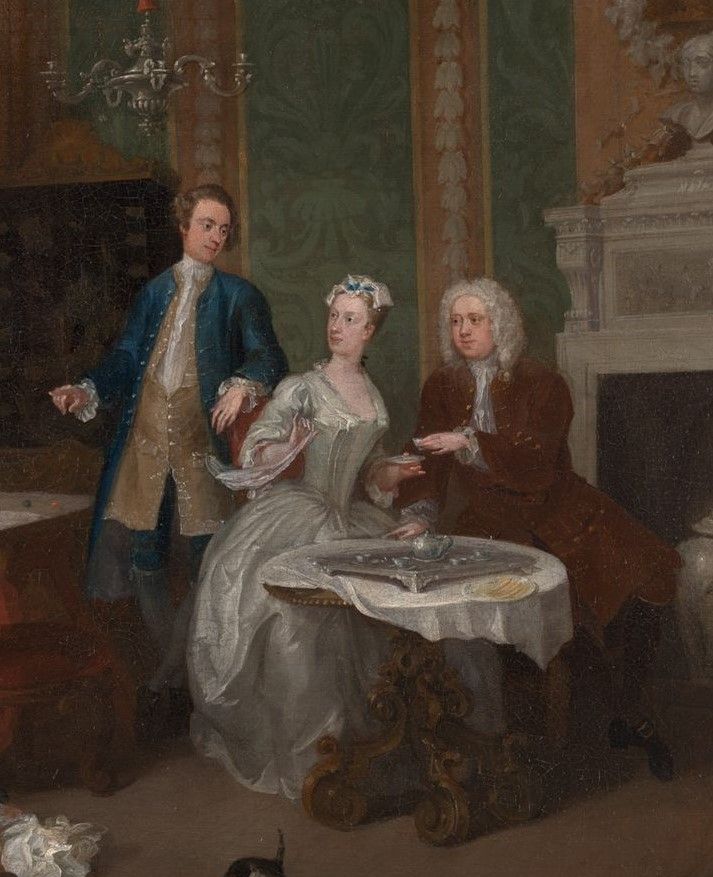
William Hogarth, The Montagu Family and an Unknown Attendant, detail, 1730–35, oil on canvas (New Haven: Yale Center for British Art, Paul Mellon Collection).
We are delighted to announce that the Furniture History Society and the Silver Society will join forces in spring 2026 to hold a one-day symposium on the theme of Silver and Furniture: Aesthetics and Value, from the Middle Ages to Now.
Talks will explore the relationship between furniture and silver in terms of valuing, owning, describing, and making. Furniture displays and stores silver; how did the two combine in princely, ecclesiastical, domestic, and retail settings, and how did viewers react? Do collectors prize silver in its native or worked state, in terms of its place of origin, as they might a rare wood? What prominence do artists give furniture and silver in paintings, and how does furniture frame depictions of metalwork? How do inventories and chronicles describe silver and associated furnishings? Did designers and manufacturers of silver and furniture work collaboratively, or mutually influence each other? Did all societies across the globe value these materials equally, and has their relative importance and material worth fluctuated over the centuries?
We welcome submissions for 20-minute conference papers on these and related topics, from anyone working in the field of decorative and visual arts across continents, in archives, and in conservation. To submit a proposal, please send an abstract of 250–300 words and a brief biography to Dr Amy Lim (Co-chair, Events Committee, Furniture History Society), at events@furniturehistorysociety.org or to Dr Kirstin Kennedy (Chairman, The Silver Society), at chairmankmk@gmail.com.
Call for Papers | Materiality and the Reception of Ancient Objects
A few weeks ago, I posted a list of various CAA panels relevant to the eighteenth century but inadvertently omitted this one. The due date for proposal submissions (to be completed through the CAA website) is August 29. –CH
Materiality and the Reception of Ancient Objects / College Art Association Conference
Chairs: Stephanie Rose Caruso (The Art Institute of Chicago) and Andrea Morgan (The Art Institute of Chicago)
Hilton Chicago, 18–21 February 2026
Ancient Mediterranean objects typically survive in a fragmented state, and their reception, particularly sculpture, has shifted over time. Seventeenth-century artists worked to return fragmented ancient sculptures to a ‘whole’ or ‘complete’ state. Yet, in 1803, Antonio Canova refused Lord Elgin’s proposal to restore the Parthenon marbles, fearing it would damage their original condition. Thus, there was an eventual shift in the perception of the fragment—no longer ‘incomplete’, it possessed an “age value” as Alois Riegl later theorized. With the discovery of ancient textiles in Egypt in the second half of the nineteenth century an opposite approach to the fragment developed. Despite the fact that one might discover a ‘complete’ ancient textile, it was rarely retained; rather, it was cut into as many pieces as possible. Not perceived as fine art, their value instead stemmed from their ability to transmit patterns.
This panel aims to explore the reception, manipulation, restoration, or destruction of ancient objects from the Renaissance through the end of the nineteenth century. We invite papers that investigate whether the specific materiality of ancient objects makes them more vulnerable or resistant to later intervention. Topics can include the exploration of the concept of in/completeness in relation to changing tastes and theoretical divisions between the fine and applied arts; in/completeness and restoration in relation to aesthetic and historical integrity; and the exploration of pastiches. We seek contributions that look closely at surviving objects to extrapolate new ways of thinking about the reception of ancient art.
Call for Articles | The Burlington Magazine, Asian Art

Pictures of Ancient Playthings, detail of one section, Chinese, 1728, handscroll, ink and color on paper, mounted on silk
(London: The British Museum, PDF,X.01)
◊ ◊ ◊ ◊ ◊
From The Burlington:
The Burlington Magazine | Asian Art
We are inviting proposals for articles prsenting new research on any aspect and period of the arts of Asia.
Please send proposals for The Burlington Magazine to Christine Gardner-Dseagu at gardner-dseagu@burlingtong.org.uk. For a full set of submission guidelines, please refer to our website.
For articles on art produced after 1960, please send a 150-word synopsis to Kathryn Lloyd at lloyd@burlington.org.uk. You can find the full submission guidelines for Burlington Contemporary Journal here.
Call for Papers | Art, Inc.

Anonymous artist, An Address to the Proprietors of the South-Sea Capital, 1732, etching, 17 × 29 cm.
◊ ◊ ◊ ◊ ◊
From The Courtauld:
Art, Inc.
Courtauld Institute of Art, London, 5 December 2025
Proposals due by 5 September 2025
Across galleries and university curricula, art is still routinely categorised, displayed, and taught according to a conceptual framework that centres the nation. This focus has resulted in a minimisation of the significant role that corporations have played in commissioning art, innovating artistic styles and genres, and transporting art objects across the globe. Indeed, the historical process of nation-building arguably relied on visual and material practices that incorporated bodies had long used to communicate common values or cultivate loyalty. To this day, private corporations are major patrons of artists and generate considerable contestation over cultural values, with much contemporary debate over the character of corporate-sponsored art. By recentring an overlooked ‘corporate art history’, this symposium will provide insights into the place of art objects within a range of broader historical phenomena: the role of corporations in the formation of civil society and the state; the expansion of commercial and industrial capitalism; the concomitant globalisation of legal understandings of incorporation; as well as the ‘corporate character’ of European imperialism. Importantly, it will also foreground how visual and material cultures have historically played a significant role in materialising and making tangible the very concept of incorporation—the abstract notion that continues to underpin so many of today’s legal and financial modes of association. Held at a time when the political and environmental impact of multinational corporations is under particular historical and journalistic focus, Art, Inc. will not only provoke new thinking about corporations as significant actors in art history, but will open new insights into the ways visual and material cultures have shaped the histories of empire, commerce, law, and globalisation.
We invite proposals for twenty-minute papers on topics from any period or geography that address issues including, but not limited to:
• Histories of corporate patronage in art history
• Corporations as agents of stylistic innovation in art history
• Histories of visual and material culture making the abstract concept of incorporation intelligible or tangible
• The possibility of tracing a ‘corporate style’ in visual and material culture
• Histories of corporations provoking contestation over artistic values
• Antagonism, relations, or blurred boundaries between the state and corporations in art history
• Histories of states using art to manage or nationalise corporations
• How the visual and material practices of corporations contributed to the development of civil societies
Please send paper proposals of no more than 400 words, along with a full CV, to tom.young@courtauld.ac.uk. Papers should not contain material that is already in publication, as ideally this conference will lead to further collaboration and, if possible, the publication of an edited volume. The deadline for applications is Friday, 5th September. Applicants will be informed about decisions by mid-September. Successful applicants will be encouraged, where possible, to use institutional funding they have available for travel and accommodation, as only minimal funding from the Courtauld will be available and this will be reserved for early career candidates and those without institutional support.
Call for Papers | Religious Enlightenments: Spirituality and Space
This session is part of next year’s EAHN conference; the full Call for Papers is available here:
Religious Enlightenment(s): Spirituality and Space in the Long Eighteenth Century
Session at the Conference of the European Architectural History Network, Aarhus, 17–21 June 2026
Chair: Demetra Vogiatzaki
Proposals due by 19 September 2025
 In recent decades, the traditional view of the Enlightenment as a period of radical secularization and material monism has been substantially revised. Scholars such as David Sorkin, Jonathan Israel, Catherine Maire, Paschalis Kitromilides, and Robert Darnton have emphasized the enduring and multifaceted role of religion and spirituality—across both institutional and popular expressions—in shaping the politics, culture, and everyday life of the long eighteenth century. Architectural surveys of the period, however, have often lagged behind this historiographical turn, overlooking the importance of religion and spirituality in the shaping of Enlightenment culture, limiting their scope to a strictly formal analysis, or dismissing non-sanctified spaces and experiences of spirituality as anomalies in the progressive, inevitable ‘disenchantment’ of the world.
This session invites papers that explore the political, social, and aesthetic resonances of sacred space in the Enlightenment. From little studied state-sponsored and public programs, all the way to local, vernacular and/or intimate expressions of sacrality, how did architecture and the built environment broad-writ reflect or resist evolving religious identities, dogmatic debates, and communal rituals? Following the lead of such studies as Karsten Harries’ work on Bavarian Rococo Churches, or Ünver Rüstem’s reading of Ottoman Baroque forms and their entanglement with local Christian and Islamic traditions, the goal is to integrate formal analysis with socio-politically embedded approaches, foregrounding spatial practices that have often been overlooked in dominant narratives of Enlightenment architecture.
Topics might include, but are not limited to:
• Patronage networks and sacred architecture in diasporic or commercial communities, as in the port towns of the Mediterranean.
• Reused or re-interpreted religious sites in post-Jesuit or post-missionary contexts (i.e. in the Ethiopian highlands).
• Syncretic religious spaces shaped by colonial conquest and negotiation, as for example, in and around the settlements of New France.
• Ephemeral structures associated with pilgrimage, mourning, or ritual performance.
• Staged sacred environments in Enlightenment theatre, festivals, and visual culture.
• Interfaith collaborations and architectural vocabularies in multi-confessional settings.
We particularly encourage proposals that attend to sacred experiences and spatial practices beyond the bounds of formal religious architecture, and that consider the ways in which spiritual expression operated through, and resisted Enlightenment-era aesthetics. Abstracts are invited by 19 September 2025, 23.59 CET. Abstracts of no more than 300 words should be submitted directly to the chair, along with the applicant’s name, email address, professional affiliation, address, telephone number, and a short curriculum vitae.
Chair
Dr. Demetra Vogiatzaki, gta/ETH Zurich
vogiatzaki@arch.ethz.ch
Call for Papers | CAA 2026, Chicago

I’ve highlighted here a selection of panels related to the eighteenth century; but please consult the Call for Papers for additional possibilities. –CH
114th Annual Conference of the College Art Association
Hilton Chicago, 18–21 February 2026
Proposals due by 29 August 2025
Architectural Utopias Redux
Chair: Demetra Vogiatzaki (ETH Zurich)
Can utopia still be a meaningful framework for researching and teaching architecture in a time of ecological and political crisis? Since the Enlightenment, architectural utopias have often shed their emancipatory potential, functioning instead as instruments of capitalist expansion, settler colonialism, and modernist abstraction–so Manfredo Tafuri and Anthony Vidler, among other architectural historians, have claimed. Yet beneath the failed promises of the architectural ‘avant-gardes’ lie counter-histories of resilience—’rear-guard’ efforts that challenged dominant spatial paradigms while restoring equity in their present. This panel invites a rethinking of architectural utopianism by turning attention to those who resisted, subverted, or reconfigured utopian ideals from the margins. What insights can be gained by examining utopia not as a formal project of radical innovation, but as a practice of community endurance and revolt?
We welcome papers that explore the spatial practices of feminist, decolonial, spiritual, and other collectivist movements challenging the exclusions embedded in dominant utopian narratives. These may include intentional communities, grassroots infrastructures, pedagogical experiments, or speculative practices grounded in marginalized worldviews. Submissions may address any historical period, but special attention will be given to work that situates premodern, early modern, or underrepresented geographic contexts within broader debates on utopianism. We also encourage contributions proposing alternative methodologies for teaching utopias in architecture—through archives, oral histories, literary or material culture. By centering the ‘rear-guard’ of architectural history—those whose visions have often been erased, or dismissed—we hope to reimagine utopia not as an unreachable blueprint, but as a lived and ongoing project of resistance.
◊ ◊ ◊ ◊ ◊
Art and Architecture vs. Environment: Failure, Redesign, and Innovation in the Early Modern Iberian World (Society for Iberian Global Art)
Chairs: Rebecca Yuste (Columbia University) and Amy Chang (Harvard University)
The history of the early modern Iberian world is strewn with stories of architectural ambition and engineering innovation that seek to defy, overcome, or restructure extant environmental conditions. Land-reclaiming and flood-controlling projects represent a major thematic in this period, from Regi Lagni in Naples to the desagüe of Mexico City, as do seismic-responsive architectures such as the famous Earthquake Baroque in the Philippines and Guatemala, and as well as post-earthquake architectures in Sicily and Lisbon. Early modern architecture and engineering is often characterized by new boldness of ambition in responding to, attempting to overcome, or intending to change environmental conditions, it often yields cycles of loss, failure, and reiteration, until new technics are achieved.
This panel seeks to learn from stories of architectural and infrastructural failure, innovation, and redesign, especially as it relates to practices of colonialism, from across the Iberian world. We invite papers that seek to complicate the narrative of architectural domination on the land and landscape and search for cases that focus on moments of disjunction and defeat in the face of environmental factors, and the struggle to respond. Papers may examine the consequences of incomplete knowledge of landscapes, ecologies, and materials, and the cases under consideration may be architectural works that were unfinished, hypothetical, never realized, or rebuilt after confronting natural disasters and misunderstandings of ground conditions. We also welcome papers on artworks representing knowledge of materials and environments; moments of disaster, engineering, and rebuilding; or changes in understandings of nature and environment.
◊ ◊ ◊ ◊ ◊
Bad Government: Art and Politics in the Eighteenth Century (American Society for Eighteenth-Century Studies)
Chair: Amy E. Freund (Southern Methodist University)
How did art, architecture, and visual and material culture in the long eighteenth century perpetuate or resist objectionable forms of government? This panel will consider how the arts were weaponized both by political leaders to shore up their regimes and by their critics to bring those regimes down. Potential topics include but are by no means limited to: the arts of the eighteenth century’s revolutions and counterrevolutions, the enlistment of the visual arts to justify, perpetuate, and resist colonialism, popular media and propaganda, the building and destruction of palaces, monuments, and other public-facing forms of art, artists as political actors, private and domestic forms of artistic control and contestation, portraits of rulers and political figures, sacred art in the service of secular struggles, and the mobilization of scientific illustration for political ends.
◊ ◊ ◊ ◊ ◊
Centering the Margins: Art and Identity beyond the Colonial American Metropoles
Chairs: JoAnna Reyes (Arizona State University) and Carlos Rivas (The Ohio State University)
This panel investigates the rich artistic traditions of colonial cities in the Americas that developed outside imperial capitals. While metropolitan centers such as Mexico City and Lima have long dominated narratives of colonial art, cities like Antigua (Guatemala), Ouro Preto (Brazil), Cuzco (Peru), and Popayán (Colombia) cultivated distinctive visual cultures that reflected complex interactions among European, Indigenous, African, and mestizo communities. These extra-metropolitan locales were not peripheral but central to the formation of regional artistic identities, often serving as hubs of innovation, adaptation, and resistance.
Panelists will explore how visual culture and aesthetic preference were transformed in these cities through localized interpretations, responding to local materials, labor networks, and spiritual traditions. Religious architecture and devotional arts—especially those commissioned for monasteries, cathedrals, and mission churches—may serve as a lens to examine both the imposition and reinterpretation of colonial ideologies. The panel also considers the importance of artisan networks and the movement of artists, artworks, and raw materials across colonial territories, illuminating the transregional dynamics that shaped local production.
In tracing these developments, the panel foregrounds how artistic production in these cities negotiated colonial authority while fostering creole and Indigenous expressions of identity. By centering these often-overlooked locales, this panel seeks to expand the geographies of colonial art history and enrich our understanding of artistic agency in the Americas.
◊ ◊ ◊ ◊ ◊
Freedom, Fugitivity, and Revolt in the Global Netherlandish World, 1500–1800
Chairs: Arianna Ray (Northwestern University) and Kathleen DiDomenico (Washington University in St. Louis)
This session explores the distinct but related notions of freedom, fugitivity, and revolt in art of the global Netherlandish world, ca. 1500–1800. Freedom, understood as the state of being unencumbered by restrictions, restraints, or oppression, is often seen as a defining feature of the early modern Netherlands, where political revolt, religious reform, economic endeavor, and artistic experimentation resulted in newfound freedoms for certain populations. But alongside these often precarious freedoms, there remained hierarchies of power that kept people locked in systems of repression, subjugation, and exploitation. In response, historical subjects turned to strategic practices of fugitivity and revolt, both overt and subtle, in an effort to resist domination and create alternative spaces of personal and collective liberty. This panel will examine concepts of freedom/unfreedom capaciously, as a labor status, an artistic practice, and a theoretical question. We build upon the insights of scholars within and beyond art history, including Saidiya Hartman, Neil Roberts, and Tina Campt, among others. We welcome interdisciplinary and methodologically innovative approaches, particularly those engaging with Black studies, Indigenous studies, gender and queer theory, and decolonial critique.
Potential topics include:
• Depictions of forced labor including slavery, serfdom, and indentured servitude
• Depictions of fugitives, maroons, revolutionaries, and diasporic communities
• Representations of individual and collective acts of resistance
• Mapping spaces/sites/locations of freedom, fugitivity, and revolt
• Objects made by forced laborers or those who achieved freedom
• Visual culture around rebellions and uprisings
• Artistic freedom and creativity
• Coded imagery and subversive aesthetics
• Absences in the archive and/as fugitivity
◊ ◊ ◊ ◊ ◊
Garden and its Discontents / Discontents in the Garden
Chairs: Xiaoyao Guo (Princeton University) and Chenchen Yan (Princeton University)
As locus amoenus and paradise lost, the garden has been a place of ambivalence since the start of human civilization. Positioned uneasily between landscape and architecture, it is also one of the most powerful topoi through which to tame, emulate, and (re)construct nature. This panel revisits the long and rich histories of the garden and investigates its ambivalence, here reformulated as “discontents,” through various cultural historical mediations.
Motivated by Sigmund Freud’s famous essay “Civilization and its Discontents” on the irreconcilable clash between individual instincts and societal regulations, this panel aims to reread the garden into its concrete sociohistorical textures. Furthermore, drawing from the precise translation of the essay’s original title, “The Discontent in Civilization,” this panel approaches the garden as a contested site between ideologies, discourses, and sensibilities in which contradictions and antagonisms are inherently constitutive of its construction. From the Venetian terraferma to the Japanese bonsai, from the English picturesque to the American wilderness, the garden addresses specific questions of its times, and challenges its presumed harmony and unity: What are the discontents housed within the seemingly serene Elysium? What perceptual and conceptual tensions need to be identified, what hierarchies undone? We welcome submissions on the discontents of/in the garden across cultures and histories. This “comparative-global” approach, we hope, would highlight in turn the cultural-specificity and social constructedness of the garden. Articulating these discontents, then, would offer valuable insights into the binaries of art-science, nature-culture, self-other urgent to today’s ecologically conscious world.
◊ ◊ ◊ ◊ ◊
Hybridity, Adaptability, and Exchange during the Long Eighteenth Century: Producing Global Aesthetics in Decorative Art and Design (Historians of Eighteenth-Century Art and Architecture)
Chairs: Zifeng Zhao (University of Cambridge) and Alisha Ma (London School of Economics and Political Science)
Over the long eighteenth century (c. 1689–1815), the decorative arts and design underwent profound change via global diffusion of objects, techniques, and knowledge. Although global artistic exchange has shaped cultural landscapes for centuries, this particular period saw the creation of new aesthetic paradigms and fostered cultural discourses regarding notions of cultural agency, identity, and authenticity. This session examines the making of global aesthetic traditions and practices in the long eighteenth century by closely interrogating the dynamics of cross-cultural hybridity, adaptability, and exchange along with their usefulness as art historical concepts. Furthermore, the session will illustrate how the evolution of artistic traditions shaped visual, material, sensorial, and political landscapes across the early modern world.
We invite contributions that address how individuals and collectives responded to cross-cultural interactions, creatively adapting and transforming these influences into novel, hybrid forms. We welcome papers from diverse geographies that consider how decorative art and design functioned as crucial contact zones where local traditions were continuously reimagined through exchange as well as resistance. For example, Indian artisans adapted traditional cotton textile designs for European tastes, while European potters such as the Delft and Meissen factories experimented with new technologies to produce ceramics in competition with Chinese porcelain. Meanwhile, Colonoware pottery was produced by enslaved Africans in North America from a combination of African traditions, local resources and practical demands. Ultimately, this discussion will deepen scholarly understanding of the role played by the decorative arts in producing global visual and material cultures during the long eighteenth century.
◊ ◊ ◊ ◊ ◊
Is There a Native American Art History Canon? Is It a Good Idea?
Chairs: Karen Kessel and Alicia Lynn Harris (University of Oklahoma)
While the framing of art history survey courses has gradually shifted from a core focus on Western Civilization emanating from Europe and the Eastern Mediterranean regions to a more global view, the North American continent remains marginalized. Some American art history texts now incorporate Native American works into their narrative, but do Native Americans identify with being part of the United States’ cultural history? Current textbooks for Native American art focus disproportionately on the post-contact era with minimal coverage of the millennia that came before. Why? Archaeologists, who do not generally prioritize artistic achievement in their research, have been the main contributors to studies of the pre-contact era in North America. Given recent contributions to the field from an increase in Native scholars working in museums and academic institutions, this panel seeks to understand and help define the current best practices for teaching Native American art history. We invite papers that assess what can and should be shared, when, and who has authority over cultural domains, along with consideration of what themes, ideas, artworks, and frameworks are currently considered best practices to enhance the appreciation and understanding of Native American art history.
◊ ◊ ◊ ◊ ◊
Landscape, Materiality, and Representation in the Long Nineteenth Century
Chair: Noam Gonnen (Ben-Gurion University of the Negev)
This session invites contributions that investigate the entangled relationships between landscape, materiality, and representation in the long nineteenth century. While landscape has often been examined through symbolic, nationalistic, or pictorial frameworks, this panel foregrounds its material dimensions—both as subject and substance—and asks how they shaped artistic and cultural production during this transformative period. How did the physical qualities of land, earth, and environment inflect visual representation? What tensions emerged between landscape as material presence and landscape as mediated image?
Bridging art history, material and visual culture, human geography, and environmental humanities, this session seeks to integrate phenomenological approaches (Merleau-Ponty, Heidegger, Casey), material and object-oriented ontology (Bennett, Harman), and geographical theory (Ingold) with close visual and historical analysis. We are particularly interested in how the materiality of land—its textures, substances, and transformations—was registered, abstracted, or resisted in the practices of representation across diverse geographies, media, and artistic traditions during this period.
Contributors might consider:
• The material construction of landscape images: grounds, supports, pigments, and surfaces
• Representing geological time, land use, or extraction industries
• Earth as medium: pigment, sediment, and organic matter in artistic practice
• Artistic responses to ecological degradation
• Indigenous and non-Western modes of representing land and territory
• The role of materiality in 19th-century cartography or land surveys
• The visual rhetorics of land ownership, enclosure, and displacement
• Intersections of land, labor, and class in visual culture
We welcome proposals engaging with both canonical and understudied works that rethink landscape through its material and representational operations.
◊ ◊ ◊ ◊ ◊
Let’s Get Metaphysical: Rethinking the Empiricism of British Art (Historians of British Art)
Chair: Douglas R. Fordham (University of Virginia)
Histories of British art rarely ask metaphysical questions. More common are narratives in which the empiricism of Locke and Newton inspired artists to draw and paint the material world “after the life”. But how feasible was it for British artists to bracket metaphysical questions out of their work? As Eugene Thacker noted, “‘Life’ is a troubling and contradictory concept…. Every ontology of ‘life’ thinks of life in terms of something-other-than-life [which] is most often a metaphysical concept, such as time and temporality, form and causality, or spirit and immanence.”
What, if anything, enabled British art to transcend its base materiality? Should paintings ever be more than mimetic ‘pictures’ of the material world, and if so, what beliefs, ideas, or eternal propositions did they invoke? We have grown accustomed to thinking of British artists as post-Reformation iconoclasts who embraced an empirical view of the world. Painting is treated like a mode of critique in which artists contributed to the disenchantment of the modern world. This panel is interested in British art, in any medium and from any period, that refused to settle for mimetic realism. While altarpieces, funerary monuments, and the spiritual visions of William Blake immediately come to mind, papers could interrogate the ‘naturalism’ or ‘lifelikeness’ of J.M.W. Turner, the Pre-Raphaelites, Walter Sickert, and a great deal more.
◊ ◊ ◊ ◊ ◊
Materiality and the Reception of Ancient Objects
Chairs: Stephanie Rose Caruso (The Art Institute of Chicago) and Andrea Morgan (The Art Institute of Chicago)
Ancient Mediterranean objects typically survive in a fragmented state, and their reception, particularly sculpture, has shifted over time. Seventeenth-century artists worked to return fragmented ancient sculptures to a ‘whole’ or ‘complete’ state. Yet, in 1803, Antonio Canova refused Lord Elgin’s proposal to restore the Parthenon marbles, fearing it would damage their original condition. Thus, there was an eventual shift in the perception of the fragment—no longer ‘incomplete’, it possessed an “age value” as Alois Riegl later theorized. With the discovery of ancient textiles in Egypt in the second half of the nineteenth century an opposite approach to the fragment developed. Despite the fact that one might discover a ‘complete’ ancient textile, it was rarely retained; rather, it was cut into as many pieces as possible. Not perceived as fine art, their value instead stemmed from their ability to transmit patterns.
This panel aims to explore the reception, manipulation, restoration, or destruction of ancient objects from the Renaissance through the end of the nineteenth century. We invite papers that investigate whether the specific materiality of ancient objects makes them more vulnerable or resistant to later intervention. Topics can include the exploration of the concept of in/completeness in relation to changing tastes and theoretical divisions between the fine and applied arts; in/completeness and restoration in relation to aesthetic and historical integrity; and the exploration of pastiches. We seek contributions that look closely at surviving objects to extrapolate new ways of thinking about the reception of ancient art.
◊ ◊ ◊ ◊ ◊
Modes of Inscription
Chairs: Erica DiBenedetto (The Museum of Modern Art) and Charles Kang (Rijksmuseum)
Adding language to an object takes many forms and has a long history. It can be done, for example, by the maker of an object as an integral part of generating a work. It can be done by others–and often at a later date–as an addition, an intervention, or even an accident irrelevant to the work. While the modes of inscription might differ from case to case, the voice behind the inscription can bestow a sense of authority in the life of an object. It can also trouble its interpretation. Rather than framing the idea of inscription in terms of word/image relations, this CAA session understands the act of adding language to an object fundamentally as a mediation. Although found across many periods, geographies, and mediums, the practice of inscription has not received sufficient attention from a global and transhistorical perspective. Panelists are therefore invited to examine instances of inscription specific to their respective fields, using their expertise to offer new questions and theoretical considerations about the phenomenon. The common aim will be to consider how such mediations help us think differently about conceptions of authorship, meaning, and possession across time and space.
◊ ◊ ◊ ◊ ◊
Nature in Indigenous Arts of the Ancient and Colonial Americas
Chairs: James Cordova (University of Colorado Boulder) and Angélica J. Afanador-Pujol
The culture-nature divide inherent in European epistemologies and cosmologies contrasts sharply with Indigenous American perspectives, which emphasize interconnectedness over discordance between humans and the natural world. Before European colonization, Indigenous ontologies profoundly shaped the roles of the natural world in their artistic expressions. These beliefs are often evident in the materials chosen for creations, representations of plants, animals, deities, and other sentient beings, as well as the design and layout of cities. In addition to the colonial exploitation of Indigenous peoples and the natural world, the imposition of European epistemologies elicited diverse responses, ranging from outright resistance to selective appropriation, partial acceptance, and full assimilation. This session invites papers that examine the critical roles nature and the environment played in Indigenous creative expressions from ancient to colonial times (c. 1400 BCE – 1825 CE) across North America, Mesoamerica, the Caribbean, Amazonia, and the Andes.
◊ ◊ ◊ ◊ ◊
Pigments and Praxis in the Early Modern Period
Chairs: Annie Correll (New York University) and Gerrit Albertson (Art Institute of Chicago)
Early modern and contemporary sources alike have compared artists’ workshop practices with those of alchemists, as they ground and mixed their pigments with binding media, experimenting with additives and proportions to develop paints with particular viscosities and opacities. Technical studies have further proven the specialized attention that early modern artists paid to their pigments. Hendrick Avercamp used smalt between layers of lead white, diffracting and absorbing light to achieve icy, atmospheric skies in his winter scenes; Frans Hals experimented with indigo in the sashes of his 1627 Haarlem Civic Guard portraits despite contemporary concerns about its discoloration; and Rembrandt developed a signature lead-white paint, adjusting its rheological properties for use in his impasto. This panel seeks to bring together the technical and the art historical to consider pigments not just as agents for color, but for artistic experimentation and cultural significance. We especially welcome joint papers by early modern art historians and conservators or scientists.
Questions addressed may include:
• What can be revealed by tracing the trade routes along which pigments travelled?
• How did environmental or geological factors affect the raw materials of natural pigments? How were they harvested, processed, and made into paint?
• Who played a role in this process? What were the socio-economic or power dynamics at play?
• How did the use of pigments conform to or converge from art theory?
• How did artists experiment to achieve desired color, light, or textural effects?
• What can pigments tell us about the perceived value or purpose of a painting?
◊ ◊ ◊ ◊ ◊
The Margins and Backgrounds of Portraits
Chairs: Joseph Litts (Princeton University) and Michael Hartman (Dartmouth College – Hood Museum)
Portraiture studies have traditionally focused on faces, clothing, and accessories as sites of creating and stabilizing identity within art. Layers of oil paint, pastel dust, and engraved ink articulate race, gender, class, and kinship networks on a scale ranging from jewelry miniatures to life-size replicas. Scholars have demonstrated how these representations surrogated for distant power, how collections and exhibitions were political statements, and how portrait iconoclasm could be broadly ideological rather than personal.
However, what happens behind and around the body? This facet of portraiture remains an open field. Our panel thus invites papers that examine the margins and backgrounds of portraits. These spaces vary from roundels or planes of color, to classicizing scenes or imaginary gardens, to draperies or architectural structures. As much as standardized formulas and techniques have developed for the face itself, the (back)ground has been curiously resistant to such strategies. This panel asks what do these diverse environments—a visualized “habitus,” to borrow from Bourdieu—contribute to the portrait? How might painterly surroundings trouble notions of identity and modernity? For group portraits and conversation pieces, how does setting provoke or dismiss relationality? Do specific display or exhibition contexts become extended backgrounds for portraits, especially with sculptures? Ultimately, how do the edges, however they might be defined, (re)frame our understanding of the key genre of portraiture? In addition to paying close attention to the borders and liminal spaces of portraiture as traditionally understood, we also welcome papers that trouble the definitions of portraiture itself through close attention to context.
◊ ◊ ◊ ◊ ◊
Ungrading Art History
Chairs: Jessy L. Bell (Northwestern University) and Brian T. Leahy (Montana State University Billings)
The art history classroom has long been distinguished by harsh grading, steep learning curves, and high-stakes memorization. However, in the current era of generative AI and legislative attacks on the humanities, there is an urgent need for art history to reexamine its pedagogical foundations to better fulfill its most vital role: teaching critical thinking about images. Recent pedagogical movements variously called ungrading, contract grading, or de-grading, backed by research in the science of teaching and learning (Alfie Kohn, Susan D. Blum, Joshua R. Eyler, Jesse Stommel, and others) challenge the predominance of punitive strategies for evaluating student learning. Instead, these studies propose approaches that develop students’ intrinsic desires for learning through evaluative feedback, progress-based assessment, self-reflection, project-based learning, and other methods. This panel asks how art history might also reimagine its pedagogical and evaluative practices beyond grades—or conventional assessments more broadly—not only to deepen student engagement, but also to reclaim the radical potential of looking closely at images.
We invite papers that reconsider assessment in art history and architectural history at the university level. We welcome the results of classroom experiments and reflections, including but not limited to the alternative assessment methods mentioned above; new theoretical frameworks for teaching art history; experiments in student-centered approaches; historical perspectives on grading’s role in disciplining art historical knowledge; or collaborative redefinitions of assessment. Together, the panel asks: What is possible when our students approach art history not as a way to make the grade but as a tool to see the world anew?
◊ ◊ ◊ ◊ ◊
Note (added 18 August 2025) — The posting was updated to include the session on “Materiality and the Reception of Ancient Objects.”
Call for Articles | Fall 2026 Issue of J18: Archipelago
From the Call for Papers:
Journal18, Issue #22 (Fall 2026) — Archipelago
Issue edited by Demetra Vogiatzaki and Catherine Doucette
Proposals due by 1 September 2025; finished articles will be due by 1 February 2026
“Antillean art,” remarked St. Lucian poet Derek Walcott upon receiving the Nobel Prize for Literature in 1992, “is this restoration of our shattered histories, our shards of vocabulary, our archipelago becoming a synonym for pieces broken off from the original continent.” Walcott’s Nobel lecture, “The Antilles: Fragments of Epic Memory”, offers a compelling meditation on the interplay between art, history, and the archipelago as a space of fragmentation, multiplicity, and interconnectedness. In dialogue with Walcott’s reflections, Italian philosopher and politician Massimo Cacciari has framed the rise of early Cycladic culture in the Aegean Sea as the archetype of sociocultural relationality in Europe, inviting a reconsideration of the Archipelago as a model of geographical, as well as political negotiations.
 As the eighteenth century witnessed the expansion of the trans-Atlantic slave trade and the anchoring of European empires across Atlantic, African, Indian, and Mediterranean archipelagic complexes, the insights of Walcott and Cacciari challenge us to rethink how eighteenth-century art and architectural practices in archipelagic spaces were shaped by tensions between isolation, connection, empire, displacement, autonomy, and exchange. While offering an opportunity to reconsider the intertwined histories of colonialism, slavery, and territorialism, focusing on archipelagic structures can help “decenter” Western narratives. An archipelagic perspective is also critical to understanding how island societies navigated and negotiated their cultural identities and agency outside, or in spite of, colonial structures.
This issue of Journal18 explores how archipelagic thinking informs the study of eighteenth-century art, architecture, and material culture. How might concepts of creolization, diaspora, and tidalectics, in the words of Kamau Brathwaite, reshape our understanding of artistic production and circulation? In the fragmentation of archival repositories, what can eighteenth-century objects and built environments made within archipelagic spaces reveal about the experiences of the people who lived there? How did eighteenth-century objects negotiate relationships between islands, oceans, and continents? How did artistic and architectural practices in the archipelago both reflect/reinforce and resist colonial power?
We encourage contributions that explore the metaphorical and material implications of the archipelago in artistic practices, cartography, and networks of exchange and use. We welcome interdisciplinary and innovative approaches to object study in the form of full-length articles or shorter pieces focused on single objects, interviews, or other formats.
To submit a proposal, send an abstract (250 words) and a brief biography to the following email addresses: editor@journal18.org, cd2bv@virginia.edu, and vogiatzaki@arch.ethz.ch. Articles should not exceed 6000 words (including footnotes) and will be due for submission by 1 February 2026. For further details on submission and Journal18 house style, see Information for Authors.
Issue Editors
Demetra Vogiatzaki, gta/ETH Zurich
Catherine Doucette, University of Virginia
Call for Papers | Character in Global Encounters with Architecture
This session is part of next year’s EAHN conference; the full Call for Papers is available here:
‘Character’ in Global Encounters with Architecture, 1700–1900
Session at the Conference of the European Architectural History Network, Aarhus, 17–21 June 2026
Chairs: Sigrid de Jong, Dominik Müller and Nikos Magouliotis
Proposals due by 19 September 2025
The eighteenth century was at once the period when Classical architecture was canonized in the Western world and beyond, and the moment when its supposedly universal ideal came into crisis. The study of competing practices and traditions of various medieval (Romanesque, Gothic, Byzantine) and vernacular architectures in Europe, and the allure of ‘Oriental’ styles (filtered through Turquerie and Chinoiserie) challenged the claims of Classicism, as did the encounters with different extra-European building traditions through travel and colonialism. These encounters prompted an avid preoccupation with cultural difference, as evidenced in Voltaire’s Essai sur les moeurs et l’esprit des nations (1756), Vico’s Principi di una scienza nuova d’intorno alla natura delle nazioni (1725–44), and Hume’s Of National Characters (1748).
Before the systematic global histories of architecture of the nineteenth century, and previous to the notion of style, Western authors employed a particular term to describe cultural specificity and difference: character. Stemming originally from the Greek word χαρακτήρ, its meaning evolved from the tool with which one carved signs on a wax or stone surface, over denoting these signs themselves, to the imprint these had on a reader or viewer. The distinctiveness of that impact, and the marks of identity of a whole culture in its environment and material culture, was encapsulated by its character. As such, from 1750 onwards the notion of character became ubiquitous in a variety of languages and was used in reference to people, buildings and landscapes, and shared across different genres of writing and scientific disciplines: from travel literature, political theory and ethnography, over treatises of art and architecture, to gardening manuals.
This session interrogates the architectural category of character in the globalizing world of the long eighteenth century, by zooming in on its meanings, implications, and complexities in moments of encounter between Western and non-Western cultures and architectures. We draw on recent inquiries into how Western travellers conceptualized non-Western architectures (Brouwer, Bressani, and Armstrong, Narrating the Globe, 2023), but also on works aiming to show how indigenous thinking conceptualized and criticized Western political and aesthetic norms (Graeber and Wengrow, The Dawn of Everything, 2021).
We are interested in instances of encounter addressing the following questions:
• How have Western accounts used the notion of character to describe non-Western architectures, building traditions, cultures, landscapes and places?
• How was the notion of character employed for architectures that challenged Western taxonomies and categorizations of architectural style?
• Which are the analogous notions in native languages that have been used to respond to encounters with Western architectures? How were these employed to process cultural specificity and otherness, and to describe, translate, acculturate or criticize Western cultural expressions (including mores and manners) from an indigenous perspective?
We welcome papers dealing with one or more of these questions in the period c. 1700–1900, across geographies. We are eager to discuss a variety of written, visual, and material sources, drawn from various disciplines, to expand the critical history of the term character beyond its well-established place in the history of European architectural theory.
Abstracts of no more than 300 words should be submitted by 19 September 2025 to sigrid.dejong@gta.arch.ethz.ch, nikolaos.magouliotis@gta.arch.ethz.ch, and mueller@arch.ethz.ch, along with the applicant’s name, email address, professional affiliation, address, telephone number, and a short curriculum vitae (maximum one page). Abstracts should define the subject and summarize the argument to be presented in the proposed paper. The content of that paper should be the product of well-documented original research that is primarily analytical and interpretative rather than descriptive in nature.
Call for Papers | Architecture and the Literary Imagination, 1350–1750
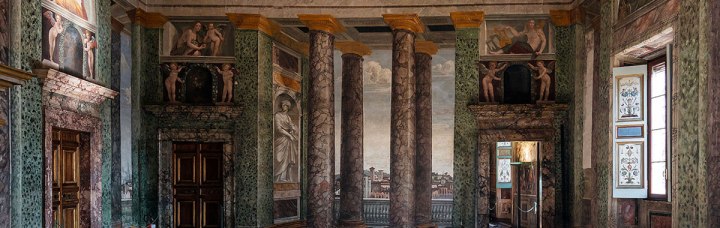
Hall of Perspectives, Villa Farnesina, frescoes painted by Baldassare Peruzzi, ca. 1510–16. Built for Agostino Chigi, the villa was acquired by the Farnese family in 1577.
◊ ◊ ◊ ◊ ◊
From ArtHist.net and the American University of Rome:
Architecture and the Literary Imagination, 1350–1750
American University of Rome, 6–8 November 2025
Organized by Fabio Barry and Paul Gwynne
Proposals due by 1 October 2025
Architecture and the Literary Imagination solicits conference papers that will broaden the repertoire of literary sources for understanding European architecture from around 1350 to 1750 and foster dialogue across disciplines. Architectural historians typically rely on histories for facts, and treatises for theories. A much wider range of texts records the reception of real buildings, the capacity to imagine fantastic ones, and the reciprocity between architecture and literature: poetry, dramaturgy, the picaresque novel, inauguration or consecration speeches, travelogues, epigraphy, and so on.
‘Architecture’ includes cities, civic buildings, palaces, villas, housing, individual rooms, gardens, grottoes, the constructions of nature itself, fountains, monuments, engineering, and decorations from vault painting to topiary. Our focus is largely Europe, but encompasses the Ottoman Empire, all territories ringing the Mediterranean basin, and descriptions of architecture transmitted by the global missions of the Church or travellers.
The source language may be in any vernacular, and we are also interested in Neo-Latin, Neo-Greek, and Classical Arabic as legacy languages of cultural transmission across history and borders. A particular theoretical concern is the intermedial relationship between immaterial words and solid buildings—however that may be defined.
A collection of essays from the conference will be published, subject to peer review, in an edited volume of the new book series, Architecture & the Literary Imagination (Harvey Miller Publishers, series editors, Fabio Barry and Paul Gwynne).
Papers will be 30 minutes in length and preferably in either English or Italian. Please send an abstract of 200 words by 1 October to Fabio Barry (rabirius@cantab.net) and Paul Gwynne (p.gwynne@aur.edu).










leave a comment