Call for Papers | Houses as Museums / Museums as Houses
Call for Papers from the Museums and Galleries History Group:
Houses as Museums / Museums as Houses
Wallace Collection, London, 12–13 September 2014
Proposals due by 17 February 2014
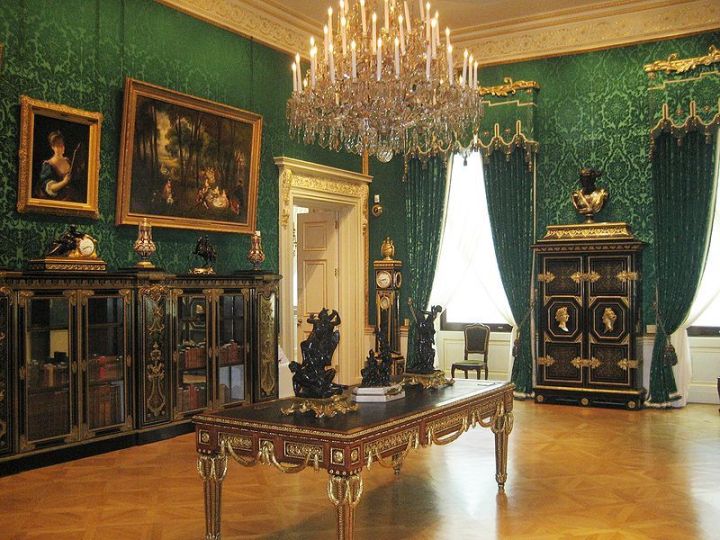
Back State Room, Wallace Collection, London
◊ ◊ ◊ ◊ ◊
The relationship between museums and domestic spaces is a long and complex one. Museums were born in the houses of collectors, while the reconstruction of the house or domestic room—of ‘home’, effectively—continues to be an influential if controversial model for museum display. On the other hand, museums have at times invested heavily in the idea of their spaces as public, scientific and definitively non-domestic. The line between house and museum is therefore also one between public and private, scientific and domestic; and house-museums/museum-houses have acted both to confirm, to alter, and to undermine this line completely.
The 2014 MGHG conference seeks to understand the historical development of this relationship by investigating the ways in which museums have acted as houses, and houses have acted as museums. It will also explore the ways in which house-museums/museum-houses have been positioned in boundary zones of space and time, and what effect they have had on those boundaries. The conference will take place at the Wallace Collection, London, on Friday 12 and Saturday 13 September 2014, itself an illustration of the ways in which houses may become museums, or are (re)designed as museums by their owner, as Hertford House was by Sir Richard Wallace.
We also encourage papers on aspects as diverse as the growth of the celebrity house museum, cabinets of curiosity, curatorial practices of the homeowner in contrast to those of the professional curator, and the development of open air museums and their approach to house reconstruction. Our focus is on the historical development of these themes, but papers which consider the interaction of historical and contemporary practice will also be considered. We encourage papers from museum professionals, researchers, and students from multiple disciplines.
Keynote speakers confirmed so far: Helen Rees Leahy, Professor of Museology at the University of Manchester.
Possible topics for papers include, but are not limited to:
•Country houses as museums
• Artist/writer/scientist house museums
• Houses converted into museums
•Museums in houses: cabinets of curiosity, children’s museums, amateur museumss
•Museums in other domestic settings such as ‘inn parlour’ museums
•Museums as places to live, for curators, caretakers and others
•Owners, custodians and curators
•Subjective and eccentric taxonomies
Please send proposals for papers, of no more than 250 words, with brief biographical information, to secretary@mghg.org, by Monday 17 February 2014.
Call for Papers | Enlightenment Senses?
From the conference website:
Enlightenment Senses? Eighteenth-Century Sensorium(s), Theory and Experience
Centre for Enlightenment Studies at King’s, King’s College London, 13–14 June 2014
Proposals due by 8 March 2014
The senses mattered a great deal in the eighteenth century. Sensibility, sympathy, and Lockean subject theory were all overwhelming concerned with the senses, and ‘The Enlightenment’ is often seen as a crucial breaking point in how we have historically understood and used our senses. Historical narratives that stress the increased value placed on the rationality of vision and the primacy of touch over the eighteenth century—gaining prominence over the sense of smell as a method of evaluation—are much contested today. Scholars such as Foucault, Horkheimer and Adorno, and Lucien Febvre have emphasized the manifold changes in the way the senses were thought about and used during the Enlightenment. At a broader level Mark Smith has stated that
In the seventeenth and eighteenth centuries, the senses informed the emergence of social classes, race and gender conventions, industrialization, urbanization, colonialism, imperialism, nationalism, ideas concerning selfhood and “other,” to list the most obvious developments typically associated with the “modern” era (Mark Smith, Sensing The Past, Berg, 2007, p.1).
This two-day conference aims to bring together those concerned with the social and cultural history of the senses in the period from 1650 to 1790 as well as those working on literary or intellectual histories of the senses in an attempt to encourage a more active dialogue between these areas. The conference aims to link ‘sensory histories’, concerned with embodied sensory experience and representation, with ‘histories of the senses’ in which the intellectual and medical understandings of the senses are foregrounded. Papers are invited that reflect on the wide variety of issues described above and their connections with notions of ‘Enlightenment’. We particularly welcome papers that seek to critique the utility of the ‘Enlightenment’ for the understanding of the senses in the seventeenth and eighteenth centuries.
Proposals are invited from across disciplines for papers of 20 minutes in length. Proposals of up to 300 words should be sent to enlightenmentsenses@kcl.ac.uk with a brief biography attached.
Call for Papers | A Dialogue of the Arts: Architecture and Interiors
Conference and Edited Volume | A Dialogue of the Arts
The Relationship of Exterior and Interior: Descriptions of Architecture and Interiors
Institute of History of Art, University of Zurich, 23–24 October 2014
Proposals due by 28 February 2014
Keynote Speaker: Cornelia Jöchner (Ruhr-Universität Bochum Kunstgeschichtliches Institut)
The project A Dialogue of the Arts is a long-term concept, which includes Early Modern Times to the present and this for all places, exploring the possibilities of widening and enriching the methods of History of Art. The papers presented at these biannual conferences are subsequently published.
A Dialogue of the Arts: The Relationship of Exterior and Interior: Descriptions of Architecture and Interiors in Literature of Early Modern Times to the Present
During the earlier conferences of 2010 and 2012, which dealt with Descriptions of Architecture in Literature of Early Modern Times to the Present and Descriptions of Interior Design in Literature of Early Modern Times to the Present, the third conference is devoted to the relationship of architectural interior and exterior aspects and this again relying on literature of different languages from Early Modern Times to the present. The first two conferences have shown us that literary descriptions of different times and languages witness the time in which they are written: they are on the one hand an important contribution for understanding the development of methods; on the other hand they can disclose new interdisciplinary dialogues. The presentations and the following publication of the foregoing conference have shown clearly that literary texts of different genres like prose, poetry, travelogues, diaries as well as letters and other categories are door openers not only for new art historian perceptions, but also can give hints to new methods of our discipline. This means not only the breaking up of the periodical conception of history of art, but also the architectural and spatial categories defined by history of art.
These are also the intentions of the third conference, dedicated to the relation of inside and outside of architecture in literary descriptions. How far and how deep literary descriptions can scrutinize the methods of art history and in which extent this will be possible. Furthermore, the conference is interested in papers showing new perspectives for the discipline, being able to engage and continue new dialogues for the different shifts of time and genres. We particularly encourage the submission of proposals that crosscut cultural contexts, present diachronic perspectives or establish relationships between different universes.
Submissions for a 30-minute presentation and edited volume should be forwarded to the Scientific Committee, which will proceed to a peer review. Submissions should be sent by email to barbara.vonorelli@khist.uzh.ch until 28th February 2014, with “CFP Dialogue of the Arts 2014” as the subject. The abstracts should include only title and a maximum of 500 words; the abstract must be accompanied by a separate file with a curriculum vitae (maximum: 1 page), that must include personal identification elements, the submission title, academic affiliation and a selection of a maximum of 5 bibliographic references.
Working Languages: English / German / French / Italian
Call for Articles | ABO Public: Forum for Women in the Arts, 1640–1830
ABO Public: An Interactive Forum for Women in the Arts, 1640–1830
Proposals due by 15 March 2014; final contributions due by 15 April 2014
ABO: Interactive Journal for Women in the Arts, 1640–1830 is pleased to announce ABO Public: An Interactive Forum for Women in the Arts, 1640–1830.
Launching in April 2014, ABOPublic is a new public scholarship forum that integrates public and academic interests through intersecting feminist perspectives on gender, sexuality, race, class, privilege, geography, politics, culture, and the arts. Each issue may explore different themes related to eighteenth-century studies. ABOPublic invites submissions that consider any of the topics below or other topics relating to eighteenth century studies. For our first issue, we are particularly interested in (although not limited to) submissions that explore the nature of public scholarship in the eighteenth century, or public scholarship about the eighteenth century. Consider it our “meta issue.”
Bawdy Houses
Brewing/Alcohol Production
Children’s Literature and Public Scholar Programs
Coffee Houses and Coffee House Culture
Cookery
Faith-Based Furniture
Fashion/Fashion Culture/Material Culture
Female Pirates
Girl’s Education
Gossip/Secret Histories
Midwifery and Medicine
Natural History and Science
Postcolonial Approaches to the Eighteenth Century
Publishing and Print Culture
Queer Approaches to the Eighteenth Century
Religion and Missionary Work
Slavery/Colonialism
The Theater and Performance
Transatlanticism
Women’s Roles in Whaling
Women of Color and the Eighteenth Century
Women and Travel
Submissions should fit into one of the following categories. See the categories below for a more detailed description:
Bluestocking Salon
The Eighteenth Century in Popular Culture
Public Pedagogy/New Media Pedagogy
News and Discoveries
Proposals must be submitted through our online submission form before March 15, 2014. Final contributions must be received by April 15, 2014 for publication in the March issue. Before submitting a proposal, please review our submission guidelines. General inquiries may be sent to abopublic@aphrabehn.org.
Call for Papers | The Period Room: Museum, Material, Experience
The Period Room: Museum, Material, Experience
The Bowes Museum, Barnard Castle, County Durham, 19–20 September 2014
Proposals due by 31 March 2014
Since the late 19th century the Period Room has been a consistent presence in the public museum, and yet over the past 25 years the Period Room has become a contentious museum object, leading many museums to question the legitimacy of the Period Room as an effective and appropriate method of display and interpretation. As dislocated fragments, often remodelled to fit the spaces of the museum, the Period Room is, for some, a signifier for the inauthentic, an outmoded method of display and a representation of unfashionable museum interpretation. The problems associated with Period Rooms are exacerbated by the fact that they are large and bulky objects, difficult and expensive to redisplay or reinterpret. Many museums retain their Period Room displays, but the recent changes in the perspectives on Period Rooms have also led a number of museums in the UK, Europe and the USA to reconsider their continued relevance as museum objects, to dismantle and deaccession the displays, and in some cases to repatriate the Period Rooms to their places of origin (if that still exists of course).
This conference, held at the Bowes Museum, which redisplayed its own collection of Period Rooms in 2007–10, aims to consider the Period Room from a wide variety of perspectives in order to address some key questions about Period Rooms and the history of Period Rooms display in Museums: Should Period Rooms be considered objects in their own right, or merely ‘contexts’ for related material? How, and in what ways, did Period Rooms satisfy ideas of museum interpretation, and how and why did these attitudes change? What was the role of the evolving frameworks of national/local heritage in the appearance of Period Rooms in museums? What were/are the theoretical, technical and aesthetic frameworks for the display of Period Rooms in museums? How, and in what ways, is the Period Room different from, or similar to, the Historic Interior?
We invite papers to explore these themes and relationships from a wide range of perspectives and from a wide range of organisations, institutions and disciplines, from academics (historians, art historians, literary and film historians), museum curators and professionals, exhibition designers, technicians and craft-workers):
Themes for consideration may include:
• The processes of the circulation, display and redisplay of Period Rooms
• The dealers, merchants, decorators, collectors, and museum curators and their roles in the changing taste for the Period Room
• Case Studies of Period Rooms—the history of specific displays in museums and other public institutions; their provenance, removal and reconstruction; display and interpretation
• The philosophical history of the Period Room as a particular mode of engagement with the past—as an historical space, as a space of historical empathy, and as an immersive environment
• The material and technical aspects of Period Room display—the challenges of redisplay in museum contexts, what the objects reveal about the history of their making and the history of museum interpretation.
• The ‘Period Room’ in literature, film and visual culture— how was/is the Period Room/Historic Interior imagined, and what can these perspectives tell us about how we engage with the Period Room in the museum?
Please send abstracts of no more than 400 words to the conference organisers:
Dr Mark Westgarth (University of Leeds), m.w.westgarth@leeds.ac.uk
Dr Jane Whittaker (The Bowes Museum), jane.whittaker@thebowesmuseum.org.uk
Dr Howard Coutts (The Bowes Museum), howard.coutts@thebowesmuseum.org.uk
Call for Articles | Living Images
2015 Issue of Horti Hesperidum: Living Images
Proposals due by 28 February 2014; complete papers due by 31 July 2014
The biannual journal Horti Hesperidum intends to devote the first issue of 2015 to ‘Living Images’. Literary texts can serve as a source for documenting an anthropological phenomenon during Classical Antiquity, the Middle Ages and the Modern Age: images perceived as living beings, capable of talking, acting and interacting with us. Special attention will be paid to the following topics:
1. The relationship between believers and devotional images;
2. Ekphrastic descriptions of living, talking, ‘real’ images;
3. Iconoclasm, i.e. the desire to ‘kill’ images in each historical age.
The titles of proposed contributions, together with an abstract of not more than 2500 characters (including spaces) and a CV, should be e-mailed to the journal’s editors by 28th February 2014 (horti-hesperidum@libero.it).
Whenever an abstract is accepted, the editorial board will consider the complete paper by 31 July 2014. This should not exceed 65,000 characters, including spaces, and may be accompanied by up to 10 images at a resolution of 300 dpi. If protected by copyright, permission to reproduce images should already have been obtained.
Call for Papers | The Sculpture of the Écorché
The Sculpture of the Écorché
Henry Moore Institute, Leeds, 7 June 2014
Proposals due by 17 February 2014
This one-day conference takes the écorché as its subject, reconsidering the many ways in which it has been understood in relation to sculpture from the sixteenth century to the present day. We are interested in how the écorché has been variously seen and employed:
• as a teaching tool and as a model for the education of sculptors
• as a scientific, three-dimensional demonstration model
• in relation to the idealised forms of classical sculpture
• as sculpture in its own right, produced, reproduced and circulated in different forms
• as sculptural process and in relation to the figurative sculptural imagination
The écorché has frequently operated across disciplinary boundaries and registers of respectability. Makers of wax écorchés in the eighteenth century, such as the Florentine Clemente Susini (1754–1814), were highly acclaimed during their lifetimes, with their work sought by prestigious collectors. For instance in 1781 the Holy Roman Emperor Joseph II commissioned Susini to make a collection for the Museum of the Medical University of Vienna. From 1799 Susini was engaged as a professor at the Accademia di Belle Arti in Florence, demonstrating the regard in which his work was held for the education of artists.
By the nineteenth century, however, wax came to be seen as a merely preparatory or even a disreputable medium for sculpture, with its capacity for forensic detail and mimetic reproduction of bone, muscle and skin operating against the prevailing neoclassical tendency towards ideal form. As a result of this change in taste, the écorché in plaster of Paris, with both plain and coloured surfaces, became the primary teaching object for anatomical studies in European Academies and Schools of Art.
Papers are invited which draw out the relationships between sculpture and the écorché, looking at objects and makers from the sixteenth century onwards. Please send a 250-word abstract and a short CV to Dr Rebecca Wade (rebecca.wade@henry-moore.org) by Monday 17 February 2014.
This conference coincides with the Artistic Practice and the Medical Museum conference at the Hunterian Museum of the Royal College of Surgeons in London on 6 June 2014.
Call for Papers | New Eyes on the Eighteenth Century Dinner Symposium
For graduate students and new PhDs in and around the Boston/New England region:
Fifth Annual New Eyes on the Eighteenth Century Dinner Symposium
Harvard University, Cambridge, MA, 10 February 2014
Proposals due by 17 January 2014
We are pleased to announce the fifth annual symposium featuring new work from emerging scholars (graduate students and new PhDs) living or studying in the region. This year we are again adopting a hybrid model, and we therefore invite abstracts for either of two formats:
• a 5-minute presentation of a specific problem, challenge, or conundrum in your research, followed by a dedicated time for problem-solving, discussion, and advice
• a 10-minute paper drawn from a larger piece of work: a seminar paper, your dissertation, or another current project, followed by a brief time for questions.
We aim to represent in a lively forum a broad spectrum of disciplines, national cultures, and intellectual approaches to eighteenth-century studies. Graduate students and new PhDs who wish to participate are asked to submit a one-page abstract electronically to Ruth Perry (rperry@mit.edu) and Sue Lanser (lanser@brandeis.edu) by Friday, January 17. Those selected will be notified within a week so that you will have time to prepare your brief presentation.
We ask all our colleagues to circulate this notice widely, to encourage graduate students to participate, and to make plans to join us on Monday, February 10. And please remember that ours is a long eighteenth century.
Monday, February 10, 2014, 6:00–8:30, Barker Center, Room 133
Sponsored by the Harvard Humanities Seminar on Eighteenth-Century Studies
Call for Articles | Collecting and Displaying in Portugal
As noted at ArtHist:
Collecting and Displaying in Portugal: From João V to the Estado Novo
Edited by Foteini Vlachou (Instituto de História da Arte, Faculdade de Ciências Sociais e Humanas, Universidade Nova de Lisboa)
Proposals due by 30 January 2014
During the last two decades, the interest in Portuguese collecting and collectors, as well as objects commissioned and purchased abroad during the maritime expansion has known a significant surge. The publications and exhibition catalogues of scholars such as Maria Antónia Pinto de Matos (the specialist on Chinese export porcelain) or Annemarie Jordan Gschwend have drawn attention to the extensive commerce of luxury and exotic goods between Portugal and her colonies. Other scholars, such as João Carlos Pires Brigola have pioneered the study of the early history of museums and collections in the late eighteenth and early nineteenth century, focusing on natural history museums. Individual collectors have also been studied (Manuel do Cenáculo Vilas-Boas and João Allen, for example), and various exhibition catalogues have been dedicated to them (such as the one on Henry Burnay). Teaching and research has also developed along these lines, notably the master’s degree on museum studies (Faculdade de Ciências Sociais e Humanas, Universidade Nova de Lisboa), and the research program “Fontes para a História dos Museus de Arte em Portugal,” both spearheaded by Raquel Henriques da Silva.
This volume aims to present to an international audience a comprehensive view of recent scholarly activity, but also—and most importantly—a panorama of the history of collections, exhibitions and museums in Portugal, roughly from the beginning of the eighteenth century till the end of Salazar’s regime. Methodological approaches that take into account the relationship between collecting and displaying practices and class, gender, national identity and citizenship, and/or focus on material culture will be especially welcome. The volume is under consideration with Ashgate Publishing (Series: The Histories of Material Culture and Collecting, 1700–1950, Series Editor: Michael Yonan, University of Missouri).
Topics will fall under four major headings:
• Collecting and Displaying the Empire — botanical gardens and naturalist specimens from the scientific expeditions, the development of concepts such as the Indo-Portuguese and related exhibition history, etc.
• Decorative Arts — collections of textiles, porcelain, etc., the importance of azulejos in both a local and colonial context, nineteenth-century exhibitions of decorative arts and the notion of ‘national’ art, etc.
• ‘European Traditions’ — prints and drawings collections, collections of copies and/or plaster casts, nineteenth-century Portuguese collectors, etc.
• Museums, Exhibitions and Collections during the First Republic and the Estado Novo — museums and the state, the proclamation of the Republic as a seminal moment in the institutional history of Portuguese museums, exhibiting Portugal abroad, etc.
Please send proposals of up to 500 words and a one page CV to Foteini Vlachou (nandia.vlachou@gmail.com) no later than January 30, 2014. Writers will be notified by the end of February 2014.
Call for Papers | The Visual Arts in Wales
Wales / Iâl / Yale: Graduate Student Symposium
Yale Center for British Art, New Haven, Connecticut, 5 April 2014
Proposals due by 22 January 2014
This one-day graduate student symposium considers the visual arts in Wales.
For centuries, Wales has been an integral and yet distinct part of the United Kingdom. Its history, language, and landscape have inspired artists of all kinds–from painters, sculptors, and architects to musicians, dancers, and poets.
Yale University itself has deep and enduring ties to the country. Founded in 1701 as the Collegiate School, it was renamed Yale College in 1718 after Elihu Yale (1649–1721), the original benefactor who was of Welsh ancestry. Indeed, the surname Yale comes from the Welsh place name Iâl. Elihu Yale himself is buried in his ancestral home in the churchyard of St. Giles Church, Wrexham, while Wrexham Tower at Yale University’s Saybrook College is modeled after St. Giles’s tower and incorporates an inscribed stone sent to the university as a gift from the church.
The symposium coincides with two exhibitions opening at the Yale Center for British Art in spring 2014 that feature Welsh artists and depictions of Wales: Richard Wilson and the Transformation of European Landscape Painting (March 6–June 1, 2014) is the first major exhibition devoted to the Penegoes-born artist in thirty years and explores
Wilson’s work in its broader European contexts, focusing on his transformative experience in Rome, where he spent nearly seven years in the 1750s; and, Art in Focus: Wales (April 4–August 10, 2014), the Center’s eighth annual Student Guide exhibition, presents depictions of Welsh landscape in the Center’s collections and their significance to
the history of landscape in British art.
Papers are invited on all topics relating to the visual arts in Wales including, but not limited to:
• standing stones, cromlechs, and stone circles in Wales
• medieval wall paintings in Welsh churches
• the production of Insular manuscripts in Wales
• landscape painting in Wales
• bardic imagery and Welsh nationalism
• the development of schools of art and architecture in Wales
• photography and Wales
• art and industry in Wales
• the architectural heritage of Wales
• public sculpture in Wales
• Welsh modernism in accounts of British modernism
• the historiography of art in Wales
• Welsh artists abroad
• Welsh art now
We invite proposals for 25-minute papers on this theme from graduate students working in any discipline. Cross-disciplinary and comparative studies are particularly welcome. Please e-mail abstracts of no more than 300 words by January 22, 2014.
lars.kokkonen@yale.edu
Lars Kokkonen
Postdoctoral Research Associate
Research Department
Yale Center for British Art
Travel and accommodations will be provided for speakers arriving from outside the New Haven area, and meals will be provided for all.










leave a comment