The Prado Publishes New Acquisitions Catalogue *Only* Online — It’s Free
Is this the future or just an experiment along the way? From the Prado’s website:
José Manuel Matilla, ed., No solo Goya: Adquisiciones para el Gabinete de Dibujos y Estampas del Museo del Prado 1997-2010, exhibition catalogue (Madrid: Prado, 2011), 383 pages, ISBN: 9788484802204.
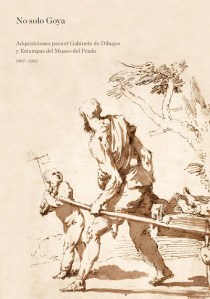 For the first time in the Museum’s history the catalogue has only been published in on-line format. An innovative new format has been designed that combines the benefits of the traditional printed book with the new possibilities offered by digital formats, such as links, attached archives, image enlargement, bibliographies and automatic searches.
The catalogue offers detailed descriptions and reproductions of the 111 works in the exhibition. The texts are written by curators at the Museum and by outside experts with whom the Museum is working on various projects that are currently in progress.
Exhibition: ‘The First Actresses’ in London
Press release rom the NPG:
The First Actresses: Nell Gwyn to Sarah Siddons
National Portrait Gallery, London, 20 October 2011 — 8 January 2012
Curated by Gill Perry, supported by Lucy Peltz

John Hoppner, "Mrs. Robinson as 'Perdita'," 1782 © Chawton House Library, Hampshire
The first exhibition to explore art and theatre in eighteenth-century England through portraits of women will open at the National Portrait Gallery in October 2011. With 53 portraits, some brought together for the first time and others not previously seen in public, the exhibition will show the remarkable popularity of actress-portraits and provide a vivid spectacle of eighteenth-century femininity, fashion and theatricality. The First Actresses: Nell Gwyn to Sarah Siddons will show large paintings of actresses in their celebrated stage roles, intimate and sensual off-stage portraits and mass-produced caricatures and prints, and explore how they contributed to the growing reputation and professional status of leading female performers.
The exhibition will combine much-loved works by artists such as Joshua Reynolds, Thomas Gainsborough, John Hoppner, Thomas Lawrence, Johann Zoffany and James Gillray, with some newly discovered works such as the National Portrait Gallery’s new acquisition of the Three Witches from Macbeth by Daniel Gardner.
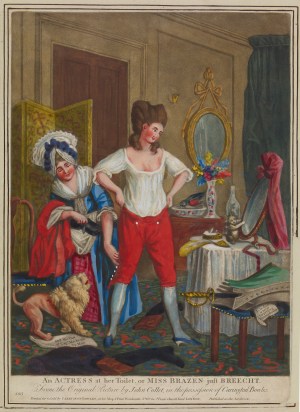
After John Collett, "An Actress at Her Toilet or Miss Brazen just Breecht," ca. 1779
Actresses featured in the exhibition include Nell Gwyn, Kitty Clive, Hester Booth, Lavinia Fenton, Peg Woffington, Sarah Siddons, Mary Robinson, Dorothy Jordan, Elizabeth Farren, Giovanna Baccelli and Elizabeth Linley. Highlights include a little known version of Reynolds’s famous portrait of Sarah Siddons as the Tragic Muse, Hogarth’s The Beggar’s Opera, Gainsborough’s portraits of Giovanna Bacelli and Elizabeth Linley. Important loans include works from the Garrick Club Library, the Royal Shakespeare Company, the National Gallery of Art, Washington, The Fitzwilliam Museum, Cambridge, Tate Britain, the V&A, as well as Petworth, Kenwood and Longleat Houses.
Starting with the emergence of the actress’s profession in the late seventeenth century, The First Actresses: Nell Gwyn to Sarah Siddons will show how women performers, in drama, as well as music and dance, were key figures within a spectacular celebrity culture. Fuelled by gossipy theatre and art reviews, satirical prints and the growing taste for biography, eighteenth-century society engaged in heated debate about the moral and sexual decorum of women on stage and revelled in the traditional association between actress and prostitute, or ‘whores and divines’. The exhibition will also reveal the many ways in which women performers stimulated artistic innovation and creativity and provoked intellectual debate.
As well as focusing on the eighteenth-century actress as a glamorous subject of high art portraits, and the ‘feminine face’ of eighteenth century celebrity culture, the exhibition will look at the resonances with modern celebrity culture and the enduring notion of the actress as fashion icon. As a counterpoint to the exhibition, an accompanying display will show photographic and painted portraits, drawn from the Gallery’s permanent collections, of some of today’s actresses, some of whom have agreed to be the exhibition’s ‘Actress Ambassadors’. A full list will be published prior to opening.
◊ ◊ ◊ ◊ ◊
An exhibition conference will take place on Friday, 11 November 2011.
Exhibition catalogue: Gill Perry with Joseph Roach and Shearer West, The First Actresses: Nell Gwyn to Sarah Siddons (London: National Portrait Gallery, 2011), 160 pages, ISBN: 9781855144118, £30.
Exhibition: ‘Italian Master Drawings’ in Washington
Press release from the National Gallery in DC:
Italian Master Drawings from the Wolfgang Ratjen Collection, 1525–1835
National Gallery of Art, Washington D.C., 8 May — 27 November 2011
Curated by Margaret Morgan Grasselli

Canaletto, "The Giovedì Grasso Festival before the Ducal Palace in Venice," 1763/1766 (Washington DC: National Gallery, Ratjen Collection, Paul Mellon Fund 2007.111.55)
Splendors of Italian draftsmanship from the Wolfgang Ratjen Collection, spanning the late Renaissance to the height of the neoclassical movement, will be showcased at the National Gallery of Art, Washington. On view in the Gallery’s West Building from May 8 to November 27, 2011, Italian Master Drawings from the Wolfgang Ratjen Collection, 1525–1835 will include 65 stunning Italian compositions and study sheets by the most important artists of the period, from Giulio Romano and Pellegrino Tibaldi to Canaletto, all three members of the Tiepolo family, and Giovanni Battista Piranesi.
In 2007, the National Gallery of Art acquired 185 German and Italian works from the Ratjen Collection—one of the finest private European holdings of old master drawings—with the help of 12 generous private donors as well as the Paul Mellon Fund and the Patrons’ Permanent Fund. “We are delighted to celebrate the second part of the Gallery’s acquisition of this exceptional group of German and Italian drawings formed by the great European collector Wolfgang Ratjen,” said Earl A. Powell III, director, National Gallery of Art. “The Italian portion of the collection is an assemblage of works of beauty and power. Italian drawings were in fact Ratjen’s first love, and he worked on this part of his collection with attentive care throughout his years as a collector.”

ISBN: 9781907372216, $50
Wolfgang Ratjen formed his Italian collection of drawings over a period of about 25 years. He grew up with two that had been acquired by his family during his youth—works by Guercino and Giovanni Battista Tiepolo—and he began collecting himself in the early-1970s. He purchased his last Italian drawing, by Giulio Cesare Procaccini, in July 1997. Ratjen’s collection of Italian drawings is best described as a group of single outstanding works, including famous artists as well as artists of lesser renown. For a select few—such as Jacopo Palma il Giovane, Guercino, and Giovanni Battista Tiepolo—he acquired multiple sheets that conveyed different facets of the artists’ styles or represented a variety of media used.
Organized chronologically throughout three galleries, the exhibition will present works that span three centuries, from the last flowering of the Renaissance around 1530 to the height of neoclassicism in the early 19th century. The works represent a dynamic range of techniques, including quick pen and ink sketches, finely nuanced chalk studies, and highly
finished brush drawings. (more…)
Exhibition: The Düsseldorf Gallery and Its Catalogue
Press release from the Getty:
Display and Art History: The Düsseldorf Gallery and Its Catalogue
Getty Research Institute, Getty Center, Los Angeles, 31 May — 21 August 2011
Curated by Thomas Gaehtgens and Louis Marchesano
ISBN: 9781606060926, $20
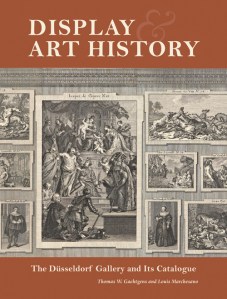
Display and Art History: The Düsseldorf Gallery and Its Catalogue illustrates the making of one of the earliest modern catalogues, La galerie électorale de Dusseldorff (1778), a revolutionary two-volume publication that played a significant role in the history of museums and helped mark the transition from the Baroque to the Enlightenment.
Constructed by Elector Palatine Johann Wilhelm II von der Pfalz between 1709 and 1714, the Düsseldorf gallery is an early example of exhibiting an art collection in a nonresidential structure. It charted the course toward what would eventually become the institution of the public museum. The Düsseldorf gallery featured a new system of display in which the arrangement of objects was determined by art historical principles such as style and school, rather than subject. Published in the second half of the eighteenth century, the Düsseldorf catalogue represented this new display in numerous etchings; the accompanying text sought to educate a broader circle of readers.
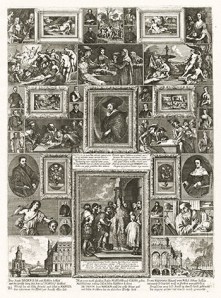
Fictive Wall of Paintings from the Imperial Collection in Vienna, Frans van Stampart and Anton Joseph von Prenner, etching. Prodromus (Vienna, 1735), pl. 21. 88-B2961
Display and Art History: The Düsseldorf Gallery and Its Catalogue, on view at the Getty Research Institute at the Getty Center from May 31 through August 21, 2011, showcases the exquisite watercolors, red chalk drawings, and architectural elevations that were used to produce this revolutionary catalogue. The exhibition explores their role in the printmaking process and underscores their value as precious works of art created by accomplished draftsmen. “We are most fortunate to have an almost complete set of preparatory drawings in our archives, which allows for the reconstruction of this ambitious enterprise and reflects a pivotal moment in the history of art as well as the history of the art museum,” says Thomas Gaehtgens, Director of the Getty Research Institute.
Prince-elector Johann Wilhelm II assembled one of the most important European art collections of the eighteenth century. He constructed a gallery to exhibit his nearly 400 paintings, 46 of which were by Peter Paul Rubens. At the time, many princes were reorganizing their substantial collections in order to convey the message that they not only possessed a wide variety of artistic treasures but were also able to care for them properly and make
them available for study.

Pierre-Louis de Surugue's etching after the "The Night" by Correggio, 1753–1757. Karl Heinrich von Heinecken, Recueil d'estampes d'apres les plus celebres tableaux de la Galerie Royale de Dresde..., vol. 2 (Dresden, 1757), pl. 1.
A generation later, Prince-elector Carl Theodor von der Pfalz, Johann Wilhelm’s nephew and successor, commissioned Lambert Krahe, director of the Düsseldorf Academy and gallery, to rehang the paintings collection following its storage during the Seven Years’ War (1756-63). Krahe broke with the Baroque tradition of decoratively covering entire walls with paintings. Instead, he displayed the paintings in a didactic, symmetrical arrangement ordered by schools, thus introducing a completely new and modern system of organizing art. Rather than hanging paintings frame-to-frame, Krahe integrated space between them, preserving their identity as separate works of art. This new display encouraged viewers to draw comparisons.
The Düsseldorf catalogue similarly fostered learning and education, in addition to celebrating the prestige of the collector. Produced by court architect Nicolas de Pigage, printmaker Christian von Mechel, and linguist Jean-Charles Laveaux, the catalogue illustrates Krahe’s display of paintings on the gallery walls. Unlike earlier catalogues that only provided brief inventories, Pigage’s publication offers an analysis of each painting that was aimed at an educated public. “In this sense, the catalog was very much a work of the Enlightenment, and the princely gallery, accessible to interested visitors,
became more like a museum as we understand it today,” says Gaehtgens.
Louis Marchesano, the GRI’s Curator of Prints and Drawings, adds, “The catalogue no longer simply represented princely magnificence; it now also fostered aesthetic reflection and art historical education.”
◊ ◊ ◊ ◊ ◊
Exhibition catalogue: Thomas W. Gaehtgens and Louis Marchesano, Display and Art History: The Düsseldorf Gallery and Its Catalogue (Los Angeles: Getty Publications, 2011), 104 pages, ISBN: 9781606060926, $20.
Johan Zoffany, More to Come — Exhibition, Catalogue, and Conference
From The Yale Center for British Art:
Johan Zoffany RA: Society Observed
Yale Center for British Art, New Haven, 27 October 2011 — 12 February 2012
The Royal Academy of Arts, London, 10 March — 10 June 2012
Curated by Martin Postle with Gillian Forrester and MaryAnne Stevens

Johan Zoffany, “The Drummond Family” (detail), ca. 1769 (New Haven: Yale Center for British Art)
Of all the major artists working in eighteenth-century England, none explored more inventively the complexities of Georgian society and British imperial rule than Johan Zoffany (1733–1810). Born near Frankfurt, Zoffany trained as an artist in Germany and Italy. In 1760 he moved to London, where he adapted brilliantly to the indigenous art culture and patterns of patronage, creating virtuoso portraits and subject pictures that proved to be highly desirable to a wide range of patrons. Zoffany’s work provides an invaluable and distinctive appraisal of key British institutions and edifices: the art academy, the Court, the theatre, the families of the aristocracy and bourgeoisie, and the burgeoning empire. Despite achieving considerable success in England, Zoffany remained in many ways an outsider, scrutinizing British society and its customs and mores. Restless and drawn to a peripatetic existence, he traveled for extended periods in his native Germany, Austria, Italy, and India. After his death there was no move to situate Zoffany as one of the key figures in the burgeoning British school of art; this exhibition aims to correct that oversight and will demonstrate his central importance to the artistic culture of eighteenth-century Britain and Europe. (more…)
Reviewed: English Silver from the Virginia Museum of Fine Arts
Recently published by Apollo Magazine:
Christopher Hartop, A Noble Pursuit: English Silver from the Rita Gans Collection at the Virginia Museum of Fine Arts (Richmond: Virginia Museum of Fine Arts, 2011), 88 pages, ISBN 9780917046902, $25.
Reviewed by Martin Chaisin; posted 1 May 2011.
In 1988, Jerome (Jerry) and Rita Gans loaned their magnificent collection of English silver of the 17th and 18th centuries to the Virginia Museum of Fine Arts (VMFA). The collection was eventually gifted to the museum in 1997; a decade later, it was permanently housed in a beautifully designed installation, as celebrated in Christopher Hartop’s earlier overview, ‘A Noble Feast: The Jerome and Rita Gans Collection of English Silver’ (2007). Then, following Jerry’s death, Rita assembled a collection – reflecting her taste and engaging personal style – from which she donated an additional 50 pieces to the museum in 2009. Hartop’s present publication is a catalogue of that latter collection, as well as an illuminating discussion of collecting, connoisseurship and the design and uses of silver in 18th-century England. . . .

The full review is available here»
Reviewed: ‘Baroque: Style in the Age of Magnificence’
Recently added to caa.reviews:
Michael Snodin and Nigel Llewellyn, eds., Baroque: Style in the Age of Magnificence 1620–1800, exhibition catalogue (London: V&A Publishing, 2009), 372 pages, ISBN: 9781851775583, $85.
Reviewed by Matthew Knox Averett, Creighton University; posted 29 April 2011.
‘Baroque 09’ was a yearlong series of cultural events in the United Kingdom that celebrated the era’s art, music and culture. The Victoria and Albert Museum participated with the well-received exhibition, ‘Baroque 1620–1800: Style in the Age of Magnificence‘, which ran from April 4 to July 19, 2009. Michael Snodin and Nigel Llewellyn’s volume of the same name serves as the catalogue for the exhibition. The book is more than this, however, as the catalogue itself comprises only twenty-eight pages located toward the back of the book. The preceding three hundred pages attempt to reconstruct the Baroque and present it to a wide audience. Making sense of the Baroque is a difficult challenge, but for the
most part the authors have succeeded. . .
The full review is available here» (CAA membership required)
Reviewed: New Publications on Meissen
Recently added to caa.reviews:
Ulrich Pietsch and Claudia Banz, eds., Triumph of the Blue Swords: Meissen Porcelain for Aristocracy and Bourgeoisie, 1710–1815 (Leipzig: E. A. Seemann, 2010), 400 pages, ISBN: 9783865022486, €49.90.
Ulrich Pietsch and Theresa Witting, eds., Fascination of Fragility: Masterpieces of European Porcelain (Leipzig: E. A. Seemann, 2010), 368 pages, ISBN: 9783865022479, €49.90.
Reviewed by Donna Corbin, Associate Curator, European Decorative Arts, Philadelphia Museum of Art; posted 22 April 2011.
‘Triumph of the Blue Swords, Meissen Porcelain for Aristocracy and Bourgeoisie, 1710–1815’ (the English-language version of ‘Triumph der blauen Schwerter. Meissener Porzellan für Adel und Bürgertum 1710–1815‘) and the accompanying exhibition at the Japanese Palace in Dresden (May 8–August 29, 2010) celebrate the three hundredth anniversary of the founding of the Meissen porcelain manufactory. The exhibition was conceived as one of three complementary exhibitions—the other two being ‘The Fascination of Fragility‘ (Ephraim-Palais, Berlin, May 9–August 29, 2010; catalogue reviewed below) and ‘All Nations are Welcome. Three Hundred Years of the Meissen Manufactory’ (Meissen, January 23–December 31, 2010)—organized for the anniversary year. The exhibitions were intended to commemorate the anniversary, to highlight the indisputably influential role Meissen played in the development of porcelain production across Europe in the eighteenth century, and to bring attention to the Staatliche Porzellan-Manufaktur Meissen that still exists today. . .
The full review is available here» (CAA membership required)
Reviewed: Portrait of the County of Dorset
Notice of the exhibition appeared here back in February. Alex Kidson’s recent review is, however, much more illuminating — and laudatory — than the general description.
Alex Kidson, “Review of Georgian Faces: Portrait of a County,” The Burlington Magazine 153 (April 2011): 274-75.
Anyone expecting . . . the kind of celebratory ‘treasures from local houses’ show that was a staple of regional museums until the later part of the last century is in for a surprise. The sixty-seven portraits that make up this exhibition are for the most part not masterpieces; but they have been selected with immense rigour. . . Gwen Yarker, the curator, for whom the show is a triumph, has lived in Dorset for many years, and her understanding of the history of the county is apparent at every turn. She has explicitly based her selection on the structure of the Revd John Hutchin’s ‘History and Antiquities of the County of Dorset’ of 1774, with its emphasis on social hierarchy, and has given full weight to eighteenth-century modes of patronage. She fearlessly prefers, for example, to include replicas over originals to remind us that our present-day obsession with ‘originality’ is not one that was shared in the eighteenth century. . . .
Yet in Yarker’s text [for the catalogue], as well as with her selection, art-historical revisionism is far from suppressed. . . . In fact, the show is full of art-historical trouvailles. . . . It seems almost an understatement to say that the exhibition is at the forefront of the current study of eighteenth-century British portraiture. More than that, in its concern for local detail, its accuracy, but also its willingness to confront problems and to speculate, it points the way forward for future research. In revealing just how powerfully the old county structure acts as a focus of inquiry, it occupies some of the same research terrain as the catalogues of the Public Catalogue Foundation, or some of the initiatives of the National Portrait Gallery’s Subject Specialist Network project Understanding British Portraits (which supported the exhibition’s study day); yet its impact is far more direct and forceful than theirs. . . What takes this exhibition out of the realms of the remarkable and into those of the miraculous is that it was accomplished on a budget of £1000. . . .
Furniture Exhibition at Winterthur: ‘Paint, Pattern, and People’
Press release from Winterthur:
Paint, Pattern & People: Furniture of Southeastern Pennsylvania, 1725-1850
Winterthur, 2 April 2011 — 8 January 2012
Curated by Wendy Cooper and Lisa Minardi

ISBN: 9780912724690, $55
This landmark exhibition explores the colorful furniture of southeastern Pennsylvania along with the people who made, owned, inherited, and collected it. Featuring nearly 200 objects—including furniture, fraktur, needlework, and paintings—the show focuses on the culture and creativity of the area’s English- and German-speaking inhabitants. Paint, Pattern & People sheds new light on southeastern Pennsylvania’s highly distinctive local expressions of furniture and presents important objects for which the maker or family history is known. This well-documented furniture provides a new context to understand the objects as fully as possible and place them within specific locations. Although the exhibition is about furniture, it is not about dovetails and glue blocks but rather the people of the region who are the threads from which the story is woven. Thus the furniture in Paint, Pattern & People is the vehicle that transports us into the lives of our ancestors and leads to a greater understanding of our rich cultural heritage.
Due to William Penn’s policy of religious tolerance that attracted people of various faiths and ethnic backgrounds, Pennsylvania was the most culturally diverse of the thirteen colonies. Through the study of objects produced by this great mixed multitude, the extraordinary vibrance and variety of the region’s furniture comes into focus. Ethnicity, religious affiliation, personal taste, socioeconomic status, and the skill of the craftsman all influenced local forms, ornamentation, and construction. (more…)










 Enfilade
2 comments