Exhibition: Toile de Jouy, Printed Gardens and Fields
I’m happy to welcome one more addition to the Enfilade team! The Paris-based Ph.D. student Hélène Bremer will be weighing in with occasional contributions. She completed her M.A. in Art History at the University of Leiden in 2000 and is now working on her dissertation (also at Leiden) “Grand Tour, Grand collections: The Influence of the Grand Tour Experience on Collection Display in the Eighteenth Century.” She’ll be reporting not only on events in France but also sharing news from the Netherlands. We start things off with an exhibition sketch in response to the Musée de la Toile de Jouy. -CH
◊ ◊ ◊ ◊ ◊
Parties de Campagne, Jardins et champs dans la toile imprimée XVIIIe-XIXe siècle
Musée de la Toile de Jouy, Jouy-en-Josas, 29 April — 20 November 2011
Exhibition sketch by Hélène Bremer

Founded in 1977, the Musée de la Toile de Jouy moved into its current home, the nineteenth-century Château d'Eglantine in 1991. The museum's holdings include some 5000 objects.
The Musée de la Toile de Jouy at Jouy-en-Josas is an ideal destination for anyone taken with wonderful fabrics and eighteenth-century history. Just a few kilometers from the Château de Versailles (though far from its tourist throngs), the museum is located at the Château d’Eglantine. While this charming setting is alone worth a visit, the museum’s interiors offer lovely rooms full of toile-covered furniture. Not only do you find here a vast collection of Toile de Jouy, the displays explain the industrialization of toile-making, particularly the printing innovations of factory founder Christophe-Philippe Oberkampf, the German immigrant who introduced to Jouy-en-Josas, the use of engraved copper plates (1770) and then copper rollers (1797), replacing the older wood blocks.
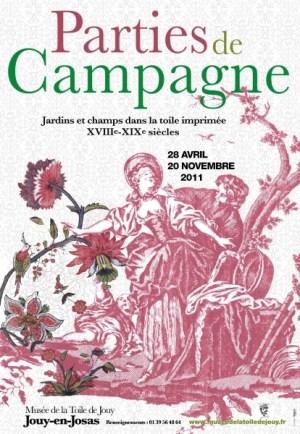 For the spring and summer, the staff of the museum have organized a delightful exhibition, Parties de Campagne, Jardins et champs dans la toile imprimée XVIIIe-XIXe siècles. The curators have assembled over 200 examples of fabrics depicting a wide variety of subjects: the four seasons, workers in the fields, shepherds and hunting scenes, children playing, landscapes with ruins, and fête champêtre motifs. There is also a nice, small fabric-covered balloon — to my mind, just begging to be shown with the fabric, Le Ballon de Gonesse, an example of which can be found nearby in the museum’s permanent display.
The sheer quantity of fabrics on display is impressive, suggesting at times the feel of a densely packed closet. The quantity indicates how much there is to explore on this interesting topic of la vie champêtre and how rich the museum’s holdings are, given that all the material comes from the museum’s own collection.
Having seen the exhibition, I’m curious about the accompanying book, edited by Anne de Thoisy-Dallem, which unfortunately was not yet available when I visited in early May. It promises to be a useful publication with two fully-illustrated volumes, addressing not only the exhibition themes but also outlining new research on rare costumes, the gardens of Toile de Jouy, and precious botanical books that provided inspiration for the pattern designers.
For more information, including terrific images, the press release (in French) is available here»
The Wallace Collection’s Reynolds Research Project
Exciting news from The Wallace Collection (22 July 2011) . . .

X-Ray Image of the Portrait of 'Mrs Jane Braddyll', Wallace Collection, 2011
The Wallace Collection Reynolds Research Project is a three year project funded by The Paul Mellon Centre for Studies in British Art. A collaboration between the Wallace Collection and the Conservation and Scientific Departments at the National Gallery, its purpose is to investigate the techniques and materials used by Reynolds by examining twelve of his paintings, which are in the Wallace Collection; and use this research as a basis for their conservation.
To examine the paintings, images are captured using high resolution digital photography, infrared and x-ray, and small paint samples are taken. Initial results have already revealed how complex Reynolds’ technique really was!
This very exciting project will continue to yield new and surprising results, with all the research being made publicly available later in the project. Alongside this, the Wallace Collection will continue to provide updates as new discoveries are made. The first restored painting has already arrived back at the Collection: Mrs Elizabeth Carnac, which can now be seen in the Great Gallery. The project will culminate in an exhibition, catalogue and scholarly conference at the Collection in 2014, which is sure to be well worth the wait!
Exhibition: ‘Making History: Antiquaries in Britain’

Making History: Antiquaries in Britain
McMullen Museum of Art, Boston College, 4 September — 11 December 2011
Yale Center for British Art, New Haven, 2 February — 27 May 2012
Making History celebrates the achievements of the Society of Antiquaries of London, the oldest independent learned society concerned with the study of the past. The exhibition, featuring one hundred works selected from the Society’s treasures (with a number of additions from the collections at the Center), focuses on the discovery, recording, preservation, and interpretation of Britain’s past through its material remains. It explores beliefs current before the Society was founded in 1707, and reveals how new discoveries, technologies, and interpretations have transformed our understanding of the history of Britain since the eighteenth century.
 Making History is organized into nine sections. Highlights include antiquities such as a rare Late Bronze Age shield (ca. 1300–1100 BCE) discovered on a farm in Scotland in 1779; an early copy of the Magna Carta (ca. 1225); a medieval processional cross reportedly recovered from the battlefield of Bosworth (1485); the inventory (1550–51) of Henry VIII’s possessions at the time of his death; and a forty-foot-long illuminated “roll chronicle” on parchment detailing the genealogical descent of Henry II from Adam and Eve. Also on display will be an extraordinary collection of English royal portraits painted on panel, from Henry VI to Mary Tudor.
The exhibition is organized by the Society of Antiquaries of London in association with the McMullen Museum of Art, Boston College, and the Center. It will be on display at the McMullen Museum of Art from September 9, 2011, to January 2, 2012, where the organizing curator is Nancy Netzer, Director. The organizing curator at the Center is Elisabeth Fairman, Senior Curator of Rare Books and Manuscripts.
◊ ◊ ◊ ◊ ◊
More information is available at the exhibition website.
Exhibition: French Romantic Gardens
Thanks to Hélène Bremer for this notice. From the exhibition website:
Jardins Romantiques Français (1770-1840)
Musée de la Vie Romantique, Paris, 8 March — 17 July 2011
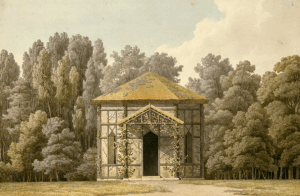
Louis-Hippolyte Lebas, "Le Petit Pavillon du Parc de Malmaison," watercolor (Musée National du château de la Malmaison) © RMN/Gérard Blot -- the building was designed by François Cointereaux around 1790.
Comment proposer aujourd’hui une définition du jardin romantique français, telle est la question que nous nous sommes posée alors que certains des meilleurs spécialistes en réfutent l’appellation. Aussi bien avons-nous usé du pluriel dans le titre « Jardins romantiques » pour évoquer, sans pouvoir être exhaustif, certains parmi les trop multiples reflets du romantisme au jardin.
Au fil des siècles et des saisons, le goût du jardin pittoresque s’est raffiné en un art de vivre à part entière dont les Encyclopédistes puis Beaumarchais avant l’impératrice sont les ambassadeurs écoutés. Au premier rang s’imposent naturellement voyageurs et savants qui rapportent et multiplient, d’un continent à l’autre, moult herbiers
soigneusement conservés au Muséum et rares cultivars
développés dans le secret des pépinières ou à l’arboretum.
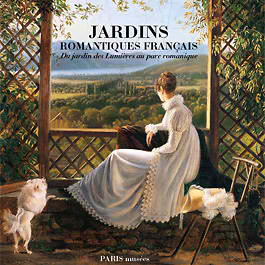
ISBN: 9782759601592, 30€
Au XIXe siècle l’Europe des botanistes résonne tel un bruissant arbre à palabres : on y disserte en latin comme en français sur les principes modernes de la taxinomie et de la dendrologie ; jardinistes et passionnés ouvrent largement les enclos sur la nature environnante et plantent des parcs paysagers. Serres chaudes et palmariums ponctuent les propriétés que leurs commanditaires identifient à leur récente prospérité. Le sentiment du sublime inspire fabriques et cascades, grottes et lacs. Ces nouveaux jardins d’Armide s’ornent de maints caprices secrets : temple de l’amour ou laiterie, chalet ou casino, faux tombeaux ou ménagerie. Pour les délices du vert galant, il n’est pas de sens plus nomade que la vue. Ainsi, la Restauration et la Monarchie de Juillet voient la pratique du jardinage conquérir toutes les couches de la société, et les grands destins du romantisme s’y enracinent. . . .
More information is available here»
◊ ◊ ◊ ◊ ◊
Exhibition catalogue: Daniel Marchesseau, Jardins romantiques français: Du jardin des Lumières au parc romantique (Paris Musées, 2011), 256 pages, ISBN: 9782759601592, 30€.
Exhibition: ‘Revolution!’
From the New-York Historical Society:
Revolution! The Atlantic World Reborn
New-York Historical Society, 11 November 2011 — 15 April 2012
Details of additional venues to be announced later
Curated by Richard Rabinowitz

ISBN: 9781904832942, $65
Revolution! The Atlantic World Reborn, an international exhibition sponsored by the New-York Historical Society, will open in New York in November 2011 and travel to sites in Britain, France, the United States, and Haiti. Occupying about 3,500 square foot (325 m2), the exhibition will feature magnificent paintings, drawings, and prints from collections in a half-dozen countries; historical documents, maps, and manuscripts penned by participants in these revolutions; audio-visual presentations and computer-interactive learning stations; inventive and beautiful works of art commissioned for this exhibition; and curriculum materials for students from kindergarten through graduate school. The exhibition will be fully accessible in English, French, and Haitian Kreyol. Dr. Richard Rabinowitz of the American History Workshop, is Chief Curator of the exhibition. A beautifully illustrated catalog, with scholarly essays by leading scholars in revolutionary studies and edited by Professors Thomas Bender of NYU and
Laurent Dubois of Duke, will accompany the exhibition.

Noel le Mire, "General Washington," 1780, engraving (New York Historical Society)
The exhibition explores the enormous transformations in the world’s politics and culture between the 1763 triumph of the British Empire in the Seven Years War and the end of the Napoleonic Wars 52 years later. For the first time, this story will be told as a single global narrative rather than as chapters within national histories. Opposing the power and reach of European imperial authorities, the diverse men and women of the Atlantic world — natives of Africa, Europe, and the Americas — registered their grievances in both legal argument and violent protest. Their first major outbursts, comprised in the American Revolution, triggered an explosion of radical ideas. And these in turn drew many Britons to the antislavery crusade, then fomented a fierce antagonism to entrenched privilege among French revolutionaries, and finally spawned the astonishing insurrection on the island of Saint Domingue leading to the world’s only successful slave revolt and the establishment of the first nation fully committed to equality and emancipation, Haiti.

John Greenwood, "Sea Captains Carousing in Surinam," ca. 1752-58, oil on bed ticking (Saint Louis Art Museum)
Linking the attack on monarchism and aristocracy to the struggle against slavery, Revolution! explores how thousands of revolutionaries across the Atlantic world made freedom, equality, and the sovereignty of the people into universal goals. The eighteenth-century revolutionaries certainly did not succeed in obliterating every trace of the Ancient Regime, but they invented the notions of human rights, within a world of nation states, that still fire the desire for justice everywhere.
◊ ◊ ◊ ◊ ◊
Exhibition catalogue: Thomas Bender and Laurent Dubois, eds., Revolution! The Atlantic World Reborn (London: Giles, 2011), 288 pages, ISBN: 9781904832942, $65.
Exhibition: ‘Life, Liberty, and the Pursuit of Happiness’
Life, Liberty, and the Pursuit of Happiness: American Art from the Yale University Art Gallery
Speed Art Museum, Louisville, 7 September 2008 — 4 January 2009
Seattle Art Museum, 26 February — 24 May 2009
Birmingham Museum of Art, Alabama, 4 October 2009 — 10 January 2010
Yale University Art Gallery, New Haven, 29 July 2011 — 8 July 2012 (in three parts)

John Trumbull, "The Declaration of Independence, July 4, 1776," 1786–1820 (Yale University Art Gallery)
This exhibition draws upon the Gallery’s renowned collection of American paintings, decorative arts, and prints to illuminate the diverse and evolving American experience from the time of the settlements of the late seventeenth century to the World’s Columbian Exposition in 1893. The more than 200 works in this traveling exhibition—including treasures such as John Trumbull’s Declaration of Independence and Winslow Homer’s Morning Bell—now return to New Haven for a three-part presentation.
Exhibition and publication organized by Helen A. Cooper, the Holcombe T. Green Curator of American Paintings and Sculpture, with Robin Jaffee Frank, the Alice and Allan Kaplan Senior Associate Curator of American Paintings and Sculpture; Elisabeth Hodermarsky, the Sutphin Family Associate Curator of Prints, Drawings, and Photographs; and Patricia E. Kane, Friends of American Arts Curator of American Decorative Arts, all Yale University Art Gallery.
◊ ◊ ◊ ◊ ◊
Exhibition catalogue: Helen A. Cooper, ed., Life, Liberty, and the Pursuit of Happiness: American Art from the Yale University Art Gallery (New Haven: Yale University Press, 2008), 368 pages, ISBN: 9780300122893.
 The American experience—from its colonial beginnings to the modern age—has captured the imagination of all Americans, including its artists. This richly illustrated book explores works from the renowned collections of American paintings, decorative arts, prints, and photographs at the Yale University Art Gallery and creates a vivid portrait of a young country defining itself culturally, politically, and geographically.
Distinguished scholars shed new light on American history by examining some of the most familiar and revered objects in American art—paintings by Trumbull, Peale, Copley, Eakins, Church, and Homer; silver by Revere and Tiffany; furniture by Roux and Connelly; and photographs by Muybridge, among others. The authors discuss how issues of cultural heritage, patriotism, politics, and exploration shaped America’s art as well as its attitudes and traditions.
Exhibition: ‘Georges de Lastic: Amateur, Collector, and Curator’
As reviewed by Bénédict Ancenay for The Art Tribune (18 February 2011) . . .
Georges de Lastic: Le Cabinet d’un amateur, collectionneur et conservateur
Musée de la Chasse et de la Nature, Paris, 7 December 2010 — 14 March 2011
Musée de la Vénerie, Senlis, 7 December 2010 — 14 March 2011
Musée d’Art Roger-Quilliot, Clermont-Ferrand, 4 October 2011 — 5 February 2012
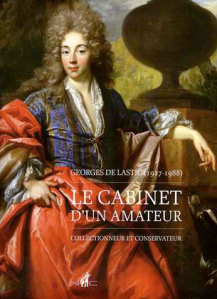
ISBN: 978-2350391021, 42.00€
One man and two exhibitions, Georges de Lastic (1927-1988), a curator and collector, amply deserves this celebration in the two locations which distinctly marked his professional life. . . . An aesthete and historian, both in his professional and personal life, Georges de Lastic assembled a private collection which is now highlighted in the double exhibition presented at the Musée de la Vénerie in Senlis and the Musée de la Chasse et de la Nature in Paris. . . .
In 1970, Georges de Lastic inherited the château de Parantignat, his “little Versailles in Auvergne,” the residence for the Marquis de Lastic for over three centuries which, along with his Parisian apartment on quai de Bourbon, housed his collection of 17th- and 18th- century French paintings acquired over the years at the Drouot auction house and from various art dealers. The ensemble is made up mainly of three artists, the portraitists Nicolas de Largillierre and Hyacinthe Rigaud, representative of the “grand genre” in the Grand Siècle and the Regency, as well as François Desportes, an artist who illustrated the Sun King’s hunting parties. His wife, Françoise de Lastic and his son, Anne-François, who today are in charge of preserving the collection, accepted to lend over sixty paintings, drawings and sculptures. . . .
All of these magnificent pieces now on display to the general public will soon return to their private residence, but the catalogue will remain in testimony. The entries, under the supervision of Pierre Rosenberg, were all written by the most respected specialists of each of the artists in the exhibition. Curators, university scholars, historians or researchers, each has achieved a hymn to the glory of French painting during the Grand Siècle and Georges de Lastic’s refined taste.
A visit to the Marais, at the Musée de la Chasse et de la Nature, is a traditional part of any art lover’s itinerary. They should now add a trip to Senlis to better understand the range and complexity of the Lastic collection. This sidetrip will also allow visitors to rediscover the Musée de la Vénerie, which houses a valuable collection presented with great quality, thus going far beyond the misleadingly limited confines of its name in a historic city which has known how to preserve all of its charm.
The full review is available here»
◊ ◊ ◊ ◊ ◊
Exhibition catalogue: Pierre Rosenberg et al., Le cabinet d’un amateur, Georges de Lastic (1927-1988), collectionneur et conservateur (Paris: Chaudun, 2010), 240 pages, ISBN: 978-2350391021, 42€.
Reviewed: ‘Thomas Gainsborough and the Modern Woman’
Benedict Leca, Aileen Ribeiro, and Amber Ludwig, Thomas Gainsborough and the Modern Woman, ed. Benedict Leca (London: Giles Limited, 2010) 196 pages, ISBN: 9781904832850, $49.95.
Reviewed for Enfilade by Susan M. Wager
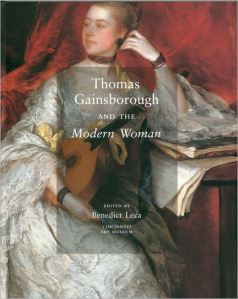 After a visit to Thomas Gainsborough’s studio in October 1760, the socially and culturally accomplished Mary Delany wrote, “There I saw Miss Ford’s picture—a whole length with her guitar, a most extraordinary figure, handsome and bold; but I should be sorry to have any one I loved set forth in such a manner.” The picture in question, Gainsborough’s Ann Ford of 1760, and the ambivalent reactions (like Mrs. Delany’s) it has engendered, is the central focus of Thomas Gainsborough and the Modern Woman. This lavishly illustrated catalogue, published to accompany an exhibition of the same name that originated at the Cincinnati Art Museum in 2010 before traveling to the San Diego Museum of Art earlier this year, was edited by Benedict Leca, Curator of European Painting, Sculpture, and Drawings at the Cincinnati Art Museum.
The portrait of Ann Ford—an eighteenth-century woman who garnered an ambiguous reputation by daring to organize public performances of her talent at the viola da gamba (unusual for a woman at the time)—was acquired by the Cincinnati Art Museum in 1927 and remains a highlight of the Museum’s collection. Leca has cleverly constructed an exhibition around the portrait, enriching our understanding of it through the juxtaposition of several well-selected loans. These include some of Gainsborough’s portraits of other “demireps”—women whose “social and sexual assertiveness combined with their flair for personal style and public exposure ran counter to propriety,” as defined by Leca. The catalogue’s three essays—by Leca, Aileen Ribeiro, and Amber Ludwig—all seem to be underpinned, implicitly, by the question: to what extent were these “demireps” in control of the constructed identities mediated through their painted portraits?
Leca’s approach to this question is decidedly optimistic. Drawing on compelling evidence such as Ann Ford’s published writings on the merits of the female sex, Leca argues that Gainsborough and Ford, in addition to some of his other female sitters, were equal partners in the production of images that challenged circumscribed gender codes and asserted female liberation from masculine control. Leca reads the correlation of Gainsborough’s signature loose brushwork—deemed “feminine” by his contemporaries—with painted passages of conventionally feminine accessories adorning sexually assertive women as the artist’s ironic and progressive rejection of masculinist norms. As Leca writes, Gainsborough’s portraits present “provocative women provocatively painted.”
Ribeiro’s essay considers how the costumes worn by Gainsborough’s demireps participated in the negotiation of reputation, class, and status. Ribeiro subtly complicates Leca’s reading of Ann Ford by evoking scholars who have suggested that paintings of accomplished women like Ford could be seen as relatively traditional presentations of ideal and precious objects of beauty, served up for the viewer’s delectation. Although Ribeiro ultimately disagrees with these readings, her essay nonetheless gestures toward the plurality of interpretations that can be gleaned from images of demireps.
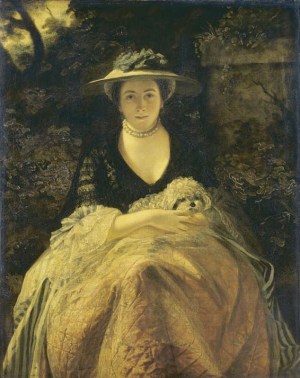
Joshua Reynolds, "Portrait of Nelly O'Brien," ca. 1762-64 (London: Wallace Collection)
Leca and Ribeiro mobilize two different portraits by Joshua Reynolds of the courtesan Nelly O’Brien to make divergent points about Ann Ford. Leca emphasizes the “subversive femininity” and “suggestiveness” of Ford’s pose by contrasting it to Reynolds’s 1762-4 portrait of O’Brien (The Wallace Collection). Whereas Reynolds dissembles the unsavory profession of O’Brien through the imposition of a pyramidal, closed, Marian pose onto her body, Gainsborough flaunts the immodesty and impropriety of Ford’s dynamic, crossed-leg attitude. Ribeiro, however, juxtaposes Ann Ford with a 1763-7 Reynolds portrait of O’Brien (The Hunterian Museum & Art Gallery, University of Glasgow) in order to underscore the formality of Ford’s dress in contrast to O’Brien’s “loose bed-gown.” The latter is far more scandalous than Ford’s costume, which would have been chosen precisely to shore up Ford’s ambiguous reputation. Conflicting readings like these do not detract from the overall thrust of the book; instead, they strengthen it, attesting to the complexity of the images under examination.

Joshua Reynolds, "Portrait of Nelly O'Brien," ca. 1763-67 (Glasgow: Hunterian Museum)
Indeed, complexity characterizes the images addressed by Amber Ludwig in her essay on how portraiture could attach the appearance of virtue to women with dubious reputations. Addressing pictures of Emma Hamilton, she underscores, for instance, tensions between the desires and personality of the sitter and the desires for propriety imposed by her husband or lover.
Thomas Gainsborough and the Modern Woman would be a welcome addition to the libraries of scholars and general readers alike. The catalogue’s clear prose is supplemented by sumptuous, full-color plates and extraordinarily high-resolution details, offering a worthy substitute for individuals who did not see the exhibition, or a handsome aide-mémoire for those who did.
◊ ◊ ◊ ◊ ◊
Susan M. Wager is a Ph.D. candidate in Art History & Archaeology at Columbia University. Her research examines eighteenth-century reproductions after François Boucher in the mediums of gems, porcelain, and tapestries at the intersection of consumer culture, natural history, antiquarianism and connoisseurship, and global exchange.
The Prado Publishes New Acquisitions Catalogue *Only* Online — It’s Free
Is this the future or just an experiment along the way? From the Prado’s website:
José Manuel Matilla, ed., No solo Goya: Adquisiciones para el Gabinete de Dibujos y Estampas del Museo del Prado 1997-2010, exhibition catalogue (Madrid: Prado, 2011), 383 pages, ISBN: 9788484802204.
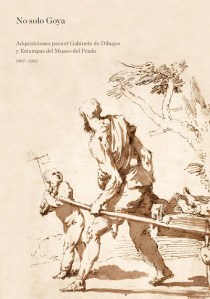 For the first time in the Museum’s history the catalogue has only been published in on-line format. An innovative new format has been designed that combines the benefits of the traditional printed book with the new possibilities offered by digital formats, such as links, attached archives, image enlargement, bibliographies and automatic searches.
The catalogue offers detailed descriptions and reproductions of the 111 works in the exhibition. The texts are written by curators at the Museum and by outside experts with whom the Museum is working on various projects that are currently in progress.
Exhibition: ‘The First Actresses’ in London
Press release rom the NPG:
The First Actresses: Nell Gwyn to Sarah Siddons
National Portrait Gallery, London, 20 October 2011 — 8 January 2012
Curated by Gill Perry, supported by Lucy Peltz

John Hoppner, "Mrs. Robinson as 'Perdita'," 1782 © Chawton House Library, Hampshire
The first exhibition to explore art and theatre in eighteenth-century England through portraits of women will open at the National Portrait Gallery in October 2011. With 53 portraits, some brought together for the first time and others not previously seen in public, the exhibition will show the remarkable popularity of actress-portraits and provide a vivid spectacle of eighteenth-century femininity, fashion and theatricality. The First Actresses: Nell Gwyn to Sarah Siddons will show large paintings of actresses in their celebrated stage roles, intimate and sensual off-stage portraits and mass-produced caricatures and prints, and explore how they contributed to the growing reputation and professional status of leading female performers.
The exhibition will combine much-loved works by artists such as Joshua Reynolds, Thomas Gainsborough, John Hoppner, Thomas Lawrence, Johann Zoffany and James Gillray, with some newly discovered works such as the National Portrait Gallery’s new acquisition of the Three Witches from Macbeth by Daniel Gardner.
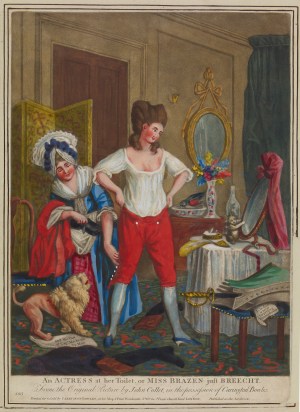
After John Collett, "An Actress at Her Toilet or Miss Brazen just Breecht," ca. 1779
Actresses featured in the exhibition include Nell Gwyn, Kitty Clive, Hester Booth, Lavinia Fenton, Peg Woffington, Sarah Siddons, Mary Robinson, Dorothy Jordan, Elizabeth Farren, Giovanna Baccelli and Elizabeth Linley. Highlights include a little known version of Reynolds’s famous portrait of Sarah Siddons as the Tragic Muse, Hogarth’s The Beggar’s Opera, Gainsborough’s portraits of Giovanna Bacelli and Elizabeth Linley. Important loans include works from the Garrick Club Library, the Royal Shakespeare Company, the National Gallery of Art, Washington, The Fitzwilliam Museum, Cambridge, Tate Britain, the V&A, as well as Petworth, Kenwood and Longleat Houses.
Starting with the emergence of the actress’s profession in the late seventeenth century, The First Actresses: Nell Gwyn to Sarah Siddons will show how women performers, in drama, as well as music and dance, were key figures within a spectacular celebrity culture. Fuelled by gossipy theatre and art reviews, satirical prints and the growing taste for biography, eighteenth-century society engaged in heated debate about the moral and sexual decorum of women on stage and revelled in the traditional association between actress and prostitute, or ‘whores and divines’. The exhibition will also reveal the many ways in which women performers stimulated artistic innovation and creativity and provoked intellectual debate.
As well as focusing on the eighteenth-century actress as a glamorous subject of high art portraits, and the ‘feminine face’ of eighteenth century celebrity culture, the exhibition will look at the resonances with modern celebrity culture and the enduring notion of the actress as fashion icon. As a counterpoint to the exhibition, an accompanying display will show photographic and painted portraits, drawn from the Gallery’s permanent collections, of some of today’s actresses, some of whom have agreed to be the exhibition’s ‘Actress Ambassadors’. A full list will be published prior to opening.
◊ ◊ ◊ ◊ ◊
An exhibition conference will take place on Friday, 11 November 2011.
Exhibition catalogue: Gill Perry with Joseph Roach and Shearer West, The First Actresses: Nell Gwyn to Sarah Siddons (London: National Portrait Gallery, 2011), 160 pages, ISBN: 9781855144118, £30.










1 comment