Exhibition | Olympus on the Lake: Canova, Thorvaldsen, Hayez
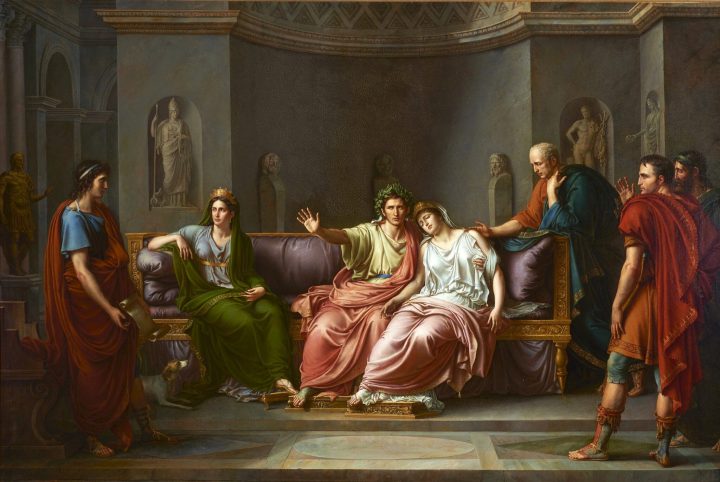
Jean-Baptiste Joseph Wicar, Virgil Reading the Sixth Canto of the Aeneid, 1818–21, oil on canvas
(Tremezzo: Museo di Villa Carlotta)
◊ ◊ ◊ ◊ ◊
Now on view at Villa Carlotta (with an English description available here) . . .
Olympus on the Lake: Canova, Thorvaldsen, Hayez, and the Treasures of the Sommariva Collection
Villa Carlotta, Tremezzo (on Lake Como), 22 June – 30 September 2024
Abile politico e potente braccio destro di Napoleone a Milano, Giovanni Battista Sommariva (1762–1826) è stato uno dei maggiori e più celebri collezionisti tra l’Impero e la Restaurazione. Approfittando di quei tempi di rapidi e radicali cambiamenti, nel 1802—quando si interruppe la sua breve ma fulminante carriera—era ormai riuscito a costruirsi una immensa fortuna.
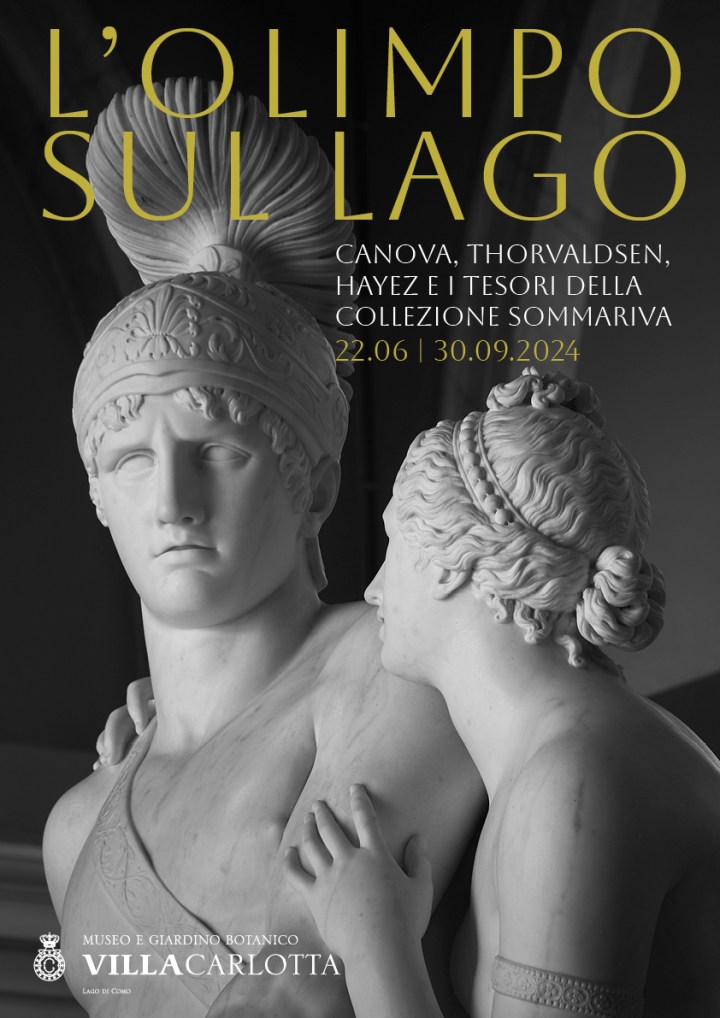 La sua leggendaria raccolta era una delle più importanti dell’epoca, insieme a quelle dei familiari di Napoleone, in particolare dell’imperatrice Josephine. Divisa tra il suo palazzo a Parigi, in uno dei quartieri più alla moda della città, e la villa di Tremezzo sul Lago di Como (oggi Villa Carlotta), vantava dipinti antichi e capolavori dei maggiori artisti dell’epoca—David, Prud’hon, Girodet, Wicar, Appiani, Bossi, Hayez—oltre a una infinità di preziosi oggetti d’arte. Soprattutto per la presenza a Villa Sommariva delle opere di Canova e degli splendidi marmi di Thorvaldsen, accorrevano viaggiatori da tutto il mondo, tra cui personaggi illustri come Stendhal, Lady Morgan, Flaubert. Attraverso una selezione delle opere più famose di quella straordinaria collezione—sculture, dipinti, stampe, gioielli e miniature—Villa Carlotta celebra un magnifico protagonista della propria storia e un grande mecenate di statura europea.
Per tutta la durata della mostra L’Olimpo sul lago, è possibile visitare presso il Museo del Paesaggio del Lago di Como (Tremezzina) l’esposizione Paesaggio sublime: Il Lago di Como all’epoca di Giovanni Battista Sommariva (1801–1826) che esporrà incisioni, tempere e acquerelli della prima a metà del XIX secolo con il proposito di evocare l’aspetto del lago e dei suoi borghi al tempo di Giovanni Battista Sommariva.
Fernando Mazzocca, Maria Angela Previtera, and Elena Lissoni, eds., L’Olimpo sul lago: Canova, Thorvaldsen, Hayez e i tesori della Collezione Sommariva (Milan: Silvana Editoriale, 2024), 352 pages, ISBN 978-8836658336, €35.
Exhibition | Belle da Costa Greene: A Librarian’s Legacy
Opening in October at The Morgan:
Belle da Costa Greene: A Librarian’s Legacy
The Morgan Library & Museum, New York, 25 October 2024 — 4 May 2025
Organized by Philip Palmer and Erica Ciallela
 The incredible story of the first director of the Morgan Library: a visionary Black woman who walked confidently in an early 20th-century man’s world of wealth and privilege
To mark the 2024 centenary of its life as a public institution, the Morgan Library & Museum will present a major exhibition devoted to the life and career of its inaugural director, Belle da Costa Greene (1879–1950). Widely recognized as an authority on illuminated manuscripts and deeply respected as a cultural heritage executive, Greene was one of the most prominent librarians in American history.
She was the daughter of Genevieve Ida Fleet Greener (1849–1941) and Richard T. Greener (1844–1922), the first Black graduate of Harvard College, and was at birth known by a different name: Belle Marion Greener. After her parents separated in the 1890s, her mother changed the family surname to Greene, Belle and her brother adopted variations of the middle name da Costa, and the family began to pass as White in a racist and segregated America.
Greene is well known for the instrumental role she played in building the exceptional collection of rare books and manuscripts formed by American financier J. Pierpont Morgan, who hired her as his personal librarian in 1905. After Morgan’s death in 1913, Greene continued as the librarian of his son and heir, J.P. Morgan Jr., who would transform his father’s Library into a public institution in 1924. But her career as director of what was then known as the Pierpont Morgan Library―a leadership role she held for twenty-four years―is less well understood, as are aspects of her education, private collecting, and dense social and professional networks.
The exhibition will trace Greene’s storied life, from her roots in a predominantly Black community in Washington, D.C., to her distinguished career at the helm of one of the world’s great research libraries. Through extraordinary objects―from medieval manuscripts and rare printed books to archival records and portraits―the exhibition will demonstrate the confidence and savvy Greene brought to her roles as librarian, scholar, curator, and cultural executive, and honor her enduring legacy.
This exhibition is organized by Philip Palmer, Robert H. Taylor Curator and Department Head of Literary and Historical Manuscripts, and Erica Ciallela, Exhibition Project Curator.
Erica Ciallela and Philip Palmer, eds., Belle da Costa Greene: A Librarian’s Legacy (New York: DelMonico Books, 2024), 304 pages, ISBN: 978-1636811352, $50. With a foreword by Colin Bailey, an afterword by Tamar Evangelestia-Dougherty, and contributions by Araceli Bremauntz-Enriquez, Julia Charles-Linen, Erica Ciallela, Rhonda Evans, Anne-Marie Eze, Daria Rose Foner, Jiemi Gao, Juliana Amorim Goskes, Gail Levin, Philip Palmer, Deborah Parker, and Deborah Willis.
The Burlington Magazine, June 2024
Summer is for falling behind . . . and for catching up . . . The long 18th century in the June issue of The Burlington:
The Burlington Magazine 166 (June 2024)
e d i t o r i a l
 • “La Serenissima,” p, 543.
Henry James famously wrote in his Italian Hours (1909) that there is nothing more to be said about Venice. As so much ink has been spilt over its charms you can see his point. However, James then proceeded to rhapsodise at length about its beauty; and it is imperative that we, similarly, keep talking and writing and championing it, not least because all that it represents seems to be more precious and precarious than ever.
a r t i c l e s
• Ittai Gradel, “Nothing To Do with Menander: A Rediscovered Roman Cameo from the Caylus Collection,” pp. 546–53.
A Roman cameo published in 1752, but since lost, has been rediscovered. It shows actors rehearsing The Pimp by Posidippus, who portrait is included on the cameo. All other identifiable scenes of comedies in Roman art depict plays by Menander, the most popular Greek comic poet on the Roman stage.
• Gauvin Alexander Bailey, “The Cathedral of Notre-Dame-de-la-Conception, Pondicherry,” pp. 580–95.
When the cathedral at Pondicherry, the most ambitious in French India, was begun in 1771, its anonymous designer was obliged to make allowance for separation of the castes, despite a papal edict that they must attend public worship together. The cathedral was completed with the construction of its west facade in 1788–91; its design was based on seventeenth-century Parisian models and is here attributed to the engineer-architect François-Anne-Maire Rapine de Saxy.
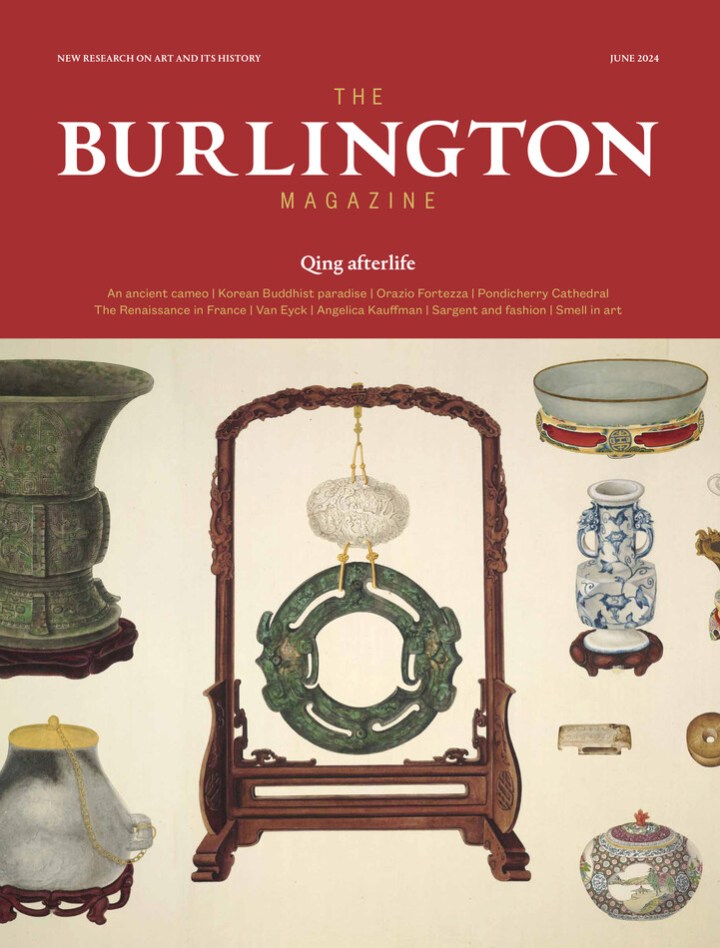
• Ricarda Brosch, “The Art of Qing Imperial Afterlife: The Pictures of Ancient Playthings (Guwantu 古玩圖) Revisited,” pp. 596–611.
Two magnificent eighteenth-century handscrolls depict myriad precious objects made of jade, bronze, porcelain, glass, and bamboo. A novel interpretation of their function suggests that the illustrations were originally for wall decorations and remounted as scrolls for the Yongzheng Emperor’s tomb. The paintings’ remediation and repurposing offer a compelling example of the art of Qing imperial afterlife.
r e v i e w s

• Johnny Yarker, Review of the exhibition Angelica Kauffman (London: Royal Academy of Arts, 2024), pp. 620–23.
• William Barcham, Review of Martin Gayford, Venice: City of Pictures (Thames & Hudson, 2023), p. 653.
• Lianming Wang, Review of Henriette Lavaulx-Vrécourt and Niklas Leverenz, Berliner Schlachtenkupfer: 34 Druckplatten der Kaiser von China / Berlin Battle Engravings: 34 Copperplates for the Emperors of China (Deutscher Kunstverlag, 2021), pp. 654–55.
• Amina Wright, Review of Frédéric Ogée, Thomas Lawrence: Le génie du portrait anglais (Cohen & Cohen, 2022), pp. 655–56.
• Barry Bergdoll, Review of Didem Ekici, Patricia Blessing, Basile Baudez, eds., Textile in Architecture: From the Middle Ages to Modernism (Routledge, 2023), pp. 662–63.
Exhibition | Living with Sculpture: Presence and Power
From the press release for the exhibition:
Living with Sculpture: Presence and Power in Europe, 1400–1750
Hood Museum of Art, Dartmouth, Hanover, New Hampshire, 23 March 2024 — 22 March 2025
Curated by Elizabeth Rice Mattison and Ashley Offill

The Hood Museum of Art presents Living with Sculpture: Presence and Power in Europe, 1400–1750, on view from 23 March 2024 until 22 March 2025. Drawing on the wealth of the Hood Museum’s permanent collection, the exhibition contributes to the field’s understanding of the role of sculpture in everyday life, historically and today. Whether given as tokens of affection, cast to memorialize important events, designed to promote faith, or used to write a letter, these sculptures engaged their spectators in dialogues of devotion, authority, and intimacy.
Living with Sculpture is curated by two scholars at the Hood Museum of Art: Elizabeth Rice Mattison, Andrew W. Mellon Curator of Academic Programming and Curator of European Art, and Ashley B. Offill, Curator of Collections. It includes 164 objects in two galleries and is accompanied by a major publication of the same title.
Sculpture enlivened private and public spaces in medieval and Renaissance Europe, contributing to presentations of identity, practices of devotion, and promotions of nationhood. Featuring objects made across the continent, this exhibition examines the significance of sculpture between 1400 and 1750, an era of profound cultural and social change. Amid war, colonization, religious conflict, academic upheaval, and social stratification, these works of art ornamented homes, altars, libraries, and collections.
The role of sculpture as a commemorative and connective tool is newly evident in today’s debates about monuments and cultural patrimony. Sculpture manipulates notions of history, forges bonds between distant places, and promotes future actions, as this exhibition shows. Bringing this often-cerebral area of study down to earth, exhibition curators Elizabeth Rice Mattison and Ashley Offill note, “In examining a group of historic objects, this exhibition highlights the way that the material things with which we surround ourselves are critical to developing our personal identities and our relationships with one another. As curators, we lived with these objects during this project, gaining insight into the works and the people who owned them. The choice of a laurel wreath or a cross on a medal was, in many ways, just as informative back then as a social media bio is today.”
Recent examinations of sculpture suggest its singular presence and power for its makers, patrons, and audiences. The dynamism of sculpture became particularly evident in the 15th and 16th centuries with the explosion of interest in purchasing mass-produced objects such as plaquettes and small-scale bronzes. Technological innovations in making sculpture allowed artists to expand their markets and create new types of artwork.
Organized thematically, this exhibition focuses on small-scale sculptures for everyday spaces. With these works, artists could enhance their status and promote their creativity. Meanwhile, useful sculptures like locks and inkwells communicated their owners’ identities and prestige. In collecting sculptures, patrons activated their social connections. Sculpture also facilitated access to the divine, through objects that focused prayer and encouraged tactile connection with God. Similarly, sculptures forged a sense of history, recording contemporary events and promoting ideas about the past. Together, the sculptures presented here attest to how objects in bronze, wood, or stone gave meaning to people’s lives in early modern Europe.
This exhibition and its corresponding catalogue are organized by the Hood Museum of Art, Dartmouth, and generously supported by the Leon C. 1927, Charles L. 1955, and Andrew J. 1984 Greenebaum Fund, and by grants from the Gladys Krieble Delmas Foundation and the Samuel H. Kress Foundation.
The catalogue is distributed by Penn State UP:
Elizabeth Rice Mattison and Ashley Offill, Living with Sculpture: Presence and Power in Europe, 1400–1750 (Hanover: Hood Museum of Art, Dartmouth, 2024), 340 pages, ISBN: 978-0944722558, $50.
The accompanying publication includes five thematic essays, extended catalogue entries for 99 objects, and an illustrated checklist of 114 additional objects from the important collection of early modern sculpture at the Hood Museum of Art, Dartmouth. The book is published by the Hood Museum of Art, distributed by The Pennsylvania State University Press, and produced by Marquand Books, Seattle.
◊ ◊ ◊ ◊ ◊
Exhibition Colloquium | Living with Sculpture
Hood Museum of Art, Dartmouth, 7 September 2024
In connection with the exhibition, this colloquium brings together scholars and curators from around the Northeast to discuss how audiences, patrons, and makers engaged with sculpture in the Middle Ages and early modern period. Ranging from twelfth-century Spain to seventeenth-century Rome, the discussion topics will offer an in-depth examination of making and living with sculpture. The day will include a tour of the exhibition led by its curators, Elizabeth Rice Mattison and Ashley Offill. Check-in opens at 9.30am, and the program will begin at 10.00. The colloquium itself is free, by registration at Eventbrite. A limited number of hotel rooms are available at the Hanover Inn under the block ‘Living with Sculpture’. Please reserve before August 7.
p r e s e n t a t i o n s
• Elizabeth Lastra (Vassar College), Threads of Power and Identity: Exploring Textile Motifs in Sculpture at the Romanesque Monastery of San Zoilo
• Kelley Helmstutler Di Dio (University of Vermont), Seeing Two Sides of the Same Coin: Leone Leoni’s Circle and their Medals in the Hood Museum
• Lara Yeager-Crasselt (Baltimore Museum of Art), François Duquesnoy’s Funerary Monument to the Painter Jacob de Hase: Untangling Flemish Expatriate Networks in Rome
• Laura Tillery (Hamilton College), The Armed Image of Olav Lorenzo Buonanno, University of Massachusetts, Boston, Living with Imaginary Sculptures
• Miya Tokumitsu (Davison Art Center, Wesleyan), Gothic to Grotesque: Sculptural Ornament in the Prints of Lucas van Leyden
• Nicola Camerlenghi (Dartmouth College), Living Sculptures in the Renaissance Streets of Rome
Exhibition | Looking Allowed?
Now on view at Ambras Castle in Austria:
Looking Allowed? Diversity from the 16th to the 18th Century
Schloss Ambras, Innsbruck, 20 June — 6 October 2024

Johann Gottfried Haid after Johann Nepomuk Steiner, Portrait of Angelo Soliman (Mmadi Make), ca. 1750. Born in West Africa, Soliman was enslaved and shipped to Europe before eventually advancing in Austrian society as a successful Freemason and member of court.
Diversity has always existed. In the Renaissance—as humans increasingly took centre stage—it was not only the ideal that was of interest, but also humans’ inexhaustible diversity. The exhibition Looking Allowed? Human Diversity from the 16th to the 18th Century considers diversity in the past from today’s perspective, taking as its point of reference the Ambras collections of Archduke Ferdinand II. Here the whole world was illustrated, as was common in chambers of art and wonders.
Why did the Portrait of a Disabled Man find its way into the Ambras Chamber of Art and Wonders? Who is behind the ‘hair family’? And why do portraits of ‘court giants’ and ‘court dwarves’ move us? Such paintings run the risk of being dismissed as mere curiosities. This exhibition, by contrast, tells the stories of these people who did not fit period norms, taking as its theme the questions of whether, and if so, how encounters with them took place. It invites visitors to reflect on their own perceptions, confronting us with the question: ‘is it permissible to look?’
Current viewpoints are brought into the exhibition through audio and video contributions. Adapted font sizes and objects placed on different levels are aimed at reducing barriers and making it possible for a variety of visitors to experience the exhibition. Furthermore, the installation of a lift in the upper castle offers easy access for the first time to the special exhibition rooms located on the second floor.
Thomas Kuster, Christian Mürner, and Veronika Sandbichler, eds., Schauen erlaubt: Vielfalt Mensch vom 16. bis 18. Jahrhundert (Cologne: Walther König, 2024), 192 pages, ISBN: 978-3753306506, €19. With contributions by Volker Schönwiese, Katharina Seidl, Susanne Hehenberger, Eva Seemann, Anne Kuhlmann-Smirnov, and Rudi Risatti.
With statements, six essays, and over 70 catalog entries, the volume engages human diversity and the tensions between self-empowerment, acceptance, and discrimination.
Exhibition | Bologna during the Enlightnement
Now on view the Fesch Museum:
Bologne au siècle des Lumières: Art et science, entre réalité et théâtre
Palais Fesch, Musée des Beaux-Arts, Ajaccio, Corsica, 29 June — 30 September 2024

Attributed to Giacomo Boni, The Triumph of David, oil on canvas (Ajaccio, Palais Fesch, Musée des Beaux-Arts, 852.1.967).
Cette nouvelle exposition sur la peinture, la sculpture et les objets de curiosité, faite en collaboration avec la Pinacoteca Nazionale, les Musei Civici et la fondation de la Cassa di Risparmio de Bologne (CARISBO), s’inscrit dans le prolongement des précédentes expositions du musée d’Ajaccio portant sur l’art italien des XVIIe et XVIIIe siècles. Si le XVIIe siècle bolonais, celui des Carracci, de Reni et de Guercino, est bien connu en France, l’exposition permettra au public de découvrir une période moins familière de ce centre artistique.
Le XVIIIe siècle bolonais s’ouvre avec la fondation de l’Istituto delle Scienze et de l’Accademia Clementina, nés de la volonté du général Luigi Ferdinando Marsili, avec le soutien d’intellectuels inspirés des Lumières et l’approbation du Sénat. Les deux institutions bénéficient de la protection du pape Clément XI, le souverain qui a fait rentrer la ville dans le giron des États de l’Église.
Tandis que l’Istituto delle Scienze, réglé sur les dernières avancées scientifiques européennes, se propose de rendre son prestige à la cité, siège de la plus ancienne université, l’Accademia Clementina vise à retrouver les fastes du siècle d’or de la peinture célébré par la Felsina pittrice de Carlo Cesare Malvasia (1678) et lié aux noms des Carracci, de Reni et de Guercino. Le siècle naissant voit s’achever les carrières de peintres tels que le néo-carracesque Domenico Maria Viani, Benedetto Gennari, neveu de Guercino, rentré à Bologne après un long séjour en Angleterre, Giovanni Gioseffo dal Sole, dernier interprète des finesses de Guido Reni, et Carlo Cignani, prince à vie de l’Accademia Clementina, représentant d’un classicisme teinté de souvenirs corrégiens.
Dans la première moitié du XVIIIe siècle, l’opposition entre les deux champions de la peinture, Donato Creti et Giuseppe Maria Crespi, est radicale et irréductible. Les recherches du premier aboutissent à un classicisme élégant et raffiné, lumineux et incorruptible, alors que le second affiche au contraire un naturalisme agressif et prosaïque aux accents ironiques, d’un caractère presque populaire. Dans le même temps, la culture littéraire de l’Arcadia inspire, avec Marcantonio Franceschini, peintre européen cher aux princes de Liechtenstein, un purisme qui évolue vers un barocchetto atténué, habile et léger, apprécié des milieux aristocratiques et de l’autorité religieuse. Si les solennels tableaux d’autels répondent aux exigences du décorum et de la commande officielle, les grandes peintures destinées aux palais visent à célébrer, avec des allégories et l’évocation des gloires antiques, les familles sénatoriales, soutiens de l’autorité pontificale dans le gouvernement de la ville.
La ville pullule de petites comme de grandes collections. Ce sont non seulement les palais de l’aristocratie, mais aussi les habitations de la bourgeoisie ou des artisans qui se couvrent de peintures, disposées sous les fresques où se déploie la virtuosité perspective des peintres de quadratura.
Trompe-l’œil, dilatations spatiales et illusions théâtrales allant jusqu’à l’invraisemblable rendent les scénographes bolonais célèbres dans les théâtres européens, grâce aux succès de la famille Bibiena, dans le sillage des expériences passées d’Angelo Michele Colonna et d’Agostino Mitelli, appelés, au-delà des cours italiennes, jusqu’en Espagne et en France. Autour de l’Accademia Filarmonica, fréquentée entre autres par des personnalités telles que le chanteur Carlo Broschi, dit Farinelli, le compositeur Johan Christian Bach, le musicologue Charles Burney—à laquelle se sont joints des chanteurs, des compositeurs et des instrumentistes, sous l’œil attentif du célèbre père Giambattista Martini, qui fut le maître du Mozart lorsque celui-ci avait quatorze ans—se développe une intense activité mêlant architecture, peinture, musique et poésie, tandis qu’est inauguré en 1763 le Teatro Comunale avec le Triomphe de Clelia de Christoph Willibald Gluck, sur des textes de Métastase.
Une peinture légère opère la mutation de la solide tradition du XVIIe siècle vers le rocaille. Ses interprètes sont Francesco Monti, Giuseppe Marchesi dit Sanson, Vittorio Maria Bigari, Giuseppe Varotti et Nicola Bertuzzi, rejoints, en parfaite harmonie, par les sculpteurs et modeleurs Giovan Battista Bolognini, Francesco Jannsens, Angelo Piò et son fils Domenico, qui, à partir de l’exemple de Giuseppe Maria Mazza, donnent aux figures de stuc et de terre cuite un élégant mouvement tout en courbes et une grâce pleine de séduction.
Le succès de l’Accademia Clementina, dû au zèle de son secrétaire Gianpietro Zanotti, amène le remplacement progressif de la formation traditionnelle au sein des ateliers par des enseignements codifiés, l’institution officielle de prix dans les différentes branches artistiques et l’ouverture de l’Accademia del nudo. Dans ce contexte vont émerger les deux principales personnalités de la seconde moitié du siècle, les frères Ubaldo et Gaetano Gandolfi, chez qui la tradition s’est régénérée au contact fructueux de la culture picturale vénitienne, freinant l’avancée du néoclassicisme.
En 1796, à l’arrivée des troupes napoléoniennes, Gaetano Gandolfi pourra assister à l’effondrement de l’Ancien Régime, et aux bouleversements socio-politiques qui vont en découler : le renversement du pouvoir pontifical, la suppression des ordres religieux et des confréries laïques avec la confiscation de leurs biens. En remplacement de l’Accademia Clementina, la création de l’Accademia di Belle Arti, accompagnée de la naissance de la moderne Pinacoteca, inaugure cette nouvelle ère.
Bologne au siècle des Lumières: Art et science, entre réalité et théâtre (Milan: Silvana Editoriale, 2024), 368 pages, ISBN: 978-8836658527, €33.
Exhibition | Guillaume Lethière
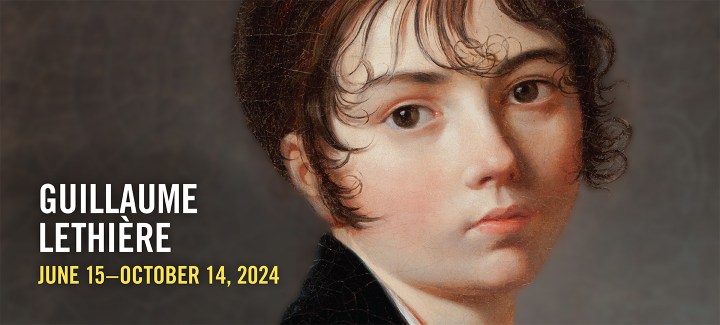
Guillaume Lethière, Woman Leaning on a Portfolio, detail, ca. 1799, oil on canvas
(Worcester Art Museum, Massachusetts, 1954.21)
◊ ◊ ◊ ◊ ◊
Now on view at The Clark:
Guillaume Lethière
The Clark Art Institute, Williamstown, Massachusetts, 15 June — 14 October 2024
Musée du Louvre, Paris, 13 November 2024 — 17 February 2024
Curated by Esther Bell, Olivier Meslay, Sophie Kerwin, and Marie-Pierre Salé
The first monographic exhibition ever presented on the artist
 Born in Sainte-Anne, Guadeloupe, Guillaume Lethière (1760–1832) was a key figure in French painting during the late eighteenth and early nineteenth centuries. The son of a white plantation owner and an enslaved woman of mixed race, Lethière moved to France with his father at age fourteen. He trained as an artist and successfully navigated the tumult of the French Revolution and its aftermath to achieve the highest levels of recognition in his time.
A favorite artist of Napoleon’s brother Lucien Bonaparte, Lethière served as director of the Académie de France in Rome, as a member of the Institut de France, and as a professor at the École des Beaux-Arts. A well-respected teacher, he operated a robust studio that rivaled those of his most successful contemporaries. Despite his remarkable accomplishments and considerable body of work, Lethiere is not well known today. The exhibition, organized in partnership with the Musée du Louvre and featuring some one hundred paintings, prints, and drawings, celebrates Lethière’s extraordinary career and sheds new light on the presence and reception of Caribbean artists in France during his lifetime.
Guillaume Lethière is co-organized by the Clark Art Institute, Williamstown, Massachusetts, and the Musée du Louvre, Paris, and curated by Esther Bell, deputy director and Robert and Martha Berman Lipp Chief Curator; and Olivier Meslay, Hardymon Director; with the assistance of Sophie Kerwin, curatorial assistant, at the Clark; and by Marie-Pierre Salé, chief curator in the Department of Drawings at the Louvre.
For more information, see the exhibition press release»
Esther Bell and Olivier Meslay, eds., Guillaume Lethière (New Haven: Yale University Press, 2024), 432 pages, ISBN: 978-0300275780, $65. With contributions by Alain Chevalier, Natasha Coleman, Darcy Grimaldo Grigsby, Frederic Lacaille, Anne Lafont, Christelle Lozere, Sophie Kerwin, Mehdi Korchane, C.C. McKee, Marie-Isabelle Pinet, Frederic Regent, Marie-Pierre Sale, Aaron Wile, and Richard Wrigley.
Exhibition | Comment m’habillerai-je?
Now on view at the Museum of the French Revolution (near Grenoble):
Comment m’habillerai-je? Se vêtir sous la Révolution française, 1789–1804
Musée de la Révolution française, Vizille, 28 June — 10 November 2024
 Découvrez une mode en pleine (r)évolution!
Dans la société française de la fin du XVIIIe siècle, marquée par la culture des apparences, dans quelle mesure la rupture que constitue la Révolution française se reflète-t-elle dans la manière de se vêtir ?
L’exposition se propose de répondre à cette question. Véritable marqueur social sous l’Ancien Régime, le vêtement se transforme sous la Révolution française pour devenir le symbole d’une prise de position politique. Face au nouveau contexte politique et social et au nouvel élan de liberté, il devient par la suite un véritable objet de luxe et de mode. L’exposition présentera ces transformations à l’aide de textes, d’objets, d’iconographie et surtout d’estampes, medium de diffusion par excellence des modes, des symboles politiques et des idées.
Dans le cadre de la saison culturelle Des habits et nous, portée par le Département de l’Isère. Une exposition conçue et organisée par le Musée de la Révolution française et la Bibliothèque nationale de France.
Comment m’habillerai-je ? Se vêtir sous la Révolution française, 1789–1804 (Gent: Snoeck Publishers, 2024), 160 pages, ISBN: 978-9461619136, €30.
Exhibition | Sèvres Extraordinaire! Sculpture from 1740 until Today

From the press release for the upcoming BGC exhibition (note the new dates) . . .
Sèvres Extraordinaire! Sculpture from 1740 until Today
Bard Graduate Center, New York, 10 September — 16 November 2025
Curated by Tamara Préaud, Soazig Guilmin, Charlotte Vignon, and Susan Weber
Sèvres Extraordinaire! Sculpture from 1740 until Today presents the history of the Sèvres Manufactory and its production of extraordinary sculptural objects in various ceramic pastes. Organized by Sèvres, Manufacture et Musée nationaux, and Bard Graduate Center (BGC), the exhibition is the first outside of France to highlight the production of sculpture made at the famed porcelain manufactory.

Etienne-Maurice Falconet, L’Amour menaçant (Threatening Love), 1758/61, Manufacture de Sèvres, soft-paste porcelain biscuit (Manufacture et Musée nationaux, Sèvres, MNC 27724.1).
From extravagant Rococo to restrained Neoclassical, from romantic, neo-Gothic inventions to the elegant curves of the Art Nouveau or the geometries of the Art Deco, and in partnership with artists associated with Surrealism, Abstract Expressionism, and Pop art, Sèvres has continually pushed the boundaries of ceramic production, creating objects that are neither functional nor decorative but rather art that it simply calls ‘sculpture’. One of the main characteristics of the manufactory, from its origins in the disused premises of the Château de Vincennes until the present day, is the unsurpassed variety of its production. The exhibition considers the term ‘sculpture’ in its broadest sense and features three-dimensional vases, centerpieces for a dining table, clocks, inkstands, and rare cups and saucers alongside more expected objects such as busts, figures, and medallions. This approach presents the history of the Sèvres Manufactory through a lesser-known part of its production while highlighting the significant roles of artists, designers, and architects, whose designs represent a microcosm of larger developments in art and culture.
The exhibition reveals the roles of chemical and technological advances as well as artistic innovations in the manufactory’s success, and it presents approximately two hundred works from the collection of Sèvres, Manufacture et Musée nationaux, in ceramic, soft- and hard-paste porcelain, faïence, and stoneware. Other objects highlight the long process of making a sculpture at Sèvres, from initial design to its final painted decoration. These items—sketched, drawn, or engraved sources as well as terra-cotta models and plaster molds—represent the institution’s rich, diverse, and mostly unknown archives.
Situating sculpture produced at the Sèvres Manufactory in the larger context of French history from 1740 through the twenty-first century, the exhibition tells the story of Sèvres’s relationship to French political power. As a royal, imperial, and then a national manufactory, Sèvres was regularly called upon to produce elaborate porcelain dinner, tea, and coffee services, as well as vases and other objects to be used as diplomatic gifts or to adorn the residences of the French elite.
The exhibition is organized chronologically and occupies all four floors of the Bard Graduate Center Gallery. It reflects the manufactory’s history of collaborations with innovative artists and architects to create new forms and designs aligned with the fashions of their time. Featured works from eighteenth-century artists and designers include those of Jean-Claude Duplessis and Louis-Simon Boizot, among others. Alexandre-Évariste Fragonard, Jean-Baptiste Carpeaux, Albert-Ernest Carrier-Belleuse, and Auguste Rodin represent important collaborations of the nineteenth century. Jean Arp, Louise Bourgeois, and Ettore Sottsass are among the artists whose work demonstrates the manufactory’s artistic output in the twentieth century; and creations by Yayoi Kusama, Johan Creten, Jim Dine, Kristin McKirdy, and Betty Woodman reflect Sèvres’s ongoing commitment to working with the most important living artists of the day.
Bard Graduate Center will schedule a number of public events associated with the exhibition. A symposium for scholars and curators is expected to feature Judith Cernogora and Viviane Mesqui, Conservatrices de musée, Sèvres; Tamara Préaud, former archivist of the Sèvres Manufactory; and Linda Roth, Charles C. and Eleanor Lamont Cunningham Curator of European Decorative Arts at the Wadsworth Atheneum Museum of Art.
◊ ◊ ◊ ◊ ◊
Three Centuries of Innovation at Sèvres: A Research Symposium
Friday, 20 September 2024, 1:30–5:30pm
1.00 Introduction by exhibition curator Charlotte Vignon
2.00 Session A
• Tamara Préaud (Manufacture nationale de Sèvres) — Dynasties of Sculptors at Sèvres
• Viviane Mesqui (Manufacture nationale de Sèvres) — Re-editions Serving Heritage at the Sèvres Manufactory: Sèvres Beehive Vases from 1769 to 2024
3.15 Coffee break
3.45 Session B
• Linda Roth (Wadsworth Atheneum Museum) — Taxile Doat: Sculptor, Decorator, and Studio Potter at Sèvres
• Soazig Guilmin (Manufacture nationale de Sèvres) — The Art of Light and Sculpture: A Legacy of the Sèvres Manufactory
• Judith Cernogora (Manufacture nationale de Sèvres) — Luxury and Extravagance: Contemporary Furniture in Sèvres Porcelain
5.15 Concluding remarks
Registration information is available here»
◊ ◊ ◊ ◊ ◊
Tamara Préaud, Sevres Extraordinaire! Sculpture from 1740 Until Today (New Haven: Yale University Press, 2024), 600 pages, ISBN: 978-0300278750, $85.
 The accompanying catalogue is the first large-scale, English-language publication to explore the production of sculpture created by the famed French manufactory from its eighteenth-century origins to the present. Published by Bard Graduate Center and distributed by Yale University Press, this richly illustrated volume is primarily written by Tamara Préaud, who held the position of archivist at the Sèvres Manufactory for more than forty years and today is considered one of the most important historians of the manufactory. Additional texts were written by Guilhem Scherf, curator of sculpture at the Louvre Museum; Soazig Guilmin, head of the registrar’s department and art historian at the Sèvres Museum; Judith Cernogora, curator of contemporary art at the Sèvres Museum; and Florence Rionnet, curator at the Musée des Beaux-Arts in Quimper, Brittany. The volume is edited by Susan Weber and Charlotte Vignon.
c o n t e n t s
Unless otherwise noted, all text by Tamara Préaud
Introduction
• French Sculpture in the Eighteenth and Nineteenth Centuries: Historical Context and Stylistic References — Guilhem Scherf
• Sculpture in France from the Belle Époque to Pop Art — Florence Rionnet
Part I | General Considerations
1 Materials and Production — Tamara Preaud with Soazig Guilmin
2 Salaries and Prices
3 Imitations, Copies, Overmoldings, and Marks
Part II | History
4 The Eighteenth Century
5 The Directorship of Alexandre Brongniart
6 The Second Half of the Nineteenth Century, 1848–91
7 The Twentieth Century
8 Two Decades of Contemporary Art at Sèvres, 2000–20 — Judith Cernogora
9 Sales and Deliveries after 1941 — Soazig Guilmin
◊ ◊ ◊ ◊ ◊
Note (added 9 September 2024) — The posting was updated to include information on the symposium.
Note (added 6 September 2025) — The posting was updated with the exhibition’s new dates. It was originally slated to be on view from 21 September 2024 to 5 January 2025 but closed early due to building maintenance issues.
The Burlington Magazine, May 2024
From the May issue of The Burlington, which is dedicated to French art — and please note that Yuriko Jackall’s important article is currently available for free, even without a subscription.
Burlington Magazine 166 (May 2024)

Jean-Honoré Fragonard, The Swing, 1767, oil on canvas, 81 × 64 cm (London: Wallace Collection).
a r t i c l e s
• Ludovic Jouvet, “A Medal of the Sun King by Claude I Ballin,” pp. 440–45.
• Yuriko Jackall, “The Swing by Jean-Honoré Fragonard: New Hypotheses,” pp. 446–69.
• Thadeus Dowad, “Dāvūd Gürcü, Ottoman Refugee, and Girodet’s First Mamluk Model,” pp. 479–87.
• Humphrey Wine, “The Paintings Collection of Denis Mariette,” pp. 488–92.
r e v i e w s
• Richard Stemp, Review of Ingenious Women: Women Artists and their Companions (Hamburg: Bucerius Kunst Forum / Basel: Kunstmuseum, 2023–24), pp. 501–04.
• Christoph Martin Vogtherr, Review of Louis XV: Passion d’un roi (Château de Versailles, 2022), pp. 508–10.
• Eric Zafran, Review of The Hub of the World: Art in Eighteenth-Century Rome (Nicholas Hall, 2023), pp. 515–18.
• Saffron East, Review of Black Atlantic: Power, People, Resistance (Cambridge: Fitzwilliam, 2023), 523–25.
• Gauvin Alexander Bailey, Review of Marsely Kehoe, Trade, Globalization, and Dutch Art and Architecture:
Interrogating Dutchness and the Golden Age (Amsterdam UP, 2023), pp. 534–35.
• Helen Clifford, Review of Vanessa Brett, Knick-Knackery: The Deards’ Family and Their Luxury Shops, 1685–1785 (2023) pp. 535–37.
o b i t u a r y
• Michael Hall, Obituary for Jacob Rothschild (1936–2024), pp. 538–40.
One of the leading public figures in the arts in the United Kingdom, Lord Rothschild was a major collector of historic art and a patron of contemporary artists and architects. His principal focus was Waddesdon Manor, his family’s Victorian country house and estate in Buckinghamshire.
◊ ◊ ◊ ◊ ◊
Jean-Honoré Fragonard was one of the supreme exponents of the French Rococo style and his painting The Swing in the Wallace Collection, London, is perhaps his most famous work. Yet despite this elevated status, mystery surrounds its origins. New documentary and technical research presented here by Yuriko Jackall may, however, have finally established for whom it was painted and why the painting was hidden away for the first few years of its existence.
The May issue also includes the publication by Ludovic Jouvet of a previously unknown and spectacular medal of the Sun King, Louis XIV, as well as Humphrey Wine’s study of the intriguing collection of the publisher Denis Mariette (the uncle of the more famous Pierre-Jean Mariette). Other articles feature the work of French Romantic painters: Andrew Watson establishes the early history of Delacroix’s The Death of Sardanapalus in the Musée du Louvre, Paris, and Thadeus Dowad identifies Girodet’s first Mamluk model.
Exhibition reviews include Sarah Whitfield discussing Bonnard’s Worlds (Kimbell Art Museum, Fort Worth, and the Phillips Collection, Washington) and Lisa Stein assessing Saul Leiter (MK Gallery, Milton Keynes). Catalogue reviews feature Christoph Martin Vogtherr on Louis XV, Lunarita Sterpetti on Eleonora of Toledo, and Eric M. Zafran surveying art in eighteenth-century Rome. Meanwhile, an impressive and wide range of new books are examined: these feature Megan McNamee on diagrams in medieval manuscripts, Christine Gardner-Dseagu on photographing Pompeii and Richard Thomson on Henry Lerolle.
◊ ◊ ◊ ◊ ◊
Note (added 31 July 2024) — The posting was updated to include additional content.










 Enfilade
leave a comment