Print Quarterly, September 2024
The long eighteenth century in the latest issue of Print Quarterly:
Print Quarterly 41.3 (September 2024)
a r t i c l e s
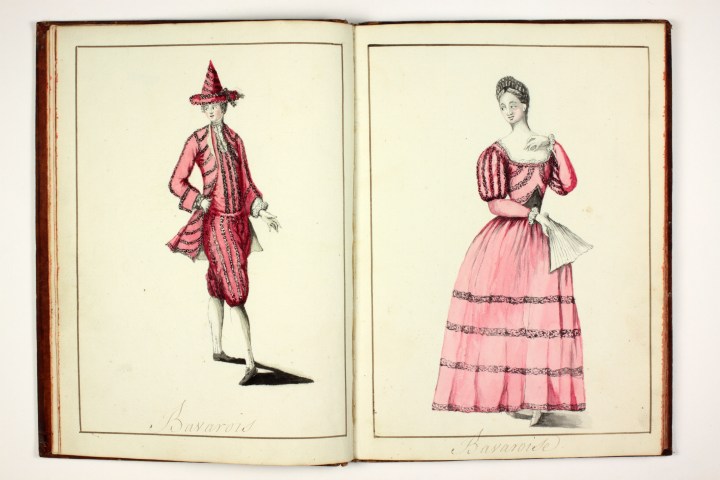
Anonymous artist, A Bavarian Man and A Bavarian Woman, ca. 1759, watercolour, 269 × 190 mm (Welbeck, Nottinghamshire: Welbeck Abbey).
• Derek Adlam and Maureen Cassidy-Geiger, “The Duke of Portland’s Album of Masquerade Costumes Worn in Warsaw in 1759”, pp. 268–84.
This article examines an album of watercolours in the library of the Dukes of Portland at Welbeck Abbey near Worksop, Nottinghamshire, depicting costumed figures and the print sources that inspired them. Seemingly related to the Polish masked balls and banquets mounted in Warsaw on 26 and 27 February 1759 by Jerzy August Mniszech (1715–78), King August III, the album is closely related to imagery seen in Abraham a Sancta Clara’s Neu-eröffnete Welt-Galleria (Nuremberg, 1703), among others, listed in an Appendix at the end of the article. Its commission and creator remain unknown.
n o t e s a n d r e v i e w s
• Daniel Godfrey, Review of Anna Marie Roos, Martin Lister and his Remarkable Daughters: The Art of Science in the Seventeenth Century (Bodleian Library, 2019), pp. 313–16.
• Antoinette Friedenthal, Review of Erminia Gentile Ortona, Le Lettere di Pierre-Jean Mariette ‘Eccellente nella Intelligenza delle Tre Arti’ a Giovanni Gaetano Bottari. Il Codice 1606 (32-E-27) della Biblioteca dell’Accademia Nazionale dei Lincei e Corsiniana (Bardi Edizioni and Accademia Nazionale dei Lincei, 2022), pp. 316–19.

Letitia Byrne, Title-Page to the series ‘Animals’, 1795, etching, 145 × 181 mm (London: British Museum).
• Andaleeb Badiee Banta, Review of Artemis Alexiou and Rose Roberto, eds., Women in Print 1: Design and Identities (Peter Lang, 2022) and Caroline Archer-Parré, Christine Moog and John Hinks, eds., Women in Print 2: Production, Distribution and Consumption (Peter Lang, 2022), pp. 319–20.
• Antony Griffiths, Review of Nigel Tattersfield, Dealing in Deceit: Edwin Pearson of the ‘Bewick Repository Bookshop’, 1838–1901 (The Bewick Society, 2020), pp. 320–21.
• Suzanne Boorsch, Review of Arianna Quaglio, Linda Schädler and Patrizia Keller, eds., From Albrecht Dürer to Andy Warhol: Masterpieces from the Graphische Sammlung ETH Zürich (MASI Lugano and Graphische Sammlung ETH Zürich, 2023) and Elizabeth Nogrady and Alyx Raz, eds., Making & Meaning: The Frances Lehman Loeb Art Center / Vassar College (Hirmer, 2023), pp. 327–30.
• Rena Hoisington, Review of Edouard Kopp, Elizabeth Rudy and Kristel Smentek, eds., Dare to Know: Prints and Drawings in the Age of the Enlightenment (Harvard Art Museums, 2022), pp. 346–50.
• Tim Clayton, Review of Allison Stagg, Prints of a New Kind: Political Caricature in the United States, 1789–1828 (Pennsylvania State University Press, 2023), pp. 351–54; recipient of Ewell L. Newman Book Award from the American Historical Print Collectors Society.
b o o k s r e c e i v e d
• Clarissa von Spee and Yiwen Liu, eds., China’s Southern Paradise: Treasures from the Lower Yangzi Delta (Cleveland Museum of Art, 2024), pp, 340–41.
• Iris Brahms, ed., Marginale Zeichentechniken: Pause, Abklatsch, Cut&Paste als ästhetische Strategien in der Vormoderne (De Gruyter, 2022), p. 341. The book explores ‘marginal drawing practices’ through a collection of essays focusing on works on paper from the sixteenth to eighteenth centuries.
Exhibition | Jean-Baptiste Oudry and the Royal Hunts of Louis XV
From the press release for the exhibition:
Peintre de courre: Jean-Baptiste Oudry et les Chasses royales de Louis XV
Château de Fontainebleau, 12 October 2024 — 27 January 2025
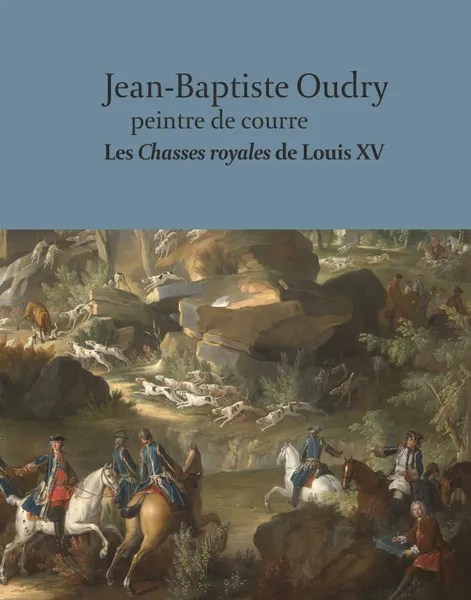 Cette exposition valorisera des trésors méconnus du château : les cartons préparatoires au tissage de la tenture des Chasses de Louis XV, dont quatre cartons tout récemment restaurés.
À l’automne 2024, le château de Fontainebleau mettra en lumière le travail du peintre Jean-Baptiste Oudry, célèbre pour ses représentations des chasses du roi Louis XV et ses portraits animaliers. Peintures, ouvrages, porcelaines, dessins, habits et tapisseries plongeront les visiteurs dans l’univers de la chasse, activité favorite du roi, qu’il souhaita fixer pour l’éternité en passant la commande à Oudry à partir de 1733 d’un ensemble de tapisseries. Cette exposition présentera pour la première fois, côte à côte, les dessins préparatoires, les cartons d’Oudry (œuvres préparatoires à l’échelle réelle qui servent ensuite au lissier à tisser les tapisseries), conservés à Fontainebleau et dont quatre ont été récemment restaurés et les tapisseries qui en sont issues, tissées par la manufacture royale des Gobelins.
Par ailleurs, l’exposition illustrera le goût pour les scènes de chasse dans la peinture et le décor intérieur des demeures royales et aristocratiques du XVIIIe siècle , ainsi que l’« Oudrymania », c’est-à-dire la diffusion des créations de l’artiste dans divers domaines des arts décoratifs, tels que les illustrations de beaux livres, la porcelaine et l’orfèvrerie. L’exposition invite les visiteurs à (re)découvrir la résidence de chasse favorite des rois de France que fut le château de Fontainebleau au fil des siècles.
Un colloque Jean-Baptiste Oudry et la peinture animalière sera co-organisé avec la Fondation François Sommer et se tiendra à Paris et à Fontainebleau mi-décembre 2024.
Vincent Cochet et Oriane Beaufils, eds., Peintre de courre: Jean-Baptiste Oudry et les Chasses royales de Louis XV (Paris: Réunion des Musées Nationaux, 2024), 229 pages, ISBN: 978-2711880423, €49.
The full press release is available here»
Exhibition | Oudrymania
Now on view at the Château de Chantilly:
Oudrymania: Fables, Hunts, Fights
Musée Condé, Château de Chantilly, 8 June — 6 October 2024
Curated by Baptiste Roelly with Oriane Beaufils
 Depicted in hunting scenes, portraiture, and combat, animals feature among the most striking images produced by Jean-Baptiste Oudry (1686–1755). A gifted artist with an unrivalled mastery of his technique, he brings us face-to-face with the animal repertoire as it existed in the 18th century, including in a series of three hunting scenes painted for the Château de Chantilly, works that were scattered after the French Revolution but which have now been brought back together.
Animal scenes were extremely popular with the leading collectors of the 18th century, including the princes of Condé, who commissioned them from the artist. A set of exquisite drawings by Oudry loaned from a private collection feature in the exhibition alongside works from Chantilly’s collections, allowing visitors to see pieces never before displayed in public. These include a large number of illustrations for La Fontaine’s fables, showing how the fabulist and the artist use the animal kingdom to help us laugh at and reflect on human nature. These illustrations were so effective they were copied by the arts and crafts industry and included in their decorative production, examples of which can also be admired in the exhibition. Through paintings, drawings, objets d’art, and rare books, this show shines a light into every corner of the Oudrymania that has gripped art lovers for centuries.
The exhibition is organized by Baptiste Roelly, curator at the Condé museum, in collaboration with Oriane Beaufils, curator and director of collections at the Villa Ephrussi de Rothschild.
Baptiste Roelly and Oriane Beaufils, eds, Oudrymania: Fables, Chasses, Combats (Éditions Faton, 2024), 128 pages, ISBN: 978-2878443585, €22. With contributions by Oriane Beaufils, Claire Betelu, Lucile Brunel-Duverger, Laurence de Viguerie, Juliette Debrie, Mathieu Deldicque, Nicole Garnier-Pelle, François Gilles, Maxime Georges Métraux, Roberta J.M. Olson, and Baptiste Roelly,
The press release (in French) is available here»
Exhibition | The King’s Horses: The Marly Horses
From the press release for the exhibition (a companion to the show Horse in Majesty on view at Versailles):
The King’s Horses: The Marly Horses, Masterpieces of Equestrian Art
Musée du Domaine Royal de Marly, 7 June — 3 November 2024
Curated by Karen Chastagnol
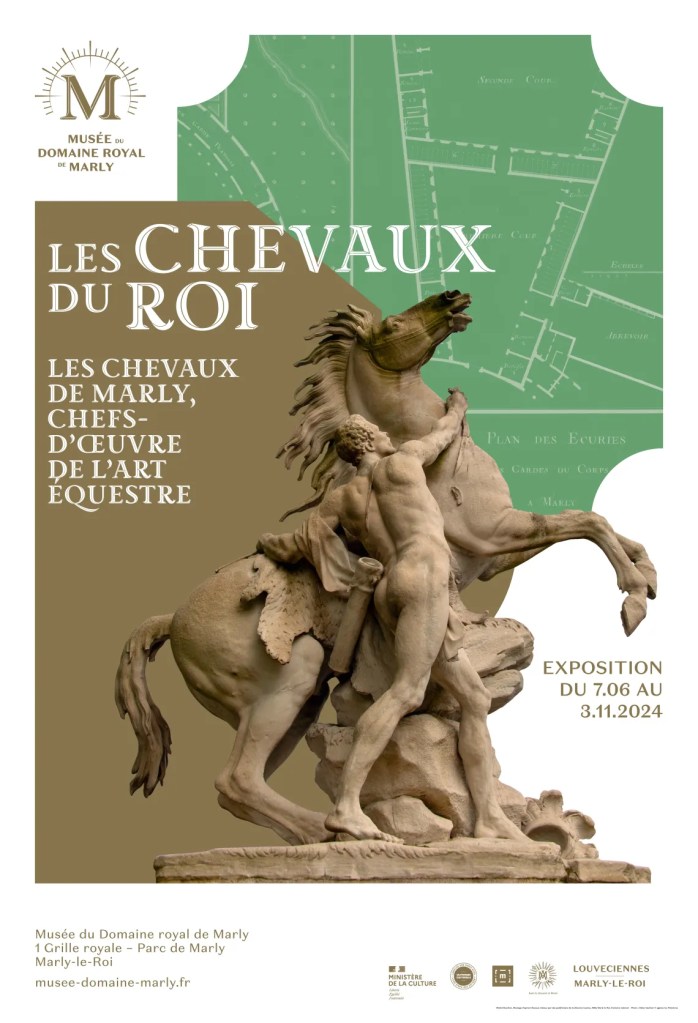 The Royal Estate of Marly, once a hunting residence of kings and the setting for the monumental Marly Horses, has always given an essential role to the horse. From transportation and aristocratic entertainments to military activities, equestrian buildings and artistic representations, horses have taken over the estate in various forms. Through a hundred paintings, sculptures, drawings, engravings, accessories, and archival documents, the Museum of the Royal Estate of Marly presents, on the occasion of the equestrian events of the Paris 2024 Olympic and Paralympic Games, an original exhibition dedicated to the role of the horse at the Estate of Marly, from Louis XIV to the French Revolution.
Karen Chastagnol, ed., Les chevaux du roi: Les chevaux de Marly, chefs-d’œuvre de l’art équestre (Milan: Silvana Editoriale, 2024), 104 pages, ISBN: 978-8836657919, €28. With contributions by Ambre Bozec, Valérie Carpentier-Vanhaverbeke, Annick Heitzmann, Carlos Pereira, and Benjamin Ringo.
The full press release is available here»
The Burlington Magazine, August 2024
The long 18th century in the August issue of The Burlington—and special thanks to The Burlington for making Rosalind Savill’s article available to Enfilade readers for free.
The Burlington Magazine 166 (August 2024) — Decorative Arts
a r t i c l e s

Unidentified artist, Portrait of Paul Crespin, ca.1726, oil on canvas laid on board, 114 × 90 cm (London: Victoria and Albert Museum).
• Lucy Wood and Olivia Fryman, “The 1st Duke of Devonshire’s ‘Queen Mary’ Beds at Devonshire House, Chatsworth, and Hardwick Hall,” pp. 780–809.
In 1696 the 1st Duke of Devonshire purchased two beds that had belonged to Mary II, one of which was made by Louis XIV’s upholsterer, Simon Delobel. Documents and fragments of its crimson velvet embroidered hangings record a lost example of Stuart state furniture of the highest quality.
• Stefano Rinadli, “Six Horses for the King of Poland: Making and Staging a Diplomatic Gift at the Court of Louis XIV,” pp. 810–25.
In July 1715 Augustus the Strong of Saxony-Poland received a splendid present from the Sun King: a team of six Spanish stallions, each equipped with embroidered trappings and a pair of elaborate flintlock holster pistols. Documents published here for the first time help establish the gift’s political context and chronology and provide detailed insight into the payment and the identity of all the craftsmen involved.
• Teresa Leonor M. Vale, “Eighteenth-Century English Silver for King João V of Portugal,” pp. 826–33.
João V of Portugal acquired works of art from Rome and Paris; analysis of diplomatic correspondence illustrates how he also commissioned objects from Britain in the 1720s, notably spectacular examples of silverware. These included and exceptionally large and renowned silver-gilt bath by Paul Crespin, the Huguenot silversmith who lived and worked in Soho, London.

Detail of the bottom tray of worktable mounted with two trays, attributed to Bernard II van Risenburgh, ca.1761–63. Table: wood, green varnish and gilt-bronze mounts, 68.6 × 36.8 × 30.5 cm; trays: Sèvres soft-paste porcelain, green ground, enamel colours and gilding, 32 × 26 cm (New York: Metropolitan Museum of Art, 58.75.45).
• Rosalind Savill, “From Storeroom to Stardom: The Revelations of Two Sèvres Porcelain Trays,” pp. 834–47.
Two porcelain trays set into a Rococo table in the early 1760s, now in the Metropolitan Museum of Art, New York, are reassessed and here confirmed as Sèvres. Their subjects are probably the family of the Marquis de Courteille, Louis XV’s representative at the porcelain factory, and their intimate representation in this manner is almost unique in eighteenth-century Sèvres.
The full article is available for free here»
r e v i e w s
• Elizabeth Savage, Review of two exhibition catalogues: Edina Adam and Julian Brooks, with an essay by Matthew Hargraves, William Blake: Visionary (J. Paul Getty Museum, 2020); and David Bindman and Esther Chadwick, eds., William Blake’s Universe (Philip Wilson Publishers, 2024), pp. 862–65.
• John Pinto, Review of the exhibition catalogue, John Marciari, Sublime Ideas: Drawings by Giovanni Battista Piranesi (Paul Holberton Publishing, 2023), pp. 865–67,
• Gauvin Alexander Bailey, Review of the exhibition catalogue, Rosario Inés Granados, ed., Painted Cloth: Fashion and Ritual in Colonial Latin America (University of Texas Press, 2022), pp. 867–69.
• Camilla Pietrabissa, Review of the exhibition catalogue, Anita Viola Sganzerla and Stephanie Buck, eds., Connecting Worlds: Artists and Travel (Paul Holberton Publishing, 2023), pp. 870–72.
• Giullaume Kientz, Review of the exhibition catalogue, Víctor Nieto Alcaide, ed., Goya: La ribellione della ragione (ORE Cultura, 2023), pp. 872–74.
• Timothy Wilson, Review of Marino Marini, Maiolica and Ceramics in the Museo Nazionale del Bargello, translated by Anna Moore Valeri (Allemandi, 2024), pp. 876–77.
• J. V. G. Mallet, Review of Caterina Marcantoni Cherido, Maioliche italiane del Rinascimento (Fondazione Musei Civici di Venezia, 2022), pp. 877–79.
• Aurora Laurenti, Review of Esther Bell, Pauline Chougnet, Sarah Grandin, Charlotte Guichard, Corinne Le Bitouzé, Anne Leonard, and Meredith Martin, Promenades on Paper: Eighteenth-Century French Drawings from the Bibliotheque nationale de France / Promenades de papier: Dessins du XVIIIe siècle des collections de la Bibliothèque nationale de France (Clark Art Institute and BnF Editions, 2023), pp. 883–84.
• Clare Hornsby, Review of Christopher M.S. Johns, Tommaso Manfredi, and Karin Wolfe, eds., American Latium: American Artists and Travelers in and around Rome in the Age of the Grand Tour (Accademia Nazionale di San Luca, 2023), pp. 884–86.
• Lydia Hamlett, Review of John Laycock, William Kent’s Ceiling Paintings at Houghton Hall (Houghton Arts Foundation, 2021), p. 887.
• Lin Sun, Review of Shane McCausland, The Art of the Chinese Picture-Scroll (Reaktion Books, 2023), pp. 887–88.
Exhibition | Wonders of Creation: Art and Science in the Islamic World
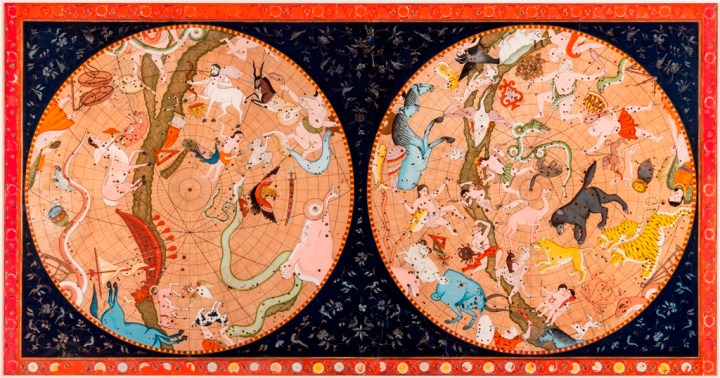
Star map depicting the Northern and Southern celestial hemispheres (with constellations inscribed in Devanagari), India, Jaipur, ca. 1780, ink, opaque watercolor, and gold on paper (Chicago: Pritzker Collection; photo by Michael Tropea).
◊ ◊ ◊ ◊ ◊
From the press release (11 July) for the exhibition:
Wonders of Creation: Art, Science, and Innovation in the Islamic World
The San Diego Museum of Art, 7 September 2024 — 5 January 2025
McMullen Museum of Art, Boston College, 2025
Curated by Ladan Akbarnia
The San Diego Museum of Art (SDMA) invites visitors to explore sources of wonder in the exhibition, Wonders of Creation: Art, Science, and Innovation in the Islamic World. The exhibition explores intersections of science and craft in Islamic material culture and contemporary art through the framework of a 13th-century text by Zakariyya ibn Muhammad al-Qazwini describing the wonders of the universe.
This trailblazing exhibition, organized by Ladan Akbarnia, Curator of South Asian and Islamic Art at The San Diego Museum of Art, showcases over 200 extraordinary works of art and objects from the eighth century to today. Using wonder as the vehicle to introduce and explore Islamic culture, Wonders of Creation illuminates the global impact of science and artistic production from the Islamic world while introducing new audiences to its diverse geographies and multifaceted visual cultures. With treasures including lavishly illuminated and illustrated manuscripts, fine textiles, luster-painted glass and ceramic wares, astrolabes and star maps, talismans, inscribed precious stones, and architectural marvels, visitors will gain a deeper appreciation of ingenuity and craftsmanship spanning 13 centuries across the Islamic world.
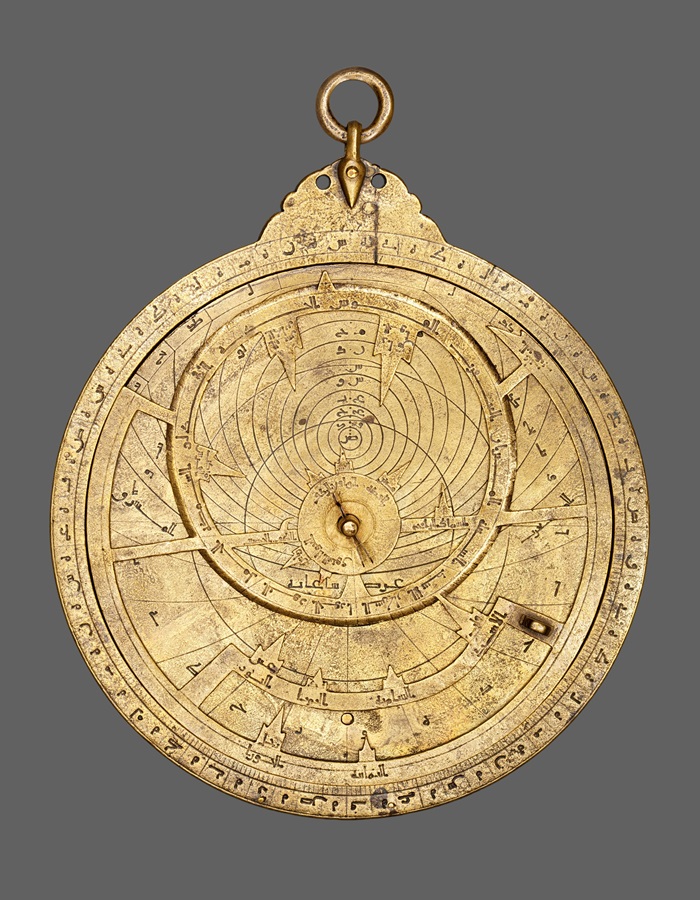
Nastulus, Astrolabe, 101 AH (ca. 720), 18 × 22 cm (Kuwait: al-Sabah Collection). The note at the Google Arts & Culture page describes this as “the earliest dated Islamic astrolabe.”
The exhibition presents works from more than 30 lenders, including major loans from The al-Sabah Collection, Dar Al-Athar al-Islamiyyah, Kuwait; and the Islamic Arts Museum Malaysia (IAMM). Works from the IAMM are on loan to the US for the first time. In addition to selections from these prestigious collections, visitors will also see contemporary commissions specifically for the exhibition by artists Ala Ebtekar and Hayv Kahraman, along with works by other prominent contemporary artists. The Museum has also commissioned Mamluk joinery samples made by master craftsman Hassan Abou Zeid of the Egyptian Heritage Rescue Foundation to introduce a hands-on opportunity for guests and commissioned two contemporary replicas of a 17th-century Persian astrolabe by Taha Yasin Arslan to further evoke a sense of awe throughout the exhibition. Wonders of Creation is designed to invite visitors to explore the marvels of the heavens and the earth and admire the crafts and customs of humanity.
“We are thrilled to present this groundbreaking exhibition to our visitors with support from the Getty through its PST Art: Art & Science Collide initiative,” says Roxana Velásquez, Maruja Baldwin Executive Director and CEO at The San Diego Museum of Art. “This exhibition celebrates the rich cultural heritage and enduring legacy of Islamic civilization, inviting audiences of all backgrounds to discover and appreciate its profound and diverse contributions.”
Qazwini’s text, The Wonders of Creation and the Rarities of Existence, is a revolutionary cosmography that meticulously details the universe, blending scientific knowledge with fantastical anecdotes, portraying all phenomena as signs of divine creation. The author, an Islamic judge and professor, emphasized wonder as a path to knowledge, urging readers to contemplate natural marvels to deepen their understanding of God and the cosmos. Today, his work remains influential, offering insights into Islamic culture and inspiring curiosity about natural phenomena. The exhibition invites visitors to explore some of the world’s wonders in the spirit of Qazwini’s call to wonder.
Wonders of Creation is part of Getty PST Art, an arts initiative that brings together more than 70 exhibitions from organizations across the Southern California region, all exploring intersections of art and science. Funding for this exhibition is made possible with support from Getty through its PST ART: Art & Science Collide initiative and the National Endowment for the Humanities. Wonders of Creation is also supported in part by the National Endowment for the Arts, and additional support is provided by Bank of America, Lani and Joe Curtis, Tatiana and Robert Dotson, Diana and Fred Elghanayan, Drs. Nasrin Owsia and Behrooz Akbarnia, The Nissan Foundation, and A.O. Reed. Institutional support is provided by the City of San Diego Commission for Arts and Culture and the members of The San Diego Museum of Art.
Wonders of Creation will be on view at The San Diego Museum of Art from 7 September 2024 until 5 January 2025. It will then travel to the McMullen Museum of Art, Boston College. The exhibition is complemented by a full-color catalogue with original research and contributions from leading international scholars, a scholarly symposium, artists in conversation, family-oriented art-making workshops, performances, and other programming for the community.
◊ ◊ ◊ ◊ ◊
Also worth noting is this recent study of al-Qazvini’s The Wonders of Creation from Edinburgh UP:
Stefano Carboni, The Wonders of Creation and the Singularities of Painting: A Study of the Ilkhanid London Qazvīnī (Edinburgh: Edinburgh University Press, 2020), 456 pages, ISBN: 978-1474461399, $65.
A beautifully illustrated study of the so-called London Qazvini, an early fourteenth-century illustrated Arabic copy of al-Qazvini’s The Wonders of Creation and the Oddities of Existing Things. One of a handful of extant illustrated codices produced under the Mongols of Iran, this unique manuscript gathers earlier Mesopotamian painting traditions, North Jaziran-Seljuq elements, Anatolian inspiration, the latest changes brought about after the advent of Mongols and a large number of illustrations of extraordinary subjects which escape proper classification. In this lavishly illustrated volume Stefano Carboni offers a stylistic analysis and discussion of the manuscript’s miniatures, a presentation and description of the 368 extant paintings that illustrate the codex, and a partial critical translation of the related Arabic text. This is the first time that sections throughout the whole text are available in English.
Stefano Carboni is the director and CEO of the Art Gallery of Western Australia and adjunct professor at the University of Western Australia. He is author and editor of several books including Glass from Islamic Lands: The Al-Sabah Collection (2001) and Venice and the Islamic World 828–1797 (2007).
Exhibition | Paper and Light
Opening in October at The Getty:
Paper and Light
J. Paul Getty Museum, Los Angeles, 15 October 2024 — 19 January 2025
 Artists have for centuries explored the interaction of paper and light. This exhibition of drawings charts some of the innovative ways in which the two media were creatively used together. Works include the Museum’s extraordinary 12-foot-long transparency by Carmontelle—essentially an 18th-century motion picture—which will be shown lit from behind as originally intended. Drawings by more contemporary artists including Vija Celmins will join sheets by Tiepolo, Delacroix, Seurat, and Manet to portray the themes of translucency and the representation of light.
Julian Brooks and Michelle Sullivan, Paper and Light: Luminous Drawings (Los Angeles: J. Paul Getty Museum, 2024), 112 pages, ISBN 978-1606069301, $25.
The treatment of light and shadow is one of the building blocks of drawing. From techniques such as highlights and reserves, to material selection and the creation of translucent tracing paper, to the use of light as a medium for viewing artworks, artists for hundreds of years have found innovative and dazzling ways to create light on a sheet of paper. This publication examines the central relationship between paper and light in the world of drawings in western European art from the Renaissance to the twentieth century. Focusing on drawings from the collection of the J. Paul Getty Museum, as well as works from the British Museum, Musée du Louvre, and others, and featuring masterful works by such artists as Parmigianino, Leonardo da Vinci, Nicolas Poussin, Odilon Redon, Edgar Degas, and Georges Seurat, Paper and Light will entice readers to look longer and more closely at drawings, deriving an even deeper appreciation for the skill and labor that went into them.
Julian Brooks is senior curator and head of the Department of Drawings at the J. Paul Getty Museum. Michelle Sullivan is associate conservator of drawings at the J. Paul Getty Museum.
Exhibition | Olympus on the Lake: Canova, Thorvaldsen, Hayez
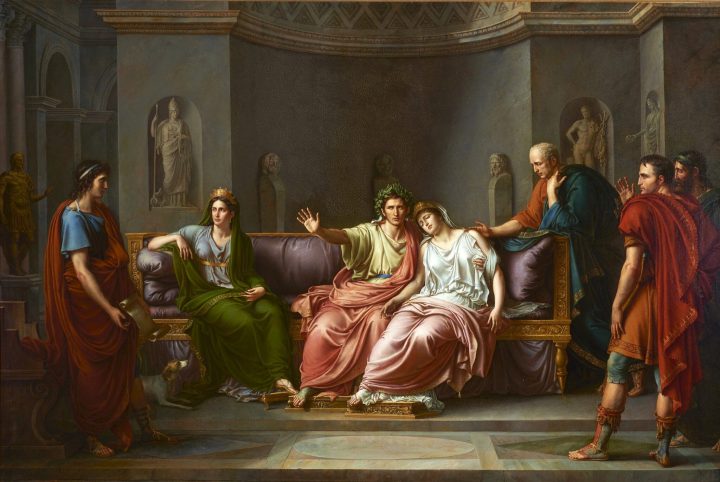
Jean-Baptiste Joseph Wicar, Virgil Reading the Sixth Canto of the Aeneid, 1818–21, oil on canvas
(Tremezzo: Museo di Villa Carlotta)
◊ ◊ ◊ ◊ ◊
Now on view at Villa Carlotta (with an English description available here) . . .
Olympus on the Lake: Canova, Thorvaldsen, Hayez, and the Treasures of the Sommariva Collection
Villa Carlotta, Tremezzo (on Lake Como), 22 June – 30 September 2024
Abile politico e potente braccio destro di Napoleone a Milano, Giovanni Battista Sommariva (1762–1826) è stato uno dei maggiori e più celebri collezionisti tra l’Impero e la Restaurazione. Approfittando di quei tempi di rapidi e radicali cambiamenti, nel 1802—quando si interruppe la sua breve ma fulminante carriera—era ormai riuscito a costruirsi una immensa fortuna.
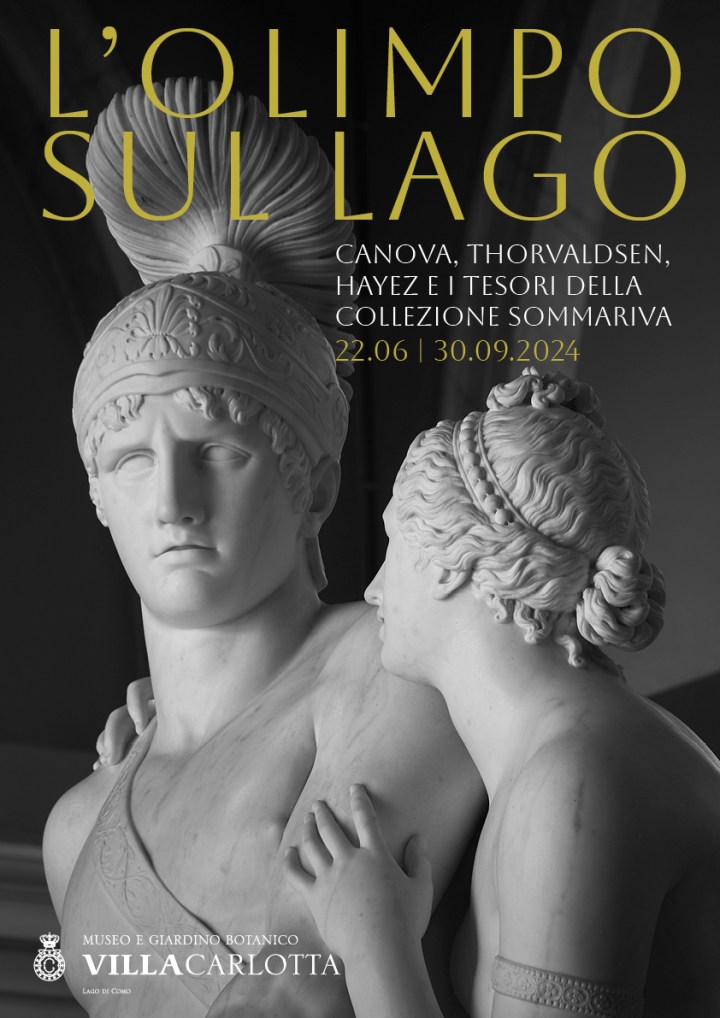 La sua leggendaria raccolta era una delle più importanti dell’epoca, insieme a quelle dei familiari di Napoleone, in particolare dell’imperatrice Josephine. Divisa tra il suo palazzo a Parigi, in uno dei quartieri più alla moda della città, e la villa di Tremezzo sul Lago di Como (oggi Villa Carlotta), vantava dipinti antichi e capolavori dei maggiori artisti dell’epoca—David, Prud’hon, Girodet, Wicar, Appiani, Bossi, Hayez—oltre a una infinità di preziosi oggetti d’arte. Soprattutto per la presenza a Villa Sommariva delle opere di Canova e degli splendidi marmi di Thorvaldsen, accorrevano viaggiatori da tutto il mondo, tra cui personaggi illustri come Stendhal, Lady Morgan, Flaubert. Attraverso una selezione delle opere più famose di quella straordinaria collezione—sculture, dipinti, stampe, gioielli e miniature—Villa Carlotta celebra un magnifico protagonista della propria storia e un grande mecenate di statura europea.
Per tutta la durata della mostra L’Olimpo sul lago, è possibile visitare presso il Museo del Paesaggio del Lago di Como (Tremezzina) l’esposizione Paesaggio sublime: Il Lago di Como all’epoca di Giovanni Battista Sommariva (1801–1826) che esporrà incisioni, tempere e acquerelli della prima a metà del XIX secolo con il proposito di evocare l’aspetto del lago e dei suoi borghi al tempo di Giovanni Battista Sommariva.
Fernando Mazzocca, Maria Angela Previtera, and Elena Lissoni, eds., L’Olimpo sul lago: Canova, Thorvaldsen, Hayez e i tesori della Collezione Sommariva (Milan: Silvana Editoriale, 2024), 352 pages, ISBN 978-8836658336, €35.
Exhibition | Belle da Costa Greene: A Librarian’s Legacy
Opening in October at The Morgan:
Belle da Costa Greene: A Librarian’s Legacy
The Morgan Library & Museum, New York, 25 October 2024 — 4 May 2025
Organized by Philip Palmer and Erica Ciallela
 The incredible story of the first director of the Morgan Library: a visionary Black woman who walked confidently in an early 20th-century man’s world of wealth and privilege
To mark the 2024 centenary of its life as a public institution, the Morgan Library & Museum will present a major exhibition devoted to the life and career of its inaugural director, Belle da Costa Greene (1879–1950). Widely recognized as an authority on illuminated manuscripts and deeply respected as a cultural heritage executive, Greene was one of the most prominent librarians in American history.
She was the daughter of Genevieve Ida Fleet Greener (1849–1941) and Richard T. Greener (1844–1922), the first Black graduate of Harvard College, and was at birth known by a different name: Belle Marion Greener. After her parents separated in the 1890s, her mother changed the family surname to Greene, Belle and her brother adopted variations of the middle name da Costa, and the family began to pass as White in a racist and segregated America.
Greene is well known for the instrumental role she played in building the exceptional collection of rare books and manuscripts formed by American financier J. Pierpont Morgan, who hired her as his personal librarian in 1905. After Morgan’s death in 1913, Greene continued as the librarian of his son and heir, J.P. Morgan Jr., who would transform his father’s Library into a public institution in 1924. But her career as director of what was then known as the Pierpont Morgan Library―a leadership role she held for twenty-four years―is less well understood, as are aspects of her education, private collecting, and dense social and professional networks.
The exhibition will trace Greene’s storied life, from her roots in a predominantly Black community in Washington, D.C., to her distinguished career at the helm of one of the world’s great research libraries. Through extraordinary objects―from medieval manuscripts and rare printed books to archival records and portraits―the exhibition will demonstrate the confidence and savvy Greene brought to her roles as librarian, scholar, curator, and cultural executive, and honor her enduring legacy.
This exhibition is organized by Philip Palmer, Robert H. Taylor Curator and Department Head of Literary and Historical Manuscripts, and Erica Ciallela, Exhibition Project Curator.
Erica Ciallela and Philip Palmer, eds., Belle da Costa Greene: A Librarian’s Legacy (New York: DelMonico Books, 2024), 304 pages, ISBN: 978-1636811352, $50. With a foreword by Colin Bailey, an afterword by Tamar Evangelestia-Dougherty, and contributions by Araceli Bremauntz-Enriquez, Julia Charles-Linen, Erica Ciallela, Rhonda Evans, Anne-Marie Eze, Daria Rose Foner, Jiemi Gao, Juliana Amorim Goskes, Gail Levin, Philip Palmer, Deborah Parker, and Deborah Willis.
The Burlington Magazine, June 2024
Summer is for falling behind . . . and for catching up . . . The long 18th century in the June issue of The Burlington:
The Burlington Magazine 166 (June 2024)
e d i t o r i a l
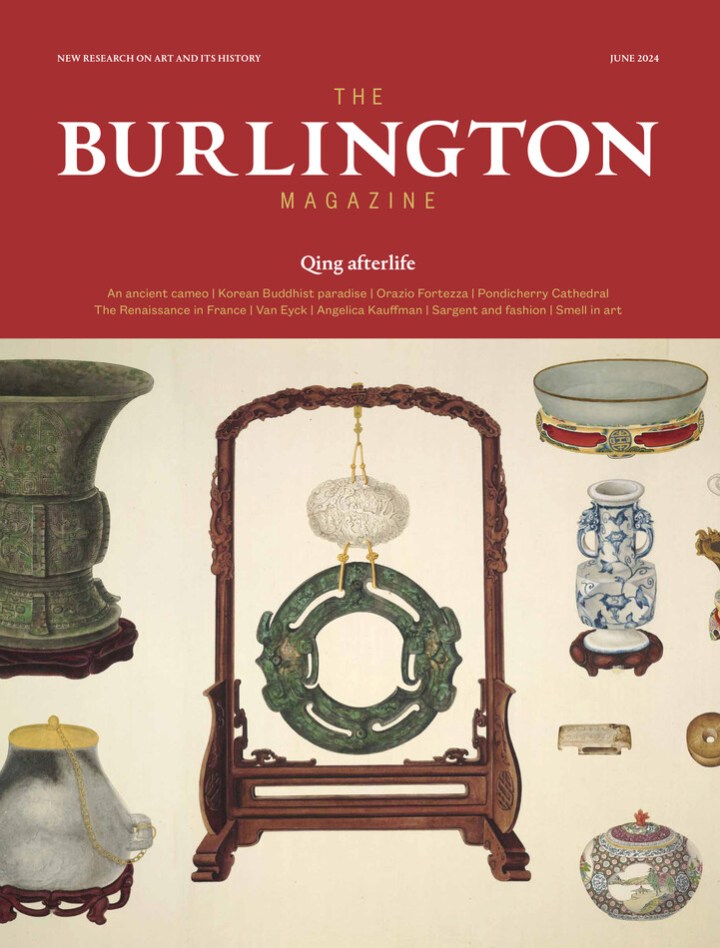 • “La Serenissima,” p, 543.
Henry James famously wrote in his Italian Hours (1909) that there is nothing more to be said about Venice. As so much ink has been spilt over its charms you can see his point. However, James then proceeded to rhapsodise at length about its beauty; and it is imperative that we, similarly, keep talking and writing and championing it, not least because all that it represents seems to be more precious and precarious than ever.
a r t i c l e s
• Ittai Gradel, “Nothing To Do with Menander: A Rediscovered Roman Cameo from the Caylus Collection,” pp. 546–53.
A Roman cameo published in 1752, but since lost, has been rediscovered. It shows actors rehearsing The Pimp by Posidippus, who portrait is included on the cameo. All other identifiable scenes of comedies in Roman art depict plays by Menander, the most popular Greek comic poet on the Roman stage.
• Gauvin Alexander Bailey, “The Cathedral of Notre-Dame-de-la-Conception, Pondicherry,” pp. 580–95.
When the cathedral at Pondicherry, the most ambitious in French India, was begun in 1771, its anonymous designer was obliged to make allowance for separation of the castes, despite a papal edict that they must attend public worship together. The cathedral was completed with the construction of its west facade in 1788–91; its design was based on seventeenth-century Parisian models and is here attributed to the engineer-architect François-Anne-Maire Rapine de Saxy.
• Ricarda Brosch, “The Art of Qing Imperial Afterlife: The Pictures of Ancient Playthings (Guwantu 古玩圖) Revisited,” pp. 596–611.
Two magnificent eighteenth-century handscrolls depict myriad precious objects made of jade, bronze, porcelain, glass, and bamboo. A novel interpretation of their function suggests that the illustrations were originally for wall decorations and remounted as scrolls for the Yongzheng Emperor’s tomb. The paintings’ remediation and repurposing offer a compelling example of the art of Qing imperial afterlife.
r e v i e w s
• Johnny Yarker, Review of the exhibition Angelica Kauffman (London: Royal Academy of Arts, 2024), pp. 620–23.
• William Barcham, Review of Martin Gayford, Venice: City of Pictures (Thames & Hudson, 2023), p. 653.
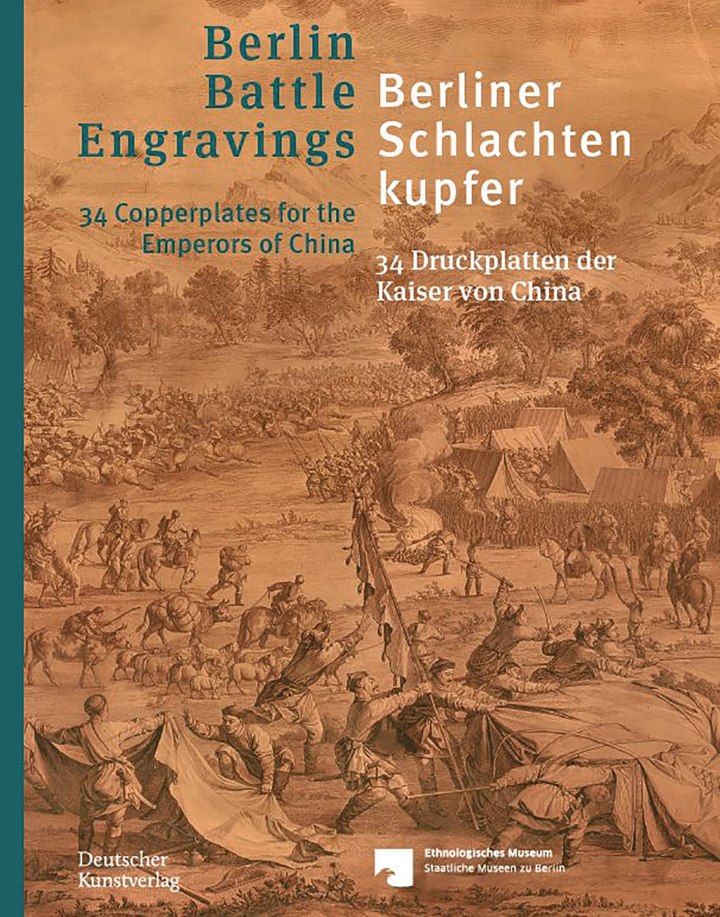
• Lianming Wang, Review of Henriette Lavaulx-Vrécourt and Niklas Leverenz, Berliner Schlachtenkupfer: 34 Druckplatten der Kaiser von China / Berlin Battle Engravings: 34 Copperplates for the Emperors of China (Deutscher Kunstverlag, 2021), pp. 654–55.
• Amina Wright, Review of Frédéric Ogée, Thomas Lawrence: Le génie du portrait anglais (Cohen & Cohen, 2022), pp. 655–56.
• Barry Bergdoll, Review of Didem Ekici, Patricia Blessing, Basile Baudez, eds., Textile in Architecture: From the Middle Ages to Modernism (Routledge, 2023), pp. 662–63.










leave a comment