Exhibition | Petr Brandl: The Story of a Bohemian

Installation view of the exhibition Petr Brandl: The Story of a Bohemian, Waldstein Riding School, Prague (2023).
◊ ◊ ◊ ◊ ◊
Now on view at Národní galerie Praha (as noted at Art History News) . . .
Petr Brandl: The Story of a Bohemian / Příběh bohéma
Waldstein Riding School, National Gallery Prague, 19 October 2023 — 11 February 2024
Curated by Andrea Steckerová
After over fifty years, this exhibition presents the work of the most important Baroque artist in Bohemia, Petr Brandl (1668–1735). On display are his monumental altarpieces—specially restored for the occasion—as well as his portraits and genre paintings of very interesting subject matter. Visitors will also see newly discovered works by Brandl for the very first time. The exhibition is organized around two parallel narratives: the painter’s works and his life.
 We have numerous archival documents of Brandl’s life of bohemian revolt, which is remarkable even today, offering interesting contexts for the problems of our time. Brandl was, for instance, a lifelong debtor due to his penchant for the luxury lifestyle of nobility, which he was keen to enjoy himself. It also led him to court battles with his wife Helena over alimony. In addition, Brandl was regularly in trouble with his commissioners, as he often failed to comply with the terms of his contracts. The painter’s unbound life has inspired a contemporary theatre play Three Women and a Hunter in Love, which will be staged together with the exhibition (Geisslers Hofcomoedianten).
None of this, however, changes the fact that Brandl was the highest-paid artist of his time, probably because of his very distinctive and original style of painting, in which we can trace certain parallels with Rembrandt. X-rays and macro-photographs of Brandl’s works complement the exhibition to give visitors a glimpse into the inner workings of his painting.
Andrea Steckerová, Petr Brandl: Příběh Bohéma (Prague: Národní galerie Praha, 2023), 288 pages, ISBN: 978-8070358221, 1050 Czech Koruna / $46.
Exhibition | South Asian Miniature Painting and Britain
Closing this month at The Box, with the catalogue appearing this spring from Bloomsbury:
Beyond the Page: South Asian Miniature Painting and Britain, 1600 to Now
The Box, Plymouth, 7 October 2023 — 28 January 2024
 Beyond the Page explores how the traditions of South Asian miniature painting have been reclaimed and reinvented by modern and contemporary artists, taken forward beyond the pages of illuminated manuscripts to experimental forms that include installations, sculpture, and film. The exhibition features work by artists from different generations working in dialogue with the miniature tradition, including Hamra Abbas, Zahoor ul Akhlaq, David Alesworth, Nandalal Bose, Noor Ali Chagani, Lubna Chowdhary, Adbur Rahman Chughtai, Olivia Fraser, Samuel Fyzee-Rahamin, Alexander Gorlizki, N.S. Harsha, Howard Hodgkin, Ali Kazim, Bhupen Khakhar, Matthew Krishanu, Jess MacNeil, Imran Qureshi, Nusra Latif Qureshi, Mohan Samant, Willem Schellinks, Raqib Shaw, Gulammohammed Sheikh, Nilima Sheikh, Arpita Singh, the Singh Twins, Shahzia Sikander, Abanindranath Tagore and Muhammad Zeeshan. Contemporary works are shown alongside examples of miniature painting dating as far back as the 16th century drawn from major collections including The Royal Collection, the Victoria & Albert Museum, and The British Museum, many on public display for the first time.
Anthony Spira and Fay Blanchard, eds., with essays by Emily Hannam and Hammad Nasar and catalogue entries by Emily Hannam, Cleo Roberts-Komireddi, and Elizabeth Brown, Beyond the Page: South Asian Miniature Painting and Britain, 1600 to Now (London: Philip Wilson Publishers, 2024), 224 pages, ISBN: 978-1781301258, $40.
Exhibition | Indian Skies: The Howard Hodgkin Collection

An Elephant and Keeper, India, Mughal, ca. 1650–60, opaque color and gold on paper
(New York: The Metropolitan Museum of Art, Howard Hodgkin Collection, 2022.187)
◊ ◊ ◊ ◊ ◊
Opening next month at The Met:
Indian Skies: The Howard Hodgkin Collection of Indian Court Painting
The Metropolitan Museum of Art, New York, 6 February — 9 June 2024
Over the course of sixty years, British artist Howard Hodgkin (1932–2017) formed a collection of Indian paintings and drawings that is recognized as one of the finest of its kind. A highly regarded painter and printmaker, Hodgkin collected works from the Mughal, Deccani, Rajput, and Pahari courts dating from the 16th to the 19th centuries that reflect his personal passion for Indian art. This exhibition presents over 120 of these works, many of which The Met recently acquired, alongside loans from The Howard Hodgkin Indian Collection Trust.
The works on view include stunning portraits, beautifully detailed text illustrations, studies of the natural world, and devotional subjects. The exhibition will also display a painting by Hodgkin, Small Indian Sky, which alludes to the subtle relationship between his own work, India, and his collection. This exhibition is accompanied by an issue of The Metropolitan Museum of Art Bulletin.
Exhibition | Within Reach of Asia
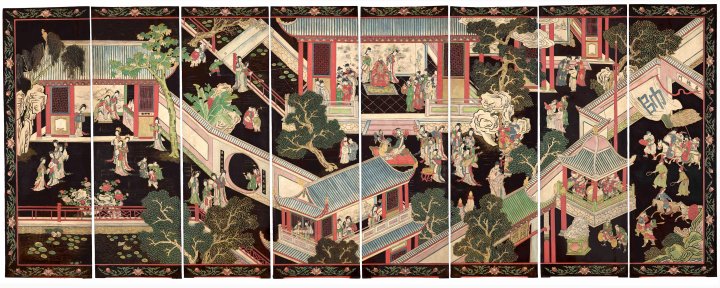
Eight-leaf screen, depicting a Palace Scene with the Arrival of a Delegation and Festivities in Honor of Tang General Guo Ziyi 郭子儀, Qing dynasty, Kangxi (1662–1722) or Qianlong (1736–1795) period, late 17th or 18th century; wood, ‘Coromandel’ lacquer, 135 × 346 cm (Dijon: Musée des beaux-arts). In the 18th century, the screen was part of the collection of Jehannin de Chamblanc (1722–1797).
◊ ◊ ◊ ◊ ◊
A review of the exhibition (in French) by Gilles Kraemer, with excellent installation photographs, is available at Le Curieux des Arts:
Within Reach of Asia: Asian Art Collectors and Dealers in France, 1750–1930
Musée des Beaux-Arts, Dijon, 20 October 2023 — 22 January 2024
Curated by Catherine Tran-Bourdonneau, Pauline d’Abrigeon, and Pauline Guyot
On 20 October 2023, the Musée des Beaux-Arts in Dijon opened its new exhibition À portée d’Asie: Collectors, Collectors and Dealers of Asian Art in France, 1750–1930, labelled of national interest by the Ministry of Culture. In partnership with the Institut National de l’Histoire de l’Art (INHA), the exhibition highlights two centuries of enthusiasm for Asian arts in France, from the royal collections of Louis XV and Marie-Antoinette, to collections gathered for commercial and scientific purposes between 1850 and 1930, along with the vogue for Japonism shared by artists, collectors, and simple amateurs of the bibelotage in the 19th century.
 Extending a research program of INHA, the exhibition brings together national collections and Far Eastern collections of regional museums, which include multiple objects brought from Asia over the ages. With more than 300 works—diverse technically (with lacquers, porcelains, ivories, bronzes, screens, prints and illustrated books, silk paintings, and theater masks), as well as historically and geographically (with objects from China, Japan, Korea, and Cambodia)—the exhibition draws on prestigious loans from important national institutions, including the Musée Guimet, the Louvre, the Palace of Versailles, the Musée des Arts Décoratifs, and the Musée du Quai Branly. Also well represented are the Asian collections of the region (those of Florine Langweil in Colmar and Strasbourg, Jules Adeline in Rouen, and Adhémard Leclère in Alençon) and especially those of Dijon’s Musée des Beaux-Arts. Moreover, through a participatory sponsorship campaign, €10,000 was raised for the museum’s restoration of a Coromandel lacquer screen from the 18th-century collection of Jehannin de Chamblanc.
Organized by the City of Dijon, in partnership with the National Institute of Art History (INHA), the exhibition is recognized as being of national interest by the Ministry of Culture, which provides exceptional financial support. The label ‘Exhibition of National Interest’ (Exposition d’intérêt national) was created by the Ministry of Culture in 1999 to support remarkable exhibitions organized by French museums in different regions. Such exhibitions highlight themes that reflect the richness and diversity of the collections of museums in France. The label rewards an innovative museum discourse, a new thematic approach, a scenography and a mediation device with the aim of reaching various audiences.
Pauline d’Abrigeon, Pauline Guyot, and Catherine Tran-Bourdonneau, eds., À portée d’Asie: Collectionneurs, collecteurs et marchands d’art asiatique en France, 1750–1930 (Paris: Lienart éditions, 2023), 320 pages, ISBN: 978-2359064049, €35.
The Burlington Magazine, December 2023
The eighteenth century in the December issue of The Burlington, which focuses on Spain:
The Burlington Magazine 165 (December 2023)

Francisco de Goya, Self-Portrait with Dr Arrieta, 1820, oil on canvas, 115 × 77 cm (Minneapolis Institute of Art, 52.14).
a r t i c l e
• Mercedes Cerón Peña, “Goya’s Self-Portrait with Dr Arrieta,” pp. 1300–04.
In 1820 Goya painted a portrait of himself as he had appeared during his serious illness of the year before, attended by his doctor, Eugenio García Arrieta. Newly discovered biographical information about Arrieta suggests that the painting’s red and and green colour scheme may allude to the political views he shared with Goya.
r e v i e w s
• Michael Hall, Review of the new Galería de las Colecciones Reales (Royal Collections Gallery) in Madrid (opened 28 June 2023), pp. 1339–43.
• Stephen Lloyd, Review of the exhibition Return of the Gods (World Museum, Liverpool, (April 2023 — February 2024), pp. 1343–45. “Britain’s largest assemblage of Classical sculpture outside London belongs to National Museums Liverpool . . . In 1959 Liverpool City Council and its museums were gifted the entirety of the Ince Blundell collection—approximately six hundred heavily restored Roman marbles . . . collected by . . . Henry Blundell (1724–1810), a wealthy Catholic landowner, between 1776 and 1809.”
• Humphrey Wine, Review of the catalogue raisonné by Joseph Assémat-Tessandier, Louis Lagrenée, dit l’Aîné (1725–1805) (Arthena, 2022), pp. 1364–65.
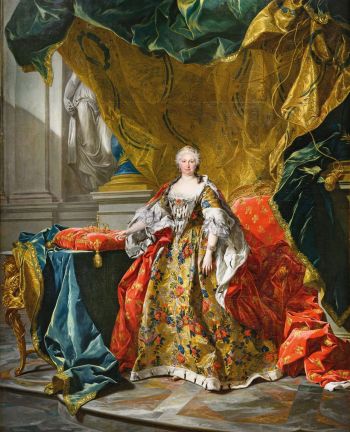
Louis-Michel van Loo, Portrait of Isabel Farnese, 1737, oil on canvas, 341 × 264 cm (Madrid: Galería de las Colecciones Reales).
• Rebeka Hodgkinson, Review of Stephanie Barczewski, How the Country House Became English (Reaktion, 2023), pp. 1370–71.
• Peter Humfrey, Review of Eveline Baseggio, Tiziana Franco, and Luca Molà, eds., La chiesa di Santa Maria dei Servi e la comunità veneziana dei Servi di Maria, secoli XIV–XIX (Viella, 2023), pp. 1374–75. “The demolition of the great fourteenth-century church of the Servi in about 1812–13 represents one of the most grievous of the many losses suffered by Venice’s artistic heritage during the Napoleonic period.”
o b i t u a r y
• Saloni Mathur, Obituary for Kavita Singh (1964–2023), pp. 1379–80.
Professor of art history and Dean of the School of Arts and Aesthetics at Jawaharlal Nehru University, Kavita Singh became internationally known for her publications on the history and politics of museums and the pre-modern art of South Asia. An authority on Indian court paintings, she was an inspiring colleague and teacher who publicly championed both her university and the study of Mughal art in the subcontinent.
Exhibition | Gods, Heroes, and Traitors
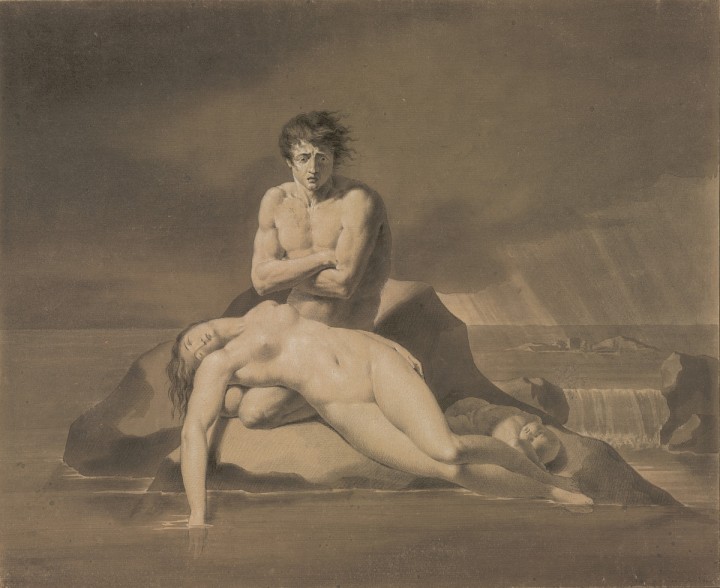
Robert von Langer, The Human Race Threatened by the Element of Water (Das Menschengeschlecht vom Element des Wassers bedroht), 1804
(Vienna: Albertina)
◊ ◊ ◊ ◊ ◊
The show was on view at the Albertina last summer; the catalogue (in German) is still available from Hatje Cantz Verlag:
Gods, Heroes, and Traitors: The History Image around 1800
Albertina, Vienna, 2 June — 27 August 2023
Borne up by sentiment, historical painting was considered the most elevated genre of art well into the early nineteenth century. Staking a claim to morality as Schiller saw it—in the sense of having the ability to affect the spirit and intellect didactically—the drawings condense significant moments of religious, mythological material. Human emotions and deeds were turned into an artistic image of history, in the truest sense of the word.
 With the pictures assembled here, the Albertina unites outstanding works of art that mark the origins of what is today the most important collection of prints worldwide. Its founder, Prince Albert Casimir of Saxony, Duke of Teschen, was a collector with his finger on the pulse of the times. He was especially interested in drawings, studies, sketches, and large-format works on paper, acquiring the artworks directly, and often personally, from the studios of artists such as Jacques-Louis David, Anton Raphael Mengs, Antonio Canova, Angelika Kauffmann, Heinrich Friedrich Füger, and Johann Heinrich Füssli, or from the big Academy exhibitions of his era.
Christof Metzger and Julia Zaunbauer, eds., with a foreword by Klaus Albrecht Schröder, Götter, Helden und Verräter: Das Historienbild um 1800 (Berlin: Hatje Cantz Verlag, 2023), 216 pages, ISBN: 978-3775754521, $62.
Exhibition | Canops: Extraordinary Furniture for Charles III of Spain
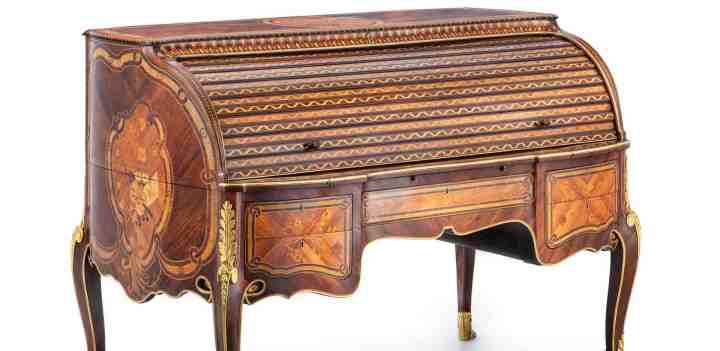
Madrid court workshop of Charles III under the direction of José Canops, Writing bureau with exotic marquetry decoration, ca. 1772–73
(Staatliche Museen zu Berlin, Kunstgewerbemuseum; photo by Stephan Klonk)
◊ ◊ ◊ ◊ ◊
Now on view at Berlin’s Museum of Decorative Arts, from the Staatliche Museen zu Berlin, with a related conference taking place 25–27 January:
Canops: Extraordinary Furniture for Charles III of Spain, 1759–1788
Kunstgewerbemuseum, Schloss Köpenick, Berlin, 12 October 2023 — 11 February 2024
Curated by Achim Stiegel
Although largely unknown today, the work of José Canops (1733–1814), an ébéniste of German descent born Joseph Cnops, and his Madrid workshop is one of the crowning achievements of European furniture-making.
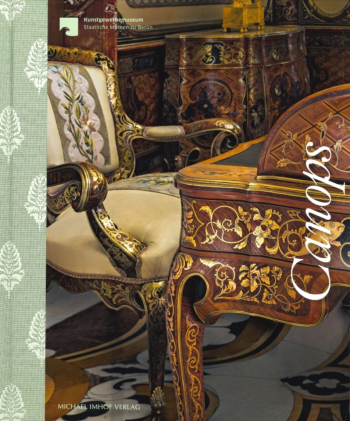 The furniture and boiseries are from the apartments of Charles III of Spain (r. 1759–1788), a Gesamtkunstwerk in exuberant rococo style conceived by the court painter and stuccoist Mattia Gasparini—a truly European creation inspired by Italian traditions, a taste for Parisian opulence, and the exotic worlds of Asia. Such elements combine in Canops’s work with the precision of German cabinetmaking and the riches of the Spanish colonies.
The starting point for the exhibition and publication was the acquisition for the Kunstgewerbemuseum of a magnificent roll-top desk by José Canops. With lavish new photography and never previously exhibited loans from the Patrimonio Nacional (the Spanish royal collections in Madrid), German and international audiences are afforded a glimpse into a hitherto hidden world.
In conjunction with the Spanish Embassy, the Ibero-Amerikanisches Institut of the Preußischer Kulturbesitz and Instituto Cervantes Berlin, the exhibition is accompanied by a programme of supporting events within the context of the 2023 Spanish presidency of the Council of the European Union.
Daniela Heinze, Achim Stiegel, et al., Canops: Möbel von Welt für Karl III. von Spanien (1759–1788), with photographs by Stephan Klonk (Petersberg: Michael Imhof Verlag, 2023), 288 pages, ISBN: 978-3731913689, €50.
New Book | Tischbein the Elder (1722–1789)
An exhibition from 2022 that I missed, though the catalogue is still available from Michael Imhof:
Tischbein: Meisterwerke des Hofmalers, Porträts und Landschaften von Johann Heinrich Tischbein d. Ä. (1722–1789) (Petersberg : Michael Imhof Verlag, 2022), 160 pages, ISBN: 978-3731912675, €35.
 Ausstellung im Schloss Fasanerie in Eichenzell/Fulda: 11. Juni bis 9. Oktober 2022
Am 3. Oktober 2022 jährt sich der Geburtstag Johann Heinrich Tischbeins des Älteren (1722–1789) zum 300. Mal. Den runden Geburtstag des bedeutendsten Vertreters der berühmten hessischen Malerdynastie Tischbein nimmt die Kulturstiftung des Hauses Hessen zum Anlass, dem landgräflich-hessischen Hofmaler im Museum Schloss Fasanerie bei Fulda eine monografische Ausstellung zu widmen. Ein Schwerpunkt der Ausstellung stellt die Rolle Tischbeins als Hofmaler dreier hessischer Landgrafen in Kassel dar. Im Jahr 1753 wurde Johann Heinrich d. Ä. von Landgraf Wilhelm VIII. von Hessen-Kassel zum Hofmaler ernannt und blieb es auch während der gesamten Regierungszeit Friedrichs II. (1760–1785). Obwohl Tischbein bei Regierungsantritt Wilhelms IX. bereits krank war, blieb er auch unter ihm Hofmaler, und der Landgraf richtete auf Schloss Wilhelmshöhe eine ihm posthum gewidmete Gemäldegalerie ein. Aufträge erhielt der Maler jedoch nicht allein von Mitgliedern des Kasseler Hofs, er schuf auch zahlreiche Porträts für Fürst Karl August von Waldeck und Pyrmont und stattete dessen Residenz in Bad Arolsen mit Gemälden aus. Darüber hinaus porträtierte Tischbein seine eigene Familie und war auch bei bürgerlichen Auftraggebern jenseits von Hof und Residenz gefragt. Neben Porträts zeigt der Katalog Landschaftsgemälde von Johann Heinrich Tischbein d. Ä. Darunter befinden sich wichtige Ansichten des Schlosses auf dem Weißenstein (dem Vorgängerbau von Schloss Wilhelmshöhe in Kassel) und der das Schloss umgebenden Parkanlagen des 18. Jahrhunderts.
i n h a l t
Zum Geleit Donatus Landgraf von Hessen
1 Johann Heinrich Tischbein d. Ä.: Selbstbildnisse als Inszenierungdes sich wandelnden Künstlertums — Justus Lange
Katalog
2 Die Porträts Landgraf Friedrichs II. von Hessen-Kassel — Andreas Dobler
Katalog
3 Landgräfin Philippine von Hessen-Kassel (1745–1800) im Porträt — Malena Rotter
Katalog
4 Denker und Dichterinnen: Johann Heinrich Tischbeins d. Ä. Porträtmalerei jenseits von Hof und Residenz — Andrea Linnebach
Katalog
5 Landschaftsgemälde von Johann Heinrich Tischbein d. Ä.— Markus Miller
Katalog
Literaturverzeichnis
Exhibition | Unnamed Figures: Black Presence and Absence
 Rufus Hathaway, A View of Mr. Joshua Winsor’s House &c., Duxbury, Massachusetts, ca. 1793–95, oil on canvas (New York: American Folk Art Museum, gift of Ralph Esmerian, 2013.1.19). From the museum’s Instagram account, “This iconic folk painting has typically been interpreted as its eighteenth-century patron, Joshua Winsor, would have expected: as a chronicle of his wealth and property as a merchant and shipbuilder in Duxbury, Massachusetts. Usually unremarked upon is the figure of a Black woman in the lower left-hand corner of the scene. With her back to the viewer, the woman is faceless, evoking the limited details known about early African American lives. Census records provide small clues. Was she the one free person of color recorded in the Winsor household in 1790, a few years before this painting was made? Likely attending to many aspects of the Winsors’ domestic lives, this enigmatic figure was one of the many unnamed Black residents of New England whose underrecognized labor paved the way for their employers’ or enslavers’ prosperity.”
◊ ◊ ◊ ◊ ◊
Karen Rosenberg’s review of the exhibition recently appeared in The New York Times (21 December 2023) . . . .
Unnamed Figures: Black Presence and Absence in the Early American North
American Folk Art Museum, New York, 15 November 2023 — 24 March 2024
Flynt Center of Early New England Life, Deerfield, Massachusetts, 1 May — 4 August 2024
Curated by Emelie Gevalt, RL Watson, and Sadé Ayorinde
Unnamed Figures: Black Presence and Absence in the Early American North is on view at the American Folk Art Museum until 24 March 2024. As a corrective to histories that define slavery and anti-Black racism as a largely Southern issue, this exhibition offers a new window onto Black representation in a region that is often overlooked in narratives of early African American history.
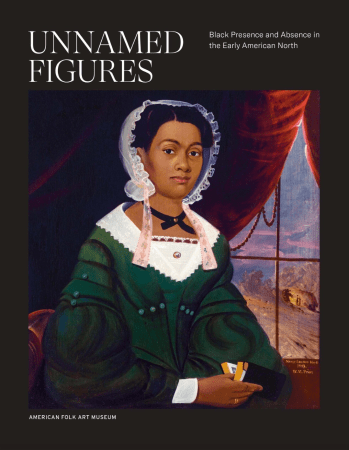 Through 125 remarkable works including paintings, needlework, and photographs, this exhibition invites visitors to focus on figures who appear in—or are omitted from—early American images and will challenge conventional narratives that have minimized early Black histories in the North, revealing the complexities and contradictions of the region’s history between the late 1600s and early 1800s. A 300-page scholarly book with contributions from Gwendolyn DuBois Shaw, Jennifer Van Horn, and several other authors, is available for purchase.
The exhibition is co-curated by Emelie Gevalt, Curatorial Chair for Collections and Curator of Folk Art, AFAM; RL Watson, Assistant Professor of English and African American Studies, Lake Forest College; and Sadé Ayorinde, Terra Foundation Predoctoral Fellow in American Art at the Smithsonian American Art Museum. A free digital guide on Bloomberg Connects is available here.
Please be advised that this exhibition contains complex, challenging, and racist imagery.
Unnamed Figures: Black Presence and Absence in the Early American North (New York: American Folk Art Museum, 2023), 300 pages, $75.
Catalogue contributors are scholars and researchers with expertise in American art history, material culture, African American history and literature, and other related topics. The book includes a foreword by Gwendolyn DuBois Shaw and Jason Busch. Contributors include the exhibition’s curators as well as Virginia Anderson, Kelli Racine Barnes, Michael Bramwell, Christy Clark-Pujara, Anne Strachan Cross, Jill Vaum Rothschild, Jonathan Michael Square, Lea Stephenson, Jennifer Van Horn, and Gordon Wilkins.
r e l a t e d p r o g r a m m i n g
7 December 2023
Virtual Insights: Reasserting Black Presence in the Early American North
11 January 2024
BlackMass Responds to Unnamed Figures: Tour with Yusuf Hassan and Kwamé Sorrell
14 February 2024
Notes on Style: A Discussion with BlackMass on Portraiture and Personhood
23 February and 28 March 2024
‘The Picture Is Still Out There’: Reframing Black Presence in the Collections of Early American Art and Material Culture | 2024 Elizabeth and Irwin Warren Folk Art Symposium
18 March 2024
Autobiographical Landscapes: Gary Tyler in Conversation with Allison Glenn
◊ ◊ ◊ ◊ ◊
Note (added 4 January 2024) — The posting was updated to include Historic Deerfield as a venue.
Exhibition | James Gillray: Characters in Caricature
Now on view at Gainsborough’s House (which was just announced as the winner of The Georgian Group’s 2023 award for the ‘Restoration of a Georgian Building in an Urban Context’). . .
James Gillray: Characters in Caricature
Gainsborough’s House, Sudbury, 11 November 2023 — 10 March 2024
Curated by Tim Clayton
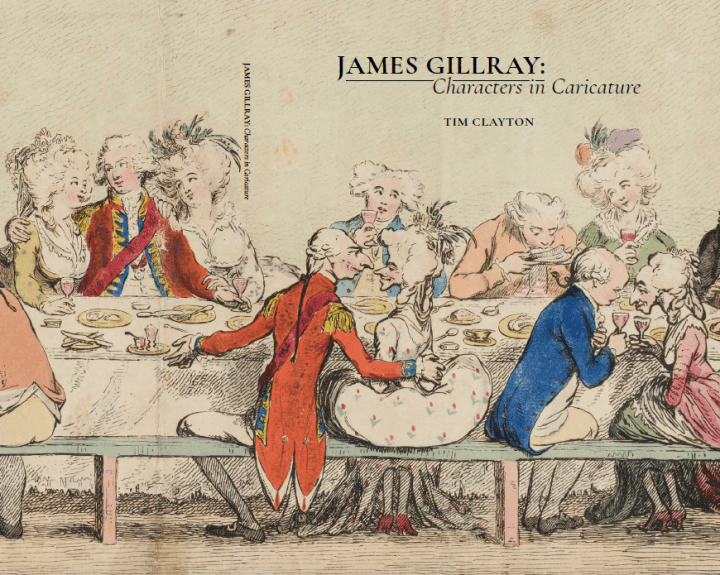
James Gillray (1756–1815) was Georgian Britain’s funniest, most inventive, and most celebrated graphic satirist. His work transcends his own time and has continued to influence his successors of the modern age, from David Low to Martin Rowson. Tim Clayton, author of 2022’s definitive biography of James Gillray, brings the master satirist to life in an astonishing, colourful, and at times salacious exhibition, James Gillray: Characters in Caricature. This lively and daring exhibition examines how Gillray exposed the most notorious scandals of his time by focusing on the artist’s principal characters—household names to which he returned to again and again, from Emma Hamilton to the Emperor Napoleon.
Tim Clayton, James Gillray: Characters in Caricature (Sudbury: Gainsborough’s House Society, 2023), ISBN: 978-0946511693, £20.










 Enfilade
leave a comment