Exhibition | Timeless Beauty: A History of Still Life
From the Staatliche Kunstsammlung Dresden:
Timeless Beauty: A History of Still Life / Zeitlose Schönheit: Eine Geschichte des Stilllebens
Gemäldegalerie Alte Meister, Zwinger, Dresden, 17 November 2023 — 1 September 2024
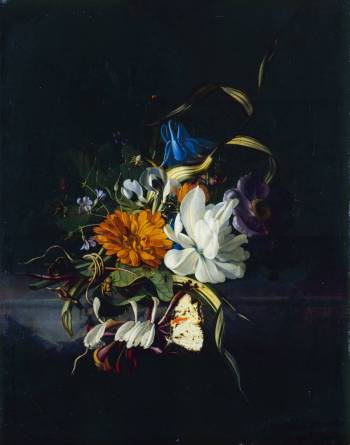
Rachel Ruysch (1664–1750), Floral Still Life, 1690, oil on canvas on oak panel, 35 × 27 cm (Dresden: Museum Gemäldegalerie Alte Meister, 3149).
In the Winckelmann Forum of the Semper Building, the Gemäldegalerie Alte Meister presents around 80 works from its own collection in the exhibition Timeless Beauty: A History of Still Life. The wide-ranging presentation—with masterpieces by painters such as Frans Snyders, Balthasar van der Ast, Jan Davidsz. de Heem, Adriaen van Utrecht, Willem Claesz. Heda, Abraham Mignon, and Rachel Ruysch—comprehensively illuminates the genre ‘still life’. Since when has it existed? What exactly constitutes a still life? What meaning, what content and what function did they have and still have today? What allegories and symbols are hidden in these motifs?
Still lifes were not only showpieces of decorative room furnishings, in which the overall effect was in the foreground. They also bear witness to natural scientific interests: the depicted object is regarded as a scientifically object and ‘document’—today as in the Age of Enlightenment. At the same time, however, still lifes are also an illusion, a game with the eye (trompe-l’œuil), in which the optical effect of the entire motif takes center stage. Through the bravura of painting, the ephemeral is immortalized. Many of the works on display, some of them recently restored, allow visitors to rediscover this fascinating genre, as only a few of the more than 100 still lifes in the Gemäldegalerie Alte Meister are on permanent display.
Konstanze Krüger, ed., Stillleben: Zeitlose Schönheit (Berlin: Hatje Cantz Verlag, 2023), 160 pages, ISBN: 978-3775751131, $50.
Konstanze Krüger, ed., Still Life: Timeless Beauty (Berlin: Hatje Cantz Verlag, 2024), 144 pages, ISBN: 978-3775751148, $40.
Print Quarterly, March 2024
The long eighteenth century in the latest issue of Print Quarterly:
Print Quarterly 41.1 (March 2024)
a r t i c l e s
• Przemysław Wątroba, “Jacques Rigaud’s Drawings in Warsaw of the Residences of Louis XIV,” pp. 23–32.
“In the collection of the last king of Poland, Stanisław August Poniatowski (1732–98), kept in the Print Room of the University of Warsaw Library, there is a renowned volume titled Recueil choisi des plus belles vues des palais et maisons royales de Paris et des environs containing a series of 106 engravings by Jacques Rigaud (1681–1754). . . . A set eight hitherto unpublished drawings by Rigaud [also in Warsaw and] formerly kept in Portfolio 174 are here presented as designs” for eight of the prints (23, 25).
n o t e s a n d r e v i e w s

Seven Creamware Plates, ca. 1808–36, diameters 20–23 cm, transfer-printed with various scenes, clockwise from top: Defoe’s Robinson, Choisy factory; Cervantes’s Don Quixote, Montereau factory; Perrault’s Fairies, Montereau factory; Fontaine’s Fable of the Fox and Grapes, Sèvres factory; Ovid’s Metamorphoses, Judgement of Midas, Choisy factory; Chateaubriand’s Atala Found with Chactus by Father Aubry, Choisy factory; and at centre, Cottin’s Matilda Saved by Malek Adhel, Choisy factory (Germany, Peter-Christian Wegner Collection).
• Marzia Faietti, Review of Heather Madar, ed., Prints as Agents of Global Exchange: 1500–1800 (Amsterdam UP, 2021), pp. 37–39.
• Sheila McTighe, Review of Francesco Ceretti and Roberta D’Adda, eds., Immaginario Ceruti: Le stampe nel laboratorio del pittore (Skira, 2023), pp. 42–43. This catalogue accompanied an exhibition that explored the work of the painter Giacomo Ceruti (1698–1767) and his reliance on printed images. “A complementary show of Ceruti’s paintings, Miseria & Nobiltà: Giacomo Ceruti nell’Europa del Settecento was also held in 2023 at the Museo Santa Giulia in Brescia, followed by a reduced version at the J. Paul Getty Museum, Los Angeles during the second half of that year, Giacomo Ceruti: A Compassionate Eye” (42).
• Natasha Ruiz-Gómez, Review of Rebecca Whiteley, Birth Figures: Early Modern Prints and the Pregnant Body (University of Chicago Press, 2023), pp. 43–45.
• Antony Griffiths, Review of Chiara Travisonni with Luca Fiorentino and Andrea Muzzi, Pietro Giacomo Palmieri (Edifir, 2023), pp. 45–46. This monograph on the draughtsman and printmaker, Pietro Giacomo Palmieri (1737–1804), “will become the definitive source of information” for the artist and his work (46).
• Patricia Ferguson, Review of Peter-Christian Wegner, Literatur auf französischen Steingut-Tellern des frühen 19. Jahrhunderts (Georg Olms, 2022), pp. 46–47. Wegner addresses the popularity of subjects drawn from French literature for transfer-printed ceramics, starting in 1808. “While we await a larger in-depth survey of this engaging material, Wegner’s publication is a huge contribution to its appreciation” (46).
• Elizabeth Savage, Review of Christien Melzer and Georg Josef Dietz, Holzschnitt: 1400 bis heute (Hatje Cantz, 2022), pp. 48–50. This is the catalogue for an exhibition that “featured more than 100 prints from the Kupferstichkabinett [in Berlin], as well as what was effectively the first large-scale display of woodblocks from its enormous yet relatively little-known collection” (50).

Johann Christoph Weigel, Sheet for Découpage with Figures on Cloudlike Landscapes and a Fantastical Bird, c. 1700–25, from album Inventions Chinoises V, handcoloured engraving, 216 x 151 mm (Dresden, Kupferstich-Kabinett).
• Brief notice of Katy Barrett, Looking for Longitude: A Cultural History (Liverpool UP, 2022), p. 76. Rather than a retelling of the familiar story of accurately calculating longitude, this book “is a remarkably well-researched account of the ways in which this long-running sage impacted on many areas of public discourse, thought, and imagery” (76).
• Emanuele Lugli, Review of Miriam Vogelaar, The Mokken Collection: Books and Manuscripts on Fencing before 1800 (MMIT Publishing, 2020), pp. 88–92.
• Nadine Orenstein, Review of Maureen Warren, ed., Paper Knives, Paper Crowns: Political Prints in the Dutch Republic (Champaign: Krannert Art Museum, 2022), 92–96. “Never have these prints been so lavishly presented. The beautifully produced catalogue, winner of the 2023 IFPDA Book Award, exceptionally allocates plenty of space to the images. It allows the reader to see entire works along with accompanying text and provides space for multi-plate productions” (93).
• Maureen Cassidy-Geiger, Review of Cordula Bischoff and Petra Kuhlmann-Hodick, eds, La Chine: Die China-Sammlung Des 18. Jahrhunderts Im Dresdner Kupferstich-Kabinett (Sandstein Verlag, 2021), 97–103. This “is the catalogue of an exhibition at the Dresden State Museum devoted to the Chinese works on paper and European chinoiserie prints acquired by the Saxon Electors before 1750” (97). It “was an ambitious project that took many years to come to fruition and required collaboration between colleagues in different disciplines with different working languages” (102).
Exhibition | William Blake’s Universe

From the press release for the exhibition:
William Blake’s Universe / William Blakes Universum
The Fitzwilliam Museum, Cambridge, 23 February — 19 May 2024
Hamburger Kunsthalle, 14 June — 8 September 2024
Curated by David Bindman and Esther Chadwick
Responding to the upheavals of revolution and war in Europe and the Americas, visionary artist, poet, and printmaker William Blake (1757–1827) produced an astonishing body of work that combined criticism of the contemporary world with his vision for universal redemption. But he wasn’t the only one. William Blake’s Universe is the first major exhibition to consider Blake’s position in a constellation of European artists and writers striving for renewed spirituality in art and life.
Organised in collaboration with the Hamburger Kunsthalle, and drawing on extensive research, this ambitious exhibition will explore the artist’s unexpected yet profound links with important European figures including pre-eminent German Romantic artists Philipp Otto Runge (1777–1820) and Caspar David Friedrich (1774–1840). It will also place Blake within his artistic network in Britain, drawing parallels with the work of his peers, mentors, and followers including Henry Fuseli (1741–1825), John Flaxman (1755–1826), and Samuel Palmer (1805–1881).

Poster with detail of William Blake after Henry Fuseli, Head of a Damned Soul, ca. 1788–90, engraving and etching on paper (University of Cambridge: The Fitzwilliam Museum).
Featuring around 180 paintings, drawings, and prints—including over 90 of those by Blake—this major exhibition marks the largest ever display of work from the Fitzwilliam’s world-class William Blake collection, with additional loans from the British Museum, Tate, Ashmolean and other institutions. Examples of the artist’s most iconic and much-loved works including Albion Rose (1794–96) and Europe: A Prophecy (1794), will be joined by rarely exhibited artworks from Blake’s oeuvre, including outstanding new acquisitions from the Sir Geoffrey Keynes bequest, displayed publicly for the first time since joining the Fitzwilliam collection. These include the trial frontispiece of Blake’s prophetic book Jerusalem (1804–1820) and his spectacular large drawing Free Version of the Laocoön (c.1825). Additional highlights include the unique first state of Joseph of Arimathea (1773), produced by Blake as an apprentice aged 16, shown alongside a reworked version of the same image, completed by Blake in his mature years.
Visitors will have a special opportunity to discover the work of Runge, one of Germany’s most important Romantic artists, who has been very rarely seen in the UK until now. Bringing together the largest number of Runge works in the UK to date, the exhibition will include the engravings from the Times of Day (1802–10) series, a defining work of German Romanticism. Representing not only the changing times of day, but the seasons, the ages of man and historical epochs, Runge obsessively returned to this important body of work, an extensive number of preparatory drawings and studies of which will be presented at the Fitzwilliam. Among the works on loan from the Hamburger Kunsthalle will be The Large Morning (1808–09), a fragmentary oil painting widely considered to be one of the most important works from Runge’s short career, cut short by his death aged 33.
Another highlight of the exhibition will be Caspar David Friedrich’s seven sepia drawings The Ages of Man (c.1826) on loan from the Hamburger Kunsthalle. Thought to be inspired by Runge’s interest in visual representations of time, the exquisitely delicate series is associated with the themes of change in nature, the cyclical representation of time, and the temporality of human life.
 William Blake’s Universe will unfold in three main sections—past, present and future—with an introductory display of artists’ portraits. ‘The Past: Antiquity and the Gothic’ will focus on the legacy of classical antiquity and Blake’s turn towards the Gothic as an alternative source of inspiration, as well as a spotlight section on Flaxman, an artistic mentor to Blake who gained great acclaim in Germany and across Europe. ‘The Present: Europe in Flames’ will concentrate on the responses of Blake and his close contemporaries in Britain to the revolutionary 1790s. The third section, ‘The Future: Spiritual Renewal’, will show how visions of redemption from a fallen world became a central concern for Blake and his contemporaries in the post-revolutionary period. Jacob Böhme’s mystical ideas about light and cosmic unity, which form a bridge between Blake and his German contemporaries, will be a central display.
William Blake’s Universe is curated by David Bindman, emeritus Durning-Lawrence professor of the History of Art at University College London, and Esther Chadwick, Lecturer in Art History at the Courtauld Institute of Art. The exhibition will be accompanied by a fully illustrated catalogue featuring new scholarship by the curators, as well as essays by leading academics Sarah Haggarty, Joseph Leo Koerner, Cecilia Muratori, William Vaughan, and James Vigus.
Curators David Bindman and Esther Chadwick said: “This is the first exhibition to show William Blake not as an isolated figure but as part of European-wide attempts to find a new spirituality in face of the revolutions and wars of his time. We are excited to be able to shed new light on Blake by placing his works in dialogue with wider trends and themes in European art of the Romantic period, including transformations of classical tradition, fascination with Christian mysticism, belief in the coming apocalypse, spiritual regeneration and national revival.”
David Bindman and Esther Chadwick, eds., William Blake’s Universe (London: Philip Wilson Publishers, 2024), 224 pages, ISBN: 978-1781301272, £35 / $45.
Exhibition | Kaendler’s Meissen Porcelain Figures
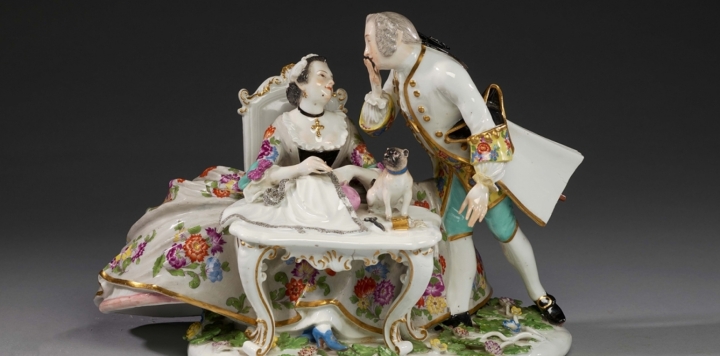
This summer at the Wawel Royal Castle:
Magnificence of Rococo: Kaendler’s Meissen Porcelain Figures
Wspaniałość rokoka: Miśnieńskie figurki porcelanowe Johanna Joachima Kaendlera
Wawel Royal Castle, National Art Collection, Kraków, 23 May — 29 September 2024
At the age of 25, Johann Joachim Kaendler (1706–1775) was appointed court sculptor by Augustus the Strong (r. 1694–1733). In the same year he joined the Meissen porcelain manufactory as a modeller, to which he remained loyal throughout his life. Kaendler’s name is closely associated with the golden age of the Meissen manufactory in the 18th century, where, he demonstrated his artistic and technical talent in creating numerous porcelain sculptures, which are still highly valued as collectors’ items today. At the same time they are still part of the manufactory’s repertoire.
 The choice of themes in Kaendler’s works reflects the courtly life of the period, which ranged from the late Baroque through the Rococo to the emerging Classicism. Until the end of the Saxon-Polish joint reign in 1763, the nobility and the court were almost the only clients of the manufactory, before the emerging middle classes finally discovered porcelain for themselves. Accordingly, Kaendler’s early works are oriented towards the preferences and fashions of the court. Hunting and theatre—especially the popular Commedia dell’arte—played a central role here, as did the Masonic Order, which was replaced by the Order of the Pug after the papal ban of 1738.
In 1736, for the first time Kaendler created one of the highly esteemed crinoline groups, which often depicted men and women in everyday court life, also in an amorous context. They were named after the ladies’ flared skirts, which were given their shape by a framework of fishbone. Alongside love adventures, the pastoral idyll, the simple life, was one of the secret longings of the nobility. This trend found its most famous manifestation in the Hameau of the French Queen Marie Antoinette (1755–1793) in Versailles. Kaendler served this fad with figures from the people, craftsmen, peasants and, last but not least, the ‘Cris de Paris’ (Cries of Paris), which embody various professions.
Increasing world trade and travel reports from distant countries stimulated people’s curiosity at that time. Exotic depictions of all kinds were in vogue. Artists and craftsmen endeavoured to satisfy the wishes of their customers with ever new subjects, which, however, were often far removed from reality—and few could verify it anyway. Kaendler devoted himself to the subject in his own way. He modelled figures in the national costumes of various peoples as well as animals that were foreign to Central Europeans at the time, such as elephants, lions and dromedaries, to name but a few. The chinoiseries had long since developed into a fashion in their own right. Kaendler did not limit himself to shaping individual figures in their characteristic costumes and physiognomy, but also created family scenes with a unique charm.
Kaendler’s surviving notes from the 1740s prove his productivity. The surviving porcelain sculptures bear witness to his creativity, his genius. Thus, within a few years, a world of his own was created in porcelain, which was enjoyed by the society of the time. Even if tastes have changed since then, Kaendler still proves to be a gifted artist when we take a closer look.
The exhibition jointly organised by the Röbbig Gallery and Wawel Royal Castle will present, for the first time in Poland, a magnificent group of figures by Johann Joachim Kaendler from European private collections. The exhibition will be an excellent pendant to the Wawel collection of Meissen porcelain, which centres around stately objects that create illustrate how the manufactory worked to elevate the prestige of the Wettin court. Wawel Hill was the seat of Polish kings from 1025, and coronations took place here, including that of Augustus II the Strony and his son Augustus III. The figurines presented by the Röbbig Gallery served the more private needs of porcelain lovers all over the world and continue to do so today. Together, the two collections will provide an opulent picture of life in the palaces and residences of the mid-eighteenth century.
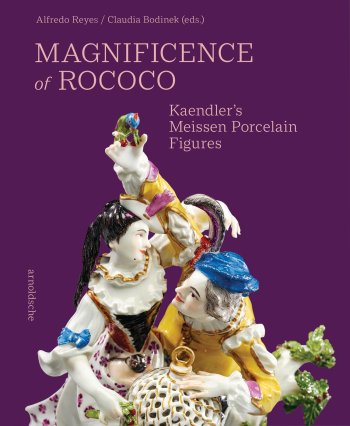
Alfredo Reyes and Claudia Bodinek, eds., Magnificence of Rococo: Kaendler’s Meissen Porcelain Figures (Stuttgart: Arnoldsche, 2024), 400 pages, ISBN: 978-3897907072, $135.
Exhibition | ‘Fruit of Friendship’: Portraits by Mary Beale
From Philip Mould & Co:
‘Fruit of Friendship’: Portraits by Mary Beale
Philip Mould & Company, London, 25 April — 19 July 2024
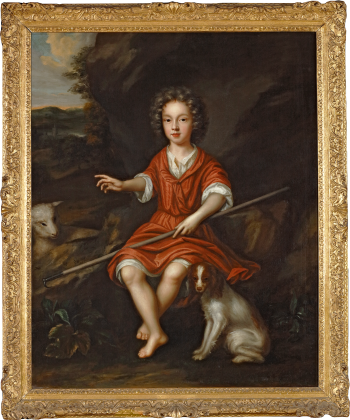
Mary Beale, Portrait of a Young Boy Seated in a Landscape, 1680s, oil on canvas, 127 × 102 cm.
Mary Beale (1633–1699) was one of Britain’s first professional woman artists. Philip Mould & Company’s forthcoming exhibition ‘Fruit of Friendship’: Portraits by Mary Beale, opening this spring, will feature twenty-five of her works from public and private collections, spanning her entire career and including self-portraits, portraits of her family and friends, and formal commissions.
The exhibition will also shed light on Beale’s studio practice and highlight its radical reversal of conventional gender roles for the period. Beale’s husband Charles dedicated himself to his wife’s career and supported her studio diligently by priming canvases, manufacturing pigments, and recording business in a series of notebooks. The exhibition will present three works not seen in public before, including an early re-discovered portrait of the artist’s husband and a portrait of Anne Sotheby, which will be displayed in the gallery for two weeks before it is exhibited in Tate Britain’s upcoming exhibition Now You See Us: Women Artists in Britain, 1520–1920.
The exhibition will be complemented by an openly available online catalogue. In anticipation of a comprehensive printed publication scheduled for summer 2024, this online resource will be an accessible guide to her works and their significance.
Ellie Smith and Lawrence Hendra, Fruit of Friendship: Portraits by Mary Beale (London: Paul Holberton Publishing, 2024), 160 pages, ISBN: 978-1913645748, £25.
◊ ◊ ◊ ◊ ◊
Note (added 4 September 2024) — The posting was updated to include the hardback catalogue.
Exhibition | Angelica Kauffman

Angelica Kauffman, Portrait of Emma, Lady Hamilton, as Muse of Comedy, detail, 1791, oil on canvas, 127 × 102 cm
(Private collection)
◊ ◊ ◊ ◊ ◊
A version of the exhibition appeared in 2020 at Düsseldorf’s Kunstpalast and was intended to arrive much sooner at the Royal Academy but was derailed by Covid. The show opens next month (hooray!). . .
Angelica Kauffman
Royal Academy of Arts, London, 1 March — 30 June 2024
Curated by Bettina Baumgärtel and Per Rumberg, with Annette Wickham
Angelica Kauffman RA (1741–1807) was one of the most celebrated artists of the 18th century. In this major exhibition, we trace her trajectory from child prodigy to one of Europe’s most sought-after painters.
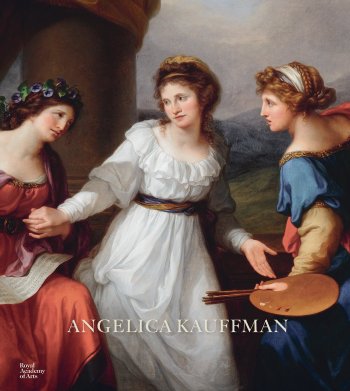 Known for her celebrity portraits and pioneering history paintings, Angelica Kauffman helped to shape the direction of European art. She painted some of the most influential figures of her day—queens, countesses, actors and socialites—and she reinvented the genre of history painting by focusing largely on female protagonists from classical history and mythology. This exhibition covers Kauffman’s life and work: her rise to fame in London, her role as a founding member of the Royal Academy, and her later career in Rome where her studio became a hub for the city’s cultural life. See paintings and preparatory drawings by Kauffman, including some of her finest self-portraits and her celebrated ceiling paintings for the Royal Academy’s first home in Somerset House, as well as history paintings of subjects including Circe and Cleopatra, and discover the remarkable life of the artist whom one of her contemporaries described as “the most cultivated woman in Europe.”
The exhibition is curated by Bettina Baumgärtel, Head of the Department of Painting at the Kunstpalast in Düsseldorf, and Per Rumberg, Curator at the Royal Academy, with Annette Wickham, Curator of Works on Paper at the Royal Academy.
Bettina Baumgärtel and Annette Wickham, Angelica Kauffman (London: Royal Academy of Arts, 2024), 144 pages, ISBN: 978-1915815033, £20 / $30.
◊ ◊ ◊ ◊ ◊
Note (added 15 February 2024) — Wendy Wassyng Roworth’s review of the 2020 exhibition catalogue appeared in The Woman’s Art Journal 42.1 (Spring/Summer 2021): 46–48.
Exhibition | Entangled Pasts, 1768–Now
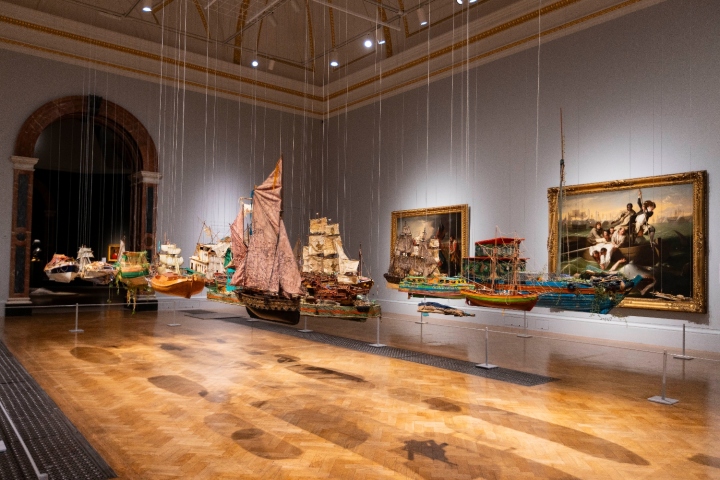
Installation view of Entangled Pasts, 1768–Now: Art, Colonialism, and Change at the Royal Academy of Arts, London, showing Hew Locke’s Armada, 2017–19 (Photo by David Parry for the Royal Academy of Arts, London).
◊ ◊ ◊ ◊ ◊
Now on view at the RA:
Entangled Pasts, 1768–Now: Art, Colonialism, and Change
Royal Academy of Arts, London, 3 February — 28 April 2024
Curated by Dorothy Price with Cora Gilroy-Ware and Esther Chadwick
J.M.W. Turner and Ellen Gallagher. Joshua Reynolds and Yinka Shonibare. John Singleton Copley and Hew Locke. Past and present collide in one powerful exhibition.
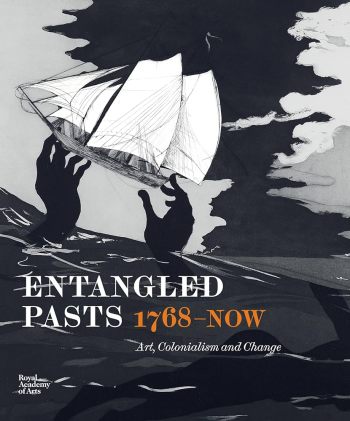 This spring, we bring together over 100 major contemporary and historical works as part of a conversation about art and its role in shaping narratives of empire, enslavement, resistance, abolition, and colonialism—and how it may help set a course for the future. Artworks by leading contemporary British artists of the African, Caribbean, and South Asian diasporas, including Sonia Boyce, Frank Bowling, and Mohini Chandra will be on display alongside works by artists from the past 250 years including Joshua Reynolds, J.M.W.Turner, and John Singleton Copley—creating connections across time which explore questions of power, representation, and history. Experience a powerful exploration of art from 1768 to now. Featuring a room of life-sized cut-out painted figures by Lubaina Himid, an immersive video installation by Isaac Julien, a giant flotilla of model boats by Hew Locke, and a major new sculpture in the Courtyard by Tavares Strachan. Plus, powerful paintings, photographs, sculptures, drawings, and prints by El Anatsui, Barbara Walker, Kerry James Marshall, Kara Walker, Shahzia Sikander, John Akomfrah, and Betye Saar. Informed by our ongoing research of the RA and its colonial past, this exhibition engages around 50 artists connected to the RA to explore themes of migration, exchange, artistic traditions, identity, and belonging.
More information is available here»
Dorothy Price, Alayo Akinkugbe, Esther Chadwick, Cora Gilroy-Ware, Sarah Lea, and Rose Thompson, Entangled Pasts, 1768–Now: Art, Colonialism, and Change (London: Royal Academy of Arts, 2024), 208 pages, 978-1912520992, £25 / $35.
Exhibition | Petr Brandl: The Story of a Bohemian

Installation view of the exhibition Petr Brandl: The Story of a Bohemian, Waldstein Riding School, Prague (2023).
◊ ◊ ◊ ◊ ◊
Now on view at Národní galerie Praha (as noted at Art History News) . . .
Petr Brandl: The Story of a Bohemian / Příběh bohéma
Waldstein Riding School, National Gallery Prague, 19 October 2023 — 11 February 2024
Curated by Andrea Steckerová
After over fifty years, this exhibition presents the work of the most important Baroque artist in Bohemia, Petr Brandl (1668–1735). On display are his monumental altarpieces—specially restored for the occasion—as well as his portraits and genre paintings of very interesting subject matter. Visitors will also see newly discovered works by Brandl for the very first time. The exhibition is organized around two parallel narratives: the painter’s works and his life.
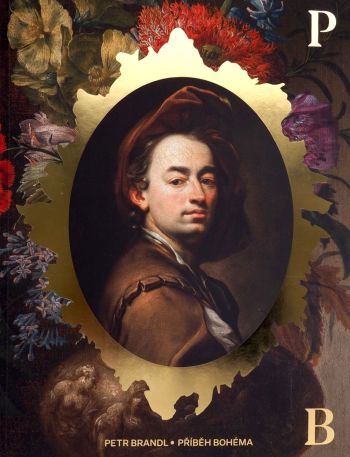 We have numerous archival documents of Brandl’s life of bohemian revolt, which is remarkable even today, offering interesting contexts for the problems of our time. Brandl was, for instance, a lifelong debtor due to his penchant for the luxury lifestyle of nobility, which he was keen to enjoy himself. It also led him to court battles with his wife Helena over alimony. In addition, Brandl was regularly in trouble with his commissioners, as he often failed to comply with the terms of his contracts. The painter’s unbound life has inspired a contemporary theatre play Three Women and a Hunter in Love, which will be staged together with the exhibition (Geisslers Hofcomoedianten).
None of this, however, changes the fact that Brandl was the highest-paid artist of his time, probably because of his very distinctive and original style of painting, in which we can trace certain parallels with Rembrandt. X-rays and macro-photographs of Brandl’s works complement the exhibition to give visitors a glimpse into the inner workings of his painting.
Andrea Steckerová, Petr Brandl: Příběh Bohéma (Prague: Národní galerie Praha, 2023), 288 pages, ISBN: 978-8070358221, 1050 Czech Koruna / $46.
Exhibition | South Asian Miniature Painting and Britain
Closing this month at The Box, with the catalogue appearing this spring from Bloomsbury:
Beyond the Page: South Asian Miniature Painting and Britain, 1600 to Now
The Box, Plymouth, 7 October 2023 — 28 January 2024
 Beyond the Page explores how the traditions of South Asian miniature painting have been reclaimed and reinvented by modern and contemporary artists, taken forward beyond the pages of illuminated manuscripts to experimental forms that include installations, sculpture, and film. The exhibition features work by artists from different generations working in dialogue with the miniature tradition, including Hamra Abbas, Zahoor ul Akhlaq, David Alesworth, Nandalal Bose, Noor Ali Chagani, Lubna Chowdhary, Adbur Rahman Chughtai, Olivia Fraser, Samuel Fyzee-Rahamin, Alexander Gorlizki, N.S. Harsha, Howard Hodgkin, Ali Kazim, Bhupen Khakhar, Matthew Krishanu, Jess MacNeil, Imran Qureshi, Nusra Latif Qureshi, Mohan Samant, Willem Schellinks, Raqib Shaw, Gulammohammed Sheikh, Nilima Sheikh, Arpita Singh, the Singh Twins, Shahzia Sikander, Abanindranath Tagore and Muhammad Zeeshan. Contemporary works are shown alongside examples of miniature painting dating as far back as the 16th century drawn from major collections including The Royal Collection, the Victoria & Albert Museum, and The British Museum, many on public display for the first time.
Anthony Spira and Fay Blanchard, eds., with essays by Emily Hannam and Hammad Nasar and catalogue entries by Emily Hannam, Cleo Roberts-Komireddi, and Elizabeth Brown, Beyond the Page: South Asian Miniature Painting and Britain, 1600 to Now (London: Philip Wilson Publishers, 2024), 224 pages, ISBN: 978-1781301258, $40.
Exhibition | Indian Skies: The Howard Hodgkin Collection

An Elephant and Keeper, India, Mughal, ca. 1650–60, opaque color and gold on paper
(New York: The Metropolitan Museum of Art, Howard Hodgkin Collection, 2022.187)
◊ ◊ ◊ ◊ ◊
Opening next month at The Met:
Indian Skies: The Howard Hodgkin Collection of Indian Court Painting
The Metropolitan Museum of Art, New York, 6 February — 9 June 2024
Over the course of sixty years, British artist Howard Hodgkin (1932–2017) formed a collection of Indian paintings and drawings that is recognized as one of the finest of its kind. A highly regarded painter and printmaker, Hodgkin collected works from the Mughal, Deccani, Rajput, and Pahari courts dating from the 16th to the 19th centuries that reflect his personal passion for Indian art. This exhibition presents over 120 of these works, many of which The Met recently acquired, alongside loans from The Howard Hodgkin Indian Collection Trust.
The works on view include stunning portraits, beautifully detailed text illustrations, studies of the natural world, and devotional subjects. The exhibition will also display a painting by Hodgkin, Small Indian Sky, which alludes to the subtle relationship between his own work, India, and his collection. This exhibition is accompanied by an issue of The Metropolitan Museum of Art Bulletin.










leave a comment