Exhibition | Claude Gillot

Claude Gillot, Scène de la comédie italienne: Une pantomime, pen and ink with red chalk wash and graphite drawing, 16 × 22 cm
(Paris: Musée du Louvre, INV 26748)
◊ ◊ ◊ ◊ ◊
300 years after his death, Gillot (1673–1722) was the subject of a spring show at The Morgan and a related symposium; a second exhibition opens next month at the Louvre:
Claude Gillot
Musée du Louvre, Paris, 9 November 2023 – 26 February 2024
Organized by Hélène Meyer and Xavier Salmon
A draughtsman and printmaker in the last years of the Grand Siècle, Claude Gillot is known for the inventiveness and originality of his works, heralding the freedom of expression and mores of the Régence period (1715–1723). With his parodies, witchcraft scenes, farces, and fairground improvisations, he is an artist known for satire, comedy, and performing arts. His countless drawings, coveted by collectors, nevertheless attest to extensive activity in a broad range of fields: illustration, theatre and opera, costume, and interior decoration. At the core of his work, a rich corpus of drawings illustrates his penchant for the comedy of the Comédie Italienne (Italian companies performing in France), with its pantomimes, acrobatics, and cross-dressing figures. A costume and set designer for the Paris Opera starting in 1712, Gillot was also a sought-after decorator, notably collaborating with Claude Audran III on private interiors and reinventing arabesque painting in the process.
Xavier Salmon, Hélène Meyer, and Jennifer Tonkovitch, Claude Gillot (1673–1722): Comédies, Fables, et Arabesques (Paris: Lienart, with the Musée du Louvre, 2023), ISBN: 978-2359064124, €32.
Exhibition | Dutch Art in a Global Age
Now on view at the NC Museum of Art and arriving at the Kimbell in the fall of 2024:
Dutch Art in a Global Age: Masterpieces from the Museum of Fine Arts, Boston
North Carolina Museum of Art, Raleigh, 16 September 2023 — 7 January 2024
Kimbell Art Museum, Fort Worth, 10 November 2024 — 9 February 2025

Jan van Huysum, Flowers in a Terracotta Vase, 1730, oil on panel, 80 × 61 cm (Museum of Fine Arts, Boston. Promised gift of Rose-Marie and Eijk van Otterloo, in support of the Center for Netherlandish Art, L-R 13.2019).
In the seventeenth century, Dutch merchants sailed across seas and oceans, joining trade networks that stretched from Asia to the Americas and Africa. This unprecedented movement of goods, ideas, and people gave rise to what many consider the first age of globalization and sparked an artistic boom in the Netherlands.
Dutch Art in a Global Age brings together paintings by Rembrandt, Frans Hals, Gerrit Dou, Jacob van Ruisdael, Maria Schalcken, Rachel Ruysch, and other celebrated artists from the Museum of Fine Arts, Boston’s renowned collection. These are joined by prints, maps, and stunning decorative objects in silver, porcelain, glass, and more, from the seventeenth and the first half of the eighteenth centuries. Exploring how Dutch dominance in international commerce transformed life in the Netherlands and created an extraordinary cultural flourishing, the exhibition also includes new scholarship that contextualizes seventeenth-century Dutch art within the complex histories of colonial expansion, wealth disparity, and the transatlantic slave trade during this period.
Christopher D.M. Atkins, ed., Dutch Art in a Global Age (Boston: MFA Publications, 2023), 224 pages, ISBN: 978-0878468911, £54 / $60. With text by Christopher Atkins, Pepijn Brandon, Simona Di Nepi, Stephanie Dickey, Michele Frederick, Hanneke Grootenboer, Katherine Harper, Courtney Leigh Harris, Mary Hicks, Anna Knaap, Rhona MacBeth, Katrina Newbury, Christine Storti, Gerri Strickler, Claudia Swan, Jeroen van der Vliet, and Benjamin Weiss.
Exhibition | Hub of the World: Art in 18th-Century Rome

Gaspar van Wittel, known as Vanvitelli, The ‘Casino’ of Cardinal Annibale Albani on the Via Aurelia, 1719, oil on canvas, 74 × 135 cm
(Private Collection, United Kingdom)
◊ ◊ ◊ ◊ ◊
From the press release (via Art Daily) for the exhibition:
Hub of the World: Art in 18th-Century Rome
Nicholas Hall Gallery, New York, 6 October — 30 November 2023
This fall, Nicholas Hall presents Hub of the World: Art in 18th-Century Rome, organized in association with the Milanese Galleria Carlo Orsi. Presented at the Upper East Side gallery in New York, the exhibition celebrates the legacy of esteemed American scholar, connoisseur, and artist Anthony M. Clark (1923–1976), who would have turned 100 this year.

Pompeo Batoni, Saint Louis Gonzaga, ca. 1744, oil on canvas, oval, in an 18th-century frame, 81 × 67 cm (Private Collection, NY).
Considered one of the most influential and admired museum professionals of his generation, Clark made a profound impact on American collecting trends in the 1950s and 1960s through his taste for art made in 18th-century Rome, especially the paintings of the Pompeo Batoni. The exhibition brings together more than 60 works by artists who lived in or traveled to Rome in the 18th century, along with a selection of Clark’s personal notebooks and a portrait photograph on loan from the National Gallery of Art in Washington, DC.
After graduating from Harvard, Clark began his career in 1955 at the Rhode Island School of Design before going on to prominent curatorial roles at the National Gallery of Art, the Metropolitan Museum of Art, and the Minneapolis Institute of Arts, of which he later became director. He also taught art history at the Institute of Fine Arts, NYU and at Williams College, Williamstown. During his tenure at Mia and The Met, Clark made significant acquisitions for the institutions and organized world-class exhibitions as a pioneering American scholar of 18th-century Rome.
The Hub of the World brings to light the fundamental role Clark played in the revival of interest among American museums in collecting work from this period. Clark deeply believed in the importance of Roman Settecento painting, drawing, and sculpture, and this passion is brilliantly reflected in his scholarship and writings. As a curator, he consistently created a historic context for art by showing sculpture and decorative arts alongside paintings and drawings at a time when it was customary to maintain a ‘hierarchy’ of the arts by studying and displaying the mediums separately.

Domenico Corvi, The Liberation of Saint Peter, 1770, oil on canvas, 63 × 49 cm (Private Collection, Paris).
Tragically Clark succumbed to a heart attack at age 53 while jogging in his favorite city, where, at the time, he was a fellow at the American Academy in Rome. Born in Philadelphia, Clark worked closely with curators at the Philadelphia Museum of Art over the course of his career; and, in 2000, the PMA—in partnership with the Museum of Fine Arts, Houston—mounted The Splendor of 18th-Century Rome, which was dedicated to his memory.
In the words of Nicholas Hall: “Anthony Clark was a larger-than-life character who changed the way we look at Old Masters. He rescued the art of 18th-century Rome from obscurity by dint of his own personal enthusiasm and brilliant scholarship. He had enormous personal charm: the son of the owner of two works in the exhibition remembers how, as a boy, he enjoyed Clark’s visits to see his parents. Clark, an avid ornithologist, later bequeathed to him a stuffed Green Woodpecker. Our exhibition is an homage to a great scholar, a tastemaker, and a dedicated museum professional.”
Hub of the World highlights the richness of the culture of 18th-century Rome with its extraordinary mixture of patronage, from popes and cardinals, to Roman aristocrats and visiting foreigners—including the German writer and poet Johann Wolfgang von Goethe, from whom the exhibition borrows its title. Goethe deemed Rome the “hub of the world,” writing that “the entire history of the world is linked up with this city.” Hall and Orsi have gathered a diverse selection of paintings, drawings, sculpture, and decorative arts that will provide a rare opportunity to experience the cosmopolitan appeal of 18th-century Rome.

Hubert Robert, Colonnade and Gardens at the Villa Medici, 1759, oil on canvas, 75 × 64 cm (Assadour O. Tavitian Trust).
Headlining the exhibition is View of the Villa Medici by Hubert Robert (1733–1808), painted in 1759 during the artist’s transformative time in Rome and on loan from the Assadour O. Tavitian Trust. A recent discovery, the exceptional work has rarely been on view to the public—previously only exhibited in the U.S. briefly at the National Gallery of Art. Other works on view include the Hemp Harvest in Caserta, executed by Jackob Philipp Hackert for the King of Naples; a portrait of the Cardinal Carlo Rezzonico by Anton Raphael Mengs that remained in the sitter’s family until the last decade; a unique view of the Villa Albani by Vanvitelli, recorded in the inventory of Cardinal Albani; a pair of oil on coppers by Angelika Kauffmann based on James Thomson’s pastoral poetry that newly resurfaced from a private Kenyan collection; a caricature painting by Joshua Reynolds, recently discovered at the estate where it has hung for over two centuries; A Vestal by Jacques-Louis David painted in Rome; a harbor scene painted on copper by Claude Joseph Vernet; Anton von Maron’s Portrait of Two English Gentlemen before the Arch of Constantine; the Rockingham Silenus, a 1st-century sculpture reworked by the celebrated Roman sculptor Bartolomeo Cavaceppi; a set of candelabras in the form of Antonius-Osirus by Luigi Valadier; and a console table designed by Antonio Asprucci, made for the Egyptian Room of the Palazzo Borghese. The exhibition pays tribute to Clark as an expert on Pompeo Batoni, as represented by a painting of Saint Louis Gonzaga and its preparatory drawing in red chalk, among several other works. Once belonging to Clark, a painting of the artist Paolo de Matteis by Pier Leone Ghezzi will also be showcased.
In conjunction with the exhibition, Nicholas Hall and Galleria Carlo Orsi will publish a fully illustrated catalogue with original essays by Italian art experts and renowned historians Edgar Peters Bowron, Alvar Gonzáles-Palacios, Melissa Beck Lemke, and J. Patrice Marandel.

Pier Leone Ghezzi, Four Samples of Classical Polychrome Marbles, 1726, watercolor on paper; from top left clockwise: ‘Diaspro Verde Fiorito, 16 × 21 cm, ‘Bianco e negro antico’, 19 × 24 cm, ‘Broccatello’, 19 × 21 cm, ‘Alabastro Orientale’, 19 × 23 cm (Private Collection, Italy). To be published by Dr. Adriano Aymonino in his upcoming book from MIT press, Paper Marbles: Pier Leone Ghezzi’s Studio di Molte Pietre (1726).
The Burlington Magazine, September 2023
The eighteenth century in the September issue of The Burlington:
The Burlington Magazine 165 (September 2023)

Bed, by Ince and Mayhew, 1768, mahogany and other woods, with original blue silk ‘flowered tabby’ in the ‘Large Antique Headboard’, tester and cornice, height 356 cm (Stamford: The Burghley House Collection).
a r t i c l e r e v i e w
• Lucy Wood, “The Industry and Ingenuity of William Ince and John Mayhew,” pp. 996–1001.
Fifty years ago, the question was asked what had become of the furniture made by Ince and Mayhew, one of the most successful and long-lasting firms of cabinetmakers in eighteenth-century London? A monograph by Hugh Roberts and Charles Cator, decades in the making, provides the answer in a revelatory picture of the achievements of these rivals of Thomas Chippendale.
r e v i e w s
• Christoph Martin Vogtherr, Review of the exhibition Rosalba Carriera – Perfection in Pastel (Gemäldegalerie Alte Meister, Zwinger, Dresden, 2023), pp. 1007–10.
• Christopher Baker, Review of the Redevelopment of the National Portrait Gallery, London (reopened in June 2023), pp. 1013–17.
• Raha Shahidi, Review of the exhibition catalogue L’Amour en scène! François Boucher, du théâtre à l’opéra, ed. by Hélène Jagot, Jessica Degain, and Guillaume Kzerouni (Éditions Snoeck, 2022), pp. 1029–31.
• Christopher Rowell, Review of Tessa Murdoch, ed., Great Irish Households: Inventories from the Long Eighteenth Century (John Adamson, 2022) and Conor Lucey, ed., House and Home in Georgian Ireland: Spaces and Cultures of Domestic Life (Four Courts Press, 2022), pp. 1038–40.
• Armin Kunz, Review of Mareike Hennig and Neela Struck, eds., Zeichnen im Zeitalter Goethes: Zeichnungen und Aquarelle aus dem Freien Deutschen Hochstift (Hirmer, 2022), pp. 1040–42.

Sewell Bequest, 2008,3008.1). Room 18 of the National Portrait Gallery, London, showing the newly acquired Portrait of Mai (Omai) by Joshua Reynolds (c. 1776) as the centrepiece of a group of eighteenth-century portraits (Photography by Dave Parry).
Print Quarterly, September 2023
The long eighteenth century in the latest issue of Print Quarterly:
Print Quarterly 40.3 (September 2023)
a r t i c l e s
 • Vitalii Tkachuk, “Averkiy Kozachkovskyi and Western Sources of Kyiv Prints, 1720s–40s,” pp. 265–86.
This article features the oeuvre of the Ukrainian engraver Averkiy Kozachkovskyi (active 1721–46), whose illustrated output by the press of the Orthodox monastery Kyiv of the Caves (Kyiv Pechersk Lavra) numbers about forty engravings. He primarily produced book illustrations, but also illustrated printed oaths taken by new members of the local student confraternity. His sources derived largely from seventeenth- and eighteenth-century Catholic imagery from German, Flemish, and French schools, several of which are discussed in detail throughout the article, especially the compositions of Peter Paul Rubens. Such borrowings testify to the willingness of Orthodox recipients to accept imagery—unaltered in iconography or style—stemming from other denominations and cultures. The paper contributes to our knowledge of Ukrainian engraving and to the study of the global transfer of images during the early modern period.
• Nicholas J.S. Knowles, “Thomas Rowlandson’s The Women of Muscovy and Other Russeries after Jean-Baptiste Le Prince,” pp. 287–301.
This article discusses a previously unidentified series of prints by Thomas Rowlandson (1757–1827), after Jean-Baptiste Le Prince (1734–1781), mentioned only as a single lot in the sale of his art collection and studio contents. No definitive set of these “Various Dresses of the Women in Muscovy” has been found, but the author has identified several substantial groups in public and private collections; the largest of these, with twenty-two prints, is in the British Museum. Most of these Rowlandson impressions reside among Le Prince originals and have previously been catalogued as by or after Le Prince. As a series overall, five hundred and forty impressions are claimed to have been produced in the lot description. The article continues with an in-depth discussion of the series and its context. An appendix lists all known impressions of Rowlandson’s Women of Muscovy prints and their location.
n o t e s a n d r e v i e w s
• Mark McDonald, Review of Susan Stewart, The Ruins Lesson: Meaning and Material in Western Culture (The University of Chicago Press, 2020), pp. 322–25. This book explores the significance of ruins in Western art and literature, paying close attention to the evidentiary role of prints and how the printmaking process parallels the ruinous lifecycle of its subject matter. In the review, Piranesi is cited as a fascinating example of creating trompe l’oeil in his prints, while later discussions focus on the discovery and metaphorical associations of Rome’s antique ruins in the eighteenth century.
• David Bindman, Review of the exhibition catalogue, Edina Adam and Julian Brooks, William Blake: Visionary (Getty Publications, 2020), pp. 330–31. This brief review pertains to a previously rescheduled, now forthcoming, exhibition on William Blake at the J. Paul Getty Museum. The author examines the collecting of Blake in America and some of the curatorial choices for this anticipated show.
 • Patricia Mainardi, Review of Pascal Dupuy and Rolf Reichardt, La caricature sous le signe des révolutions. Mutations et permanences, XVIIIe–XIXe siècles (Presses Universitaires de Rouen et du Havre, 2021), pp. 331–34. This book and review introduce the origins and rapid development of caricature during the French Revolutionary period, focusing on how topical imagery and signs manifested into an accessible visual language capable of being understood by ordinary citizens at the time. More importantly, many of these signifying tropes, such as severed heads and raids on government buildings have become universally recognisable up to the present day.
• Mark Bills, Review of Tim Clayton, James Gillray: A Revolution in Satire (Paul Mellon Centre for Studies in British Art, 2022), pp. 353–57. This extensive review of the latest monograph on James Gillray highlights the British artist’s unique achievements in the world of graphic satire. The book bravely tackles some of his previously neglected areas, such as very early and pornographic prints, or previously unpublished ones that can now be contextualised. The same is true of Gillray’s interplay of word and image (his titles, conversations and commentary of the images), which the author believes is Clayton’s most original piece of scholarship in this book.
• Jeannie Kenmotsu, Review of the exhibition catalogue, Hans Bjarne Thomsen, ed., Japanische Holzschnitte: Aus der Sammlung Ernst Grosse / Japanese Woodblock Prints: From the Ernst Grosse Collection (Michael Imhof Verlag, 2018), pp. 357–60. This review recognises the value of this catalogue in bringing Ernst Grosse and his collecting practices to a larger audience, especially since the Museum Natur und Mensch’s collection of Japanese woodblock prints was a historically important case of intersection between European japonisme and ethnological approaches to non-Western cultures. Most of Grosse’s acquisitions were made through the art dealer Hayashi Tadamasa.
Exhibition | Liotard and The Lavergne Family Breakfast

The exhibition opens this fall at The National Gallery (with the press release available here) . . .
Discover Liotard and The Lavergne Family Breakfast
The National Gallery, London, 16 November 2023 — 3 March 2024
In the second of our ‘Discover’ exhibitions, which explore well-known paintings through a contemporary lens, we reunite for the first time in 250 years Swiss painter Jean-Étienne Liotard’s pastel and oil versions of The Lavergne Family Breakfast. With the pastel and oil works side by side, the exhibition presents a rare opportunity to compare the difference in technique and effect between the two.

Jean-Etienne Liotard, The Lavergne Family Breakfast, 1754, pastel on paper stuck down on canvas, 80 × 106 cm (London: National Gallery, accepted in lieu of Inheritance Tax by HM Government from the estate of George Pinto, 2019, NG6685).
Long regarded as Liotard’s masterpiece, The Lavergne Family Breakfast (executed in Lyon in 1754) is the artist’s largest and most ambitious work in pastel. Despite the medium’s notorious delicacy, Liotard skilfully reproduced complex textures: the sheen on the metal coffee pot, the shiny ceramic jug, the silky fabrics and reflections, in the black lacquer tray. Liotard was extremely versatile, producing works in pastel, oil, enamel, chalk, and even on glass. Highly unusually, he returned to The Lavergne Family Breakfast 20 years later to make an exact replica in oil.
Liotard (1702–1789) worked across the length and breadth of 18th-century Europe. Following four years in Constantinople, he grew a long beard, adopted Turkish dress, and nicknamed himself ‘the Turkish painter’. The exhibition showcases the raw materials used to make pastels as well as drawings, paintings, and miniatures that seek to bring this idiosyncratic artist to life.
Francesca Whitlum-Cooper, with contributions by Iris Moon, Discover Liotard & The Lavergne Family Breakfast (New Haven: Yale University Press, 2024), 120 pages, ISBN: 978-1857097023, $20.
Exhibition | Hokusai: Beyond the Great Wave

Katsushika Hokusai, Under the Wave off Kanagawa (The Great Wave), from Thirty-Six Views of Mt Fuji, late 1831, color woodblock print (London: The British Museum, acquired with the assistance of Art Fund and a contribution from the Brooke Sewell Bequest, 2008,3008.1).
◊ ◊ ◊ ◊ ◊
Opening in October at the Bowers Museum:
Beyond the Great Wave: Works by Hokusai from the British Museum
The British Museum, London, 25 May — 13 August 2017
Bowers Museum, Santa Ana, California, 21 October 2023 — 7 January 2024
Katsushika Hokusai (Japanese, 1760–1849) is the renowned artist behind The Great Wave, one of the most iconic prints ever made. Originally part of the series Thirty-Six Views of Mount Fuji, this seminal vision of man in nature is just one of the estimated 30,000 prints that Hokusai designed over his 70-year career. This exhibition includes a beautiful early example of The Great Wave and ventures beyond to feature a broad selection of works that Hokusai produced right up to his death at the age of 90.
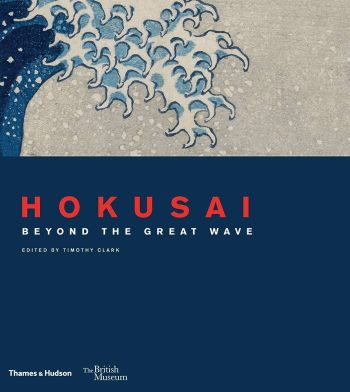 Visitors will be able to examine Hokusai’s personal beliefs through more than 100 paintings, drawings, woodblock prints, and illustrated books that speak to his early career, rise to fame, interest in the natural and supernatural worlds, personal life, and search for immortality. Distinct from the art of his Japanese contemporaries, Hokusai’s work is intensely individual, subjective, energized, and sublime; and the exhibition will provide a powerfully emotional and spiritual experience.
Hokusai never left Japan, but his work traveled around the globe to inspire many European artists and collectors such as Monet and Van Gogh. The exhibition includes biographical portraits of six individuals who helped build the Hokusai collection at the British Museum and shows how these scholars and proponents of Japanese art understood and appreciated Hokusai’s genius, skill, and invention.
The presentation of this exhibition is a collaboration between the British Museum and the Bowers Museum.
Timothy Clark, ed., Hokusai: Beyond the Great Wave (London: Thames & Hudson, 2017), 352 pages, ISBN: 978-0500094068, $65.
Exhibition | William Blake: Visionary
Opening this fall at The Getty:
William Blake: Visionary
Getty Center, Los Angeles, 7 October 2023 — 14 January 2024
 A remarkable printmaker, painter, and poet, William Blake (1757–1827) developed a wildly unconventional world view, representing universal forces of creation and destruction—physical, psychological, historical—through his own cast of characters. By combining his poetry and images on the page through radical graphic techniques, Blake created some of the most striking and enduring imagery in British art. This major international loan exhibition explores the artist-poet’s imaginative world through his most celebrated works.
Organized by the J. Paul Getty Museum in cooperation with Tate.
Edina Adam and Julian Brooks, with an essay by Matthew Hargraves, William Blake: Visionary (Los Angeles: J. Paul Getty Museum, 2020), 168 pages, ISBN: 978-1606066423, $35.
Celebrated for his boundless imagination and unique vision, William Blake (1757–1827) created some of the most striking and distinctive imagery in art, often combining his poetry and visual images on the page through innovative graphic techniques. He has proven an enduring inspiration to artists, musicians, poets, and performers worldwide and a fascinating enigma to generations of admirers. Featuring over 130 color images, this catalogue brings together many of Blake’s most iconic works. Organized by theme, it explores Blake’s work as a professional printmaker, his roles as both painter-illustrator and poet-painter, his relationship to the medieval, Renaissance, and Baroque artists that preceded him, and his legacy in the United States. It also examines his visionary prophetic books, including all eighteen plates of America a Prophecy.
A specialist in works on paper, Edina Adam is assistant curator of drawings at the J. Paul Getty Museum. Julian Brooks is senior curator and head of the Department of Drawings at the J. Paul Getty Museum and is the author of many books, most recently The Lure of Italy: Artists’ Views (Getty Publications, 2017) and Andrea del Sarto: The Renaissance Workshop in Action (Getty Publications, 2015). Now the director of the Wadsworth Atheneum Museum of Art, Matthew Hargraves was previously chief curator of art collections and head of collection information and access at the Yale Center for British Art.
Exhibition | Black Atlantic: Power, People, Resistance
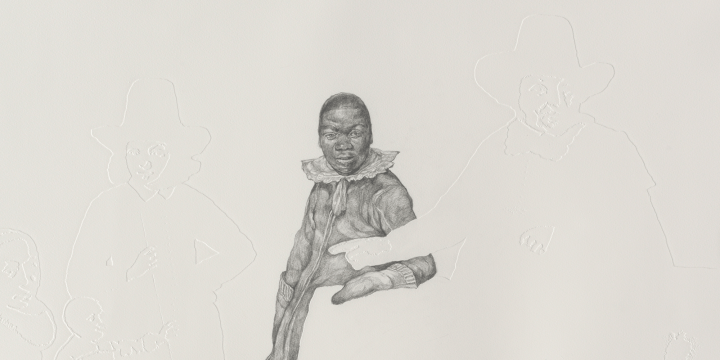
Barbara Walker, Vanishing Point 29 (Duyster), 2021 / © Barbara Walker, 2023.
More information on the Vanishing Point series is available here»
◊ ◊ ◊ ◊ ◊
Opening soon at The Fitzwilliam:
Black Atlantic: Power, People, Resistance
The Fitzwilliam Museum, Cambridge, 8 September 2023 — 7 January 2024
Curated by Jake Subryan Richards
A landmark exhibition exploring the impact of the Black Atlantic staged in the Museum’s historic Founder’s Galleries, which were built using the profits from enslavement and exploitation.
Black Atlantic: Power, People, Resistance brings together significant national and international loans with collections from across the University of Cambridge’s museums, libraries, and colleges to tell both a Cambridge story and a global one. Using as its starting point the story of the Museum’s founder, Viscount Richard Fitzwilliam, whose family wealth came in part from the South Sea Company and East India Company, the exhibition charts a history from pre-colonial Africa and the Caribbean, the rise and racialisation of Atlantic enslavement, and histories of resistance by enslaved people and their allies. Artworks and other objects illustrating the financial, scientific, and commercial transformations in seventeenth- and eighteenth-century Britain that came about because of enslaved labour are shown in dialogue with modern and contemporary artworks by artists including Donald Locke, Barbara Walker, Keith Piper, and Jacqueline Bishop that respond to hidden histories and reveal stories of courage, resistance, hope, and repair.
Black Atlantic is curated by Dr Jake Subryan Richards, acclaimed early career historian of law, empire, and the African diaspora in the Atlantic world at the London School of Economics. It is the first in a series of exhibitions and gallery interventions planned for 2023–2026.
The catalogue is published by Bloomsbury:
Victoria Avery and Jake Subryan Richards, eds., Black Atlantic: Power, People, Resistance (London: Philip Wilson Publishing, 2023), 192 pages, ISBN: 978-1781301234, £30 / $40.
Published to accompany the landmark exhibition on view at the Fitzwilliam Museum in autumn 2023, the catalogue contains contributions by curators, historians, and artists.
 Black Atlantic: Power, People, Resistance brings together significant national and international loans with exhibits from the Fitzwilliam’s collection and from other University museums, colleges, and libraries. Objects and artworks illustrating the financial, scientific, and commercial transformations in seventeenth- and eighteenth-century Britain that came about because of enslaved labour are shown in dialogue with modern and contemporary artworks by artists including Donald Locke, Barbara Walker, Keith Piper, and Jacqueline Bishop that respond to hidden histories and reveal stories of courage, resistance, hope, and repair.
c o n t e n t s
Contributor Biographies
Acknowledgements
Foreword by Luke Syson
Introduction
Section 1 | Before Atlantic Enslavement
• Africa: Akan Region
• Indigenous Islands in the Caribbean Sea
• Europe: Slavery before Racism, Blackness before Slavery
Section 2 | Cambridge Wealth from Atlantic Enslavement
• Royal Patronage
• Making Money: Dutch Connections
• Technology for the Transatlantic Trade
• Warfare between the British, Dutch, and Spanish Empires
Section 3 | Fashion, Consumption, and Racism
• Blackness in European Art
• Enslavement and Fashion
Section 4 | Plantations: Production and Resistance
• Production, Knowledge Generation, and Exploitation
• Plantation Violence
• Remembering
Further Reading
Image Credits
Index
Exhibition | Portraits of Dogs

Jean-Jacques Bachelier, Dog of the Havana Breed, detail, 1768, oil on canvas, 70 × 91 cm
(The Bowes Museum, Barnard Castle, BM 913)
◊ ◊ ◊ ◊ ◊
For anyone celebrating, a very happy National Dog Day to you and yours! Now on at The Wallace Collection:
Portraits of Dogs: From Gainsborough to Hockney
The Wallace Collection, London, 29 March — 15 October 2023
The exhibition Portraits of Dogs: From Gainsborough to Hockney explores our devotion to four-legged friends across the centuries. Through carefully selected paintings, sculptures, drawings, works of art and even taxidermy, the exhibition highlights the unique bond between humans and their canine companions. Dog portraiture developed as an artistic genre contemporaneously with its human counterpart—dogs are represented in the earliest cave paintings alongside humans—and it flourished, particularly in Britain, from the 17th century onwards. More than any other nationality perhaps, the British have both commissioned and collected portraits of dogs. Bringing over 50 works of art to Hertford House, Portraits of Dogs presents a broad range of portraiture showing dogs in all their different shapes and sizes, with each painter or sculptor challenging themselves how best to represent mankind’s most faithful and fearless friend.
From Giles:
Xavier Bray and Bruce Fogle, Faithful and Fearless: Portraits of Dogs (London: Giles, 2021), 160 pages, ISBN: 978-1913875015, £25 / $35.
 Throughout history, dogs and humans have had a special relationship based on trust, loyalty, and friendship—a relationship frequently immortalised in art. Faithful and Fearless: Portraits of Dogs features 50 works of art depicting the bond between people and their beloved pet—from members of the British Royal Family, to artists themselves. Organised in a series of thematically grouped sections—the dog as hero, as a companion to royals, aristocrats and artists, or as an allegory of the human condition—the book explores the canine portrait in its many guises and features dogs belonging to many celebrated figures, including Queen Victoria’s Tilco, Lucian Freud’s Pluto, and David Hockney’s portraits of his dachshunds, Stanley and Boodgie. The pieces are all drawn from major British collections including the Royal Collection, the V&A, Tate Britain, the British Museum, and a wealth of regional museums and private collections. In “A Vet’s Point of View,” renowned clinical veterinarian Bruce Fogle examines the many reasons for the extraordinary bond between dogs and their owners. At a time of rising dog ownership, this enchanting volume is a welcome reminder of our devotion to our four-legged friends.
c o n t e n t s
Director’s Foreword
Faithful and Fearless: Portraits of Dogs by Xavier Bray
Catalogue: Introduction
• The Aristocratic Dog
• The Royal Dog
• Kylin and AhCum: Two Pekinese
• The Artist’s Dog
• The Allegorical Dog
• The Heroic Dog
• The Dog Immortal
• Until Death
A Vet’s Point of View by Bruce Fogle
Notes
Index
Photo credits










 Enfilade
leave a comment