Exhibition | Making Her Mark
Opening this fall at the BMA:
Making Her Mark: A History of Women Artists in Europe, 1400–1800
Baltimore Museum of Art, 1 October 2023 — 7 January 2024
Art Gallery of Ontario, Toronto, 30 March — 1 July 2024
Curated by Andaleeb Badiee Banta and Alexa Greist
 For centuries, women artists in Europe were considered rare and less talented than their male counterparts. Women who achieved professional artistic careers were deemed anomalous or exceptional, while those who engaged in creative pursuits in the home were dismissed as amateurs, and their works were categorized as material culture rather than art.
Making Her Mark: A History of Women Artists in Europe, 1400–1800, the BMA’s much anticipated major exhibition opening 1 October 2023, aims to correct these broadly held but mistaken beliefs through more than 200 works of diverse media and scale. From royal portraits and devotional sculptures to embroidered objects, tapestries, costumes, wax sculptures, metalwork, ceramics, graphic arts, furniture, and more, Making Her Mark will feature objects from the 15th to 18th centuries that reflect the multifaceted and often overlooked ways that women contributed to the visual arts of Europe.
The exhibition’s focus on displaying exclusively objects made by women or toward which women contributed their labor distinguishes this project by putting women makers of all social levels in conversation with each other through their works. Examples by artistic heroines such as Sofonisba Anguissola, Artemisia Gentileschi, Judith Leyster, Luisa Roldán, Rosalba Carriera, Rachel Ruysch, and Élisabeth Vigée Le Brun will join exceptional products of female artisanal collectives and talented amateurs who operated outside of the male-dominated professional arena and often remained anonymous in the historical record. Further, sublime examples of ceramics, metalwork, and cabinetmaking from this era will reflect women’s involvement in major manufactories and workshops.
Organized by the Baltimore Museum of Art and the Art Gallery of Ontario, Making Her Mark is curated by Andaleeb Badiee Banta, Senior Curator and Department Head, Prints, Drawings & Photographs at the BMA, and Alexa Greist, Curator and R. Fraser Elliott Chair, Prints & Drawings at the AGO. The exhibition is generously supported by the National Endowment for the Humanities, The Gladys Krieble Delmas Foundation, the Samuel H. Kress Foundation, and Sheela Murthy/MurthyNAYAK Foundation.
Andaleeb Badiee Banta and Alexa Greist, with Theresa Kutasz Christensen, Making Her Mark: A History of Women Artists in Europe, 1400–1800 (Fredericton, New Brunswick: Goose Lane Editions, 2023), 264 pages, ISBN: 9781773103181, $60.
Exhibition | Ingenious Women, 16th to 18th Centuries

Angelika Kauffmann, Clio, Muse of History, detail, ca. 1770–75 (Augsburg: Schaezlerpalais–Deutsche Barockgalerie; photo by Andreas Brücklmair).
◊ ◊ ◊ ◊ ◊
Opening this fall at the the Bucerius Kunst Forum:
Ingenious Women: Women Artists and Their Companions
Geniale Frauen: Künstlerinnen und ihre Weggefährten
Bucerius Kunst Forum, Hamburg, 14 October 2023 — 28 January 2024
Kunstmuseum Basel, 2 March — 30 June 2024
With the exhibition Ingenious Women: Women Artists and Their Companions, the Bucerius Kunst Forum traces the careers of outstanding women artists (Künstlerinnen) from the sixteenth to the eighteenth century. For the first time, the family context in which the women artists pursued their careers is addressed and made visible through juxtaposition with works by their fathers, brothers, husbands, and fellow painters. Today often forgotten, female artists of their time were able to achieve extraordinary success in a wide variety of family constellations: they became court painters, teachers, entrepreneurs, and even publishers and were awarded the highest honours.
 The exhibition presents around 140 works by 26 women artists, including Sofonisba Anguissola, Judith Leyster, Marietta Robusti (Tintoretto’s daughter), and Angelika Kauffmann. Masterful portraits, still lifes, and historical scenes in painting, along with drawings and prints from across Europe, ranging from the Renaissance and Baroque periods to early Neoclassicism, will be brought together in Hamburg. For the first time, works by women artists will be juxtaposed with those of their male colleagues in such a pointed way that both formal and stylistic similarities and differences will come to the fore.
In the early modern period it was not altogether impossible for women to pursue a career as an artist, but it was definitely outside the norm and therefore always subject to special challenges. Anyone wishing to practice a freelance profession had to join a guild, but some regions denied membership to women, and in others it entailed considerable hurdles and costs. A conspicuous number of women artists of this period came from or married into artistic families. They worked for their fathers, brothers, and husbands, and often in secret. At the royal courts of Europe, the situation was different: with an open mind to artistic achievement—regardless of origin or gender—women were able to work openly as artists at court. Women such as Lavinia Fontana, Anna Dorothea Therbusch, and Rachel Ruysch asserted themselves against social norms, capturing the attention and earned the esteem of their contemporaries. The fact that they fell into oblivion is also due to the history of art scholarship, in which a male gaze dominated until the advanced twentieth century.
The exhibition shows the unique careers of these pioneering women artists and offers new insights into their lives and work, as well as thought-impulses on contemporary issues such as equality and the reconciliation of work and family.
Bodo Brinkmann and Katrin Dyballa, eds., with contributions by Beiträge von B. Brinkmann, K. Dyballa, S. Engel, A. Mensger, R. Müller, S. Salomon, A. Tacke, S. Pisot, I. Wenderholm, and S. Werthemann, Geniale Frauen: Künstlerinnen und ihre Weggefährten (Munich: Hirmer Verlag, 2023), 300 pages, ISBN: 978-3777442365, €45.
Exhibition | Out of the Shadows: Women Artists
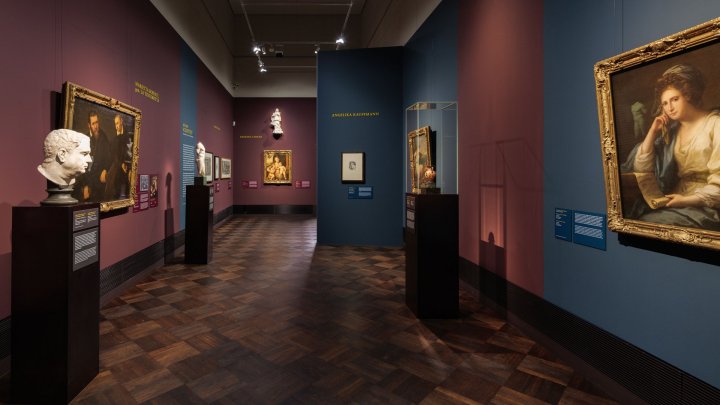
Installation view, Out of the Shadows: Women Artists from the 16th to the 18th Century, Gemäldegalerie Alte Meister at Dresden’s Zwinger, 2023.
◊ ◊ ◊ ◊ ◊
This installation on view at the Zwinger closes in a few weeks:
Out of the Shadows: Women Artists from the 16th to the 18th Century
Aus dem Schatten: Künstlerinnen vom 16. bis zum 18. Jahrhundert
Gemäldegalerie Alte Meister, Zwinger, Dresden, 12 May — 20 August 2023
With this cabinet exhibition, the Gemäldegalerie Alte Meister turns its attention to women artists (Künstlerinnen) from the 16th to the 18th century, who for a long time have been overshadowed by the ‘Great Masters’ of art history. With their works represented in the collection, they are a minority, and to this day their names are far less familiar than those of their male counterparts. This is not due to inability, but to a structural discrimination that is perpetuated in art historiography.
 Women generally were not allowed formal academic training nor drawing from live (nude) models. Only a few women were lucky enough to grow up and be promoted in an artistic environment, so that institutional and social structures did not necessarily hinder their advancement. In many cases, they were the daughters of artists trained in their father’s workshop.
The cosmopolite Angelika Kauffmann (1741–1807) achieved widespread recognition in her lifetime and is also represented here with five works. In a time when only men were seen as true artists and women were credited, at most, with talent but never genius, the painter managed to assert herself by also being a shrewd strategist and self-promotor. She produced numerous history paintings with references to antiquity in which women take the leading roles.
Lavinia Fontana (1552–1614) was one of the first women of the modern period to work as an independent artist. She painted numerous portraits and history paintings of mythological and biblical themes, some of them in large format. The devotional painting in Dresden, The Holy Family, is an early work by the Bolognese artist which, after undergoing restoration, will be included in the show in mid-August.
This concentrated presentation also features copperplate engravings by Diana Scultori from the holdings of the Kupferstich-Kabinett as well as paintings and prints by other noteworthy women artists such as Elisabetta Sirani, Barbara Longhi, Rachel Ruysch, Maria van Oosterwijck, and Theresa Concordia Mengs.
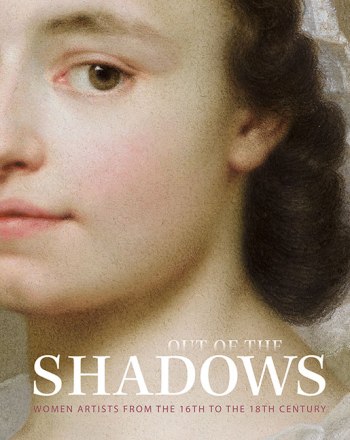
Stephan Koja and Iris Yvonne Wagner, Out of the Shadows: Women Artists from the 16th to the 18th Century (Dresden: Staatliche Kunstsammlungen Dresden, 2023), 144 pages, ISBN: 978-3954987559 (German edition) / ISBN: 978-3954987696 (English edition), €34.
The Burlington Magazine, June 2023
The eighteenth century in the June issue of The Burlington (with apologies for being so slow to post, –CH) . . .
The Burlington Magazine 165 (June 2023)
 e d i t o r i a l
• “The Future of the RIBA Drawings Collection,” p. 583.
a r t i c l e s
• Tessa Murdoch, “Roubiliac and Sprimont: A Friendship Revisited,” pp. 600–11.
Recent research into the circles of Huguenot artists and craftsmen working in London in the mid-eighteenth century has provided new evidence about the friendship and working relationship between the sculptor Louis-François Roubiliac and the goldsmith Nicholas Sprimont. This lends weight to the belief that Roubiliac provided small models for casting in silver and bronze as well as for the porcelain manufactory co-founded by Sprimont in Chelsea in 1745.
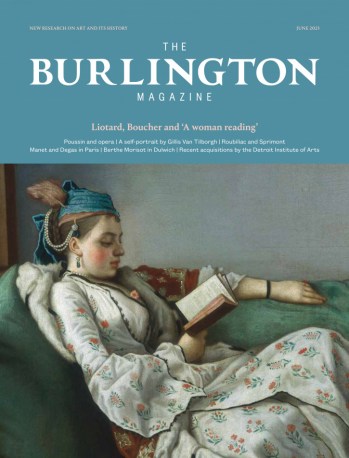
• Perrin Stein, “Liotard and Boucher: A Question of Precedence,” pp. 612–19.
There has been much debate about whether Liotard or Boucher invented the motif of a woman in Turkish costume reading a book while reclining on a sofa, which appears in both their work in the 1740s. New evidence that resolves the question highlights the very different ways these two artists constructed exoticism.
• Ann Gunn, “Titian’s Perseus and Andromeda: A Missing Link in the Chain of Provenance,” pp. 620–22.
• Simon Spier and Judith Phillips, “Joséphine Bowes’s Gift to Napoleon III: Antoine-Jean Gros’s Napoleon Distributing the Cross of the Legion of Honour to Artists during His Visit to the Salon of 1808,” pp. 626–29.
r e v i e w s
• Alexandra Gajewski, “The New Museum in the Bibliothèque Nationale, Paris,” pp. 630–37.
When in 1995–98 the books of the Bibliothèque nationale, Paris, were moved to their monumental new home in the west of the city, the library’s historic collections of antiquities, coins, medals, and other precious objects remained in the original complex of buildings in central Paris where they had been shown since the eighteenth century. Their reinstallation in the library’s newly restored museum rooms was opened last year.
• Kirstin Kennedy, Review of the exhibition Treasures from Faraway: Medieval and Renaissance Objects from The Schroder Collection (Strawberry Hill, 2023), pp. 641–43.
• Aileen Dawson, Review of the exhibition English Delftware (Bristol Museum and Art Gallery (from February 2023), pp. 652–54.
• Belinda Thomson, Review of the exhibition Berthe Morisot: Shaping Impressionism (Dulwich Picture Gallery, 2023), pp. 654–57. [In Paris, the show is entitled Berthe Morisot et l’art du XVIIIe siècle: Watteau, Boucher, Fragonard, Perronneau]
• J. V. G. Mallet, Review of Lilli Hollein, Rainald Franz, and Timothy Wilson, eds., Tin-Glaze and Image Culture: The MAK Maiolica Collection in its Wider Context (Arnoldsche Art Publishers, 2022), pp. 660–62.
• Clare Hornsby, Review of Andrew Robinson, Piranesi: Earliest Drawings / I primi disegni (Artemide Edizioni, 2022), pp. 666–67.
• G. A. Bremner, Review of Gauvin Alexander Bailey, The Architecture of Empire: France in India and Southeast Asia, 1664–1962 (McGill-Queen’s University Press, 2022), pp. 667–68
o b i t u a r y
• Peter Hecht, Obituary for Ger Luijten (1956–2022), pp. 675–76.
s u p p l e m e n t
• Recent Acquisitions (2016–22) of European Works of Art at the Detroit Institute of Arts
Exhibition | 1923 —The Domaine de Sceaux: Origins of a Renaissance
From Silvana Editoriale:
1923 — The Domaine de Sceaux: Origins of a Renaissance
Musée du Domaine départemental de Sceaux, 10 March — 9 July 2023
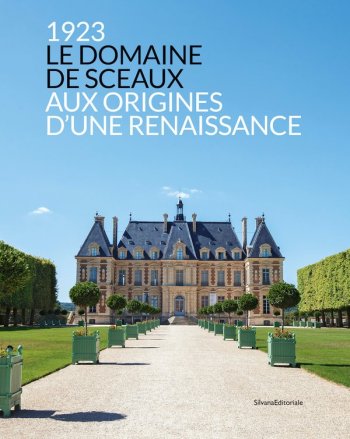 The Domaine de Sceaux was acquired in 1923 by the Hauts-de-Seine department, leading to the estate’s restoration and its opening to the public. This exhibition (installed in the former stables) brings together archival documents, posters, photographs, drawings, and paintings to tell the story of the place during this last eventful century. The exhibition traces the history of the estate from its first major transformation to the 1950s.
L’histoire du Domaine de Sceaux entre 1850 et 1950 reste peu connue du grand public. Après la Révolution, la propriété traversa plusieurs phases de déclin et de renouveau. Les aménagements d’aujourd’hui s’inspirent donc à la fois du parc ancien et des ouvrages classés du XVIIe s., et ils intègrent aussi le décor du XIXe s., introduit par les ducs de Trévise. Si vous êtes familier des lieux ou en quête d’histoire sur le Grand Paris, vous ressentirez d’autant plus cette métamorphose : celle d’un somptueux château à la campagne devenu un site muséal préservé et ouvert à tous.
Site historique et patrimonial majeur de la région parisienne, le Domaine départemental de Sceaux fut créé en 1670 par Jean-Baptiste Colbert, qui y appela les plus grands artistes de son temps, d’André Le Nôtre à Charles Le Brun, de Jules Hardouin-Mansart à Antoine Coysevox. Passé entre les mains du marquis de Seignelay, fils du ministre de Louis XIV, puis entre celles du duc et de la duchesse du Maine, du duc de Penthièvre et enfin du duc et de la duchesse de Trévise, cet ensemble remarquable, bientôt menacé par l’extension galopante de la banlieue, était appelé à une disparition quasi certaine lorsqu’en 1923, à la suggestion du maire de Sceaux, il fut acquis in extremis par le département de la Seine à la princesse de Cystria, née Trévise, dernière propriétaire. 2023 marque ainsi le centenaire du passage de ce domaine exceptionnel du statut de propriété privée à celui de bien public, devenu en 1970 l’un des fleurons du département des Hauts-de-Seine qui en assure depuis l’entretien et la valorisation. L’exposition revient sur le contexte, sur les raisons et sur les conditions de cette acquisition qui permit l’heureuse renaissance du domaine de Sceaux.
David Baurain and Céline Barbin, eds., 1923 — Le Domaine de Sceaux: Aux origines d’une renaissance (Milan: Silvana Editoriale, 2023), 208 pages, ISBN: 978-8836654239, €30.
Exhibition | Black Founders: The Forten Family of Philadelphia
Now on view at the Museum of The American Revolution:
Black Founders: The Forten Family of Philadelphia
Museum of The American Revolution, Philadelphia, 11 February — 26 November 2023
 When James Forten (1766–1842) walked the streets of Philadelphia as a young man in the 1770s, he was surrounded by the sights and sounds of transformation. He heard the words of the Declaration of Independence read aloud for the first time in 1776 before setting sail to fight for independence in 1781. Born a free person of African descent, Forten built upon his coming-of-age in a revolutionary city and his wartime experience to forge himself into a changemaker in Philadelphia and the young United States, becoming a successful businessman, philanthropist, and stalwart abolitionist.
In our new special exhibition Black Founders: The Forten Family of Philadelphia, the Museum introduces visitors to Forten and his descendants as they navigated the American Revolution and cross-racial relationships in Philadelphia to become leaders in the abolition movement in the lead-up to the Civil War and the women’s suffrage movement. Using objects, documents, and immersive environments, Black Founders: The Forten Family of Philadelphia explores the Forten family’s roles in the Revolutionary War, business in Philadelphia, and abolition and voting rights from 1776 to 1876.
The exhibition features more than 100 historical artifacts, works of art, and documents from 38 different lenders, including both institutions and private collectors, as well as the Museum’s own collection. Rare historical objects on loan from descendants of the Forten family are on view for the very first time in a public exhibit.
The unique journey and exceptional story of this family of Revolutionaries explores the legacy of the American Revolution, the history of the American experiment of liberty, equality, and self-government, and the ongoing work to improve the nation’s dedication to the principle that “all men are created equal.”
Black Founders: The Forten Family of Philadelphia (Philadelphia: Museum of the American Revolution, 2023), ISBN: 978-1933153445, $38.
Exhibition | Giacomo Ceruti: A Compassionate Eye
From The Getty:
Giacomo Ceruti: A Compassionate Eye
Brescia Musei Foundation, 14 February — 11 June 2023
The Getty Center, Los Angeles, 18 July — 29 October 2023
 In a group of remarkably haunting paintings by the Italian 18th-century artist Giacomo Ceruti, beggars, vagrants, and impoverished workers are portrayed in mesmerizing realism, emanating a sense of dignity and emotional depth. Why were these subjects painted? Where and how were these works displayed, and for whom? At a time when severe inequalities continue to mark even the wealthiest societies, Ceruti’s work testifies to the enduring power of art to reflect our shared humanity.
Organized with Fondazione Brescia Musei.
From The Getty Shop:
Davide Gasparotto, ed., with contributions by Roberta D’Adda, Francesco Frangi, Alessandro Morandotti, and Lorenzo Coccoli, Giacomo Ceruti: A Compassionate Eye (Los Angeles: J. Paul Getty Museum, 2023), 128 pages, ISBN: 978-1606068366, $28.
The northern Italian artist Giacomo Ceruti (1698–1767) was born in Milan and active in Brescia and Bergamo. For his distinctive, large-scale paintings of low-income tradespeople and individuals experiencing homelessness, whom he portrayed with dignity and sympathy, Ceruti came to be known as Il Pitocchetto (the little beggar). Accompanying the first US exhibition to focus solely on Ceruti, this publication explores relationships between art, patronage, and economic inequality in early modern Europe, considering why these paintings were commissioned and by whom, where such works were exhibited, and what they signified to contemporary audiences. Essays and a generous plate section contextualize and closely examine Ceruti’s pictures of laborers and the unhoused, whom he presented as protagonists with distinct stories rather than as generic types. Topics include depictions of marginalized subjects in the history of early modern European art, the career of the artist and his significance in the history of European painting, and period discourses around poverty and social support. A detailed exhibition checklist, along with provenance, exhibition history, and a bibliography, provides information critical for the further understanding of Ceruti’s oeuvre.
Davide Gasparotto is senior curator of paintings and chair of curatorial affairs at the J. Paul Getty Museum.
◊ ◊ ◊ ◊ ◊
Note (added 6 August 2023) — The posting was updated to include the Brescia venue, where the exhibition was entitled Miseria & Nobiltà: Giacomo Ceruti nell’Europa del Settecento.
Exhibition | Object Lessons in American Art
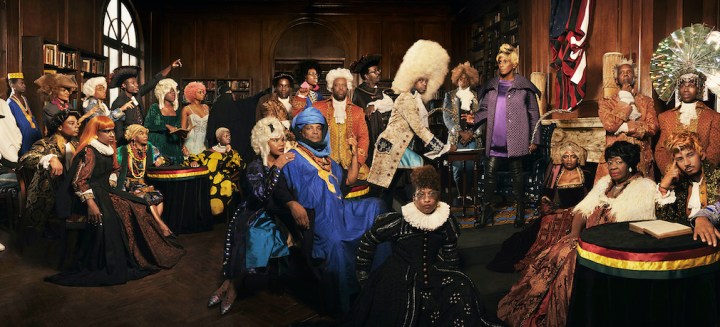
Renee Cox, The Signing, 2018, inkjet print, 122 × 213 cm
(Princeton University Art Museum)
◊ ◊ ◊ ◊ ◊
From Princeton University Art Museum:
Object Lessons in American Art: Selections from the Princeton University Art Museum
Georgia Museum of Art, University of Georgia, Athens, 4 February — 14 May 14 2023
Florence Griswold Museum, Old Lyme, Connecticut, 3 June — 10 September 2023
Speed Art Museum, Louisville, 29 September 2023 — 7 January 2024
Curated by Karl Kusserow

Henry Inman, O-Chee-Na-Shink-Ka a, 1832–33, oil on canvas, 78 × 645 cm (Promised gift from a Private Collection, member of Class of 1982).
Object Lessons in American Art features four centuries of works from the Princeton University Art Museum that collectively explore American history, culture, and society. Inspired by the concept of the object lesson—the study of a material thing to communicate a larger idea—the exhibition brings groups of objects together to ask fundamental questions about artistic significance, materials, and how meaning changes across time and contexts. With a focus on race, gender, and the environment, these pairings demonstrate the value of juxtaposing diverse objects to generate new understanding. Object Lessons presents Euro-American, Native American, and African American art from contemporary perspectives, illustrating how fresh investigations can inform and enrich its meaning, affording new insights into the American past and present. Curated by Karl Kusserow, John Wilmerding Curator of American Art.
Karl Kusserow, ed., with contributions by: Horace Ballard , Kirsten Pai Buick , Ellery Foutch , Karl Kusserow , Jeffrey Richmond-Moll, and Rebecca Zorach, Object Lessons in American Art (Princeton: Princeton University Press, 2023), 200 pages, ISBN: 978-0691978857, £35 / $40.
Object Lessons in American Art explores a diverse gathering of Euro-American, Native American, and African American art from a range of contemporary perspectives, illustrating how innovative analysis of historical art can inform, enhance, and afford new relevance to artifacts of the American past. The book is grounded in the understanding that the meanings of objects change over time, in different contexts, and as a consequence of the ways in which they are considered. Inspired by the concept of the object lesson, the study of a material thing or group of things in juxtaposition to convey embodied and underlying ideas, Object Lessons in American Art examines a broad range of art from Princeton University’s venerable collections as well as contemporary works that imaginatively appropriate and reframe their subjects and style, situating them within current social, cultural, and artistic debates on race, gender, the environment, and more.
C O N T E N T S
Foreword
Preface and Acknowledgments
• Introduction — Lenticular: Subject and Object in American Art — Karl Kusserow
• ‘Race’ as Object Lesson: Objects of Rebellion — Kirsten Pai Buick
• Looking Back and Looking Forward: A Feminist Lens on a Collection of American Art — Ellery E. Foutch
• Oblique Assemblies: Toward Queer Ecologies in American Art — Horace D. Ballard
• Intimations of Ecology: Varieties of Environmental Experience in American Art — Karl Kusserow
• Material Echoes, Traumatic Histories, and Liquid Transformations: The Romance of the Sea in American Art — Rebecca Zorach
• Learning from Object Lessons: Toward a Curatorial Pedagogy of Unfixing and Defamiliarizing the Past — Jeffrey Richmond-Moll
Contributors
Index
Photography Credits
Exhibition | Peter Brathwaite: Rediscovering Black Portraiture
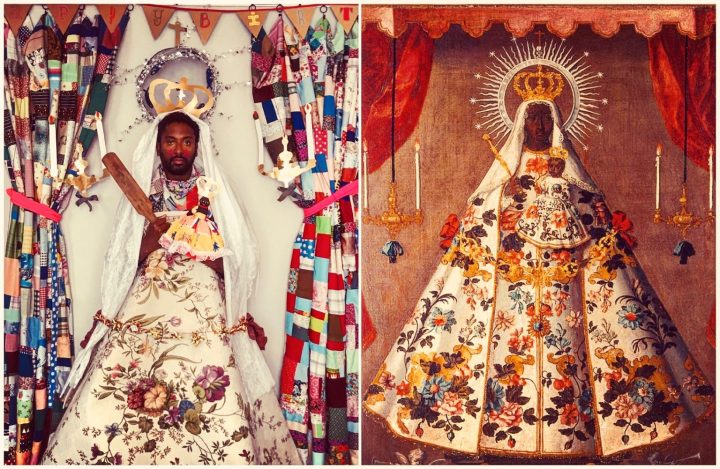
Left: Peter Brathwaite’s restaged version of The Virgin of Guadalupe. Right: Unknown painter, The Virgin of Guadalupe, oil painting, 1745 (London: Wellcome Collection), cropped from original and colour saturated.
◊ ◊ ◊ ◊ ◊
From the Bristol Museum & Art Gallery:
Peter Brathwaite: Rediscovering Black Portraiture
King’s College London, Strand Campus, October 2021 — February 2022
Bristol Museum & Art Gallery, 14 April — 3 September 2023
During the first lockdown in 2020, with all his performances cancelled, baritone, artist, broadcaster, and writer Peter Brathwaite began researching and reimagining more than 100 artworks. These artworks featured portraits of Black sitters, as part of the online #GettyMuseumChallenge to use household objects to restage famous paintings. He called the photographic series Rediscovering Black Portraiture. Alongside this project he also intensified his research into his dual heritage Barbadian roots, uncovering a wealth of detail about his enslaved and enslaver ancestors and their history, including an uprising of enslaved people in 1816 and songs of resistance they sang. Three years on, with a London exhibition behind him and a book out with Getty Publications, Peter Brathwaite brings his whole practice to the history of Georgian House Museum and the collections of Bristol Museum & Art Gallery. New interventions and sound installations reveal the Black presence hidden at the heart of our spaces and objects. The exhibition opened to coincide with the anniversary of the Barbados insurrection, 14 April 1816.
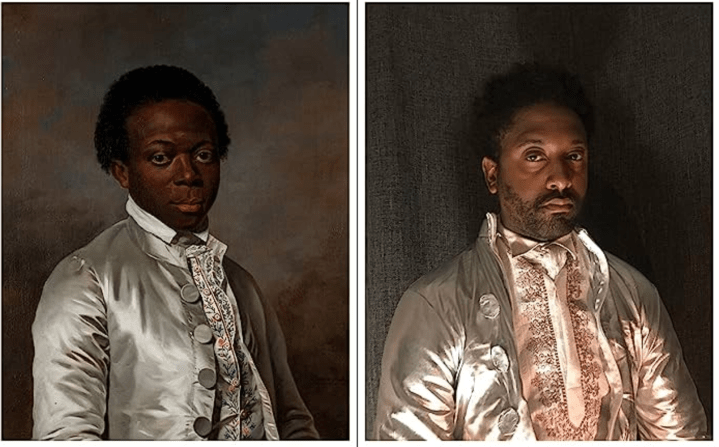
Left: Marie-Victoire Lemoine, Portrait of a Youth in Embroidered Vest, 1785, oil on canvas, 68 × 50 cm (Jacksonville, Florida: Cummer Museum of Art & Gardens). Right: Peter Brathwaite’s restaged version of a Youth in Embroidered Vest.
◊ ◊ ◊ ◊ ◊
From The Getty:
Peter Brathwaite, with contributions by Cheryl Finley, Temi Odumosu, and Mark Sealy, Rediscovering Black Portraiture (Los Angeles, Getty Publications, 2023), 168 pages, ISBN: 978-1606068168, $40.
 Join Peter Brathwaite on an extraordinary journey through representations of Black subjects in Western art, from medieval Europe through the present day. Since the beginning of the COVID-19 pandemic, Peter Brathwaite has thoughtfully researched and reimagined more than one hundred artworks featuring portraits of Black sitters—all posted to social media with the caption “Rediscovering #blackportraiture through #gettymuseumchallenge.”
Rediscovering Black Portraiture collects more than fifty of Brathwaite’s most intriguing re-creations. Introduced by the author and framed by contributions from experts in art history and visual culture, this fascinating book offers a nuanced look at the complexities and challenges of building identity within the African diaspora and how such forces have informed Black portraits over time. Artworks featured include The Adoration of the Magi by Georges Trubert, Portrait of an Unknown Man by Jan Mostaert, Rice n Peas by Sonia Boyce, Barack Obama by Kehinde Wiley, and many more. This volume also invites readers behind the scenes, offering a glimpse of the elegant artifice of Brathwaite’s props, setup, and process. An urgent and compelling exploration of embodiment, representation, and agency, Rediscovering Black Portraiture serves to remind us that Black subjects have been portrayed in art for nearly a millennium and that their stories demand to be told.
Peter Brathwaite is an acclaimed baritone who performs in operas and concerts throughout Europe. He is a presenter on BBC Radio 3 and has been shortlisted for a Royal Philharmonic Society Award. Cheryl Finley is inaugural distinguished visiting director of the Atlanta University Center Art History and Curatorial Studies Collective and the author of Committed to Memory: The Art of the Slave Ship Icon (2018). Temi Odumosu is an art historian, curator, and assistant professor at University of Washington Information School and the author of Africans in English Caricature 1769–1819: Black Jokes, White Humour (2017). Mark Sealy is director of Autograph and professor of photography, race, and human rights at University of the Arts London. His numerous publications include Different (2001), coauthored with Stuart Hall; Decolonising the Camera: Photography in Racial Time (2019); and Photography: Race, Rights, and Representation (2022).
Print Quarterly, June 2023

Left: Edmé Jeaurat after Antoine Watteau, Talagrepo, Monk of Pégou, ca. 1731, etching and engraving, 24 × 17 cm (Cambridge, MA, Harvard Art Museums / Fogg Museum). Right: Gabriel Huquier after François Boucher, Flautist and Child Timpanist, ca. 1742, etching and engraving, sheet, trimmed 30 × 24 cm (New York, The Metropolitan Museum of Art).
◊ ◊ ◊ ◊ ◊
The long eighteenth century in the latest issue of Print Quarterly:
Print Quarterly 40.2 (June 2023)
A R T I C L E S

Roger Vandercruse Lacroix, Secretaire with Marquetry, ca. 1765, tulipwood, stained marquetry with bronze mounts and marble top, 114 × 73 × 38 cm (Private collection, Image courtesy Christie’s, London).
• Kee Il Choi Jr., “Watteau and Boucher Conjoined: Imagining China in Marquetry,” pp. 138–49.
This article examines the previously unknown pairing of Chinoiserie prints based on designs by Antoine Watteau (1684–1721) and François Boucher (1703–70) to create the pictorial marquetry veneered onto two nearly identical writing desks (secrétaires en armoire) attributed to the cabinetmaker Roger Vandercruse called La Croix or Lacroix (1727–99). Each cabinet retains traces of either the original engraving or the colour deployed to bring these ‘paintings in wood’ to life. This discovery not only exemplifies the role of prints in disseminating the chinoiseries of both Watteau and Boucher but also sheds light on the working practices of marqueteurs in eighteenth-century Paris.
• Lesley Fulton, “Johann Heinrich Wilhelm Tischbein’s Album of Prints in the British Museum,” pp. 150–69.
Fulton explores the Homeric subject matter and scenes depicted in the British Museum’s album of 81 previously unidentified etchings and engravings. Intended for Tischbein’s Vases and Homer projects, the etchings and engravings were prepared in Naples towards the end of the eighteenth century. Connections are made to motifs derived from painted vases and their relationship to Tischbein’s project for Sir William Hamilton’s Collection of Engravings from Ancient Vases (Naples and Germany, 1791–1803). Further analysis links the prints to the artist’s massive Illustrated Homer project in the first quarter of the 19th century. The paper highlights the discrepancy between the identification of an antique motif made in the late eighteenth century and how it is interpreted today. A contemporary document—probably a stocklist—from the Tischbein archive at Oldenburg in Germany, undated but drawn up between 1799 and 1808, has made it possible to identify the subject of each print and also to explain its original place in the album. The Appendix correlates the British Museum prints with their description as given in the Oldenburg document and also their correspondence with Tischbein’s various publication projects. Fulton concludes that the British Museum album probably served as a sales catalogue to which new material could be added as it arrived in the artist’s workshop.
N O T E S A N D R E V I E W S
• An Van Camp, Review of Gitta Bertram, Nils Büttner, and Claus Zittel, eds., Gateways to the Book: Frontispieces and Title Pages in Early Modern Europe (Brill, 2021), pp. 175–76. This edited volume presents fifteen essays on frontispieces and title-pages found in books printed between 1500 and 1800. Written by established academics as well as PhD candidates, the contributions explore how frontispieces intersect art and literature and how the printed images can be interpreted (contributions by Malcolm Baker, Martijn van Beek, Miranda L. Elston, Alison C. Fleming, Daniel Fulco, Lea Hagedorn, Constanze Keilhoz, Fabian Kolb, Hole Rößler, Delphine Schreuder, Alice Zamboni, and Cornel Zwierlein).
• Séverine Lepape, Review of Małgorzata Łazicka, ed., Old Master Prints from the 15th Century to the 1820s: German School, Barthel Beham and Sebald Beham. The Print Room of the University of Warsaw Library, Catalogue of the Collection (University of Warsay Library, 2019), pp. 176–78.
 • Michael Matile, Review of the exhibition catalogue, Kurt Zeitler, ed., Venedig, La Serenissima: Zeichnungen und Druckgraphik aus vier Jahrhunderten (Deutscher Kunstverlag, 2022), pp. 180–83. The Staatliche Graphische Sammlung in Munich recently presented a cross-section of its rich treasures of Venetian prints and drawings from the late fifteenth to the eighteenth century.
• Antony Griffiths, Review of Joyce Zelen, Blinded by Curiosity: The Collector-Dealer Hadriaan Beverland (1650–1716) and his Radical Approach to the Printed Image (Primavera Pers, 2021), pp. 186–89. The book focuses on Hadriaan Beverland’s activities during his last years, from 1680, which he spent as a ‘paranoid alcoholic drifting through the pubs and brothels of London’. He also assembled at least two little known manuscripts with new images composed of cut-out fragments of prints. The review highlights two portrait prints seemingly commissioned by Beverland himself which Griffiths believes ‘stand far outside the traditional canons of portraiture’, as well as the discovery by Zelen of a major sale of Beverland’s print collection held in 1690.
• Kristel Smentek, Review of Marianne Grivel, Estelle Leutrat, Véronique Meyer and Pierre Wachenheim, eds., Curieux d’Estampes. Collections et collectionneurs de gravures en Europe, 1500–1815 (Universitaires de Rennes, 2020), pp. 189–91. This review presents a swift overview of newly found documentary insights relating to individual and institutional collections of prints, largely focusing on French collectors and on the eighteenth century. Of the latter, mention is made of Albert Duke of Saxe-Teschen correspondences, Joseph-Dominique d’Inguimbert’s display practices, which included mounting between rollers, the collecting and marketing of French fashion prints, and the formation of print collections documenting the history of France, as was the case with Charles-Marie Fevret de Fontette.
• Mark McDonald, Review of Jessica Maier, The Eternal City: A History of Rome in Maps (University of Chicago Press, 2020) pp. 192–94. This review highlights interesting anachronistic features in topographical depictions of a reinvented Rome, for example, in Leonardo Bufalini’s woodcut map from 1551, the Baths of Trajan are depicted as a complete structure when it was in fact ruinous at the time. Further analysis pertains to the functions of printed maps, often as guides for pilgrims and secular tourists visiting important churches and historic sites.
• Christian Rümelin, Review of the exhibition catalogue, Celia Haller-Klinger, and Anette Michels, eds., Graphiksammler Ernst Riecker (1845–1918) und Otto Freiherr von Breitschwert (1829–1910) (Graphik-Kabinett Backnang, 2018), pp. 194–95. A review relating to two German collections formed around the turn of the nineteenth century, one of which focused on eighteenth- and nineteenth-century regional artists.
• Michael Matile, Review of the exhibition catalogue, Anne Buschoff, Marcus Dekiert and Sven Schütte, eds., Linie lernen: Die Kunst zu zeichnen (Wallraf-Richartz Museum & Fondation Corboud, 2021), pp. 195–96. This review pertains to a catalogue illustrating the history of drawing education from Cennino Cennini to their depictions in sixteenth- to eighteenth-century prints.
◊ ◊ ◊ ◊ ◊
Note (added 12 June 2023) — The original posting was updated to include reproductions of the two prints after Watteau and Boucher.










leave a comment