Exhibition | La Surprise: Watteau in Los Angeles
Opening next month at the The Getty:
La Surprise: Watteau in Los Angeles
The Getty Center, Los Angeles, 23 November 2021 — 20 February 2022
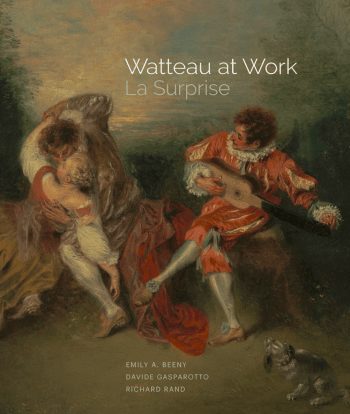 Graceful scenes of courtship, music and dance, strolling lovers and theatrical characters: this is the imaginary world conjured by the greatest French painter and draftsman of the 18th century, Antoine Watteau (1684–1721). Los Angeles is home to an extraordinary group of Watteau’s works. This focused exhibition, marking the 300th anniversary of the artist’s death, brings together a dozen of them from public and private collections and celebrates the Getty’s recent acquisition of an exquisite example: the painting La Surprise. The picture belongs to what was a new genre of painting invented by the artist himself—the fête galante. These works do not so much tell a story as set a mood: one of playful, wistful, nostalgic reverie. Esteemed by collectors in Watteau’s day as a work that showed the artist at the height of his skill and success, La Surprise vanished from public view in 1848, reemerging only in 2007. The Getty Museum acquired the painting in 2017.
Emily Beeny, Davide Gasparotto, and Richard Rand, Watteau at Work: La Surprise (Los Angeles: J. Paul Getty Museum, 2021), 88 pages, ISBN: 978-1606067352, $25.
La Surprise by Antoine Watteau has never before been the subject of a dedicated publication. Marking the three hundredth anniversary of Watteau’s death, this book considers the painting within the context of the artist’s oeuvre and discusses the surprising history of collecting works by the artist in Los Angeles.
Emily A. Beeny, former associate curator of drawings at the J. Paul Getty Museum, is curator in charge of European paintings at the Fine Arts Museums of San Francisco. Davide Gasparotto is senior curator of paintings and chair, curatorial affairs, at the J. Paul Getty Museum. Richard Rand is associate director for collections at the J. Paul Getty Museum.
C O N T E N T S
Timothy Potts, Director’s Foreword
Acknowledgments
Richard Rand, Jean Antoine Watteau, Three Hundred Years Later
Davide Gasparotto, Rediscovering a Masterpiece: Watteau’s La Surprise
Emily Beeny, Quelle Surprise! Watteau in Los Angeles
Plates
Works in the Exhibition
References
Index
New Book | Nicolas Party: Pastel
The catalogue for the exhibition is now available:
Nicolas Party, ed., Pastel (New York: The FLAG Art Foundation, 2021), 216 pages, ISBN: 978-1949172522, $50. Contributions by Nicolas Party and Dodie Kazanjian; conversation with artists Louis Fratino, Loie Hollowell, Billy Sullivan, Robin F. Williams, moderated by FLAG Founder Glenn Fuhrman; essay by Melissa Hyde, “‘Dust From a Butterfly’s Wing’: The Gentle Art of Pastel, A Short History.”
 In 2019, Nicolas Party transformed The FLAG Art Foundation in New York into a rose-colored stage set for a suite of soft pastel, Rococo-inspired murals that serve as a foil to, and occasional backdrop for, a selection of pastels from the 18th century to the present. Pastel commemorates the exhibition, its celebration of the pastel medium, and the range of contemporary artists who are giving new energy to this uniquely fragile medium. Artists in the exhibition included Rosalba Carriera, Mary Cassatt, Edgar Degas, Louis Fratino, Marsden Hartley, Loie Hollowell, Julian Martin, Toyin Ojih Odutola, Chris Ofili, Jean-Baptiste Perronneau, Billy Sullivan, Wayne Thiebaud, and Robin F. Williams.
Nicolas Party (b. 1980, Lausanne, Switzerland) is an artist living and working in Brussels and New York. He earned a BA in Fine Art at the Lausanne School of Art in 2004 and an MA at The Glasgow School of Art in 2009. More information is available here.
Print Market | Mad about Mezzotint at the Court of George III
From Isaac and Ede:
Mad about Mezzotint at the Court of George III
Reindeer Antiques, London, 6 October — 5 November 2021
 This exhibition organized by David Isaac of Isaac and Ede celebrates the bicentenary of the 60-year reign of King George III (1738–1820) through one mezzotint portrait for each year of his reign. Meet the movers and shakers, the courtiers and courtesans, the duchesses and dandies of the period. Each mezzotint was printed in the year it represents, so there are 61 prints to cover the years 1760–1820 with a couple of extras thrown in for good measure. Royalty and aristocracy dominate throughout the opening decades, but as the country finds itself increasingly at war with America, France, Spain (and practically everyone else), we see a predominance of naval and military heroes taking centre stage. Towards the end of our period, we begin to see the emergence of the self-made man, and the entrepreneurial spirit of that would come to symbolize the Victorian era. To be held at Reindeer Antiques, 81, Kensington Church Street, London W8 4BG.
Printed catalogues are available: UK £30 including P&P / USA £47 including P&P. View a PDF of the catalogue on Issuu. The catalogue is also distributed by Paul Holberton Publishing:
David Isaac, Mad about Mezzotint at the Court of George III (London: Isaac and Ede, 2022), 148 pages, ISBN 978-1913645359, £30.
◊ ◊ ◊ ◊ ◊
Note (added 6 July 2022) — The original posting did not include catalogue details from PHP.
Exhibition | Aquatint: From Its Origins to Goya
From the NGA:
Aquatint: From Its Origins to Goya
National Gallery of Art, Washington, D.C., 24 October 2021 — 21 February 2022
Curated by Rena Hoisington
 A new printmaking technique—aquatint—swept through 18th-century Europe, yielding an extraordinary range of works, from images of erupting volcanoes, amorous couples, and mysterious tombs, to Russian exotica, biting caricatures, and moonlit vistas. The first American exhibition to survey the medium’s development in France, England, Italy, Germany, the Netherlands, and Spain, Aquatint: From Its Origins to Goya presents some 100 early and exceptional impressions, many of which have recently been acquired by the National Gallery of Art. By supplementing the line work of etching, aquatint offered an exciting method for multiplying ink-and-wash drawings that render tone in subtle ways.
Aquatint flourished outside the official circles of European art academies in the hands of three kinds of artists—professional printmakers, amateurs (art lovers), and peintre-graveurs (painter-printmakers). Each played a distinctive and significant role in publicizing, disseminating, and advancing the aquatint medium. Professional printmakers combined it with other intaglio printmaking techniques to reproduce highly prized drawings by old master and contemporary artists. Amateurs, an elite group of like-minded collectors, embraced drawing, etching, and aquatint to not only expand their art-historical and connoisseurial knowledge, but also cultivate relationships with artists. Peintre-graveurs revisited, re-created, and circulated their designs through aquatint to build their reputations and broaden their audiences, dramatically expanding the formal vocabulary and expressive potential of the medium.
Rena Hoisington, Aquatint: From Its Origins to Goya (Princeton: Princeton University Press, 2021), 288 pages, ISBN: 978-0691229799, $60.
Supported by the Eugene V. and Clare E. Thaw Charitable Trust and written by Rena M. Hoisington, curator and head of old master prints at the National Gallery of Art, a book illustrated with rare works from the National Gallery’s collection of early aquatints accompanies the exhibition. It provides an engaging narrative about the medium’s flourishing as a cross-cultural and cosmopolitan phenomenon that contributed to the rise of art publishing, connoisseurship, leisure travel, and drawing instruction as well as the spread of neoclassicism.
Exhibition | Goya

Francisco de Goya, Still Life with Golden Bream (Besugos), 1808–12, oil on canvas, 45 × 63 cm
(The Museum of Fine Arts, Houston, 94.245)
◊ ◊ ◊ ◊ ◊
Press release (via Art Daily) for the exhibition:
Goya
Fondation Beyeler, Basel, 10 October 2021 — 23 January 2022
Curated by Martin Schwander and developed by Isabela Mora and Sam Keller
275 years after his birth, the Fondation Beyeler presents one of the most significant exhibitions ever devoted to Francisco de Goya—one of modern art’s major trailblazers. For the first time, rarely displayed paintings from Spanish private collections will be shown alongside key works from distinguished European and American museums and private collections. The exhibition brings together around 70 paintings and more than 100 masterful drawings and prints. Today, as during the artist’s lifetime, Goya’s works present viewers with a unique sensory and intellectual experience. For the past two centuries, his complex and ambiguous oeuvre has acted as a beacon and a landmark for many artists. The exhibition is organised by the Fondation Beyeler in collaboration with the Museo Nacional del Prado in Madrid.
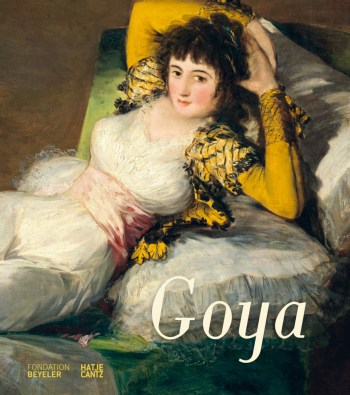 Francisco de Goya y Lucientes (1746–1828) occupies a paradoxical position in European art history as one of the last great court painters and a forerunner of the figure of the modern artist. In order to convey the uniqueness of Goya’s work, which spans a period ranging from Late Rococo to Romanticism, and do justice to the formal and thematic wealth of his painted, drawn, and printed oeuvre, the exhibition presents the full spectrum of genres and recurring motifs. Arranged chronologically, it features large-scale stately paintings as well as sketchbook pages, focussing on Goya’s late work.
The exhibition at the Fondation Beyeler presents both the established court painter and the inventor of enigmatic and disturbing pictorial worlds, his religious and his secular images, his depictions of Christ and of witches, portraits and history paintings, still lifes and genre scenes. Next to paintings commissioned by the royal family, the aristocracy and the bourgeoisie, the show features works created by Goya within a self-conquered space of artistic freedom, among them cabinet paintings often intended only for highly private display. With rebellious resolve, Goya was one of the first artists in the history of European art to push back against the rules and dogmas that constrained artistic creation, instead making a stand for artists’ impulse and inventiveness (‘capricho’ and ‘invención’). Highlights of the exhibition include the portrait of the Duchess of Alba (1795) and the iconic Clothed Maja (La maja vestida, 1800–07), as well as the rarely displayed Maja and Celestina on a Balcony and Majas on a Balcony (1808–12), the latter two on loan from European private collections.

Francisco Goya y Lucientes, María Amalia de Aguirre y Acedo, marquesa de Montehermoso, 1810, oil on canvas, 170 × 103 cm (Private Collection).
The exhibition will further feature small-format genre scenes, held for the most part in Spanish private collections and hitherto only rarely shown outside Spain. In these paintings—as in his drawings and prints—Goya gave free rein to his innermost inspiration. For the first time since their only display to date at the Museo Nacional del Prado, the Fondation Beyeler will thus show the full series of eight remaining history and genre pictures from the Madrid collection of the Marqués de la Romana. They will be joined by the four celebrated, rarely loaned panels with genre scenes from the Real Academia de Bellas Artes de San Fernando in Madrid.
In his genre scenes and history paintings, Goya depicts events from everyday life in Spain around 1800—socially, politically, and religiously troubled times. Recurring settings include markets and bullrings, prisons and ecclesiastical institutions, lunatic asylums, and the courts of the Inquisition. Depictions of witches are another key motif, used by Goya to expose the superstition of his time. Next to a group of etchings from The Disasters of War (Los desastres de la guerra, 1811–14), the exhibition will also feature a selection of prints from the 1799 Caprichos series, among them the celebrated plate no. 43, programmatically titled The Sleep of Reason Produces Monsters, which displays Goya’s resigned and melancholy realisation that neither reason nor irony and sarcasm can fight off irrationality. Goya’s enigmatic and unfathomable pictorial worlds have been held in high regard ever since the age of early 19th-century French Romanticism. Among modern artists, Pablo Picasso and Joan Miró, Francis Bacon and the Surrealists viewed Goya as a kindred spirit. And he remains a major reference for many contemporary artists, among them Marlene Dumas and Philippe Parreno.
Commissioned by the Fondation Beyeler, renowned French artist Philippe Parreno (b. 1964) has created a film based on Goya’s iconic Black Paintings series (Pinturas negras, 1819–24), which will premiere at the exhibition. The 14 murals were originally painted in Goya’s residence on the outskirts of Madrid and were most likely not intended for public viewing. Now in the collection of the Museo Nacional del Prado in Madrid, the paintings are so fragile that they cannot leave the museum.
For the first time, seldom seen paintings from Spanish private collections, some of which have not changed hands since the artist’s lifetime, are shown alongside key works from the most prestigious European and American museums and private collections. Works will be on loan from major museums such as the Museo Nacional del Prado, the Museo Thyssen-Bornemisza, the Fundación Lázaro Galdiano and the Fundación Casa de Alba, all in Madrid, the Musée du Louvre in Paris, the Metropolitan Museum of Art in New York, the National Gallery in London, the Gallerie degli Uffizi in Florence, the National Gallery of Ireland in Dublin, the Sammlung Oskar Reinhart ‘Am Römerholz’ in Winterthur, the Minneapolis Institute of Art, and the Museum of Fine Arts in Houston.
Martin Schwander, ed., with text by Andreas Beyer, Helmut C. Jacobs, Ioana Jimborean, José Manuel Matilla, Gudrun Maurer, Manuela B. Mena Marqués, Colm Tóibín, Bodo Vischer, Francisco de Goya (Stuttgart: Hatje Cantz, 2021), 288 pages, ISBN: 978-3775746571 (English edition), $90. Also available in German.
Exhibition | Portraits en Majesté: de Troy, de Largillierre, Rigaud
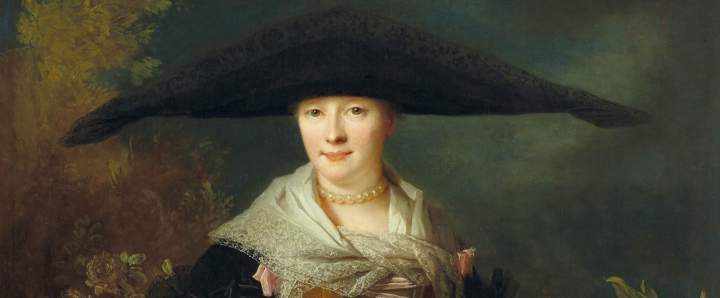
Nicolas de Largillierre, La Belle Strasbourgeoise , detail, ca. 1703, oil on canvas, 132 × 106 cm. The painting sold at Christie’s in Paris on 15 September 2020 (Sale 19158, Lot 212) for €1.57million, surpassing its high estimate of €1million.
◊ ◊ ◊ ◊ ◊
Now on view at the Musée d’art Hyacinthe Rigaud:
Portraits en Majesté: François de Troy, Nicolas de Largillierre, Hyacinthe Rigaud
Musée d’art Hyacinthe Rigaud, Perpignan, 26 June — 7 November 2021
Curated by Pascale Picard, Dominique Brême, and Ariane James-Sarazin
S’inscrivant naturellement dans la programmation du musée d’art Hyacinthe Rigaud dont les collections accordent une large place à l’enfant du pays, Portraits en majesté bénéficie d’un partenariat exceptionnel avec le musée national des châteaux de Versailles et de Trianon.
Portraits en majesté valorise de façon inédite—puisque c’est la première fois qu’un tel rapprochement est proposé—les trois artistes français qui, de Louis XIV à Louis XV ont révolutionné l’art du portrait : François de Troy (1645–1730), Nicolas de Largillierre (1656–1746) et Hyacinthe Rigaud (1659–1743), au travers d’une sélection généreuse et exigeante de leurs plus belles œuvres qui transcendent le genre et s’imposent avant tout pour leur esthétique. Chaque salle souligne tant la singularité de la matière des trois peintres que les éléments de vocabulaire (format, veine, modèle, composition…) relevant d’une inspiration commune. Le rapprochement de leurs œuvres met en exergue le fait que le portrait, tels que de Troy, de Largillierre et Rigaud le conçurent, se voulait une création d’art total, réunissant en son sein tous les genres.
La commissaire générale
• Pascale Picard, Directrice du musée d’art Hyacinthe Rigaud de Perpignan
Les commissaires scientifiques
• Dominique Brême, Directeur du musée du Domaine départemental de Sceaux
• Ariane James-Sarazin, Conservatrice générale du patrimoine, Directrice adjointe du musée de l’Armée de Paris
◊ ◊ ◊ ◊ ◊
Dominique Brême and Ariane James-Sarazin, eds., Portraits en Majesté: François de Troy, Nicolas de Largillierre, Hyacinthe Rigaud (Milan: Silvana Editoriale, 2021), 296 pages, ISBN: 978-8836644209, €35.
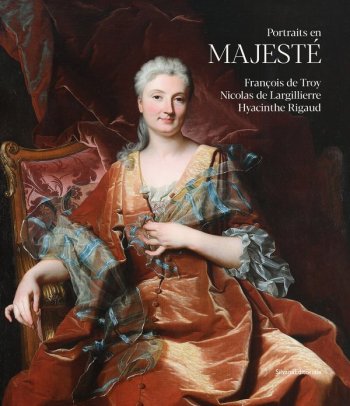 Au cours de son règne—le plus long de l’histoire de France—Louis XIV accorda aux arts une place centrale dans l’accompagnement de son projet politique : architecture, peinture, sculpture, musique ou danse bénéficièrent ainsi d’un mécénat royal quasiment sans limite. Représentant les acteurs de cet âge d’or, le portrait peint trouva particulièrement à s’y épanouir, surtout à partir des années 1680, lorsque trois artistes, concurrents mais amis, entreprirent de renouveler le modèle trop sage du portrait classique en lui insufflant un élan baroque inattendu. Francois de Troy (1645–1730), Nicolas de Largillierre (1656–1746) et Hyacinthe Rigaud (1649–1753) révolutionnèrent ainsi la syntaxe du portrait français et, plus généralement, du grand portrait d’apparat européen. Habiles à varier incessamment sur un schéma de composition très contraignant—celui du triangle de base de la figuration humaine—ils donnèrent au genre ses lettres de noblesse en le hissant à un niveau de difficulté de conception et de qualité d’exécution au moins égal à celui des grands tableaux d’histoire. Accompagnant l’exposition d’une centaine de chefs-d’œuvre, ce livre étudie les modalités pratiques, théoriques et esthétiques de l’art du portrait français à son apogée.
New Book | French Rococo Ébénisterie
From The Getty:
Anne-Lise Desmas, ed., French Rococo Ébénisterie in the J. Paul Getty Museum (Los Angeles: J. Paul Getty Museum, 2021), 320 pages, ISBN: 978-1606066300, $75. Available as a free online publication, in multiple formats, here»
 The first comprehensive catalogue of the Getty Museum’s significant collection of French Rococo ébénisterie furniture.
This catalogue focuses on French ébénisterie furniture in the Rococo style dating from 1735 to 1760. These splendid objects directly reflect the tastes of the Museum’s founder, J. Paul Getty, who started collecting in this area in 1938 and continued until his death in 1976. The Museum’s collection is particularly rich in examples created by the most talented cabinet masters then active in Paris, including Bernard van Risenburgh II (after 1696–ca. 1766), Jacques Dubois (1694–1763), and Jean-François Oeben (1721–1763). Working for members of the French royal family and aristocracy, these craftsmen excelled at producing veneered and marquetried pieces of furniture (tables, cabinets, and chests of drawers) fashionable for their lavish surfaces, refined gilt-bronze mounts, and elaborate design. These objects were renowned throughout Europe at a time when Paris was considered the capital of good taste. The entry on each work comprises both a curatorial section, with description and commentary, and a conservation report, with construction diagrams. An introduction by Anne-Lise Desmas traces the collection’s acquisition history, and two technical essays by Arlen Heginbotham present methodologies and findings on the analysis of gilt-bronze mounts and lacquer.
This open-access catalogue is available for free online and in multiple formats for download, including PDF, MOBI/Kindle, and EPUB. For readers who wish to have a bound reference copy, this paperback edition has been made available for sale.
C O N T E N T S
Timothy Potts, Director’s Foreword
Glossary of Woods Used in French Furniture from the J. Paul Getty Museum Collection
Contributors
Essays
• Anne-Lise Desmas — Introduction: Acquisitions History of the Rococo Ébénisterie Collection
• Jessica Chasen, Arlen Heginbotham, and Michael Schilling — The Analysis of East Asian and European Lacquer Surfaces on Rococo Furniture
• Arlen Heginbotham — Technical Note: The Use of X-Ray Fluorescence Spectroscopy (XRF) in the Technical Study of Gilt Bronze Mounts in This Catalogue
Catalogue
Bibliography
About
Exhibition | The Hidden Horizontal: Cornices in Art and Architecture

Giovanni Battista Piranesi, De Romanorum magnificentia et architectura: Della magnificenza ed architettura de’ Romani (Rome, 1761). ETH-Bibliothek Zürich, Rar 1311.
◊ ◊ ◊ ◊ ◊
From the press release for the exhibition:
The Hidden Horizontal: Cornices in Art and Architecture
Die unterschätzte Horizontale: Das Gesims in Kunst und Architektur
Graphische Sammlung ETH Zürich, 25 August — 14 November 2021
Curated by Linda Schädler and Maarten Delbeke, with Anneke Abhelakh, David Bühler, and Emma Letizia Jones
In architecture, the cornice hides in plain sight. Omnipresent as the elaborate junction between roof and wall, or wall and ceiling, this ornamental element seems to have attracted far less attention from architects, critics, or theoreticians than, for instance, columns or the architectural orders. But in a new exhibition at the Graphische Sammlung ETH Zürich, the cornice makes its long overdue grand entrance, displaying its many incarnations in art and architecture. Over 150 drawings, prints, books, and objects from the 15th century to the present day are united in a new dialogue, some shown for the first time in Switzerland.
Cornices are everywhere. Once you start looking, their ubiquity is almost irritating. Windows, doors, ceilings, mirrors, and wall panelling from across the centuries sport elaborate profiles at their edges. The skyline of any city street is a ragtag procession of cornices in various states of materiality, refinement, and maintenance. It does not stop there. Cars and clothes, furniture, and household objects feature their own cornice-like elements. Strips, bands, and lines of paint act like cornices by framing, delineating, or crowning almost any kind of artefact. Still, they attract far less attention from architects, critics, theoreticians, or even the general public than other building parts. In response, a reappraisal of this underrated element are presented in the current exhibition at Graphische Sammlung ETH Zürich, where the cornice is placed at centre stage.
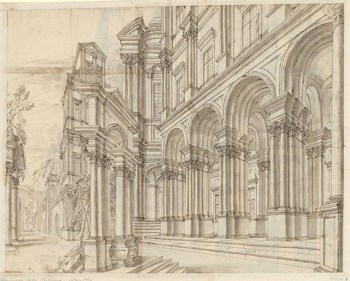
Giuseppe Gallli Bibiena, Sketch for Set Decoration ‘Scena per angolo’, 1700–50, pen and ink drawing (Graphische Sammlung ETH Zürich).
The cornice, once an essential part of any classical composition, incurred the wrath of modernists at the beginning of the 20th century. It has, at various times, been identified as the most expressive part of architecture, as well as the most problematic. It has drawn attention to itself in drawings, etchings, and other works of art. Hence, a history of the cornice in many ways offers a new window onto the multiple histories of architecture and its representations. For, on account of its ubiquity, the cornice carries several layers of meaning: as an element defined by, and defining building regulations; as the solution to the technical problem of joining wall and roof; and as a site to expression of social aspirations or distinction. As the visual limit of a construction, the cornice is as much about the individual building as it is about the city or the landscape. As an ornament applied to buildings, it involves matters of taste and aesthetics as much as of craft and industrial production. And as a subject depicted in two-dimensional works of art on paper, it allows us to interrogate the art historical conventions of image-viewing and composition. Finally, as a complex three-dimensional object, the cornice raises questions of cultural representation and communication through material transfers over time.
The exhibition unites a unique selection of drawings, prints, books, and objects from the 15th century to the present day. Authors and artists exhibited include Francesco di Giorgio Martini, Giovanni Battista Piranesi, Gottfried Semper, Frank Lloyd Wright, and Le Corbusier, amongst many others. By bringing works from earlier centuries from the ETH collections into direct dialogue with loans from important institutions in Switzerland and abroad—including the Fondation Le Corbusier, Paris, the Louvre, the Biblioteca Nazionale Centrale di Firenze, the Art Institute of Chicago, the Canadian Centre for Architecture, Montreal, the Drawing Matter Collections (UK), the Berlin State Museums, the Rietberg Museum Zurich, and more—the exhibition exposes the ‘hidden horizontal’ at the centre of five centuries of art and design thinking.
Featuring works by:
Cherubino Alberti, Daniel Badger, Ottavio Antonio Baiardi, Baccio Bandinelli, Pietro Santi Bartoli, Nicolas Beatrizet, François-Joseph Bélanger, Stefano della Bella, Ferdinando and Giuseppe Galli Bibiena, Jacques-François Blondel, Jan van Bronchorst, Andreas Buschmann, Richard Cahan, Cesare Cesariano, Charles Chipiez, François Collignon, Francesco Colonna, Le Corbusier, Pascal Coste, Marco Dente after Raphael, Deutscher Werkbund, Wendel Dietterlin, Giovanni Dosio, Albrecht Dürer, Louis-Émile Durandelle, Charles Eisen, Theodor Fischer, Domenico Fontana, Johannes Gachnang, George Jackson and Sons, Ludger Gerdes, Francesco di Giorgio Martini, Hubertus Goltzius, Karl Adolf Graffenried, Michael Graves, Iain Hales, Herzog & de Meuron, Utagawa Hiroshige, Jacques Hittorff, Daniel Hopfer, Lucas Kilian, Henri Labrouste, Mari Lending, Johann Baptist Marzohl, Johann Matthäus Mauch, Meister GA mit der Fussangel, Nicoletto da Modena, Richard Nickel, Friedrich Ohmann, Ordinary Architecture (Charles Holland and Elly Ward), Andrea Palladio, Manuel Pauli, Georges Perrot, Pablo Picasso, Christiane Pinatel, Giovanni Battista Piranesi, Marcantonio Raimondi, Mies van der Rohe, Diego Prévost Sagredo, Antonio Sangallo the Younger, Karl Friedrich Schinkel, Gottfried Semper, Sebastiano Serlio, Hermann Spielberg, Philippe Starck, Christian Ludwig Stieglitz, Gabriel Ludwig Stürler, Johann Georg Sulzer, Charles Heathcote Thatham, Philippe Thomassin, Constantin Uhde, Agostino Veneziano, Howard Charles Walker, Frank Lloyd Wright, Giacomo Barozzi da Vignola, Eugène-Emmanuel Viollet-le-Duc, Hans Vredeman de Vries, and Nicolai Zabaglia.
The presentation is jointly organised by the ETH collection of prints and drawings, Dr. Linda Schädler, and the chair of the History and Theory of Architecture ETH Zürich, Prof. Dr. Maarten Delbeke. Additional curatorial support has been provided by Anneke Abhelakh, David Bühler, and Dr. Emma Letizia Jones.
Programming details including guided tours, a lecture series, and walks can be found here.
Publications
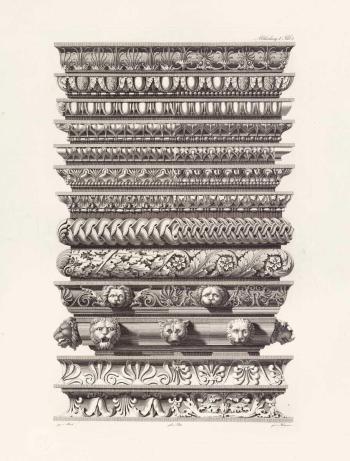
Illustration from Vorbilder für Fabrikanten und Handwerker (‘Patterns for Manufacturers and Handicraftsmen‘), edited by Christian Peter Wilhelm Beuth and Karl Friedrich Schinkel (1821).
A special edition of gta papers (the journal of the Institute for the History and Theory of Architecture ETH Zurich) dedicated to the cornice will be published in Fall 2021 to coincide with the exhibition (retail price: Fr. 25.–). Edited by Maarten Delbeke, Erik Wegerhoff, and Adam Jasper, the issue features an introduction by Maarten Delbeke and texts by Richard Anderson, Guido Beltramini, Emma Letizia Jones, Edoardo Piccoli, Linda Schädler, Oliver Streiff, David Bühler, Flavia Crisciotti, Linda Stagni with Claudio Gianocelli, Xu Han, and Maxime Zaugg.
The September 2021 issue of werk, bauen + wohnen focuses on the cornice as well. It contains an introduction by Maarten Delbeke, the first German translation of Luigi Moretti’s 1952 text “I valori della modenatura: Wert und Wirkung plastischer Profile,” a text by Mario Rinke, and reviews of projects by De Smet Vermeulen Architecten, 31/44 Architects, KilgaPopp Architekten, Joos & Mathys Architekten, Lütjens Padmanabhan Architekten, and Studio Anne Holtrop.
The Burlington Magazine, September 2021
The eighteenth century in this month’s issue of The Burlington . . .
The Burlington Magazine 163 (September 2021)
 E D I T O R I A L
• “Nicholas Goodison and The Burlington,” p. 779.
A R T I C L E S
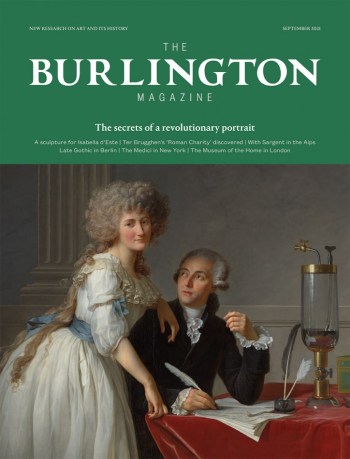
• David Pullins, Dorothy Mahon, Silvia A. Centeno, “The Lavoisiers by David: Technical Findings on Portraiture at the Brink of Revolution,” pp. 780–91.
Recent technical examination of Jacques-Louis David’s portrait of Antoine-Laurent and Marie-Anne Lavoisier in the Metropolitan Museum of Art, New York, painted between 1787 and 1788, has revealed significant and previously unknown alterations that transform our understanding of this celebrated portrait, its author, and its sitters.
R E V I E W S
• Susan Babaie, Review of the exhibition Epic Iran (V&A, 2021), pp. 837–39.
• Jonathan Conlin, Review of the exhibition Creating a National Collection: The Partnership between Southampton City Art Gallery and the National Gallery (Southampton City Art Gallery, 2021), pp. 845–48.
• Tanya Harrod, Review of the newly renovated Museum of the Home (previously the Geffrye Museum), pp. 858–61.
• John Bold, Review of John Martin Robinson, Wilton House: The Art, Architecture, and Interiors of One of Britain’s Great Stately Homes (Rizzoli Electa, 2021), pp. 872–74.
• Simon Lee, Review of Janis Tomlinson, Goya: A Portrait of the Artist (Princeton UP, 2020), pp. 874–75.
• Peter Fuhring, Review of Elena Cooper, Art and Modern Copyright: The Contested Image (Cambridge UP, 2018), pp. 875–76.
O B I T U A R Y
• Simon Jervis, “Ronald Lightbown (1932–2021),” pp. 879–80.
Spending most of his career at the Victoria and Albert Museum and National Art Library, Ronald Lightbown was a scholar of exceptional breadth, whose publications ranged from goldsmiths’ work of the late Middle Ages to Renaissance art and from the history of jewellery to Baroque wax sculpture.
Exhibition | Paris–Athens: The Birth of Modern Greece
From the press release for the exhibition:
Paris–Athens: The Birth of Modern Greece, 1675–1919
Musée du Louvre, Paris, 30 September 2021 — 7 February 2022
Curated by Marina Lambraki Plaka, Anastasia Lazaridou, Jean-Luc Martinez, and Débora Guillon
 2021 is the bicentenary year of two events: the beginning of the Greek War of Independence, traditionally dated to 25 March 1821, and the arrival at the Louvre of the Venus de Milo in the same month of the same year—on 1 March 1821—following its discovery in April 1820. The proximity of these two events is rich in meaning, raising the question of the special place of ancient Greek art in the Louvre’s collections and the singular role of Greece in the construction of the cultural identity of Europe, and of France in particular. However, the fascination with Greek antiquity continues to obscure our knowledge of modern Greece, which the French began to rediscover from the 18th century onwards. The birth of the Greek nation in the 19th century was determined to a large extent by the development of scientific archaeology and by French and German neoclassicism. This exhibition spotlights the cultural, historical, and artistic links between the two nations—links that led to the definition of modern Greece.
The exhibition is organised chronologically and divided into eight key periods.
In the 17th and 18th centuries, ambassadors on their way to the Sublime Porte (the central government of the Ottoman Empire) in Constantinople discovered an Ottoman province, which aroused the interest of artists and intellectuals. In 1821, the Greek War of Independence received military and financial support from certain European countries and generated considerable popular enthusiasm. Following its liberation in 1829, Greece proclaimed Athens as its capital in 1834. Influenced by the German and French presence on its territory, the new Greek state drew inspiration from French and German neoclassicism to build a modern cultural identity. The European contribution to the preservation of the Greek national heritage is illustrated by the founding of archaeological institutes, such as the French School of Athens in 1846, which revolutionized knowledge of the material past of Greece. This exhibition is a first attempt to cross reference the history of archaeology with the development of the Greek state and of modern art. The excavations of Delos, Delphi and the Acropolis led to the rediscovery of a colourful Greece—a far cry from the neoclassical ideal. The great Universal Exhibitions held in Paris in the late 19th century (in 1878, 1889 and 1900) presented a modern Greek art bearing the imprint of the country’s Byzantine and Orthodox identity. Our exhibition ends with works by the Techne group, Greek artists who were close to the European avant-garde and who exhibited in Paris in 1919.
Ottoman Greece and the War of Independence
The territories that make up present-day Greece were part of the so-called Byzantine Empire, under Ottoman rule from 1071 onwards. Athens was captured by the Turks in 1456, but the Christian tradition endured and the Orthodox religion remained a central part of Greek culture. The exhibition opens with the visit to Athens in 1675 by the Marquis de Nointel, Louis XIV’s ambassador to the Sublime Porte. At that time, the French saw Greece as a rather sleepy province of the Ottoman Empire.

Eugène Delacroix, Greece on the Ruins of Missolonghi, 1826, oil on canvas, 82 × 58 inches (Museum of Fine Arts of Bordeaux).
On 25 March 1821—now a Greek national holiday—Archbishop Germanos of Patras incited the Greeks to rise against the Ottoman Empire, marking the beginning of the War of Independence. After the liberation of Athens, the Peloponnese, Missolonghi and Thebes, Greece declared its independence on 12 January 1822. The Ottoman Empire launched a fierce war against the province, destroying Souli and massacring the inhabitants of the island of Chios. Eugène Delacroix depicted this dramatic battle in his painting The Massacre at Chios. The battle of Missolonghi was also depicted by Romantic artists, inspired by the heroic pride of the Greeks and the example of Lord Byron who, after committing himself to the Greek cause in his writings, went on to participate in the military action and died in the besieged city of Missolonghi in 1824. Delacroix, who had a close artistic friendship with the English poet, paid him a vibrant tribute with his painting Greece on the Ruins of Missolonghi, which he presented at an exhibition in support of the Greeks at the Galerie Lebrun in Paris, in 1826. The philhellenic movement in Europe was nourished by this Western perception of Greece and by support for the Greeks’ aspiration to independence and freedom.
The Greek proclamation of independence on 12 January 1822 sparked a violent response from the Ottomans. After the intervention of the great European powers and the Russian declaration of war on the Ottoman Empire, the modern Greek state came into being in 1829. A European dynasty was established in Greece with the ascension to the throne of the Bavarian prince Otto in 1832, and Athens became the new capital in 1834. For the Greeks, the monuments of the ancient city were reminders of their former glory; for the Germans, they were symbols of power. The young Greek state now faced the challenge of becoming a modern nation like its European neighbours. How did the Byzantine and Ottoman past fit into this scheme of things, and how did Germany and France contribute to defining the new Greek identity?
To make a clear break with the five centuries of Ottoman occupation, the Greek state had to reinvent everything and create a new European identity. New codes of language had to be established and a new kind of urbanism (inspired by Munich) needed to be defined. This remodelling appealed to Western photographers, who soon turned their attention to Athens and Greece.
Archaeology
The discipline of archaeology was truly established in the mid-19th century with the emergence of a more scientific approach to excavation. Before then, highly qualified students of history or classics had been sent to excavate in Greece, where they attempted to locate the great ancient sites through research on ancient texts, such as those of Homer and Pausanias.
The creation of archaeological institutes, beginning with the French School of Athens in 1846, spurred the development of archaeology as a truly scientific discipline. The French School of Athens conducted its first excavations in 1870 on Santorini, bringing an unknown history of Greece to light. From then on, archaeologists turned their attention to periods predating what is now known as ‘classical Greece’. At the same time, after the War of Independence, the Greek authorities introduced protective measures for antiques, such as a ban on exports.
When the Archaeological Society of Athens was founded, excavations at the great archaeological sites were shared out among the European institutes present in Greece—mainly those of Germany and France. That is how the site of Olympia came to be excavated by the German School (from 1875 onwards), and how Delphi—and Delos in particular—came to be explored by archaeologists from the French School. Those ancient sites still attest to the strong ties between the two countries, as French archaeologists continue to work there today.
With the advent of new scientific techniques—such as photography (which facilitated documentation), casting, stratigraphic drawings, etc.—the reception and treatment of archaeological discoveries also evolved. During excavations, archaeologists began to record their finds in notebooks which they filled with diagrams and sketches. Photography also made it possible to document excavations in detail, recording both the context of finds and the excavation techniques used. Furthermore, plaster casts of the new discoveries were circulated or used for study purposes. This archaeological adventure will be illustrated in our exhibition by a mosaic from Delos and rare bronzes from the Museum of Delphi, presented for the first time. The exhibition will also feature a reconstruction of the French archaeology display at the Universal Exhibition in Paris in 1900.
Colour in Antiquity and the Construction of Greek Identity
In the 18th century, two British travellers, James Stuart and Nicholas Revett, were surprised to find traces of polychromy on fragments of Greek architecture. This discovery contradicted the accepted theory of the whiteness of Greek sculpture, associated with classical beauty. Despite more and more evidence of polychromy, the myth of whiteness in classical Greek art remained deeply rooted in people’s minds. Little by little, however, the idea that ancient sculpture may have been painted gained ground, and by the late 19th century the polychromy of ancient architecture had become an accepted fact. This is reflected in the reconstructions of polychromy on Greek monuments (notably the Parthenon) proposed by French architect Benoît Loviot, at the request of the École des Beaux-Arts in Paris.
The Gilliéron family, Swiss artists who settled in Greece in 1877, helped raise awareness in Europe of Greek archaeological finds. Émile Gilliéron set up a business creating a new national imagery, which was widely circulated on the occasion of the first modern Olympic Games, held in Athens in 1896. The images of archaeological finds he reproduced on postage stamps, bank notes, diplomas and posters contributed to awareness of the finds themselves, but also to the construction of a modern national identity.
The Rediscovery of the Byzantine Past
In their battle against the Ottoman Empire and their desire to assert their Orthodox and Byzantine identity, the Greeks endeavoured to increase their knowledge of the Christian past by expanding their collection of archives and drawings.
The Byzantine past of Greece was long overshadowed in France by the ancient classical period. Travellers to Greece in the 17th and 18th centuries and the first half of the 19th century took little interest in the Byzantine period, and it was not until the 1840s that interest developed in Byzantine Greece, with travellers such as Adolphe Napoléon Didron and Dominique Papety (who were not always accurate in their dating of monuments, some of which actually post-dated the fall of Byzantium in 1453).
The first Byzantine excavations conducted by French archaeologists, in about 1900, were led by Gabriel Millet, whose interest in Byzantine Greece led him to amass a wealth of documentation on Byzantine monuments, churches, and art objects. The material thus made available for the study of Byzantine art history in France was equivalent to the documentation on ancient Greek archaeology. The Greek architect Lysandros Kaftantzoglou also played a key role in the preservation of Byzantine art. In 1849, just after the destruction of the Byzantine church of the Prophet Elijah at the Staropazaro (the Athens wheat market), he had a mid-15th century fresco detached and sent to the École des Beaux-Arts in Paris.
The Entry into Modernity and the Construction of a European Identity
The Athens School of Fine Arts opened its doors in 1836, shortly after a Bavarian dynasty ascended to the Greek throne and Athens was chosen as capital (in 1834). There was constant exchange between Bavaria and Greece, particularly in the field of art—as reflected in the influence of Munich-style neoclassicism. Due to the political and cultural links between Greece and Germany, Munich continued to be the city of reference for Greek artists—and their favourite place to study—until the late 19th century. In the second half of the 19th century, however, the artistic centre of Europe moved from Munich to Paris, and increasing numbers of Greek artists went to study in the French capital.
The Universal Exhibitions of 1878, 1889, and 1900, each in turn, marked an important step in the development of the Greek artistic identity. The Greek artists present at the 1878 Exhibition included the most distinguished representatives of the Munich School. They asserted their presence on the European art scene with painters and sculptors who inspired comparison with their great ancient ancestors. Although the classical tendencies characteristic of the Munich School endured, some Greek artists began to study in other European capitals such as Brussels—and especially Paris. The Greek pavilion at the Universal Exhibition of 1889 was still distinctly classical in style: a triangular pediment, straight lines, and ancient Greek letters surrounding a sculpture by Leonidas Drossis based on the statue of Minerva by Phidias. The Greek presence was far stronger at the Exhibition of 1900. The great names in Greek painting (the upholders of tradition) were still represented, but other artists, such as Iakovos Rizos (aka Jacques Rizo), who had studied in Paris, distinguished themselves by their modernity. Rizo was awarded a silver medal for his painting Athenian Evening—a work strongly influenced by artists of the Parisian Belle Époque, Alexandre Cabanel in particular.
The Greece of the late 19th and early 20th centuries was strongly marked by a number of geopolitical events. At the Berlin Conference of 1878, the European powers defined new borders in the Balkan Peninsula, mainly in order to counter the Greek ‘Great Idea’ of uniting all Greeks within a single nation state, with Constantinople as its capital. This arbitrary division of territory led to the Balkan Wars of 1912 and 1913. Greece—weakened by the wars, territorial losses, and the ‘National Schism’ between the Germanophile monarchists who supported King Constantine I and the partisans of the Triple Entente who backed Prime Minister Eleftherios Venizelos— was late to enter World War I alongside the Allies. The king abdicated in 1916 after a coup d’état led by Venizelos, who took his country into war against Bulgaria.
The Treaty of Sèvres, signed in 1920 between the victors of World War I, divided up the Ottoman Empire and awarded eastern Thrace and Smyrna to Greece. However, Turkey recovered those territories as a result of the Greco-Turkish war of 1919–22, putting paid to the ‘Great Idea’ and causing the ‘Great Catastrophe’—the displacement of populations in horrendous conditions.
The Greece that emerged from these multiple conflicts was a profoundly changed country, and this transformation was reflected in its artistic output. The Techne Group, which exhibited in Paris, imposed a new vision of the Greek artistic identity: its artists, inspired by the European avant-garde, put paid to the Parisians’ clichéd view of Greece with an art that was European through and through.
◊ ◊ ◊ ◊ ◊
The exhibition is curated by Marina Lambraki Plaka, director of the National Gallery–Alexandros Soutzos Museum, Athens; Anastasia Lazaridou, Directorate of Archaeological Museums, Exhibitions and Educational Programmes of the Hellenic Ministry of Culture and Sports, Athens; Jean-Luc Martinez, Honorary President-Director of the Musée du Louvre, assisted by Débora Guillon.
Jean-Luc Martinez and Débora Guillon, eds., Paris–Athènes: Naissance de la Grèce moderne, 1675–1919 (Paris: Louvre éditions/ Hazan, 2021), 504 pages, ISBN: 978-2754112123, €39.










 Enfilade
leave a comment