Exhibition | Jacques-Louis David
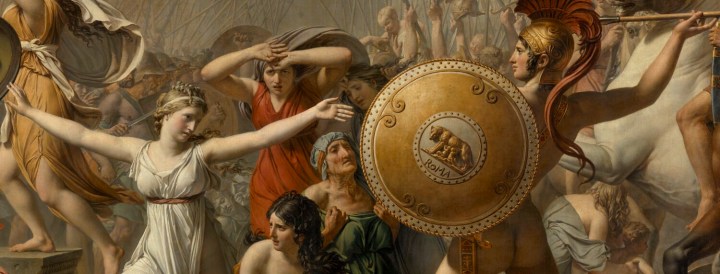
Jacques-Louis David, The Intervention of the Sabine Women, detail, 1799, oil on canvas, 3.85 × 5.22 meters
(Paris: Musée du Louvre)
◊ ◊ ◊ ◊ ◊
From the press release for the exhibition:
Jacques-Louis David
Musée du Louvre, Paris, 15 October 2025 — 26 January 2026
Curated by Sébastien Allard and Côme Fabre, with assistance from Aude Gobet
David is a towering figure. Considered the father of the French School, revered for breathing new life into painting, he produced imagery that to this day inhabits the collective imagination: from The Death of Marat to Napoleon Crossing the Alps and The Coronation of Napoleon, his paintings are the filter through which we picture the great moments of the French Revolution and the Napoleonic Empire, while his portraits bring to life the society of this period.
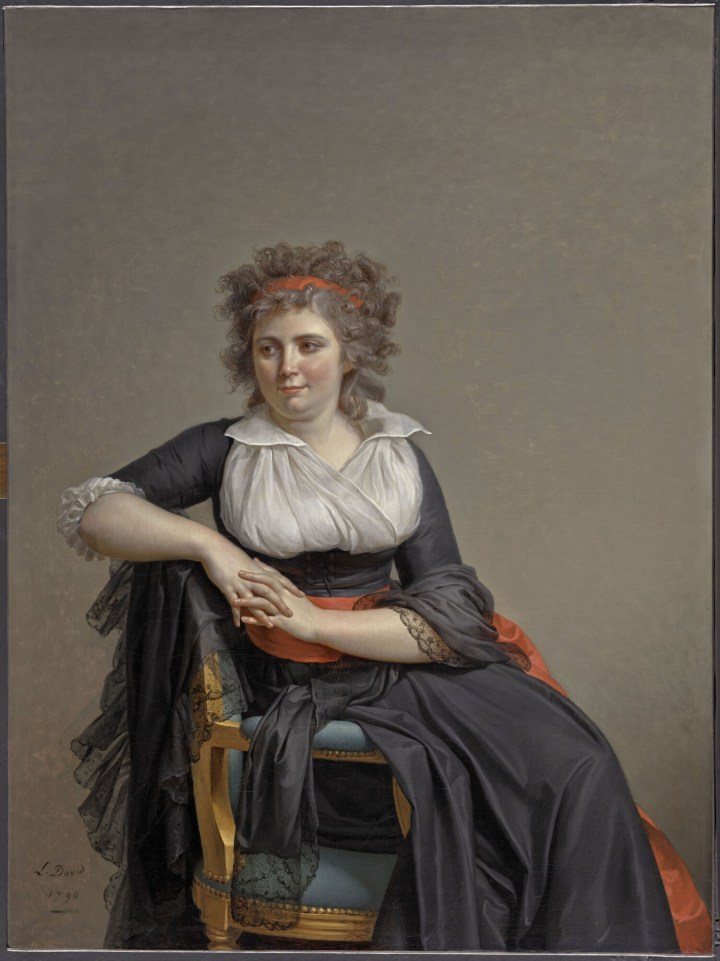
Jacques-Louis David, Portrait of Robertine Tourteau d’Orvilliers, née Rilliet (1772–1862), 1790, oil on canvas, 131 × 98 cm (Paris: Musée du Louvre / Adrien Didierjean / Sylvie Chan-Liat).
To mark the bicentennial of his death in exile in Brussels in 1825, the Musée du Louvre is offering a new perspective on a figure and body of work of extraordinary richness and diversity. The exhibition shines a light on the inventive force and expressive power of the art of Jacques-Louis David (1748–1825), whose paintings are more intensely charged with feeling than is belied by their extreme rigour. The exhibition spans the long career of an artist who witnessed six different political regimes and actively participated in the French Revolution. It gathers 100 works on special loan, including the imposing, incomplete Tennis Court Oath (Château de Versailles, long-term loan from the Musée du Louvre), and the original version of his masterpiece, the celebrated Death of Marat (Royal Museums of Fine Arts of Belgium, Brussels).
A project of such ambition could only be undertaken at the Louvre, which holds the largest existing collection of the artist’s paintings and drawings—including, first and foremost, his very large canvasses. The last major monographic exhibition devoted to David was held at the Louvre and the Château de Versailles in 1989 for bicentennial commemorations of the French Revolution. Enhanced by research conducted in the ensuing three decades, the 2025 exhibition will present a new survey revealing the unprecedented richness of David’s journey, combining artistic and political activity. Indeed, more than simply an artist observing this formative period in French history, spanning the years 1748–1825, he sought to be a prominent social actor.
The painter’s importance was unmatched in his day, for his Europe-wide artistic influence, as well as the high political offices he held in 1793–1794 alongside Robespierre, for which he suffered the consequences as a political exile after the fall of Napoleon.
The exhibition is curated by Sébastien Allard, Senior Heritage Curator, Director of the Department of Paintings, and Côme Fabre, Curator, Department of Paintings, and assisted by Aude Gobet, Head of the Department of Paintings Research Centre, Musée du Louvre. The exhibition design is by Juan-Felipe Alarcón, with graphic design by Philippe Apeloig.
Sébastien Allard, ed., Jacques-Louis David (Paris: Louvre éditions/ Hazan, 2025), 360 pages, €49.
The catalogue reflects the exhibition in offering new perspectives on David’s role and position, focusing on two essential aspects of his activity: his involvement during the French Revolution; and, after the fall of the First Empire and his exile to Brussels, his confrontation with the new generation—and Ingres, in particular—whose training he had largely overseen. The publication is divided into two parts. In the first, an essay by Sébastien Allard seeks to shift perceptions of the artist, examining his life as a coherent whole, in contrast to how historians have tended to fragment it according to the different political regimes David experienced. Sumptuous reproductions, including numerous details, help remove the proverbial dust from the image sometimes held of the painter’s work. The second part encompasses an essay by Côme Fabre on the connections between David and the Louvre; a biographical account by Aude Gobet; and a chronology of major David-related moments, from his death to today, by Morgane Weinling.
New Book | European Sculpture in the Collection of His Majesty The King
Distributed by Yale University Press:
Jonathan Marsden, European Sculpture in the Collection of His Majesty The King (London: Modern Art Press in association with the Royal Collection Trust, 2025), 4 volumes, 1648 pages, ISBN: 978-1738487813, £350 / $450.
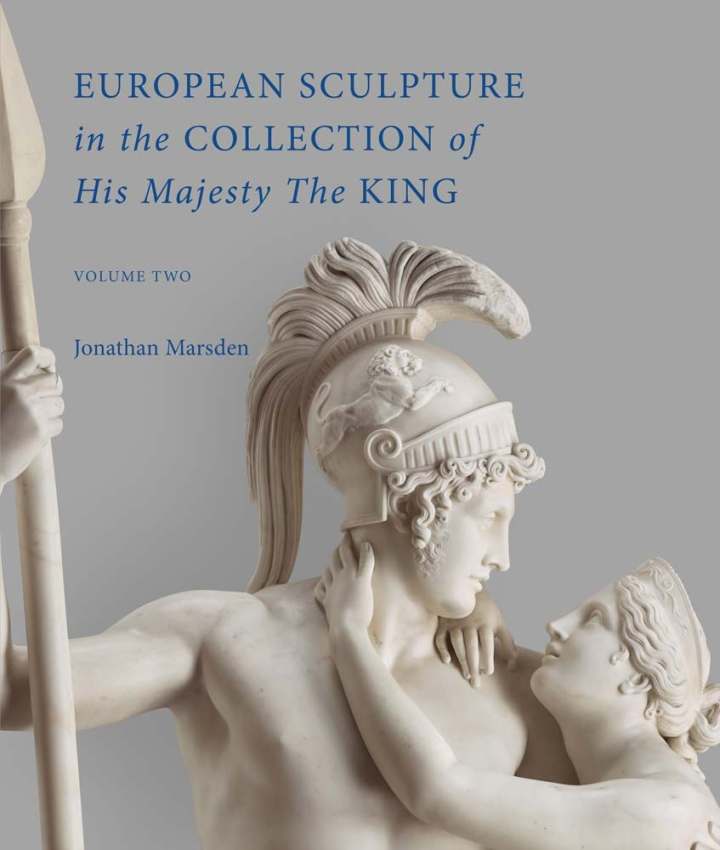 This four-volume publication marks the completion of one of the most ambitious stages in the long-term task of cataloguing sculpture in the Royal Collection.
The scope of the catalogue—covering sculpture in all materials from the fifteenth to the late twentieth century—is unprecedented. Incorporating countless new attributions and identifications and the results of conservation and scientific examination, the catalogue will be an indispensable work of reference for all students of post-medieval sculpture, impressive not only in the quality of its scholarship but also for the extent and depth of the documentation. Highlights include an exceptional group of bronze busts from the Italian and Northern Renaissance, the first bronze casts of ancient sculpture to be made in Britain, the best ensemble of French seventeenth- and eighteenth-century bronzes outside France, unrivalled examples of English portrait sculpture from the seventeenth century onwards and the most complete surviving collection of Victorian sculpture. With an introductory survey covering the relationships between British monarchs and sculptors since the seventeenth century and the impact of sculpture in the interiors of the royal palaces over the same period, the admirably clear and engaging text is essential reading for students of royal collecting. It is accompanied by almost 2,000 illustrations, most of which have been commissioned for this book.
Jonathan Marsden was Director of the Royal Collection and Surveyor of The Queen’s Works of Art from 2010 to 2017, having served as Deputy Surveyor from 1996. Prior to this, he worked for the National Trust as a Historic Buildings Representative in North Wales and Oxfordshire.
Exhibition | Le Petit Salon
Now on view at the Middlebury College Museum of Art:
Le Petit Salon: The Journey of an 18th-Century Room from Paris to Vermont
Middlebury College Museum of Art, 8 July — 7 December 2025
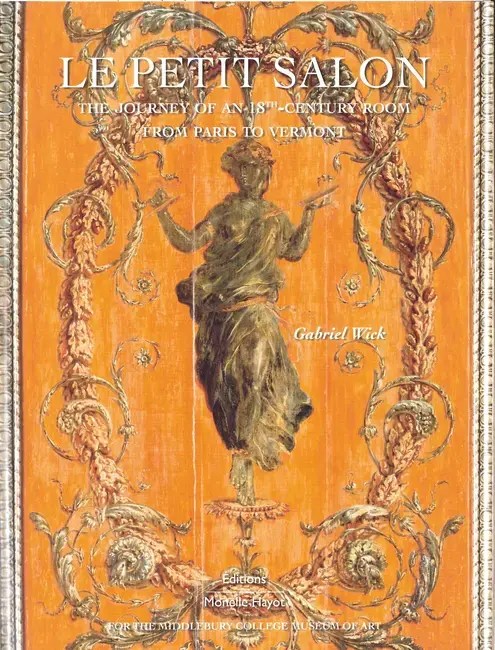 The Middlebury College Museum of Art possesses a jewel of French neoclassicism, Le Petit Salon, a delicately painted, paneled room made around 1776 for a Parisian mansion. It was designed by Pierre-Adrien Pâris ( 1745–1819), subsequently the architect of court fêtes for Louis XVI and Marie-Antoinette. His client was the duc d’Aumont, a renowned collector and patron of the arts, who had the panels installed in his Paris home, now the Hôtel de Crillon on Place de La Concorde. Gifted to Middlebury in 1959, but held in storage since the 1990s, the room will be reassembled for the first time in three decades.
The exhibition follows the journey of Le Petit Salon from Paris to Middlebury via Manhattan, where for fifty years it formed part of the decor of the Bliss family’s Gilded Age mansion. At Middlebury, the Petit Salon became part of Le Château, the college’s French language dorm, itself a fanciful recreation of a 16th-century Norman manoir. The exhibition incorporates Pâris’s 1776 exquisite watercolor elevations of Aumont’s mansion, as well as studies from his long educational sojourn in Rome and Naples. Included in the exhibition are loans from Bowdoin College, the Metropolitan Museum of Art, the Cooper-Hewitt National Design Museum, and the Fine Arts Museum of Besançon.
Gabriel Wick, Le Petit Salon: The Journey of an 18th-Century Room from Paris to Vermont (Saint-Remy-en-l’Eau: Monelle Hayot, 2025), 192 pages, €35.
Exhibition | Valkenburg — Willem de Rooij
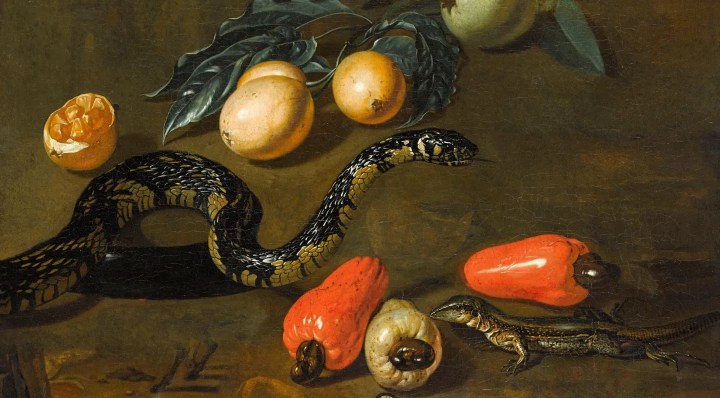
Dirk Valkenburg, Study of Cashews, Maracujas, a Tropical Chicken Snake, and an Ameiva Lizard from Suriname, detail, 1706–08, oil on canvas, 40 × 48 cm (Musée des Beaux-Arts de Quimper).
◊ ◊ ◊ ◊ ◊
Now on view at Utrecht’s Centraal Museum:
Valkenburg — Willem de Rooij
Centraal Museum Utrecht, 13 September 2025 — 25 January 2026
Dirk Valkenburg (1675–1721) was one of the first Europeans to depict Indigenous and enslaved people on Surinamese plantations, while also painting hunting still lifes and portraits of Dutch elites. The breadth of his oeuvre makes it particularly relevant for research into colonial image production and the ‘white gaze’. In this installation, Willem de Rooij displays 30 works in idiosyncratic combinations, inviting reflection on how these 18th-century Dutch elites used art to support and legitimise colonial ideology.
Since the early 1990s, Willem de Rooij (b. 1969) has created temporary installations in that explore the politics of representation through appropriation and collaboration. In 2005, he represented the Netherlands at the Venice Biennale and has since exhibited in leading museums worldwide. A distinctive feature of his practice is the reuse and rearrangement of existing images and objects, often based on in-depth art-historical and cultural research. In doing so, he creates new meanings between diverse visual elements. Recent exhibitions include King Vulture (Akademie der Künste, Vienna) and Pierre Verger in Suriname (Portikus, Frankfurt). De Rooij teaches in Frankfurt, Berlin, and Amsterdam and lectures internationally.
The exhibition will be accompanied by the first comprehensive publication on Dirk Valkenburg’s oeuvre: a catalogue raisonné developed in collaboration with the RKD–Netherlands Institute for Art History. This volume, edited by Willem de Rooij and Karwan Fatah-Black—historian and expert in Dutch colonial history, (Leiden University)—includes new essays by international scholars and thinkers from various disciplines, including art history, anthropology, postcolonial, and queer studies.
Print Quarterly, September 2025
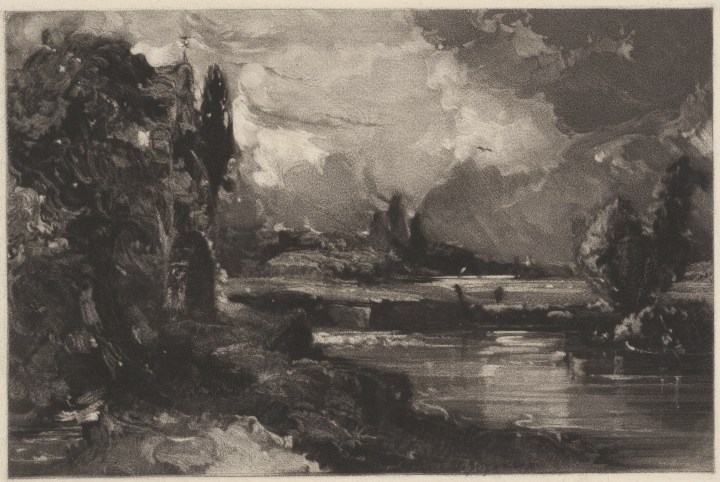
David Lucas, after John Constable, A Mill, 1829, mezzotint, 182 × 250 mm
(Cambridge, Fitzwilliam Museum, inv. P.145-1954)
◊ ◊ ◊ ◊ ◊
The long eighteenth century in the latest issue of Print Quarterly:
Print Quarterly 42.3 (September 2025)
a r t i c l e s
• Elenor Ling and Harry Metcalf, “John Constable’s Working Relationship with David Lucas on the English Landscape Series,” pp. 272–85. This article examines the collaborative partnership between John Constable (1776–1837) and his engraver David Lucas (1802–81) using the mezzotint print series English Landscape as a case study, based particularly on the technical examination of various impressions and plates.
• Niklas Leverenz, “Lithographs from Shanghai of the East Turkestan Engravings, 1890,” pp. 301–06. This short article examines the popularity of the East Turkestan engravings depicting the 1755–60 Qianlong Emperor’s conquest. Leverenz specifically discusses a set of 34 photolithographs printed in 1890 by the photographer Herman Salzwedel (active c. 1877–1904) in Shanghai.
n o t e s a n d r e v i e w s
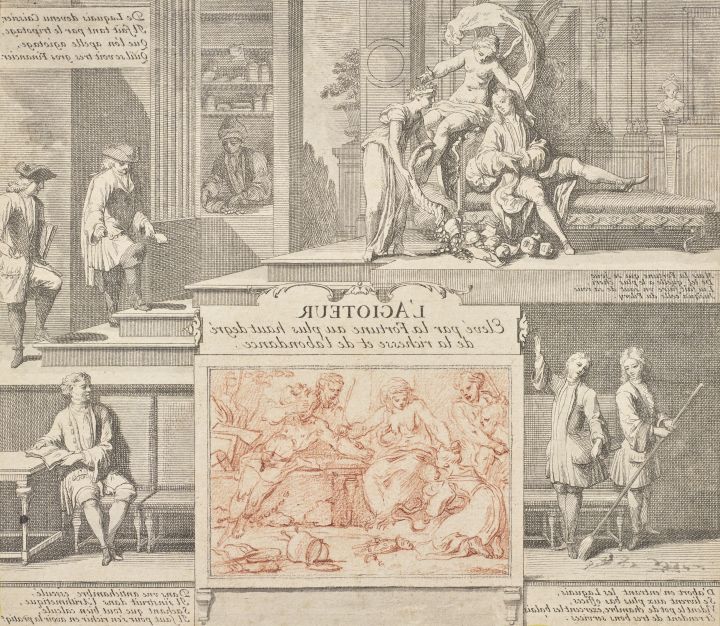
Claude Gillot, The Speculator Raised by Fortune to the Highest Degree of Wealth and Abundance, 1710–11, counterproof of engraving, with additions in red chalk, 255 × 220 mm (Paris, Private collection).
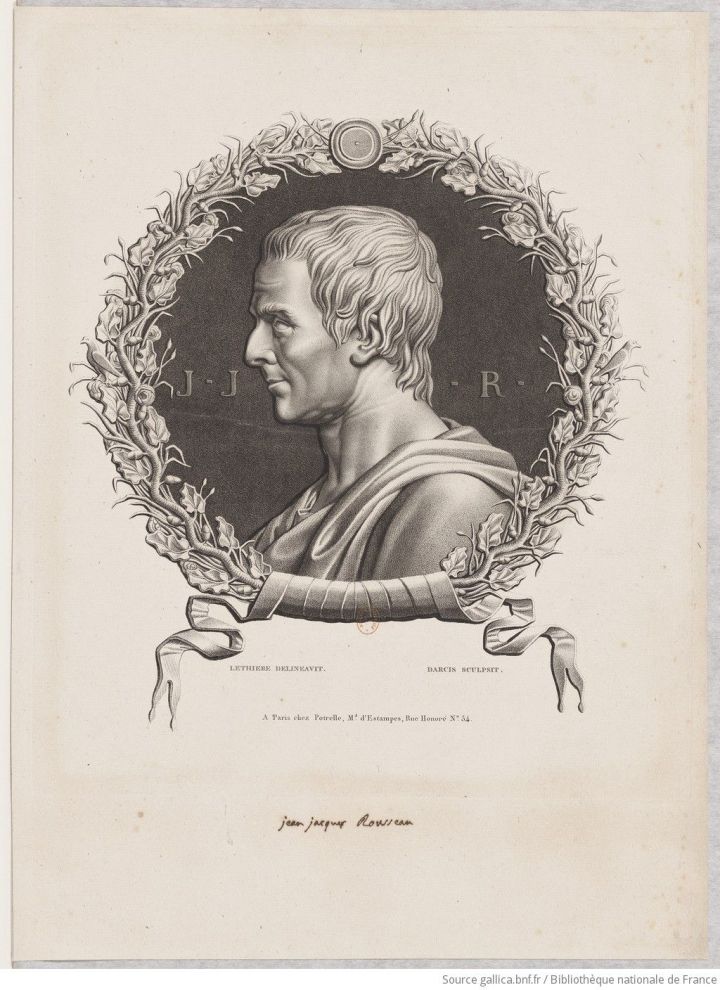
J.-Louis Darcis, after Guillaume Lethière, Portrait of Jean Jacques Rousseau, 1795, engraving, platemark 355 × 305 mm, page 440 × 320 mm (Paris, Bibliothèque Nationale de France).
• Dagmar Korbacher, Review of Andaleeb Badiee Banta, Alexa Griest and Theresa Kutasz Christiensen, eds., Making Her Mark: A History of Women Artists in Europe, 1400–1800 (Goose Lane Editions, 2023), pp. 307–10.
• Daniel Godfrey, Review of Gwendoline de Mûelenaere, Early Modern Thesis Prints in the Southern Netherlands: An Iconological Analysis of the Relationship between Art, Science, and Power (Université Catholique de Louvain, 2022), pp. 310–12.
• Meredith M. Hale, Review of Julie Farguson, Visualising Protestant Monarchy: Ceremony, Art and Politics after the Glorious Revolution, 1689–1714 (The Boydell Press, 2021), pp. 313–15.
• Rena M. Hoisington, Review of Jennifer Tonkovich, Claude Gillot: Satire in the Age of Reason (Paul Holberton, 2023), pp. 315–17.
• Michael Snodin, Review of Orsola Braides, Giovanni Maria Fara, and Alessia Giachery, eds., L’arte di tradurre l’arte: John Baptist Jackson incisore nella Venezia del Settecento (Leo S. Olschki, 2024), pp. 317–19.
• Benito Navarrete Prieto, Review of Ana Hernández Pugh and José Manuel Matilla, Del lapicero al buril. El dibujo para grabar en tiempos de Goya (Museo del Prado, 2023), pp. 320–24.
• Giorgio Marini, Review of Ilaria Miarelli Mariani, Tiziano Casola, Valentina Fraticelli, Vanda Lisanti, and Laura Palombaro, eds., La storia dell’arte illustrata e la stampa di traduzione tra il XVIII e il XIV secolo (Campisano Editore, 2022), pp. 324–28.
• Julie Mellby, Review of Roberta J. M. Olson, Audubon as Artist: A New Look at The Birds of America (Reaktion Books, 2024), pp. 328–29.
• Thea Goldring, Review of Esther Bell and Olivier Meslay, eds., Guillaume Lethière (Clark Art Institute, 2024), pp. 347–52.
Exhibition | William Blake: Burning Bright
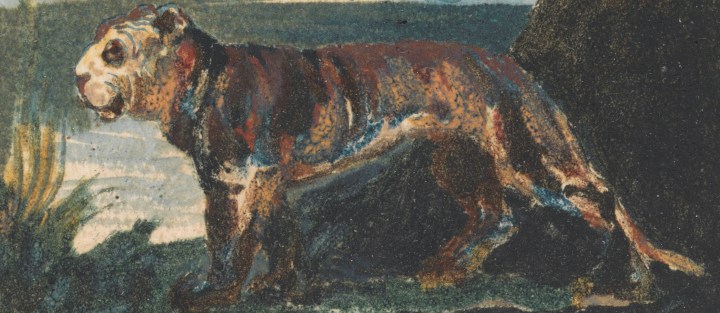
William Blake, The Tyger (Plate 42, from Songs of Innocence and of Experience), detail, 1794, color-printed relief etching with hand coloring in watercolor (New Haven: Yale Center for British Art, Paul Mellon Collection).
◊ ◊ ◊ ◊ ◊
Now on view at YCBA:
William Blake: Burning Bright
Yale Center for British Art, New Haven, 26 August — 30 November 2025
Curated by Elizabeth Wyckoff and Timothy Young
One of the most compelling figures in the history of British art and poetry, William Blake (1757–1827) developed an idiosyncratic worldview during a tumultuous era that witnessed the American and French Revolutions. He expressed his radical perspectives on religious belief, politics, and society through highly original illuminated books, watercolors, paintings, and poetry. This exhibition showcases the Yale Center for British Art’s impressive collection of works by Blake, with special focus on the inventive hand-printed publications that bring to life his poetry and prophecies.
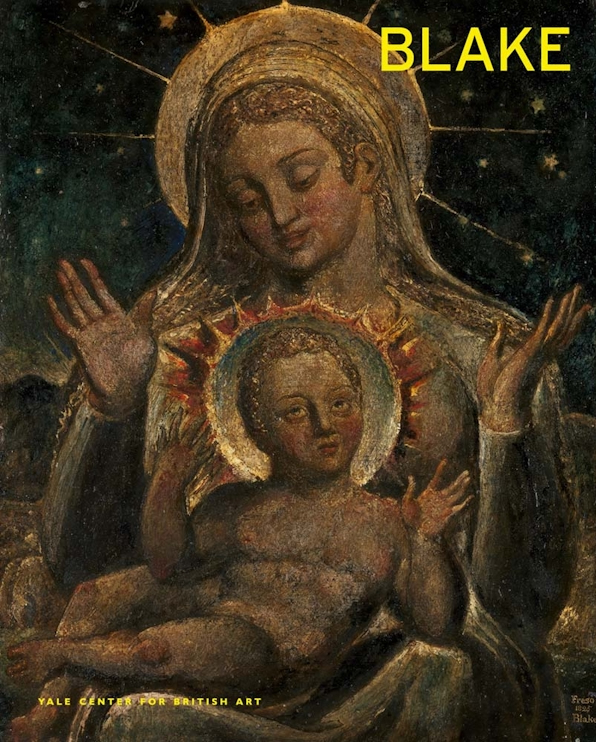 The YCBA’s extensive holdings include Blake’s most innovative and celebrated books, such as Songs of Innocence and of Experience (1789–94) and The First Book of Urizen (1794). Blake’s mastery of watercolor painting and his phenomenal imaginative powers are evident in the one-of-a-kind illustrations for The Poems of Thomas Gray (between 1797 and 1798) and in the only fully hand-colored version of his culminating poem, the 100-page Jerusalem (1804–20). This stunning presentation highlights the artist’s ambitious vision and skill, as well as his unparalleled contributions to art, literature, and spirituality.
Born in London at a time of major social change and upheaval, Blake aspired to be an artist and a poet from a young age. During his apprenticeship, he developed an elegant black-and-white engraving style that he deployed in both commissioned and original prints and book illustrations. He is best known for devising an unorthodox technique to create colorful illuminated books that merged his poetry and his art. His most notable innovation was a method for printing text and image from a single copper plate. Blake’s work was largely unacknowledged during his lifetime, yet today his striking imagery and stirring words are widely celebrated.
Blake, the second volume in the YCBA’s Collection Series, examines the art and methods of William Blake through the lens of one of the great collections of his work. Written by Elizabeth Wyckoff, with an essay by Sarah T. Weston, the book features exquisite reproductions of his paintings, watercolors, prints, and illustrated books, including the only hand-colored copy of his epic poem Jerusalem.
Elizabeth Wyckoff, Blake (New Haven: Yale Center for British Art, 2025), 136 pages, ISBN: 978-0300284577, $40. With an essay by Sarah Weston.
◊ ◊ ◊ ◊ ◊
Programs exploring multiple dimensions of Blake’s life, work, and legacy will accompany the exhibition. Please visit britishart.yale.edu for the most up-to-date information.
Opening Celebration
Thursday, September 4, 4pm
A conversation with exhibition curators Elizabeth Wyckoff, Curator of Prints and Drawings, and Timothy Young, Curator of Rare Books and Manuscripts, followed by gallery talks and a reception.
The Enduring Influence of William Blake
Thursday, October 30, 5pm
Author John Higgs will talk with Timothy Young, Curator of Rare Books and Manuscripts.
Songs from the Imagination: Music Inspired by the Poetry of William Blake
Thursday, November 20, 5pm
Yale Voxtet, the Institute of Sacred Music’s select group of graduate student singers, will perform in the Library Court.
Create Community: Imagined Worlds in the Art of William Blake and Hew Locke
Thursdays, October 2, 16, and 23, 5:30pm
This three-part workshop will explore William Blake: Burning Bright and Hew Locke: Passages through a close investigation of material and process. Enrollment is limited to twelve people, and preregistration is required.
Curator Tours
Thursdays, September 18, October 30, and November 20, 4pm
Docent Tours
Saturdays, 3pm
Exhibition | Women Artists from Antwerp to Amsterdam, 1600–1750
Opening this month at the NMWA:
Women Artists from Antwerp to Amsterdam, 1600–1750
National Museum of Women in the Arts, Washington, DC, 26 September 2025 — 11 January 2026
Museum voor Schone Kunsten, Ghent, 7 March — 31 May 2026
Curated by Virginia Treanor and Frederica Van Dam

Maria Schalcken, Self-Portrait in Her Studio, ca. 1680, oil on panel, 17 × 13 inches (Museum of Fine Arts, Boston, 2019.2094).
Women Artists from Antwerp to Amsterdam, 1600–1750 showcases a broad range of work by more than forty Dutch and Flemish women artists, including Gesina ter Borch, Maria Faydherbe, Anna Maria de Koker, Judith Leyster, Magdalena van de Passe, Clara Peeters, Rachel Ruysch, Maria Tassaert, Jeanne Vergouwen, Michaelina Wautier, and more. Presenting an array of paintings, lace, prints, paper cuttings, embroidery, and sculpture, this exhibition draws on recent scholarship to demonstrate that a full view of women’s contributions to the artistic economy is essential to understanding Dutch and Flemish visual culture of the period.
Women were involved in virtually every aspect of artistic production in the Low Countries during the seventeenth and early eighteenth centuries. During this period, colonial exploitation and the international slave trade enriched Europe’s upper and middle classes, fueling demand for art and other luxuries. From celebrated painters who excelled in a male-dominated field to unsung women who toiled making some of the most expensive lace of the day, to wealthy patrons who shaped collecting practices, women created the very fabric of the visual culture of the era. Within a thematic presentation that considers the intertwined influences of status, family, and social expectations on a woman’s training and career choices, this exhibition demonstrates the many ways in which women of all classes contributed to the booming artistic economy of the day. Whether their work was circulated within aristocratic social circles, sold on the open market, or commissioned by patrons, women shaped and molded the world around them from Antwerp to Amsterdam.
Women Artists from Antwerp to Amsterdam, 1600–1750 is organized in partnership with the Museum of Fine Arts in Ghent, Belgium.
The press release is available here»
Virginia Treanor and Frederica Van Dam, eds., Women Artists from Antwerp to Amsterdam, 1600–1750 (Veurne: Hannibal Books, 2025), 304 pages, ISBN: 978-9493416277, $60. With contributions by Klara Alen, Frima Fox Hofrichter, Elena Kanagy-Loux, Judith Noorman, Catherine Powell-Warren, Inez De Prekel, Marleen Puyenbroek, Oana Stan and Katie Altizer Takata. Available in English and Dutch editions.
Frederica Van Dam is the Curator of Old Masters at MSK Ghent. Specializing in early modern Flemish painting, Dr. Van Dam co-curated Van Eyck: An Optical Revolution and led the first monographic show on Theodoor Rombouts (1597–1637). Virginia Treanor is the Senior Curator at the National Museum of Women in the Arts in Washington, D.C. She earned her PhD in 17th-century Dutch and Flemish art from the University of Maryland. Since joining NMWA in 2012, Dr. Treanor has curated numerous exhibitions, including multiple installments of the Women to Watch series.
Exhibition | Flora Yukhnovich’s Four Seasons
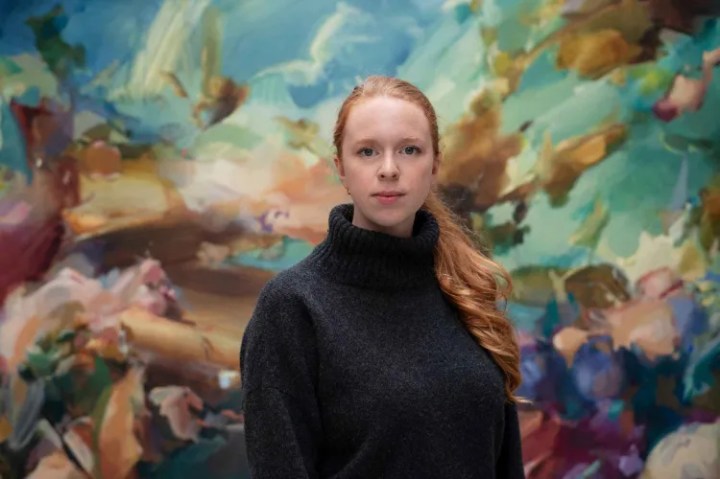
Flora Yukhnovich in Her London Studio, 2024
(Photo by Kasia Bobula © Flora Yukhnovich)
◊ ◊ ◊ ◊ ◊
Opening this week at The Frick; see the preview by Ted Loos for The New York Times (28 August 2025) . . .
Flora Yukhnovich’s Four Seasons
The Frick Collection, New York, 3 September 2025 — 9 March 2026
Taking inspiration from the French Rococo, Italian Baroque, and Abstract Expressionist movements, Flora Yukhnovich (b. England, 1990) creates works that are at once modern and timeless by translating historic compositions into contemporary abstractions. Using the Frick’s Four Seasons by François Boucher as a point of departure, Yukhnovich’s site-specific mural will cover the walls of the museum’s Cabinet. This project is accompanied by the publication of a new volume in the Frick’s acclaimed Diptych series, which highlights a single masterpiece from the permanent collection by pairing complementary essays by a curator and a contemporary artist, musician, or other cultural luminary. This volume will feature a text by Yukhnovich and an essay by Xavier F. Salomon, the Frick’s Deputy Director and Peter Jay Sharp Chief Curator, on the significance of Boucher’s beloved series.
Flora Yukhnovich’s Four Seasons is made possible by Hauser & Wirth and Victoria Miro.
Xavier Salomon and Flora Yukhnovich, Boucher’s Four Seasons (London: D. Giles, 2026), 80 pages, ISBN: 978-1913875732, $30.
Exhibition | Un/Bound: Free Black Virginians, 1619–1865
Now on view at the VMHC:
Un/Bound: Free Black Virginians, 1619–1865
Virginia Museum of History and Culture, Richmond, 14 June 2025 — 4 July 2027
 Bringing together artifacts and rich stories from across the Commonwealth, Un/Bound: Free Black Virginians, 1619–1865 tells the stories of free Black Virginians from the arrival of the first captive Africans in 1619 to the abolition of slavery in 1865. It is one of the first museum exhibitions to cover the subject in depth.
Through powerful artifacts, first-person accounts, and more than 200 years of stories, visitors will discover how Virginia’s people of color achieved their freedom, established communities, and persevered within a legal system that recognized them as free but not equal. Featured alongside artifacts spanning hundreds of years will be newly commissioned portraits by award-winning photographer Ruddy Roye, who TIME named ‘Instagram Photographer of the Year’, of some of the descendants of free Black Virginians who shared their stories and objects to help create the exhibition.
Building upon research about centuries of free Black Virginians and regional exhibitions focused on local communities, Un/Bound endeavors to encapsulate the broader, statewide story in depth and at a yet-to-be-seen scale through a collection of artifacts and rich histories told by descendants and experts. This exhibition was created by the VMHC in collaboration with subject matter experts and five institutions of higher education—Norfolk State University, Virginia State University, William & Mary, Longwood University and Richard Bland College—bringing together resources and knowledge to tell a compelling story of Virginia. The exhibition is on display alongside VMHC’s multiyear commemorative exhibitions and displays related to America’s 250th anniversary.
The accompanying book is published by D. Giles:
Cassandra Newby-Alexander, Melvin Patrick Ely, Sabrina Watson, Evanda Watts-Martinez, and Stephen Rockenbach, Un/Bound: Free Black Virginians, 1619–1865 (London: D. Giles, 2025), 176 pages, ISBN: 978-1913875619, $30.
On the eve of the Civil War, around 60,000 Black men, women and children lived free in the state of Virginia, often alongside enslaved neighbours. This volume is a history documenting the richness and variety of their lives. Although many stayed in Virginia, living, working and thriving despite serious threats to their lives, some moved north or, further still, across the Atlantic to Liberia. In studying the lives of free Black Virginians prior to emancipation, this volume explores an under-told and inspirational story of Virginia’s past. By delving into collections across the Commonwealth, whether the records of the state or testimonies left by free Black people themselves, this new volume fills a critical gap in our understanding of Virginia’s Black history.
c o n t e n t s
Foreword — James W. Dyke, Jr., Tim Sullivan, and Alvin J. Schexnider
Acknowledgments — Jamie O. Bosket
Introduction — Elizabeth M. Klaczynski
1 Black Freedom in Slaveholding Virginia — Melvin Patrick Ely
2 The Christian Faith and Legacies of Liberation in Virginia’s Free Black Society — Evanda S. Watts-Martinez
3 Free Black People in Rural Virginia: Forms of Resistance — Sabrina G. Watson
4 Joseph Jenkins Roberts, Free Black Émigrés, and the Liberian Experiment — Cassandra L. Newby-Alexander
5 Education, Politics, and the Legacy of Free Black Virginians after Emancipation — Stephen Rockenbach
Afterword — Jamie O. Bosket
Contributors
Endnotes
Index
Exhibition | Jean-Baptiste Greuze: Enlightening Childhood
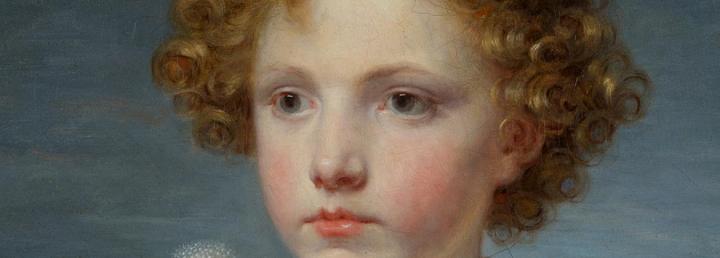
Jean-Baptiste Greuze, Young Shepherd Holding a Flower, detail, 1760–61, oil on oval canvas, 72.5 × 59.5 cm
(Paris: Petit Palais, PDUT1192)
◊ ◊ ◊ ◊ ◊
Greuze was born on this day (August 21) 300 years ago; the exhibition opens next month at the Petit Palais:
Jean-Baptiste Greuze: L’enfance en lumière
Petit Palais, Paris, 16 September 2025 — 25 January 2026
Curated by Annick Lemoine, Yuriko Jackall, and Mickaël Szanto
A little-known and misunderstood artist today, Greuze was nonetheless acclaimed by the public, adulated by critics, and sought after by the greatest collectors.
Jean-Baptiste Greuze (1725–1805) is undoubtedly one of the most important and daring figures of 18th-century France. To mark the 300th anniversary of his birth, the Petit Palais is paying tribute to this painter of portraits and genre scenes, who knew more than anyone else how to translate the human soul. This exhibition invites visitors to rediscover Greuze’s work through the prism of a central theme in his painting: childhood. Echoing the preoccupations of the philosophers Diderot, Rousseau, and Condorcet, the artist invites us to reflect on the place of the child within the family, the responsibility of parents in the child’s development, and the importance of education in shaping the child’s personality. With empathy, the artist questions the place of children in 18th-century society, their future, and their emancipation. He mirrors the major issues of his time. He also examines the transition to adulthood and the birth of love. Using the codes of his time, he tackles the theme of consent, which is strikingly topical today. Bringing together around a hundred paintings, drawings, and prints from all over the world, this exhibition is an opportunity to rediscover the singular work of this major artist of the Age of Enlightenment.
Curators
• Annick Lemoine, General Curator of Heritage, Director of the Petit Palais
• Yuriko Jackall, Director of the Department of European Art & Allan and Elizabeth Shelden Curator of European Paintings, Detroit Institute of Arts
• Mickaël Szanto, Senior Lecturer, Sorbonne University
Annick Lemoine, Yuriko Jackall, and Mickaël Szanto, Jean-Baptiste Greuze: l’enfance en lumière (Paris Musées, 2025), 304 pages, ISBN: 978-2759606177, €49.










 Enfilade
leave a comment