Exhibition | Drawn to Greatness
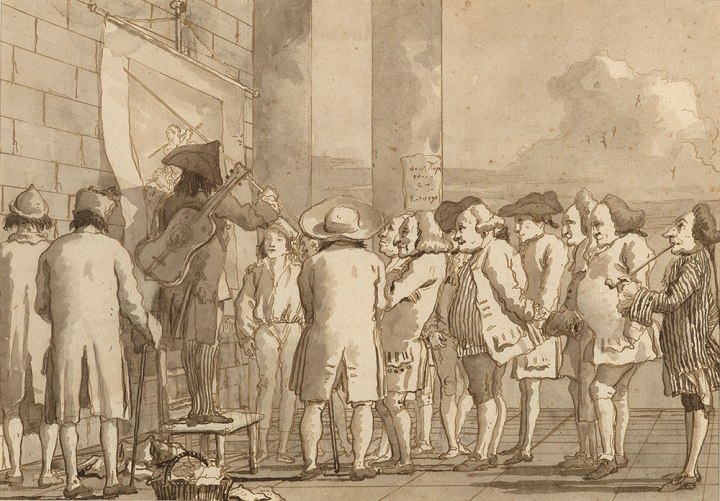
Giovanni Domenico Tiepolo, Scene of Contemporary Life: The Picture Show, 1791; pen and brown and black ink and wash over black chalk on paper, 11 5/16 × 16 5/16 inches (New York: Morgan Library & Museum, 2017.253)
◊ ◊ ◊ ◊ ◊
Press release (15 December 2017) for the exhibition now on view at The Clark:
Drawn to Greatness: Master Drawings from the Thaw Collection
The Morgan Library & Museum, New York, 29 September 2017 — 7 January 2018
The Sterling and Francine Clark Art Institute, Williamstown, MA, 3 February — 22 April 2018
Curated by Jennifer Tonkovich and Jay Clarke
Over the past fifty years, New York art dealer and philanthropist Eugene V. Thaw assembled one of the world’s finest private collections of drawings. The collection, known for its breadth and exceptional quality, charts the high points of drawing from the Renaissance through the twentieth century and features works made by pivotal artists at key moments in the history of the art form. Mr. Thaw donated his collection of more than 400 drawings to the Morgan Library & Museum, New York, which celebrated the gift with the September 2017 opening of Drawn to Greatness: Master Drawings from the Thaw Collection, an exhibition that has drawn critical acclaim for the diversity and quality of the works presented. In recognition of Mr. Thaw’s longstanding interest in the Clark Art Institute, Drawn to Greatness will travel to Williamstown for an exclusive presentation at the Clark from February 3 through April 22, 2018. Featuring 150 drawings that tell the story of a visionary collector, the exhibition examines five centuries of western drawing. Sketchbooks belonging to Jackson Pollock, Francisco de Goya, Edgar Degas, and Paul Cézanne and illustrated letters from Vincent van Gogh are among the works exhibited.
“It is an honor for the Clark to have the opportunity to show this exquisite collection in our galleries,” said Olivier Meslay, the Felda and Dena Hardymon Director of the Clark. “The works in this exhibition provide an incredibly rich and remarkable opportunity to consider the art form as practiced by generations of masters. It is one of the most important and impressive drawing exhibitions that has been assembled in decades.”
The exhibition is organized in a series of chronological sections that illustrate key moments in the history of draftsmanship while also highlighting the work of artists whom the Thaws collected in depth, among them Rembrandt van Rijn, Francisco de Goya, Odilon Redon, and Edgar Degas.
“These exceptional drawings, watercolors, and collages exemplify both the eternal power of the drawn line and the innovative genius of the artists who have explored the medium over five centuries,” said Jay A Clarke, Manton Curator of Prints, Drawings, and Photographs. “It is a truly spectacular collection of works and I am thrilled to be able to work in collaboration with the Morgan’s curatorial team to bring this show to the Clark.”
The exhibition extends the Institute’s relationship to Mr. Thaw who, in 2016, made a generous gift to create the Eugene V. Thaw Gallery for Works on Paper in the Clark’s Manton Research Center. Drawn to Greatness: Master Drawings from the Thaw Collection is organized by the Morgan Library & Museum, New York. The curator of the exhibition at the Morgan is Jennifer Tonkovich, Eugene and Clare Thaw Curator of Drawings and Prints; the curator at the Clark is Jay A. Clarke, Manton Curator of Prints, Drawings, and Photographs. Presentation of Drawn to Greatness at the Clark is made possible by the Eugene V. and Clare E. Thaw Charitable Trust. Major support is provided by the Fernleigh Foundation in memory of Clare Thaw. This exhibition is supported by an indemnity from the Federal Council on the Arts and the Humanities.
An exhibition checklist is available here»
Jennifer Tonkovich, ed., Drawn to Greatness: Master Drawings from the Thaw Collection (New York: The Morgan Library & Museum, 2017), 295 pages, ISBN: 978-0875981826, $40.
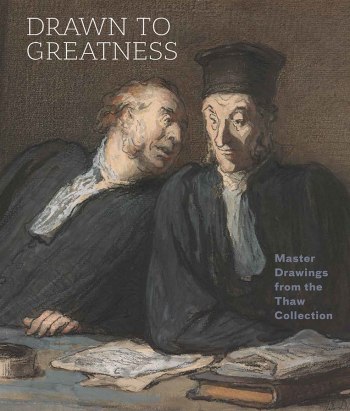 The catalogue features a series of essays by leading scholars devoted to pivotal moments in the history of drawing. Authors include Jane Shoaf Turner, Head of Rijksprentenkabinet, Amsterdam; Andrew Robison, former Head of Drawings, Prints, and Photographs at the National Gallery of Art; Matthew Hargraves, Chief Curator of Art Collections, Yale Center for British Art; Richard R. Brettell, Chair of Art and Aesthetic Studies, University of Texas at Dallas; Jay A. Clarke, Manton Curator of Prints, Drawings, and Photographs, Clark Art Institute; and, of the Morgan Library & Museum, Colin B. Bailey, Director; John Marciari, Curator and Department Head of Drawings and Prints; and Jennifer Tonkovich, Eugene and Clare Thaw Curator.
A selection of programming:
Jennifer Tonkovich | French Artists and Their Models
Sunday, 11 February 2018, 3:00pm
Jennifer Tonkovich, Eugene and Clare Thaw Curator of Drawings at the Morgan Library & Museum, explores how French artists worked with models during the eighteenth and early nineteenth centuries. Where did they find their models? What role did the models play in the creative process? How does an individual artist’s approach to the model reveal their broader outlook? A close look at studies by Watteau, Fragonard, Prud’hon, Gericault, Ingres, and Delacroix illuminates the challenges inherent in working from the model.
Matthew Hargraves | Visionaries: Romantic Drawings from the Thaw Collection
Sunday, 15 April 2018, 3:00pm
Drawn to Greatness includes some of Eugene Thaw’s finest Romantic drawings, among them outstanding works of art by William Blake, Caspar David Friedrich, and J.M.W. Turner. This lecture by Matthew Hargraves, chief curator of art collections and head of college information and access at the Yale Center for British Art, focuses on the visionary qualities of these Romantic artists and explores how they abandoned the simple imitation of the natural world to capture truths beyond the reach of the human eye.
Exhibition | Winckelmann and the Capitoline Museum
From the Capitoline Museum:
The Treasure of Antiquity: Winckelmann and the Capitoline Museum in Eighteenth-Century Rome
Musei Capitolini, Rome, 7 December 2017 — 22 April 2018
Curated by Eloisa Dodero and Claudio Parisi Presicce
 Una mostra per celebrare gli anniversari della nascita e della morte del fondatore dell’archeologia moderna, Johann Joachim Winckelmann (1717–1768)
La mostra Il Tesoro di Antichità. Winckelmann e il Museo Capitolino nella Roma del Settecento intende celebrare gli importanti anniversari winckelmanniani del 2017 (300 anni dalla nascita) e del 2018 (250 anni dalla morte) e si inserisce nel contesto delle manifestazioni europee coordinate dalla Winckelmann Gesellschaft di Stendal, dall’Istituto Archeologico Germanico di Roma e dai Musei Vaticani. L’esposizione ha una duplice finalità: la prima, offrire ai visitatori il racconto degli anni cruciali che hanno portato, nel dicembre del 1733, all’istituzione del Museo Capitolino, il primo museo pubblico d’Europa, destinato non solo alla conservazione ma anche alla promozione della “magnificenza e splendor di Roma”; la seconda, presentare le sculture capitoline sotto una luce diversa, ovvero attraverso le intuizioni, spesso geniali, del grande Winckelmann.
Arricchita da una selezione di 124 opere e da apparati multimediali realizzati appositamente, il Tesoro di Antichità si sviluppa in tre sedi diverse nell’ottica di una “mostra diffusa”: le Sale Espositive di Palazzo Caffarelli, le Stanze Terrene di Sinistra del Palazzo Nuovo e le Sale museali del Palazzo Nuovo.
Negli anni in cui Winckelmann rivoluziona il modo di studiare le testimonianze del mondo antico dando inizio alla moderna archeologia, il modello di museo pubblico rappresentato dal Museo Capitolino si diffonde rapidamente in tutta Europa, segnando la nascita di modalità del tutto nuove di fruizione dei beni artistici: un Tesoro di Antichità non più concepito come proprietà esclusiva di pochi, ma come luogo destinato all’avanzamento culturale della società.
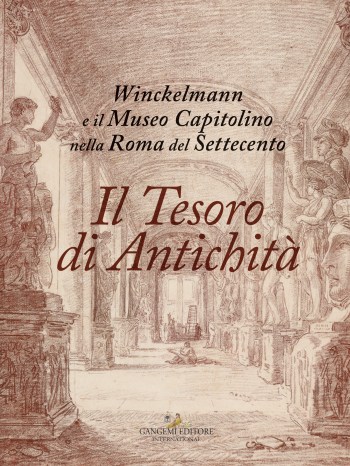
Eloisa Dodero and Claudio Parisi Presicce, Il Tesoro di Antichità: Winckelmann e il Museo Capitolino nella Roma del Settecento (Rome: Gangemi Editore, 2017), 384 pages, ISBN: 978 884923 5371, 35€.
«Vivo come un artista e come tale sono accolto nei luoghi dove ai nella Roma del Settecento giovani è permesso di studiare, come nel Campidoglio. Qui è il Tesoro delle Antichità di Roma e qui ci si può trattenere in tutta libertà dalla mattina alla sera». È il 7 dicembre del 1755 ed è con queste parole che Johann Joachim Winckelmann (1717–1768) descrive a un amico la sua prima visita al Museo Capitolino. Negli anni in cui Winckelmann rivoluziona il modo di studiare le testimonianze del mondo antico, il modello di museo pubblico rappresentato dal Museo Capitolino si diffonde in tutta Europa, segnando la nascita di nuove modalità di fruizione dei beni culturali: un «Tesoro di Antichità» non più concepito come proprietà esclusiva di pochi, ma come luogo destinato all’avanzamento culturale della società.
Exhibition | Thomas Gainsborough: Modern Landscape

Thomas Gainsborough, Mr. and Mrs. Andrews, ca. 1750
(London: National Gallery)
◊ ◊ ◊ ◊ ◊
On view this spring at the Hamburger Kunsthalle:
Thomas Gainsborough: The Modern Landscape / Die moderne Landschaft
Hamburger Kunsthalle, 2 March — 27 May 2018
Curated by Katharina Hoins and Christoph Martin Vogtherr
Thomas Gainsborough (1727–1788) was a pioneering artist in the development towards ›modern‹ landscape painting of around 1800. He was mainly perceived as a painter of brilliant society portraits by his contemporaries, although he personally far preferred his landscapes. They reflect the dramatic technological and artistic developments of his time and the growing contradictions in British society. Landscape painting served Gainsborough as a laboratory to transform impressions into innovation. He experimented with colours and techniques, painted on glass and combined natural materials into landscape models. Establishing England as a centre of European landscape painting, he created images of timeless power. Iconic works like Mr and Mrs Andrews will feature in the exhibition. Gainsborough: Modern Landscape is the first exhibition by a German museum devoted to Gainsborough. For a German and an international public it promises the (re-)discovery of an exceptional painter.
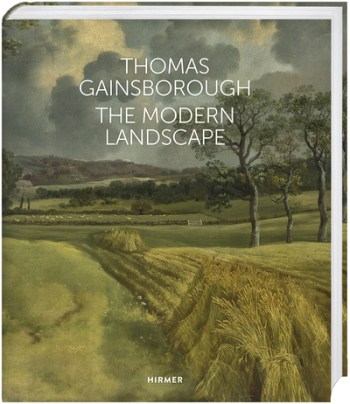 M. Bills, B. Gockel, M. Hallett, K. Hoins, R. Jones, J. Karg, S. Pisot, and C. Vogtherr, Thomas Gainsborough: The Modern Landscape (Munich: Hirmer, 2018), 224 pages, ISBN: 978 37774 29977, $65.
Gainsborough himself favoured landscape painting, a field to which he made important contributions, over his well-known portraits. His works are fascinating for their painterly subtlety and technical variation. This volume brings together German and British traditions of viewing, interpreting, and studying Gainsborough. It looks at the connections to the Dutch landscapes, explains Gainsborough’s unusual and experimental techniques from an art technological point of view, and situates his landscapes in the context of the social tensions of early industrialisation.
Exhibition | Luigi Valadier: Splendor in Eighteenth-Century Rome
Looking ahead to the fall, from the press release:
Luigi Valadier: Splendor in Eighteenth-Century Rome
The Frick Collection, New York, 31 October 2018 — 20 January 2019
Galleria Borghese, Rome, 30 October 2019 — 2 February 2020
Curated by by Alvar González-Palacios and Xavier Salomon

Luigi Valadier, Herma with Bacchus for the Palazzo Borghese, alabaster and glazed bronze with traces of gilding, 1773, 69 inches (Rome: Galleria Borghese; photo by Mauro Magliani).
Of the many artists who flourished in Rome during the eighteenth century, the silversmith Luigi Valadier (1726–1785) was among those particularly admired by popes, royalty, and aristocrats. Luigi was born in Rome in 1726, about six years after his parents emigrated from France. His father, Andrea, established a silversmith workshop that quickly captured the attention of the wealthiest Roman aristocrats. Heir to his father’s business, Luigi had an unsurpassed technical expertise, which, combined with his avant-garde aesthetic, resulted in extraordinary works in silver and bronze. Well aware of the evolution of artistic taste throughout Europe, he had an impressive ability to reframe examples of ancient Roman art and architecture within the context of contemporary Rome. Sculptures in private collections, cameos, architectural details, and ruins of ancient monuments served as his inspiration for candelabra, tableware, altars, and centerpieces in both silver and bronze. Luigi’s fame and influence spread beyond the borders of Italy, and he received commissions from patrons in France, England, and Spain. He was, however, burdened by debts for commissions undertaken but never paid for, and, in 1785, he committed suicide, drowning himself in the Tiber. Following this tragic event, his workshop passed to his son Giuseppe.
Illustrating the uncommon versatility of Luigi Valadier, who produced everything from large altar pieces to intricate works of jewelry, the Frick’s fall 2018/winter 2019 exhibition will include more than sixty works carefully selected from the vast production of the Valadier workshop. Preparatory drawings of both sacred and profane subjects will be displayed alongside finished works. . One of the highlights of the exhibition will be a full centerpiece, or deser (from the Italianization of the French word dessert), created around 1778 for the Bali de Breteuil, Ambassador of the Order of Malta to Rome. Atop a gilt-bronze base inlaid with precious stones, Valadier has re-created temples, triumphal arches, columns, and other miniature representations of ancient Roman monuments. The multiple elements of the Breteuil deser are today separated between two museums in Madrid (the Museo Arqueológico Nacional and the Palacio Real), but will be reunited for this special exhibition at the Frick. It will therefore be possible to admire this masterwork in its entirety, as nobles and cardinals did in 1778, when it was displayed for a few days in Valadier’s workshop in a candle-lit room specially decorated for the occasion.
The exhibition will also feature finely worked silver plates, tureens, salt cellars, and other pieces of tableware. The juxtaposition of these individual works with the complete centerpiece will illustrate the evolution of the Valadier workshop. While the earliest pieces presented are distinctly in the Baroque style, Valadier’s work becomes more refined in the Rococo style, before becoming neoclassical by the late-eighteenth century. The monochrome silver objects will be contrasted with polychrome works in gilt-bronze, marble, and precious stones, such as the Egyptian clock, a table from Villa Borghese, and extraordinary mounts for two antique cameos once in the Vatican collections and now at the Musée du Louvre.
One section of the exhibition will be devoted to reproductions in bronze of famous antique sculptures in Roman collections, such as the Apollo Belvedere and the Ares Ludovisi.
Luigi Valadier: Splendor in Eighteenth-Century Rome is co-curated by Professor Alvar González-Palacios, considered the world’s authority on Valadier, and Xavier F. Salomon, Peter Jay Sharp Chief Curator of The Frick Collection. It is part of a series of monographic exhibitions that focus on remarkable decorative arts artists and follows the ground-breaking and critically acclaimed Pierre Gouthière: Virtuoso Gilder at the French Court, organized by the Frick, where it was on view in fall 2016 before traveling to the Musée des arts décoratifs, Paris, in spring 2017.
Accompanying the exhibition will be the first complete monograph on Luigi Valadier. Written by González-Palacios, the book will shed new light on the provenance and dating of some works. It also identifies the exact roles performed inside the workshop by Andrea, Luigi, and Giuseppe Valadier, tracing the genesis of inventions and the authorship of models. The monograph also details the Valadier family’s collaborations with other workshops and artists. Typically, works in various materials such as bronze, marble, and precious stones were realized not by one person but by many artisans working together. The decoration of both sacred and private buildings likewise involved outside artisans and architects. This will be the only comprehensive publication on Valadier in English and, lavishly illustrated, it will feature much-needed new photography.
Together, the monograph and exhibition at the Frick will reconstruct the artistic endeavors of one of the most important silversmith families, shedding new light on the cultural life of Rome and, more broadly, Europe, during the eighteenth century. Following the presentation of this show in New York, a related exhibition will be on view later in 2019 at the Galleria Borghese, Rome.
◊ ◊ ◊ ◊ ◊
Note (added 20 December 2019) — The posting was updated to include specific dates for the Galleria Borghese.
Exhibition | Oser l’Encyclopédie: Un combat des Lumières
Now on view at the Mazarin Library (with the full press release available as a PDF file here)
Oser l’Encyclopédie: Un combat des Lumières
Bibliothèque Mazarine, Paris, 20 October 2017 — 19 January 2018
 L’Encyclopédie, ou Dictionnaire raisonné des sciences, des arts et des métiers (1751–1772), codirigée par Diderot, D’Alembert et Jaucourt, constitue la plus vaste entreprise éditoriale du 18e siècle, par le nombre des forces humaines mobilisées, l’étendue des savoirs convoqués, et son retentissement en Europe. La publication de cet « ouvrage immense et immortel » (Voltaire), dont la première édition rassemble 28 volumes, quelque 74 000 articles et près de 2 600 planches, s’étend sur plus de 25 ans. Autorisée par un privilège de librairie (1746), elle est censurée alors que deux tomes sont déjà imprimés (1752), puis tolérée (1753), à nouveau interdite et condamnée à la destruction (1759), et enfin poursuivie grâce à une permission tacite (1759–1772). Et, parce qu’elle constitue une entreprise commerciale à succès, elle connaît immédiatement réimpressions et contrefaçons.
Pour la première fois, une édition critique de l’Encyclopédie voit le jour. Réalisée au format numérique et menée de façon collaborative par plus de 120 chercheurs de tous horizons, elle vise l’annotation progressive des articles et des planches, en mobilisant l’ensemble des connaissances sur l’ouvrage. Soutenue par l’Académie des sciences, l’Édition Numérique Collaborative et CRitique de l’Encyclopédie (ENCCRE)1 s’appuie sur un exemplaire exceptionnel du premier tirage de la première édition, conservé par la Bibliothèque Mazarine qui en a fait l’acquisition au 18e siècle, volume après volume.
L’exposition met en relation cet exemplaire original et l’édition numérique. Elle montre ce que fut le travail de l’Encyclopédie au 18e siècle, et ce que représente son édition critique au 21e. De l’architecture complexe de l’ouvrage à son histoire éditoriale, on y découvre matériellement et numériquement l’intérieur de l’œuvre, ses enjeux et ce qui fut une de ses ambitions fondamentales : « changer la façon commune de penser ». (Diderot).
Organisation et commissariat
Alain Cernuschi (Université de Lausanne)
Alexandre Guilbaud (Institut de mathématiques de Jussieu) Marie Leca Tsiomis (Université Paris Ouest, Société Diderot) Irène Passeron (Institut de mathématiques de Jussieu)
Yann Sordet (Bibliothèque Mazarine)
Anne Weber (Bibliothèque Mazarine)
Alain Cernuschi, Alexandre Guilbaud, Marie Leca-Tsiomis, Irène Passeron, with Yann Sordet, preface by Cathérine Bréchignac, Oser l’Encyclopédie: Un combat des Lumières (Paris: EDP Sciences, 2017), 120 pages, ISBN: 978 27598 21389, 15€.
Exhibition | Faces of China
From the Staatliche Museen zu Berlin:
Faces of China: Portrait Paintings from the Ming and Qing (1368–1912)
Gesichter Chinas: Porträtmalerei der Ming- und Qing-Dynastie (1368–1912)
Royal Ontario Museum, Toronto, 18 May 2013 — 23 February 2014
Kulturforum, Berlin, 12 October 2017 — 7 January 2018
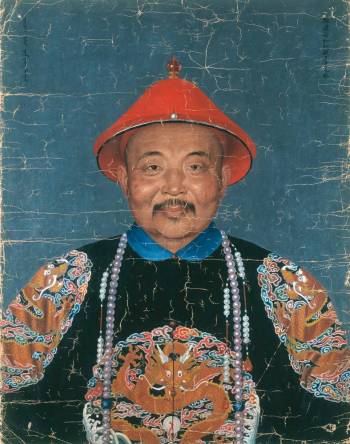
Unidentified Painter, Portrait of Dawaci, 佚名 達瓦斉像, Qing dynasty, Qianlong period (1736–1795), ca. 1756, oil on Korean paper (Ethnologisches Museum – Staatliche Museen zu Berlin, I D 22242, Waltraut Schneider-Schütz).
Faces of China is the first exhibition explicitly dedicated to Chinese portrait painting. A selection of more than 100 paintings from the collections of the Palace Museum Beijing and the Royal Ontario Museum Toronto, most of which have never been shown in Europe, spans a period of more than 500 years. The main focus is on the unique portraits of the Qing Dynasty (1644–1912), including images of members of the imperial court, ancestors, military figures, and informal portraits of artists and famous women. These portraits evidence a blossoming of the genre that had never been seen before.
Portrait painting has a 2000-year-old tradition in China. Beginning in the middle of 16th century, the late Ming Dynasty brought with it an economic boom and great intellectual openness that spurred a significant moment of florescence. It was in this period that Italian Jesuit painters visited the country, such as Matteo Ricci, who brought new techniques of European portrait painting with him in 1583. After the Manchu people conquered China in 1644 and established the Qing Dynasty, the imperial court in Beijing was host to a lively cultural exchange between China and Europe. This is particularly well reflected in the portrait paintings. The Jesuit painter Giuseppe Castiglione (Chinese name: Lang Shining; Milan 1688–Beijing 1766) is a key figure of this period.
Chinese portrait painting is characterized by two traditions of representation: images of ancestors and images of living figures. Ancestor portraits were created to honor deceased family members, who were venerated as part of religious observance within the family. Most were painted by professional but anonymous artists and are unsigned. On the other hand, there are portraits signed by often famous artists depicting well-known figures, such as officials, artists, poets, or those in the military, along with ordinary citizens shown in both single and group family portraits.
In exhibitions on Chinese portrait painting to date, only one of these traditions of representation has always been the central theme. However, Faces of China is deliberately dedicated to both of these two traditions, as developments in one always informed developments in the other. While the upper exhibition hall is dedicated to portraits of princely figures, officials, and artists, the focus in the galleries on the lower exhibition hall is on private individuals, families, and ancestral portraits.
The works are placed in carefully chosen relationships in light of their original social and religious contexts, as well as their circumstances of production. Thus, large-scale imperial portraits are surrounded by imperial silk garments once worn in the Palace—both groups of objects are on loan from the Palace Museum Beijing. The ancestor portraits—loans from the Royal Ontario Museum Toronto—are placed alongside an altar table with a censer, candlesticks, and flower vases, intended for honoring deceased relatives. Further objects on display come from the extensive Chinese collections of the Staatliche Museen’s own Ethnologisches Museum and Museum für Asiatische Kunst.
A collection of 365 preparatory studies for ancestral portraits that have never gone on display before, along with a series of presentation pieces in album form that artists showed potential clients as a way of sampling their wares, offers insight into workshop practices of the time. Also included in this collection are handbooks for portrait painters with woodcut illustrations, such as Ding Gao’s Secret Workshop Traditions of Portrait Painting, which not only gives details on technique, but also explores scientific approaches to the art of portraiture, such as physiognomy.
In addition, the exhibition deliberately highlights transcultural relationships to European portraiture by placing the Chinese portraits alongside a handful of European masterworks from the same time. So Anthony van Dyck’s Portrait of a Genovese Lady (ca. 1623) from the collection of the Gemäldegalerie appears next to a Chinese portrait of similarly large dimensions and from the same time, depicting a male ancestor.
The exhibition is organized by the Museum für Asiatische Kunst – Staatliche Museen zu Berlin and the Palace Museum Beijing, in cooperation with the Royal Ontario Museum Toronto (at the ROM, the exhibition was entitled Faces to Remember: Chinese Portraits of the Ming and Qing Dynasties). An extensive catalogue, published by Imhof Verlag, will accompany the exhibition.
Klaas Ruitenbeek, Gesichter Chinas: Porträtmalerei der Ming- und Qing-Dynastie, 1368–1912 (Petersberg: Michael Imhof Verlag, 2017), 368 pages, ISBN: 978 37319 05875, 50€.
Exhibition | Gainsborough’s Family Album
Looking ahead to the fall with a reminder that paper proposals for the coordinated conference on Portraiture and Biography, to take place at the end of November, are due by 1 February 2018; from the NPG press release (6 December 2017). . .
Gainsborough’s Family Album
National Portrait Gallery, London, 22 November 2018 — 3 February 2019
Princeton University Art Museum, 23 February — 5 June 2019.
Curated by David Solkin with Lucy Peltz

Thomas Gainsborough, The Artist’s Daughters, Mary, and Margaret, Chasing a Butterfly, ca. 1756, 113.5 × 105 cm (London: National Gallery).
The National Portrait Gallery London is to bring together for the first time all twelve surviving portraits of Thomas Gainsborough’s daughters in a major new exhibition, Gainsborough’s Family Album, opening on 22 November 2018. The portraits, which trace the development of the Gainsborough girls from playful young children to fashionable adults, include such famous images as The Artist’s Daughters Chasing a Butterfly (ca. 1756) and The Artist’s Daughters with a Cat, (ca. 1760–61). These will be shown alongside rarely seen paintings, such as the grand double full-length portrait of Mary and Margaret Gainsborough as sumptuously-dressed young women (ca. 1774).
Featuring over fifty works from public and private collections across the world, Gainsborough’s Family Album will provide a unique insight into the private life and motivations of one of Britain’s greatest artists. The exhibition will include a number of works that have never been on public display in the UK, including an early portrait of the artist’s father John Gainsborough (ca. 1746–48) and a drawing of Thomas and his wife Margaret’s pet dogs, Tristram and Fox.
Thomas Gainsborough (1727–1888) was one of Britain’s most successful eighteenth-century portraitists, but in his private correspondence he lamented that the need to earn his living from an endless parade of “damnd Faces” prevented him for pursuing his devotion to landscape, the branch of art he most loved. Nonetheless, he still managed to find the time, the energy and the desire to paint more portraits of his family members than any other artist of his or any earlier period is known to have produced. These include pictures of himself, his father, his wife, his daughters, two sisters and two brothers, a brother-in-law, two nephews, one niece, and a few more distant connections, not to mention his dogs. The vast majority of these works stayed with the family throughout the painter’s lifetime, by the end of which he had single-handedly created an unusually comprehensive visual record of an eighteenth-century British kinship network, with several of its key players shown more than once, at different stages of their lives.
Gainsborough’s Family Album will chart Gainsborough’s career from youth to maturity, telling the story of a provincial artist’s rise to metropolitan fame and fortune. However, alongside this runs a more private narrative about the role of portraiture in the promotion of family values, at a time when these were in the process of assuming a recognizably modern form. The exhibition will both offer a new perspective on Gainsborough the portraitist and challenge our thinking about his era and its relationship to our own.
Dr Nicholas Cullinan, Director, National Portrait Gallery, London, says: “We are delighted to be able to bring together so many of Gainsborough’s family portraits for the first time. The exhibition, which is unique in focusing on his paintings made for love, rather than for money, provides an unprecedented opportunity to see the intimate and personal aspect of Gainsborough’s portraits through this remarkable body of works depicting ‘ordinary people’ from a time when portraiture was almost exclusively confined to the rich, the famous and the upper classes.”
Professor David Solkin, Exhibition Curator and Emeritus Professor of the Courtauld Institute of Art says: “My hope is that Gainsborough’s Family Album will prompt new ways of thinking about Gainsborough and about the family albums that so many of us create.”
Gainsborough’s Family Album is curated by Professor David Solkin, with support from Dr Lucy Peltz, Senior Curator, 18th-Century Collections and Head of Collections Displays (Tudor to Regency), at the National Portrait Gallery. Professor Solkin is one of the world’s leading authorities on the history of British art. He joined The Courtauld Institute of Art in 1986 and completed his career there as Walter H. Annenberg Professor of the History of Art and Dean and Deputy Director. Solkin has published extensively on eighteenth-century art and culture and is the author of four major books, the latest of which are Painting out of the Ordinary: Modernity and the Art of Everyday Life in Early Nineteenth-Century Britain (2008) and Art in Britain 1660–1815 (2015). He has also curated several important exhibitions including, most recently, Turner and the Masters (2009).
Dr Peltz joined the National Portrait Gallery in 2001 as Curator of 18th-Century Collections and has curated several permanent galleries, temporary exhibitions and displays including The Regency in the Weldon Galleries (2003–); Brilliant Women: 18th-Century Bluestockings (2008); Thomas Lawrence: Regency Power and Brilliance (2010–11) and Simon Schama’s Face of Britain (2014–15), a project which resulted in a television series, a Viking-Penguin book, and an exhibition at the National Portrait Gallery.
David Solkin, Ann Bermingham, and Susan Sloman, Gainsborough’s Family Album (London: National Portrait Gallery Publications, 2018), 192 pages, ISBN: 978-1855147904, £30.
The exhibition will be accompanied by a fully illustrated book featuring fifty beautifully reproduced portraits from public and private collections around the world. The book includes essays by exhibition curator David Solkin, Ann Bermingham, Professor Emerita of Art History at the University of California, Santa Barbara and Susan Sloman, independent art historian and author of Gainsborough in Bath.
Exhibition | Chippendale 300

During 2018, the Chippendale 300 partnership is celebrating Thomas Chippendale (b. 5 June 1718) and his legacy as widely as possible, both by encouraging greater public awareness of his genius and the glories of 18th-century craftsmanship and by demonstrating how the same spirit animates today’s designers and makers. The following institutions and historic houses have joined together to create a programme of exhibitions and events to celebrate Thomas Chippendale’s tercentenary: Burton Constable Hall, The Chippendale Society, Dumfries House, Firle Place, The Furniture History Society, Harewood House, Leeds Museum & Galleries, Master Carvers’ Association, The National Trust, Newby Hall, Paxton House, Visit Otley, and Weston Park. Visit Chippendale 300 for more information. Opening in February at Leeds:
Thomas Chippendale: A Celebration of Craftsmanship and Design, 1718–2018
Leeds City Museum, 9 February — 10 June 2018
Curated by Adam Bowett and James Lomax
 This exhibition celebrates the life and work of Thomas Chippendale (1718–1779), Britain’s most famous furniture maker. It will be the most comprehensive exhibition of Thomas Chippendale’s work ever presented and will include furniture, accessories, drawings, documents and other material from collections throughout the United Kingdom. Alongside well-known masterpieces from public collections there will be rarely-seen furniture from private houses and some new discoveries, never before exhibited. The exhibition explores Thomas Chippendale’s life and work in five major themes: his family origins, training, career and the publication of the ground-breaking Director; his furniture in the Rococo, Gothic, Chinese, and neo-Classical styles; the management of his commissions, including relations with clients; his workshops, including manufacturing and decorative techniques; and his legacy from the 18th century to the present day.
◊ ◊ ◊ ◊ ◊
From ACC Publishing Group:
Adam Bowett and James Lomax, Thomas Chippendale (1718–1779): A Celebration of British Craftsmanship and Design (Bradford: The Chippendale Society, 2018), 208 pages, ISBN: 9781999922917, $90.
Celebrating the tercentenary of Thomas Chippendale’s birth, this catalogue of the 2018 Leeds exhibition covers all 95 exhibits including furniture, drawings, engravings, textiles and wallpaper, together with other contemporary and later material. Each entry is illustrated in colour, with supporting images in both colour and black and white. Also included are introductory essays to each section of the exhibition, covering Chippendale’s life and career, his furniture styles, his relationships with customers, and his legacy from the 18th century to the present day.
Adam Bowett is the Chairman of the Chippendale Society and co-curator of the tercentenary exhibition. He is a well-known historian of English furniture and has published widely on the subject in both popular and scholarly journals. He is also the author of three books on English furniture. James Lomax is the Curator of the Chippendale Society and co-curator of the tercentenary exhibition. He was formerly curator at Temple Newsam House, Leeds and is an acknowledged expert on 18th-century applied arts, particularly silver, and has a special interest in the work of Thomas Chippendale.
Note (added 4 March 2018) — The original posting did not include information about the catalogue.
Exhibition | San Antonio 1718: Art from Viceregal Mexico

José de Páez, Mexican Castes (Castas mexicanas), (15 total), ‘1. De Español, e India, produce mestizo’, oil on canvas, 1780
(Private Collection)
◊ ◊ ◊ ◊ ◊
From the San Antonio Museum of Art:
San Antonio 1718: Art from Viceregal Mexico, A Tricentennial Exhibition
San Antonio Museum of Art, 17 February 2018 — 13 May 2018
Three hundred years ago the city of San Antonio was founded as a strategic outpost of presidios defending the colonial interests of northern New Spain and missions advancing Christian conversion. The city’s missions bear architectural witness to the time of their founding, but few have walked these sites without wondering who once lived there, what they saw, valued, and thought. San Antonio 1718: Art from Viceregal Mexico tells the story of the city’s first century through more than one hundred landscapes, portraits, narrative paintings, sculptures, and devotional and decorative objects, many of them never before exhibited in the United States. The exhibition is organized in three sections: People and Places, The Cycle of Life, and The Church.
San Antonio 1718 includes portraits of political and economic power, Spanish viceroys and military leaders who helped shape the destiny of the city. It explores the intrepid Franciscan missionaries who spearheaded the evangelization of the region, including Fray Antonio Margil de Jésus, known as the ‘Patron Saint of Texas’, and the religious figures who anchored their teachings such as the Virgin of the Immaculate Conception and her American manifestation, the Virgin of Guadalupe. Many works are more personal: portraits of poised young women whose marriages will solidify status, aspirational paintings of young families at home, nuns depicted at the threshold of their vows or at their death, intimate miniatures of lovers and soldiers, post-mortem portraits of infants. Throughout, the works invoke the lineage and authority of mainland Spain, while revealing the lives and times of San Antonio’s earliest inhabitants.
Celebrating the city’s deep Hispanic roots and cultural ties with Mexico, San Antonio 1718 features works by New Spain’s most talented eighteenth-century artists, including Cristόbal de Villalpando (1649–1714), Miguel Cabrera (1695–1768), and José de Páez (1720–1790), as well as pieces by talented unknown vernacular artists.
Marion Oettinger, ed., with essays by Jaime Cuadriello, Cristina Cruz González, Ray Hernández-Durán, Katherine Luber, and Gerald Poyo, San Antonio 1718: Art from Mexico (San Antonio: Trinity University Press, 2018), 288 pages, ISBN: 9781595348340, $33.
◊ ◊ ◊ ◊ ◊
Note (added 19 February 2018) — The original posting did not include the catalogue details.
Exhibition | From Life

Thomas Rowlandson, Drawing from Life at the Royal Academy, (Somerset House), hand-coloured aquatint by A. C. Pugin and Thomas Rowlandson published in Ackermann’s The Microcosm of London, 1 January 1808. 20 × 26 cm (London: Royal Academy of Arts).
◊ ◊ ◊ ◊ ◊
Press release from the RA for the exhibition:
From Life
Royal Academy of Arts, London, 11 December 2017 — 11 March 2018
Curated by Adrian Locke
The Royal Academy of Arts presents From Life, a special exhibition project taking place across two distinct spaces: the Sackler Wing of Galleries and the Tennant Gallery. From Life examines what making art from life has meant to artists throughout history and how the practice is evolving as technology opens up new ways of creating and visualising artwork.
Drawing from casts of Classical and Renaissance sculpture and life models was long considered essential training for any aspiring artist, and was once a staple of the RA Schools, Britain’s longest established fine art school. Beginning with a display of historic paintings and works on paper drawn from the RA Collection, From Life explores the practice of life drawing, from the origins of the Royal Academy in the 18th century to the present day, whilst also looking to the future. Historic paintings by artists such as Johann Zoffany are followed by works in a diverse range of media by contemporary artists, including Jeremy Deller’s Iggy Pop Life Class (2016), Cai Guo-Qiang’s film One Thousand Youngsters Drawing David (2010), and Jenny Saville’s Entry (2004). From Life also presents work by Royal Academicians who continue to interrogate the practice of working from life, among them Antony Gormley, Chantal Joffe, Michael Landy, and Gillian Wearing.
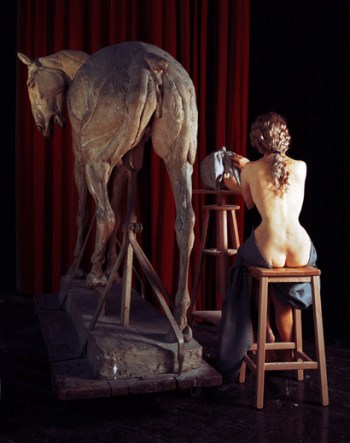
Liane Lang, Casts Series (Royal Academy), Ars Equina, 2006–07, c-type photographic print.
For the first time the Royal Academy is working with artists exploring emerging technologies, which presents them with new ways to both observe and represent themselves and the world around them. Farshid Moussavi RA, Humphrey Ocean RA, Yinka Shonibare RA, and Jonathan Yeo have experimented with virtual reality technologies, creating new artwork for the exhibition using virtual reality platform HTC Vive, Tilt Brush by Google, and artistic software programmes, including MakeVR Pro. Farshid Moussavi’s VR experience transports visitors into masterpieces of ecclesiastical architecture, which they can adapt and transform themselves, while creative technology and content studio Happy Finish have worked with Yinka Shonibare to develop a three-dimensional rendering of a neo-classical painting, featuring a cast of Venus dressed in Shonibare’s trademark batik fabric. Meanwhile, Humphrey Ocean invites audiences to create their own three-dimensional sketches within a playful virtual environment centred on the artist’s fascination with chairs.
From Life reveals the creative process in making these new artworks, as well as opening up the exciting potential of future artistic applications of virtual reality. HTC Vive has supported the development of these works, which will also be available for audiences to experience at home on Viveport, HTC’s global VR app store. Artist Jonathan Yeo has collaborated with Google Arts & Culture to create the first physical free-standing sculpture in metal made by using Tilt Brush, his creative process is captured in a VR film to be published on Google Arts & Culture Youtube channel. The visitors’ experience of the virtual reality element within the exhibition will depend on availability. As each virtual reality artwork can only be experienced individually, access cannot be guaranteed.
Tim Marlow, Artistic Director of the Royal Academy of Arts said: “This is an experimental project that explores everything from artistic process to technological evolution and creative collaboration. In a sense, From Life embodies what an artist-run academy was, is and might become.”
Sky Arts have commissioned immersive content studio Factory 42 to produce a documentary entitled Virtual Reality: Mystery of Creativity, which explores creating art in a virtual environment and how artists use these cutting-edge technologies to explore the limits of traditional artistic methods. There are also a series of short films across the Royal Academy’s online platforms, as well as available via the Sky VR and Google Arts & Culture apps.
To coincide with From Life and as part of the 250th anniversary celebrations in 2018, the Royal Academy is offering free life drawing classes for 250 people of all abilities in the historic Life Room in the RA Schools [dating to the 1860s]. Each class is for a particular group that has a special relationship with either the RA, drawing, or the human body, from members of the Royal Academy’s outreach programmes to nurses and architects. The guest tutors will not be revealed until the life drawing class begins. The project will be documented by online features and videos. The RA is also inviting the public and Friends of the RA to participate through an open ballot to win 50 places at the following free classes, led by guest tutors who will be revealed on the day. Enter the ballot here.
13 December 2017 (10.30am–1.30pm), exclusive to Friends of the RA
24 January 2018 (10.30am–1.30pm), open to all
Sam Phillips, ed., Artists Working From Life (London: Royal Academy, 2017), 160 pages, ISBN: 978 19103 50904, £22.
 From Michelangelo’s marbles to photographer’s self-portraits, artists have always been fascinated by their creative encounters with the human body. Often a key part of their early training, drawing and sculpting from life go on to inform their later work in unexpected and inspiring ways. This illuminating publication brings together interviews with over 19 artists from all disciplines, including painters, sculptors and conceptual artists, working in a variety of different media. Through in-depth conversations with them, the authors explore the many ways artists work ‘from life’: from Jeremy Deller’s open life class with Iggy Pop as model, to Jonathan Yeo’s innovative use of 3D scanners and virtual reality. The interviews are written by contributors including Caroline Bugler, Martin Gayford, Laura Gascoigne, Angela Kingston, Adrian Locke, Ben Luke, Sam Phillips, and Michael Prodger. The book is introduced by an essay on the history of life drawing by Annette Wickham, the Royal Academy’s Curator of Works on Paper.
Sam Phillips is editor of the Royal Academy of Arts Magazine.










leave a comment