Exhibition | Marie Antoinette Style
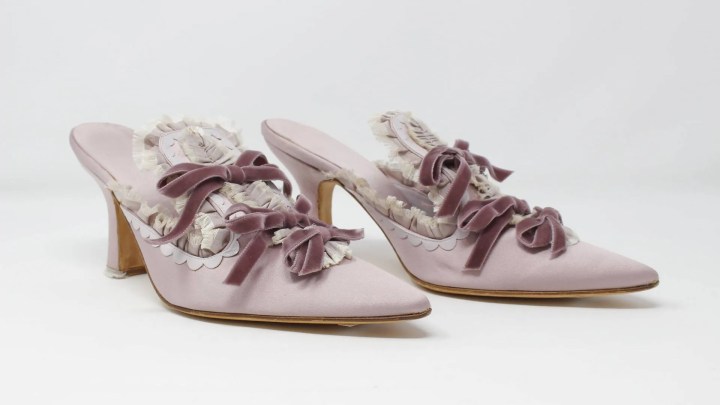
Manolo Blahnik, Antonietta, 2005.
◊ ◊ ◊ ◊ ◊
Curator Sarah Grant provides a preview of the exhibition with a focus on scent in a recorded talk from the study day The Museum and the Senses, held at the Barber Institute of Fine Arts (February 2025). From the press release for the exhibition:
Marie Antoinette Style
Victoria & Albert Museum, London, 20 September 2025 – 22 March 2026
Curated by Sarah Grant
Opening in September 2025 at V&A South Kensington, Marie Antoinette Style will be the UK’s first exhibition on the French queen Marie Antoinette (1755–1793). It will explore the origins and countless revivals of the style shaped by the most fashionable queen in history. Marie Antoinette not only contributed to the fashions, interiors, gardens, and fine and decorative arts of her own time, but continued to influence more than two and a half centuries of graphic and decorative arts, fashion, photography, film, and performance. This excessive, lavish, and feminine style will come to life through some 250 objects, including exceptional loans from the Château de Versailles never before seen outside France. Historical and contemporary fashion, alongside audio visual installations and immersive curation, will explore how and why Marie Antoinette, the person, has provided a constant source of inspiration. The exhibition will consider afresh the legacy of this complex figure whose style, youth, and notoriety have contributed to her timeless appeal. The exhibition will also trace the cultural impact of the Marie Antoinette style and her ongoing inspiration for leading designers and creatives, from Sofia Coppola and Manolo Blahnik to Moschino and Vivienne Westwood.

François-Hubert Drouais, Portrait of Marie Antoinette, Queen of France, in a Court Dress, 1773, oil on canvas (London: V&A, Jones Collection, 529-1882).
On display will be exceptionally rare personal items owned and worn by Marie Antoinette including richly embellished fragments of court dress, the Queen’s own silk slippers, and jewels from her private collection. Other highlights include personal effects such as the queen’s dinner service from the Petit Trianon, a selection of her accessories, and intimate items from her toilette case. A scent experience will re-create scents of the court and the perfume favoured by the Queen herself. The exhibition will also feature contemporary clothing including couture pieces by designers such as Moschino, Dior, Chanel, Erdem, Vivienne Westwood, and Valentino, along with costumes made for Sofia Coppola’s Oscar winning Marie Antoinette (staring Kirsten Dunst), as well as shoes designed for the film by Manolo Blahnik.
Sarah Grant, curator of Marie Antoinette Style, said: “The most fashionable, scrutinised, and controversial queen in history, Marie Antoinette’s name summons both visions of excess and objects and interiors of great beauty. The Austrian archduchess turned Queen of France had an enormous impact on European taste and fashion in her own time, creating a distinctive style that now has universal appeal and application. This exhibition explores that style and the figure at its centre, using a range of exquisite objects belonging to Marie Antoinette, alongside the most beautiful fine and decorative objects that her legacy has inspired. This is the design legacy of an early modern celebrity and the story of a woman whose power to fascinate has never ebbed. Marie Antoinette’s story has been re-told and re-purposed by each successive generation to suit its own ends. The rare combination of glamour, spectacle, and tragedy she presents remains as intoxicating today as it was in the eighteenth century.”
Presented chronologically, the first section, Marie Antoinette: The Origins of a Style, begins in 1770 and ends at Marie Antoinette’s execution in 1793. It sets the scene by presenting her life and the story of the beginnings of the style she shaped. On display will be key pieces of furniture, fashion, jewellery, porcelain, and musical instruments from her court, revealing her roles and interests as queen consort. It will consider the way in which she embraced some aspects of enlightenment thought, through her approach to maternity and childhood and support of new technologies. It will also address the ‘let them eat cake’ mythology and mythmaking that surround the queen to this day, drawing on recent research on early modern women, queenship, and celebrity. Highlights in this section include a replica of the Boehmer and Bassenge diamond necklace, from the diamond necklace affair of 1784–85, commissioned for Madame du Barry in 1772. The original necklace was famously stolen, broken up, and sold in Bond Street; the replica will sit alongside the Sutherland diamond necklace from the V&A collection, thought to be made from the original diamonds.
The first section will also display exceptionally rare loans that have never before left France, including personal effects such as the queen’s dinner service from the Petit Trianon, her accessories, and items from her toilette case. Other personal items include the queen’s armchair from the V&A’s collection with Marie Antoinette’s monogram and a jatte téton / bol sein or ‘breast cup’—one of four from the queen’s Sèvres Rambouillet dairy service delivered in 1787—which has led to the persistent though erroneous belief that it was modelled on the queen’s own breast, inspiring modern-day examples. Finally, this section includes the last note Marie Antoinette wrote before she died, on a blank page in her prayer book.
 The second section, Marie Antoinette Memorialised: The Birth of a Style Cult, explores the revival of Marie Antoinette’s style in the mid-1800s, at the impetus of Empress Eugénie. A romanticised and sentimental view of the queen took hold, and a phenomenal wave of interest continued throughout the century, peaking again in the 1880s and 1890s. Elements of Marie-Antoinette’s style became the ‘French’ or ‘French Revival’ style—the dominant style in Britain and North America for over fifty years. English collectors sought to acquire objects, furniture, and mementoes associated with the queen, and important collections of eighteenth-century French art were formed. Highlight objects include fancy dress costumes by Worth and other couturiers and photographs by Eugène Atget and Francis Frith.
Marie Antoinette: Enchantment and Illusion, the exhibition’s third section, looks to the late 19th century when the Marie Antoinette style entered a new phase of fantasy, magic, and fairy tales. The queen’s image came to embody escapism and beauty, as well as decadence and debauchery. Objects and artworks will illustrate this shifting narrative through the Art Nouveau and Art Deco periods, including the evening dress designs of couturiers such as Jeanne Lanvin and the Boué Soeurs, alongside luminous watercolour illustrations by Golden Age illustrators Erté, George Barbier, and Edmund Dulac.
The final section, Marie Antoinette Re-Styled, considers the modern and contemporary legacy of the Marie Antoinette style from the 20th century to the present day, in fashion, performance, and pop culture. Couture pieces by designers such as Moschino, Dior, Chanel, Erdem, Vivienne Westwood, and Valentino alongside photographs by Tim Walker and Robert Polidori will highlight Marie Antoinette’s continued influence on fashion globally. Costumes, accessories, film, and stills will bring to life the queen’s enduring legacy in film, stage, and even music videos. Artist Beth Katleman and designer Victor Glemaud will also showcase contemporary works inspired by elements of Marie Antoinette’s timeless style and period.
Support for the V&A is more vital than ever. Marie Antoinette Style is sponsored by Manolo Blahnik, with support from Kathryn Uhde.
Sarah Grant, ed., with forewords by Antonia Fraser, Manolo Blahnik, and Sofia Coppola, Marie Antoinette Style (London, V&A Publishing, 2025), 304 pages, ISBN: 978-1838510541, £40 / $70.
Exhibition | 1793–1794: Un Tourbillon Révolutionnaire
A second iteration of the exhibition on view previously at the Musée Carnavalet:
1793–1794: Un Tourbillon Révolutionnaire
Musée de la Révolution française, Vizille, 27 June — 23 November 2025
 Entre 1793 et 1794, « l’An II de la République » marque les débuts mouvementés de la toute première république française. Des idéaux de la Révolution aux grands procès politiques, de la liesse aux insurrections populaires, les premiers mois du nouveau régime emportent tout sur leur passage, jusqu’au quotidien des Français. Un véritable tourbillon révolutionnaire, nourri d’espoirs et de peurs.
Cette exposition revient sur des mois décisifs pour l’histoire de France : l’arrestation des Girondins, l’assassinat de Marat, l’exécution de Marie-Antoinette jusqu’à la chute de Robespierre. Voici donc « la Terreur », décryptée à la lumière des recherches historiques les plus récentes.
L’exposition 1793–1974: Un tourbillon révolutionnaire est une adaptation de l’exposition Paris 1793–1794: Une année révolutionnaire conçue par le musée Carnavalet – Histoire de Paris.
Exhibition | Traits of Genius
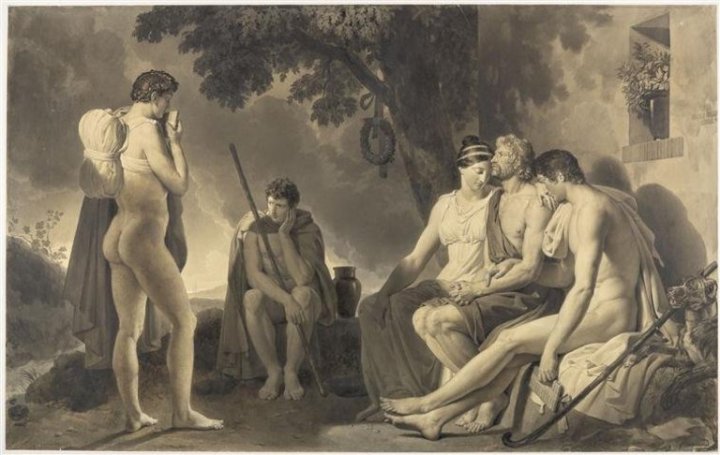
Alexandre-Évariste Fragonard, Pastorale / Homère et les Bergers, 1810; graphite, brown wash, black ink, and white highlights on beige paper; 55 × 88 cm (Louvre, INV 26657).
◊ ◊ ◊ ◊ ◊
The exhibition presents some sixty drawings by Jean-Honoré Fragonard, his wife Marguerite Gérard, and their son Alexandre-Évariste from the collections of the Louvre:
Les Traits du Génie: Dessins du Louvre par Jean-Honoré Fragonard,
Alexandre-Évariste Fragonard, et Marguerite Gérard
Musée International de la Parfumerie, Grasse, 27 June — 26 October 2025
Cet été, le Musée International de la Parfumerie vous invité à découvrir l’œuvre de Jean-Honoré Fragonard, l’un des plus grands peintres du XVIIIe siècle, à travers une exposition exceptionnelle. Né à Grasse en 1732, Fragonard a marqué son époque par son talent unique, tout en restant profondément attaché à sa ville natale. Bien que Paris ait été son principal lieu de vie, son mariage avec Marie-Anne Gérard, issue d’une famille de parfumeurs grassois, ainsi que ses séjours réguliers à Grasse, témoignent de l’attachement de l’artiste à sa ville d’origine.
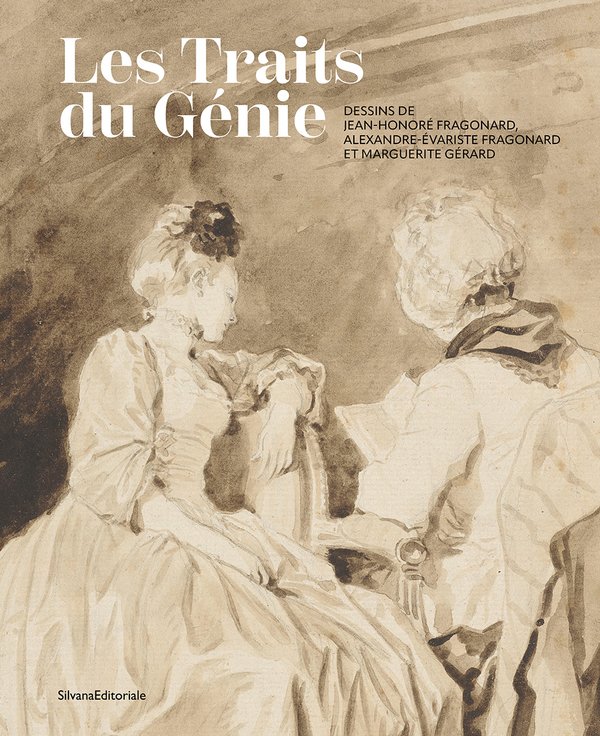 L’exposition propose une sélection de plus de soixante dessins de Fragonard, jamais exposés à Grasse et rarement montrés ailleurs. Ces œuvres, provenant des collections du département des Arts Graphiques du musée du Louvre, offrent un regard privilégié sur le processus créatif de Fragonard. Que ce soit des autoportraits, des souvenirs de voyages, des études de figures ou des projets d’illustration, les dessins de Fragonard nous donnent un aperçu de l’étendue du génie de l’artiste et offrent au visiteur grassois une proximité inédite avec l’essence de son œuvre.
Fragonard n’a pas seulement marqué l’histoire de la peinture. Son influence s’étend également aux arts décoratifs, et notamment à l’univers de la parfumerie, un domaine dans lequel Grasse occupe une place centrale. Pour illustrer ce lien, l’exposition présente une série de flacons de parfum en porcelaine du XVIIIe siècle, prêtés par la société Givaudan. Que vous soyez passionné d’art, d’histoire ou simplement curieux, cette exposition est une occasion unique de plonger dans l’univers de Jean-Honoré Fragonard, de découvrir ses œuvres et d’explorer les liens entre son art et l’univers du parfum.
From Silvana:
Laure Decomble, Olivier Quiquempois, Xavier Salmon, and Martine Uzan, Les Traits du Génie: Dessins de Jean-Honoré Fragonard, Alexandre-Évariste Fragonard et Marguerite Gérard (Milan: Silvana Editoriale, 2025), 200 pages, ISBN: 978-8836661534, €29.
c o n t e n t s
• Grasse et Jean-Honoré Fragonard — Olivier Quiquempois
• Crayonnages et lavis de Fragonard: Quelques considérations sur certains amateurs et collectionneurs — Xavier Salmon
Oeuvres
• Les Fragonard, une famille d’artistes — Laure Decomble
• Voyager et apprendre — Laure Decomble
• Regarder et inventer — Xavier Salmon
• Fragonard, illustrateur — Olivier Quiquempois
• Les Flacons de la Séduction — Martine Uzan
English Texts
Bibliographie
Exhibition | Adèle de Romance (1769–1846)
Now on view at the Fragonard Museum in Grasse (with more information available here, pp. 124–27):
Adèle de Romance: A Liberated Painter / Peintre Libre
Musée Fragonard, Grasse, 14 June — 12 October 2025
Curated by Carole Blumenfeld
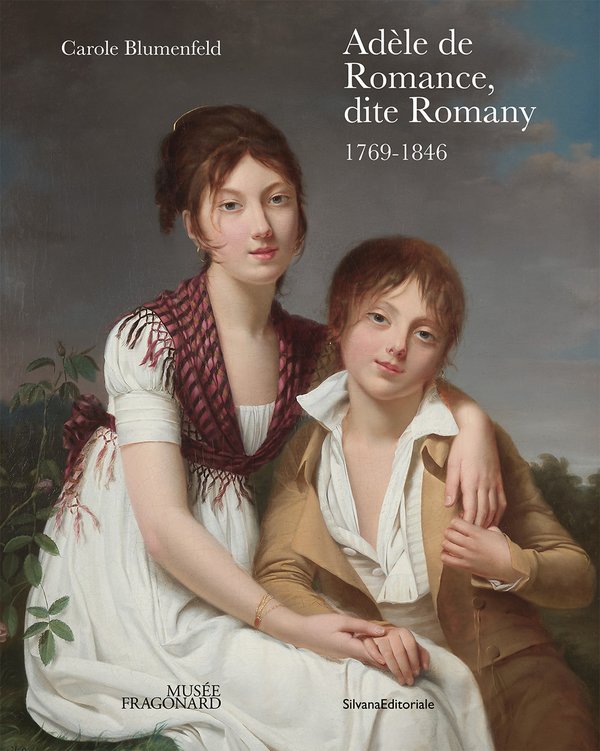 After dedicating the summer 2023 exhibition to the Lemoine sisters and their cousin Jeanne Élisabeth Chaudet, the Jean-Honoré Fragonard Museum will celebrate Adèle de Romance in 2025. This painter, whose life was as brilliant as it was tumultuous, embodies all the opportunities that the end of the 18th century and the beginning of the 19th century offered to talented artists.
Born from an illegitimate union between the Marquis Godefroy de Romance, Adèle de Romance (1769–1846) was eventually recognized and adopted by her father at the age of 8. Her younger half-sister, whose personal life perfectly met their father’s expectations, received many signs of trust from him. Despite this, Adèle de Romance now had a name and enjoyed one of the largest collections of Nordic and French paintings, including many works by Fragonard. Concerned with her education, the Marquis de Romance guided all her personal choices, from her passion for painting to the birth of her first child at the age of 18. Adèle then married the miniaturist François Antoine Romany, a mismatched union whose sole purpose was to give her a status. When her father left France in August 1791 to defend the counter-revolutionary ideas that mattered to him, Adèle de Romance was forced to conceal her partly aristocratic origins and to live… by her brushes.
After a divorce, which she willingly kept her married name, she began a series of small portraits of prominent figures. She took advantage of the fame of her subjects and, for four decades, played with a multitude of surnames, embracing public exposure and presenting dozens of works. Witnessing the upheavals of her time, she made the most of the political and social context that favored portraiture. Better than many other artists, she succeeded in capturing the desire for reinvention of the personalities she painted, presenting a gallery of portraits that reflected France. Adèle de Romance participated in a time when images were about to play an unprecedented role. Portraits, a rather insignificant genre in a monarchy—where only one person matters and everyone else is nothing—acquired a new level of interest in a Republic. It then became a vector of virtues, talents, services, and memories.
Adèle de Romance did not have the privilege of joining the royal collections, the birthplace of today’s national collections. Paying tribute to this painter who managed to live from her art first required finding her works. Thus, with the exception of the rich corpus preserved in the collections of the Comédie-Française, the paintings of Adèle de Romance held in French public collections are not only rare but rarely exhibited. Many of her portraits remained with the descendants of the sitters, who kindly allowed them to be displayed for the Grasse exhibition, thus honoring this woman who, very early on, understood that culture and artistic talents were a remarkable passport to being accepted, regardless of her origins, and having a voice in a world dominated by men.
From Silvana:
Carole Blumenfeld, Adèle de Romance, dite Romany, 1769–1846 (Milan: Silvana Editoriale, 2025), 232 pages, ISBN: 978-8836661121, €35.
Adèle de Romance appartient à cette caste ténue de femmes qui, sans jamais se poser en séditieuses, surent hanter les lisières du monde établi et frayer, dans les anfractuosités d’un ordre contraignant, un sentier d’autonomie patiemment conquis. Douée d’un discernement affûté et d’un sens exquis de la conjoncture, la portraitiste sut, avec adresse et aplomb, tirer parti des ondulations du temps et des vents favorables, pour jouer des équivoques de sa propre identité et en faire un atout, pour ses modèles et pour elle-même. Adèle de Romance devint pleinement maîtresse de son destin en peignant les visages d’autrui, qu’elle signait parfois de son nom de naissance, « de Romance », mais le plus souvent : « Romany », « Rom… », « Romanée », « de Romany » ou « DR »… Ces jeux de recomposition nominale, souples et ductiles, savamment dosés, relèvent d’une poétique du nom propre, où l’identité se dit autant par esquive que par assertion.
c o n t e n t s
Philippe Costamagna — Preface
Carole Blumenfeld — Peindre pour s’appartenir: Marie Jeanne de Romance, Adèle de Romance, dite Romany, Adèle Romanée, Adèle Romany-de-Romance, AR
Carole Blumenfeld — Catalogue des Oeuvres Exposées
Arbre généalogique d’Adèle de Romance
Chronobiographie
Liste des œuvres présentées aux Salons
Annexes
Index
Bibliographie
Exhibition | Philadelphia, The Revolutionary City
From the APS:
Philadelphia, The Revolutionary City
American Philosophical Society Museum, Philadelphia, 11 April — 28 December 2025
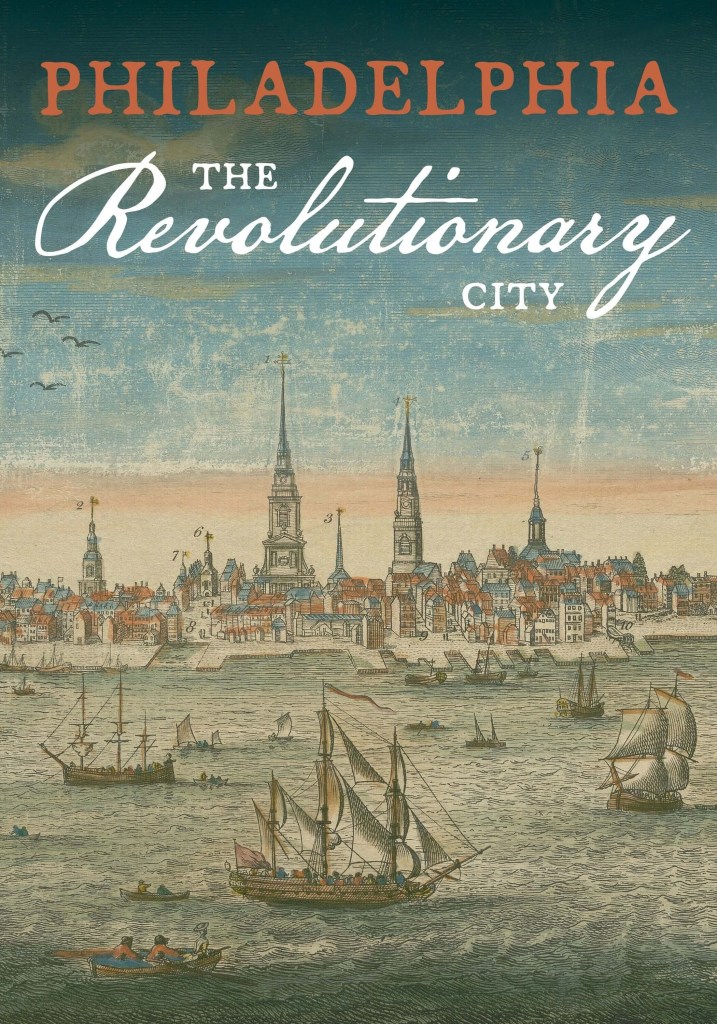 Philadelphia, The Revolutionary City illuminates the lived experiences of Philadelphians leading up to, during, and after the fight for independence. It showcases historic documents and material culture, ranging from diaries and newspapers to political cartoons and household objects. Beginning with the Stamp Act in 1765, the exhibition traces key events through the late 1780s and the impacts they had on communities living within and around the city. The exhibition features a range of voices and stories, offering windows into this turbulent period of change and presenting Revolution-era Philadelphia as a vibrant and growing city.
This exhibition is inspired by the innovative digital archive The Revolutionary City: A Portal to the Nation’s Founding, recently launched by the American Philosophical Society, the Historical Society of Pennsylvania, and the Library Company of Philadelphia, in partnership with the Kislak Center for Special Collections, Rare Books and Manuscripts and the Museum of the American Revolution. Philadelphia, The Revolutionary City brings together rare manuscript material and objects from the APS’s Library and Museum holdings, and the collections of these partners, as well as loans from regional institutions, and nearby historic houses and museums.
The related publication is distributed by the University of Pennsylvania Press:
Philadelphia, the Revolutionary City (Philadelphia: The American Philosophical Society Press, 2025), 110 pages, ISBN: 978-1606181225, $30. With contributions by Patrick Spero, Michelle Craig McDonald, John Van Horne, David R. Brigham, Caroline O’Connell, and Bayard Miller.
The book includes a fully-illustrated object checklist with information for each item as well as a curatorial statement about the project’s development. Additionally, it features three essays, one from each of the directors of the special collection libraries, focusing on key objects within each collection, plus an essay on the origins of the digital project and its ongoing work. Each essay offers a unique perspective on Philadelphia’s revolutionary history and a range of stories that can be found in these archives and on the digital portal.
Exhibition | Duplessis (1725–1802): The Art of Painting Life

From the press release for the exhibition:
Duplessis (1725–1802): The Art of Painting Life / L’art de peindre la vie
Inguimbertine, Hôtel-Dieu, Carpentras, 14 June — 28 September 2025
Curated by Xavier Salmon
From June 14 to September 28, 2025, the Inguimbertine at the Hôtel-Dieu of Carpentras hosts an exhibition dedicated to Joseph Siffred Duplessis (1725–1802), one of the most remarkable portraitists of the 18th century, in celebration of the 300th anniversary of his birth. The Hôtel-Dieu of Carpentras, magnificently restored, provides the perfect setting. Inaugurated in April 2024, this heritage site is now home to the Bibliothèque-Musée Inguimbertine. With nearly 43,000 visitors since its opening, it has established itself as a major cultural venue in the Provence-Alpes-Côte d’Azur region, immersing visitors in the history of Carpentras and the Comtat Venaissin, as well as in the world of an 18th-century library-museum and a grand fine arts gallery.

Joseph Siffred Duplessis, Portrait of Benjamin Franklin, oil on canvas, 72 × 58 cm (New York: The Metropolitan Museum of Art, The Friedsam Collection, 32.100.100).
In 2025, the Inguimbertine has the honor of celebrating a native of Carpentras, Joseph Siffred Duplessis, born 300 years ago and recognized as a master of portrait painting at the court of King Louis XVI. His works, now housed in the world’s greatest museums, attest to Duplessis’s artistic genius. The exhibition brings together around sixty paintings from the 200 he created, sourced from prestigious collections such as the Metropolitan Museum of Art in New York, the Nelson-Atkins Museum of Art in Kansas City, the National Gallery of Canada in Ottawa, the Palace of Versailles, and the Louvre Museum. The exhibition also provides the Inguimbertine with an opportunity to highlight the richness of its own collection, which includes the largest public holding of the artist’s works—22 paintings and drawings, among them the only two religious paintings he ever produced. These masterpieces allow visitors to discover or rediscover Duplessis’s remarkable skill, particularly in his role as the official portraitist of Louis XVI. This first retrospective of the master portraitist is accompanied by a catalog of his works, listing nearly two hundred paintings, published by Lienart Editions.
Duplessis had an extraordinary ability to capture the essence of his subjects with mastery and sensitivity that transcend time. Visitors will be particularly impressed by his virtuosity in rendering the complexions of faces and the textures of fabrics. Acknowledged by his contemporaries as “the greatest portrait painter in the kingdom,” his talent for portraying character and presence is being showcased through a carefully curated selection of works. For a portraitist, painting and exhibiting well-known figures was essential to gaining public recognition. In this pursuit, Duplessis worked within three spheres: men of letters, scholars, and artists. Among his most famous works are the full-length portrait of Louis XVI and two portraits that have left a lasting mark on art history: that of Austrian composer Gluck and that of the American statesman Benjamin Franklin, whose long stay in France embodied the ideals of the Enlightenment and the birth of a new world.
Curated by Xavier Salmon, curator at the Louvre Museum and a specialist in 18th-century portraiture, this exhibition promises to be a major cultural event of 2025. It offers a unique opportunity to understand why Duplessis was considered one of the greatest portraitists of his time. Visitors are able to explore his official commissions for the royal court and the ministers of Louis XVI, his clientele in both Provence and Paris, as well as his rare religious paintings, all within the stunning setting of the Hôtel-Dieu of Carpentras.
Xavier Salmon, Joseph Siffred Duplessis (1725–1802): Le Van Dyck de la France (Paris: Lienart éditions, 2025), 224 pages, ISBN: 978-2359064650, €35.
Exhibition | So Far, So Close: Guadalupe of Mexico in Spain
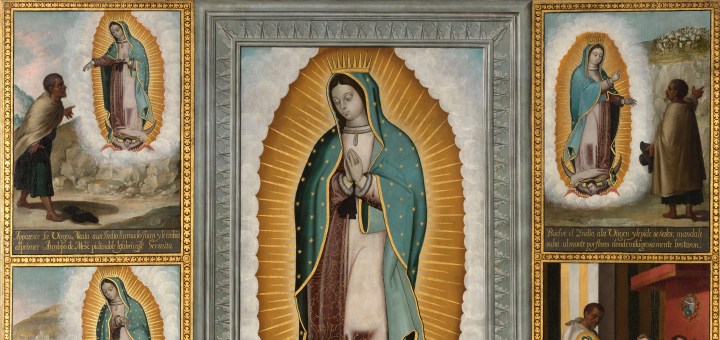
José Juárez, The Virgin of Guadalupe with Four Apparitions, detail, 1656, oil on canvas, 251 × 293 cm
(Ágreda, Soria: Monasterio de Concepcionistas Franciscanas)
◊ ◊ ◊ ◊ ◊
From the press release for the exhibition:
So Far, So Close: Guadalupe of Mexico in Spain
Museo Nacional del Prado, 10 June — 14 September 2025
Curated by Jaime Cuadriello and Paula Mues Orts
So Far, So Close: Guadalupe of Mexico in Spain casts an unprecedented gaze on the artistic dialogue between Latin America and Europe in the 17th and 18th centuries, showing how the Virgin of Guadalupe was reinterpreted, reproduced, and venerated on both continents, emerging as a transatlantic devotional and political icon. The exhibition offers a new perspective on the role of the Virgin of Guadalupe as a miraculously created image, an object of worship, and symbol of identity in the Hispanic world. Through nearly 70 works, including paintings, prints, sculptures and books, the exhibition shows how this manifestation of the Virgin, which first appeared on the Cerro del Tepeyac or Tepeyac Hill in 1531, transcended the borders of New Spain to become a powerful presence in the Spanish collective imagination. The project, curated by the Mexican professors Jaime Cuadriello (UNAM) and Paula Mues Orts (INAH), is the result of years of research and collaboration between institutions. The exhibition is structured into eleven thematic sections, combining small and large-format works that range from the earliest depictions of apparitions of the Virgin to the sophisticated vera effigies reproduced for devotional or political purposes.

Attributed to Joaquín Villegas (act. ca. 1713–53), The Eternal Father Painting the Virgin of Guadalupe, ca. 1740–50, oil on canvas (México City, INBAL/Museo Nacional de Arte, Donación FONCA, 1991).
The exhibition begins with a visual cartography that charts the surprising density of the presence of images of the Virgin of Guadalupe across all of Spain. This dissemination reflects economic, social and political factors such as trade with the Indies, mining and the movement of viceregal officials. These works reflect both devotion and the concerns of communities, artists, merchants, the nobility, and the clergy, who together made the Virgin a shared devotional cult. Themes covered in the exhibition’s different sections include the transmission of the Guadalupe story through standardised narrative and visual models; the formal genealogy of the image and its connection with European Marian icons such as the Immaculate Conception and the Tota pulchra; its status as a ‘painting not made by human hand’, which relates to the concept of the Deus pictor; and the sacredness of the Virgin’s mantle, conceived as a living relic and object of veneration. A comparison is also made with Iberian painting of the same period, revealing stylistic affinities and differences with schools such as Madrid and Andalusia.
Of particular interest are the sections dedicated to the vera effigies, which are exact copies or modified versions of the original, reproduced using specialised artistic techniques. Also notable is the presence of exotic materials, such as mother-of-pearl, ivory and brass, which arrived on the Manila Galleon, demonstrating the global reach of the cult of Guadalupe and its integration into transoceanic networks of cultural exchange. The exhibition includes masterpieces by artists from New Spain and the Iberian Peninsula, including José Juárez, Juan Correa, Manuel de Arellano, Miguel Cabrera, Velázquez, Zurbarán, and Francisco Antonio Vallejo. Together they trace an artistic and symbolic map of the cult of the Virgin of Guadalupe which lasted from the 17th to the early 19th century.
In conjunction with the exhibition, the Fundación Casa de México in Spain is collaborating on an extensive cultural programme that focuses on the symbolic and artistic dimension of the Virgin of Guadalupe. The programme includes lectures by the curators, a cycle of historical and contemporary films, informational capsules and workshops on traditional Mexican crafts taught by masters from Michoacán and Chiapas. These activities, taking place at the Museo del Prado and at the Fundación’s venue in Madrid, will offer participants a wide-ranging experience that interweaves history, art, and living tradition.
Jaime Cuadriello and Paula Mues Orts, eds., Tan lejos, tan cerca: Guadalupe de México en España (Madrid: Prado, 2025), 304 pages, ISBN: 978-8484806325, €32.
Exhibition | Picturing Nature: British Landscapes
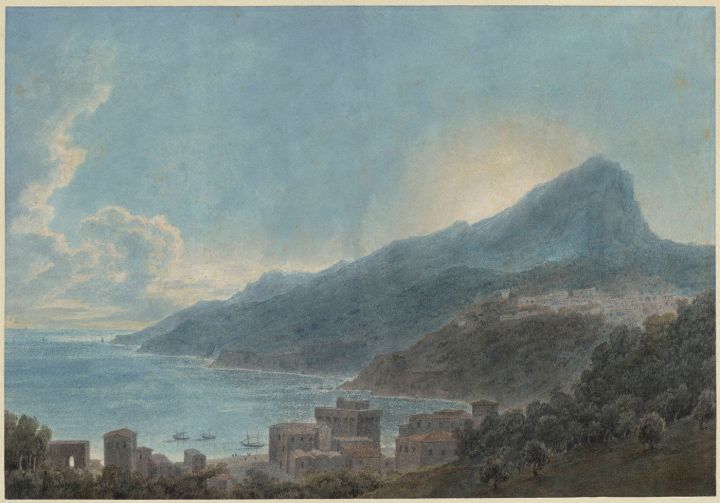
John Robert Cozens, View of Vietri and Raito, Italy, ca. 1783, watercolor over graphite on cream laid paper (The Museum of Fine Arts, Houston, The Stuart Collection, museum purchase funded by Francita Stuart Koelsch Ulmer in honor of Dena M. Woodall).
◊ ◊ ◊ ◊ ◊
Now on view at the MFAH:
Picturing Nature: The Stuart Collection
of 18th- and 19th-Century British Landscapes and Beyond
The Museum of Fine Arts Houston, 12 January — 6 July 2025
Featuring more than 70 works of art in a variety of media, Picturing Nature: The Stuart Collection of 18th- and 19th-Century British Landscapes and Beyond explores how the genre of landscape evolved during an era of immense transformation in Britain. This diverse collection of watercolors, drawings, prints, and oil sketches traces the shift from topographical and picturesque depictions of the natural world to intensely personal ones that align with Romantic poetry of the period. The exhibition spotlights the Stuart Collection, built over the past decade in collaboration with Houstonian Francita Stuart Koelsch Ulmer. This exceptional collection includes standout works by notable artists such as John Constable, John Robert Cozens, Thomas Gainsborough, J.M.W. Turner, and Richard Wilson, whose innovative approaches to watercolor raised its status as an art form and heralded a golden age for the medium.
Through the work of these luminaries and their contemporaries, Picturing Nature reveals how landscape emerged as a distinct artistic genre in England in the late 1700s, then reached its greatest heights the following century, attracting international response and inspiring both artists and collectors at home and abroad. Period publications and artist’s supplies, including drawing manuals and a mid-19th-century Winsor & Newton watercolor box, further illustrate the flowering of the landscape tradition.
Dena M. Woodall, Picturing Nature: The Stuart Collection of 18th- and 19th-Century British Landscapes and Beyond, $35. The online catalogue of the Stuart Collection is available here.
Exhibition | Mama: From Mary to Merkel
From the press release for the exhibition:
Mama: From Mary to Merkel
Kunstpalast, Düsseldorf, 12 March — 3 August 2025
Curated by Linda Conze, Westrey Page, and Anna Christina Schütz

Marie-Victoire Lemoine, Portrait of Madame de Lucqui with Her Daughter Anne-Aglaé Deluchi, 1800, oil on canvas, 100 × 81 cm (Arp Museum Bahnhof Rolandseck, Rau Collection for UNICEF).
The exhibition Mama: From Mary to Merkel explores the many different aspects of motherhood over eight chapters. The focus is on the societal expectations that have always influenced motherhood and are reflected in art, culture, and everyday life. The approximately 120 works on display from the fourteenth century to the present day create a panorama that involves everyone, including fathers and those without children of their own. From the concept of the ‘good mother’ to care work and family configurations, the show illustrates how the role of mother quickly breaks down into different, highly individual perspectives that are nevertheless deeply intertwined in cultural history. A polyphonic sound installation uses pre-recorded voice messages to give space to personal experiences, memories, and visions.
“Everyone has a mother. By placing motherhood at the centre of an exhibition, the Kunstpalast is once again addressing a topic that directly touches the lives of our visitors and that everyone can relate to with their own experiences and opinions. The show combines seriousness with humour and art with everyday life and pop culture— thus tying in with the Kunstpalast’s mission statement on several levels,” says Felix Krämer, general director of the Kunstpalast.
Popular culture and art both emphasise societal expectations of mothers and the role of the GOOD MOTHER. We begin with figures of the Virgin Mary from the fourteenth to the eighteenth centuries. The image of Mary—probably the most prominent mother in Christian culture—remains a symbol of total maternal devotion today. The stereotype of the ‘good’ mother was established in the eighteenth century and is still widespread: contemporary artists in the exhibition explore the efforts involved in attaining this ideal. For a portrait of his mother, Aldo Giannotti (b. 1977) pressed a sign into her hands. The word ‘MOM’ on it only becomes an admiring exclamation of ‘WOW’ when she subjects herself to the strain of hanging upside down from the ceiling. Motherhood is a yardstick by which a woman’s achievement is measured—even if she is not a mother. A well-known example is Angela Merkel (b. 1954): nicknamed ‘Mutti’ (Mum) when she was German Chancellor, she can also be seen as Mother Theresa on the cover of Der Spiegel magazine.
The historical changeability of notions of ‘good’ motherhood is demonstrated by advice books from various decades of the twentieth and twenty-first centuries, whose recommendations to mothers are often fundamentally contradictory. ADVICE OR REGULATION—from the Weimar Republic to National Socialism, the early Federal Republic and the GDR to the present-day reunified Germany, this genre is characterised by both consistencies and inconsistencies. A bookshelf in the exhibition gathers advice literature from recent decades and invites visitors to pause and read.
“Ideals and role models, advice, expectations and emotions—the aim of this exhibition is to make the subject of motherhood tangible in all its artistic, cultural historical, social and, of course, highly personal dimensions,” agree the three curators of the show. Linda Conze, Westrey Page and Anna Christina Schütz have approached the topic from different angles, finding mothers and non-mothers in the Kunstpalast collection, supplementing these artists with important, sometimes international loans and bringing everything together to create a narrative. “Connections between the collectively selected works reveal continuities, but also the mutability of images of mothers, which are constantly being reappropriated, reinterpreted, contested and celebrated. We see the show as an invitation to open up a dialogue about care and motherliness and look forward to hearing the audience’s perspectives,” explains the curatorial team.
Looking after children is work. Nevertheless, CARE WORK remains mostly unpaid and has traditionally been automatically assigned to women. With a critical eye, artists have drawn attention to the fact that care is influenced by social norms and class affiliations. For a long time, only poor mothers breastfed their babies themselves, while wealthier women hired wet nurses. Around 1800, the idea that all women should take care of their babies themselves became prevalent; the presence of the biological mother became more important. In the present day, working mothers who focus “too much” on their careers are judged just as much as those who devote themselves entirely to their children and the household. The balancing of care and paid work as well as the role of caregiver and other identities is a recurring theme among the women artists in the exhibition. Several paintings in the exhibition are by Paula Modersohn-Becker (1876–1907), who was always fascinated by motifs of the bond between mother and child. However, she was also apprehensive about the effects of her own motherhood on her artistic work. In her sculpture of a body dissolving in the mechanics of a breast pump, Camille Henrot (b. 1978) focuses on the fine line between providing nourishment and self-sacrifice.
The exhibition delves deeper into the subject of the PLACES OF MOTHERHOOD: historical doll’s house kitchens are brought into dialogue with the video work Semiotics of the Kitchen by Martha Rosler (b. 1943), which examines the distance of the housewife’s domain from intellectual settings. Scottish artist Caroline Walker (b. 1982) portrays mothers with their newborns in the intimate yet isolating domestic sphere. Finnish artist Katharina Bosse (b. 1968) photographs herself in erotically charged poses with her toddler crawling beside her in natural landscapes. In this way, she disrupts the seemingly natural idyll that surrounds motherhood in art and cultural history.
Several women artists use their work to address the fact that the decision to (NOT) HAVE CHILDREN often could not and still cannot be made freely, despite all the progress that has been made. For centuries, female ‘nature’ was defined in a wide variety of societies by a woman’s ability to conceive and bear children. The Virgin Mary, whose life is depicted in Dürer’s Life of the Virgin, is both a female role model and a special case. Her actions are always centred on her son, whom she conceived by divine intervention.
The medical achievements and societal developments of the twentieth century allowed women to emancipate themselves from their socially prescribed destiny for the first time by taking the contraceptive pill or asserting their hard-fought right to terminate a pregnancy. Hannah Höch (1889–1978) paints her struggle with the decision to not have a child by Raoul Hausmann. Nina Hagen’s (b. 1955) protest against the expectations of fulfilling her duty as a mother in the song “Unbeschreiblich Weiblich” (Indescribably Feminine) is juxtaposed with Elina Brotherus’s (b. 1972) confrontation with her own involuntary childlessness.
For a long time, the physical bond between mother and child was unquestioningly viewed as a prerequisite for a motherly love that was regarded as intrinsic. The exhibition also shows that the often positively connoted intimate relationship between mother and child at all ages can also have a potentially traumatic side. In a series of photographs, Leigh Ledare (b. 1976) explores his CLOSENESS to his mother, who confronts her adult son with uncompromising desire. In a video work by performance artist Lerato Shadi (b. 1979), she and her mother lick sugar and salt off each other’s tongues and explore the space between repulsion and affection. The armchair by Italian designer Gaetano Pesce (1939–2024) promises a return to the mother’s womb, with the foot section connected to the main body of the furniture via an ‘umbilical cord’.
In German, the word MUTTERSEELENALLEIN describes the utmost loneliness. Mary, Our Lady of Sorrows, mourning her dead son Jesus Christ, is one of the central motifs in Western art history. Artists have repeatedly made reference to the so-called Pietà, appropriating and reinterpreting it as a motif. The loss of the child is juxtaposed with the loss of the mother, which artists of different generations have sometimes made an autobiographical theme and thus given expression and form to their personal grief. Finally, mutterseelenallein can also refer to anyone who has been denied motherhood, whether due to social norms, physical conditions or decisions that were not made voluntarily.
 The exhibition chapter FAMILY CONFIGURATIONS asks what influence family images have on motherhood. In the eighteenth century, the nuclear family rose to become the ideal of the Western world. In this model, the mother is the centre of care, while the father is responsible for financial support. Through processing their own personal or observed experiences, artists have questioned the dominance of this father-mother-child constellation. Alice Neel, who lived apart from her daughter, captures psychological subtleties in her family portraits that resist simple narratives. Oliviero Toscani’s photos for a campaign for the Benetton fashion brand around 1990 challenged conservative notions of family by placing homosexual parents at the centre. Queer lifestyles can inspire ways of thinking in which the burden of care is placed on several shoulders instead of being the sole responsibility of the biological mother. The circle of people who can be mothered also extends beyond biological relatives: foster, step-, adopted children and those in care are also looked after. In the complexity of modern living arrangements, the bond with a pet can be just as important as other relationships. Art reflects the shift from the question ‘Who is the mother?’ to ‘Who is mothering?’
The exhibition is an invitation to continue the dialogue about care and motherhood—for example in the diverse accompanying programme, which ranges from a midwife consultation in the exhibition to workshops with various collectives and organisations such as Düsseldorf family centres. One of Germany‘s most prominent mother figures has recorded the audio guide for the exhibition: Marie-Luise Marjan, aka ‘Mutter Beimer’ from the popular TV series Lindenstraße.
Mama: From Mary to Merkel is curated by Linda Conze, Head of Department of Photographs; Westrey Page, Curator Special Projects; and Anna Christina Schütz, Department of Prints and Drawings, Research Associate.
Linda Conze, Westrey Page, and Anna Christina Schütz, ed., Mama: Von Maria bis Merkel (Munich: Hirmer Verlag, 2025), 200 pages, ISBN: 978-3777444888, €45.
Exhibition | Rococo & Co: From Nicolas Pineau to Cindy Sherman
Closing soon at the Musée des Arts Décoratifs:
Rococo & Co: From Nicolas Pineau to Cindy Sherman
Musée des Arts Décoratifs, Paris, 12 March — 18 May 2025
Curated by Bénédicte Gady, with Turner Edwards and François Gilles
 This exhibition celebrates the restoration of a unique collection of nearly 500 drawings from the workshop of the sculptor Nicolas Pineau (1684–1754), one of the main proponents of the Rocaille style, which Europe adopted as Rococo. A practitioner of measured asymmetry and a subtle interplay of solids and voids, Nicolas Pineau excelled in many fields: woodwork, ornamental sculpture, architecture, prints, furniture and silverware. The presentation of this major Rococo figure is extended to include a workshop that plunges the visitor into the heart of the creation of Rococo panelling. Asymmetries, sinuous lines, chinoiserie dreams and animal images illustrate the infinite variations of the Rococo style. Finally, from the 19th to the 21st century, this aesthetic has found numerous echoes, from neo-styles to the most unexpected and playful reinterpretations.
The exhibition explores the evolution of the Rococo style and its reappearance in contemporary design and fashion, including Art Nouveau and psychedelic art. Nearly 200 drawings, pieces of furniture, woodwork, objets d’art, lighting, ceramics, and fashion items engage in a playful dialogue of curves and counter-curves. Nicolas Pineau and Juste Aurèle Meissonnier are joined by Louis Majorelle, Jean Royère, Alessandro Mendini, Mathieu Lehanneur, the fashion designers Tan Giudicelli and Vivienne Westwood, and the artist Cindy Sherman.
Bénédicte Gady, Turner Edwards, and François Gilles, eds., Nicolas Pineau 1684–1754: Un sculpteur de rocaille entre Paris et Saint-Pétersbourg (Paris: Éditions Les Arts Décoratifs, 2025), 504 pages, ISBN: 978-2847425123, €85.










 Enfilade
leave a comment