Book and Display | Baroque and Later Ivories in the V&A
From the V&A:
Baroque and Later Ivories in the V&A
Victoria & Albert Museum, London, 25 January — 28 September 2014
This is a display of a number of sculptures from the outstanding collection of baroque and later ivories in the V&A, including German, Austrian, Netherlandish, French, British and Hispanic works. A range of objects will be seen: portrait busts, tankards, statuettes, and devotional reliefs. Carved and turned ivories were highly treasured items throughout the seventeenth, eighteenth and nineteenth centuries. They might render dramatic mythological scenes, present exquisitely carved portrait likenesses on a small scale, or depict religious narratives. This small exhibition celebrates the recent publication of a catalogue of these ivories at the V&A.
From the V&A Shop:
Marjorie Trusted, Baroque and Later Ivories in the V&A (London: V&A Publishing, 2013), 544 pages, ISBN: 978-1851777679, £85.
 Over 500 baroque and later ivories from the V&A’s outstanding collection are illustrated and discussed in this scholarly catalogue. This publication includes every ivory sculpture made after 1550 from a collection comprising German, Austrian, Netherlandish, British, French, Italian, Scandinavian, Russian and Spanish pieces, as well as examples from the Philippines, Goa, Sri Lanka and South America. The range of objects is extensive: statuettes, reliefs, tankards, boxes, cabinets, snuff rasps and cutlery handles are all represented. These small-scale sculptures might render dramatic scenes from mythology, present exquisitely carved portrait likenesses on a small scale, or depict religious narratives. The high quality of the V&A’s holdings is readily apparent; leading ivory sculptors to be found here include Francis van Bossuit, Benjamin Cheverton, Balthasar Griessmann, Joachim Henne, Johann Christoph Ludwig Lücke, David Le Marchand, and Balthasar Permoser. In addition to detailed entries on each piece, the Introduction summarises the history and techniques of baroque and later ivory carving, while indexes of subjects and artists, in addition to a comprehensive bibliography, provide a full scholarly apparatus.
Marjorie Trusted is Senior Curator of Sculpture at the V&A. She has published and lectured widely, specializing in European art from the seventeenth century onwards, in particular British and Spanish sculpture. Her books include Spanish Sculpture (V&A 1996), British Sculpture 1470–2000 (co-author, V&A 2002), The Making of Sculpture (V&A 2007), and The Arts of Spain (V&A 2007).
Exhibition | Fame and Friendship
From the YCBA press release:
Fame and Friendship: Pope, Roubiliac, and
the Portrait Bust in Eighteenth-Century Britain
Yale Center for British Art, New Haven, 20 February — 19 May 2014
Waddesdon Manor, Buckinghamshire, 18 June — 26 October 2014
Curated by Malcolm Baker

Louis François Roubiliac, Portrait Bust of Alexander Pope, 1741, marble (Yale Center for British Art)
Opening in February 2014, the Yale Center for British Art, in collaboration with Waddesdon Manor, will present an exhibition on the eighteenth-century literary figure and poet Alexander Pope (1688–1744), whose sculpted portraits exemplified his fame at a time when the portrait bust was enjoying new popularity. Fame and Friendship: Pope, Roubiliac, and the Portrait Bust in Eighteenth-Century Britain will bring together paintings, sculptures, and materials that convey Pope’s celebrity status, high-lighted by a series of eight busts by Louis François Roubiliac (1702–1762), the leading sculptor of the period, to explore questions of authorship, replication, and dissemination.
Frequently used in antiquity to represent and celebrate writers, the portrait bust became the most familiar way of lauding famous writers in the eighteenth century, as the concept of authorship was being newly conceived. The signed and documented versions of Roubiliac’s busts of Pope, which span the years from 1738 to 1760, are among the most fascinating and iconic images of the poet. These early versions of Roubiliac’s bust are likely to have been made for Pope’s close friends, serving to articulate those friendships that were so important to him. Further, the comparisons of these related versions, together with copies from the period in marble, plaster, and ceramic, will provide a unique and unprecedented opportunity to understand the role of replication and repetition in eighteenth-century sculptural practice.
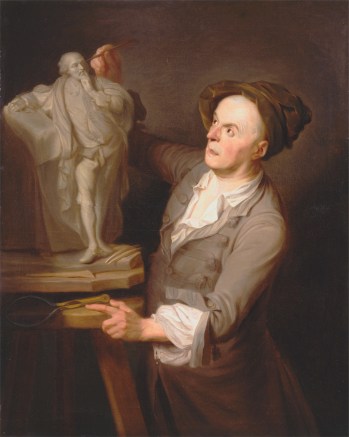
Adrien Carpentiers, Louis-Francois Roubiliac Modelling His Monument to Shakespeare, between 1760 and 1761 (Yale Center for British Art)
Complementing the sculptures of Pope will be busts of other sitters with whom Pope’s image was associated, reflecting the poet’s place in a developing literary canon, as well as a selection of painted portraits of the poet by artists such as Jonathan Richardson the Elder, Jean-Baptiste van Loo, and Sir Godfrey Kneller. Alongside these works will be a range of Pope’s printed texts. With their subtle changes in typography and their carefully planned illustrations and ornamental features, these early editions were produced under the watchful eye of Pope himself and were the outcome of the poet’s direct engagement with the materiality of the book and print.
Also presented will be lesser-known material about the Yale literary critic W. K. Wimsatt, who in the 1960s not only helped to make Yale a major center for the study of eighteenth-century literature (and Pope in particular), but spent twenty-five years researching the poet’s portraits, an achievement celebrated in this exhibition. As Wimsatt recognized, the relationship between Pope’s private persona and public fame was complex and ambiguous. Pope proved adept at managing the two while gradually establishing himself as an independent author, no longer dependent upon the support of noble patrons. Throughout his career, he astutely managed the presentation of his own image and reputation through both his published works and his portraits, especially those by Roubiliac.
Among the busts by Roubiliac will be a terracotta model (ca. 1738) from the collection of the Barber Institute of Fine Arts in Birmingham, England, and four marble pieces that he carved between 1738 and 1741. These busts have been assembled from a number of locations: the Center’s own collection; Temple Newsam House, Leeds Museums and Galleries; and the Shipley Art Gallery, Gateshead (formerly in the possession of the eighteenth-century actor David Garrick). Another, from a private collection, was made for Pope’s close friend, the brilliant young lawyer, William Murray, later first Earl of Mansfield, with whom the poet shared an enthusiasm for both the classics and the visual arts, particularly sculpture. Also on view will be an earlier marble bust of Alexander Pope made in 1730 by the Anglo-Flemish sculptor John Michael Rysbrack (1694–1770), from the collection of the National Portrait Gallery, London.
When this exhibition travels to Waddesdon Manor, the core group of busts of Pope by Roubiliac and some of the contextual material from the Yale Center for British Art will remain the same, but there will be an additional selection of painted portraits, a different range of printed texts lent by the British Library, and material that will illustrate the reception of Pope and his works in France in keeping with Waddesdon’s superb French collections.
Fame and Friendship: Pope, Roubiliac, and the Portrait Bust in Eighteenth-Century Britain is co-organized by the Center and Waddesdon Manor (The Rothschild Collection), where it will travel in June 2014. It is curated by Malcolm Baker, Distinguished Professor of the History of Art at the University of California, Riverside, and Honorary Senior Research Fellow at the Victoria and Albert Museum, London. The organizing curator at the Yale Center for British Art is Martina Droth, Associate Director of Research and Education, and Curator of Sculpture; and at Waddesdon Manor, Dr. Juliet Carey, Senior Curator of Paintings, Sculpture and Works on Paper.
P U B L I C A T I O N S & S C I E N T I F I C S T U D Y
 During the course of the exhibition, Yale University Press will be publishing The Marble Index: Roubiliac and Sculptural Portraiture in Eighteenth-Century Britain, Malcolm Baker’s study of the bust and the statue as genres [scheduled for release in August 2014]. Following the exhibition, a second book will appear as a volume in the series Studies in British Art, published by the Yale Center for British Art and the Paul Mellon Centre in collaboration with Yale University Press. The latter will include essays based on papers presented at the conferences at Yale and Waddesdon organized by the Center, the Paul Mellon Centre in London, and the Rothschild Foundation. It will also incorporate the results of a related research program of detailed digital scanning using the world-class facilities under development at the Yale Digital Collections Center at Yale’s West Campus. By analyzing the busts both visually and technically, this study aims to discover similarities and differences in surfaces, dimensions, construction, and materials, thus shedding new light on the studio practices of eighteenth-century sculptors. These findings will be the focus of a workshop to which leading figures in the field of eighteenth-century sculpture will be invited.
◊ ◊ ◊ ◊ ◊
Note (added 31 May 2014) — A more tightly focused catalogue will also be published by Paul Holberton:
Malcolm Baker, Fame and Friendship: Pope, Roubiliac and the Portrait Bust (London: Paul Holberton Publishing, 2014), 128 pages, ISBN: 978-0954731052, £15 / $25.
◊ ◊ ◊ ◊ ◊
Note (added 13 June 2014) — Waddesdon will host a study day (with a visit to Stowe) on July 10 and a conference on July 12.
Exhibition | The Art of the Louvre’s Tuileries Garden
Press release (20 September 2013) from the High Museum:
The Art of the Louvre’s Tuileries Garden
High Museum of Art, Atlanta, 3 November 2013 — 19 January 2014
Toledo Museum of Art, 13 February — 11 May 2014
Portland Art Museum, 14 June — 28 September 2014

Antoine Coysevox, Faun, 1709
The Art of the Louvre’s Tuileries Garden features more than 100 works, some of which have never traveled outside of Paris. These include large-scale sculptures from the garden that were created in the 17th, 18th, 19th, and 20th centuries by sculptors including François-Joseph Bosio, Antoine Coysevox, and Aristide Maillol along with paintings, photographs, and drawings that depict the Tuileries. Thirty-five works in the exhibition are from the collections of the Louvre.
The exhibition also explores how the 63-acre garden influenced and inspired French and American Impressionists such as Édouard Manet, Camille Pissarro, and Childe Hassam and photographers such as Eugène Atget, Henri Cartier-Bresson, and André Kertész. As part of the exhibition’s presentation in Atlanta, the High has turned the museum’s piazza into a landscaped park, inspired by the Tuileries Garden.
The ‘Paris on Peachtree’ experience begins as visitors arrive on the High’s piazza to find a dozen holly trees in planter boxes similar to those in the Tuileries Garden, installed to create a path to the exhibition entrance. Two sculptures by Maillol have been placed among the trees. The immersive experience continues in the galleries, where six sculptures that have never before left France and for centuries resided in the Tuileries Garden will greet visitors on the first level of the exhibition. The High is also devoting an entire gallery in the exhibition to a video titled “A Day in the Tuileries Garden,” featuring footage from the Garden projected on three walls.
Key works featured in the exhibition include:
• Antoine Coysevox, Faun, 1709
• François Joseph Bosio, Hercules Battling Achelous as Serpent, 1824
• Édouard Manet, Children in the Tuileries Garden, ca. 1861–62
• Childe Hassam, Tuileries Gardens, ca. 1897
• Camille Pissarro, The Tuileries Gardens in the Snow, 1900
• Aristide Maillol, Mediterranean or Latin Thought/Contemplation, 1923–27
• Henri Cartier-Bresson, The Terrace and Tree-lined Path, 1975
The exhibition examines how the Tuileries, which extends from the Musée du Louvre to the Place de la Concorde, evolved from its beginnings as an outdoor museum for French royalty to its role as one of the first public gardens in Europe, after which it served as both subject and inspiration for artists working in Paris.
Presented on the occasion of the 400th birthday of André Le Nôtre (1613–1700), The Art of the Louvre’s Tuileries Garden also celebrates the man commissioned by Louis XIV in 1664 to expand and transform the Tuileries into a formal French garden. One of the first public gardens in Europe, the Tuileries Garden was originally created in 1564 by Catherine de Medici as the garden for the Tuileries Palace, a palace that was originally part of the Louvre but which was destroyed following the Franco-Prussian War. Each monarch who lived in the palace left his or her own indelible mark on the Tuileries. Under the reign of Louis XV, the garden became known for its monumental outdoor sculpture collection. In 1667, just three years after Le Nôtre was hired, the Tuileries Garden became Paris’ first public park. The garden is still open to the public today.
The Art of the Louvre’s Tuileries Garden is co-organized by the High Museum of Art, the Toledo Museum of Art, and the Portland Art Museum, with the exceptional collaboration of the Musée du Louvre.
◊ ◊ ◊ ◊ ◊
From Yale UP:
Laura Corey, Paula Deitz, Guillaume Fonkenell, Bruce Guenther, Sarah Kennel, and Richard H. Putney, The Art of the Louvre’s Tuileries Garden (New Haven: Yale University Press, 2013), 176 pages, ISBN: 978-0300197372, $50.
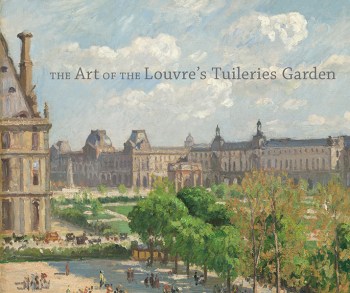 The Tuileries Garden is a masterpiece of garden design and one of the world’s most iconic public art spaces. Designed for Louis XIV by landscape architect André Le Nôtre, it served the now-destroyed Tuileries Palace. It was opened to the public in 1667, becoming one of the first public gardens in Europe. The garden has always been a place for Parisians to convene, celebrate, and promenade, and art has played an important role throughout its history. Monumental sculptures give the garden the air of an outdoor museum, and the garden’s beautiful backdrop has inspired artists from Edouard Manet to André Kertész.
The Art of the Louvre’s Tuileries Garden brings together 100 works of art, including paintings and sculptures, as well as documentary photographs, prints, and models illuminating the garden’s rich history. Beautifully illustrated essays by leading scholars of art and garden studies highlight the significance of the Tuileries Garden to works of art from the past 300 years and reaffirm its importance to the history of landscape architecture.
Laura D. Corey is consulting curator at the High Museum of Art. Paula Deitz is editor of The Hudson Review. Guillaume Fonkenell is curator of sculpture and museum historian at the Musée du Louvre. Bruce Guenther is chief curator and Robert and Mercedes Eichholz Curator of Modern and Contemporary Art at the Portland Art Museum. Sarah Kennel is curator of photographs at the National Gallery of Art, Washington, D.C. Richard H. Putney is an art historian and head of the Art Museum Practices program at the University of Toledo and Consulting Curator of Medieval Art at the Toledo Museum of Art.
Exhibition | From Veronese to Casanova: Italian Paintings from Brittany
From the Musée des Beaux-Arts de Rennes:
De Véronèse à Casanova: Parcours italien dans les collections de Bretagne
Musée des Beaux-Arts de Quimper, 19 April — 30 September 2013
Musée des Beaux-Arts de Rennes, 14 December 2013 — 2 March 2014
Curated by Mylène Allano
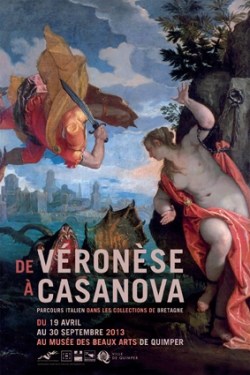 Les musées des beaux-arts de Rennes et de Quimper présentent successivement une grande exposition des peintures italiennes conservées dans la région. La manifestation a pour vocation de mettre en valeur et de faire connaître le patrimoine de la Bretagne historique, en exposant les fleurons des collections italiennes des musées de Brest, Dinan, Morlaix, Nantes, Quimper, Rennes, Vannes et ainsi que les plus belles œuvres des églises bretonnes ; soit 85 peintures de tout premier ordre offrant un panorama représentatif de la peinture italienne des XVIe au XVIIIe siècles.
Didier Rykner provides an exhibition review at La Tribune de l’Art (13 May 2013). . .
. . . L’exposition s’est basée sur une thèse de Mylène Allano—commissaire scientifique de cette exposition—qui cataloguait toutes les peintures italiennes conservées en Bretagne. Le parcours aurait pu être chronologique, par école ou par thèmes. C’est cette dernière présentation qui a été choisie. . .
◊ ◊ ◊ ◊ ◊
The catalogue is available from Artbooks.com:
Mylène Allano, ed., De Véronèse à Casanova: Parcours italien dans les collections de Bretagne (Lyon: Lieux Dits, 2013), 199 pages, ISBN: 978-2362190742, $47.50.
 Italian paintings held in Brittany are well known and appreciated by art specialists, and are characterised by their quality and by the variety of places represented (Venice, Rome, Naples…). This exhibition enables access to a remarkable set of works collected by museums, which have never previously received such attention. There are no less than eighty works which, for the first time, are the subject of an original display underlying the extraordinary vitality of artistic creation in Italy from the 16th century until the end of the 18th century.
Exhibition | Houghton Hall: Portrait of an English Country House
As Courtney Barnes noted back in November at Style Court, America’s fascination with England’s country houses will continue into the new year (and 2015). While Houghton Revisited, which brought dozens of paintings back to the house from Russia for display this summer and fall, was awarded Apollo Magazine’s 2013 Exhibition of the Year, pictures and objects still in the Houghton Hall collection will travel to Houston, San Francisco, and Nashville. From the MFAH press release (22 November 2013). . .
Houghton Hall: Portrait of an English Country House
Museum of Fine Arts, Houston, 22 June — 22 September 2013
Legion of Honor, San Francisco, 18 October 2014 — 18 January 2015
Frist Center for the Visual Arts, Nashville, 13 February — 10 May 2015
Curated by Gary Tinterow and Christine Gervais with David Cholmondeley

William Hogarth, The Cholmondeley Family, 1732
(Marquess of Cholmondeley, Houghton Hall)
◊ ◊ ◊ ◊ ◊
Family portraits by Hogarth and Sargent, exquisite examples of Sèvres porcelain, and unique pieces of William Kent furniture from this aristocratic English family chronicle three centuries of art, history, and politics.
Museum of Fine Arts, Houston, Director Gary Tinterow today announced an unprecedented exhibition: Houghton Hall: Portrait of an English Country House, which will be on view at the Museum from June 22 to September 22, 2014. The exhibition marks the first time the renowned collection of the Marquesses of Cholmondeley, housed at Houghton Hall, the family estate in Norfolk, will travel outside of England.

Houghton Hall (Photo: Nick McCann)
The house and much of its collection were built in the early 1700s by Sir Robert Walpole—England’s first prime minister and the ancestor of the current marquess. Renowned as one of the finest Palladian houses and one of the most extensive art collections in Britain, Houghton became notorious when Sir Robert’s collection of Old Master paintings was sold by his grandson to Catherine the Great, in 1779. But the house and all of its furnishings, considered to comprise William Kent’s Georgian masterpiece, remained intact; Walpole’s descendants added considerably to the collection of paintings. From great family portraits by William Hogarth, Joshua Reynolds, and John Singer Sargent, to exquisite examples of Sèvres porcelain, rare pieces of R. J. & S. Garrard silver, and unique furniture by William Kent, the exhibition vividly evokes the fascinating story of art, history, and politics through the collections of this aristocratic English family over three centuries.
Organized by Tinterow; Christine Gervais, associate curator; and Lord Cholmondeley, the exhibition will tour nationally after the Houston presentation, beginning with the Legion of Honor of the Fine Arts Museums of San Francisco (October 18, 2014–January 18, 2015) and the Frist Center for the Visual Arts in Nashville (February 13–May 10, 2015).
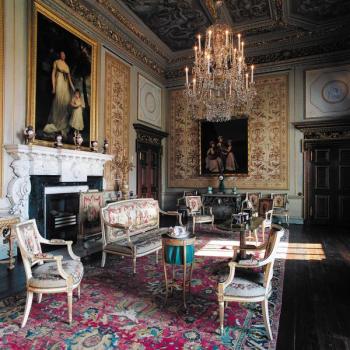
The White Drawing Room at Houghton Hall, with paintings by John Hoppner and George James (Photo: Nick McCann)
“Houghton Hall and its superb collections epitomize the historic legacy of art, architecture, and patronage among the great families and country houses of England,” commented Tinterow. “I am delighted to partner with David Cholmondeley to bring this extraordinary heritage to American audiences. Given our fascination with Downton Abbey and its similar story of a great English house and its family, I know this exhibition will be highly anticipated.”
“I was enormously gratified by the response to Houghton Revisited, the exhibition in which we reunited the paintings sold to Catherine the Great with their home at Houghton Hall,” commented David Cholmondeley on the success of that recent project. “I look forward to working with Gary Tinterow and his colleagues at the Museum of Fine Arts, Houston, to share Houghton Hall and our family’s history with visitors in Houston, San Francisco, and Nashville.”
About Portrait of an English Country House
Houghton Hall: Portrait of an English Country House will assemble more than 100 objects in settings that combine paintings, porcelain, sculpture, costume, metalwork, and furniture to evoke the stunning rooms at Houghton Hall. Bought or commissioned by eight generations of descendants of Sir Robert Walpole, together these objects comprise a fascinating chronicle. (more…)
Exhibition | Vincoli d’Amore: Spose in Casa Gonzaga
From the Palazzo Ducale in Mantova:
Vincoli d’Amore: Spose in casa Gonzaga tra XV e XVIII secolo
Museo di Palazzo Ducale, Mantua, 18 October 2013 — 6 January 2014
Curated by Paola Venturelli and Daniela Ferrari
 Si inaugura venerdì 18 ottobre alle ore 16.30 nell’Atrio degli Arcieri la mostra Vincoli d’Amore. Spose in casa Gonzaga tra XV e XVIII secolo, a cura di Paola Venturelli e Daniela Ferrari e promossa dall’Archivio di Stato di Mantova in collaborazione con la Soprintendenza BSAE di Mantova. Insieme alle curatrici intervengono Giovanna Paolozzi Strozzi, Soprintendente e Direttore del Museo di Palazzo Ducale, Francesca Zaltieri, Assessore alla Cultura della Provincia di Mantova e Renata Casarin Presidente del Soroptimist International Club di Mantova.
Spose di casa Gonzaga o spose giunte in casa Gonzaga lungo un arco di tempo che coincide con gli anni del dominio di questa grande dinastia, dagli inizi del XV secolo all’aprirsi del XVIII. Solo di alcune conosciamo le fattezze. Di poche gli interessi, i pensieri e le attitudini, rimanendo la maggior parte quasi priva di spessore storico e relegata nello sfondo della Grande Storia. Pedine, le cui mosse, abilmente studiate, porteranno tuttavia a costruire la Grande Storia dei Gonzaga. I loro matrimoni, voluti per allacciare vincoli di parentela con i principali casati, italiani o d’Oltralpe, erano infatti il frutto di oculate strategie dinastiche. Vincoli, qualche volta “d’amore”, anche spirituale – sull’imitazione del matrimonio mistico di Santa Caterina -, che cambiarono il panorama esistenziale delle nostre protagoniste.
La mostra è allestita negli ambienti in cui alcune delle protagoniste di questa esposizione hanno mosso i primi passi della loro vita coniugale. Presenti le duchesse Eleonora d’Asburgo ed Eleonora de’ Medici, ritratte nella supersite porzione della pala della Santissima Trinità, eseguita da Pieter Paul Rubens (ca. 1605), che domina la Sala degli Arcieri.
Exhibition | Grand Prince Ferdinando de’ Medici, 1663–1713
From the Uffizi:
The Grand Prince Ferdinando de’ Medici (1663–1713): Collector and Patron of the Arts
Uffizi Gallery, Florence, 26 June — 3 November 2013, extended until 6 January 2014
Curated by Riccardo Spinelli

◊ ◊ ◊ ◊ ◊
To mark the 300th anniversary of the death of Grand Prince Ferdinando de’ Medici (1663–1713), the Galleria degli Uffizi is planning to devote a celebratory exhibition to this key figure who was one of the most important collectors and patrons of the arts in the entire history of the Medici Grand Dukes of Tuscany. The son of Cosimo III and of Marguerite-Louise d’Orléans, Ferdinando nurtured two overriding interests, in the theatre and music and in the figurative arts, from a very early age. The exhibition sets out to convey the complexity of his interests and the innovative nature of his approach which drew the leading artists of the era (musicians, instrumentalists, painters and sculptors) to Florence between the end of the 17th century and the first decade of the 18th. The exhibition is broken down into sections illustrating the complex issues surrounding the prince’s cultural inclinations, while also presenting the buildings in which his patronage was played out.
An introductory iconographic section displays likenesses of the prince and of his family, with works by Giovan Battista Foggini, Justus Suttermans and Anton Domenico Gabbiani.
This is followed by a second section illustrating the early years of Ferdinando’s art collecting and patronage which focused in particular on his beloved villa at Pratolino where, alongside musicians, singers, costumiers and composers, he also hosted the Bibbiena family from Bologna, masters in the art of stage design. At the same time, the residence was being transformed in its interior decor and embellished with the work of Ferdinando’s favourite painters at the time, including Livio Mehus, Pier Dandini and Domenico Tempesti, all of whom were Tuscans, but also such “foreigners” as Crescenzio Onofri from Rome or Cristoforo Munari from northern Italy, all of them engaged in producing works closely linked to the villa and to the performances and other leisure activities that were held in it.
The third section is devoted to the renovation of Palazzo Pitti, of the Pergola Theatre and of the cathedral of Florence on the occasion of Ferdinando’s wedding to Princess Violante Beatrix of Bavaria in 1689. The ducal palace underwent radical transformation in its piano nobile, in the bridal couple’s apartments and in the mezzanines above, which were renovated in a spectacularly imaginative way, evinced in the exhibition by the memoirs and preparatory drawings of the artists who executed in the work (Luca Giordano, Diacinto Maria Marmi, Alessandro Gherardini, Giovan Battista Foggini and Anton Domenico Gabbiani). At the same time, the section also explores the ceremonies and festivities held in Florence to mark the prince’s wedding, using drawings and documents for the purpose.
The fourth section illustrates the prince’s growing interest in the figurative arts, both in contemporary sculpture and in painting, with the leading artists active at the time, many of whom were experts in such ‘modern’ late 17th-century genres of as still-life and portraiture. Thus this part of the exhibition contains both religious and secular works (by Carlo Dolci, Carlo Loth, Baldassarre Franceschini and Il Volterrano) and examples of ‘painted nature’ (by Jacopo Ligozzi, Bartolomeo Bimbi, Margherita Caffi, Fardella, Houbracken and Michelangelo Pace da Campidoglio). Of equal interest in the section is the presence of sumptuary objects, pieces of furniture and everyday items testifying to Ferdinando’s sophisticated tastes, with works by the leading engravers, marquetry inlayers and silversmiths then active at court.
The highly significant fifth section explores the tastes of the Grand Prince as collector, with some of the 16th- to 18th-century paintings removed from churches in Tuscany and elsewhere, including Andrea del Sarto’s Madonna of the Harpies, Lanfranco’s Ectasy of St. Margaret of Cortona, Annibale Carracci’s Farnese Altarpiece, and lastly, the Madonna of the Long Neck by Parmigianino, one of Fernando’s most prestigious acquisitions in the field of Renaissance art as the 17th century drew to a close.
The sixth section is devoted to the grand prince’s favourite villa of all, Poggio a Caiano, whose decoration he renovated with the greatest magnificence. He chose a room on its piano nobile to house one of his most original collections comprising ‘works in miniature’, which is eloquently recreated in the exhibition through a selection paintings that once formed part of it, illustrating the prince’s catholic tastes in collecting.
The seventh section of the exhibition illustrates the prince’s taste for major Florentine statuary at the close of the 17th century, while in the sphere of painting it looks at the change in Ferdinando’s taste in favour of ‘foreign’ schools—far more modern than anything local artists could produce—such as the Venetian school (of which he was enamoured in his youth), the Bolognese school and the Ligurian school (with work by Crespi, Cassana, Fumiani, Sebastiano and Marco Ricci, Magnasco and Peruzzini) whose leading painters were summoned to Florence, where they produced some of their masterpieces specifically for the prince.
The final section is devoted to the last years of Ferdinando’s life, exploring the results and repercussions of his art patronage and collecting, and displaying the drawings for a celebratory monument that it was planned to erect in his memory, the sketches for that project, and material relating to his funeral.
Available from Artbooks.com:
Riccardo Spinelli, ed., Il gran principe Ferdinando de’ Medici (1663–1713) Collezionista e Mecenate (Firenze: Giunti, 2013 ), 430 pages, ISBN: 978-8809786103, $77.50.
◊ ◊ ◊ ◊ ◊
This smaller exhibition was on view until recently at the Villa of Poggio a Caiano:
For the Grand Prince Ferdinando:
Still lifes, vedute, bambocciate and caramogi from the Medici Collections
Medici Villa of Poggio a Caiano, 5 July — 5 November 2013
Curated by Maria Matilde Simari

◊ ◊ ◊ ◊ ◊
The Villa of Poggio a Caiano was one of the favourite residences of the Grand Prince Ferdinando de’ Medici (1663–1713), son of the Grand Duke Cosimo III and destined to succeed his father in the government of Tuscany. In concomitance with the major exhibition devoted to the Grand Prince in the Uffizi Gallery, the idea is to recall the figure of Ferdinando in the site of his favourite villa, too. It was here that Ferdinando spent the spring and autumn, riding his Berber horses, attending sophisticated concerts and operas performed in the theatre of the villa and devoting himself to the organisation of his own particular collection of miniature paintings, the so-called ‘Gabinetto di opere in piccolo’ which went on to become a famous example of a late seventeenth-century collection.
Significant evidence of Ferdinando’s commissions for the Villa of Poggio has fortunately survived in the large fresco dating to 1698 by Anton Domenico Gabbiani showing Cosimo de’ Medici being presented to Jupiter by Florence, which can be seen on the ceiling of the dining room on the first floor. This painting shows the celebratory and official side of court taste, but other aspects of the personality of Ferdinando, who was a curious man, interested in a wide range of artistic genres, also deserve to be explored.
An itinerary extending through fourteen rooms of the Still Life Museum is devoted to the Grand Prince as a collector of still lifes, highlighting the works that were certainly part of his collection. At the end of this itinerary is a room devoted to two different aspects of his tastes as a collector: the miniatures and the genre paintings, comprising in the latter group the views, the bambocciate and the grotesque and humorous paintings portraying pygmies and dwarves, or the whimsical caramogi.
The Grand Prince Ferdinando was attracted not only by great figure painting and by the works of the most famous painters of the sixteenth and seventeenth centuries (Titian, Parmigianino and Sebastiano Ricci) but also by artists engaged in collateral aspects and genres that can certainly not be defined as minor, since they made a very particular and novel impression on seventeenth-century taste: the flower painters, the painters of vedute, the Dutch petits maîtres, the bamboccianti painters of everyday life and the caricaturists.
The inventory of the assets of the Grand Prince drawn up at his death in 1713 records no less than sixteen paintings depicting caramogi (deformed, dwarf-like figures) intent upon various games and activities, for one of which the author’s name is specifically mentioned: the Brescia artist Faustino Bocchi, a renowned specialist in ‘the painting of pygmies’ who appears to have sojourned at the grand ducal court, and whom Ferdinando may in any case have met during a trip to Veneto and Lombardy in 1688. His interest in this particular grotesque genre can be linked to the recollections of Ferdinando as a passionate lover of amusing sonnets, ‘burlette burlesche’, of poets in ottava rima, comedians and ham actors.
The small collection of works displayed in the room dedicated to the Grand Prince Ferdinando in the Still Life Museum of the Villa of Poggio a Caiano offers a synthetic overview of the vedute, the bambocciate and the caramogi that he loved, displaying works not normally visible to the public since they are conserved in the repositories of the Florentine Galleries and of other institutions. Also on display is an as yet unpublished painting by Bartolomeo Ligozzi on which the date and signature have been discovered.
The show is rounded off by a selection of ancient manuscripts and printed books connected with the eclectic personality of Ferdinando: a cultured, passionate and curious collector who is also remembered as a cordial and affable man with a great sense of humour. As one of the manuscript memoirs recalls: “With his departure, spirit and joy too took their leave of Florence and Tuscany.”
Exhibition | Joseph Wright of Derby: Bath and Beyond
From The Holburne Museum:
Joseph Wright of Derby: Bath and Beyond
The Holburne Museum, Bath, 25 January — 5 May 2014
Derby Museum and Art Gallery, dates TBA
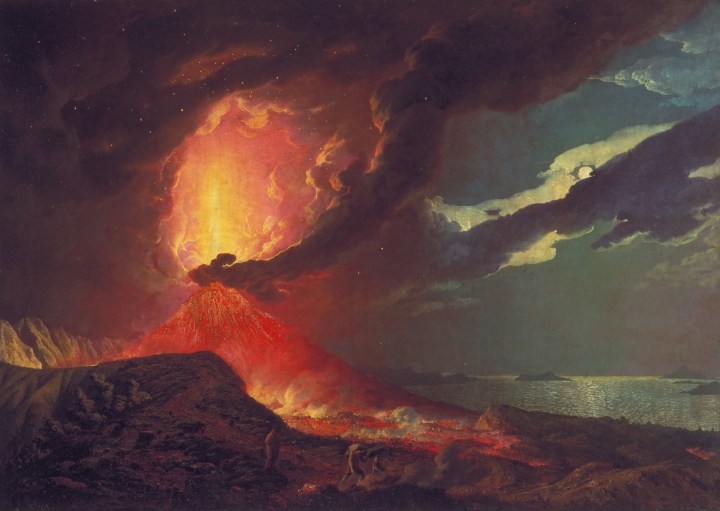
Joseph Wright, Vesuvius in Eruption, with a View over the
Islands in the Bay of Naples, ca. 1776–80 (London: Tate)
◊ ◊ ◊ ◊ ◊
I have taken the Liberty to give this Letter of Introduction to my Friend Mr. Wright of Derby, Who since his Return from Italy is come to Bath, & Designs to settle there.
Erasmus Darwin, 22 November 1775
Joseph Wright ‘of Derby’ (1734–1797) lived and worked in Bath between November 1775 and June 1777. This brief and little-known episode in Wright’s life marked a crossroads in his career; yet it has never been explored in detail. Joseph Wright of Derby: Bath and Beyond will place Wright in the context of the many artists, musicians, writers, business people and scientists living and working in the Georgian spa and present for the first time a comprehensive view of his life and work during those eighteen months. The exhibition and accompanying catalogue will also go ‘beyond’ to examine the effect of his time in Bath and his travels in Italy on Wright’s later work.

Joseph Wright, The Rev. Dr. Thomas Wilson and his adopted Daughter Miss Catherine Sophia Macaulay, 1776 (Chawton House Library)
Wright came to Bath to paint portraits, hoping to build on the success of Thomas Gainsborough who had recently left for London. The exhibition will include the three remaining portraits that the artist certainly made in Bath, including his painting of the elderly Rev. Thomas Wilson with the young daughter of Catharine Macaulay, the radical historian.
Whilst in Bath Wright worked up landscape studies he had made in Italy, producing spectacular views of Vesuvius in Eruption and the dazzling firework displays of Rome, the highlight of a visit to the artist’s studio in Brock Street. It was whilst in Bath that he first began to explore subjects from sentimental contemporary literature, which in turn have a strong impact on his portrait composition, and the exhibition will include some of his most beautiful depictions of figures alone in the landscape.
We are grateful to Derby Museum, which holds the world’s largest and finest collection of Wright’s work, for its generous loans to this exhibition which will include The Indian Widow, The Alchymist and some beautiful drawings. Other lenders include the National Gallery, Musée du Louvre, Tate, the British Museum, the Walker Art Gallery and the Fitzwilliam Museum. This exhibition will travel to Derby Museum and Art Gallery.
A study day is scheduled for 24 February 2014.
◊ ◊ ◊ ◊ ◊
From I. B. Tauris:
Amina Wright, Joseph Wright of Derby: Bath and Beyond (London: Philip Wilson Publishers, 2014), 112 pages, ISBN: 978-1781300213, £16 / $30.
 Joseph Wright (1734–1797) arrived in Bath from his native Derby in November 1775. Recently returned from a tour of Italy, he came to the fashionable spa town to re-establish his business as a portrait painter, hoping to fill the vacancy left by Thomas Gainsborough the previous year. This book, the first to examine Wright’s little-known Bath period, places the artist in the context of a city then at the height of its unique cultural significance. Using rarely-seen illustrations of his work, it considers his attempts to conquer a saturated portrait market with images of local celebrities, and his use of domestic spaces for public exhibition. His celebrated views of fireworks in Rome and the terrors of Vesuvius were first shown in Bath. Beautifully illustrated and highly readable, Joseph Wright of Derby: Bath and Beyond sheds new light on a key moment in this important English artist’s career, deepening our understanding of his life and work as a whole.
Amina Wright is Senior Curator at the Holburne Museum in Bath, UK, and has been Curator of Fine Art there since 2001. She was closely involved in the Holburne’s major redevelopment project, completed in 2011, as well as a number of exhibitions relating to British eighteenth-century painting, drawings and Georgian Bath. Previous publications include the exhibition catalogues Pictures of Innocence: Children in Portraits from Hogarth to Lawrence (2005) and Pickpocketing the Rich: Portrait Painting in Bath 1720–1800 (2002).
Exhibition | Metropolitan Vanities: The History of the Dressing Table
Press release (3 July 2013) from The Met:
Metropolitan Vanities: The History of the Dressing Table
The Metropolitan Museum of Art, New York, 17 December 2013 — 13 April 2014
Curated by Jane Adlin

Martin Carlin, combination table, ca. 1775 (New York: Metropolitan Museum of Art,1976.155.99a, b)
Metropolitan Vanities: The History of the Dressing Table at The Metropolitan Museum of Art will explore the evolution of the modern dressing table. Few pieces of furniture have revealed more about social customs, leisure-time pursuits, and popular tastes throughout history. The form of the dressing table—or vanity, as we know it today—began to develop in the late 17th century in Europe. The exhibition will consist of outstanding examples of this furniture form and some 50 related objects, paintings, and drawings selected mainly from the Metropolitan’s collection. Ancient Egyptian decorative boxes used to hold cosmetics, classical Greek and Roman scent bottles, medieval mirror cases, 18th-century nécessaires, and innovative contemporary jewelry and accessories will be on display.
In the late 17th century, European high society began commissioning luxurious specialized furniture from craftsmen and furniture makers. The poudreuse in France, and the low boy, Beau Brummel, and shaving table in England served as models for the dressing table. Jean-Henri Riesener’s Mechanical Table (1780–81) is one of the finest examples of this period in the exhibition. This table, in which the top slides back as the drawer slides forward to reveal a toilette mirror flanked by two compartments, was delivered by the cabinetmaker to Queen Marie Antoinette at Versailles in January 1781.
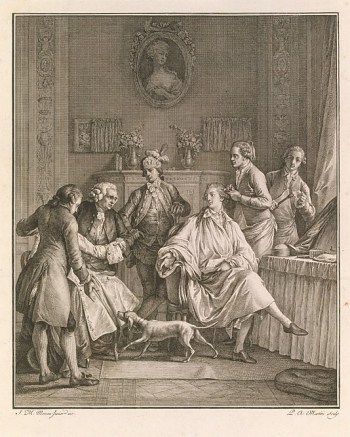
Pietro Antonio Martini, after Jean Michel Moreau the Younger, The Morning Toilet (La Petite Toilette), from Le Monument du Costume, ca. 1777
(New York: Metropolitan Museum of Art, 33.6.28)
In America the designs for dressing tables were simpler, with the Chippendale style among the most popular. During the 19th century, dressing tables were made in many revivalist styles including the Gothic, Elizabethan, Rococo, Renaissance, and Colonial revivals, to name a few. Eventually, in the later 19th century, the dressing table—like other cabinet furniture—became a matching part of the bedroom suite.
It was not until the early part of the 20th century, during the Art Deco period in both Europe and America, that luxurious dressing tables came to epitomize the modern concept of glamour and luxury. Hollywood films of the 1920s and ’30s, with their fantasy world of penthouses atop Manhattan skyscrapers, were hugely popular during this period and often depicted the femme fatale heroine sitting at her supremely elegant vanity table in the bedroom or dressing room. Norman Bel Geddes’s enamel and chrome-plated steel dressing table (1932) is a model for this streamlined and sophisticated style.
More recently, designs for the dressing table have reflected the diversity of new styles, from the modern molded-plastic valet dressing cabinet of Raymond Loewy (1969) to a postmodernist Plaza dressing table and stool by Michael Graves (1981) and a minimalist dressing table of today by the Korean contemporary designer Choi Byung Hoon (2013).
Metropolitan Vanities: The History of the Dressing Table is organized by Jane Adlin, Associate Curator in the Department of Modern and Contemporary Art at The Metropolitan Museum of Art. The exhibition is accompanied by a Bulletin published by the Metropolitan Museum and distributed by Yale University Press (volume 71, Fall 2013).
More images are available here (under additional resources).
Exhibition | Rococo to Neoclassicism from the Palazzo Chigi in Ariccia
From Artbooks.com:
Dipinti tra rococò e neoclassicismo da Palazzo Chigi in Ariccia e da altre raccolte
Palazzo Ducale Castromediano di Cavallino, Lecce, 21 September — 15 December 2013
 La mostra è dedicata alla memoria di Fiammetta Luly Lemme (Ancona, 20 marzo 1937 – Roma, 29 marzo 2005), avvocato, collezionista e studiosa d’arte, moglie dell’avvocato Fabrizio Lemme, che con lei ha condiviso i medesimi interessi per l’arte e il collezionismo, che ancora coltiva. La collezione Lemme, formata con la consulenza di insigni studiosi quali Federico Zeri, Italo Faldi e Giuliano Briganti, fornisce un rilevante materiale di studio per la conoscenza della pittura barocca, rococò e proto-neoclassica, con particolare attenzione al Settecento romano. Nel 1998 i coniugi Lemme donarono al Museo del Louvre venti quadri e una scultura, collocati nella “Sala Lemme,” mentre altri ventuno furono donati contestualmente alla Galleria Nazionale d’Arte Antica di Palazzo Barberini, oggi organicamente inseriti nel nuovo allestimento.
Il 28 maggio 2007 Fabrizio, Giuliano e Ilaria Lemme hanno formalizzato la donazione al Palazzo Chigi in Ariccia del nucleo più importante della collezione, costituito da 128 dipinti, in gran parte già oggetto di notifica del Ministero dei Beni Culturali e Ambientali come insieme di elevato interesse storico artistico (Decreto del 1 dicembre 1998). La raccolta è confluita nel Museo del Barocco Romano, ubicato nella dimora chigiana, formato a partire dal nucleo di dipinti del ‘600 lasciati nel 2002 dallo storico dell’arte Maurizio Fagiolo dell’Arco. Ulteriori donazioni provenienti da altre raccolte (Ferdinando Peretti, Oreste Ferrari, Renato Laschena, etc.) hanno potenziato il museo di Palazzo Chigi, arricchendo le già rilevanti raccolte di provenienza chigiana, acquisite con la dimora nel 1989.
Il presente evento si pone in continuità ideale ed è una prosecuzione in termini didattici e storicoartistici della mostra Dipinti del Barocco Romano da Palazzo Chigi in Ariccia, tenuta a Cavallino di Lecce tra settembre e dicembre 2012, circoscritta alla pittura romana del ‘600. L’esposizione si volge al ‘700, il secolo dei lumi, l’età d’oro del Grand Tour d’Italie, che ebbe in Roma il proprio centro pulsante, propagandosi in tutta Italia. Tuttavia, oltre agli artisti attivi nella capitale pontificia, sono presenti in mostra anche pittori della scuola napoletana, provenienti o attivi nel regno borbonico. Spicca in ambito meridionale la figura di Corrado Giaquinto, il massimo artista pugliese del secolo ed uno dei più grandi del ‘700. Sono presenti anche tele di Paolo de Matteis, pittore della scuola napoletana attivo anche nel Salento. Le opere esposte provengono in gran parte da Palazzo Chigi, sia dalla collezioni storiche chigiane che dal Museo del Barocco. Sono presenti anche alcune opere in collezione privata, compresi ulteriori dipinti raccolti da Fabrizio Lemme negli ultimi anni o provenienti da una prestigiosa collezione privata inglese.
Francesco Petrucci, Dipinti tra rococò e neoclassicismo da palazzo Chigi in Ariccia e da altre raccolte (Rome: Gangemi, 2013), 128 pages, ISBN: 978-8849227086, $48.50.










 Enfilade
leave a comment