Exhibition | Art and Appetite: American Painting
In comparison to the nineteenth century, the eighteenth-century offerings are slim, but it’s still hard to tell this story without the latter. Press release (11 December 2014) from the Amon Carter:
Art and Appetite: American Painting, Culture, and Cuisine
The Art Institute of Chicago, 12 November 2013 — 27 January 2014
Amon Carter Museum of American Art, Fort Worth, Texas, 22 February — 18 May 2014
Curated by Judith A. Barter

John Greenwood, Sea Captains Carousing in Surinam, ca.1752–58
(Saint Louis Art Museum)
◊ ◊ ◊ ◊ ◊
This spring, the Amon Carter Museum of American Art invites visitors to feast their eyes on the rich tradition of food in American art with the opening of the exhibition Art and Appetite: American Painting, Culture, and Cuisine. Exploring the many meanings and interpretations of eating in America, Art and Appetite brings together 65 paintings from the 18th through the 20th centuries to demonstrate how depictions of food have allowed American artists to both celebrate and critique everything from trends in the national diet to the broader issues of society and politics. Featuring many iconic works by such noted artists as Edward Hopper, Norman Rockwell and Andy Warhol, the exhibition is on view from February 22 through May 18, 2014. Art and Appetite is organized by the Art Institute of Chicago; admission is free.
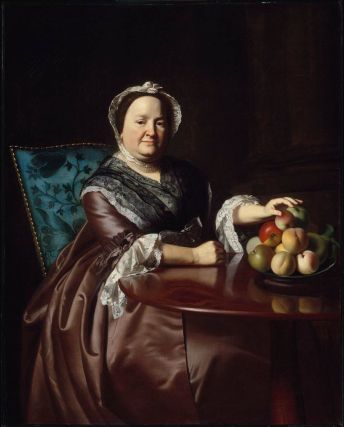
John Singleton Copley, Portrait of Mrs. Ezekiel Goldthwait (Elizabeth Lewis), 1771 (Boston: Museum of Fine Arts)
Art and Appetite takes a different approach to the subject of food in American art, contextualizing works to rediscover the meanings they held for their makers and their audiences. Despite the prevalence of works about food, research has rarely focused on the cultural significance of the objects depicted in these paintings, nor has it addressed how these images embodied changing ideals throughout the nation’s history. Thematically and chronologically organized, Art and Appetite breaks with the traditional histories of the genre to explore how these works illuminate American attitudes about patriotism and politics, identity and gender, progress and history, and production and consumption. The exhibition examines 250 years of American art, from the agricultural bounty of the “new world” to Victorian-era excess, debates over temperance, the rise of restaurants and café culture, the changes wrought by 20th-century mass production, and much more.
From the earliest years of the newly established United States, American artists such as Raphaelle Peale used still-life painting to express cultural, political and social values, elevating the genre to a significant aesthetic language. Later, in the antebellum era, depictions of food highlighted abundance, increasing wealth and changing social roles, while elegant decanters of wine and spirits in still-life paintings by John F. Francis reflect the prevalence of drinking and the mid-century debates over temperance. During the Gilded Age, despite the implications of the term, American artists moved away from excess and eschewed high Victorian opulence in favor of painting the simple meal. Many artists, such as William Harnett and De Scott Evans, also used images of food to serve up biting political commentary that addressed the social and economic transformations of the 1880s and 1890s.
In the 20th century new ways of eating and socializing began to change depictions of food in art. Restaurant dining—still novel in the United States in the late 19th century—became a common subject in the works of William Glackens, John Sloan and others. Café and cocktail culture, described in the work of Stuart Davis and Gerald Murphy, became increasingly important even as Prohibition banned the consumption of alcohol. Modern artists employed food in their radically new explorations of pictorial form, all the while challenging national ideals of family and home. Finally, during the 1950s and 1960s, Pop artists, among them Andy Warhol and Roy Lichtenstein, addressed the ways in which mass production and consumption dramatically altered the American experience of food. Hamburgers, fries and cakes were depicted as objects of mass-produced foodstuffs without human referent. Artists employed new means to explore the visual power of advertising, the standardization of factory-produced meals and the commercialization of American appetites.
Today, as professional and home chefs increasingly turn toward local, organic food and American society ponders its history as a fast-food nation, this exhibition offers visitors the chance to look at depictions of American food and culture with new meaning and fresh eyes.
Art and Appetite: American Painting, Culture, and Cuisine was organized by the Art Institute of Chicago. It is supported in part by generous contributions from Central Market, the Fort Worth Promotion and Development Fund, and the Ben E. Keith Foundation.
Also, see the online cookbook from The Art Institute of Chicago.
◊ ◊ ◊ ◊ ◊
From Yale UP:
Judith A. Barter, ed., with essays by Judith A. Barter, Annelise K. Madsen, Sarah Kelly Oehler, and Ellen E. Roberts, Art and Appetite: American Painting, Culture, and Cuisine (New Haven: Yale University Press, 2013), 248 pages, ISBN: 978-0300196238, $50.
 Food has always been an important source of knowledge about culture and society. Art and Appetite takes a fascinating new look at depictions of food in American art, demonstrating that artistic representations of edibles offer thoughtful reflection on the cultural, political, economic, and social moments in which they were created. Artists used food as prism through which they could celebrate and critique their society, expressing ideas relating to politics, race, class, and gender. With a focus that ranges from Colonial still lifes of the 18th century through the Pop artists of the 20th century, this lively publication investigates the many interpretations of eating in America.
Art and Appetite features still-life and trompe l’oeil painting, sculpture, and other works by such celebrated artists as John Singleton Copley, Raphaelle Peale, Lilly Martin Spencer, William Michael Harnett, William Merritt Chase, Elizabeth Paxton, Norman Bel Geddes, Stuart Davis, Edward Hopper, Alice Neel, Wayne Thiebaud, and Roy Lichtenstein, among others. Essays by leading experts address topics including the horticultural and botanical underpinnings of still-life painting, the history of alcohol consumption in the United States, the cultural history of Thanksgiving, and the commercialization of food in the world of Pop art. In addition to the images and essays, this book includes a selection of vintage recipes for all-American dishes.
Judith A. Barter is the Field-McCormick Chair and Curator, Department of American Art, at the Art Institute of Chicago.
Exhibition | Genius and Grace
From the exhibition press release:
Genius and Grace: Franҫois Boucher and the Generation of 1700
Cincinnati Art Museum, 14 February — 11 May 2014
Curated by Esther Bell

François Boucher, Venus Presenting Aeneas to Jupiter and Juno, 1747, black chalk, pen with brown ink, and brush with brown wash and touches of white gouache on tan antique laid paper (Boston: The Horvitz Collection)
◊ ◊ ◊ ◊ ◊
This spring, the verve, grace, and exuberance of 18th-century French drawings will be on display at the Cincinnati Art Museum. The Cincinnati Art Museum will show drawings by the talented group of artists responsible for an unprecedented level of artistic and cultural production in the France of Louis XV in an exhibition titled Genius and Grace: Franҫois Boucher and the Generation of 1700, on view from February 14 to May 11, 2014. Franҫois Boucher, Charles-Joseph Natoire, Carle Vanloo, and their contemporaries, born in or around 1700, executed virtuoso compositions whose refined elegance epitomizes the French grand manner. Along with Boucher, Natoire, and Vanloo, the exhibition will also celebrate lesser known but equally talented figures such as Louis-Gabriel Blanchet and Joseph Franҫois Parrocel, as well as several pastels, including a rare example by Jean-Baptiste-Siméon Chardin. More than seventy master drawings, many of which have never before exhibited or published, will be on view.
This exhibition is organized by the Horvitz Collection in Boston—the preeminent private collection of early French art in the United States. Twenty-nine of the most distinguished artists of this period will be featured, along with a fully illustrated catalogue edited by Alvin L. Clark, Curator of the Horvitz Collection and the J.E.Horvitz Research Curator, Department of Drawings, Harvard Art Museums/Fogg Museum. The Cincinnati Art Museum venue for Genius and Grace: François Boucher and the Generation of 1700 is organized by Dr. Esther Bell, Curator of European Paintings, Drawings, and Sculpture; it is the first old master drawings exhibition to take place at the Cincinnati Art Museum in more than thirty years. “These are some of the most beautiful and sexiest images the Old Masters ever produced,” commented Cincinnati Art Museum Director Aaron Betsky. “They are stunning in their display of talent and the sensuality they convey.”

François Boucher, Recumbent Female Nude, ca. 1742–43, red chalk, heightened with white chalk (Boston: The Horvitz Collection)
◊ ◊ ◊ ◊ ◊
Sixteen of the works on view were created by Franҫois Boucher, who an eighteenth-century critic called “the painter of voluptuousness and grace.” One of the artist’s drawings, Recumbent Nude, depicts a luscious female figure. This may, at first, seem to be a provocative and erotically charged image, but it may have simply developed from a figure study intended to be used when painting a sea nymph or other historical subject. Also part of the exhibition is Carle Vanloo’s Saint Augustine Disputing with the Donatists, which has never before been exhibited. This masterpiece is remarkable for its heavy contours and energetic forms encased within a scene of monumental Italian architecture.
According to Cincinnati Art Museum Curator Dr. Esther Bell, “A selection of master drawings was selected that best tell the story of the unfolding eighteenth century. Not only will visitors be able to enjoy the sumptuous forms of the high Rococo, but also the virtuoso drawings that resulted from rigorous academic training and the cool and classicizing manifestations of these artists’ Italian journeys.”
◊ ◊ ◊ ◊ ◊
From Artbooks.com:
Alvin Clark, ed., Genius and Grace: Franҫois Boucher and the Generation of 1700 (Boston: The Horvitz Collection, 2014), 151 pages, ISBN: 978-0991262502, $34.
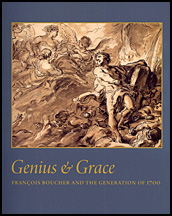 Genius and Grace: Franҫois Boucher and the Generation of 1700 features over seventy master drawings from the Horvitz Collection, Boston—widely considered the preeminent collection of French art in the United States. The exhibition features works by a group of artists known as the Generation of 1700. This talented group of artists born in or around the year 1700, such as François Boucher, Charles-Joseph Natoire, Carle Vanloo, and their contemporaries, will be celebrated for their virtuoso compositions whose curvilinear elegance epitomizes the French grand manner. From Boucher’s sumptuous reclining female nude, to a rare, early pastel by Jean-Baptiste-Siméon Chardin, to Director of the French Academy Charles Coypel’s mature self portrait—the works on view celebrate Dezallier d’Argenville’s comment of 1745: “A painter’s way of drawing is as distinctive as handwriting and more so than a writer’s style.” Includes: A. Clark, “The Generation of 1700: Draftsmen, Drawings, and Questions”; F. Joulie, “Reflections on the Early Drawings of Boucher and His Contemporaries”; and E. Bell, “Charles Coypel and the Age of Eclecticism.”
Exhibition | The First Georgians: Art & Monarchy 1714–1760
Press release (29 January 2014) from The Royal Collection:
The First Georgians: Art & Monarchy 1714–1760
The Queen’s Gallery, Buckingham Palace, London, 11 April — 12 October 2014

◊ ◊ ◊ ◊ ◊
In 1714 Georg Ludwig, Elector of Hanover in Germany, acceded to the British throne as George I, the country’s first constitutional monarch. Despite many stronger genealogical claims to the crown than his, the 1701 Act of Settlement had declared that the choice of sovereign was the gift of Parliament alone and that only a Protestant could sit on the British throne. With this unprecedented decision, the Georgian era began, ushering in an unbroken line of succession to Her Majesty Queen Elizabeth II.
Marking the 300th anniversary of the Hanoverian succession, The First Georgians: Art & Monarchy 1714–1760 explores the reigns of George 1 (r.1714–27) and his son George II (r.1727–60), shedding light on the role of this new dynasty in the transformation of political, intellectual and cultural life. Through over 300 works from the Royal Collection, it tells the story of Britain’s emergence as the world’s most liberal, commercial and cosmopolitan society, embracing freedom of expression and the unfettered exchange of ideas.
The Hanoverians’ right to rule was fiercely disputed by the Jacobites, supporters of the Stuart claim to the throne. The ‘Old Pretender’, Prince James Francis Edward Stuart, set up a rival court in Paris and Rome, and his son, Prince Charles Edward—Bonnie Prince Charlie—led an uprising in 1745–46 on behalf of his father’s cause. The continuous threat to Hanoverian rule, both at home and overseas, is reflected in the exhibition’s military maps and battle plans. They include a draft order of battle at Culloden, thought to have been produced by George II’s son, the Duke of Cumberland, who led the King’s troops to victory in 1746.
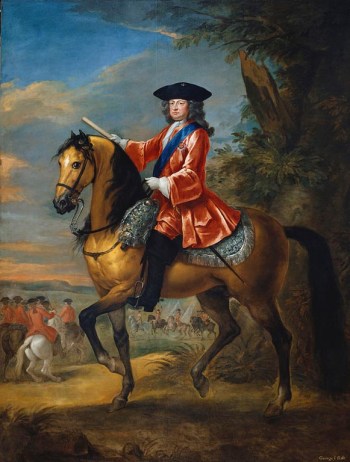
Vanderbank, Equestrian Portrait of George I, 1726
(Royal Collection 404412)
Although St James’s Palace remained the principal royal residence, the newly installed George I focused his artistic attention on Kensington Palace–its location outside London provided some shelter from the scrutiny of his more sceptical subjects. Here he appointed William Kent to decorate a new suite of State Rooms. The King filled Kensington with the best British furniture of the day, including pieces by James Moore and Old Master paintings, such as Don Roderigo Calderón on Horseback, 1612–15, and The Holy Family with St Francis, 1620–30, by Peter Paul Rubens.
The reigns of both Georges were fraught with familial strife. In 1717 George I expelled the Prince of Wales, the future George II, from St James’s Palace. Far from enduring a humiliating exile, the Prince established an alternative court, hosting ‘drawing rooms’, evening parties and balls, and regularly dining in public. Some 20 years later, George II’s son, Frederick, Prince of Wales (whose son George William Frederick became George III) was similarly banished and set up rival headquarters. Furnishing his private residences, the Prince could indulge his enthusiasm for the Old Masters. Among his acquisitions were Guido Reni’s Cleopatra with the Asp, c.1628, Anthony van Dyck’s Thomas Killigrew with an unidentified Man, c.1630, and ‘The Jealous Husband’, c.1660, by David Teniers.
Frederick presented himself as a fashionable man about town, entertaining freelyand informally—a typical supper party offered a menu of larks, pigeons, partridges, truffles, veal, turkey, lamb, turbot, salmon, teal, blackbird, asparagus, broccoli, sweetbreads, coffee cream and jelly. To dress his table, he commissioned dining plate in the new Rococo style, including the spectacular marine service by Paul Crespin and Nicholas Sprimont. Frederick’s mother, Queen Caroline, despised her son’s relaxed manner: “popularity always makes me sick,” she is reported to have said, “but Fretz’s popularity makes me vomit.”
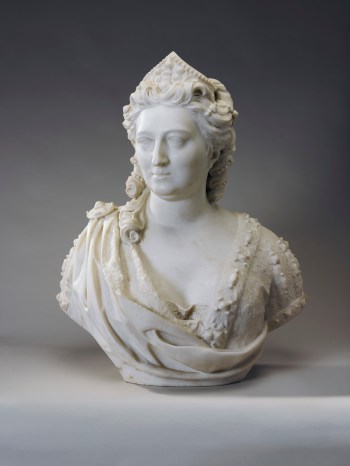
After John Michael Rysbrack and Joseph Highmore, Posthumous Portrait of Queen Caroline, Consort of George II, 1739
(Royal Collection, 31317)
Queen Caroline, consort of George II, was the most intellectual member of the Hanoverian dynasty. Her interests combined art, genealogy and a passion for gardening. She undertook major landscape projects at Kensington Palace and at her private retreat in Richmond, where she commissioned Charles Bridgeman to lay out the new gardens, complemented by follies created by William Kent. The most remarkable of these was the Hermitage, a picturesque temple devoted to British scientists and theologians, encapsulating Caroline’s belief in the interdependence of science and religion.
During the course of the 18th century, the focus of British cultural life began to shift away from court. Artists achieved success and fame through their own efforts, without the traditional support of a royal patron. William Hogarth’s portrait of David Garrick and his Viennese dancer wife, Eva-Marie Veigel, captures one of the most high-profile couples of the age. When the portrait was painted, in c.1757–64, Garrick had already combined great financial success as an actor-manager with international celebrity. Hogarth himself was not only a prominent artist, but
also a writer on art and a noted philanthropist.
The favourite genre of the early Georgian period was satire, both pictorial and literary. In 1724, its greatest practitioner, William Hogarth, published The Bad Taste of the Town, ridiculing British taste for foreign forms of art, such as Italian opera. London’s leading exponent of Italian opera was the German composer George Frideric Handel, who was employed in many royal roles. He was music teacher to George II’s daughter, Princess Anne, who is seen playing the cello with her two sisters and brother, Frederick, Prince of Wales, in Philippe Mercier’s The Music Party, 1733.

Meissen, Tea and coffee service with chinoiserie figures, 1720s
(Royal Collection, 5000106)
The desire for fashionable luxury goods drove Britain’s commercial enterprise and turned London into the most important trading city in the world. The Chelsea porcelain works, one of several new ventures set up to compete with the newly established Meissen factory in Germany, typified the entrepreneurialism of the time. With the emergence of a new leisure class came an explosion of coffee houses, gaming haunts, assembly rooms, theatrical entertainments and pleasure gardens. In the painting St James’s Park and the Mall, c.1745, all elements of cosmopolitan Georgian society mix together, with Frederick, Prince of Wales at the centre, rubbing shoulders with his future subjects.
◊ ◊ ◊ ◊ ◊
The catalogue is published by the Royal Collection and distributed by the University of Chicago Press:
Desmond Shawe-Taylor, ed., The First Georgians: Art & Monarchy 1714–1760 (London: Royal Collection Trust, 2014), 496 pages, ISBN 978-1905686797, £45 / $90.
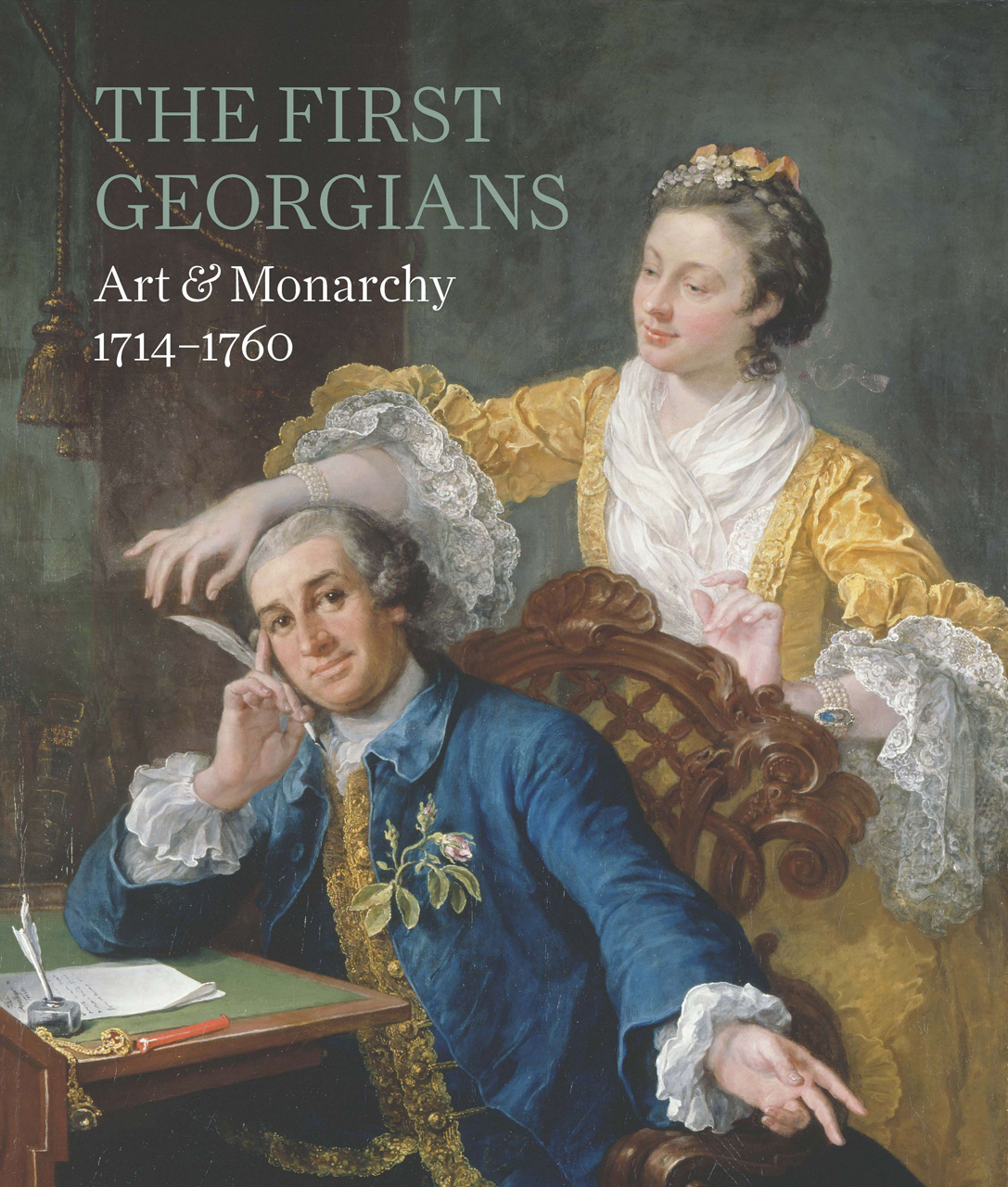 2014 marks the three-hundredth anniversary of the succession of the House of Hanover to the British throne. In celebration of this historic milestone, The First Georgians explores the rich artistic culture of the early Hanoverian period.
This publication showcases more than three hundred of the finest works of this period, many of which have never been on public display before. Created in Germany, France, and Britain during one of the most dramatic periods of change across all aspects of political, intellectual, and cultural life, they reflect changing views of science, politics, and art throughout the early to mid-eighteenth century—the period when modern Britain was coming into being.
Exhibition | Caravaggio to Canaletto
My apologies for (once again) being so late with this exhibition, which recently closed at the Museum of Fine Arts in Budapest. The catalogue, however, is still available from Artbooks.com. -CH
Caravaggio to Canaletto: The Glory of Italian Baroque and Rococo Painting
Museum of Fine Arts, Budapest, 26 October 2013 — 16 February 2014
Curated by Zsuzsanna Dobos

◊ ◊ ◊ ◊ ◊
The Museum of Fine Arts’ exhibition titled Caravaggio to Canaletto will present the leading styles, outstanding artist figures as well as the extraordinary wealth of genres, techniques, and themes of 17th- and 18th-century Italian painting through more than 140 works by 100 masters, including nine paintings—the highest number by a single artist included in the displayed material—by the period’s prominent painter genius, Caravaggio.
The backbone of the selection is formed by the 34 principal works from the internationally highly acclaimed Italian Baroque and Rococo collection of the museum’s Old Masters Gallery, which will be complemented by 106 masterpieces arriving in Budapest from sixty-two collections of eleven countries, such as the National Galleries in Washington and London, the Musée du Louvre in Paris, the Museo del Prado and the Museo Thyssen-Bornemisza in Madrid, the Galleria degli Uffizi in Florence, the Gemäldegalerie in Berlin, the Gemäldegalerie Alte Meister in Dresden, the Kunsthistorisches Museum in Vienna, and the Galleria Borghese in Rome. The material commands international attention since such a large-scale, comprehensive exhibition surveying the entirety of Italian painting as the one in Budapest has not been put on for decades anywhere in the world.
Some years ago the Museum of Fine Arts set itself the ambitious goal of presenting 15th- to 18th-century Italian painting in two consecutive exhibitions, unprecedented in its scope in Hungary. The first one, titled Botticelli to Titian, held in 2009–2010, attracted 230 thousand visitors, and thus became one of the most successful shows in the history of the museum.
The next, representative exhibition devoted to 17th- and 18th-century Italian painting will be the closing event of the Italian-Hungarian Cultural Season 2013 in Hungary. The two centuries of Italian art surveyed by the exhibition were determined by the Baroque style, which prevailed during the period all over Europe. The early Baroque, which had started at the end of the previous century saw the rise of the naturalism of Caravaggio and his followers, as well as the Bolognese School of Classicism linked to the Carracci. High Baroque, which lasted more than fifty years, was characterised equally by the dynamic style of the so-called master decorators, Baroque Classicism, and early Romanticism. We can talk about the Late Baroque period from the last decades of the seicento, when the tradition of the great masters was carried on in a somewhat empty, routine-like way. The Baroque Era ended in the 18th century with the luxurious Venetian Rococo, while in the middle of the century, also referred to as settecento, the beginnings of Neoclassicism started to appear. The artists of the various painting schools and styles of the 17th and 18th centuries were driven by the same desire: to imitate reality, strive for realistic depiction and create the illusion of tangibility, for which they had the whole range of artistic means at their disposal.
The exhibition will survey the period in eight chapters, starting with Caravaggio, whose activity in Rome brought radical change to painting, going on to the Baroque replacing Mannerism, and ending with the development of Rococo and Classicism, and the introduction of their masters. The opening section will display two early works by Caravaggio—one of them Boy with a Basket of Fruit—which will be followed by some religious compositions of Caravaggist painting, including two versions of Caravaggio’s Salome. The third section will showcase classicising Baroque linked to the names of Lodovico, Agostino and Annibale Carracci, while the fourth unit will present the spreading and flourishing of Baroque art. The fifth section will give an overview of the bourgeois genres of the still-life, the landscape, the portrait and the genre portrait, followed by the part devoted to the main stylistic trends of the 18th century. The last two sections will provide a glimpse into 18th-century painting in Venice and introduce the veduta (townscape), which became a popular genre at that time, through four Venetian townscapes by Canaletto.
The exhibition is implemented at the highest standard, thanks to the collaboration of nearly fifty Hungarian and foreign curators specialising in the period, and is accompanied by a Hungarianand English catalogue. The exhibition is curated by Zsuzsanna Dobos, art historian at the Old Masters Gallery, Museum of Fine Arts.
◊ ◊ ◊ ◊ ◊
From Artbooks.com:
Dobos, Zuzsanna, ed., Caravaggio to Canaletto: The Glory of Italian Baroque and Rococo Painting (Budapest: Museum of Fine Arts, 2013), 458 pages, ISBN: 978-6155304187, $130.
 Contents include
• J. Jernyei-Kiss, Italian Painting in the 17th and 18th Centuries
• J. Spike, Caravaggio and the Caravaggesque Movement
• D. Benati, The Carracci Academy: From Nature to History
• C. De Seta, The Grand Tour: The European Rediscovery of Italy in the 17th and 18th Centuries
• A. Vecsey, The Reception of 17th- and 18th-Century Italian Painting in Hungary: Taste and Collecting
Catalogue | Art and Music in Venice
This catalogue accompanies the exhibition Venice: The Golden Age of Art and Music, which opened last weekend at the Portland Museum of Art. From Yale UP:
Hilliard T. Goldfarb, ed., Art and Music in Venice: From the Renaissance to Baroque (New Haven: Yale University Press, 2013), 240 pages, ISBN: 978-0300197921, $65.
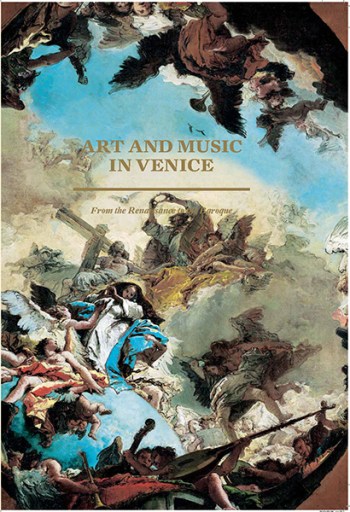 Artistic and musical creativity thrived in the Venetian Republic between the early 16th century and the close of the 18th century. The city-state was known for its superb operas and splendid balls, and the acoustics of the architecture led to complex polyphony in musical composition. Accordingly, notable composers, including Antonio Vivaldi and Adrian Willaert, developed styles that were distinct from those of other Italian cultures. The Venetian music scene, in turn, influenced visual artists, inspiring paintings by artists such as Jacopo Bassano, Canaletto, Francesco Guardi, Pietro Longhi, Bernardo Strozzi, Giambattista and Domenico Tiepolo, Tintoretto, and Titian. Together, art and music served larger aims, whether social, ceremonial, or even political. Lavishly illustrated, Art and Music in Venice brings Venice’s golden age to life through stunning images of paintings, drawings, prints, manuscripts, textbooks, illuminated choir books, musical scores and instruments, and period costumes. New scholarship into these objects by a team of distinguished experts gives a fresh perspective on the cultural life and creative output of the era.
Hilliard T. Goldfarb is associate chief curator and curator of Old Masters at the Montreal Museum of Fine Arts.
Exhibition | Samuel Hieronymus Grimm, 1733–1794
From Bern’s Kunstmuseum:
Samuel Hieronymus Grimm, 1733–1794: A Very English Swiss
Kunstmuseum, Bern, 17 January — 21 March 2014
Curated by William Hauptman with Therese Bhattacharya-Stettler
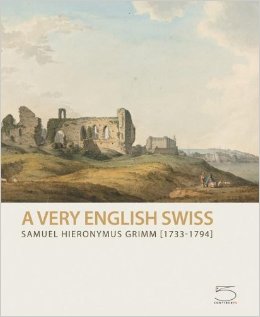 Samuel Hieronymus Grimm (1733–1794) is being presented in a comprehensive exhibition for the very first time. He pursued a career as topographer, illustrator, caricaturist and painter of watercolors, acquiring quite a reputation especially in England.
Grimm was born in Burgdorf and was initially devoted to poetry. Around 1760 he became interested in painting and took lessons with Johann Ludwig Aberli (1723–1786). In 1765 he went to Paris to continue his art studies with Jean-Georges Wille (1715–1808). There Grimm focused on landscape painting, going on long hikes with his art teacher in the countryside. In 1768 he moved to London, where he stayed for the rest of his life, working as both an illustrator and a caricaturist. With biting humor Grimm portrayed British society, fashion and politics. Around 1773, he was commissioned by Sir Richard Kaye to paint to watercolors. Kaye was to become one of his most devoted patrons, giving Grimm carte blanche to capture everything he found ‘unusual’. 2600 watercolors and drawings illustrating everyday subjects in Britain, the country’s architecture and the mores of its people were the outcome of Kaye’s patronage, producing a veritable illustrated encyclopedia of Georgian England during the 18th century. Grimm had numerous additional well-known personages as his patrons whom he accompanied on trips in England and Wales.
Grimm’s great popularity is due to the exactness of his representations; he was renowned for his speed with the pen, his moderate prices, and the perfection of his technique in sketching and painting outdoors. Specialists on British art see in Grimm one of the most talented topographers of his generation, his watercolors leave nothing to be desired and are equal to those of the best British masters of the time.
The exhibition combines examples from every genre Grimm worked in and will be accompanied by a richly illustrated catalogue in German and English. Prof. William Hauptman, Lausanne, is curator of the show, a great specialist for the period. Already in 1996 he was in charge of organizing the large John Webber exhibition at the Kunstmuseum Bern. Dr. Therese Bhattacharya-Stettler is co-curator.
William Hauptman, Samuel Hieronymus Grimm, 1733–1794: A Very English Swiss (Milan: 5 Continents Editions, 2014), 224 pages, ISBN: 978-8874396627, €35 / $45.
Exhibition | A Dialogue with Nature: Romantic Landscapes
Press release from Sue Bond:
A Dialogue with Nature: Romantic Landscapes from Britain and Germany
The Courtauld Gallery, London, 30 January — 27 April 2014
The Morgan Library & Museum, New York, 30 May — 7 September 2014
Curated by Rachel Sloan

John Robert Cozens, A Ruined Fort near Salerno, ca. 1782
watercolour on paper (The Courtauld Gallery)
◊ ◊ ◊ ◊ ◊
Organised as a collaboration between The Courtauld Gallery and The Morgan Library & Museum in New York, this exhibition explores aspects of Romantic landscape drawing in Britain and Germany from its origins in the 1760s to its final flowering in the 1840s. Bringing together twenty-six major drawings, watercolours and oil sketches from both collections by artists such as J.M.W. Turner, Samuel Palmer, Caspar David Friedrich, Carl Philipp Fohr, and Karl Friedrich Lessing, it draws upon the complementary strengths of both collections: the Morgan’s exceptional group of German drawings and The Courtauld Gallery’s wide-ranging holdings of British works. A Dialogue with Nature offers the opportunity to consider points of commonality as well as divergence between two distinctive schools. Together, these drawings exemplify Friedrich’s understanding of Romantic landscape draughtsmanship as ‘a dialogue with Nature’.
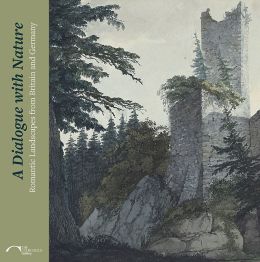 Friedrich claimed that ‘the artist should not only paint what he sees before him, but also what he sees in himself’. His words encapsulate two central elements of the Romantic conception of landscape: close observation of the natural world and the importance of the imagination. The display opens with a selection of drawings made in the late 18th century. The legacy of Claude Lorrain’s ideal vision is visible in both Jakob Philipp Hackert’s magisterial view of ruins at Tivoli, near Rome, and in Thomas Gainsborough’s more informal rendering of a rustic cottage among rolling hills, while cloud and tree studies by John Constable and Johann Georg von Dillis demonstrate the importance of drawing from life and the observation of natural phenomena. This newfound emphasis on drawing out of doors extended to amateur artists as well, exemplified by two remarkable sketchbooks by dilettante draughtsmen, the composer Felix Mendelssohn and the British naval officer Robert Streatfeild.
The important visionary strand of Romanticism is brought to the fore in a group of works centred on Friedrich’s Moonlit Landscape and The Jakobikirche as a Ruin and Samuel Palmer’s Oak Tree and Beech, Lullingstone Park. These are exemplary of their creators’ intensely spiritual vision of nature as well as their strikingly different techniques, Friedrich’s painstakingly fine detail contrasting with the dynamic freedom of Palmer’s penwork.
The final grouping shows Romantic landscapes at their most expansive and painterly, featuring Turner’s St Goarshausen and Katz Castle, one of fifty watercolours inspired by his first visit to Germany in 1817 and his highly atmospheric late rendering of a full moon over Lake Lucerne, as well as Friedrich’s subtle wash drawing of a coastal meadow on the remote Baltic island of Rügen. The exhibition closes with three small-scale drawings revealing a more introspective and intimate facet of the Romantic approach to landscape: Theodor Rehbenitz’s fantastical medievalising scene, Palmer’s meditative Haunted Stream and, lastly, Turner’s Cologne made as an illustration for The Works of Lord Byron (1833), which underscores important links between literature and the visual arts in the ongoing exchange of ideas between Britain and Germany.
A Dialogue with Nature is the first exhibition to be organised jointly by The Courtauld’s IMAF Centre for Drawings and The Morgan Library & Museum’s Drawings Institute. The accompanying publication will feature an essay by Matthew Hargraves (Yale Center for British Art and Morgan-Courtauld Fellow) and individual catalogue entries for each work by Rachel Sloan (The Courtauld Gallery).
From Athena Books/Paul Holberton:
Matthew Hargraves and Rachel Sloan, A Dialogue with Nature: Romantic Landscapes from Britain and Germany (London: Paul Holberton Publishing, 2014), 84 pages, ISBN: 978-1907372667, $25.
Book and Display | Baroque and Later Ivories in the V&A
From the V&A:
Baroque and Later Ivories in the V&A
Victoria & Albert Museum, London, 25 January — 28 September 2014
This is a display of a number of sculptures from the outstanding collection of baroque and later ivories in the V&A, including German, Austrian, Netherlandish, French, British and Hispanic works. A range of objects will be seen: portrait busts, tankards, statuettes, and devotional reliefs. Carved and turned ivories were highly treasured items throughout the seventeenth, eighteenth and nineteenth centuries. They might render dramatic mythological scenes, present exquisitely carved portrait likenesses on a small scale, or depict religious narratives. This small exhibition celebrates the recent publication of a catalogue of these ivories at the V&A.
From the V&A Shop:
Marjorie Trusted, Baroque and Later Ivories in the V&A (London: V&A Publishing, 2013), 544 pages, ISBN: 978-1851777679, £85.
 Over 500 baroque and later ivories from the V&A’s outstanding collection are illustrated and discussed in this scholarly catalogue. This publication includes every ivory sculpture made after 1550 from a collection comprising German, Austrian, Netherlandish, British, French, Italian, Scandinavian, Russian and Spanish pieces, as well as examples from the Philippines, Goa, Sri Lanka and South America. The range of objects is extensive: statuettes, reliefs, tankards, boxes, cabinets, snuff rasps and cutlery handles are all represented. These small-scale sculptures might render dramatic scenes from mythology, present exquisitely carved portrait likenesses on a small scale, or depict religious narratives. The high quality of the V&A’s holdings is readily apparent; leading ivory sculptors to be found here include Francis van Bossuit, Benjamin Cheverton, Balthasar Griessmann, Joachim Henne, Johann Christoph Ludwig Lücke, David Le Marchand, and Balthasar Permoser. In addition to detailed entries on each piece, the Introduction summarises the history and techniques of baroque and later ivory carving, while indexes of subjects and artists, in addition to a comprehensive bibliography, provide a full scholarly apparatus.
Marjorie Trusted is Senior Curator of Sculpture at the V&A. She has published and lectured widely, specializing in European art from the seventeenth century onwards, in particular British and Spanish sculpture. Her books include Spanish Sculpture (V&A 1996), British Sculpture 1470–2000 (co-author, V&A 2002), The Making of Sculpture (V&A 2007), and The Arts of Spain (V&A 2007).
Exhibition | Fame and Friendship
From the YCBA press release:
Fame and Friendship: Pope, Roubiliac, and
the Portrait Bust in Eighteenth-Century Britain
Yale Center for British Art, New Haven, 20 February — 19 May 2014
Waddesdon Manor, Buckinghamshire, 18 June — 26 October 2014
Curated by Malcolm Baker

Louis François Roubiliac, Portrait Bust of Alexander Pope, 1741, marble (Yale Center for British Art)
Opening in February 2014, the Yale Center for British Art, in collaboration with Waddesdon Manor, will present an exhibition on the eighteenth-century literary figure and poet Alexander Pope (1688–1744), whose sculpted portraits exemplified his fame at a time when the portrait bust was enjoying new popularity. Fame and Friendship: Pope, Roubiliac, and the Portrait Bust in Eighteenth-Century Britain will bring together paintings, sculptures, and materials that convey Pope’s celebrity status, high-lighted by a series of eight busts by Louis François Roubiliac (1702–1762), the leading sculptor of the period, to explore questions of authorship, replication, and dissemination.
Frequently used in antiquity to represent and celebrate writers, the portrait bust became the most familiar way of lauding famous writers in the eighteenth century, as the concept of authorship was being newly conceived. The signed and documented versions of Roubiliac’s busts of Pope, which span the years from 1738 to 1760, are among the most fascinating and iconic images of the poet. These early versions of Roubiliac’s bust are likely to have been made for Pope’s close friends, serving to articulate those friendships that were so important to him. Further, the comparisons of these related versions, together with copies from the period in marble, plaster, and ceramic, will provide a unique and unprecedented opportunity to understand the role of replication and repetition in eighteenth-century sculptural practice.
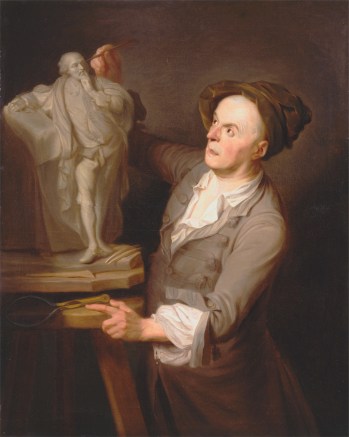
Adrien Carpentiers, Louis-Francois Roubiliac Modelling His Monument to Shakespeare, between 1760 and 1761 (Yale Center for British Art)
Complementing the sculptures of Pope will be busts of other sitters with whom Pope’s image was associated, reflecting the poet’s place in a developing literary canon, as well as a selection of painted portraits of the poet by artists such as Jonathan Richardson the Elder, Jean-Baptiste van Loo, and Sir Godfrey Kneller. Alongside these works will be a range of Pope’s printed texts. With their subtle changes in typography and their carefully planned illustrations and ornamental features, these early editions were produced under the watchful eye of Pope himself and were the outcome of the poet’s direct engagement with the materiality of the book and print.
Also presented will be lesser-known material about the Yale literary critic W. K. Wimsatt, who in the 1960s not only helped to make Yale a major center for the study of eighteenth-century literature (and Pope in particular), but spent twenty-five years researching the poet’s portraits, an achievement celebrated in this exhibition. As Wimsatt recognized, the relationship between Pope’s private persona and public fame was complex and ambiguous. Pope proved adept at managing the two while gradually establishing himself as an independent author, no longer dependent upon the support of noble patrons. Throughout his career, he astutely managed the presentation of his own image and reputation through both his published works and his portraits, especially those by Roubiliac.
Among the busts by Roubiliac will be a terracotta model (ca. 1738) from the collection of the Barber Institute of Fine Arts in Birmingham, England, and four marble pieces that he carved between 1738 and 1741. These busts have been assembled from a number of locations: the Center’s own collection; Temple Newsam House, Leeds Museums and Galleries; and the Shipley Art Gallery, Gateshead (formerly in the possession of the eighteenth-century actor David Garrick). Another, from a private collection, was made for Pope’s close friend, the brilliant young lawyer, William Murray, later first Earl of Mansfield, with whom the poet shared an enthusiasm for both the classics and the visual arts, particularly sculpture. Also on view will be an earlier marble bust of Alexander Pope made in 1730 by the Anglo-Flemish sculptor John Michael Rysbrack (1694–1770), from the collection of the National Portrait Gallery, London.
When this exhibition travels to Waddesdon Manor, the core group of busts of Pope by Roubiliac and some of the contextual material from the Yale Center for British Art will remain the same, but there will be an additional selection of painted portraits, a different range of printed texts lent by the British Library, and material that will illustrate the reception of Pope and his works in France in keeping with Waddesdon’s superb French collections.
Fame and Friendship: Pope, Roubiliac, and the Portrait Bust in Eighteenth-Century Britain is co-organized by the Center and Waddesdon Manor (The Rothschild Collection), where it will travel in June 2014. It is curated by Malcolm Baker, Distinguished Professor of the History of Art at the University of California, Riverside, and Honorary Senior Research Fellow at the Victoria and Albert Museum, London. The organizing curator at the Yale Center for British Art is Martina Droth, Associate Director of Research and Education, and Curator of Sculpture; and at Waddesdon Manor, Dr. Juliet Carey, Senior Curator of Paintings, Sculpture and Works on Paper.
P U B L I C A T I O N S & S C I E N T I F I C S T U D Y
 During the course of the exhibition, Yale University Press will be publishing The Marble Index: Roubiliac and Sculptural Portraiture in Eighteenth-Century Britain, Malcolm Baker’s study of the bust and the statue as genres [scheduled for release in August 2014]. Following the exhibition, a second book will appear as a volume in the series Studies in British Art, published by the Yale Center for British Art and the Paul Mellon Centre in collaboration with Yale University Press. The latter will include essays based on papers presented at the conferences at Yale and Waddesdon organized by the Center, the Paul Mellon Centre in London, and the Rothschild Foundation. It will also incorporate the results of a related research program of detailed digital scanning using the world-class facilities under development at the Yale Digital Collections Center at Yale’s West Campus. By analyzing the busts both visually and technically, this study aims to discover similarities and differences in surfaces, dimensions, construction, and materials, thus shedding new light on the studio practices of eighteenth-century sculptors. These findings will be the focus of a workshop to which leading figures in the field of eighteenth-century sculpture will be invited.
◊ ◊ ◊ ◊ ◊
Note (added 31 May 2014) — A more tightly focused catalogue will also be published by Paul Holberton:
Malcolm Baker, Fame and Friendship: Pope, Roubiliac and the Portrait Bust (London: Paul Holberton Publishing, 2014), 128 pages, ISBN: 978-0954731052, £15 / $25.
◊ ◊ ◊ ◊ ◊
Note (added 13 June 2014) — Waddesdon will host a study day (with a visit to Stowe) on July 10 and a conference on July 12.
Exhibition | The Art of the Louvre’s Tuileries Garden
Press release (20 September 2013) from the High Museum:
The Art of the Louvre’s Tuileries Garden
High Museum of Art, Atlanta, 3 November 2013 — 19 January 2014
Toledo Museum of Art, 13 February — 11 May 2014
Portland Art Museum, 14 June — 28 September 2014

Antoine Coysevox, Faun, 1709
The Art of the Louvre’s Tuileries Garden features more than 100 works, some of which have never traveled outside of Paris. These include large-scale sculptures from the garden that were created in the 17th, 18th, 19th, and 20th centuries by sculptors including François-Joseph Bosio, Antoine Coysevox, and Aristide Maillol along with paintings, photographs, and drawings that depict the Tuileries. Thirty-five works in the exhibition are from the collections of the Louvre.
The exhibition also explores how the 63-acre garden influenced and inspired French and American Impressionists such as Édouard Manet, Camille Pissarro, and Childe Hassam and photographers such as Eugène Atget, Henri Cartier-Bresson, and André Kertész. As part of the exhibition’s presentation in Atlanta, the High has turned the museum’s piazza into a landscaped park, inspired by the Tuileries Garden.
The ‘Paris on Peachtree’ experience begins as visitors arrive on the High’s piazza to find a dozen holly trees in planter boxes similar to those in the Tuileries Garden, installed to create a path to the exhibition entrance. Two sculptures by Maillol have been placed among the trees. The immersive experience continues in the galleries, where six sculptures that have never before left France and for centuries resided in the Tuileries Garden will greet visitors on the first level of the exhibition. The High is also devoting an entire gallery in the exhibition to a video titled “A Day in the Tuileries Garden,” featuring footage from the Garden projected on three walls.
Key works featured in the exhibition include:
• Antoine Coysevox, Faun, 1709
• François Joseph Bosio, Hercules Battling Achelous as Serpent, 1824
• Édouard Manet, Children in the Tuileries Garden, ca. 1861–62
• Childe Hassam, Tuileries Gardens, ca. 1897
• Camille Pissarro, The Tuileries Gardens in the Snow, 1900
• Aristide Maillol, Mediterranean or Latin Thought/Contemplation, 1923–27
• Henri Cartier-Bresson, The Terrace and Tree-lined Path, 1975
The exhibition examines how the Tuileries, which extends from the Musée du Louvre to the Place de la Concorde, evolved from its beginnings as an outdoor museum for French royalty to its role as one of the first public gardens in Europe, after which it served as both subject and inspiration for artists working in Paris.
Presented on the occasion of the 400th birthday of André Le Nôtre (1613–1700), The Art of the Louvre’s Tuileries Garden also celebrates the man commissioned by Louis XIV in 1664 to expand and transform the Tuileries into a formal French garden. One of the first public gardens in Europe, the Tuileries Garden was originally created in 1564 by Catherine de Medici as the garden for the Tuileries Palace, a palace that was originally part of the Louvre but which was destroyed following the Franco-Prussian War. Each monarch who lived in the palace left his or her own indelible mark on the Tuileries. Under the reign of Louis XV, the garden became known for its monumental outdoor sculpture collection. In 1667, just three years after Le Nôtre was hired, the Tuileries Garden became Paris’ first public park. The garden is still open to the public today.
The Art of the Louvre’s Tuileries Garden is co-organized by the High Museum of Art, the Toledo Museum of Art, and the Portland Art Museum, with the exceptional collaboration of the Musée du Louvre.
◊ ◊ ◊ ◊ ◊
From Yale UP:
Laura Corey, Paula Deitz, Guillaume Fonkenell, Bruce Guenther, Sarah Kennel, and Richard H. Putney, The Art of the Louvre’s Tuileries Garden (New Haven: Yale University Press, 2013), 176 pages, ISBN: 978-0300197372, $50.
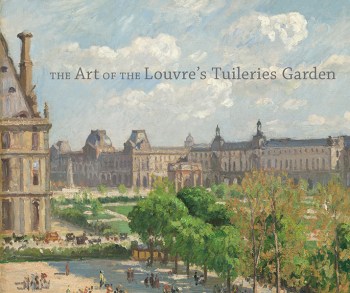 The Tuileries Garden is a masterpiece of garden design and one of the world’s most iconic public art spaces. Designed for Louis XIV by landscape architect André Le Nôtre, it served the now-destroyed Tuileries Palace. It was opened to the public in 1667, becoming one of the first public gardens in Europe. The garden has always been a place for Parisians to convene, celebrate, and promenade, and art has played an important role throughout its history. Monumental sculptures give the garden the air of an outdoor museum, and the garden’s beautiful backdrop has inspired artists from Edouard Manet to André Kertész.
The Art of the Louvre’s Tuileries Garden brings together 100 works of art, including paintings and sculptures, as well as documentary photographs, prints, and models illuminating the garden’s rich history. Beautifully illustrated essays by leading scholars of art and garden studies highlight the significance of the Tuileries Garden to works of art from the past 300 years and reaffirm its importance to the history of landscape architecture.
Laura D. Corey is consulting curator at the High Museum of Art. Paula Deitz is editor of The Hudson Review. Guillaume Fonkenell is curator of sculpture and museum historian at the Musée du Louvre. Bruce Guenther is chief curator and Robert and Mercedes Eichholz Curator of Modern and Contemporary Art at the Portland Art Museum. Sarah Kennel is curator of photographs at the National Gallery of Art, Washington, D.C. Richard H. Putney is an art historian and head of the Art Museum Practices program at the University of Toledo and Consulting Curator of Medieval Art at the Toledo Museum of Art.










leave a comment