New Book | Jodice: Canova

◊ ◊ ◊ ◊ ◊
Accompanying an exhibition of photographs by Mimmo Jodice of works by Canova (Museo Civico di Bassano del Grappa, 15 September 2013 to 23 March 2014), the catalogue will appear in English this September. As reported at the Robb Rebort, in 2009 Silvio Berlusconi presented members of the G8 with copies of the book Antonio Canova: L’invenzione della bellezza, each handmade with a marble cover weighing 21 pounds and 77 photographs by Jodice; only 39 copies were published by Marilena Ferrari House of Fine Art and Foundation (FMR) of Bologna, with 4 copies being donated to museums and 25 copies offered for sale at a whopping $200,000 each (itself interesting for the reception history of Canova). -CH
From ArtBooks.com:
Giuliana Ericani, Jodice: Canova (Venice: Marsilio, 2014), 116 pages, ISBN: 978-8831717571, $47.
 A disquiet expressed with a timeless vision. The decision to pay homage to Antonio Canova could not but start out of the encounter with the man who, back in 1992, had already understood his sculptures and captured their essence in images that have themselves become works of art. This man, this contemporary artist, could only be Mimmo Jodice. He is not only a photographer of art but a person with a keen gaze and vision who has decided to tackle perhaps the most complex sculptor of all time. Jodice chose to approach Canova with love and intellectual nobility and now, through a fascinating series of unprecedented details, is offering us a new, contemporary, conceptually lucid, authoritative, and captivating view of one of the greatest artists in history.
Giuliana Ericani was born in Trieste and graduated in Art History with Rodolfo Pallucchini at the University of Padua. She
is the director of the museums at Bassano del Grappa.
Exhibition | Pierre-Antoine Demachy (1723–1807)
Adapted from the Office of Tourism of Versailles:
Le Témoin Méconnu: Pierre-Antoine Demachy (1723–1807)
Musée Lambinet, Versailles, 15 February — 18 May 2014
 The Musée Lambinet in Versailles dedicates a unique exhibition to Pierre Antoine Demachy. This little-known artist of the eighteenth century, whose work has never before been showcased in a single exhibition, is a fabulous witness of his time. Strongly influenced by Italian art, Demachy applied to Paris cityscape types practiced by Canaletto and Guardi. He was among the artists whom the Empress Catherine II of Russia in 1768 placed an order through its ambassador to France, and the Count of Angivillers purchased for Louis XVI a view of the Seine at the Salon of 1783.
The work of Demachy will be presented through the following seven themes:
• Architectural whims and fantasy views
• Views related to the Louvre
• Demolition of churches and fire the Foire Saint-Germain
• Church interiors
• Other views in and around Paris
• Historic Events
• Views of the Seine and cityscapes
The press release, which includes a checklist of the major works exhibited, is available here»
◊ ◊ ◊ ◊ ◊
The catalogue is available from Artbooks.com:
Françoise Roussel-Leriche and Marie Petkowska Le Roux, Le Témoin Méconnu: Pierre-Antoine Demachy, 1723–1807 (Paris: Magellan, 2014), 216 pages, ISBN: 978-2350742809, $55.
Exhibition | Andreas Schlüter and Baroque Berlin
To mark the 300th anniversary of Andreas Schlüter’s death, the Bode-Museum mounts this exhibition:
Schloss Bau Meister: Andreas Schlüter and Baroque Berlin
Bode-Museum, Berlin, 4 April — 13 July 2014
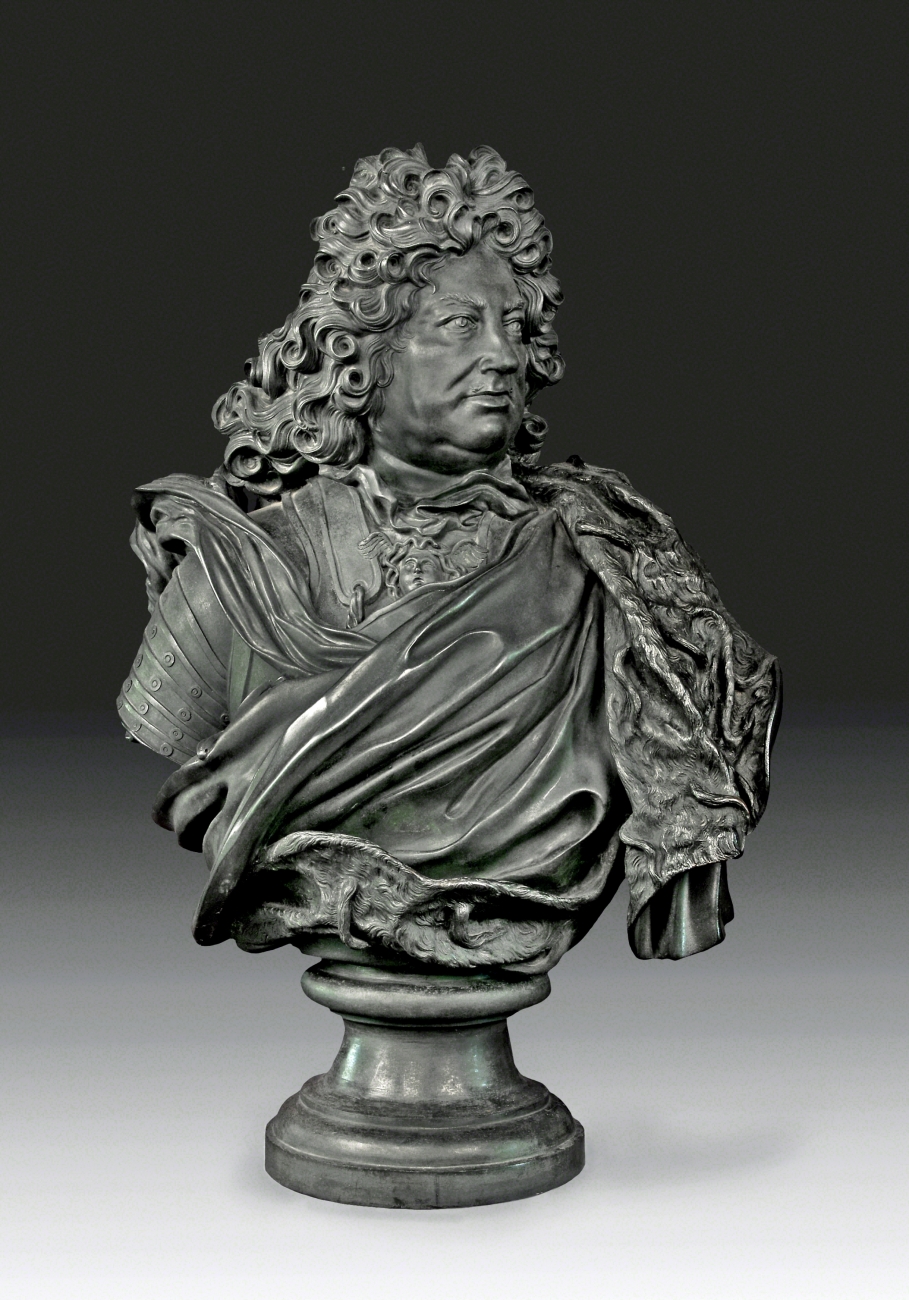
Bust of Landgrave Frederick II of Hesse Homburg, Berlin, 1701, bronze © Bad Homburg v. d. Höhe, Palace, Photo: Renate Deckers-Matzko
Andreas Schlüter (1659/60–1714) was a Baroque artist par excellence. Celebrated by his contemporaries as the ‘Michelangelo of the North’, Schlüter was not only a sculptor, but also an architect, town planner, and designer of magnificent interiors which were created to give lustre, for the first time, to the ambitious and emerging royal capital of Berlin. To commemorate the 300th anniversary of his death, the Bode-Museum is now holding the first ever major exhibition to be devoted to this important Berlin artist.
During the reign of Elector Friedrich III (from 1701 Friedrich I, ‘King in Prussia’), Schlüter was appointed official court sculptor and was entrusted with a variety of artistic roles in the Prussian capital, during a time when Prussia was emerging as a nascent new power.
This retrospective takes in all aspects of his multifaceted work and, enriched by numerous outstanding loans, recreates the opulent world that this creator of Baroque Berlin fashioned and inhabited. The exhibition in the Bode-Museum runs from 4 April until 13 July 2014 and is spread over a total of 16 galleries and side rooms. On display are not only Schlüter’s own works, but also those of the greatest role models of his time, including sculptures by such distinguished artists as Gian Lorenzo Bernini, Francesco Mochi, Francois Girardon, and Antoine Coysevox.
More information is available at the exhibition website.
◊ ◊ ◊ ◊ ◊
Published by Hirmer, the catalogue is available from Artbooks.com:
Hans-Ulrich Kessler, ed., Andreas Schlüter: Schöpfer des Barocken Berlin (Munich: Hirmer Verlag, 2014), 540 pages, ISBN: 978-3777421995, 50€ / $95.
 Andreas Schlüter (1659/60–1714), der bedeutendste Architekt und Bildhauer der Barockzeit nördlich der Alpen, verwandelte um 1700 Berlin in eine moderne, barocke Residenzstadt. Anlässlich seines 300. Todestages erzählt das opulente Katalogbuch die spannende Geschichte von Schlüters künstlerischem Werdegang und bietet einen fundierten Überblick über sein Œuvre.
Zunächst am Hof des polnischen Königs tätig, wurde Schlüter 1694 von Kurfürst Friedrich III. von Brandenburg, ab 1701 König Friedrich I. von Preußen, nach Berlin berufen. Fortan war er als Hofkünstler maßgeblich an der Umsetzung der Repräsentationsstrategien seines königlichen Auftraggebers beteiligt, wobei er sich an so glanzvollen Kunstzentren wie Rom und Paris orientierte. In 25 Beiträgen stellen namhafte Kenner Schlüters Werk umfassend vor, beginnend mit den Jahren in Danzig und Polen über seine Berliner Blütezeit mit Hauptwerken wie dem Reiterstandbild des Großen Kurfürsten,
dem Zeughaus und dem Berliner Schloss bis hin zu seinem
Spätwerk, der Berliner Villa Kameke.
Exhibition | Neapolitan Drawings
As noted at ArtDaily (25 March 2014) . . .
Dessins Napolitain / Neapolitan Drawings
Marty de Cambiaire, Paris, 25 March — 10 April 2014
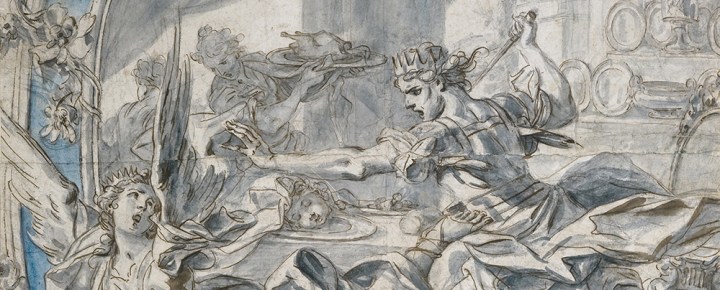
Filippo Falciatore (actif à Naples 1718–1768),
Térée pourchassant Procné et Philomèle
◊ ◊ ◊ ◊ ◊
Marty de Cambiaire’s seventh show takes place in their offices, located on 16 place Vendôme, from 25 March to 4 April 2014. It focuses on a group of forty Neapolitan and Sicilian drawings dating from the 16th to the 18th century. A bilingual exhibition catalogue has been published, similar to their previous catalogues (which can be downloaded from their website). Given the scarcity of the literature on the subject, this publication provides fresh scholarship on a field still relatively unknown to the public as well as connoisseurs. There are very few Neapolitan drawings in public collections. They are equally rare far on the market. Therefore several years were required to build up a coherent group intended to illustrate 350 years of graphic production in Naples and Sicily. The ultimate goal of this venture, quite unprecedented in the old master drawing market, is to make a significant scientific contribution to the field.
Neapolitan drawing has long been a neglected research area. A few sporadic shows—some of which quite recent—have confirmed art historians’ strong interest in an area which remains largely unexplored. There is thus ample room for fascinating discoveries. The Neapolitan school (which includes the Sicilian school) is largely underrepresented in museums. Nor is it clearly identified as a distinct school, especially in comparison with other Italian schools such as the Florentine, Bolognese, Roman or Venetian ones. The Neapolitan school gives us the opportunity to examine draughtsmanship in its various aspects as an active practice, apprehended as a working method and not just as an intellectual concept destined to confer a social status to artists. Consequently their intention is to showcase the specificities of the Neapolitan school, through a group of 40 drawings dating between 1550 and 1800.
The prime concern in gathering them has been to focus on quality, condition and scholarly interest. It turned out to be a challenging venture given the traditional scarcity of Neapolitan drawings on the market. The gallery has decided to bring together artists such as Giordano and Solimena, already well-researched and known from the public, with other artists whose names are not so familiar but who were essential in the genesis of this school. It seemed equally important to illustrate the diversity of: the techniques used; the subjects illustrated; and the purpose of these drawings, which could be preparatory studies either for religious altarpieces or for decorative compositions, for book frontispieces or decorative pieces, or even intended as works of art per se.
The show explores successive periods in the Neapolitan and Sicilian graphic production. The earliest sheet presented is by a rare and precious artist, Leonardo Castellano (circa 1544–1588). This is complemented by two other 16th-century drawings by Francesco Curia (1538–1610), while Belisario Corenzio (circa 1558–1646) takes us into the 17th century. There big names such as Luca Giordano, Matia Preti and Salvator Rosa feature, alongside with lesser-known artists who deserve a reappraisal, including Cesare and Francesco Fracanzano, Battistello Carraciolo. and Aniello Falcone. Francesco Solimena and his pupils, Francesco De Mura, Francesco Celebrano, Giacopo Cestaro, Lorenzo de Caro and Campora are represented with several sheets which demonstrate how profoundly the master renewed the field of decorative painting. Solimena also revived the creative process itself, passing down to his pupils a method on which they firmly grounded their approach and developed their own talent. The final drawing in the collection’s chronology is a large sheet by Giuseppe Camarrano, a neoclassical artist rarely seen on the market. It illustrates the evolution of Neapolitan art towards a more European neo-classical taste.
One of the key criteria in the selection process was the condition of each drawing. However it is important to bear in mind that Neapolitan artists viewed their drawings not only as a mental projection but also as a hands-on device: assembled and pasted together, some sheets were thus pricked for transfer, while others bear the marks of working life in the studio. This show presents a varied and representative overview of the Neapolitan school. New attributions will be put forward, which will shed new light on certain artists. The gallery is thus hoping to provide a panorama of a rich, distinct graphic field.
Exhibition | Wedding Dresses, 1775–2014
Press release for the upcoming exhibition at the V&A (also see the exhibition blog). . .
Wedding Dresses, 1775–2014
Victoria & Albert Museum, London, 3 May 2014 — 15 March 2015
Curated by Edwina Ehrman
◊ ◊ ◊ ◊ ◊
The V&A’s spring 2014 exhibition will trace the development of the fashionable white wedding dress and its interpretation by leading couturiers and designers, offering a panorama of fashion over the last two centuries. Wedding Dresses 1775–2014 will feature over 80 of the most romantic, glamorous and extravagant wedding outfits from the V&A’s collection. It will include important new acquisitions as well as loans such as the embroidered silk coat design by Anna Valentine and worn by The Duchess of Cornwall for the blessing after her marriage to HRH The Prince of Wales (2005), the purple Vivienne Westwood dress chosen by Dita Von Teese (2005), and the Dior outfits worn by Gwen Stefani and Gavin Rossdale on their wedding day (2002).
Displayed chronologically over two floors, the exhibition will focus on bridal wear. Most of the outfits were worn in Britain, by brides of many faiths. Alongside the dresses will be accessories including jewellery, shoes, garters, veils, wreaths, hats and corsetry as well as fashion sketches and personal photographs. Garments worn by bridegrooms and attendants will also be on display. The exhibition will investigate the histories of the garments, revealing fascinating and personal details about the lives of the wearers, giving an intimate insight into their occupations, circumstances and fashion choices.

Silk brocade gown, hat, and shoes, 1780. Olive Matthews Collection, Chertsey Museum. Photo by John Chase.
The opening section of the exhibition will feature some of the earliest examples of wedding fashion including a silk satin court dress (1775) and a ‘polonaise’ style brocade gown with straw bergère hat (1780) lent by the Chertsey Museum. The preference for white in the 19th century will be demonstrated by a white muslin wedding dress decorated with flowers, leaves and berries (1807) recently acquired by the V&A, and a wedding outfit embellished with pearl beads design by Charles Frederick Worth (1880). As the 19th century drew to a close historical costume influenced fashion. A fine example will be a copy of a Paris model designed by Paquin Lalanne et Cie made by Stern Brothers of New York (1890) for an American bride.
Designs from the 1920s and 1930s will illustrate the glamour of bridal wear which was now influenced by evening fashions, dresses were slim-hipped and made from richly beaded textured fabrics and slinky bias-cut satin. During the Second World War when clothing restrictions were introduced, brides needed to make imaginative and practical fashion choices. They used non-rationed fabrics such as upholstery materials, net curtaining and parachute silk, or married in a smart day dress or service uniform. On display will be a buttercup patterned dress made in light-weight upholstery fabric by London dressmaker Ella Dolling (1941).
Wedding Dresses 1775–2014 will also explore the growth of the wedding industry and the effect of increasing media focus on wedding fashions. Improvements in photography in the early 20th century encouraged photojournalism and society weddings were reported in detail in the national press and gossip columns. Two of the most spectacular wedding dresses on show will be the Norman Hartnell dress made for Margaret Whigham (later Duchess of Argyll) for her marriage to Charles Sweeny (1933), and the Charles James ivory silk satin dress worn by Barbara ‘Baba’ Beaton for her marriage to Alec Hambro (1934). These dramatic dresses will be seen alongside archive film and news clippings of the occasions as examples of society ‘celebrity’ weddings.
The mezzanine level will feature wedding garments from 1960 to 2014, taking the exhibition right up to date with Spring/Summer 2014 designs by Jenny Packham and Temperley Bridal. Emphasising the glamour and spectacle of weddings today, key designers will include Vivienne Westwood, John Galliano, Christian Lacroix, Lanvin, Vera Wang, Jasper Conran, Bruce Oldfield, Osman, Hardy Amies, Bellville Sassoon, Mr.Fish, John Bates and Jean Muir, with millinery by Philip Treacy and Stephen Jones. This section will explore the changing social and cultural attitudes to the wedding ceremony and marriage in the late 20th century and will feature examples of innovative and unconventional wedding outfits including dresses designed by Gareth Pugh and Pam Hogg for the weddings of Katie Shillingford (2011) and Mary Charteris (2012).
A version of the exhibition previously toured to Bendigo Art Gallery, Victoria, Australia (2011), Museum of New Zealand Te Papa Tongarewa (2011–12), National Museum of Singapore (2012), and Western Australian Museum, Perth, Australia (2012–13).
◊ ◊ ◊ ◊ ◊
From the V&A:
Edwina Ehrman, The Wedding Dress: 300 Years of Bridal Fashions, 2nd edition (London: V&A Publishing, 2014), 208 pages, ISBN 978-1851778133, £30 / $50.
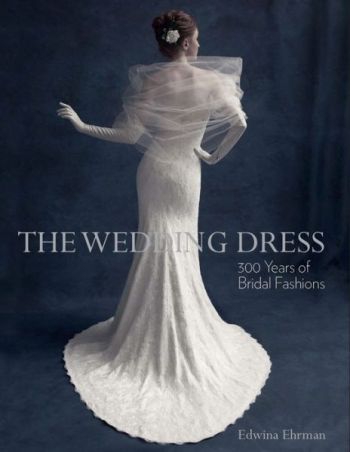 This sumptuous book draws on wedding garments in the V&A’s collection, photographs, letters, memoirs, newspaper accounts and genealogical research to explore the history of the wedding dress and the traditions that have developed around it since 1700. It focuses on the white wedding dress, which became fashionable in the early nineteenth century and is now chosen by women across the world. The book considers the way couturiers and designers have challenged and refreshed the traditional white dress and the influence of the wedding industry, whose antecedents lie in the commercialization of the wedding in Victorian Britain. The Wedding Dress is not only about costume, but also about the cultivation of the image of the bride. This book is a glorious tribute to an exquisite, stylish, glamorous gown, the romance of its evolution and the splendour of its design.
Edwina Ehrman is a curator of Textiles and Fashion at the V&A and of the exhibition The Wedding Dress: 300 Years of Bridal Fashions. She is co-author of The London Look: Fashion from Street to Catwalk and a contributor
to The Englishness of English Dress.
Exhibition | The Coast and the Sea
Press release (4 October 2013) from D. Giles:
Linda S. Ferber, The Coast and the Sea: Marine and Maritime Art in America (London: D. Giles Limited, 2013), 104 pages, ISBN 978-1907804311, $30 / £20.
The Society of the Four Arts, Palm Beach, Florida, 25 January — 9 March 2014
The Baker Museum of Art, Naples, Florida, 19 April — 6 July 2014
Portland Museum of Art, Portland, Maine, January — May 2015
The Mattatuck Museum, Waterbury, Connecticut, 6 June — 13 September 2015
The New York State Museum, Albany, New York, 24 October 2015 — 22 February 2016

A Southeast Prospect of the City of New York, ca. 1756–61. Oil on canvas. 38 x 72 1/2 in. (96.5 x 184.2 cm). Collection of the New-York Historical Society.
◊ ◊ ◊ ◊ ◊
The Coast and the Sea: Marine and Maritime Art in America will be published by D Giles Limited, in association with the New-York Historical Society, in December 2013. It is an appealing and colourful volume which presents over 50 of the best marine paintings and artifacts from the New-York Historical Society’s impressive maritime art collection.
 The works range in date from 1750 to 1940, and are by eminent marine artists like Thomas Birch, John Frederick Kensett, and Charlton T. Chapman. Highlights include large format canvasses of famous sea battles, ships at work, portraits of heroic sea captains, dashing naval officers like James Gordon Bennett Jr. and pioneering merchants, such as the aptly named Preserved Fish of New York, prominent in shipping in the early 19th century. There are also maritime themed objects such as an engraved whale’s tooth from the late 19th century, and a silver presentation urn commemorating acts of bravery from the War of 1812. An essay by curator Linda S. Ferber places the works within their wider historical and cultural narrative.
The works are then arranged thematically rather than by artist or period; there is for example a chapter on the Anglo-Dutch tradition in American marine art: the War of 1812 with its great sea battles and heroes and romantic and idealized visions of the sea. A section on the merchant marine and maritime trade features paintings of major trading posts in and around the Pearl River Delta, including Hong Kong; some of these paintings were by a group of Chinese artists working in the European style specifically for the export market. There are views of the Hudson River and the great Port of New York, as well as Gilded Age nostalgia for the great age of sail, with its clipper ships and majestic wind-jammers.
Linda S. Ferber is Senior Art Historian, the New-York Historical Society.
◊ ◊ ◊ ◊ ◊
Note (added 1 August 2014) — The original version of this posting included only the first two exhibition venues.
Exhibition | From Watteau to Fragonard: Les Fêtes Galantes
The exhibition opens today at the Jacquemart-André. In addition to the remarkably comprehensive 30-page press kit, the exhibition website, available in both French and English, is outstanding. -CH
From Watteau to Fragonard: Les Fêtes Galantes
Musée Jacquemart-André, Paris, 14 March — 21 July 2014
Curated by Christoph Vogtherr and Mary Tavener Holmes

Antoine Watteau, An Embarrassing Proposal, oil on canvas, ca. 1715–20
(Saint-Petersburg, Hermitage Museum)
◊ ◊ ◊ ◊ ◊
The Musée Jacquemart-André is delighted to be holding the exhibition From Watteau to Fragonard, les fêtes galantes. There will be approximately sixty works on display, mostly paintings lent for the occasion by major collections, predominantly public, from countries including France, Germany, the UK and the USA.
The poetical term fête galante refers to a new genre of paintings and drawings that blossomed in the early 18th century during the Regency period (1715–1723) and whose central figure was Jean-Antoine Watteau (1684–1721). Inspired by images of bucolic merrymaking in the Flemish tradition, Watteau and his followers created a new form, with a certain timelessness, characterised by greater subtlety and nuance. These depict amorous scenes in settings garlanded with luxuriant vegetation, real or imaginary: idealised dancers, women and shepherds are shown engaged in frivolous pursuits or exchanging confidences. The poetical and fantastical atmospheres that are a mark of his work are accompanied by a quest for elegance and sophistication characteristic of the Rococo movement, which flourished during the Age of Enlightenment, evidenced in his flair for curved lines and light colours.

Jean-Honoré Fragonard, A Game of Hot Cockles, oil on canvas, ca. 1775–80 (Washington, D.C., National Gallery of Art)
The exhibition offers a chance to rediscover the pioneering nature of Watteau’s output. These are works of great creativity, depictions of life outdoors in some of his finest paintings and most accomplished drawings. Nicolas Lancret (1690–1743) and Jean-Baptiste Pater (1695–1725) were greatly influenced by the master, their works revisiting and refining the codes of the fêtes galantes. Their imaginary scenes are anchored in reality, featuring locations, works of art and multiple details that would have been easily recognisable to their contemporaries.
The flexibility of the fête galante theme proved to be an invitation to experimentation and innovation, and the genre was to inspire several generations of artists, occupying a central place in French art throughout the 18th century. Works by other highly creative painters, such as François Boucher (1703–1770) and Jean-Honoré Fragonard (1732–1806), illustrate their very personal visions of the joys of the fête galante as first imagined by Watteau.
The Musée Jacquemart-André, with its marvellous collection of 18th-century French paintings, is the perfect setting for an exhibition looking at fêtes galantes. We are particularly pleased that several of the finest drawings from the period, from the collection created by Nélie Jacquemart and Édouard André, will also be on display as part of the exhibition.
The Curators
 Currently director of London’s Wallace Collection, Christoph Vogtherr is a specialist in 18th-century French painting. He is the author of an authoritative work on the subject, the catalogue raisonné of paintings by Jean-Antoine Watteau, Jean-Baptiste Pater, and Nicolas Lancret in Berlin and Potsdam, published in 2010. During 2011, he curated two successful exhibitions of works by Watteau at the Wallace Collection.
Mary Tavener Holmes holds a doctorate from the Institute of Fine Arts at New York University. A specialist in 18th-century French paintings and drawings, she has over thirty years’ experience as a curator, author and professor of European art. She has produced numerous publications, including A Magic Mirror: The Portrait in France, 1700–1900 (1986) and Nicolas Lancret: Dance before a Fountain (2006).
◊ ◊ ◊ ◊ ◊
The catalogue is available from Artbooks.com:
Christoph Vogtherr and Mary Tavener Holmes, De Watteau à Fragonard. Les Fêtes Galantes (Antwerp: Mercator, 2014), 224 pages, ISBN: 978-9462300453, €39.
Exhibition | Ruin Lust
For anyone with Richard Wilson on the mind, he turns up in Tate Britain’s ruin exhibition, too.
Ruin Lust
Tate Britain, London, 4 March — 18 May 2014
Curated by Brian Dillon, Emma Chambers, and Amy Concannon
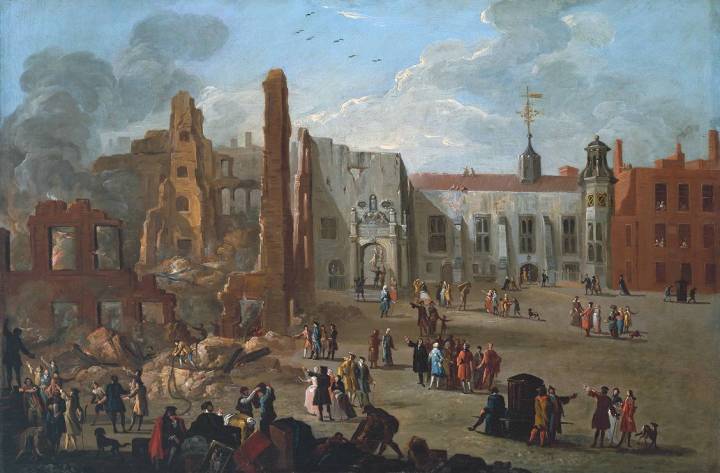
Richard Wilson, The Inner Temple after the Fire of 4 January 1737, oil on canvas, 1737 (Tate Britain). The picture records the devastation caused by a fire that destroyed Crown-Office Row in the Inner Temple. The group in the centre includes Frederick, Prince of Wales (in blue, wearing the Garter star), who had sent fifty soldiers to help the firemen and later came to inspect the scene himself. More information is available here»
◊ ◊ ◊ ◊ ◊
Ruin Lust, an exhibition at Tate Britain from 4 March 2014, offers a guide to the mournful, thrilling, comic and perverse uses of ruins in art from the eighteenth century to the present day. The exhibition is the widest-ranging on the subject to date and includes over 100 works by artists such as J.M.W. Turner, John Constable, John Martin, Eduardo Paolozzi, Rachel Whiteread, and Tacita Dean.
The exhibition begins in the midst of the craze for ruins that overtook artists, writers and architects in the eighteenth century. J.M.W. Turner and John Constable were among those who toured Britain in search of ruins and picturesque landscapes, producing works such as Turner’s Tintern Abbey: The Crossing and Chancel, Looking towards the East Window 1794 and Constable’s Sketch for ‘Hadleigh Castle’ c.1828–29.
 This ruinous heritage has been revisited—and sometimes mocked—by later artists such as Keith Arnatt, who photographed the juxtaposition of historic and modern elements at picturesque sites for his deadpan series A.O.N.B. (Areas of Outstanding Natural Beauty) 1982–84 and John Latham whose sculpture Five Sisters Bing 1976, which was part of a project to turn post-industrial shale heaps in Scotland into monuments. Classical ruins have a continued presence in the work of Eduardo Paolozzi, Ian Hamilton Finlay, and John Stezaker. In works such as Keith Coventry’s Heygate Estate 1995 and Rachel Whiteread’s Demolished—B: Clapton Park Estate 1996, which shows the demolition of Hackney tower blocks, we see Modernist architectural dreams destroyed.
The exhibition explores ruination through both the slow picturesque decay and abrupt apocalypse. John Martin’s The Destruction of Pompeii and Herculaneum 1822 recreates historical disaster while Gustave Doré’s engraving The New Zealander 1872 shows a ruined London. The cracked dome of St Paul’s Cathedral in the distance was a scene partly realised during the Blitz.
Ruin Lust will include work provoked by the wars of the twentieth century, including Graham Sutherland’s Devastation series 1940–41, which depicts the aftermath of the Blitz and Jane and Louise Wilson’s 2006 photographs of the Nazis’ defensive Atlantic Wall. Paul Nash’s photographs of surreal fragments in the 1930s and 40s, or Jon Savage’s images of a desolate London in the late 1970s show how artists also view ruins as zones of pure potential, where the world must be rebuilt or reimagined.
The exhibition will include rooms devoted to Tacita Dean and Gerard Byrne. Dean’s nostalgic film installation Kodak 2006 explores the ruin of the image, as the technology of 16 mm film becomes obsolescent. In 1984 and Beyond 2005–07, Byrne reimagines a future that might have been. The installation presents a re-enactment of a discussion, published in Playboy in 1963, in which science fiction writers—including Isaac Asimov, Ray Bradbury, and Arthur C. Clarke—speculate about what the world might be like in 1984.
This transhistorical exhibition is curated by writer and critic Brian Dillon; Emma Chambers, Curator of Modern British Art; and Amy Concannon, Assistant Curator of British Art, 1790–1850. It will be accompanied by a book and a programme of talks and events in the gallery.
◊ ◊ ◊ ◊ ◊
From Tate Britain’s bookshop:
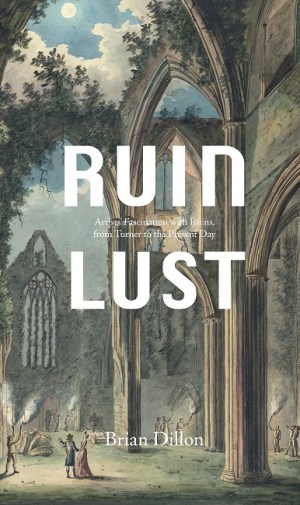
Brian Dillon, Ruin Lust: Artists’ Fascination with Ruins from Turner to the Present Day (London: Tate Publishing, 2014), 64 pages, ISBN: 978-1849763011, £10 / $22.
Why are we fascinated by ruins? They recall the glory of dead civilisations and the certain end of our own. They stand as monuments to historic disasters, but also provoke dreams about futures born from destruction and decay. Ruins are bleak but alluring reminders of our vulnerable place in time and space. For centuries, ruins have attracted artists: among them J.M.W. Turner, Gustave Doré, Paul Nash, Graham Sutherland, Patrick Caulf eld, Tacita Dean, and Jane and Louise Wilson. Ruin Lust explores the history of this obsession, from the art of the picturesque in the eighteenth century, through the wreckage of two world wars, to contemporary artists complex attitudes to the ruins of the recent past.
Brian Dillon is a novelist, critic, and curator who has explored many ancient and modern ruins and written widely on the history of ruination in art and culture. His books include: Objects in this Mirror: Essays; Sanctuary; In the Dark Room; and Ruins, an anthology of artists and critics reflections on ruination. He is UK editor of Cabinet magazine and reader in critical writing at the Royal College of Art.
Exhibition | Le Bivouac de Napoléon: Luxe impérial en campagne
From the Palais Fesch:
Le Bivouac de Napoléon: Luxe impérial en campagne
Palais Fesch, Musée des Beaux Arts, Ajaccio, 13 February — 12 May 2014
 Napoléon Ier passe une grande partie de son existence en campagne ou en voyage. Il possède pour ses déplacements et ses bivouacs, une organisation particulière reproduisant pour partie l’étiquette impériale. Ses tentes de campagne sont de véritables palais tissés mobiles, ses bagages, – lit, table, fauteuil, écritoire, nécessaire ou encore chaise d’affaires – constituent un ameublement pliant et luxueux en boite. Les nombreuses voitures qui transportent les effets de l’empereur en campagne, escortées et conduites par un personnel de service nombreux, forment un véritable convoi.
Cet ouvrage, sous la direction de Jehanne Lazaj, conservatrice au Mobilier national, entend montrer l’ingéniosité d’objets prestigieux tout comme la somptuosité de l’artisanat d’Empire à travers l’étude de plus de 70 œuvres qui sont autant d’éléments de campements, de contexte ou de documents iconographiques. Le lecteur s’installe, ainsi, sous le tente de Napoléon pour appréhender une vision la plus
complète possible de la vie des bivouacs, les soirs de
victoire comme de défaite.
Exhibition | Richard Wilson
To mark the opening of Richard Wilson and the Transformation of European Landscape Painting, curators Robin Simon and Martin Postle will be in New Haven this evening (5:30, Wednesday, 5 March 2014) for a session entitled “Putting Wilson on the Spot: Landscape, Art, and Location.” Exhibition press release from the YCBA:
Richard Wilson and the Transformation of European Landscape Painting
Yale Center for British Art, New Haven, 6 March — 1 June 2014
National Museum Cardiff, 5 July — 26 October 2014
Curated by Robin Simon and Martin Postle
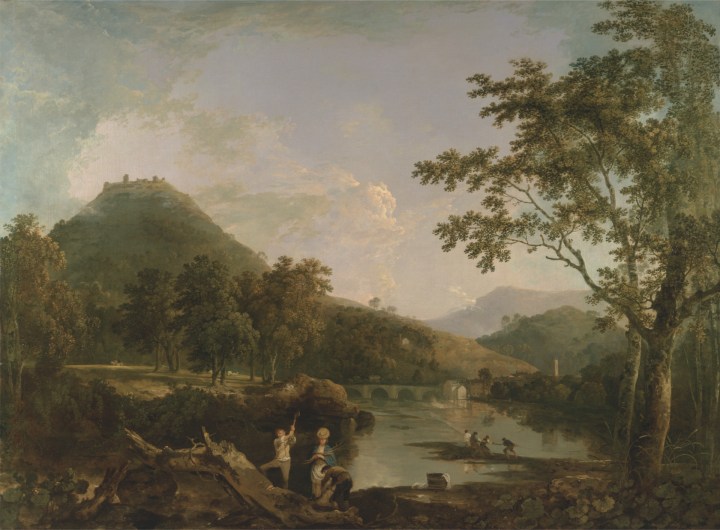
Richard Wilson, Dinas Bran from Llangollen, 1770–71, oil on canvas,
Yale Center for British Art, Paul Mellon Collection
◊ ◊ ◊ ◊ ◊
This spring, the Yale Center for British Art presents the first major exhibition in more than thirty years devoted to Welsh painter Richard Wilson (1714–1782), considered by many to be the father of British landscape painting. Richard Wilson and the Transformation of European Landscape Painting, opening on March 6, 2014, will demonstrate the extent of Wilson’s influence throughout Europe and explore his work in its international context. The exhibition will focus on the nearly seven years he spent working in Rome in the 1750s, a transformational period for Wilson and for European landscape art.
The exhibition will feature many of Wilson’s greatest paintings and drawings alongside works by European masters who preceded Wilson, contemporaries whose practice directly influenced his, and artists who were in turn taught or influenced by him. Other artists in the exhibition will include the old masters Claude Lorrain and Gaspard Dughet, as well as many of Wilson’s contemporaries such as Claude-Joseph Vernet, Pompeo Batoni, and Anton Raphael Mengs. Also presented will be works by many of Wilson’s pupils and followers, including the little-known artists Robert Crone and Adolf Friedrich Harper—both of whom studied with Wilson in Italy, as well as major figures such as John Constable and J. M. W. Turner.
As part of a cosmopolitan group of artists in Rome, Wilson pioneered a serious and powerfully original approach to landscape that reflected the nascent neoclassicism being advanced by his friends Anton Raphael Mengs and Johann Winckelmann. Wilson’s pupils in Rome transmitted his style across northern Europe. Setting up in London after his Italian sojourn, he established a large and successful studio and gained a European reputation with grand historical landscapes—such as The Destruction of the Children of Niobe (1760)—which were featured at the new public art exhibitions in London and widely disseminated through popular engravings. His treatment of British landscapes, particularly of his native Wales, borrowed their conceptual framework from the paintings of the seventeenth-century masters Claude Lorrain and Gaspard Dughet, but with a specificity of lighting conditions and weather that was an enduring legacy to the British landscape school.
Wilson’s great success during the 1760s slipped away in the following decade, as there was less demand for his work and his health deteriorated. By the time of his death he was largely forgotten. However, within a few years his critical reputation began to revive, and by the early nineteenth century he was celebrated as a pioneering figure of the British school. His innovations in landscape painting were crucial to the development of the genre during the romantic period, which saw its greatest expression in the work of J. M. W. Turner and John Constable, both profound admirers of Wilson.
This is the first exhibition the Center has co-organized with Amgueddfa Cymru– National Museum Wales. The exhibition has been co-curated by Robin Simon, Honorary Professor of English, University College London, and Editor, The British Art Journal, and Martin Postle, Deputy Director of Studies, The Paul Mellon Centre for Studies in British Art, London. The organizing curator at the Center is Scott Wilcox, Chief Curator of Art Collections and Senior Curator of Prints and Drawings; and, at Amgueddfa Cymru–National Museum Wales, Oliver Fairclough, Keeper of Art.
◊ ◊ ◊ ◊ ◊
From Yale UP:
Martin Postle and Robin Simon, eds., with contributions by Steffen Eggle, Oliver Fairclough, Jason Kelly, Ana María Suárez Huerta, Lars Kokkonen, Kate Lowry, Paul Spencer-Longhurst, Jonathan Yarker, Scott Wilcox, and Rosie Ibbotson. Richard Wilson and the Transformation of European Landscape Painting (New Haven: Yale University Press, 2014), 416 pages, ISBN: 978-0300203851 $80.
 Long known as the father of British landscape painting, Richard Wilson (1713–1782) was in fact at the heart of a profound conceptual shift in European landscape art. This magnificently illustrated volume not only situates Wilson’s art at the beginning of a native tradition that would lead to John Constable and J. M. W. Turner, but compellingly argues that in Rome during the 1750s Wilson was part of an international group of artists who reshaped the art of Europe. Rooted in the work of great seventeenth-century masters such as Claude Lorrain but responding to the early stirrings of neoclassicism, Wilson forged a highly original landscape vision that through the example of his own works and the tutelage of his pupils in Rome and later in London would establish itself throughout northern Europe.
Martin Postle is assistant director of the Paul Mellon Centre for Studies in British Art. Robin Simon is honorary professor of English at University College
London, and editor of The British Art Journal.










leave a comment