Exhibition | Bronze at The Royal Academy
Reviewed for Enfilade by Craig Ashley Hanson
Bronze
Royal Academy of Arts, London, 15 September — 9 December 2012
Curated by David Ekserdjian and Cecilia Treves
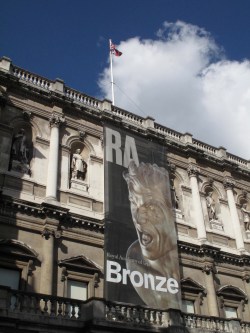 Critics have been raving about Bronze since it opened last month at the Royal Academy of Arts in London. Notwithstanding the exhibition’s sweeping coverage–in terms of geography and history–I didn’t initially include it here at Enfilade as I had trouble finding eighteenth-century points of relevance. Indeed, out of dozens of objects shown across ten rooms, only a handful of works were produced during the period. And yet, now that I’ve seen the exhibition, I’m convinced dix-huitièmistes should pay attention.
Organized by theme rather than time and place, the range of works is staggering. If, in keeping with traditional historiographical models, the show begins with an achingly beautiful example from ancient Greece–a recently recovered Dancing Satyr–it quickly brings an international array of work into open and productive dialogue. On display are works from Ghana and Nigeria, Eturia and Rome, China and Japan, Northern Europe and the United States. Categories one might expect to see are well represented: ritual dining vessels from Shang dynasty tombs, classicizing work from Renaissance Florence, Buddhist work from India (including an extraordinary sixth-century Buddha Shakyamuni from Bihar). Rodin’s Age of Bronze is, of course, included. But there are surprises, too: ancient court objects from Israel (a crown, scepter, and vulture standard), sixteenth-century French spurs, a basketball by Jeff Koons. Works by Giambologna appear next to an oversized spider by Louise Bourgeois (climbing the wall, no less).

François Girardon, Laocoön and His Sons, ca. 1690 Houghton Hall, Norfolk/Photo © Royal Academy of Arts, London, Roy Fox (click for more info)
While it all could have gone horribly wrong, the experience of viewing the exhibition appears to be, for most viewers, one of coherence rather than confusion, coherence derived from the thoughtful attention to the possibilities of bronze as a material. The medium is the subject in an entirely convincing, indeed revelatory manner. The varieties of objects, selected from a global vision of art history, work thanks to careful attention to exploration of seven thematic categories: figures, animals, groups, objects, reliefs, gods, and heads. Scale and texture, color and composition, the tensile strength and resulting artistic flexibility of bronze all become matters of first, rather than passing, interest.
And for the eighteenth-century? The final room of heads includes original choices: Massimiliano Soldani-Benzi’s Damned Soul of 1705 after Bernini and Anne Damer’s Mary Berry from 1793, while François Girardon’s Laocoön from Houghton Hall, ca. 1690, exerts a commanding presence in the gallery dedicated to groups. Particularly compelling for me, in that same room, is the sensitive installation of Francesco Bertos’s 1730s allegorical group of Sculpture, Arithmetic, and Architecture from the Prado. Placed alongside Giambologna’s 1576 Nessus and Deianira (a centaur abduction scene) and Alessandro Algardi’s 1647 St. Michael Overcoming the Devil, Bertos’s work appears as an entirely legible development from Renaissance humanism, to forceful Baroque religious expression, to refined Enlightened optimism. Adrian de Vries’s Hercules, Nessus and Deianira of 1622 dominates the center of the gallery, making the relationships–the similarities and differences within this 150-year period–all the more striking.
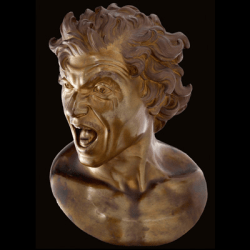
Massimiliano Soldani-Benzi, after Bernini, Damned Soul (‘Anima Dannata’), 1705-07. Bronze with golden-red lacquer patina, 39.5 cm. Liechtenstein Museum, Vienna. Photo © Liechtenstein. The Princely Collections, Vaduz-Vienna
And so historical arguments do exist within the exhibition, even if there’s no obvious central argument based on tracking change over time (it is I think one reason material from all over the world can be placed side by side so effectively). One may wish there were more eighteenth-century offerings–I’ll leave those criticisms to the sound judgment of my colleagues. But, for me, it is an exhibition that likely would make a lot more sense to eighteenth-century connoisseurs than the much more tightly focused, monographic approaches dominating exhibitions in the present age. No only is it a show I think many eighteenth-century viewers would understand (with admittedly a bit of instruction), it’s a show I think they would like.
Alongside it, the catalogue offers innovative models for thinking about different ways exhibitions generally might succeed. The book pairs beautifully with the catalogue for the 2009 exhibition Cast in Bronze: French Sculpture from Renaissance to Revolution, available–for anyone regretting that there aren’t more eighteenth-century works on
display–in the Royal Academy gift shop on the way out.
◊ ◊ ◊ ◊ ◊
Catalogue: Bronze (London: Royal Academy Publications, 2012), 248 pages, ISBN: 9781907533280, $65.
 Bronze, long celebrated for its durability and the wide range of effects that it offers, has been prized as an artistic material in many parts of the world throughout the ages. Magnificent bronze sculptures from the ancient times have emerged unscathed after millennia on the sea bed. It is a material that has been used on all scales, from the minute to the monumental. This sumptuous catalogue examines bronze’s earliest beginnings in North Africa, the Middle East and China as it transcended tools and weaponry to become a medium of fine art. Expert authors chart the virtuousity of artists in ancient Greece and Rome; developments in Asia and Africa; bronze’s great flowering in the European Renaissance and its use in the modern era by artists such as Rodin, Picasso, Brancusi and Bourgeois.
A unique testament to the works of art that one medium has inspired, Bronze contains lavish colour plates of over 150 masterworks arranged chronologically to take the reader on a voyage through time, tracing the work of sculptors, casters and chasers through the centuries.
Exhibition | Dark Romanticism: From Goya to Max Ernst
Press release from the Städel Museum:
Schwarze Romantik: Von Goya bis Max Ernst
The Städel Museum, Frankfurt am Main, 26 September 2012 — 20 January 2013
Musée d’Orsay, Paris, 4 March — 9 June 2013
Curated by Felix Krämer
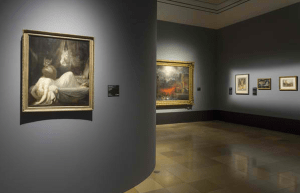 The Städel Museum’s major special exhibition Dark Romanticism: From Goya to Max Ernst is the first German exhibition to focus on the dark aspect of Romanticism and its legacy, mainly evident in Symbolism and Surrealism. Comprising over 200 paintings, sculptures, graphic works, photographs and films, it presents the fascination that many artists felt for the gloomy, the secretive and the evil. Using outstanding works in the museum’s collection on the subject by Francisco de Goya, Eugène Delacroix, Franz von Stuck or Max Ernst as a starting point, the exhibition is also presenting important loans from internationally renowned collections, such as the Musée d’Orsay, the Musée du Louvre, both in Paris, the Museo del Prado in Madrid and the Art Institute of Chicago. The works on display by Goya, Johann Heinrich Fuseli and William Blake, Théodore Géricault and Delacroix, as well as Caspar David Friedrich, convey a Romantic spirit which by the end of the 18th century had taken hold all over Europe. In the 20th century artists such as Salvador Dalí, René Magritte or Paul Klee and Max Ernst continued to think in this vein. The art works speak of loneliness and melancholy, passion and death, of the fascination with horror and the irrationality of dreams. After Frankfurt the exhibition, conceived by the Städel Museum, will travel to the Musée d’Orsay in Paris.
The exhibition’s take on the subject is geographically and chronologically comprehensive, thereby shedding light on the links between different centres of Romanticism, and thus retracing complex iconographic developments of the time. It is conceived to stimulate interest in the sombre aspects of Romanticism and to expand understanding of this movement. Many of the artistic developments and positions presented here emerge from a shattered trust in enlightened and progressive thought, which took hold soon after the French Revolution – initially celebrated as the dawn of a new age – at the end of the 18th century. Bloodstained terror and war brought suffering and eventually caused the social order in large parts of Europe to break down. The disillusionment was as great as the original enthusiasm when the dark aspects of the Enlightenment were revealed in all their harshness. Young literary figures and artists turned to the reverse side of Reason. The horrific, the miraculous and the grotesque challenged the supremacy of the beautiful and the immaculate. The appeal of legends and fairy tales and the fascination with the Middle Ages competed with the ideal of Antiquity. The local countryside became increasingly attractive and was a favoured subject for artists. The bright light of day encountered the fog and mysterious darkness of the night.
The exhibition is divided into seven chapters. It begins with a group of outstanding works by Johann Heinrich Fuseli. The artist had initially studied to be an evangelical preacher in Switzerland. With his painting The Nightmare (Frankfurt Goethe-Museum) he created an icon of dark Romanticism. This work opens the presentation, which extends over two levels of the temporary exhibition space. Fuseli’s contemporaries were deeply disturbed by the presence of the incubus (daemon) and the lecherous horse – elements of popular superstition – enriching a scene set in the present. In addition, the erotic-compulsive and daemonic content, as well as the depressed atmosphere, catered to the needs of the voyeur. The other six works by Fuseli – loans from the Kunsthaus Zürich, the Royal Academy London and the Staatsgalerie Stuttgart – represent the characteristics of his art: the competition between good and evil, suffering and lust, light and darkness. Fuseli’s innovative pictorial language influenced a number of artists – among them William Blake, whose famous watercolour The Great Red Dragon from the Brooklyn Museum will be on view in Europe for the first time in ten years.
The second room of the exhibition is dedicated to the Spanish artist Francisco de Goya. The Städel will display six of his works – including masterpieces such as The Witches’ Flight from the Prado in Madrid and the representations of cannibals from Besançon. A large group of works on paper from the Städel’s own collection will be shown, too. The Spaniard blurs the distinction between the real and the imaginary. Perpetrator and victim repeatedly exchange roles. Good and evil, sense and nonsense – much remains enigmatic. Goya’s cryptic pictorial worlds influenced numerous artists in France and Belgium, including Delacroix, Géricault, Victor Hugo and Antoine Wiertz, whose works will be presented in the following room. Atmosphere and passion were more important to these artists than anatomical accuracy. . .
The full press release is available here»
◊ ◊ ◊ ◊ ◊
Available from the publisher:
Catalogue: Felix Krämer, ed., Dark Romanticism: From Goya to Max Ernst (Ostfildern: Hatje-Cantz-Verlag, 2012), 305 pages, ISBN 9783775733731 (German edition ISBN: 9783775733724), $70 / 35€.
 The exhibition, which presents the Romantic as a mindset that prevailed throughout Europe and remained influential beyond the 19th century, is accompanied by a substantial catalogue with contributions by Roland Borgards, Ingo Borges, Claudia Dillmann, Dorothee Gerkens, Johannes Grave, Mareike Hennig, Hubertus Kohle, Felix Krämer, Franziska Lentzsch, Manuela B. Mena Marqués and Nerina Santorius. As is true for any designation of an epoch, Romanticism too is nothing more than an auxiliary construction, defined less by the exterior characteristics of an artwork than by the inner sentiment of the artist. The term ‘dark Romanticism’ cannot be traced to its origins, but – as is also valid for Romanticism per se – comes from literary studies. The German term is closely linked to the professor of English Studies Mario Praz and his publication La carne, la morte e il diavolo nella letteratura romantica of 1930, which was published in German in 1963 as Liebe, Tod und Teufel:
Die schwarze Romantik (literally: Love, Death and Devil: Dark
Romanticism).
Exhibition | Pride and Prejudice: Female Artists in France and Sweden
Press release from Sweden’s Nationalmuseum in Stockholm:
Pride and Prejudice: Female Artists in France and Sweden 1750–1860
Nationalmuseum, Stockholm, 27 September 2012 — 20 January 2013

Constance Marie Charpentier, Melancholy, 1810
(Amiens: Musée de Picardie)
◊ ◊ ◊ ◊ ◊
Pride and Prejudice – Female Artists in France and Sweden 1750–1860 explores conditions for female artists in France and Sweden during a period of revolutionary social change. The exhibition presents works by some of the French and Swedish women who managed to establish themselves as artists and create a name for themselves at this time. Works by amateurs are also on display, since women of higher standing were expected to master skills such as drawing and embroidery.
The exhibition includes six works by Marie Suzanne Giroust. She was married to artist Alexander Roslin and is The Lady with the Veil in his well-known painting of that name. During her lifetime, she was also a recognised figure, but she later came to be omitted from art history, a fate that she shares with many other female artists. Today only 19 of her works can be identified with any certainty. Giroust was one of the few women to be inducted into France’s Royal Academy of Painting and Sculpture in the late 18th century. Its members had the exclusive opportunity to showcase works at the Salon in Paris, the most important exhibition in France at the time. Within the Royal Academy, there was staunch opposition to female artists. In the mid-18th century, a ceiling was introduced that permitted no more than four members of this gender at any one time.

Adélaïde Labille-Guiard, Portrait of a Woman, 1787 (Musée des beaux-arts de Quimper)
During this period, family ties or social relations to male artists were crucial in determining women’s opportunities for training and inclusion in the art establishment. Giroust was accepted into the Royal Academy for her high artistic quality, but her husband’s prominence was no doubt also a significant factor. The same was true for other female members: Anne Vallayer-Coster, Elisabeth Louise Vigée-Lebrun and Adélaïde Labille-Guiard were all under Royal patronage and Marie Thérèse Reboul was married to the director of the French Academy in Rome. In Sweden too, female artists were unable to access the training offered by the Royal Swedish Academy of Fine Arts. Ulrica Fredrica Pasch became the first female member of the Royal Academy in 1773. She was apprenticed to her father, portraitist Lorens Pasch the Elder, and her brother Lorens Pasch the Younger was a professor and director of the Royal Academy. Once again, family ties and relations to established artists were a precondition for admission.
After the French Revolution, the Salon was opened up to all artists. Art was broadened out, enabling women to exhibit on the same terms as men. At the same time, the revolution caused the well-heeled customers to disappear, which affected incomes and the chances of finding good patrons. Women were also still excluded from all public art-related education. Their only chance was to enrol at private art schools such as the studios of Jacques-Louis David and Jean-Baptiste Regnauld. Some of the most eminent female artists had their own students, but these were all women. Soon these exclusively female studios in Paris also began to attract Swedish students.
During the first half of the 19th century, more and more women were able to step out of the shadows and see their career follow an increasingly professional course. In certain areas, such as French miniature painting, women led the field. Portraits were a path to both fame and fortune and, coupled with genre painting, came to form an important area for women artists. Leading figures during the first half of the 17th century include Cécile Hortense Haudebourt-Lescot and Marguerite Gérard in France, and Maria Röhl, Sophie Adlersparre and Amalia Lindegren in Sweden. Women gained the formal right to become fully-fledged students at the Royal Swedish Academy of Fine Arts in 1864, which is why the exhibition has taken this particular decade as its cut-off point.
Pride and Prejudice is a joint venture with Washington’s National Museum of Women in the Arts, where several of the French works have featured in the exhibition Royalists to Romantics. In Stockholm, they will be complemented with key loans from France plus works from Nationalmuseum and other collections. For many of the works, this will be their first appearance before a Swedish audience. The exhibition comprises around 250 objects, from works in oils and pastels to drawings, miniatures and embroidered artworks. The artists on show include Marie Suzanne Giroust, Anne Vallayer-Coster, Elisabeth Louise Vigée-Lebrun, Adélaïde Labille-Guiard, Marie Thérèse Reboul, Cécile Hortense Haudebourt-Lescot, Marguerite Gérard, Ulrica Fredrica Pasch, Maria Röhl, Sophie Adlersparre and Amalia Lindegren.
The exhibition is accompanied by a fully illustrated catalogue containing articles written by various Swedish and international specialists. Magnus Olausson, Eva-Lena Bengtsson, Barbro Werkmäster, Eva-Lena Bergström, Eva-Lena Karlsson and Solfrid Söderlind are among the Swedish authors.
◊ ◊ ◊ ◊ ◊
Theme Day
Sunday, 14 October, 1–3 pm
(Program will be announced later in September)
Lecture
Thursday, 17 January, 6 pm
Royalists and Revolutionaries: Women Artists and the French Revolution, lecture by Laura Auricchio, Associate Professor of Art History, Parsons The New School for Design. In English.
Exhibition | The Last Days of Pompeii
While the exhibition showcases the nineteenth-century response to the eruption, there are still plenty of eighteenth-century offerings. The exhibition checklist is available here (as a PDF file). The following comes from the description of the accompanying publication.
◊ ◊ ◊ ◊ ◊
The Last Days of Pompeii: Decadence, Apocalypse, Resurrection
Getty Villa, Los Angeles, 12 September 2012 — 7 January 2013
Cleveland Museum of Art, 24 February — 19 May 2013
Musée national des beaux-arts du Québec, 13 June — 8 November 2013
 Destroyed yet paradoxically preserved by the eruption of Mount Vesuvius in A.D. 79, Pompeii and other nearby sites are usually considered places where we can most directly experience the daily lives of ancient Romans. Rather than present these sites as windows to the past, however, the authors of The Last Days of Pompeii: Decadence, Apocalypse, Resurrection explore Pompeii as a modern obsession, in which the Vesuvian sites function as mirrors of the present. Through cultural appropriation and projection, outstanding visual and literary artists of the last three centuries have made the ancient catastrophe their own, expressing contemporary concerns in diverse media—from paintings, prints, and sculpture, to theatrical performances, photography, and film. This lavishly illustrated volume—featuring the works of artists such as Piranesi, Fragonard, Kaufmann, Ingres, Chassériau, and Alma-Tadema, as well as Duchamp, Dalí, Rothko, Rauschenberg, and Warhol—surveys the legacy of Pompeii in the modern imagination under the three overarching rubrics of decadence, apocalypse, and resurrection.
Decadence investigates the perception of Pompeii as a site of impending and well-deserved doom due to the excesses of the ancient Romans, such as paganism, licentiousness, greed, gluttony, and violence. The catastrophic demise of the Vesuvian sites has become inexorably linked with the understanding of antiquity, turning Pompeii into a fundamental allegory for Apocalypse, to which all subsequent disasters (natural or man-made) are related, from the San Francisco earthquake of 1906 to Hiroshima, Nagasaki, 9/11, and Hurricane Katrina. Resurrection examines how Pompeii and the Vesuvian cities have been reincarnated in modern guise through both scientific archaeology and fantasy, as each successive cultural reality superimposed its values and ideas on the distant past.
Victoria C. Gardner Coates, Kenneth Lapatin, and Jon L. Seydl, The Last Days of Pompeii: Decadence, Apocalypse, Resurrection (Los Angeles: J. Paul Getty Museum, 2012), 256 pages, ISBN: 9781606061152, $40.
Exhibition | ‘Canaletto in Venice’ at the Musée Maillol
It’s a busy autumn for eighteenth-century Venice — whether you’re in Venice or Paris. Along with the exhibition at the Musée Jacquemart-André, Canaletto–Guardi: The Two Masters of Venice, museum-goers in Paris can also see Canaletto in Venice at the Musée Maillol. The latter is loosely connected with the Guardi exhibition, opening in Venice at the Correr Museum on September 28. Continuing this theme of pairs, Canaletto in Venice will include the Venetian Notebook, shown earlier this year at the Palazzo Grimani. Thanks to Pierre-Henri Biger for pointing out this latest Parisian offering. The full press release is available as a PDF file here.
◊ ◊ ◊ ◊ ◊
Canaletto in Venice
Musée Maillol, Paris, 19 September 2012 — 10 February 2013
Curated by Annalisa Scarpa
 The Musée Maillol pays homage to Venice with the first exhibition devoted exclusively to Canaletto’s Venetian works. The exhibition will be presented in partnership with the Foundation of Venice Civic Museums which is preparing to put on a Francesco Guardi retrospective at the Correr Museum in Venice to mark the 300th anniversary of that Venetian painter’s birth. Canaletto in Venice will be an exclusive occasion for visitors to enjoy the master’s vision of his city, brought to life through his paintbrush. Along the canals we discover places, islands, squares and monuments, views of a city that still retains its 18th-century charm. The Venetian painter certainly didn’t invent the veduta, or detailed cityscape, a genre that has ancient origins, but he helped to develop it by giving his paintings a modernity that allowed him to overtake his masters.
Canaletto (1697-1768) is the most famous of the Venetian vedutisti of the 18th century. Over the centuries Antonio Canal has never fallen from favour; his works have always been eagerly sought after by collectors. They seem to have an endless charm, unaffected by trends. Canaletto has the crystal clarity of a man who was faithful to the spirit of the Enlightenment, with a very personal vision of reality. His painting manages to capture the very essence of the light; it conveys a unique and sensual shimmering.
The exhibition will bring together more than 50 carefully selected works, from the greatest museums and some historic private collections. On display too will be his drawings and also the famous sketchbook from about 1731, a rare loan by the Gabinetto dei Disegni e Stampe Gallerie the Cabinet of Prints and Drawings of the Accademia Gallery in Venice, which will be displayed open but which can be fully explored on computers.
Visitors will also be able to see a copy, made by Venetian master craftsmen, of the optical chamber used by Canaletto to make his drawings, thanks to a partnership with the superintendence of the Polo Museale of the City of Venice and the research of Dario Maran. It is taken from Canaletto’s original device, which was often used on a boat, made with carefully placed lenses that offered highly precise images that were unique at that time. Visitors will be able to see for themselves just how effective it was.
In recent times Canaletto has had a central role in a series of ground-breaking exhibitions about the vedutisti, including the one in Rome curated by the much-missed Alessandro Bettagno with Bozena Anna Kowalczyk; The Splendours of Venice in Treviso in 2009, by Giuseppe Pavanello and Alberto Craievich; and more recently the outstanding shows in London and Washington, curated by Charles Beddington. The exhibition at the Musée Maillol aims to be the last in this decade-long cycle by allowing Canaletto alone to lead the spectator around his city through his view paintings. The works on display will show how the artist developed his style. The juxtapositioning of his paintings of the same view will show how his early style, heavily influenced by the artist Marco Ricci and also by his training as a theatrical scenery painter, gradually evolved into interpretations of reality. These were imbued with an atmosphere that was both subtle and sublime, paving the way for painting that was to conquer Europe.
◊ ◊ ◊ ◊ ◊
Annalisa Scarpa specialises in Venetian painting of the 18th century and Venetian view painting. After teaching at the University of Ca’ Foscari in Venice, alongside authorities on Venetian art such as Pietro Zampetti, Alessandro Brettagno and especially Terisio Pignatti, she spent many years studying Canaletto’s graphic art. With Ludovico Mucchi she published Nella Profondità dei Dipinti: La Radiografia nell’indagine Pittorica (The Profundity of Painting: Radiography in Art Research), analyzing more than 200 Venetian view paintings using radiography. She is the author of important works on 18th-century Venetian art, Marco Ricci, Sebastiano Ricci and Jacopo Amigoni. She has curated a number of major recent exhibitions: Settecento Veneciano at the Academia of San Fernando in Madrid and at the Museo ode Bellas Artes in Seville, as well as From Canaletto to Tiepolo at the Palazzo Reale in Milan. She is the curator of the Fondazione A. F. Terruzzi in Milan.
S C I E N T I F I C C O M M I T T E E
• Irina Artemieva, Curator of Venetian painting, the State Hermitage Museum, St Petersburg
• Charles Beddington, Art historian who was curator of two of the most recent and important exhibitions dedicated to Canaletto: Canaletto in England: A Venetian Artist Abroad 1746-1755 at Yale Centre for British Art, New Haven, 2006, and the Dulwich Picture Gallery, London, 2007; as well as Venice: Canaletto and His Rivals at the National Gallery in London, 2010 and the National Gallery of Art in Washington, D.C. in 2011.
• Alberto Craievich, Curator, Museo del Settecento Veneziano, Ca’ Rezzonico, Venice, and Professore Emerito of the University of Ca’ Foscari
• Alastair Laing, Curator of Paintings and Sculpture, the National Trust, London
• Filippo Pedrocco, Director, Museo del Settecento Veneziano, Ca’ Rezzonico, Venice
• Lionello Puppi, President of the Centro Studi Tiziano e Cadore, Pieve di Cadore
• Alain Tapié, Chief Curator of Cultural Heritage
Exhibition | The Princely Furniture of the Roentgens
Press release (15 August 2012) for the upcoming exhibition at The Met:
Extravagant Inventions: The Princely Furniture of the Roentgens
The Metropolitan Museum of Art, New York, 30 October 2012 — 27 January 2013
Curated by Wolfram Koeppe
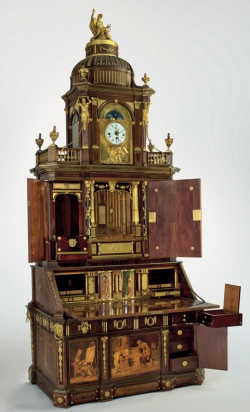
David Roentgen, Berlin Secretary Cabinet, ca. 1778–79. 11 ft. 9 in. (Kunstgewerbemuseum, Staatliche Museen zu Berlin)
Extravagant Inventions: The Princely Furniture of the Roentgens will be the first comprehensive survey of the Roentgen family’s cabinetmaking firm from 1742 to its closing in the early 1800s. Some 60 pieces of furniture, many of which have never before been lent outside Europe, and several clocks will be complemented by paintings, including portraits of the Roentgen family, and prints that depict the masterpieces of furniture in contemporary interiors. The exhibition and catalogue are made possible by the Anna-Maria and Stephen Kellen Foundation.
The meteoric rise of the workshop of Abraham Roentgen (1711-93) and his son David (1743-1807) is the most spectacular chapter in the history of innovative 18th–century Continental furniture-making. Their original designs, combined with their use of intriguing mechanical devices, revolutionized traditional French and English furniture types. From its base in Germany, the workshop served an international clientele. The Roentgens utilized a sophisticated business model, combined with intensive research on potential patrons’ personal taste and forward-looking marketing and production techniques.
In 1742 Abraham Roentgen opened a cabinetmaker’s workshop in the tiny village of Herrnhaag, in the Wetterau region near Frankfurt am Main. With only one journeyman on staff, the shop was concerned principally with the production of furniture for daily use. Abraham distinguished himself by adhering to the highest standards of quality, and soon he was producing veneered show-off pieces in the English Queen Anne style, which he had learned during his years as a journeyman in the Netherlands and England. The local nobility recognized the furnishings’ unusual appearance and quality. Abraham’s progressive designs and types, such as his fashionable tea chest and multi-functional table, were novelties in Germany and were an immediate success. Following his move to Neuwied-at-the-Rhine in 1750, Abraham took his innovative designs even further by adapting elegant French-inspired outlines that, combined with superb marquetry, fine carving, intricate gilded bronze mounts, and multiple mechanical devices, came to be recognized by contemporaries as hallmarks of the Roentgen brand. Roentgen’s playful and perfectly executed inventions became a favored status symbol in princely interiors throughout Europe.
Abraham’s son, David Roentgen, graduated quickly from his apprenticeship in his father’s workshop and eventually took over the enterprise between 1765 and 1768. He perfected the sophisticated structure and intricate marquetry designs of the furniture, and was appointed Ebéniste-Méchanicien du Roi et de la Reine at the court of Queen Marie Antoinette and King Louis XVI at Versailles in 1779. Having conquered the Western market, David revised his designs and reinvented his product line’s appearance as he looked eastward. Focusing on his new target, the Imperial residences of Catherine the Great in St. Petersburg, David Roentgen developed specific models catering to Russian taste. He caught the fancy of the Empress herself with his Apollo Desk (1783-84), which depicted her favorite dog as a gilded mount, and which David produced on pure speculation. After Catherine the Great paid a huge sum for the piece, Russian nobility hurried to catch up with its sovereign, ordering examples of ‘Neuwied Furniture’ by the dozens.
Abraham and David Roentgen’s story is a tale of international success, fame, luxury, and high honor but, in the case of David, it is also the tragedy of a deeply pious man who struggled to balance his ambitions and his glorious achievements with the regulations of his religious community, the Moravian brotherhood. At the pinnacle of David’s career, the workshop employed more than 130 specialists and the annual production amounted to that of the famous Meissen porcelain factory. His fortune shifted dramatically with the progress of the French Revolution, as Europe’s nobility struggled to stay afloat, and the market for luxurious furnishings collapsed.
Many of the works in Extravagant Inventions will be lent from distinguished international museums and royal collections. Six pieces from the Metropolitan Museum’s own collection of Roentgen furniture will be featured, in addition to two that are on long-term loan to the Museum. The exhibition will showcase many outstanding pieces, including a Writing Desk (ca. 1758-62) designed by Abraham Roentgen and considered to be one of the finest creations of his workshop; a spectacular Automaton of Queen Marie Antoinette (1784), a likeness of the queen at a clavichord that still functions and will be played at select times during the exhibition; and six intriguing objects from the Berlin Kunstgewerbe Museum that have never before traveled, most notably a mechanical Secretary Cabinet (1779) made for King Friedrich Wilhelm II of Prussia that is one of the most complex pieces of royal furniture ever produced.
The most complicated mechanical devices in the exhibition will be illustrated through virtual video animations. Additionally, working drawings and portraits of the cabinetmakers, their family, and important patrons—as well as a series of documents owned by the Metropolitan Museum that originated from the Roentgen estate—will underline the long-overlooked significance and legacy of the Roentgens as Europe’s principal cabinetmakers of the ancien régime.
◊ ◊ ◊ ◊ ◊
From Yale UP:
Wolfram Koeppe, ed., Extravagant Inventions: The Princely Furniture of the Roentgens (New Haven: Yale University Press, 2012), 304 pages, ISBN: 9780300185027, $75.
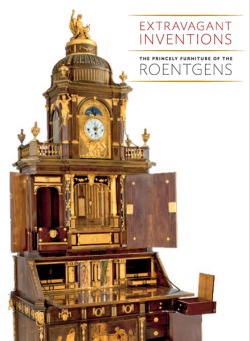 During the second half of the 18th century, the German workshop of Abraham and David Roentgen was among Europe’s most successful cabinetmaking enterprises. The Roentgens’ pieces combined innovative designs with intriguing mechanical devices that revolutionized traditional types of European furniture. An important key to their success was the pairing of the skilled craftsman Abraham with his brashly entrepreneurial son David, whose clients included Louis XVI and Marie Antoinette of France as well as Catherine the Great of Russia. This landmark publication is the first comprehensive survey, in nearly four decades, of the firm from its founding in about 1742 to its closing in the late 1790s.
The Roentgen workshop perfected the practice of adapting prefabricated elements according to the specifications of the customers. Detailed discussions of these extraordinary pieces are complemented by illustrations showing them in their contemporary interiors, design drawings, portraits, and previously unpublished historical documents from the Roentgen estate. This fascinating book provides an essential contribution to the study of European furniture.
Wolfram Koeppe is the Marina Kellen French Curator in the Department of European Sculpture and Decorative Arts at The Metropolitan Museum of Art.
◊ ◊ ◊ ◊ ◊
Lecture | The Legacy of David Roentgen
The Metropolitan Museum of Art, New York, 15 November 2012
David Linley (Chairman, Christie’s, UK), and Charles Cator (Deputy Chairman, Christie’s International)
David Roentgen (1743–1807) was known throughout Europe for his inventive and ingenious mechanical furniture, which found favor in the courts of France and Russia through the patronage of Marie Antoinette and Catherine the Great respectively. He was also famed for pioneering a new method of marquetry, created to give the impression of pietra dura. To mark the occasion of an extensive exhibition of Roentgen’s work, David Linley will share personal insights into Roentgen’s influence on his own furniture designs and his enduring influence on furniture makers today. Charles Cator will examine the collectors’ market for Roentgen from his rediscovery in the nineteenth century to today.
William Morris Gallery Reopens after Renovation
Yes, I realize William Morris stretches the long eighteenth century to the breaking point. I note the reopening of the museum because of the building itself, which dates to around 1744. The official ceremony marking the completion of the renovation took place on 2 August 2012. The following is an excerpt from Alastair’s Sooke’s response for The Telegraph. -CH
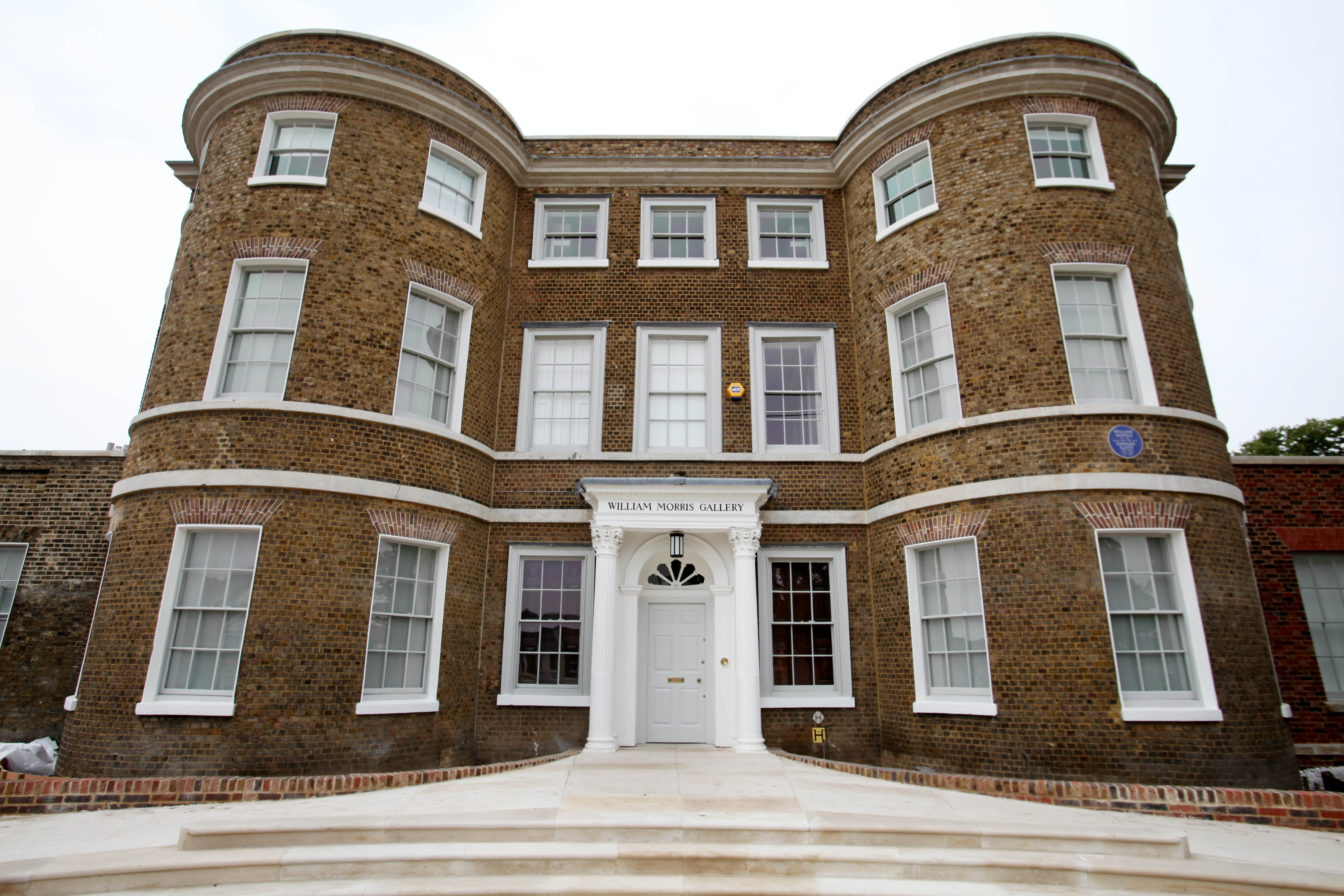
William Morris Gallery, Walthamstow, London © Oliver Dixon / Imagewise — The building dates to ca. 1744
. . . Making sense of the personality, achievements and legacy of such a visionary polymath is a complicated task. Yet that is what the new-look William Morris Gallery, which reopens this week following a year-long £5 million refurbishment, manages to do. The gallery occupies a magnificent Grade II-listed Georgian villa, with a front boasting full-height semicircular bays and a white-painted timber porch with Corinthian columns. Situated in Lloyd Park in Walthamstow in northeast London, like a beacon of beauty amid the local asphalt-benighted urban sprawl, the three-storey building was home to the Morris family between 1848 and 1856, when William was at Marlborough College and then Oxford University, where he met his lifelong friend and collaborator, the painter Edward Burne-Jones, as well as Jane Burden, whom he married in 1859. . .
The full review is available here»
Display | Dead Standing Things at Tate Britain
I was fortunate enough to visit this terrific display earlier in the summer, but for anyone who hasn’t seen it, impressive points of access are available online, offering a fine model for extending an exhibition’s usefulness well beyond the physical site of the museum. A page from the University of York provides an online record, and the first-rate publication edited by Tim Batchelor with contributions by Caroline Good, Claudine van Hensbergen, Peter Moore, and Debra Pring is available free of charge as a PDF file. -CH
◊ ◊ ◊ ◊ ◊
From Tate Britain:
Dead Standing Things: Still Life 1660-1740
Tate Britain, London, 21 May — 16 September 2012
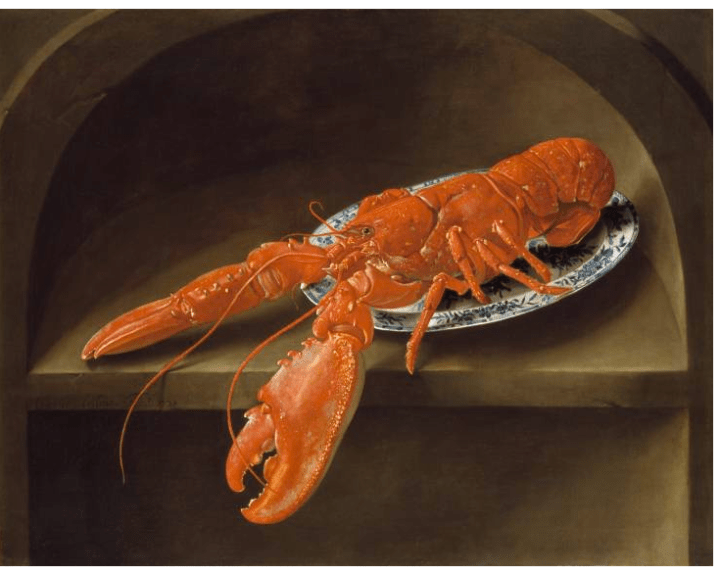
Charles Collins, Lobster on a Delft Dish
oil on canvas, 1738 (London: Tate)
◊ ◊ ◊ ◊ ◊
A familiar genre today, still life painting became established in Britain in the late seventeenth century. Writing in the 1650s, the author William Sanderson referred to such paintings as ‘dead-standing-things’, the term ‘still life’ (from the Dutch ‘stilleven’) only appearing in the following decades. Characterised as the detailed depiction of inanimate objects, the genre had been established in the Netherlands early in the seventeenth century and its introduction into Britain was through the work and influence of Dutch incomer artists. Pieter van Roestraten arrived in London from Amsterdam in the mid-1660s and became known for his ‘portraits’ of objects, particularly silver; another Dutchman known by the anglicised name of Edward Collier was active in London from the 1690s.
This period saw a shift in the way artists sold their works. The old system of artistic patronage by and commissions from the wealthy elite was, from the later 1680s, augmented by newly-emerging auctions. Sales at taverns, coffee houses and commercial exchanges provided artists with new opportunities. It also meant the ‘middling’ class of professionals and merchants could purchase art to furnish their homes and satisfy their social ambitions, with affordable and easily available still lifes a popular choice.
This is the second of two displays at Tate Britain organised as part of Court, Country, City: British Art, 1660-1735, a major research project run by the University of York and Tate Britain, and funded by the Arts and Humanities Research Council. This display has been devised by curator Tim Batchelor.
Exhibition | Fables and Magic: The Guidobono Brothers
From Cultura Italia:
Fables and Magic: The Guidobono Brothers, Painters of the Baroque
Palazzo Madama, Turin, 29 May — 2 September 2012
Curated by Mary Newcome Schleier, Giovanni Romano, and Gelsomina Spione
 From 29 May to 2 September, Palazzo Madama in Turin hosts Fables and Magic: The Guidobono Brothers, Painters of the Baroque, an exhibition focusing on the life and work of the two artists, Bartolomeo and Domenico Guidobono, best known for decorating the ceiling of Palazzo Madama, along with an extensive series of paintings on canvas held in the most prestigious European and American museums.
The Savona-born painters Bartolomeo and Domenico Guidobono were not well-known in Piedmont. Nevertheless, between the end of the 17th century and the beginning of the 18th, they were entrusted with several important commissions in Turin. Following in the footsteps of their father, the painter and ceramic artist Giovanni Antonio, who drew a salary from Victor Amadeus II, the two brothers introduced to Turin the light and festive decorative style typical of Genoese residences, with its emphasis on light effects and elements drawn from nature. Both lived in Turin twice, more precisely between 1685 and 1690, and again from 1702 to 1726, when they painted the frescoes decorating the vault ceiling of the apartments of the second Madama Reale, Marie Jeanne of Savoy.
Their work is illustrated by paintings, drawings, and engravings that highlight their meticulous approach to depicting the details of their subjects, which ranged from mythology to Biblical stories, sacred subjects, still lifes, and magic scenes. Flowers, fruits, birds, animals, objects, and details of still lifes are painted with a refined, light touch and ooze seductive mystery.
The exhibition is arranged chronologically and begins with the work of the older of the two brothers, Bartolomeo Guidobono (Savona 1654 – Turin 1709). During his first sojourn in Turin, he painted the frescoes of the presbytery of the Casanova abbey near Carmagnola and a painting for Palazzo Madama, which was originally located in the former apartments of the Madama Reale and is now lost. During his second sojourn, from 1702 to 1709, Bartolomeo decorated both the residences of the Savoy court and church altars in Turin and the Duchy of Savoy. It is in this context that his Genoese-inspired decorations were made, such as those of the convent of San Francesco da Paola and the Pilone cupola, the ceiling in the hall currently known as the Madama Felicita apartment in Palazzo Reale, which are featured in the exhibition thanks to video images.
Domenico’s style began to emerge more forcefully after his brother’s death in 1709. The artist, who maintained a close relationship with the Madama Reale Maria Giovanna Battista, became the undisputed protagonist of the decorations of the halls on the first floor of Palazzo Madama, known as the Guidobono halls – the Madama Reale’s Chamber, the Chinese Cabinet, and the Southern Veranda – which were decorated on the orders of the Duchess orders between 1708 ad 1721. Domenico Guidobono was active in Turin and the rest of the Duchy until the ascent of Filippo Juvara, who eventually marginalized him and caused him to return to Genoa and subsequently to Naples, where he died in 1746. The exhibition delves into the life and work of Domenico Guidobono through recently discovered documents and artwork. The history of his art can be traced thanks to a dowry inventory put together by his daughter Maria Beatrice in 1720, which lists the works from her father’s Turin workshop. Today, most of these works are held in foreign museums, including the Louvre in Paris and the Metropolitan Museum in New York City.
The exhibition is enhanced by works by Genoese masters and other artists who were crucial influences on the Guidobono brothers, such as Domenico Piola, Gregorio De Ferrari, and Daniel Seyter. There is also a selection of engravings by Rembrandt and Castiglione, the stylistic points of reference underlying Genoese painting, followed by a section on project planning with preparatory sketches by Piola and De Ferrari from the Cabinet of Drawings and Paintings in Genoa’s Palazzo Rosso.
◊ ◊ ◊ ◊ ◊
From Artbooks.com:
Catalogue: Clelia Arnaldi di Balme, Giovanni Romano, Mary Newcome Schleier, and Gelsomina Spione, Favole e Magie: I Guidobono, Pittori del Barocco (Milano: Silvana, 2012), 128 pages, ISBN: 9788836623952, $33.
Ai fratelli Bartolomeo e Domenico Guidobono, attivi tra la fine del Seicento e l’inizio del Settecento in Liguria e in Piemonte, è dedicato questo volume, che offre una retrospettiva completa e aggiornata sulla loro carriera di pittori, costellata di successi in vita, ma poco considerata dalla critica nei secoli successivi. I due fratelli, originari di Savona, hanno lasciato il segno della loro ispirazione più alta nei soffitti di Palazzo Madama a Torino, ma si deve a loro anche una vasta produzione di quadri da cavalletto, ora in gran parte dispersa in musei e collezioni private d’Europa e d’America. Giunti a Torino a seguito del padre – pittore e ceramista stipendiato da Vittorio Amedeo II –, introducono in Piemonte i caratteri leggeri e festosi della grande decorazione barocca genovese, che trae i suoi spunti dall’osservazione della natura e dallo studio degli effetti della luce. Favole mitologiche, storie bibliche e soggetti sacri, nature morte e scene di magia si accompagnano alla descrizione precisa di fiori, frutti, uccelli, animali, oggetti e brani di natura morta, con esiti di raffinata leggerezza e talvolta di seducente mistero. Il volume, che nel ricostruire la loro attività permette di fare il punto sulla fortuna critica e sugli studi svolti intorno ai due pittori, presenta, accanto alle opere dei Guidobono, anche quelle di altri artisti che rappresentarono un punto di riferimento per la loro formazione, come Domenico Piola, Gregorio De Ferrari e Daniel Seyter. Il volume è completato da una bibliografia.
Exhibition | Daily Pleasures: French Ceramics
From LACMA:
Daily Pleasures: French Ceramics from the MaryLou Boone Collection
Los Angeles County Museum of Art, 6 October 2012 — 31 March 2013
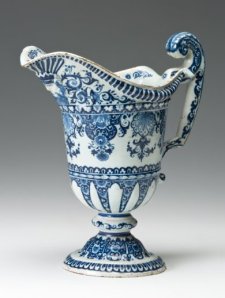
Ewer, c. 1700, Rouen, France, Earthenware with tin glaze and enamel (grand feu faïence), 11 x 11 in. LACMA, Gift of MaryLou and George Boone in honor of the museum’s twenty-fifth anniversary, M.2010.51.1, Photo © Susan Einstein.
Long-time LACMA benefactor MaryLou Boone has amassed the West Coast’s finest collection of French faience and soft-paste porcelain, 25 pieces of which she gave to LACMA in 2010. (Although originally made to emulate hard-paste porcelain imported into Europe from Asia, faience and soft-paste porcelain ultimately became distinctive and sought-after ceramics in their own right.)
The exhibition comprises over 130 pieces from the foremost manufactories of the era, representing myriad aesthetic influences, as well as advances in technology and the rhythms of domestic life. The collection includes wares for dining and taking tea, for storing the many toiletries necessary for a stylish appearance, and for preparing mixtures that comforted in time of sickness. Inextricably intertwined with every day duties and diversions, these objects provide a unique view of French life and culture.
The accompanying exhibition catalogue, Daily Pleasures: French Ceramics from the MaryLou Boone Collection, includes more than 145 entries of French faience and porcelain from the collection, as well as essays about the collector and 17th and 18th-century French ceramics.
◊ ◊ ◊ ◊ ◊
From ACC Distribution:
Elizabeth Williams and Meredith Chilton, Daily Pleasures French Ceramics from the MaryLou Boone Collection (Los Angeles: Los Angeles County Museum of Art, 2012), 392 pages, ISBN: 9780875872155, $75.
 MaryLou Boone’s collection of French ceramics spans the reigns of some of France’s most fascinating kings, from Louis XIII to Louis XVI, yet the collection is not one of royal vases and princely gifts but, rather, of wares for dining and taking tea, of porcelain frivolities, and of ceramics for the sickroom and the pharmacy. Mrs. Boone – a collector, scholar, and donor – has amassed the West Coast’s finest collection of 17th and 18th-century French faience and soft-paste porcelain, objects that provide a unique view of French life and culture. Emphasizing the aesthetics French ceramics and also its functionality, the catalogue comprises over 130 collection entries, as well as essays on the collector, ceramics in 17th-18th century France, French faience and its makers and French porcelain and its makers. Although originally created to emulate Asian porcelain, faïence and soft-paste porcelain ultimately became distinctive and sought-after ceramics in their own right.
C O N T E N T S
• Michael Govan and John Murdoch — Foreword
• Elizabeth Williams — Introduction
• Map of Manufactories
• Victoria Kastner — MaryLou Boone: The Accidental Collector
• Meredith Chilton — The Pleasures of Life: Ceramics in Seventeenth- and Eighteenth-Century France
• Antoinette Faÿ-Hallé — French Faience from Its Origins to the Nineteenth Century
• Antoinette Faÿ-Hallé — Faience Manufactory Histories
• Faience Catalogue
• Meredith Chilton — Porcelain Production in Seventeenth- and Eighteenth-Century France
• Meredith Chilton — Porcelain Manufactory Histories
• Porcelain Catalogue
• Marks Appendix
• Glossary
• Selected Bibliography
• Illustration Credits
• Index
Meredith Chilton is an independent art historian and was the founding curator of the Gardiner Museum of Ceramic Art in Toronto from 1983 to 2004. She has curated many exhibitions, published extensively and lectured internationally. Antoinette Faÿ-Hallé is Conservateur général honoraire du Patrimoine and Ancien directeur du musée national de Céramique, Sèvres where she worked as both a conservator and director. She has organized many ceramic and glass exhibitions and written extensively on the history of ceramics. Catherine Hess is Chief Curator of European Art at The Huntington Art Collections in San Marino, California. She is responsible for a collection particularly strong in Renaissance bronzes, 18th-Century French decorative arts, and 18th-Century British portraiture. Victoria Kastner, the Historian at Hearst Castle, has published several books and holds graduate degrees in architectural history and museum management. Elizabeth A. Williams is the Marilyn B. and Calvin B. Gross Assistant Curator of the Decorative Arts and Design department at the Los Angeles County Museum of Art.










leave a comment