Exhibition | Migrations: Journeys into British Art
From Tate Britain:
Migrations: Journeys into British Art
Tate Britain, London, 31 January — 12 August 2012

Benjamin West, Pylades and Orestes Brought as Victims before Iphigenia, 1766 (London: Tate), N00126
This exhibition explores British art through the theme of migration from 1500 to the present day, reflecting the remit of Tate Britain Collection displays. From the sixteenth- and seventeenth-century Flemish and Dutch landscape and still-life painters who came to Britain in search of new patrons, through moments of political and religious unrest, to Britain’s current position within the global landscape, the exhibition reveals how British art has been fundamentally shaped by successive waves of migration. Cutting a swathe through 500 years of history, and tracing not only the movement of artists but also the circulation of visual languages and ideas, this exhibition includes works by artists from Lely, Kneller, Kauffman to Sargent, Epstein, Mondrian, Bomberg, Bowling andthe Black Audio Film Collective as well as recent work by
contemporary artists.
◊ ◊ ◊ ◊ ◊
From the Tate Shop:
Lizzie Carey-Thomas, Migrations: Journeys into British Art (London: Tate, 2012), 128 pages, ISBN: 9781849760072, £15.
 With contributions by John Akomfrah, Tim Batchelor, Sonia Boyce, Emma Chambers, T.J. Demos, Kodwo Eshun, Leyla Fakhr, Paul Goodwin, Nigel Goose, Karen Hearn, David Medalla, Lena Mohamed, Panikos Panayi and Wolfgang Tillmans.
This book offers a unique perspective on the history of British art, charting how it has been shaped by successive waves of migration. It cuts a swathe through five hundred years of history and traces not only the movement of artists themselves, but also the circulation of art and ideas, from the hugely influential arrival of Northern European artists such as Anthony van Dyke in the sixteenth and seventeenth centuries to the influence of Italy and the development of neoclassicism on eighteenth-century artists such as Benjamin West, and on to the broad cultural interchange of the Victorian era. James McNeill Whistler and John Singer Sargent were two of many artists who moved between Britain, France and the United States in the nineteenth century. In the early twentieth century, David Bomberg and Mark Gertler were among the group of second-generation Jewish artists who played a considerable role in the establishment of British modernism. The rise of fascism in the 1930s, causing artists such as Oskar Kokoschka and Kurt Schwitters to flee to Britain, foreshadowed the explosion of a multicultural diaspora. Several generations of artists have since explored what it means to be both ‘black’ and ‘British’, and contemporary artists continue to investigate the meaning of identity today.
Generously illustrated, and including artist interviews and texts by leading curators and art critics, this illuminating book tells a previously hidden but vital story in the shaping of British art and culture.
Exhibition | Drawings from the Christian and Isabelle Adrien Collection
Didier Rykner reviewed the exhibition for The Art Tribune in May (with an English version available). From the museum’s website:
Une Collection Particulière: Les Dessins de la Collection Christian et Isabelle Adrien
Le Musée des Beaux-Arts de Rennes, 21 March — 26 August 2012
 Le musée des Beaux-Arts de Rennes présentera, à partir du 21 mars, les plus belles feuilles de la collection de dessins de Christian et Isabelle Adrien. Au hasard des rencontres, à la lumière de quelques intuitions fulgurantes, M. Adrien a inlassablement cherché et étudié, tout au long de sa vie, les feuilles dessinées par les grands maîtres du passé. C’est à Rennes que ce collectionneur d’origine bretonne invite aujourd’hui le public à venir partager sa passion pour le dessin ancien. La découverte de près de quatre-vingt dessins français (La Hyre, Poussin, Boucher), italiens (Bandinelli, Salviati, Carraci) et nordiques (Bloemaert, Rubens), dont beaucoup sont encore inédits, marquera l’un des temps fort de la Semaine du dessin 2012 et de la programmation culturelle rennaise du printemps et de l’été prochain. Le catalogue de l’exposition, qui rassemble les notices des plus grands spécialistes de
chaque artiste, est dirigé par Monsieur Rosenberg, de l’Académie française.
◊ ◊ ◊ ◊ ◊
Catalogue: Francis Ribemont and Pierre Rosenberg, Dessins de la collection Christian et Isabelle Adrien (Paris: Editions Chaudun, Musée des beaux-arts de Rennes, 2012), 207 pages, ISBN: 9782350391281, $77.50. [Available from ArtBooks.com]
Exhibition | Messerschmidt and Modernity
Press release (16 April 2012) from The Getty:
◊ ◊ ◊ ◊ ◊
Messerschmidt and Modernity
The J. Paul Getty Museum, Getty Center, Los Angeles, 24 July — 14 October 2012

The Getty Celebrates the Modern and Contemporary Legacy of Franz Xaver Messerschmidt’s Distinctive Character Heads
◊ ◊ ◊ ◊ ◊

Ken Gonzales-Day, Untitled (Franz Xaver Messerschmidt, The Vexed Man, The J. Paul Getty Museum, Los Angeles, CA), 2008. Light jet print. Courtesy of Ken Gonzales-Day and Fred Torres Collaborations, N.Y.C. © Ken Gonzales-Day
The intriguing series of heads that are collectively known as Character Heads, created by the German Baroque artist Franz Xaver Messerschmidt (1736–1783) during the last 13 years of his life, have become increasingly popular with the general public through a series of recent exhibitions and books devoted to these expressive works. Furthermore, the sculptures, depicting various states of emotion and expression, have also captured the imaginations of generations of artists—especially during the 20th and 21st centuries.
Messerschmidt and Modernity, on view at the J. Paul Getty Museum from July 24 through October 14, 2012, is the first exhibition to explore the contemporary legacy of these surprisingly modern-looking sculptures, which were carved in alabaster, or cast in a lead or tin alloy. Along with Messerschmidt’s works, the exhibition will feature a selection of modern and contemporary works of art that testify to the lasting impact of these astonishing heads. Eight Character Heads will be exhibited—among them the Getty’s own Vexed Man— along with a newly discovered reduced variation of a now-lost Character Head known as A Cheeky Nitpicky Mocker, which has never before been exhibited publicly. Contemporary artists featured in the exhibition include Tony Bevan, Tony Cragg, Ken Gonzales-Day, Bruce Nauman, Pierre Picot, Arnulf Rainer, Cindy Sherman, and Emily Young.
“Messerschmidt’s Character Heads have appealed to audiences since they were first produced. They were especially popular in turn-of-the-century Vienna and subsequently inspired modern artists of the 20th century,” explains Antonia Boström, senior curator of sculpture and decorative arts at the J. Paul Getty Museum. “Now, this unparalleled series of sculptures is enjoying a renewed popularity—not only fascinating to museum audiences and scholars, but compelling for contemporary artists.”
The exhibition demonstrates how Messerschmidt’s heads are linked to the 18th and 19th centuries’ fascination with expression and the “passions,” as well as with the pseudosciences of physiognomy and pathognomy. It also traces how this series has influenced the work of artists in fin-de-siècle Vienna and contemporary artists in Austria, Great Britain, and the United States.
Messerschmidt
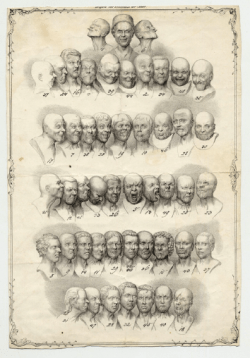
Matthias Rudolph Toma, Messerschmidt’s ‘Character Heads’, 1839. Lithograph. Courtesy of the Museum of Fine Arts, Budapest.
The German-born Messerschmidt led a successful career in Vienna in the mid-18th century, receiving many important commissions from the Habsburg empress Maria Theresa and her consort, Francis Stephen of Lorraine. Messerschmidt’s circumstances changed dramatically around 1770 when he began to show signs of mental instability, leading to the loss of prestigious commissions and conflicts with colleagues and friends. He eventually left Vienna and, in 1777, he settled in Pressburg (now Bratislava), and remained there until his death in 1783, focusing obsessively on the production of the heads as well as more conventional portraits. Messerschmidt called the dozens of heads he created between 1770 and 1783 Kopfstücke (head pieces) and intended them to represent the full range of human expressions, which he believed there are sixty-four. In 1793, ten years after his death, the heads were exhibited at the Citizen’s Hospital in Vienna, when, despite their misrepresentation, they also received the often incongruous titles by which they are still referred to today. They were only referred to as “Character Heads” after Messerschmidt’s death.
Just Rescued from Drowning belongs to a group of alabaster Character Heads probably depicting the same man, but differentiated by the arrangement of the hair. The title suggests that he has just been submerged in water, and his lank hair (or a wig) hangs down over his forehead, but the hairstyle may actually reflect those featured on Gothic sculptures of southern Germany, which would have been familiar to Messerschmidt from his youth.
Another head on view, The Ill-Humored Man, belongs to a group of middle-aged bald men within the series of Character Heads. The man’s tightly squeezed eyes and the flat strip covering his mouth contribute to a strong sense of alienation and interiority and we sense his extreme discomfort. The object covering the mouth may relate to the magnets that the German physician Franz Anton Mesmer (1734–1815) applied to patients during his therapeutic sessions. They formed part of his “animal magnetism” theory that a universal magnetic fluid coursing through the human body could be manipulated by magnets for curative purposes. Mesmer and Messerschmidt were known to be friends and these experimental procedures were of great interest to the artist.
The French artist Joseph Ducreux (1735–1802) was a contemporary of Messerschmidt, and as a painter at the court in Vienna he was probably familiar with his sculpture. Like Messerschmidt, Ducreux was interested in the pseudoscience of physiognomy, and his Self-Portrait, Yawning (by 1783, Getty Museum’s permanent collection) is an example of his experiments with the expressive possibilities of portraiture.
Some forty-nine of the sixty-nine heads Messerschmidt created are accounted for today. A lithograph on view in the exhibition has been a key element in reconstructing the series of Messerschmidt’s heads. Created by Matthias Rudolph Toma after a drawing by Josef Hasslwander, this print (from Budapest) depicts forty-nine of the heads and was made four years after the heads were publicly exhibited in 1835 by their then-owner, Josef Jüttner.
The psychological theme of Messerschmidt’s sculptures and their uncompromising aesthetic colored their public reception in Vienna. After his death and throughout the early 19th century the Character Heads were viewed as oddities and exhibited in Vienna for popular entertainment. Over time, this perception changed and by the end of the 19th century the heads were seen as useful examples of expression and emotion for art students to copy, and for students of anatomy and psychology to study. Some of the heads found their way into art-school storerooms in Vienna, while others were collected both by preeminent medical professionals and by art collectors. By the turn of the century the Character Heads found favor with Vienna’s Jewish cultural elite, which supported avantgarde art movements such as the Viennese Secession and the Wiener Werkstätte, and also had links to Sigmund Freud. Their interests in unconventional contemporary art and the science of psychiatry combined to create a new culture of support for Messerschmidt’s heads in Vienna.
Modernity and Beyond
The works created since 1900 on view in the exhibition represent a wide range of responses to the Character Heads. Modern and contemporary artists have been drawn to Messerschmidt’s heads for their perceived departure from the confines of academic convention. But it is also the combination of a reductive style, refined modeling and carving,
and exaggerated expression that make these sculptures resonate with modern audiences. By the early 20th century, Messerschmidt’s heads were well known in Vienna, and prized by collectors and artists as distinctive and affecting works of art. Anton Josef Trčka’s renowned 1914 portrait photograph of Egon Schiele (1890–1918) reflects the visual and psychological impact of Messerschmidt’s grimacing heads. The camera focuses closely on the artist’s head and hands; his anxious expression and interlocked fingers hint at his angst-ridden mood.
Contemporary artists such as Arnulf Rainer (b. 1929) and Tony Bevan (b. 1951) directly quote Messerschmidt’s sculptures, while others, including Bruce Nauman (b. 1941) and Cindy Sherman (b. 1954), incorporate their body, human expression, and self-portraiture into their work in a way that prompts comparison with Messerschmidt. The sculptures of Tony Cragg (b. 1949) and Emily Young (b. 1951) are more indirectly related, though the sculptors’ grounding in a figurative tradition and their exploration of the material’s expressive potential can be paralleled in Messerschmidt’s works. The juxtaposition of works from different time periods in this section of the exhibition illustrates the psychological power that Messerschmidt’s Character Heads continue to have for the contemporary viewer.
Expression Lab
The final gallery of the exhibition is designed to encourage visitors to consider and respond to Messerschmidt’s sculptures and the contemporary works focused on expression. The gallery is installed with mirrors, art reproductions, and an interactive “photo booth” for those who wish to actively explore and record their own facial expressions. For example, Rainer practiced “pulling faces” in the mirror, performing and documenting a series of contorted expressions as a means of investigating his own image. Using mirrors, visitors will be able to try these exercises themselves. In the photo booth, participants will be invited to replicate the intense facial expression of the Vexed Man or other character heads, or to invent an expression of their own choosing. Visitors may then share their photo on video screens in the gallery. A related video will be shown and reference books will be on hand for those who wish to learn more about Messerschmidt and expression, and about the other artists represented in the exhibition.
An audio tour, narrated by Boström and guest contributor Professor Eric Kandel, a Nobel-prize winning neuroscientist and author of The Age of Insight: The Quest to Understand the Unconscious in Art, Mind, and Brain, from Vienna 1900 to the Present, will accompany the exhibition. Messerschmidt and Modernity will also be accompanied by a richly illustrated book of the same name, written by Antonia Boström and published by Getty Publications.
◊ ◊ ◊ ◊ ◊
From the Getty Store:
Antonia Boström, Messerschmidt and Modernity (Los Angeles: Getty Publications, 2012), 80 pages, ISBN: 9780892369744, $20.
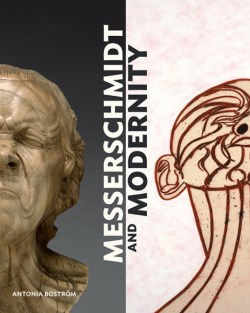 An astonishing group of sixty-nine “Character Heads” by German sculptor Franz Xaver Messerschmidt (1736–1783) has fascinated viewers, artists, and collectors for more than two centuries. The heads, carved in alabaster or cast in lead or tin alloy, were conceived outside the norm of conventional portrait sculpture and explore the furthest limits of human expression. Since their first exposure to the public in 1793, artists, including Egon Schiele (1890–1918), Francis Bacon (1909–1992), Arnulf Rainer (born 1929), and, more recently, Tony Cragg (born 1949) and Tony Bevan (born 1951), have responded to their over- whelming visual power.
Lavishly illustrated, Messerschmidt and Modernity presents remarkable works created by and inspired by Messerschmidt, an artist both of and ahead of his time. The Character Heads situate the artist’s work squarely within the eighteenth-century European Enlightenment, with its focus on expression and emotion. Yet their uncompromising style stands in sharp contrast to the florid Baroque style of Messerschmidt’s earlier sculptures for the court of Empress Maria Theresa of Austria. With their strict frontality and narrow silhouettes, the Character Heads appear to contemporary eyes as having been conceived in a “modern” aesthetic. Their position at the apparent limits of rational art have made them compelling to successive generations of artists working in a variety of media. An exhibition of the same name will be on view at the Getty Center from July 24 through October 14, 2012.
Antonia Boström is senior curator of sculpture and decorative arts at the J. Paul Getty Museum and the editor of The Fran and Ray Stark Collection of 20th-Century Sculpture in the J. Paul Getty Museum (Getty, 2008).
Exhibition | Renaissance to Goya: Prints and Drawings in Spain
From The British Museum:
Renaissance to Goya: Prints and Drawings Made in Spain
The British Museum, London, 20 September 2012 — 5 January 2013
The Art Gallery of New South Wales, Sydney, 31 August — 24 November 2013
New Mexico Museum of Art, Santa Fe, 14 December — 9 March 2014
Curated by Mark McDonald
Spanish prints and drawings is a subject that is little known outside Spain. It is generally assumed these were marginal arts practiced only by a few well-known artists, including José de Ribera, Bartolomé Murillo and Francisco de Goya. The aim of this project is to explore the largely unchartered territory of the origins, form and function of prints and drawings in Spain. It will present for the first time a coherent study, largely based on the collections of the British Museum, that looks at their history from around 1400 through to and including Goya (died 1828). It will also present new research on the subject of the graphic arts in Spain. The material will be published in a monograph to accompany an exhibition at the British Museum in late 2012.
It is the first time prints and drawings made in Spain have been studied together. A critical aspect of the project will be to consider the presence of foreign artists working in Spain and how they contributed to the artistic landscape. Particular attention will be given to the different types of prints and drawings and their many functions to convey the role they played in artistic practice and visual culture in Spain (architectural prints and drawings, reproductive prints, landscape, religious subjects, prints made for commemorative purposes, fans, playing cards and more).
◊ ◊ ◊ ◊ ◊
Due out in October from Ashgate:
Catalogue: Mark McDonald, Renaissance to Goya: Prints and Drawings Made in Spain (Aldershot: Lund Humphries, 2012), 320 pages, ISBN: 9781848221185.
 The rich tradition of printmaking and drawing in Spain has rarely been examined, in part because of the misapprehension that Spanish artists did not draw and few turned their hand to printmaking. This spectacular study of prints and drawings will for the first time examine the history of graphic practice in Spain, providing an overview of more than 400 years of artistic production.
The story begins in the late 15th century with convergence of foreign artists in Spain who introduced new techniques and ideas. The most significant changes were brought about through the building of Philip II’s monastery of the Escorial near Madrid. Large numbers of foreign artists arrived to decorate the monastery. They included the Italians Pellegrino Tibaldi and Federico Zuccaro and the Flemish printmaker Pedro Perret, whose engravings of the Escorial are among the most remarkable architectural prints of the period. At the Escorial the international influences formed the basis of artistic practice and contributed to the distinctive appearance of art produced in Spain.
The ‘Golden Age’ — a dramatic flourishing of artistic and literary endeavour in Spain during the 17th century — is celebrated through discussion of key works by the most important visual artists of the period: Alonso Berruguete; the Carducho brothers; Murillo; Ribera; Zurbarán and the extraordinary drawings of Velázquez, about which very little is known. Each region of Spain is explored separately as independent centres of artistic activity during this time with prints and drawings examined together to demonstrate how their production was closely linked.
The book concludes with the Enlightenment and the 18th century, with a study of remarkable prints and drawings by Francisco de Goya. Goya’s important Spanish contemporaries are examined alongside the works of foreign artists who continued to come to Spain, such as the Tiepolo family who worked in Madrid.
Contents
Introduction
1. Prints and Drawings in Spain: Attitudes and Evidence
2. Drawings and Prints before 1500 and Early Collecting in Spain
3. Importing Graphic Practices: Castile 1550–1600
4. Madrid as Artistic Capital 1600–1700
5. Andalusia 1500–1700
6. Valencia 1500–1700 and Ribera in Naples
7. The Eighteenth-Century Reinvention of the Graphic Arts
8. Francisco de Goya
Appendix by Clara de la Peña McTigue, Spanish Paper and Papermaking
Bibliography
Mark McDonald is curator of Old Master prints and Spanish drawings at the British Museum. He has published widely on the subject of Old Master prints from the 15th to the 18th centuries, with special interest in the Renaissance period. He is the author of The Print Collection of Ferdinand Columbus (1488–1539): A Renaissance Collector in Seville (winner of the Mitchell Prize 2005).
◊ ◊ ◊ ◊ ◊
Note (added 1 September 2013) — The original posting did not include the Sydney venue; more information is available here»
Note (added 21 December 2013) — Earlier versions did not include Santa Fe venue; more information is available here».
Exhibition | The Horse: From Arabia to Royal Ascot
While you probably wouldn’t know it from the description provided below, the eighteenth century is a major theme for this exhibition on horses at The British Museum — with a good showing of Stubbs, including Letitia, Lady Lade from the Royal Collection, but other treats, too. I found it immensely instructive, one of the most interestingly layered exhibitions I recall seeing in a long time. There’s something for everyone — antiquity and the role of the horses in early civilizations and empires of Mesopotamia and Egypt, extraordinary Persian and Mughal miniatures, textiles, equestrian rock art (photographed in stunning detail), paintings, books, portraiture, agrarian history, and sport. The challenge, however, is not simply putting together a varied exhibition but imparting coherence, and given just how much is covered in this relatively modest sized show, it succeeds brilliantly, appropriately acknowledging both the Diamond Jubilee and the Olympics without being obsequious to either one. It also offers, I think, an example of how projected photographs and video can be used effectively in an exhibition without taking over or supplanting the objects on display. For better or worse, I’m guessing we’ll see lots more moving images in the exhibitions of the future. Integrating that technology thoughtfully into the larger intellectual program of a show is a tall order. The Horse: From Arabia to Royal Ascot offers a start and plenty else besides.
-Craig Hanson
◊ ◊ ◊ ◊ ◊
From The British Museum:
The Horse: From Arabia to Royal Ascot
The British Museum, London, 24 May — 30 September 2012
Curated by John Curtis and Nigel Tallis
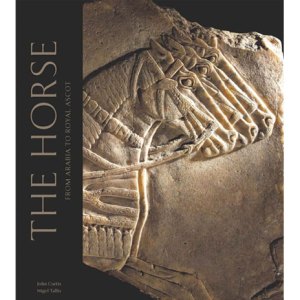 The history of the horse is the history of civilisation itself. The horse has had a revolutionary impact on ancient civilisations and this major exhibition explores the influence of horses in Middle Eastern history, from their domestication around 3,500 BC to the present day. Britain’s long equestrian tradition is examined from the introduction of the Arabian breed in the 18th century to present day sporting events such as Royal Ascot and the Olympic Games.
Important loans from the British Library, the Fitzwilliam Museum and the Royal Armouries, as well as rare material from Saudi Arabia, will be seen alongside objects from the British Museum’s exceptional collection, including famous pieces such as the Standard of Ur and Achaemenid Persian reliefs. Supported by the Board of Trustees of the Saudi Equestrian Fund, the Layan Cultural Foundation and Juddmonte Farms. In association with the Saudi Commission for Tourism & Antiquities. (more…)
Exhibition | Drawings of Natoire and the Roots of Artistic Creation
Thanks to Hélène Bremer for noting this exhibition at the Musée des Beaux-Arts in Nîmes. It brings together more than 90 drawings from private and public collections, including loans from the Louvre and the Atger Museum (an English description is available here).
◊ ◊ ◊ ◊ ◊
Charles-Joseph Natoire (1700-77): Le dessin à l’origine de la création artistique
Musée des Beaux-Arts de Nîmes, 8 June — 16 September 2012
 A l’occasion de la parution de la monographie de Natoire aux éditions Arthena, rédigée par Susanna Caviglia-Brunel, le Musée des Beaux-Arts propose une exposition sur Charles-Joseph Natoire dessinateur (Nîmes, 1700 – Castel Gandolfo, 1777). Après les célébrations du bicentenaire de la mort de Natoire en 1977 et le tricentenaire de sa naissance en 2000, le Musée des Beaux-Arts rend hommage, par l’exposition inédite de sa production graphique, à cet artiste d’origine nîmoise, considéré comme l’un des grands représentants de la peinture française du XVIIIe siècle.
Né à Nîmes en 1700, Charles-Joseph Natoire illustre sans doute le mieux, avec François Boucher, un certain esprit de la peinture française sous le règne de Louis XV. Peintre subtil, dessinateur inspiré et virtuose, sa réputation s’établit rapidement après son entrée à l’Académie Royale de peinture et de sculpture en 1734 et les nombreuses commandes royales qu’il exécute avec brio (Fontainebleau, Versailles…). A partir de 1756, Natoire réduit sa production peinte au profit du dessin.
Au cœur des peintures de grands formats dont font partie les quatre cartons de tapisseries du Cycle de l’Histoire de Marc-Antoine que conserve le musée (L’entrée de Marc-Antoine à Ephèse, L’Arrivée de Cléopâtre à Tarse et Le Repas de Cléopâtre et Marc-Antoine, La Paix de Tarente), près de 90 dessins sortent exceptionnellement des réserves de collections privées et publiques (dont le musée du Louvre et le Musée Atger de Montpellier) pour le plus grand plaisir du public. Les sanguines, pierres noires et lavis permettent d’aborder les différentes fonctions du dessin dans les étapes de la création chez Charles-Joseph Natoire. Copie d’après l’Antique, étude des grands maitres, dessin sur le motif, moyen d’exercice, étude préparatoire de l’œuvre d’art ou œuvre d’art… le dessin chez Natoire révèle un charme des contours, une harmonieuse association des matériaux, le goût de l’élégance, la recherche de la beauté.
Exposition organisée avec la participation du musée du Louvre et l’aide de la DRac Languedoc-Roussillon et de l’AAMAC.
◊ ◊ ◊ ◊ ◊
From Dossier de l’Art:
Dossier de l’Art: Natoire. N° 196 (May 2012), 9€.
 C’est l’un des plus illustres enfants de Nîmes que célèbre aujourd’hui le musée des Beaux-Arts en consacrant une exposition à l’abondante production graphique de Charles-Joseph Natoire. Près de quatre-vingt-dix feuilles sorties exceptionnellement des réserves de collections privées et publiques offrent un large panorama de l’usage qu’il fit du dessin tout au long de sa carrière, des bancs de l’Académie de peinture et de sculpture de Paris à la direction de l’Académie de France à Rome. Sanguines, pierres noires, lavis, études rehaussées à la craie ou à l’aquarelle illustrent les différentes étapes du processus de création, de la copie de motifs d’après les maîtres au premier tracé, de l’étude de variantes à l’esquisse minutieuse et jusqu’au dessin comme œuvre autonome.
Articles
Entretien avec Pierre Rosenberg, de l’Académie française
Le dessin à l’origine de la création
Arrêt sur une oeuvre : la copie de motif
Arrêt sur une oeuvre : la première pensée
Arrêt sur une oeuvre : les reprises et les variantes
Arrêt sur une oeuvre : les dessins de paysage
Les techniques graphiques au XVIIIe siècle
Le songe d’une Académie idéale
Le cas Greuze
L’invention à l’œuvre
Actualités
Le musée Atger, une collection exceptionnelle de dessins anciens
Le musée des Beaux-Arts de Nîmes
Les dessins du XVIIIe siècle du musée Fabre
Les collectionneurs de dessins au XVIIIe siècle
Les dessins de la collection Adrien au musée des Beaux-Arts de Rennes
Exhibition | Expanding Horizons: Lusieri and the Panoramic Landscape
From the National Galleries of Scotland, as noted by Hélène Bremer:
Expanding Horizons: Giovanni Battista Lusieri and the Panoramic Landscape
Scottish National Gallery, Edinburgh, 30 June — 28 October 2012
Curated by Aidan Weston-Lewis

Giovanni Battista Lusieri, The Monument to Philopappos, Athens, ca. 1805-07
Giovanni Battista Lusieri (1754–1821) was hailed during his lifetime as one of the most gifted of all living landscape artists and his exquisitely crafted works were eagerly sought by collectors. But within a few years of his death his reputation descended into an obscurity from which it has only recently begun to re-emerge. His name will still be unfamiliar to all but a few specialists, a neglect which this exhibition, the first ever devoted to the artist, aims to redress.
Lusieri was one of very few Italian artists to have adopted watercolour as their favoured medium. From the outset his work exhibits the meticulous detail, precision and faultless perspective that remained the hallmarks of his style throughout his career, combined with a panoramic breadth of vision and an astonishing ability to render brilliant effects of light. The latter part of Lusieri’s career was spent mainly in Athens as Lord Elgin’s resident artist and agent. In that capacity he was closely involved in supervising the removal and shipping of the celebrated marbles from the Acropolis, now in the British Museum.
◊ ◊ ◊ ◊ ◊
Catalogue: Aidan Weston-Lewis with Fabrizia Spirito, Kim Sloan, and Dyfri Williams, Giovanni Battista Lusieri and the Panoramic Landscape: Expanding Horizons (Edinburgh: National Galleries of Scotland, 2012), 236 pages, ISBN: 9781906270469, £25 / $63 — available from Artbooks.com in August
 This is the first publication in English devoted to the extraordinary work of the Italian landscape watercolourist Giovanni Battista Lusieri (1754-1821). His career took him from his native Rome to Naples, then to Sicily and finally to the eastern Mediterranean, where he spent twenty years in the service of the 7th Earl of Elgin as his resident artist and agent in Athens. In that capacity he was closely involved in the removal of the celebrated marbles from the Parthenon and other monuments in Greece. Lusieri’s watercolours combine a broad, panoramic vision, an uncanny ability to capture brilliant Mediterranean light and a meticulous, almost photographic attention to detail. He was widely acclaimed as one of the most accomplished landscape artists of his day, and his works were eagerly sought by British Grand Tourists, but after his death he was soon forgotten, and only recently have his exceptional gifts begun to be recognised once again.
Contents
Foreword
Acknowledgements
Aidan Weston-Lewis — ‘The most exact and eloquent transcriptions of nature I ever saw’: Giovanni Battista Lusieri, Life, and Work
Fabrizia Spirito — Lusieri and his Contemporaries | Drawing on the Spot around Rome and Naples
Aidan Weston-Lewis — Rome | An Early Patron: Philip Yorke; entries 1-13
Kim Sloan — Naples | ‘Naples, where the landscape painter is most truly in his element’; entries 14-59
Fabrizia Spirito — Sicily | Lusieri in Sicily; entries 60-66
Dyfri Williams — Greece | Lusieri in the Eastern Mediterranean, 1800-1821; entries 67-92
Bibliography
Notes and References
◊ ◊ ◊ ◊ ◊
Aidan Weston-Lewis is Chief Curator at the Scottish National Gallery with responsibility for the Italian and Spanish collections. He has organised numerous exhibitions at the Gallery and been closely involved with many major acquisitions. He has a particular interest in north Italian painting and drawing of the sixteenth and seventeenth centuries and has published widely in this area.
Exhibition | Napoleon: Revolution to Empire
Press release from the NGV:
Napoleon: Revolution to Empire
National Gallery of Victoria, Melbourne, 2 June — 7 October 2012
On 2 June 2012 the National Gallery of Victoria will opened this year’s spectacular Melbourne Winter Masterpieces exhibition, Napoleon: Revolution to Empire, examining French art, culture, and life from the 1770s to the 1820s. Its story runs from the first French voyages of discovery to Australia during the reign of Louis XV to the end of Napoleon’s transforming leadership as first Emperor of France.
Premier and Minister for the Arts Ted Baillieu said, “Now a well-established highlight of our major events calendar, the Melbourne Winter Masterpieces series has set the benchmark for blockbuster exhibitions in this country. I’m pleased to welcome the latest installment, Napoleon: Revolution to Empire. Through hundreds of priceless treasures, never before seen in Australia, this exhibition brings to life the legend one of history’s most extraordinary and complex figures. It’s another great Melbourne exclusive, another tourism drawcard for Victoria and another stunning exhibition for the NGV.”
This panoramic exhibition features nearly 300 works, dating from the 1770s to the 1820s, objects of breathtaking opulence and luxury – from paintings, drawings, engravings, sculpture, furniture, militaria, textiles, porcelain, gold and silver, fashion and jewellery.
Dr Gerard Vaughan, Director NGV, said, “Napoleon: Revolution to Empire continues the tradition of spectacular NGV exhibitions which have become a winter highlight in Victoria’s cultural calendar. This year visitors will be intrigued by the life of Napoleon, a man who held the world captive to his ambition. He had a vision of a united Europe, but a Europe controlled by France and united through conquest. Napoleon is well known as a master military strategist; this exhibition reveals that he was also a passionate lover and dedicated patron of the arts, sciences and literature.”
Napoleon: Revolution to Empire explores, amongst other themes, the stormy period of social change forced upon France through the outbreak of the French Revolution, the execution of Louis XVI and Marie-Antoinette, and the rise to power of the young Napoleon Bonaparte and his new wife Josephine, as the couple worked to cement their place as France’s new political and social leaders.
Ted Gott, Senior Curator International Art, NGV said, “World leaders in the Age of Exploration, Napoleon and Josephine were a true power couple- famous and stylish. The stunning artworks and objects in this exhibition illustrate their belief that the advancement of knowledge was integral to social order; they welcomed scientists and artists to receptions and dinners where world affairs were reshaped under their rule.”
Personal items will give visitors a glimpse into an extravagant private world of the couple. Jewels owned by Josephine, Napoleon’s personal weapons, lavish furniture from private residences and a lock of Napoleon’s hair feature alongside spectacular decorative objects, bejewelled gifts given to dignitaries, military uniforms and a beautiful court dress- the only surviving garment worn at Napoleon’s coronation ceremony in 1804.
Napoleon: Revolution to Empire also considers the enormous cultural and scientific contact between Australia and France from the 1770s to the 1820s. This is a story that is not often told. Both Napoleon and Josephine were captivated by Australia, which had newly entered the world’s imagination following the publication of Captain Cook’s travels. The exhibition tells the story of how this fascination spurred Napoleon to fund a voyage in 1805 that collected information about the continent and produced the first map of the southern Australian coastline with the land we now know as Victoria, but which was at the time first named Terre Napoléon (Napoleon Land). French voyages to Australia returned with collection’s of Australian flora and fauna, much specifically earmarked for the hothouses and enclosures of Napoleon and Josephine’s country residence Malmaison. Captivating works in the exhibition show kangaroos, black swans and a range of native Australian plants in the grounds of this quintessentially French estate.
Organised in partnership with the Fondation Napoléon in Paris, who are lending many of their greatest works, the exhibition also features incomparable treasures drawn from Europe’s most important Revolutionary and Napoleonic collections, including the Château de Malmaison, Château de Versailles, Musée Carnavalet and Musée de l’Armée in France, the Napoleonmuseum Thurgau in Switzerland, and the Museo Napoleonico in Rome.
More information is available at the exhibition website.
◊ ◊ ◊ ◊ ◊
From the NGV:
Catalogue: Ted Gott and Karine Huguenaud with contributing authors, Napoleon: Revolution to Empire (Melbourne: National Gallery of Victoria, 2012), 336 pages, ISBN: 9780724103560 (hardback) /978072410355-3 (paperback).
 This panoramic volume tells the story of French art, culture and life from the 1770s to the 1820s: the first French voyages of discovery to Australia, the stormy period of social change with the outbreak of the French Revolution, and the rise to power of the young Napoleon Bonaparte and his wife Josephine. Together the couple defined taste for a new century, and in the age of exploration developed a particular fascination for Australia. As well as telling the remarkable story of France’s close involvement with Australia in the early 1800s, Napoleon: Revolution to Empire showcases hundreds of works of breathtaking opulence and luxury. Featuring insightful writing by world-renowned historians of Napoleonic art and design, this authoritative publication celebrates the vital contributions to the visual arts made by Napoleon as first Emperor of France.
Reviewed | Heidi Strobel on ‘The Look of Love’
Graham Boettcher, ed., with essays by Graham Boettcher, Elle Shushan, and Jo Manning, The Look of Love: Eye Miniatures from the Skier Collection (London: D. Giles Limited in association with the Birmingham Museum of Art, Birmingham, Alabama, 2012), 208 pages, ISBN: 9781907804014, $35.
Reviewed for Enfilade by Heidi Strobel
Drink to me only with thine eyes,
And I will pledge with mine.
– Ben Jonson, “Song to Celia” (1616)
 In the sumptuously illustrated catalogue for The Look of Love: Eye Miniatures from the Skier Collection (on at the Birmingham Museum of Art from 7 February to 10 June 2012 ), Graham Boettcher, Elle Shushan, and Jo Manning highlight the world’s largest collection of eye pictures: small, often jewel-encrusted, paintings of individual eyes of lovers or beloved family members. These synecdochal portraits enjoyed a brief heydey between 1790 and 1850, in large part due to the patronage of the Prince of Wales (later George IV) who famously commissioned several lover’s eye portraits for his forbidden amour, Maria Fitzherbert. Although the best known of such commissions, these were not the first. In antiquity, the Romans and Etruscans produced similar images and, more recently, according to Horace Walpole, the French did so in the eighteenth century (18).
In “The Artist’s Eye,” Elle Shushan describes the evolution of the eye miniature and introduces its practitioners, portraitists such as Richard Cosway, who produced the aforementioned miniatures in his role as Miniature Painter to the Prince of Wales, and George Engleheart, Miniature Painter to the prince’s father, George III. In addition to the latter’s prolific output (4853 portrait miniatures between 1775 and 1813), Engleheart trained several relatives to paint eye miniatures, including his cousin Thomas Richmond and nephew John Cox Dillman Engleheart, whose work is also included in the catalogue. Shushan explains the initial modern popularity of the genre (in England and on the Continent) and describes patrons who later resuscitated the genre, including Queen Victoria who requested eye pictures of her closest friends and relatives from her Royal Miniaturist, Sir William Charles Ross. In closing, Shushan attributes the genre’s demise to its hybrid status — “part portrait, part jewelry, and part decoration” (27).
In “Symbol & Sentiment: Lover’s Eyes and the Language of Gemstones,” Graham Boettcher demonstrates how the jewels that often surrounded an eye portrait provided additional information about the qualities and features of the sitter and its wearer. Since many of these portraits were memorials to a deceased loved one, Boettcher’s discussion of these items as mourning jewelry is particularly useful.
In the third section of the catalogue, Jo Manning contributes five fictional vignettes inspired by items in the Skier Collection, an inclusion stimulated by the lost identities of most of the sitters and artists. Interspersed amid the catalogue entries are brief biographies of specialists George Engleheart and his family protégés, Cosway, Richmond, William Grimaldi, as well as George IV. Some of the entries also supply information about inscriptions and particular sitters.
Although most recent publications on miniatures include a section on eye miniatures, The Look of Love is the first publication devoted to this fleeting genre. While the liminal status of the eye miniature as part jewelry, part decoration, and part portrait may have contributed to the genre’s transience, we might ask whether such images should be considered portraits at all, a point made by Hanneke Grootenboer in her 2006 Art Bulletin article, “Treasuring the Gaze: Eye Miniature Portraits and the Intimacy of Vision.”[1] Perhaps it would be more accurate to describe these small paintings as ‘eye pictures’ (rather than portraits) since they work so differently from traditional portrait conventions grounded in personal identification. And, given that more typical portrait miniatures were also commonly hybrids (part portrait, part jewelry, and part decoration), why was their popularity more enduring than that of the eye pictures? Were eye pictures – often profusely decorated – more expensive than standard portrait miniatures? And if so, did this factor contribute to the genre’s demise?
Notwithstanding such questions, this generously illustrated catalogue marks a significant addition to the study of miniatures and should appeal to a broad audience with its combination of scholarly scrutiny and fictional narratives.
[1] Hanneke Grootenboer, “Treasuring the Gaze: Eye Miniature Portraits and the Intimacy of Vision,” The Art Bulletin 88 (September 2006): 496-507; also see her forthcoming book from the University of Chicago Press, Treasuring the Gaze: Intimate Vision in Late Eighteenth-Century Eye Miniatures (November 2012).
◊ ◊ ◊ ◊ ◊
Heidi Strobel is Associate Professor of Art History at the University of Evansville, in Indiana. Her dissertation research, focused on the promotion of eighteenth-century female artists by female patrons such as Charlotte, wife of King George III of England, is published as The Artistic Matronage of Queen Charlotte (1744-1818) (Edwin Mellen Press, 2011). Other recent publications include articles on twentieth-century topics such as British sculptor Barbara Hepworth, American folklore artist Howard Finster, World War II icon Rosie the Riveter, and women’s scholarship on women.
Exhibition | ‘Fashioning Fashion’
This exhibition from LACMA (on display there from 2 October 2010 to 6 March 2011) is currently on view in Berlin and will travel to Paris in the fall. From the German Historical Museum:
Fashioning Fashion: European Dress in Detail, 1700-1915
Deutsches Historisches Museum, Berlin, 27 April — 29 July 2012
Musée des Arts Décoratifs, Paris, 13 December 2012 — 14 April 2013
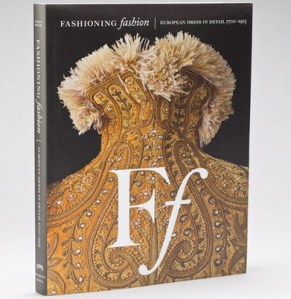 With Fashioning Fashion: European Dress in Detail, 1700-1915 the German Historical Museum is presenting – exclusively in Germany – a unique collection of historical garments and accessories from the Los Angeles County Museum of Art. More than 200 years of European fashion history are on display. The renowned Belgian scenographer Bob Verhelst has specially designed the exhibition architecture for Berlin. Glamorous women’s costumes and elegant men’s suits are adorned with elaborately fashioned trimmings. Luxurious clothing of the wealthy haute-bourgeoisie and nobility are shown, including such highlights as the gold-embroidered dress of a Portuguese queen and the turban of the designer Paul Poiret. Fascinating fabrics, exquisitely tailored raiments and precious décor are all to be seen in the museum’s show.
This spectacular exhibition takes us through four chapters focusing on the aesthetic and technical developments of fashion history:
Timeline shows in chronological sequence the changes in the silhouette of women’s dresses and the evolution of men’s suits from brightly coloured to their traditional dark hue.
Textiles informs us about the variety of surfaces that come about through complex weaving, colouring and printing techniques.
Tailoring deals with the process of turning plain material into clothing, with special emphasis on forming, bracing and constricting techniques.
Trim presents the finery of fashionable clothes: delicate laces, magnificent fine-wire embroidery, artful silk trimmings and colourfully patterned and sequined accessories.










leave a comment