Call for Papers | Trans-National Figures in the Arts, 1750–1850
From the Call for Papers, which includes the German:
‘Lost in TransNation’: (Trans-)National Figures in the Arts around 1800?
Friedrich-Schiller-University Jena, Centre for Romanticism Research, 24–26 February 2027
Organized by Johannes Grave, Justus Hierlmeier, and Selina Kusche
Proposals due by 31 October 2026
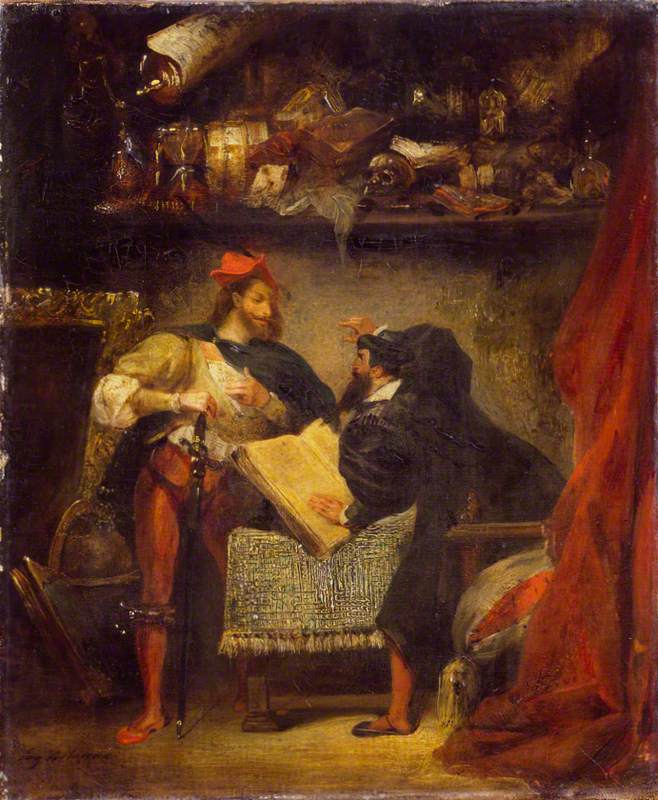
Eugène Delacroix, Faust and Mephistopheles, shown at the Salon of 1827–28, oil on canvas, 18 × 15 inches (London: Wallace Collection).
The period around 1800 was characterised by the simultaneous coexistence of national and transnational thinking. An understanding of one’s own ‘nation’ in a modern sense began to develop, not least through acts of demarcation that drew upon one’s own history and literature. At the same time figures who became focal points for the formation of national identity could also serve as transnational cultural reference points and be appropriated. While William Shakespeare was celebrated in England as the embodiment of English literature and culture, he was simultaneously appropriated by the German Johann Gottfried Herder as the greatest ‘poet of the Nordic people’. Such national and transnational processes of appropriation of cultural reference figures appear to be characteristic of Romanticism(s).
They are demonstrated not least in the visual arts of the period and the focus was not solely on poets and writers. Alongside Dante Alighieri, William Shakespeare, John Milton, Johann Wolfgang von Goethe and Lord George Byron, the characters they had invented or adapted also exerted a powerful fascination. Beatrice and Virgil, Macbeth and the witches, Robin Goodfellow, Mephisto, Gretchen and Manfred experienced a remarkable resurgence in the visual arts of Europe during the ‘Sattelzeit’. The subject of Ossian by the Scotsman James Macpherson was also rendered in paintings by the British artist Joseph Mallord William Turner and the Dane Nicolas Abildgaard, as well as by the Frenchman François Gérard and the American John Trumbull. This also applies to archetypal characters such as the figure of the monk, who was of interest to the Englishman Matthew Gregory Lewis (1796) as well as to the Frenchmen Pierre-Paul Prud’hon (1797) and Louis-Édouard Rioult (1831).
It is striking how frequently, in the visual arts, individual actors—even minor characters—were lifted out of their narrative contexts and, as isolated figures, became central subjects of depictions. This decontextualisation was often accompanied by an emphasis on the individuality of the figure in question. In this way, visual representations of figures were able to offer a wide range of points of connection for various forms of appropriation and re-
interpretation. By pushing a figure’s definition within a narrative context into the background, these images invited viewers to devise new definitions, characterisations and narrative frameworks. The figures, which tended to be decontextualised and individualised, served as models for identification.
The workshop ‘Lost in (Trans-)Nation’ will focus on cultural figures of reference and their visual representation during the transitional period between 1750 and 1850. The focus is on both fictional characters (e.g. Mephisto) and fictionalised figures, i.e. figures who are historically documented but whose image has also been shaped by fictional texts (e.g. Macbeth, Faust), including poets and artists (e.g. Dante, Raphael). The workshop aims to trace the translation and mediation of fictional and fictionalised figures in art across Europe around 1800. It explores whether specific forms of visual representation prevalent around 1800 fostered a simultaneity of national and transnational appropriations. How do different interpretations of one and the same figure differ, and how are these differences linked to trends in image types and forms of representation? To answer these questions, we aim for an interdisciplinary approach that seeks to draw on the overlaps between cultural and visual studies with a historical focus.
The workshop is being organised by the research group European Romanticism or Romantics in Europe? On the question of the unity of Romanticism in the visual arts and aesthetics of the early 19th century’ at the Jena Centre for Romantic Studies. The conference language is expected to be English; contributions in German are also welcome.
In addition to guests who have already been confirmed, we would also like to extend a special welcome to early-career researchers. This call for papers is therefore primarily aimed at PhD students or those who have only recently completed their PhD. Please submit a tabular CV of no more than 2 pages, together with an abstract and the title of your presentation, by October 31 to europaeischeromantik@uni-jena.de. The abstract should, if possible, not exceed 300 words. Presentations are limited to a maximum of 25 minutes, to allow sufficient time for questions and discussion.










leave a comment