Exhibition | Floating Worlds: Prints from Osaka and Kyoto
From the press release for the exhibition:
Floating Worlds: Prints from Osaka and Kyoto
Art Gallery of South Australia, Adelaide, 30 January — 18 April 2027
Curated by Russell Kelty
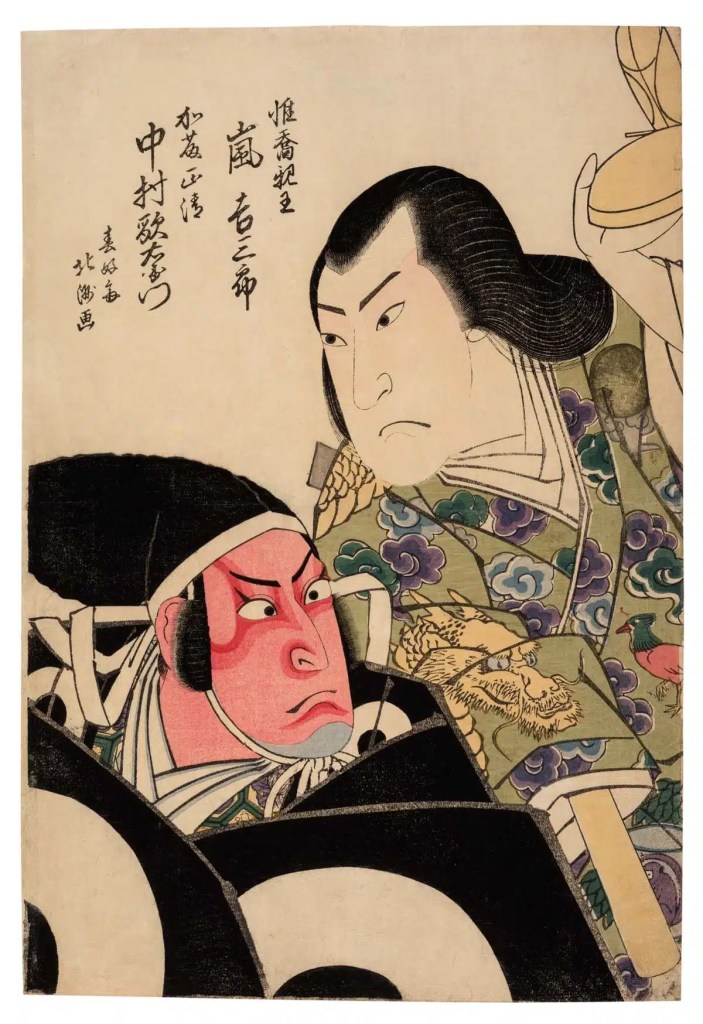
Shunkōsai Hokushū, Actors Arashi Kichisaburō II as Prince Koretaka and Nakamura Utaemon III as Katō Masakiyo, 9/1820, Osaka, color woodblock print (nishiki-e) with metallic pigment, ōban, 38.6 × 26.3 cm (Adelaide: Art Gallery of South Australia, Bequest of M.J.M. Carter AO).
The Art Gallery of South Australia will present Floating Worlds: Prints from Osaka and Kyoto from 30 January 2027, the first exhibition in Australia to explore the unique woodblock print culture that emerged in Japan’s historical Kamigata region of Osaka and Kyoto during the Edo period (1603–1868). Through striking images of Kabuki actors, celebrated beauties, the supernatural, sumo wrestlers, and sweeping landscapes, alongside dramatic examples of samurai armour and finely crafted kimonos, the exhibition will showcase the ‘floating worlds’ of theatre, beauty, fashion, and entertainment that dominated the vibrant urban centres of Osaka and Kyoto. Revealing the artistic innovation, sophistication, and vitality of Kamigata print culture, Floating Worlds will feature works by more than ninety woodblock print artists rarely seen in Australia.
The ‘floating world’ (ukiyo) refers to the pleasure-seeking lifestyle that emerged in Japan during the Edo period. As Japan’s lower classes (chōnin) flourished, they sought escape from their daily obligations and spent their leisure time in theatres, teahouses, and pleasure quarters. From these urban centres arose ukiyo-e, or ‘pictures of the floating world’, a celebrated art form that captured the beauty, drama, and enchantment of these entertainment districts. At the heart of this thriving culture were the legendary stars of the kabuki stage, whose rivalries inspired intense public admiration and fuelled the production of woodblock prints commissioned by devoted admirers and collectors.
Jason Smith, Director, AGSA, said, “Floating Worlds will offer audiences in Adelaide and from across Australia a rare encounter with the captivating ‘floating worlds’ of seventeenth- to nineteenth-century Osaka and Kyoto. Demonstrating an extraordinary level of craftsmanship and creativity, these prints mark AGSA’s first major acquisition through the M.J.M. Carter AO Bequest that forms the foundation of this exceptional exhibition. Thanks to this transformational bequest, AGSA is now home to the most comprehensive collection of Kamigata prints in Australia, on par with major collections around the world.”
The Hon Kyam Maher MLC, Deputy Premier and Minister for Arts, said, “Floating Worlds will offer visitors an unprecedented opportunity to delve into the remarkable woodblock print culture of Edo-period Japan. Even today, this artform remains hugely influential and enduringly popular, and this exclusive exhibition will be a must-visit event for Japan enthusiasts, families, and art lovers this summer.”
Offering a fascinating insight into the cultural heart of historical Japan, Floating Worlds showcases the craftsmanship and distinctive visual language of woodblock prints from the Kamigata region of Osaka and Kyoto. It was in Kamigata that a distinctive school of woodblock printmaking emerged, with a remarkable mastery of materials and inventive visual language that was distinct from works produced in Edo (present-day Tokyo). While Edo sustained Japan’s most prolific print industry, the Kamigata region cultivated an exceptional aesthetic sensibility and supreme level of artistry.
Floating Worlds will present woodblock print designers who are rarely seen in Australia, including the pioneering Osaka-based artist Ryūkōsai Jokei (1776–1811), whose realistic depiction of the faces of kabuki actors set the standard for succeeding generations. Floating Worlds also includes luminaries of the nineteenth century such as Shunkōsai Hokushū (1802–1832), Shunbaisai Hokuei (active 1828–1836), Ryūsai Shigeharu (1803–1853), and the initiator of the only true familial lineage of artists which continues today, Hasegawa Sadanobu (1809–1879). The masters of the late nineteenth century, such as Utagawa Sadamasu (active c.1830–1854) and Gosōtei Hirosada (active c.1847–1863, d. 1865), also feature. Showcasing more than 200 works from the AGSA collection, alongside loans from public and private collections, Floating Worlds will reveal the artistic traditions, skills, and cultural practices passed down through generations, many of which continue to shape Japanese society today.
Exhibition curator Russell Kelty, Curator of Asian Art, AGSA, commented, “Floating Worlds seeks to reveal the beauty and sophistication of Kamigata ukiyo-e, by offering a new vision of this artform and expanding conventional understandings of Kamigata woodblock prints to present a more holistic view of the culture that captivated the region. Alongside celebrated actor prints are depictions of highly skilled courtesans, sumo wrestlers, comic, and at times bawdy interludes, tales of samurai heroism, landscapes, and scenes from everyday life. Together these works reveal the breadth, complexity, and dynamism of Kamigata visual culture.”










leave a comment