Exhibition | ‘Fashioning Fashion’
This exhibition from LACMA (on display there from 2 October 2010 to 6 March 2011) is currently on view in Berlin and will travel to Paris in the fall. From the German Historical Museum:
Fashioning Fashion: European Dress in Detail, 1700-1915
Deutsches Historisches Museum, Berlin, 27 April — 29 July 2012
Musée des Arts Décoratifs, Paris, 13 December 2012 — 14 April 2013
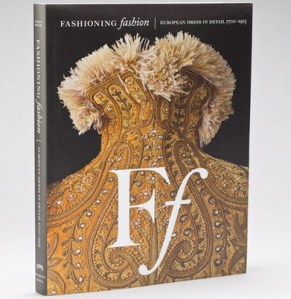 With Fashioning Fashion: European Dress in Detail, 1700-1915 the German Historical Museum is presenting – exclusively in Germany – a unique collection of historical garments and accessories from the Los Angeles County Museum of Art. More than 200 years of European fashion history are on display. The renowned Belgian scenographer Bob Verhelst has specially designed the exhibition architecture for Berlin. Glamorous women’s costumes and elegant men’s suits are adorned with elaborately fashioned trimmings. Luxurious clothing of the wealthy haute-bourgeoisie and nobility are shown, including such highlights as the gold-embroidered dress of a Portuguese queen and the turban of the designer Paul Poiret. Fascinating fabrics, exquisitely tailored raiments and precious décor are all to be seen in the museum’s show.
This spectacular exhibition takes us through four chapters focusing on the aesthetic and technical developments of fashion history:
Timeline shows in chronological sequence the changes in the silhouette of women’s dresses and the evolution of men’s suits from brightly coloured to their traditional dark hue.
Textiles informs us about the variety of surfaces that come about through complex weaving, colouring and printing techniques.
Tailoring deals with the process of turning plain material into clothing, with special emphasis on forming, bracing and constricting techniques.
Trim presents the finery of fashionable clothes: delicate laces, magnificent fine-wire embroidery, artful silk trimmings and colourfully patterned and sequined accessories.
Exhibition | 1740, Un Abrégé du Monde
On at the INHA in Paris this summer, as noted by Hélène Bremer:
1740, Un Abrégé du Monde: Savoirs et Collections autour de Dezallier d’Argenville
Institut National d’Histoire de l’Art, Paris, 4 May — 27 July 2012
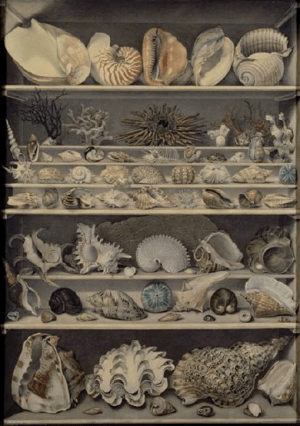
Alexandre Isidore Leroyde Barde (1777-1828), Choix de coquillages, encre noire et gouache, 125cm × 90cm (Paris: Musée du Louvre)
Naturaliste et historien de l’art, Antoine-Joseph Dezallier d’Argenville (1680-1765) fut membre de nombreuses académies scientifiques, auteur d’une théorie du jardinage, de traités sur les pierres et les coquillages (1742), et de l’Abrégé de la vie des plus fameux peintres de toutes les écoles… (1745-1752). Il fut aussi un grand collectionneur qui possédait plus de cinq cents dessins et de rares spécimens naturels. Pour interroger cette figure symptomatique de la dynamique entre arts et savoirs au XVIIIe siècle, l’Institut national d’histoire de l’art a voulu retrouver la fonction première de l’un des espaces-clefs de la Galerie Colbert, une ancienne boutique, car les savants-collectionneurs du siècle des Lumières étaient étroitement liés aux marchés de l’art et des curiosités naturelles.
L’exposition s’organise donc autour d’un comptoir qui évoque non seulement le long meuble à surface plane sur lequel les marchands échangeaient coquillages, estampes, tableaux et dessins, mais aussi les implantations commerciales sur les côtes des colonies d’où provenaient ces étranges objets naturels, lesquels manifestaient à la fois la soif de découverte du monde et l’ambition encyclopédique de ces amateurs.
Les curieux français du XVIIIe siècle furent avant tout des collectionneurs d’objets, que leur goût portait indistinctement sur les produits de l’Art ou de la Nature. Ils prêtaient également une attention remarquable à l’arrangement, la disposition dans l’espace des choses naturelles et artificielles constituant leurs cabinets. À cet égard, il faut noter que Dezallier fut l’un des premiers auteurs français à théoriser, dans un article de 1727, l’arrangement idéal d’un cabinet de curiosités, tout comme il fut le premier à employer en français le terme muséographie, en 1742.
Les années 1740 sont celles de la métamorphose des lieux de savoirs, puisque l’on passe alors des salles dédiées, dans les demeures privées, à la présentation d’objets de collection, à la création de musées, autrement dit de salles publiques d’exposition, où les visiteurs sont invités à s’instruire. C’est aussi l’époque de la mutation des savoirs livresques, dont les formes et les structures sont alors repensées dans le but de dresser des inventaires totalisants, comme l’Encyclopédie ou les catalogues raisonnés illustrés.
The exhibition press release is available (as a PDF) here»
◊ ◊ ◊ ◊ ◊
From Fage éditions:
Anne Lafont, ed., 1740, Un Abrégé du Monde: Savoirs et Collections autour de Dezallier d’Argenville (Paris: Fage éditions) 304 pages, ISBN: 9782849752609, 35€.
Contributeurs: Nebahat Avcioglu, Lise Bicart-Sée, Sarah Boyer, Sabine Cartuyvels, Pascal Dubourg Glatigny, Jennifer Ferng, Isabelle Flour, Catherine Girard, Martial Guédron, Charlotte Guichard, Pierre-Yves Lacour, Anne Lafont, Gaëtane Maës, Marie-Pauline Martin, Dominique Morelon, Aline Pelletier, Jessica Priebe, Chiara Savettieri, Anke Te Heesen, Isabelle Tillerot
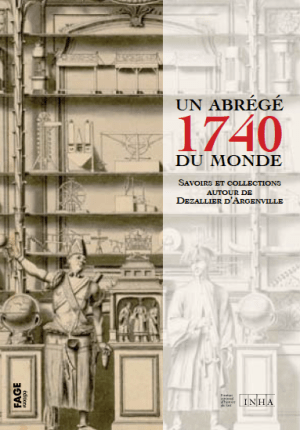 1740 un abrégé du monde traite des modalités de présentation des objets naturels et artificiels au sein des cabinets de curiosités, des relations entre les marchands et les collectionneurs de coquillages, estampes, tableaux, dessins, et des systèmes de classification en vigueur au temps de l’Encyclopédie et de Linné…
Rédigé par vingt spécialistes sous la direction d’Anne Lafont, conseillère scientifique à l’INHA, l’ouvrage gravite autour de la figure du naturaliste, historien de l’art et collectionneur français Dezallier d’Argenville (1685-1765), pivot de la dynamique nature/culture au XVIIIe siècle.
Il est organisé sous la forme d’un abécédaire de vingt-sept articles illustrés abordant des concepts qui sont au cœur de cette enquête sur les arts et les savoirs naturalistes : Abrégé, Amateur, Basseporte, Cabinet, Dessein, École, Fossiles, Grotesque, Histoire naturelle, Illustration, Jardin, Kiosque, Laboratoire, Manière, Numérotation, Ornement, Parterre, Plume, Quartz, Rocaille, Système, Table, Unique, Vernis, Vie, Watteau, Zoomorphose.
Exhibition | Gold, Jasper, and Carnelian: Johann Christian Neuber
From The Frick:
Gold, Jasper, and Carnelian: Johann Christian Neuber at the Saxon Court
Grünes Gewölbe, Dresden, 3 March — 2 May 2012
The Frick Collection, New York, 30 May — 19 August 2012
Galerie J. Kugel, Paris, 12 September — 10 November 2012
Coordinated by Dirk Syndram, Jutta Kappel, Ian Wardropper, and Charlotte Vignon

Johann Christian Neuber, Breteuil Table, Dresden, 1779–80, wood, gilded bronze, semiprecious stones, faux-pearls, and Meissen porcelain plaques, H: 32 inches, collection of the Marquis de Breteuil, Chäteau de Breteuil (Choisel/Chevreuse); photo: © Georges Fessy
Johann Christian Neuber was one of Dresden’s most famous goldsmiths. Sometime before 1775 he was named court jeweler to Friedrich Augustus III, elector of Saxony, and in 1785 he was appointed Curator of the Grünes Gewölbe (Green Vault), the magnificent royal collection of Augustus the Strong, the founder of the Meissen Porcelain Manufactory. For more than thirty years, Neuber created small gold boxes, chatelaines, and watchcases decorated with local semiprecious stones such as agate, jasper, and carnelian. He fashioned enchanting landscapes, complex floral designs, and geometric patterns with tiny cut stones, often incorporating Meissen porcelain plaques, cameos, and miniatures. These one-of-a-kind objects, which reflect the Saxon court’s interest in both luxury items and the natural sciences, remain prized treasures today, but have never before been shown together in a monographic exhibition.
In 2012, the public will have their first comprehensive introduction to this master craftsman’s oeuvre through a traveling exhibition that is accompanied by a lavishly illustrated publication (Paul Holberton publishing, London, and Editions d’Art Monelle Hayot, under the direction of Alexis Kugel). The exhibition began in Dresden at the Grünes Gewölbe on March 3, remaining there through May 2, 2012, when it travels to the United Sates for an exclusive engagement at The Frick Collection (May 30 through August 19, 2012). It concludes at Galerie J. Kugel in Paris in the fall (September 12 through November 10, 2012).
Gold, Jasper, and Carnelian: Johann Christian Neuber at the Saxon Court includes some thirty-five boxes and other decorative objects from the Grünes Gewölbe and the Porcelain Collection of the Staatliche Kunstsammlungen Dresden, The Metropolitan Museum of Art, and private collections in Europe and the United States. The exhibition also features Neuber’s masterpiece, the Breteuil Table. This small table is regarded as one of the most extraordinary pieces of eighteenth-century furniture ever made, distinguished not only by the materials used in its construction and for the remarkable skill of its creator, but also for its prestigious history. It was presented in 1781 by Friedrich Augustus III to Baron de Breteuil, a French diplomat, as recognition for the role Breteuil played in the negotiation of the Treaty of Teschen, which officially ended the war of Bavarian Succession fought between the Habsburg monarchy and a Saxon-Prussian alliance to prevent the Habsburg acquisition of the Duchy of Bavaria. The table features a mosaic top of 128 semiprecious stones and Meissen porcelain plaques. Still owned by the family who received it nearly 250 years ago, this stunning object has almost never been exhibited outside the Château de Breteuil (some twenty-five miles west of Paris) and has never before crossed the Atlantic. The Frick exhibition also reunites for the first time two bases designed and crafted by Neuber for the display of Meissen porcelain groups. One is now in the collection of the Walters Art Museum, Baltimore, while the other is from a private collection in Paris. These bases were part of a much larger diplomatic gift from Friedrich Augustus III to Nicolai Wasilijewitsch Repnin, the Russian emissary who helped to negotiate the Treaty of Teschen. The gift originally included a Meissen porcelain service and an enormous centerpiece composed of seven stands of varying heights, each supporting an allegorical group made of Meissen porcelain. Of this extravagant gift, only these two bases have been definitively identified.
The exhibition is co-organized by the Grünes Gewölbe, Staatliche Kunstsammlungen Dresden, The Frick Collection, and Galerie J. Kugel, Paris. The exhibition in Dresden will be shown in a slightly different form as Johann Christian “Neuber à Dresde”: Schatzkunst des Klassizismus für den Adel Europas. It is coordinated by Dirk Syndram, Director of the Grünes Gewölbe and the Armoury, and Jutta Kappel, Senior Curator of the Grünes Gewölbe. The presentation of the exhibition at The Frick Collection is coordinated by Director Ian Wardropper and Charlotte Vignon, Associate Curator of Decorative Arts.
◊ ◊ ◊ ◊ ◊
From Paul Holberton Publishing:
Alexis Kugel, ed., Gold, Jasper and Carnelian: Johann Christian Neuber at the Saxon Court (London: Paul Holberton, 2012), 400 pages, ISBN: 9781907372360, £100.
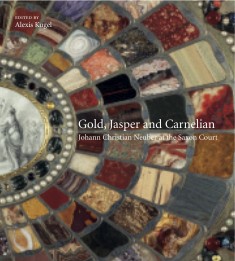 Johann Christian Neuber (1736–1808) was a goldsmith and mineralogist at the Saxon Court. In 1769 he became director of the Grünes Gewölbe, the magnificent State Treasury, and was appointed court jeweler in 1775. He specialized in creating small gold boxes, chatelaines and watchcases decorated with semiprecious stones, such as agate, jasper and carnelian. Neuber fashioned enchanting landscapes, complex floral designs and geometric patterns out of tiny cut stones, often incorporating Meissen porcelain plaques, cameos and miniatures. These one-of-a-kind objects are treasured in public and private collections all over the world today, but have never been brought together.
This book is the first comprehensive introduction to this master craftsman’s oeuvre, presenting boxes and other decorative objects from the Grünes Gewölbe, the Metropolitan Museum of Art as well as public and private collections in Germany, France and New York. One of its highlights is the ‘Breteuil Table’, still owned by the family for which it was made as a diplomatic gift nearly 250 years ago.
Beautiful photographs of all Neuber’s creations adorn this extraordinary book – well over 500 in number. The context and history of the growing interest in mineralogy and its celebration in these works of art are fully investigated. Its distinguished authors include Dr Jutta Kappel, Head of Conservation at Grünes Gewölbe, Dresden; art historians and specialists Sophie Mouquin and Philippe Poindront; marquis de Breteuil, Henri-François Le Tonnelier; and the editor of the book, Alexis Kugel, of the famous Parisian gallery.
There is also a French edition of this book: Le luxe, le goût, la science: Neuber, orfèvre minéarologiste à la cour de Saxe (ISBN 9782903824808).
Autumn Exhibition in Venice | Francesco Guardi
From the Correr:
Francesco Guardi, 1712-1793
Museo Correr, Venice, 28 September 2012 — 6 January 2013
Curated by Alberto Craievich and Filippo Pedrocco

Francesco Gurdi, The Parlour of the Nuns at San Zaccaria
ca. 1750 (Venice: Ca’ Rezzonico), Photo: Wikimedia Commons
◊ ◊ ◊ ◊ ◊
In the third centenary of the birth of Francesco Guardi, the last great landscape artist of the 18th century, the monographic exhibition promoted by the Fondazione dei Musei Civici di Venezia aims to highlight his complex artistic production, from the lesser-known figure paintings of his youth to the ‘interior scenes’, concluding with the splendid views of Venice and his fabulous capriccios, painted in his maturity and old age. The exhibition at the Museo Correr will illustrate the various phases in Guardi’s development thanks to a series of major loans of works never before made to Venice.
It is known that Francesco Guardi’s training took place within a modest family workshop in which everyone was a painter, from his father, Domenico, to his brothers, Nicolò and Antonio. None of them in life was able to attain a certain degree of prosperity, let alone success. After his death in 1793, Francesco Guardi was forgotten. His rediscovery is the merit of 20th-century criticism, and attained a high point in the fine exhibition curated by Pietro Zampetti, held in Palazzo Grassi in 1965.
The first part of the exhibition will focus on the production of works of a prevalently everyday life subject inspired by genre painting of costume painting, one dominated by Pietro Longhi. The exhibition will present two masterpieces from this period: The Ridotto and The Parlour of the Nuns at San Zaccaria, now in Ca’ Rezzonico. A little later, Francesco Guardi began his production of the views, capriccios and fantastic landscapes that underpin his fame today. It is not certain when exactly he began working as a landscape painter; perhaps it was around 1755, when the painter was over 40 years old and had a less than exhilarating career as a figure painter behind him. His first works echoed the compositions of Canaletto and Marieschi, with fluid, controlled brushstrokes, still a long way from the bubbling, shorthand manner that would make him famous. But his unique style does already emerge in some of these works from the first period, including in the St. Mark’s Square belonging to the National Gallery in London, in which the figures, painted by frothy little impastos of colour, reveal a lively chromatic touch. His period of greatest success was between the 1760s and 1770s and it was in this period that he painted the 12 canvases of the Ducal celebrations adapted from Canaletto’s own models and engraved by Giambattista Brustolon. Guardi based his paintings, today in the Louvre, on these prints; the result is truly astonishing and reveals the artist’s transfiguring, fantastic skill.
The picture showing the Bucentaur at San Nicolò on the Lido is exemplary: although faithful to its model, it creates an image of unmatched appeal. The gondolas and Bucentaur used for special occasions seem to shimmer on the water; a myriad of reflections sparkle on the slightly choppy sea, while tiny figures resembling Oriental ideograms bustle in the vessels. In 1782, Guardi was commissioned to paint four pictures to commemorate the visit of Pope Pius VI to Venice. For the 70-year-old artist, here at last was an official commission, and it was followed by the celebratory paintings of the incognito visit to Venice of the Russian archdukes, who travelled under the name of the Counts of the Nort
Over time, his highly personal style became increasingly free and allusive; the proportions between the various elements were freely modified, the perspective framework became elastic and was deformed, losing all association with reality. And finally, the figures became simply splashes of colour, a rapid white scribble or black dot traced out with a trembling movement.
Apart from a number of airy capriccios, he also painted some splendid pictures of villas half-hidden in the green Veneto countryside, and alongside traditional views of Venice he added others of the lagoon, broadening the horizons of 18th-century Venetian landscape and dissolving it in wide stretches of water and sky.
The exhibition will present a total of over 100 paintings and drawings from leading Italian and foreign institutions, including the Musée du Louvre in Paris, the Metropolitan Museum of Art of New York, the National Gallery of Washington, the National Gallery in London, the Gemäldegalerie in Berlin, the Alte Pinakothek of Munich, the Gulbenkian Foundation of Lisbon, the Hermitage of Saint Petersburg, the Fine Art Museum of Boston, the Accademia Carrara in Bergamo and the Poldi Pezzoli of Milan. The exhibition can boast an academic committee formed of the leading international scholars of 18th-century Venetian painting, and will be accompanied by a comprehensive, well-illustrated catalogue edited by Alberto Craievich and Filippo Pedrocco, and published by Skira, containing the latest studies concerning the artist.
Curators: Alberto Craievich and Filippo Pedrocco
Academic Committee: Giuseppe Pavanello, Charles Beddington, Catherine Whistler, Keith Cristiansen, Stephane Loire, Andrew Robison, Irina Artemieva, Lino Moretti
Scientific Director: Gabriella Belli
◊ ◊ ◊ ◊ ◊
Catalogue: Alberto Craievich and Filippo Pedrocco, eds., Francesco Guardi, 1712-1793 (Milan: Skira, 2012), ISBN: 9788857214818, $90. Available October 2012
Exhibition | Gainsborough’s Landscapes
From the Holburne Museum in Bath . . .
Gainsborough’s Landscapes: Themes and Variations
Holburne Museum, Bath, 24 September 2011 — 22 January 2012
Compton Verney, Warwickshire, 11 February — 10 June 2012

Thomas Gainsborough, Landscape with a View of a Distant
Village, ca. 1750 (Edinburgh: National Gallery of Scotland)
◊ ◊ ◊ ◊ ◊
Gainsborough’s Landscapes: Themes and Variations is the first exhibition in fifty years devoted solely to his landscape paintings and drawings, bringing together remarkable works from public and private collections, many of them little known and some not previously exhibited. For Gainsborough, if portraiture was his business, landscape painting was his pleasure, and his landscape paintings and drawings reveal his mind at work, the extraordinary breadth of his invention and the dazzling quality of his technique.
Thomas Gainsborough (1727-1788) sold relatively few of his landscape paintings, and none of his drawings, but he regarded them as his most important work. His paintings do not represent real views, but are creations ‘of his own Brain’, as he put it. A limited number of rural subjects exercised his imagination from one decade to the next, changing as he developed an increasingly energetic ‘hand’, or manner of painting, and becoming ever grander in conception.
The exhibition includes some of his most famous and popular works including The Watering Place from the National Gallery (the most famous of all his landscape compositions in his life-time) and less well-known works such as the little-seen but ravishing Haymaking from Woburn. The paintings have been selected to represent six landscape themes; the remarkable drawings and prints show Gainsborough returning to these themes and demonstrate the longevity of each theme and the degree of experimentation that was involved in the search for the perfect composition.
The evolution of Gainsborough’s style is traced from early naturalistic landscapes in the Dutch manner, enlivened with small figures (pictured above), to grand scenery that is dramatically lit and obviously imaginary, such as the Romantic Landscape from the Royal Academy of Arts. In the Girl with Pigs, from the Castle Howard Collection, a rustic figure takes centre stage: fancy figures of this kind are, in Gainsborough’s art, closely integrated with his landscape practice.
◊ ◊ ◊ ◊ ◊
Accompanying publication: Susan Sloman, Gainsborough’s Landscapes: Themes and Variations (London: Philip Wilson Publishers, 2011), ISBN: 9780856676970, £14.99
Exhibition | The Art of German Stoneware
From the Philadelphia Museum of Art:
The Art of German Stoneware
Philadelphia Museum of Art, 5 May — 5 August 2012
Curated by Jack Hinton

Inkstand and Candleholder with Musicians, Animals, and a Griffin, ca. 1740. German Salt-glazed stoneware with painted decoration, roughly 20 x 10 x 7 in. (Philadelphia Museum of Art)
From the fourteenth through eighteenth centuries, stoneware ceramics from Germanspeaking centers in modern-day Germany and the Low Countries were valued and widely traded throughout northern Europe. In the 1600s—the heyday of stoneware production—they found an enthusiastic market in colonial North America. The medium’s success is due to its stonelike durability and imperviousness to liquid, making it perfect for cooking, storage, and drinking vessels. The social aspect of stoneware ceramics explains the crisp relief decoration on sixteenth- and seventeenth-century pieces, which feature moralizing images or political figures and their coats of arms; later pieces often eschew such ornament for floral or geometric patterns inspired by Far Eastern porcelains imported to Europe. Inkstand and Candleholder with Musicians, Animals, and a Griffindemonstrates the inventiveness and artistry of stoneware potters, even when faced with a dwindling market for their works in the homes of the well-to-do. This exhibition examines German stoneware from its origins to later revivals in the nineteenth-century and celebrates its long-standing relationship with the city of Philadelphia. It features selections from the Museum, seventeenth-century Dutch pictures demonstrating the high status of stoneware, and a generous promised gift of around forty pieces of German
stoneware from Dr. Charles W. Nichols. The exhibition is accompanied by an
illustrated publication by Jack Hinton, Assistant Curator of European Decorative
Arts and Sculpture.
◊ ◊ ◊ ◊ ◊
From Yale UP:
Jack Hinton, The Art of German Stoneware, 1300-1900 From the Charles W. Nichols Collection and the Philadelphia Museum of Art (New Haven: Yale University Press, 2012), 60 pages, ISBN: 9780300179781, $20.
 Beautiful and eminently useful, stonewares produced in the German-speaking lands from the Middle Ages onward were highly valued for their durability and suitability for a range of domestic and social uses. Widely traded throughout Europe, they were also among the first European ceramics to reach colonial North America. During the Renaissance the addition of brilliant salt glazes—s well as relief imagery that communicated with the user—raised the status of these wares. Later examples introduced abstract floral or geometric decorations and more unusual, original forms, which retained broad cultural significance.
About ninety fine stoneware pieces from the Philadelphia Museum of Art and a promised private collection testify here to the success, artful decoration, and fascinating variety of this medium. Jack Hinton describes the developments in stoneware through these notable examples, and beautiful color images bring
their details vividly to life.
Exhibition | Animal Beauty in Paris
From the Grand Palais:
Beauté Animale / Animal Beauty
Grand Palais, Galeries Nationales, Paris, 21 March — 16 June 2012
Curated by Emmanuelle Héran
 Ever since the Renaissance, artists and naturalists have observed animals closely and represented them as accurately as they could. Nevertheless, naturalism ends where the norm and morality begin: various ethical and aesthetic criteria were established which influenced the artists’ point of view. There is extraordinary variety in the ways the same animal is represented. They reveal our fascination and curiosity for a world whose diversity is far from fully explored.
Through a set of major works, the exhibition looks at the relationships that artists, often great painters and sculptors, have developed with animals. It shows that there is still a close link between art and science, between our desire to know about animals and our fascination for their beauty. Paintings, drawings, sculptures, photographs, famous or unfamiliar… the exhibition brings together about 130 masterpieces of Western art from the Renaissance to the present day, and takes a radical new approach by choosing works in which the animal is shown on its own and for itself, without any human presence. This marvellous menagerie, laid out in a clear design accessible to all audiences, will mingle wild and domestic beasts, the strange and the familiar.
I. Looking at Animals
Just like human beauty, animal beauty must meet specific criteria, which vary with different periods and milieus. A revolution occurred at the Renaissance: outstanding artists such as Dürer, and then the pioneers of zoology studied animals closely and described them in minute detail. This was also when the discovery of the New World revealed new animals, such as parrots and turkeys. Repertoires were soon built up. As soon as they could study animals, painters kept a record of them in their albums, which they dipped into for motifs which had already inspired other works. They also worked on anatomical studies and tried to analyse motion, such as the movements of a galloping horse. But man was not content to represent animal beauty; he modified it, transforming the animals themselves, with all the means that science put at his disposal. New breeds of cows, dogs and cats appear in works of art. And conversely, paintings show us breeds that have gone out of fashion.
II. Aesthetic and Moral Prejudices (more…)
Reviewed | ‘Revolution! The Atlantic World Reborn’
Thomas Bender, Laurent Dubois, and Richard Rabinowitz, eds. Revolution! The Atlantic World Reborn (London: D. Giles Limited in association with the New-York Historical Society, 2011), 287 pages, ISBN: 9780916141240 (softcover), $45 / ISBN: 9781904832942 (hardcover), $65.
Reviewed for Enfilade by Jason Nguyen (Harvard University)
 In the lavishly illustrated catalogue for Revolution! The Atlantic World Reborn (on view at the New-York Historical Society through April 15, 2012), editors Thomas Bender, Laurent Dubois, and Richard Rabinowitz present a collection of eleven essays on the connections between the American, French, and Haitian Revolutions. Whereas traditional narratives have tended to treat the three events separately, the fourteen contributors to Revolution focus instead on their political, economic, and social junctures. “The point here is not to abandon or dilute national history,” Thomas Bender suggests in the catalogue’s first essay, “but rather to enrich it by revealing the ways in which historical causation operates across space as well as through time” (40).
The chain of political events linking the three revolutions is offered straightaway by Bender (and subsequently evaluated by his fellow contributors). The financial and military support that France provided to the United States in their War for Independence sent the European kingdom into a crippling debt that led to the calling of the Estates General in May of 1789. This event resulted in the establishment of the National Assembly and, consequently, the onset of the French Revolution. The rhetoric of the Revolution, and in particular the Déclaration des droits de l’Homme et du Citoyen (1789), helped to ignite abolitionist discourses and revolutionary fervor in the French colony of Saint-Domingue (present-day Haiti). And the political and military successes by the Haitians in the early years of the nineteenth century resulted in the selling of Louisiana by Napoleon to the United States in 1803, thus providing the young American nation with its first taste of continental expansion.
While each essay addresses at least one component of this transcontinental circuit of events, the scope of the catalogue is hardly limited to the political sphere. Cathy Matson, for example, reveals how the revolutions in France and Haiti nearly destabilized the commercial life among Philadelphia grain merchants in the last two decades of the eighteenth century. And in one of the catalogue’s more emotional contributions, Rebecca J. Scott and Jean M. Hébrard chronicle through a chain of legal documents and personal letters the tumultuous social and family life of Rosalie, an African-born inhabitant of Saint-Domingue who found herself the victim of sexual and racial slavery three times during the course of her life.
Rosalie’s story encapsulates two themes that course through the various essays. First is the focus on the peripheral within the predominant historical narrative, or as Richard Rabinowitz terms it, “history’s silences.” This can be noted by the prominence of the Haitian Revolution in the catalogue, with seven of the eleven contributions centering squarely on the global and local dealings of the Caribbean colony between 1791 and 1804. Of the remaining four essays, two focus on the economic and social situation in America, one addresses the broader global condition linking the revolutionary conflicts in the United States, France, and Haiti, and one presents the aims and intentions of the exhibition. The curatorial decision to cast increased light on the Haitian Revolution serves two purposes. The first concerns the marked absence within the general public consciousness of the social and political insurrections that transformed the former French colony. And the second speaks to its privileged status as the culmination (and, indeed, the ultimate test) of eighteenth-century revolutionary fervor. “As the most thoroughgoing of these upheavals,” Rabinowitz writes in the catalogue’s concluding essay, “at least in its destruction of slavery, imperial dependency, and constitutionally sanctioned inequalities — the Haitian revolution could be viewed as the climax of the entire age of Atlantic revolutions” (255).
The revolutionary quest for “freedom” rarely followed a straight path, however: it is this concern that serves as the second theme of the catalogue. Robin Blackburn, for example, carefully unpacks the means by which the slave uprisings in Saint-Domingue during the early 1790s mobilized the Enlightenment trope of “utility” in order to achieve social and economic liberty. The first clause of the Déclaration des droits de l’Homme et du Citoyen, she notes, clearly stated that, “Men are born, and always continue, free and equal in respect of their rights. Civil distinctions, therefore, can be founded only on public utility” (118). The Haitian rhetoric of freedom, therefore, served an instrumental purpose in broadening the social, cultural, and political conceits that made the revolutionary ideology in France possible in the first place. Laurent Dubois and Julius S. Scott press the significance of figurative speech further, examining how the Haitian revolutionaries deployed a host of linguistic symbols, often in conflict with one another. Sometimes Royalist and sometimes Republican, their words and texts eventually turned toward the possibility of national sovereignty, a declaration ultimately claimed in 1804. Yet, as the early decades of Haiti’s independence reveal, this situation too presented profound struggles, including local forms of political tyranny and crippling trade embargoes by both Napoleon’s French Empire and Jefferson’s United States.
The attention paid to verbal and textual rhetoric, however, marks the limit of the authors’ interest in representation, as the images within the catalogue serve mostly an illustrating function. Yet, as art historical contributions by Tim Barringer, Darcy Grimaldo Grigsby, and Jennifer L. Roberts, among others, have made clear, colonial and revolutionary images are profoundly complex, embodying in their very form the geo-political and ideological rupturing that marked the events of this period. “To paint is, at the most fundamental level, to incorporate,” noted Grigbsy in her groundbreaking 2002 analysis of Anne-Louis Girodet’s Portrait of Jean-Baptiste Belley (1797), which serves as the cover image for the Revolution catalogue. “Formal description reenacts that deceptively transparent act of inclusion … constituting Belley as picturing’s object (paint) and aggrandizing him as social subject (portraiture’s sitter) were deeply bound up with one another …”[1] Dubois and Scott acknowledge (while not specificing by name) contributions by Grigsby and others in their essay, “An African Revolution in the Atlantic World.” For them, however, Girodet’s painting – on loan for the exhibition from the Musée National du Château de Versailles – serves not as a problematic in and of itself. Instead, it stands as an optimistic visual prolepsis, demarcating through imagery a future that was never to be realized fully.
Such a critique should hardly detract from the merits of the catalogue, which lucidly present for a general audience the social, political, and economic connections linking the late eighteenth-century Atlantic world. Timely and provocative, it suggests that the each historical event carries with it profound global ramifications. And by tracing these connections (through texts, objects, and images), we might begin to understand better the universal aspirations for human equality and freedom.
[1] Darcy Grimaldo Grigsby, Painting Empire in Post Revolutionary France (New Haven: Yale University Press, 2002), p. 13.
Exhibition | Treasures of Kenwood House
Press release (9 December 2011) from the MFAH:
Rembrandt, Van Dyck, Gainsborough: The Treasures of Kenwood House, London
Museum of Fine Arts, Houston, 3 June — 3 September 2012
Milwaukee Art Museum, 4 October 2012 — 6 January 2013
Seattle Art Museum, 14 February — 19 May 2013
Arkansas Arts Center, Little Rock, 6 June — 8 September 2013
Curated by Susan Jenkins

Thomas Gainsborough, "Portrait of Mary, Countess Howe," ca. 1764 (London: Kenwood House, English Heritage, Iveagh Bequest)
On June 3, 2012, the Museum of Fine Arts, Houston, will debut the exhibition Rembrandt, Van Dyck, Gainsborough: The Treasures of Kenwood House, London, whose four-venue national tour was announced today by the American Federation of Arts in New York. An exhibition of forty-eight masterpieces, this will be the first tour of this important group of works from the Iveagh Bequest and will provide a unique opportunity to see these superb paintings outside the United Kingdom. Most of these paintings have never traveled to the States before, and many of them have rarely been seen outside Kenwood.
Donated to the nation by Edward Cecil Guinness (1847–1927), 1st Earl of Iveagh and heir to the world’s most successful brewery, the Iveagh Bequest resides at Kenwood House, a neoclassical villa in London that was remodeled by Robert Adam in the eighteenth century. The collection was shaped by the tastes of the Belle Epoque—Europe’s equivalent to America’s Gilded Age—when the earl shared the cultural stage and art market with other industry titans such as the Rothschilds, J. Pierpont Morgan and Henry Clay Frick. Acquired mainly from 1887 to 1891, the earl’s purchases reveal a penchant for the portraiture, landscape and seventeenth-century Dutch and Flemish works typically found in English aristocratic collections. While the majority of the paintings in the exhibition are from the Iveagh Bequest, several are drawn from the works acquired specifically for display at Kenwood. Pauline Willis, AFA’s Director, remarked, “We are extremely proud to be able to give greater exposure to this magnificent selection of paintings while Kenwood undergoes a major refurbishment.” Simon Thurley, Chief Executive for English Heritage, commented, “The collection of works of art on display at Kenwood is one of the most important in England, and we are thrilled that works from this collection will travel across the Atlantic for the first time and find new audiences in the United States.”
The collection is particularly strong in works by such Golden Age eighteenth-century English portraitists as Sir Joshua Reynolds, Thomas Gainsborough and George Romney, whose depictions of society beauties of the Georgian era, also known as England’s “Age of Aristocracy,” held a great appeal for Lord Iveagh. Among the several fine Gainsboroughs in the exhibition is the sumptuous full-length portrait Mary, Countess Howe (c. 1764), an image of both aristocratic elegance and of a landowner among her properties. Such full-length portraits of ladies in nature were very popular during this period, owing to a great admiration for the aristocratic portraits of Van Dyck. Along with such aristocratic women, the collection’s “virtual harem” of English portraits features celebrity demimondes, among them Emma Hart—later Lady Hamilton—who served as Romney’s muse, and Kitty Fisher—one of the most celebrated courtesans in London society. (more…)
New Gallery at Greenwich | Traders: The East India Company and Asia
From the National Maritime Museum:
Traders: the East India Company and Asia
National Maritime Museum, Greenwich, gallery opened in September 2011

◊ ◊ ◊ ◊ ◊
Established by a group of London merchants, the East India Company was given its first royal charter by Elizabeth I. By the time it was abolished 250 years later, Queen Victoria was on the throne. The East India Company took on pirates, princes and rival traders in its pursuit of profit – changing the world in the process. This new gallery at the National Maritime Museum explores the history and continuing relevance of Britain’s trade with Asia, looking at this compelling story through the lens of the East India Company. Traders: the East India Company and Asia examines the commodities that the company traded, the people that shaped its tumultuous career and the conflicts and rebellions that were its ultimate undoing.
The exotic spices the company imported brought exciting flavours to Britain. The calicos, muslins and silks carried on its ships shaped fashions, clothing rich and poor alike. But its greatest success was tea, which it helped transform from an expensive luxury to a national pastime. However, the British cup of tea had a darker side: opium. This illegal drug trade was interwoven with the company’s business, resulting in war with China on two separate occasions.

ISBN: 9781857596755, $60
The company can be seen as a forerunner of the modern multinational. But its power and global reach were unique. At its height, the company minted its own currency and ruled over a sixth of humanity. It had its own navy, the Bombay Marine, and had 250,000 soldiers at its command. Regarded by the British establishment as too big to fail, the Company was repeatedly bailed out and ended its days shrouded in controversy.
Traders: the East India Company and Asia showcases the museum’s world-famous collection of objects relating to Asia and the Indian Ocean, including: Japanese, Chinese and Burmese swords; beautifully crafted ship models and navigational instruments; Nelson’s Japan-pattern breakfast service; Victoria Crosses awarded during the Indian Mutiny; and journals kept by Company sailors.
The gallery also contains portraits of key figures from throughout the East India Company’s history including: Sir James Lancaster, commander of the first Company voyage; Jamsetjee Bomanjee Wadia, master shipbuilder at Bombay Dockyard; the ship-wrecked and imprisoned Robert Knox, said to be the inspiration for Defoe’s Robinson Crusoe; the appropriately named Money brothers, who made their fortunes in Asia; and Commodore Sir William James, a poor Welsh miller’s son who ran away to sea, and rose to become commodore of the Bombay Marine and Chairman of the Company.
To celebrate the opening of Traders the National Maritime Museum staged a festival of events throughout autumn and winter 2011. Traders Unpacked, sponsored by Sharwood’s, explored the complex legacy of the EIC and its contemporary significance though events including a textile-themed walking tour of London’s East End; an alternative East India Company pub quiz; an evening of Japanese psychedelia; Singaporean deep house and sea shanties; the Curry and a Pint nights, which explored the origins of the great British curry; a series of international tea parties; and a night of nautical games for grown-ups.
The gallery is accompanied by an illustrated history of the Company, which draws extensively on the collections of the Museum. Monsoon Traders: the Maritime World of the East India Company is published by Scala and written by Robert J. Blyth and John McAleer, curators of Imperial and Maritime History at the National Maritime Museum and H. V. Bowen, Professor of Modern History, Swansea University.
◊ ◊ ◊ ◊ ◊
Writing for The New York Times (4 November 2011), Roderick Conway Morris provides a review of the exhibition.










leave a comment