Exhibition: Royalists to Romantics
The following exhibition soon opens at the National Museum of Women in the Arts (in conjunction, artist-in-residence Celia Reyer will be creating a Brunswick traveling coat inspired by 18th-century fashion). -AH
◊ ◊ ◊ ◊ ◊
Royalists to Romantics: Women Artists from the
Louvre, Versailles, and Other French National Collections
National Museum of Women in the Arts, Washington, D.C., 24 February — 29 July 2012

Rose Adélaïde Ducreux, "Portrait of the Artist," ca. 1799 (Rouen: Musée des beaux-arts)
In keeping with its mission to rediscover and celebrate women artists of the past and demonstrate their continued relevance, the National Museum of Women in Arts (NMWA) presents Royalists to Romantics: Women Artists from the Louvre, Versailles, and Other French National Collections. The exhibition features 77 paintings, prints, and sculptures dating from 1750 to 1850—many of which have never been seen outside of France. To develop the exhibition, NMWA spent months scouring the collections of dozens of French museums and libraries to cull rarely-seen works by women artists. Royalists to Romantics showcases these exceptional works and reveals how the tumultuous period that saw the flowering of the court of Louis XVI and Marie Antoinette, the terrors of the French revolution, the rise and fall of Napoleon, and the restoration of the monarchy affected the lives and careers of women artists.
Featuring 35 artists, including Marguerite Gérard, Antoine Cecile Haudebourt-Lescot, Adélaïde Labille-Guillard, Sophie Rude, Anne Vallayer-Coster, and Élisabeth Louise Vigée-Lebrun, the exhibition explores the political and social dynamics that shaped their world and influenced their work. Some of these artists flourished with support of such aristocratic patrons as Marie Antoinette, who not only appointed her favorite female artists Élisabeth Louise Vigée-LeBrun and Anne Vallayer-Coster to court, but advocated their acceptance into the Académie Royale de peinture et de sculpture. The political upheavals of the French Revolution and the following decades brought a new set of challenges for women artists. Royalists to Romantics explores the complex ways that women negotiated their cultural positions and marketed their reputations in France’s shifting social, political and artistic environment.
Royalists to Romantics: Women Artists from the Louvre, Versailles, and other French National Collections has been organized by the National Museum of Women in the Arts, Washington, D.C., with logistical support from sVo Art, Versailles.
◊ ◊ ◊ ◊ ◊
 Laura Auricchio, Melissa Hyde, and Mary D. Sheriff have contributed essays to the catalogue:
Jordana Pomeroy, ed. Royalists to Romantics: Women Artists from Versailles, the Louvre, and Other French National Collections (New York: Scala Publishers, 2012), 144 pages, ISBN: 9781857597431, $45.
This beautifully illustrated book examines eighteenth-century French theories of sexual difference and their influence on the ‘woman-artist question’; paradoxical Revolutionary attitudes toward women artists, who encountered as many new limitations as opportunities; and the complex ways that women marketed their reputations and managed their cultural positions in France’s intricate social and artistic hierarchy.
Exhibition: Piranesi at the Hermitage
From the Hermitage:
Ruins, Palaces and Prisons: Piranesi and Italian Eighteenth-Century Architectural Fantasies
State Hermitage Museum, St Petersburg, 7 December 2011 — 25 March 2012
Curated by A.V. Ippolitov, M.F. Korshunova, and V.M. Uspenskiy
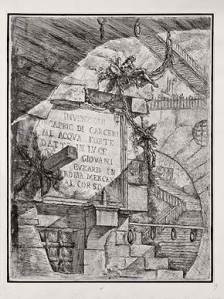
Piranesi, Title page of the 'Carceri' series, 1749-1750
On December 7th, 2011, Saint Catherine’s day, the State Hermitage Museum welcomed an exhibition entitled Ruins, Palaces and Prisons: Giovanni Battista Piranesi and Italian Eighteenth-Century Architectural Fantasies, dedicated to the early period of Piranesi’s work. This exhibit is being held as part of the Year of Italy in Russia and Year of Russia in Italy 2011 program, which continues tradition of partnership and cooperation between the two countries in the fields of art and culture.
This exhibition, presenting about 100 drawings and prints from the collection of the Hermitage, is divided into two parts: the first is dedicated to Piranesi and will present the series entitled Prima Parte (“Prima Parte “), Grotteschi (“Grotesques”) and Carceri (“Dungeons”) in their rare original condition, which have never been published in Russia before. All of them are from the 1750 album Opere Varie, which was acquired by the Empress Catherine the Great in 1768 as part of the collection of Count Bruhl and became the basis of the graphic arts collection of the Hermitage. The Carceri is presented in two conditions; the early one, from the Bruhl
collection, and a later one which was extensively revised. This is the first
time this sort of juxtaposition has been presented in Russia.

Piranesi, "Drawbridge," A page from the 'Carceri' series, 1749-1750
The second part consist of drawings by Italian artists of the 18th century who worked as scene decorators, designers and architects and created the unique genre of imaginative Veduta, which is important for understanding the style of the settecento, as the 18th century is called in Italian, a unique and complex phenomenon. Imaginative Veduta is represented by the work of the Galli Bibiena family, G. Valeriani, Pietro Gonzaga, G. Barbari, G. Mannocchi, many of which are being published for the first time. The phenomenon of Piranesi’ early fantasies is put in the context of a unique genre, and is examined at this exhibit as original sources, as is the influence of the Piranesi phenomenon on the later development of imaginative Veduta.
Giovanni Battista Piranesi (1720-1778) has an enduring place in the history or art as an artist who defined European art in the mid 18th- early 19th century. Piranesi is acknowledged as a reformer of public taste and one of the progenitors of neoclassicism, which might be called the Avant Garde of the 18th century, and as such his name is associated with this movement. However, while the series of etching entitled Carceri (dungeons), a procession of frightening, inexplicable and obscure images was not well known in the artist’s life, was many decades ahead of its time. Carceri become of the works of art most beloved by modernism. This series, which was not particularly popular during Piranesi’s life, a rediscovery of Romanticism attracted writers, architects, directors then and continues to do so now not only with its unusual subject matter, but also with its unusual spatial construction, which reminds one not of real architecture, but of the unreal space of a dream or hallucination. (more…)
Reviewed: Trio of Books on the Dilettanti and Antiquarianism
Recently added to caa.reviews:
Bruce Redford, Dilettanti: The Antic and the Antique in Eighteenth-Century England, exhibition catalogue (Los Angeles: Getty Trust Publications, 2008), 232 pages, ISBN: 9780892369249, $49.95.
Ilaria Bignamini and Clare Hornsby, Digging and Dealing in Eighteenth-Century Rome, 2 volumes (New Haven: Yale University Press, 2010), 622 pages, ISBN: 9780300160437, $85.
Jason M. Kelly, The Society of Dilettanti: Archaeology and Identity in the British Enlightenment (New Haven: Yale University Press, 2010), 366 pages, ISBN: 9780300152197, $75.
Reviewed by Susan Dixon, University of Tulsa; posted 1 December 2011.
These three recent books explore an eighteenth-century British engagement with classical archaeology during a time when the practice was transforming from an early modern antiquarianism into a modern scientific discipline. Two of the books are monographic studies of the Society of the Dilettanti, an organization that became known for its support of unprecedented archaeological activity in Greece, while a third outlines how British subjects, some of whom were Dilettanti, undertook archaeological excavations on Italian soil and refurbished, sold, and bought the antiquities found there. In some measure, all the authors note this engagement as integral to shaping British cultural identity in the eighteenth century, and in this way add to robust scholarship on the issue. . . .
The full review is available here» (CAA membership required)
Reviewed: ‘Thomas Lawrence: Regency Power and Brilliance’
Recently added to caa.reviews:
Cassandra Albinson, Peter Funnell, and Lucy Peltz, eds., Thomas Lawrence: Regency Power and Brilliance, exhibition catalogue (New Haven and London: Yale Center for British Art, National Portrait Gallery, London, and Yale University Press, 2011), 280 pages, ISBN: 9780300167184, $70.
Reviewed by Bruce Redford; posted 17 November 2011.
‘How various he is!’ Thomas Gainsborough’s tribute to Joshua Reynolds applies equally well to their successor in grand-manner portraiture. It is one of the signal achievements of ‘Thomas Lawrence: Regency Power and Brilliance’ that it removes any lingering traces of the negative stereotype: Lawrence the slick, formulaic sycophant who prostituted his gifts in the service of a decadent Regency elite. In its place this wide-ranging exhibition and thoughtful catalogue substitute a dynamic, probing, and inventive explorer of human psychology—one who is keenly attentive to the interplay of surface and depth, social mask and private self. Even Lawrence’s most public statements create a form of co-extensive space: not by breaking the picture plane, as in Caravaggio for instance, but by drawing the viewer into an
electric zone of intimacy. . . .
The full review is available here» (CAA membership required)
Exhibition: French Drawings in Grenoble

Jean-François-Pierre Peyron, “Curius Denatus refusant les présents
des ambassadeurs Samnites,” XVIIIe siècle, Musée de Grenoble
◊ ◊ ◊ ◊ ◊
Currently on display at the Musée de Grenoble, as noted by Hélène Bremer . . .
L’idée et la ligne – Dessins français
Musée de Grenoble, 5 November 2011 — 12 February 2012
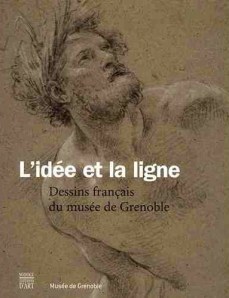 Après la présentation de ses plus belles feuilles italiennes, le musée de Grenoble met en valeur son extraordinaire fonds de dessins français. De la Renaissance à la fin du XVIIIe siècle, les plus grands artistes répondent présents. Nicolo dell’Abate, appelé pour travailler à Fontainebleau, offre une introduction magistrale à un parcours graphique qui puise ses sources en Italie. Laurent de la Hyre, Simon Vouet, Philippe de Champaigne, Patel, Charles Mellin, Charles Alphonse Dufresnoy ou François Perrier illustrent brillament les tendances d’une école française qui s’affirme et prend peu à peu son indépendance face à l’Italie. Le Brun, Noël Coypel, Jean-Baptiste de Champaigne, Louis de Boulogne et Charles de la Fosse poursuivent les avancées sous Louis XIV. La partie la plus riche et paradoxalement la moins connue de cette collection concerne le XVIIIe siècle : Boucher, Pierre ou Huber Robert viennent marquer le triomphe de la couleur et de la nature. Feuillet après feuillet, un pan entier de l’histoire de l’art française se dessine
sous nos yeux.
◊ ◊ ◊ ◊ ◊
Catalogue: Guillaume Kazerouni, Barbara Brejon de Lavergnée, Jérôme Delaplanche and Pierre Rosenberg, L’idée et la ligne: Dessins français du musée de Grenoble, XVIe-XVIIIe siècle (Paris: Somogy éditions d’art, 2011), 240 pages, ISBN: 9782757204818, €35.
Exhibition: Boxes and Objets de Vertu
From the Cognacq-Jay, as noted by Hélène Bremer . . .
Boîtes en or et objets de vertu
Cognacq-Jay Museum, Paris, 21 December 2011 — 6 May 2012
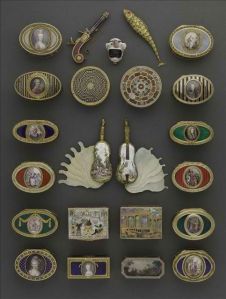 A l’occasion de la parution du Catalogue raisonné des Boîtes en or et objet de vertu, le musée Cognacq-Jay expose cet hiver sa riche collection de boîtes, tabatières, étuis, boîtes à rouge, à mouches, nécessaires de toilette, à écrire… Avec 240 objets, celle-ci est l’une des plus importantes des musées français.
Chefs-d’œuvre de l’orfèvrerie, en or, enrichis de pierres dures ou précieuses, d’émail, de porcelaine, d’ivoire ou de nacre. . . étaient dès le XVIIIe siècle l’objet d’orgueil et de convoitise Leur forme était parfois étrange, prenant l’apparence d’un dromadaire, d’un tatou, d’une jambe, d’une tête, d’un violoncelle. . . Leur usage, participant aux rituels de la vie quotidienne, témoigne des pratiques de la sociabilité au Siècle des Lumières : le tabac, les modes cosmétiques, le jeu. . .
L’exposition mettra exceptionnellement en lumière cette collection, au moyen d’une scénographie originale et surprenante, et en réunissant autour de ces
objets des dessins, des gravures pour mieux comprendre leurs secrets de
fabrication et leur usage.
◊ ◊ ◊ ◊ ◊
Catalogue: Objets de Vertus, Boites, Tabatieres, Etuis et Necessaires Collections D’Orfevrerie (Paris: Paris Musées, 2011), ISBN: 9782759601813, €44.
Exhibition: Winter Tales, from Bruegel to Beuys
From the Kunsthistorisches Museum:
Winter Tales: Depictions of Winter in European Art from Bruegel to Beuys
Kunsthistorisches Museum, Vienna, 18 October 2011 — 8 January 2012
Kunsthaus Zurich, 10 February — 29 April 2012
Curated by Ronald de Leeuw

Joshua Reynolds,"Lady Caroline Scott as Winter," 1776. Collection of the Duke of Buccleuch and Queensberry, Bowhill, Selkirk, Scotland (Photo: Wikimedia Commons)
The creation myths of most great civilizations agree that winter came into the world to punish man, or as a plague. Boreas, the Greek god of the cold north wind, personified winter. In northern mythology three years of frost herald the end of the world.
Large-scale depictions of how Napoleon’s Grande Armée was defeated by the Russian winter are a modern equivalent of these ancient scenarios of the end of the world. The contrary vision comprises serenity and joyous cheer: we gaze at views of a snow-covered countryside with skaters enjoying themselves on frozen ponds and rivers in the distance. The late 18th century sees a revival of long-unfashionable winter landscapes: at first romanticized, they evolve to reflect the palette of winter.
Impressionism, Dutch art and a wealth of landscapes – these were the ingredients of earlier winter exhibitions. The Kunsthistorisches Museum and the Kunsthaus Zurich have expanded this successful trio. Broadening the selection to include many different genres and schools, the two museums present a comprehensive survey comprising over 180 works by west-European artists. Four galleries and nine small rooms of the KHM’s
Picture Gallery form the show’s spectacular setting. The works on show
date from 1450 to the present. In addition to the subjects mentioned
above there are Dutch allegories of the months, depictions of winter
festivities and folk customs, and still lifes; even portraits join in and
present changing winter fashions.
 The paintings are arranged more or less in chronological order; the show’s guest curator, Ronald de Leeuw, was able to augment the selection by including large-scale tapestries and an imperial sleigh as well as cups and goblets, fragile porcelain figures and vessels cut from semi-precious stones. Three years in the making, the exhibition brings together important loans from Amsterdam, Munich, London, Cambridge, Paris, Strasbourg, Rotterdam, Dresden, Zurich, Philadelphia, Darmstadt, Edinburgh, Cologne, The Hague, New York, Gent, Weimar and Boston, to name but a few. However, the unique focal point of any winter exhibition is in the Picture Gallery of the Kunsthistorisches Museum: Pieter Bruegel the elder’s painting “Hunters in the Snow”, perhaps the most famous depiction of winter in European art. The large panel cannot be loaned and will only be on show in Vienna.
In addition to works by Pieter Bruegel the exhibition includes paintings by Jacob van Ruisdael, Hendrick Avercamp, Jan van Goyen, Aert van der Neer, Peter Paul Rubens, Jan Steen, Jacob Jordaens, William Turner, Francisco de Goya, Caspar David Friedrich, Gustave Courbet, Jean-François Millet, Claude Monet, Alfred Sisley, Camille Pissarro, Vincent van Gogh, Giovanni Segantini, Edvard Munch, Joseph Beuys and Anselm Kiefer.
For more information, see the exhibition press release»
◊ ◊ ◊ ◊ ◊
Catalogue: Sabine Haag, Ronald de Lleuw, and Christoph Becker, Wintermärchen: Der Winter in der Kunst von Bruegel bis Beuys (Cologne: DuMont, 2011), 432 pages, ISBN: 9783832193935, €39 / $77.50 [available from artbooks.com]
Exhibition: Duncan Phyfe, Master Cabinetmaker in New York
From The Met:
Duncan Phyfe: Master Cabinetmaker in New York
The Metropolitan Museum of Art, New York, 20 December 2011 — 6 May 2012
Museum of Fine Arts, Houston, 20 June — 11 September 2012
 In the early 1800s, furniture from the workshop of New York City cabinetmaker Duncan Phyfe (1770–1854) was in such demand that he was referred to as the “United States Rage.” This exhibition—the first retrospective on Phyfe in ninety years—will serve to re-introduce this artistic and influential master cabinetmaker to a contemporary audience.
The full chronological sweep of Phyfe’s distinguished career will be featured, including examples of his best-known furniture based on the English Regency designs of Thomas Sheraton, work from the middle and later stages of his career when he adopted the richer “archaeological” antique style of the 1820s, and a highly refined, plain Grecian style based on French Restauration prototypes. The exhibition brings together nearly one hundred works from private and public collections throughout the United States. Highlights of the exhibition include some never-before-seen documented
masterpieces and furniture descended directly in the Phyfe family, as well as
the cabinetmaker’s own tool chest.
Organized chronologically, the exhibition will present the cabinetmaker’s life and work through drawings, documents, personal possession, and furniture. Portraits of his clients and contemporary depictions of New York City street scenes and domestic interiors will provide a glimpse into Phyfe’s milieu.
Read more»
◊ ◊ ◊ ◊ ◊
Catalogue: Peter Kenny, Frances Bretter, Michael Brown, and Matthew Thurlow, Duncan Phyfe: Master Cabinetmaker in New York (New York: Metropolitan Museum of Art, 2011), 352 pages, ISBN: 9780300155112, $65.
Exhibition: The English Prize, The Capture of the Westmorland
From the YCBA:
The English Prize: The Capture of the Westmorland, an Episode of the Grand Tour
The Ashmolean Museum, Oxford, 17 May — 27 August 2012
The Yale Center for British Art, New Haven, 20 September 2012 — 6 January 2013
Curated by Scott Wilcox, Elisabeth Fairman, and María Dolores Sánchez-Jáuregui Alpañés
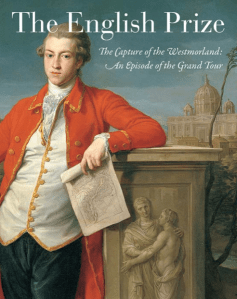 This exhibition tells the extraordinary story of the capture of the Westmorland, a British merchant ship laden with works of art acquired by young British travelers on the Grand Tour in Italy, and the subsequent disposition of its contents. Shortly after sailing from Livorno, Italy, in 1778, the ship was captured by the French navy, which was well aware of its exceptional contents. The Westmorland was escorted to Málaga, in southern Spain, where its contents were inventoried and acquired by agents who in turn sold most of the works of art on board to King Carlos III of Spain. Much of the material was subsequently presented by the king to the Real Academia de Bellas Artes de San Fernando in Madrid. The original inventories, which survive in the Academia’s archives, are remarkably thorough, enabling the identification of many of the items on board the ship when it was captured. Much of the material remains in the Real Academia, but significant works were passed on to the Spanish Royal Collection and are now in the Museo Nacional del Prado or in royal residences in Spain. Because most of these works can be associated with the tourists who were sending them back to Britain, the contents of the Westmorland forms the most complete “cross section” of the Grand Tour discovered to date. The exhibition comes out of a major research project initiated in the late 1990s, led by Professor José María Luzón Nogué, that investigates the story of the Westmorland and its contents. In recent years, with the support of the Paul Mellon Centre for Studies in British Art in London, remarkable progress has been made in identifying and cataloguing these extraordinarily diverse treasures, and this research forms the basis of the exhibition.
◊ ◊ ◊ ◊ ◊
Catalogue: María Dolores Sánchez-Jáuregui Alpañés and Scott Wilcox, eds., The English Prize: The Capture of the Westmorland, an Episode of the Grand Tour (New Haven: Yale University Press, 2012), 400 pages, ISBN: 9780300176056, $75.
◊ ◊ ◊ ◊ ◊
Charlotte Higgins writes about the exhibition for The Guardian (20 November 2011).
Exhibition: French Drawings from the Mariette Collection
From the Louvre, as noted by Hélène Bremer:
French Drawings from the Mariette Collection
Musée du Louvre, Paris, 10 November 2011 — 6 February 2012
Curated by Pierre Rosenberg, Laure Barthélemy-Labeeuw, and Bénédicte Gady

Jean-Baptiste Oudry, Egret (Paris: Louvre)
Pierre Jean Mariette (1694–1774) brought together one of the most fascinating collections in the whole of the eighteenth century, with drawings taking pride of place (around ten thousand sheets). Masterpieces by great artists stood alongside pieces of bravura by minor masters, in line with the encyclopedic commitment of this “genius jack-of-all-trades.” A collection of this caliber seemed destined to join those of king and nation. This was the wish of both Mariette and the administration—but, as sometimes happens, the heirs decided otherwise. The auctioning-off lasted for no less than two and a half months, during which time nearly one thousand drawings were nonetheless purchased for the king’s cabinet.
Pierre Rosenberg, of the French Academy, President emeritus of the Musée du Louvre, assisted by Laure Barthélemy-Labeeuw, rose to the dizzying challenge of reconstructing this legendary collection by scouring public and private collections the world over to track down drawings that had once belonged to Mariette. On the occasion of the publication of two initial volumes listing nearly four thousand French drawings, the Musée du Louvre is presenting the survey’s methodological basis and its main findings. On display are around one hundred works, some famous and some recently identified, which went from the collector’s to the museum’s portfolios.
◊ ◊ ◊ ◊ ◊
From Artbooks.com:
Pierre Rosenberg and Laure Barthélemy-Labeeuw, Les Dessins de la Collection de Pierre-Jean Mariette, volumes 1-2 (Milan: Electa, 2011), 704 pages, ISBN: 9788837064273, €600 / $900.
After the reproduction of the complete auction catalogue illustrated by Saint-Aubin and kept in Boston, a necessary tool through which to track down many of the items, the entire drawing collection which belonged to Pierre-Jean Mariette (1694-1774) is now being reproposed. Without any doubt, to use the words of Frederik Johannes “Frits” Lugt, the 20th-century collector, Mariette was the greatest, if not the ‘prince’ in the field of drawing collections. He began his collection during brief sojourns in Italy and, from 1750 onwards, devoted himself exclusively to this pursuit. During his lifetime he put together almost 9,000 items, carefully cataloguing them according to school and type. When he died, they were scattered as a result of 42 auctions (between November 1775 and January 1776).
The incredible task of putting the collection back together was made possible because of the trade-mark (a capital M) which Mariette stamped on every drawing he owned and by the unusual mounting of each drawing on a blue background (‘Mariette blue’) which brought out the best qualities of the drawings. The whole collection will be published in six volumes: the first two are devoted to the French School, three to the Italian school and one to the Dutch, Flemish and German schools. A monumental work of inestimable historical and artistic value. This ambitious publishing project reconstructed the world’s largest-ever collection of drawings. The first volumes focus on the French school: thousands of drawings that were scattered worldwide can now finally be seen at a single glance.
Additional information (in Italian) comes from the Italian bookseller, LibroCo.Italia»
Humphrey Wine provides a review in the April 2012 issue of Apollo Magazine (note added April 2012).










 Enfilade
leave a comment