Exhibition: Contested Visions in the Spanish Colonial World
From LACMA:
Contested Visions in the Spanish Colonial World
Los Angeles County Museum of Art, 6 November 2011 — 29 January 2012
Museo Nacional de Historia, Mexico City, 6 July — 7 October 2012

"The Apparition of San Miguel del Milagro to Diego Lázaro," first half of the 18th century (Museo Universitario Casa de los Muñecos, Benemérita Universidad Autónoma de Puebla, Mexico)
Contested Visions in the Spanish Colonial World examines the significance of indigenous peoples within the artistic landscape of colonial Latin America. The exhibition offers a comparative view of the two principal viceroyalties of Spanish America—Mexico and Peru—from the fifteenth to the nineteenth centuries. Under colonial rule, Amerindians were not a passive or homogenous group but instead commissioned art for their communities and promoted specific images of themselves as a polity. By taking into consideration the pre-Columbian (Inca and Aztec) origins of these two vast geopolitical regions and their continuities and ruptures over time, Contested Visions offers an arresting perspective on how art and power intersected in the Spanish colonial world. The exhibition is divided into themes:
Contested Visions
Tenochtitlan and Cuzco Pre-Columbian Antecedents
Ancient Styles in the New Era
Conquest and New World Orders
The Devotional Landscape and the Indian as Good Christian
Indian Festivals and Sacred Rituals
Memory, Genealogy, and Land
A checklist of the exhibition is available here»
◊ ◊ ◊ ◊ ◊
Exhibition catalogue: Ilona Katzew, ed., Contested Visions in the Spanish Colonial World (New Haven: Yale University Press, 2011), 320 pages, ISBN: 9780300176643, $70.
 Contested Visions offers a comparative view of the two principal viceroyalties of Spanish America: Mexico and Peru. Spanning developments from the 15th to the 19th century, this ambitious book looks at the many ways and contexts in which indigenous peoples were represented in art of the early modern period—by colonial artists, European artists, and themselves. More than two hundred works of art, including paintings, sculptures, illustrated books, maps, codices, manuscripts, and other materials such as textiles, keros, and feather works, are reproduced in full-color illustrations, demonstrating the rich variety of these artistic approaches.
A collection of essays by an international team of distinguished scholars in the field uncovers the different meanings and purposes behind these depictions of native populations of the Americas. These experts explore
the role of the visual arts in negotiating a sense of place in late pre-Columbian and colonial Latin America. They address a range of important topics, such as the construct of the Indian as a good Christian; how Amerindians drew on their pre-Columbian past to stake out a place within the Spanish body politic; their participation in festive rites; and their role as artists. Lavishly illustrated, this ambitious book provides a compelling and original framework by which to understand the intersection of vision and power in the Spanish colonial world.
Ilona Katzew is curator and co-department head of Latin American art at the Los Angeles County Museum of Art.
◊ ◊ ◊ ◊ ◊
Symposium: Contested Visions in the Spanish Colonial World
Los Angeles County Museum of Art, 2-4 December 2011
LACMA and UCLA are co-sponsoring a major international three-day symposium in conjunction with the special exhibition Contested Visions in the Spanish Colonial World, which brings together thirty of the most distinguished scholars in the field from Mexico, South America, Europe, and the United States.
Free, no reservations | Printable Schedule | View Abstracts
Exhibition: Daniel Sarrabat
From the Centre des monuments nationaux website:
Daniel Sarrabat (1666-1743) l’éclat retrouvé
Monastère royal de Brou, Bourg-en-Bresse (near Lyon), 15 October 2011 — 29 January 2012
Curated by François Marandet
 Cette exposition révèle l’art d’un des plus grands peintre d’histoire à Lyon et dans sa région, pendant la première moitié du XVIIIe siècle : Daniel Sarrabat (1666-1743). Alors que le style rocaille triomphe en France, il poursuit l’idéal artistique de Nicolas Poussin, et montre combien la peinture d’histoire s’est maintenue à Lyon et dans sa région depuis la disparition de Jacques Stella (1596-1657) et Thomas Blanchet (1614-1689).
Cette toute première rétrospective rassemble près de 50 œuvres de l’artiste, dont 36 tableaux. Sont présentées des réalisations inédites aux cotés d’œuvres de collections privées, notamment le décor mythique de l’Hôtel de Sénozan, à Lyon, complété par un groupe de tableaux provenant du patrimoine religieux de la région, avec le cycle illustrant l’histoire de Marie-Madeleine de l’église de Thoissey. Le parcours de l’exposition restitue les étapes successives de la carrière de Daniel Sarrabat : l’époque de son apprentissage à Paris, le séjour à
Rome (1685-1694), son implantation à Lyon en 1695, jusqu’à sa consécration
(1716-1732).
Additional information is available from the exhibition brochure (PDF).
◊ ◊ ◊ ◊ ◊
Catalogue: François Marandet, Daniel Sarrabat, 1666-1748 (Saint-Étienne: I.A.C. Éditions d’Art, 2011), 128 pages, ISBN: 9782916373478, $42.50. [Available from Artbooks.com]
Exhibition: Monkeys and Dragons at Chantilly
The following press release comes from the Musée Conde. -HB
Singes et Dragons: La Chine et le Japon à Chantilly au XVIIIe Siècle
Musée Conde, Château de Chantilly, 14 September 2011 — 1 January 2012
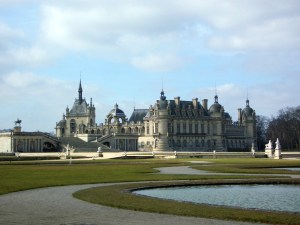
Pour la rentrée de septembre 2011, le musée Condé propose une exposition qui s’inscrit dans la thématique du « voyage » qui sera développée jusqu’à la fin 2011 par le Domaine de Chantilly. En effet, les visiteurs sont invités à remonter le temps, au XVIIIe siècle, quand artistes et artisans réalisaient des œuvres peintes ou d’art décoratif sur commande, afin de combler un goût immodéré pour les décors asiatiques où singes et dragons se mêlaient parfois avec délicatesse aux animaux familiers de nos campagnes.
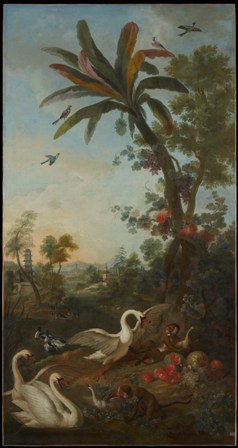 En ce début du XVIIIe siècle, alors que la France se passionne pour l’exotisme, le duc de Bourbon, prince de Condé (1692-1740), collectionne pour son Château de Chantilly les porcelaines, les indiennes – tissus peints ou imprimés fabriqués en Asie entre le XVIIe siècle et le XIXe siècle – et les meubles en laque de Chine et du Japon. Il les fait copier par des artisans français et crée pour ce faire trois manufactures. En mécène entrepreneur passionné, il commande en 1735 au dessinateur Jean-Antoine Fraisse (1680-1739) un album de modèles, gravés en taille-douce, d’après ses collections. Les artisans au service du prince s’en inspirent, notamment pour les porcelaines de Chantilly ; et ce jusqu’en 1740 à la mort du Prince et au tournant de cet engouement pour l’exotisme. C’est à partir de cet ouvrage in-folio rarissime que Nicole Garnier, conservateur général du patrimoine chargée du musée Condé, a conçu son exposition de rentrée où sont présentés outre les deux exemplaires enluminés provenant des collections du Château de Chantilly et de la Bibliothèque nationale de France (Bnf), des gravures de Fraisse (dont deux de plus de trois mètres sont extraites de l’exemplaire enluminé), d’autres de Jean-Baptiste Guélard (1698-1767), des peintures de Christophe Huet (1700-1759) et des pièces d’art décoratif représentatives de cette époque où l’Extrême-Orient était de mise à la Cour et dans les plus belles demeures. . . .
The full press release is available here»
◊ ◊ ◊ ◊ ◊
Catalogue: Manuela Finaz de Villaine and Nicole Garnier-Pelle with assistance from Eléonore Follain, Singes et Dragons: La Chine et le Japon à Chantilly au XVIIIe siècle (Chantilly: Édité par la Fondation pour la Sauvegarde et le Développement du Domaine de Chantilly, 2011), 64 pages, ISBN: 9782953260335, 12€.
Exhibition: The Young Tiepolo, The Discovery of Light
Xavier Salomon reviews the exhibition in the October issue of The Burlington (pp. 698-99). From the Udine website:
Il giovane Tiepolo: la scoperta della luce
Civic Museum of Udine, Castello, Udine, 4 June — 4 December 2011
Curated by Giuseppe Pavanello and Vania Gransinigh
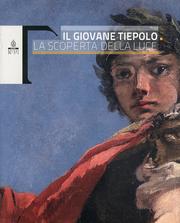
ISBN: 9788895752112
Che cosa caratterizza l’esordio di un giovane pittore di genio? Quali percorsi mentali e creativi presiedono alla formazione di un artista di talento? A questa e ad altre domande proverà a dare risposta la mostra che i Civici Musei di Udine inaugurano il 4 giugno 2011 all’interno della terza edizione delle Giornate del Tiepolo. L’esposizione, dal titolo Il giovane Tiepolo: la scoperta della luce, è rivolta proprio a ricostruire, attraverso le opere più significative, il periodo giovanile dell’attività di Tiepolo, prima del suo soggiorno udinese del 1726.
Se, nel corso del suo apprendistato presso la bottega del pittore accademico Gregorio Lazzarini, l’artista ebbe modo di confrontarsi con i modelli offerti dalla tradizione figurativa veneta del Cinquecento, egli si dimostrò particolarmente attento anche a quanto i suoi contemporanei andavano sperimentando, e alle nuove teorie sulla luce di ispirazione newtoniana. Le opere di Federico Bencovich e Giambattista Piazzetta rappresentarono per il giovane Tiepolo un punto di riferimento ugualmente importante che egli seppe assimilare in maniera originale, in sintonia con il suo essere “tutto spirito e foco,” attraverso un linguaggio pittorico costruito sull’interpretazione luminosa dell’immagine. Ed è proprio su questa peculiare visione tiepolesca della luce che l’esposizione udinese si focalizza, ripercorrendo il tracciato di un’attività che dalle tele dipinte per la chiesa veneziana dell’Ospedaletto si dipana, per il tramite delle decorazioni di Palazzo Sandi, fino al ciclo di affreschi realizzati a Udine nel Palazzo Patriarcale.
I dipinti in esposizione permettono così di documentare il passaggio da una pittura costruita nella luce, secondo precise fonti di illuminazione interne all’immagine, a una pittura costruita dalla luce, nella quale forme e volumi appaiono generati, come vetro soffiato, dall’interna energia luminosa della materia. In mostra sono presentate opere provenienti dai musei di Venezia, Milano, Torino e da alcune delle più prestigiose collezioni pubbliche e private internazionali.
Comitato scientifico: Svetlana Alpers, William L. Barcham, Linda Borean, Caterina Furlan, Peter O. Krückmann, Giuseppe Pavanello e Catherine Whistler.
◊ ◊ ◊ ◊ ◊
Catalogue: Giuseppe Pavanello and Vania Gransinigh, eds., Il Giovane Tiepolo. La Scoperta della Luce (Udine: Civici Musei e Gallerie di Storia e Arte di Udine, 2011), 207 pages, ISBN: 9788895752112, €45 / $87.50.
Exhibition and Colloquium: The Hôtels Particuliers of Paris
As noted by Hélène Bremer, from the museum’s website:
The Townhouse: A Parisian Ambition / L’hôtel particulier: Une ambition parisienne
Cité de l’Architecture & du Patrimoine, Palais de Chaillot, Paris, 6 October 2011 — 19 February 2012
Curated by Alexandre Gady
The townhouse is a key part of Paris’s architectural character, and we can trace the story of the capital by studying the development of the townhouse in different districts of the city.
 The Parisian townhouse made its first appearance in the Middle Ages and became more popular during the 16th century when, thanks to François I, Paris again became the political capital where the monarchic state assembled and settled. It was important to be at court, near the king, and, therefore, at Paris. This golden age continued throughout the 17th, 18th and 19th centuries. The last of the townhouses were built in the period between the two world wars, marking the end of a long history, but they still exist in today’s 21st-century Paris and are very much in use: (museums, embassies, ministries). This exhibition aims to explore this history and takes the visitor on three complementary and illuminating journeys, in a bid to discover the secret of the Parisian townhouse.
The first section features a small reconstructed townhouse, between garden and courtyard, with different authentically decorated rooms for the visitor to explore. In this way, each visitor can enjoy a sense of familiarity with, and ownership of, the building. The building is not an exact replica of an existing townhouse but aims rather to convey a general impression, an overall picture, with each “external” and internal space specifically designed for educational purposes.
In the second section of the exhibition, the visitor will take a journey through the history of the townhouse, this time organized chronologically, from the Middle Ages to the Belle Epoque. This part of the exhibition, displayed in a vast open space, presents a series of large models of townhouses, specifically chosen for their distinctive characteristics – hôtels de Cluny, Lambert, Thélusson and finally the Palais-Rose (these last two buildings no longer exist) – complete with an interactive terminal with wonderfully illustrated information on some 300 town houses.
The last section offers themed reading, examining the Parisian hotel as an architectural object. Three “alcoves” will be devoted to the relationship between the city and the townhouse – a relationship which was both passionate and destructive. A further three sections allow the visitor to explore the external architecture of the townhouse (façades overlooking gardens and courtyards), its interior décor, gardens and finally internal layout. To complete the display, there is a multi-touch screen on the layout and organization of the townhouse, presented in a fun way.
Alexandre Gady, L’hôtel particulier de Paris: Du Moyen Age à la belle époque, second edition (Paris: Parigramme, 2011), 320 pages, ISBN: 9782840967040, €49.
◊ ◊ ◊ ◊ ◊
Colloquium: L’hôtel particulier des capitales régionales, une ambition française
Cité de l’Architecture & du Patrimoine, Palais de Chaillot, Paris, 2-3 December 2011
Ce colloque placé sous la direction scientifique de Pascal Liévaux, conservateur en chef à la Direction générale des patrimoines et Alexandre Gady, professeur à l’université de Nantes, commissaire de l’exposition L’Hôtel particulier. Une ambition parisienne, fait écho à cette manifestation.
Il propose d’en élargir la thématique à l’ensemble du territoire national et donnera la parole à des chercheurs et à des professionnels du patrimoine. Ces spécialistes témoigneront des dernières avancées dans la connaissance, la conservation, la restauration et la mise en valeur de ces édifices complexes qui, associant au plus haut niveau d’excellence l’architecture, l’art des jardins et celui du décor, témoignent de trois siècles de vitalité et de diversité de l’architecture urbaine sur l’ensemble du territoire national.
Exhibition: Master Drawings from the Crocker Art Museum
From The Frances Lehman Loeb Art Center at Vassar:
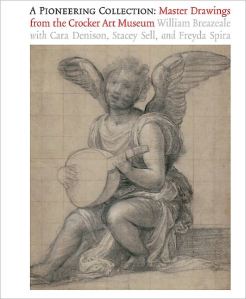
A Pioneering Collection: Master Drawings from the Crocker Art Museumm
Portland Art Museum, Oregon, 12 June — 19 September 2010
Crocker Art Museum, Sacramento, California, 10 October 2010 — 6 February 2011
Frances Lehman Loeb Art Center, Vassar College, Poughkeepsie, New York, 16 September — 11 December 2011

Hubert Robert, "Massacre of the Innocents," 1796, chalk, brown, and red, on paper, 8 1/4 in. x 7 1/4 in. (Sacramento: Crocker Art Museum)
A Pioneering Collection: Master Drawings from the Crocker Art Museum includes 57 rarely seen works by artists such as Albrecht Durer, Fra Bartolommeo, Anthonie van Dyck, Francois Boucher, and Jean-Auguste-Cominque Ingres. The exhibition is divided thematically into four sections of drawings from Italy, the Low Countries, France, and Central Europe.
These drawings date from the late 15th- to the mid-19th centuries and were purchased between 1869-71 by forward-thinking railroad magnate E. B. Crocker, forming the basis of the Crocker Museum’s master drawings collection. In total, the Crockers purchased 1344 master drawings and 700 paintings during their time in Europe and these formed the basis of their private art gallery, which opened in 1872, featuring visitors like the queen of Hawaii and former U.S. President Grant. Following the death of Edwin Crocker, his wife Margaret transferred the gallery to the California Museum Association, now the Crocker Art Museum. Their old master drawing collection was one of the first historically to be opened to the
public in 1885.
 This exhibition was organized in celebration of the Crocker’s Anne and Malcolm McHenry Works on Paper Study Center and exhibition space, designed to significantly enhance public access to this collection of master drawings.
A catalogue by lead author and Crocker Art Museum curator Wiliam Breazeale; Cara Dufour Denison, curator at the Morgan Library and Museum; Stacey Sell, associate curator of Old Master drawings at the National Gallery of Art, and Freyda Spira, research associate at the Metropolitan Museum of Art, accompanies the exhibition and will be available at the Art Center gift shop (Paul Holberton Publishing, 2010, $35).
A full checklist for the exhibition is available here»
Exhibition: ‘Claude Lorrain: The Enchanted Landscape’
From the Ashmolean:
Claude Lorrain: The Enchanted Landscape
Ashmolean Museum of Art and Archaeology, Oxford, 6 October 2011 — 8 January 2012
Städel Museum, Frankfurt, 3 February — 6 May 2012
Curated by Jon Whiteley
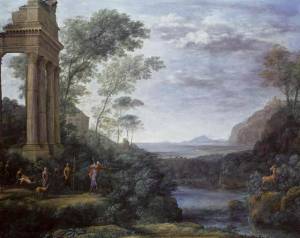
Claude Lorrain, "Landscape with Ascanius Shooting the Stag of Sylvia," 1682 (Oxford: Ashmolean Museum)
The Ashmolean’s major exhibition this autumn will be Claude Lorrain: The Enchanted Landscape, rediscovering the father of European landscape painting, Claude Gellée (ca. 1600–1682), or Claude Lorrain as he is best known.
In partnership with the Städel Museum, Frankfurt, the exhibition will bring together 140 works from international collections, created at different points in the artist’s career. By uniting ‘pairs’ of Claude’s paintings and making a comprehensive survey of his work in different media, the exhibition brings new research to bear on his working methods, to reveal an unconventional side to Claude which has previously been little known.
Born in France, Claude travelled first to Italy at the age of 13 or 14, settling in Rome for the rest of his life in 1627. The scenery of his great compositions was based on his studies of the ancient ruins and the rolling country of the Tiber Valley and the Roman Campagna. Claude’s ability to translate his vision of the countryside and the majesty of natural light with the aid of his brush won him the admiration of his contemporaries, above all else, as a ‘natural painter’. It has been his signature treatment of classical landscape and literature which has impressed itself on generations of artists and collectors, and which has made his name synonymous with great landscape painting.
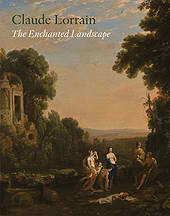
ISBN: 9781848220928, $80
The cult of Claude which grew up in the 18th and 19th centuries, begun by British ‘Grand Tourists’, has left a profound mark on our history and landscape. English country houses are well stocked with both originals by Claude and with copies. Responding to aristocratic taste and fashion, designers such as Capability Brown, Henry Hoare and William Kent reproduced his ideal views in the parklands of great houses from Blenheim Palace, Rousham House and Stowe, to Stourhead and Chatsworth. Claude’s drawings were collected with no less enthusiasm by English connoisseurs, as a result, over 40% of his drawings are now in the British Museum. Claude’s influence on later artists is apparent in the work of Gainsborough, Turner and Constable, who described him as ‘the most perfect landscape painter the world ever saw’.
A lesser-known side to Claude is the eccentricity of his graphic art. Claude Lorrain: The Enchanted Landscape will exhibit 13 paintings alongside related drawings and etchings from international and private collections, and from the Ashmolean’s own extensive holdings. Claude was a dedicated graphic artist. He drew for the sake of mastering the world of nature but also because drawing was a pleasure in itself. Many of his drawings were made as works of art in their own right. During his own lifetime Claude’s fame grew rapidly. As a guard against forgeries, he made copies of his paintings in a book, the Liber Veritatis (Book of Truth), which, by the time of his death, contained 200 drawings. The book also gave him a collection of ideas which he could reuse when necessary. Although he made only 40 prints in total, all of which are on display, he took a serious interest in printmaking. Similar to his drawings, his principle focus was to explore the potential of the medium. His exceptional technique – a painterly brush-and-ink style replicating natural effects – was a novelty in contemporary printmaking. The spectacular ‘Fireworks’ series, ten etchings made during a week of firework displays in Rome, illustrate his experimental style and will be on show together in the Ashmolean’s exhibition.
Unlike contemporaries who had an academic training, Claude’s style and artistic process were unique to him. He worked frequently with existing materials progressing from one painting to another through a process of variation and combination. His sketching excursions provided him with a stock of motifs, including trees, hills, rivers and antique ruins, which became constant accessories in his paintings. Figure groups were shifted from one composition to another. Landscapes, like stage scenery, were taken out for reuse with a different set of characters. Elsewhere he would cut compositions in two or enlarge them with separate sheets. Occasionally, he would pick up a discarded study and add detail to make it a finished work of art, often with peculiar results.
Claude was also the first artist to specialise in painting ‘pairs’. Approximately half his compositions were made as companion pieces, the earliest of which, on display here, are Landscape with the Judgement of Paris and Coast View (both 1633). The idea of pairs is also found among his prints. While many of his pairs show a compositional correspondence, contrast played as great a role as similarity. Often an Arcadian landscape is combined with a maritime view, or a morning scene with an evening setting. The pairs were not always executed concurrently: his very last painting, the Ashmolean’s great Ascanius and the Stag of Sylvia (1682), was made 5 years after its companion, Aeneas’s Farewell to Dido in Carthage (1676) now in Hamburg.
Claude Lorrain: The Enchanted Landscape will display some of Claude’s greatest masterpieces, works which have made his art familiar and well-loved. In placing these beside his graphic art and exploring his singular methods of working, the exhibition aims to expose an unexplored dimension to one of the western canon’s most famous names.
“Claude’s art is recognisable to almost all of us, even if we are less familiar with his name, and this important exhibition will reintroduce us to one of the greatest painters of all time.” Dr Jon Whiteley, Exhibition Curator and Senior Assistant Keeper of Western Art, Ashmolean Museum.
Catalogue: Martin Sonnabend, Jon Whiteley, and Christian Rumelin, Claude Lorrain: The Enchanted Landscape (London: Lund Humphries, 2011), 200 pages, ISBN: 9781848220928, $80.
◊ ◊ ◊ ◊ ◊
S E L E C T E D P R O G R A M M I N G
Colin Harrison (Senior Assistant Keeper of Western Art, Ashmolean Museum), Claude, Wilson, Turner
Saturday, 12 November, 11:00
Claude’s landscape paintings had a profound influence on British artists in the 18th and 19th century. This lecture focuses on his long-lasting inspiration, most apparent in the work of Richard Wilson (1714–1782) and J.M.W Turner (1775-1851).
Michael Clarke (Director of the Scottish National Gallery), Arcadia Revisited – Claude’s Enduring Legacy
Wednesday, 16 November, 2:00
Generally acknowledged as the founder of the European landscape tradition, Claude Lorrain was admired by many of the great European painters, especially Constable and Turner. His work exerted an enormous influence on later generations even eliciting praise from the Impressionist Camille Pissarro. This lecture charts the perennial attraction of an artist who ‘conducts us to the tranquility of Arcadian scenes and fairy land’ (Sir Joshua Reynolds).
Christopher Woodward (Director of the Garden Museum), Claude Lorrain and the Making of the English Landscape Garden
Wednesday, 7 December, 5:00
How did a French artist working in Rome in the 17th-century inspire the creation of 18th-century gardens such as Blenheim, Rousham and Stourhead? Christopher Woodward, Director of The Garden Museum and author of “In Ruins”, explores how Claude’s idyllic Italian scenes inspired the transformation of English gardens into visions of Arcadia.
Exhibition: Louis-Léopold Boilly (1761-1845)
From Art Media Agency:
Boilly (1761-1845)
Palais des Beaux-Arts de Lille, 4 November 2011 — 6 February 2012
 The Palais des Beaux-Arts in Lille will host the first international retrospective dedicated to Louis-Léopold Boilly (1761-1845). The event, celebrating the 250th birthday of the artist, will run from 4 November to 6 February. . . .
It is the first Boilly retrospective since the 1930s and it will feature works from numerous collections. It will underline the painter’s originality. His talent as a portraitist will also be highlighted, as well as his taste for trompe-l’œil and his role as the century’s chronicler, precursory to Daumier. The exhibition will feature more than 170 paintings, drawings, lithographs, miniatures and furniture. It will be divided into seven sections, in chronological and thematic order, recounting the painter’s itinerary.
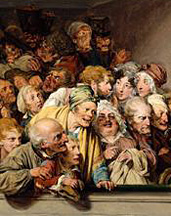
ISBN: 9782350391250
The full AMA posting is available here»
The exhibition press release (in French) is available here»
◊ ◊ ◊ ◊ ◊
Annie de Wambrechies, Louis-Leopold Boilly (1761-1845), exhibition catalogue (Paris: Chaudun, 2011), 304 pages, ISBN: 9782350391250, 42€ / $82.50 — The catalogue, scheduled for release in November, will be available from ArtBooks.com.
Exhibition: French Artists in Eighteenth-Century Rome
From the exhibition website:
Drawn to Art: French Art Lovers and Artists in 18th-Century Rome
National Gallery of Canada, Ottawa, 21 October 2011 — 2 January 2012
Musée des Beaux-Arts de Caen, 4 February — 23 April 2012
Curated by Sonia Couturier

Jacques-Louis David, "St. Jerome," 1779 Musée du Séminaire, Quebec City (deposited by the Fabrique Notre-Dame, inv. PE34.984) on loan to the National Gallery of Canada, Ottawa
In the 18th century, Rome was the principal crossroads for the European community and an important source of influence for French artists who rose to prominence in the Eternal City. This exhibition highlights the flowering of French art in 18th-century Rome, focusing on some 100 works, of which many are travelling to North America for the first time.
Visitors will have the opportunity to view an exceptional selection of drawings and prints as well as a number of paintings by many important French artists of the period, including Hubert Robert, Jean-Honoré Fragonard and Jacques-Louis David. After its presentation in Ottawa, the exhibition Drawn to Art: French Artists and Art Lovers in 18th-Century Rome will be on view at the Musée des Beaux-Arts de Caen, France from 4 February to 23 April 2012.
Catalogue: Sonia Couturier, ed., Drawn to Art: French Artists and Art Lovers in 18th-Century Rome (Milan: Silvana, 2011), 216 pages, ISBN: 9788836620548, $67.50. [available from artbooks.com]
◊ ◊ ◊ ◊ ◊
Academic Training

Jean-Baptiste Frédéric Desmarais, "The Shepherd Paris," 1787–88 (Ottawa: National Gallery of Canada) Photo © NGC
The Académie de France in Rome, founded in 1666, provided training for the most talented students from the Académie royale de peinture et de sculpture in Paris, for a period of about four years. This group of artists comprised the dozen recipients of the Grand Prix de Rome, awarded for excellence in painting, sculpture and architecture.
The students made copies of antiquities in public squares, gardens and the Capitoline Museum, and they visited the churches and palazzos of Rome to study Renaissance and Baroque masters. The Académie also offered a live model class, open to these pensionnaires (as they were called), external students and foreigners. Although the nude study was part of the curriculum, many of the resulting paintings of academy figures were of exceptional quality. Students’ work was regularly dispatched to the king of France to attest to their progress.
A number of French artists went on to successful careers in Rome or submitted proposals for major Roman projects. The length of time that both pensionnaires and independent artists spent in Rome varied depending on
their financial resources and patron support.
The Landscape of Rome and its Surroundings
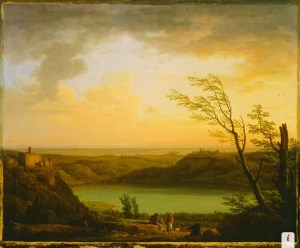
Claude-Joseph Vernet, "View of Lake Nemi," 1748 (Ottawa: National Gallery of Canada)
A revival of interest in the art of landscape was sparked in 1725 when Nicolas Vleughels, who took over as director of the Académie de France in Rome, encouraged young painters to sketch in situ. This desire to breathe new life into the landscape genre resulted in a variety of forms.
Rome and its environs provided painters and draughtsmen in search of picturesque views with a constant source of inspiration. Some artists offered an idyllic, pastoral vision, mixing imagination and reality, while others opted for a more objective portrayal of the land and its inhabitants, carefully reproducing the natural and built environment. During his Roman sojourn (1754–65), Hubert Robert made countless images of the surrounding landscape, building a vast repertoire of motifs. Like other French pensionnaires in the 1740s, he was influenced by the vedutisti Giovanni Paolo Panini and Giovanni Battista Piranesi. The masterful studies of atmospheric effects by Adrien Manglard, Claude-Joseph Vernet and Pierre-Henri de Valenciennes helped to bring landscape to the forefront in the following century.
Art Lovers, Patrons, and Artists

François-André Vincent, "Portrait of Pierre-Jacques-Onésyme Bergeret de Grancourt," 1774 (Besançon: Musée des beaux-arts et d'archéologie)
Rome was a cosmopolitan centre that attracted not only artists of diverse nationalities but also sophisticated sponsors and connoisseurs eager to hone their knowledge. A number of dilettanti emerged as key figures of this lively community, in which the most promising talents of the time flourished.
The well-established artistic relationships linking Paris and Rome were forged primarily through the directors of the Académie de France in Rome and reinforced by visiting amateurs, each with his own set of connections. The diplomatic realm also provided a fertile terrain for exchanges and development of the network.
Art tourists rarely stayed in Rome for more than a few months. They took full advantage of the resources offered by the Académie, which had available a pool of young artists keen to serve as guides. Certain visitors seem to have warranted special attention; the most important was the Marquis de Marigny, future director of the king’s buildings, who was in Rome in 1750–51 in preparation for his upcoming appointment.
Celebrations and Festivities
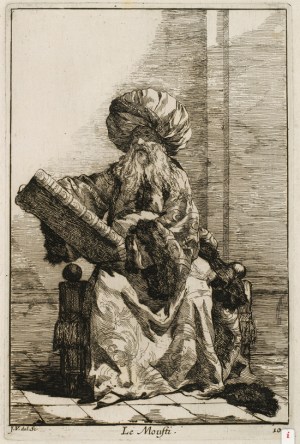
Jean-Marie Vien, 32 plates Illustrating the "Caravane du Sultan à la Mecque" during the Carnival in Rome, 1748, detail (Ottawa: National Gallery of Canada)
Life in Rome was punctuated by numerous celebrations and festivals, and the French artists made the most of them. Especially memorable were the extraordinary Turkish and Chinese masquerades organized by students at the Académie de France for Rome’s annual carnival. The caricatures produced offer a glimpse into a milieu full of camaraderie.
Various works illustrate the extravagant set pieces, parade floats and fireworks displays conceived for the secular celebrations and religious ceremonies that regularly transformed the city. Among the official ceremonies held to mark political events was the Chinea festival, commemorating the ceding of the kingdom of Naples by Pope Clement IV to Charles of Anjou in 1265. As the new king of Naples, Charles presented the papacy with a white mare known as a chinea (a “hackney” in English). When Naples passed into Spanish hands, the tradition was preserved. Temporary structures made of wood, canvas and stucco were built before the ambassador’s palace. These macchine, inspired by allegorical themes that glorified the kingdom of Naples, were lit up at night by fireworks.
Exhibition & Symposium: Drawings from the Louvre at the Morgan
I noted the show back in February, but I’m afraid tomorrow afternoon’s lecture series nearly slipped by me. From The Morgan:
◊ ◊ ◊ ◊ ◊
David, Delacroix, and Revolutionary France: Drawings from the Louvre
The Morgan Library and Museum, New York, 23 September — 31 December 2011
Curated by Louis-Antoine Prat and Jennifer Tonkovich with assistance from Esther Bell

ISBN: 9780875981598, $40
From the time of the French Revolution of 1789 through the reign of King Louis-Philippe and the establishment of the Second Empire in 1852, an incredible concentration of artistic talent brought its collective skill to bear on one of the most turbulent times in French history. This exhibition features some of the greatest examples of works on paper of the period from Paris’s famed Musée du Louvre. Included are eighty drawings by such noted artists as David, Prud’hon, Ingres, Géricault, Delacroix, and Corot.
Rarely does the Louvre allow such a major group of drawings, with so many iconic works, to travel. The exhibition will offer visitors a singular opportunity to experience the mastery of the era. The Morgan is the only venue for this important show.
David, Delacroix, and Revolutionary France: Drawings from the Louvre is organized by Louis-Antoine Prat, curator in the Department of Graphic Arts at the Musée du Louvre and Jennifer Tonkovich, curator in the Department of Drawings and Prints at The Morgan Library & Museum, with the assistance of Esther Bell, Moore Curatorial Fellow, The Morgan Library & Museum.
◊ ◊ ◊ ◊ ◊
Symposium — Drawing in the Age of Revolutions: New Perspectives
The Morgan Library and Museum, New York, 24 September 2011
This symposium coincides with the exhibition David, Delacroix, and Revolutionary France: Drawings from the Louvre, which offers the American public a rare opportunity to view some of the most celebrated French drawings from the Louvre. Through a series of brief talks, leading scholars will explore the diversity of draftsmanship during the period and present new research in the field. The program will conclude with a gallery conversation with curators and speakers, allowing for a closer examination of works on view.
The Art Market, Drawings Galleries, and Collectors
Louis-Antoine Prat, Curator, Department of Graphic Arts, Musée du Louvre, and Professor, Ecole du Louvre
Between Language and Painting: the Function of Drawing in the Later Work of Jacques-Louis David
Thomas Crow, Rosalie Solow Professor of Modern Art, and Associate Provost for the Arts, Institute of Fine Arts, New York University
The Louvre Drawings: A Cultural Historian’s Perspective
Stéphane Gerson, Associate Professor of French and French Studies, New York University
Drawing’s Stepchild: The Printed Image from David to Delacroix
Patricia Mainardi, Doctoral Program in Art History Graduate Center, City University of New York
In-Gallery Talks:
“Petits Souvenirs de Bonne Amitié”: Drawings and Friendship in Nineteenth-Century France
Esther Bell, Moore Curatorial Fellow, Department of Drawings and Prints, Morgan Library & Museum
Place and Memory in Nineteenth-Century French Drawings
Alison Hokanson, Research Assistant, Department of Drawings and Prints, Metropolitan Museum of Art










 Enfilade
2 comments