Conference | Fragile Things
From Yale’s Program in Russian, East European, and Eurasian Studies at the MacMillan Center:
Fragile Things: Material Culture and the Russian Empire
Whitney and Betty MacMillan Center, Yale University, New Haven, 12–13 April 2024
 In February 2022, Russian forces set ablaze the Museum of History in Ivankiv, Ukraine. Locals struggled to save paintings by the celebrated folk artist Maria Primachenko, but other collections were lost: cutlery, textiles, fossils, stamps. In the museum’s burnt-out frame, metals, fibers, and bones mixed in the self-same gray of ashy heaps. Plucked from homes, factories, and workshops, these humbler objects so redolent of 19th- and 20th-century life in Ivankiv became the target of imperial erasure.
Today’s imperial violence highlights the fragility of objects like these, and urgently asks us to reconsider the frameworks by which we study the material culture of the Russian empire. How might such a landscape of endangered things resist the traditional presumptions with which we approach historical objects? In place of tactility, materiality, and presence, this conference offers a slipperier view. Objects can be hidden, stolen, destroyed. But such physical precarity belies other, intangible, mutabilities: ideologies shift, meanings elude, objects slip from our scholarly grasp. What would it mean to see material culture—and our study of it—as fragile? Fragility can be the threat of collapse or loss; it is also the gleam of volatile possibility. Where recent literary and art historical trends see matter as ‘vibrant’ or ‘powerful’, this conference proposes fragility as a model and a mood for understanding the Russian empire’s things.
In the past two decades the humanities has experienced a marked ‘material turn’, a new materialism that has brought fresh methods and theories to the study of objects. With amplified attention not only to matter itself, but to the ideological, social, economic, political, and ecological dimensions of material objects, historians and theorists of culture have imagined the deep human and environmental networks that make, shape, and mediate things. This conference will explore these materialities as defining of the Russian empire, comprised as it was not only of matryoshka nesting dolls and Faberge eggs, but of the artistic, industrial, and religious objects of the imperial peripheries, Central Asia, the Baltic region, the Caucasus, and Ukraine. How, for example, are stories of colonial expansion or class violence retained in the crumbling relics of imperial everyday life? Can we discern shifting social and political ideologies in the migration of ornamental forms across the decorative arts? In which materials might we seek inscriptions of ecological transformation and vulnerability? And how does the researcher engage materiality when objects are lost or made inaccessible by geopolitical upheaval? In asking these and other questions, Fragile Things will attend to three main goals: to propose the concept of ‘fragility’ as generative for material cultural scholars across a range of disciplines and methodologies; to explore the potential of new materialism to excavate previously overlooked objects, experiences, and frameworks of the Russian empire; and to leverage the framework of materiality in the project of decolonizing the study of Russia, Eastern Europe, and Eurasia.
f r i d a y , a p r i l 1 2
2.00 Welcome
2.15 Panel 1 | Animal Materialities
Moderator: Emily Ziffer
• Matthew Romaniello — Creation through Destruction: Animal Materials and their Afterlives in the 18th Century
• Philippe Halbert — ‘There’s no Rushia in Town’: Rethinking Russia’s Leather Empire
• Bart Pushaw — Otter Offerings: The Materials of Indigenous Insurgency in Russian-Occupied Alaska
4.30 Conference Keynote
• Michael Yonan — From Material Culture to Materiality: Conceiving Meaning for Historical Things
6.00 Reception
s a t u r d a y , a p r i l 1 3
9.00 Welcome
9.15 Panel 2 | Migrating Orientalisms
Moderator: John Webley
• Michael Kunichika — Ornament and Orient: Migration and the Fragility of National Identity
• Mary Roberts — The Fragile Things of Stanisław Chlebowski’s Epistolary Interiors
• Mollie Arbuthnot — Museums against Fragility: Material Heritage and Imperial Legacies in Revolutionary Turkestan
11.15 Panel 3 | Fragile Icons
Moderator: Molly Brunson
• Christine Worobec — The Ukrainian Okhtyrka/Akhtyrka Icon of the Mother of God: A Russian Imperial Project
• Wendy Salmond — The Fragile Icon
1.30 Panel 4 | Tastemaking
Moderator: Liliya Dashevski
• Margaret Samu — Fragile Clay, Firm Aspirations: A Safronov Teapot
• Karen Kettering — How ‘Russian’ Is a ‘Fabergé Egg’ and What Can They Actually Tell Us?
• Wilfried Zeisler — ‘You may rest assured that we will take the best care of them.’ – Marjorie Post to Colonel Serge Cheremeteff, 1964
3.30 Panel 5 | Peripheries Centered
Moderator: Emily Cox
• Christianna Bonin — Konstantin Korovin’s Borderline Modernism
• Ismael Biyashev — Mobile Pasts//Tethered Poetics: Archaeology, Nomadism, and Material Culture in Late Imperial Siberia
• Rosalind Blakesley — Vasily Surikov and the Precarity of Materializing History
5.15 Concluding Remarks
Conference | Edo Outsiders: Ainu and Ryūkyūan Art
From ArtHist.net:
Edo Outsiders: Ainu and Ryūkyūan Art
University of California, Los Angeles, 19 April 2024

Panoramic Map of the Tōkaidō Highway, Shōtei Kinsui, drawn by Kuwagata (better known as Keisai). Published by Sanoya Ichigorō, Izumiya Hanbei, and Izumoji Manjirō, n.d. (likely 1810). Polychrome xylography, 52 × 24 inches (Los Angeles: Richard C. Rudolph Collection of Japanese Maps, Special Collections, UCLA Library).
◊ ◊ ◊ ◊ ◊
On Friday, April 19, the William Andrews Clark Memorial Library at UCLA will host Edo Outsiders: Ainu and Ryūkyūan Art, the third of three conferences at UCLA this year on the theme of Edo-period art. The conference is free and open to the public. If interested in attending, please do register, as space is limited in the Clark Library (also, note that the Clark is housed in a villa in West Adams, some ten miles east of the main UCLA campus in Westwood). Parking is free, and lunch is provided. To register, follow this link. While there will be no livestream or recording, an edited volume should follow.
p r o g r a m
9.30 Coffee and Registration
10.00 Welcome and Opening Remarks
• Bronwen Wilson (UCLA) and Kristopher Kersey (UCLA)
10.15 Panel 1 | Ainu Material and Visual Cultures: History, Materiality, and Practice
Moderator: Julia H. Clark (UCLA)
• Christina M. Spiker (St. Olaf College), Carving Identity: Early Ainu Woodcarving, Cultural Revitalization, and the Patchwork of History
• Fuyubi Nakamura (The University of British Columbia), Art and Sinuye with Ainu Artist Mayunkiki
• Katsuya Hirano (UCLA), The Eye of Kelp: Ainu-Japanese Trade and the Formation of a Culinary Culture in the Eighteenth and Nineteenth Centuries
12.15 Lunch — Display of Clark Library materials in the North Book Room
1.15 Panel 2 | The Circulation and Dynamism of Ryūkyūan Textiles and Lacquerware
Moderator: Kristopher Kersey (UCLA)
• Setsuko Nitta (Okinawa Prefectural University of Arts), The Dyeing in Ryūkyū: The Relationship with Overseas
• Monika Bincsik (The Metropolitan Museum of Art), Lacquer Art at the Crossroads: Ryūkyū Ware
2.45 Coffee Break
3.15 Panel 3 | Ryūkyūan Painting: Heritage, Afterlives, and Restorations
Moderator: Rika Hiro (Los Angeles County Museum of Art)
• Eriko Tomizawa-Kay (University of East Anglia and University of Michigan), Tracing the Artistic Heritage: The Development of Ryūkyūan Painting from the Seventeenth to the Early Eighteenth Century
• Heeyeun Kang (UCLA), Ryūkyū Royal Portraits: Restoring and Contextualizing Lost Ryūkyū Art
4.45 Break
5.00 Plenary Discussion (all speakers and moderators)
5.30 Reception
Conference | Imaging Religious Ceremonies in Early Modern Europe
From ArtHist.net:
Performing Theatricality and Imaging Religious Ceremonies in Early Modern Western Europe
Centre for Architecture and Art, Ghent University, Vandenhove, 15–17 May 2024
Registration due by 8 May 2024

Bernard Picard, Le Bairam ou la Paque des Mahometans (The Bairam or the Passover of the Muhammadans), from Cérémonies et coutumes religieuses de tous les peuples du monde, volume 5: Cérémonies des mahométans, &c. (1737).
2023 marks the 300th anniversary of the publication of the early eighteenth-century book series Cérémonies et coutumes religieuses de tous les peuples du monde, a work on all the world’s religions known to Europe at that time and originally published in seven volumes between 1723 and 1737 in Amsterdam. Edited by the exiled French Huguenot Jean Frederic Bernard, the original seven volumes of the Cérémonies knew a vast distribution across European readers in the Netherlands, France, England, and the Holy Roman Empire, among other countries. Its popularity was at least partly due to the impressive set of prints included within the books. After all, the engravings were for the most part manufactured by the exiled Parisian artist, Bernard Picart, who was known as one of Europe’s most distinguished engravers at that time.
More than ten years after the publication of some pioneering studies on the project—Religionsbilder der frühen Aufklärung (2006), The Book That Changed Europe (2010), and The First Global Vision of Religion (2010)—the intriguing ceremonies and customs of the various religions depicted in the books still capture the imagination. This is not only caused by their ingenuity regarding the comparative method of inquiry into religion in general, as earlier research widely acknowledged, but also because of their importance as an early modern compendium of imaging religious ceremonies. After all, as the title already indicates, the Cérémonies discusses global religious ceremonies and customs. It focuses on performing religion, instead of on religion as such.
In line with Picart and Bernard’s project, this conference aims to focus on the ways in which early modern Europeans related to religious ceremonies of all kinds, ranging from customs that were familiar to Western Europe’s everyday religious life, to rituals from peoples across the globe that were still rather alien to early modern Europeans. How did early modern Europeans perceive religious rituals practiced in other parts of the world, particularly those in overseas territories? To what extent did early modern knowledge production on religious customs contribute to the development of early anthropology and ethnography in the latter half of the eighteenth century? How did representations of religious rituals either endorse or challenge existing knowledge on various religious practices? In what ways did the early modern period witness a shift toward a more encyclopedic approach to representing the ceremonies and customs of various religions, and how did this reflect broader intellectual trends of the Enlightenment era?
Registration is available here»
w e d n e s d a y , m a y 1 5
9.00 Keynote
• Inger Leemans (Vrije Universiteit Amsterdam) — Bernard Picart, Nil Volentibus Arduum, and the Concept of Imagineering
10.30 Panel 1 | Imag(in)ing Religious ‘Otherness’
1 Katherine Kelaidis (National Hellenic Museum / Center for Orthodox Christian Studies) — The Familiar Other: Re/Imagining Eastern Christian Religious Ceremony in Richard Chandler’s Journey to Mount Athos
2 Alexander McCargar (University of Vienna) — A Fascinating Enemy: Ottoman Depictions in the Work of Lodovica Ottavio Burnacini
3 Matthieu Guy Michel Somon (UC Louvain) — Scenes from the Religious Life according to Alessandro Magnasco
1.30 Panel 2 | Switching up Perspectives
4 Daniel Purdy (Pennsylvania State University) — The Spectacle of Chinese Idolatry: Dutch Book Illustrations contra Jesuit Accommodation
5 Philipp Stenzig (Institut für Geschichtswissenschaften) — Jean-Baptiste Le Brun des Marettes (1651–1731)
3.30 Panel 3 | Religious Ceremonies in New Spain
6 Luis Javier Cuesta Hernandez (Universidad Iberoamericana) — A Global History of Funeral Ceremonies for Philip IV of Spain: America and Africa
7 Tomas Macsotay (Universitat Pompeu Fabra) — Between Concealing and Domesticizing: Ceremony and Community in Dominican Spaces of the Viceroyalty of New Spain (Mexico)
t h u r s d a y , m a y 1 6
9.00 Keynote
Agnès Guiderdoni (Université Catholique de Louvain) — The Hagiographic Spectacle in Seventeenth-Century France
10.30 Panel 4 | Ceremony, Festivity, and Cultures of Commemoration
8 Maria João Pereira Coutinho (Universidade Nova de Lisboa) — Fiat Ignatio, Fida Ignatio: Visual and Performative Culture of Ignatius of Loyola’s Beatification Festivals in Brussels and Douai (1610)
9 Marek Walczak (Jagiellonian University) — ‘It Is a Memorial to Posterity that All These Adornments Have Been Set Up’: Glorification of the Past in the Celebrations Commemorating the Canonisation of St. John Cantius Held in Cracow in 1775
10 Ivo Raband (University of Hamburg) — 100 Years of Faith: The Festivities for the Centennial of the Recatholicization of Antwerp (1685)
1.30 Panel 5 | The Dramaturgy of the Pilgrimage
11 Barbara Uppenkamp and Anke Naujokat (Muthesisu Kunsthochschule Kiel & RWTH Aachen University) — The Heptagonal Pilgrimage Church in Scherpenheuvel and Its Three Image Programs
12 Jaroslaw Pietzrak (Pedagogical University of Kraków) — The Spectacle of Power: Religious Ceremonies and Rituals on the Court of Queen Maria Kazimiera d’Arquien Sobieska (1699–1714)
3.30 Panel 6 | Rituality and Ceremoniality in Late Medieval and Early Modern France
13 Margaret Aziza Pappano (Queen’s University) — The Priest in the Execution Ritual: Performing Pain and Penance in Late Medieval France
14 Joy Palacios (University of Calgary) — The Mass and Entertainments in Seventeenth-Century France’s Courtly Ritual System
f r i d a y , m a y 1 7
9.00 Keynote
Paola Von Wyss-Giacosa (University of Zurich) — Staging Religion(s) in the Early Enlightenment: Bernard Picart’s Frontispiece for Cérémonies et coutumes religieuses de tous les peuples du monde
10.30 Panel 7 | Re-considering Picart and Bernard’s Cérémonies et coutumes religieuses I
15 Steff Nellis (Ghent University) — Aspects of Theatricality in Picart and Bernard’s Cérémonies et coutumes religieuses
16 Margaret Mansfield (University of California) — Encore! Encore! Picart’s Repetitions of Religious Excess and Austerity in India
17 Sara Petrella (University of Fribourg) — Embodying Americas: From Western Representations to Indigenous Material Culture
1.30 Panel 8 | Re-considering Picart and Bernard’s Cérémonies et coutumes religieuses II
18 Rachel Kupferman (Bar Ilan University) — The Twin Sets of The Kehilot Moshe Bible
19 Nicolas Kwiátkowski (UPF) — From the Son of Adam and Eve to an All-Devouring Deity: Ganesha in Early Modern European Culture
20 Pascal Rihouet (Rhode Island School of Design) — The Pope’s Triumph: Plagiarized Prints from Rome to Amsterdam
Conference | American Historical Print Collectors Society
From the AHPCS website.:
American Historical Print Collectors Society 48th Annual Meeting
Williamstown, MA, 15–17 May 2024
Registration due by 15 April 2024
The 48th annual meeting of the American Historical Print Collectors Society—open to both members and non-members—will take place in Williamstown, Massachusetts.
Williamstown, a charming college town, located in the shadow of Mount Greylock, the highest point in the Berkshire Mountains of northwestern Massachusetts, is home to Williams College and the Clark Art Institute. The surrounding area abounds historic associations and cultural attractions, including the homes and studios of artists Daniel Chester French and Norman Rockwell and authors Hermann Melville, William Cullen Bryant, and Edith Wharton. Nathaniel Hawthorne completed The House of the Seven Gables while living in a little red house now located on the grounds of the Tanglewood Music Center, the summer home of the Boston Symphony Orchestra. Other nearby attractions include Hancock Shaker Village, the Berkshire Atheneum, and the Massachusetts Museum of Contemporary Art (MassMOCA). The AHPCS has arranged special tours of several of the region’s outstanding cultural collections for this year’s annual meeting, as well as lining up a program of first-rate speakers, including Georgia Barnhill, Robert Emlen, Michael McCue, Rebecca Szantyr, and Christina Michelon.
w e d n e s d a y , m a y 1 5
Historic Deerfield
The meeting will begin on Wednesday with a full-day trip to Deerfield, Massachusetts, to visit Historic Deerfield, an outdoor museum that interprets the history and culture of western Massachusetts from the earliest English settlers through the arts and crafts movement. The visit will include special tours of the Flynt Center of New England Life and the Henry N. Flynt Library to view highlights of those collections, a buffet lunch at the Deerfield Inn, and ample time to explore the twelve historic buildings on the site.
t h u r s d a y , m a y 1 6
Williams College, Williams College Museum of Art
A continental breakfast will be provided before the morning session at the Williams Inn.
Morning session:
• Georgia Barnhill on illustrated books
• Robert Emlen on prints of the Shakers
• Michael McCue on Louis Harlow
• Christina Michelon on the Great Boston Fire
The session will be followed by a buffet lunch at the Inn. The afternoon will be spent at Williams College, a liberal arts college founded in 1793. While primarily an undergraduate institution, the college offers a graduate program in art history in conjunction with the Clark Art Institute and MassMOCA. The Williams College Museum of Art began collecting in the mid-nineteenth century and is especially well known for its collection of works by Maurice and Charles Prendergast, the largest collection of the Prendergasts’ works in existence. In addition to the WCMA, there will be a curator-led program at the Chapin Library, featuring its extensive collection of Americana, including prints, illustrated books, and ephemera. Back at the Williams Inn, a buffet dinner will be preceded by the Print Mart.
f r i d a y , m a y 1 7
The Clark Art Institute
Friday’s program at the Williams Inn will begin with a continental breakfast, followed by the annual business meeting. Following the meeting:
Rebecca Szantyr will deliver a talk on Atmosphere in Prints, focusing on the collections at the Clark Art Institute
Immediately after Rebecca’s talk, there will be a buffet lunch at the Clark, where the afternoon will be spent in curator-led tours of the exhibition Paper Cities, visits to the Manton Study Center to view a selection of American prints, and tours of the Williamstown Art Conservation Center (WACC).
The Clark Art Institute, which opened to the public in 1955, has expanded greatly through the years, adding to the collections donated by Sterling and Francine Clark, renovating the original museum building and adding the Manton Research Center and two new buildings designed by Tadao Ando, the Clark Center and the Lunder Center at Stone Hill.
That evening, the meeting will culminate with a plated dinner at the Williams Inn, followed by the annual auction to benefit the AHPCS.
For more information and to register, please visit the AHPCS website.
Conference | York and the Georgian City
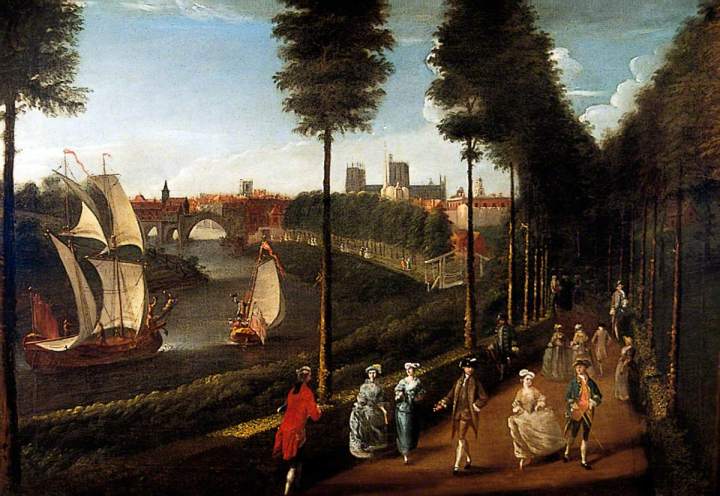
Nathan Drake, The New Terrace Walk, York, ca. 1756, oil on canvas, 76 × 107 cm
(York Art Gallery)
◊ ◊ ◊ ◊ ◊
From the York Georgian Society:
York and the Georgian City: Past, Present, and Future
King’s Manor, York, 18 May 2024
This conference aims to re-evaluate the notion of York as a Georgian city, one of the founding premises of the York Georgian Society in 1939. It will examine to what extent York can be described as a ‘Georgian’ city, and whether that label is relevant or meaningful in the present day. This is the first conference organised by the York Georgian Society in conjunction with the Centre for Eighteenth-Century Studies at the University of York. It will be held in the beautiful and historic King’s Manor just outside the city walls, historically the most important building in York after the Minster.
Keynote lectures will be given by Professor Rosemary Sweet of the University of Leicester and Madeleine Pelling, historian, writer, and broadcaster. Others speakers are from the Faculty of Arts and Humanities at the University of York: Professor Jon Mee, Dr Matt Jenkins, and PhD students Constance Halstead and Rachel Feldberg. The day ends with a round table to discuss issues raised on the day and a reception. Tickets cost £5 for students, £15 for members of the Society and University of York staff, and £25 for others. The price includes morning coffee, a light lunch, afternoon tea, and a reception.
p r o g r a m m e
10.15 Registration and coffee
10.50 Introduction — Charles Martindale (University of Bristol) and Jim Watt (University of York)
11.00 First Keynote
Chair: Charles Martindale
• Rosemary Sweet (University of Leicester) — When Did York Become Georgian?
12.00 First Panel: University of York Student Papers
Chair: Jon Mee
• Rachel Feldberg — Sense and Sociability: Jane Ewbank’s Critical Engagement with Georgian York
• Constance Halstead — Different Cities, Different Sensibilities: The Influence of Social Milieu on Anne Lister’s Discussion of Her Journal
12.50 Lunch
2.00 Second Keynote
Chair: Adam Bowett
• Madeleine Pelling (historian, writer, and broadcaster) — Writing on the Wall: Graffiti, Rebellion, and the Making of 18th-Century Britain
3.15 Second Panel
Chair: Jim Watt
• Matt Jenkins (University of York) — An Archetypal Georgian City?: Contradictions and Conformity in 18th-Century York
• Jon Mee (University of York) — Manchester College, York, 1803–40: An Outpost of Rational Dissent in an Anglican City
4.15 Tea
4.45 Roundtable
Chair: Charles Martindale
• Rosemary Sweet, Madeleine Pelling, Adam Bowett, and Peter Brown (formerly Director of Fairfax House)
5.30 Reception
Exhibition | The Doering Fashion Collection

Shoes, made in England or America, ca. 1800, leather, silk, and linen
(Mary Doering Fashion Collection)
◊ ◊ ◊ ◊ ◊
From the press release for the exhibition:
Elegance, Taste, and Style: The Mary D. Doering Fashion Collection
DeWitt Wallace Decorative Arts Museum, Colonial Williamsburg, opening 22 February 2024 (with three rotations)
More than 150 objects from one of the greatest private collections of early textiles, accessories, and historic dress assembled in the United States will go on view over the next several years at the DeWitt Wallace Decorative Arts Museum, one of the Art Museums of Colonial Williamsburg. Elegance, Taste, and Style: The Mary D. Doering Fashion Collection will take visitors through 50 years of this collector’s passion and feature gowns, jackets, waistcoats, shoes, textile documents, and more dating between 1700 and 1840. Due to light sensitivity, the objects will be shown in three parts. The first installment displays approximately 40 objects and is the inaugural exhibition to be shown in the Mary Turner Gilliland and Clinton R. Gilliland Gallery, the Art Museums’ first dedicated gallery to historic costume. The dates for the second and third rotation of objects on view are still to be determined.
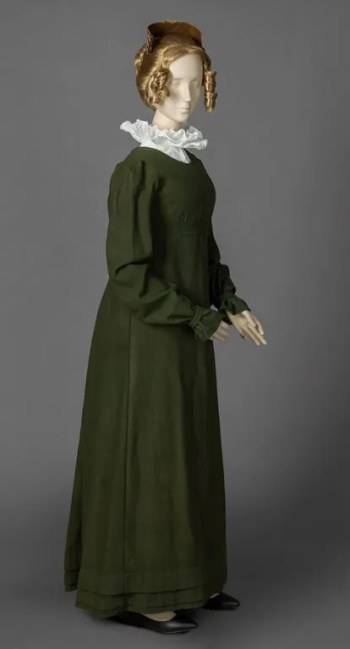
This green gown, made of wool, ca. 1815, is remarkable to have survived, because many woolen garments of the day were destroyed by moths and carpet beetles (Mary Doering Fashion Collection).
“Examples of historic dress are among the most human of artifacts from the past, providing windows into the lives and tastes of our forebearers,” said Ronald Hurst, the Foundation’s Carlisle H. Humelsine chief curator and senior vice president. “Mary Doering’s superb collection is particularly rich in such opportunities, and it is highly fitting that the Doering Collection constitutes the first exhibition in the new Gilliland Gallery for historic dress.”
When Mary D. Doering (b. 1952), a lifelong curator, educator, and researcher, was sixteen years old, she received a trunk filled with early 20th-century clothing as a bequest from her great aunt. This small gift was the impetus for what became a lifelong passion for historic dress. Throughout her career, Doering used her collection, which ultimately grew to thousands of pieces (there are approximately 800 pieces dating before 1840 alone), to educate hundreds of students and researchers about changing fashions, taste, design, and style. From the early collecting days when she went picking at local flea markets and antiques stores, to her first trip to the United Kingdom and her eventual meeting with the legendary antiques dealer Cora Ginsburg, who became Doering’s mentor, she thoughtfully and carefully selected every object in her collection. Over the nearly 50 years that she built the collection, Doering gained expertise to create a truly comprehensive assemblage ranging from underwear to the finishing accessories.
“It has been an absolute pleasure working with Mary’s collection, especially using objects so near and dear to her heart, to tell her lifelong story of collecting historic dress,” said Neal Hurst, Colonial Williamsburg’s curator of historic dress and textiles. “Every object that Mary acquired was carefully hand-selected based on her research and what she saw in other museums. Visitors to the new historic dress gallery will love seeing the range of clothing from the fine and fancy to the plain and every day.”

One highlight of the collection is a blue silk Englishman’s waistcoat, likely embroidered in the 1760s in China (Mary Doering Fashion Collection).
Among the highlights of Elegance, Taste, and Style is one of the first waistcoats Doering purchased of what was to become more than 100 examples dating between 1700 and 1840. This stunning blue silk waistcoat was probably embroidered in China in the 1760s for the Western market. Chinese embroidery is distinctive in that it uses twisted threads rather than single stranded floss. The object, the first of several Doering purchased at Christie’s in South Kensington, London, on 11 June 1974, was bought with money she saved to travel to Europe. Doering remembered the auctioneer saying, “Sold to the enthusiastic young woman on the aisle.”
Another featured object in the exhibition is an ivory, silk satin round gown in nearly perfect condition. Believed to be a wedding gown worn in the West Country of England, the style was popular in the mid-18th century; it integrates the petticoat into the structure of the skirt rather than it being a separate garment. Doering purchased this round gown along with two other gowns from Cora Ginsburg in honor of her mother who died in January 1978. Doering used the small sum of money her mother left to her to fund the gowns.
Although the Doering Collection is strong in American and English objects and focused heavily on women’s dress from the 18th and early 19th centuries, it also includes important pieces from Europe, such as the 1780s Dutch jacket that is another star piece in the exhibition. Jackets of this era, such as this one, were very low cut, even under the bust, with a large handkerchief worn over the top. Dutch women often dressed with many different prints and patterns, which varied greatly depending on the region. This example is unusual in that it uses two different block-printed cotton fabrics with black or dark blue backgrounds in the lower skirts and under the sleeves. It is important to note the careful use of textiles here with two different but very similar textiles used in obvious places; textiles were more expensive than the labor to construct the jacket, so this indicates a level of frugality.
The Doering Collection features numerous accessories, including shoes, buttons, work bags, hats, caps, and buckles. One example among the shoe collection is another highlight of Elegance, Taste, and Style. Although James B. Patterson’s identity is lost to history, he saw value in this pair of ivory, silk satin slippers with a small Italian-style heel popular in the 1780s. He affixed a paper label to the bottom that reads: “Shoes worn in 1782” along with his name. This pair shows very little wear on the soles and heels perhaps indicating that they were worn as wedding slippers.

Designed by Jean-Baptist Huet between 1800 and 1805, this piece of French-printed cotton includes amphora, Apollo’s lyre, and the mythical harpee enclosed within medallions (Mary Doering Fashion Collection).
Mary Doering also collected many textile documents to use in her class on design, manufacturing techniques, and the change in taste over time, which she taught at The Smithsonian Institution’s Master’s Program in the History of Decorative Arts in 2001. One such rare example to be seen in the exhibition is an early 19th-century cylinder print that shows the new style and taste desired across England and Europe. With the discovery of Pompeii and Herculaneum in the 1730s and Napoleon’s Egyptian Campaign at the turn of the century, ancient relics and symbols quickly became popular. Designed by Jean-Baptist Huet between 1800 and 1805, this print includes amphora, Apollo’s lyre and the mythical beast known as a Harpee, or half woman-half bird, enclosed within different medallions. The print, known as a furniture, was primarily used for bed hangings, window curtains, and slip covers. It is especially rare in that the designer, the printer, the date, and the place of production are all known.
Also included in the exhibition is a larger-than-life video panel that will be sure to delight visitors and highlight a practice we share with our 18th-century ancestors. It will show people of all races and classes, from Native Americans to soldiers, enslaved Africans to members of the top echelons of colonial society, tradesmen, and women, getting dressed.
In celebration of Elegance, Taste, and Style, a symposium on historic dress, Collections, Collectors, and Collaborations, will be held at The Colonial Williamsburg Foundation, 14–16 November 2024. The symposium will not only celebrate the opening of the Mary Turner Gilliland and Clinton R. Gilliland Gallery at the Art Museums of Colonial Williamsburg but also 90 years of historical dress and costumed interpretation at Colonial Williamsburg (since 1934), 70 years of the Margaret Hunter Shop, which was the first curated exhibition of clothing and accessories at Colonial Williamsburg (in 1954), and 40 years of mantua making in the Colonial Williamsburg’s department of historic trades (begun in 1984). Registration for the conference will launch later this spring.
Elegance, Taste, and Style: The Mary D. Doering Fashion Collection is generously funded by the Thomas L. and Nancy S. Baker Museum Exhibitions Support Fund. The exhibition’s video component, men’s accessories, and other essential aspects of the exhibition are funded by Charles and Ellan Spring.
Conference | Environmental Impacts of Catholic Missions, Atlantic
From ArtHist.net:
The Environmental Impacts of Early Modern Catholic Missions in the Atlantic Space
Online and in-person, Institut National d’Histoire de l’Art, 9 March 2024
This is one in a series of workshops aimed at exploring the role of the Catholic Church, through its missionary undertaken, in the global environmental upheavals and discoveries of the early modern period. Venturing wide and far beyond the familiar European sphere, early modern missionaries frequently used the rhetoric of Theatrum Mundi to reflect on their encounters with previously unknown cultures. What has escaped scholars’ attention, however, is how these rapidly evolving dramas of evangelization in turn shaped the seemingly timeless backstage setting of Nature. As the missionaries voyaged away and established new religious communities, they were not only faced with social and cultural challenges raised by the vastly different linguistic, political, and philosophical traditions, but they also had to adapt to unfamiliar geographical, climate, and material conditions as they sought to construct churches or realize liturgical rituals, not to mention the extensive agricultural and medical activities they had to pick up for personal survival in often severe natural conditions.
One overarching method we want to propose is to think about early modern Catholicism in the plural term, as theorized by Simon Ditchfield. Studies on post-Tridentine missions tended to emphasize the central authoritative role of Rome, focusing especially on the role of the missionary as leader in the creating of new religiosity, new economical exchanges, or new societies. The new attention paid to missionaries’ interactions with local natural conditions will complicate our understanding of Rome as one of the few truly global institutions of the early modern period acting not only as a religious and evangelist force but also in the colonialist expansions.
p r o g r a m m e
13.30 Introduction — Silvia Mostaccio (Université Catholique de Louvain)
13.45 Yasmina Rocio Ben Yessef Garfia (Università di Napoli Federico II) — La natura contro gli indigeni: religiosi e racconti della catastrofe nel viceregno del Perù (s. XVII–XVIII)
14.30 Nils Renard (Université Paris 1 Panthéon-Sorbonne) — The Catholic Church and the Liberty Trees during the French Revolution: An Environmental Syncretism between France and the New World
15.15 Break
15.45 Thomas Brignon (Université Paris 3 Sorbonne Nouvelle) — A Predatory Arcadia: Revisiting Animal Husbandry, Hunting, Fishing, and Gathering in the Jesuit-Guaraní Missions (Paraguay, 17–18th Centuries)
16.30 Andréanne Martel (Université du Québec à Montréal, Université de Genève) — Nommer la faune, la flore et le territoire « en Canada » : écriture, oralité et savoirs autochtones dans les cartes du missionnaire jésuite Pierre-Michel Laure (1688–1738)
17.15 Break
17.30 Isabel Harvey (Université du Québec à Montréal, UCLouvain) — L’environnement comme protagoniste historique
18.00 Final Discussion
Organizing Commitee
• Isabel Harvey, Université du Québec à Montréal
• Alysée Le Druillenec, Université Paris 1 Panthéon-Sorbonne
• Wenjie Su, Princeton University
Online Symposium | New Work on Old Dance
The conference program includes a handful of intriguing 18th-century talks:
New Work on Old Dance: A Pre-1800 Dance Studies Symposium
Online, 22–24 February 2024
It is with great pleasure that we share the program for New Work on Old Dance, an international early dance symposium jointly sponsored by Dance Studies Association and the University of Pennsylvania, to be held via Zoom 22–24 February 2024. Organized by the Early Dance Working Group of DSA, the symposium will feature a tremendous diversity of dance scholarship and practitioner workshops over the course of three days. Registration is free. Please address any questions to Amanda Danielle Moehlenpah (amanda.moehlenpah@slu.edu), Emily Winerock (contact@winerock.com), or Mary Channen (Caldwell maryca@sas.upenn.edu). We hope to see many of you on Zoom soon!
Conference | Traveling Objects: Material Cultures of the Atlantic Routes
Hosted by the INHA, as noted at ArtHist.net:
Travelling Objects: The Material Culture of the Atlantic Routes — Encounters of Cultures and Things
Institut national d’histoire de l’art, Paris, 21 February 2024
Organized by Maddalena Bellavitis and José Manuel Santos Pérez
9.30 Welcome and Opening
Maddalena Bellavitis (EPHE) and José Manuel Santos Pérez (Centro de Estudios Brasileños, Universidad de Salamanca)
9.45 Morning Session
1 Alicia Sempere Marín and Ignacio José García Zapata (Universidad de Murcia), Jesuits’ Travel Journal from New Spain to Europe: Routes, Stops, and Acquisitions of Devotional Objects in 1757
2 Genevieve Warwick (University of Edinburgh), Jewelled Currency: Glass Conterie in the First Age of Circumnavigation
3 Charikleia (Haris) Makedonopoulou (NTU Athens / ETH Zurich), Tracing the Multiple Journeys of the Palm Tree between the East and the West
4 Rebecca Legrand, Fanny Bulté (Université de Lille), The Taste of Others: Between Fear and Fascination
5 Patrícia Gomes da Silveira (Colégio Pedro II/Universidade do Estado do Rio de Janeiro), William John Burchell and the Representation of Brazilian Landscape in His Expedition, online
13.30 Lunch Break
14.30 Afternoon Session
6 Carmen Espejo-Cala (Universidad de Sevilla) and Paul Firbas (Stony Brook University, New York), Conexiones entre las imprentas de lima y Sevilla (siglos XVI y XVII): agentes y actores-red
7 Eduardo Corona Pérez (Universidad de Sevilla), En los albores de la fundación y de la fiebre del oro: los hombres y mujeres que hicieron Vila Rica de Ouro Preto
8 Lauren Beck (Mount Allison University), Viewing Spain from the Americas: Indigenous Perspectives, Experiences, and Sources
9 Britt Dams (Ghent University / Université Paul Valéry), « I am a better Christian than you are », The Remarkable Epistolary Exchange between Two Potiguara Leaders, Pedro Poti and Felipe Camarão
10 Eduardo Cesar Valuche Oliveira Brito (Universidade Federal Fluminense, UFF-Brasil), As ‘Missões de Marinheiros’ no Atlântico anglo-americano: a cultura material protestante na virada dos séculos XVIII e XIX
11 Ana-Marianela Rochas-Porraz (ÉNSA Versailles), Images d’expatriation de la France au Mexique: le fonds photographique de l’architecte Fernand Marcon (1877–1962)
17.30 Discussion and Conclusions
The description of the project from the Call for Papers is available here»
Contact Information
Maddalena Bellavitis
Laboratoire Saprat
École pratique des hautes études
Campus Condorcet – Bâtiment Recherche Nord
14, Cours des Humanités
93322 Aubervilliers Cedex
France
maddalena.bellavitis@gmail.com
Conference | Eco Edo: Ecological Perspectives
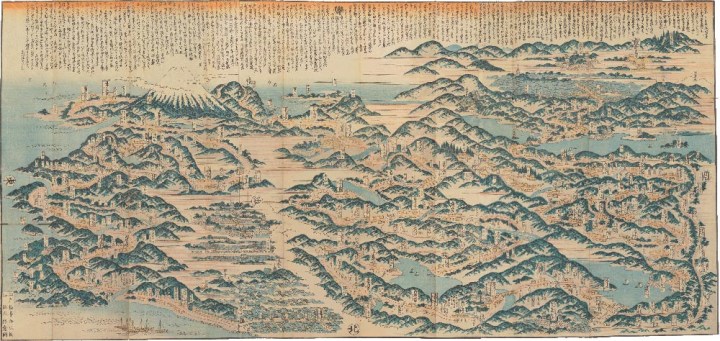
Panoramic Map of the Tōkaidō Highway, Shōtei Kinsui, drawn by Kuwagata (better known as Keisai). Published by Sanoya Ichigorō, Izumiya Hanbei, and Izumoji Manjirō, n.d. (likely 1810). Polychrome xylography, 52 x 24 inches (Los Angeles: Richard C. Rudolph Collection of Japanese Maps, Special Collections, UCLA Library).
◊ ◊ ◊ ◊ ◊
As noted yesterday at ArtHist.net:
Eco Edo: Ecological Perspectives on Early Modern Japanese Art
William Andrews Clark Memorial Library, UCLA, Los Angeles, 2 February 2024
Organized by Kristopher Kersey
On 2 February 2024, the William Andrews Clark Memorial Library at UCLA will host the conference Eco Edo: Ecological Perspectives on Early Modern Japanese Art. This is the second of three conferences at UCLA this year on the theme of early modern Japanese art.
The art of Japan’s Edo period (1603–1868) presents a paradox. On the one hand, the nineteenth-century proliferation of ukiyo-e—polychrome woodblock prints of the ‘floating words’ of theater and sex work—made the popular visual culture of this city a familiar component of modern art in the nineteenth and twentieth centuries. Yet the outsize fascination with ukiyo-e outside Japan has sorely obscured Edo’s far more diverse social, material, and artistic landscapes. In an effort to countervail the enduring stereotypes of early modern Japanese art, Open Edo will present a suite of conferences addressing three interlinked themes: the representation and agency of marginalized groups, the ecological horizons of artistic production, and the ongoing need to counter the myth that Japan in early modernity was somehow disconnected from the rest of the world. Throughout the year-long series, the focus will be both historical and historiographical inasmuch as Open Edo asks how Japanese art history might challenge the discourse of early modernity writ large.
If interested in attending, please register, as space is limited in the Clark Library (also, note that the Clark is housed in a villa in West Adams, about 8 miles east of the main UCLA campus in Westwood). The conference is free and open to the public. Parking is free, and lunch is provided. To register, follow this link. There is no livestream or recording, but an edited volume should follow. Should you have any questions, please email kersey@humnet.ucla.edu.
p r o g r a m
9.30 Coffee and registration
10.00 Director’s welcome by Bronwen Wilson (UCLA), with opening remarks by Kristopher Kersey (UCLA)
10.15 Panel 1
Moderator: Kristopher Kersey (UCLA)
• Greg Levine (University of California, Berkeley), ‘Close Looking,’ but at What? Hasegawa Tōhaku’s Pine Grove and ‘Attentional Deviance’
• Rachel Saunders (Harvard Art Museums), The Birds, Flowers, and Botany of Edo Rinpa
11.45 Lunch, with a display of Clark Library materials in the North Book Room
1.00 Panel 2
Moderator: William Marotti (UCLA)
• Chelsea Foxwell (University of Chicago), What Are Bugs Doing in Edo-Period Paintings?
• Kit Brooks (National Museum of Asian Art, Smithsonian Institution), Morphing into Madness: Shifting Perceptions of the Japanese Wolf
2.30 Coffee break
3.00 Panel 3
Moderator: Kendall Brown (California State University Long Beach)
• Christian Tagsold (Heinrich Heine University Düsseldorf), The Thousand Gardens of Edo: Exploring the Nature of the Cultivated Environment
• Nobuko Toyosawa (Oriental Institute of the Czech Academy of Sciences), The Place of Ecology in Matsudaira Sadanobu’s Gardens
4.40 Plenary discussion with all speakers
5.30 Reception










 Enfilade
leave a comment