Symposium | Portraiture in 18th-Century Europe
From the DFK:
Portraiture in 18th-Century Europe: Artwork—Social Practice—Circulation
Le portrait au XVIIIe siècle en Europe: Œuvre d’art—pratique sociale—objet de transfert
Deutsches Forum für Kunstgeschichte, Paris, 11–12 March 2024
Organized by Markus Castor, Martin Schieder, and Marlen Schneider

Alexandre Roslin, Self-Portrait with the Artist’s Wife Marie-Suzanne Giroust Painting a Portrait of Henrik Wilhelm Peill, detail, 1767, oil on canvas, 131 × 99 cm (Stockholm, Nationalmuseum, NM 7141).
Whether a manifestation of political power, expression of intimate feelings, an embellishing masquerade, or a faithful likeness, the art of portraiture in the Age of Enlightenment was marked by exceptional diversity throughout Europe. Between the apogee of absolutism and the political, social, and intellectual upheavals of the revolutionary era, it became a mirror of a society in full mutation. The differentiation of taste, changes in the art market, and the gradual establishment of public exhibitions were decisive factors contributing to the variety of effigies. Finally, the criticism of portraiture that flourished at the same time as this artistic genre, wrongly considered as ‘minor’, testified to the growing tension between its social functions and its claim to be a work of art in its own right.
The aim of the symposium is to study portraiture from a multifaceted perspective, tracing its social, theoretical, artistic, and material conditions. Focusing on its development during the Enlightenment in the French context, we also wish to open the discussions up to a European perspective. What concepts and themes shaped the debates surrounding portraits? How did the usages and functions of portraits evolve, and what were the consequences for the production and materiality of these objects? By what means and networks did portrait modes circulate in the various European artistic centers? We intend to shed light on these different aspects in their interdependence, in order to better understand the complex success story of portraiture in the 18th century.
Concept and Organization
Markus A. Castor (DFK Paris), Martin Schieder (Universität Leipzig), and Marlen Schneider (Université Grenoble Alpes/LARHRA)
◊ ◊ ◊ ◊ ◊
m o n d a y , 1 1 m a r c h 2 0 2 4
Speakers are assigned 45-minute slots; specific times, along with breaks, are available here»
14.30 Opening remarks by Peter Geimer (Director of the DFK Paris) and introduction by Markus Castor, Martin Schieder, and Marlen Schneider
15.00 I | Social Practices
Moderation: Martin Schieder
• Elise Urbain Ruano (Musée royal de Mariemont), Portraits transgressifs et modes négligées
• Gerrit Walczak (Zentralinstitut für Kunstgeschichte, München), Silk, Lace, and Deception: The Rococo Dummy Board Princesses of Georg David Matthieu
• Lara Pitteloud (Université de Neuchâtel), S’entourer de portraits « regardés comme uniques » : le cas parisien du Comte de Baudouin
• Philippe Bordes (Université Lumière Lyon 2 / LARHRA), Le piège de la célébrité sous la Révolution: les portraits de députés par Adélaïde Labille-Guiard et Jean Louis Laneuville
18.30 Conférence du soir
• Melissa Hyde (University of Florida), Gifted: Women, Portraiture, and the Art of Friendship
Drinks reception
t u e s d a y , 1 2 m a r c h 2 0 2 4
9.30 II | Circulations and Transfer
Moderation: Markus Castor
• Hannah Williams (Queen Mary University of London), Linked Lives: Portraits as Traces of Colonial Networks in Paris’s 18th-Century Art World
• Ulrike Kern (Goethe-Universität, Frankfurt am Main), License to Portrait: Annexation of a Genre in Early 18th-Century British Art Theory
• Marlen Schneider (Université Grenoble Alpes / LARHRA), Portraits à la française? Appropriations et détournements du portrait déguisé entre Paris et Berlin
• Agata Dworzak (Jagiellonian University, Cracovie), Representation and Creation: The Tradition of Portraiture of Church Hierarchs in Central and Eastern Europe in the Second Half of the 18th Century: A Case Study of the Polish-Lithuanian Commonwealth
12.45 Lunch break
14.00 III | Theories and Techniques
Moderation: Marlen Schneider
• Marianne Koos (Universität Wien), Resemblance as a Passing Quality: Liotard, La Tour, and the Question of le faire in 18th-Century Portraiture
• Juliette Souperbie (Université Toulouse II Jean Jaurès), L’artiste à l’œuvre: Une mise en abyme du portrait au XVIIIe siècle
• Andreas Plackinger (Albert-Ludwigs-Universität Freiburg), Zwischen Konventionsbruch, Kunsttheorie und Sociabilité: Plastische Bildhauerselbstporträts im Frankreich des späten Ancien Régime
• Jan Mende (Stadtmuseum Berlin), Die Porträtbüste geht in Serie: Neue Technologien und preiswerte Werkstoffe um 1790
• Amy Freund (Southern Methodist University), Who/What is a Self? Animal Portraiture in 18th-Century France
18.15 Conclusion and perspectives
Conference | Visualizing Antiquity, Part II
From ArtHist.net:
Visualizing Antiquity: On the Episteme of Early Modern Drawings and Prints — Part II: Find and Display / Fragment and Whole
Bildwerdung der Antike: Zur Episteme von Zeichnungen und Druckgrafiken der Frühen Neuzeit — II. Fund und Aufstellung / Fragment und Ganzes
Online and in-person, Zentralinstitut für Kunstgeschichte Munich, 31 January 2024
Organized by Ulrich Pfisterer, Cristina Ruggero, and Timo Strauch
The academy project Antiquitatum Thesaurus: Antiquities in European Visual Sources from the Seventeenth and Eighteenth Centuries, hosted at the Berlin-Brandenburg Academy of Sciences and Humanities (thesaurus.bbaw.de), and the Zentralinstitut für Kunstgeschichte Munich (zikg.eu) are organizing a series of colloquia in 2023–2025 on the topic Visualizing Antiquity: On the Episteme of Drawings and Prints in the Early Modern Period. The significance of drawings and prints for ideas, research, and the circulation of knowledge about ancient artifacts, architecture, and images in Europe and neighboring areas from the late Middle Ages to the advent of photography in the mid-19th century will be examined. The second colloquium will explore how the various states and contexts of ancient objects, in the broadest sense, between their discovery and their ‘final’ display, were captured and documented in images. Later study days will focus on Collectors, Artists, Scholars: Knowledge and Will in Collection Catalogs and Fake News? Fantasy Antiquities. Participation in the event is free of charge, and the talks will also be broadcast via Zoom (Meeting-ID: 856 5934 5839 | Password: 148258).
p r o g r a m
11.00 Begrüßung & Einführung
11.15 Dokumentation
Moderation: Arnold Nesselrath (Rom)
• Francesco Benelli (Alma Mater Studiorum – Università di Bologna), ‘Che no sia tondo e che abia dello aovato’: Uffizi U1132A, a stratification of meanings and strategies within the Sangallo’s workshop
• Barbara Sielhorst (Ruhr-Universität Bochum), Pars pro toto. Zur visuellen Dokumentation des Palatins in Rom vom Beginn des 18. bis zur Mitte des 19. Jahrhunderts
• Alessia Zambon (UVSQ-University Paris-Saclay), Thomas Burgon’s Excavations in Athens in 1813: Fieldwork and Finds’ Recording
13.00 Mittagspause
14.00 Restaurierung – Rekonstruktion
Moderation: Elena Vaiani (ZIKG München)
• Elena Efimova (Lomonossow-Universität Moskau), Dessins des détails d’ordres: entre un livre de modèles et une collection antiquaire
• Lena Demary (Ruhr-Universität Bochum), Transparenz und Verschleierung – Ambivalenzen früher restauratorischer Dokumentationen in Katalogen antiker Bildwerke
• Annie Maloney (Oberlin College), Reconstructing the Fragments of Pietro Santi Bartoli’s Reproductive Corpus
• Koenraad Vos (University of Cambridge), Restorations of Ancient Sculpture as Epistemic Images: Filippo Aurelio Visconti on the Benefits of Intervention
16.20 Kurze Pause
16.30 Aufstelling
Moderation: Henri de Riedmatten (Université de Genève)
• Anna Degler (Freie Universität Berlin), Auf unsicherem Grund. Der sog. Torso Belvedere und die Körperdiskurse in der ersten Hälfte des 16. Jahrhunderts
• Daniela Picchi (Museo Civico Archeologico di Bologna), Giovanni Nardi and Ancient Egypt at the Medici Court
• Sophie Kleveman (Georg-August-Universität Göttingen), Kommissarisches Antikenwissen und die Regulation des Antikenmarktes im 17. Jahrhundert
• Henri de Riedmatten (Université de Genève), Zusammenfassung und Leitung Abschlussdiskussion
The Decorative Arts Trust’s Emerging Scholars Colloquium, 2024
The Decorative Arts Trust’s Emerging Scholars Colloquium takes place this Sunday, on the heels of the group’s Antiques Weekend, an annual foray into New York’s Americana Week:
The Decorative Arts Trust’s Emerging Scholars Colloquium
Park Avenue Armory, New York, 21 January 2024
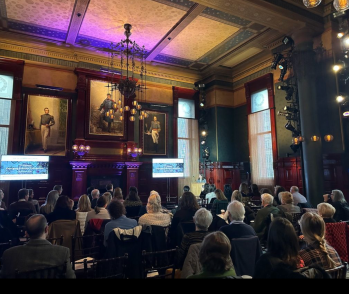
Photo from the 2023 Emerging Scholars Colloquium in the Park Avenue Armory’s Board of Officers Room (via the Instagram account of The Decorative Arts Trust).
The Decorative Arts Trust is excited to host its 8th Annual Colloquium featuring young scholars in the decorative arts field. The registration fee for the colloquium is $25; Decorative Arts Trust membership is not required to attend. The event is generously sponsored by Classical American Homes Preservation Trust and Mr. & Mrs. Donald B. Ayres III. Registration is available here.
p r o g r a m m e
9.00 Coffee and bagels
9.30 Welcome by Benjamin Prosky, President, Classical American Homes Preservation Trust
Introductions by Catherine Carlisle, Manager of Educational Programs, Decorative Arts Trust
• Follow the Hearth: Retracing the Spatial History of Edgewater’s Dining Room Mantelpiece — Lauren Drapala (PhD candidate, Bard Graduate Center, and William L. Thompson Collections Fellow, Classical American Homes Preservation Trust)
• An Artifact of Afro-America: A Blanket Chest by Brooks Thompson — Neil Grasty (Undergraduate Student, Morehouse College, and Curatorial Intern, High Museum of Art)
• Loud and Clear: Glass and Obscured Narratives at the New Orleans Museum of Art — Laura Ochoa Rincon (Decorative Arts Trust Curatorial Fellow, New Orleans Museum of Art)
• Does Architecture Move? The Mahadol Palanquin of 18th-Century Gujarat and Marwar — Krishna Shekhawat (PhD Student, University of California, Berkeley)
• ‘Dressing Up’ Egypt: Performing Race and Late 19th-Century Egyptomania — Lea Stephenson (PhD Candidate, University of Delaware)
11.30 Concluding remarks by Matthew Thurlow, Executive Director, Decorative Arts Trust
Battle of New Orleans Historical Symposium, 2024
From Nunez Community College, with registration available at Eventbrite:
The 9th Annual Battle of New Orleans Historical Symposium
Nunez Community College, Chalmette (New Orleans), 5–6 January 2024
The 9th Annual Battle of New Orleans Historical Symposium will take place January 5th and 6th in Chalmette, Louisiana, at Nunez Community College (on Friday) and at the St. Bernard Council Chambers (on Saturday).
f r i d a y , 5 j a n u a r y
9.00 Coffee
9.30 Welcome and Opening Remarks — Tina Tinney
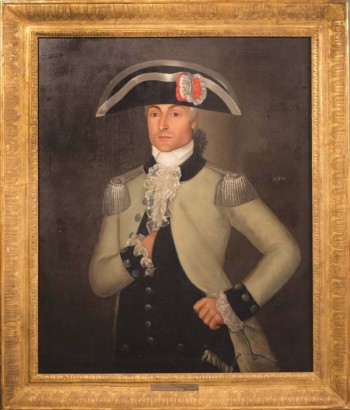
Attributed to José Francisco Xavier de Salazar y Mendoza, Portrait of Captain Joseph Bernard Vallière d’Hauterive, ca. 1791–95, oil on canvas (Little Rock: Historic Arkansas Museum). Vallière d’Hauterive was the Grenoble-born commandant of the Arkansas Post from 1787 to 1790; this portrait was likely painted upon his return to New Orleans.
9.45 Morning Talks
• Overview of Battle of New Orleans — William Hyland
• ‘Nothing Pleases Them So Much as the Uniform’: Martial Culture and Military Life in Early Louisiana — Philippe Halbert
• The Past as Prelude: The Impact of Spain and the Galvez Expedition on the American Victory in the Battle of New Orleans — Bradford Waters
12.15 Lunch
1.30 Afternoon Talks
• ‘Pirate City’: Tracing Property Records of Selected Members of Jean Laffite’s Baratarian Pirate Syndicate who Played Prominent Roles in the War Effort of the Winter of 1814–15 — Ina Fandrich
• What if New Orleans had been Taken by the British in 1815? — Harold Youmans
4.00 Wine and Cheese Reception
s a t u r d a y , 6 j a n u a r y
10.00 Welcome — Katherine Lemoine
10.05 Morning Talks
• A Reminiscence of the Battle of New Orleans by Bernard de Marigny — William Hyland
• Native American Influence in the Battle of New Orleans: Houma Indians in Louisiana — Colleen Billiot
• Scottish Heraldry: A Window into a Culture — Christen Raby Elliot
12.45 Closing Remarks — William Hyland
The Furniture History Society’s Early Career Symposium

◊ ◊ ◊ ◊ ◊
From The Furniture History Society, with registration at Eventbrite:
The Furniture History Society Early Career Research Symposium
The Metropolitan Museum of Art, New York, 24 January 2024
The Furniture History Society is delighted to hold its seventh Early Career Research Symposium at The Metropolitan Museum of Art in New York on Wednesday, 24th January. The symposium is part of our Early Career Development (ECD) programme and presents current research by emerging scholars in the fields of furniture history, the decorative arts, and historic interiors. The wide range of papers reflects the variety of interests among young scholars with speakers from Britain, the Czech Republic, France, Italy, and the United States. We welcome curators, dealers, academics, members of the Furniture History Society, and anyone interested in the decorative arts and the history of interiors to join us for this symposium to enjoy the fascinating medley of topics, ranging from the 1650s to the 1950s. The event is free, but it is necessary to register here on Eventbrite by midnight Sunday, 21st January to secure a place. This event is neither being recorded nor livestreamed.
The day is made possible thanks to the generous support of the Oliver Ford Trust.
p r o g r a m m e
9.30 Welcome
9.45 Morning Session A
• Cynthia Kok (Rijksmuseum, Amsterdam) Ebonyworkers in 17th-Century Amsterdam
• Bridget Griffin (The Attingham Trust, London), Crafting Connections: Mapping the Lives and Trade Networks of British and Irish Immigrant Furniture Makers in North-Eastern Port Cities of Early America
• Grace Ford-Dirks (Philadelphia Museum of Art), Exploring the Lives and Meanings of an 18th-Century Caribbean Armoire
11.15 Break
11.45 Morning Session B
• Noah Dubay (Bard Graduate Center, New York), Comfort, Convenience, and Convalescence: How the Fauteuil de Malade Changed 18th-Century France
• Geoffrey Ripart (Bard Graduate Center, New York), The Road from Rome to Paris: Sourcing Rare Marbles at the End of the Ancien Regime and the Rise of French Taste for Objets d’Art Made from Stone, 1760–1810
12.45 Lunch Break
1.45 Afternoon Session A
• Romana Mastrella (University of La Sapienza, Rome), Collecting Fireplaces
• Justine Gain (École de Louvre, Paris), When the Furniture Matches the Architecture: The Birth of French Eclecticism through the Oeuvre of Jean-Baptiste Plantar (1790–1879)
• Laura Jenkins (Courtauld Institute of Art, London) From Galerie to Ballroom: Gilbert Cuel at 1 West 57th Street
3.15 Break
3.45 Afternoon Session B
• Karolina Kourilova (Masaryk University, Brno), Design behind the Iron Curtain: Furniture Industry Development in Post-War Czechoslovakia
• Melania Andronic (University of La Sapienza, Rome), Rational Furniture: A Chair Is Made for Sitting
4.45 Closing Remarks
◊ ◊ ◊ ◊ ◊
Images: Detail of a fireplace, 1785, by Luigi Valadier in the Sala della Flora on the first floor of the Villa Borghese in Rome. Detail of a cabinet attributed to Herman Doomer, Amsterdam ca. 1640–50 (New York: The Met). Detail of a drawing by Jean-Baptiste Plantar in the Album d’une centaine de dessins d’architecture, Paris, ca. 1855 (held online by the Institut national d’histoire de l’art). Detail of the Galerie dorée at the Hôtel de Toulouse (now Banque de France), decorated by Robert de Cotte and Francois-Antoine Vasse, 1713–17 (photo by Guilhem Vellut).
Exhibition | Unnamed Figures: Black Presence and Absence
 Rufus Hathaway, A View of Mr. Joshua Winsor’s House &c., Duxbury, Massachusetts, ca. 1793–95, oil on canvas (New York: American Folk Art Museum, gift of Ralph Esmerian, 2013.1.19). From the museum’s Instagram account, “This iconic folk painting has typically been interpreted as its eighteenth-century patron, Joshua Winsor, would have expected: as a chronicle of his wealth and property as a merchant and shipbuilder in Duxbury, Massachusetts. Usually unremarked upon is the figure of a Black woman in the lower left-hand corner of the scene. With her back to the viewer, the woman is faceless, evoking the limited details known about early African American lives. Census records provide small clues. Was she the one free person of color recorded in the Winsor household in 1790, a few years before this painting was made? Likely attending to many aspects of the Winsors’ domestic lives, this enigmatic figure was one of the many unnamed Black residents of New England whose underrecognized labor paved the way for their employers’ or enslavers’ prosperity.”
◊ ◊ ◊ ◊ ◊
Karen Rosenberg’s review of the exhibition recently appeared in The New York Times (21 December 2023) . . . .
Unnamed Figures: Black Presence and Absence in the Early American North
American Folk Art Museum, New York, 15 November 2023 — 24 March 2024
Flynt Center of Early New England Life, Deerfield, Massachusetts, 1 May — 4 August 2024
Curated by Emelie Gevalt, RL Watson, and Sadé Ayorinde
Unnamed Figures: Black Presence and Absence in the Early American North is on view at the American Folk Art Museum until 24 March 2024. As a corrective to histories that define slavery and anti-Black racism as a largely Southern issue, this exhibition offers a new window onto Black representation in a region that is often overlooked in narratives of early African American history.
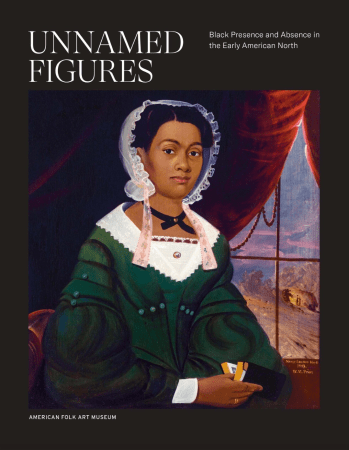 Through 125 remarkable works including paintings, needlework, and photographs, this exhibition invites visitors to focus on figures who appear in—or are omitted from—early American images and will challenge conventional narratives that have minimized early Black histories in the North, revealing the complexities and contradictions of the region’s history between the late 1600s and early 1800s. A 300-page scholarly book with contributions from Gwendolyn DuBois Shaw, Jennifer Van Horn, and several other authors, is available for purchase.
The exhibition is co-curated by Emelie Gevalt, Curatorial Chair for Collections and Curator of Folk Art, AFAM; RL Watson, Assistant Professor of English and African American Studies, Lake Forest College; and Sadé Ayorinde, Terra Foundation Predoctoral Fellow in American Art at the Smithsonian American Art Museum. A free digital guide on Bloomberg Connects is available here.
Please be advised that this exhibition contains complex, challenging, and racist imagery.
Unnamed Figures: Black Presence and Absence in the Early American North (New York: American Folk Art Museum, 2023), 300 pages, $75.
Catalogue contributors are scholars and researchers with expertise in American art history, material culture, African American history and literature, and other related topics. The book includes a foreword by Gwendolyn DuBois Shaw and Jason Busch. Contributors include the exhibition’s curators as well as Virginia Anderson, Kelli Racine Barnes, Michael Bramwell, Christy Clark-Pujara, Anne Strachan Cross, Jill Vaum Rothschild, Jonathan Michael Square, Lea Stephenson, Jennifer Van Horn, and Gordon Wilkins.
r e l a t e d p r o g r a m m i n g
7 December 2023
Virtual Insights: Reasserting Black Presence in the Early American North
11 January 2024
BlackMass Responds to Unnamed Figures: Tour with Yusuf Hassan and Kwamé Sorrell
14 February 2024
Notes on Style: A Discussion with BlackMass on Portraiture and Personhood
23 February and 28 March 2024
‘The Picture Is Still Out There’: Reframing Black Presence in the Collections of Early American Art and Material Culture | 2024 Elizabeth and Irwin Warren Folk Art Symposium
18 March 2024
Autobiographical Landscapes: Gary Tyler in Conversation with Allison Glenn
◊ ◊ ◊ ◊ ◊
Note (added 4 January 2024) — The posting was updated to include Historic Deerfield as a venue.
Online Symposium | Reframing Black Presence
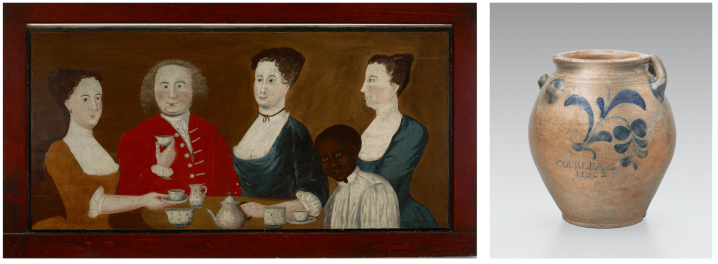
Left: unidentified painter, John Potter and Family, Matunuck, Rhode Island, ca. 1740, oil on wood, 31 × 64 inches (Newport Historical Society). Right: Thomas W. Commeraw, Two-Gallon Jar, New York City, ca. 1793–1819, salt-glazed stoneware with cobalt decoration, 9 inches high (Private Collection).
◊ ◊ ◊ ◊ ◊
From the American Folk Art Museum in New York:
‘The Picture Is Still Out There’: Reframing Black Presence in the Collections of Early American Art and Material Culture
Elizabeth and Irwin Warren Folk Art Symposium
Online, 23 February 2024 and 8 March 2024
“ … Even if I die, the picture of what I did, or knew, or saw, is still out there,” says one of Toni Morrison’s characters in her masterpiece Beloved. Reflecting on this process of Black ‘re-memory’, the symposium ‘The Picture Is Still Out There’: Reframing Black Presence in the Collections of Early American Art and Material Culture presents curatorial practices and scholarship that affirm African American presence in early American art and material culture. This two-day online symposium is organized in connection with the exhibition Unnamed Figures: Black Presence and Absence in the Early American North, on view at the American Folk Art Museum, from 15 November 2023 until 24 March 2024. Drawing inspiration from the research behind this exhibition, the symposium serves as a platform for a broader consideration of museum practices in relation to folk art, early American history, and issues of anti-Black racism.
Art scholars, museum curators, and public historians—including exhibition co-curators Emelie Gevalt, RL Watson and Sadé Ayorinde as well as Janine Boldt, Alexandra Chan, Anne Strachan Cross, Gwendolyn DuBois Shaw, Michael Hartman, Elizabeth S. Humphrey, Tiffany Momon, Marc Howard Ross, Jennifer Van Horn and Jill Vaum Rothschild—are invited to gather, share, and discuss their efforts in celebrating and reframing the early contributions of African American individuals to the field of art. Talks will consider early material culture from global and historically marginalized perspectives, acknowledging gaps in history, knowledge, and care. This virtual symposium will also present new methods of preserving, acquiring, and exhibiting that address colonialist and racist ideologies while rethinking accountability, transparency, and language choices in interpretation. This will be a unique opportunity to approach the colonial past and its continuities in museums and public institutions.
Learn more about our speakers by clicking here. A detailed schedule with speaker abstracts will be released in January. For questions, please email publicprograms@folkartmuseum.org.
f r i d a y , 2 3 f e b r u a r y
11.00 Introductory Conversation
• Jennifer Van Horn, Associate Professor of Art History and History, University of Delaware
• Gwendolyn DuBois Shaw, Class of 1940 Bicentennial Term, Associate Professor of History of Art, University of Pennsylvania
1.30 Session 1
Moderator: Anne Strachan Cross, Assistant Teaching Professor of American Art, Pennsylvania State University
• Elizabeth S. Humphrey, former Curatorial Assistant and Manager of Student Programs, Bowdoin College Museum of Art; PhD Candidate at the University of Delaware
• Michael Hartman, Jonathan Little Cohen Associate Curator of American Art Hood Museum of Art, Dartmouth College
• Janine Yorimoto Boldt, Associate Curator of American Art at The Chazen Museum of Art
Register here»
f r i d a y , 8 m a r c h
11.00 Session 2
Moderator: Jill Vaum Rothschild, Luce Foundation Curatorial Fellow, Smithsonian American Art Museum
• Alexandra Chan, archaeologist, member of the academic advisory board of the Royall House and Slave Quarters, a National Historic Landmark and museum in Medford, Massachusetts, and author of Slavery in the Age of Reason: Archaeology at a New England Farm (2015)
• Marc Howard Ross, William Rand Kenan, Jr., Emeritus Professor of Political Science at Bryn Mawr College, and author of Slavery in the North: Forgetting History and Recovering Memory (2018), which begins with a study of the President’s House/Slavery Memorial at Independence National Historical Park in Philadelphia
• Tiffany Momon, Assistant Professor of History and Mellon Fellow at Sewanee, University of the South, founder and co-Director of Black Craftsmanship Digital Archive
1.30 Closing Conversation
• Emelie Gevalt, Curatorial Chair for Collections and Curator of Folk Art, AFAM
• RL Watson, Assistant Professor of English and African American Studies, Lake Forest College
• Sadé Ayorinde, Terra Foundation Predoctoral Fellow in American Art at the Smithsonian American Art Museum
Register here»
Conference | 76th Annual Williamsburg Antiques Forum
From Colonial Williamsburg:
76th Annual Antiques Forum: Domestic Affairs
Online and in-person, Colonial Williamsburg, 23–27 February 2024
Registration due by 1 February 2024 (virtual registration by 10 February)
 From London to Nova Scotia, New England to Virginia and the Carolinas, the Mid Atlantic to the Gulf South: all make an appearance at Colonial Williamsburg’s 76th Annual Antiques Forum: Domestic Affairs. Join us as we explore fashions, furnishings, and the familial while traveling through time and space and delving into houses and histories. We will journey through public and private collections, revealing new research, revitalized spaces, and the fascinating stories that are told by objects, architecture, and interiors.
On opening day of this year’s Antiques Forum, we are joined by Tim Whittaker, former Director of The Spitalfields Trust, who introduces the visionaries and eccentrics who saved the Georgian architectural legacy of East London. Robert Leath, Executive Director of Edenton Historical Commission, then dives into four centuries of North Carolina History as he examines the story of Hayes Plantation. Chief Curator Adam Erby reveals recent discoveries from Mount Vernon, and architectural paint conservator Maeve Woolley Delph peels back the layers on the interior paint restoration of Wilton House Museum. Trevor Brandt from Americana Insights and Colonial Williamsburg’s Associate Curator of Paintings, Drawings, and Sculpture, Kate Teiken Rogers round out our visit to houses and objects as they take a deeper look at spiritual labyrinths in Pennsylvania German fraktur and portraiture of early Williamsburg residents, respectively.
On Sunday, Cynthia Cooper from the McCord Stewart Museum reveals the unlikely travels of an 18th-century dress from Virginia to Quebec City. We then travel to Mississippi as Jefferson Mansell, Historian with the Natchez National Historical Park, looks at the rise of the of the Natchez suburban estate. In the afternoon, attendees are invited to venture to the Art Museums of Colonial Williamsburg for an update on recent acquisitions in the foundation’s collection, with mini-lectures by Colonial Williamsburg’s Curator of Furniture Tara Chicirda; Senior Curator of Mechanical Arts, Metals, and Numismatics Erik Goldstein; and Curator of Costumes and Textiles Neal Hurst. Following afternoon refreshments, lectures resume in the Virginia Room of the Lodge with the Carolyn and Michael McNamara Young Scholars Series, sponsored by The Decorative Arts Trust and featuring emerging scholars Ahmauri Williams-Alford (Telfair Museum), Henry Beard (Old Salem), and Cecelia Eure (Winterthur). The Annual Forum Shields Tavern Barbecue, sponsored by Jeffrey S. Evans & Associates, concludes the day.
We explore indoors and out, above ground and below on Monday with independent scholar Errol Manners addressing “Ceramics and the Garden: Display, Delight, and Consumption,” and Drayton Hall’s Director of Archaeology Luke Pecoraro investigating Drayton Hall’s designed landscape. Colonial Williamsburg’s Director of Archaeology Jack Gary and Associate Curator of Ceramics and Glass, Angelika Kuettner then join our guest speakers on stage to discuss garden ceramics, archaeology, and historic preservation. In the afternoon attendees are invited to an open house at Custis Square to see the ongoing garden archaeology project and join Colonial Williamsburg’s Nation Builder Kurt Smith for a fascinating look at “Thomas Jefferson and English Gardens,” inspired by the visits of both men spanning different centuries. The Margaret Beck Pritchard Associate Curator of Maps and Prints, Katie McKinney, will end the day with a look at Robert Furber, his prints, and their influence on garden and floral arrangement design in the 18th century and today.
Our final day of lectures ventures to New England and the Mid-Atlantic with Historic Deerfield’s Amanda Lange looking at ceramics for the American home. Montgomery County Pennsylvania’s Daniel Hiester House is the subject of this year’s Collectors Talk, given by scholar and owner Lisa Minardi, while Matthew Skic, Curator of Exhibitions, Museum of the American Revolution, takes a look at the material world of the Forten Family of Philadelphia. Brenton Grom, Director of Connecticut’s Webb-Deane-Stevens Museum discusses how the spectacle of house museums can bring us together, and architectural historian Willie Graham gives our closing keynote highlighting remarkable discoveries during the restoration of Cloverfields, one of Tidewater Maryland’s grandest houses. A night to remember follows with live entertainment for the closing dinner.
Images from the Forum Flyer: Top Left: Detailed shot of a three-piece Court Suit, Warsaw, Poland, 1787–95, silk, linen, wool, iron, silver, gold, garnets, wood, paper (Transfer from The Valentine Museum, Richmond, VA, 2023-21,1-3). Bottom Left: Portrait of Helen M. Eddy, Joseph Whiting Stock, Springfield, Massachusetts, 1845, oil on canvas (Bequest of Abby M. O’Neill, 2018.100.3). Top Middle: Three-piece Court Suit, Warsaw, 1787–95, silk, linen, wool, iron, silver, gold, garnets, wood, paper (Transfer from The Valentine Museum, Richmond, VA, 2023-21,1-3). Bottom Middle: Hong Bowl, Jingdezhen, China, ca. 1787–88, hard-paste porcelain (Museum Purchase, The Joseph H. and June S. Hennage Fund, 2023-4). Top Right: Portrait of Major General Alexander Finley Whitaker possibly by John Bradley, New York, ca. 1835, oil on mattress ticking (Museum Purchase, Hank and Dixie Wolf in honor of Margaret Beck Pritchard and Laura Pass Barry, 2023.100.1). Bottom Right: Armchair, London, 1763–67, mahogany (Museum Purchase, 1959-351,3).
Conference | Working Wood in the 18th Century: By the Book

From Colonial Williamsburg:
Working Wood in the 18th Century: By the Book
Online and in-person, Colonial Williamsburg, 25–28 January 2024
Registration due by 1 January 2024
Printed words and images: How did 18th-century craftspeople turn them into actions and objects? How did craftspeople fill in the blanks left by what was unwritten or unillustrated? And how can the ink they left on paper inform our understanding of a past in which most craft knowledge was shared orally? Join tradespeople and scholars from Colonial Williamsburg and esteemed guest presenters as they explore woodworking by the book.
All lectures will take place in the Hennage Auditorium, at the Art Museums of Colonial Williamsburg. In-person capacity is limited and those on the waitlist will be notified via email should space become available. Virtual capacity is unlimited.
Christopher Schwarz—woodworker, author, and publisher of Lost Art Press—will open the conference with a keynote on the long historical arc of woodworking books. Later, he’ll demonstrate the low workbench illustrated by M. Hulot in L’Art du Tourneur Mécanicien (1775) to explore how the design has persisted among chairmakers up to the present. Chairmaking of a different flavor will be the focus of demonstrations by master cabinetmaker and educator Dan Faia, who will explore the structure and ornament of a high-style neoclassical chair design published by George and Alice Hepplewhite in The Cabinet-maker and Upholsterer’s Guide (1789). Colonial Williamsburg cabinetmakers Bill Pavlak and John Peeler will explore how 18th-century craftspeople could use Thomas Chippendale’s elaborate published patterns as a springboard for designing and building chairs in the ’plain and neat’ manner favored by colonial Virginia’s fashion-conscious consumers.
In the realm of architectural woodworking, Colonial Williamsburg’s joiners Brian Weldy and Peter Hudson will employ a variety of 18th-century pattern books to design and build a door, its frame, and the decorative woodwork that surrounds it. In a panel moderated by supervisor-journeyman Matt Sanbury, apprentice carpenters Harold Caldwell, Mary Lawrence Herbert, and McKinley Groves will crack open Joseph Moxon’s late 17th-century work Mechanick’s Exercises to put his lessons in carpentry to the test. Does Moxon’s writing accurately reflect the practices of carpenters?
Decorative techniques are discussed at length in period writings, though usually in an incomplete manner. Conservators Chris Swan and Sarah Towers will introduce their recent exploration into traditional silvering techniques for carved picture frames. Harpsichord makers Edward Wright and Melanie Belongia will explore decorative veneering methods that are useful for furniture and musical instruments alike. In both cases, presenters will show how the written word combined with hours of experimentation at the bench led to successful results.
In addition to bringing the techniques and designs from books to life, we’ll also explore books themselves from a variety of perspectives. Whitney L.B. Miller, author of Henry Boyd’s Freedom Bed, will share how she was inspired to turn her research on Henry Boyd—a free Black furniture maker, inventor, and abolitionist who was born into enslavement—into a book for today’s children. Colonial Williamsburg’s curator of furniture Tara Chicirda will introduce the role that pattern books and price books played in the cabinetmaker’s trade. To learn about what went into making detailed printed illustrations, master engraver Lynn Zelesnikar will demonstrate her craft while reproducing a plate from Chippendale. She and Bill Pavlak will also compare notes on how to turn the same ornamental pattern into a two-dimensional engraving or a three-dimensional wood carving. Any collection of books needs shelves, and decorative arts historian Thomas Savage will deliver our banquet keynote on the acclaimed Holmes-Edwards library bookcase, a beautifully crafted home for books with a compelling story of its own.
Conference | Women in Architecture before 1800

From the conference website:
WoArch 2024: Women as Builders, Designers, and Critics of the Built Environment before 1800
Online and in-person, Palazzo Taverna, Rome, 25–27 January 2024
Organized by Shelley Roff, Consuelo Lollobrigida, and Francesca Riccardo
We are pleased to announce the first edition of the conference series WoArch (Women in Architecture) as an international symposium entitled Women as Builders, Designers, and Critics of the Built Environment before 1800, which will take place in Rome, 25–27 January 2024. Organized by the University of Arkansas Rome Center in collaboration with the School of Architecture + Planning at the University of Texas at San Antonio, this symposium is also supported by the Women in Architecture Affiliate Group of the Society of Architectural Historians. The event will be hosted in person at the Rome Center in Palazzo Taverna, Rome, and will be live-streamed on the Rome Center YouTube channels.
For almost 30 years, the literature investigating women and the built environment before the modern era has focused on women’s patronage of architecture. This symposium is designed to open a discussion about what is missing from this conversation and yet can be found in the historical record: the roles that women of various social classes played in shaping architecture, landscapes, and cities in diverse parts of the world and the cultural and political implications of their activities. In part, the symposium calls for a re-interpretation of patronizing activities by women; and, from another point of view, it directs the spotlight toward women engaging in socio-political urban reform, creating networks of design influence, managing and participating in construction, and serving as the designer of the built environment across a broad geographic scope before modern industrialization.
For program details and speakers’ abstracts, please visit our webpage. For other queries, please write to Shelley Roff, shelley.roff@utsa.edu.
2 5 j a n u a r y | w o m e n a s b u i l d e r s a n d d e s i g n e r s
9.00 Introduction by Shelley E. Roff, Consuelo Lollobrigida, and Francesca Riccardo
9.20 Session 1: A Passion for Design
Moderator: Francesca Riccardo
• Alba Carballeira (Private Foundation, Spain), Building Knowledge: Princesse des Ursins’ Gesamtkunstwerk for Philip the V
• Rebecca Shields (Virginia Commonwealth University), Frances Stewart, the Duchess of Lennox and Richmond, and Richmond House
• Consuelo Lollobrigida (University of Arkansas Rome Center), The Influence of Borromini in Bricci’s Architectural Apprenticeship and Background
• Laura Hindelang (University of Bern), Female Architectural Agency Pre-1900: Conceptualizing Cross-Cultural Perspectives
• Izabela Kopania (Institute of Art, Polish Academy of Sciences), Dutch-British Style for Cottage Architecture: Magdalena Morska’s Aesthetic Vision of Zarzecze Village
12.30 Archive Oratorio dei Filippini
14.20 Lunch
16.00 Session 2: Women Building the City
Moderator: María Elena Díez Jorge
• Mariana de Moura (Universidade Federal de Minas Gerais, Brazil), Women and Construction Know-How: Critical Fabulations from Self-Produced Sites
• Barry Stiefel (College of Charleston), To Carry Forty Pounds of Clay: Enslaved Black Women and Children Building Trades Workers in Early America
• Elizabeth Biggs (Trinity College Dublin) and Kirsty Wright (Historic Royal Palaces), Women Shaping the Palace of Westminster, ca. 1290–1700
• Nicoletta Marconi (Università degli Studi di Roma Tor Vergata), Unsuspected Presences: Women Workers on 16th–18th Century Roman Building Sites
• Gül Kale (Carleton University, Canada), Women as Shapers of Spatial Practices in Ottoman Istanbul
2 6 j a n u a r y | c o n n e c t i n g s p h e r e s o f i n f l u e n c e
9.00 Session 3: Critical Agents of Transformation
Moderator: Alba Carballeira
• Julie Beckers (University of Leuven), Rebuilding for Observance: Architectural Changes to Santa Maria di Monteluce in Perugia post Reform, ca. 1448–1485
• Sol Pérez Martinez (ETH Zürich), Nuns Reporting the City: Convents, Urban Life, and Female Experiences of 1700s Chile
• Elena Rieger (ETH Zürich), Urban Living: Emilie von Berlepsch and the Late 18th-Century City
• Christina Contandriopoulos and Étienne Morasse-Choquette (Université du Québec à Montréal), “Woman Writing on the Art and Architecture in 18th-Century Paris
• Anne Hultzsch (ETH Zürich), Conversations at the Tea Table: Eliza Haywood and the Sites of Criticism
11.50 San Giovanni dei Fiorentini, Galleria Spada, Palazzo Falconieri
13.45 Lunch
15.30 Session 4: The Politics of Gender in Building
Moderator: Consuelo Lollobrigida
• María Elena Díez Jorge (Universidad de Granada), The Prestige of Women through Architecture in 16th-Century Spain
• Ceren Göğüş (İstanbul Kültür University), Self-Representation of Ottoman Women through Public Projects
• Jaroslaw Pietrzak (University of the National Education Commission, Krakow), Polish Abbesses as Restorers of Churches and Monasteries in the 18th Century in the Light of Monastery Chronicles
• Konrad Niemira, (Museum of Literature / Polish Academy of Sciences, Warsaw)
• Sigrid de Jong (ETH Zürich), Women as Agents of Change: Female Interventions in Parisian Architecture
18.10 Keynote Address
• Anuradha Chatterjee (Dean of the School of Design and Innovation, RV University, India), Remembering (and Forgetting) Ahilya Bai Holkar’s Architectural Legacy
2 7 j a n u a r y | m a t r o n a g e i n a n e w l i g h t
9.30 Roundtable
Moderator: Shelley Roff
• Shelley Roff (University of Texas at San Antonio), Introduction: Matronage in a New Light
• Margaret Woodhull (University of Colorado, Denver), Women and Public Buildings around the Ancient Mediterranean: Some Thoughts on What and Why They Built
• Jyoti Pandey Sharma (School of Planning and Architecture, Delhi), Invisible Patrons and Stewardship of the Faith: The Begami Masjids (Mosques built by Mughal Ladies) of the Mughal Badshahi Shahar (Imperial City) Shahjanahabad
• Alper Metin (Università di Bologna ), Women Shaping the Ottoman Capital, from Saliha to Nakşıdil Sultan, 1730–1817
• Hannah Mawdsley and Eleanor Harding (National Trust, UK), Unpicking the Evidence of Elizabeth Murray’s Role in the Expansion of Ham House
• Mercedes Simal López (Universidad de Jaén), Elizabeth Farnese, Builder of the Majesty of Philip V
• Priscilla Sonnier (University College Dublin), ‘Noble Minded Sister’: Grizelda Steevens and Dublin’s Steevens’ Hospital, 1717–1733
• Danielle Willkens (Georgia Institute of Technology), Paper Patrons: Women of the Transatlantic Design Network
10.50 Discussion
11.30 Closing Remarks










 Enfilade
leave a comment