Conference | Scientific Objects in the Museum
From ArtHist.net:
Les objets scientifiques au musée: Comment étudier et exposer l’histoire des sciences? XVIe–XIXe siècle
Musée du Louvre, Centre Dominique-Vivant Denon, Paris, 11–13 December 2023
Rencontre organisée dans le cadre du projet «Réflexions ciblées autour de la muséologie entre la France et l’Amérique du Nord d’hier à nos jours: collections, politiques culturelles et innovations muséographiques», soutenu par l’accord France-Canada pour la coopération et les échanges dans le domaine des musées (Ministère de la Culture, France / Ministère de l’enseignement supérieur et de la recherche, France / Ministère du patrimoine canadien, Canada).
l u n d i , 1 1 d e c e m b r e 2 0 2 3
Journée du 11 décembre ouverte au public, Centre Dominique-Vivant Denon; inscription obligatoire à centre-vivant-denon@louvre.fr. Les inscrits sont priés de se présenter munis de leur carte d’identité.
9.00 Mot de bienvenue par Françoise Mardrus (Directrice, direction des Études muséales et de l’Appui à la recherche, musée du Louvre) et Vincent Droguet (Conservateur général du patrimoine, sous-directeur des collections, Service des Musées de France), à confirmer
9.10 Présentation du déroulement des trois journées par Françoise Dalex (direction des Études muséales et de l’Appui à la recherche, musée du Louvre)
9.30 Objets d’art et de science: Points de vue de la recherche
Présidence de séance: Philippe Cordez
• Susanne Thürigen (Curator for Scientific Instruments, History of Medicine and Pharmacy, Arms and Armour, Germanisches Nationalmuseum, Nuremberg), The Behaim Globe: History and Future of a Political Instrument
• Federica Gigante (Research Associate, Faculty of Asian and Middle Eastern Studies / Oxford Centre for the History of Science, Medicine, and Technology, University of Oxford), Du cabinet de curiosités au musée d’aujourd’hui: L’histoire remarquable d’un astrolabe longtemps méconnu
• Sven Dupré (Professor of History of Art, Science and Technology / Director, Research Institute for History and Art History, Utrecht University), Glass, Conservation, and the Art of Scientific Instrument Making
• Marco Storni (Postdoctoral researcher, EOS project RENEW18, Université Libre de Bruxelles), Vers une histoire alternative de la mesure du temps: Les sabliers, XVe–XVIIIe siècle
• Omar Nasim (Professor of History of Science, University of Regensburg), Furniture History of Science: Merging Material and Visual Cultures
12.30 Pause déjeuner
14.00 Visite et présentation de la salle des objets scientifiques au musée du Louvre
15.00 Quelques collections et expositions d’objets scientifiques en Europe
Présidence de séance: Françoise Dalex
• Marta Lourenço (National Museum of Natural History and Science, MUHNAC, Portuguese Infrastructure of Scientific Collections, University of Lisbon), An Overview of the Recent Past in the Preservation and Access of Scientific Heritage: Where Are We Now?
• Rebekah Higgitt (Principal Curator of Science, National Museums, Scotland, Edinburgh), Collections and Displays of Historic Scientific Instruments in United Kingdom Museums
• Giorgio Strano (Head of Collections, Museo Galileo, Florence), Displaying the Medici and Lorena Collections of Historic Scientific Instruments at the Museo Galileo in Florence
• Dominique Bernard (maître de conférences (honoraire) en physique, Université de Rennes 1, membre de l’association Rennes en Sciences), Les instruments scientifiques et l’enseignement: Quelques exemples de l’université de Rennes
17.30 Vanessa Ferey et Jean-François Gauvin: Commentaire général et résumé de la journée
m a r d i , 1 2 d e c e m b r e 2 0 2 3
Visites-ateliers, pour les intervenants
Musée des Arts et Métiers
10.00 Présentation de la collection Lavoisier par Marco Beretta (Professor, Department of Philosophy and Communication Studies, History of Science and Technology, Université de Bologne)
Muséum national d’Histoire Naturelle
14.00 Visite de la salle des collections de chimie avec Christine Maulay-Bailly (ingénieur d’études CNRS en analyse chimique, Responsable technique de la Chimiothèque/Extractothèque, Unité Molécules de Communication et Adaptation des Microorganismes, Museum national d’Histoire naturelle) et Brice Monnely (secrétaire Gestionnaire, Unité Molécules de Communication et Adaptation des Micro-organismes, Museum national d’Histoire naturelle)
15.00 Visite de la zoothèque avec Pierre-Yves Gagnier (délégué à l’innovation numérique, Muséum national d’Histoire naturelle)
m e r c r e d i , 1 3 d e c e m b r e 2 0 2 3
Visites-ateliers, pour les intervenants
Musée de la Marine, réserves de Dugny
10.00 Présentation des réserves, de la documentation, d’objets non exposés par Louise Contant (Cheffe du département des Collections), Eric Rieth (responsable de la recherche scientifique au musée national de la Marine, directeur de recherche émérite au CNRS, membre de l’Académie de Marine, spécialiste d’archéologie nautique médiévale et moderne des espaces maritimes et fluviaux), Marianne Tricoire (conservatrice du patrimoine en charge des objets scientifiques et techniques), et Léa Surrel (chargée de documentation)
Musée de la Marine, Paris, palais de Chaillot
15.00 Visite du musée par Louise Contant (Cheffe du département des Collections) et Marianne Tricoire (conservatrice du patrimoine en charge des objets scientifiques et techniques)
Colloquium | Secrets of Painting
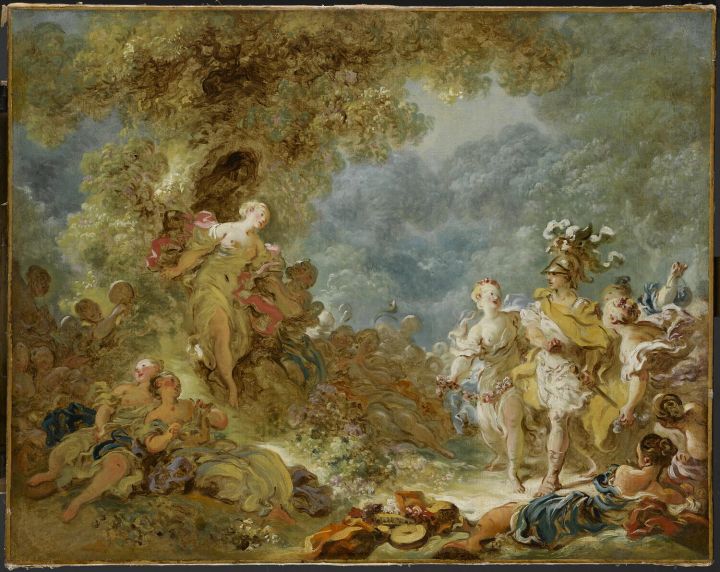
Jean-Honoré Fragonard, Renaud in the Gardens of Armide / Renaud dans les jardins d’Armide, ca. 1761–65, oil on canvas, 72 × 91 cm
(Paris, Musée du Louvre, RF2003 11)
◊ ◊ ◊ ◊ ◊
From ArtHist.net and the DFK:
Les Secrets de la peinture: Pratique et théorie de la peinture, de la manière et de la matérialité dans l’art du XVIIIe siècle français
Les Secrets de la peinture: Zu Praxis und Theorie von Malfarbe, Manier und Materialität in der Kunst des französischen 18. Jahrhunderts
Online and in-person, Deutsches Forum für Kunstgeschichte, Paris, 7–8 December 2023
Que peut légitimement dire la peinture, en tant que travail artistique technique, des conditions sociologiques de l’art, et que dit de la peinture des tableaux, du fecit, la réflexion théorique formulée dans les témoignages critiques—salons, conférences d’académie, traités ? Le colloque se consacre, à l’exemple de la peinture française du XVIIIe siècle, aux questions de la théorie et de la pratique de l’image et de la description de l’image. Il se veut une première tentative de reset de la perspective empirique dans le regard porté sur la peinture en tant que legs matériel spécifique des beaux-arts. Participation en ligne ou sur place au DFK Paris, pas d’inscription nécessaire.
j e u d i , 7 d é c e m b r e 2 0 2 3
10.00 Ouverture par Léa Kuhn (directrice adjointe du DFK Paris)
Introduction par les organisateurs — Markus Castor (DFK Paris), Deborah Schlauch (HAB Wolfenbüttel/ Université Marbourg), et Marie Isabell Wetcholowsky (Université Marbourg)
10.30 Théorie et langage autour de la peinture
• Comment la reconnaissance de la matière en peinture a renversé les paradigmes de la théorie artistique — Jérôme Delaplanche (Paris)
• The Sublime: Theory and Practice in French Painting after Charles Le Brun — Aaron Wile (Washington DC)
• Une Relation Instructive: Aesthetic and Socio-Political Dimensions of the ‘tout ensemble’ in Fête Galante Paintings — Elisabeth Fritz (Berlin)
12.45 Déjeuner
13.45 Visite du Salon Louis XV au Musée de la BnF site Richelieu
15.00 Les artistes et la pratique de la peinture
• Le rythme du ‘repos’ en peinture: Entre contemplation esthétique et expérience vécue — Susanna Caviglia (Durham/Milan)
• Les secrets d’un père à son fils: L’Epître à mon fils sur la peinture d’Antoine Coypel (1721) et sa postérité — Anthony Saudrais (Rouen)
• Dans l’atelier des fêtes galantes: Antoine Watteau, maître de Lancret et Pater — Axel Moulinier (Paris)
• Antonio Pellegrini, François Lemoyne et l’adaptation de la sprezzatura vénitienne: Le décor de la Galerie des Mississipiens et la critique du comte de Caylus — Marie Isabell Wetcholowsky (Paris/Marbourg)
• Au service de Dieu, la peinture selon Louis Galloche — Marine Roberton (Dijon)
18.45 Buffet dinatoire
v e n d r e d i , 8 d é c e m b r e 2 0 2 3
9.00 Visite du choeur de la Basilique Notre-Dame-des-Victoires de Paris La diversité de la couleur, des pigments et de la matérialité
10.00 Les artistes et la pratique de la peinture
• Learning How to Paint, Pigment by Pigment: Catherine Perrot’s Leçons Royales (1686) — Tori Champion (St Andrews)
• Fragonard’s Stalled Cart and Formless Landscape in 18th-Century France — Camilla Pietrabissa (Venise)
• Pigment, Puder, poussière précieuse: Metaphorik und visuelle Topik in der Pastellmalerei des 18. Jahrhunderts — Iris Brahms (Tübingen)
• « Fille de la peinture » Farbdruck von Le Blon bis Bonnet — Astrid Reuter (Francfort-sur-le-Main)
13.00 Déjeuner
14.00 La critique de la peinture
• “’Un des plus grans coloristes de l’école Francoise.’ He might be so and not very excellent”: English Critiques of French Painters in Britain after 1700 — Deborah Schlauch (Marbourg/Wolfenbüttel)
• Le langage des arts: Kunstkritik am Beispiel von Gemälden zu antiken Themen der Salons, 1747–1789 — Alexandra Röckel (Munich)
• La capacité olfactive de la couleur et la langue: Les taches de Bachelier, l’attaque de Diderot et les propos de Caylus sur la couleur — Markus Castor (Paris)
• « Fondre les effets » Diderot et la loi des nuances — Marie Schiele (Paris)
Conference | On Paper
International Catalogue Raisonné Association Annual Conference, On Paper
Royal Academy, London, 5 December 2023
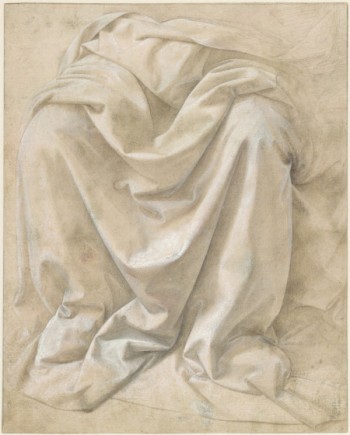
Lorenzo di Credi, Study of Drapery for a Seated Figure, detail (Paris: Fondation Custodia, Collection Frits Lugt).
The International Catalogue Raisonné Association (ICRA) is pleased to host its forthcoming annual conference, titled On Paper, at The Royal Academy London on 5 December 2023. The day-long conference will present unique perspectives from leading professionals in the field on all aspects of paper—from cataloguing, curating and conservation, to materials, techniques and artists’ innovative use of paper across the centuries from Old Masters to present day. On Paper will provide deep insight into the questions and challenges posed by paper both as a support and medium. Ticket are available at eventbrite; £150 for ICRA members, £250 for non-members. Discounted tickets are available for art historians and academics; send an email to Esme at esme.constanti@icra.art for further information.
p r o g r a m m e
9.00 Registration
9.30 Welcome — Teresa Krasny (ICRA Chair)
9.35 Introduction to the Royal Academy’s Collection of Works on Paper — Annette Wickham (Curator of Works on Paper, RA, London)
9.45 A Brief History of Paper-Making — Susan Catcher (Senior Paper Conservator, V&A, London)
10.15 The Art of Cataloguing Works on Paper — Gregory Rubinstein (Head of Old Master Drawings Department, Sotheby’s, London) and Fabienne Ruppen (Assistant Curator, Kunstmuseum Basel)
11.15 Coffee and Tea
11.30 The Legacy of a Works on Paper Collector and Art Historian: Frits Lugt — Rhea Blok (Curator, Fondation Custodia, Paris)
12.00 Spotlight on Pastel — Leila Survage (Paper Conservator, Rijksmuseum, Amsterdam) with Margaret Zayer (la Maison du Pastel, Paris)
12.30 Lunch and visit to the RA’s exhibition Impressionists on Paper: From Degas to Toulouse-Lautrec
2.00 Prints: The Unique versus the Multiple
Moderator Daniel Herrmann (Curator of Modern & Contemporary Projects, The National Gallery and author of the forthcoming catalogue raisonné of Eduardo Paolozzi’s prints)
Alan Cristea (20th- and 21st-century gallerist and print dealer, London) and Kari Greve (Paper Conservator, National Museum Oslo and author of the forthcoming catalogue raisonné of Nikolai Astrup’s prints)
3.00 Pushing the Boundaries of Paper: Radical Approaches
Moderator: Yuval Etgar (author, The Ends of Collage and Vitamin C+: Collage in Contemporary Art)
Claudine Grammont (Head of Cabinet d’art graphique, Centre Pompidou, Paris) and Eric Robertson (Professor of Modern French Literary and Visual Culture, Royal Holloway, University of London)
4.00 Coffee and Tea
4.15 Rethinking the Role of Paper in an Artist’s Legacy
Moderator: Andrea Rose (art historian and editor of Leon Kossoff: Catalogue Raisonné of the Oil Paintings)
Adam Greenhalgh (lead author of the catalogue raisonné Mark Rothko: The Works on Paper and Associate Curator at the National Gallery of Art, Washington DC), Kira Kofoed (Head of Archives, Thorvaldsen Museum), and Sewon Kang (Archivist, The Easton Foundation/Louise Bourgeois Archive and Cataloguer, Louise Bourgeois: The Complete Prints & Books)
5.15 Keynote Presentation — Claudette Johnson (artist)
Currently the subject of a major exhibition, Claudette Johnson: Presence at The Courtauld Gallery (29 September 2023 — 14 January 2024), Johnson will share key insights into her practice over the past three decades.
5.45 Closing Remarks — Teresa Krasny (ICRA Chair)
Conference | Fischer von Erlach and His Contemporaries
From ArtHist.net:
Court Architects in Europe, ca. 1700: Johann Bernhard Fischer von Erlach and His Contemporaries
Theatermuseum im Palais Lobkowitz, Vienna, 30 November — 2 December 2023
Registration due by 27 November 2023
Scholarly research has described Johann Bernhard Fischer von Erlach (1656–1723) early on as an outstanding artistic personality and has endeavored to contour his built, drawn, and printed oeuvre, which can safely be described by his own word as ungemein (‘extraordinary’). Even if scholars have increasingly been concerned with integrating Fischer into the architectural culture of his time, it has rightly and repeatedly been emphasized that the question of his international profile still requires a broader perspective that takes into account the relationship to his contemporary ‘colleagues’ as well as structural questions. In this sense, the conference aims to examine Fischer’s activities in a broader European context by means of selected thematic fields, thus attempting to sharpen his profile. Registration requested to irina.morze@wienmuseum.at by 27 November.
Organizers
• Institute for Habsburg and Balkan Studies (IHB) der Österreichischen Akademie der Wissenschaften
• Wien Museum
• Institut für Kunstgeschichte der Universität Münster
Concept
Herbert Karner, Jens Niebaum, Andreas Nierhaus
t h u r s d a y , 3 0 n o v e m b e r 2 0 2 3
13.00 Welcome and Introduction
13.30 Section 1 | Architects of Great Courts: Conditions, Scope, Hierarchies
• Anna Mader-Kratky — Fischer von Erlach als kaiserlicher Oberbauinspektor und die institutionellen Rahmenbedingungen des Wiener Hofbauamtes
• Simon Thurley — Sir Christopher Wren and His Contemporaries at Court: British Royal Architects and Architecture, 1660–1714
• Benjamin Ringot — Jules Hardouin-Mansart, from Architect to Administrator: Becoming Louis XIV’s Superintendent of Royal Buildings
• Martin Olin — Architect, Courtier, Police Minister: Nicodemus Tessin the Younger in the Service of Royal Absolutism
• Konrad Ottenheym — Jacob Roman, Hofarchitekt der Oranier um 1700
17.30 Discussion
f r i d a y , 1 d e c e m b e r 2 0 2 3
9.00 Section 2 | Drawing and Prints: Media of Visualisation, Transfer, and Knowledge Production
• Werner Oechslin — „…das Auge zu ergötzen, und denen Künstlern zu Erfindungen Anlass zu geben…“: Fischer von Erlachs Zeichnungen für die Historische Architektur
• Jasenka Gudelj — Fischer von Erlach’s Dalmatian Connection: Drawing the Diocletian Palace in Split
• Elisabeth Kieven — Fischer von Erlach und Juvarra: Zeichnungen im Vergleich
• Kristina Deutsch — Jean Marot und die druckgraphische Architekturdarstellung zur Zeit Ludwigs XIV. in Frankreich
12.00 Lunch Break
13.30 Section 2 | Drawing and Prints, continued
• Jonas Nordin — The People beyond the Mountains: Erik Dahlbergh’s Images of Swedish Architecture and Topography
• Peter H. Jahn — „Inventées … par Mathieu Daniel Pöppelmann Premier Architecte de Sa Majesté“ – das Dresdner Zwingerstichwerk von 1729 als publizistische Statusbekundung eines Hofbaumeisters
14.40 Discussion
16.15 Section 3 | Paths to Architecture: Court Architects and Their Education around 1700
• Anna-Victoria Bognár — Das akademische Studium der Architektur in der Frühen Neuzeit. Zur Entwicklung von Studienzahlen, Studienorten und Inhalten
• Giuseppe Bonaccorso — The Roman Training of Johann Bernhard and Joseph Emanuel Fischer von Erlach between Carlo Fontana and Emissaries from European Courts
• Alexandre Gady — Becoming Jules Hardouin-Mansart, the Sun King’s First Architect
s a t u r d a y , 2 d e c e m b e r 2 0 2 3
9.00 Section 3 | Paths to Architecture, continued
• Kristoffer Neville — Nicodemus Tessin’s Autobiography
• Matthew Walker — Christopher Wren: From Science to Service
• Tommaso Manfredi — Studying Architecture in Rome between the 17th and the 18th Centuries: From Fischer von Erlach to Juvarra
• Giuseppe Dardanello — Practicing with Goldsmithing, Perspective Views, Stage Design: Filippo Juvarra Shaping His Own Visual Design Culture
• Freek Schmidt — Renewing Court Architecture in a Republic: The Professional Advancement of Pieter de Swart
13.00 Discussion
London Art Week to Include Symposium on Conservation
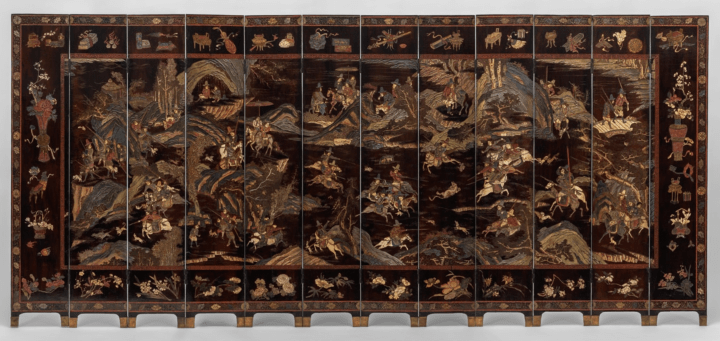
12-paneled Kangxi lacquer screen with a Dutch hunting scene, Kangxi period (1662–1722), carved, incised, and lacquered wood, painted, with brass fittings, 119 × 266 cm (Amir Mohtashemi). This is one of a rare group of about nine known lacquered screens of the period depicting Dutchmen; related examples are in the National Museum of Denmark, the Rijksmuseum, and the Museum of Fine Arts, Boston.
◊ ◊ ◊ ◊ ◊
From the press release for the Winter 2023 edition of LAW:
London Art Week, Winter 2023
1–8 December 2023
A busy eight days in early December will see the capital’s leading auction houses and fine art galleries from around the UK and Europe taking part in the Winter 2023 edition of London Art Week from Friday, 1 to Friday, 8 December. Exhibitions and sales will take place online and in galleries across central London, revealing important and exciting works. From Renaissance and Old Master rarities to Modern and Contemporary paintings, drawings, and sculpture, and encompassing exceptional works of art and craftsmanship, including, rare furniture, books, and manuscripts, this year’s Winter edition of London Art Week offers the best selection of the finest art on the market.
LAW Symposium | The Art of Conservation: Preservation, Restoration, and Framing
National Portrait Gallery, London, 5 December 2023
The 2023 LAW Symposium The Art of Conservation: Preservation, Restoration, and Framing takes place on Tuesday, 5 December at the recently reopened National Portrait Gallery. In partnership with The Burlington Magazine, there will be three panels of talks with leading curators, conservators, and LAW experts. These will investigate such topics as: how study informs conservation treatment; exciting moments from the history of conservation, including important contributions from women, based on the panellists’ articles in The Burlington Magazine’s new publication The Art of Conservation co-published with Paul Holberton (pre-launch on the day); and historic picture frames and their changing fashions, 27 years after the UK’s first exhibition devoted to picture frames was held at the National Portrait Gallery.
Lynn Roberts and Paul Mitchell, authors of Frameworks, Form, Function & Ornament and A History of European Picture Frames, who were closely involved with that exhibition, will be joined by conservators from the National Gallery and National Portrait Gallery. Tickets for the symposium are £20.
More information about London Art Week, its exhibitions, and other programming can be found in the full press release and at the LAW website.
Study Day | Spectacle and Representation during the Régence
From the Carnavalet:
Spectacle et représentation royale durant la Régence, 1715–1723
Orangerie du musée Carnavalet, Paris, 16 November 2023
 Dans le cadre des manifestations organisées autour de l’exposition La Régence à Paris (1715–1723): L’aube des lumières, le Centre de musique baroque de Versailles et le musée Carnavalet – Histoire de Paris proposent une journée d’études pluridisciplinaire sur les divertissements du jeune Louis XV. Cette journée réunit historiens, historiens de l’art, historiens de la danse et musicologues pour une journée d’études pluridisciplinaire autour des trois ballets dansés devant toute la cour par le jeune Louis XV aux Tuileries en 1720 et 1721 (L’Inconnu, Les Folies de Cardenio, Les Éléments), peu de temps avant sa majorité, son sacre et donc sa prise de souveraineté. S’inscrivant à la fois dans la lignée des grands divertissements royaux du Grand Siècle, mais dans des inspirations et une esthétique plus modernes, annonciatrices des Lumières, ces spectacles royaux ont participé à la construction de l’image publique du jeune souverain. Au-delà des aspects musicaux, littéraires, chorégraphiques et esthétiques, ces spectacles de cour, seront ainsi envisagés au travers de la question, transversale, de la représentation du pouvoir royal durant la Régence.
Réservation recommandée, jcharbey@cmbv.com.
m o d e r a t e u r s
Alexandre Dupilet
Petra Dotlačilová (Stockholm University, CMBV-CESR)
Thomas Leconte (CMBV-CESR)
i n t e r v e n a n t s
• José de Los Llanos (Conservateur en chef, responsable du Cabinet des Arts graphiques et du département des Maquettes, Musée Carnavalet – Histoire de Paris) et Ulysse Jardat (Conservateur du patrimoine, responsable du département des Décors, Mobilier et Arts décoratifs, Musée Carnavalet – Histoire de Paris), commissariat scientifique de l’exposition La Régence à Paris (1715–1723): L’aube des Lumières
• Laurent Lemarchand (Université de Rouen, GHRis) — Louis XV et Philippe d’Orléans : l’Union sacrée
• Vivien Richard (Musée du Louvre) — Les Tuileries : résidence du jeune Louis XV, 1715–1722
• Thomas Leconte (CMBV-CESR) — Le roi en sa capitale, 1715–1722 : l’image de la majesté à travers le cérémonial royal et le maillage urbain
• Pascale Mormiche (CY Cergy Paris Université) — Louis XV aimait-il danser ?
• Nathanaël Eskenazy (Université Paul-Valéry-Montpellier III, IRCL) — Convaincre, persuader, exhorter : repenser le discours encomiastique et la célébration de la figure royale dans les trois ballets dansés par Louis XV
• Barbara Nestola (CMBV-CESR) — Réunir pour mieux régner ? Fusion et collaboration entre troupes de cour et de ville pour la représentation des ballets dansés par Louis XV, 1720–1721
• Petra Dotlačilová (Stockholm University, CMBV-CESR) — Terpsichore durant la Régence : entre la tradition de cour et la danse théâtrale
• Mickaël Bouffard (Sorbonne Université, Théâtre Molière Sorbonne, CELLF) — Les habits des ballets de Louis XV : goût nouveau ou recyclage de vieilles idées ?
Conference | The Scottish Interior
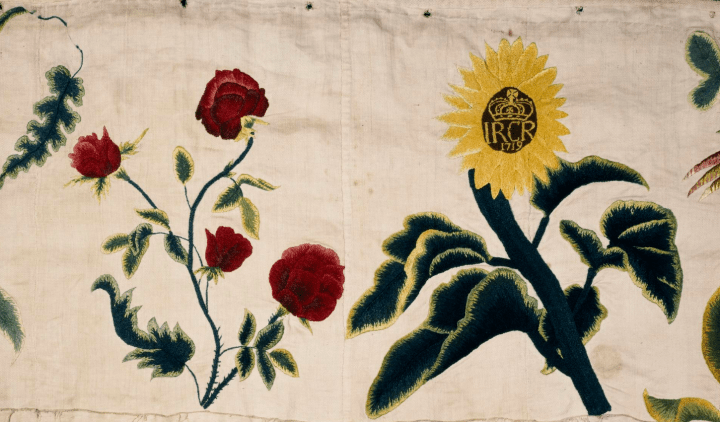
Embroidered valance celebrating the marriage of James Francis Stuart and Clementina Sobieska, 1719 (Edinburgh: National Museum of Scotland, A.1988.263 C). Part of a set of two crewel work wall hangings and four valances of white linen embroidered in coloured wool with a ‘Tree of Life’ pattern. This valance is embroidered with the cypher ‘IRCR / 1719’ under a crown within a sunflower, for ‘Jacobus Rex Clementina Regina’, referring to the marriage of James Francis Stuart and Clementina Sobieska.
◊ ◊ ◊ ◊ ◊
From the National Museum of Scotland:
The Scottish Interior
National Museum of Scotland, Edinburgh, 1 December 2023
A one-day conference on aspects of the Scottish interior from the 16th century to the present.
Thirty years on from the publication of Ian Gow’s defining book The Scottish Interior, this conference brings together specialists from a range of backgrounds to discuss questions of Scottishness—or lack thereof—in Scottish interiors from the 16th century to the present. Exploring a range of themes from the Renaissance to the Arts and Crafts movement via ‘Balmoralisation’, and with an interdisciplinary approach looking at patronage, collecting, architecture, and design, this event will appeal to anyone interested in Scottish history, design, and identity. The event is free, but booking is essential. Lunch and refreshments will be provided.

Armchair designed by Robert Adam for Sir Lawrence Dundas and made in Thomas Chippendale’s workshop, 1765 (Edinburgh: National Museum of Scotland, K.2002.9).
p r o g r a m m e
9.00 Arrival
9.30 First Panel
• Helen Wyld — Introduction
• Sally Rush — The Renaissance Interior in Scotland
• Michael Pearce — North-Britons: Interiors for an Anglicised Scottish Aristocracy
10.50 Tea
11.20 Second Panel
• Ian Gow — The Scottish Interior
• Stephen Jackson — The Role of Antique Furniture in the Scottish Interior
• Annette Carruthers — The Arts and Crafts Interior in Scotland
12.40 Lunch
13.50 Third Panel
• Emma Baillie — Messages in Plaster: The Work of Thomas Clayton at Blair Castle
• Calum Robertson — The Scottish Armoury
• Godfrey Evans — Hamilton Palace: The Projection of Exceptional Connoisseurship and Exalted Status by the Premier Peers of Scotland
15.10 Tea
15.40 Fourth Panel
• Mary Miers — Romantic Retreats
• Mhairi Maxwell, James Wylie, and Jonathan Faiers — Balmoralisation
16.20 Round table discussion with all speakers
Conference | Elizabeth Montagu and the Bluestocking Corpus Online
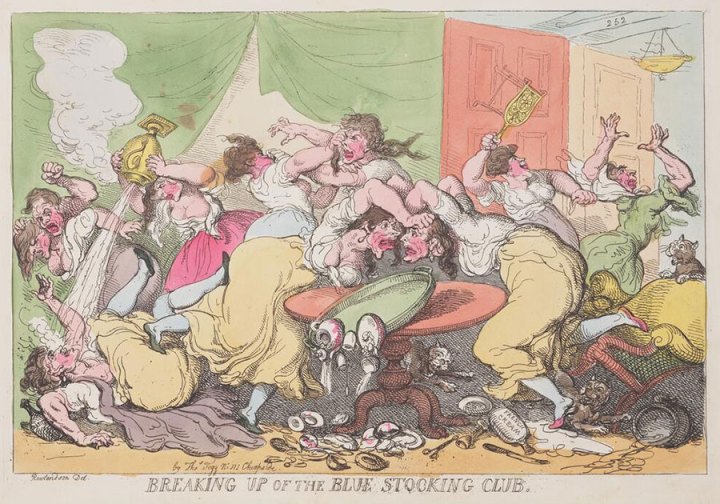
Thomas Rowlandson, Breaking Up of the Blue Stocking Club, 1815, hand-colored etching
(San Marino: Huntington Library, Art Museum, and Botanical Gardens)
◊ ◊ ◊ ◊ ◊
Next month at The Huntington:
Correspondence and Embodiment: The Bluestocking Corpus Online
The Huntington Library, Art Museum, and Botanical Gardens, San Marino, 8–9 December 2023
Organized by Elizabeth Eger and Nicole Pohl
This conference, organized in collaboration with the Elizabeth Montagu’s Correspondence Online (EMCO) project, explores themes related to The Huntington’s Elizabeth Montagu Papers. Topics include the letter as object, historical document, linguistic artifact, as well as a carrier of objects and messages about friendship, health, the mind and body, and politics. The Huntington’s collection of Elizabeth Montagu’s extensive correspondence has provided a rich source—as well as a practical challenge—for scholars working in a variety of fields, from social and economic history to histories of medicine, aesthetics, authorial selfhood, and literary genres.
Elizabeth Robinson Montagu (1718–1800) combined many roles: pioneering Shakespeare critic, businesswoman, manager of coalmines and agricultural estates, philanthropist, and patron of artists and writers. She pivoted between several important social, political, religious, and intellectual networks. Her letters connect people, places and concepts with graphic immediacy.
In 2017, the registered charity Elizabeth Montagu Correspondence Online (EMCO) was founded to fund the digitization of her 8000 extant manuscript letters, most of which are curated by The Huntington Library. This conference will explore themes connected to the archive, the letter as object, historical document, linguistic artifact, as well as a carrier of objects and messages about friendship, health, the mind and body, and politics.
This conference is organized by Elizabeth Eger (King’s College, London) and Nicole Pohl (Oxford Brookes, Oxford). Funding is provided by The Homer Crotty Lecture Endowment and the Edward A. Mayers Fellowship Endowment.
f r i d a y , 8 d e c e m b e r 2 0 2 3
8.45 Registration and Coffee
9.15 Welcome by Susan Juster (The Huntington Library) and Conveners
9.30 Session 1 | A History of the Montagu Collection at The Huntington
• Vanessa Wilkie (The Huntington Library)
• Karla Nielsen (The Huntington Library)
10.00 Break
10.30 Session 2 | EMCO: The Physical Archive and Its Virtual Other
Moderator: Joanna Barker (Durham and EMCO Senior Editor)
• Alexander Roberts (Swansea University)
• Daniel Archambault (Swansea University)
• Nicole Pohl (Oxford Brookes and EMCO Editor in Chief)
Noon Lunch
1.00 Session 3 | Gender and Knowledge
Moderator: Emily Anderson (University of Southern California)
• Rachael Scarborough King (UC Santa Barbara), Improving Letters: Self- and Literary Improvement in Women’s Epistolary Genres
• Nataliia Voloshkova, (Kazimierz Wielki University), Bluestockings and Science: Acquiring, Sharing, and Employing Knowledge, read by Nicole Pohl
2.30 Break
3.00 Session 4 | Absence and Presence
Moderator: Susan Carlile (Cal State Long Beach)
• Elizabeth Eger (King’s College London and EMCO Consultant Editor), Embodying Mind: Portraits of Elizabeth Montagu
• Felicity Nussbaum (UCLA), The Beloved Absent: The Correspondence between Elizabeth Montagu and Hester Thrale Piozzi
s a t u r d a y , 9 d e c e m b e r 2 0 2 3
8.30 Registration and Coffee
9.00 Session 5 | Embodying Language: The Letter and Creative and Critical Modes of Writing
Moderator: Nicole Pohl (Oxford Brookes)
• Betty A. Schellenberg (Simon Fraser University), Unclothed Bodies: The Problem of Enclosures in the Montagu Collection
• Mike Cousins (Historian), Keeping Track of Mrs. Montagu: Challenges in Dating Her Correspondence with Lord Lyttelton, and a Comparison with Unpublished Letter Collections of Some Other Contemporary Women Writers
10.30 Tours of the Library and Gallery
Noon Lunch
1.00 Session 6 | Bodies in Letters, Letters as Bodies
Moderator: Dena Goodman (University of Michigan)
• Lisa Forman Cody (Claremont McKenna College), Pregnant Pauses: Reproduction in—and as—Letter Writing
• Karen Harvey (University of Birmingham), ʽWe Must Chat about Invalids’: The Lived Body in British Women’s Letters, 1730–1800
2.30 Break
3.00 Session 7 | In Sickness and in Health: Bluestocking Friendship
Moderator: Karla Nielsen (The Huntington Library)
• Anna Senkiw (Oxford Brookes), ʽSeveral Weeks Indisposition, a Little Dastardly Fever Lurking about Me, Has Hinderd My Coming to the Adelphi’: Friendship with the Garricks, in Sickness and in Health
• Helen Deutsch (UCLA), Symptomatic Correspondences, Female Complaints: Authorship, Friendship and Illness in the Montagu Letters
4.30 Concluding Remarks
Colloquium | Léopold Robert and Aurèle Robert
From the conference programme:
Frères d’art: Léopold et Aurèle Robert
Neuchâtel / La Chaux-de-Fonds, 9–10 November 2023
 Dans le cadre de l’exposition Léopold et Aurèle Robert présentée conjointement au Musée des beaux-arts de La Chaux-de-Fonds et au Musée d’art et d’histoire de Neuchâtel du 14 mai au 12 novembre 2023, l’Institut d’histoire de l’art et de muséologie de l’Université de Neuchâtel souhaite encourager la réflexion et l’échange d’idées à propos de ces deux figures artistiques à l’occasion d’un colloque international. Celui-ci se tiendra en présentiel le jeudi 9 novembre 2023 au Musée d’art et d’histoire de Neuchâtel, et le vendredi 10 novembre 2023 au Musée des beaux-arts de La Chaux-de-Fonds.
j e u d i , 9 n o v e m b r e 2 0 2 3
10.00 Accueil et café
10.30 La fabrique de l’œuvre: Léopold Robert au travail
• Léopold Robert au prisme de la conservation-restauration: État des lieux, nouvelles investigations et perspectives — Léa Gentil (Musée des beaux-arts de La Chaux-de-Fonds)
• La notion d’« œuvres de jeunesse » touchant Léopold Robert: Un réexamen des premières orientations de l’artiste — Cecilia Hurley (École du Louvre / Université de Neuchâtel)
• Les Brigands de Robert, ou l’art d’accommoder les restes de l’histoire de l’art — Pascal Griener (Université de Cambridge / École du Louvre)
12.30 Pause déjeuner
14.00 La fabrique de l’œuvre: Aurèle Robert au travail
• Un sens aigu de l’observation: Corpus d’études d’après nature d’Aurèle Robert conservé au Musée des beaux-arts du Locle — Anaëlle Hirschi (Chargée de projet de recherche en collaboration avec le Musée des beaux-arts du Locle)
• Les hors-champs de l’image: L’Atelier de Léopold Robert à Rome en 1829 par Aurèle Robert — Lucie Girardin Cestone (Musée d’art et d’histoire de Neuchâtel)
15.30 Pause café
16.00 Conférence
• Quand le folklore devient désirable: La mise en scène de la vie populaire entre représentation, collection et recherche — Federica Tamarozzi (Musée d’ethnographie de Genève)
v e n d r e d i , 1 0 n o v e m b r e 2 0 2 3
10.00 Accueil et café
10.30 Les stratégies de Léopold Robert, ou comment prendre sa place sur la scène artistique
• Une histoire de regards — Walter Tschopp (Fondation Ateliers d’Artistes)
• Léopold Robert et l’apparition de la grande scène de genre italienne en France — Laurent Langer (Musée d’art de Pully)
• Petit genre et grand format: Quelle grandeur pour représenter le peuple ? — Olivier Bonfait (Université de Bourgogne Franche-Comté, LIR3S)
12.30 Pause déjeuner
14.00 Regards contemporains sur Léopold Robert
• Léopold Robert et les écrivains de son temps (suite) — Alain Corbellari (Universités de Lausanne et de Neuchâtel)
• The legacy of Léopold Robert in 19th-century cosmopolitan Rome — Giovanna Capitelli (Università degli Studi Roma Tre)
15.30 Pause café
16.00 Conférence
• Et in Italia ego: Le voyage des peintres femmes à Rome et en Italie au XIXe siècle — Martine Lacas (Auteure, chercheuse et commissaire d’exposition indépendante)
Conference | A Mundane History of Collecting, 1600–1918
From ArtHist.net:
The Backstage View: A Mundane History of Collecting, 1600–1918
Collegium Maius, Adam Mickiewicz University, Poznań, 26–27 October 2023
Organized by Michał Mencfel and Camilla Murgia
 After more than half a century of intense scientific exploration, resulting in hundreds of in-depth studies, the history of collections has established itself as one of the privileged fields of research in the humanities. Various issues such as the provenance of objects in collections; ways in which these objects have been ordered, arranged, and displayed; rooms and buildings in which they have been kept and exhibited; narratives beyond objects and collections; biographies of collectors; social practices connected with collections, etc. have been versatilely investigated. Consequently, collecting—fascinating in its own right—has proved also to be a sensitive indicator of broad cultural and social phenomena connected with artistic, scientific, philosophical, societal, and political movements.
Indeed, recent research has shown how the art market has been crucial to the history of collections in specific cultural contexts that have undergone a series of exchanges and openings linking different economic elements and realities (Brill’s Studies in the History of Collecting & Art Markets). Furthermore, particular attention has been paid to both the circulation of works of art from the perspective of collecting strategies (Art Markets, Agents and Collectors: Collecting Strategies in Europe and the United States 1550–1950, ed. by Adriana Turpin and Susan Bracken, 2021), and of provenances (Study of Collecting and Provenance and the Getty Provenance Index).
Collecting, however, also relies on a great number of less noble and less sophisticated but nevertheless indispensable practices. These include negotiating with artists and dealers, observing (or escaping) the formalities, paying (or avoiding paying) customs fees, transporting and securing the collectibles, restoring and framing the pieces of art, etc. The present call for contributions aims to invite proposals for papers focusing on this everyday—somewhat down-to-earth and mundane—side of collecting. What about this background, consisting of daily actions, practical skills, and made-to-measure resolutions, that contributes to the constitution of collections and the act of collecting itself? How does this meticulous, essential and somehow ‘invisible’ infrastructure enable the purchase, conditioning, sale, and exchange of artwork?
This conference aims to explore the various aspects regarding the mundane site of the history of collecting. We intend to question the multitude of logistic, administrative, organisational, and managerial practices that contribute to the act of collecting and how they affect selling and buying artwork. We are interested in identifying and studying the elements that mark out the diverse and versatile apparatuses of collecting in specific cultural, social, and economic realities, both private and public. Changes in issues, paradigms, and availability are at the heart of our study.
Conference Organizers
Michał Mencfel (Adam Mickiewicz University), mmencfel@amu.edu.pl
Camilla Murgia (Université de Lausanne), camilla.murgia@unil.ch
t h u r s d a y , 2 6 o c t o b e r 2 0 2 3
9.00 Registration
9.30 Welcome by Michał Mencfel (Adam Mickiewicz University) and Camilla Murgia (Université de Lausanne)
1000 Panel 1 | References
• Katharina Januschewski (Universität Paderborn) — Selling Italian Landscapes to the Russian Empire: Sylvester Shchedrin’s Letters from Italy (1818–30) as a Source for International Art Transport Logistics and Sales Strategies
• Malena Rotter (Gemäldegalerie Alte Meister, Kassel) — ‘I Am Gradually Acquiring the Necessary Material for a Gallery of Italian Pieces’: Landgrave William VIII of Hesse-Kassel (1682–1760) and His Italian Collection
11.10 Coffee
11.30 Panel 2 | Mundanity
• Ulrike Müller (Antwerp University and Royal Museums of Fine Arts of Belgium) and Davy Depelchin (Royal Museums of Fine Arts of Belgium) — Staging Privately-Owned Artworks: Private Collectors and the Exhibitions for Living Masters in Brussels, 1830–1860
• Maria Chiara Scuderi (University of Leicester) — Missionary Exhibitions as Mundane Sites for Private Collections: The Case of Dryad ‘Handicrafts’
12:40 Lunch
14.15 Panel 3 | Curating
• Arianna Candeago (Ca’ Foscari University Venice) — On the Art Market in Late 18th-Century Venice: Everyday Practices from the Letters of Collectors and Intermediaries
• Michelle Huang (University of St Andrews) — Curatorial Considerations and Practices behind the Acquisitions of the George Eumorfopoulos Collection of Chinese Art by the British Museum and the V&A
15.20 Coffee
15.40 Panel 4 | Practices
• Dorothee Haffner (Hochschule für Technik und Wirtschaft Berlin) — Organising and Visualising Collections: Changing Principles and Functions
• Laia Anguix-Vilches (Radboud University Nijmegen) — Women in the Backstage: Gender-Related Challenges in Institutional Collecting Practices
f r i d a y , 2 7 o c t o b e r 2 0 2 3
9.30 Welcome by Michał Mencfel (Adam Mickiewicz University) and Camilla Murgia (Université de Lausanne)
9.45 Keynote Lecture
• Erin Thompson (City University of New York) — Backstage, Viewed from the Archives: Researching Illicit Trafficking in Cultural Property
10.45 Coffee
11.00 Panel 5 | Trading and Cataloguing
• Nadia Rizzo (Scuola Normale Superiore, Pisa) — The Unfortunate Vicissitudes of Jean Gossaert’s Malvagna Triptych
• Bénédicte Miyamoto (Université Sorbonne Nouvelle) — Auction Clerks and Paper Trails: The Bureaucracy of Collection Transfers in 18th-Century Britain
• Elizabeth Pergam (Society for the History of Collecting) — Trading Art History: Art Dealer Archives and Day-To-Day Business of Collecting
12.45 Lunch
14.30 Panel 6 | Shaping Collections
• Martyna Łukasiewicz (Adam Mickiewicz University) — Fortune and Vision: The Art Market and the Emergence of Major Art Collections in Copenhagen, 1850–1900
• Silvia Marin Barutcieff (University of Bucharest) — Collecting Art in Modern Romania: Social Circumstances and Economic Endeavors, 1881–1918
15.40 Closing Notes and Coffee










 Enfilade
leave a comment