Adam Smith 300 in 2023
From the press release (23 November 2022) for Adam Smith 300 . . .
The University of Glasgow is marking the 300th anniversary of pioneering Scot Adam Smith (1723–1790) with a year-long celebration of his life, work, and influence.
The tercentenary commemoration of the ‘father of economics’ includes a host of events in Scotland and around the world, designed to inspire renewed discussion about Smith’s ideas. Smith’s work has had a lasting impact on the way the world considers economics, politics, and society more broadly. The planned programme of events aims to consider how his ideas from 300 years ago can help answer some of the biggest challenges we face today.
Throughout 2023 the University of Glasgow has a raft of programmes and events that will give academics, students, and the public new insights into his life and work. Highlights include:
• Tercentenary Week (5–10 June 2023)—a week-long series of activities, including talks and exhibitions at the University of Glasgow featuring scholars from the London School of Economics, the universities of Princeton and Harvard, and the University of Cambridge.
• An on-campus and virtual exhibition of significant and rare Smith-related artifacts—including letters, first edition books, and material from the University of Glasgow’s archives.
• The Adam Smith Tercentenary Global Lecture Series, featuring internationally renowned speakers from academia, business, and public policy.
• New research into Smith’s life and writings.
• The Royal Economic Society and Scottish Economic Society Joint Conference in April, featuring global academics reflecting upon Smith’s legacy.
Other activities involve a national student competition to re-design the front cover of The Wealth of Nations, online courses for adult learners, and new programmes to introduce high school to Adam Smith and his ideas. Universities from across the world, in North and South America, Asia, Africa, Europe, and Australia will be joining in the commemorations with their own events to mark the tercentenary.
Professor Sir Anton Muscatelli, Principal and Vice Chancellor of the University of Glasgow, said: “Adam Smith is one of our most famous alumni, and he left an indelible impact on the University of Glasgow, on the fields of economics and moral philosophy, and on the wider world. His studies and writings introduced new ideas, insights, and concepts that shaped our understanding of economics today but were revolutionary in their day. To mark the tercentenary of his birth we will see academics, students, and the public discuss his continued relevance at a series of events taking place in Glasgow and across the world. I look forward to taking part in the University’s commemoration of Adam Smith as we evaluate his legacy and consider how his thoughts and ideas from 300 years ago can still help us answer the greatest challenges of today.”
Adam Smith—born in Kirkcaldy, Fife, in June 1723—started his studies at the University of Glasgow aged 14. In 1740, he was awarded the Snell Scholarship, which is still in existence today, and left to study at Oxford. In 1751, Smith returned to Glasgow as a Professor of Logic, later becoming Professor of Moral Philosophy. While at Glasgow, Smith published the first edition of The Theory of Moral Sentiments in 1759, developing upon the principles and concepts explored in his lectures. Smith’s final connection with the University came in 1787 when he assumed the prominent position of Rector. He published arguably his most famous work The Wealth of Nations in 1776 and died in 1790.
Symposium | Digging for Delftware

Plate with the Head of King James II, painted in blue, yellow, and manganese-purple on a white glaze
(Bristol Museum & Art Gallery, Na625)
◊ ◊ ◊ ◊ ◊
From Bristol Museums:
Digging for Delftware
Bristol Museum & Art Gallery, 27—28 February 2023
Organized by Amber Turner
Comprising over 2000 pieces of delftware, Bristol Museum has one of the largest and most important collections of in the UK. For over 100 years, Bristol was a leading manufacturer of delftware, producing objects that were exported across the globe. Bristol Museum has been working for two years on a project funded by Arts Council England to research and re-display its collection of English delftware.
In celebration of the project, this two-day symposium will bring together specialists from around the world. They will share insights into delftware from Bristol and beyond and explore the latest international research in the field of delftware studies. There will also be an opportunity to visit the new displays and to see a selection of objects from our reserve collection.
We will be joined by an array of experts including Karin Walton, Matthew Winterbottom, Ian Betts, Caroline McCaffrey-Howarth, Peter Francis, Femke Diercks, Roger Massey, David Dawson, Oliver Kent, and Amanda Lange.
M O N D A Y , 2 7 F E B R U A R Y 2 0 2 3
10.00 Registration, with Tea and Coffee
10.25 Welcome — Kate Newnham (Senior Curator of Visual Arts, Bristol Museum & Art Gallery)
10.30 A Century of Collecting — Karin Walton (Former Curator of Applied Art, Bristol Museum & Art Gallery)
11.05 Archaeology and Delftware: Production in Bristol — David Dawson (Former Curator of Archaeology at Bristol Museums)
11.40 Break
12.00 The Decorative Delftware Wall Tiles of Bristol — Ian Betts
12.35 Louis Lipski and the Limekiln Lane Pottery — Roger Massey (Ceramics Historian)
13.10 Lunch Break
14.15 Digging for Delftware: Bristol Museum’s Collection of Tin-glazed Earthenware — Amber Turner (Curator of Applied Art, Bristol Museum & Art Gallery)
14.50 Free-flow tour of the ceramics gallery
15.35 Tea Break
16.00 ICP Analysis of Delftware Sherds from Bristol: New Insights into Production — Kamal Badreshany (Assistant Professor, Department of Archaeology, Durham University)
16.35 Study of delftware sherds from Bristol Museum’s reserve collection
T U E S D A Y , 2 8 F E B R U A R Y 2 0 2 3
10.00 Registration, with Tea and Coffee
10.25 Welcome — Amber Turner (Curator of Applied Art, Bristol Museum & Art Gallery)
10.30 Wincanton Delftware Pottery: Some New Discoveries — Roger Massey (Ceramics Historian)
11.10 Irish Delftware: Some Recent Discoveries — Peter Francis (Former Research Fellow, Institute of Irish Studies, Queen’s University Belfast)
11.50 Break
12.10 Dutch Delftware at the Rijksmuseum: New Research — Femke Diercks (Head of Decorative Arts, Rijksmuseum, Amsterdam)
12.50 Delftware as Historical Agents, c. 1640–1700 — Caroline McCaffrey-Howarth (Lecturer in History of Art, University of Edinburgh)
13.30 Lunch
14.30 Margaret Macfarlane’s Delftware Teawares: The Ashmolean Bequest — Matthew Winterbottom (Curator of Sculpture and Decorative Arts, Ashmolean Museum, Oxford)
15.10 Transatlantic Trade and Global Connections: English Delftware for American and Caribbean Markets — Amanda Lange (Curatorial Department Director and Curator of Historic Interiors, Historic Deerfield, Massachusetts)
15.50 Tea Break
16.10 ‘Just Arrived from Bristol’: Tin-glazed Earthenware above and below Ground in Virginia (delivered via pre-recorded talk) — Angelika Kuettner (Associate Curator of Ceramics, Colonial Williamsburg, Virginia)
16.50 Closing Remarks — Amber Turner
Thematic Route | Women as Art Promoters and Patrons at the Prado
This thematic route is one tangible result of a symposium held in March of this year, which focused on the period 1451 to 1633; a second symposium addressing the seventeenth and eighteenth centuries is scheduled for 6–7 March 2023 (see the note at the end of this posting and a separate posting).
El Prado en femenino
The Female Perspective: The Role of Women as Promoters and Patrons of the Arts at the Prado
Museo Nacional del Prado, Madrid, 14 December 2022 — 9 April 2023
Developed with Noelia García Pérez
In collaboration with the Ministry of Culture’s Institute for Women, from today (14 December 2022) until 9 April 2023 the Museo Nacional del Prado is offering a new perspective on its permanent collection through a thematic route devised with the academic supervision of Noelia García Pérez, associate professor of art history at the University of Murcia. The result is a fresh viewpoint and one that encourages us to focus on the role of women as promoters and patrons of the arts.
Among all European museums, the Prado is probably the one in which women have played the most decisive role with regard to its configuration, either as collectors and promoters or through their key contribution to its foundation and existence. Works such as Van der Weyden’s Descent from the Cross, Titian’s Charles V at the Battle of Mühlberg, the superb bronze sculptures of Philip II and Mary of Hungary commissioned from Pompeo and Leone Leoni, and The Holy Family with Saints by Rubens would not be present in the Prado’s collection without women’s involvement.
The works included in this thematic route are associated with women who were not only notable for their activities as patrons but also in the promotion of the artists who worked in their service. One particularly notable example is that of Isabel Clara Eugenia (1566–1633). The Prado houses dozens of works directly resulting from her patronage, in addition to the fact that the Museum’s close connections with Rubens is particularly allied to the promotion and dissemination of his career on the part of the Archduchess, who was governor of the Southern Netherlands. This explains why the Prado houses the largest collection of works by Rubens in the world.
The Female Perspective reflects the first edition of the symposium Key Women in the Creation of the Prado’s Collections: From Isabella I of Castile to Isabel Clara Eugenia (Protagonistas femeninas en la formación de las colecciones del Prado: De Isabel I de Castilla a Isabel Clara Eugenia), which took place in March this year and will be followed by Key Women in the Creation of the Prado’s Collections, Part II: From Elisabeth of France to Mariana of Neuburg (Protagonistas femeninas en la formación de las colecciones del Museo del Prado II: De Isabel de Borbón a Mariana de Neoburgo), to be held on 6 and 7 March 2023.
The full press release is available here»
The Female Perspective: Women Art Patrons of the Museo del Prado (Madrid: Prado, 2022), 160 pages, €10.
Symposium | Women in the Creation of the Prado’s Collections, Part II
From The Prado:
Key Women in the Creation of the Prado’s Collections, Part II: From Elisabeth of France to Mariana of Neuburg
Protagonistas femeninas en la formación de las colecciones del Museo del Prado II: De Isabel de Borbón a Mariana de Neoburgo
Museo del Prado, Madrid, 6-7 March 2023
El Museo del Prado posee dos peculiaridades que lo convierten en un modelo paradigmático para explorar, recuperar y difundir el destacado papel desempeñado por las mujeres en el ámbito del patronazgo artístico. La primera de ellas, vinculada a su creación y consolidación, nos remite a ejemplos tan significativos como el de su fundadora, Isabel de Braganza, o el de Isabel II, quien logró mantener unidas las obras que integraban el Real Museo de Pintura. La segunda de estas peculiaridades alude a la estrecha vinculación que existe entre la formación de sus colecciones y las mujeres de las casas reales europeas. Reinas, princesas, regentes y gobernadoras que, como quedó de manifiesto en la primera edición del simposio Protagonistas femeninas, celebrado en 2022, contribuyeron poderosamente, por haber aportado algunas de sus obras más valiosas, a enriquecer las colecciones que tenemos la fortuna de poder admirar aún hoy.
Para la segunda edición de este encuentro científico, cuya celebración hacemos coincidir con las vísperas del Día Internacional de la Mujer, el Museo del Prado reúne a un destacado elenco de investigadores internacionales que analizarán la promoción y agencia artística desarrollada por nuevas Protagonistas femeninas, esta vez por mujeres de una época encuadrada entre las vidas de Isabel de Borbón (1603–1644) y la de Mariana de Neoburgo (1667–1740).
En las diferentes sesiones teóricas y mesas redondas planteadas se examinarán, entre otras cuestiones, el concepto de reginalidad o queenship en la cultura visual de la Edad Moderna, la construcción de la imagen de poder femenina, la instrumentalización de arte al servicio de intereses políticos o devocionales y el papel que las mujeres desempeñaron como mediadoras artísticas y culturales, creando redes femeninas con importantes repercusiones en lo relativo al intercambio de obras y promoción de artistas.
Estas sesiones teóricas se verán complementadas con una propuesta de carácter práctico: la presentación y posterior visita al itinerario expositivo El Prado en femenino. Promotoras artísticas de las colecciones del Museo (1451–1633). Un recorrido a través de la colección permanente que nos invita a explorar nuevas narrativas, a conocer los relatos originales y sorprendentes que subyacen tras las obras comisionadas por mujeres de tan considerable repercusión histórica como María de Hungría, Juana de Austria o Isabel Clara Eugenia.
6 M A R Z O 2 0 2 3
9.00 Recogida de acreditaciones
Sesión 1. Mujeres y patronazgo artístico en el contexto de la cultura visual del Barroco
9.30 Presentación del simposio. Las mujeres de las Casas Reales (1602–1740) y la formación de las colecciones del Museo del Prado — Javier Arnaldo (Museo Nacional del Prado) y Noelia García Pérez (Universidad de Murcia)
10.00 Early Modern Women’s Patronage in a Global Context — Merry E. Wiesner (University of Wisconsin-Milwaukee)
10.45 Descanso-Café
11.30 Queenship in Early Modern World: Display, Ceremonial, Portraiture and Patronage — Elena Woodacre (University of Winchester)
12.15 Presentación del Itinerario expositivo El Prado en femenino: Promotoras artísticas de las colecciones del Museo (1541–1633) — Miguel Falomir Faus (Museo Nacional del Prado), Victor Cageao Santacruz (Museo Nacional del Prado), y Noelia García Pérez (Universidad de Murcia)
13.00 Visita libre al Itinerario
Sesión 2. Promotoras artísticas en el Museo del Prado (1602–1740)
16.30 Legado histórico-político de cuatro reinas de España en el siglo XVII (1621–1700): Proyectos realizados e inacabados — Silvia Mitchell (Purdue University)
17.30 Mesa redonda: De Isabel de Borbón a Mariana de Neoburgo: arte, política y devoción al servicio de la Casa de Austria
Modera: Mía Rodríguez Salgado (The London School of Economics and Political Science)
• Ezequiel Borgognoni (Universidad de Buenos Aires, Universidad Rey Juan Carlos)
• Gloria Martínez Leiva (Investigadora independiente)
• Cecilia Paolini (Università degli Studi di Teramo)
• Álvaro Pascual Chenel (Universidad de Valladolid)
7 M A R Z O 2 0 2 3
Sesión 3. Líneas de investigación y nuevas perspectivas de estudio
9.00 Starting the Conversation with Pictures: How Art Collecting Gave Women a Voice — Sheila Barker (University of Penssylvania/ Studio Incamminati)
9.45 Retratos y poder femenino en la cultura visual del Barroco: La construcción de la imagen Mariana de Austria
Modera: Mía Rodríguez Salgado (The London School of Economics and Political Science)
• Mercedes Llorente Molina (Universidad Jaume I)
• Patricia Manzano Rodríguez (Durham University)
10.45 Descanso-Café
11.15 Arte y devoción femenina en las colecciones del Museo del Prado en el contexto de la Contrarreforma — Benito Navarrete (Universidad de Alcalá)
12.00 Mesa redonda: Las mujeres de la Casa de Austria en las cortes europeas del Barroco
Modera: Kathleen Wilson Chevalier (American University, París)
• Katrin Keller (Austrian Academy of Sciences)
• Mathieu De Vinha (Centre de recherche du château de Versailles)
Sesión 4: Cristina de Suecia, reina, filósofa y patrona de las artes
15.30 Christina of Sweeden: Art Patron and Collector — Theresa Kutasz Christensen (Baltimore Museum of Art)
16.15 Mesa redonda: La huella de Cristina de Suecia en las colecciones del Museo del Prado
Modera: Manuel Arias (Museo Nacional del Prado)
• Beatrice Cacciotti (Università degli Studi di Roma)
• Miguel Ángel Elvira Barba (Universidad Complutense de Madrid)
• Mercedes Simal López (Universidad de Jaén)
Conference | Boiseries: Decoration and Migration
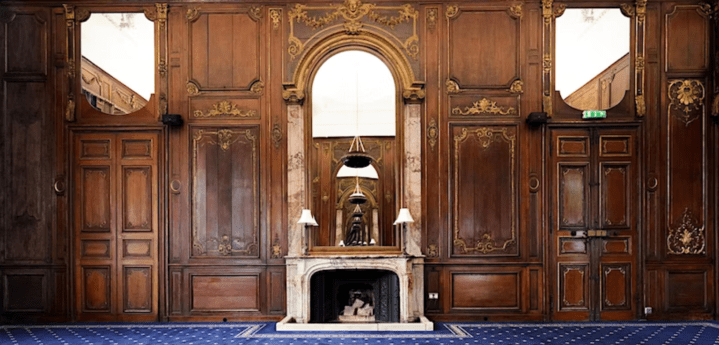
From the conference website:
Boiseries: Decoration and Migration from the Eighteenth Century to the Present
Camden Place, Chislehurst (Kent), 12–13 January 2023
Organized by Lindsay Macnaughton and Laura Jenkins
This two-day conference investigates the cultural and commercial migrations of French eighteenth-century boiseries from their places of production in Paris and the Bâtiments du Roi to the drawing rooms of Britain and the United States. It will be the first major study of boiseries in the context of transatlantic cultural history and will build on the landmark studies of panelling as architectural salvage by Bruno Pons (1995, 2001) and the late John Harris (2007). The conference will bring together international experts and emerging scholars in the fields of art, architecture, history, and museums and heritage management and will form part of a programme of events marking the 150th anniversary of the death of Napoleon III at Camden Place.
Camden Place, where the conference will be held, is an English country house whose history and interiors have been shaped by the migration of people and decoration for over 300 years. Home to Chislehurst Golf Club, the Grade II* listed building features architectural elements by the British architects George Dance the Younger (1741–1825) and James ‘Athenian’ Stuart (1713–1788), and played host to the French Imperial court after the fall of the Empire in 1870. French chimney pieces, boiseries from the eighteenth-century Château de Bercy (demolished in 1862), and heavily carved oak panelling are among the elements that make up the house’s many layers, testifying both to the eclectic tastes of its nineteenth-century occupants and to the multifaceted, and multinational, histories of many English country houses.
Organised by Dr Lindsay Macnaughton (University of Buckingham) and Laura C. Jenkins (The Courtauld Institute of Art), with support from Chislehurst Golf Club, The Chislehurst Society, The University of Buckingham, and The Society for the Study of French History.
Tickets are available here. For enquiries, please contact lindsay.macnaughton@buckingham.ac.uk or laura.jenkins@courtauld.ac.uk.
T H U R S D A Y , 1 2 J A N U A R Y 2 0 2 3
10.00 Registration
10.30 Introduction by Lindsay Macnaughton
10.45 Session 1 | The Cultural Impact of French Émigrés in Britain
Moderated by Lindsay Macnaughton
• Camden Place as a Headquarters of Bonapartism, 1870–1879 — Thomas C. Jones (Senior Lecturer, The University of Buckingham)
• The French Imperial Family in Exile: The Display of Collections in Camden Place, 1870–1880 — Rebecca Walker (Independent Scholar)
• Lord Hertford’s Room from the Château de Bercy — Félix Zorzo (Curatorial Assistant, The Wallace Collection)
12.45 Lunch
1.45 Session 2 | Moving Rooms: Markets and Merchants
Moderated by Mark Westgarth
• The Valued Fragment: Georges Hoentschel as Dealer in Historic Interiors — Ulrich Leben (Independent Scholar)
• Decorating on a Grand Scale: British Professional Decorators of the Early 20th Century — Pat Wheaton (Independent Scholar)
• Saviours or Gravediggers of Panelling? Some Thoughts on the Role of Merchants — François Gilles (PhD Candidate, Université de Versailles St-Quentin-en-Yvelines)
3.45 Tea and Coffee Break
4.15 Keynote Lecture
• The Archaeology of Camden Place: An Architectural Conundrum — Lee Prosser (Curator of Historic Buildings, Historic Royal Palaces)
5.15 Closing Remarks
6.00 Drinks Reception
F R I D A Y , 1 3 J A N U A R Y 2 0 2 3
9.30 Tours of Camden Place (Registrants)
10.00 Registration
10.30 Opening Remarks by Laura Jenkins
10.45 Session 3 | Staging the Past: Boiseries and ‘Period Rooms’
Moderated by Laura Jenkins
• History of the Paneling of the State Bedroom of the Hôtel de Chevreuse et de Luynes in Paris, 1765–2014 — Frédéric Dassas (Senior Curator, Musée du Louvre)
• The ‘Roman’ Petit Salon of the Duc d’Aumont and the 18th-Century Origins of the Period Room — Gabriel Wick (Lecturer, NYU Paris)
• ‘Un Décor Authentique et Harmonieux’: Framing and Aestheticising the Cognacq-Jay Collection — Barbara Lasic (Lecturer, Sotheby’s Institute of Art)
12.45 Lunch
1.45 Session 4 | Franco-British Collectors of Boiseries
Moderated by Helen Jacobsen
• British Duc d’Aumale: The Boiseries of Orleans House, from Twickenham to Chantilly — Mathieu Deldicque (Director, Musée Condé, Château de Chantilly)
• Contextualising the Rothschild Collection of Panelling at Waddesdon Manor (provisional title) — Mia Jackson (Curator of Decorative Arts, Waddesdon Manor)
• Uncovering Identity and a Nationalist Narrative: The Imported Interiors at Harlaxton Manor — Carter Jackson (PhD Candidate, Boston University)
3.45 Tea and Coffee Break
4.15 Session 5 | Reuse and Reinterpretation
Moderated by Caroline McCaffrey-Howarth
• Past Lives: The Mona Von Bismarck House, 34 Avenue de New York, Paris — Melany Telleen (Independent Scholar)
• Boiserie Alternatives: Wallcoverings in Glass Beads, Straw, Lacquer, Porcelain, and Feathers — Maureen Cassidy-Geiger (Independent Scholar)
5.45 Closing Remarks
6.00 Tours of Camden Place (Registrants)
Colloquium | Historical Interiors and Digital Reconstructions
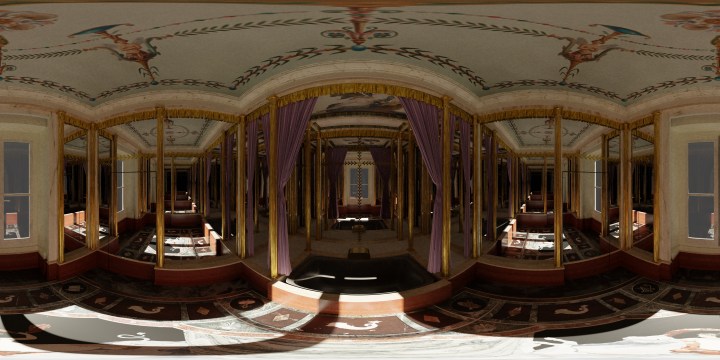
From the conference programme:
Historical Interiors and the Digital: The Possibilities and Limits of Virtual Reconstructions
Les intérieurs historiques et le numérique: possibilités et limites des reconstructions virtuelles pour la recherche
Online and in-person, Paris and Versailles, 17–18 November 2022
Colloque international organisé par Centre allemand d’histoire de l’art Paris, le Mobilier national et le Centre de recherche du château de Versailles
The virtual reconstruction of historical interiors—from architecture to wall decoration and furniture to textiles—has been a proven instrument of cultural mediation in recent years, particularly in museums, exhibitions and/or for the study of historical monuments (for instance in archaeology). Questions of spatial proportions and fundamental architectural units are today at the forefront, with emphasis often placed on the possibility of visiting these spaces virtually, either on a 2D screen or with an immersive headset.
However, when it comes to the recreation of the aesthetic characteristics of interiors, which are one of the key issues for their understanding, the possibilities of these new models seem limited. Depending largely on the harmonious interaction of different materials such as woods, metals, and textiles, as well as the structures of their respective surfaces, the nuances of colour or gold, or even the traces of artisanship, the existing solutions in rendering the materiality of an historic interior remain insufficient, both aesthetically and scientifically. The hope to swiftly overcome the excessively sanitized surfaces of digital models, expressed in 2013 (Kohle 2013, p. 166), has not yet come to fruition. Nevertheless, there is more to it than that, as the possibilities of using virtual reconstruction effectively for researching historical interiors—for example, through the virtual insertion of materials that are no longer ethically justifiable or prohibited today—are not fully exploited.
Focusing on the possibilities and limits of virtual reconstructions of historical interiors, of which questions of materiality are only one aspect, this conference highlights the fundamental issues that occupy current research. To attend in person or online on Wednesday, November 16 and Thursday, November 17, please email interieursetnumerique@dfk-paris.org. To attend the day on Friday, November 18 at Versailles (in person or online), registration is compulsory and free here.
W E D N E S D A Y , 1 6 N O V E M B E R 2 0 2 2
Centre allemand d’histoire de l’art Paris, salle Julius Meier-Graefe
18.30 Conférence inaugurale et discussion
Realism or Believability? The Production of Sensation in Animated Films – Bill Kinder, Boxcar Pictures, Berkeley/Paris
T H U R S D A Y , 1 7 N O V E M B E R 2 0 2 2
Centre allemand d’histoire de l’art Paris, salle Julius Meier-Graefe
9.30 Accueil par Peter Geimer, Directeur du Centre allemand d’histoire de l’art Paris
9.45 Présentation du colloque par les organisateurs
10.00 Études de cas et questions de recherche (1)
Modération : Muriel Barbier, Conservateur en chef du patrimoine, Mobilier national
• Digitally Recreating Lost Eighteenth-Century Irish Interiors: Challenges and Opportunities – Andrew Tierney, Department of the History of Art and Architecture, Trinity College Dublin
• De l’outil scientifique à l’« expérience de visite », le numérique à l’épreuve des enjeux de la restauration des appartements des ducs de Lorraine au château de Lunéville – Thierry Franz, Musée du château de Lunéville
• Restituer les palais impériaux napoléoniens : un défi technique et historique – Philippe Le Pareux, lycée de Valognes (Manche)
• ExploVision présente la première plateforme de consultation et d’échange autour du mobilier patrimonial – Philippe Dechenaux, Explovision
14.15 Galeries et artisanat
• La reconstitution 3D des galeries d’exposition du Garde-Meuble de la Couronne : enjeux, difficultés et compréhension d’un espace disparu – Gatien Wierez, CREHS Université d’Artois
• The Virtual Museum: Digital Reconstructions of the Kongl. Museum at the Royal Palace in Stockholm – Johan Eriksson, Department of Art History, Uppsala Universitet
• Réflexions autour de la galerie disparue de l’hôtel de Noailles à Saint-Germain-en-Laye – François Gilles, UVSQ/ENS Cachan, with Paul Feytis; Louis-Joseph Lamborot; Gabriel Wick
F R I D A Y , 1 8 N O V E M B E R 2 0 2 2
Centre de recherche du château de Versailles, Auditorium, aile Dufour
9.00 Accueil par Mathieu da Vinha, Directeur scientifique du G.I.P. Centre de recherche du château de Versailles
9.15 Autres approches et apports de la 3D
Modération : Benjamin Ringot, G.I.P. Centre de recherche du château de Versailles
• Augmented Reconstruction: On Introducing a Novel Reconstruction Method for Simulating Material and Materiality Using Mixed Realities – Clemens Brünenberg, TU Darmstadt, Department of Architecture, Institute of Classical Archaeology
• Au-delà de l’illustration. Quand des étudiants de licence apportent une contribution à la recherche – Nicolas Priniotakis, Cergy-Paris Université
11.00 Études de cas et questions de recherche (2)
Modération : Benjamin Ringot, G.I.P. Centre de recherche du château de Versailles puis Michel Jordan, laboratoire ETIS – CY Cergy Paris Université / ENSEA / CNRS
• Florence4D – Fabrizio Nevola, Chair of Art History and Visual Culture, University of Exeter
• Reconstitution 3D d’espaces intérieurs de trois domaines royaux : Versailles, Marly, Choisy – Hubert Naudeix, Aristeas
• Reconstitution d’un séjour d’Auguste le Fort à Moritzburg à l’hiver 1728 – Edouard Lussa, Histovery
15.15 Au-delà de la reconstitution 3D
Modération : Michel Jordan, laboratoire ETIS – CY Cergy Paris Université / ENSEA / CNRS
• Experimental Virtual Archaeological-Acoustics: Bringing together Physical, Computer, and Social Science Researchers – Brian Katz, Sorbonne Université, CNRS, UMR 7190
• Sacred Sound / Sacred Space: In Search of Lost Sound, Virtual Acoustic-Visual Reconstruction of Sacred Spaces of the Middle Ages – Stefan Morent, Department of the Institute of Musicology, University of Tübingen
• Reproduire l’histoire: Multi-Sensory Reconstructions of Historical Interiors for Virtual Reality – James Hutson and Trenton Olsen, Lindenwood University, Missouri
17.45 Conclusions
Conference | The Horse and the Country House

John Frederick Herring, Sr., Grey Carriage Horses in the Coachyard at Putteridge Bury, Hertfordshire, 1838, oil on canvas, 102 × 127 cm
(New Haven: Yale Center for British Art)
◊ ◊ ◊ ◊ ◊
From The Attingham Trust:
The Horse and the Country House: Art, Politics and Mobility
Online and In-person, Institute of Continuing Education, Madingley Hall, Cambridge, 18–19 November 2022
The Attingham Trust is organising a stimulating two-day conference in Cambridge focused on the horse and the country house. Following on from the successful Attingham Study Programme in 2018, issues and themes relating to the equestrian culture associated with these houses will be explored by an international panel of speakers.
Horses, once so vital to the smooth functioning of the country house in England, have, more recently, been marginalized and even omitted from discussions. Existing stable blocks are seldom used for their original purposes and the signs of the working horse and horse-drawn transport are often hard to find. Inside houses, the legacy of the horse in the form of sporting art and racing trophies is more evident, but rarely examined. The conference will encourage a wide-ranging assessment of the many roles played by horses in country house life. From sporting art and memorabilia, riding dress and horse tack, carriage design, stables and stable servants, mobility and horseracing, it will explore the ways in which the horse has been central to the artistic, social, cultural, and political functions of the country house.
Following an overwhelming response to the call for papers, the advisory committee has selected a varied list of international speakers including representatives of major museums, universities, and historic houses. Spread over the two days, there will be sessions on horse welfare, the employment of stable servants, social mobility, women riders and drivers, and the visual representation and material culture of horses.
Madingley Hall is a beautiful sixteenth-century country house and garden. Built by Sir John Hynde in 1543, and occupied as a residence by his descendants until the 1860s, the Hall is now owned by the University of Cambridge. It is close to the centre of town, with free parking available onsite. Specially discounted B&B rates are available if you would like to stay at Madingley Hall. To take advantage, please email reservations@madingleyhall.co.uk quoting “horse and the country house conference.”
In person tickets are now sold out, but the conference will be live-streamed thanks to the generous sponsorship of the Carriage Association of America. Tickets are available for purchase here. If you would like to be placed on a waiting list for in-person tickets, please email rebecca.parker@attinghamtrust.org.
F R I D A Y , 1 8 N O V E M B E R 2 0 2 2
9.00 Registration
9.30 Welcome from Helen Jacobsen (Attingham Trust)
9.35 Introduction
• Elizabeth Jamieson (Attingham Trust) — The Horse and the Country House: An Untold History
10.00 Session 1 | The Domesticated Horse: Horse Welfare and Care of Servants
Chair: Christopher Garibaldi (University of Cambridge)
• Jana Schuster (University of Cambridge) — Transport Innovations, Stables, and Animal Welfare of the 2nd Duke of Montagu, 1709–49
• Jessica Dallow (University of Alabama, Birmingham) — Architecting Horses and Buildings: Stable Design and Culture at John Hartwell Cocke’s Bremo
• Frances Bailey (National Trust) — Chariots and Gold Cups, Tails and Hooves, Hermit and Hambletonian: The Lives of the Londonderry’s Horses
• John Stallard (Carriage Association of America) — The Pride of the Country House Stable: Carriages for Sport
11.30 Coffee Break
12.00 Session 2 | Evidence of the Horse: Architectural, Visual, and Textual
Chair: Michaela Giebelhausen (Courtauld Institute)
• Julian Munby (Independent Scholar) — Horse and Carriage in Town and Country: Sources and Issues
• Christopher Garibaldi (University of Cambridge) — Evidence of the Architectural History of the Royal Palaces of Newmarket in Paintings by Jan Siberechts and John Wootton
• Adam Menuge (University of Cambridge) — Blickling’s Early 17th-Century Stables Revisited
• Aurore Bayle-Loudet (Hermès) — Hermès and Horses, 1837–1914: A Story of Patrons and Muses
1.30 Lunch Break
2.30 Session 3 | Places for Horses: Old Buildings, New Life
Chair: Elizabeth Jamieson (Attingham Trust)
• Alexandra Lotz (State Office for Heritage Management and Archaeology, Saxony-Anhalt) — The Stables of the Garden Kingdom of Dessau-Wörlitz: New Life for Historic Buildings
• Sally Goodsir (Royal Collection Trust) — Creating and Curating the Royal Mews, Buckingham Palace
• Allesandra Griffo (Uffizi Galleries) — The Carriage Museum in the Stables of the Pitti Palace
• Paula Martin (Harewood House Trust) — The Horse at Harewood
• Phillippa Turner (National Trust) — The National Trust Carriage Museum at Arlington Court, Devon
• Thomas Reinhart (George Washington’s Mount Vernon) — The Mount Vernon Stables
3.45 Tea Break
4.15 Panel Discussion
5.30 Drinks Reception
S A T U R D A Y , 1 9 N O V E M B E R 2 0 2 2
9.30 Coffee and registration for new delegates
10.00 Session 4 | Horsepower: Politics, Social Mobility, and Fashion
Chair: Oliver Cox (Victoria and Albert Museum)
• Sophie Chessum (National Trust) — Horse Racing and the Onslows of Clandon Park: A Case Study in Politics, Business, and the Country
• Jon Stobart (Manchester Metropolitan University) — Clergy and Carriages: The Place of the Horse in the Late Georgian Parsonage
• Emma Lyons (University College, Dublin) — Racehorses, Gambling, and Equestrian Buildings of Sir Edward O’Brien of Dromoland
• Maria-Anne Privat (Château de Compiègne) — Anglomania and French Horse-Drawn Carriages
11.30 Short Break
11.45 Session 5 | Women and the Horse: Riders, Hunters, and Carriage Drivers
Chair: Frances Bailey (National Trust)
• Erica Munkwitz (American University) — Country Contentments: Women, Hunting, and the English Countryside
• Helena Esser (Independent Scholar) — Horse-Riding and Gender in the Victorian Popular Imagination
• Charlotte Newman (National Trust) — Equine Adventures and Constructions of Femininity at Lanhydrock House, Cornwall
• Whitney White (Pebble Hill Plantation) — Elisabeth ‘Pansy’ Ireland Poe: An Extraordinary American Equestrienne
1.15 Lunch Break
2.15 Session 6 | The Commodification of the Horse: Visual Representation and Culture
Chair: Lydia Hamlett (University of Cambridge)
• Sebastian Edwards (Historic Royal Palaces) — The Horse from Hanover: The Role of the Horse and Equine Sport in the Court Culture of Kings George I and II
• Timothy Cox (British Sporting Art Trust) and Karen Hladik (Independent Scholar) — The Mysterious Case of Sir T.S. Bonnet and his Horse ‘Swallow’
• Michaela Giebelhausen (Courtauld Institute of Art) — The Trouble with George Stubbs: More than Just a Horse Painter
• Alexandra Mayson (University of Oxford) — ‘Extraordinary Sagacity’: Representations of Arab Horses and Arabic Horsemanship in Four Horseracing Prizes from the 1830s
• Sheila O’Connell (Independent Scholar) — Magnificent or Comic: Horses and Riders in Prints
4.10 Closing Remarks and Tea
Conference | Asian Art in the World
From the conference website:
Asian Art in the World: Historical Influences on Culture and Society
Lisbon, Portugal, 24–26 November 2022
 This three-day conference will highlight the important contribution made by Asia to world art and universal civilisation, from the remote ages of the Silk Road, and its land and sea routes, to the modern age of globalisation. Guest speakers will present comprehensive and partial perspectives of the strong or enduring ties and links established among the various regional Asian cultures present at any one time in history. These include the economic and cultural bonds that every single one of them forged with the Western cultures they came across, commencing from the period of the Roman Empire until the end of the Middle Ages and then from the first globalisation to the present day. Finally, it is our intention to show the huge prestige afforded to the many artistic cultures of Asia in the Western world. This was based primarily on admiration for their outstanding technical skills as seen in the use of a variety of materials, some of them unknown in the West, but also on general acknowledgment of the exemplary capacity to imaginatively reinvent motifs, narratives and symbolisms shown in these works of art, not to mention the many scenarios and rituals underlying those artistic manifestations, ranging from the visual and decorative arts to the performing arts.
Speaker information and abstracts are available here»
T H U R S D A Y , 2 4 N O V E M B E R 2 0 2 2
Museu Calouste Gulbenkian
9.10 Registration
9.50 Jorge Welsh, Opening Remarks
10.00 Morning Session
• Jorge Santos Alves, Fernão Mendes Pinto’s ‘Malay Mediterranean’: An Asian Geopolitical Concept in a Modern Europe Bestseller?
• Fernando A. Baptista Pereira, Identifying Indo-Portuguese Art and Its Impact in Worldwide Collections
• Brigitte Nicolas, From China to Chinoiserie: The Example of the Chinese Fan Trade and Its Legacy
• Li Zhongmou, Recent Discoveries, Exhibitions, and Researches on the Silk Roads in Mainland China
13.10 Lunch Break
14.40 Afternoon Session
• Cora Würmell, Asia in Dresden: Augustus the Strong’s Exceptional Porcelain Collection
• Clement Onn, A Transpacific Cabinet
• Nuno Senos, Asia in Portuguese Homes in the 16th Century
F R I D A Y , 2 5 N O V E M B E R 2 0 2 2
Museu do Oriente
10.00 Morning Session
• Christiaan Jörg, Functional Beauty: Japanese Lacquer and Porcelain for Europe
• Alexandra Curvelo, The Circulation of Folding Screens in the Early Modern World
• Sonia Ocaña-Ruiz, Novohispanic Enconchados: The Impact of Namban Lacquer and Beyond
• Maureen Cassidy-Geiger, Deciphering Asian Forms and Motifs in European Porcelain from the Meissen Manufactory
13.10 Lunch Break
14.40 Afternoon Session
• Alexandre Pais, The Blue, and the Binding Sea: Influences and Dissemination of Portuguese 17th-Century Ceramics
• Cristina Castel-Branco, Eastern Voyages and the Fascination of Exotic Gardens
• Rossella Menegazzo, Japanese Aesthetics in Western Contemporary New Perspectives of Space, Materials, and Colour
S A T U R D A Y , 2 6 N O V E M B E R 2 0 2 2
Museu Nacional de Arte Antiga
10.00 Morning Session
• William R. Sargent, America and China: ‘Adventurous Pursuits in Commerce …’
• Tianlong Jiao, Linking Asia and Beyond: Presenting Chinese Arts with a New Perspective
• Francisco Clode, The Archipelago of Madeira in the Context of the Portuguese Maritime Expeditions: Casa Colombo-Museum of Porto Santo
• Maria Antónia Pinto de Matos, From China to the World: Ceramics and Tea, Two Age-Old Commodities
13.10 Lunch Break
14.40 Afternoon Session
• Jessica Hallett, Crossing Cultures, Crossing Time: China, Iraq and Europe, c. 800
• Francisco Capelo, A Traveller’s Eye, 25 Years Travelling in Asia
• Valentina Bruccoleri, From the Royal Banquet to the ‘Porcelain House’: Use and Display of Chinese Porcelain in the Islamic World
Organized by Jorge Welsh Research & Publishing, the conference is sponsored by Barta & Partner, Câmara Municipal de Lisboa, Fundação Carmona e Costa, Fundação Oriente, Museu Calouste Gulbenkian, Santa Casa da Misericórdia de Lisboa, and Sapientia Foundation.
Supported by Apollo Magazine, Fundação Medeiros e Almeida, Museu Nacional de Arte Antiga, Orientations Magazine, Secretaria Regional de Turismo e Cultura da Madeira, and The Art Newspaper.
Symposium | Early Modern Global Political Art
From the Krannert Art Museum:
Early Modern Global Political Art
In-person and online, Krannert Art Museum, University of Illinois, Urbana-Champaign, 20–21 October 2022
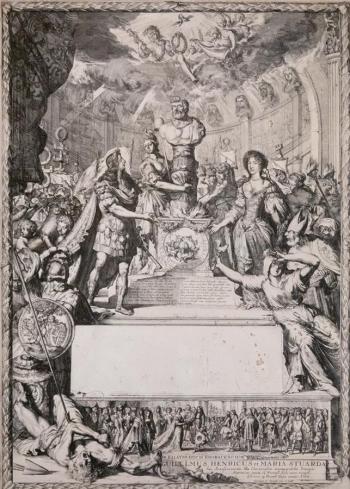
Romeyn de Hooghe, Marriage of William and Mary, 1677, etching (Krannert Art Museum, 2019.7.7).
Featuring emerging scholarship on the art of this period against the backdrop of the exhibition Fake News & Lying Pictures: Political Prints in the Dutch Republic, Krannert Art Museum hosts a symposium on Early Modern Global Political Art.
In the early modern period, nations, nobles, corporations, religious groups, and others found dynamic and innovative ways to use the visual arts for a wide range of political purposes. Nations dispatched elaborate diplomatic gifts to initiate and consolidate alliances. Aristocratic powers and individual collectors alike amassed collections to convey and enhance their political and economic power. Courts and cities produced ephemeral decorations to assert and display ideal political relations between nobility and their subjects, and between regional and outside authorities. Broadsheets addressing factional conflicts within and among institutions proliferated with the expansion of affordable print media. This symposium will investigate visual media that communicated political ideas, arguments, positions, and forms of resistance in the early modern period.
The event will be hybrid, blending in person presentations with online presentations via Zoom to facilitate greater accessibility and wider participation. All virtual components will be live captioned in English via Zoom. If you have a question or an accessibility request, please email us at kam-accessibility@illinois.edu. Registration is required for virtual and in-person components of the symposium.
Keynote Speakers
Dawn Odell (Lewis & Clark College) — Dr. Odell studies artistic exchange between China and northern Europe in the 17th and 18th centuries. She is currently writing a book on Andreas Everardus van Braam Houckgeest, an 18th-century Dutch Immigrant to the newly formed United States whose travelogues and Chinese porcelain collection were leveraged for social and political power.
Liza Oliver (Wellesley College) — Dr. Oliver’s research focuses on 18th- and 19th-century India, Europe, and the West Indies. Her current projects include the book Empire of Hunger: Representing Famine, Land, and Labor in Colonial India and work about British prints about abolition and the Haitian Revolution.
T H U R S D A Y , 2 0 O C T O B E R 2 0 2 2
9.00 Catholic Rulership around the World, Part One
• Moyun Zhou (PhD Candidate, University of Hong Kong), Can You Feel Me? The Global Space of St. Paul’s in Macao, 1592–1644
• Maria Vittoria Spissu (Senior Assistant Professor, University of Bologna and Marie Skłodowska-Curie Global Fellow), Bonds and Tenets in the Wider Iberian Catholic Universe: Fostering Political Unanimity by Means of Early Modern Altarpieces and Books
• Małgorzata Biłozór-Salwa (Curator of Old Master Drawings, University of Warsaw Library), Let’s Make A Crusade! Power of Images Under Louis XIII
10.20 Fashion, Part One
• Isabel Escalera (PhD Candidate, University of Valladolid), Jewelry as A Political Instrument: Renaissance Women and the Transmission of Their Power
• Diana Lucía Gómez-Chacón (Faculty, Complutense University of Madrid), Fashion as A Political Art: Gender, Monarchy, and Spectacle in Early Modern Castile
11.15 Negotiating Political Power in Republics
• Răzvan-Iulian Rusu (Graduate Student, Utrecht University), Global Gifts of Johan Maurits: Patronage, Image-Formation, Art & Material Culture
• Laura Blom (Postdoctoral Fellow, Dutch University Institute for Art History, Florence), Death as Dissent: The Macabre and the Medici in Renaissance Florence
5.30 Keynote Lecture
• Liza Oliver (Associate Professor of Art, Wellesley College), An Economy of Sentiment: The Shared Language of Abolitionists and the West India Interest in Late 18th-Century British Print Culture link»
This talk considers how spectatorial sympathy, a governing principle of 18th-century British art and literature, was deployed by opposing sides of the debate on Britain’s slave trade in the decades preceding its abolition. Considering broadsides, travel narratives, and caricatures, it argues for the ways in which sentiment became a common visual currency among both abolitionists and the pro-slavery lobby, with each side respectively seeking to sever or reaffirm the connection between morality on the one hand and self-interest and economic prosperity on the other.
F R I D A Y , 2 1 O C T O B E R 2 0 2 2
9.30 Coffee
10.00 Catholic Rulership around the World, Part Two
• Rachel Wise (2020 PhD in Art History, University of Pennsylvania), A Royal Devotion: Printed Habsburg Propaganda and the 80 Years’ War
• Angela Ho (Associate Professor, George Madison University), Risks and Payoffs: Ferdinand Verbiest’s World Map for Kangxi in Political Context
11.00 Fashion, Part Two
• Heather Hughes (Curator of Prints, Philadelphia Museum of Art), Recognizing the Enemy: The Spaniard in Dutch and Flemish Costume Prints
• Nancy Karrels (2022 PhD in Art History, University of Illinois Urbana-Champaign), Women for Bonaparte: Political Prints and Female Self-Fashioning in France’s Cultural Conquests
12.00 Lunch Break
1.30 Keynote
• Dawn Odell (Associate Professor of Art History, Lewis & Clark College), The Politics of Personhood in A.E. Van Braam Houckgeest’s China Memoir link»
Following his participation in the Dutch East India Company’s last embassy to the Chinese court (1794–95), A.E. van Braam Houckgeest moved to Philadelphia with an enormous personal collection of Chinese art. This talk explores van Braam’s self-fashioning through his collaboration with two unnamed Guangzhou artists and the French émigré printer and defender of race-based slavery, M.L.E. Moreau de Saint-Méry. The illustrated memoir these men produced places van Braam’s textual narrative within an expansive visual environment of Chinese landscape paintings and other works of Asian art, conjuring artistic presences as testaments to the author’s self-proclaimed virtue, prestige, and republican ideals.
3.00 Tour of Fake News and Lying Pictures: Political Prints in the Dutch Republic
◊ ◊ ◊ ◊ ◊
From the Krannert:
Fake News & Lying Pictures: Political Prints in the Dutch Republic
Krannert Art Museum, University of Illinois, Urbana-Champaign, 25 August — 17 December 2022
Curated by Maureen Warren
 Comedians, editorial cartoons, and memes harness the power of satire, parody, and hyperbole to provoke laughter, indignation—even action. These forms of expression are usually traced to eighteenth-century artists, such as William Hogarth, but they are grounded in the unprecedented freedom of artistic expression in the seventeenth-century Dutch Republic.
Maureen Warren, ed., with contributions by Wolfgang Cillessen, Meredith McNeill Hale, Daniel Horst, Maureen Warren, and Ilja Veldman, Paper Knives, Paper Crowns: Political Prints in the Dutch Republic (Champaign: Krannert Art Museum, 2022), 184 pages, ISBN: 978-1646570294, $40.
Symposium | The Fabric of the Spanish Americas

Domestic Landscape from Quito, in Jorge Juan and Antonio de Ulloa’s Relación histórica del viage a la América Meridional (Madrid: A. Marin, 1748). Benson Latin American Collection, LLILAS Benson Latin American Studies and Collections, The University of Texas at Austin.
◊ ◊ ◊ ◊ ◊
From the Blanton Museum of Art:
The Fabric of the Spanish Americas
Online, Friday, 21 October 2022
Organized in conjunction with the exhibition Painted Cloth: Fashion and Ritual in Colonial Latin America, on view at the Blanton Museum of Art at The University of Texas at Austin, this symposium will bring together scholars from Colombia, Mexico, the United Kingdom, and the United States to further explore the social role of textile arts in colonial Latin America. The keynote will be delivered by Dr. Elena Phipps, and speakers include historians Tamara Walker and Meha Priyadarshini, along with fashion historian James Middleton. The round table discussion will feature art historians Laura Beltrán-Rubio, Martha Sandoval, and Leslie Todd. Registration is available here.
P R O G R A M M E
Central Time
9.00 Keynote
• Elena Phipps (Independent Scholar), Garments and Identity: Textile Traditions in the Global World of Colonial Latin America
10.00 Morning Panel
• Tamara Walker (Barnard College), Fashioning Whiteness in Colonial Latin American Art
• James Middleton (Independent Scholar), They All Greatly Affect Fine Clothes: Textiles in Eighteenth-Century Lima-School Painting
• Meha Priyadarshini (University of Edinburgh), Global Trade, Local Fashion: The rebozo, piña and mantón de Manila
11.30 Q&A
12.00 Intermission
1.30 Round Table Discussion: Artifice in Fashion, Painting and Sculpture
• Laura Beltrán-Rubio (Universidad de los Andes), The Artifice of Fashion: Creating and Performing Identities through Clothing in Colonial Spanish America
• Martha Sandoval-Villegas (Instituto Tecnológico de Estudios Superiores de Occidente, ITESO), Habit Makes the Man… and the Woman: Portrait and New Spain Social ‘Fabric’
• Leslie Todd (Sewanee: The University of the South), The Brilliance and Brocateado of Eighteenth-Century Sculpture in Quito










 Enfilade
leave a comment