Conference | Listening In: Architectures, Cities, and Landscapes
From the conference website:
Listening In: Conversations on Architectures, Cities, and Landscapes, 1700–1900
ETH Zürich, Hönggerberg and Zentrum campus, 13–15 September 2023
 Who do we listen to when we write histories of architectures, cities, and landscapes? How many women authors can we find among our sources? How many of them are cited by those whose research we read? We argue that women and other marginalised groups have always been part of conversations on architectures, cities, and landscapes—but we have not had the space to listen to them. This conference is an invitation to reconstruct such conversations, real, imagined, and metaphorical ones, taking place in the 18th and 19th centuries, in any region, in order to diversify the ways we write histories. Taking the art of conversation, integral as both practice and form to the period in Western thought, and repurposing it to dismantle the exclusivity of historiography, this conference calls for contributions which bring women into dialogue with others.
Listening In proposes a new approach to the ‘canon’ and its protagonists. Rather than either fighting its existence or expanding it by means of ‘exceptions to the rule’, we call for the setting up of productive conversations. We acknowledge that the canon never exists on its own; instead, it is shaped by what Griselda Pollock has called “that which, while repressed, is always present as its structuring other” (1999, 8). This conference is envisaged as a listening exercise. We regard a conversation as both codified practice as well as a specific act of verbal exchange, spoken or written, on a particular subject—here architectures, cities, and landscapes—occurring in a specific site, from street to salon, kitchen to court, construction site to theatre, field to church, or book to newspaper, to name but a few.
Listening In is organised in the context of two externally funded research projects based at gta, ETH Zurich. Women Writing Architecture, 1700–1900 (WoWA) is funded by the ERC, led by Anne Hultzsch, and studies female experiences of architecture and landscapes as recorded in women’s writings from South America and Europe. The SNSF-funded project Building Identity: Character in Architectural Discourse and Design, 1750–1850, led by Sigrid de Jong and Maarten Delbeke, focuses on the uses and meaning of the notion of ‘character’ in architectural criticism and practice. Both projects share an interest in the experiences of marginalised groups, especially those who identified as women, and strive to have them heard not in a niche, but in the centre of our field. With this conference we wish to open up our approaches to a wider field of research, going beyond our respective geographical frameworks.
There will be a limited number of free audience tickets for our two-day conference. To register and for more information please visit our website.
This conference is part of a project that has received funding from the European Research Council (ERC) under the European Union’s Horizon 2020 research and innovation programme (Grant agreement No.949525).
Key Note Speakers
• Prof Mabel O. Wilson
• Prof Jane Rendell
Organised by
Group Anne Hultzsch and Professor Maarten Delbeke Chair, Institute for the History and Theory of Architecture (gta), ETH Zürich
Scientific Committee
Prof Maarten Delbeke, PD Dr Anne Hultzsch, Dr Sigrid de Jong, Dr Sol Pérez Martínez, Dr Nikos Magouliotis
Orginising Committee
Prof Maarten Delbeke, PD Dr Anne Hultzsch, Dr Sigrid de Jong, Dr Sol Pérez Martínez, Dr Nikos Magouliotis, Dr Noelle Paulson, Elena Rieger, Alejandra Fries
Symposium | Evoking the Incommensurable: Painting the Sublime

Philip James De Loutherbourg, An Avalanche in the Alps, 1803, oil on canvas, 110 × 160 cm
(London: Tate, T00772).
◊ ◊ ◊ ◊ ◊
From the conference website:
Evoking the Incommensurable: Painting the Sublime
In person and online, Friedrich Schiller University, Jena, 26–28 July 2023
Organised by Johannes Grave, Sonja Scherbaum, and Arno Schubbach
Collaborative Research Center (SFB) 1288 “Practices of Comparing,” Bielefeld University, and Research Center for European Romanticism, Friedrich Schiller University Jena.
In the 18th century, the concept of the sublime constitutes a genuine novelty and a driving force for advancements in the theoretical reflection on the arts throughout Europe. Edmund Burke and Immanuel Kant distinguished the sublime sharply from the beautiful, i.e., the traditional organizing subject of treatises on painting and literature, and emphasized its excessive strain on the senses, its incommensurability with any measure, and its irreducibility to any bounded shape. It thus constituted a harsh contrast to the beautiful and challenged the aesthetic values of pictorial or literary representation.
Moreover, the sublime was also a challenge to artistic practice. Theoretical discourse concerning the sublime often referred much more directly to our experience of nature than to our experience of artistic works. Particularly in the case of Kant, it was not evident that the arts are at all able to evoke anything sublime. Nevertheless, various attempts to paint the sublime can be seen in the genre of landscape painting. The sublime stimulated painters to push the limits of painting and to explore its capabilities anew.
The international conference Evoking the Incommensurable: Painting the Sublime will discuss the question of how artists purposefully explored and exploited the limits and capabilities of painting in order to evoke the incommensurable and paint the sublime. Participation is possible both on-site or via Zoom. Please register at paintingthesublime@uni-jena.de by 24 July 2023. The conference will be held in a hybrid format. Please let us know if you would like to attend in person or via Zoom.
w e d n e s d a y , 2 6 j u l y 2 0 2 3
13.00 Arrival and Registration
13.30 Welcome and Introduction
14.00 Panel 1
Chair: Johannes Grave
• Aris Sarafianos (Ioannina), Hard Imitation and the Sublime Real: Art, Exhibitions, Panoramas, Casts, and Displays at the Far Ends of Visibility, c. 1800
• Elisabeth Ansel (Jena), ‘Most Magnificent and Sublime’: Ossian, Blindness, and the Sublime in the Visual Arts
• Hélène Ibata (Strasbourg), Temporal Vertigo and the Historical Sublime in Turner’s Venice Paintings
17.30 Coffee Break
18.00 Keynote Lecture
• Robert Doran (Rochester), ‘Moving Us to Pity’: Visual Art and Sublimity in Burke, Du Bos, and Kant
20.00 Conference Dinner
t h u r s d a y , 2 7 j u l y 2 0 2 3
9.15 Welcome
9.30 Panel 2
Chair: Mira Claire Zadrozny
• Yvon Le Scanff (Paris), Victor Hugo, ‘Bringing out the Sublime’
• Caroline van Eck (Cambridge), The Animal Sublime, c. 1800
• Sarah Gould (Paris), Mary Somerville’s Scientific Sublime: Picturing the Immaterial
13.00 Lunch Break
14.30 Panel 3
Chair: Britta Hochkirchen
• Laure Cahen-Maurel (Bonn), Viewing beyond the Visible: The Power of the Imagination from the Kantian to the Romantic Sublime
• Mark Cheetham (Toronto), The Incommensurability of Arctic Sublimity: Environmental Stereotypes and the Specificity of the Sublime
• Craig Hanson (Grand Rapids), Before & After: Temporal Strategies for Effecting the Sublime
19.30 Reception at Schillers Gartenhaus
f r i d a y , 2 8 j u l y 2 0 2 3
9.15 Welcome
9.30 Panel 4
Chair: Arno Schubbach
• Marie-Louise Monrad Møller (Leipzig), Pauelsen, Dahl, Lundbye: Aspects of the Sublime in Scandinavian Landscape Painting
• Adèle Akamatsu (Paris), Fjords, Waterfalls and High Mountains: Painting the ‘Rough’ and ‘Grand’ Landscapes of Norway from Germany, 1820s–1860s
• Nikita Mathias (Oslo), Painting the Sublime beyond Painting: From the Easel to the Cinema
13.00 Concluding Discussion
Symposium | Belatedness and Historiographies of N. American Art
The last event in the Belatedness and North American Art series, from The Courtauld:
Belatedness and Historiographies of North American Art
Courtauld Institute, Vernon Square Campus, London, 16–17 June 2023
Focused on historiographies of North American Art, the symposium asks, how has belatedness shaped the historiography of the arts of North America? How have projections of belatedness shaped the inclusion or exclusion of African American, Latinx, Caribbean, and Native American art in the canon of ‘American art’, as well as art from regions outside the Northeast? How have the arts of Canada and Mexico been framed in dialogue with the art of the United States? Has visual studies recentred these hierarchies? In the context of the United States, how has the discipline’s emergence in dialogue with the American Mind school of American studies continued to shape the sub-field’s relationships with the wider field and canons of the history of art? How have narratives of modernist progress in abstraction shaped critics’ constructions of belatedness around artists who retain figuration? How have artists operating outside geographic and cultural ‘centres’ of art production taken up, mimicked, or inverted expectations of cultural belatedness?
Abstracts and registration information can be found here»
F R I D A Y , 1 6 J U N E 2 0 2 3
12.45 Registration
1.15 Welcome and Introductory Comments
1.30 Session 1 | Belatedness as Difference
• Emmanuel Ortega — From New Spain to Mexico, Belatedness as a Tool of Empire
• Alexis L. Boylan — Always Late to the Party: North American Art, Science, and Epistemological Anxiety in the Twentieth Century
2.45 Coffee Break
3.15 Session 2 | Belatedness as Positionality
• Jessica L. Horton — Tipi and Dome: Indigenous Futurism at Expo 70
• Leon Wainwright — Between the United States, Britain and the Caribbean: A Historiography of Belatedness
4.30 Reception
S A T U R D A Y , 1 7 J U N E 2 0 2 3
10.00 Registration
10.30 Welcome and Introductory Comments
10.45 Session 3 | Belated Inclusions
• Elizabeth Hutchinson — When Did Indigenous Art Become ‘American’?
• Tanya Sheehan — American Art Historiography, Slavery, and Its Aftermath
12.00 Lunch Break
1.30 Session 4 | Belatedness and American Art Histories
• Juliet Sperling — The Late Jacob Lawrence
• Martha Langford — Belatedness, Near and Far
• Nicholas Robbins — ‘Yet-to-be-dismantled’: Elizabeth Bishop and Winslow Homer in 1974
3.15 Concluding Remarks
Symposium | Rethinking Methodologies in British Art Research
From the Mellon Centre and Eventbrite:
Expanding the Field: Rethinking Methodologies in British Art Research
Online and in-person, Paul Mellon Centre, London, 23 June 2023
This hybrid event has been programmed by the Early Career Researchers Network (ECRN) and Doctoral Researchers Network (DRN). All interested parties are welcome to attend. You can find out more about the networks here.
This annual symposium offers an opportunity for doctoral and early career researchers to share and discuss their research creative methods, varied approaches, ethics, and methodologies on topics related to British art and art history (broadly defined). By questioning ‘how we come to know what we know’, we aim to reflect on the current possibilities, dilemmas, and challenges in academic research, participatory engagement, or creative practice. Join us to hear from speakers presenting on a variety of topics that cover decolonial, postcolonial, feminist, or queer perspectives; address the impact of quantitative and data-driven methodologies; report on practice-based, curatorial, or collaborative research; or reflect on the role of different media, including digital, audio, and filmmaking.
Travel grants are available for DRN and ECRN members travelling to London from within the UK to join us for the day. Please contact us at doctoralresearchers@gmail.com to be considered for a travel grant.
P R O G R A M M E
10.00 Opening Remarks
10.15 Panel 1 | Transnational Identities
Chair: Lauren Houlton (University of Westminster)
• Rahila Haque (University of the Arts, London) — In Rehearsal: A Methodology for Diasporic Feminist Worlds
• Helena Cuss (Kingston University) — Transnational Art Markets, 1948–57
• Excellent Hansda (University of Liverpool) — Exploring Modern Identity in Twentieth-Century Residential Architecture in Mumbai through ‘Contrapuntal Reading’
• Lucy Shaw (University of Birmingham) — Travel, Sexuality, and Nation in John Minton’s Post-War Work
11.35 Break
11.50 Panel 2 | Perception, Practice, and Participation
Chair: Alex Gushurst-Moore (University of Cambridge)
• Layla Khoo (University of Leeds) — Exploring Practice-based Methodologies in Creating and Evaluating Participatory Contemporary Art within Heritage Sites and Collections
• Antonio Capelao (University College London) — Our Children Will Change the Built Environment
• Adam Benmakhlouf (University of Dundee, Dundee Contemporary Arts) —‘The Work before the Work’
• Alex Culshaw (Arts University Bournemouth) — Listening Lounge Q&A
1.10 Lunch
2.00 Panel 3 | Reconsidering Visual Culture (Virtual)
Chair: Claudia di Tosto (University of Warwick and The Paul Mellon Centre)
• Lea Stephenson (University of Delaware) — Egyptomania, Experiential Research, and the Senses
• Sonal Singh (University of Delhi) — Colonial Cities in British Art, Late Eighteenth to Mid-Nineteenth Century
• Jessica Johnson (University of Oregon) — Of the Wrong Class and Complexion: James Northcote’s Ira Aldridge as Othello, the Moor of Venice
• Tania Cleaves (University of Warwick) — The Ethics of Exclusion: On (Not) Representing Photographs of Child Nudists
• Nora Epstein, (Independent Scholar) — Carving New Lines of Investigation: Material and Digital Methods for Tracing the Use of Tudor Relief Blocks
3.35 Break
3.50 Panel 4 | Creation: Media, Technology, and Representation
Chair: Nick Mols (Welsh School of Architecture, Cardiff University)
• Dawn Kanter (The Open University) — A Digital Approach to the Portrait Sitting in Enhancing Knowledge and Understanding of British Portraiture, 1900–1960
• Clare Chun-yu Liu (Manchester Metropolitan University) — Reinterpreting English Chinoiserie from a Postcolonial Perspective through Fiction Filmmaking / Trailers for Clare Chun-yu Liu’s films: This is China of a Particular Sort, I Do Not Know (trailer) and Another Beautiful Dream (trailer)
• Richard Müller (University College London) — Depictions of the Para-City: Art and Practice as Methodology in Informal Taiwan
4.50 Closing Remarks
5.00 Reception at the Paul Mellon Centre
Conference | HECAA@30
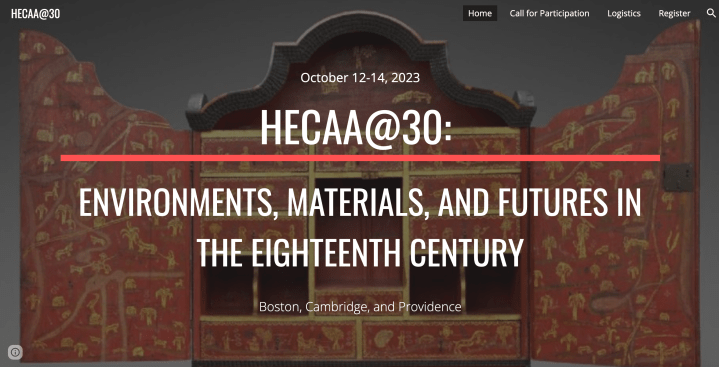
Registration is now open! It’s an extraardinary programme with terrific small session offerings. If you’ve not (yet) been part of HECAA, please know that you would be very welcome—whether you’re an academic, a museum or heritage professional, or simply someone interested in the eighteenth century. –CH
From the conference website:
HECAA@30: Environments, Materials, and Futures in the Eighteenth Century
Boston, Cambridge, and Providence, 12–14 October 2023
On the land of the Massachusett and neighboring Wampanoag and Nipmuc peoples, Boston developed in the eighteenth century as a major colonized and colonizing site. Its status today as a cultural and intellectual hub is shaped by that context, making it a critical location to trace the cultural legacies of racism and social injustice between the eighteenth century and today. For whom is ‘eighteenth-century art and architecture’ a useful category? What eighteenth-century materials, spaces, and images offer tools or concepts for shaping our collective futures? This conference marks HECAA’s 30th year as a scholarly society dedicated to facilitating communication and collaboration among scholars of eighteenth-century art to expand and promote knowledge of all aspects of the period’s visual culture.
The standard registration fee is $125; the discounted fee is $30. HECAA membership is required of all conference attendees. And please consider making a contribution to help cover travel costs for unfunded colleagues. Register here.
T H U R S D A Y , 1 2 O C T O B E R 2 0 2 3
Morning Panels at Bartos Auditorium, List Visual Arts Center, MIT, Cambridge
8.00 Registration
9.00 Introduction
9.15 Panel: Timing Aesthetics and the Aesthetics of Time
Chairs: Megan Baker (University of Delaware) and Joseph Litts (Princeton University)
• Carole Nataf (Courtauld Institute of Art), Shell Grottos and the Aesthetics of Deep Time in Georges-Louis Leclerc de Buffon’s Theories of the Earth
• Elizabeth Bacon Eager (Southern Methodist University), Peter Hill’s Regulator: Considering the Materiality of Time in the Context of American Slavery
• Daniella Berman (Institute of Fine Arts, New York University), Mismatched and Out of Time: Aesthetics of Contingency in 1800
• Lea C. Stephenson (University of Delaware), Reviving the Alabaster Portrait: J.P. Morgan’s Eighteenth-Century Collection and Whiteness
10.30 Coffee
11.00 Roundtable Panel: What’s Race Got To Do With It? Part I
Chair: Karen Lipsedge (University of Kingston)
Respondent: Victoria Barnett-Woods (Loyola University, Maryland)
• Stephen Hague (Rowan University), A Long S-Shaped Shadow from in the Long Eighteenth Century
• Lisa Vandenbossche (University of Michigan), Oceans of (In)stability: Race and Gender from Shore to Sea
• Chloe Wigston Smith (University of York), Race, Material Culture, and Women’s Work
• Adrienne L. Childs (Independent Scholar), Ornamental Blackness: What, Why, So What?
• Laura Keim (Stenton Historic House), Granting Her Requests: Dinah’s Freedom, Dinah’s Family, Dinah’s Place
12.30 Lunch
2.30 Afternoon Small Group Sessions in and around Cambridge
Sign up during conference registration.
House Tour and Roundtable Session | What’s Race Got to Do with It? Part II
Royall House and Slave Quarters (15 George Street, Medford)
Chair: Karen Lipsedge (University of Kingston)
Respondent: Kyera Singleton (Royall House and Slave Quarters)
• Nuno Grancho (Centre for Privacy Studies, Copenhagen), Domestic Space, Race and Gender in the Eighteenth-Century Danish Colonial Home
• Laura Engel (Duquesne University), The Paradox of Pearls: Gender, Race, Embodiment, and Domestic Space
• Caroline Fowler (Williams College, The Clark Art Institute), Privacy
• Sarah Lund (Harvard University), Republican Motherhood and Republican Equality: Female Engravers and the ‘Ideals’ of the French Revolution
• Tori Champion (University of St. Andrews), Race, Liminality, and the Floral Garland in French Portraiture
Object Session and Panel | For a Better Future: Networks of Pastel Painting
Art Study Center, Harvard Art Museums (32 Quincy Street, Cambridge)
Chairs: Valérie Kobi (Université de Neuchâtel) and Iris Brahms (Universität Hamburg)
• Alexa McCarthy (University of Southern Maine), Blue on Blue: The Tonality of Skin and Eighteenth-Century Pastel
• Heather McPherson (University of Alabama at Birmingham), ‘Pastel Crayons as Paintbrushes’: Chardin’s Portrait of a Man (1773)
• Isabelle Masse (Musée national des beaux-arts du Québec), Chardin’s Pastel Materials: A Hypothesis
Gallery Tour | Islamic and South Asian Painting
Harvard Art Museums (32 Quincy Street)
Led by Ayşin Yoltar-Yildirim (Harvard Art Museums)
Gallery Tour | Eighteenth-Century European and American Art
Harvard Art Museums
Led by Maher Fellow TBA (Harvard Art Museums)
Object Session | Legacies of the Enlightenment
Houghton Library (Harvard Yard, near Quincy and Harvard Streets)
Led by John Overholt (Houghton Library), Elizabeth Rudy (Harvard Art Museums), and Kristel Smentek (MIT)
Gallery Tour | Time, Life, and Matter: Colonial Science
Historical Scientific Instruments Collection, Harvard University Science Center (1 Oxford Street)
Led by Sara J. Schechner (Harvard University)
Suggestions for Self-Guided Visits
• Harvard Art Museums permanent collection galleries and exhibits including Disrupt the View: Arlene Schechet. Present your HECAA@30 conference badge for free admission to the HAM on Thursday afternoon.
• Resetting the Table: Food and Our Changing Tastes, and Glass Flowers: The Ware Collection of Blaschka Glass Models of Plants, Peabody Museum of Archaeology and Ethnology (11 Divinity Avenue), $15 general admission.
• MIT Special Collections Library, Self-guided viewing of volumes of a first-edition folio of Diderot and d’Alembert’s Encyclopédie.
5.30 Reception and Viewing Session at the Boston Athenaeum
Wine and cheese reception generously co-sponsored by the Boston Athenaeum for all conference attendees. Eighteenth-century highlights from the Atheneum’s rare books and prints collection will be on view in the Study Room, and significant 18th- and 19th-century American paintings are hung throughout the building.
F R I D A Y , 1 3 O C T O B E R 2 0 2 3
Morning Panels at Bartos Auditorium, List Visual Arts Center, MIT, Cambridge
9.00 Introduction
9.15 Rethinking the Material Afterlives of Animals
Chairs: Sarah Grandin (Clark Art Institute) and Catherine Girard (St. Francis Xavier University)
• Dani Ezor (Southern Methodist University), Tortoiseshell: From Sea Turtle to Snuffbox
• Kaitlin Grimes (Auburn University), The Elephant and the Lathe: The Intimate Materiality of Monarchical Ivory Portraits in Early Modern Denmark-Norway
• Sylvia Houghteling (Bryn Mawr), The Silk and the Worm: Writing Sericulture into the History of South Asian Textiles
• Cynthia Kok (Yale University), Thinking into Early Modern Mother-of-Pearl, Materiality and Liveliness
10.30 Coffee
11.00 Workshop: Quilt! Inclusivity in Eighteenth-Century Studies
Chairs: HECAA DEI Committee
12.30 Lunch
2.30 Afternoon Small Group Sessions at MFA Boston, Part I
Sign up during conference registration.
Object Session and Panel | Mining for Mica at the MFA, 90-minute session
Morse Study Room, MFA Prints and Drawings
Chair: Ruth Ezra (University of St. Andrews)
• Margaret Masselli (Brown University), A Glittering Ghagra: Women’s Clothing, Shisha Embroidery, and Mica Mining in Eighteenth-Century India
• Katherine A. P. Iselin (Emporia State University), Materiality and Image on Folding Fans
• Ruth Ezra (University of St Andrews), Brilliant Boxes
Object Session and Panel | Paying Attention: Materials, Materiality, and the Definitions of Technical Art History, 90-minute session
Voss Seminar Room, MFA Conservation Center
Chair: Daniella Berman (Institute of Fine Arts, NYU)
• Josephina de Fouw (Rijksmuseum), The Whole is Greater than the Sum of Its Parts: Research into the Rijksmuseum Collection of Dutch Eighteenth-Century Decorative Interior Paintings
• Courtney Books and Amy Torbert (St Louis Art Museum), Bridging the Apparent Divide: Thoughts from the Field on ‘Responsible Art History’ and ‘Technical Art History’
• Heidi Strobel (University of North Texas), Picking at Threads: A Material Analysis of an Embroidered Picture
• Andy Schulz (University of Arizona), The Collaborative Creation of Meaning in a Hand-Colored Set of Goya’s Caprichos
Object Session and Panel | Ivory: Animal Body and Artistic Material, 90-minute session
MFA Center for Netherlandish Art Seminar Room
Chairs: Katherine Fein (Columbia University) and Deepthi Murali (George Mason University)
• Erika Riccobon (Leiden University), Folding Fans in Translation: Ivory as Painting Medium and Site of Crosscultural Design in the Early Phase of the Canton Trade
• Maggie Keenan (The Nelson-Atkins Museum of Art), Disembodied Eyes: The Fragility of Flesh and Ivory Appeal
• Marina Wells (Boston University), Incisions into the Gendered History of American Marine Ivory
• Kristine Korzow Richter (Harvard University), Ivory as a Biomineral: Relationships between Biomechanical Structure, Interspecies Life Histories, and Tool Functionality
Gallery Session | Art of the Americas
MFA Art of the Americas Wing, Ground Floor Galleries
Chair: Ethan Lasser (MFA Boston)
• Michele Navakas (Miami University of Ohio), Coral, Women, Labor: Joseph Blackburn’s Isaac Winslow and His Family (1755)
• Wendy Bellion (University of Delaware), Benjamin West’s King Lear
• Matthew Gin (University of North Carolina, Charlotte), Uncanny Encounters in Cindy Sherman’s Madame de Pompadour (née Poisson) Tea Service (1990)
Gallery Session | European Porcelain and Decorative Arts
MFA Gallery 142
Chair: Michael Yonan (University of California, Davis)
• Amy Freund (Southern Methodist University), Sinceny Manufactory, France, Tray with Chinoiserie (?) Hunting Scene, c. 1750
• Maura Gleeson (Independent Scholar), Meissen Manufactory, Germany, Modeled by Johann Joachim Kändler, Macaw, c. 1732
• Thomas Michie (Museum of Fine Arts, Boston), Alcora Manufactory, Spain, Console Table, c. 1761–63
• Sarah Williams (Millsaps College), Nicolas Lancret, Le Déjeuner de jambon, 1735
• Michael Yonan (University of California, Davis), Franz Xaver Messerschmidt, A Hypochondriac, c. 1775–80
Gallery Tour | Jewish Ritual Silver in Eighteenth-Century Europe and America
MFA Galleries
Led by Simona Di Nepi (MFA Boston)
3.30 Afternoon Small Group Sessions at MFA Boston, Part II
Sign up during conference registration.
Gallery Session | New Approaches to Silver
MFA Firestone Gallery, 141A
Chair, Dani Ezor (Southern Methodist University)
• Agnieszka A. Ficek (CUNY Graduate Center)
• Brittany Luberda (Baltimore Museum of Art)
• Ben Miller (S.J. Shrubsole)
Gallery Session | Tiny Treasures: The Magic of Miniatures
MFA Rabb Gallery
Chair: Courtney Harris (MFA Boston)
• Gerri Strickler (MFA Boston), Nevers Glass
• Lauren DiSalvo (Utah Tech), Miniaturizing the Picturesque Landscape through Micromosaic Souvenirs
• Damiet Schneeweisz (Courtauld Institute of Art), Rethinking the Potency of the Early Modern Miniature in the Americas
Gallery Tour | Porcelain, Painting, and Scholar Rocks of the Qing Dynasty
MFA Chinese Art Galleries
Led by Nancy Berliner (MFA Boston) and Dawn Odell (Lewis and Clark College)
4.30 Roundtable: The Politics of Materiality
Alfond Auditorium, MFA Boston
Chairs: Jennifer Chuong (Universität zu Berlin) and Elizabeth Bacon Eager (Southern Methodist University)
• Sarah Cohen (University at Albany, SUNY)
• Edward S. Cooke, Jr. (Yale University)
• Kathryn Desplanque (UNC Chapel Hill)
• Kailani Polzak (UC Santa Cruz)
• Jennifer Van Horn (University of Delaware)
S A T U R D A Y , 1 4 O C T O B E R 2 0 2 3
Morning Panels at Brown University
8.30 Bus departs from the Marriott Cambridge to Providence, Rhode Island
Please sign up during registration for a seat on the bus.
10.00 Global Sacred Garden Encounters
Chair: Emily Everhart (Art Academy of Cincinnati)
• Lelaine Bangilan Little (Misericordia University), Firstfruits of the Land: Vegetal Motifs in Art and Architecture of the Spanish Philippines
• Susan Taylor-Leduc (Independent Scholar), Mesdames at Bellevue: Collecting Plants, Sacralizing the French Picturesque, 1775–92
• Emily Thompson (Washington University, St Louis), Sacred Translations: Giambologna’s Samson and Its European Encounters
11.30 Lunch
12.30 Panel: Indigenous Imprints
Chair: Douglas Fordham (University of Virginia)
• Monica Anke Hahn (Community College of Philadelphia), Reproducing ᎤᏍᏔᎾᏆ (Otacite Ostenaco), 1762–2023
• Eleanore Neumann (University of Virginia), Living Proof: Retrospective Agency in Judy Watson’s experimental beds (2012)
• Laura M. Golobish (Ball State University), James Lavadour’s Lithographic Geologies and Stewardship of the Land
• Kimberly Toney and Pedro Germano Leal (John Carter Brown Library and John Hay Library, Brown University), The John Carter Brown’s Americana Platform: A Digital Tool for Researching the History and Culture of the Early Americas
2.30 Afternoon Small Group Session in Providence, RI
Sign up during conference registration.
Object Session | Fashion, Race, and Power in the Eighteenth Century
RISD Musuem, Textile Study Center (20 North Main Street)
Chair: Amelia Rauser (Franklin and Marshall College)
• Priscilla Sonnier (University College, Dublin), Flax, Fashion, and Free-Trade: Manufacturing Gendered Patriotism in Ascendancy Ireland
• Emma Pearce (University of Edinburgh), Plaided Products: Checked Cloth in Caribbean Textile Markets
• Marina Kliger (Harvard Art Museums), “Cut into Pieces”: The Politics of the “Robe de Cachemire” and the Fashions of the Franco-Persian Alliance in Paris, 1808–15
Gallery Session | Indulging the Self, Stimulating the Globe: Chocolate, Sugar, Empire, Enslavement
RISD Museum, Trading Earth: Ceramics, Commodities, and Commerce exhibition
Chairs: Tara Zanardi (Hunter College) and Elizabeth Williams (RISD Museum)
• Alicia Caticha (Northwestern University), Rethinking a Wedgwood Creamware Basket or, the Secret History of Sugar Sculpture
• Nina Dubin (University of Illinois Chicago) and Meredith Martin (New York University), Gods of the Indies
• Katherine Calvin (Kenyon College), The Cape Coast Castle Platter: Currency and Consumption across the Atlantic
Gallery Tour | East and South Asian Works on Paper
RISD Museum Print Study Room
Led by Wai Yee Chiong (RISD Museum)
Object Session | The Visual Culture of War in the Global Eighteenth Century
Hay Library Special Collections
Chair: Dominic Bate (Brown University)
• Chloe Northrop (Tarrant County College), “Rodney Triumphant”: James Gillray and 1782 Satirical Prints of the American War for Independence
• Remi Poindexter (The Graduate Center, CUNY), Cooper Willyams’ “A Scene at St. Pierre” and the French Revolution in Martinique
• Rebecca Szantyr (The New York Public Library), Keeping Tabs on the British Empire
• Heather Belnap (Brigham Young University), “Les Amours Prussiens” and Other Narratives of Sexual Politics in Allied-Occupied Paris
• Enrique Ramirez (Taubman College, University of Michigan), Airs Apparent: Chemistry and Aeronautics on the Brink of War
Object Session | How To Teach with Collections
Hay Library Special Collections
Led by Heather Cole (Brown University Library)
Object Session | Native American Collections
Special Collections, John Carter Brown Library
Led by Kimberly Toney (John Carter Brown Library)
House Tour | Mahogany at the John Brown House
John Brown House (52 Power Street)
Led by John Brown House docents
Architecture Walking Tour | Colonial Providence
Benefit Street
4.00 Roundtable | The Interstitial Eighteenth Century: Objects, Actors, and Ideas ‘In-Between’
Chairs: Emily Casey (University of Kansas) and Matthew Gin (University of North Carolina, Charlotte)
• Bart Pushaw (University of Copenhagen), A Queer Qulleq and Inuit Art History between Rhetoric and Reality
• Joseph D. Litts (Princeton University), Capsized Aesthetics: Risk Management, Shipwrecks, and Vernet
• Lauren Cannady (University of Maryland, College Park), Green Infrastructure: An Extramural Garden as Case Study
• Caitlin Meehye Beach (Fordham University), Yamqua, In Between
5.30 Wine and Cheese Reception
6.45 Bus departs from Providence to the Marriott Cambridge
Please sign up during registration for a seat on the bus.
Workshop | Across the Seas: Denmark and the World
From ArtHist.net:
Across the Seas: Denmark and the World in Art and Visual Culture in the Early Modern Period
Kunsthistorisches Institut, Christian-Albrechts-Universität zu Kiel, 9–10 June 2023
Organised by Caecilie Weissert, Johannes von Müller, and Benjamin Asmussen
In cooperation with the Maritime Museum of Denmark, Copenhagen
Registration due by 8 June 2023
The workshop Across the Seas: Denmark and the World in Art and Visual Culture in the Early Modern Period takes an interdisciplinary perspective combining art historical questions with those of the histories of politics and economics. The sea serves as a common denominator allowing for bridging such disparate standpoints. Furthermore, it presents itself as a backdrop against which early modern Denmark keeps oscillating between centre and periphery.
With this framework, the workshop seeks to dislodge the presented objects from a conventional frame of reference. They will be addressed as ‘nodes’, making interrelations and itineraries visible and mapping them out, finally revealing themselves as factors that contribute to constituting the very structures they disclose. Next to a series of case studies dedicated to the material and artistic cultures of exchange between Denmark and non-European regions, notably China, and investigating the circulation of both art and artistic materials via the sea, the workshop will engage with both the challenges and methodological potential of an ‘oceanic turn’.
Please register before 8 June 2023 by email, vonmueller@kunstgeschichte.uni-kiel.de.
Workshop Organizers
Prof. Dr. Caecilie Weissert (Christian-Abrechts-Universität zu Kiel)
Dr. Johannes von Müller (Christian-Abrechts-Universität zu Kiel)
Dr. Benjamin Asmussen (Maritime Museum of Denmark, Copenhagen)
Friday, 9 June | Denmark and the World
14.00 Arrival
14.30 Welcome and Opening Remarks — Caecilie Weissert (Kiel)
14.50 Benjamin Asmussen (Copenhagen) — Chinese Export Paintings as Sources of Danish Early Modern Trade and the Industrialisation of Art
15.40 Kee Il Choi Jr. (Zurich) — Models and Marketing in Canton: Two Chinese Export Porcelain Punch-bowls Made for the Danish Market
16.30 Coffee Break
17.00 Winnie Wong (Berkeley) — The Clay Portraits of the Danish Kunstkammer: Chinese Sources on a European Demand
Saturday, 10 June | Maritime Art History
9.15 Arrival
9.30 Opening Remarks — Johannes von Müller (Kiel)
9.50 Michèle Seehafer (Amsterdam) — Immersion in Foreign Worlds: Lacquer at the Danish Court
10.40 Margit Thøfner (Milton Keynes) — ‘Through Various Tracts of Sea’: Anna of Denmark-Norway and the Trinity Panels
11.30 Coffee Break
12.00 Anne Haack Christensen (Copenhagen) — Materials at Sea: Trading Painters’ Supplies in 17th-Century Denmark
12.50 Closing Discussion
Conference | The Mutability of Collections
From ArtHist.net and the Seminar on Collecting and Display website:
The Mutability of Collections: Transformation, Contextualisation, and Re-interpretation
Online and in-person, Birkbeck College, London, 7 July 2023
Registration due by 7 June 2023
This one-day conference concentrates on the ways in which objects in collections are added, exchanged or disposed of, translated and transformed. Items can be moved to new surroundings and different decorative settings, resulting in altered contexts of display, meaning, and significance. This conference thus aims to explore the various issues underlying the mutability of collections:
• the ways in which intentionality, taste, and the periodically fluctuating finances of collectors influenced the composition and display of a collection, sometimes more than once within a collection’s biography
• the ways in which fashion may have directed a collector towards particular groups of objects, as well as their alteration according to the taste of the time
• the ways in which collections may be reinterpreted and take on new meanings according to the spaces in which they were displayed
• the different associations and meanings given to individual objects through their changing representations, displays, or associations
Conference Fees
Regular booking fee (including lunch and tea & coffee), £42
Student booking fee, £25
Conference dinner on Friday evening (to be paid on the evening), £30
Zoom participation only, £15
Booking information is available here, or email collectingdisplay@gmail.com in case of difficulties.
P R O G R A M M E
9.00. Introduction
9.15. Morning Session
• Laura Moretti — Object History and Museum Display: The Adventurous Life of the Berlin Adorante
• Vincent Pham — Vernacular Veneration: Lord Chesterfield’s Library Portraits and Their afterlives
• Lara Pitteloud — From a Private to an Imperial Cabinet: The Various Re-interpretations of the Comte de Baudoin’s Collection
• Emily Monty — Prints and Books in the Dutch Fagel Collection: Continuity and Disjuncture in the London Market around 1800
• Ludovica Scalzo — Collections on Display in the Braccio Nuovo: A New Interpretation
12.45 Lunch Break
13.30 Afternoon Session
• Hannah McIsaac — Dutch Botanical Gardens: Visual Representation and the Impermanence of Collections
• Michal Mencfel — The Pulawian Relics of Unhappy Lovers, or the Poetics of Framing
• Solmaz Kive — Framing the Other: Decorative Art at the South Kensington Museum
• Maria Silina — Re-making Soviet Collections: Knowledge Production and Border Divisions, via Zoom
• Renata Komiƈ Marn — ‘Sammlung Attems’: The Identity of the Collection in Its Changing Contexts
16.40 Closing Discussion
Conference | Ephemerality and Materiality in France
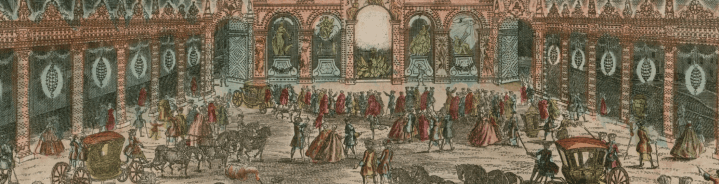
From the conference programme:
Here Today, Gone Tomorrow? Ephemerality and Materiality in France in the Long 18th Century: Arts, Theatre, and Spectacle
Università Ca’ Foscari, Venice, 27–28 June 2023
Organized by Elisa Cazzato
The Greek etymology of ephemeral, ephḗmeros, denotates something that only lasts for one day. In many ways, the ephemeral has become a key subject for our 21st-century lives, via temporary architecture and installations, digital art, but also new forms of media and social communication. However, with the invention of photography and videorecording in the late 19th century, and with new digital technologies in contemporary times, the ephemeral has also found new ways to become enduring, sustainable, and collectable in new archival forms. Yet ephemeral art and ways of being that existed before are more difficult to trace.
The study of 18th-century artistic and performance culture has naturally focused mostly on material objects that have survived in physical or representational forms, like paintings, decorative arts, written texts, and musical scores. But what happens to those forms of art whose material nature is short-lived, fleeting, or perishable? Does the absence of a surviving object preclude the possibility of its examination?
This conference investigates the topic of ephemerality in French culture in the long 18th-century, embracing both artistic, theatrical, and performance practices created through fragile and temporal media like theatre settings, sketches, fireworks, or spectacles that were performed but never replicated or transcribed, as well as trends in modes of dress, walking, and ways of being. In order to exist, however, ephemerality needs materiality, since any creative process intersects with the material requirements that both artworks and performances need: materials, location, scripts, costumes, instruments. How do ephemerality and materiality connect within the cultural context of 18th-century France?
This conference seeks to foster a debate not only about the aesthetic significance of ephemerality but also about the political and cultural meanings of the ephemeral. It questions whether, and how, short-lived forms of art had a role in communicating ideas of power. The conversation also embraces the politics of absence: What is the long-term effect of ephemerality? How can we create a history of the ephemeral? How do we deal with the relative paucity of sources? And how might our failure to deal with ephemerality exclude certain groups or cultures.
With the support of the Centre de Musique Baroque de Versailles
Zoom link:
https://unive.zoom.us/meeting/register/tZAsduyhqDIsHNGv0kOSqXNP7nqM3wZAf7t4
Organization
Elisa Cazzato, Marie Skłodowska-Curie Research Fellow, Department of Linguistics and Comparative Cultural Studies, Ca’ Foscari University of Venice
Information
elisa.cazzato@unive.it
Scientific Committee
Renaud Bret-Vitoz (Sorbonne Université)
Elisa Cazzato (Università Ca’ Foscari)
Emanuele De Luca (Université Côte d’Azur)
Meredith Martin (NYU)
Barbara Nestola (CMBV)
Gerardo Tocchini (Università Ca’ Foscari)
T U E S D A Y , 2 7 J U N E 2 0 2 3
10.00 Welcome
10.15 Greetings and Conference Introduction
• Elisa Cazzato (Università Ca’ Foscari), Nicoletta Bortoluzzi (Università Ca’ Foscari – research advisor), and Barbara Nestola (CMBV)
10.30 Session 1 | Ephemerality in French Theater
Chair: Paola Perazzolo (Università degli Studi di Verona)
• Renaud Bret-Vitoz (Sorbonne Université), L’expérience éphémère d’Ériphyle (Voltaire, 1732) à la scène: matériaux tangibles d’une dramaturgie avant reprises et réécritures
• Pierre Frantz (Sorbonne Université), L’éphémère et la circonstance, réflexion sur le théâtre de la Révolution française
• Ilaria Lepore (Università degli Studi La Sapienza), L’art du comédien au tournant des Lumières. Souci d’éphémère et sensibilité mémorielle
12.00 Session 2 | Architectures and Urban Settings
Chair and discussant: Emanuele De Luca (Univeristé Côte D’Azur)
• Alessandra Mignatti (Università Cattolica del Sacro Cuore, Milano), Tra utopia e ricerca del consenso: gli apparati effimeri di epoca napoleonica a Milano
• Annamaria Testaverde (Università degli Studi di Bergamo), Una via triumphalis per «Florence la belle ville»: dall’apparato effimero al progetto stabile, 1608–1810
13.00 Lunch Break
15.00 Session 3 | Ephemerality in Dance
Chair and discussant: Stefania Onesti (Università degli Studi di Padova/Università Aldo Moro Bari)
• Olivia Sabee, (Swarthmore College), Noverre on 18th-Century Dance Theory and Ephemerality
• Cornelis Vanistendal (Independent Scholar), Ephemerality on the Fringe: Power Quadrilles in Brussels on the Eve of Waterloo
16.00 Session 4 | Researching Ephemerality in Arts and Costumes
Chair: Carlotta Sorba (Università degli Studi di Padova)
• Daniella Berman (New York University), “…even in the midst of the terrible movements and variables of the Revolution”: Jacques-Louis David’s Joseph Bara and the Unrealized Fête of the 10th of Thermidor
• Brontë Hebdon (New York University), ‘The Right to Dress Plainly’: Embroidery and the Ephemeral in Napoleonic Court Costumes
• Petra Dotlačilová (Stockholm University / CMBV), Witnesses of the Past: Studying Costumes as Material Evidence of the Ephemeral Performance
W E D N E S D A Y , 2 8 J U N E 2 0 2 3
9.30 Session 5 | Reconstructing Feasts, Settings, and Special Effects
Chair: Barbara Nestola (CMBV)
• Christine Jeanneret (University of Copenhagen), Ephemeral Spaces, Ephemeral Costumes, and Ephemeral Arts: The Bal des Ifs at Versailles in 1745
• Gerardo Tocchini (Università Ca’ Foscari Venezia), Lorsqu’une scénographie devient ‘la’ preuve: « Orfeo ed Euridice » de Ch. W. Gluck, opéra maçonnique
• Emanuele De Luca (Univeristé Côte d’Azur), Poudres, feux, couleurs: les artifices des Ruggieri à Paris au XVIII siècle
11.00 Session 6 | The Specter of Race
Chair and discussant: Michele Matteini (New York University)
• Noémie Etienne (University of Vienna) and Meredith Martin (New York University), The Comte d’Artois and the Spectacle of Otherness in Pre-Revolutionary Paris
12.00 Keynote Lecture
• Mark Ledbury (University of Sydney), “Et le lendemain matin… Afterlives of the Ephemeral”
Symposium | Unpacking the V&A Wedgwood Collection
Unpacking the V&A Wedgwood Collection
Barlaston (Stoke-on-Trent) and London, 7–8 July 2023
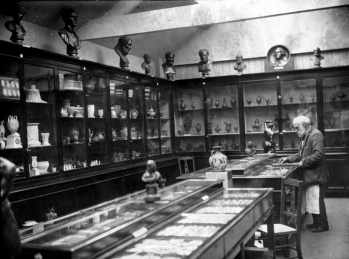
Isaac Cook, curator of the first Wedgwood Museum at the Etruria factory, sorting trays of Josiah Wedgwood’s trials © Fiskars.
Join leading ceramic artists, scholars, and emerging voices for a two-day symposium exploring fresh avenues of research into Wedgwood. We look forward to conversations that expand our understanding of Wedgwood and push scholarship in new directions. This dual-site landmark conference honours Gaye Blake-Roberts MBE, former curator of the V&A Wedgwood Collection, and her contribution to ceramic research. It will take place at the V&A Wedgwood Collection in Barlaston, Stoke-on-Trent (Friday) and at the V&A South Kensington, London (Saturday). A small number of bursaries for early career professionals will be available (generously funded through the Paul Mellon Centre); please send a 300-word application to wedgwood@vam.ac.uk by 5 June, outlining how attending the conference will benefit your professional development.
Book Day 1 here»
Book Day 2 here»
Please scroll down to ‘related events’ to book afternoon options and the evening dinner.
F R I D A Y , 7 J U L Y 2 0 2 3
Barlaston, Stoke-on-Trent, 10.00–17.00
• Kate Turner (Acting Chief Curator, V&A Wedgwood Collection) — Welcome
• Robin Emmerson (former Head of Decorative Art Department, National Museums Liverpool) — Gaye Blake-Roberts MBE: The Story So Far
Panel 1 | Beyond Josiah Wedgwood: Re-examining the Narrative
Chair: Oliver Cox (Head of Academic Partnerships VARI, NAL and Archives)
• Iris Moon (Assistant Curator European Sculpture and Decorative Arts, Metropolitan Museum of Art) — Phantom Urn: Wedgwood’s Disability
• Nicola Scott (Curator of Decorative Art, National Museums Liverpool) — Joseph Mayer (1803–1886): Portrait of a Victorian Wedgwood Collector
• Rebecca Klarner (Assistant Curator, V&A Wedgwood Collection, PhD Researcher University of Leeds) — Who Made It? Questions of Authorship, Authorising, and Authority in Wedgwood’s 20th-Century Design and Marketing
Bookable Afternoon Options for Day 1
2.00 Randeep Atwal and Lucy Lead — Extraordinary Wedgwood Women: Celebrating the Lives of Mary Euphrasia Wedgwood and Lucie Wedgwood
2.30 Alice Walton — Impressions from a Contemporary Ceramic Maker
2.00 Kate Turner — Wedgwood’s Anti-Slavery Medallion: A Re-display at the V&A Wedgwood Collection
2.00 Isabel Clanfield — Highlights of the Museum Store: A Guided Handling Session
A Wedgwood factory tour and have-a-go pot throwing sessions are also available to book.
Panel 2 | Impressions of the Past and Contemporary Ceramic Making
Chair: Catrin Jones (Chief Curator, V&A Wedgwood Collection)
• Matt Smith (Artist and Curator) — Remaking the Museum
Clare Twomey (Artist and Researcher) — Wedgwood: Identity and Practice
• Adam Hemming (Vice President of Marketing, Fiskars) — Making Wedgwood Today
Evening at Lunar restaurant, to be booked separately
With dinner speakers Tristram Hunt (Director, Victoria and Albert Museum) and Aileen Dawson (Former Curator, 1660–1800, Britain, Europe and Prehistory, British Museum)
S A T U R D A Y , 8 J U L Y 2 0 2 3
South Kensington, 10.00–17.30
• Antonia Boström (Director of Collections, V&A South Kensington) — Welcome
Panel 3 | Narratives of Creativity, Technology, Economics, and Labour
Chair: Caroline McCaffrey-Howarth (Lecturer in History of Art, 1650–1900, University of Edinburgh)
• Paul Greenhalgh (Director, Zaha Hadid Foundation) — Mimesis, Method, and Money: Wedgwood and His Forebears
• Claire Blakey (Curator of Modern Decorative Arts, National Museums Scotland) — Wedgwood and the Industrial Museum of Scotland
• Samantha Lukic-Scott (PhD Researcher, University of York) — Wedgwood and Pictorial Translation
• Paul Scott (Artist and Researcher) — Wedgwood’s American Transferware Patterns: New American Scenery, Archives, and Insights
Bookable Afternoon Options for Day 2
1.45 Angus Patterson — Cut Steel Dress Accessories with Jasperware Plaques: A Collaboration between Josiah Wedgwood and Matthew Boulton
2.05 Simon Spier and Florence Tyler — Wedgwood at the V&A South Kensington
Panel 4 | Global Wedgwood
Chair: Patricia Ferguson (Independent Researcher)
• Kate Smith (Associate Professor in 18th-Century History, University of Birmingham) — Clay, Labour, and Heat: Making Ceramics in a Global World
• Brigid von Preussen (Junior Research Fellow in History of Art, University of Oxford) — Model Colonies: Australian Clay, British Moulds, and the New Etruria
• Raffaella Ausenda (Professor, Freelance Historian of Italian Ceramics, Milan) — Italian Creamware ‘ad uso d’Inghilterra’ in Northern Italy and Beyond
• Rachel Gotlieb (Curator of Ceramics, Crocker Art Museum) — Viola Frey (1933–2004): Disrupting Josiah Wedgwood’s Portland Vase in Northern California
Conference | The Power of Flowers, 1500–1750
From ArtH.net and the conference website:
The Power of Flowers, 1500–1750
Museum voor Schone Kunsten, Ghent, 14–15 June 2023
Organized by Jaya Remond and Catherine Powell-Warren
Flowers and fruits have been mobilized as expressions of power and counter-power since long before the poet Allen Ginsberg coined the slogan ‘Flower Power’ in 1965 to encourage nonviolent protest, and Hippies in San Francisco’s Haight-Ashbury area weaved flowers in their hair. In the newly founded Dutch Republic, the house of Orange-Nassau relied on the orange not only as a short-hand for its name, but also a signifier of the trading empire it developed. Sultan Süleiman the Magnificent was known for his taste in gardens and incorporated flowers in his official insignia (Tughra), a complex work of calligraphy conveying the power and legitimacy of his rule. During the early modern (re)discovery of nature, flowers and their fruits (local and foreign) offered unique promises for profit while their pictorial representations promoted their commercial potential and could also stand as artistic objects. This interdisciplinary conference aims to investigate how flowers and the fruits they produce represented power in a myriad of ways in the early modern world. The speakers will address the function of flowers—including the flowering process, culminating in fruit—as tools of political, religious, or commercial power, as instruments of global and local knowledge transfer and appropriation, as well as their role in art-making, science, and the construction of gender from around 1500 to 1750.
The conference will take place in person at the Museum of Fine Arts, Ghent; presentations will not be live-streamed or recorded. Conference registration is required. The registration fee of 20 euros (10 euros for students) includes two lunches and a reception following the keynote address. The conference is organized by Prof. dr. Jaya Remond, Assistant Professor of Early Modern Art History at Ghent University, and Dr. Catherine Powell-Warren, FWO Postdoctoral Researcher in Art History at Ghent University. For any practical questions, please contact Lien Vandenberghe (lien.vandenberghe@ugent.be) or Lisa Schepens (l.schepens@ugent.be).
W E D N E S D A Y , 1 4 J U N E 2 0 2 3
9.00 Registration and Coffee
9.30 Welcome Remarks
9.45 Far Removed from the Hortus Conclusus: Women Harnessing Flowers and Power, Part I
• Zara Kesterton (Cambridge) — Flower Girls: Pastoralism, Fashioning, and Gender Politics in 18th-Century France
• Lucia Querejazu Escobari (Zurich) — A Rose from Lima and Kantutas for Pomata: Saint Rose of Lima, Our Lady of Pomata, and the Construction of the Symbolical Garden of the Colonial Andes
11.00 Coffee Break
11.15 Far Removed from the Hortus Conclusus: Women Harnessing Flowers and Power, Part II
• Henrietta Ward (Cambridge) — Exchanging Seeds: Agnes Block and Her Flower Drawings
• Bożena Popiołek and Anna Penkała-Jastrębska (Krakow) — The Private Garden as a Symbol of Innovation and Power at the Noble Women’s Courts in Polish-Lithuanian Commonwealth in the First Half of the 18th Century
12.30 Lunch Break
14.00 Philosophy and Medicine: The Intrinsic Power of Flowers & Fruits, Real and Imagined, Part I
• Fabrizio Baldassarri (Venice) — The Silence of the Lambs: Sensitive and Vegetative Powers in Plantanimals
• Océane Magnier (Tours) — Violet Powder: The Perfume of the Flower and the Scent of the Iris
15.15 Coffee Break
15.30 Re-Centering the Garden: The Garden as a Backdrop for Memory, Art, and Networking
• Arjan van Dixhoorn (Utrecht) — Re-Centering the Garden in Philosophical Life: Hondius’s Dapes inemptae of 1618/1621
• Tine L. Meganck (Brussels) — Bruegel’s Spring Garden as Mastery of Nature
• Klara Alen (Antwerp) — From Rubens’s Garden to The Swan Inn: Tulips and Trust in Early Modern Antwerp
17.30 Keynote Address
• Claudia Swan (St Louis) — Handling Flowers in Early Modern Europe: A Florilegium of Gestures
18.45 Reception
T H U R S D A Y , 1 5 J U N E 2 0 2 3
9.30 Trading, Exchanging, and Controlling Plants and Flowers, Part I
• Philippe Depairon (Kyoto) — New Flowers in Old Yamato
• Elena Falletti (Castellanza) — How Botanical Gardens Helped to Shape International Law
10.45 Coffee Break
11.00 Trading, Exchanging, and Controlling Plants and Flowers, Part II
• James M. Córdova (Boulder) — Art in Bloom: The Polysemy of Flowers in Colonial Mexican Visual Culture
• Daniel Margócsy (Cambridge) — The Flowers of St Thomas: Colonial Botany and the Hortus malabaricus, c. 1680
12.15 Lunch Break
13.30 Philosophy and Medicine: The Intrinsic Power of Flowers & Fruits, Real and Imagined, Part II
• Anna Svensson (Uppsala) — Arvid Månsson’s Örta-Book: Translating Medicinal Plant Knowledge in 17th-Century Sweden
• Dominic Olariu (Marburg) — Herbal Books at Court as a Gesture of Medical Erudition and Medical Providence
14.45 Coffee Break
15.00 Paper Plants and the Epistemic Power of Flower Imagery, Part I
• Clio Rom (Springdale, Arkansas) — On Being Planted and Portrayed: Horticulture and Floral Imagery in Seicento Rome through the works of Anna Maria Vaiani
• Lara de Mérode (Brussels) — Hortus floreus Archiducis Leopoldi or the Power of Flowers at the Service of the Archduke Leopold Wilhelm (1614–1662)
16.15 Paper Plants and the Epistemic Power of Flower Imagery, Part II
• Sheila Barker (Philadelphia) — Giovanni Battista Ferrari’s “Flora, overo Cultura dei fiori” (1638)
• Katherine M. Reinhart (Broome County, New York) — Painting Plants, Engraving Gloire
17.30 Concluding Remarks










leave a comment