Symposium | New Discoveries in Furniture and Historic Interiors
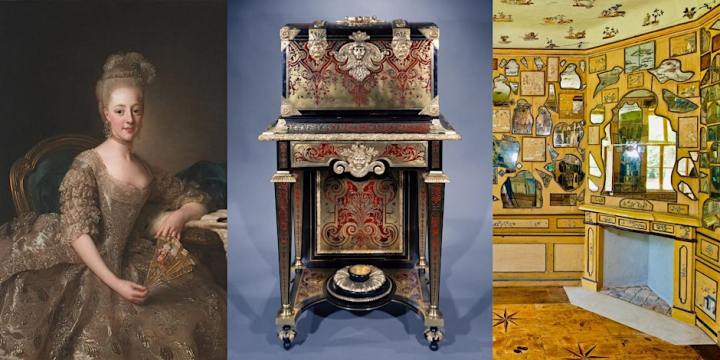
Left: Alexander Roslin, Portrait of Hedvig Elisabet Charlotta, Princess of Sweden, detail, 1775 (Nationalmuseum, Sweden). Center: André-Charles Boulle, Coffer-on-stand (Chatsworth House Trust). Right: Mirror shard cabinet, Apartment of Margravine Wilhelmine of Bayreuth, ca. 1750 (Old Palace of the Hermitage in Bayreuth; photo by Achim Bunz).
◊ ◊ ◊ ◊ ◊
From the reservation page at Eventbrite:
New Discoveries in Furniture and Historic Interiors
University of Buckingham, London Campus, 23 January 2026
Registration due by 19 January 2026
The Furniture History Society invites you to its eighth Early Career Research Symposium, to be held at the University of Buckingham’s London campus, 51 Gower Street, from 9.30am to 5pm on Friday, 23 January. Part of the Society’s Early Career Group (ECG) programme, the symposium features current research by emerging scholars in furniture history, the decorative arts, and historic interiors. The programme reflects the wide range of interests among early-career researchers, with speakers from Britain, Sweden, France, Italy, Germany, and the United States. The event is free to attend, but advance registration via Eventbrite is required by midnight (GMT) on Monday, 19 January. The limited number of places are allocated on a first-come, first-served basis. The symposium will be recorded and made available for one month to registered participants. Any enquiries about this event or the Early Career programme should be directed to grants@furniturehistorysociety.org.
The day is made possible thanks to the generous support of the University of Buckingham, the Della Howard Fund, and the Oliver Ford Trust.
p r e s e n t a t i o n s
• Mary Algood (V&A/RCD History of Design Programme, UK) — Makers of Funeral Furniture in 17th-Century England
• Tristan Fourmy (Institut National du Patrimoine, France) — Hercules in the Decorative Arts in 18th-Century France
• Laini Farrare (University of Delaware, USA) — Atlantic Mahogany: Enslavement, Labor, and the Early American Windsor Chair
• Francesco Montuori (European University Institute, Italy) — Beyond Chinoiserie: The Gabinetto di Porcellana and its Floor
• Anne Weiss (University of Cologne, Germany) — Status and Space: Dynastic References in the Furnishings of Wilhelmine von Bayreuth’s Apartments in the New Palace and Old Palace of the Hermitage in Bayreuth, 1735–1758
• Karolina Laszczukowska (University of Uppsala, Sweden) — The Material Hierarchies in the Furnishings and Interiors of the Private Apartments of Princess Sofia Magdalena and Duchess Hedvig Elisabet Charlotta at Stockholm Palace in 1766 and 1774
• Katherine Hardwick (Chatsworth House, UK) — Garrets Full of the Commodity? Collecting Boulle at Chatsworth
• Paul Giraud (Institut National du Patrimoine, France) — Collecting Italian 18th-Century Furniture at the Belle Epoque: The Origins of Interior Design
• Justine Lecuyer (Sorbonne, France) — Crafting Comfort: Upholstery and Textile Aesthetics in 19th-Century Interiors
• Eleonora Drago (Civic Museums of Treviso, Italy) — Paul Albert Bernard and the Decoration of the French Room at the Biennale in 1905: An Homage to Venice and France from a Decorative Skylight
Study Day | Relevance and Reception of Anton Raphael Mengs
From ArtHist.net and Zentralinstitut für Kunstgeschichte:
Die ‘allgemeine Erwartung besserer künstlerischer Zustände’:
Relevanz und Rezeption von Anton Raphael Mengs
Online and in-person, Zentralinstitut für Kunstgeschichte, Munich, 28 January 2026
Organized by Steffi Roettgen and Ulrich Pfisterer

Anton Raphael Mengs, Self-Portrait, 1773, oil on panel 28 × 22 inches (Munich: Bayerische Staatsgemäldesammlungen, Neue Pinakothek).
Dem steilen Aufstieg von Anton Raphael Mengs (1728–1779) zu einem der, wenn nicht dem berühmtesten Maler Europas ab der Mitte des 18. Jahrhunderts entsprach der nicht minder steile Absturz in der allgemeinen Wertschätzung bereits wenige Jahre nach seinem Tod. Das Kolloquium untersucht die Faktoren, die sowohl die Relevanz als auch die wechselhafte Rezeption von Mengs zu verstehen helfen. Für eine differenzierte Einschätzung scheint es dabei wichtig, deutlicher als bislang geschehen zwischen den Wirkungsbereichen von Ästhetik, Antike(nrezeption), Akademie und Kunsttheorie zu unterscheiden.
Die Teilnahme ist kostenlos. Die Veranstaltung wird parallel via Zoom übertragen. Dem Zoom-Meeting können Sie unter folgendem Link beitreten. Das Mitschneiden der Veranstaltung oder von Teilen der Veranstaltung sowie Screenshots sind nicht gestattet. Mit der Teilnahme akzeptieren Sie diese Nutzungsbedingung.
Konzeption
Steffi Roettgen (LMU München)
Ulrich Pfisterer (Zentralinstitut für Kunstgeschichte)
p r o g r a m m
14.00 Ulrich Pfisterer (ZI) — Begrüßung und Einführung
14.15 Session 1
Moderation: Steffi Roettgen (LMU München)
• Gernot Mayer (Universität Wien) — Auf der Jagd nach Mengs: Die Rezeption von Anton Raphael Mengs im Spiegel transnationaler Netzwerke
• Susanne Adina Meyer (Università di Macerata) — Zwischen Malerei und Philosophie: Anton Raphael Mengs im Spiegel römischer Kunstzeitschriften des 18. Jahrhunderts
• Andrés Úbeda de los Cobos (Museo del Prado, Madrid) — Mengsianus Methodus, or the Limits of a Strict System of Thought
15.45 Kaffee
16.15 Session 2
Moderation: Hubertus Kohle (LMU München)
• Susanne Müller-Bechtel (Julius-Maximilians-Universität Würzburg) — Antike – Rezeption – Modell: Anton Raphael Mengs’ Studien des menschlichen Körpers
• Roland Kanz (Rheinische Friedrich-Wilhelms-Universität Bonn) — Casanova als Mengs-Adept
• Steffi Roettgen (LMU München) — ‘Ikonen‘ mit Verfallsdatum: Zum Einfluss der Kopien auf Mengs’ Nachruhm
17.45 Pause
18.00 Session 3
Moderation: Ulrich Pfisterer (ZI)
• Tilman Schreiber (Friedrich-Schiller-Universität Jena) — Anton Raphael Mengs als ‘(Neo)Klassizist’: Überlegungen aus heuristischer Perspektive
• Michael Thimann (Georg-August-Universität Göttingen) — Der kalte Weg: Mengs unter den Romantikern
19.00 Abschlussdiskussion
Conference | Legacies: Why Museum Histories Matter
From ArtHist.net and the conference website (which includes abstracts) . . .
Legacies: Why Museum Histories Matter
Leiden, 13–15 January 2026
Organized by Laurie Kalb Cosmo, Marika Keblusek, Susanne Boersma, Raphaël Gerssen, and Margot Stoppels
 In January 2026, Leiden University’s Museum Lab will host the international conference Legacies: Why Museum Histories Matter. The conference reflects on museums with significant founding histories, broadly defined by their buildings, collections, commemorative functions, collectors or founders, that are currently engaged in some manner of institutional introspection, by way of exhibitions, acquisitions, restitutions, or renovations. International researchers and museum professionals from a range of institutions present their research and museum practices tied to museum legacies.
The three-day programme consists of twelve panels and four keynote speeches by Dr. Carole Paul (University of California, Santa Barbara), Monsignor Dr. Timothy Verdon (Museo dell’Opera del Duomo, Florence), Prof. Dr. Emile Schrijver (Jewish Cultural Quarter and National Holocaust Museum, Amsterdam), and Prof. Dr. Andrew McClellan (Tufts University, Boston).
Registration is available here»
t u e s d a y, 1 3 j a n u a r y
9.00 Registration
9.30 Welcome and Introduction
• Welcome — Stijn Bussels (Academic Director, Leiden University Centre for the Arts in Society)
• Introduction — Laurie Kalb Cosmo (University Lecturer and Project Director, Museum Lab, Leiden University)
9:50 Keynote
• Reflections on the History of the Public Art Museum — Carole Paul (Director of Museum Studies, University of California, Santa Barbara)
10.30 Coffee Break
11.00 Panel 1 | Monumental Legacies
Chair: Pieter ter Keurs (Emeritus, Leiden University)
• The Glyptotheque as a Site of Memory, Monumentality, and Transformation: Historical Identity and Contemporary Reflection of a Museum Institution in Croatia — Magdalena Getaldić (Glyptotheque of the Croatian Academy of Sciences and Arts)
• Obelisks and Totems: On Reframing Ethnographic Museums and Why Artistic Practice Matters — Irene Quarantini (Sapienza University, Rome)
• The Palatine Gallery: How Residents of the Pitti Palace Shaped Today’s Museum — Ilya Markov (Leiden University)
12.20 Lunch break
13.20 Panel 2 | Reshaping Legacies: Italian Museums
Chair: Irene Baldriga (Sapienza University)
• Reshaping the Oldest Italian National Museum — Paola D’Agostino, (Musei Reali Torino)
• Legacies Now: The Renewal of Institutional Inheritances at Five Museums in Rome — Laurie Kalb Cosmo (Leiden University)
• Two Centuries of Legacy, One Decade of Inclusion. Political Backlash and Strategic Reframing of Outreach at the Museo Egizio — Costanza Paolillo (New York University)
14.40 Panel 3 | Founders’ Legacies
Chair: Susanne Boersma (Leiden University)
• The Long Shadow of the Founder. Hero-Worship and the Construction of Continuity for a ‘National Museum’ — Joachim Berger and Darja Jesse (Germanisches Nationalmuseum, Nuremberg)
• National Gallery in Prague throughout the 20th Century: The Case of the Morawetz Collection — Lucie Němečková (Documentation Centre for Property Transfers of the Cultural Assets of WWII Victims, Prague)
• Leache & Wood: Rediscovering the Chrysler Museum’s Lost Founders — Mia Laufer and Drew Lusher (Chrysler Museum of Art, Norfolk)
16.00 Tea Break
16.30 Panel 4 | Unseen Legacies: Belgian Museum Buildings
Chair: Annemarie de Wildt (Former Curator at the Amsterdam Museum, Board Member of CAMOC, ICOM)
• Inherited Workspaces: Rethinking Creative Practice at the Constantin Meunier Museum — Ulrike Müller (University of Antwerp/Royal Museums of Fine Arts of Belgium, Brussels)
• Haunted Halls: Reclaiming Hidden Histories of the Royal Museums of Art and History in Brussels — Gerrit Verhoeven (University of Antwerp/Royal Museums of Art and History, Brussels)
• Between Immersion and Reflection. Old Antwerp and Museum Mayer van den Bergh Performing the Past — Stijn Bussels (Leiden University) and Bram van Oostveldt (Ghent University)
17.50 Day Closing — Laurie Kalb Cosmo
w e d n e s d a y , 1 4 j a n u a r y
9.00 Introduction — Laurie Kalb Cosmo
9.10 Keynote
• Legacies: Gifts of Love, Sacred Trusts, Investments — Timothy Verdon (Director of the Museo dell’Opera del Duomo/Museum of the Workshop of the Cathedral of Santa Maria del Fiore, Florence)
9.50 Keynote
• Developing and Opening Amsterdam’s National Holocaust Museum in a Politicized Era: Curatorial Challenges and Critical Choices — Emile Schrijver (Director of the Jewish Cultural Quarter and National Holocaust Museum, Amsterdam)
10.30 Coffee Break
11.00 Panel 5 | Revealing Histories and Reclaiming Heritage
Chair: Laurie Kalb Cosmo
• ‘My Heritage, Your Heritage?!’ Places of Jewish Heritage in Germany — Christiane Dätsch (Merseburg University of Applied Sciences
• POLIN Museum i Warsaw: A Place Where Memory Meets Responsibility — Joanna Fikus (POLIN, Warsaw)
• How to Celebrate the 75th Anniversary of the Museum Rietberg? Reflections on Researching and Curating the Institution’s History — Esther Tisa Francini (Museum Rietberg, Zurich)
12.20 Lunch break
13.20 Panel 6 | Eastern Europe: War and Recuperation
Chair: Seraina Renz (Leiden University)
• UNESCO and Museum Diplomacy: Geographies and Balances of Cultural Policy during the Cold War — Irene Baldriga (Sapienza University, Rome)
• Cultural Losses of Museums: The Polish Respond to World War II —Bartłomiej Sierzputowski and Elżbieta Przyłuska (Polish Ministry of Culture and National Heritage, Warsaw)
14.40 Panel 7 | Eastern Europe: (Post-)socialist Museums
Chair: Seraina Renz
• Shaping the Contemporary Art Museum Identity through its Complex Heritage. The Example of the Museum of Fine Arts in Split, Croatia —Jasminka Babić (Museum of Fine Arts, Split) and Dalibor Prančević (University of Split)
• Collecting to Forget: The Legacy of the Museum of Atheism in Vilnius — Karolina Bukovskytė (Lithuanian Culture Research Institute/National Museum of Lithuania, Vilnius)
• Whose Ethnography? Ethnographic Collections and Museums in Central Europe — Marika Keblusek (Leiden University)
16.00 Tea Break
16.30 Panel 8 | Revisiting Institutional Narratives
Chair: Wonu Veys, Leiden University/Wereldmuseum
• The Imperial Gaze Materialised: The Ten Thousand Chinese Things Museum as Archive — Yuansheng Luo (KU Leuven)
• Museum Histories in a Postcolonial Age: Collecting and Curating Netherlandish Art Legacies in the Global South — Laia Anguix-Vilches (Utrecht University)
• ‘You’re usually wrong’: Looking Back at the Anti-racism of the Past at One Museum — Deirdre Madeleine Smith (University of Pittsburgh/Carnegie Museum of Natural History)
17.50 Day Closing — Susanne Boersma
t h u r s d a y , 1 5 j a n u a r y
9.00 Panel 9 | Modernist Legacies in the Americas
Chair: Stephanie Noach (Leiden University)
• Lourival Gomes Machado and the Legacy of a Certain Brazilian Modernism at MAM-SP — Ana Avelar (University of Brasília)
• Legitimating Modernism: Art History and the Formation of Museum Authority in the United States — Laura Braden (Erasmus University Rotterdam)
• (Re)Making the San Francisco Museum of Art Modern — Berit Potter (California State Polytechnic University Humboldt, Arcata)
10.20 Coffee Break
10.50 Panel 10 | Crafts and Material Legacies
Chair: Lieske Huits (Leiden University)
• Donating Lace and Knowledge: Women and Early 20th-Century Historic Lace Acquisitions in the Belgian Royal Museums for Art and History — Julie Landuyt (Ghent University/Free University of Brussels)
• Crafts’ Networks and the National Museum of Capodimonte in Naples — Francesco Montuori (European University Institute, Florence)
• Preserving Heritage through Museums: The Case of the Kurdistan Region of Iraq — Chang Farhan Tahir (University of Duhok)
12.10 Lunch break
13.30 Panel 11 | Colonial Legacies
Chair: Wonu Veys (Leiden University/Wereldmuseum)
• Founding Myths and Colonial Entanglements: The Japan Folk Crafts Museum and the Politics of Mingei — Anna Stewart-Yates (University of Oxford)
• A Forgotten History: The Former Colonial Collection of the Royal Museums of Art and History, Belgium — Anke Hellebuyck (University of Antwerp)
• Rethinking Narratives: The ‘Animals of Africa’ in Bern — Sarah Csernay (Nordamerica Native Museum, Zurich)
14.50 Panel 12 | Prominent Figures and Entangled Histories
Chair: Susanne Boersma
• A Contested Museum History: Scenography and the Placement of the Islamic Collection at the Berlin Museums — Zehra Tonbul (Ozyegin University, Istanbul)
• Entangled Objects and Memory Sites in the Museum: Re-imagining the ‘Modern’ Collection — Juliet Simpson (Coventry University)
• The Museum as a Battleground: Political Art at the Israel Museum, 1967–1977 — Meital Raz (University of Amsterdam)
16.10 Tea Break
16.40 Keynote
• The Museum of Fine Arts, Boston, 1909: Towards a Machine for Looking — Andrew McClellan (Tufts University, Boston)
17.25 Closing Remarks — Marika Keblusek (Leiden University)
Colloquium | Textile Conservation Research at The Met
From The Met:
Conferences to Colloquium: Sharing Textile Conservation Research
The Metropolitan Museum of Art, New York, 9 December 2025
Join us for a colloquium featuring a series of talks by The Met’s Textile Conservation Department focusing on innovative conservation efforts that have been presented at leading conferences across the United States and internationally. Listen as speakers share case studies, methodologies, and insights into the preservation of historical and culturally significant textiles. The colloquium offers an opportunity for dialogue among professionals and people with an interest in historic textiles, highlighting recent advancements and practical challenges in the field of textile conservation.
This event is free to attend, though advance registration is required. Please note that space is limited; registration does not guarantee admission once the lecture hall reaches capacity.
s c h e d u l e
11.00 Morning Papers
• Monitoring Deformation of Tapestries by Image Analysis — Kisook Suh (Conservator) and Alejandro Schrott (Consultant, Department of Scientific Research)
• Technical and Scientific Findings of Four Textile Fragments with Shaded Bands from Dura-Europos — Martina Ferrari (Associate Conservator) and Janina Poskrobko (Conservator in Charge)
• Conservation of American Wing Samplers — Alexandra Barlow (Associate Conservator)
12.00 Lunch break
1.00 Afternoon Papers
• X-radiography of Textiles, Evolving Techniques and Approaches —Cristina Balloffet Carr (Conservator and Consulting Conservator for the Antonio Ratti Textile Center)
• The Met’s Contribution to Green Art: Experimentations with Nanogels and Green Consolidants for the Historic Textiles Preservation — Giulia Chiostrini (Conservator), Kristine Kamiya (Conservator), and Janina Poskrobko (Conservator in Charge)
2.00 Closing remarks
Conference | The Future of the Antique
From Eventbrite:
The Future of the Antique: Interpreting the Sculptural Canon
Institute of Classical Studies, Senate House and Warburg Institute, London, 10–12 December 2025
Organized by Adriano Aymonino and Kathleen Christian
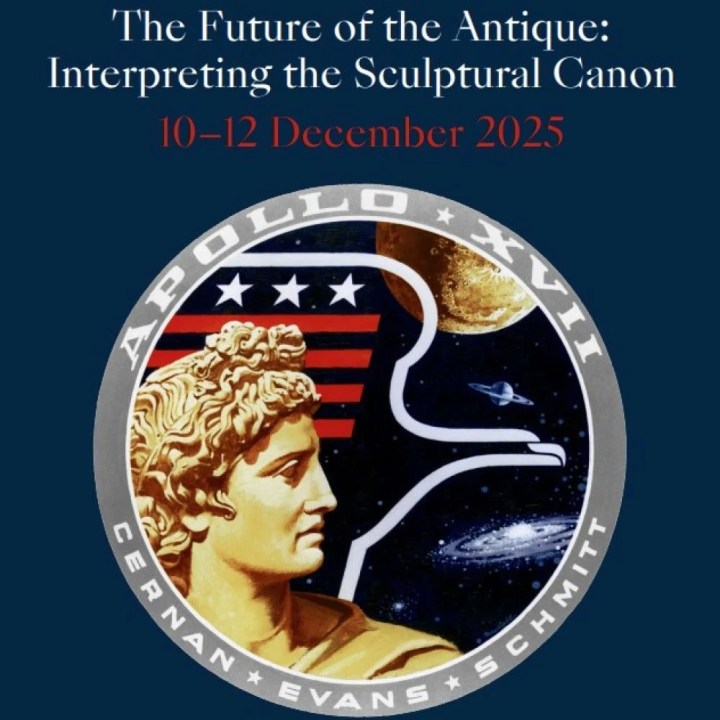 Celebrating the publication of the new, expanded edition of Francis Haskell and Nicholas Penny’s seminal Taste and the Antique (3 vols, Harvey Miller/Brepols, 2024), this conference explores the interpretation and reception of classical sculpture.
The original edition of Taste and the Antique was a landmark study that established a canonical list of ninety-five ancient sculptures that were widely admired, collected, and copied between 1500 and 1900. It traced how these works—from the Apollo Belvedere to the Laocoön—shaped artistic taste, collecting practices, and artistic discourse by defining a classical aesthetic and pedagogy. As one of the most influential texts in the history of art history, Taste and the Antique has profoundly shaped scholarship and curatorial practice on the reception of ancient sculpture. The revised three-volume edition of 2024 substantially updates the original text with recent research. It broadens the discussion of the reception of the classical canon, incorporates decades of intervening scholarship, and brings the conversation into the realm of contemporary art, opening new perspectives on the afterlives of Greek and Roman sculpture. Taking the new edition as a point of departure, the conference assesses the state of the field, explores emerging methodologies, and considers future directions. It aims to foster dialogue across generations, traditions, and methodologies of scholarship.
Sessions will address how classical statues shaped visual culture beyond replication, including:
• Shaping and Transmitting the Canon | Examining the establishment, radical alteration, and dissolution of the sculptural canon in the early modern era.
• The Canon and the Body in the Age of Empire | Exploring the role of classical statuary in the conception of ‘proportionate’ and ‘disproportionate’ bodies, in the representation of non-European populations, and in colonial educational and social policies.
• Restoration and Display | Considering reconfigurations of the antique and notions of authenticity; situating the antique within modern museum contexts.
• Changing and Rethinking Canons | Rethinking the antique within modern and postmodern theoretical frameworks and practices.
The conference is organised by Adriano Aymonino (University of Buckingham) and Kathleen Christian (Census of Antique Works of Art and Architecture Known in the Renaissance, Humboldt University of Berlin). It is supported by Humboldt-Universität zu Berlin; Center for Palladian Studies in America; Trinity Fine Art; and Istituto Italiano di Cultura.
w e d n e s d a y , 1 0 d e c e m b e r
6.00 Doors open
6.20 Introduction — Katherine Harloe (Director, Institute of Classical Studies)
6.30 Keynote
• Salvatore Settis (Accademico dei Lincei) — Only Connect: Dionysus and Christ
t h u r s d a y , 1 1 d e c e m b e r
10:00 Registration
10.30 Introduction — Adriano Aymonino (The University of Buckingham) and Kathleen Christian(Census-Humboldt University of Berlin)
10.45 Session 1 | Shaping and Transmitting the Canon
Chair: Katherine Harloe (Institute of Classical Studies)
• An Antiquity of Plants and Animals? Towards a Non-Human Canon — Katharina Bedenbender (Humboldt-Universität zu Berlin)
• Piranesi and the Classical Body — Clare Hornsby(British School at Rome)
• Art, Historiography, and Connoisseurship: The Specimens of Antient Sculpture (1809) — Vivien Bird (The University of Buckingham)
12.00 Lunch break
2.00 Session 2 | The Canon and the Body in the Age of Empire
Chair: Caroline Vout (University of Cambridge)
• Living Antiquities? Anthropological/Travel Imagery and the Sculptural Canon in the Late Eighteenth Century — Annette Kranen (Universität Bern)
• The Bodies of Gods: Drawing from the Antique in Colonial India — Eva Ehninger (Humboldt-Universität zu Berlin)
• A Black Apollo? John Quincy Adams Ward’s The Freedman and the Belvedere Torso — Anna Degler (Freie Universität Berlin)
• Between Plaster and Stone: Reframing the Classical Canon in Bourbon New Spain — Rebecca Yuste (Columbia University)
3.35 Tea and coffee break
4.05 Introducing the Updated Census — Kathleen Christian(Census-Humboldt University of Berlin)
4.25 Introducing the New Edition of Haskell and Penny, Taste and the Antique — Adriano Aymonino (University of Buckingham) and Eloisa Dodero (Capitoline Museums, Rome)
5.00 Keynote Introduction — Bill Sherman (Director, Warburg Institute)
5.10 Keynote
• The Invention of the Classical — Nicholas Penny (Former Director of the National Gallery, London)
f r i d a y , 1 2 d e c e m b e r
Warburg Institute – Auditorium
10.00 Registration
10.30 Introduction — Adriano Aymonino (The University of Buckingham) and Kathleen Christian (Census-Humboldt University of Berlin)
10.45 Session 3 | Restoration and Display
Chair: Chiara Piva (Sapienza Università di Roma)
• Zooming In: The Social Lives of Statues — Jeffrey Collins (Bard Graduate Center)
• Zooming Out: Restoration as Taste — Elizabeth Bartman (Former President of the Archaeological Institute of America)
• Restoration, De- and Re-restoration of Ancient Sculptures in the Munich Glyptothek, Nineteenth to Twenty-First Century — Astrid Fendt (Landesmuseum Württemberg, Stuttgart)
11.45 Tea and coffee break
12.15 Session 3 | Restoration and Display, continued
• The Braccio Nuovo in the Vatican Museums: Display and Restorations of the Antique in the Nineteenth Century — Eleonora Ferrazza (Vatican Museums) and Claudia Valeri (Vatican Museums)
• Revealing Restorations: Assessing the Presentation and Reception of Restored Roman Sculptures from the Torlonia Collection at the Art Institute of Chicago — Lisa Ayla Çakmak (Art Institute of Chicago) and Katharine A. Raff (Art Institute of Chicago)
1.30 Lunch break
3.00 Session 4 | Changing and Rethinking Canons
Chair: Flora Dennis (Warburg Institute)
• The Head of an Etruscan: Alternative Antiquities and the Physiognomies of Modern Sculpture — Joanna Fiduccia (Yale University)
• The Fragmented Marble Body: Surrealism, Political Phantoms, and the Canon Recast — Domiziana Serrano (Université Jean Monnet -Saint-Étienne)
• From the Cortile to the Cosmos: Interpreting the Sculptural Canon in the Context of US Space Travel — Tilman Schreiber (Friedrich Schiller University Jena)
4.15 Tea and coffee break
4.45 Closing Paper | Historiographic Perspectives on the Canon
• Fear Revealed: Jacob Burckhardt on Classical Anthropomorphism and Demonic Hybridity — Mateusz Kapustka (Freie Universität Berlin – Zurich)
5.05 Final Remarks
Conference | Turner 250
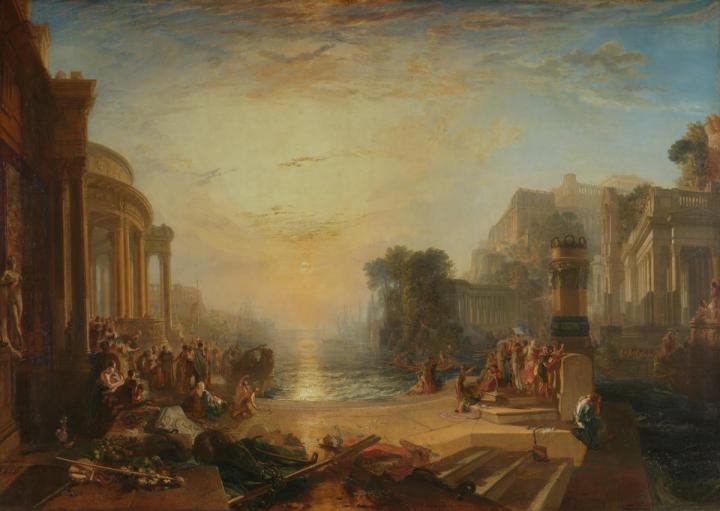
J.M.W. Turner, The Decline of the Carthaginian Empire, exhibited in 1817, oil on canvas, 170 × 239 cm (London: Tate, accepted by the nation as part of the Turner Bequest 1856, N00499).
◊ ◊ ◊ ◊ ◊
From the Paul Mellon Centre:
Turner 250
Tate Britain, London, 4–5 December 2025
2025 marks two hundred and fifty years since the birth of Romantic painter J.M.W. Turner (1775–1851). Timed to coincide with the Turner and Constable exhibition at Tate Britain and to help bring celebrations of Turner’s 250th anniversary year to a close, this conference will take Turner’s art and life as a starting point for exploring what it means to research Turner and to curate his work today.
t h u r s d a y , 4 d e c e m b e r
9.30 Registration with tea and coffee
10.00 Opening Remarks — Amy Concannon (Manton Senior Curator of Historic British Art at Tate)
10.10 Panel 1 | Curating Turner Now
Chair: Esther Chadwick (senior lecturer in history of art and Head of the History of Art Department, The Courtauld)
• Turner as Teacher: Lessons in Perspective — Helen Cobby (curator and lecturer, Bath Spa University)
• A Maligned Masterpiece? Displaying Turner’s The Battle of Trafalgar in Greenwich — Katherine Gazzard (Curator of Art (Post-1800), Royal Museums Greenwich)
• Reimagining the Liber Studiorum: Reasserting the Primacy of Print in Turner’s Art — Imogen Holmes-Roe (Curator (Historic Art), the Whitworth, University of Manchester)
• Curating Turner in East Anglia — Emma Roodhouse (curator and researcher) and Francesca Vanke (Senior Curator and Keeper of Fine and Decorative Art, Norwich Museums)
• A Site of Inspiration: Curating Turner at Petworth — Emily Knight (Property Curator, Petworth House) and Sue Rhodes (Visitor Experience Manager, Petworth House)
• The New Carthaginian: Turner, Memory, and Imperial Echoes (Performative Lecture) — Nick Makoha (poet and playwright)
12.50 Lunch break
Completing the Turner Cataloguing Project, the Paul Mellon Centre (PMC) film to be screened
2.00 Panel 2 | Researching Turner’s Bequest
Chair: Nicola Moorby (Curator, British Art 1790–1850, Tate)
• Introduction to Turner Bequest Catalogue — Matthew Imms (former Senior Cataloguer and Editor: Turner Bequest, Tate)
• The Discovery and Assembly of the 1838 Tour — Hayley Flynn (former Turner Cataloguer, Tate), with support from the Turner Society.
• Turner Technical Studies: Their Legacy and Preservation — Joyce Townsend (Senior Conservation Scientist, Tate)
3.10 Tea and coffee break
Completing the Turner Cataloguing Project, PMC film to be screened
3.40 Panel 3 | Building Turner’s Reputation
• About Carthage – An Exhibition of Seven Paintings by Stephen Farthing RA Held at the UK Ambassador’s Residence in Carthage 2025 — Stephen Farthing (artist)
• Turner and Robert Hills: Collaborating Contemporaries? — Kimberly Rhodes (professor of art history, Drew University)
• Paper Galleries and the Mediation of Art: Turner, John Constable, and Clarkson Stanfield in The Royal Gallery of British Art (ca. 1851) — Chia-Chuan Hsieh (professor, Graduate Institute of Art Studies, National Central University, Taiwan)
• From Patriotic Patronage to National Property: The Trajectory of the Petworth Turners, 1805–1956 — Andrew Loukes (Curator of the Egremont Collection, Petworth House)
5.20 Drinks reception
6.15 Evening Lecture
• Art, Music, and the Sublime — Tim Barringer, with live performance by the Kyan Quartet of Franz Schubert’s string quartet no.14 in D minor, D.810, Death and the Maiden
f r i d a y , 5 d e c e m b e r
10.00 Registration with tea and coffee
10.30 Panel 4 | Eco-critical Approaches to the Artist
Chair: Tom Ardill (Curator of Paintings, Prints and Drawings, London Museum)
• Out of the Blue: Exploring Water in Turner’s Work — Martha Cattell (artist, curator and researcher)
• Watermarks: Environmental Contingencies and the Turner Bequest — Tobah Aukland-Peck (postdoctoral fellow, PMC), with support from the Turner Society.
• Rethinking Turner’s Human Landscape — Caterina Franciosi (PhD candidate in the history of art, Yale University), with support from the Turner Society.
• What Was in Turner’s Lungs? — Sarah Gould (assistant professor, Université Paris 1, Panthéon-Sorbonne)
• Necro-Geographies of the Sublime: A Posthuman Reckoning with Turner’s Horizon (Multimedia Video-Essay) — Parham Ghalmdar (artist and researcher, The New Centre for Research & Practice)
12.40 Lunch break
Completing the Turner Cataloguing Project, PMC film to be screened
1.40 Panel 5 | Artistic Legacies
Chair: John Bonehill (senior lecturer in history of art, University of Glasgow)
• Encounters at MoMA: Turner, Rothko, and the Invention of ‘Modernist’ — Nicole Cochrane (Assistant Curator, Historic Art, 1790–1850, Tate Britain)
• 1966: Turner, Frank Bowling, and the Subject of Modernism — Ed Kettleborough (PhD candidate in history of art, University of Bristol), with support from the Turner Society.
• Where Sky Meets Ground: Turner and Sheila Fell in the Solway Firth — Kate Brock (researcher, Royal College of Art)
• Reservoirs of Recollection: John Akomfrah and the Oceanic Afterlives of Turner’s Sublime — Sabo Kpade (writer, curator, and researcher)
• What Can We Find in Turner’s Shadows? Artist Libby Heaney at Orleans House Gallery — Julia DeFabo (curator and creative producer), with support from the Turner Society.
4.20 Historical Fiction
• Varnishing Day: Ruskin, Turner, and the End of Idolatry — Cal Barton (writer and teacher)
4.40 Closing Remarks — Nicola Moorby and Amy Concannon (Tate) and Martin Myrone (PMC)
Colonial Williamsburg’s Antiques Forum, 2026
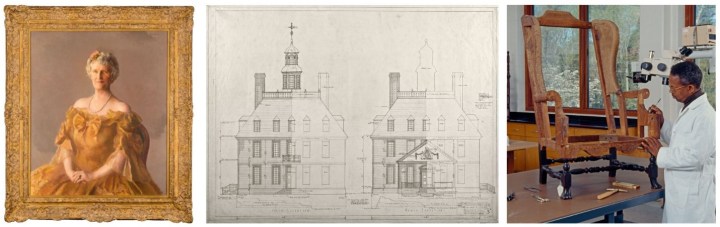
Left: Robert Brackman, Portrait of Abby Aldrich Rockefeller (Mrs. John D. Rockefeller), 1941, oil on canvas·(Gift of the Blanchette Hooker Rockefeller Fund through the generosity of John D. Rockefeller 3rd, his wife Blanchette Hooker Rockefeller, and their four children, 2019-82, A&B). Center: David Hayes, Governors Palace North and South Elevations, Drawing #5, 30 October 1931. Right: Upholstery Conservator Leroy Graves Examines an Easy Chair in the Conservation Lab RIG.
◊ ◊ ◊ ◊ ◊
In 2026 the US will turn 250 and Colonial Williamsburg 100. From the Antiques Forum press release:
78th Annual Antiques Forum at Colonial Williamsburg
Online and in-person, Williamsburg, Virginia 19–25 February 2026
Scholarship applications for students and emerging scholars due by 16 December 2025
The Colonial Williamsburg Foundation will host its 78th Annual Antiques Forum February 19–25, 2026. Offered both virtually and in-person, this year’s conference is organized around the Foundation’s mission statement, “That the future may learn from the past.” To commemorate the 250th anniversary of American independence and the 100th anniversary of Colonial Williamsburg’s founding, the 2026 forum will explore past inspiration and future influence through the lens of material culture and the decorative arts. Forum attendees will also have an exclusive opportunity to preview Colonial Williamsburg: The First 100 Years, a new exhibition at the Art Museums of Colonial Williamsburg opening February 28.

Mourning Ring with Print of George Washington, possibly by the Philadelphia jeweler Jean-Simon Chaudron with a print by Charles Balthazar Julien Fevret de Saint-Memin, ca. 1800, copper/gold/silver alloys, enamel, paper, glass (Colonial Williamsburg, Gift of Mike and Carolyn McNamara, 2025–26). The ring descended through the family of the Marquis de Lafayette who may have acquired it during his tour of the United States in 1824–25.
Curators and scholars from Colonial Williamsburg will be joined by leading experts and collectors from across the nation to present on historic preservation, decorative arts, antiques, architecture, historic costume and more. President and CEO of the Museum of the American Revolution in Philadelphia, Dr. R. Scott Stephenson, will open the conference with a keynote address that expands upon their recent exhibition, Banners of Liberty: Flags that Witnessed the American Revolution. Additional guest presenters include Jeff Evans, decorative arts specialist; Calder Loth, senior architectural historian, Virginia Department of Historic Resources; Amanda Keller, executive director, Wilton House Museum; Elyse Werling, director of interpretation and collections, Preservation Virginia; Samantha Dorsey, independent consultant; Matthew Wood, curator, Castle Howard; William L. Coleman, director of the Andrew & Betsy Wyeth Student Center, Brandywine Museum of Art; Janine Skerry, independent consultant; and emerging scholars presenting new scholarship as part of the Carolyn and Michael McNamara Young Scholars Series sponsored by the Decorative Arts Trust.
The majority of conference activities will take place in the Virginia Room of the Williamsburg Lodge, located at 310 S. England Street. A variety of exclusive pre- and post-conference activities are available for in-person registrants, as are special room rates at Colonial Williamsburg hotel properties. A limited number of in-person and virtual attendance scholarships are available to students and emerging professionals in relevant positions or programs; scholarship applications are due by December 16. In-person registration is $660 per person through January 4 and includes a welcome reception, continental breakfasts, coffee and refreshment breaks, conference reception and dinner, and presentations as well as access to the conference streaming platform. Virtual-only registration is $150 per person and includes access to all general session presentations through the conference streaming platform. Both in-person and virtual-only registrations include a seven-day ticket voucher to Colonial Williamsburg’s Art Museums and Historic Area, valid for redemption through December 31, 2026. Registration and payment in full are required by Sunday, February 8.
Details are available here»
Antiques Forum is sponsored by Roger & Ann Hall and Friends of Colonial Williamsburg Collections, Mark & Loretta Roman, Jeffrey S. Evans & Associates, Brunk Auctions, The Decorative Arts Trust, Doyle Auctions, Americana Insights, Winterthur Museum, Jamestown Yorktown Foundation, Bayou Bend, and The National Institute of American History & Democracy.
Working Wood in the 18th C. Conference at Colonial Williamsburg
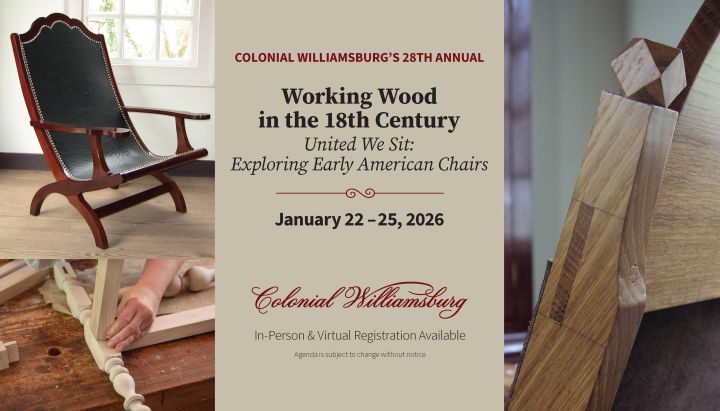
From the press release for the 2026 Working Wood in the 18th Century Conference:
Working Wood in the 18th Century Conference at Colonial Williamsburg
Online and in-person, Williamsburg, Virginia 22–25 January 2026
The Colonial Williamsburg Foundation will host its annual Working Wood in the 18th Century Conference January 22–25, 2026. Offered both virtually and in-person, this year’s conference, United We Sit: Exploring Early American Chairs, will center around six different chairs that spotlight a multitude of topics and techniques drawn from early America’s rich woodworking traditions. A limited number of in-person and virtual attendance scholarships are available to students and emerging professionals in relevant positions or programs.
Conference highlights include a presentation by esteemed chairmakers Elia Bizzarri and Curtis Buchanan on Windsor chairmaking techniques with a focus on hand-powered production rates and Elia’s research into early 19th-century Massachusetts chairmaker Samuel Wing. Celebrated cabinetmaker and carver Ray Journigan will demystify and recreate one of pre-Revolutionary Philadelphia’s rococo masterpieces, a heavily carved side chair made in Benjamin Randolph’s shop for the Cadwallader family. Historical interpreter and woodworker Jerome Bias will take us into the antebellum world of Thomas Day’s North Carolina shop where complex race relations intertwine with the collision of the handwork tradition and the coming machine age as he explores a curvaceous and veneered mahogany side chair. Scholar Daniel Ackermann, director of Bayou Bend Collection and Gardens, will deliver an opening keynote on a group of mid-18th-century Annapolis chairs.
From Colonial Williamsburg, master cabinetmaker Bill Pavlak will demonstrate the design and structure of Campeche chairs, a form with ancient roots that became fashionable on the east coast in the early 19th century by way of Mexico, New Orleans, and Thomas Jefferson’s Monticello. Master joiner Brian Weldy will explore a Boston baroque armchair with complex turnings, sculpted arms, and Russia leather upholstery. Conservator of upholstery Sarah Towers will walk attendees through the fundamentals of making a traditional slip seat. Apprentice joiner Laura Hollowood will demonstrate weaving a rush seat with traditional materials and senior curator of furniture Tara Chicirda will provide an overview of different period approaches to seats by showing off several examples from the Colonial Williamsburg collection. Journeyman cabinetmaker John Peeler will explore some of the planes and planecraft required for period chairmaking. Director of Historic Trades and Skills Ted Boscana will offer a banquet talk that pulls back the curtain on nine decades of Trades at Colonial Williamsburg to glimpse where we’ve been and where we’re headed.
The majority of conference activities will take place at the Art Museums of Colonial Williamsburg, located at 301 South Nassau Street. A variety of exclusive pre-conference activities are available for in-person registrants, as are special room rates at Colonial Williamsburg hotel properties. In-person registration is $400 per person through December 1 and includes presentations, opening reception, continental breakfasts on Friday, Saturday and Sunday, coffee and refreshment breaks, and a conference reception and dinner Saturday evening. Virtual-only registration is $150 per person and includes access to all presentations through the conference streaming platform. Both in-person and virtual-only registration include a seven-day ticket voucher to Colonial Williamsburg’s Art Museums and Historic Area, valid for redemption through December 31, 2026. Registration and payment in full are required by January 2 for in-person attendance and by January 22 for virtual attendance.
Details are available here»
Working Wood is sponsored by the Society of American Period Furniture Makers, Early American Industries Association, and Lie-Nielsen Toolworks, Inc.
Conference | Mapping Fashion Savoir Faire, 16th–21st Centuries
From the conference website:
Mapping Fashion Savoir Faire: Craft, Space, and Scale, 16th–21st Centuries
Paris, 11–13 December 2025
Organized by Ariane Fennetaux and Emilie Hammen
A typically French and even somewhat untranslatable expression, the notion of ‘savoir-faire’ in France seems to refer to the traditional sets of specialist technical skills and know-how underpinning the fashion trades. This narrative however is predicated upon what is commonly understood as ‘the fashion system’, itself a cultural, social and economic construction invented in the nineteenth and twentieth centuries often in relation to the great Parisian fashion houses.
The notion of space invites us to recalibrate our gaze and ask new questions about fashion, its actors, its sites and its dynamics—in space and time. Looking beyond the twentieth century, and beyond the European-centric prism that often dominates thinking about fashion and dress, the conference aims to question the traditional vision of fashion as a Western invention. By looking at clothing practices, textile crafts and the materials and resources specific to other regions of the world, the conference borrows from global history and examines the links and spatial dynamics between various centres and peripheries.
t h u r s d a y , 1 1 d e c e m b e r
Institut Français de la Mode, Auditorium
9.00 Registration and coffee
9.30 Keynote
• Mei Mei Rado (Bard Graduate Center), Cross-cultural Savoir-faire and Remaking: Transformations of Chinese Skirts into Western Fashion
10.30 Tea and coffee break
10.45 Colonial and Post Colonial Crafts
• Pierre Jean Desemerie (Bard Graduate Center/ Musée des Arts Décoratifs), ‘Moderniser’ la Chebka (dentelle algérienne) en période coloniale
• Pragya Sharma (University of Brighton), ‘Everyone will praise you’: Fashioning the Knitted Self in 20th-Century India
11.45 Lunch break
13.00 Interlocking Networks and Scales
• Miriam Fleck-Vidal (McGill University), French Silk, Global Networks: Negotiating National Identity through Silk Production in Early Modern France
• Tristan Dot (Universitéy of Cambridge), 19th-Century Textile Design Studios as Nodes of Visual Circulation
• Victoria De Lorenzo (London College of Fashion, University of London), Crafting a Culturally-Situated Demand: A Microhistory of Market Sub-Segmentation in Chile and Peru, 1845–1855
14.30 Tea and coffee break
14.45 Transnational Circulations
• Kirsty Hassard (V&A, Dundee), Tartan: Mapping Craft, Space, and Scale in Scotland and Beyond
• Antonia Behan (Queen’s University), The Texture of Nationalism and Transnational Handweaving Revival
• Elena Kanagy Loux (Bard Graduate Center), Interlacing the Globe: Mapping the Magdalena Nuttall Lace Collection
16.15 Tea and coffee break
16.30 Workshop #1
19.00 Opening of the Savoir Faire exhibition at the Galliera Museum (for conference speakers only)
f r i d a y , 1 2 d e c e m b e r
Institut Français de la Mode, Auditorium
8.45 Coffee
9.00 Keynote
• Ulinka Rublack (Cambridge University), The Triumph of Fashion
10.15 Coffee break
10.30 Resources and Techniques: From Local to Global
• Marie Colas des Francs (EPHE), Le voyage des plumes: Provenance des matériaux et des techniques de la plumasserie parisienne autour de 1600
• Jean-Alexandre Perras (IZEA, Martin-Luther Universität, Halle-Wittenberg), Technial Expertise in 18th-Century Women’s Hairstyling: The Case of Rouen
11.30 Tea and coffee break
11.45 Colonial Couture
• Khemais Ben Lakhdar (Université Paris I-Panthéon Sorbonne), Une jubla parsie devenue dernier cri de la mode à Paris: Itinéraire d’une tunique brodée entre la Chine, l’Inde et la maison Paul Poiret dans un contexte colonial
• Tokiko Sumida (Université Toulouse Jean Jaurès), L’art du Savoir-Faire du Kimono et la Résistance Spatiale: Du japonisme aux Innovations Contemporaines en France
• Chiara Faggella (The Daniel and Gayle D’Aniello Syracuse University Program in Florence), Beyond the Tourist Gaze: Colonial Legacies and Spatial Entanglements in the Making of Italian Fashion
13.15 Lunch break
14.30 Géographies du réemploi / The Geographies of Reuse
• Miki Sugiura (Hosei University, Tokyo – University of Antwerp), Mapping Savoir-Faire in the Circulation of Second-Hand Kimono in Early Modern Japan
• Estelle Dupuis (Paris I Panthéon Sorbonne- IFM), Vraie et fausse usure dans la mode: Circulations esthétiques paradoxales à l’heure de la crise environnementale
15.30 Tea and coffee break
16.00 Workshop #2
20.00 Conference Dinner – Le Bougainville
s a t u r d a y , 1 3 d e c e m b e r
INHA, Galerie Colbert, salle Vasari
9.30 Keynote
• Malick N’Diaye (Cheik Antia Diop/ IFAN, Dakar), Le Musée sur le fil
10.30 Coffee Break
10.45 Museums and Decentered Narratives
• Pierre-Antoine Vettorello (Antwerp Research Institute for the Arts), Decentering the Fashion Museum: Colonial Legacies and Indigenous Voices in French Fashion History
• Chiara Tuani (École du Louvre), Tositea Moala Hoatau Broutin et le Tapa: Transmission des Savoir-Faire d’Uvéa et de Futuna en Nouvelle-Calédonie
12.15 Workshop #3
Conference | Rethinking Carlo Maratti (1625–1713)
From ArtHist.net and KNIR:
Rethinking Carlo Maratti (1625–1713): Patronage, Practice, Reception
Royal Netherlands Institute, Rome, 20–21 November 2025
Organized by Giovan Battista Fidanza, Guendalina Serafinelli, and Laura Overpelt
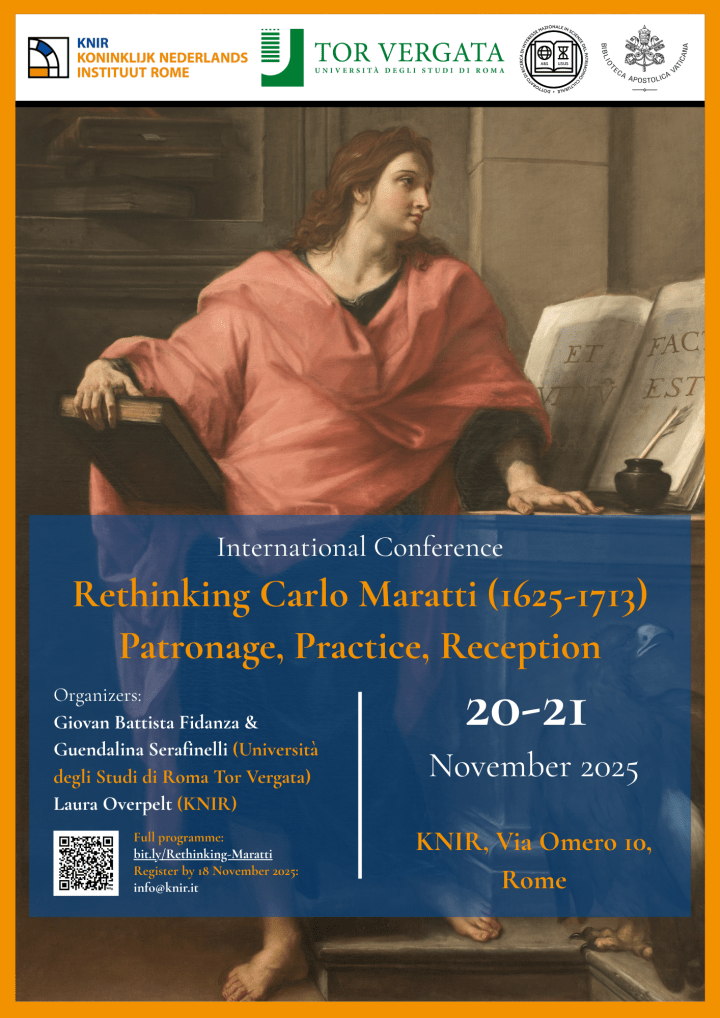 Carlo Maratti (1625–1713) stands as one of the most significant painters of late Baroque Rome—celebrated in his own time as the natural heir to Raphael and Carracci and the leading painter of the Eternal City. Maratti’s extraordinarily long and successful career linked the seventeenth and eighteenth centuries, shaping academic practice, taste, and artistic institutions well beyond his lifetime. His activity as painter, restorer, collector, ‘principe’ of the Academia di San Luca, and head of a large and international workshop placed him at the centre of Rome’s artistic and cultural networks.
Despite this prominence, Maratti’s reputation in art history has long oscillated between admiration and neglect. While traditional scholarship often portrayed him as the embodiment of academic classicism or as a symbol of stylistic decline after Bernini and Cortona, more recent research has begun to reassess the complexity of his artistic persona and his impact on the European art world. Yet, major questions remain regarding his patronage, his practices, his economic strategies, his workshop organisation, and his reception.
Marking the 400th anniversary of Carlo Maratti’s birth, this international conference seeks to offer a critical reassessment of the artist and his legacy. Bringing together established scholars and emerging researchers, it provides a forum for exploring new perspectives on Maratti’s art, practice, and influence. Special emphasis is placed on the study of unpublished archival materials, newly identified documents, and analytical approaches that shed light on the dynamics of patronage, artistic production, restoration, collecting, and reception.
The conference will take place in person at the Koninklijk Nederlands Instituut Rome (KNIR). Presentations will be given in English and Italian. A keynote lecture by Dr Arnold Witte (University of Amsterdam) will conclude the first day of the conference and can be attended remotely via Zoom. The conference is organized by Giovan Battista Fidanza and Guendalina Serafinelli (Università degli Studi di Roma Tor Vergata) and Laura Overpelt (Royal Netherlands Institute in Rome). It is supported by the Royal Netherlands Institute in Rome and the PhD Program of National Interest in Cultural Heritage at the Università degli Studi di Roma Tor Vergata, with the patronage of the Biblioteca Apostolica Vaticana.
In-person participation is free of charge, but places are limited. Please RSVP by 18 November 2025 by sending an email to info@knir.it. Kindly specify which part(s) of the conference you plan to attend, if not the entire programme. Zoom registration for the keynote lecture is available here.
t h u r s d a y , 2 0 n o v e m b e r
10.15 Welcome and Opening Remarks
• Susanna de Beer (Deputy Director of the Koninklijk Nederlands Instituut Rome); Lucia Ceci (Vice Chancellor for Communications and Head of the Dipartimento di Storia, Patrimonio culturale, Formazione e Società – Università degli Studi di Roma Tor Vergata); Tullia Iori (Vice Chancellor for Education – Università degli Studi di Roma Tor Vergata); Don Mauro Mantovani S.D.B. (Prefect of the Biblioteca Apostolica Vaticana)
• Introduction by Guendalina Serafinelli (Università degli Studi di Roma Tor Vergata) on behalf of the organizers
11.00 Session 1 | Barberini Patronage
Chair: Isabella Aurora (Biblioteca Apostolica Vaticana)
• Giovan Battista Fidanza (Università degli Studi di Roma Tor Vergata) — Carlo Maratti and His Workshop for Cardinal Carlo Barberini: Reconstructing the Significance of a Relationship
• Olga Arenga (Università degli Studi di Roma Tor Vergata) — Prince Maffeo Barberini and Carlo Maratti: New Documents in Microhistorical Perspective
• Sara Carbone (Università degli Studi di Roma Tor Vergata) — Francesco Reale in the Workshop of Carlo Maratti: Professional History in the Service of the Barberini Family
13.45 Session 2 | Transregional Patronage and Institutions
Chair: Loredana Lorizzo (Università degli Studi ‘G. d’Annunzio’ Chieti – Pescara)
• Andrea Spiriti (Università degli Studi dell’Insubria) — Maratti, the Omodei Family, and the Lombard National Church of SS. Ambrogio e Carlo al Corso in Rome: Problems and Reflections
• Laura Facchin (Università degli Studi dell’Insubria) — ‘Del signor Carlo Maratta, stimato da molti il primo che sia oggidì in quell’arte’: Reassessing the Master’s Relationship with Painting in the Savoy State
• Isabella Salvagni (Independent Scholar) — Carlo Maratti e l’ Accademia di San Luca
15.20 Session 3 | Reception and Historiography
Chair: Donatella Livia Sparti (Syracuse University)
• Guendalina Serafinelli (Università degli Studi di Roma Tor Vergata) — Niccolò Maria Pallavicini’s Ambition, the Cult of Carlo Maratti, and Bellori’s Legacy
• Laura Overpelt (Koninklijk Nederlands Instituut Rome) — A Netherlandish Perspective on Carlo Maratti: Hoogewerff and Beyond
17.00 Keynote available remotely via Zoom
Chair: Laura Overpelt (KNIR)
• Arnold A. Witte (Universiteit van Amsterdam) — Cardinals Commissioning Carlo Maratti: Shifts in Ecclesiastical Patronage around 1700
A recent biography of Maratti states that “at the turn of the century, political and economic factors caused official and aristocratic patronage to decline,” which reflects Francis Haskell’s more generic assumption of a general wane of the Roman artistic climate occurring around 1700. This keynote lecture will consider how this presumed downturn in ecclesiastical patronage in the late Seicento affected the artistic milieu in Rome and particularly how Maratti’s late career was determined by this shift.
f r i d a y , 2 1 n o v e m b e r
9.30 Session 4 | Maratti as Entrepreneur
Chair: Karin Wolfe (British School at Rome)
• Alessandro Agresti (Independent Scholar) — Nell’atelier di Carlo Maratti: Struttura, funzione e allestimento di una quadreria (con un inventario inedito del 1701)
• Adriano Amendola (Università degli Studi di Salerno) & Cristiano Giometti (Università degli Studi di Firenze) — Per un ampliamento dei committenti: Le finanze di Carlo Maratti
• Paolo Coen (Università degli Studi di Teramo) — Maratti and the Art Market: New Reflections
11.25 Session 5 | Restoration Practices
Chair: Maria Grazia D’Amelio (Università degli Studi di Roma Tor Vergata)
• Donatella Livia Sparti (Syracuse University) — The Restoration of the Loggia Farnesina Revisited (Without Bellori)
• Simona Rinaldi (Università degli Studi della Tuscia) — Materiali e tecniche nei restauri pittorici di Carlo Maratti
• Lotte van ter Toolen (Rijksuniversiteit Groningen) — From Restoring Reputations to Meddling with Memorials: Reflections on Carlo Maratti and the Pantheon
12.40 Concluding Remarks










 Enfilade
leave a comment