Colloquium | Visualizing Antiquity: The Copy of the Copy
From ArtHist.net:
Visualizing Antiquity: On the Episteme of Early Modern Drawings and Prints V:
The Copy of the Copy … of the Copy: Techniques of Pictorial Reception of
Antiquity in the Early Modern Period
Online and in-person, Berlin-Brandenburgische Akademie der Wissenschaften, 3 July 2026
Organized by Elisabeth Décultot, Arnold Nesselrath, Cristina Ruggero, and Timo Strauch
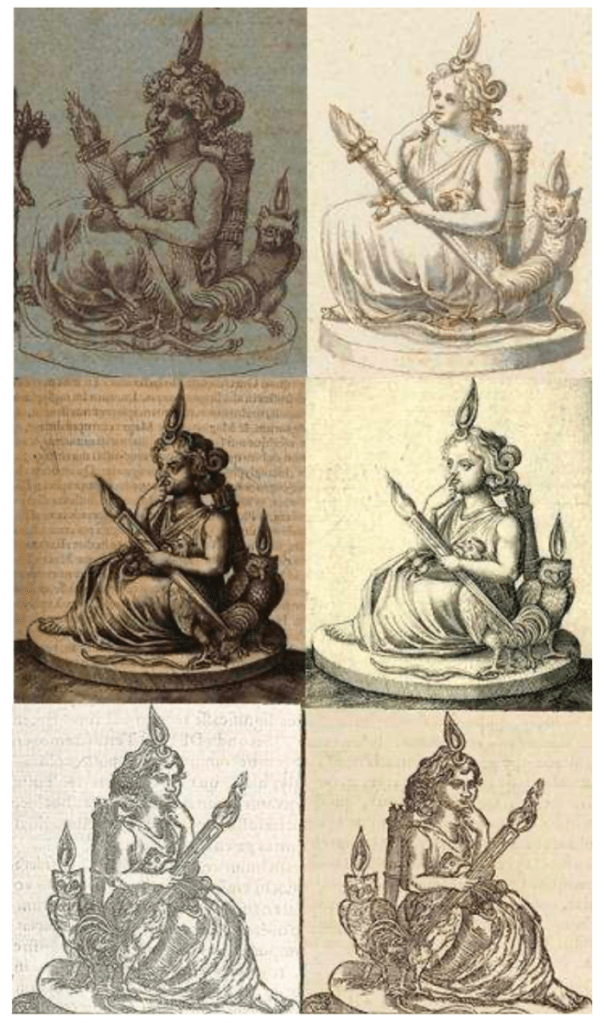
Various early modern depictions of Harpocrates (the Greek form of the Egyptian child-god Horus).
In virtually all areas of human creativity, the outcomes—whether intentional or not—are subject to the principle of repetition. Likewise, in the history of acquisition of knowledge about antiquity, what has once been recorded in writing or in images regularly becomes the starting point for reproduction. The information gathered at the beginning of the line of transmission is henceforth copied and disseminated for as long as there is a need for it, with the copies themselves often becoming multipliers through replication. In this context, copies by no means function merely as duplicates in a subordinate hierarchical relationship to the ‘original’. In chains of transmission that are usually preserved only in fragments, and often in the absence of the lost ‘original’, copies are rather a standard of transmission and thus offer crucial insights into historical processes, illustrate methodological strategies and promote epistemic understanding by making visible the continuous engagement with ancient models. The fifth colloquium in the series, Visualizing Antiquity: On the Episteme of Early Modern Drawings and Prints focuses on diverse processes of copying in the graphic arts and examines the role of copies as powerful resources of knowledge in the context of the preservation, transmission and creative transformation of concepts of antiquity.
Admission is free, with the required registration available here. Online access will be available here.
p r o g r a m m e
12.30 Welcome and Introduction — Elisabeth Décultot (Martin-Luther-Universität Halle-Wittenberg) and Cristina Ruggero (BBAW)
12.45 On the Theories of Copies
Chair: Elisabeth Décultot (Martin-Luther-Universität Halle-Wittenberg)
• Arianna Farina (Università degli Studi Suor Orsola Benincasa, Naples), Reproducing Art: the Copy as an Epistemic Device
1.15 Antiquities in Academic Contexts
Chair: Tommaso Gristina (Sapienza Università di Roma, Rome)
• Lorenzo Giammattei (Sapienza Università di Roma, Rome), Learning Antiquity through Copies: Vincenzo Camuccini and the Transmission of Classical Models in Private Roman Academies
• Susanne Müller-Bechtel (Munich/Würzburg), Das akademische Aktstudium – ein wichtiger Multiplikator der bildlichen Antikenrezeption
Coffee Break
2.45 (Mis-)Interpretations of Antiquity
Chair: Timo Strauch (BBAW)
• Anna Carrarini (Zentralinstitut für Kunstgeschichte, Munich), Copy or Creature? Die druckgraphische Verfremdung der Kapitolinischen Wölfin
• Ana Sofia Pinto (Marta Rocha Moreira / CENP, FAUP, Porto), Around the ‘tripode’: The Roman Meal, Revisited
• Norbert Franken (Berlin), Fallstudien: Stiche und Zeichnungen verschollener Altertümer im kritischen Vergleich
Coffee Break
4.45 Antique Architecture in Copy Chains in Drawing and Print
Chair: Arnold Nesselrath (Rome)
• Elena Efimova (Lomonossow University, Moscow), Les copies des dessins de la Renaissance par les maîtres du cercle de Cassiano dal Pozzo dans un album du XVIIe siècle à Saint-Pétersbourg
• Ruggero De Blasi (Università degli Studi di Genova, Genoa), Representing Obelisks in Sixteenth- and Seventeenth-Century Roman Prints: Practices of Copying and Reconfiguration
• Ana Šverko (Cvito Fisković Centre and University, Split), The Copy of a Transformed Original. The Temple of Jupiter in Split and a Case of Graphic Transmission
6.15 Closing Discussion
Symposium | Imagining Britain
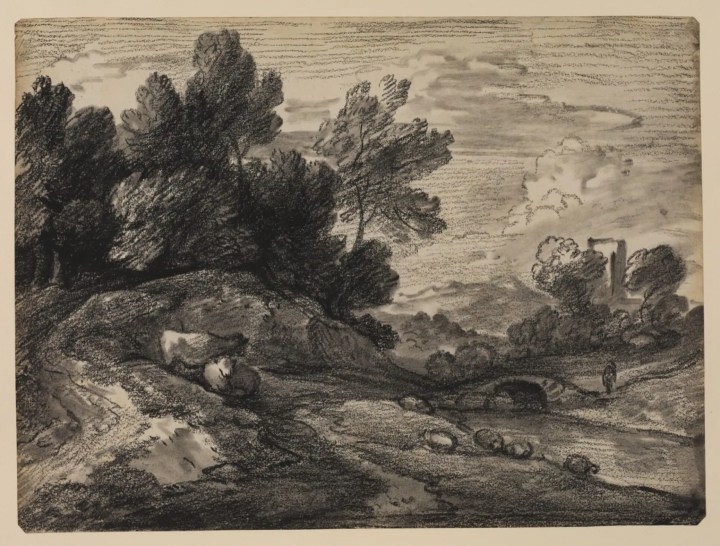
Thomas Gainsborough, Landscape with Sheep and Cattle on the Bank of a Stream, 1780–84, synthetic black chalk with stumping on wove paper, all four corners cut (London: Courtauld Gallery, Robert Clermont Witt, bequest, 1952).
◊ ◊ ◊ ◊ ◊
Upcoming at the Courtauld:
Imagining Britain: Postgraduate and Early Career Research in British and Irish Art
Courtauld, Vernon Square Campus, London, 9 June 2026
Organized by Claire Ó Nualláin and Clara Shaw
A decade on from the inaugural provocation of British Art Studies Volume I, published in November 2015, in which art historians responded to the statement, “There’s No Such Thing as British Art,” a significant aspect of British art studies has involved reflection on the nature and boundaries of the field itself.
The expansion of the field’s geographic and intellectual perspectives has opened new avenues for further research. For instance, scholars have recognised the possibilities afforded to the study of British art when it is brought into dialogue with the arts of regions which have been marginalised in its discussion, including Ireland and former colonial territories. This introspection has instigated a re-examination of British collections, with major rehangs including at Tate Britain, encouraging fresh perspectives on canonical works of art and the emergence of lesser-known artists and histories from the archive. In 2025, the Courtauld Institute of Art announced the opening of the Manton Centre for British Art, a major new initiative in the field, and providing new contexts in which to explore the definition, scope and even relevance of the concept of ‘British’ art.
Centred around themes of a national taste, the construction of landscapes, visualisations of empire, and the fabrication of a ‘national’ identity, this symposium provides an interdisciplinary, cross-period forum for fruitful discussions by PhD and early career researchers on the role of visual and material culture in reinforcing, challenging and complicating the notion of ‘British.’
This symposium event is organised by Claire Ó Nualláin and Clara Shaw, supported by the CHASE Doctoral Training Partnership and the Manton Centre for British Art.
p r o g r a m m e
9.30 Registration
10.00 Opening remarks
10.10 Session 1 | Cultivating Taste
Chaired by Jelena Sofronijevic
• Isobel Muir — ‘Art for the People’? An Examination of the Response to the ‘Modern Painters of To-Day’ exhibitions of 1942, curated by Lillian Browse
• Nam Huh — Whose Britain? Diasporic Moving-Image, Archives, and Contemporary Histories
• Ella Nixon — The Arts Council Collection: Redefining British Art in the 1980s
11.20 Tea and Coffee break
11.35 Session 2 | Constructing Spaces
Chaired by Jack Englehardt
• Grace Fannon — Performing Britain in John Speed’s The Theatre of the Empire of Great Britaine
• Eleanor Stephenson — Visualising Britishness in Industrial Landscapes of Wales
• Méabh Scahill — Germinating ‘Britain’ in Ireland?: Centring Ireland in Decimus Burton and Richard Turner’s Botanic Architecture
12.45 Lunch break
13.45 Session 3 | Conceptualising Empire
Chaired by Alisha Ma
• Abigail Spencer — The Maternal Image and the Visual Culture of Slavery, c.1788–1814
• Sarah Hutcheson — ‘Whose rich productions we so justly prize’: Naturalizing Catarina de Bragança in the Ceiling Paintings at Windsor Castle, 1678–88
• Shaheen Alikhan — Elephant and Castle: African Forts and Heraldry in the Shaping of British National Identity
14.55 Tea and coffee break
15.10 Session 4 | Creating Identities
Chaired by Emma Davis
• Christina Childs — Free Unions Locked Up: The Paradox of Resistance and the Special Branch Confiscation of a British Surrealist Journal
• Ed Kettleborough — Sunset on Stability: Class, Nation, and Masculinity in the Early Work of Derek Boshier
• Amber Butchart — Fabric of Britain: Textiles, Affect, and the Propaganda of National Identity
16.20 Closing remarks
16.30 Wine reception
Study Days | Framing the Drawing – Drawing the Frame
This week at the Bibliotheca Hertziana:
Gernsheim Study Days: Framing the Drawing – Drawing the Frame
Online and in-person, Bibliotheca Hertziana – Max Planck Institute for Art History, Rome, 13–15 May 2026
Organized by Tatjana Bartsch, Ariella Minden, and Johannes Röll
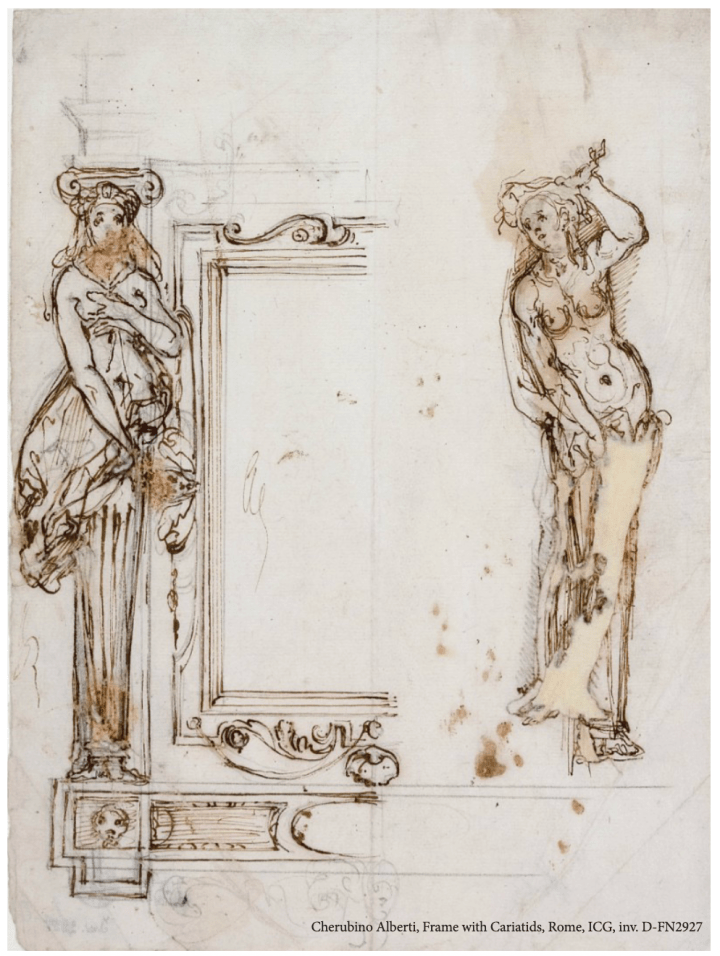 The 2026 Gernsheim Study Days will explore the relationship between early modern drawings, frames, and framing. Papers will consider both how the symbolic connotations associated with the frame in the early modern period functioned as part of artists’ generative creative processes as a cultural technique as well as the role that the physical act of framing drawings played within histories of collecting and reception. With this focus on the medium of drawing, this conference seeks to uncover new ways to think about the myriad semiotic potentials of the frame in the making and study of early modern art. Please follow the event online at https://vimeo.com/event/5864584
w e d n e s d a y , 1 3 m a y
14.00 Welcome and Opening Remarks
• Tatjana Bartsch (BHMPI) and Ariella Minden (University of St Andrews)
14.30 Section 1
Chair: Ariella Minden
• Reinier Baarsen (Rijksmuseum Amsterdam), Who Drew Frames?
• Furio Rinaldi (Fine Arts Museums of San Francisco), Leonardo’s Border Lines
15.50 Coffee Break
16.10 Section 2
Chair: Silvia Massa (Kunstmuseum Basel)
• Elizabeth Merrill (Ghent University), Copy, Snip, Cut, Collage: Drawing Practices in the Workshop of Lambert Lombard
• Ludovico Maria Durante (Roma, Sovrintendenza Capitolina), Abitare la soglia: La cariatide come cornice incarnata nei disegni di Cherubino Alberti e Federico Zuccari
• Helen Barr (Goethe-Universität Frankfurt am Main), Cornice / senza cornice / fuori cornice: Il libro de’ disegni di Francesco Morandini
t h u r s d a y , 1 4 m a y
10.00 Section 3
Chair: Francesca Borgo (BHMPI)
• Laura Moretti (University of St Andrews), Framing the Disegno: Vincenzo Borghini’s Cultural Techniques and the Construction of the Vasarian Libro
• Vera Hendriks (The Hague, RKD — Netherlands Institute for Art History), Framing Authorship: Drawn Borders and Inscribed Frames in Eighteenth-Century Dutch Artists’ Portraits
11.20 Coffee Break
11.40 Section 4
Chair: Tatjana Bartsch
• Gudula Metze (Kupferstich-Kabinett – Staatliche Kunstsammlungen Dresden), Creative Collecting: A Group of Baroque Drawn Frames at the Dresden Kupferstich-Kabinett
• Elisabeth Oy-Marra (Johannes Gutenberg-Universität Mainz), Le scritture ai margini: Sebastiano Resta e la doppia incorniciatura dei disegni
13.00 Lunch Break
14.00 Section 5
Chair: Anna Magnago Lampugnani (BHMPI)
• Thomas Pöpper (Westsächsische Hochschule Zwickau, Angewandte Kunst Schneeberg), Passage, Access, Depth: Mounting as Framing–The Window Mount in Albrecht Dürer and Michelangelo
• Giovanni Santucci (Università di Pisa), Mounting, Borders, and Meaning in the Talman Collection
15.20 Coffee Break
15.40 Section 6
Chair: Giorgio Marini (Roma, Istituto Centrale per la Grafica)
• Christoph Orth (Klassik Stiftung Weimar), Framing the Face: On the Role of Drawings in Lavater’s Ideas on Physiognomy
• Kristel Smentek (Massachusetts Institute of Technology), A Persian Muraqqa and Pierre-Jean Mariette’s Mounted Drawings
f r i d a y , 1 5 m a y
no streaming
10.00–13.00 Roundtable
Chair: Johannes Röll (BHMPI)
Conference | England in Thüringen
From ArtHist.net:
England in Thüringen: Kunst — Sport — Gärten — Architektur
Schlosskapelle Reinhardsbrunn, Friedrichroda, 7–9 May 2026
Die Tagung England in Thüringen: Kunst — Sport — Gärten — Architektur widmet sich den vielfältigen kulturellen Nahtstellen zwischen Großbritannien und Thüringen vom 18. bis zum 20. Jahrhundert.
Ihr historisches Fundament liegt in den dynastischen Allianzen des Thüringer Adels mit dem englischen Königshaus: 1736 heiratete Augusta von Sachsen-Gotha-Altenburg den englischen Prinzen Friedrich Ludwig von Wales. Ihr Sohn bestieg als Georg III. den britischen Thron.
Adelheid von Sachsen-Meiningen wurde 1818 durch ihre Ehe mit dem späteren König Wilhelm IV. Königin von Großbritannien und Irland. Über Königin Victoria und ihren Ehemann Prinz Albert von Sachsen-Coburg und Gotha wirkten diese Verbindungen im 19. Jahrhundert prägend nach. Mit deren Sohn Alfred und dem Enkel Carl Eduard regierten später “Engländer” das Herzogtum Sachsen-Coburg und Gotha. Im Unterschied zu den dynastischen Beziehungen sind die kulturellen Impulse, die mit diesen ein-hergingen, nur wenig erforscht. Umso lohnender erscheint es, diese zum ersten Mal in dieser Form in Thüringen, und zudem mit Schloss Reinhardsbrunn an einem historisch höchst bedeutungsvollen Tagungsort, zu beleuchten.
Die wissenschaftlichen Beiträge decken ein breites thematisches Spektrum ab und zeigen, wie nachhaltig der Kulturtransfer die Region prägte und welche neuen Perspektiven sich dadurch auch für die Zukunft entwickeln lassen.
Anmeldung und Information: angelika.eder@friedenstein-stiftung.de
Veranstalter
Friedenstein Stiftung Gotha, gefördert durch das Thüringer Ministerium für Bildung, Wissenschaft und Kultur sowie den Arbeitskreis selbständiger Kultur-Institute e.V. – ASKI aus Mitteln des Beauftragten der Bundesregierung für Kultur und Medien
d o n n e r s t a g , 7 m a i
14.45 Begrüßung
• Tobias Pfeifer-Helke, Stiftungsdirektor der Friedenstein Stiftung
Grußworte
• Christian Tischner, Thüringer Minister für Bildung, Wissenschaft und Kultur
• S.E. Andrew Mitchell, CMG, Britischer Botschafter in Deutschland
• S.H. Prinz Hubertus von Sachsen-Coburg und Gotha
15.15 Eröffnungsvortrag
• Benedikt Stuchtey (Marburg) — Eminent Victorians und der Kulturtransfer zwischen Empire und Thüringen
16.15 Kaffeepause
16.30 Sektion 1 | Gärten: Ästhetik und Technik
Moderation: Angelika Eder
• Ute Däberitz (Waltershausen/Berlin) — „Durch wilde Waldparthien gebahnter Weg im englischen Geschmacke“ – Herzog Ernst II. von Sachsen-Gotha Altenburg (1745–1804) und Reinhardsbrunn als südlicher Teil des Englischen Gartens von Gotha.
• Hiram Kümper (Mannheim) — Englische Agrarinnovationen in Thüringen zwischen Skepsis und „Agromanie“, ca. 1750–1830
• Franziska Bartl (Chemnitz) — England in Coburg. Das Beispiel der englischen Musterfarmen Callenberg und Ernstfarm
f r e i t a g , 8 m a i
9.15 Sektion 2 | Objekte und Begegnungen: Britische Spuren in Thüringen
Moderation: Ute Däberitz
• Kerstin Volker-Saad (Gotha) — Prinzgemahl Albert von Großbritannien und Herzog Ernst II. von Sachsen-Coburg und Gotha – die brüderliche Passion für außereuropäische Artefakte
• Steffen Arndt (Gotha) — „And if I was not what I am – this would have been my real home“. Die Besuche Queen Victorias und Prinz Alberts in Coburg und Gotha
10.45 Kaffeepause
11.00 Sektion 3 | Erziehung und Identitätsbildung
Moderation: Elisa Schmidt-Winkler
• Stefan A. Eick (Gotha) — „Der Apfel fällt nicht weit vom Stamm“. Beerbohm-Tree et al. – Britische Schüler an der Salzmannschule Schnepfenthal, 1784–1934
• Angelika Eder (Gotha) — „Try to be a good German”. Der junge Carl Eduard von Sachsen-Coburg und Gotha zwischen England und Thüringen.
12.15 Mittagspause
13.30 Erste Möglichkeit einer Führung durch Schloss oder Park Reinhardsbrunn
14.15 Sektion 4 | Sport
Moderation: Claudia Fenske
• Sonja Fielitz (Marburg) — Sport und Mord: Pferdekrimis von Ascot bis Gotha-Boxberg
• Manuel Schwarz (Weißenfels) — “…diese Land wird sein eine sehr gute Tennisplatz for my grandmother.” – Herzog Carl Eduard und der Sport
15.30 Kaffeepause
15.45 Zweite Möglichkeit einer Führung durch Schloss oder Park Reinhardsbrunn
s a m s t a g , 9 m a i
9.15 Sektion 5 | Greiz und Weimar
Moderation: Timo Trümper
• Ulf Häder (Greiz) — Englischer Hochadel in Ostthüringen. Die Graphik-Sammlung Elizabeths von Großbritannien und Irland (1770–1840) im Greizer Sommerpalais
• Adam Eaker (New York) — “Die höchst interessante Engländerin”: Die Gore-Schwestern und die Weimarer Anglophilie
• Hermann Mildenberger (Weimar) — Carl Ruland (1834–1907). Ein Connaisseur zwischen Windsor und Weimar.
11.15 Kaffeepause
11.45 Sektion 6 | Meiningen
Moderation: Sonja Fielitz
• Daniela Roberts (Würzburg) — Gothic Revival in Thüringen. Jeffry Wyatvilles Entwürfe für Fürst Bernhard II
• Doris Fischer (Rudolstadt) — Die Umgestaltung von Schloss Altenstein durch Herzog Georg II. von Sachsen-Meiningen und Albert Neumeister 1888–90
• Florian Beck M.A. (Meiningen) — Beinahe fünfzig Jahre – Die Shakespeare-Rezeption am Meininger Hoftheater unter Herzog Georg II
Conference | Thinking through Tea
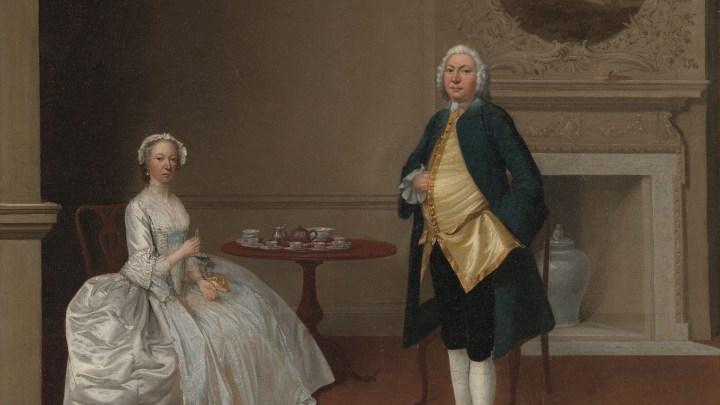
Arthur Devis, A Couple, Traditionally Identified as Mr. and Mrs. Hill, detail, 1750–51, oil on canvas
(New Haven: Yale Center for British Art, Paul Mellon Collection, B1981.25.226).
◊ ◊ ◊ ◊ ◊
From YCBA:
Thinking through Tea: Art, Resistance, and
Global Entanglements in the Age of American Independence
Online and in-person, Yale Center for British Art, New Haven, 7–8 May 2026
Marking the 250th anniversary year of the Declaration of Independence, this program reconsiders American resistance not as a singular political rupture, but as a material and visual process shaped through objects, images, and everyday rituals. Rather than treating independence as an abstract ideal, it asks how freedom was experienced, negotiated, resisted, and contested through practices often far from the political stage yet deeply enmeshed in global systems of extraction and exploitation. From drinking tea and sweetening foodstuffs with sugar, to furnishing interiors with tropical woods, wearing imported or locally adapted textiles, or handling silver objects, these material acts encoded both refinement and refusal.
Across multiple sessions held over two days, the program brings objects to the center of inquiry, examining how global goods circulating through colonial households acquired new meanings. Turning to the present moment, the program questions how museums have inherited, framed, and sometimes obscured these histories. The conversations will invite reflection on the ethical responsibilities of collecting institutions as stewards of objects that bear the uneven legacies of revolution, extraction, and empire.
Join the livestream, beginning at 5.30pm ET on Thursday, May 7, and at 10am on Friday, May 8. Registration, available here, is recommended but not required.
The event is made possible through the support and partnership of the Lunder Institute for American Art, the Colby College Museum of Art.
t h u r s d a y , 7 m a y
5:30 Roundtable 1 | Ritual, Tradition, and Fashion
This roundtable examines how everyday rituals—tea drinking, fashionable dress, and interior furnishing—became charged sites of negotiation in the decades surrounding the American Revolution. Far from being peripheral to political life, these practices were central arenas in which identity, allegiance, and resistance were actively produced and contested. Treating tea and related goods as both commodities and ritual objects, the session explores how colonial communities engaged global materials through practices of adaptation, refusal, and diplomacy. It considers how imported fashions and customs from Africa, the Caribbean, India, and England were reworked into hybrid practices that signaled loyalty, dissent, or strategic ambivalence, and in doing so challenged imperial norms.
Moderator: Mark Peterson, Edmund S. Morgan Professor of History, Yale University
Speakers
• Anna Arabindan-Kesson, Associate Professor of Art and Archaeology and African American Studies, Princeton University
• Catherine E. Kelly, Professor of History and Executive Director of the Omohundro Institute of Early American History and Culture, William & Mary
• Ellen Hartigan-O’Connor, Professor of History and Associate Dean, Graduate Studies, University of California, Davis
f r i d a y , 8 m a y
10.15 Roundtable 2 | Trade, Movement, and Empire
How did the movement of commodities (and the people who cultivated, transported, taxed, and consumed them) create new traditions, dependencies, and inequalities? Rather than treating American independence as a self-contained national event, this session situates it within global networks of trade, labor, and extraction, in order to think through the networks that both enabled revolutionary protest and reproduced new inequalities.
Moderator: Romita Ray, Associate Professor and Director of Undergraduate Studies in Art History, Syracuse University, College of Arts and Sciences
Speakers
• Zara Anishanslin, Associate Professor of History and Art History | Director, Museum Studies & Public Engagement, University of Delaware
• John Stuart Gordon, Benjamin Attmore Hewitt Curator of American Decorative Arts, Yale University Art Gallery
• Jennifer L. Anderson, Associate Professor of History, Stony Brook University
11.30 Break
11.45 Roundtable 3 | The Art of Refusal and Everyday Resistance
What does resistance look like when it happens quietly, domestically, and collectively, through everyday objects, plant commodities, and rituals rather than overt political action? By beginning with domestic refusal—such as tea boycotts and the political meaning of American tea silver—this session reframes revolutionary resistance as embedded in everyday material practice, much of it undertaken by women.
Moderator: Jennifer Van Horn, Professor, Joint Appointment with History, Director of Graduate Studies, Art History, North American Art and Material Culture, University of Delaware
Speakers
• Yota Batsaki, Executive Director and Principal Investigator, Plant Humanities Initiative, Dumbarton Oaks, Washington, DC
• Catherine Molineux, Associate Professor of History, Vanderbilt University
1.00 Lunch Break
2.15 Roundtable 4 | The Afterlives of Curating Resistance
The closing roundtable reflects on institutional and curatorial responsibilities. As the United States marks the 250th anniversary of independence, this session asks how American museums should curate objects of resistance that are inseparable from empire, enslavement, and extraction. What does responsible commemoration look like in material terms? How should we bring out these stories that might not be visible in the archive?
Moderator: Stephanie Sparling Williams, Andrew W. Mellon Curator of American Art, Brooklyn Museum of Art
Speakers
• Stéphanie Delamaire, Curator of European and American Art, Carnegie Museum of Art, Pittsburgh, Pennsylvania
• Erica Lome, Curator of Collections, Historic New England
3.45 Closing Reception
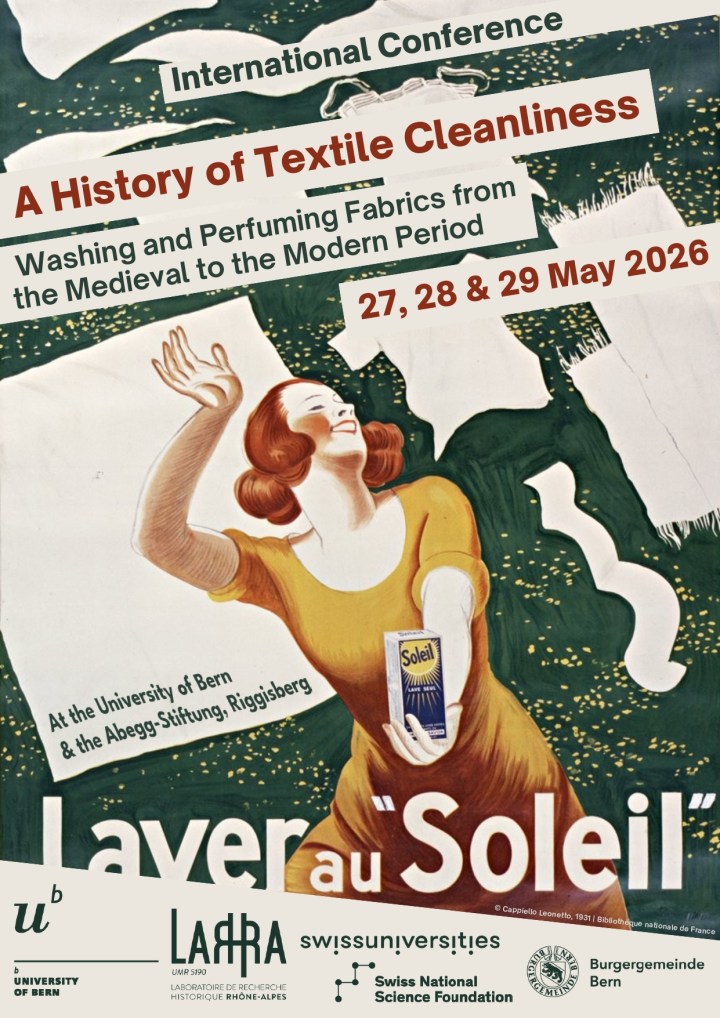
Conference | A History of Textile Cleanliness
From ArtHist.net, with registration available at the University of Bern:
A History of Textile Cleanliness: Washing and Perfuming Fabrics
from the Medieval to the Modern Period
University of Bern / Abegg-Stiftung, Riggisberg, 27–29 May 2026
Organized by Moïra Dato and Érika Wicky
 w e d n e s d a y , 2 7 m a y
University of Bern, Hauptgebaüde, Kuppelraum
13.00 Arrival and coffee
13.30 Introduction by Moïra Dato and Érika Wicky
14.15 Panel 1 | Cultural and Social Attitudes to Cleaning and Textile Care
Moderation: Torsten Korte (Universität Bern)
• Isabella Campagnol (Istituto Marangoni) — Doing the Laundry in 18th-Century Venice: Washing in a City on Water, but without Water
• Marie Charvet (Nantes Université) — Whiteness vs Preservation: Laundresses and Housewives in 19th-Century Urban France Public Washhouses
15.30 Coffee Break
16.00 Panel 2 | The Scent of Cleanliness
Moderation: Érika Wicky
• Océane Fontaine Cioffi (Université de Tours) — The Scent of Clean: Perfuming Linen between Health, Sensuality, and Material Care in 16th-Century Europe
• Pauline Devriese (Universiteit Gent/Modemuseum Hasselt) — The Scent of Dress: Tracing the Separation of Scent and Dress in Daily Hygiene and Health Practices from the 16th to 18th Centuries in Western Europe
• Lucille Lefrang (Université Grenoble Alpes) and Olivier David (Institut Lavoisier/Paris Saclay) — The Contemporary ‘Toxic’ Smell of Clean: The Example of Galaxolide
t h u r s d a y , 2 8 m a y
Abegg-Stiftung, Riggisberg
10.00 Panel 3 | Techniques and Practices of Textile Cleaning
Moderation: Jean-Alexandre Perras (Sorbonne Université / Cellf)
• Vendy Hoppe (University of Manchester/The Delmas Foundation) — Too Precious to Wash? The Care and Cleaning of Velvets in Early Modern Europe
• Audrey Colonel-Coquet (Université Grenoble-Alpes/LARHRA) — The Cleanliness of Gloves in the 19th Century: From Home Cleaning to Washable Gloves
• Eloïse Richard (Université de Genève) — Behind the White Coat: Cleaning and Sterilizing Hospital Textiles in the Early 20th Century
12.00 Lunch
13.30 Visit of the conservation workshop and storage of the Abegg-Stiftung
14.30 Panel 4 | Cleaning in Textile Conservation
Moderation: Regula Schorta (Abegg-Stiftung)
• Bettina Niekamp (Abegg-Stiftung) — Textile Cleanliness: Some Case Studies of Conservation/Restoration Treatments of Soiled Linen Damasks, Burial Textiles, Tapestries, and Liturgical Textiles
• Johanna Nilsson (Göteborg University), Jan Pettersson (Göteborg University), and Karin Tetteris (Armémuseum) — Traces of Environment and Humans: Interdisciplinary Studies of Dirt on Historical Textiles
• Anna Robinson (University of Lincoln) — In the Usual Fashion: Learning from and Deciphering 19th-Century Laundering Instructions
16.15 Coffee break
16.30 Visit of the permanent and temporary exhibition of the Abegg-Stiftung
f r i d a y , 2 9 m a y
University of Bern, Hauptgebaüde, Kuppelraum
9,00 Panel 5 | The Actors and Knowledge of Cleaning
Moderation: Raphaël Morera (CNRS/EHESS)
• Olga Arenga (Università degli Studi di Roma Tor Vergata) — From Soap to Scent: Garment Care and Daily Labor in the Barberini Archive
• Sara van Dijk (Rijksmuseum) and Danielle van den Heuvel (Universiteit Utrecht) — White and Bright: Washing Linens in the Dutch Republic
• Santosh Kumar Rai (University of Delhi) — From Flowers to Chemicals: Textile Cleanliness and Changes in the Handloom Industry of Colonial North India
• Monica Klasing Chen (Universität Heidelberg) — Virtue or Science: Washing and Caring for Textiles in Early-Modern and Modern China
11.00 Coffee break
11.30 Panel 6 | Religious Rituals and Practices of Cleanliness
Moderation: Corinne Mühlemann (Universität Bern)
• Juliette Calvarin (Humbold-Universität zu Berlin) — ‘Lynin cloth of witlé coloure’: Veronica’s Veil, Linen Vestments, and the Laundress
• Patricia Blessing (Stanford University) — Textile Cleanliness in Islamic Law: From Hadith to Ottoman Fatwas
12.30 Lunch
14.00 Panel 7 | Dirt and the Absence of Cleaning
Moderation: Sasha Rossman (Universität Bern)
• Sylvia Houghteling (Bryn Mawr College) — The Soil of Dyes: Ground, Water, and Scent in the Making of Early Modern South Asian Textiles
• Léon Rochard (Sorbonne-Université) — ‘The world is like this cloth, misleading and fake’: Clean, Dirty Textiles, and the Question of Representation in the 17th-Century Netherlands
• Alison Matthews David (Toronto Metropolitan University) — Offenders: Cleanliness and the Scent of Crime
• Julia Guarneri (University of Cambridge) — Dry Clean Only: Dealing with Unwashable Clothing in the 20th-Century United States
16.00 Final discussion and closing remarks
Scientific Committee
• Olivier David (Institut Lavoisier / Paris-Saclay)
• Raphaël Morera (CNRS-EHESS)
• Corinne Mühlemann (Universität Bern)
• Helen Wyld (National Museum Scotland)
Conference | Revolutions, Art, and the Market
From ArtHist.net and Eventbrite:
Revolutions, Art, and the Market
Sotheby’s Institute of Art, London, 4–5 June 2026
Art market trends and practices—whether historical or contemporary—are affected by networks of complex and often competing forces. As moments of political, economic, intellectual, or technological rupture, revolutions have significantly shaped art market systems and fortunes, refracting and redirecting collecting ambitions, displacing existing markets and creating new ones, and promoting novel modes of commercialisation of art. Embracing wide chronological and geographical spans, this conference considers how revolutions have inflected the circulation and consumption of art and facilitated the emergence of new art market practices and collecting paradigms.
Tickets range from £10 to £60—depending on whether attendance is online or in-person and whether there is a student rate. Registration is now open here.
t h u r s d a y , 4 j u n e
9.15 Coffee and Registration
9.45 Welcome
10.00 Session 1 | Revolutions in the Age of Enlightenment
Chair: Barbara Lasic
• Catherine Dossin (Associate Professor, Purdue University) — Franklinmania: The French Art Market and the Making of the American Revolution
• Gabriel Wick (Assistant Professor, American University in Paris) — Marketing Gardens: The Duc d’Orléans, Palais Royal, Le Raincy, and the Parisian Public, 1785–1793
• Jan Dirk Baetens (Assistant Professor, Radboud University) and Evelien De Visser (Curator, RKD – Netherlands Institute for Art History) — Art for All: The Emergence of a Mass Market for Cheap Paintings in the Age of Revolutions
12.30 Lunch Break
13.30 Session 2 | The 1917 Russian Revolutions and Their Aftermath</span
Chair: Lis Bogdan
• Natalia Murray (Lecturer, Courtauld Institute) — All the Empty Palaces: The Fate of Private Collections in Russia after the 1917 Revolutions
• Daniel Bulatov (PhD Candidate, University of Münster) — Beyond the Market: Soviet Patronage and the Economics of Western Revolutionary Art, 1920s–30s
14.45 Tea Break
15.15 Session 3 | Modernist Revolutions and Cross-border Networks
Chair: Bernard Vere
• Lara Virginie Pitteloud (PhD Candidate, University of Neuchâtel) — Exhibiting Modernism in Revolutionary Odesa: Izdebsky’s Salons and the Formation of Transnational Art Market Networks, 1909–1911
• Lucia Colombari (Assistant Professor, University of Oklahoma) — The Afterlife of Italian Futurism: Postwar Art Markets and Transatlantic Networks
• Annie Wong (Independent Art Historian) — After the Cultural Revolution: Wu Guanzhong and the Making of a Transregional Chinese Modernist Market
17.15 Keynote
• Adrian Locke (Curator Emeritus, The Royal Academy of Arts) — Frida Kahlo and the Mexican Revolution
18.15 Drinks Reception
f r i d a y , 5 j u n e
10.00 Session 4 | Revolutions, Representations, and Structural Transformations
Chair: David Bellingham
• Maxence Garde (Curator, Gulbenkian Museum) — Building on a Revolution: A Transformative Economical Approach of Egyptian Antiquities after 1952
• Iris Gilad (University of Tel-Aviv) — Revolution and Recognition: War, Canon Formation, and the Israeli-Palestinian Art Market
• Aurella Yussuf (PhD Candidate, University of Birmingham) — Revolutionary Rhetoric and Market Continuity: Black Political Rupture and the Art Market after 2020
12.30 Lunch Break
13.30 Session 5 | Cultural Revolutions and New Market Practices in Asia
Chair: Ivy Chan
• Vivian Tong (Lecturer, Hong Kong Baptist University) — Shaping Taste in an Evolving Market: Historical Chinese Works of Art and their Auction Market in Hong Kong, 1970s–2020s
• Katie Hill (Senior Lecturer, SIA London) — The Cultural Bond of Maoism: Political Memory and (Cultural) Value in Contemporary Art from China
14.45 Tea Break
15.15 Session 6 | Digital Revolutions
Chair: Melanie Fasche
• Georgia Gerson (PhD Candidate, University of York) — NFTs and the Art Market: Revolution or Continuity?
• Giulia Taurino (Getty Research Institute) — Beyond Network Centrality: Machine Intelligence and the Recovery of Invisible Markets
• Jonathan Adeyemi (Leverhulme Early Career Fellow, Loughborough University) — Political Revolution and Digital Mediation: A Sustainable Increasing Stake of African Art in the Global Market?
17.15 Concluding Remarks
Clay Stories: A Ceramics Symposium
From Colonial Williamsburg:
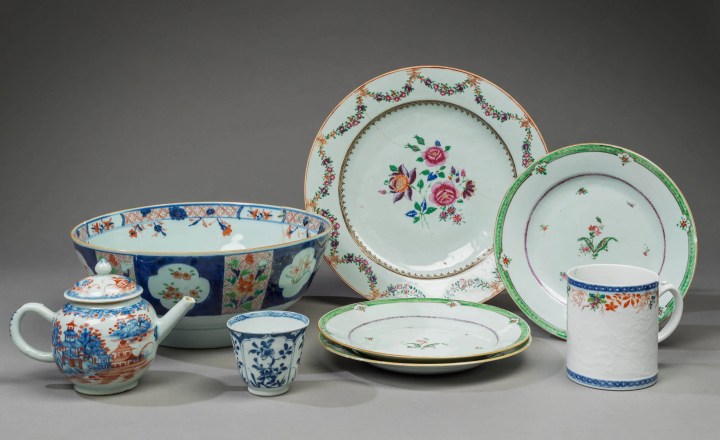
Clay Stories: A Ceramics Symposium
Online and in-person, Colonial Williamsburg, 4–6 June 2026
Colonial Williamsburg is pleased to host the 2026 bi-annual ceramics conference, in collaboration with the Museum of Early Southern Decorative Arts (MESDA), for this year’s symposium entitled Clay Stories. Every object has multiple stories layered through time as it passes from raw materials in the hands of makers, to finished vessel, to single owner or multiple stewards, and from useful utilitarian piece to archaeological fragment or prized possession mounted in a collector’s curio cabinet or in a museum’s case. Clay Stories weaves together history and research shared by curators, scholars, archaeologists, and potters.
All lecture presentations will be available on the conference streaming platform for both virtual and in-person registrants through 31 August 2026. Virtual attendees have virtual access to all lectures.
t h u r s d a y , 4 j u n e
12.00 Registration
1.00–6.00 Pre-Conference Bus Tour: Following the Dragon
Generously supported by James D. and Pamela J. Penny
f r i d a y , 5 j u n e
9.30–3.30 Pre-Conference Workshops and Tours
Please visit the pre-conference options page for more details.
4.30 Welcome
4.45 Glories and the Unexpected: Remarkable Ceramics in American Collections — Errol Manners (Independent Arts Dealer)
5.30 Treasure in Jars of Clay: Discovering Ceramic Masterworks in Unlikely Settings — Luke Zipp (Curator and Author, Crocker Farm)
6.15 Opening Reception
s a t u r d a y , 6 j u n e
8.30 Announcements and Updates from Colonial Williamsburg and MESDA — Angelika Kuettner (Curator of Ceramics and Glass, Colonial Williamsburg) and Johanna Brown (Chief Curator and Director of Collections, Old Salem)
8.45 Ceramics from England to Jamestown to Williamsburg — Julie Edwards (Archaeological Officer, Cheshire West and Chester Council)
9.30 Coffee Break
10.15 A ‘Magical Mystery Tour’, or the Life and Travels of a Curator —Leslie Grigsby (Emerita Senior Curator of Ceramics and Glass, Winterthur)
10.45 Jack and Acton: Revealing the Contributions and Presence of Enslaved Potters in the 18th-Century Red Earthenware Industry of Charlestown, MA. — Joe Bagley (City Archaeologist and Director of Archaeology, Boston Archaeology Program)
11.15 Bonnin and Morris: New Discoveries in Philadelphia — Melissa and Matt Dumphy (Citizen Archaeologists)
11.45 Philadelphia Slipware in Context — Debbie Miller (Archeologist and Curator, National Park Service)
Lecture Supported by the Chipstone Foundation (Ceramic in America)
12.15 Lunch Break
2.15 From Hubener to Medinger: Redware Potters of Southeastern Pennsylvania — Lisa Minardi (Editor, Americana Insights)
2.45 Midwestern Harvest Jugs: An Expression of Personal Choice — Wes Cowan (Vice Chair Emeritus, Freeman’s Auction House and Founder, Cowan’s Auctions)
3.15 ‘The Prospects of Obtaining Wealth with Ease’: The Ceramic Assemblage of 17th-Century Drayton Hall — Luke Pecoraro (Director of Archaeology and Collections, Drayton Hall Preservation Trust)
3.45 Coffee Break
4.30 RE-coiling and Master Potter David Drake — Michelle Erickson (Independent Artist)
Presentation supported by Jeffrey S. Evans & Associates
5.30 Closing Remarks — Tom Savage (Director of Educational Conferences and Travel, Colonial Williamsburg
6.00 Closing Reception with Live Entertainment at Shields Tavern
Haughton Seminar | Courtly Magnificence
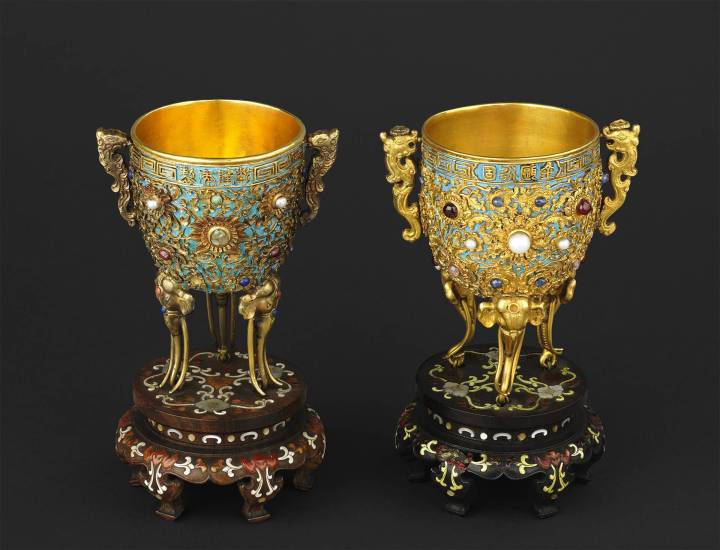
Imperial Wine Cups: Gold Cups of Eternal Stability 金甌永固杯, 1740–41 (Qing dynasty, Qianlong period), gold, kingfisher feathers, pearls, sapphires, spinels, tourmalines, carnelian, quartz, chrysoberyl, lapis, turquoise, ivory, mother of pearl and wood; 18 cm high, including stand (London: Wallace Collection, W112 / W113).
◊ ◊ ◊ ◊ ◊
This year’s Haughton International Seminar:
Courtly Magnificence: Gender, Dynasty, and Politics
The British Academy, 11 Carlton House Terrace, London, 24–25 June 2026
Addressing topics ranging from the royal courts of the Middle Ages to those of the 20th century, this seminar will look at how some of the world’s greatest art collections were formed. It will explore how political intrigue and power were involved in their accumulation and how the personalities of these royal collectors—women as much as men—were reflected in their collections.
Two-day seminar: £140
Two-day seminar including a champagne reception and dinner at The Athenaeum on Wednesday, 24th: £230
Student tickets for two-day seminar (on production of ID): £60
p r e s e n t a t i o n s
• Silvia Davoli — Thinking outside the Court: Horace Walpole, Prince of Strawberry Hill
• Lisa Skogh de Zoete — A Family Network of Collectors: Maria Eleonora of Brandenburg, Christina of Sweden, and Hedwig Eleonora of Schleswig-Holstein-Gottorp
• Mia Jackson — Madame de Pompadour: Love, Friendship, and the Arts
• Rose Kerr — Collections of the Forbidden City
• Tim Knox — China Queens: 20th-Century Royal Collectors of Porcelain
• Caroline McCaffrey-Howarth — Our Ceramic Chasse’: The Exceptional Legacy of Lady Charlotte Schreiber
• Lara Virginie Pitteloud — An Imperial ‘Gluttony’: Art Collecting and the Self-Fashioning of Catherine II’s Court
• Ivan Day and Timothy Schroder — Service a la Francaise
• Christopher (Kit) Maxwell — Staging the Past: The Thorne Miniature Rooms and the Theatre of Historic Interiors
• Timothy Wilson — The Earliest Royal Maiolica Commission: The Service for Matthias Corvinus, King of Hungary, and His Wife Beatrice of Aragon
• Catriona Seth— Virtuous Circulations? Maria Theresa and Marie Antoinette’s Family Portraits
• Claudia Wagner — Collecting Intaglios: Princes as Scholars
Symposium | (In)Visible Faces
From Syracuse University:
(In)Visible Faces: The Politics of Portraiture and Social Change, 1700–the Present
Online and in-person, Syracuse University, 26–27 March 2026
The 2025–2026 Ray Smith Symposium features a two-day conference that focuses on portraiture, the British empire, and the visual legacies of imperial portraiture in our current times. Building on a recently discovered 18th-century portrait of a Mrs. Seaforth painted by Sir Joshua Reynolds, the first president of the Royal Academy in London, the symposium will analyze portraiture, textile trade, and the East India Company on the first day, before shifting to print culture, photography, media, and social justice on the second day. Bringing together curators from the Syracuse University Art Museum (in whose collections Reynolds’s ‘lost’ painting was found) and Special Collections Research Center, as well as art historians, historians, curators, art and textile conservators, and communication scholars, the symposium will feature keynote lectures by acclaimed art historian Tim Barringer (Yale University) and renowned social psychologist Nilanjana (Buju) Dasgupta (University of Massachusetts Amherst).
Co-sponsored by Art and Music Histories. Chemistry. CODE^SHIFT. English. Goldring Arts, Style and Culture Journalism. History. Lender Center for Social Justice. Light Work. Premodern Global Studies. Ray Smith Symposium. South Asia Center. Syracuse University Art Museum. Syracuse University Humanities Center. Syracuse University Libraries. The Alexia at Newhouse. Women’s and Gender Studies. Psychology. The Rubin Family Foundation.
t h u r s d a y , 2 6 m a r c h
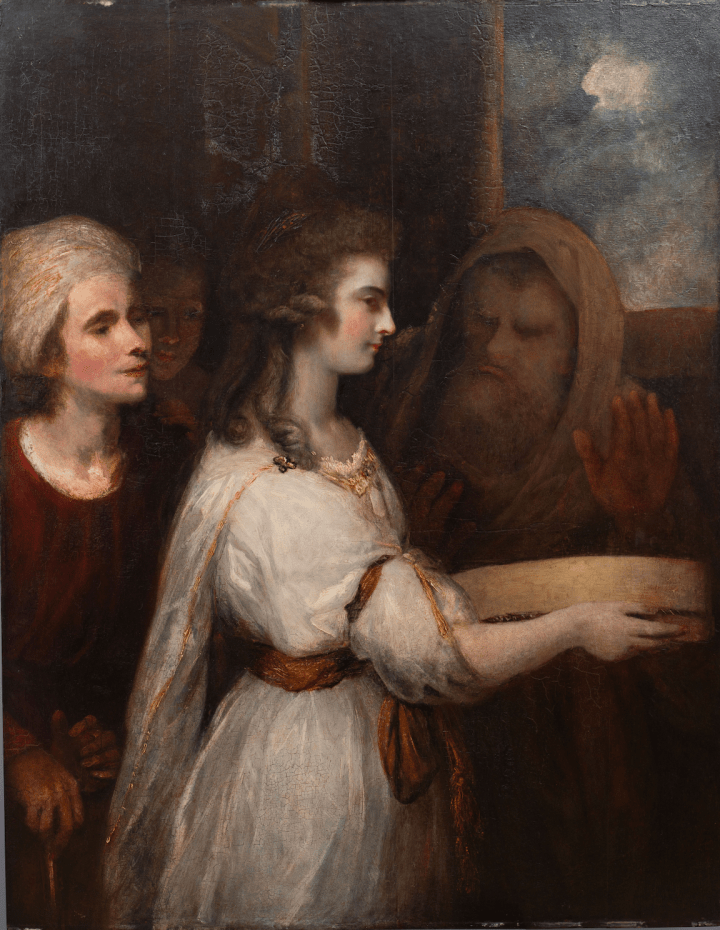
Joshua Reynolds, Tuccia, The Vestal Virgin, 1786, oil on panel (Syracuse University Art Museum, gift of Theodore Newhouse, 1968.329).
11.30 Welcome
11.45 Session 1
Moderator: Radha Kumar
• Robert Travers (Cornell University) — The Return of the Nabob: Richard Barwell and Warren Hastings in 1780s Britain
• Melinda Watt (Art Institute of Chicago) — The Lore and Allure of Woven Air
12.35 Session 2
Moderator: Irina Savinetskaya
• Debarati Sarkar (CUNY Graduate Center) — ‘My Black Servant Juba’: Sir Joshua Reynolds’s Earliest South Asian Ayah Portrait in 18th-Century Britain
• Jennifer Germann (Independent Scholar and Affiliated Scholar, Institute for European Studies, Cornell University) — Dressing up Dido: Constructions of Gender, Race, and Social Rank in the Portrait of Dido Elizabeth Belle and Lady Elizabeth Murray
1.30 Lunch Break
2.40 Session 3
Moderator: Jeffrey Mayer
• Amelia Rauser (Franklin and Marshall College) — Veritable Athenians: How Artistic Dress Became Neoclassical Fashion
• Joanna Marschner (Historic Royal Palaces) — Muslin in Western Fashion in the Later 18th Century: Lady Rockingham’s Muslin Sack-Back Dress c.1775, A Case-Study
3.30 Session 4
Moderator: Kate Holohan
• Raphael Shea (Westlake Art Conservation Center) — A Considered Approach to the Conservation Treatment of Reynolds’s Tuccia, The Vestal Virgin
• Kirsten Schoonmaker (Syracuse University) — Muslin, Magnified: Material Evidence in Local Collections
4.20 Tea and Coffee Break
5.00 Keynote Lecture
Moderator: Junko Takeda
• Tim Barringer (Paul Mellon Professor of the History of Art, Yale University) — A Suitable Ornament: Reynolds, the Royal Academy, and the British Empire
f r i d a y , 2 7 m a r c h
10.00 Welcome
10.10 Session 5 — virtual
Moderator: Durba Ghosh
• Adam Eaker (The Metropolitan Museum of Art) — Two New Indian Portraits for the Met
• Alice Insley (Tate Britain) — TBA
11.00 Session 6
Moderator: Romita Ray
• Melissa Yuen (Syracuse University Art Museum) — ‘And every body may know her’: The Display and Circulation of Mrs. Seaforth’s Image as Tuccia, the Vestal Virgin
• Elizabeth Mitchell (McNay Art Museum) — Anatomy of an Exhibition: From Reynolds to Warhol and Back Again
11.50 Lunch Break
2.15 Keynote Lecture
Moderator: Srividya ‘Srivi’ Ramasubramanian
• Nilanjana ‘Buju’ Dasgupta (Provost Professor and Inaugural Director, Institute of Diversity Sciences, University of Massachusetts Amherst) — How ‘Wallpaper’ Creates Inequality: A Science-Driven Approach to Change It
3.30 Closing Remarks
3.35 Tea, Coffee, Conversation










leave a comment