Conference | Body and Power: The Body in Political Art
From ArtHist.net:
Corps et pouvoir: le corps dans l’art politique des temps modernes
Body and Power: The Body in Political Art in Early Modern Times
Online and In-person, Hôtel d’Assézat, Toulouse, 6–8 October 2021
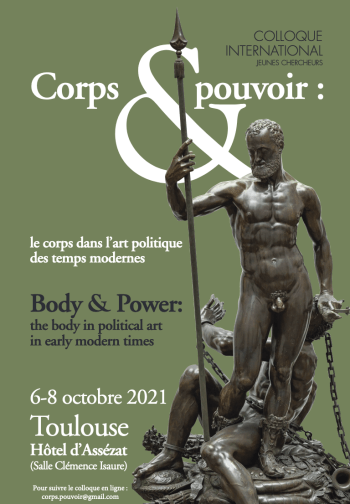 During the Renaissance, it became common to see bodies—both male and female—transformed and strategically exploited through artworks. Real or mythical, aged or juvenile, often bearers of a complex imaginary, they were conceived and perceived as metaphors and regularly used as propaganda devices. In early modern times, the representation of the body had a fundamental place in the process of exaltation and legitimation of the elite.
‘Body and Power’ tends to emancipate from the figure of the prince—although central but not exclusive. Rulers relied on the idealisation of their own person to reinforce their pre-eminence. However, if their bodies were staged and glorified within their portraits—as an essential element to reassure or impress—they could also be juxtaposed with others. The bodies of these secondary figures, whether enemies or allies, could be used to intensify the message, either within or outside of their representations. Thus, all bodies could be evoked: those of the elites as well as those of auxiliaries, intended to support the idea of power from a semantic point of view.
Elements that make this power concrete, visible, and palpable will also be examined. Apparent objects covered the bodies to transcend them, while in response, bodies in turn covered the objects, all of which articulated a substantial discourse that must be deciphered. These same bodies adorned the space of palaces and other places where authority was exercised. Within both perennial and ephemeral decorations, they gave rhythm to the facades through anthropomorphic orders, populated niches, adorned the porticoes of triumphal entrances, inhabited fountains, staircases, fireplaces, etc. Here again, each of these expressions must give rise to a reflection on its context of creation and exhibition, as well as its intentions.
The programme revolves around the inherent relationship between the body and the polysemy of the terms ‘power’ and ‘potency’, referring to ability as well as strength and authority. Showing a body is an effective way to subjugate and convince. The posture, the gestures, the musculature attributed to it, the sensuality, the grace, the elegance that emerge from it, contribute to translate ideas. The body is both subordinated and esteemed by and for power and, like a mirror effect, it is also through its aesthetic, emotional, and symbolic power that it honours and valorises the powerful.
If for a long time the biblical reference served as a pretext for the exhibition of these bodies, the reappropriation of ancient culture brought them out of the private and sacred spheres and into the public space. This development reflects a widespread understanding of the hermeneutic power, the expressive and persuasive range of the body, whose evocative power is developed in relation to the close relationship between physical impression and psychological aspect. These compositions, full of vitality, affect, and dynamism, conferred an emotional and sensory force on ambivalent and sometimes violent subjects that was indispensable to the process of political seduction. It is then a question of assessing the place of the senses—optical and haptic—in political iconography, both formally and semiotically.
In short, the ambition of these two days is to explore issues related to the body as a bearer of political discourse by bringing together artworks created from the Renaissance to the dawn of the 19th century. By bringing together young and experienced researchers, both French and foreign, this event will allow us to compare methodologies (formal, iconographic, and aesthetic approaches, etc.) by bringing together various case studies discussing these imposing, heroic, seductive, disturbing, or repulsive bodies, whose anatomy was more or less revealed to embody, among other things, the figure of the invincible victor as well as that of the vulnerable victim.
For online access, please contact corps.pouvoir@gmail.com.
W E D N E S D A Y , 6 O C T O B E R 2 0 2 1
14.30 Introductions by Mathilda Blanquet and Juliette Souperbie
15.00 Opening Lecture
• Victor I. Stoïchita (Professeur émérite, Université de Friburg), Gardiens du corps, gardiens du visage
15.40 Discussion
T H U R S D A Y , 7 O C T O B E R 2 0 2 1
8.45 Welcome
9.15 Morning Session
Moderation: Juliette Souperbie (Doctorante, Université de Toulouse)
Le corps comme stratégie figurative dans les représentations des élites / The Body as a Figurative Strategy in the Representations of Elites
• Chloé Pluchon-Riera (Doctorante, Université de Grenoble), Petits corps, grandes ambitions. Enjeux politiques des portraits d’enfants dans l’Italie de la première modernité (XVe–XVIe siècles)
• Yann Lignereux (Professeur, Université de Nantes), Voy le portrait au vif de Henri quatrième. Sur une économie modeste de la persuasion politique : les portraits gravés d’Henri IV
• Émilie Ginestet (Doctorante, Université de Toulouse), Le corps inaltérable du roi, triompher du temps de Louis XIII à Louis XVI
• Andreas Plackinger (Maître de conférences, Université de Freiburg im Breisgau), Quelques observations sur l’imaginaire du souverain-père (XVe–XVIIIe siècles)
• Itay Sapir (Professeur, Université du Québec à Montréal), Le roi est mort, vive le roi ? : le corps royal à l’instant de son décès
• Dominic-Alain Boariu (Chercheur Senior, Université de Fribourg), Louis-Philippe à l’épreuve de la photographie
13.00 Lunch Break
14.30 Afternoon Session
Moderation: Frank Fehrenbach (Professeur, Hamburg Universität)
Pouvoirs du corps dans les objets d’apparat / Body’s Power in Pageantry Objects
• Gaylord Brouhot (Docteur, Historien de l’art et de la mode), Quand la mode façonne la persona privée d’une Reine : le « Cabinet Doré » de Marie de Médicis
• Simon Colombo (Doctorant, Université de Toulouse), Le corps-décor : fantaisies anatomiques dans les armes et armures de la Renaissance
• Yannis Hadjinicolaou (Chercheur associé, Université de Hambourg / Warburg Haus), The Ruler in Action: Falconry, Training, and the Body
• Diane Bodart (Professeure associée à Columbia University, en détachement de l’Université de Poitiers) – en visioconférence, Armures de lumière pour la Conquête
17.30 Discussion
F R I D A Y , 8 O C T O B E R 2 0 2 1
8.45 Welcome
9.15 Morning Session
Moderation: Pascal Julien (Professeur, Université de Toulouse)
Le pouvoir du corps : sens et émotions enflammés dans l’imaginaire politique / The Power of the Body: Meaning and Emotions Ignited in the Political Imagination
• Mathilda Blanquet (Doctorante, Université de Toulouse / Junior Fellow Hamburg Universität), De l’éphèbe à l’athlète : variations esthétiques dans la sculpture politique (Florence, XVIe siècle)
• Mathilde Jaccard (Doctorante, Université de Genève), Pistoia 1479 : une Déjanire dénudée en Fortitude endeuillée
• Juliette Souperbie (Doctorante, Université de Toulouse), Sublime et dévoilé, immonde et écrasé : les ambiguïtés du corps féminin dans l’iconographie bourbonnienne
• Nicolas Cordon (Chercheur associé, Université Panthéon-Sorbonne), La politique du corps dans la Sala Regia du Vatican : interface et pouvoir de sujétion
• Bastien Hermouet (Doctorant, Université de Toulouse), La draperie et le corps sacré du roi : le buste de Louis XIV par le Bernin
13.00 Lunch Break
14.00 Afternoon Session
Moderation: Émilie Roffidal (Chargée de recherche CNRS, laboratoire FRAMESPA)
Les règnes du corps dans les décors princiers / The Reigns of the Body in Princely Decorations
• Tania Levy (Maîtresse de conférences, Université de Brest), Aprochant de corsage & traict de visage a la noble personne du Roy nostre sire’. Le corps du roi dans les entrées royales françaises du XVIe siècle : décors et manuscrits
• Marie Bouichou (Masters de l’université Columbia et de Toulouse), Le corps dans l’apparat politique des princes et des élites. Carrosses et décors éphémères au XVIIe siècle à Rome
• Caroline Ruiz (Doctorante, Université de Toulouse / membre de la Casa de Velázquez), Des corps déchus, un corps célébré : La fontaine de la Renommée de Sa Majesté Catholique à San Ildefonso (1728–1738)
• Giulia Cicali (Post-doctorante, EPHE), Vers l’apothéose du corps absolu
16.15 Discussion
16.30 Concluding Remarks
Conference | The Humours of Collecting: Books and Related Material

Thomas Rowlandson, The Doctor’s Dream, ca. 1812.
◊ ◊ ◊ ◊ ◊
From the conference flyer:
The Humours of Collecting: Motive and Opportunity in Collecting Books and Related Material
42nd Annual Conference on Book Trade History
Stationers’ Hall (St Martin within Ludgate), London, 26–27 November 2021
Organized by Robin Myers, Michael Harris, and Giles Mandelbrote
This year’s conference on book-trade history can be seen as a moment of renewal. We look forward to a rich and informative exploration of current research on aspects of the history of collecting books and book-related material. Our emphasis will be on the individual collector, whose motives, methods, and experience have developed alongside the steady accumulation by libraries and specialist institutions.
The conference fee includes coffee/tea, a sandwich lunch, and a reception on both days. Registered students may apply for a limited number of reduced-rate places, sponsored by the Bibliographical Society. Conference fee: £95, with limited availability for the following: Student conference fee, £60; Single-day fee, £60; and Student single-day fee, £50. Early booking is recommended and places will be offered in order of receipt.The number of places may be limited, as we will be observing social distancing restrictions applicable at the time.
S P E A K E R S
Mark Byford, formerly Salvesen junior fellow at New College, Oxford, is an associate member of the Oxford History Faculty. His doctorate focused on religious change in Elizabethan Essex. A collector of early modern books and manuscripts, he is a Council member of the Bibliographical Society.
Laura Cleaver is Senior Lecturer in Manuscript Studies at the University of London and Principal Investigator of the Cultivate MSS project, funded by the European Research Council. The project is examining the international trade in pre-modern manuscripts c.1900–1945 and its impact on the formation of collections and scholarship.
Michelle Craig is a Leverhulme Trust doctoral scholar working on the library of Dr William Hunter (1718–1783). Her thesis is titled “From Early Modern to Enlightenment: Provenance in William Hunter’s Library.” She is interested in 18th-century book auctions, library cataloguing systems, and the materiality of books, provenance, and bindings.
Patrick Goossens studied history at the universities of Antwerp and Louvain. Closely connected with the Plantin-Moretus Museum in his home town of Antwerp, he is Treasurer of the Association of European Printing Museums and board member of the printing museum at the Royal Library of Belgium. His archival research into innovation in the printing industry in 19th-century Belgium is complemented by his collecting of historical printing equipment.
Robert Harding is a director of the London antiquarian bookdealer Maggs Bros Ltd., specialising in early modern Britain, and has a personal interest in the history of collecting in the Stuart period, especially around the circle of Thomas Howard, 14th Earl of Arundel.
Julie Anne Lambert has been Librarian of the John Johnson Collection at the Bodleian Library, Oxford, for more than 30 years. She is interested in all ephemera, while her exhibitions have focused principally on trade and advertising: A Nation of Shopkeepers (2001) and The Art of Advertising (May–August 2021). Both are accompanied by publications.
Robin Myers is archivist emeritus of the Stationers’ Company, where she was in charge of the archive for 30 years. Her many publications include The Stationers’ Company Archive (1990) and The Stationers’ Company, a History of the Later Years, 1800–2000 (2001).
Julian Pooley FSA is Public Services and Engagement Manager at Surrey History Centre and Honorary Visiting Fellow of the Centre for English Local History at the University of Leicester. He is preparing an analytical guide to the Nichols family papers from the time of John Nichols (1745–1826) to the death of John Gough Nichols in 1873. His recent publications include articles about John Nichols for The Journal of Eighteenth Century Studies and the British Library website Picturing Places.
F R I D A Y , 2 6 N O V E M B E R 2 0 2 1
10.00 Registration and coffee
10.30 Mark Byford — Study, Self-Expression, and Sentiment: Charting the Meaning of Some Early Modern English Books for Their Successive Owners
11.45 Coffee
12.15 Robin Myers — Booksellers and Bookbinders’ Collections within the Stationers’ Company Archive
1.30 Lunch
2.30 Robert Harding — Connoisseurs and Patriots: Four Centuries of Collecting the Prints and Drawings of Wenceslaus Hollar
3.45 Tea
4.15 Julian Pooley — ‘A Copious Collection of Newspapers’: John Nichols and His Collection of Newspapers, Pamphlets, and News Sheets, 1760–1865
5.30 Reception at Stationers’ Hall
S A T U R D A Y , 2 7 N O V E M B E R 2 0 2 1
10.00 Coffee
10.30 Laura Cleaver — Henry White (1822–1900): Wine Merchant and Collector of Second-Rate Manuscripts?
11.45 Coffee
12.15 Julie Anne Lambert — John de Monins Johnson and His ‘Sanctuary of Printing’
1.30 Lunch. During the break, Dr Michael Harris will lead a walking tour to visit some parts of the parish with book-trade connections
3.00 Michelle Craig — A Physician and a Book Collector: The Library of Dr William Hunter (1718–1783)
4.15 Tea
4.45 Patrick Goossens — Wood, Iron, Lead, and Printed Matter: On Converging Collections
Online Symposium | Corning Museum’s 59th Annual Seminar on Glass
From the Corning Museum of Glass:
59th Annual Seminar on Glass
Online, Corning Museum of Glass, Corning, New York, 8–9 October 2021
 The Corning Museum’s 59th Annual Seminar on Glass will be presented virtually, in conjunction with the special exhibition In Sparkling Company: Glass and the Costs of Social Life in Britain during the 1700s. For the first time, the Annual Seminar on Glass will take place online, on Friday, 8 October, and Saturday, 9 October 2021. All are welcome to register for the free two-day seminar, which will include lectures and panel discussions, with pre- and post-seminar digital materials. We hope that this edition of the seminar will be of interest to Corning Museum of Glass members, students, museum and academic professionals, dealers, collectors, artists, glass enthusiasts, and anyone curious to learn more about glass in the 18th century. We look forward to welcoming speakers and attendees from around the world.
F R I D A Y , 8 O C T O B E R 2 0 2 1
Staging the 18th Century for 21st-Century Museum Audiences
Dr. Christopher Maxwell, curator of early modern glass, will introduce the major themes and highlights of the special exhibition In Sparkling Company: Glass and the Costs of Social Life in Britain during the 1700s. Three panel discussions will follow, in which CMoG staff and external collaborators will consider approaches to the interpretation, design, and digital components of the exhibition, including the remarkable virtual reality reconstruction of the now-lost glass drawing room at Northumberland House, London, designed in 1775 by Robert Adam for the 1st Duke and Duchess of Northumberland.
10.00 Welcome
10.10 Video tour of the exhibition In Sparkling Company: Glass and the Costs of Social Life in Britain during the 1700s
10:45 Panel One: In Sparkling Company and Interpretation
Moderator: Mieke Fay (Manager, Education and Interpretation, CMoG)
• Christopher ‘Kit’ Maxwell (Curator of Early Modern Glass, CMoG)
• Kris Wetterlund (former Director of Education and Interpretation, CMoG)
• Cheyney McKnight (Founder and Director of Not Your Momma’s History)
11.45 Break, with hot glass demonstration
12.15 Introduction to the Glass Drawing Room at Northumberland House
• Kit Maxwell (Curator of Early Modern Glass, CMoG)
12.30 Panel Two: In Sparkling Company and Digital Technology
Moderator: Scott Sayre (Chief Information Officer, CMoG)
• Niall Ó hOisín (Noho, Dublin)
• John Buckley (Noho, (Dublin)
• Maria Roussou (Assistant Professor in Interactive Systems, Department of Informatics & Telecommunications, National and Kapodistrian University of Athens)
• Tom Hambleton (Undertone Music, Minnesota)
• Mandy Kritzeck (Digital Media Producer and Project Manager, CMoG)
1.30 Panel Three: In Sparkling Company and Design
Moderator: Carole Ann Fabian (Director of Collections, CMoG)
• Selldorf Architects (New York)
• Warren Bunn (Collections Manager, CMoG)
• Kit Maxwell (Curator of Early Modern Glass, CMoG)
2.30 Q&A
S A T U R D A Y , 9 O C T O B E R 2 0 2 1
Glass and the 18th-Century Atlantic World
The day will open with a live introductory paper. A series of pre-recorded papers, made available a week before the event, will inform three live panel discussions relating to the many contexts, meanings, functions, and innovations of glass within cultures and communities throughout the Atlantic World during the long 18th century (about 1680–1820). The day will end with a state-of-the-field discussion considering the achievements of and possibilities for glass scholarship and 18th-century studies.
10.00 Welcome
10.15 Introduction
• Kit Maxwell (Curator of Early Modern Glass, CMoG), Glass in the 18th-Century Atlantic World
10:45 Panel One: De-centering Glass Production in the Atlantic World
Moderator: Elliot Blair (Assistant Professor of Anthropology and Curator of Southeastern Archaeology, University of Alabama)
• Karime Castillo Cárdenas (Assistant Professor of Anthropology, Bowdoin College), An 18th-Century Glass Workshop in Mexico City: Economic and Social Aspects of Colonial Glassmaking
• Liesbeth Langouche (PhD candidate, University of Antwerp), Clear Window Glass in the Age of Enlightenment
• Melania Ruiz Sanz de Bremond (PhD candidate, Universidad Autónoma de Madrid), Transfer and Reception of Reverse Painting on Glass in Spain and Latin America through Three Case Studies
11.45 Panel Two: Mobility, Identity, and Empire
Moderator: Kerry Sinanan (Assistant Professor in 18th- and 19th-Century Transatlantic Literature, University of Texas at San Antonio)
• Anna Laméris (Frides Laméris Art and Antiques, Netherlands), A History of Colonial Exploitation as Featured on Dutch Ceremonial Goblets
• Hannah Young (Lecturer in 19th-Century British History, University of Southampton), Glass and the Atlantic World: Ralph Bernal, Collecting, and Slave-Ownership
• Philippe Halbert (PhD candidate, History of Art, Yale University), La Belle Créole: Identity, Race, and the Dressing Table in the French Atlantic World
• Alexi Baker (Division of the History of Science and Technology, Yale Peabody Museum), Empire, Science, and Spectacle: Glass Instruments on the Transatlantic Stage
12.45 Break, with a glass-making demonstration
1.15 Panel Three: Cultural Practices of Glass
Moderator: Iris Moon (Department of European Sculpture and Decorative Arts, Metropolitan Museum of Art)
• Suzanne Phillips (PhD student, University of Buckingham), Francis Eginton (1737–1805): A Satellite in the Orbit of the Lunar Circle
• Sammi Lukic-Scott (PhD candidate, University of York), Illuminating Images: The Role of Glass in Developing Reproductive Translucent Images in the Long 18th Century
• Ann Smart Martin (Stanley and Polly Stone Professor of American Decorative Arts and Material Culture, University of Wisconsin), Blaze-Creators: A Material Culture of Lighting and Surfaces in 18th-Century Domestic Interiors
2.15 Panel Four: Wrap-Up Discussion
Moderator: Kit Maxwell
• Elliot Blair
• Kerry Sinanan
• Iris Moon
Workshop | 18th-C Persianate Albums Made in India

Musical and dance performance in the harem, from an Indo-Persianate album of Antoine Louis Polier, I 4594, fol. 19, Delhi or Faizabad before 1777
(Staatliche Museen zu Berlin, Museum für Islamische Kunst / Johannes Kramer)
◊ ◊ ◊ ◊ ◊
From ArtHist.net (11 September 2021) . . .
18th-Century Persianate Albums Made in India: Audiences – Artists – Patrons and Collectors
Online and In-Person, Museum of Asian Art and Museum of Islamic Art, Berlin, 15–17 September 2021
Organized by Friederike Weis
This workshop will address the role of Indo-Persianate albums (muraqqaʿs) that were assembled for or collected by the Mughal governors of Awadh (Uttar Pradesh): Shujaʿ al-Daula (r. 1754–75) and his successor Asaf al-Daula (r. 1775–97), as well as other local elites in Bengal and Bihar. Europeans also participated in the creation and consumption of albums, as patrons and collectors. In 1882, the Prussian State acquired a group of twenty albums from the twelfth Duke of Hamilton. So far, these artworks have received little study. Eight of them belonged to the Scottish surgeon and interpreter Archibald Swinton (1731–1804) and ten to the Franco-Swiss engineer-architect Antoine Louis Henri Polier (1741–1795)—both were Company officers deeply acquainted with Indo-Persian aristocratic culture. Many more albums are linked to well-known European figures, such as the Governor-General of Bengal Warren Hastings (1732–1818) and the French Company officer (and special agent to Shujaʿ al-Daula in Faizabad) Jean-Baptiste-Joseph Gentil (1726–1799). Numerous interrelated questions arise from the study of this material, concerning audiences, artists, patrons, collectors, and their wish to produce and preserve knowledge.
The workshop will be held as a blended format with a mix of online and on-site presentations at the Museum of Asian Art and the Museum of Islamic Art in Berlin. You are cordially invited to join all presentations via webex (free of charge). We anticipate that the event will be recorded. If you wish to attend the workshop in person, please note that the number of seats at both venues is limited. Advance registration for on-site attendance is essential: f.weis@smb.spk-berlin.de.
Times are listed according to CEST (Central European Summer Time)
W E D N E S D A Y , 1 5 S E P T E M B E R 2 0 2 1
Museum für Asiatische Kunst, 3.00–6.20pm | Link
3.00 Raffael Gadebusch (Berlin) — Welcome
3.15 Friederike Weis (Berlin) — Introduction
3.50 Session 1. Polier’s Albums and Manuscripts: Contents and Contexts
Chair: Friederike Weis
• Susan Stronge (London) — Collecting the Mughal Past
• Malini Roy (London) — Blurred Lines: Looking at the Paintings by the Artist Mihr Chand and Determining the Boundaries between Innovation, Imitation, or Intentional ‘Duplication’
• Firuza Abdullaeva-Melville (Cambridge) — Three Highlights of Polier’s Collection from Cambridge: Treasures or Leftovers
T H U R S D A Y , 1 6 S E P T E M B E R 2 0 2 1
Museum für Asiatische Kunst, 9.30am–4.30pm | Link
9.30 Session 2. Patrons, Collectors, and Compilation Strategies
Chair: Susan Stronge
• Emily Hannam (Windsor) — Fit for a King? Two Late Mughal Albums in the Royal Library at Windsor Castle
• Axel Langer (Zurich) — Obvious or Hidden Narratives in the Large Clive Album
• J.P. Losty (Sussex) — Archibald Swinton’s Indian Paintings and Albums: An Analysis
12.00 Lunch Break
1.20 Session 3. Recurrent Themes and Tropes in Indo-Persianate Albums
Chair: Laura Parodi
• Katherine Butler Schofield (London) — Performing Women in the Polier and Plowden Albums: Pursuing Khanum Jan
• Molly Aitken (New York) — Intoxicating Friendships: Figuring Classical Indian Aesthetic Regimes in Mughal Album Painting
• Yuthika Sharma (Edinburgh) — Topography as Mughal Utopia? Polier’s ‘Garden Series’ and Artistic Exchange in 18th-Century Periphery-Centre Imagination
• Anastassiia Botchkareva (New York) — Tropes and Outliers: Tracing Patterns of Iconography in the Polier Albums
F R I D A Y , 1 7 S E P T E M B E R 2 0 2 1
Archäologisches Zentrum (Offices of the Museum für Islamische Kunst), 9.45am–3.30pm | Link
9.45 Stefan Weber and Deniz Erduman-Çalış (Berlin) — Welcome
10.00 Session 4. Calligraphy in the Berlin Albums: Historicism and Contemporary Mughal Masters
Chair: Axel Langer
• Claus-Peter Haase (Berlin) — The Calligraphies of the 16th-17th Centuries in the Berlin Albums: Reflections on their Origins and Purpose in a Muraqqaʿ
• Will Kwiatkowski (Berlin) — Expanding the Canon: Mir Muhammad Husayn ʿAta Khan and the Polier Albums
11.50 Session 5. Indian Muraqqaʿs Collected by Europeans: Networks and Relationships
Chair: Deniz Erduman-Çalış
• Laura Parodi (Genova) — Allegory and Verisimilitude in Later Indian Albums
• Isabelle Imbert (Manchester) — Like a Garden Bedecked: Floral Margins in 18th-Century Awadhi Albums Produced for European Patrons
1.10 Lunch Break
2.20 Session 5: Indian Muraqqaʿs Collected by Europeans: Networks and Relationships, continued
• Yael Rice (Amherst, MA) — The London Market for South Asian Muraqqaʿs and the Hastings Albums
3.00 Final Discussion
Symposium | Everyday Rococo: Madame de Pompadour and the Arts
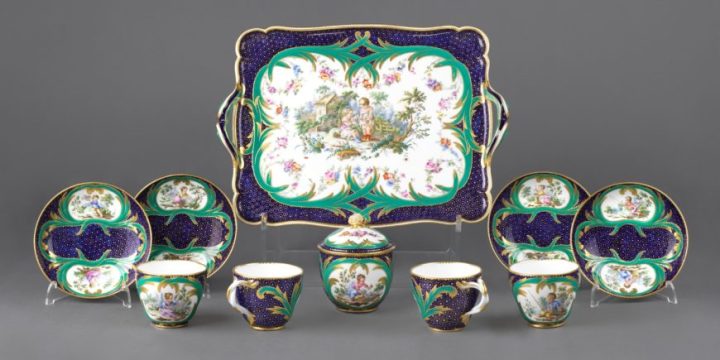
Tray and Tea Service (déjeuner ‘Courteille’, four gobelets ‘Hébert’ et soucoupes, pot à sucre ‘Bouret’), Manufacture de Sèvres, soft-paste porcelain, painted and gilded, lapis and green ground painted with children in landscapes by André-Vincent Vielliard, date letter F for 1759; probably bought by Mme de Pompadour in December 1759 (London: The Wallace Collection, C401-06).
◊ ◊ ◊ ◊ ◊
From The French Porcelain Society:
Everyday Rococo: Madame de Pompadour and the Arts
The Wallace Collection, London, 3–4 December 2021; rescheduled for 1–2 July 2022
The French Porcelain Society is pleased to announce its forthcoming symposium Everyday Rococo: Madame de Pompadour and the Arts to be held at the Wallace Collection, London, on 3–4 December 2021. With two days of papers, which we hope will also be available online, this will be the first reassessment of Jeanne-Antoinette Poisson’s artistic patronage since the landmark exhibition Madame de Pompadour et les Arts of 2002.
Commemorating the tercentenary of her birth, and marking the publication of Rosalind Savill’s book Everyday Rococo: Madame Pompadour and Sèvres Porcelain, this conference will welcome international experts discussing her interests in the fine and decorative arts from pets to porcelain and from prints to religious paintings. Further details will follow in the autumn, but please save the dates: Friday 3rd and Saturday 4th December.
Online Workshop | Imperial Material: Napoleon’s Legacy
From Eventbrite:
Imperial Material: Napoleon’s Legacy in Culture, Art, and Heritage, 1821–2021
Online, 3 September 2021
Organized by Matilda Greig and Nicole Cochrane
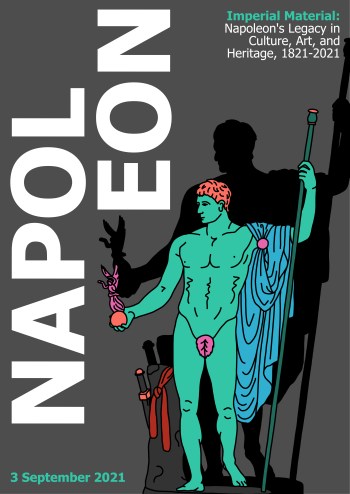 Two hundred years after Napoleon Bonaparte’s death, this online workshop confronts his vast material, visual, and cultural legacy.
Napoleon Bonaparte died exactly two hundred years ago on a small island in the middle of the Atlantic Ocean. He had spent the last six years of his life in exile on St Helena, removed from political and military power, in the unusual situation of being able to try to shape and preserve his own posthumous legacy. He was, in a way, phenomenally successful. Napoleon is an instantly recognisable name to this day, and despite growing efforts in recent years to critically revise his reputation and highlight his role in issues such as the reinstatement of slavery, he has largely managed to escape the same level of historical censure as other infamous military dictators. This is perhaps partly because his name has become such an adaptable brand, standing for an entire era of people, places, and events, as well as a full two centuries’ worth of art, craft, and consumer commodities. While other events marking the bicentenary of Napoleon’s death have weighed his contributions to legislative, political, and military reform, less work has been done to confront his vast material, visual, and cultural legacy. This workshop therefore brings together researchers and museum and heritage professionals to reflect on the enduring material and visual legacy of Napoleon, what our interpretation and use of it means for the future, as well as how it affects our understanding of the past. The workshop is free to attend; registration information is available here.
F R I D A Y , 3 S E P T E M B E R 2 0 2 1
All times are in BST
10.00 Opening Remarks
10.15 Keynote
• Napoleon: A Life Told in Gardens and Shadows, In Discussion — Ruth Scurr (University of Cambridge)
11.10 Break
11.30 Panel 1: National Responses
• Vive L’Empereur!: Napoleon’s Material Legacy in Australia — Emma Gleadhill (Macquarie University) and Ekaterina Heath (University of Sydney)
• Napoléon alla turca: The Ultimate European — Fezanur Karaağaçlıoğlu (Boğaziçi University)
12.15 Panel 2: Politics of Iconography
• Victory Shall Be Mine: The Form, Fate, and Fortune of the Vittoria di Fossombrone and Napoleon as Mars the Peacemaker — Melissa Gustin (University of York)
• Napoleon’s Iconography: Politics of Images and an ‘Imperial Corporate Design’? — Andrea Völker (Leuphana Universität Lüneburg)
13.00 Lunch Break
14.00 Panel 3: Napoleon in the Museum
• The Mysteries of Napoleon’s Toothbrush — Harriet Wheelock (Royal College of Physicians of Ireland and TU Dublin)
• Absence and Ubiquity in the Louvre’s Commemoration of Napoleonic Art Pillage — Nancy Karrels (University of Illinois Urbana-Champaign)
14.45 Panel 4: Representations on Stage and Screen
• I, Napoleon: Blurred Boundaries in Napoleonic Performance — Laura O’Brien (Northumbria University)
• The Emperor’s New Close-Up: Napoleon’s Enduring Impact on Contemporary Film as an Iconic Historical Brand — Aidan Moir (York University)
15.30 Break
16.00 Panel 5: Objects from the Sacred to the Mundane
• From Mania to Relics: The Artefacts of the 1890 Waterloo Panorama — Luke Reynolds (University of Connecticut)
• The Relics of Napoleon and Modern Memory — David O’Brien (University of Illinois Urbana-Champaign)
16.45 Panel 6: Urban and Cultural Legacies
• Perpetual Erasure: Napoleonian Politics and the Cemetery — Kaylee P. Alexander (Guilford College)
• The Legacy of the Napoleonic Era on Hairstyle and Hairdressing — Hervé Boudon (Independent scholar)
17.30 Closing Remarks
Online Symposium | Printmaking between Art and Science in Britain
From Eventbrite:
The Itinerant Image: Printmaking between Art and Science in Enlightenment Britain
Online, University of St Andrews, 12–13 August 2021

Charles Reuben Ryley, Ring-Tailed Lemurs, in George Shaw, Museum Leverianum (1792), op. p. 43.
In early modern Britain, the printed image was a major practical and conceptual tool for scientists. As recent research into the graphic practices of the Royal Society has shown, illustrations and diagrams were indispensable to communicating scientific knowledge, both collectively and by individuals. In particular printed images circulated between the Royal Society’s periodicals and the published volumes of its fellows. Some of these images, such as the flea from Robert Hooke’s Micrographia (London 1665), subsequently became widely reproduced and iconic images in the history of science. Yet these printed images were rarely confined to scientific domains; not only were they usually the result of collaboration with artisans and in some cases artists, but the most successful images would often circulate far beyond the scientific communities for which they were initially produced. Further still, images were often copied or translated into new locations, where their meaning might be altered for new audiences.
Over two days, this symposium will bring together scholars and curators of British art, science, and print culture from the seventeenth and eighteenth centuries, to interrogate the creation, use, and function of prints in the production of new scientific knowledge. It considers how the ‘epistemic’ value of an image changed as it was reprinted, adapted, and modified; and pays particular attention to how and when a reproduced image might gain or lose scientific authority.
All sessions will take place over Zoom. Please register for an online ticket. A link will be sent to all attendees in advance of each day’s event.
T H U R S D A Y , 1 2 A U G U S T 2 0 2 1
14.00–16.30 BST
Welcome and Introduction, Stephanie O’Rourke (University of St. Andrews) and Katherine Reinhart (Bibliotheca Hertziana – Max Planck Institute for Art History)
• Megan Barford (Royal Museums Greenwich), Travelling Charts and Shrinking Paper: Royal Naval Hydrography in the 1830s
• Richard Bellis (University of St. Andrews), Printing the Structures and Textures of Disease: Matthew Baillie’s A Series of Engravings … to Illustrate the Morbid Anatomy (1799–1802)
• Elaine Ayers (New York University), Drawing at a Distance: Botanical Illustration in the East India Company in the Early Nineteenth Century
Respondents: Jack Hartnell (University of East Anglia) and Katy Barrett (Science Museum)
F R I D A Y , 1 3 A U G U S T 2 0 2 1
14.00–16.30 BST
• Anna Marie Roos (University of Lincoln), Lives and Afterlives of the Lithophylacii Britannici ichnographia (1699), the First Illustrated Field Guide to English Fossils
• John Bonehill (University of Glasgow) ‘Curious and Chargeable Cuts’: Michael Burghers and the Illustration of Robert Plot’s Natural Histories
• Meghan Doherty (Berea College), The Long Life of Ephemera: (Re)Printing the Philosophical Transactions of the Royal Society
Respondents: José Marcaida (University of St. Andrews) and Aileen Fyfe (University of St. Andrews)
Online Symposium | The Politics of the Portrait, in Three Parts
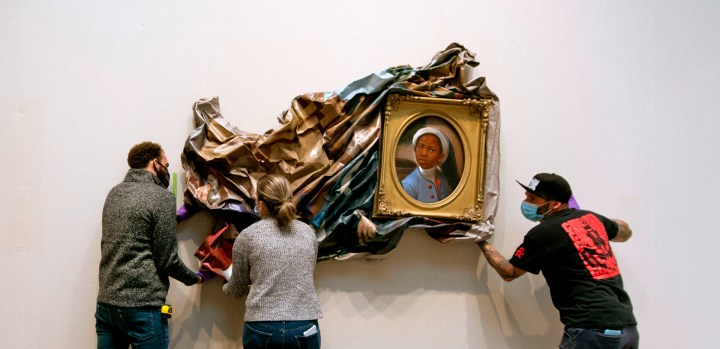
Titus Kaphar, Enough About You, 2016, oil on canvas with an antique frame, on loan from the Collection of Arthur Lewis and Hau Nguyen, Courtesy of the artist, photo by Richard Caspole. More information is available here.
◊ ◊ ◊ ◊ ◊
From the YCBA:
The Politics of the Portrait, in Three Parts
Online, Yale Center for British Art, 23 July — 17 September 2021
Featuring artists, collectors, curators, and scholars, The Politics of the Portrait is a three-part online symposium that considers potential solutions and alternatives regarding the history, display, and making of portraits and the role of representation in today’s sociopolitical climate.
In 2020 the Yale Center for British Art began a research project on Elihu Yale with Members of his Family and an Enslaved Child (ca. 1719), a painting in the collection that depicts one of Yale University’s founders with an enslaved child. This project became a springboard for this online series of conversations among artists, collectors, curators, and scholars to consider potential approaches, revisions, and additions to the canon of art history, curating, and artmaking.
◊ ◊ ◊ ◊ ◊
Part 1 | Art History: Hierarchies of Representation
Friday, 23 July 2021, 12–1:30pm
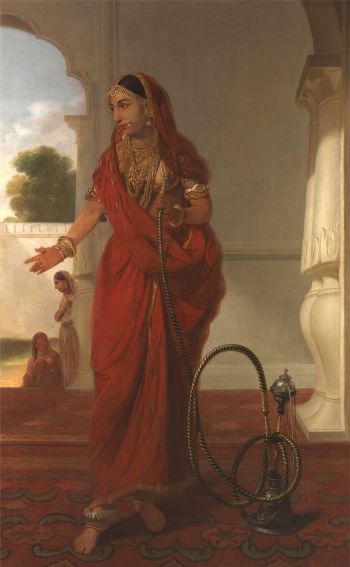
Tilly Kettle, Dancing Girl, 1772, oil on canvas (New Haven: Yale Center for British Art, Paul Mellon Collection).
Zirwat Chowdhury, Bridget R. Cooks, and Edward Town discuss potential approaches to and revisions of frameworks that are commonly used for telling the history of portraiture with a particular focus on the Black figure. How might we restructure art history to make it a more decentralized, inclusive discipline? What scholarly initiatives have been effective at countering systemic marginalization in the representation of Black and Brown bodies in Western art? How can we overcome the problem that there are few records—material, textual, or visual—of many of the Black figures represented in Western art? Notwithstanding these absences, what work is being done to center the lives of Black figures in historical portraits? What can we learn about these figures from close looking and study in museums?
Zirwat Chowdhury is Assistant Professor of 18th- and 19th-century European Art at the University of California, Los Angeles. Bridget R. Cooks is Associate Professor at the University of California, Irvine. Edward Town is Head of Collections Information and Access at the Yale Center for British Art. The conversations is moderated by Maryam Ohadi-Hamadani, Postdoctoral Research Associate at the Center.
To join us for this program, please register here.
◊ ◊ ◊ ◊ ◊
Part 2 | Curatorial Practice and the Museum: Contextualization and Narratives
Friday, 6 August 2021, 12–1:30pm
Curators Liz Andrews, Christine Y. Kim, Denise Murrell, and Keely Orgeman discuss their recent projects and upcoming exhibitions and consider the ethical, practical, and historical implications of displaying portraits and figurative artworks in museums.
Liz Andrews is Executive Director of the Spelman College Museum of Fine Art. Christine Y. Kim is Curator of Contemporary Art at the Los Angeles County Museum of Art. Denise Murrell is Associate Curator of 19th- and 20th-Century Art at The Metropolitan Museum of Art. Keely Orgeman is Associate Curator of Modern and Contemporary Art at the Yale University Art Gallery. The conversation is moderated by Maryam Ohadi-Hamadani, Postdoctoral Research Associate at the Yale Center for British Art.
To join us for this program, please register here.
◊ ◊ ◊ ◊ ◊
Part 3 | In Conversation: Titus Kaphar and Art Collectors Arthur Lewis and Hau Nguyen
Friday, September 17, 2021, 12–1pm
Titus Kaphar, Arthur Lewis, and Hau Nguyen discuss Kaphar’s practice and the importance of supporting emerging artists, artists of color, and local art communities. The conversation is moderated by Abigail Lamphier, Senior Curatorial Assistant in the Department of Paintings and Sculpture at the Yale Center for British Art.
Kaphar is an American artist whose paintings, sculptures, and installations examine the history of pictorial representation. Kaphar physically manipulates his canvases by cutting, shredding, twisting, breaking, and tearing his paintings and sculptures, reconfiguring them into works that reveal unspoken truths about the nature of history, often in an effort to consider overlooked subjects. By transforming these styles and mediums with formal innovations, he emphasizes the physicality and dimensionality of the canvas and the materials. His practice challenges art historical images and the narratives they normalize.
Kaphar received an MFA from the Yale School of Art in 2006 and is a distinguished recipient of numerous prizes and awards including a MacArthur Fellowship (2018), an Art for Justice Fund grant (2018), a Robert R. Rauschenberg Artist as Activist grant (2016), and a Creative Capital grant (2015). His work appears in the collections of the Crystal Bridges Museum in Arkansas, the Pérez Art Museum Miami, and several New York City museums, including the Brooklyn Museum, the Metropolitan Museum of Art, the Museum of Modern Art, and the Whitney Museum of American Art.
Kaphar lives and works in New Haven, Connecticut. In 2015, he cofounded NXTHVN, a 40,000-square-foot nonprofit arts incubator located in two former manufacturing plants in the Dixwell neighborhood of New Haven. NXTHVN offers fellowships, residencies, and other professional development opportunities to artists, curators, and students in the local community and beyond.
Lewis and Nguyen have built an art collection celebrated for its focus on contemporary women artists and artists of color and were named in the top 200 art collectors by ArtNews in 2020. Over the last thirteen years, the couple have intentionally focused on supporting a wide range of black artists and developing their local art community in Los Angeles. As a result, the core of Lewis and Nguyen’s collection features both emerging and established artists including Genevieve Gaignard, Jennie C. Jones, Titus Kaphar, Kerry James Marshall, Ebony G. Patterson, and Amy Sherald.
Lewis and Nguyen are further renowned for their intentional approach to collecting, which extends beyond building the market value for artworks. Seeing the role of the collector as one of guidance and care, the couple are active in the artist community and enjoy personal relationships with many artists represented in their collection. Lewis is creative director of United Talent Agency’s fine arts group and the UTA Artist Space in Beverly Hills, California. He is a member of the boards of the Hammer Museum and the Underground Museum in Los Angeles, as well as New York’s Studio Museum in Harlem. Nguyen is the owner and creative director of boutique hair salons.
In October 2020, Lewis and Nguyen lent Kaphar’s Enough About You (2016) to the Yale Center for British Art. This artwork was on view in the Center’s galleries for eight months in place of the eighteenth-century group portrait Elihu Yale with Members of his Family and an Enslaved Child. To learn more about why this change was made and a description of the ongoing research into this group portrait, visit New light on the group portrait of Elihu Yale, his family, and an enslaved child.
Online Conference | Travel and Archaeology in Ottoman Greece
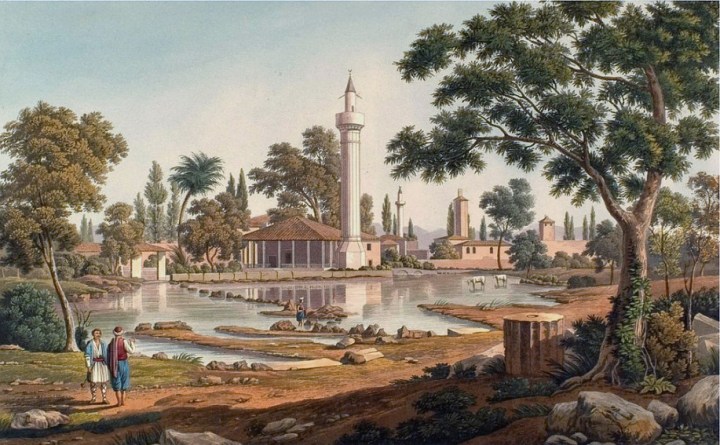
The Hyperian Fountain at Pherae, Edward Dodwell, Views in Greece (London 1821), p. 91.
◊ ◊ ◊ ◊ ◊
From the conference programme:
Travel and Archaeology in Ottoman Greece in the Age of Revolution, c.1800–1833
Online, British School at Athens, 16–17 September 2021
Organised by Alexia Petsalis-Diomidis
Registration due by 20 August 2021
The bicentenary of the Greek War of Independence of 1821 offers a timely opportunity for a re-evaluation of travel and archaeology in the age of revolution. The conference foregrounds diversity and small-scale engagements with the landscape and material past of Ottoman Greece at a time of political tension and explosive violence. The conference will explore the perspectives of both foreign travellers and local inhabitants in order to tease out diverse voices, keeping a sharp focus on the effects of ethnicity, race, gender, and social status.
Within this inclusive intellectual framework we will pose a series of questions to analyse the mediating role of the Greek landscape and its antiquities between travellers and local inhabitants in all their diversity. How did major intellectual and cultural developments of the late eighteenth century, ranging from revolutionary politics in France and America to scientific and museological developments, intersect with actual encounters ‘on the ground’ in Ottoman Greece, specifically with the landscape, local inhabitants, and small-scale objects and antiquities? How did the ethnic, cultural, and religious identities of Ottoman communities affect local perceptions of contemporary travel and the classical material past? How did status (including slave status) and gender shape encounters with the Greek landscape and its antiquities, not least with idealising white sculptured male bodies? How did archaeological-focused travel, with its emerging sophisticated discourses, intertwine with travel undertaken for scientific, military, and Romantic aims?
In this way the conference will give prominence to hitherto marginalised perspectives drawing on recent work to decolonise Ancient Mediterranean Studies, including sensory approaches to access silenced voices, and will develop a micro-cultural history of travel and archaeology in Ottoman Greece in this tumultuous period.
Hosted via Zoom, the conference is free and open to all who are interested, but registration is essential. Speakers’ full papers will be pre-circulated to registered participants at the end of August. To register for the conference, please email Dr Jenny Messenger at jenny@atomictypo.co.uk by 20 August. For Dr Alexia Petsalis-Diomidis’ lecture, registration is separate: a link to register will be available in the ‘Events’ section of the BSA website approximately one month in advance.
T H U R S D A Y , 1 6 S E P T E M B E R 2 0 2 1
13.00 John Bennet and Alexia Petsalis-Diomidis, Welcome and Introduction
13.15 Panel 1: Travel as a Kaleidoscope of Perspectives
Chair: Estelle Strazdins (University of Queensland)
• Charalampos Minaoglou (National and Kapodistrian University of Athens), Traveling in Europe, Exploring Greek Identity: Orientalism and ‘Westernism’ in Constantine Karatzas’ Diaries
• Federica Broilo (Universitá Degli Studi Urbino ‘Carlo Bo’), Simone Pomardi and the Rediscovery of the Modern Greek Landscape
• Jason König (University of St Andrews), Mineralogy, Ethnography, Antiquarianism: Images of Collecting in the Travel Writing of Edward Daniel Clarke
• Ayşe Ozil (Sabanci University), Local Greek Travel-Writing, Antiquities, and the Diverse Social Landscape in the Post-Revolutionary Ottoman Empire
14.15 Break
14.30 Panel 2: Ottoman Spaces and Identities
Chair: Edhem Eldem (Boğaziçi University and Collège de France)
• Nikos Magouliotis (ETH Zurich, Institute for the History and Theory of Architecture, PhD Candidate), Inside the Villager’s House: Views of European and Greek Authors on the Vernacular Architecture of Late-Ottoman Greece, ca. 1800–30
• Zafeirios Avgeris (Uppsala University, MA Candidate), From Text to Space: Mapping Sir William Gell and Edward Dodwell as Data Layers on an Ottoman Landscape
• Emily Neumeier (Temple University, Philadelphia), Orientalism in Ottoman Greece
• Elisabeth Fraser (University of South Florida), Louis Dupré in Ottoman Greece: Multiple Identities, Contradictory Encounters
15.30 Break
17.30 British School at Athens Public Lecture
• Alexia Petsalis-Diomidis (University of St Andrews), From Ottoman Smyrna to Georgian London: Travel, Excavation, and Collecting of Levant Company Merchant Thomas Burgon (1787–1858)
F R I D A Y , 1 7 S E P T E M B E R 2 0 2 1
13.00 Panel 3: Individuals Collecting Antiquities
Chair: Ayşe Ozil (Sabanci University)
• Estelle Strazdins (University of Queensland), Imagining Ethiopians in the Age of Revolution: Arrowheads from the Marathon Sôros and the Statue of Rhamnoussian Nemesis
• Alessia Zambon (Université Versailles Saint Quentin en Yvelines, Paris), ‘Je vois qu’à Paris on a une bien fausse idée des Grecs…’: Fauvel’s Perception of the Greeks and of the Greek Revolution
• Irini Apostolou, (National and Kapodistrian University of Athens), In Search of Antiquities: The Travels of Alexandre and Léon de Laborde during the Greek War of Independence of 1821
• Michael Metcalfe (The Syracuse Academy), Ancient Inscriptions and British Travellers to Ottoman Greece, 1800–21
14.00 Break
14.15 Panel 4: Antiquities and Official Discourses
Chair: Elisabeth Fraser (University of South Florida)
• Edhem Eldem (Boğaziçi University and Collège de France), ‘Viewing and Contemplating’ (Seyr ü Temaşa): Foreign Travelers and Antiquarians and the Sublime Porte, ca 1800–30
• Aikaterini-Iliana Rassia (King’s College London), Andreas Moustoxydes (1785–1860) and Kyriakos Pittakis (1798–1863) and the Rescue of Greek Antiquities
14.45 Break
15.15 Panel 5: Forms of Philhellenism
Chair: Jason König (University of St Andrews)
• Mélissa Bernier (Ecole Normale Supérieure de Paris, PhD candidate), Samuel Gridley Howe’s Travels: Classical, Romantic, and Philanthropic Philhellenism, 1800–30
• Fernando Valverde (University of Virginia), Greece in the Age of Revolution: An Intimate Poetics of Landscape, Travel, and Liberty
15.45 Break
16.00 Conclusions and Future Directions
• Breakout Rooms
• Roundtable Discussion
Conference | Afterlife of the Mausoleum of Halicarnassus, 1500–1850
From ArtHist.net:
Re-Conceiving an Ancient Wonder: The Afterlife of the Mausoleum of Halicarnassus, 1500–1850
RWTH Aachen University (online and in-person), 9–11 September 2021
Organized by Anke Naujokat, Desmond Bryan Kraege, and Felix Martin
The importance of the Mausoleum of Halicarnassus for European culture is revealed by its very name, which—in many languages—has become a noun signifying any sufficiently monumental tomb. However, the Mausoleum was destroyed during the Middle-Ages, and many aspects of its appearance remain uncertain, even since the excavation of its foundations in the 1850s. During the Early Modern Period, the main sources of information on this building were thus ancient texts, which were the only references concerning the Mausoleum’s dimensions and appearance. Accurately reconstructing architecture according to brief written descriptions, however, is an impossible task. Yet, despite this difficulty or perhaps due to the liberty it offered the imagination, numerous artists, architects and antiquaries took a keen interest in the monument during the timeframe 1500–1856, mainly using Pliny’s description to suggest reconstructions, devise pictorial representations and seek inspiration for new funerary projects or monumental public architecture.
This workshop aims to examine the afterlife of the Mausoleum during this period. Being an invisible reference, the monument left far more leeway to the imagination than other, existing ancient buildings that also attracted scholarly and artistic attention, such as the Pantheon. The Mausoleum’s invisibility entails that it is not the monument itself that will be investigated here, but rather the ensemble of texts, images and architectural projects referring to this central but unknowable model. Drawing upon recent developments in the methodologies of intermediality and temporality, the project aims to add a new dimension to this discussion by focusing on a precise case study examining the evolution of several key themes over a long period.
The workshop will be organised as a hybrid onsite/online event. It will be possible to listen to papers and join the discussions via Zoom. All are welcome to join, we will gladly provide the event link if you write to us at halicarnassus@ages.rwth-aachen.de.
Organising Committee
• Prof. Dr. Anke Naujokat (RWTH Aachen University)
• Dr. Desmond Bryan Kraege (AHO Oslo School of Architecture and Design)
• Felix Martin M.Sc. (RWTH Aachen University)
T H U R S D A Y , 9 S E P T E M B E R 2 0 2 1
14.00 Welcome
14.15 Anke Naujokat, RWTH Aachen University, Introduction
14.30 I. Tombs and Widows
• Inmaculada Rodriguez Moya (Universitat Jaume I Castellón) and Victor Minguez (Universitat Jaume I Castellón), The Mausoleum of Halicarnassus in the Renaissance Imagination: Royal and Noble Tombs, 1384–1545
• Simone Salvatore (Sapienza Università di Roma), The Iconographic Fortune of Artemisia and the Mausoleum of Halicarnassus in Early Modern Italy, 1500–1630
• Sheila Ffolliott (George Mason University), Embodying the Mausoleum: Artemisia as Model for 16th- and 17th-Century Women and Regents
18.00 Evening Lecture
• Poul Pedersen (University of Southern Denmark / The Danish Halikarnassos Project), The Maussolleion at Halikarnassos and the Ionian Renaissance in Greek Architecture
F R I D A Y , 1 0 S E P T E M B E R 2 0 2 1
9.30 II. The Sangallo Circle
• Peter Fane-Saunders (Birkbeck, University of London), The Mausoleum, Architectural Theory, and the Renaissance Church
• Andreas Raub (Alte Pinakothek, Munich), Antonio da Sangallo the Younger: Mausolea for St. Peter and the Popes
• Fabio Colonnese (Sapienza Università di Roma), Porsenna, Mausolus, and the Pyramids of Antonio da Sangallo the Younger
• Marco Brunetti (Bibliotheca Hertziana – Max-Planck-Institut für Kunstgeschichte), Dream of a Shadow: The Mausoleum of Halicarnassus and the Accademia della Virtù
12.00 Lunch Break
13.30 III. Print Culture and the Seven Wonders
• Katharina Hiery (Universität Tübingen), Maarten van Heemskerck’s Images and the Mausoleum in Print Culture
• Ainhoa de Miguel Irureta (Universidad Católica de Murcia), The Mausoleum of Halicarnassus in 17th-Century Series of the Seven Wonders: Following in the Wake of Maarten van Heemskerck
• Marco Folin (Università degli studi di Genova) and Monica Preti (Head of Academic Programmes, Musée du Louvre, Paris), Fischer von Erlach’s Mausoleum of Halicarnassus
15.00 Coffee Break
15.30 IV. The Mausoleum and the City
• Raphaëlle Merle (Université Paris 10 Nanterre), Travellers and Topography in Early Modern Halicarnassus, 1656–1857
• Daniel Sherer (Princeton University School of Architecture), Architecture and Print Culture in the Late 17th- and Early 18th-Century English Reception of the Mausoleum of Halicarnassus: Intermedium Signification in Hawksmoor’s St George’s Bloomsbury and Hogarth’s Gin Lane, 1670–1751
S A T U R D A Y , 1 1 S E P T E M B E R 2 0 2 1
9.30 IV. The Mausoleum and the City, continued
• Stefan Hertzig (Architectural Historian and Heritage Specialist, Dresden), An Ancient Wonder for Dresden: The So-Called Pyramid Building of Augustus the Strong on the Neustadt Bridgehead as a Paraphrase of the Mausoleum à la Heemskerck
• Desmond-Bryan Kraege (AHO Oslo School of Architecture and Design), Imaginary Architecture and the Mausoleum’s Move to a Peri-Urban Environment, France, ca. 1750s–1790s
10.30 Coffee Break
11.00 V. Scholarship and a New Vision of History
• Felix Martin (RWTH Aachen University), Building for Posterity: Friedrich Weinbrenner, the Mausoleum at Halicarnassus, and the Pursuit of Permanence around 1800
• Christian Raabe (RWTH Aachen University), Karl Friedrich Schinkel’s Tomb of King Mausolus of Caria
12.00 Lunch Break
13.30 V. Scholarship and a New Vision of History, continued
• Marina Leoni (Université de Genève), Quatremère de Quincy’s Mausoleum of Halicarnassus and French Scholarship
• Lynda Mulvin (University College Dublin), Charles Robert Cockerell (1788–1863): A Pioneering Study of the Mausoleum of Halicarnassus as Part of a Wider Project to Locate Other Unknown Sites and Monuments in ‘Ionian Antiquities’
14.30 Concluding Discussion










 Enfilade
leave a comment