Symposium | Georgian London Revisited
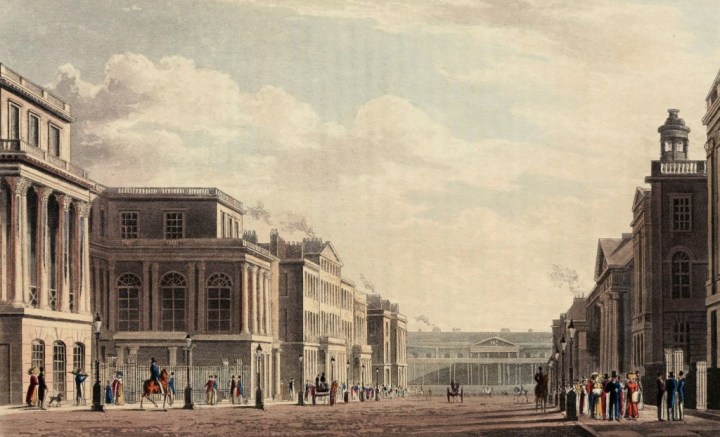
Regent Street, Looking toward Carlton House, ca.1822, from The Repository of Arts, Literature, Commerce, Manufactures, Fashions and Politics.
◊ ◊ ◊ ◊ ◊
From The Georgian Group:
2021 Georgian Group Symposium: Georgian London Revisited
Online, 22–23 May 2021
Following the successful conferences run by the Georgian Group in previous years on Women and Architecture, on The Architecture of James Gibbs, and on The Work of the Adam Brothers, our symposium for 2021 will highlight changing perspectives and new research on the architecture of London undertaken since the publication of the latest edition of Sir John Summerson’s Georgian London (1988, reissued 2003). A series of short papers by both established and younger scholars will cover aspects of housing and estate development, public and commercial architecture, places of entertainment, and related topics.
This year’s symposium will take place online over Saturday 22nd and Sunday 23rd May. Joining details for the symposium will be sent to ticket holders on Friday 21st May. Tickets are £25; students can purchase a discounted ticket (£15) by clicking here.
The symposium will be recorded and the recording will be available to all those who have purchased a ticket for a limited period of time after the event takes place. Please read our Terms and Conditions before booking.
S A T U R D A Y , 2 2 M A Y 2 0 2 1
9.30 Welcome
9.40 Keynote Talk
• Elizabeth McKellar — Georgian London after Summerson
10.10 Session 1 | The Restoration and After
• Frank Kelsall — Nicholas Barbon in Holborn
• India Wright — The Redevelopment of Middle Temple in the Late Seventeenth Century
• Charlotte Davis — Restoration London Reconsidered: Edward Pearce and Carved Ornament
• Helen Lawrence-Beaton — The Remodelling of Monmouth House, Soho Square by Thomas Archer
11.25 Break
11.40 Session 2 | Eighteenth-Century Town Houses and Estate Development
• Juliet Learmouth — Living amidst the Ruins: Eighteenth-Century Whitehall and the Bentinck Family
• Melanie Hayes — A Cultural Exchange: The Anglo-Irish in Hanoverian London
• Rory Lamb — Scottish Property in Georgian London: George Steuart and the Duke of Buccleuch’s Urban Estates
• Sarah Milne — Merchants’ Houses of Goodman’s Fields Whitechapel
12.55 Closing Remarks
S U N D A Y , 2 3 M A Y 2 0 2 1
10.30 Welcome
10.35 Session 3 | The Early Nineteenth Century
• Todd Longstaffe-Gowan — Charlotte Girdlestone’s Early Nineteenth-Century Panorama of Regent’s Park
• Geoffrey Tyack — Beyond the Park: John Nash, the Park Village, and Cumberland Market
• Amy Spencer — Architectural Competition and Its Values at the London University, 1825–26
11.35 Break
11.50 Session 4 | Miscellany
• Michael Burdon — A ‘Vile and Absurd Edifice of Brick’: London’s Opera House in the Haymarket
• Gillian Williamson — Life in Lodgings in Georgian London
• Caroline Stanford — ‘The Resurrection Is upon Us!’ The Role of Sculpture in Georgian London
12.50 Closing Remarks
Online Conference | Sensory Experience in 18th-Century Art Exhibitions
From the conference programme:
The Sensory Experience in 18th-Century Art Exhibitions: From Emotion to Sensation
L’expérience sensorielle dans les expositions d’art au XVIIIe siècle
Online, 10–11 June 2021
Organized by Gaëtane Maës, Isabelle Pichet, and Dorit Kluge
Registration due by 4 June 2021
The conference The Sensory Experience in 18th Century Art Exhibitions is the final part of a research project funded by the Social Sciences and Humanities Research Council of Canada (2018–2020) and led by Isabelle Pichet (UQTR, Canada), Gaëtane Maës (University of Lille, France) and Dorit Kluge (VICTORIA International University, Germany) on the question of the sensory body. The aim of the project is to define the way in which the experience of the visitor’s sensory body is shaped during the visit of temporary art exhibitions at a time when these are emerging and establishing themselves in Europe as a new social practice. This knowledge should provide a better understanding of the trajectory and inherent sensory experiences of museum and gallery visitors through the centuries up to the present day.
 The 18th century, in fact, saw the birth of art exhibitions, which were part of a new field of social activities that the European population was able to enjoy from the 1730s onwards. For visitors, attending these exhibitions became a new and unique experience that challenged each of their senses. This simple observation leads us to the research fields on senses and sensibility in which the colloquium is a new research path for the history of art exhibitions in the 18th century.
Conceived as a laboratory for exchange, the conference will bring together participants from three continents and diverse backgrounds. It will be organised around two sessions: the first one initially planned at the Louvre-Lens museum will take place on 10–11 June 2021 in total distance mode via Zoom, and the second one will take place at the Vivant-Denon centre of the Louvre museum in Paris on 18–19 November 2021. The first session will focus on the experience of the work of art, from emotion to sensation, while the second will examine the question of the experience of the visit, from spectator to critic.
Registration is mandatory before 4th June 2021: irhis-recherche@univ-lille.fr.
T H U R S D A Y , 1 0 J U N E 2 0 2 1
12.45 Accueil
13.00 Ouverture du colloque, mot de bienvenue
• Marie Lavandier, Musée du Louvre-Lens
• Charles Meriaux, IRHiS – CNRS UMR 8529 – U Lille
13.30 Introduction par les organisatrices du colloque
14.00 La sensorialité du spectateur
• Emma Barker (Open University), Viewing Blindness at the Paris Salon
• Laura Giudici (Curatrice indépendante, Berne), Prière de toucher: La réception de la statue de l’Hermaphrodite endormi aux XVIIe et XVIIIe siècles
• Friederike Vosskamp (Université de Heildelberg), Exprimant le froid: La représentation des sensations et leur perception par le public à l’exemple de ‘L’Eté’ et de ‘L’Hiver’ de Jean-Antoine Houdon
• Markus Castor (Centre allemand d’histoire de l’art, Paris), Le langage du corps entre affection, discussion et contemplation des arts au XVIIIe siècle – Les images du spectateur et ses expressions des passions entre changement épistémologique et mentalités politiques: Gestes, mots, pas, grâce, nature et religion
17.00 Pause
17.30 Voir et sentir à l’anglaise
• Frédéric Ogee (Université Paris Diderot), L’expérience du sensible: Nature et vérité dans le premier portrait anglais, de William Hogarth à Thomas Lawrence
• Sarah Gould (Université Paris 1 – Panthéon Sorbonne), The Texture of Thomas Gainsborough’s Paintings: A Site of Tension at London Art Exhibitions
F R I D A Y , 1 1 J U N E 2 0 2 1
11.45 Accueil
12.00 Femmes sous le regard des spectateurs I
• Gaëtane Maës (Université de Lille – IRHiS – UMR 8529), Représenter l’identité ou l’émotion ? Les actrices Clairon et Dumesnil au Salon du Louvre
• Jan Blanc (Université de Genève), Les plaisirs du public: l’érotisation du regard dans les expositions de la Royal Academy au XVIIIe siècle
13.15 Pause
13.45 Percevoir le temps : entre passion et politique
• Mark Ledbury (University of Sydney), Untimely History Painting
• Aaron Wile (National Gallery of Art, Washington, DC), Antoine Coypel’s Galerie d’Enée: Sensibility, Passion, and Politics in Regency France
15.00 Pause
15.30 Femmes sous le regard des spectateurs II
• Bénédicte Prot (University of Oxford), Nus de marbre et filles en émoi dans ‘Le Nouveau Paris’ de Louis-Sébastien Mercier
• Kim de Beaumont (Hunter College, City University of New York), Le corps et l’esprit des femmes dans les vues du Salon de Gabriel de Saint-Aubin
• Mathias Blanc (UMR 8529 – IRHiS – Université de Lille), Parcours contemporains du regard sur des œuvres du XVIIIe siècle
(restitution du projet de médiation EXART réalisé au Louvre-Lens en collaboration avec Gaëtane Maës, et avec l’aide de Laurine Delmas et de Victoria Martinez, étudiantes en Master 2 Recherche en Histoire de l’Art à l’Université de Lille)
Online Workshop | Viewing Topography Across the Globe, Indigeneity
From The Lewis Walpole Library:
Viewing Topography Across the Globe Series, Workshop II: Indigeneity
Online, The Lewis Walpole Library, 13–14 May 2021
Organized by Cynthia Roman and Holly Schaffer
Topography, from topos, is the practice of describing place through language, the features of the land, the inhabitants, and the accumulation of history. Specific to locality and the perspective of the person delineating, describing, or collecting materials, topography counters the worldliness of geography while also offering a potential tool to multiply singular approaches.
In this second workshop in the series Viewing Topography Across the Globe, we will consider approaches to place from Indigenous and European perspectives and interrogate the frame of ‘topography’ in global contexts (the first workshop was held at Brown on 11 December 2019). In two half-day virtual sessions, we will focus on topographical practices in the Americas as well as South and Southeast Asia and the Pacific Ocean as well as how the materials of art-making both locate and disrupt notions of place. We will hear from artists and academics, work with colonial-era paintings, Indigenous objects, mapping, and literature, and consider Indigenous pedagogy.
The workshop, which will take place via Zoom, has been organized by Cynthia Roman (The Lewis Walpole Library, Yale University) and Holly Schaffer (Brown University). Details, including abstracts for each talk, are available as a PDF file here. Please note that registration is required for each day’s sessions (links are available below).
Keynote Speakers
• Cannupa Hanska Luger
• Douglas Fordham
◊ ◊ ◊ ◊ ◊
T H U R S D A Y , 1 3 M A Y 2 0 2 1
Register here»
10.00 Panel 1: The Americas
• Barbara E. Mundy (Fordham University), Indigenous Bodies and Topographical Imagination
• Emmanuel Ortega (University of Illinois at Chicago), Local vs. Universal Knowledge: Locating Place in von Humboldt’s Picturesque
• Robbie Richardson (Princeton University), Sucker-fish Writings: Indigenous Inscription and the History of Written Language in the 18th Century
• Heather V. Vermeulen (Wesleyan University), Sybil / Spider / Sibyl: On Anancy*ness, Archives, and Spider Space
12.00 Lunchtime Keynote Talk
Moderated by Marina Tyquiengco (Boston Museum of Fine Arts)
• Cannupa Hanska Luger (Artist), Artist as Social Engineer
F R I D A Y , 1 4 M A Y 2 0 2 1
Register here»
10.00 Panel 2: South, Southeast Asia, and the Pacific Ocean
• Jinah Kim (Harvard University), Beyond Human Vision: Knowing Angkor Wat through Topography, from a Watercolor Map to LIDAR Capture
• Dipti Khera (New York University) and Debra Diamond (Freer Gallery of Art and Arthur M. Sackler Gallery, Smithsonian Institution), Unexplored Terrains: Topography, Temporality, and Emotion in 18th-Century Udaipur
• Kailani Polzak (University of California, Santa Cruz), Rising from the Ocean: Perspectives of Land and Watercraft during Cook’s Third Voyage
• Ayesha Ramachandran (Yale University), Topographies of Battle: The National War Memorial, New Delhi
• Garima Gupta (Artist and Researcher) and Chitra Ramalingam (Yale Center for British Art), Anxieties of a Bazaar: Making of Commodities in Colonial South and Southeast Asia
12.00 Lunchtime Keynote Talk
Moderated by Tim Barringer (Yale University)
• Douglas Fordham (University of Virginia), Techniques of the Imperial Observer: How Aquatint Travel Books Taught Britons to See
Online Conference | Reimagining the Court Portrait, 1500–1800
From CRASSH at Cambridge:
Dressing a Picture: Reimagining the Court Portrait, 1500–1800
Online, CRASSH, University of Cambridge, 6–7 May 2021
Organized by Ana Howie and Alessandro Nicola Malusà

Juan Pantoja de la Cruz, Portrait of Doña Ana de Velasco y Girón, Duchess of Braganza, 1603 (Alicia Koplowitz Collection).
As Ulinka Rublack asserts in Dressing Up, her seminal book on dress in early modern Europe, society was extremely dress-literate and nowhere more so than in the courtly environments that generated and fuelled fashion. Within these sartorially-minded elite communities, one was constantly on display. Capturing dressed sitters in paint for prosperity, portraiture was a unique vehicle for the inherent dialectic in clothing between subject and observer, and presentation and perception. As such, this conference will examine three themes surrounding early modern portraiture: the artist, the depicted material culture and the setting for its iconographic display, that is the court. We aim to examine these connections via the prism of the period’s intricate social stratification and complex gender power dynamics. To provide sufficient breadth, the conference will present papers dealing with material between 1500 and 1800.
Considering the interdisciplinary nature of our project—spanning history, dress studies, art theory, gender history, court studies and architectural history—we believe that our conference will generate exciting contributions from leading international scholars. This conference will meaningfully contribute to the wider scholarly debate on the significance of early modern portraiture as pivotal sources for numerous branches of historical research and not just art history. Our conference will both firmly enable this discussion and bring attention to this burgeoning field of interdisciplinary historical studies. Registration is available here»
Keynote Speakers
• Erin Griffey (University of Auckland)
• Karen Hearn (UCL)
• Katarzyna Kosior (Northumbria University)
• Mei Mei Rado (LACMA)
• Catherine Stearn (Kentucky University)
• Cordula van Wyhe (York University)
T H U R S D A Y , 6 M A Y 2 0 2 1
All times are BST.
13.00 Welcome and Opening Remarks
13.20 Panel 1: Materialising Courtly Bodies
Chair: Holly Fletcher (University of Sussex)
• Panel Keynote — Karen Hearn (UCL), ‘Richly apparelled, and her belly laid out …’: Signalling (or not Signalling) Pregnancy in 16th- and Early 17th-Century Court Portraits
• Ana Howie (University of Cambridge), ‘White Ruff and Red Cuffs, on a Black Dress. The Negro Dressed in Yellow’: Materialising Bodies in van Dyck’s Portrait of Elena Grimaldi-Cattaneo
• Lisa Nunn (East Anglia), ‘A Hundred Times Fitter for a Barn than a Palace’: A Gendered Analysis of the Protectorate Portraits of Elizabeth Cromwell and Her Daughters
14.50 Break
15.00 Panel 2: Negotiating Gender in Early Modern Portraiture
Chair: Sophie Pitman (Aalto University)
• Panel Keynote — Catherine Stearn (Kentucky University), Countess or Queen, Countess and Queen: How Dress and Portraiture Illuminate the Role of Elizabeth I’s Privy Chamber Women
• Vanessa de Cruz Medina (Independent Scholar, former Prado Museum & Villa I Tatti Fellow), Ladies-in-Waiting and Portrait Galleries: Identity, Family, and Power at Early Modern Habsburg Courts
• Alice Blow (University of Cambridge), Gender Ambiguity in The Cobbe Portrait of Henry Wriothesley, Third Earl of Southampton, c.1590–93
16.30 Break
16.40 Panel 3: The Court Portrait: Global Considerations
Chair: Giorgio Riello (European University Institute)
• Panel Keynote — Mei Mei Rado (LACMA), Qing Imperial Portraits and Europe
• Jessica Hower (Southwestern University), Drawing an Empire: Elizabeth I, The Armada Portrait, and the Creation of a British Atlantic World
• Marina Hopkins (Warburg Institute), The Portrait of María Luisa de Toledo with Her Indigenous Companion
• Alejandro M. Sanz Guillén (Universidad de Zaragoza), Shoguns and Emperors: Representations of the Japanese Court in Europe during the 18th Century
F R I D A Y , 7 M A Y 2 0 2 1
13.10 Panel 4: The Court: A Stage for Princely Society
Chair: Caroline van Eck
• Panel Keynote — Katarzyna Kosior (Northumbria University), Defining the Royal Court in Poland-Lithuania: Some Textual Evidence From Jan III Sobieski’s Lifetime (1629–1696)
• Martina Vyskupova (Slovak National Museum), Portrait Representation of Maria Theresa as a Queen of Hungary Seated on a Horse in the Context of Period Female Equestrian Portraits in the 18th Century
• Pedro Manuel Tavares (Centro de História de Arte — CHAIA), D. Joana de Áustria, Embodiment of Political/Religious Propaganda of the Habsburg Women, Beyond the Validos Power
• Anna Lisa Nicholson (University of Cambridge), The Transfiguration of Hortense Mancini: How the Vagabond Duchess Became the Patron Saint of Brides
15.20 Break
15.30 Panel 5: The Artist Behind the Portrait
Chair: Alexander Marr (University of Cambridge)
• Panel Keynote — Cordula van Wyhe (York University), Fashioning Displaced Identities: Anthony van Dyck as Portraitist of the French Exiles
• Sarah Emily Farkas (University of North Carolina at Chapel Hill), Sibylle of Cleves: Cranach, Convention, and Clothing Identity in Lutheran Saxony
• Alessandro Nicola Malusà (University of Cambridge), The Sitter as Artist: Depicting Mourning Dress and Negotiating Authority in the Regencies of Christine of France and Marie Jeanne Baptiste of Savoy-Nemours
17.00 Break
17.30 Featured Keynote Address
Chair: Ulinka Rublack (University of Cambridge)
• Erin Griffey (The University of Auckland), ‘Beauties Silken Livery’: Dressing the Face at the Early Modern Court
18.30 Final Remarks and Thanks
Online Lecture and Conference | Piranesi @300

Base of the Antonine Column from Piranesi’s Campo Marzio (Rome, 1762)
(British School at Rome Library)
◊ ◊ ◊ ◊ ◊
Clare Hornsby, Piranesi at the BSR: Thomas Ashby’s Curious Campo Marzio
Online Lecture, 6 May 2021, 18.00–19.30 CET
Piranesi @300
Online Conference, 19–21 May 2021
Giovanni Battista Piranesi (Venice 1720 – Rome 1778) was one of the leading figures in 18th-century Italian and European culture. An artist, engraver, architect, merchant, intellectual, and polemicist, he was essential in the formation of modern aesthetic sensibility, for the birth of modern archaeology, for the theories of architecture and urbanism. His influence has been enduring, from Romanticism to the avant-garde movements of the 20th century, up to the present day.
The third centenary of Piranesi’s birth struggled to achieve resonance in 2020 due to the pandemic. Initiatives to celebrate the great artist’s work will resume in Rome in May 2021, accessible online internationally.
◊ ◊ ◊ ◊ ◊
On Thursday, May 6, the British School at Rome, will host an online lecture exploring Piranesi’s book Campo Marzio di Antica Roma of 1762, its magnificent map, and some of the curiosities of the copy of the volume held in the rare books collections of the library at BSR. This lecture by Clare Hornsby in collaboration with Valerie Scott BSR librarian will feature the recently launched initiative of BSR Library and Archive, the Digital Collections website, of which the Piranesi Campo Marzio volume will be a highlight.
◊ ◊ ◊ ◊ ◊
On 19, 20, and 21 May a group of Roman institutions—the Biblioteca Nazionale Centrale, British School at Rome, Villa Médicis-Académie de France, and the Centro di Studi sulla Cultura e l’Immagine di Roma—have organised an online conference, Piranesi@300, bringing together more than 20 Italian and foreign scholars (from Brazil, the United States, Japan, Germany, France, England, Spain, etc.) to present new research and new analyses of some of the many aspects of Piranesi’s extraordinary personality and creativity.
During the week of the conference, further presentations will be made available via video recording; a highlight is The Digital Piranesi presented by a team from the University of South Carolina. Additionally, the YouTube channel of the Biblioteca Nazionale Centrale will host contributions from a number of Piranesi experts, including the Director of the Vatican Museums Barbara Jatta and the restoration team which brought the church of Santa Maria del Priorato on the Aventine hill in Rome, Piranesi’s architectural masterpiece, back to its original beauty.
1 8 – 2 4 M A Y 2 0 2 1
Pre-recorded sessions (available all week)
Hosted on the website of the University of South Carolina
• Jeannie Britton, From Page to Screen: A New Look at Piranesi’s Annotated Images
• Zoe Langer, The Digital Piranesi: New Approaches to Translating the Opere
• Jason Porter, The Virtual Piranesi: New Methods of Immersive Literacy
• Michael Gavin, Piranesi’s Diagrammatic Sublime
Hosted on the YouTube channel of the Biblioteca Nazionale Centrale, Rome
• Barbara Jatta (Direttore, Musei Vaticani), Piranesi in Vaticano
• Daniela Porro (Soprintendente Speciale archeologia, belle arti e paesaggio di Roma) Restauri della Soprintendenza alla piazza di S. Maria del Priorato
• Alessandro Mascherucci (Soprintendenza Speciale archeologia, belle arti e paesaggio di Roma), Problematiche tecniche del restauro al complesso piranesiano
• Giorgio Ferreri (Sovrano Militare Ordine di Malta), S. Maria del Priorato, i restauri
• John Wilton-Ely (Professor Emeritus, Hull University), Soane’s Attitude towards Piranesi
• Maria Cristina Misiti (Ministero della Cultura) and José Maria Luzon Nogué (Real Academia de Bellas Artes de San Fernando, Madrid), Piranesi dal libro cartaceo all’opera multimediale
• Sergei Tchoban (Tchoban Voss architects, Berlin), Imprint of the Future: Destiny of Piranesi‘s City
• Pierluigi Panza (Politecnico di Milano), Piranesi alla Scala
W E D N E S D A Y , 1 9 M A Y 2 0 2 1
Hosted by Biblioteca Nazionale Centrale, Roma
9.45 Welcome by Andrea De Pasquale (Direttore, Biblioteca Nazionale Centrale, Roma) and Marcello Fagiolo (Presidente, Centro di Studi sulla Cultura e l’Immagine di Roma)
10.00 Piranesi’s Techniques: Drawing, Etching
Chairs: Mario (Bevilacqua (Università di Firenze / Centro di Studi sulla Cultura e l’Immagine di Roma) and Simonetta Prosperi Valenti Rodinò (Roma)
• Andrea De Pasquale (Biblioteca Nazionale Centrale, Roma), Piranesi e il suo torchio
• Giovanna Scaloni (Istituto Centrale per la Grafica, Roma), L’Istituto centrale per la grafica per Piranesi
• Lucia Ghedin (Istituto Centrale per la Grafica, Roma) and Sofia Menconero (Sapienza – Università di Roma), La tecnica di reflectance transformation imaging (RTI) applicata alle matrici calcografiche: una sperimentazione sulla serie delle Carceri piranesiane
• Ginevra Mariani (Roma), Progetto Piranesi: il catalogo generale delle matrici di Piranesi, 2010–2020. Nuovi dati e future prospettive sull’opera incisa di Giambattista Piranesi
• Stefan Morét (Staatliche Kunsthalle Karlsruhe), The Role of Drawn Copies after Antique Ornaments in Piranesi’s Workshop
• Bénédicte Maronnie (Università della Svizzera Italiana, Mendrisio), Pratiques graphiques dans l’atelier de Giovanni Battista Piranesi à l’exemple d’un dessin inédit conservé à Zurich
13.30 Lunch Break
14.30 Piranesi and European 18th-Century Collections
Chairs: Mario Bevilacqua (Università di Firenze / Centro di Studi sulla Cultura e l’Immagine di Roma) and Barbara Jatta (Vatican Museum)
• Ebe Antetomaso (Biblioteca Corsiniana e dei Lincei, Roma), Materiali piranesiani nella collezione Corsini: appunti dai bibliotecari
• Charleen Rethmeyer and Georg Schelbert (Humboldt-Universität zu Berlin), Piranesi in Prussia: Spotlights on a Variable Relationship
• Gudula Metze (Staatliche Kunstsammlungen Dresden), 1720–1778: Piranesi and the Kupferstich-Kabinett Dresden
16.45 Break
17.00 Keynote Address
• Delfin Rodriguez Ruiz (Universidad Complutense, Madrid), Piranesi e la Spagna
T H U R S D A Y , 2 0 M A Y 2 0 2 1
Hosted by the British School at Rome
9.45 Welcome by Chris Wickham (Director, British School at Rome)
10.00 Piranesi: Architect, Antiquarian, and Theorist
Chairs: Clare Hornsby (BSR) and Caroline Barron (Birkbeck)
• Maria Grazia D’Amelio Università di Roma ‘Tor Vergata’) and Fabrizio De Cesaris Sapienza – Università di Roma), Giovan Battista Piranesi e l’architettura pratica
• Lola Kantor-Kazovsky (The Hebrew University of Jerusalem), Piranesi’s Carceri, Cartesian ‘Dream Argument’ and Scientific Interests in Early 18th-Century Venice
• Silvia Gavuzzo Stewart (Roma), La dedica di Piranesi a Lord Charlemont nella Tavola II delle Antichità Romane
• Paolo Pastres (Deputazione di Storia Patria per il Friuli), Fantasia al potere: Piranesi, Algarotti e la lezione di Antonio Conti
• Cristina Ruggero (Berliner-Brandenburgische Akademie der Wissenschaften, Berlin), ‘Onde per riguardo della Pianta… non resta che l’indice ad incidersi’: Piranesi e Villa Adriana
• Eleonora Pistis (Columbia University, New York), Piranesi without Images: The Thinkability of Architecture
13.45 Lunch Break
14.30 From Venice to Rome: Piranesi as Artist, Dealer, and Entrepreneur
Chair: Harriet O’Neill (British School at Rome / Royal Holloway University of London)
• Enrico Lucchese (Univerza v Ljubljani), Pulcinella e poveri Cristi: Per Giambattista Piranesi disegnatore e i suoi rapporti con Giandomenico Tiepolo
• Francesco Nevola (Atene), Piranesi: Peritissimo in tutte le Arti Liberali
15.30 Keynote Address
• Heather Hyde Minor (University of Notre Dame, South Bend, Indiana), Piranesi’s Epistolic Art
F R I D A Y , 2 1 M A Y 2 0 2 1
Hosted by the Villa Médicis-Académie de France à Rome
9.45 Welcome by Sam Stourdzé (Direttore, Accademia di Francia a Roma)
10.00 Piranesi’s Influence: Europe and Beyond
Chair: Heather Hyde Minor (University of Notre Dame)
• Olga Medvedkova (Centre National de la Recherche Scientifique, Paris), ‘La Dévideuse italienne’ ou habiter la ruine
• Valeria Mirra (Roma), Dalla fortuna di Giovanni Battista Piranesi in Francia allo stabilimento dei ‘Piranesi frères’ a Parigi
• Helena Perez Gallardo (Universidad Complutense, Madrid), Sotto il cielo di Parigi: Piranesi negli incisori e fotografi francesi nel 1850
• Angela Rosch Rodrigues (Universidade de São Paulo, Brasil), G. B. Piranesi at the Brazilian National Library: A Trajectory of the rovine parlanti from Rome to Rio de Janeiro
• Hiromasa Kanayama (Keio University, Tokyo), La raccolta piranesiana nel Giappone dell’Ottocento: le vicende della collezione Kamei
13.15 Lunch Break
14.30 Piranesi in the 20th Century
Chair: Francesca Alberti (Académie de France à Rome)
• Giacomo Pala (Universität Innsbruck) Piranesi: Posthumous Architect
• Angelo Marletta (Università degli Studi di Catania), Forma Urbis forma architecturae: Piranesi, Kahn e i frammenti di Roma
• Victor Plahte Tschudi (Oslo School of Architecture and Design), Alfred H. Barr and the Reinvention of Carceri as Modern Art
16.30 Break
17.00 Keynote Address
• Alain Schnapp, Piranèse, ruine des ruines
Online Conference | Country House Gardens and Landscapes
From the conference flyer:
Razored Hedgerows, Planted Trees, and Natural Delights: Country House Gardens and Landscapes
Online, Centre for the Study of Historic Irish Houses and Estates, Maynooth University, 11 May 2021
 After the disappointing cancellation of the annual conference in 2020, the Centre for the Study of Historic Irish Houses and Estates is pleased to announce the 19th annual Historic Houses Conference, which will be held online (via Zoom) at Maynooth University on 11 May 2021.
Country houses sit in the middle of designed landscapes. Their backdrop, large or small, might be a combination of parkland, pasture, woods, and waterways, as well as formal gardens blazoned with horticultural delights. These natural features complement the built heritage and often share similar stories about their creation, improvement, loss, or recovery. The acres surrounding a mansion house may have shrunk over the centuries, but the terrain itself remains even if in different ownership and used for other purposes today.
This one-day online conference will include papers on a number of houses and gardens, examining their history, survival, and changing fortunes, with papers on Emo Court, Annes Grove, Doneraile, Glin Castle, Brodsworth Hall, Vaux-le-Vicomte, Lambay Castle, Illnacullin, Johnstown Castle, Newbridge, and the Glebe Churchill; as well as presentations on glasshouses, plant collections, and the art of landscape design. The day will conclude with an online forum on the subject of gardens and well-being in the twenty-first century.
Speakers include Sarah Couch, Michael O’Sullivan, Catherine Fitzgerald, Neil Porteous, Hugh Carrigan, Anne O’Donoghue, Kim Wilkie, Alexandre de Vogue, Matthew Jebb, Chris O’Neill, Cathal Dowd Smith, Eleanor Matthews, and Adrian Kelly.
Attendance is free, but places are limited; for details on how to register please contact cshihe@mu.ie.
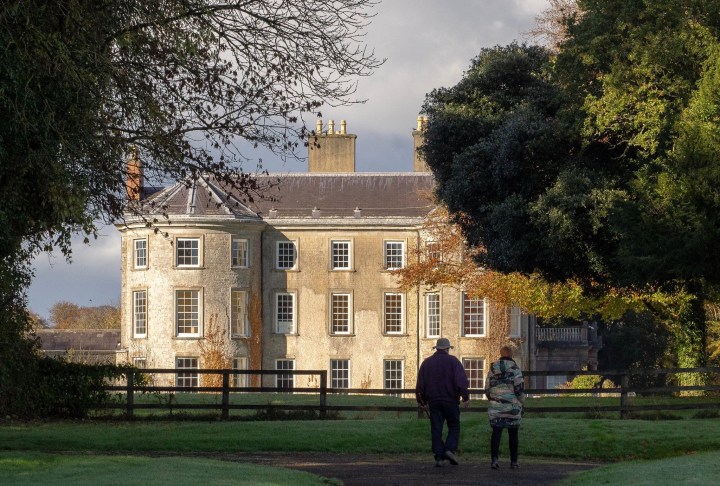
Doneraile Court (side of the house), near the town of Doneraile in County Cork, Ireland; most of the house dates to the early eighteenth century. After an extensive renovation by the Office of Public Works, the house opened to the public in 2019. The 400 acres of walled parkland are laid out in the style of Capability Brown (Office of Public Works).
Online Symposium | Speculative Minds in Georgian Ireland
From the conference programme:
Speculative Minds: Commerce, Experiment, Innovation, and the Arts in Georgian Ireland
Online, Thursday, 27 May 2021
Organized by Toby Barnard and Alison FitzGerald
 Maynooth University and the Irish Georgian Society are partnering to deliver a live online symposium, Speculative Minds: Commerce, Experiment, Innovation & the Arts in Georgian Ireland on Thursday, 27th May 2021. The symposium has been convened by Dr Toby Barnard, Emeritus Fellow of Hertford College, Oxford University, and Dr Alison FitzGerald, Associate Professor, Maynooth University. The symposium will appeal to both a specialist audience of academics and the general public. Bookings can be made online through the Irish Georgian Society’s website. Price: €40; full-time students are free (to register for a student place please email emmeline.henderson@igs.ie with a photo of your student ID).
The period between 1750 and 1837 saw a striking increase in the introduction of new materials, new manufacturing processes, and new products. ‘Novelty’ was at a premium: touted in newspaper advertisements, puffed in trade catalogues and pattern books, and encouraged by energetic individuals and learned groups. These initiatives were driven by simple curiosity, focused experimentation, patriotic and humanitarian ideals, and the quest for profit. Homes, small workshops, and large manufactories all felt the impact of these ‘polite and commercial’ impulses and the resulting artefacts; they spread beyond the peerage and landed elite through the professional and middling sorts. Arguably it was the latter who spread these developments most widely, thereby drawing Ireland deeper into the ambit, attitudes and fashions of Britain, continental Europe and the North Atlantic world. British artists, artificers, and entrepreneurs were quick to exploit the Irish market, feeding the appetite for what was new; as the potter Josiah Wedgwood wrote to his business partner in 1773, “Will not the people of Ireland like these things better that come from London?” This symposium investigates the intellectual, cultural, and mercenary forces behind these phenomena, looking closely at specific cases. It aims to clarify the nexus between art, commerce, and science in Georgian Ireland, especially in towns, most notably in Dublin, Britain’s ‘second city’.
Speculative Minds has been made possible through sponsorship from Sara Moorhead and Ecclesiastical Insurance. The symposium forms an action of the Irish Georgian Society’s Conservation Education Programme, overseen by Emmeline Henderson, IGS Assistant Director and Conservation Manager. The IGS’s Conservation Education Programme is supported by the Department of Housing, Local Government and Heritage and The Heritage Council and Merrion Property Group.
P R O G R A M M E
9.45 Welcome by David Fleming (Senior Lecturer, University of Limerick)
10.00 Toby Barnard, MRIA (Hon.) (Emeritus Fellow of Hertford College, Oxford University), A Taste for Pastes: Dr Henry Quin, James Tassie, and the Empress of Russia
10.30 Alison, FitzGerald (Associate Professor, Department of History, Maynooth University), Classicism and Commerce: Josiah Wedgwood and His ‘Seed[s] of Consequence’
11.00 Coffee Break
11.30 James Kelly, MRIA (Professor of History, and Head of the School of History and Geography, Dublin City University), The Impact of the English Visual Caricature Tradition on the Product of Single-sheet Caricature in Ireland, 1780–1830
12.00 Questions & Answers
12.30 Lunch Break
1.30 Leonie Hannan (Senior Lecturer, Department of History, Queen’s University Belfast), A Culture of Curiosity: Scientific Enquiry in the Eighteenth-Century Home
2.00 Finola O’Kane, MRIA (Professor, School of Architecture, Planning and Environmental Policy, University College Dublin), Dublin’s Sugar Landscapes in the Eighteenth Century
2.30 Jonathan Wright (Lecturer, Department of History, Maynooth University), The Merchant, the Quaker, and the Enslaved Boy: A Story of Slavery in Mid-Eighteenth-Century Ulster
3.00 Questions & Answers
Abstracts of papers and speakers’ biographies are available here»
Image: Detail from John Rocque’s Exact Survey of Dublin (1756).
ASECS 2021, Online
Starting Wednesday, with sessions running until Sunday evening!
2021 American Society for Eighteenth-Century Studies Conference
Online, 7–11 April 2021
The 51st annual meeting of the American Society for Eighteenth-Century Studies takes place online. HECAA will be represented by the Anne Schroder New Scholars’ Session, chaired by Susanna Caviglia and scheduled for Saturday afternoon at 2:50 and the annual business meeting, right after that, starting at 3:55. A selection of 33 additional panels is included below (of the 182 sessions scheduled, many others will, of course, interest HECAA members). For the full slate of offerings, see the program. Regular registration is $80; discounted rates are $35. All times are Eastern Standard Time.
◊ ◊ ◊ ◊ ◊
W E D N E S D A Y , 7 A P R I L 2 0 2 1
Spanish Sensorium
Wednesday, 12:10–1:10
Chair: Elena DEANDA-CAMACHO, Washington College
1. Lilian BRINGAS SILVA, Georgetown University, “Los bodegones de Goya”
2. Karissa BUSHMAN, Quinnipiac University, “Goya’s Illnesses and Deafness and the Impact on his Senses”
3. Meira GOLDBERG, Fashion Institute of Technology, CUNY, “The Space of Perfect Rhythm: Experiencing the Flamenco Circle”
4. Rachael Givens JOHNSON, University of Virginia, “Moving the Faithful: Hearing, Seeing, and Feeling in Eighteenth-Century Spanish- Atlantic Religious Festivals”
◊ ◊ ◊ ◊ ◊
Publishing Natural History
Wednesday, 12:10–1:10
Chairs: Eleanore NEUMANN, University of Virginia, and Agnieszka Anna FICEK, CUNY
1. April SHELFORD, American University, “More Estimable than Sloane? Patrick Browne’s Civil and Natural History of Jamaica (1756)”
2. Marianne VOLLE, York University/Paris 1 Panthéon-Sorbonne, “Natural History in the Making: Exploring the Network and Botanical Collection of Fougeroux de Bondaroy (1732–1789)”
3. Taylin NELSON, Rice University, “The ‘Totality’ of the Animal: Systems of Classification and Domestication”
4. Demetra VOGIATZAKI, Harvard University, “Three Allegorical Caves in Choiseul-Gouffier’s Voyage Pittoresque de la Grèce (1782)”
◊ ◊ ◊ ◊ ◊
Built Form in the Long Eighteenth Century
Wednesday, 1:20–2:20
Chair: Janet WHITE, UNLV
1. Luis J. GORDO PELAEZ, California State University, “Grain Architecture in Bourbon New Spain”
2. Paul HOLMQUIST, Louisiana State University, “Une autre nature: Aristotelian Strains in Ledoux’s Theory of Architecture as Legislation”
3. Dylan Wayne SPIVEY, University of Virginia, “Building from a Book: James Gibb’s Book of Architecture and the Commodification of Architectural Style”
4. Miguel VALERIO, Washington University in St. Louis, “Architecture of Devotions: The Churches Afro-Brazilian Religious Brotherhoods Built in the Eighteenth Century”
◊ ◊ ◊ ◊ ◊
Canada or the Tower: Finding, Depicting, and Imagining Canada
Wednesday, 2:50–3:50
Chair: Cristina S. MARTINEZ, University of Ottawa
1. Georgiana UHLYARIK, Art Gallery of Ontario, “Kanata: Indigenous Sovereignty and the Canadian Imagination”
2. Dominic HARDY, Université du Québec à Montréal, “Thomas Davies’ Watercolours of Québec under British Colonial Rule (1760–1812), Iconographies of Landscape, Identity, and Memory”
3. Marjolaine POIRIER, Université du Québec à Montréal, “Space, Place, and the figurant: Looking at Quebec City in 3D during the American Revolution”
4. Isabelle MASSE, UCLA and Concordia University, “Lower Canada or the Debtors’ Prison: Insolvent Portraitists on the Run”
◊ ◊ ◊ ◊ ◊
Imagining the Future in Ruins
Wednesday, 2:50–3:50
Chair: Thomas BEACHDEL, Hostos, CUNY
1. Amy DUNAGIN, Kennesaw State University, “Rosamund’s Bower, Addison’s Rosamond, and Whig Visions of British Ruin”
2. Anne Betty WEINSHENKER, Montclair State University, “Freemasonic Elements in the Tombeaux des princes
3. Jason BIRCEA, University of California, Berkeley, “The Sound of Depopulation in Oliver Goldsmith’s The Deserted Village”
4. Susannah B. SANFORD, Texas Christian University, “Birds and the Bees: Clara and Environmental Ruin in Sansay’s Secret History”
◊ ◊ ◊ ◊ ◊
Playing with Pigments: Color Experiments in the Visual Arts
Wednesday, 4:00–5:00
Chairs: Daniella BERMAN, New York University, and Caroline M. CULP, Stanford University
1. Alicia MCGEACHY, Northwestern University/Art Institute of Chicago Center for Scientific Studies in the Arts, “Through the Colored Glaze: Multi-analytical Studies of Eighteenth-Century Chelsea Ceramics”
2. Thea GOLDRING, Harvard University, “Printing Nature’s Taches: The Invention of Aquatint and the Depiction of Human Varieties”
3. Colleen STOCKMANN, Gustavus Adolphus College, “Climate and the Spectrum of Indigo Production in the Americas, 1740–1780”
◊ ◊ ◊ ◊ ◊
From Tabula Rasa to Terra Incognita: Landscape and Identity in the Enlightenment
Wednesday, 4:00–5:00
Chair: Shirley TUNG, Kansas State University
1. Michael BROWN, University of Aberdeen, “Locating Britain: The English Geographies of Daniel Defoe”
2. John DAVENPORT, Missouri Southern State University, “Topographical Dialogues and Competing Claims to Selfhood in Eighteenth-Century Travel Writing”
3. Kasie ALT, Georgia Southern University, “Negotiating the Self through Landscape Design and Representation: Thomas Anson’s Estate at Shugborough”
4. Julia SIENKEWICZ, Roanoke College, “Landscape and Alterity: Encounters with Virginia and South Africa”
◊ ◊ ◊ ◊ ◊
Amateur or Professional? Reconsidering the Language of Artistic Status
Wednesday, 5:10–6:10
Chairs: Paris SPIES-GANS, Harvard Society of Fellows, and Laurel PETERSON, Independent Scholar
1. Laura ENGEL, Duquesne University, “Fashioning Fairies: Lady Diana Beauclerk’s Watercolors”
2. Luke FREEMAN, University of Minnesota, “Engraving Authority: Bernard Picart’s Status and the ‘Leading Hands of Europe’”
3. Maura GLEESON, Independent Scholar, “Picturing La Créatrice: Image, Imagination, and Artistic Practice in Napoleonic France”
4. Cynthia ROMAN, The Lewis Walpole Library, “‘Not Artists’: Horace Walpole’s Hyperbolic Praise of Prints by Persons of Rank and Quality”
◊ ◊ ◊ ◊ ◊
Colonial Matter in the Eighteenth-Century World
Wednesday, 5:10–6:10
Chairs: Danielle EZOR, Southern Methodist University, and Kaitlin GRIMES, University of Missouri-Columbia
1. Amelia RAUSER, Franklin & Marshall College, “Madras Cloth: Currency, Costume, and Enslavement”
2. Kelly FLEMING, University of Virginia, “Empire, Satire, and the Regency Cap in The Adventures of an Ostrich Feather of Quality (1812)”
3. Yiyun HUANG, University of Tennessee, Knoxville, “‘Nothing but large potions of tea could extinguish it’: Chinese Knowledge and Discourse of Tea in Colonial America”
◊ ◊ ◊ ◊ ◊
T H U R S D A Y , 8 A P R I L 2 0 2 1
Roundtable: Scholarly Tourism: Traveling to Research the Eighteenth Century
Thursday, 11:00–noon
Chair: Ula Lukszo KLEIN, University of Wisconsin-Oshkosh
1. Meg KOBZA, Newcastle University, “Places of Privilege: Price and Practice in Private Archives”
2. Caroline GONDA, Cambridge University, “Strawberry Hill and Shibden Hall: Anne Damer and Anne Lister”
3. Laura ENGEL, Duquesne University, “The Archival Tourist”
4. Fiona RITCHIE, McGill University, “Mentoring Student Researchers in the Archives”
5. Yvonne FUENTES, University of West Georgia, “Eighteenth-Century Gossip and News: The Archives of Spanish Parish Churches, Cathedrals, and Basilicas”
◊ ◊ ◊ ◊ ◊
Roundtable: Methods for Bibliography and Eighteenth-Century Studies
Thursday, 12:10–1:10
Chair: J. P. ASCHER, University of Virginia
1. Mathieu BOUCHARD, McGill University, “Beaumont and Fletcher in 1711: The Bibliographical Analysis of an Anonymous Editor”
2. Ashley CATALDO, American Antiquarian Society, “Bradstreet’s Pastedowns: De(bri)s Bibliography”
3. David LEVY, Writer, “Collateral Bibliography: Are Hoyle Collections Separate Issues?”
4. Nina M. SCHNEIDER, William Andrews Clark Memorial Library, UCLA, “Three-Dimensional Bibliography: Plaster Casts in the Sir John Soane Museum”
5. Michael VANHOOSE, University of Virginia, “A Rationale for Cliometric Bibliography, with Applications to British Papermaking, 1782–1837”
◊ ◊ ◊ ◊ ◊
Vital Matters: Materialism(s) in the Eighteenth Century and Beyond
Thursday, 12:10–1:10
Chair: Pichaya (Mint) DAMRONGPIWAT, Cornell University.
1. Jess KEISER, Tufts University, “Cavendish contra New Materialism; or, Anthropomorphism in Lyric and Panpsychism”
2. Susan EGENOLF, Texas A&M University, “Josiah Wedgwood, Thomas Griffiths, and the Mystique of Cherokee Clay”
3. Roger MAIOLI, University of Florida, “England’s First Atheistic Manifesto”
Respondent: Lucinda COLE, University of Illinois
◊ ◊ ◊ ◊ ◊
The Sister Arts in Eighteenth-Century Ireland
Thursday, 12:10–1:10
Chair: Michael GRIFFIN, University of Limerick
1. Scott BREUNINGER, Virginia Commonwealth University, “Improvement and the Arts during the Early Irish Enlightenment”
2. Tríona O’HANLON, Independent Scholar, “The Violinist in Eighteenth-Century Dublin: A Case Study Addressing the Connection between Cultural Activity and Political Agendas in Eighteenth-Century Ireland”
3. David BURROW, University of South Dakota, “Assessing Russia: Artistic Taste and Civilizational Values”
◊ ◊ ◊ ◊ ◊
‘Too Political, Too Big, No Good’: Picturing Politics
Thursday, 3:40–4:40
Chair: Jessica L. FRIPP, Texas Christian University
1. Alexandra CALDON, Graduate Center, CUNY, “Engaging the Public: The Rejection of Mythology in Royal Almanac Prints, 1695–1715”
2. J. Patrick MULLINS, Marquette University, “Thomas Hollis’s ‘Liberty Prints’ and the Transatlantic Cult of Tyrannicide”
3. Thomas BUSCIGLIO-RITTER, University of Delaware, “Denis Volozan’s Portrait of George Washington in an Atlantic Context”
4. Marina KLINGER, New York University/The Metropolitan Museum of Art, “From ‘Great Men’ to ‘Women’s Influence’: Retelling the Story of Louis Ducis’s Tasso and Eleonora d’Este from the Empire to the Restoration”
◊ ◊ ◊ ◊ ◊
Visualizing the French Empire
Thursday, 4:50–5:50
Chairs: Philippe HALBERT, Yale University, and Izabel GASS, Yale University
1. Alexandre DUBÉ, Université du Québec à Chicoutimi, and Sophie WHITE, University of Notre Dame, “The Stuff of Conviction”
2. Agnieszka Anna FICEK, CUNY, “Picturing the Péruvienne: The Exotic and Erotic in the Illustrations to Mme. de Graffigny’s Lettres d’une Péruvienne”
3. Joseph LITTS, Princeton University, “Materials, Race, and the Body in the Franco-Swiss Atlantic World”
4. Thomas BEACHDEL, Hostos, CUNY, “The Sublime Future of Ruins”
◊ ◊ ◊ ◊ ◊
2020 Presidential Session: The Carbon Footprint of ASECS: What to Do?
Thursday, 4:50–5:50
Organizer: Jeffrey S. RAVEL, MIT
ASECS can no longer ignore its contributions to climate change. Given the rapidly increasing rate of natural disasters around the globe, each of us has an ethical responsibility to reduce their carbon footprint. We will all have to make painful sacrifices to repair the damage already done to the environment. ASECS has one built-in advantage that we can leverage—our roster of regional affiliate societies. We might, for example, hold the annual meeting every other year, and then encourage attendance at the meetings of the regional societies in years when we did not convene the national meeting. For both the national and regional conferences, we might build a more robust remote system that would allow members without funding or those who do not wish to travel by plane or car to participate virtually. In this session, the chair would like to start a conversation with all concerned members of the Society about responsible steps ASECS can take going forward.
◊ ◊ ◊ ◊ ◊
F R I D A Y , 9 A P R I L 2 0 2 1
Roundtable: Cultural Histories of Fame and Celebrity in the Age of Enlightenment
Friday, 11:00–noon
Chair: Brian COWAN, McGill University
1. Meghan ROBERTS, Bowdoin College, “Fame and the French Enlightenment”
2. Heather MCPHERSON, University of Alabama at Birmingham, “The Visual Arts and Modern Celebrity in Georgian England”
3. Ted MCCORMICK, Concordia University (Montreal), “Fame and Celebrity in Eighteenth-Century Science”
4. Pascal BASTIEN, Université de Quebec à Montréal, “Infamy in Eighteenth-Century France”
5. Sydney AYRES, Institute of Advanced Study, Edinburgh University, “Contemporary Celebrity vs. Posthumous Fame in Britain, c.1790–1820”
6. Antoine LILTI, EHESS (Paris), “Eighteenth-Century Celebrity”
◊ ◊ ◊ ◊ ◊
Collecting, Antiquities, and Eighteenth-Century Art
Friday, 12:10–1:10
Chairs: Katherine ISELIN, University of Missouri-Columbia, and Lauren DISALVO, Dixie State University
1. Freya GOWRLEY, University of Derby, “Classical Specimens and Fragmentary Histories: The Specimen Table as Part and Whole”
2. Josh HAINY, Truman State University, “For Their Mutual Benefit: John Flaxman’s Recreation of the Belvedere Torso for Thomas Hope”
3. Katherine CALVIN, Kenyon College, “Collecting on Credit: The British Levant Company in Aleppo’s Art and Money Markets”
◊ ◊ ◊ ◊ ◊
ASECS Listening Session
Friday, 1:20–2:20
Presiding: Nyree GRAY, ASECS Ombuds and Associate Vice President / Chief Civil Rights Officer, Claremont McKenna College
The many ASECS members who have recently contacted the Executive Board are concerned about a range of issues regarding the Society. Therefore, the Board has decided to devote the Friday plenary to a Listening Session, at which ASECS members are invited to share their thoughts and suggestions. Another Listening Session will be held during the 5:10–6:10 time slot on Friday evening. Through these meetings, members can help develop an agenda for a Town Hall Meeting, to be held on April 23.
◊ ◊ ◊ ◊ ◊
William Hogarth in the Twenty-First Century
Friday, 2:50–3:50
Chair: Nick ALLRED, Rutgers University
1. Ann VON MEHREN, University of Memphis, “Black Children in Hogarth’s ‘Modern Morality’ Art”
2. Corey GOERGEN, Georgia Institute of Technology, “‘Makes Human Race a Prey’: Hogarth’s Gin Lane in Twenty-First-Century Public Health Campaigns”
3. Debra BOURDEAU, Embry-Riddle Aeronautical University, “Hogarth’s Bedlam: A Rake’s Progress and Britain’s Mental Health Crisis”
◊ ◊ ◊ ◊ ◊
Roundtable: Reflections on David Gies and Cynthia Wall, eds., The Eighteenth Centuries: Global Networks of Enlightenment
Friday, 2:50–3:50
Chair: Elizabeth Franklin LEWIS, University of Mary Washington
1. Jeanne BRITTON, University of South Carolina, “Using Global Networks of Enlightenment: Giovanni Piranesi and the Digital Eighteenth Centuries”
2. Valentina TIKOFF, DePaul University, “Using Global Networks of Enlightenment: How Interdisciplinary Perspectives, Multiple Geographies, and Linguistic Perspectives Help Us Navigate and Teach the Age of Enlightenment”
3. Carol GUARNIERI, University of Virginia, “Creating a Digital Companion to Global Networks of Enlightenment: ‘The Digital Eighteenth Centuries’ on mapscholar.org”
4. Cynthia WALL, University of Virginia, and David GIES, University of Virginia, “Editing Global Networks of Enlightenment”
◊ ◊ ◊ ◊ ◊
Networks and Practices of Connoisseurship in the Global Eighteenth Century
Friday, 4:00–5:00
Chairs: Kristel SMENTEK, MIT, and Valérie KOBI, Universität Hamburg
1. Ünver RÜSTEM, Johns Hopkins University, “Connoisseurship and the Art of Synthesis in Eighteenth-Century Istanbul: Ottoman Engagements with Western Architectural Books and Prints”
2. Michele MATTEINI, New York University, “Western Painting Inside Out: Pak Chiwon and the Connoisseurship of Western Painting in Eighteenth-Century East Asia”
3. Elizabeth Saari BROWNE, MIT, “Discernment or Devotion: Egypt and Sculptural Politics in Eighteenth-Century France”
◊ ◊ ◊ ◊ ◊
Art Professions
Friday, 5:10–6:10
Chair: Carole PAUL, University of California, Santa Barbara
1. Heidi A. STROBEL, University of Evansville, “Terminology and its Limitations”
2. Anne Nellis RICHTER, Independent Scholar, “‘Yr Obedient, Grateful, and Dutiful Servant’: Hierarchies of Work in a Private Art Gallery”
3. Rachel HARMEYER, Rice University, “Emulating Angelica: Decorative and Amateur Art after Kauffman”
4. Kristin O’ROURKE, Dartmouth College, “From Connoisseur to Professional: The Metamorphosis of Art Criticism”
◊ ◊ ◊ ◊ ◊
ASECS Listening Session
Friday, 5:10–6:10
Presiding: Nyree GRAY, ASECS Ombuds and Associate Vice President / Chief Civil Rights Officer, Claremont McKenna College
The many ASECS members who have recently contacted the Executive Board are concerned about a range of issues regarding the Society. Therefore, the Board has decided to devote the Friday plenary to a Listening Session, along with this evening slot. Through these meetings, members can help develop an agenda for a Town Hall Meeting, to be held on April 23.
◊ ◊ ◊ ◊ ◊
S A T U R D A Y , 1 0 A P R I L 2 0 2 1
The 37th James L. Clifford Memorial Lecture
Anne LAFONT, École des hautes études en sciences sociales de Paris (EHESS), Winckelmann Congo: Blackness in the Age of White Marble
Saturday, 11:30–12:30
Presiding: Melissa HYDE, University of Florida
This lecture will address the rise of African Art History—in the broadest sense—during the long eighteenth-century. During this period, notions of African art and its history were entangled with the idea of diasporic Africa or Blackness, as conceptualized by a diverse ensemble of European textual sources, most of them not concerned with art. The line of argument to be pursued here is that many of these early modern texts, ought, nonetheless, to be understood as a historical discourse on art—whether they describe African geography, natural history or commerce; narrate African history or catalogue its objects in Cabinets de Curiosités. Of course, these narratives, which are more or less connected with African material culture and ritual performances, eventually would be articulated in art theoretical publications properly speaking, as eighteenth-century authors such as abbé du Bos or Winckelmann began to include Africa in their ambition to write a comprehensive, comparative art history grounded on a climatic explanation of style. This approach to art history understood artistic style, form and content as products of the natural climate and atmosphere in which art was created. Recent scholarship has demonstrated the centrality of Whiteness to archeology’s emergence in the mid-eighteenth century. Adding to our understanding of the racial implications of whiteness and color in art history, this lecture will show, how, at the very same historical moment, Blackness was being constructed, both as a counterpart to Whiteness but also, more generally as a means of inscribing African rites and objects into the domain of European Fine Arts.
The Clifford Lecture series honors James L. Clifford, founder of the Johnsonian News-Letter, biographer of Samuel Johnson, and third President of the American Society for Eighteenth-Century Studies. The first lecture was presented in 1984 and since 1987 the Clifford Lecture has been delivered at every ASECS Annual Meeting.
◊ ◊ ◊ ◊ ◊
The Enlightened Mind: Education in the Long Eighteenth Century
Saturday, 1:20–2:20
Chairs: Karissa BUSHMAN, Quinnipiac University, and Amanda STRASIK, Eastern Kentucky University
1. Franny BROCK, University of North Carolina, Chapel Hill, “Madame de Genlis’ ‘New Method’ and Teaching Drawing to Children in Eighteenth-Century France”
2. Dorothy JOHNSON, University of Iowa, “Bodies of Knowledge? Teaching Anatomy to Artists in Enlightenment France”
3. Madeline SUTHERLAND-MEIER, University of Texas, Austin, “Raising and Educating Children in Eighteenth-Century Spain: Padre Sarmiento’s Discurso sobre el método que debia guardarse en la primera educación de la juventud”
4. Brigitte WELTMAN-ARON, University of Florida, “Exercising Body and Mind in Madame d’Epinay’s Conversations d’Emilie”
◊ ◊ ◊ ◊ ◊
Anne Schroder New Scholars Session (HECAA)
Saturday, 2:50–3:50
Chair: Susanna CAVIGLIA, Duke University
1. Isabel BALDRICH, University of Iowa, “Black Skin, White Hands: Ambivalence in Girodet’s Portrait of Belley”
2. Alicia CATICHA, Northwestern University, “Sculpting Whiteness: Marble, Porcelain, and Sugar in Eighteenth-Century Peru”
3. Xena FITZGERALD, Southern Methodist University, “Between Frame and Stage: Viewing a Historical Marriage in Eighteenth-Century”
4. Philippe HALBERT, Yale University, “La Belle Créole: Identity, Race, and the Dressing Table in the French Atlantic World”
◊ ◊ ◊ ◊ ◊
HECAA Business Meeting
Saturday, 3:55–4:55
◊ ◊ ◊ ◊ ◊
Do-Overs: Repetition and Revision
Saturday, 5:00–6:00
Chair: Elizabeth MANSFIELD, Penn State University
1. Servanne WOODWARD, University of Western Ontario, “Transitions from Rococo to Neo-Classical Illustration with Moreau le jeune”
2. Amy FREUND, Southern Methodist University, “Jean-Baptiste Oudry and Canine Repetition”
3. Daniella BERMAN, New York University, “‘d’après David’: Variations on Portraiture”
4. Wendy BELLION, University of Delaware, “The Eighteenth Brumaire of King George III”
◊ ◊ ◊ ◊ ◊
S U N D A Y , 1 1 A P R I L 2 0 2 1
Material Forms
Sunday, 11:00–noon
Chair: Chloe WIGSTON SMITH, University of York
1. David A. BREWER, The Ohio State University, “Charles II in Aurangabad”
2. Allison LEIGH, University of Louisiana at Lafayette, “Cultural Bilingualism in Eighteenth-Century Russian Portraiture”
3. Laura AURICCHIO, Fordham University, “French Accents: Picturing the Mechanical Arts in Early Republican New York”
◊ ◊ ◊ ◊ ◊
Mineralogy and Artful Metamorphosis
Sunday, 12:10–1:10
Chairs: Tara ZANARDI, Hunter College, CUNY, and Christina LINDEMAN, University of Southern Alabama
1. Elisabeth C. RIVARD, University of Virginia, “The Handheld Wunderkammer: Mineralogical Snuffboxes in the Enlightenment”
2. Jennifer GERMANN, Ithaca College, “Peaches and Pearls: Materializing Metaphors of Race in Eighteenth-Century British Art”
4. Eleanore NEUMANN, University of Virginia, “Maria Graham’s Landscapes following the 1822 Valparaiso Earthquake”
◊ ◊ ◊ ◊ ◊
Raw: Materials, Merchants, and Movement
Sunday, 2:30–3:30
Chair: Brittany LUBERDA, Baltimore Museum of Art
1. Sophie TUNNEY, Graduate Center, CUNY, “The Global Journey of Potted Plants and Seeds: The French Botanical Network between l’Isle de France and Cayenne”
2. Cynthia KOK, Yale University, “The Plastic Shell: Mother-of-Pearl and Material Literacy in Early Modern Europe”
3. Sarah COHEN, SUNY Albany, “Sugar, Silver, and Enslaved Labor Staged for the French Elite”
◊ ◊ ◊ ◊ ◊
The Visual Gothic
Sunday, 4:00–5:00
Chair: Kristin O’ROURKE, Dartmouth College
1. Aurélien DAVRIUS, ENSA Paris-Malaquais, “Jacques-François Blondel, an Admirer of Gothic Religious Architecture”
2. Elizabeth HORNBECK, University of Missouri, “The Vetusta Monumenta and the Eighteenth-Century Remediation of Gothic Architecture”
3. Pamela WEIDMAN, University of California, Berkeley, “‘Imperfect gleam of moonshine’: Beholding Gothic Objects in Horace Walpole’s The Castle of Otranto”
4. Shao-wei HUANG, SUNY Buffalo, “The Unexpected Image of the Gothic: The Epistemological Link Between The Castle of Otranto and A Tale of a Tub”
◊ ◊ ◊ ◊ ◊
Workshop: Bringing Historical Maps into GIS
Sunday, 5:10–6:10
Chairs: Erica HAYES, Villanova University, and Kacie WILLS, Illinois College
This workshop will provide participants with the technical skills to align geographic coordinates to a digitized historical map from the eighteenth century in order to create a georeferenced historical map. Participants will learn how to use simple tools like Map Warper, an open source image georeferencer tool, in order to overlay the digitized historical map on top of a GIS modern basemap for comparison and use in an interactive web mapping application. This workshop is ideal for scholars working with historical maps or interested in learning digital humanities GIS skills. No prior GIS or mapping experience is required.
◊ ◊ ◊ ◊ ◊
Experiencing the Past: Bringing Collections to Life through Experiment and Reconstruction
Sunday, 5:10–6:10
Chair: Al COPPOLA, John Jay College, CUNY
1. Emily BECK, Wangensteen Historical Library of Biology and Medicine, Bentley GILLMAN, Tattersall Distilling, Jon KRIEDLER, Tattersall Distilling, Nicole LaBOUFF, Minneapolis Institute of Art, “Alcohol’s Empire: Distilled Spirits in the 1700s
Atlantic World”
2. Christine E. GRIFFITHS, Bard Graduate Center, “Distilling Gardens and (Re)Materializing Eighteenth-Century Perfumes”
3. Anna CHEN, William Andrews Clark Memorial Library, UCLA, and Marguerite HAPPE, William Andrews Clark Memorial Library, UCLA, “‘Bad Taste’: A Pedagogy of Public-Facing Recipe Revival”
◊ ◊ ◊ ◊ ◊
Note (added 6 April 2021) — The original version of the posting did not include information on the HECAA business meeting.
Online Conference | Relics and the Arts between Europe and America
From ArtHist.net:
Relics and the Arts between Europe and America: Debating Shared Histories
Reliquias y arte entre Europa y América: historias compartidas a debatir
Online, Universidad de los Andes UNIANDES, Bogotá, Colombia, 12–14 April 2021
Registration due by 8 April 2021
 This international conference is the first to address relics from a transatlantic perspective. It aims to explore art historical issues regarding relics and reliquaries in the early modern period in the Iberian world. By bringing together papers that deal both with the Iberian Peninsula and Latin America, we also wish to provide a forum for wider discussion and debate regarding the presumed ‘shared histories’ of these territories as far as concerns relics and reliquaries, objects which are as peculiar as they are inextricably tied to the Catholic societies of this age. Papers will be in English and Spanish.
This free conference is open to academics and professionals. Please register at the conference website. Note that the times are for Columbia (5 hours behind GMT).
Organización
• Luisa Elena Alcalá (Universidad Autónoma de Madrid, España)
• Juan Luis González García (Universidad Autónoma de Madrid, España)
• Patricia Zalamea Fajardo (Universidad de los Andes, Colombia)
Comité científico
• María Berbara (Universidade do Estado do Rio de Janeiro, Brasil)
• Carmen Fernández-Salvador Ayala (Universidad San Francisco de Quito, Ecuador)
• Escardiel González Estévez (Universidad de Sevilla, España)
• Cécile Vincent-Cassy, (Université Sorbonne Paris Nord, Francia)
L U N E S , 1 2 A B R I L 2 0 2 1
8:30 Inauguración y bienvenida. Patricia Zalamea (Decana), Universidad de los Andes
Presentación del Proyecto “Spolia Sancta,” a cargo de Luisa Elena Alcalá (UAM) y Juan Luis González García (UAM)
8.40 Primera sesión: Reliquias e imágenes-reliquia
Moderan: Juan Luis González García y Luisa Elena Alcalá
• Imagen-reliquia o imágenes y reliquias en la Nueva España: funciones y funcionamientos propios y compartidos — Patricia Díaz Cayeros, Universidad Nacional Autónoma de México
• Divine Fragments: Image-Relics in Spanish America — Cristina Cruz González, Oklahoma State University (EEUU)
• El poder de la mirada. El caso de la Virgen del Lledó y otras imágenes-reliquia — María Elvira Mocholí Martínez, Universitat de València (España)
• Francisco de Holanda: reliquia, icono, retrato — José Riello, Universidad Autónoma de Madrid (España)
• Relics and Miraculous Images in Early Modern Spain and Latin America: Religious Responses to the Plague of Locusts — Milena Viceconte, Università degli Studi di Napoli ‘Federico II’ (Italia)
11.30 Segunda sesión. Mapas de circulación
Modera: Cécile Vincent-Cassy
• Presencia y amplificación del lignum crucis en el Virreinato del Perú: elaboraciones visuales y escritas para la construcción de lo sagrado — Agustina Rodríguez Romero, UNTREF-CONICET, Buenos Aires (Argentina)
• Auge y desaparición de las reliquias en Tunja. El altar relicario de la Soledad en la iglesia de los Jesuitas, 1655–1854 — Abel Fernando Martínez Martín (Universidad Pedagógica y Tecnológica de Colombia, Tunja) y Andrés Ricardo Otálora Cascante (Universidad Nacional de Colombia, Bogotá)
• Presencia de corpi santi en México: análisis del proceso de circulación y materialidad de un relicario. Siglos XVIII–XIX — Gabriela Sánchez Reyes, Coordinación Nacional de Monumentos Históricos-INAH (México). Doctoranda en El Colegio de Michoacán. (México)
M A R T E S , 1 3 A B R I L 2 0 2 1
8.30 Tercera sesión. Reliquias e identidad local: éxitos y fracasos
Modera: Patricia Zalamea Fajardo
• Reliquias e identidades en el virreinato del Perú (siglos XVI–XVII) — María Cruz de Carlos Varona, Universidad Autónoma de Madrid (España)
• Tras las huellas de los mártires, santos y hombres insignes. Bosquejo sobre las reliquias de la iglesia catedral metropolitana de Lima (siglos XVI–XIX) — Jesús Alfaro Cruz, Universidad Nacional Autónoma de México
• La memoria perdida de los Santos Mártires de Cardeña en San Juan de Puerto Rico (1664–presente) — María Judith Feliciano, Independent Scholar, Nueva York (EEUU)
10.15 Cuarta sesión. Relicarios y lenguajes artísticos
Modera: Escardiel González Estévez
• A Paper Journey into a Sacred World: The Transmission of Manual Manifestations of Devotion in New World Convents — Yessica Porras, University of California, Berkeley (EEUU)
• Los relicarios de la Iglesia de San Ignacio en Bogotá — María Constanza Villalobos, Investigadora Independiente, Bogotá
• Capilla, oratorio, tesoro: algunas reflexiones en torno al relicario como espacio de íntima oración — Elsaris Nuñez Méndez, IIE, Universidad Nacional Autónoma de México
• Envolviendo la (in)tangible sacralidad: el retablo de la Virgen del Pilar de Quito — Carmen Fernández-Salvador Ayala, Universidad San Francisco de Quito (Ecuador)
M I É R C O L E S , 1 4 A B R I L 2 0 2 1
8.30 Quinta sesión. Reliquias y sus controversias: ortodoxia / heterodoxia
Moderan: Maria Berbara y Carmen Fernández-Salvador
• Reliquias del cielo: Las cuentas de Estefanía de la Encarnación y el problema de la ortodoxia — Tanya J. Tiffany, University of Wisconsin-Milwaukee (EEUU)
• Reliquiae maioris y reliquiae minoris. Circulación, uso y censura de reliquias en el Nuevo Reino de Granada, siglos XVI–XVIII — María Cristina Pérez Pérez, Universidad Externado de Colombia, Bogotá
• Reliquia, conversión y sometimiento. Apuntes sobre la reliquia de Pedro Claver y su función como objeto de evangelización e identidad — Darío Velandia, Uniandes, Bogotá
• Heads to Adore, Heads to Horrify — Jens Baumgarten, Universidade Federal de São Paulo (Brasil)
• Reliquaries as Nodal Objects in Transcultural Negotiation Processes — Urte Krass, Institute for Art History, Universität Bern (Suiza)
11:30 Visita virtual al Museo Colonial, Bogotá
13:00 Conclusiones y cierre
Online Seminars | The Future of Country House Studies

Antonio Verrio, Heaven Room, ca. 1695–96
Burghley House, Lincolnshire
◊ ◊ ◊ ◊ ◊
From the research day programme:
The Future of Country House Studies
Online, University of Buckingham, Tuesday, 13 April 2021
A research day organized by the University of Buckingham Humanities Research Institute—one of a series of research seminars in the history of art.
This series of postgraduate Research Days revolve around some of the main research strengths of the department of History and History of Art of the University of Buckingham: the history of collecting and the evolution of taste; the reception of the classical tradition in the art and architecture of early modern Europe; the cultural history of the long eighteenth century; and the history of materials in art and architecture.
Each Research Day involves presentations by PhD students and members of staff, followed by a seminar given by an established scholar. Their structure is intended to facilitate dialogue and exchange between scholars at different stages of their career. Sessions are open to all, free of charge. To register, please send a simple one-line email to seminars-hri@buckingham.ac.uk.
◊ ◊ ◊ ◊ ◊
All times listed are for the UK.
2.30pm Session 1
Adrian Tinniswood, OBE — Fellow, Humanities Research Institute, University of Buckingham
The Guilt and the Gingerbread: The Country House 1945–1974
Adrian Tinniswood discusses his latest research project, Noble Ambitions, to be published by Jonathan Cape in September 2021. Adrian directs the MA in the History of the English Country House at the University of Buckingham. His most recent books include Behind the Throne: A Domestic History of the Royal Household and The Long Weekend: Life in the English Country House between the Wars.
3.30pm Session 2
Michael Bentley — PhD Student, University of Buckingham
‘Properly Bestowed’: Decorum and the Mural in the English Country House, from Verrio to Thornhill, 1672–1728
To what extent was decorum a factor in the decision-making process when commissioning wall and ceiling paintings for an English country house? If not decorum, then what? New light will be shed on Adlington Hall, Sudbury Hall, and Boughton in particular.
4.30pm Tea break
5.00pm Session 3
Martin Postle — Deputy Director, Paul Mellon Centre for Studies in British Art, Yale University
Collection and Display: Art and the Country House Digital Project
Martin Postle discusses the Mellon Centre’s latest digital project. Art & the Country House, launched in autumn 2020, is an online publication focused on the collection and display of works of art in the country house in Britain from the sixteenth century to the present day. Eight case studies (Castle Howard, Doddington Hall, Mells Manor, Mount Stuart, Petworth House, Raynham Hall, Trewithen, and West Wycombe) relate to a broad range of research topics and give a varied set of examples, in terms of geographical location, scale, patterns of ownership, chronologies, collections, and displays.










 Enfilade
leave a comment