Symposium | Women and Architecture, 1660–1840

Belmont (Lyme Regis, Dorset), completed in 1785, the home of Eleanor Coade; appropriately the house showcases the eponymous artificial stone she pioneered. The house is part of the Landmark Trust, which means it’s possible for visitors to spend the night.
◊ ◊ ◊ ◊ ◊
From The Georgian Group:
‘Embroidered with Dust and Mortar’: Women and Architecture, 1660–1840
2019 Georgian Group Symposium
Society of Antiquaries, Burlington House, London, 28 September 2019
Following successful conferences held by the Group in previous years, this day-long symposium will explore how women contributed to and interacted with architecture in the period 1660–1840. Women’s involvement in architectural design and drawing, their patronage of buildings and their contribution to the building industry has long been overlooked by scholars. Drawing on recent research, the symposium will reassess, and throw new light upon, female architectural achievement and the significance this has upon our understanding of architecture from this period. The event is open to all (members and non-members). £60 includes lunch and refreshments; a limited number of student tickets are available at £30.
P R O G R A M M E
9.30 Registration
10.00 Opening Address by Amy Boyington
10.15 Session 1: The Role of the Patroness
Chair: Rosemary Baird Andreae
• Megan Leyland and Esme Whittaker, Marble Hill: A Woman’s Domain?
• Richard Hewlings, Catherine, Duchess of Buckingham (1680–1743) and Her Estate at Whitby
• Juliet Learmouth, The Patroness, the Architect, and the West End Town House
• Sue Berry, Lady Anne Pelham of Stanmer and Stratton Street, 1768–99
11.30 Break
12.00 Session 2: Inhabiting Space
Chair: Caroline Knight
• Iris Moon, Architecture in Blue and White: A Delft Tile from Mary II’s Water Gallery
• Karen Lipsedge, ‘Women Made Homes and Homes Made Women’: Women, the Eighteenth-Century British Novel, and the Creation of Identity through the Medium of Architectural Space
• Emma Newport, ‘The House is a Material Business’: Female Authority and Interior Alterations at Erddig House
13.00 Lunch
14.00 Session 3: Women and the Building Industry
Chair: Peregrine Bryant
• Caroline Stanford, ‘Employed by Many of the Nobility and First Architects in the Kingdom’: Eleanor Coade’s Business Practice
• Conor Lucey, Women and the Building Industry
• Sydney Ayers, The Adam Sisters: Forgotten Figures in the Adam Brothers’ Architectural Practice
15.00 Session 4: The Agency of the Wife
Chair: Juliet Learmouth
• Clarisse Godard Desmarest, Patronage and Craftsmanship: The Women in the Circle of Sir William Bruce (c. 1630–1710)
• Michelle Naylor, ‘In All Your Boasted Seat’: Mary Delany’s Drawings of Delville House
15.45 Break
16.15 Session 5: Female Patronage at the Turn of the Nineteenth Century
Chair: Rosemary Yallop
• Rebecca Tropp, On Her Own: The Dower House at the Turn of the Nineteenth Century
• Judith Hill, Catherine Maria Bury and the Design of Charleville Castle, Co. Offaly, 1800–12
17.00 Closing Remarks by Rosemary Baird Andreae
17.30 Drinks Reception
Conference | Red Chalk Drawings
From the conference programme, to be held at NIKI:
Red Chalk Drawings: Sources, Techniques, and Styles, 1500–1800
Nederlands Interuniversitair Kunsthistorisch Instituut, Florence, 18–19 September 2019
Organized by Michael Kwakkelstein and Luca Fiorentino
The Dutch University Institute for Art History in Florence (NIKI) and the Scientific Committee of Avere Disegno are pleased to host an international conference devoted to one of the most fascinating graphic media: red chalk. Red chalk has an expressive power with vibrant and noticeable traits and artists were quick to explore its tonal possibilities, stretching its limits with rubbing and washing. This conference, the first of its kind in Italy, invites scholars to study this medium from a variety of angles. By taking a multi-disciplinary approach, the papers in the conference encourage an interweaving of technical and scientific findings with the insights yielded by the analysis of an artist’s different uses of the medium and its impact on style or of the interplay with other graphic media. On occasion of this conference, a selection of privately-owned drawings in red chalk will be on display in the rooms of the Dutch Institute between 17 and 22 September. The conference proceedings will be published in the Edifir series Avere Disegno. The conference is open to the public with no charge. Pre-registration is required to guarantee seating: niki@nikiflorence.org.
W E D N E S D A Y , 1 8 S E P T E M B E R 2 0 1 9
8.45 Coffee and tea
9.15 Michael W. Kwakkelstein, Director’s Welcome
9:20 Luca Fiorentino, Introduction
9.45 Session 1
Chair: Annalisa Perissa Torrini, già direttore del GDS Gallerie dell’Accademia, Venezia
• Birgit Reissland (Cultural Heritage Agency of the Netherlands, Amsterdam), Natural Red Chalk for Drawing: Revealing Origin, Availability, and Unique Properties through the Centuries
• Rita Bernini (Istituto Nazionale per la Grafica, Roma), Esempi di disegni a pietra rossa nel Gabinetto Disegni e Stampe dell’ING
• Letizia Montalbano (Direttore Scuola Alta Formazione e di Studio OPD, Firenze), Red on Red: un uso particolare della pietra rossa in Leonardo e nella sua cerchia
11.00 Coffee and tea
11.30 Session 2
Chair: Marzia Faietti (Gallerie degli Uffizi/Kunsthistorisches Istitut, Firenze)
• Claudia Echinger-Maurach (Professor of Art History at University of Münster), Michelangelo’s Use of Red Chalk
• Annalisa Perissa Torrini (già direttore del Gabinetto dei Disegni delle Gallerie dell’Accademia, Venezia), Disegni a pietra rossa di Leonardo e allievi, ora alle Gallerie dell’Accademia di Venezia
• Juliette Trey (Deputy Director for Studies and Research, INHA, Paris), Collecting Red Chalk Counterproofs in the 18th Century
12.45 Lunch
14.10 Session 3
Chair: Rita Bernini (Istituto Nazionale per la Grafica, Roma)
• Marzia Faietti (Gallerie degli Uffizi/Kunsthistorisches Istitut, Firenze), La pietra rossa in Andrea del Sarto, Correggio e Parmigianino: Convergenze e divergenze
• Alexa McCarthy (PhD Student, University of St Andrews, Scotland), Carletto Caliari Head’s Studies: A Unification of Disegno e colorito
• Luca Fiorentino (Curatore scientifico Avere Disegno/Independent scholar, Siena), Gian Lorenzo Bernini: i disegni a pietra rossa
15.20 Coffee and tea
15.45 Session 4
Chair: Letizia Montalbano (Direttore Scuola Alta Formazione e di Studio OPD, Firenze)
• Paola Biocca (Borsista di ricerca, Laboratori di Chimica, ICRCPAL, Roma), Le sanguigne di Leonardo alla Biblioteca Reale di Torino
• Luca Baroni (PhD Student, Scuola Normale di Pisa), I disegni a pietra rossa di Federico Barocci
• Margherita Melani (Fondazione Rossana e Carlo Pedretti, Lamporecchio), Pietra rossa per scrivere e per disegnare: dai disegni ‘rosso su rosso’ come ‘nero su nero’ al Manoscritto G di Leonardo
17.30 Reception
T H U R S D A Y , 1 9 S E P T E M B E R 2 0 1 9
9.00 Coffee and tea
9.30 Session 5
Chair: Gert Jan van der Sman (Istituto Universitario Olandese di Storia dell’Arte, Firenze)
• Christien Melzer (Klassik Stiftung Weimar), Red Chalk as a Medium of Transfer in Dutch and Flemish Drawings
• Valentina Frascarolo (Pandolfini Auction House, Firenze), I disegni dei naturalisti genovesi di primo Seicento
• Stefan Moret (Staatliche Kunsthalle, Karlsruhe), Drawing Antique Ornaments in Piranesi’s Workshop
10.45 Coffee and tea
11.00 Session 6
Chair: Luca Fiorentino (Curatore scientifico Avere Disegno/Independent scholar)
• Gabriele Fattorini (Ricercatore Università Messina), Domenico Beccafumi e la sanguigna
• Federica Mancini (Département des Arts Graphiques, Musée du Louvre, Paris), The Taste of the Connoisseur: The Red Chalk Drawings from Filippo Baldinucci’s Collection at the Louvre Museum
• Benedetta Spadaccini (Assistant Curator, Veneranda Biblioteca Ambrosiana, Milano), La pietra rossa nelle stampe che imitano i disegni
12.15 Discussion and concluding remarks
Une journée d’étude | Blue / Bleu
In September at INHA, via ArtHist.net:
Blue: Intersecting Worlds of Colour in the 18th Century
Bleu: Les mondes croisés de la couleur au XVIIIe siècle
Institut national d’histoire de l’art, Paris, 6 September 2019
Organized by Charlotte Guichard, Anne-Solenn Le Hô, and Hannah Williams
Pigments, paints, and dyes. Made from organic and inorganic materials, derived from natural substances or synthetic processes, these chemical products are responsible for every artwork ever painted, drawn, printed, or woven. In the eighteenth century, at a moment just before the mass production and marketization of artists’ materials, colour became a vibrant space for scientific invention, artistic experimentation, technological advancement, and commercial success. Blue in particular—from Indigo to Prussian Blue—became a site of energetic entrepreneurship and innovation, leading from the macrocosms of global trade and the international circulation of scientific knowledge, to the microcosms of the laboratory, factory, shop, and studio. Encompassing a diverse range of actors, objects, and spaces, the intersecting worlds of colour present a fascinating space for inquiry into eighteenth-century relationships between art, chemistry, commerce, and industry, and into the materials, practices, and economies that brought them together.
Taking ‘blue’ as its focus, this workshop will explore the artistic, scientific, and social histories of colour in the eighteenth century, and above all, the intersections between them. What happens when artists’ colours are considered as interdisciplinary substances? What relationships exist, for instance, between a colour’s physico-chemical properties, its economic values, and its aesthetic qualities? How might these materials set histories of artworks in dialogue with histories of gesture and technique, or with social histories of the ‘art world’, in Howard Becker’s sense of the term? Where is colour in these multi-layered histories, and where do their narratives meet and diverge? Attending to Tim Ingold’s injunction to “follow the materials,” this workshop seeks micro-historical engagements that recontextualise the colour blue (as a material) by tracing it through the intersecting worlds of art, science, technology, and commerce across the long eighteenth century.
Concluding a research project—PaintItBlue—on ‘Matériaux anciens et patrimoniaux’, funded by the Île de France region, this interdisciplinary workshop will bring together art historians, historians, curators, scientists, and conservators in an effort to prompt new conversations about the histories of artists’ materials, while shaping rich methodological terrains through which to pursue them. This event is supported by a grant from the Ile-de-France Region – DIM ‘Matériaux anciens et patrimoniaux’ ».
Organising Committee
Charlotte Guichard (CNRS/ENS-PSL)
Anne-Solenn Le Hô (C2RMF/Chimie ParisTech-PSL)
Hannah Williams (Queen Mary University of London)
P R O G R A M M E
9.00 Accueil
9.20 Ouverture – Sigrid Mirabaud (INHA)
9.30 Bleu de Prusse: Les histoires d’une couleur — Le projet ‘PaintItBlue’ en contexte
• Charlotte Guichard (CNRS / ENS-PSL), Le bleu de Prusse comme ‘objet frontière’
• Anne-Solenn Le Hô (C2RMF / Chimie ParisTech, PSL), Le bleu de Prusse comme produit chimique
• Hannah Williams (Queen Mary University of London), Le bleu de Prusse comme matériau artistique
11.00 Pause café
11.20 Session 1 — Couleur: Art et Chimie
Modérateur: Michel Menu (C2RMF / Chimie ParisTech, PSL)
• Myriam Eveno (C2RMF / Chimie ParisTech, PSL), La palette de Watteau et de ses épigones: l’analyse des pigments bleus
• Alexandra Gent (National Portrait Gallery, London), Turchino, Azzurro, Blue: Joshua Reynolds’s Use of Blue Pigments
13.00 Déjeuner / Lunch
14.30 Session 2 — Couleur: Historicité et Matérialité
Modérateur: Guillaume Faroult (Musée du Louvre)
• Sven Dupré (Artechne ERC, Universiteit Utrecht), Re-working Recipes, Reconstructing Colour Worlds
• Marguerite Martin (Université Paris 1 Panthéon Sorbonne), Indigo: de la construction des savoirs sur un produit exotique à la définition commerciale du produit et de ses usages
• Yuriko Jackall (Wallace Collection, London), Greuze’s Greens: Colour and Biography in Eighteenth-Century Paris
16.30 Cocktail
Conference | Minor Forms: Politics of Smallness around 1800
From ArtHist.net:
Minor Forms: Politics of Smallness around 1800
Ludwig-Maximilians-Universität, Institute of Art History, Munich, 14 June 2019
Organized by Léa Kuhn
The period around 1800 is typically characterised by scholars through concepts such as the heroic, the pathetic or the sublime. Accordingly, notions like ‘magnitude’ (Großheit), ‘oneness’ (Einheit), and ‘totality’ (Totalität) are recurrent terms within the art theory at the time in order to meet the contemporary desire for ‘major’ aesthetic concepts. Even the nascent art historical discourse in the contemporary moment testifies a pronounced interest in totalisations: Attempts to grasp the history of art in its totality are legion. In opposition to these tendencies, this workshop focuses on small and marginalised instances of artistic production and their potentialities.
Minor forms may concern a wide range of aspects, such as scale (especially miniatures and miniaturisation), genre hierarchies (the combination of low subjects with consonant formal decisions), questions of materiality (the use of supposedly worthless material), and the state of elaboration (the draft, the unfinished etc.). Indeed, minor forms is a relational term, a concept that is defined through its relation to a major form.
The aim of the workshop is to examine precisely the potential for critical commentary on hegemonic forms of art and knowledge and to chart the shape, contours, potentialities, and possibilities of minor forms. The conference is organized by Léa Kuhn, lea.kuhn@lmu.de.
P R O G R A M M E
2.00 Coffee
2.30 Introduction by Léa Kuhn
2.45 Smallness and Discursive Framings
Chair: Johanna-Charlotte Horst (Munich)
• Jan Von Brevern (Berlin), Denner’s Disgusting Details
• Christian Drobe (Halle-Wittenberg), Ruins and the Private: Smallness as a Flexible Discourse for the Emergence of Modern Archeology and the Bourgeoisie
4.15 Coffee break
4.45 Small Forms and Objects
Chair: Ulrike Keuper (Munich)
• Michelle Moseley-Christian (Blacksburg, Virginia), Miniature and Microscopy: Collecting ‘the Small’ in the Long Eighteenth-Century Netherlands
• Etienne Wismer (Bern), Having the World at Home: Politics of Wallpapers
6.30 Keynote Address
• Hannah Williams (Paris/London), A Pair of Spectacles and an Account Book: The Lives of Little Things in the Paris Art World
Conference | Recycling Luxury

From ArtHist.net:
Recycling Luxury
Christie’s Education, 42 Portland Place, London, 5 July 2019
Organized by Jacqui Ansell and Marie Tavinor
The concept of luxury is associated with ideas of excess (luxus) or even worse immodesty (luxure). An infamous example involving Cleopatra dissolving a priceless pearl and swallowing it encapsulates some common associations between luxury and immorality, or luxury as intrinsically linked to the idea of waste. The Christie’s Education Recycling Luxury Conference intends to go beyond the common connotations attached to the concept of luxury, and challenge them. It will posit that luxury cannot be seen entirely in the light of dissipation. Rather it will explore the links between luxury and the idea of recycling i.e. the re-using, repurposing, remaking, reshaping of luxury materials and objects across time and place, hence giving more space for discussion to this understudied historical phenomenon.
Designed to coincide with Classic Week at Christie’s London, the conference is organised by Jacqui Ansell and Dr. Marie Tavinor. To attend, please register here.
P R O G R A M M E
9.15 Coffee and registration
9.45 Welcome
10.00 Panel 1: The Circular Economy
• Sarah Fergusson (McTear’s Auctioneers), The Virtue of Auction Houses
• Levi Higgs and Dianne Batista (David Webb Archives), Lady’s Own Stones: Refashioning Gems of Yesterday into Jewels of Today
• Joy McCall (Christie’s), Re-appropriate in the Making of Late 20th-Century Furniture
11.00 Panel 2: Thrifty Opulence
• Isabella Campagnol (Istituto Marangoni), ‘Broken and Useless’: Notes on Fashion and Textile Recycling and Repurposing in 18th-Century Venice
• Jennifer Halton (Imperial College), Luxury as Spectacle: Making Festivals in Early Modern Florence
• Rosamund Weatherall (National Trust), Re-birth: The Spangled Bed from Knole
• Rachel Perry (University of Haifa), Rags to Riches: Jean Dubuffet’s Rehabilitiation of Mud
12.15 Discussion
12.30 Lunch break
13.30 Panel 3: Symbolic (Re-)Appropriation
• Ian Cockburn (Independent Scholar), Crossing Religious Boundaries: Luxury Islamic Silks and Ivories from al-Andalus
• Susan Jaques (Author and Journalist), ‘This Heavy Thing’: Catherine the Great’s Coronation Crown
• Uta Coburger (State Palaces and Gardens of Baden-Wuerttemberg), Pretty in Pink: The Re-Use of Mannheim Court Fashion by the Jesuits in the 18th Century
14.30 Panel 4: Provenance as a form of Recycling?
• Diana Davis (Independent Researcher), Recycled, Redecorated, Renewed: A Porcelain Inkstand by Edward Holmes Baldock
• Isabelle Cartier-Stone (Christie’s), The Rothschilds and Renaissance Jewellery
• Gil Darby (Independent Scholar), Pearls and La Peregrina
15.20 Discussion
15.40 Tea
16.00 Panel 5: The Afterlife of Luxury
• Pascal Bertrand (Université Bordeaux Montaigne), The Case Study of a ‘Tinkered’ Tapestry
• Catrin Jones (Holburne Museum), ‘Aux Plaisirs des Dames’: A Meissen Bourdaloue Transformed
• Caroline McCaffrey-Howarth (V&A / University of Leeds), Is a Vase Really a Vase When It Used to Be a Chamberpot?
• Joseph Robson (Christie’s), Italian Archeological Jewellery: From Antiquity to the Antiquarian
• Benjamin Wild (Independent Scholar), Liminal Luxury: The Cost and Value of Fancy Dress Costume
17.15 Discussion
17:35 Closing remarks by Jonathan Faiers (University of Southampton)
17:45 Wine reception
Conference | Keywords of Mobility
From ArtHist.net:
Keywords of Mobility: Paradigms of Movement in Premodern Material Culture
The Norwegian Institute in Rome, 6–7 June 2019
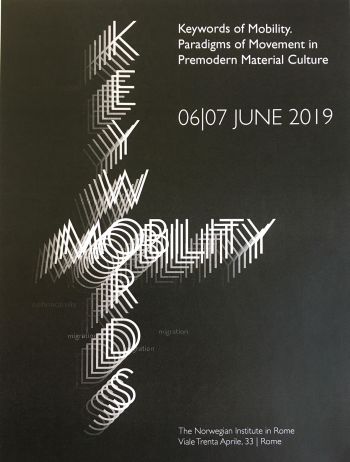 The history of art has been engaged with mobility for centuries. Movement, with its limits and potentials, constitutes in several ways a founding principle of the discipline, and its fascination or rejection stands at the core of much of its narrative. But the recent (re)turn to mobility is rapidly reframing many assumptions about the discourses and practice of the discipline itself. How has art history and, more generally, the study of material cultures, absorbed and reacted to the mobility turn? What kind of theoretical frameworks has, does, and will the discipline, in its broader acceptance, foster and promote? How is mobility—whose intangible nature makes it a rather elusive object of study—embraced and developed in art historical projects?
More than a decade after Sheller and Urry’s call for a ‘mobility turn’, this workshop invites scholars of the premodern period to reconsider the role of art history and material studies in a de-sedentarized, mobile world. Our scope is to reflect and redefine a set of critical terms, whose use (and sometimes abuse) is central to current debates. In doing so, we do not intend to propose a ‘grand narrative’ of mobility, but rather to explore a new set of questions, theoretical approaches, and ideas, in order to understand practices, meanings, forces, and impacts of movement in premodern art.
T H U R S D A Y , 6 J U N E 2 0 1 9
9.30 Registration
9.45 Welcome by Christopher Prescott (Director of The Norwegian Institute in Rome)
10.00 Morning Talks
• Mattia Biffis (Oslo), Mobility What? Viewing Movement Tridimensionally
• Yannis Hadjinicolaou (Hamburg), Flying: Falconry as an Image Vehicle
• Bronwen Wilson (Los Angeles), The Itinerary, the Line, and the Limits of the Page
• Hagi Kenaan (Tel Aviv), Visual Network: The Case of Graffiti
13.00 Lunch break
14.30 Afternoon Talks
• Janina Wellmann (Lüneburg), Rhythm: A New Episteme around 1800
• Meha Priyadarshini (Edinburgh), Boats, Bales, and Ballads: The Material and Culture Practice of Transportation in the Early Modern Period
• Piers Baker-Bates (London), Travelling between the Viceroyalties: The Cosmopolitanism of Works of Art within the 16th-Century Hispanic World
• Stefan Neuner (Berlin), The Ferryman and the Obsessed: Connectivity in Urban and Social Space in Venice around 1500 according to Vittore Carpaccio
18.00 Aperitivo
20.00 Dinner
F R I D A Y , 7 J U N E 2 0 1 9
9.50 Welcome by Sam Hardy (The Norwegian Institute in Rome)
10.15 Morning Talks
• Miriana Carbonara (East Anglia), Art and Borders: A Methodology
• Federico Zuliani (Turin), Migrant Bibles: Relocating Objects and Beliefs in Early Modern Europe
• Aron Vinegar (Oslo), On Habit’s Remainder and the Subject Matter of Inertia
13.00 Lunch break
14.30 Afternoon Talks
• Peter Gillgren (Stockholm), Siting: Mobility and Materiality
• Ivo Van der Graaff (New Hampshire), The Architecture of Departure and Arrival in the Early Roman Empire
• Tiffany Racco (Washington DC), The Performance of Speed: Luca Giordano’s Recurring Role as the Fast Painter
17.00 Concluding Remarks
17.30 Visit to the Fontana dell’Acqua Paola
20.00 Dinner
Conference | Baroque to Neo-Baroque
From the Kunsthistorisches Institut in Florenz:
Baroque to Neo-Baroque: Curves of an Art Historical Concept
Kunsthistorisches Institut in Florenz – Max-Planck-Institut, Palazzo Grifoni Budini Gattai, Florence, 3–5 June 2019
Organized by Estelle Lingo and Lorenzo Pericolo with Alessandro Nova and Tristan Weddigen
 In recent decades there has been a notable revival of scholarly discourse on the baroque. The term ‘baroque’ emerged in the mid-eighteenth century as a pejorative designation for the dominant style of European art produced from c. 1600 to c. 1750. The critical valences the term possessed from the outset have endowed the ‘baroque’ with an afterlife in art history quite distinct from that of the Renaissance and one that it is now particularly timely to interrogate. This conference will bring together eminent and emerging scholars of seventeenth-century European art, colonial Latin American art, and modern and contemporary art to discuss and reassess the ‘baroque’ and the ways in which this concept is currently in play across these diverse subfields. Free admission until capacity is reached.
A cooperation of the Kunsthistorisches Institut in Florenz – Max-Planck-Institut and the Bibliotheca Hertziana, Max-Planck-Institut für Kunstgeschichte
M O N D A Y , 3 J U N E 2 0 1 9
15:00 Welcome and Introduction by Estelle Lingo, Lorenzo Pericolo, Alessandro Nova, and Tristan Weddigen
15:30 Keynote Address
• Alina Payne (Harvard University and Villa I Tatti)
16:50 The Formation of a Concept
Chair: Estelle Lingo
• Evonne Levy (University of Toronto), ‘Baroque’: Mnemosyne Atlas
• Brigid Doherty, Princeton University), ‘Das direkte Herauskommen aus dem Bilde, das Losgehen auf den Beschauer’: Wölfflin, Benjamin, and the Possibility of a ‘Neo-Baroque’ Sistine Madonna in Reproduction
T U E S D A Y , 4 J U N E 2 0 1 9
10:00 The European Baroque
Chair: Alessandro Nova
• Lorenzo Pericolo (University of Warwick), The Baroque Body as a Stylistic Paradox
• Celeste Brusati (University of Michigan), Painting Naturally in the Netherlands
• Estelle Lingo (University of Washington), Baroque Visuality between Perspective and the Photograph
15:00 The Colonial Baroque
Chair: Lorenzo Pericolo
• Jesús Escobar (Northwestern University), Baroque Classicism and Institutional Architecture in the Early Modern Spanish Empire
• Aaron Hyman (Johns Hopkins University), Toward a Notion of (Global, Colonial) Baroque Form
• Fernando Loffredo (New York University and The Cooper Union), The Baroque as National Identity: Aleijadinho in the Brazilian Cultural Imaginary
18:00 The Neo-Baroque
Chair: Tristan Weddigen
• Laura Moure Cecchini (Colgate University), Italian Fascism and the Baroque: Appropriation and Invention between 1922 and 1945
W E D N E S D A Y , 5 J U N E 2 0 1 9
9:30 The Neo-Baroque (continued)
Chair: Tristan Weddigen
• Amy Buono (Chapman University), Hidden Dreams of the Brazilian Baroque
• Jens Baumgarten (Universidade Federal de Sao Paulo), Invention of the Baroque and Discourses of the Neo-Baroque: Politics and Religion in Brazil and the Philippines
• Peter Krieger (Universidad Nacional Autónoma de México), Contemporary Neo-Baroque Architecture and Neo-Colonial Ideology: The Mexican Case
Conference | Collecting and Display: A Matter of Access
From H-ArtHist:
Collecting and Display: A Matter of Access
Munich, 22 June 2019; and London, 24 June 2019
Organized by Susan Bracken, Andrea Gáldy, and Adriana Turpin
Since its foundation in 2004, the international forum Collecting & Display has investigated numerous aspects of both collections and collectors. Such activity has taken place at regular seminars and at our conferences and has resulted in a number of publications. For June 2019 we plan an international conference at two venues: Munich (22nd) and London (24th). Speakers and attendees are welcome to book either part of the conference separately or both as a package. The 2019 conference aims to extend the discussion of the nature and pertinence of collections by focusing on the spaces in which they were displayed and how access to those spaces was controlled. By examining how collections were displayed, used and presented, and who had access to these spaces, we hope to develop a deeper understanding of the meaning of collections to their owners and of their significance to contemporaries.
S A T U R D A Y , 2 2 J U N E 2 0 1 9
Ludwig-Maximilians-Universität München, Institut für Kunstgeschichte, Room 007, Zentnerstr. 31, 80798 München
10.00 Registration and welcome
10.30 Morning Talks
• Orsolya Bubriák (Institute of Art History, Research Centre for the Humanities, Hungarian Academy of Sciences), The Kunstkammer of Johann Septimius Jörger in Nuremberg
• Virginie Spenlé (Director, Kunstkammer Georg Laue Inventarisierung und wissenschaftliche Bearbeitung des Bestandes), Leonhard Christoph Sturm (1669–1719) and an Ideal Architecture for Dynastic Collections
• Mary Malloy (Fellow of the Peabody Museum of Archaeology and Ethnology, Harvard University), The Catalogue as Invitation: Recruiting Visitors to Collections in Seventeenth-Century Europe
• Catherine Phillips (Independent Scholar), Paintings, Prints, Squirrels, and Monkeys: Catherine the Great’s Hermitage
1.00 Lunch
2.00 Afternoon Talks
• Paweł Ignaczak (Academy of Fine Arts, Warsaw), A Parisian Collection in a Polish Castle: Lights and Shadows of a Prestigious Location in the Context of the Struggle for National Identity
• Cecilia Riva (Collection Cataloguer, Palazzo Ducale, Venice), ‘A Well-known Subject for Photographic Reproduction’: The Layard Collection as an Example of Nineteenth-Century Advertising
• Sarah Coviello (Warburg Institute, London), ‘A scholar collects, exhibits, and writes about it’: The Personal Study Collections of Twentieth-Century Art Historians
• Maria Höger (Department für Kunst- und Kulturwissenschaften der Donau-Universität Krems, Art / Brut Center Gugging), ‘Art Brut’ and ‘Outsider Art’ – ‘Ghettoization’ of Art and Their Creators?
• Laura Humphreys (Curatorial Project Manager at the Science Museum in London), New Frontiers for the Science Museum Group Collection
5:30 Drinks reception
M O N D A Y , 2 4 J U N E 2 0 1 9
IHR, Senate House, Wolfson Room, Malet Street, London WC1E 7HU
9.30 Registration
9.45 Welcome and introduction
10.00 Morning Talks
• Anne Harbers (Radboud University, The Netherlands), His & Her Royal Collections: The Synergies and Symbiosis of Selecting a Publicity Channel
• Esmee Quodbach (Assistant Director of the Center for the History of Collecting at The Frick Collection and Frick Art Reference Library), To See or Not to See: The Visibility of the John G. Johnson Collection in Philadelphia, c.1880 to the Present
• Julia Rössel (Research Assistant in the project ‘Kupferstichkabinett Online’ of the Herzog August Bibliothek, Wolfenbüttel), Displaying Print Collections: Location, Site, Practice
• Anne Nellis Richter (Adjunct Professorial Lecturer, Department of Art, American University, Washington DC), ‘An Excess of Folly’: Townhouses as Public Art Galleries in Early Nineteenth-Century London
• Isobel Caroline MacDonald (University of Glasgow and The Burrell Collection), A Private Collection on Public Display: The Significance of (Sir) William Burrell’s (1861–1958) Loan Collection
1.00 Lunch
2:00 Afternoon Talks
• Alison Clarke (University of Liverpool and the National Gallery, London), In a Better Light: Agnew’s, Spatiality, and Connoisseurial Practice, c.1875–1916
• Rebecca Tilles (Associate Curator of 18th-Century French and Western European Fine and Decorative Arts at Hillwood Estate, Museum & Gardens), The Homes and Collecting Display of Marjorie Merriweather Post
• Laia Anguix (Northumbria University-Department of Arts), ‘In Deplorable Conditions and Totally Inadequate for the Housing of the Collections’: Storage, Conservation, and Access in Public Collections, The Case of the Laing Art Gallery in Newcastle
• Megakles Rogakos (The American College of Greece), The Work of an ACG Art Curator
5.00 Drinks reception
Conference | The Artistic Taste of Nations, 1550–1815
From the Vrije Universiteit Amsterdam:
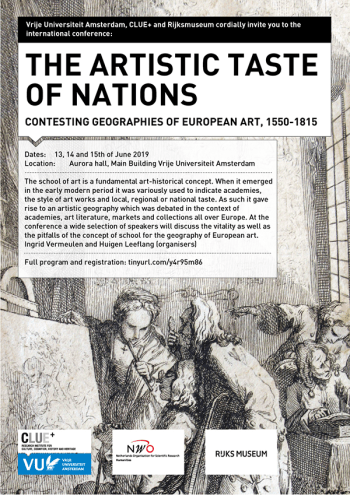
The Artistic Taste of Nations: Contesting Geographies of European Art, 1550–1815
Vrije Universiteit Amsterdam, 13–15 June 2019
Organized by Ingrid Vermeulen and Huigen Leeflang
The school of art is a fundamental art-historical concept. When it emerged in the early modern period, it was variously used to indicate academies, the style of art works and local, regional, or national taste. As such it gave rise to an artistic geography, which was debated in the context of academies, art literature, markets, and collections all over Europe. This conference aims to address the vitality as well as the pitfalls of the concept of school for the geography of European art.
 T H U R S D A Y , 1 3 J U N E 2 0 1 9
12.00 Registration
12.30 Welcome by Gert-Jan Burgers (director research institute CLUE+) and Ingrid Vermeulen (Vrije Universiteit)
13.00 Academies of Art and Artistic Nations
Moderator: Arno Witte (KNIR Rome/ Universiteit van Amsterdam)
• Susanne Kubersky-Piredda (Bibliotheca Hertziana, Max-Planck-Institut für Kunstgeschichte Rome), Notions of Nationhood and Artistic Identity in 17th-Century Rome
• Maria Onori (Sapienza Università di Roma), Spanish Artists and the Academies: Places of Belonging in the Second Half of the 17th Century in Rome
• Ludovica Cappelletti (Politecnico di Milano), Shaping Architecture: The Case of the Regia Accademia di Pittura, Scultura e Architettura in Mantua
14.45 Break
15.15 Drawings, Connoisseurship, and Geography
Moderator: Klazina Botke (Vrije Universiteit)
• Simonetta Prosperi Valenti Rodinò (Università di Roma ‘Tor Vergata’), Father Sebastiano Resta (1635–1714) and the Italian Schools of Design
• Federica Mancini (Musée du Louvre), Connoisseurship beyond Geography: Some Puzzling Drawings from Filippo Baldinucci’s Personal Collection
• Sarah W. Mallory (Harvard University), Arthur Pond’s Prints in Imitations of Drawings: Connoisseurship and the National School in Early 18th-Century Britain
17.00 Drinks reception
F R I D A Y , 1 4 J U N E 2 0 1 9
9.00 Registration
9.30 The Taste and Genius of Nations
Moderator: Marije Osnabrugge (Université de Genève)
• Ingrid Vermeulen (Vrije Universiteit), The ‘Taste of Nations’: Roger de Piles’s Diplomatic Views on European Art
• Pascal Griener (Université de Neuchâtel), How Do Great Geniuses Appear in a Nation? A Historiographical Problem for the Enlightenment Period
10.40 Break
11.10 Print Collecting and School Formation
Moderator: Huigen Leeflang (Rijksmuseum)
• Gaëtane Maës (Université de Lille), Between Theory and Practice: Dezallier d’Argenville’s Idea on Print Collections
• Véronique Meyer (Université de Poitiers), Des Notices générales au Manuel du Curieux: Michael Huber et l’Ecole française de gravure (From Notices Générales to Manuel du Curieux: Michael Huber and the French School of Printmaking)
• Stephan Brakensiek (Universität Trier), Chronology and School: Questioning Two Competing Criteria for the Classification of Graphic Collections around 1800
13.00 Lunch break
14.00 Transnational Identities
Moderator: TBA
• Elisabeth Oy-Marra (Johannes Gutenberg Universität Mainz), Towards the Construction of an Italian School: The Transformative Power of Place in Bellori’s Lives
• Marije Osnabrugge (Université de Genève), Claimed by All or Too Elusive to Include: The Place of Mobile Artists in Artist Biographies and the Local Canon
• Ewa Manikowska (Polish Academy of Sciences Warsaw), The Galeriewerk and the Self-Fashioning of Artists at the Dresden Court
15.45 Break
16.15 Practices of Classification
Moderator: Ingrid Vermeulen (Vrije Universiteit)
• Everhard Korthals Altes (Technische Universiteit Delft), The Dutch and Flemish Schools of Painting in 18th-Century Art Literature, Auction Catalogues, and Collections: Together or Apart?
• Huigen Leeflang (Rijksmuseum), Pieter Cornelis van Leyden’s Collections of Prints and Paintings: Content, Organization, and Schools
• Irina Emelianova (Accademia di Architettura di Mendrisio (Ch), «In the school of the Netherlands I joined two schools, Flemish and Holandaise, I even added some German painters»: The Problem of European Artistic Schools in the Context of the Russian Enlightenment
18.30 Conference dinner for speakers and moderators at the Botanical Gardens, Vrije Universiteit
S A T U R D A Y , 1 5 J U N E 2 0 1 9
9.00 Registration
9.30 Schools Going Public: The Picture Gallery
Moderator: Everhard Korthals Altes (Technische Universiteit Delft)
• Cécilia Hurley (École du Louvre/ Université de Neuchâtel), In Search of a Higher Order: The Organisation of the Munich Hofgartengalerie at the End of the 18th Century
• Christine Godfroy-Gallardo (HICSA Université Paris I – Sorbonne), An Organisation by Schools Considered Too Commercial for the Newly Founded Louvre Museum
• Pier Paolo Racioppi (Fondazione IES Abroad Italy Rome), The ‘Louvre Effect’: The New Arrangement of the Vatican Pinacoteca and Guattani’s Catalogue I più celebri quadri delle diverse scuole italiane (1820)
11.15 Break
11.30 Panel discussion and closing remarks
Study Day | Ceramics as Sculpture

Pierre Giovanni Volpato, Personification of the River Nile, ca. 1785–95, hard-paste biscuit porcelain, Giovanni Volpato’s Factory Rome, 30 × 59 × 30 cm (New York: The Metropolitan Museum of Art; Purchase, The Isak and Rose Weinman Foundation Inc. Gift, 2001.456).
◊ ◊ ◊ ◊ ◊
From The French Porcelain Society:
Ceramics as Sculpture, French Porcelain Society Study Day
Masterpiece London, 28 June 2019
The French Porcelain Society is pleased to announce that it will be holding a study day entitled Ceramics as Sculpture, celebrating figurative art, at this year’s Masterpiece London, on Friday, 28 June 2019. The conference aims to open up wider discussion about the contemporary and historical contexts for ceramic sculpture and its place within art history. It also seeks to underline the primacy of sculpture in all the decorative arts, bringing together scholars, curators, artists, and dealers working in the interconnected fields of ceramics and sculpture. Tickets: £45 (includes free entrance to Masterpiece, lectures, tour, tea and coffee, and champagne reception), £20 (student concession). For additional information, please contact Caroline McCaffrey-Howarth, c.mccaffrey-howarth@leeds.ac.uk.
P R O G R A M M E
9.30 Registration
10.00 Welcome by Oliver Fairclough, FSA (Chairman of the French Porcelain Society) and introduction by Caroline McCaffrey-Howarth (V&A/RCA and University of Leeds)
10.10 Session One
• Federica Carta (PhD Candidate, Université de Picardie Jules Verne and at the Università degli Studi di Perugia), Ceramic Sculpture: Ornament and Figuration in the Chapels by Luca Della Robbia at Impruneta
• Antoine D’Albis (Former Chief Scientist at the Manufacture Nationale de Sèvres), La Source ou la Naïade en Porcelaine de Vincennes-Sèvres du Musée du Louvre, New Research
• Elizabeth Saari Browne (PhD Candidate, Massachusetts Institute of Technology), Sculpting le Goût Pittoresque: Clodion’s Bacchic Subjects
• Matthew Martin (Lecturer in Art History and Curatorship, University of Melbourne; Former Curator of International Decorative Arts at the National Gallery of Victoria, 2006–18), Porcelain and Sculptural Aesthetics: Untangling a Troubled Relationship
11.30 Tea and coffee
12.00 Session Two
• Alicia Caticha (PhD Candidate, University of Virginia), Casting Replication: Porcelain and Sculpture Networks in Eighteenth-Century Paris
• Tamara Préaud (Former Archivist of the Manufacture Nationale de Sèvres), Sculpture and Personal Creativity at Sèvres during the Second Empire, 1850–70
• Oliva Rucellai (Former Curator of the Museo Richard-Ginori della Manifattura di Doccia in Sesto Fiorentino, 2002–14), Gio Ponti and Ceramic Sculpture for Richard-Ginori: An Art Director’s Approach
• Martin Chapman (Curator in Charge, European Art, interim; Curator in Charge, European Decorative Arts and Sculpture, The Fine Arts Museum of San Francisco), Accident or Design? Ceramic Sculpture in San Francisco’s Legion of Honor
Thank you by Dame Rosalind Savill, DBE, FBA, FSA (President of the French Porcelain Society, Former Director of the Wallace Collection)
13.30 Lunch break
15.00 Private group tours to ceramics and sculpture stalls at the Masterpiece Fair
17.00 Champagne reception on the terrace










 Enfilade
leave a comment