Conference | Matters of Knowledge: Conservation through the Centuries
From the conference programme:
Matters of Knowledge:
Paradigms and Practices of Conservation through the Centuries
Université de Neuchâtel, June 5–6 June 2025
 Preservation and conservation, along with collecting and valuation, are pillars of any institution that holds a collection of cultural heritage. However, conservation is rarely the subject of analytical and reflexive discourse, researched in a historical perspective. Studies in museology, the history of collections, and even the history of science and technology, have offered their perspectives on why and how all kinds of material collections are preserved in institutions dedicated to conservation. Further, the professionals of these institutions are faced with their own questions about the state of their collections and the origins of the practices they execute in their daily work.
As part of the SNSF project Libraries and Museums in Switzerland (https://www.biblios-musees.ch/), a two-day conference will be held on June 5th and 6th, 2025, focusing on all these dimensions of the conservation of important collections since their founding. This event will bring together academic, scientific and professional circles, while providing an opportunity for theoretical reflection and case studies.
More information and abstracts of the papers can be found here»
t h u r s d a y , 5 j u n e
9.45 Welcome and Introduction
10.00 Documentation and Exhibition of Museum Work
Moderator: Séverine Cattin
• Isabelle Le Pape — Exposer les coulisses du musée: Dévoilements et mises en abyme
• Julie Hochenedel — Transforming the Museum into Heritage: Photographs of Exhibition Spaces in the Louvre Museum
11.30 Coffee Break
12.00 Keynote Lecture
Moderator: Valérie Kobi
• Lauren R. Cannady — Paper Gardens: Cataloguing Change in Early Modern Botanical Thinking
13.00 Lunch Break
15.00 Practices of Conservation in a Global Perspective
Moderator: Natania Girardin
• Marie-Charlotte Lamy — The Race for the Mounted Specimen: The Art of Taxidermy in the Museum Context of the 19th Century
• Karolyna de Paula Koppke — Two Conservator-Restorers in 19th-Century Americas: Carlos Luiz Do Nascimento (1812–1876) and Vicente Huitrado (?–1890)
17.00 Exhibition Visit
Nommer les Natures: Histoire naturelle et héritage colonial at the Muséum d’Histoire Naturelle de Neuchâtel, Rue des Terreaux 14
f r i d a y , 6 j u n e
9.15 Genius loci and Classifications
Moderator: Remo Stämpfli
• Alexandre Claude — Unchanging Materials? Preserving Stones in Early Modern European Collections
• Felicity Myrone and Ce Stevenson — Library or Print Room? New Insights into the Collecting and Care of Graphic Materials at the British Museum
• Federica Mancini — Des paradigmes et des pratiques à faire évoluer : Le cas du fonds graphique Picot-Brocard conservé au musée du Louvre
12:00 Lunch Break
13.45 Nationalism, Transculturation, and Identity Politics
Moderator: Chonja Lee
• Yuka Kadoi — From Shrine to Museum: Demonumentalising Persian Architectural Heritage
• Charlotte Rottier — The Making of a ‘Musée Belge’ Abroad? Private and State Art Collections on Display in Diplomatic Interiors, 1900–1940
15.15 Closing Remarks
Conference | History of Map Collecting
From ArtHist.net:
History of Map Collecting: Vienna, Central Europe, and Beyond
University of Vienna, 12 June 2025
Organized by Silvia Tammaro and Eva Chodějovská
Organised jointly by the Vienna Center for the History of Collecting (University of Vienna, Austria) and the Moravian Library in Brno (Czech Republic), the conference will be accompanied by an exhibition on Bernard Paul Moll (1697–1780) and his map collection, formed in 18th-century Vienna and now preserved at the Moravian Library. To register, please send an email to silvia.tammaro@univie.ac.at.
p r o g r a m
9.00 Welcome and Opening
• Markus Ritter (Head of Department of Art History, University of Vienna)
• Tomáš Kubíček (Director of the Moravian Library Brno)
• Eva Chodějovská and Silvia Tammaro (Conference Organizers)
9.30 Composite Atlases
• Markus Heinz (Berlin State Library) — Collectors’ Practices: A Composite Atlas Built on an Editor’s Atlas
• Elisabeth Zeilinger (Austrian National Library, Vienna) — Aspects of Collecting in the Mirror of the Atlas Blaeu-Van der Hem
• Maretta Johnson (Atlas Van Stolk, Rotterdam/Amsterdam University) and Anne-Rieke van Schaik (Amsterdam University) — Maps as Memory Mirrors: The Construction of a Historical Narrative in the Album of Willem Luytzs van Kittensteyn (1613)
11.00 Coffee Break
11.30 A Passion for Maps: Bernard Paul Moll’s Eighteenth-Century Composite Atlas
• Eva Chodějovská and Jiří Dufka — Exhibition launch and discussion
12.00 Lunch
13.15 Collectors
• Jan Mokre (Austrian National Library, Vienna) — Map Collectors and Collections in Vienna, 17th to 19th Centuries
• Silvia Tammaro (University of Vienna) — Artaria & Co. and the Market of Maps and Art Objects
• Šárka Steinová and Filip Paulus (National Archives of the Czech Republic, Prague) — Franz Leonard Herget: Creator of the Collections of the Czech Estates Engineering School
14.45 Coffee Break
15.00 Map Collections: Between State and Private
• Martijn Storms (Leiden University Library) — The 19th-Century Private Map Collectors in the Netherlands
• Zsolt Török (ELTE Eötvös Loránd University, Budapest) — Concealed Composite Atlases: Maps in a 19th-Century Hungarian Petty Noble Art Collection
• Katie Parker (Royal Geographic Society, London) — The Map Office of the Nation: Collecting Maps at the Royal Geographical Society
16.30 Closing Discussion
17.30 Guided Tour to the Woldan Map Collection
• Petra Svatek (Austrian Academy of Sciences) — Meet at Dr.-Ignaz-Seipel-Platz, 1010 Vienna (in front of the Jesuit Church).
Study Day | C. F. R. Lisiewsky on His 300th Birthday
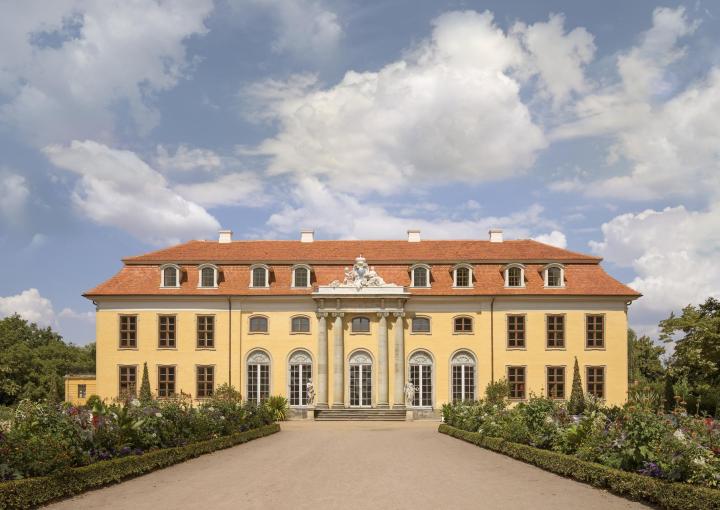
Located near Dessau, Schloss Mosigkau, was built by Princess Anna Wilhelmine of Anhalt-Dessau in the 1750s.
◊ ◊ ◊ ◊ ◊
From ArtHist.net:
Auf einen Blick mit … C. F. R. Lisiewsky. Matinée zum 300. Geburtstag
Schloss Mosigkau, Dessau-Rosslau, 15 June 2025
Registration due by 13 June 2025
2025 jährt sich der Geburtstag des Malers Christoph Friedrich Reinhold Lisiewsky (1725–1794) zum 300. Mal—Anlass, um diesen (nicht nur) für Anhalt-Dessau bedeutsamen Künstler mit einer Veranstaltung zu würdigen. Lisiewsky, der meist im Schatten von Künstlerkollegen wie Anton Graff oder Antoine Pesne steht, hat zwanzig Jahre als Hofmaler in Anhalt-Dessau gewirkt und hier zahlreiche Spuren hinter lassen. Im Schloss Mosigkau, wo im Jahr 2010 die erste Retrospektive zu Lisiewsky unter dem Titel „Teure Köpfe“ gezeigt wurde und wo sich heute eine umfangreiche Sammlung von Gemälden des Malers befindet, will die Matinee mit Fachvorträgen und einer Führung neue Blicke auf Lisiewsky und dessen Umfeld eröffnen.
Bitte melden Sie sich bis zum 13.6.2025 bei Jana Kittelmann an: jana.kittelmann@gartenreich.de. Aktuelle Informationen zur Veranstaltung finden sich unter: https://www.gartenreich.de/de/aktuelles/veranstaltungen?y=2025&m=6
p r o g r a m m
13.00 Begrüßung — Jana Kittelmann und Maria Zielke (Kulturstiftung Dessau-Wörlitz)
13.05 Grußwort — Wolfgang Savelsberg (Dessau)
13.15 Zur Einführung oder Blicken, Sichten, Sehen im Zeitalter Lisiewskys — Jana Kittelmann (KsDW)
13.30 Falten, Warzen und Triefnasen. Hässlichkeit als Programm bei den Herrenbildnissen von C.F.R. Lisiewsky — Kilian Heck (Universität Greifswald)
14.00 Pause
14.15 Lisiewsky und das ‚veristische‘ Porträt — Reimar F. Lacher (Gleimhaus Halberstadt)
14.45 Beobachtungen zur Maltechnik C.F.R. Lisiewskys als Hofmaler, Alchemist und Restaurator — Maria Zielke (KsDW)
15.00 Führung zu Gemälden Lisiewskys — Andreas Mehnert (KsDW)
ab 15.30 Ausklang auf der Schlossterrasse
Conference | The Global Baroque, 1600–1750
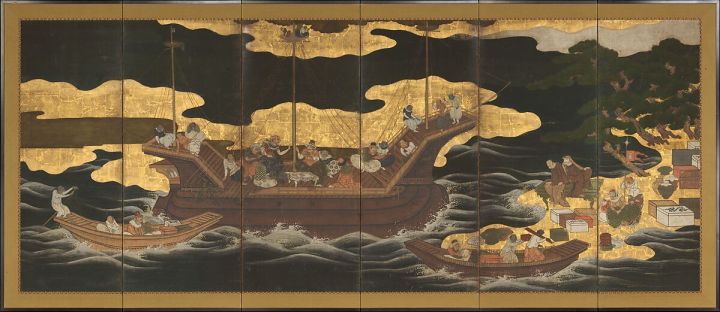
Japanese, Arrival of the Europeans, first quarter of the 17th century, one of a pair of folding screens, 105 × 261 cm
(New York: The Metropolitan Museum of Art, 2015.300.109.1, .2).
◊ ◊ ◊ ◊ ◊
From ArtHist.net and the University of York:
The Global Baroque
European Material Culture between Conquest, Trade, and Mission, 1600–1750
King’s Manor, University of York, 10–11 July 2025
Organized by Adam Sammut and Tomasz Grusiecki
Registration due by 1 July 2025
The period of Western art history known as ‘the Baroque’ has traditionally been interpreted as a stylistic phenomenon. However, artistic production in Europe from around 1600 to 1750 was enabled by a proto-industrial world system dominated by Spain and Portugal, the Netherlands, and later Britain. As a result, material culture became entangled in networks of trade, colonial rule, and Catholic global mission stretching from Naples to Nagasaki. This conference will broaden perspectives on the Baroque, embracing its transcontinental and multi-media character. By culturally decentring Europe and with materiality a special focus, the programme will recast the continent as a constituent part of an expanding artistic world driven by war, the exploitation of ecosystems, and the first information technology revolution. Bringing together scholars and museum curators from the UK and internationally, the conference will demonstrate how objects can offer intimate insights into global histories often characterised by vast, impersonal economic forces.
Part of The British Academy Conferences 2025/26
t h u r s d a y , 1 0 j u l y
9.00 Registration with coffee, tea, and pastries
9.40 Opening Remarks — Adam Sammut (University of York) and Tomasz Grusiecki (Boise State University)
10.00 Session 1 | Baroque Aesthetics
Chair: Adam Sammut (University of York)
• Black Beauty and the Canon: Nicolas Cordier’s Borghese Moor — Lorenzo Pericolo (Florida State University)
• Ancient Greece and the English Baroque — Matthew Walker (Queen Mary University of London)
11.20 Coffee and tea
11.50 Session 2 | New Geographies of the Low Countries
Chair: Cordula van Wyhe (University of York)
• Global Conversions: Peter Paul Rubens, King Philip IV of Spain, and the Coiners of Antwerp — Christine Göttler (University of Bern)
• Biting lines: Baroque Violence in Rembrandt’s Small Lion Hunt (1629) — Thomas Balfe (The Warburg Institute)
• A Taste for Blackness: Ebony in the Dutch Republic — Claudia Swan (Washington University in St. Louis)
13.20 Lunch break
14.20 Session 3 | Ottoman Worlds
Chair: Richard McClary (University of York)
• Style, Society, and the State: Ottoman Baroque Identities in 18th-Century Istanbul — Ünver Rüstem (Johns Hopkins University)
• Object Circulation and Networks on the Periphery of Eastern Central Europe: The Case Studies of the Ottoman Tributary States of Transylvania and Moldavia — Robert Born (Bundesinstitut für Kultur und Geschichte des östlichen Europa)
15.30 Coffee and tea
16.00 Keynote Address
• Necropastoral Worldscapes in Dutch-occupied Brazil — Angela Vanhaelen (McGill University)
18.00 Dinner at Ambiente Fossgate, by invitation
f r i d a y , 1 1 j u l y
9.30 Coffee, tea, and pastries
10.00 Session 4 | Where is Central and Eastern Europe?
Chair: Tomasz Grusiecki (Boise State University)
• Corpisanti between Rome and the Fringes of Catholicism: A Case Study in a Centripetal Approach to Material Culture of the Late Global Baroque — Ruth Sargent Noyes (Estonian Academy of Arts)
• Black Bodies as Baroque Decorations: Objectification of Africans in the Self-Representation of Polish-Lithuanian Elites — Vital Byl (University of Bonn)
11.00 Coffee and tea
11.30 Session 5 | The Asia-Pacific and the Indian Ocean
Chair: Tara Alberts (University of York)
• Objects and Empire on the Portuguese India Run — Elsje van Kessel (University of St Andrews)
• Indian Oceanic Travels of Coco-de-mer: Mythology and Materiality — Peyvand Firouzeh (University of Sydney)
• The Transcultural Body of the Mermaid — Anna Grasskamp (University of Oslo)
13.00 Lunch break
14.00 Session 6 | Atlantic Crossings
Chair: Simon Ditchfield (University of York)
• What’s in a Name? The Low Countries and the Global Turn — Stephanie Porras (Tulane University)
• A Counter-Baroque? Iroquois Town Planning and the Early Modern Imagination — Lorenzo Gatta (University College London)
• Emptied Orbs, or, A Case Against the Global — Aaron Hyman (University of Basel)
15.30 Coffee and tea
16.00 Roundtable discussion
17.30 Wine reception
Conference | Gardens and Empires
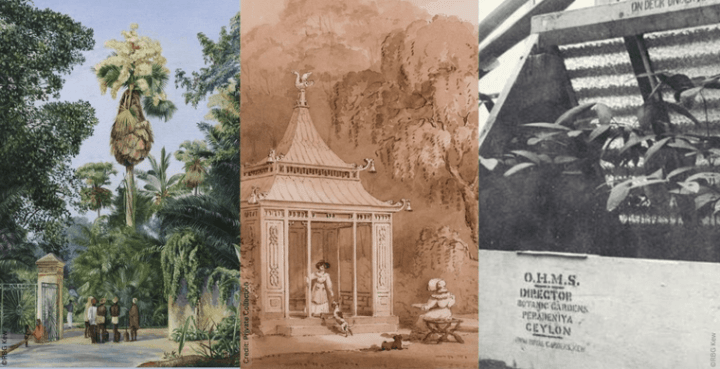
◊ ◊ ◊ ◊ ◊
Next month at the British Library:
Gardens and Empires
British Library, London, 27–28 June 2025
The histories of plants and gardens are deeply entangled with the histories of empires. This two-day conference investigates the impacts of these global connections on gardens around the world. It investigates the influence of global networks of science, commerce, and horticulture on the plants, designs, and practices found in the gardens of European and non-European empires, at home and abroad. The conference includes talks about the impact and influence of empires in gardens all over the world including East Asia, India, North America, South America, Australia, the Caribbean, and Europe. The speakers share the stories of the plants, people, and powers that shaped the gardens of empires. A keynote lecture will be delivered by Advolly Richmond (BBC Gardener’s World), and a roundtable discussion on the legacies of empire will be chaired by Sathnam Sanghera (author of Empireland and Empireworld).
Tickets include an exclusive visit to the British Library exhibition Unearthed: The Power of Gardening. Also included are refreshments each day and an evening reception on Friday, 27 June in the wonderful surroundings of The Story Garden, a dynamic community garden created by Global Generation, hidden behind the British Library.
f r i d a y , 2 7 j u n e
10.00 Opening Remarks
10.05 Welcome — Gerard Lemos (Chair of Trustees, English Heritage)
10.15 Keynote Lecture
• Guns and Roses: Humphry Repton at the Warley Estate — Advolly Richmond (Independent Researcher)
10.45 Coffee/Tea Break
11.10 Session 1 | The Circulation of Ideas around and between Empires
Chair: Mark Nesbitt (Royal Botanic Gardens, Kew)
• Where Empires Meet: Power, Identity, and Cultural Negotiation in Huế (Vietnam) Gardens — Tami Banh (University of Pennsylvania)
• Traveling Plants: Taiwanese Garden Spaces under Japanese Rule — Jing-Wen Chien (National Taiwan University)
• Transnational Influences on Urban Greenspace Development: The Role of Kew Gardens in Shaping Modern Greenspace Systems in Shanghai, Hong Kong, and Singapore — Minqian Zheng (Academic Researcher), Fei Mo* (Shanghai Jiao Tong University), and Xinyuan Yu (Academic Researcher)
12.30 Lunch Break
13.30 Session 2 | The Circulation of Ideas around and between Empires
Chair: Gerard Lemos (English Heritage)
• Mughal Garden or English Park? The Genesis of the Victoria Memorial Gardens, Kolkata — Caroline Cornish (Royal Botanic Gardens, Kew)
• From the Shores of Empire: Shells and Coral in the Grottos of 18th-Century Gardens — Emily Parker (English Heritage)
• Forced Plants and Displaced People: The British Empire’s Impact on North American Botany — Kimberly Glassman (Queen Mary University of London and Royal Botanic Gardens, Kew)
14:50 Coffee/Tea Break
15.15 Session 3 | The Circulation of Ideas around and between Empires
Chair: Romita Ray (Syracuse University)
• Paleis Het Loo: From Royal Showcase towards a Decolonized Botanical Garden — Renske Ek (Paleis Het Loo)
• The Race for American Trees and the Prince’s Garden at Aranjuez, 1797–1809: A Story of Rivalry, Emulation, and Oblivion among the Gardens of the Atlantic Colonial Powers — Francisco Javier Giron Sierra (Universidad Politécnica de Madrid, Escuela Técnica Superior de Arquitetura)
• Augusta of Saxe-Gotha’s ‘World in Microcosm’: Political Gardening at Kew, 1750–1770 — Joanna Marschner (Historic Royal Palaces)
16.35 Introduction to Unearthed: The Power of Gardening — British Library Curators
16:50 Exhibition View — Unearthed: The Power of Gardening
18:00 Evening Reception at The Story Garden (pizza and canapés provided)
s a t u r d a y , 2 8 j u n e
9.30 Session 4 | People and Economics
Chair: Advolly Richmond (Independent Researcher)
• Horticulture, Empire, and Race: Thomas Dawodu and Ferdinand Leigh in Lagos, Jamaica, and Kew — Kate Teltscher (University of Roehampton and Royal Botanic Gardens, Kew)
• Pineapples, Prestige, and Imperial Politics: The 3rd Duke of Portland’s Gardening Practice at Welbeck Abbey, Nottinghamshire, Britain — Susanne Seymour (University of Nottingham)
• The Links between Scottish Country Estates and the Profits of Transatlantic Slavery, 1707–1850 — Catherine Middleton (Historic Environment Scotland)
11.00 Coffee/Tea Break
11.30 Session 5 | Plant Mobilities
Chair: Felix Driver (Royal Holloway, University of London)
• On ‘Exotics’ and ‘Civilisation’: The 19th-Century Transatlantic Exchange of Ornamental Plants — Diego Molina (Royal Holloway, University of London)
• Palms, Rubber, and Orchids: Introduced and Created Plants in the Singapore Botanic Gardens — Timothy Barnard (National University of Singapore)
12.30 Lunch Break
13.30 Session 6 | Legacies of Empire and Colonialism
Chair: Judy Ling Wong (Black Environment Network)
• Creole Gardens as Decolonial Practice, Regrowth, Resistance, Recycling, and Repair — Ananya Jahanara Kabir (King’s College London) and Rosa Beunel-Fogarty (King’s College London)
• A Private Empire: Interpreting European Gardens Funded by Leopold II’s Personal Ownership of the ‘Congo Free State’ — Jill Sinclair (Independent Researcher)
• Converting the ‘Wilderness’ in Colonial Western Australia — Lisa Williams (Independent Researcher) and Emma-Clare Bussell (Independent Researcher)
15.00 Coffee/Tea Break
15:30 Session 7 | Roundtable: Legacies of Empire and Colonialism
Chair: Sathnam Sanghera (Journalist and Writer)
• Fiona Davidson (Royal Horticultural Society)
• Corinne Fowler (University of Leicester)
• Akiko Tashiro (Hokkaido University)
• Juliet Sargeant (Garden Designer)
Conference | Publics of the First Public Museums: Visual Sources
From ArtHist.net:
Publics of the First Public Museums, 18th and 19th Centuries: Visual Sources
Online and in-person, Museo Nacional del Prado, Madrid, 5–6 June 2025
Organized by Carla Mazzarelli and David García Cueto
The conference Publics of the First Public Museums, 18th and 19th Centuries: Visual Sources is an integral part of the research project Visibility Reclaimed: Experiencing Rome’s First Public Museums (1733–1870), An Analysis of Public Audiences in a Transnational Perspective (FNS 100016_212922) directed by Carla Mazzarelli. Marking the third of three encounters (following I. Institutional Sources and II. Literary Discourses), this workshop delves into the examination of visual sources, vital to understanding the forms of representation of early museums and their publics. We intend to investigate a vast range of visual sources, from views of internal and external spaces to architectural and display projects, from caricatures to illustrations published in catalogues, guidebooks, voyages pittoresques up to the (self)representation of publics, museum staff (directors, custodians, ciceroni), and artists within the museum.
Visual sources have long represented a privileged source for investigating the origins of the first public museums and the impact on their publics. However, in the light of recent studies aimed at deepening the material history of the museum and the encounter of the public with the institutions, these sources deserve a closer scrutiny in both methodological and critical terms. As museums sought to define and engage their publics, visual sources often became both a mirror and a mould; they reflect and shape institutional and societal perceptions, contributing to build up the idea of museum but also to give a depiction of practices of access to public and private collections in Europe and in the World. The Museo Nacional del Prado welcomes this initiative as it has been involved since its foundation in 1819 in the process that the conference analyzes. The well known paintings that represent the spaces of Museo Nacional del Prado, since its opening, such as those of Fernando Brambilla, are an important starting and comparison point for the theme at the center of the conference discussion. On the other hand, paintings depicting ‘quadrerie’ have been a codified genre at least since the 17th century. Such artworks have also been read as sources for the study of the evolution of the display during the early modern age, but they also represent reference models for artists on how to represent the interiors of museum spaces, their publics and staff.
Direction
Carla Mazzarelli (Università della Svizzera italiana, Accademia di Architettura, Istituto di storia e teoria dell’arte e dell’architettura)
David García Cueto (Madrid, Museo Nacional del Prado)
It is possible to attend the sessions until all seats are filled or to follow the congress on line through the link to the Zoom platform that will be provided for all those enrolled. When enrolling you must choose a type of attendance.
Contact
visibilityreclaimed@gmail.com
congreso.visibily@museodelprado.es
t h u r s d a y , 5 j u n e
10.15 Registration
10.45 Welcoming Remarks — Alfonso Palacio (Director Adjunto de Conservación e Investigación del Museo del Prado)
11.00 Session 1 | Museums and Audiences in Image: Frameworks and Methodologies
Chair: David García Cueto (Museo Nacional del Prado)
• Carla Mazzarelli (Università della Svizzera italiana) — Alle origini del pubblico “esposto”. Proposte di lettura e confronto delle fonti visive
• Daniela Mondini (Università della Svizzera italiana) — Visiting Sacred Spaces as ‘Museums’
• Luise Reitstätter (Universität Wien) — Museums Ego Documents as Visual Source: Imaging First Publics within Founding Missions
• Javier Arnaldo Alcubilla (Museo Nacional del Prado) — La bohemia en el Prado: entre fuentes visuales y literarias
12.45 Keynote Address
• Sebastian Schütze (Universität Wien) — Going Public: The Gallery Picture and its Agencies
13.30 Lunch Break
14.45 Panel 2 | Mirroring Museums: The Public in Photographic Archives and Digital Atlases
Chair: Daniela Mondini (Università della Svizzera italiana)
• Beatriz Sánchez Torija (Museo Nacional del Prado) — El Museo del Prado y el uso de la fotografía como enlace con el público en la segunda mitad del siglo XIX
• Irina Emelianova (Università della Svizzera italiana) — European Art Museums and Their Audiences through the Photographic Collection of the Academy of Fine Arts in St. Petersburg: Between the End of the 19th Century and the Beginning of the 20th Century
• Paola D’Alconzo (Università degli studi di Napoli Federico II), Donata Levi (Università degli studi di Udine), Martina Lerda (Università di Pisa) — Dall’Atlante digitale dei musei italiani (DAIM): Immagini del pubblico, immagini per il pubblico
16.15 Coffee Break
16.30 Panel 3 | Museums in Sight: Visual Records of Visit and Display
Chair: Christoph Frank (Università della Svizzera italiana)
• Barbara Lasic (Sotheby’s Institute of Art) — Visualising Museal Trajectories at the Garde-Meuble de la Couronne
• Luca Piccoli (Università della Svizzera italiana) — ‘The colours of them so chosen to carry the eye forward’: alle origini dell’esperienza di visita del Museo Pio Clementino tra rappresentazione e realtà (1770–1796)
• Julia Faiers (Independent Scholar) — Experiencing Medieval Art at Toulouse’s First Public Museums
17.50 Break
18.00 Keynote Address
Andrew McClellan (Tufts University) — Towards a Machine for Looking: Science, Psychology, and Visitor Experience at the Museum of Fine Arts, Boston, 1900
f r i d a y , 6 j u n e
10.00 Panel 4 | Strategies of Self-Presentation: Museums between Politics and Cultural Stereotypes
Chair: Chiara Piva (Sapienza Università di Roma)
• Benjamin Carcaud (École du Louvre / Ministère de la Culture) — Quelle image du visiteur les artistes ont-ils construite dans leurs œuvres? Les stéréotypes du visiteur de musée dans les salles du Louvre
• Adrián Fernández Almoguera (Universidad Nacional de Educación a Distancia, Madrid) — ¿Imágenes como estrategia? A propósito del Musée des Antiques en la cultura visual del Louvre imperial
• Cynthia Prieur (University of Victoria, British Columbia) — Shaping the Image of the Louvre Museum: Maria Cosway’s Prints of the Exhibitions of Looted Art
11.20 Coffee Break
11.35 Panel 5 | The Critical Eye: Museums and Publics Between Promotion and Satire
Chair: Stefano Cracolici (Durham University)
• Grégoire Extermann (Université de Genève) — Un caricaturista en París: el ginebrino Wolfgang Adam Töppfer y el público del Louvre imperial
• Ludovica Scalzo (Università Roma Tre) — Il pubblico dei musei nei primi periodici illustrati europei (1830–1850)
• Gaetano Cascino (Università della Svizzera italiana) — I musei di Roma e i loro visitatori in satira nella pubblicistica dopo l’Unità
13.00 Lunch Break
14.00 Panel 6 | The Public Image of the Private Museum
Chair: Carlos G. Navarro (Museo Nacional del Prado)
• Federica Giacomini (Istituto Centrale per il Restauro, Roma) — La Galleria Borghese in un’illustrazione de ‘Le Magasin Pittoresque’: per un’indagine del pubblico nell’Ottocento
• Kamila Kludwiecz (Adam Mickiewicz University, Poznań) Aldona Tolysz (the Office of the Provincial Conservator of Monuments in Warsaw) — Between Documentation and Self-Creation: The Role of Illustration in the Activities of Polish Private Museums in the 19th Century
15.00 Panel 7 | From National to Global Image: The Identity of the Museum and Its Audiences
Chair: Giovanna Capitelli (Università Roma Tre)
• Susanne Anderson-Riedel (University of New Mexico) Caecilie Weissert (Universität Kiel) Joelle Raineau-Lehuédé (Petit Palais) — A Global Public for France’s National Museum
• Elizaveta Antashyan (Sapienza Università di Roma) — Visibility Granted: The Hermitage Museum in the 19th Century and Its Representation in Contemporary Imagery
• Raffaella Fontanarossa (Indipendent Scholar) — Le muse in Oriente. I primi visitatori dei musei in Cina e Giappone attraverso le fonti visive
• Jonatan Jair López Muñoz (Univesidad Complutense de Madrid) — La imagen omnipresente. La representación regia en los museos nacionales del siglo XIX en España e Italia
16.45 Coffee Break
17.00 Panel 8 | A Museum for All? The Variety of Audiences on Display
Chair: Daniel Crespo Delgado (Universidad Complutense de Madrid)
• Gemma Cobo (Universidad Nacional de Educación a Distancia, Madrid) — La mirada de la infancia: Nuevos museos y educación artística en la Europa de entresiglos, 1750–1850
• Anna Frasca-Rath (Friedrich-Alexander University) — Through the Eye of a Child? Visual Sources of/for Museum Publics in 19th-Century Vienna
• Marie Barras (Université de Genève) — See and Be Seen: Museums and Art Exhibitions as Fashion Stages, 1870–1900
18.20 Concluding Remarks by Carla Mazzarelli
Haughton Seminar | Treasures: Creation, Emulation, and Imitation

Gold Box with Hanau marks for Les Frères Toussaint, ca. 1780
(Nuremberg: Germanisches Nationalmuseum, HG13559)
◊ ◊ ◊ ◊ ◊
This year’s Haughton International Seminar:
Treasures: Creation, Emulation, and Imitation
The British Academy, 11 Carlton House Terrace, London, 25–26 June 2025
Each year the Haughton International Seminar draws together a group of eminent international speakers to share their knowledge and passion with an appreciative audience. This year’s seminar, Treasures: Creation, Emulation, and Imitation—dedicated to the memory of Dame Rosalind Savill—will take place in London at The British Academy on Wednesday, 25th and Thursday, 26th June.
From the earliest cave painters to the stars of today, artists have balanced invention with imitation. Imitation looks to nature—the human form or the shape of a flower—but artists also imitate each other. In some cases imitation is loose and a point of departure; in others it is exact but made as honest copies; and in yet others it is done to impersonate and to deceive. Addressing a wide range of media—including the 18th-century ‘Porcelain Fever’ of Augustus the Strong, the 19th-century Arts & Crafts movement, royal sculptural collections, gold boxes, and more—the seminar will explore the extent to which the works were creations, emulations, or imitations. More information about the 2025 seminar, along with previous years’ offerings, can be found at the event website, where one can also purchase tickets. Booking in advance is essential due to limited numbers.
p r e s e n t a t i o n s
• Adriano Aymonino — Media Transfer: Creating, Emulating, and Imitating the Antique in Early Modern Europe
• Emerson Bowyer — Canova: Sketching in Clay
• Tobias Capwell — The Helmschmids of Augsburg: German Renaissance Masters of the Art of Armour
• Angela Caròla-Perrotti — Del Vecchio, Giustiniani, Mollica, or Colonnese? A Preliminary Approach to Differentiating Vases ‘all’Etrusca’ Produced in Naples between 1800 and 1850
• Ivan Day — The Surtout de Table: From Trionfi da Tavola to Gilt Bronze
• Katharina Hantschmann — The Best Teachers: Role Models for Porcelain Production and a Virtuoso in Nymphenburg
• J. V. G Mallet and Elisa Sani — Italian Maiolica in the Rothschild Collection at Waddesdon Manor
• Jonathan Marsden — Changing Seasons: Sculptural Metamorphoses from the Royal Collection
• Roger Massey — Ingenuity and Plagiarism: The Concept of Originality in 18th-Century English Pottery and Porcelain Figures
• Stacey Pierson — Archaism as Imitation: Recreating the Past in Chinese Porcelain
• Justin Raccanello — From Imitation to Modernity: Margaret and Flavia Cantagalli and the Art Nouveau
• Linda Roth — Ceramicist Taxile Doat (1851–1938): Imitation to Innovation
• Timothy Schroder — All the Glitters is Not Gold: Perception and Deception in the World of Goldsmithery
• Heike Zech — Made in Paris? So-called poinçons de prestige on 18th-Century Goldboxes
Symposium | Opus Architectonicum
From ArtHist.net:
Opus Architectonicum: A Symposium Honoring Joseph Connors
Online and in-person, Notre Dame Rome, Roma, 12 May 2025
Organized by Silvia Dall’Olio and Susan Klaiber
This international symposium marks the eightieth birthday of the distinguished architectural historian Joseph Connors and his retirement from active teaching. Currently the Michael C. Duda Visiting Professor at the University of Notre Dame School of Architecture, Connors has shaped the study of Baroque art, architecture, and urbanism—particularly of Borromini and the city of Rome—as a scholar, teacher, and mentor for half a century. In his role as a visionary institutional leader, Connors has fostered innovative work in early modern Italian studies, the wider humanities, and the visual and performing arts.
The symposium gathers European colleagues and former students to celebrate this cherished friend. Presentations will explore issues in the history of art and architecture, their methodologies, and historiography, all using Joe’s personal ‘Opus Architectonicum’ as a point of departure. Attendance is free, but registration required at this link. The symposium will also be live streamed; those interested in following the symposium online should register at the same link on the symposium webpage, checking the box for the video link rather than in-person attendance.
p r o g r a m
9.00 Welcome — Silvia Dall’Olio (Director, Notre Dame Rome), David Mayernik (Notre Dame Architecture), and Susan Klaiber (co-organizer)
9.20 Session 1 | Celebrating Joseph Connors
Chair: Susan Klaiber (independent, Switzerland)
• Ingrid D. Rowland (University of Notre Dame) — Laudatio
• Barbara Jatta (Musei Vaticani) — Lievin Cruyl and the Rome of Alexander VII
10.30 Coffee
11.00 Session 2 | The Rome of Borromini
Chair: Sabina de Cavi (Universidade Nova, Lisboa)
• Augusto Roca De Amicis (Università di Roma La Sapienza) —Rivedendo i Santi Luca e Martina: Architettura come sintassi
• Alberto Bianco (Archivio della Congregazione dell’Oratorio di San Filippo Neri) — Virgilio Spada: Il progetto della Casa dei Filippini e l’identità oratoriana
• Fabio Barry (Warburg Institute) — St. Teresa in Ecstasy: Sacred or Profane Love?
12.45 Lunch break
14.00 Session 3 | Encounters with Joe and Borromini
Chair: Heather Hyde Minor (University of Notre Dame)
• Helen Hills (University of York) — Meeting Joe, via video
• Susan Klaiber (independent, Switzerland) — Borromini and Guarini: Master and Pupil?
• Sabina de Cavi (Universidade Nova, Lisboa) — ‘Borrominismi’ a Lisbona: Osservazioni preliminari sull’impatto dell’Opus Architectonicum in Portogallo
15.45 Break
16.15 Session 4 | Oltre Borromini
Chair: Fabio Barry (Warburg Institute)
• Elisabeth Kieven (Bibliotheca Hertziana) — About a Drawing by Carlo Marchionni: Delight and Despair
• Heather Hyde Minor (University of Notre Dame) — Piranesi’s Imaginary Prisons
• Susanna Pasquali (Università di Roma La Sapienza) — Qualche domanda intorno a un caffè preso nel bar nel Cortile della Biblioteca, Palazzo del Belvedere Vaticano
18.00 Reception
Conference | Watercolour and Weather, 1750–1850
From ArtHist.net:
Watercolour and Weather, 1750–1850
Musée cantonal des Beaux-Arts de Lausanne, Switzerland, 4–6 June 2025
Organized by Bérangère Poulain and Desmond Kraege
Registration due by 3 June 2025
Simultaneously with a resurgence of landscape painting, the period 1750–1850 in European art witnessed an increased interest in the weather, not only as concerns its momentary states (clouded skies, lightning), but also the broader study of meteorological phenomena and of their unfolding over time. Besides the more radical events—such as storms—that were frequently represented, this period thus developed a keen observation of subtle moments of changing weather, allowing artists to combine varied effects of light. This is true not only of the most famous British painters (Joseph Mallord William Turner, John Constable, Alexander and John Robert Cozens) but also of figures from further afield, such as Giovanni Battista Lusieri, Caspar David Friedrich, and Abraham Louis Rodolphe Ducros.
In close connection to this artistic evolution, the period under scrutiny also witnessed the development of meteorology and climatology as scientific disciplines. This led both to Luke Howard’s classification of clouds (1804) that remains in use to this day, and to the theorisation of the greenhouse effect by Joseph Fourier in 1824. A new consciousness of the atmosphere and of its complexities, leading directly to present concerns regarding climate change, can thus be traced back to this cultural environment.
This conference forms part of a broader research and teaching project at the Universities of Lausanne and Geneva concerning Swiss watercolor artist Abraham Louis Rodolphe Ducros, whose personal collection forms the original nucleus of the Lausanne MCBA Museum. The conference will include a viewing of a selection of his works. Please register for this free event by 3 June 2025 by emailing berangere.poulain@unige.ch.
w e d n e s d a y , 4 j u n e
14.00 Institutional Greetings — Juri Steiner (MCBA)
14.15 Introduction — Bérangère Poulain (Université de Genève) and Desmond Kraege (Université de Lausanne)
14.45 Session 1 | Prelude
• Ulrike Gehring (Universität Trier)
15.15 Session 2 | Discovering Weather
Chair: Camille Lévêque-Claudet
• John Robert Cozens: The ‘man of clouds’ — Timothy Wilcox (Independent Curator, Oxford; Former Curator, British Museum and Victoria & Albert Museum)
• The Depiction of Atmospheric Changes in Piedmontese Watercolour Painting between the 18th and 19th Centuries: Artists, Approaches, and Techniques — Matteo Cappellotto (PhD Student, Università degli Studi di Siena)
16.15 Pause
16.45 Session 3 | Architecture and Weather
Chair: Basile Baudez
• Water, Weather, and Colour in the Roman Architectural Academy — Tracy Ehrlich (Parsons School of Design/The New School, New York)
• Le tonnerre et le pinceau: à propos de quelques orages dans les projets d’architecture de l’Académie royale de Paris — Adrián Fernández Almoguera (Universidad Nacional de Educación a Distancia)
t h u r s d a y , 5 j u n e
10.15 Session 4 | Watercolour and Other Media
Chair: Philippe Kaenel
• Painting the Sky in Hand-Coloured Prints — Basile Baudez (Princeton University)
• The Theatre and the Easel: The Depiction of Meteorological Effects in Watercolour Painting and Stage Productions in Georgian England — Segundo J. Fernandez (Independent Scholar and Curator, Tallahassee, Florida)
11.15 Session 5 | Abraham-Louis-Rodolphe Ducros
Chair: Christian Michel
• Viewing of a selection of watercolours by A.L.R. Ducros from the MCBA
• Clouds in the Sea: A.L.R. Ducros, Weather, and Pictorial Texture — Bérangère Poulain (Université de Genève) and Desmond Kraege (Université de Lausanne)
12:30 Lunch
14.00 Session 6 | Charting Colonial Weather
Chair: Nicolas Bock
• Verdant Landscapes: Art, Observation, and Sustainability — Mari-Tere Álvarez (J. Paul Getty Museum, Los Angeles)
• Atmosphères des contrées canadiennes 1790–1820: De l’esquisse à l’œuvre achevée, l’art de dépeindre les horizons nouveaux par quelques amateurs britanniques — Marie-Claude Beaulieu (Independent Scholar, Montréal; Associate Researcher, CRIHAM – Université de Poitiers)
• Watercolour and the ‘melancholy darkness’ of Caribbean Weather in the 18th Century — Joseph D. Litts (PhD Student, Princeton University)
• Ciels en scène: Les aquarelles brésiliennes d’Hercule Florence (autour de 1830) — Martine Tabeaud (Université Paris I Panthéon Sorbonne)
16:30 Pause
16:45 Doctoral workshop
f r i d a y , 6 j u n e
10.15 Session 7 | Watercolour and Science
Chair: Nathalie Dietschy
• Les planches de Luke Howard: l’eau et les « modifications » des nuages — Anouchka Vasak (Université de Poitiers)
• Ecology and Aesthetics in Carus and Friedrich: Two Approaches to Meteorology — Elisabeth Ansel (Friedrich-Schiller-Universität Jena)
• Can Colours in Watercolour Paintings be Considered a Quantitative Climate Archive? — Christian von Savigny (Institute of Physics, Universität Greifswald)
• Volcanic Weather, 1816–1818: Tambora, Turner, and Friedrich — Dewey Hall (California State Polytechnic University, Pomona)
• Painting the Invisible: Representations of Wind Force in Watercolour — Nicola Moorby (Tate Britain, London)
13:00 Lunch
14.15 Session 8 | Revisiting the Masters
Chair: Jan Blanc
• J.M.W. Turner: Storm Chaser — Ian Warrell (Independent Curator, Brighton; Former Curator, Tate Britain)
• ‘A view unequalled in Europe’: John Constable’s Watercolours of Skies Looking over London Painted from his House in Well Walk, Hampstead in the Early 1830s — Anne Lyles (Independent Curator, London; Former Curator, Tate Britain)
Conference | Sculpture between Britain and Italy, 1728–1854
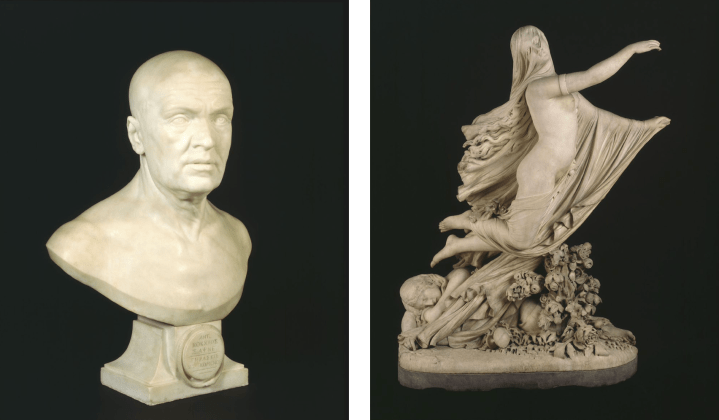
Left: Joseph Wilton, Dr Antonio Cocchi, 1755 (London: V&A: A.9‐1966). Right: Raffaele Monti, The Sleep of Sorrow and the Dream of Joy, 1861 (London: V&A: A.3-1964).
◊ ◊ ◊ ◊ ◊
From the conference programme:
Academy, Market, Industry
Sculptural Models, Themes, and Genres between Britain and Italy, 1728–1854
Online and in-person, Victoria and Albert Museum, London, 16–17 May 2025
Organized by Adriano Aymonino, Kira d’Alburquerque, Albertina Ciani Sciolla, and Andrea Bacchi
This two‐day interdisciplinary conference, organised by the University of Buckingham, the Victoria and Albert Museum, and the Fondazione Federico Zeri, investigates the role played by British‐Italian artistic exchanges in shaping sculptural models, themes, and genres between the eighteenth and nineteenth centuries. The conference adopts a longue durée approach, focusing on the century when these exchanges were most intense: from 1728, when the anglicised Flemish sculptors Laurent Delvaux and Peter Scheemakers travelled to Italy “to form and improve their studies,” to the 1854 opening of the Crystal Palace in Sydenham, whose sculptural decoration was directed by the Milanese Raffaele Monti. Throughout this period, the two traditions became interdependent, developing an artistic dialogue that influenced sculptural models, themes, and genres not only in Italy and Britain but also across Europe and the territories of the expanding British Empire, from the Indian subcontinent to the Americas.
This conference adopts a typological approach, analysing how academic frameworks and patronage networks influenced the diffusion of sculptural models, themes, and genres, and how market dynamics—along with the industrial production of new materials—either reinforced or challenged these aspects. Papers will explore the evolution of established genres such as busts, ideal sculptures, funerary and public monuments, copies and adaptations after the Antique, as well as the diffusion of models and themes in decorative figurative sculpture, including reliefs, medallions, chimneypieces, and in smaller artworks such as gems, cameos, impressions, ivories, or in objects produced in porcelain, earthenware, and various new artificial ‘stones’. While concentrating on sculpture, the conference embraces an interdisciplinary approach to evaluate how the development of new models, themes, and genres reflected or shaped cultural and national identities, social values, evolving canons, and shifting audiences in the different contexts of Italy and the Anglophone world. Recent years have witnessed a surge in monographic publications and PhD dissertations by art historians, social historians, and scholars focused on material culture, examining individual artists and themes connected to this trans‐national movement. This conference aims to assess the current state of research and explore future directions in the discipline.
The conference is part of a series of events organised to celebrate the launch of a new edition of Francis Haskell and Nicholas Penny’s Taste and the Antique in December 2024. A further conference focused on the “Future of the Antique” will take place at the Warburg Institute and Institute of Classical Studies on 10–12 December 2025 (see the call for papers here).
Registration for online attendance is available here»
Registration for in-person attendance is available here»
f r i d a y , 1 6 m a y
10.00 Registration
10.30 Welcome and Introduction — Adriano Aymonino, Kira d’Alburquerque, and Albertina Ciani Sciolla
10.45 Session 1 | New Approaches to Old Genres and Themes
Moderator: Andrea Bacchi (Fondazione Federico Zeri‐Università di Bologna)
• Italy, By Way of Flanders: John Michael Rysbrack and Peter Scheemakers the Younger in England, ca. 1720–1750 — Emily Hirsch (Brown University)
• The Impact of British Collecting on Italian Artistic Trends: The Case of Filippo della Valle (1698–1768) — Camilla Parisi (Università Roma Tre)
• Antonio Cocchi and Joseph Wilton: The Charm of Antiquity and the ‘True Catholic Air’ — Mattia Ciani (Università degli Studi di Siena)
• ‘The insolence of this puppy!’: Evidence for the Complexities of Commissioning Models between England and Rome in the Mid-Eighteenth Century — Susan Jenkins (Westminster Abbey)
• Christopher Hewetson and the Evolution of the Portrait Bust in Late Eighteenth‐Century Rome — Matteo Maggiolo (Independent Scholar)
13.15 Lunch
14.45 Session 2 | Models, Themes, Genres, and Media Transfer
Moderator: Malcolm Baker (University of California, Riverside)
• Media Transfers and Transnational Exchange in Edme Bouchardon’s Roman Portraits, 1727–1732 — Karl Brose (University of Virginia)
• Giles Hussey and the Revival of Gem Engraving in Georgian Britain — Dominic Bate (Brown University)
• Antiquity in Dialogue: Eleanor Coade’s Artificial Stone and Global Exchanges — Miriam Al Jamil (Independent Scholar)
• Flaxman Models and Wedgwood Design Process — Catrin Jones (V&A Wedgwood Collection)
16.55 Session 3 | Book Presentations
• Introducing the New Edition of Francis Haskell and Nicholas Penny, Taste and the Antique (Brepols/Harvey Miller, 3 vols, December 2024) — Adriano Aymonino
• Introducing the European Sculpture in the Collection of His Majesty The King (Modern Art Press and Royal Collection Trust, 4 vols, Autumn 2025) — Jonathan Marsden
17.15 Closing Remarks
s a t u r d a y , 1 7 m a y
10.00 Registration
10.30 Welcome and Introduction — Adriano Aymonino, Kira d’Alburquerque, and Albertina Ciani Sciolla
10.45 Session 4 | New Genres, New Subjects
Moderator: Anne‐Lise Desmas (The J. Paul Getty Museum)
• Cockerell’s ‘Progetto’ and the Transformation of the Sculpted Pediment — Max Bryant (Minneapolis Institute of Art)
• Outside Mythology: Religious and Historical Themes in Anglo‐Roman Sculpture (Late Eighteenth to Early Nineteenth Century) — Tiziano Casola (Independent Scholar)
• The Wounded Ideal: New Iconographies in Roman Sculpture around 1848 — Anna Frasca‐Rath (Universität Wien)
• Between Art and Industry: Raffaele Monti’s ‘Veiled Women’ — Albertina Ciani Sciolla (University of Buckingham)
13.00 Lunch
14.30 Session 5 | Patronage, Industry, and the Dissemination of Renaissance and Modern Models
Moderator: Alison Yarrington (Loughborough University)
• The British Glory of Thorvaldsen and His School — Alessio Costarelli (Università degli Studi di Messina)
• The Sutherlands’ Patronage and Copies of ‘Renaissance’ Statues in Britain: from Florence to Trentham Hall and Sydenham — Giuseppe Rizzo (Gallerie degli Uffizi)
• Exhibiting Italian Neo‐Renaissance Sculpture in Great Britain: The Commissions of the 3rd Marquess of Londonderry to Lorenzo Bartolini — Francesco Zagnoni (Università di Bologna)
• Genoese Casts from ‘Professor Varny’: Sculptural Exchanges between Genoa and England through the Work of Santo Varni — Matteo Salomone (Università degli Studi di Roma Tor Vergata)
16.30 Closing Remarks — Nicholas Penny (former Director, National Gallery, London)










 Enfilade
leave a comment