Conference | Impressions of Empire: Works on Paper
From ArtHist.net:
Impressions of Empire: Works on Paper as
Agents of Intermedial Translation and Cultural Exchange
Online and in-person, Colnaghi Gallery, London, 25–26 September 2025
The Colnaghi Foundation and Athena Art Foundation in London are delighted to host this symposium exploring how works on paper were used to construct meaning and identity, and engendered the intermediary exchange of artistic ideas during the period of global empire and colonisation. The symposium will be hosted both online and in the Colnaghi Gallery in London.
t h u r s d a y , 2 5 s e p t e m b e r , online and in-person
12.30 Arrival
13.00 Welcome
13.15 Session One
• Chloé Glass (Research Associate, Prints and Drawings, Art Institute of Chicago) — Decoding Stefano della Bella’s Etchings
• Eunice Yu (DPhil Candidate, University of Oxford) — Collecting and Constructing National Identity in Print: Translations of Empire from the Black Sea to the Adriatic
14:20 Coffee and Tea Break
14.45 Session Two
• Emily Cadger (PhD candidate, University of British Columbia and Adjunct Lecturer at the University of Western Washington) — Political Poppies and Beautiful Books: Illustrated Floral-hybrids as Interpreters of Empire in the Fin-de-siècle Children’s Books of Walter Crane
• Vivian Tong (Lecturer in Chinese Art History at the Hong Kong Baptist University) — Images of Nature in a Global Horticultural Expansion: Sketching a Story of Sino-European Commerce, Cultural Exchange, and Colonial Expansion with Chinese Export Watercolours in the 18th and 19th Centuries
• Joseph Litts (PhD Candidate, Department of Art & Archeology, Princeton University) — The Plantation Landscapes of Anna Atkins and Anne Dixon, online presentation
16.15 Break
16.30 Session Three
• Linda Mueller (Post-doctoral Researcher, University of Zurich) — Drawing the Contract: Visualizing Obligation in the Early Modern Mediterranean and Atlantic Worlds
• Gonzalo Munoz-Vera (Assistant Professor, Virginia Tech School of Architecture) — Rediscovering Latin America: Robert Burford’s Panorama of Lima (1834) through the Eyes of Lieutenant William Smyth, online presentation
17:45 Drinks
f r i d a y , 2 6 s e p t e m b e r , online only
11.00 Welcome
11.10 Session One
• Victoria Adams (PhD, the University of Auckland Waipapa Taumata Rau) — The Art of the Empire in the ‘Britain of the South’: Works on Paper in the British Art Section of the 1906–1907 New Zealand International Exhibition
• Chandni Jeswani (Art and Architectural Historian) — Mapping Kashi: Pilgrimage Cartographies and Colonial Translations on Paper
12.15 Break
12.45 Session Two
• Michael Hartman (Jonathan Little Cohen Associate Curator of American Art, Hood Museum of Art, Dartmouth) — Collecting Portraits to Control Land in 18th-Century British North America
• Catherine Dossin (Associate Professor of Art History, Purdue University) — Harbors of Power: Maritime Identity and Colonial Ambition in 18th-Century French Prints
14.00 Break
14.30 Session Three
• Annemarie Iker (Lecturer in Writing, Princeton University) — Cuba and Catalan Modernisme
• Ashar (Usher) Mobeen (PhD Candidate, Western University) — Palimpsests of the Heavens: Empire, Epistemicide, and the Papered Sky
15.15 Closing Remarks
Conference | Bertoli (1677–1743)
From ArtHist.net:
Bertoli (1677–1743): Zeichnerische Eleganz in den Diensten des Kaiserhofes
Italian Embassy, Vienna, 25 September 2025
Organized by Rudi Risatti
Registration due by 19 September 2025
 Ab 1707 ‘Dissegnatore di camera’ (Kammerzeichner) seiner Majestät Kaiser Karls VI., jahrzehntelang Kostümbildner des Hoftheaters, früh Zeichenlehrer der jungen Erzherzogin Maria Theresia und ab 1731 sogar Galerie- und Kunstkammerinspektor des Hofes … Antonio Daniele Bertoli, geboren in San Daniele del Friuli und in Venedig künstlerisch ausgebildet, war ein Mann mit weitreichenden Ansichten. Ein Gemälde von Martin van Meytens zeigt ihn während eines Aufenthalts in Rom in Begleitung seines Windhundes Pattatocco, der damals vielleicht ebenso berühmt war wie sein Herrchen. Ziel dieser internationalen Konferenz ist es, die Persönlichkeit Bertolis in ihren verschiedenen Facetten wiederzuentdecken. Dabei soll der Schwerpunkt auf seinem grafischen Werk liegen, das über Sammlungen in aller Welt verstreut ist und zu lange unbeachtet blieb. Ein Großteil seiner exquisiten Zeichnungen, etwa rund 280 Kostümfigurinen von beispielloser Eleganz, werden im Theatermuseum in Wien verwahrt und stehen im Mittelpunkt der Tagung. Die Konferenz ist öffentlich, Anmeldung bis zum 19.9.2025 an vienna.eventi@esteri.it.
Kuratiert von Rudi Risatti, Theatermuseum Wien. Eine Kooperation zwischen dem Theatermuseum und der italienischen Botschaft in Wien.
p r o g r a m m
9.15 Eröffnung der Tagung — S.E. Giovanni Pugliese (Ambasciatore d’Italia in Austria) und Franz Pichorner (Direktor des Theatermuseums)
9.30. Einführung
Rudi Risatti (Wien, Theatermuseum) — Die Eleganz zeichnen: Bertolis Kostümentwürfe im Theatermuseum
9.50 Artist Statement
Monika von Zallinger (Wien) — Bertolis Kostümkunst: Apotheose des Floralen
10.00 Enrico Lucchese (Trieste/Napoli) — I disegni di Daniele Antonio Bertoli a Dresda
10.30 Kaffeepause
11.00 Andrea Sommer-Mathis (Wien) — Bertoli und der kaiserliche Kostümfundus
11.30 Jean-Philippe Huys — Bertoli, disegnatore cortigiano: Grafica e fortuna critica
12.30 Caterina Pagnini (Firenze) — La danza teatrale sulle scene del Settecento
1.00 Pause
14.00 Çiğdem Özel (Wien) — Bertoli als kaiserlicher Gallerie- und Kunst-Cammer Inspector, 1731–1743
14.30 Nadja Pohn (Theatermuseum), Martina Griesser, Nikoletta Sárfi, Katharina Uhlir (Kunsthistorisches Museum, Naturwissenschaftliches Labor) — Bertoli’s Drawing Art: Scientific Investigations with a Focus on Photographic and Other Non-Destructive Techniques
15.00 Paolo Pastres (Udine) — Le Antichità di Aquileja: Un’allegoria di Carlo VI protettore delle arti
15.30 Kaffeepause
16.00 Alexander McCargar (Vienna/Boston) — From Scottish Kings to Chinese Emperors: On Bertoli’s Exoticism
16.30 Juergen Hagler, Nils Gallist, Kurt Korbatits (FH Oberösterreich) — Bertoli Goes Digital: New Horizons
Conference | Women’s Enterprise in the French Art Economy
From ArtHist.net:
The Business of Art, au féminin:
Women’s Enterprise in the French Art Economy, Late 1600s to 1945
Institut National d’Histoire de l’Art (INHA), Paris, 26–27 September 2025
Bringing together the history of art, the history of women, and economic history, this colloquium investigates women’s role in the financing of artistic production and development in France (painting, sculpture, architecture, decorative arts, engraving, photography, etc.). Embracing an extended time frame, we intend to interrogate both continuities and transformations in their roles across a significant period, starting from the policies and practices of artistic patronage initiated by Louis XIV up to the particular circumstances of the Occupation. Across this longue durée, women are approached as agents making and moving the money required for artistic invention and production (their own as well as others’) and as integral actors in the operation of art markets, within the bounds imposed by their marital and legal status.
The colloquium focuses particularly on strategies of adapting, circumventing, and assertion deployed by French women or women working in France to negotiate masculine circuits of capital(ists)—strategies that may have gone beyond a mere male/female coexistence to include collaboration, emulation, competition, and conflict. Determined by their access to education, knowledge, and economic information, this positioning emerges clearly in discussions about the financial and legal subordination of women, whether single, married, or widowed. We study their ability to assemble capital, invest in their own names or via proxies, operate shops, form enterprises, and organize companies. We will also interrogate the limits of their range of action and empowerment, and inquire into the possible existence of economic practices specific to women in the arts.
f r i d a y , 2 6 s e p t e m b e r
9.45 Welcome
10.00 Introduction
10.15 Session 1 | Patrons and Philanthropists of the Arts
Moderator: Élodie Vaudry (maîtresse de conférences, Sorbonne Université)
• Aux origines du Comité des Dames de l’UCAD : des femmes actrices de l’économie des arts décoratifs — Coline Dupuis (PhD candidate, UVSQ-Paris Saclay)
• L’art comme instrument d’ascension socio-économique. Le cas Nélie Jacquemart (1841–1912) — Claire Dupin de Beyssat (post-doctoral researcher, École des chartes et Centre national des arts plastiques)
• Et si la « duchesse de Guermantes » (Proust) était réellement engagée dans l’économie des arts ? La comtesse Greffuhle (1860–1952), mécène, collectionneuse et médiatrice des arts — Emma Bayle (Ma2 student, Université de Poitiers)
• Mécène et créatrice : la Baronne d’Oettingen et les avant-gardes —Gwendoline Corthier‑Hardoin (deputy curator, Musée d’art moderne de Céret and associate researcher, Framespa, Université Toulouse Jean Jaurès)
12.30 Lunch break
2.30 Session 2 | Art Dealers and
Moderator: Julia Drost (director of research, Centre allemand d’Histoire de l’Art, DFK Paris)
• Marchandes d’art : place et rôle des femmes dans le commerce des œuvres d’art à Paris dans l’entre-deux-guerres — Olivia Delporte, (PhD candidate, Université de Tours)
• « Femmes d’affaires !! / Ton domaine est la création d’art et non le commerce ». Marie Cuttoli : collectionneuse, marchande et éditrice (1922–1935) — Laura Pirkelbauer (PhD candidate, EPHE, Saprat)
• Innovation Irregardless: the entrepreneurship strategies of women artists in 1930s Paris — Charlotte Greenaway (Ma2, IntM, Glasgow University)
• Femmes pionnières du marché de l’art extra-européen durant première moitié du XXe siècle — Nathalie Bertrand (associate professor) and Coralie Panizza (Ma2 student, TELEMMe CNRS, Aix Marseille Université)
• Berthe Weill : s’imposer par la modernité, parcours d’une marchande d’art, éditrice et mécène — Marianne Le Morvan (founder and director of the Berthe Weill Archives, independent scholar, and curator of the exhibition Berthe Weill: Galeriste d’avant-garde at the Musée de l’Orangerie)
s a t u r d a y , 2 7 s e p t e m b e r
9.30 Welcome
9.45 Session 3 | Self-Financing and Creation
Moderator: Justine Lécuyer (Sorbonne Université)
• The Business of Teaching Female Artists in Paris (1848–1870) — Alison McQueen (professor, McMaster University)
• The Woman Artist as a Collector: The Avuncular Economies of Claudine Bouzonnet Stella (1636–1697) — Yasemin Altun (PhD candidate, Duke University)
• Femmes copistes à Versailles : stratégies économiques et institutionnelles sous la Monarchie de Juillet — Agathe Arrighi (PhD candidate, Sorbonne Université)
• Les métiers de la haute couture – les « arts alimentaires » des intellectuelles russes en exil à Paris (1920–1930) — Diana Plachendovskaya (PhD candidate, EHESS)
11.30 Coffee break
11.45 Session 4 | The Economic Life of the Workshop
Moderator: Elsa Jamet (researcher, CNRS, Centre André-Chastel)
• Julie Lavergne (1823–1886) : Une femme au cœur de l’économie d’un atelier de vitrail au XIXe siècle — Auriane Gotrand (Sorbonne Université)
• Au-delà de la muse : Gala Diakonova, Simone Kahn et les engagements économiques des femmes dans les premières années du mouvement surréaliste — Domiziana Serrano (Université Jean Monnet Saint-Étienne, France)
12.45 Lunch break
2.30 Session 5 | Promoting and Financing the Performing Arts
Moderator: Nastasia Gallian (associate professor, Sorbonne Université)
• Mademoiselle Castagnery et l’édition gravée de la danse à Paris (1760–1789) — Pauline Chevalier (professor, Université de Tours) and Johanna Daniel
• « C’est une très mauvaise tête, mais l’on ne peut s’en passer ». Antoinette de Saint Huberty et la place des femmes dans l’économie des arts au sein de l’Académie royale de musique à fin du XVIIIe siècle — Caroline Giron-Panel (archivist, Université de Grenoble, Università Ca’Foscari, École nationale des chartes)
3.30 Conclusion
Conference | Sacred Ceramics
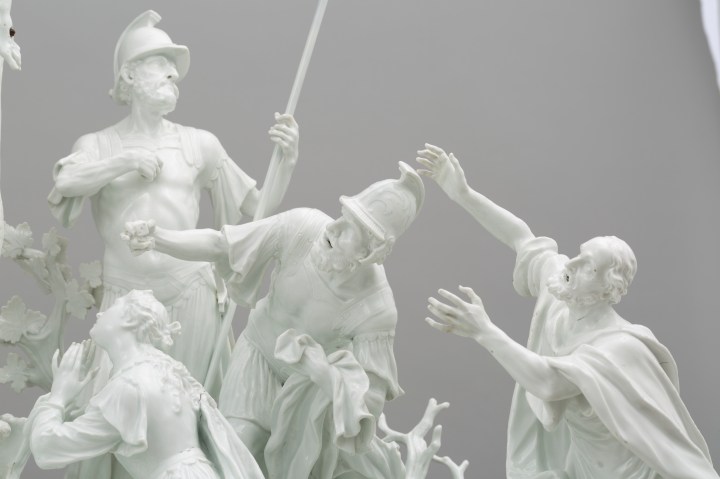
Johann Joachim Kaendler, Crucifixion Group, detail, Meissen, 1743
(Porzellansammlung, Staatliche Kunstsammlungen Dresden; photo by Adrian Sauer)
◊ ◊ ◊ ◊ ◊
Registration is open for this conference, with a limited number of bursaries available for early career scholars (online registration is available here):
Sacred Ceramics: Devotional Images in European Porcelain
Online and in-person, Victoria & Albert Museum, London, 30 September 2025
Organized by Matthew Martin and Rebecca Klarner
Was eighteenth-century European porcelain just a ceramic material to be moulded into useful objects—or could it mean more? This conference explores what European porcelain might have communicated when it was used to create devotional objects.
This conference explores the phenomenon of religious sculpture produced in European porcelain in the eighteenth century. Sculptures on religious subjects represent some of the most ambitious and complex productions in European porcelain of the period, yet they remain relatively understudied. Meissen, Doccia Vienna, Höchst, Fulda, Nymphenburg—all these factories produced devotional images in porcelain. Even factories in mid eighteenth-century Protestant England—Chelsea and Derby—produced sculptures employing Catholic devotional imagery. In each instance, cultural-political motives for the creation of these images can be reconstructed.
The 1712 letter penned by the Jesuit Father François Xavier d’Entrecolles not only conveyed to Europe first-hand knowledge of Chinese porcelain production at Jingdezhen, but it also construed access to this knowledge as a triumph of the Jesuit global mission—the successes of the Jesuits in China made the secret of kaolinic porcelain available to the Catholic princes of Europe.
Porcelain’s alchemical heritage was also not without significance: success at the alchemical enterprise had always been deemed dependent on divine favour. These factors could lead to porcelain assuming a sacral character in Catholic court contexts. Devotional images in European porcelain exploited these cultural associations of the medium itself.
This international conference will explore the religious production of European ceramic factories and consider questions such as: Who were the artists and patrons involved in these sculptures’ creation? How did these sculptures function in private and public contexts? What significance lay in the use of porcelain to create devotional images?
A small number of early career bursaries to attend the conference will be available (including a contribution towards travel cost), generously funded by the French Porcelain Society. To apply, please email fhrlmk@leeds.ac.uk by 5 September 2025, outlining in 150 words or less how you would benefit from attending this conference.
Generously supported by the French Porcelain Society
s c h e d u l e
10.00 Museum Opens / Registration
10.30 Welcome
10.45 Introduction — Julia Weber (Director, Porcelain Collection, Staatliche Kunstsammlung Dresden)
11.00 Catholic China: Porcelain, the Jesuits, and Counter-Reformation Propaganda — Matthew Martin (Senior Lecturer in Art History and Curatorship, The University of Melbourne)
11.20 Religious Sculpture in Meissen Porcelain — Maureen Cassidy-Geiger (Independent Curator and Scholar)
11.40 Break
11.55 Marian Figures in Meissen Porcelain: A Female Body between a Catholic Court and a Protestant State — Rebecca Klarner (Collaborative Doctoral Partnership Researcher, University of Leeds/V&A and Assistant Curator, V&A Wedgwood Collection)
12.15 The Divine Mission of Du Paquier: Grace, Virtue, and Propaganda in the Context of Habsburg Piety — Claudia Lehner-Jobst (Director and Collections Curator, Augarten Porcelain Museum, Vienna)
12.30 Q&A
12.40 Lunch Break
13.30 Handling Session | Ceramics, Terracotta, and Ivory — Simon Spier, (Curator Ceramics & Glass 1600–1800, V&A) and Kira d’Alburquerque, (Senior Curator Sculpture, V&A), places are limited; please sign up during registration.
14.10 Handling Session Repeated
14.50 A Reliquary Made by the Imperial Vienna Porcelain Manufactory — Manuel von Aufschnaiter (Postgraduate Student, Art History, University of Vienna)
15.10 The Influence of Religious Patronage on European Porcelain Commissioning: Investigating the Rarest Monumental Sacral Porcelain Ensembles and the Ritual Use of the Porcelain Objects in European Ecclesiastical Rites — Carina Nathalia Madonna Visconti Paff (Art Historian, Licensed Art Expert and Embassies Art Advisor)
15.30 St Augustine’s Church at Hammersmith: A Contemporary Ceramic Commission for a Catholic Church — Julian Stair (Ceramic Artist, Academic, and Writer)
15.45 Q&A
15.55 Tea and Coffee Break
16.20 Piety and Politics in Italian Porcelain — Errol Manners (Historic Ceramics Specialist)
16.40 Reflections on the Devotional Sculpture from Buen Retiro — Félix Zorzo (Assistant Curator European Decorative Arts, National Museums Scotland)
17.00 Porcelain for the Pope: Sacred Ceramics in Eighteenth-Century France — Susan Wager (Assistant Professor of Art History, University of New Hampshire, Durham)
17.15 Q&A and Closing Remarks
Abstracts for papers are available here»
◊ ◊ ◊ ◊ ◊
Note (added 28 September 2025) — The posting was updated to included the online registration link.
Workshop | Art and Conflict in Times of Climate Change
From the conference programme:
Art and Conflict in Times of Climate Change
Forum Transregionale Studien, Berlin, 17–18 July 2025
Organized by Emily McGiffin, Feng Schöneweiß, T Pritchard, and Antonio Montañes Jimenez
A British Academy SHAPE Research Project in collaboration with the 4A_Lab (KHI in cooperation with Stiftung Preußischer Kulturbesitz) and the Forum Transregionale Studien.
Climate change has happened more than once in the histories of planet Earth and those of human beings. Notably more recent, and historically documented, occurrences include the so-called Medieval Climate Anomaly (ca. 950–1250 CE), the Little Ice Age (ca. 1300–1850) and indeed the contemporary Anthropogenic climate crisis in times of the Anthropocene. From the Russian famine at the beginning of the 17th century following severe winters triggered by volcanic eruptions in Peru, to severe flooding in Kenya, Tanzania and Burundi displacing almost a million people, such climatic shifts have affected and are affecting enormous numbers of people around the planet.
Unsurprisingly, endemic to the periods of climate changes are conflicts. These conflicts drastically affect human lives, thus we find both conflicts and the climatic shifts that precipitated them reflected in and entangled with cultural productions. One example is the paintings created by Dutch masters of people ice-skating and revelling on frozen rivers and enjoying the curious prosperity brought by conflict with Spain. Another is from Song-dynasty China: Facing deforestation and military conflicts with northern Jurchen powers, metropolitan regions of the Song increasingly shifted from firewood to coal as energy source, which corelated with producing some of the finest porcelain glazes in Chinese history. These historical instances resonate strongly with the contemporary music of Syrian activists, who are grappling with the effects of drought and Civil war. In multifaceted ways, the making of arts, broadly defined as the cultural expression of human lived experience, has been entangled with both the violent forces of climatic change, conflicts, and crises.
To examine the complex connections and correlations between art and conflict in times of climate change, this workshop focuses on (1) how cultures have been shaped by the concurrent forces of war and changing environments, and (2) how these lived experiences are expressed through art and literature. Researchers will contribute works-in-progress across disciplinary boundaries, including anthropology, art and cultural history, environmental and digital humanities, postcolonial literature, besides film and media studies. Taking a necessarily planetary perspective, the workshop will interrogate and explore artistic creation and armed conflicts in historical and contemporary climate changes, and will explore pertinent and indeed timely topics across historical and geographical boundaries.
Core questions
• How was/is artistic creation, and cultural expression in general, conditioned and/or oriented by non-human beings and beyond-human factors, such as deforestation, ocean currents, monsoon, El Niño, orbital facing, and volcanic activities?
• How have these factors been represented, and what are the complexities of representing and recording such profound cultural memories?
• How were/are violence and environmental disruption intertwined within cultural memories, and constituted in material, oral, visual and textual cultures?
• What methodologies could contemporary researchers use and develop to address the aforementioned questions from interdisciplinary perspectives?
• How could formats of interdisciplinary collaboration, such as this workshop, enhance academic research on common questions, further knowledge transfer across sectors, and enable actions for positive changes?
Contacts
Feng Schöneweiß, 4A_Lab Postdoctoral Fellow, feng.schoeneweiss@khi.fi.it
Antje Paul, 4A_Lab Program Coordinator, antje.paul@khi.fi.it
t h u r s d a y , 1 7 j u l y
9.30 Welcome by Georges Khalil (Forum Transregionale Studien) and Hannah Baader (4A_Lab / Kunsthistorisches Institut in Florenz – Max-Planck-Institut)
9.50 Welcome by Feng Schöneweiß (4A_Lab)
10.00 Concept Note by T Pritchard (The University of Edinburgh)
10.20 Keynote
• Katrin Kleemann (German Maritime Museum – Leibniz Institute for Maritime History) — Climate History Perspectives: Echoes of Conflict and Culture
11.00 Coffee Break
11.30 Panel 1 | Extraction, Transition, and Repair
Chair: T Pritchard (The University of Edinburgh)
• Rebecca Macklin (University of Aberdeen) — Visualising Relations in the Tar Sands: Extraction, Aesthetics, and Repair
• Emily McGiffin (The University of Warwick) — ‘God has riches, I have cows’: Field Notes on Cultural Heritage in the Bauxite Zone
12.30 Lunch
13.30 Panel 2 | Anthropologies of Collaboration and Conflicts
Chair: Christopher Williams-Wynn (Freie Universität Berlin)
• Antonio Montañes Jimenez (University of Oxford) — Scarcity, Family Memories, and Conflict: Methodological Notes and Collaborative Insights
• Freya Hope (University of Oxford) — Anarchy, Art, and Alternative Worldmaking: New Travellers’ Historicity of Resistance
14.30 Coffee Break
15.00 Film Screening (work in progress) and Discussion (hybrid)
Film and presentation: Matthias De Groof, University of Antwerp / University of Amsterdam
Discussants: Antonio Montañes Jimenez, Rebecca Macklin, Emily McGiffin, and Feng Schöneweiß
16.30 Coffee Break
17.00 Lecture (online and in-person)
Chair: Hannah Baader (4A_Lab / KHI)
• Sugata Ray (UC Berkeley) — Das Paradies: The Anthropocene Extinction in the Early Modern World
f r i d a y , 1 8 j u l y
9.30 Panel 3 | Climate and the Arts of Change
Chair: Parul Singh (Kunsthistorisches Institut in Florenz – Max-Planck-Institut)
• Tenaya Jorgensen (Trinity College Dublin) — Climatic Stress and Political Fragmentation: Environmental ‘Pull Factors’ in Viking Raiding Strategies in Ninth-Century Francia
• Feng Schöneweiß (4A_Lab) — Celadon Aesthetics, Gunpowder, and Energy Transition in Song-dynasty China
• T Pritchard (The University of Edinburgh) — ‘As if the world should straight be turn’d to ashes’: Comprehending Climate Change and Conflict in the Early 17th Century
11.00 Coffee Break
11.30 Panel 4 | Resilience and Memories (hybrid)
Chair: Mahroo Moosavi (4A_Lab)
• Ammar Azzouz (University of Oxford) — A Revolution of Art
• Rebecca Hanna John (Zentralinstitut für Kunstgeschichte) — Preservation and Extinction: On the Entanglement of Ecological and Decolonial Perspectives in Jumana Manna’s Artistic Practice
12.30 Lunch
13.30 Roundtable Discussion
15.00 Concluding Remarks by Emily McGiffin and Feng Schöneweiß
Symposium | Culture and Heritage in Napoleonic Spain
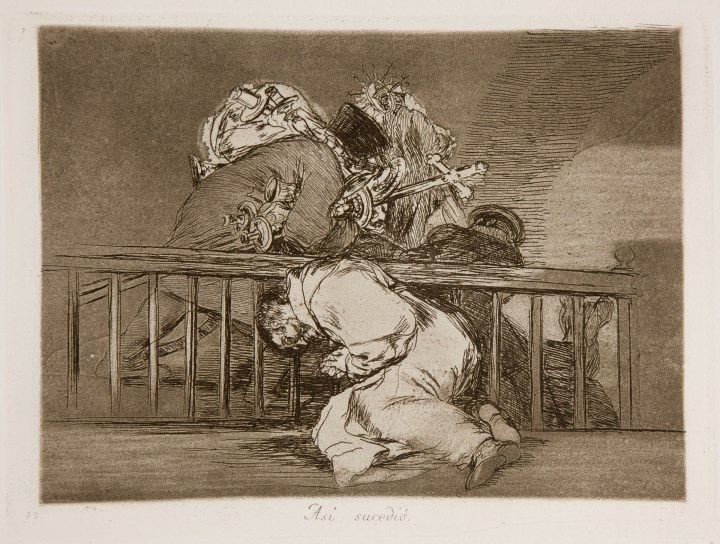
Francisco José de Goya y Lucientes, Así sucedió (This is How It Happened), from Los desastres de la guerra (The Disasters of War), 1810–14
(Madrid: Museo Nacional del Prado)
◊ ◊ ◊ ◊ ◊
From The Prado:
Cultura y Patrimonio en la España napoleónica:
Expolio, protección y transformación
In-person and online, Museo Nacional del Prado, Madrid, 22–23 September 2025
En los últimos años han sido numerosos los estudios que han valorado con mayor perspectiva el gobierno de José I (1808–1813) y la España napoleónica, entendiéndola como un periodo de plena correspondencia con la crisis general del entorno europeo. Se trataría no tanto de un periodo de ‘gobierno intruso’, sino del reflejo del orden napoleónico que trataba de imponerse en Europa y que suponía, también para nuestro país, una iniciativa reformadora que acababa definitivamente con el Antiguo Régimen, lo que motivó que contara con firmes defensores. Sus iniciativas culturales y artísticas tuvieron igualmente gran repercusión, por más que el desarrollo de la guerra dificultara su realización. La eliminación de las órdenes religiosas liberalizó un gran patrimonio artístico que, aunque se trató de vehicular en iniciativas tan novedosas como el llamado Museo Josefino, en ocasiones terminó siendo motivo de expolios y destrucciones. En este simposio se estudiarán estos fenómenos complejos y su repercusión, contemplándolos en relación al entorno europeo contemporáneo. El simposio se vincula temáticamente a la Cátedra del Prado 2024, que impartió la profesora Bénédicte Savoy, si bien atiende prioritariamente al específico caso de lo ocurrido en España con las políticas napoleónicas que afectaron al patrimonio cultural.
Es posible la asistencia presencial a las sesiones hasta completar el aforo, así como la asistencia en línea, mediante el enlace a la plataforma Zoom que se facilitará a los inscritos. Al realizar la inscripción es necesario escoger una modalidad de asistencia. Las ponencias se impartirán en la lengua en la que aparecen enunciados sus títulos. Habrá traducción simultánea. Contacto: centro.estudios@museodelprado.es.
Actividad realizada en colaboración con el proyecto de I D I Bellas artes, cultura e identidad nacional. La construcción del relato artístico entre la Ilustración y el Liberalismo. Textos e imágenes (PID20222-136475OB-I00), financiado por el Ministerio de Ciencia e Innovación y de la Fundación Séneca, proyecto 21936/PI/22, titulado Cultura y nación. Las bellas artes entre la Ilustración y el Liberalismo.
m o n d a y , 2 2 s e p t e m b e r
9.00 Acreditación de asistentes
9.30 Inauguración y Presentación
• Javier Arnaldo (Museo Nacional del Prado)
• David García López (Universidad de Murcia)
10.00 Sección 1 | Expoliaciones artísticas en la época napoleónica
Modera David García López
• Pillage et appropiations d’art à l’époque napoléonienne en Allemagne et en Autriche (Expolios y apropiaciones de arte durante la época napoleónica en Alemania y Austria) — Bénédicte Savoy (Technische Universität Berlin)
• La ocupación napoleónica y la usurpación de los bienes artísticos — Manuel Moreno Alonso (Universidad de Sevilla)
• El expolio artístico del Mariscal Soult en España y el saqueo sevillano — Ignacio Cano Rivero (Museo de Bellas Artes de Sevilla)
• Las colecciones reales durante el periodo napoleónico — Virginia Albarrán Martín (Patrimonio Nacional)
13.00 Debate
16.00 Sección 2 | Espacios para la protección de las artes
Modera: Joaquín Álvarez Barrientos
• El Museo Josefino: una institución cultural en su contexto nacional y europeo — Pierre Géal (Université Stendhal)
• El museo napoleónico en el Real Alcázar de Sevilla — Rocío Ferrín Paramio (Patrimonio Nacional, Reales Alcázares de Sevilla)
• La Academia de San Fernando como instrumento del poder napoleónico en las políticas culturales — Itziar Arana (Museo Nacional del Prado)
• El tráfico de pinturas en el Madrid josefino — David García López (Universidad de Murcia)
18.30 Debate y fin de la jornada
t u e s d a y , 2 3 s e p t e m b e r
10.00 Sección 3 | Transformaciones y nuevos horizontes de las políticas relativas a los bienes culturales
Modera: Javier Arnaldo
• Le Musée Napoléon, aux sources du mythe du musée universel (El Museo Napoleón, los orígenes del mito del museo universal) — Philippe Malgouyres (Musée du Louvre)
• Debates artísticos y sus consecuencias en la restauración de las obras requisadas durante las campañas napoleónicas — Ana González Mozo (Museo Nacional del Prado)
• La política cultural de José I, proyectos y consecuencias — Joaquín Álvarez Barrientos (CSIC)
• Le Gallerie private romane all’inizio dell’Ottocento: dispersioni, riorganizzazioni, riallestimenti (Las galerías privadas en Roma al inicio del siglo XIX: dispersiones, reorganizacines y reordenamientos) — Giovanna Capitelli (Università Roma Tre)
• La nascita delle Gallerie dell’Accademia di Venezia negli anni del Regno d’Italia, 1805–1814 (El nacimiento de la Galería de la Academia de Venecia durante los años del Reino de Italia, 1805–1814) — Giulio Manieri Elia (Gallerie dell’Accademia di Venezia)
13.30 Debate y conclusiones finales
Conference | Eat, Drink, Revolution: Our Friend the Tavern

From Colonial Williamsburg:
Eat, Drink, Revolution: Our Friend the Tavern
Online and in-person, Colonial Williamsburg, 6–8 November 2025
This fall, Colonial Williamsburg will host the inaugural Eat, Drink, Revolution: Our Friend the Tavern conference, which explores taverns as both dining establishments and as important gathering places throughout the centuries, particularly in the years surrounding the American Revolution.
While the in-person conference registration is now sold out, virtual registration, along with limited in-person spaces for scholarship recipients, is still available. Interested attendees can email us to request to be added to the in-person waitlist. Scholarships are available to students currently enrolled in programs relating to history and foodways, emerging professionals in fields related to food and drink, and history museum professionals.
Conference speakers include Pete Brown, renowned Sunday Times Magazine columnist, author and broadcaster; Dr. Jonathan Zarecki, associate professor of classical studies, University of North Carolina at Greensboro; The Beer Archaeologist Travis Rupp; Marc Meltonville, food and drink historian, author and heritage distiller; public historian and executive director of Newlin Grist Mill, Tony Shahan; Jason Baum, interpretive park ranger at Guilford Courthouse National Military Park; Dr. Sarah Hand Meacham, associate professor, Virginia Commonwealth University; along with members of Colonial Williamsburg’s staff. The full conference schedule is available here.
Virtual registration is $100 per person and includes livestream access to all conference presentations, access to presentations as recordings through the end of the year, and a 7-day ticket voucher to Colonial Williamsburg’s Historic Area, valid for redemption through May of 2026.
Eat, Drink, Revolution: Our Friend the Tavern is sponsored in part by Craft & Forge, a lifestyle brand that reimagines early American maker style for today’s audience with a focus on craftsmanship, authenticity, and high-quality materials.
Conference | The 9th Feminist Art History Conference
From ArtHist.net and the conference website:
The 9th Feminist Art History Conference
Online and in-person, American University, Washington D.C., 25–26 September 2025
Registration due by 1 September 2025
The Feminist Art History Conference fosters intersectional and interdisciplinary scholarship on the ways in which gender and sexuality have shaped the visual arts and their study–with a conference program designed to advance new research on topics from the ancient past through the present and across the globe. It provides a forum for participants to examine the roles that art and its agents have played in informing and resisting historical and contemporary inequities. Through this forum, the conference aims to model a more inclusive art history and scholarly community.
The Feminist Art History Conference was established in 2010 to celebrate and build on the feminist art-historical scholarship and pedagogy of Norma Broude and Mary D. Garrard, Professors Emeriti at American University. It is sponsored by the Art History Program in the Art Department, College of Arts and Sciences, at American University, with the generous support of Robin D’Alessandro and Dr. Jane Fortune. The conference comprises 10 in-person panels, 12 online panels, and 5 hybrid panels. Keynotes will be hosted in-person with a livestream feed. Registration is available here.
Organizing Committee
Andrea Pearson, Joanne Allen, Juliet Bellow, Kim Butler Wingfield, Mary Garrard, Norma Broude, Nika Elder, Ying-chen Peng
f r i d a y , 2 6 s e p t e m b e r
10.30 Keynote 1 (online)
• Dorothy Price (Courtauld Institute)
1.00 Session 1 | Shifting Identities / Identity Shifts (online)
• Judith Rehermann — Hans Baldung Grien’s Enigmatic Painting Lot and His Daughters
• Anna Savchenkova — Beauties Replacing Popes and Crosses: The Phenomena of Renaissance Niello Medallions
• Pat Simons — The Amateur Woman Artist and the Myth of Irene di Spilimbergo
• Lauryn Smith — Transcending One’s Sex: Connoisseurial Displays in the Cabinets of Amalia van Solms-Braunfels
2.00 Session 2 | Images of the Female Body as Resistance I (online)
• Georgieva & Takeyana Jini — Embodied Revolt: Gender Perspectives on the Female Body in Japanese Modern and Contemporary Art
• Maite Luengo-Aguirre — Reimagining the Female Body: Feminist Interventions in Painting and Photography in 1990s Spain
• Maria Garth — Zenta Dzividzinska: Nude Photography and Self-Portraiture in the Soviet 1960s
• Gandotra Apeksha — Gender Analysis of Korean Drama Posters: Visual Representation and Stereotypes
3.00 Session 3 | Italy: Women Artists, Feminist Art, and Their Promotion in the 20th Century (online)
• Federica Arcorarci — Romana Loda’s Legacy: Promoting Feminist Art in 1970s Italy Francesca della Ventura: ‘La lotta é FICA1!’. Feminist Practices of Urban Art and Gender Claims in Contemporary Italy
• Camilla Paolino — Feminist Escapes from the Domestic through Art Making in 1970s Italy: On the Work of Clemen Parrocchetti and Lydia Sansoni
4.00 Session 4 | Locating Agency (online)
• Carmen Ruiz Vivas — Women and Peace in Ancient Roman Art: From Symbols to Agents
• Lydia McKelvie — Ghiberti’s Story of Rebecca: Women’s Agency in the Gates of Paradise
• Monica Zavala Cabello — Practices, Rituals, and Agency of the ‘Warrior Woman’ in the Ancient Mexican Tradition: A Gender Perspective Approach to Bernardino de Sahagún’s Images in the Florentine Codex
• Emma Luisa Cahill Marrón — Bloody Mary Tudor Revisited: Queen Mary I of England in the Prado Museum’s Female Perspective
s a t u r d a y , 2 7 s e p t e m b e r
9.00 Session 5a | From the Margins (online)
• Mey-yen Moriuchi — A Reconsideration of Las Señoritas Pintoras from 19th-Century Mexico
• Yuniya Kawamura — Female Ukiyo-e Artists in the Male-dominated Japanese Art World during the Edo Period
• Nadine Nour el-Din — Inventing the Modern: Women Who Shaped Collecting and Patronage in Egypt: Émilienne Hector Luce and Huda Shaarawi
• Georgina Gluzman — Decorative, Useful, National, and Very Feminine: Discourses and Practices around the ‘Impure’ Arts (Argentina, 1920–1940)
9.00 Session 5b | Textiles I: Tradition and Subversion (online)
• Irene Bronner — Eroticism as Gender Critique in Textile Art by South Africans Ilené Bothma, Kimathi Mafafo, and Talia Ramkilawan
• Marina Vinnik — Otti Berger and Anni Albers: Bauhaus Weaving Workshop and Architecture
• Smaranda Ciubotaru — Crafting Subversion: Intermediality and Artisanal Knowledge Among the Female Fiber Artists of the Ceaușescu Regime
• Elizabeth Hawley — Intertwined: “Ancestral Lands, Women’s Work, and Indigenous Sovereignty in the Photographic Weavings of Sarah Sense and Darby Raymond-Overstreet
9.00 Session 5c | Domestic Labor I (online)
• Sarah Evans — Twinned Mothers Set to Work? Bharti Kher’s Mother and Child Joins the Debate About Remunerated Gestational Surrogacy in India
• Bálint Juház — Gender and Motherhood on Eszter Mattioni’s female portraits in the 1930s: The contradictions of a Hungarian woman artist
• Elizabeth Hamilton — Troubled Domesticities
10.00 Session 6a | State of the Field: Asia (extended panel; runs until 11.50)
• Naoko Seki, Professor, Faculty of Letters, Waseda University
• Yoonjung Seo, Assistant Professor, Department of Art History, Myonji University
• Soyeon Kim, Associate Professor, Department of Art History, Ewha Womans University
• Yutong Li, Postdoc fellow, Center for Global Asia, NYU Shanghai
10.00 Session 6b | Spectatorship in France (online)
• Dani Sensabaugh — Virtue and Viewership in Élisabeth Vigée Le Brun’s Julie Le Brun as a Bather (1792)
• Heather Belnap — Homme Fatal: Female Spectators and the Male Nude in the Musée Napoléon
• Mathilde Leichle — Looking for the Male Gaze in 19th-Century France: Armand Silvestre and Le Nu au Salon
• Viktoriia Bazyk — The Hypermasculine Male Nude in Student Works at the Académie de France à Rome Viewed through a Queer-Feminist Lens
10.00 Session 6c | Historic Feminist Art Exhibitions (online)
• Joanna Gardner-Huggett — Beijing and Beyond: The Women’s Caucus for Art and the Fourth U.N. World Conference on Women (1995)
• Maggie Hire — Valie Export and Magna Feminism
• Emilie Martin-Neute — In the Shadows: French Female Artists Groups Exhibitions, the Case of the Société des Femmes Artistes (1893–1908)
10.00 Session 6d | Herstories across Asia (Online)
• Lily Filson — From Rada’a to Rome: Elite Women of Tahirid Yemen in the Codex Casanatense
• SaeHim Park — The Little Girl Commemorative Coin: Art, Memory, and Commodification
• Chinghsin Wu — Womanhood and Ethnicity: Chen Jin’s Paintings of Women in Modern Japan and Taiwan
• Sophia Merkin — Fanny van de Grift Osbourne Stevenson (1840–1914)
11.00 Lunch Break
12.30 Session 7a | Mother Nature (in-person)
• Katia Myers — Brú na Bóinne Monuments: The Female Body in Architecture, Myth and Landscape
• Jessica Weiss — Be Fruitful and Multiply: Vegetal Decoration and Dynastic Aspirations in Isabel of Castile’s Breviary
• Tobah Auckland-Peck — The Mine, ‘Mother Nature’, and the Woman Artist: Gender and Industry in Modern British Art
12.30 Session 7b | Feminist Methodologies (online)
• Nina Lubbren — Women’s Public Sculpture in Weimar Germany’s Regions, or: Feminist Art History and Canon Critique
• Nancy Gebhart — Theorizing a Nonlinear Art Historical Timeline as Feminist Practice and Pedagogy
• Karen Leader — Critical Contexts: Getting the Art History We Deserve
12.30 Session 7c | Public Monuments: Feminist Protest and Canon Critique (in-person)
• Sierra Rooney — On the Pedestal: Gender, Representation, and Violence in Monuments to Hannah Duston (19th-Century America)
• Francesca Gregori — The Feminist Antimonumenta Movement in Mexico: The case of ‘Antimonumenta – Vivas Nos Queremos’
• Brenda Schmahmann — Between a Torch and a Wing: Liberating Women in Two Public Sculptures in Johannesburg
12.30 Session 7d | Politics of Media (in-person)
• Agnieszka Anna Ficek — (Un)Fragile Passions: Maria Amalia’s Porcelain Salottino and Queenly Patronage
• Brittany Luberda — Forces at the Forge: 18th-Century Women Silversmiths in America
• Isabel Bird — ‘People Have No Trust in Glue’: Eve Babitz, Amateurism, and the Art of Collage
1.45 Caffe Pause
2.00 Session 8a | 1930s Germany (hybrid)
• Annika Richter — Queer-Feminist Utopias and Deviant Aesthetic Practices in the Artist Album ‘Die Ringlpitis’, 1931
• Elizabeth Otto — Designing Home: Bauhaus Designers and the Nazi Everyday
• Shalon Parker — Two in One: Doubling of the Self in Lotte Jacobi’s Interwar-Period Portraiture
2.00 Session 8b | Images of the Female Body as Resistance II (in-person)
• Theo. Triandos — Crossing: Feminist Interventions at the Intersection of Critical and Aesthetic Practice (Lynda Benglis)
• Rachel Middleman — Revisiting ‘Female Imagery’: Abstract Painting and the Central Image, c. 1963–1973
• Marissa Vigneault — Hannah Wilke: Nice Piece of Art
2.00 Session 8c | Assertions of Women Artists (hybrid)
• Ann Pleiss-Morris — ‘Embroiderers in blue, purple and scarlet yarn and fine linen’: The Reclamation of Feminine Spirituality in the Embroidered Cabinets of Early Modern Women
• Emma Thompson — Authorship, Agency, and Inventive Input: Claudine Bouzonnet Stella and Professional Self-Fashioning
• Mirja Beck — Aimée-Zoë Lizinka de Mirbel and Her Networks: European Women Miniature Painters around 1800
2.00 Session 8d | Domestic Labor II (in-person)
• Ashley McNelis — Mother Art’s Public Performances of Care
• Oriana Mejias Martinez — Art Revindicates Afro Latin American Households Run by Women
• Rebecca DeRoo — Reconsidering Motherhood and Labor in Mary Kelly’s Post-Partum Document
3.15 Katzen Museum Visit/In-person Meetings
4.00 Museum Reception
4.30 Keynote 2 (in-person)
• Joan Breton Connelly (NYU)
s u n d a y , 2 8 s e p t e m b e r
9.00 Tour at the National Museum of Women in the Arts
10.30 Transportation to Katzen Art Center at American University
11.45 Session 9a | Interrogating Female Vices (in-person)
• Michelle Moseley-Christian — Eve as Glutton: Appetite and Sensory Embodiment in 15th-Century Netherlandish Imagery
• Stephen Speiss — Representing Whoredom in the Early Modern Visual Arts
• Maria Maurer — Imagining the Mistress: Renaissance Portraits and Modern Fantasies
• Annelies Verellen — Michaelina Wautier, Judith Leyster, and Maria Schalcken
11.45 Session 9b | Italy: Women Artists, Feminist Art, and Their Promotion in the 20th Century II (in-person)
• Greta Boldorini — ‘Ashes to Ashes’: An Intimate Work by Adrian Piper from US to Italy
• Allison Belzer — Shared Origins, Distinct Paths: The Nathan and Modigliani Sisters in Post-Risorgimento Italian Art
• Jennifer Griffiths — Adriana Bisi Fabbri: Caricatures and Cartoons of the Feminist Avant-garde
• Giulia Colombo/Zompa — Photography in the Journals by Milanese Feminist Collectives (1972–1978)
11.45 Session 9c | Feminist Museum Initiatives Today (in-person)
• Bryn Schockmel — A Feast of Fruit and Flowers: Women Still Life Painters of the Seventeenth Century and Beyond, on view at The Hyde Collection in Glens Falls, New York (from October 25, 2025 to March 8, 2026)
• Élenore Besse — AWARE (Archives of Women Artists, Research & Exhibitions) Proposes to Present Its Missions, History and Research
• Maria Holtrop and Charles Kang — Point of View, Gender at the Rijksmuseum
• Carolyn Russo — Art, Space, and Gender: The Evolution of Women Artists in the NASA Art Program
11.45 Session 9d | Women of a Certain Age: Looking at the Overlooked (hybrid)
• Jessica Fripp — The ‘Critical Age’ during a Critical Time: Older Women and the French Revolution
• Alissa Adams — From Telling to Reading Stories: Older Women and the Disembodiment of Knowledge in 19th-Century Art
• Ruth E. Iskin — Mary Cassatt’s ‘Splendid Old Woman’: Aging as a Feminist Issue in Cassatt’s Art and Time
• Alice Price — Aging Bodies, Mature Careers: Intersectionality of Modernism, Gender, and Aging
1.15 Caffe Pause
1.25 Session 10a | Crossing the Binary (hybrid)
• Robin O’Bryan — A Female Dwarf as a Warrior Maiden: Poetry and Performance in a Venetian Portrait
• Consuelo Lollobrigida — Amaryllis and Mirtillo: Did Women Have in 17th-century Europe Their Same Sexual Love Affair Code of Representation in 17th-Century Europe?
• Yukina Zhang — Vogue Chang’an: Fashion, Gender, and New Female Beauty in Tang China, 618–907
• Kathrine Kiltzanidou — Women as Patrons of Ecclesiastical Institutions in the Balkans and Cyprus during the Late Medieval and Early Modern Periods
1.25 Session 10b | Textiles II: Labors of Love (in-person)
• Amy Rahn — Affiliative Threads: Made-to-Measure Clothes as Circuits of Care
• Stephanie Strother — Jeanne Goehring, Agnès Jallat, Gabrielle Rousselin, Alice Rutty
• Diletta Haberl — Herta Wedekind zur Horst / Herta Ottolenghi Wedekind
• Margot Yale — At the Seams: The Labor Politics of Sewing in Elizabeth Catlett’s Prints
1.25 Session 10c | Lesbian Self-Fashioning in the 19th and 20th Centuries (in-person)
• Justine De Young — Public Selves, Private Lives: Lesbian Self-Fashioning in Louise Abbéma’s Portraiture
• Toni Armstrong — Beauty Contest: Florine Stettheimer and Queer Modernism
• Julie Cole — Lesbian Collaboration as Subterfuge in the Works of Marcel Moore and Claude Cahun
• Rachel Silveri — Sapphic Surrealism: Valentine Penrose’s Dons des féminines
1.25 Session 10d | 1970s Feminist Art Movement: New Contexts (in-person)
• Susana Pomba — Smoke & Dust Bodies: Judy Chicago’s Atmospheres and Antonioni’s Zabriskie Point
• Jennifer Kruglinski — Eleanor Antin’s Exiled King in Solana Beach
• Stephanie Seidel — Temporary Constellations: The Installations of Betye Saar
• Lesley Shipley — Making Whiteness Visible: The Protest Paintings of Vivian Browne, Faith Ringgold, and May Stevens
Conference | Artists’ International Social Networks, 1750–1914
From ArtHist.net and the conference website:
(Re)Searching Connections: Artists’ International Social Networks, 1750–1914
Academia Belgica, Rome, 30 September — 1 October 2025
Registration due by 20 September 2025
 This two-day international academic conference presents recent and ongoing research into the social networks of artists who lived, studied, and worked abroad between 1750 and 1914. Embracing a broad chronological and geographical scope, it brings together insights from various global contexts. By fostering interdisciplinary dialogue across art history, sociology, and digital humanities, and by connecting diverse methodologies and findings across specializations, we aim to deepen our understanding of the transnational social connections that ‘make’ art history.
The conference is organized by Musea Brugge in collaboration with the Academia Belgica. Free registration is available here before 20 September 2025.
t u e s d a y , 3 0 s e p t e m b e r
10.00 Welcome — Anne van Oosterwijk (Musea Brugge)
10.05 Introduction — Cécile Evers (Academia Belgica)
10.15 Keynote Lecture
• France Nerlich (Musée d’Orsay) — Between Legacy and the Living: Artistic Dialogues in a Transnational Europe
11.15 Session 1 | Navigating National Identities
Chair: Christine Dupont (House of European History)
• Thijs Dekeukeleire (Musea Brugge) — The Writing’s on the Wall: Mentorship, Mobility, and the Bruges-Rome Artistic Network, ca. 1800
• Cécilia Hurley-Griener (École du Louvre) — Réseaux superposés: Espaces et sociabilités dans la Rome du XIXe siècle
• Julia A. Sienkewicz (Roanoke College) — Networking and the Making of a Transnational Sculptor: The Social Sites of Luigi Persico
14.15 Session 2 | Networks’ Sources
Chair: Veerle Thielemans (INHA-Institut national d’histoire de l’art)
• Virginie D’haene (Museum Plantin-Moretus) — Achieving Ideals: The Social Network behind Andries Lens’s Neoclassicism
• Lucie Montassier (Université de Poitiers) — Reconstituer les réseaux des artistes femmes: Les approches cartographiques
• Ieva Kalnača and Aija Zandersone (Latvian National Museum of Art) — Mapping a Network: Documenting Latvian and Spanish Artistic Connections in Paris, 1900–1914
16.15 Session 3 | The Studio as a Social Hub
Chair: Laura Overpelt (KNIR-Royal Netherlands Institute in Rome)
• Oriane Poret (Université Lyon 2/LARHRA) — Beasts on Loan: Global Networks and the Economy of 19th-Century Animal Art
• Marlen Schneider (Université Grenoble Alpes/LARHRA) — In the Light of Batoni’s Studio: Artistic Networks and the Circulation of Drawing Practices between Rome and German Art Academies
w e d n e s d a y , 1 o c t o b e r
10.00 Introduction – Anne van Oosterwijk (Musea Brugge)
10.15 Keynote Lecture
• Giovanna Ceserani (Stanford University) — ‘Here in the Proper Center for Gentlemen of [t]his Profession’: Artists in 18th-Century Rome
11.15 Session 4 | From Data to Networks
Chair: Eva Geudeker (RKD-Netherlands Institute for Art History)
• Mayken Jonkman (Rijksmuseum Amsterdam) — Paris Intimates: The Role of Connections for Dutch Artists’ Success in the French Capital, 1774–1914
• Fien Messens (Ghent University and KBR-Royal Library of Belgium) — Networking over a Bowl of Onion Soup: A Data-driven Perspective on the Artist François-Joseph Navez in Rome
• Carla Mazzarelli (Università della Svizzera italiana), Gaetano Cascino (Università della Svizzera italiana and Università Roma Tre), and Luca Piccoli (Università della Svizzera italiana and Sapienza Università di Roma) — For a map of Artistic Sociability inside the Museo di Roma: 19th-Century Visiting Experiences and Networks
14.15 Session 5 | Academies as Anchor
Chair: Anne van Oosterwijk (Musea Brugge)
• Gabriel Marques (Universidade NOVA de Lisboa – FCSH) — National Academies and Artistic Communities in Rome: The Portuguese Pensioners of the 1820s–1830s
• Dominiek Dendooven (Merghelynck Museum and Yper Museum) — A Transnational Network to ‘Revive Flemish Art’: Bruges and Rouen in the 18th Century
15.45 Session 6 | Collaboration across Borders
Chair: Evelien De Wilde (Musea Brugge)
• Nina Reid (Radboud University) — The Power of the Print: International Etching Societies during the Fin-de-siècle
• Iliana Mejias-Ojajärvi (University of Helsinki) — Russian Artists’ Exhibition Activities in Helsinki, 1890–1911: Organization, Artistic Exchange, and Transnational Connections
16.45 Closing Keynote Lecture
Giovanna Capitelli (Università Roma Tre) — Transnational Sources for Studying the Cosmopolitan Art World of Early 19th-Century Rome
18.00 Reception
Conference | Baldassarre Fontana and Stucco Decoration across Europe
From ArtHist.net:
Stucco Decoration across Europe
Baldassarre Fontana and Other Travelling Stucco Artists
Online and in-person, Olomouc and Kroměříž, Czech Republic, 16–18 June 2025
Focusing on the the life and work of Baldassarre Fontana (1661–1733), this conference addresses stucco artists working across Europe in the seventeenth and early eighteenth centuries. Fontana created a number of remarkable works, particularly in the territories that are now the Czech Republic and Poland. The conference aims to present new findings pertaining to material studies within the broader context of the migration phenomenon, showcasing diverse methodological approaches and the latest techniques for studying, interpreting, restoring, preserving, and conserving stucco decorations across Europe.
The conference is organized as part of the Stucco Decoration across Europe project (STUDEC), co-financed by the European Union thanks to the Erasmus+ programme, KA220-HED – Cooperation partnerships in higher education. The conference is held under the auspices of the Swiss Embassy in the Czech Republic and the Italian Cultural Institute in Prague. Partners of the conference are Archbishopric of Olomouc and Archbishopric Château and Garden in Kroměříž.
Scientific Committee
Alberto Felici (SUPSI Mendrisio), Giacinta Jean (SUPSI Mendrisio), Martin Krummholz (Palacký University Olomouc), Ondřej Jakubec (Palacký University Olomouc), Michał Kurzej (Jagiellonian University in Cracow), Serena Quagliaroli (University of Turin), Jan Válek (Institute of Theoretical and Applied Mechanics of the Czech Academy of Sciences), Jana Zapletalová (Palacký University Olomouc)
Organising Committee
Jana Zapletalová, Martin Krummholz, Ondřej Jakubec
Organisational Assistance
Štěpánka Malíková, Jan Malý, Jiří Mikuš, Natálie Nosková, Anna Rýcová
m o n d a y , 1 6 j u n e
8.00 Registration
9.00 Welcome and Greetings
• Marialuisa Pappalardo, Director of the Istituto Italiano di Cultura di Praga
• Lorenza Fässler Pascuzzo, Deputy head of Mission, Swiss Embassy to the Czech Republic
• Jana Zapletalová, Palacký University Olomouc
9.20 Section 1 | Baldassarre Fontana between Chiasso, Rome, and Moravia: Education, Life, Patrons, and Networking
Directed by Jana Zapletalová and Martin Krummholz
• Stefania Bianchi and Mark Bertogliati — Baldassarre Fontana: Professional Success and Patrimonial Fortune
• Federico Bulfone Gransinigh — Baldassarre Fontana in Rome: Collaborations and Apprenticeships between Hypotheses and Certainties
• Laura Facchin — Baldassarre Fontana and Ercole Ferrata’s Workshop in Rome: The Legacy of Alessandro Algardi
• Katarzyna Brzezina-Scheuerer — Hohenaschau and the Stucco Decorations in Bavaria in the Late 17th Century
• Jana Zapletalová — The Unknown Beginnings of Baldassarre Fontana’s Work in Moravia
12.15 Lunch break
14.00 Section 2 | Baldassarre Fontana in Poland: Impacts and the Art of Stucco of His Time
Directed by Matej Klemenčič and Piotr Krasny
• Michał Kurzej — Stuccoes in Bookkeeping: The Cracow Work of Baldassarre Fontana in Light of Archival Sources
• Mariusz Smoliński — Baldassarre Fontana and the Stucco Decoration of the Pawlowski Chapel in Doboszowice (Silesia)
• Martin Krummholz — Early Commissions of Santino Bussi (1664–1736): Payments to Stucco Workers in Central Europe around 1700
• Marina Dell´Omo — Stuccatori e pittori lombardi e ticinesi nell’Europa centrale, tra legami personali e rapporti con la committenza: Qualche esempio
16.15 Optional Visit: Corpus Domini Chapel in former Jesuit Convict, led by Jan Malý and Medea Uccelli
t u e s d a y , 1 7 j u n e
8.00 Departure to Kroměříž Château
9.30 Section 3 | Baldassarre Fontana’s Stucco Decoration in the Sala Terrena, Kroměříž Château
Directed by Alberto Felici and Jana Zapletalová
• Jana Zapletalová — Brief Art Historical Introduction
• Alberto Felici and Giovanni Nicoli — Emergency Interventions
• Jan Válek, Sylwia Svorová Pawełkowicz, and Petr Kozlovcev — Materials and Manufacturing Techniques
• Sylwia Svorová Pawełkowicz and Jan Válek — Original Finishes and Subsequent Coatings
• Peter Majoroš — The Colour Conception
12.00 Lunch break / time to visit the Castle and Gardens
15.00 Departure from Kromeriz to Olomouc
16.30 Section 4 | Stucco Manufacturing Techniques and Their Conservation Issues
Directed by Giacinta Jean and Alberto Felici
• Alberto Felici, Giovanni Nicoli, and Medea Uccelli — The Cleaning of Stucco Decorations: Conservation Treatments between Historical-Aesthetic Instances and Operational Practice
• Jan Vojtěchovský and Daniela Jakubů — Stucco Decoration of the Chapel of St. Isidore in Křenov and Its Surface Treatments
• Blanka Veselá and Zuzana Wichterlová — Study of Original Stucco Techniques by Bartolomeo Muttoni and Their Polychromy in the Baroque Chapel of Kácov Castle
• Marta Caroselli, Eleonora Cigognetti, Alberto Felici, Giovanni Nicoli, and Alessia Grandoni — Consolidation of Stucco Decorations, Laboratory Tests, and Field Applications
w e d n e s d a y , 1 8 j u n e
9.00 Section 5 | Materiality, Authenticity, and Perception of 17th- and 18th-Century Stucco Decorations
Directed by Serena Quagliaroli and Edi Guerzoni
• Serena Quagliaroli — Some Preliminary Observations on the History of Stucco Restoration: Comparing Cases from Piedmont and Eastern Europe
• Andrzej Siwek — Conservation Works on the Interior of St. Anne’s Church in Cracow in the 2nd Half of the 20th Century and Their Place in the State of Research on Fontana’s Artistic Legacy
• Daniela Russo, Marie-Claire Canepa, Annalisa Dameri, Andrea Longhi, Irene Malizia, Paola Manchinu, and Chiara Ricci — The Stucco Decoration of the Sala Verde at the Castello del Valentino: Study, Preservation, and Proposals for Conservation
• Stefania De Blasi and Edi Guerzoni — The Color of Stuccoes: Towards a History of Restoration in 1990s Piedmont from the Pinin Brambilla Barcilon Archive and the Case of the Former Santa Croce Convent in Turin
• Renata Tišlová, Zdeněk Kovářík, and Zdeňka Míchalová — Material and Technological Beginnings of Stucco Marble Art in the Czech Lands at the Turn of the 17th and 18th Centuries
12.00 Lunch break
13.30 Section 6 | Predecessors and Contemporaries of Fontana: Interactions between Stucco Workers, Architects and Other Artists
Directed by Ondřej Jakubec and Massimo Romeri
• Giuseppe Dardanello — Stuccatori luganesi to the Challenge of Painted Quadratura: Competition and Interaction between Decorative Techniques and Choices of Taste in the Decorative Worksite of Stupinigi
• Frančiška Oražem, Sara Turk Marolt, and Matej Klemenčič — From Lombard Tradition to Bavarian Innovation: The Transformation of Stucco and Altarpiece Production in Carniola in 1730s to 1750s
• Piotr Krasny — Gesamtkunstwerk, Bel Composto, or Homogenous Arrangement? On the Problems with Describing Early Modern Interior Decorations by Artists from the Region of Lake Como and Lake Lugano
14.45 Final discussion










leave a comment