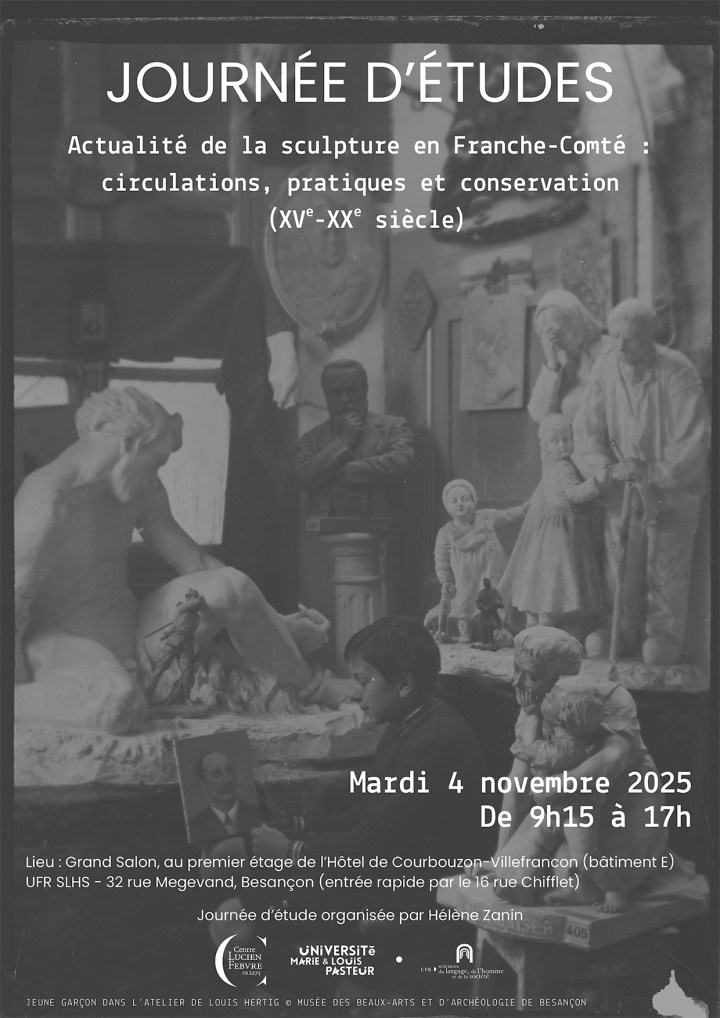
Journée d’études | Sculpture in Franche-Comté, 15th–20th Centuries
From ArtHist.net:
Actualité de la sculpture en Franche-Comté:
Circulations, Pratiques et Conservation, XVe–XXe siècle
Online and in-person, Université Marie et Louis Pasteur, Besançon, 4 November 2025
Organized by Hélène Zanin
 Inscription et lien de visioconférence disponible sur demande: helene.zanin@umlp.fr
9.15 Introduction, Hélène Zanin (Université Marie et Louis Pasteur / Centre Lucien Febvre)
9.30 Actualité de la sculpture des XVe et XVIe siècles
Modération: Sandra Bazin-Henry (Université Marie et Louis Pasteur / Centre Lucien Febvre)
• Matthieu Fantoni (musée Fabre), en visioconférence — Retour d’expérience sur la restauration de La Pietà de Conrad Meit à la cathédrale de Besançon, 2019–23
• Thomas Flum (Université Marie et Louis Pasteur / Centre Lucien Febvre) — La Pietà de Conrad Meit et l’originalité du choix iconographique
• Lola Fondbertasse (musées de Dijon) — Quelques réflexions sur la sculpture bourguignonne du XVe siècle: Le projet d’exposition du musée des Beaux-Arts de Dijon
11.00 Pause
11.15 Sculptures et monuments des XIXe et XXe siècles: études et protection
Modération: Sara Vitacca (Université Marie et Louis Pasteur / Centre Lucien Febvre)
• Justine Vigneres (DRAC Bourgogne-Franche-Comté) et Michaël Vottero (DRAC Bourgogne-Franche-Comté), en visioconférence — Découvertes et protections récentes au titre des monuments historiques de sculptures du XIXe siècle en Bourgogne-Franche-Comté
• Charlotte Leblanc (DRAC Occitanie), en visioconférence — La protection des statuaires monumentales de Belfort: étude du groupe Quand Même d’Antonin Mercié
12.45 Pause déjeuner
14.15 Sociabilités, circulation et carrière des artistes
Modération: Claire Maingon (université Bourgogne-Europe / LIR3S)
• Virginie Guffroy (musée du Louvre) — Les réseaux de sociabilités d’un sculpteur bisontin, l’exemple de Luc Breton (1731–1800)
• Grégoire Extermann (Haute école spécialisée de la Suisse Italienne – SUPSI / Fonds National Suisse pour la recherche scientifique) — Nul n’est prophète en son pays: James Pradier et la sculpture à Genève au XIXe siècle
15.20 Pause
15.30 Œuvres multiples et leurs usages
Modération: Hélène Zanin (Université Marie et Louis Pasteur / Centre Lucien Febvre)
• Emy Faivre (Université Marie et Louis Pasteur / ISTA) — Modèles pour apprendre: Circulation et réception des plâtres dans les écoles d’art de Franche-Comté, XIXe–XXIe siècles
• Virginie Frelin-Cartigny (Musée des Beaux-Arts et d’Archéologie de Besançon) — Louis Hertig: Découverte de l’œuvre d’un sculpteur à travers la photographie
Fin de la journée vers 17h
Symposium | Vanbrugh from Stage to Stone
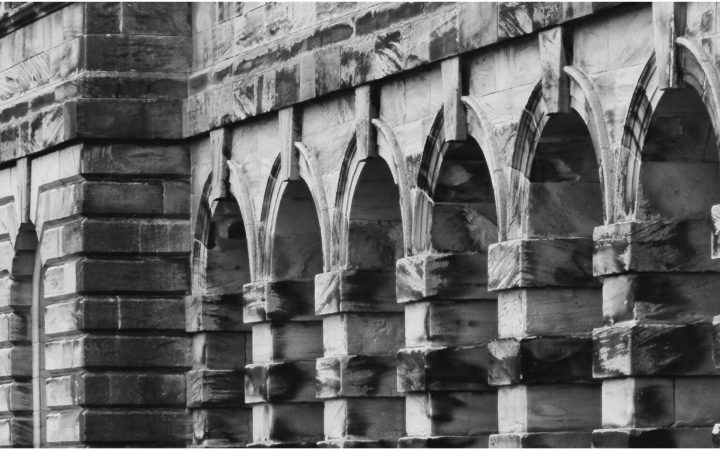
Sir John Vanbrugh, Seaton Delaval Hall, Northumberland, near Newcastle, 1718–28. Ravaged by fire in 1822, it is now owned by the National Trust.
◊ ◊ ◊ ◊ ◊
Next spring at the University of Cambridge:
Vanbrugh from Stage to Stone
Howard Theatre, Downing College, Cambridge, 27 March 2026
This international academic conference will explore the impact and legacy of Sir John Vanbrugh. The event marks the tercentenary of Vanbrugh’s death in March 1726 and forms part of the Vanbrugh300 festival for 2026, organised by The Georgian Group, the conservation organisation founded in 1937 to protect and promote Georgian buildings.
For those requiring hotel accommodations, there are two options nearby: the Regency Guesthouse, an independent boutique hotel, and the University Arms, a luxury hotel located directly across Regent Street from Downing College.
This conference is organised by the Ax:son Johnson Centre for the Study of Classical Architecture (CSCA) at the University of Cambridge in partnership with The Georgian Group.
Registration is now open via The Georgian Group website.
p r o g r a m m e
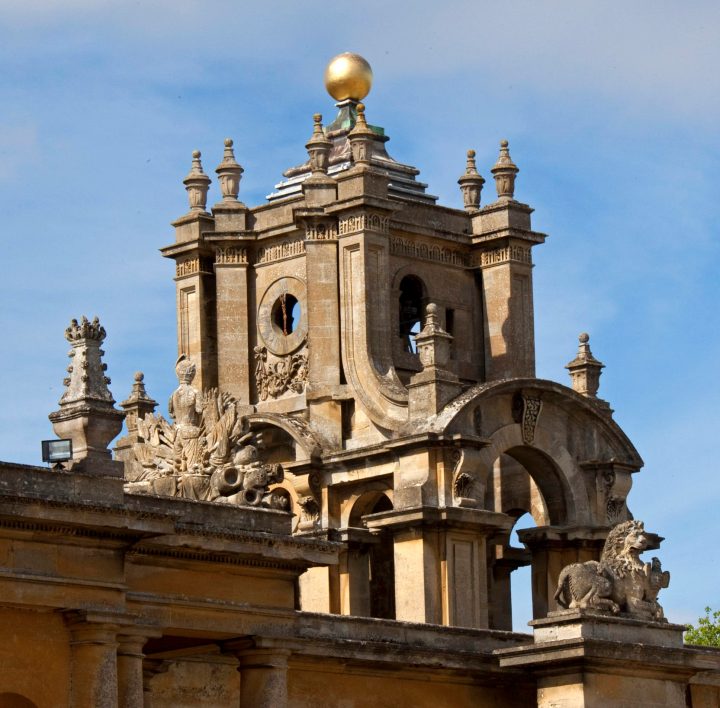
Detail of Blenheim Palace (Photo by Tony Hisgett CC BY-SA 2.0).
9.00 Registration breakfast with tea and coffee
9.45 Introductory Remarks — Frank Salmon (CSCA) and Anya Lucas (The Georgian Group)
10.00 Session 1 | Vanbrugh: The Writer and Herald
Chair: Charles Saumarez Smith
• Christopher Ridgway — Sir John Vanbrugh: The Letters of a ‘Great and Versatile Character’
• Annette Rubery — ‘I confess I have not at all stuck to the original’: John Vanbrugh as Translator and Adaptor
• David Roberts — The Playwright in Print
• James Peill — Vanbrugh as Herald
11.15 Coffee and tea
11.45 Session 2 | Vanbrugh: The Architect and Politician
Chair: Charlotte Davis
• Matthew Wood — Weighing Scales of Power? The State Apartments at Castle Howard
• Susie West — Vanbrugh and the Country House Plan
• Rory Fraser — John Vanbrugh: The Politician behind the Polymath
13.00 Lunch
14.00 Session 3 | Vanbrugh’s Network
Chair: Elizabeth Deans
• Melanie Hayes and Andrew Tierney — Building Relations: Collaboration, Achievement, and Artisanal Agency in Vanbrugh’s Architectural Practice
• Helen Lawrence-Beaton — Parallel Careers and Building Neighbours: The Relationship between Vanbrugh and Thomas Archer
• James Legard — Vanbrugh/Hawksmoor: The Graphic Anatomy of an Architectural Partnership
15.00 Tea and cake
15.30 Session 4 | Vanbrugh at Stowe
Chair: Frank Salmon
• Tom Nancollas — Vanbrugh’s Sleeping Parlour: Anatomy of a Lost Folly
• Michael Bevington — Vanbrugh’s Innovative Architectural Reconstructions at Stowe
• Francis Terry — Vanbrugh’s Design for Stowe
16.30 Break
16.45 Panel Discussion | Vanbrugh’s Influence
Chair: Matthew Walker
• Jeremy Musson, Frances Sands, and Owen Hopkins
17.30 Champagne reception
Conference | The Image of the Black Archive: Past, Present and Future
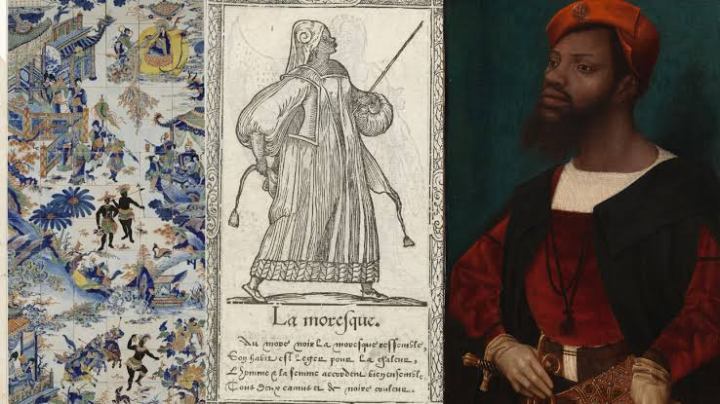
Anonymous (Delft), Tile panel with a Chinese landscape, ca. 1700; François Desprez, Illustration from Recueil de la diversité des habits‘, 1562; Jan Jansz Mostaert, Portrait of an African Man (Christophle le More?), 1525–30 (Rijksmuseum, Amsterdam).
◊ ◊ ◊ ◊ ◊
From The Warburg Institute:
The Image of the Black Archive: Past, Present, and Future
Online and in-person, The Warburg Institute, University of London, 7–8 November 2025
Organized by Hannah Lee and Maria Golovteeva
In 1960, Franco-American art collectors and philanthropists Jean and Dominique de Ménil initiated the Image of the Black archive. Originally begun in Paris and then expanded with an office in Houston, the research project was a response to the 1960s Civil Rights movement in the US. This two-day international conference brings together scholars who have contributed to the project over its history and those producing new research on the historic representation of African people in European and American art and culture. Attendance (online or in-person) is free with advance booking, though places are limited.
Keynote Speaker
Dr Adrienne L. Childs is an independent scholar, art historian, and curator. She is Senior Consulting Curator at The Phillips Collection. Her current book is an exploration of Black figures in European decorative arts entitled Ornamental Blackness: The Black Figure in European Decorative Arts, published by Yale University Press in 2025.
This conference is organised with the generous support of the Henry Moore Foundation, the Society for Renaissance Studies, and the Association for Art History.
f r i d a y , 7 n o v e m b e r
9.00 Registration
9.30 Opening Remarks
9.45 Panel 1
• Joaneath Spicer (Walters Art Museum), Balthazar, One of the Three Kings > Portrait: Prince Aniaba of Assinie as Balthazar, 1700
• Adam Sammut (University of York), Painted Black: Rubens’s ‘Mulay Ahmad’ after Jan Cornelisz. Vermeyen
• Edward Town (Yale Center for British Art), Framing the Black Presence in British Art: Research, Curation, and the Limits of the Archive
11.05 Tea and coffee break
11.30 Panel 2
• Najee Olya (William & Mary), The Contradictions of the Anthropological Gallery: Frank M. Snowden, Jr.’s Ethiopians and the Image of the Black in Western Art
• Jaqueline Lombard (University of New Hampshire), Coins on the Cutting Room Floor: Twelfth-Century Images of Saint Maurice in the Image of the Black Archives
• Paul Kaplan (Purchase College, SUNY), First Fruits
12.50 Lunch break
13.50 Panel 3
• Michael I. Ohajuru (Institute of Commonwealth Studies), The John Blanke Project: Artists and Historians Reimagine the Black Trumpeter to Henry VII and Henry VIII
• Sarah Thomas (Birkbeck), Facing the Inventory: WY Ottley and the Archive of Enslavement
• Nanfuka Joan Kizito (Makerere University), Decolonising the Archive: An Africanised Reflection on the History of the ‘Image of the Black in Western Art’ Project
15.10 Panel 4
• Isabel Raabe (Talking Objects) and Doreen Mende (Staatliche Kunstsammlung Dresden), Plural Histories of Networked Knowledge: Cross-Collections Research at the Staatliche Kunstsammlungen Dresden
• Sarah Okpokam (National Portrait Gallery), TBC
16.10 Tea and coffee break
16.30 David Bindman: In Memoriam
Drinks Reception
s a t u r d a y , 8 n o v e m b e r
9.30 Registration
10.00 Keynote
• Adrienne L. Childs, The Ornamentality of Blackness
11.00 Tea and coffee break
11.30 Panel 5
• Jacopo Gnisci (UCL), European Perceptions of Ethiopia’s Material Past in the Renaissance
• Patricia Simons (University of Michigan Ann Arbor \ University of Melbourne), Heat and Wind: Renaissance Representations of Black Men in Material Culture
• Riccardo Tonin (Ca’ Foscari University of Venice), Musi da porton: The Image of the Black on the Doors of Venice
12:50 Lunch break
13:50 Panel 6
• Amber Burbidge (European University Institute), Blackness and Bathing: The ‘Black Venus’ in the Image of the Black Archive
• Denva Gallant (Rice University), Afterlives of the Black Body: Dismemberment and the Black body in Matteo di Pacino’s Miracle of the Leg
• Nancy Ba (Sorbonne Université), Ethnographic Sculpture as Visual Archive? The Politics of Flesh, Complexion, and Scientific Image-Making in the Colonial Context, 1859-1931
15.10 Panel 7
• Borja Franco Llopis (Universidad Nacional de Educación a Distancia), Misconceptions and Silences: Black Representation and Slavery in Iberian Art
• Ekaterini Kepetzis (Rheinland-Pfälzische Technische Universität, Landau), ‘Only a lodger, and hardly that’: The Representation of Blacks on Eighteenth-Century English Trade Cards
• C.C. McKee (Bryn Mawr), Forms of Blackness from Fireburn to Sale: Painting Labor, Race, and the Environment in the Post-Emancipation Danish West Indies
16.30 Closing Remarks
Conference | 18th-C. Painting between Italy and the Hapsburg Empire
From the Department of Art History at the Universität Wien:
Settecento Malerei: Cultural Transfer between Italy and the Habsburg Territories
Online and in-person, Department of Art History of the University of Vienna, 23–24 October 2025
Organized by Eleonora Gaudieri and Erika Meneghini
Registration due by 19 October 2025
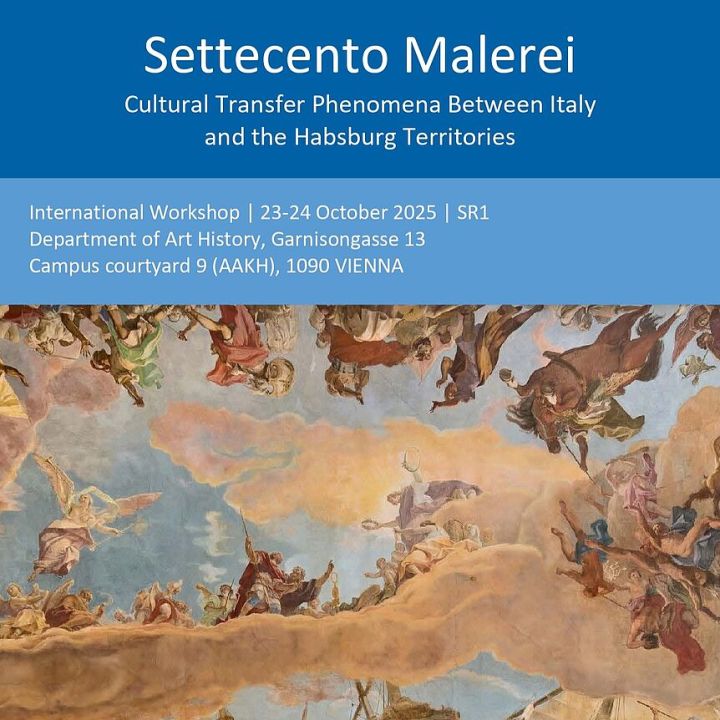 The beginning of the Settecento was characterised by a considerable expansion of the transalpine art market, driven by a strong interest in collecting Italian artworks. This phenomenon attracted numerous Italian artists, including many painters, to Vienna and its allies, the courts of the German prince-electors of Schönborn, Wittelsbach and others. At the same time, a number of Austrian painters were encouraged to further their training in Italy, where they were profoundly influenced by the local visual language. The high quality and renowned tradition of Italian painting, fostered by a dense network of international connections, enabled numerous artists of Italian origin, as well as Italians by adoption, to pursue successful careers at the Habsburg imperial court in Vienna. This phenomenon must be understood within the broader context of the diplomatic and artistic networks that connected Vienna with key centres on the Italian peninsula, such as Venice, Bologna, Rome, and Naples.
The two-day workshop will provide a wide-ranging exploration of 18th-century Italian painting as a focal point for transfer phenomena between the Italian peninsula and the domains of the Habsburg Empire, with a special focus on Vienna as the imperial capital. The proceedings will open with the keynote speech by Cecilia Mazzetti di Pietralata. The subsequent sixteen presentations have been organised into four sections, reflecting the variety of perspectives through which these historical and artistic phenomena can be approached: Collecting Italian Painting in the Habsburg Empire; Artworks and Material Objects as Vehicles of Cultural Transfer; Artists as Transregional Agents Between Italy and the Habsburg Regions; and The Role of Academies and Museums in the Transfer of Knowledge. The objective of this study day is on one hand to examine the meanings and functions of Italian painting within the socio-political and cultural context of the Habsburg imperial court in Vienna and its allied courts; and on the other hand, to explore the various dynamics that fostered the transfer of Italian painting and Italian artistic knowledge to Vienna and the territories of the then Habsburg Empire.
The conference languages are English, German, and Italian. A livestream of the event will be available. Please confirm your attendance in-person or online via email to settecentomalerei@gmail.com by 19 October. If you have any questions, please contact the organisers: Eleonora Gaudieri and Erika Meneghini.
Dr. Eleonora Gaudieri, eleonora.gaudieri@univie.ac.at
Postdoctoral Researcher (APART-GSK funding programme, ÖAW)
Department of Art History, University of Vienna
Erika Meneghini MA, erika.meneghini@univie.ac.at
PhD Candidate
Department of Art History, University of Vienna
The workshop is supported by the Department of Art History and the Vienna Center for the History of Collecting at the University of Vienna. Funding is provided by the Faculty of Historical and Cultural Studies at the University of Vienna, the City of Vienna, and the Austrian Academy of Sciences.
t h u r s d a y , 2 3 o c t o b e r
9.00 Welcome
9.30 Keynote
• Cecilia Mazzetti di Pietralata (University of Cassino and Southern Lazio) — Vienna italiana: Forme e attori dello scambio culturale tra Sei e Settecento, tra immigrazione artistica e vocazione internazionale dell’aristocrazia europea
10.30 Coffee Break
10.50 Section 1 | Collecting Italian Painting in the Habsburg Empire
Moderator: Silvia Tammaro
• Stefan Albl (Schloss Eggenberg & Alte Galerie, Graz) — Il dilemma della scelta: L’arrotino di Giacomo Francesco Cipper
• Ilaria Telesca (University of Naples ‘Federico II’) — Arte e potere: La committenza artistica dei viceré austriaci di Napoli
• Jiří Štefaňák (Masaryk University, Brno) — Non multa, sed multum: Italian Painting in the Collections of the Moravian Aristocracy at the End of the 18th Century
12.30 Lunch Break
14.00 Section 2 | Artworks and Materials Objects as Vehicles of Culture Transfer
Moderator: Eleonora Gaudieri
• Ada Berktay (Sakıp Sabancı Museum, Istanbul) — Lepanto as Material Allegory: Naval Triumph and the Politics of Display in Italian and Habsburg Visual Culture
• Tomáš Kowalski (Monuments Board of the Slovak Republic, Bratislava) — Baroque Illusion: Italian Settecento Frescoes in Slovakia
• Beatrice Bolandrini (Università e-Campus; Accademia del Lusso, Milan) — Anton Giorgio Clerici ed Annibale Visconti, ‘consiglieri intimi’ di Carlo VI e Maria Teresa, committenti di Giambattista Tiepolo e Mattia Bortoloni
• Tomáš Valeš (Masaryk University, Brno) — Shared, ‘Recycled’, Reinvented: Art of Venetian Settecento in the Hands of ‘Viennese’ 18th-Century Painters
• Erika Meneghini (University of Vienna) — From Naples to Vienna and the Habsburg Lands: The Artistic Reception of Francesco Solimena’s Oeuvre beyond the Alps
19.00 Conference Dinner
f r i d a y , 2 4 o c t o b e r
9.00 Section 3 | Artists and Transregional Agents between Italy and the Habsburg Regions
Moderator: Erika Meneghini
• Francesco Ceretti (University of Pavia) — Pietro Bellotti: Da Venezia alle corti mitteleuropee
• Eleonora Gaudieri (University of Vienna) — Daniele Antonio Bertoli: Traces of his Activity at the Habsburg Court in Vienna
• Enrico Lucchese (University of Campania ‘Luigi Vanvitelli’) — I soggiorni viennesi e nei territori asburgici di Antonio Pellegrini (1675–1741)
• Sanja Cvetnić (University of Zagreb) — Federico Bencovich as Transregional Artist
• Laura Facchin (University of Insubria, Varese) — Angelica Kauffmann: Painter of the Habsburg Court from Milan to Vienna
12.00 Lunch Break
13.30 Section 4 | The Role of Academies and Museums in the Transfer of Knowledge
Moderator: Stefan Albl
• Susanne Müller-Bechtel (University of Würzburg) — Figur–Pose–Wissen: Das akademische Aktstudium als epistemische Kunstpraxis in Rom, Wien und Mailand
• Lorenzo Giammattei (Sapienza University of Rome) — The Antique in the Drawings of Austrian Artists in Rome in the Second Half of the 18th Century
• Paolo Pastres (Independent Researcher, Udine) — Vienna e Firenze nel Settecento: Due modelli museali a confronto
15.00 Coffee Break
15.20 Final Discussion
16.45 Optional visit to the Schönbrunn Chapel and the Blue Staircase
Poster Image: Sebastiano Ricci, Allegory of the Princely Virtues, Blue Staircase, Schönbrunn Palace, 1702 (Vienna).
Symposium | The French Influence in Newport
From Newport Mansions:
The French Influence in Newport
Rosecliff and Marble House, Newport, Rhode Island, 6–7 November 2025
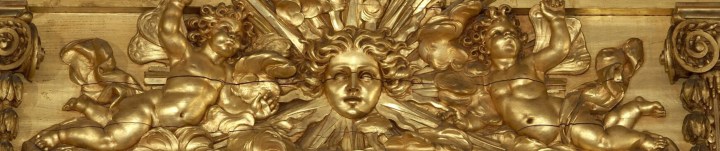
French art, architecture, design and cuisine permeated the lifestyles of the Gilded Age elite as they looked to the French aristocracy for inspiration. Richard Morris Hunt, the first American architect trained at the Ecole des Beaux-Arts in Paris, modeled the architecture of Alva Vanderbilt’s Marble House after the Petit Trianon at Versailles. Horace Trumbauer’s inspiration for The Elms came from the 18th-century Château d’Asnières, while Stanford White’s design for Rosecliff incorporated elements of another Versailles palace, the Grand Trianon. Furniture maker and interior designer Jules Allard et Fils furnished Newport’s summer ‘cottages’ with treasures inspired by and imported from France, and French chefs created magnificent culinary confections. Learn about all of this and more during the symposium’s morning lectures and guided afternoon tours (Thursday at Rosecliff and Friday at Marble House). Registration includes special access to the exhibition Richard Morris Hunt: In a New Light at Rosecliff.
Scholarships are available to assist undergraduate and graduate students interested in attending the symposium.
t h u r s d a y , 6 n o v e m b e r
Speakers
• Keynote Speaker: Mathieu Deldicque, Chief Curator and Museum Director of Château de Chantilly
• Margot Bernstein, Private Collection Curator
• Becky Libourel Diamond, Food Culture Historian
• Leslie Jones, Director of Museum Affairs and Chief Curator, the Preservation Society
• Laura Bergemann, former Preservation Society Conservation Research Fellow and PhD candidate at Vanderbilt University
• Théo Lourenço, Preservation Society Curatorial Research Fellow
f r i d a y , 7 n o v e m b e r
Speakers
• Justine De Young, Associate Professor and Chair of the History of Art Department, Fashion Institute of Technology (SUNY) in New York City
• Natalie Larson, Interior Textile Historian, Historic Textile Reproductions LLC
• Nadia Albertini, French Heritage Society Scholar, Franco-Mexican embroidery and textile designer
• Bob Shaw, HBO’s The Gilded Age Production Designer
Conference | Servants, Labourers, and the Manorial World
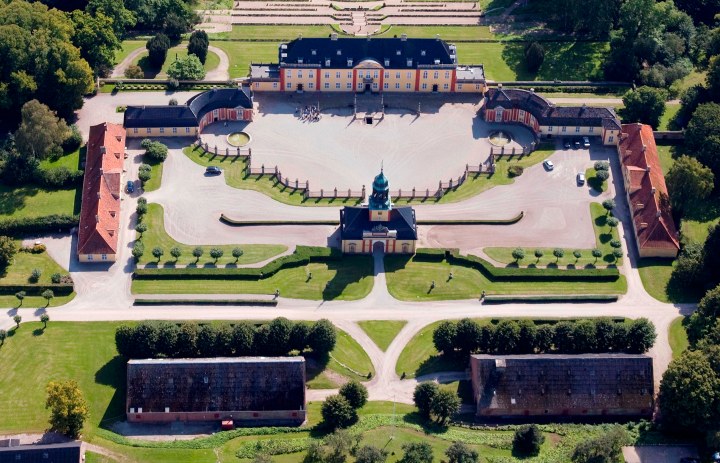
Johan Cornelius Krieger, Ledreborg Castle, Denmark (about 30 miles west of Copenhagen). Most of the house was constructed in the 1740s.
◊ ◊ ◊ ◊ ◊
From ENCOUNTER:
Servants, Labourers, and the Manorial World: Alternative Perspectives
9th ENCOUNTER Conference
Ledreborg Castle, Denmark, 9–11 October 2025
The European Network for Country House and Estate Research (ENCOUNTER) is pleased to host its ninth conference, organized in collaboration with The Danish Research Centre for Manorial Studies and Gammel Estrup, The Danish Manor Museum.
The manor or country house is often viewed exclusively as a stage for the economic and political elite of the past, a setting for splendour, luxury, and self-presentation. However, the world of the manor also included a well-defined hierarchy consisting of landowning families, tenant farmers, servants, craftsmen and labourers, all negotiating the dynamics of power. Ideally, the manor operated as a paternalistic institution built on mutual obligations: masters provided care and protection and subordinates offered work, loyalty and obedience. This relationship was both a practical arrangement and an ideological framework, a power dynamic and a manifestation of social inequality.
These historical structures could however be a source of both resistance and conflict as well as support and benevolence. On a larger scale, country houses became both targets and symbols during major confrontations, from peasant revolts to revolutions and civil wars. On a smaller scale, historical court records reveal conflicts involving servants and owners or the owners’ representatives. Conversely, the manor provided the social framework for many people’s lives, offering employment, housing, and protection. Country house owners offered patronage and sought to cultivate the religious and moral development of their staff and communities. Loyal service was rewarded with promotions and comfortable living conditions. Manors funded churches, schools, alms-houses, and gave donations. However, the nineteenth century brought dramatic social changes, as industrialisation drew labor and wealth into the urban centres. To what extent were these changes driven by further political developments and societal reforms? Was social change in a rural context a one-way phenomenon dictated by landowners?
This ENCOUNTER conference will explore these dynamics, primarily focusing on a bottom-up perspective, highlighting the master-servant relationship in its full paternalistic scope, and addressing household, villages, rural communities, etc. This includes shedding light on the conditions and material realities for servants and workers, as well as the organisational structures. And to explore conflicts/resistance and limits within the relationship, as well as changes in the nature and conditions of the relationship over time.
ENCOUNTER was founded in Denmark in 2015 and has since provided a framework for interaction between scholars and cultural institutions in Europe sharing a professional interest in the research and interpretation of manor and country house history. The conference thus also marks the network’s 10th anniversary.
Abstracts for each paper are available here»
t h u r s d a y , 9 o c t o b e r
8.40 Bus departure from Scandic Roskilde
8.55 Bus departure from Roskilde Station
9.15 Arrival Ledreborg Estate
10.00 Welcome — Kasper Steenfeldt Tipsmark (Gammel Estrup The Danish Manor & Estate Museum) and Signe Boeskov (The Danish Research Centre for Manorial Studies)
10.15 Keynote
• Aristocratic Servants in 17th-Century Sweden: Gender, Recruitment, and Career — Svante Norrhem (Lund University)
10.55 Session 1 | Servants
Chair: Kasper Steenfeldt Tipsmark
• Servants’ Property and Material Culture on Swedish Manors, 1770–1870 — Göran Ulväng (Uppsala University)
• The Organisation of the Household: The Role of High-Ranking Servants at 19th-Century Danish Manors — Signe Boeskov and Søren Broberg Knudsen (The Danish Research Centre for Manorial Studies)
• Behind the Scenes of the Manor — Aina Aske (Vestfoldmuseene IKS) and Lars Jacob Hvinden-Haug (Norwegian Institute for Cultural Heritage Research, NIKU)
• Hidden Doors and Secret Passages: Telling the Story of Servants in Eidsvoll House — Solveig Therese Dahl (Eidsvoll 1814, The Norsk Folkemuseum foundation)
13.00 Lunch
14.10 Guided tour Ledreborg
15.25 Session 2 | Labour and Estate Community
Chair: Paul Zalewski (European University of Viadrina)
• The Transition from Serfdom to the Industrial Worker in the Vodka Distillery of the Estonian Manor during the 19th Century — Mirje Tammaru (Estonian Academy of Arts)
• Arm Wrestling: Agency and Negotiations between Tenant Farmers and the Big House: An Alternative Perspective from Four 18th-Century Estates in the Netherlands — Gerrit van Oosterom, (independent researcher)
• Labourers on the Estate—Esbogård, 1770–1920 — Tryggve Gestrin (Espoo City Museum)
• Work, Family, Security: The Relationships and Life Strategies within the Håkansböle Manor Community — Eeva Kotioja (Vantaa City Museum)
17.30 Discussion and break
18.45 Dinner at Restaurant Herthadalen
f r i d a y , 1 0 o c t o b e r
8.10 Bus departure from Scandic Roskilde
8.25 Bus departure from Roskilde Station
8.45 Arrival Ledreborg Estate
9.30 Early Career Keynote
• Early Modern Estates as Communities of ‘Care’: Medical Practice across the Social Hierarchy in Rural England, 1650–1750 — Emma Marshall (University of Birmingham and University of York)
10.10 Session 3 | Care and Crisis
Chair: Hanneke Ronnes (University of Groningen)
• A Manorial World in Miniature? The Hospital of Laurvig County in the 18th Century — Arne Bugge Amundsen (University of Oslo)
• The State, the Subjects, and the Lord: Conflicts at Ängsö Manor, 1690–1710 — Joakim Scherp (Stockholm University and The Riksdag Library)
• Caring Beyond the Grave? The Estate of Denis Roest van Alkemade (1720–1791) — Thijs Boers (Amsterdam Museum and University of Amsterdam)
12.15 Lunch
13.35 Bus departure for Gisselfeld
14.30 Guided tour of Gisselfeld
16.45 Departure for Vallø
17.20 Guided tour of Vallø
19.00 Dinner at Vallø Slotskro
s a t u r d a y , 1 1 o c t o b e r
8.10 Bus departure from Scandic Roskilde
8.25 Bus departure from Roskilde Station
9.30 Guided tour of Gjorslev
11.15 Departure for Gavnø
12.35 Lunch at Café Tulipanen / Guided tour of Gavnø
14.45 Bus departure
16.15 Arrival Scandic Roskilde
16.30 Arrival Roskilde Banegård
Symposium | Meissen Symposium: Höroldt’s Legacy
From the Meissen Porcelain Museum:
1st Meissen Symposium: Höroldt’s Legacy
Meissen Porzellan-Stiftung, Meißen, 7–9 November 2025
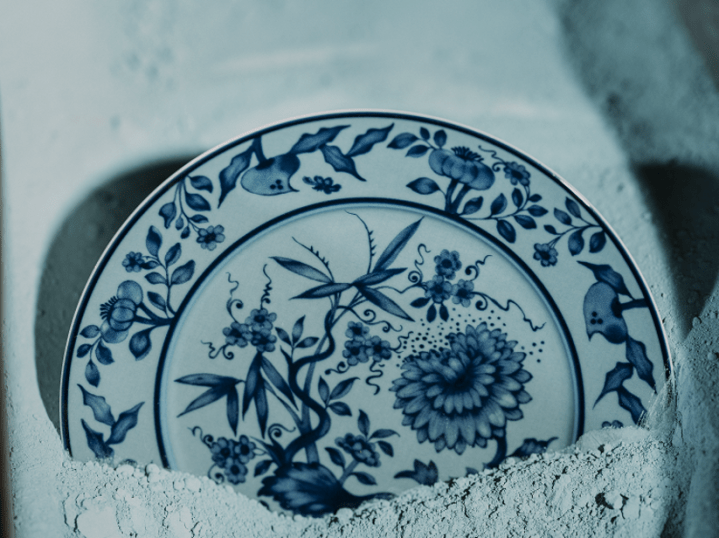 The Meissen Porcelain Foundation is hosting the Meissen Symposium, part of what is envisioned as a regular series of symposia aimed at facilitating exchanges on ceramic history at the birthplace of European porcelain. The subject of this year’s symposium is Höroldt’s Legacy, with an emphasis on ceramic pigments, their historical and contemporary development, and their use within the Meissen Manufactory and beyond. The occasion for this year’s symposium is the 250th anniversary of the deaths in 1775 of Meissen’s two towering figures, Johann Gregorius Höroldt (1696–1775) and Johann Joachim Kaendler (1706–1775).
Höroldt’s arrival in Meissen in 1720 signaled a breakthrough in porcelain painting. Höroldt was an innovative artist with a natural and intuitive understanding of pigment chemistry without any formal training. He developed the proper technology for the enameling of porcelain using metal-oxide-based pigments at high temperatures. Today, his initial set of 16 enamel colors has grown to around 10,000.
Augustus the Strong’s initial objective was the making of blue-and-white porcelain, similar to that of the Chinese. With Höroldt’s arrival the success story of overglaze polychrome painting began. Inspired initially by East Asian decors it was expanded to include European flower painting, the classic harbor scenes, hunting scenes, and scenes after Watteau, Ridinger and others. In the 19th century it was expanded to royal blue ground, to include platinum, pâte-sur-pâte, and Limoges painting. Experiments with tinted porcelain paste can be traced to the 18th century. Exploring the miscibility of colorants was intensely investigated as documented by the hundreds of surviving, meticulously documented and archived color samples in the Meissen Manufactory Museum. In-glaze painting, and the invention of soluble and high-temperature resistant colorants that could be used underglaze were significant additional technological developments. Advances in scientific analysis are expected to provide new insights.
f r i d a y , 7 n o v e m b e r
10.00 Morning Session
1 Frank Löchelt, Meissen — Color Laboratory / Farblabor der Manufaktur
2 Nicholas Zumbulyadis, USA — Influencing the Influencer: Thoughts about the Origins of Höroldt’s Technological Advances / Wer beeinflusste Höroldt: Gedanken zu den Ursprüngen von Höroldts technologischen Fortschritten
3 Ullrich Knüpfer — Insights into the Technological Basics of Polychrome Porcelain Decoration / Technologische Grundlagen der farbigen Porzellan-Dekoration
4 Annett Lorenz, Meissen — Porcelain Painter: Aspects of Figure Painting / Porzellanmaler: Aspekte der Figurenmalerei
5 Maureen Cassidy-Geiger, USA — Glazed Canvases: New Approaches to the Study of (Miniature) Painting on Meissen Porcelain / Neue Ansätze zur Erforschung der (Miniatur-)Malerei auf Meissener Porzellan
6 Holger Schill, Meissen — Head of Bundling and Finishing: A Practical Report on Customer Requests, Color Palettes, and New Decors / Leiter Bund- und Endfertigung: Ein Praxisbericht über Kundenwünsche, Farbpalletten und neue Dekore
1.30 Lunch
3.00 Afternoon Session
7 Sebastian Bank, SKD — Frankenthal Colors: From Meissen to the Palatinate / Die Entwicklung der Frankenthaler Farben aus kunsthistorischer Sicht
8 Uwe Marschner, Meissen — About Pate-sure-pate Painting / Leiter Modellherstellung und Formenarchiv: Zur Pate-sure-pate Malerei
9 Lena Hensel, Meissen — Meissen Today / Leiterin Produktentwicklung: Meissen heute
s a t u r d a y , 8 n o v e m b e r
9.30 Welcome
10.00 Morning Session
1 Susanne Bochmann, Meissen — Porzellan-Stiftung Color Samples and Patterns in the Collections of the Meissen Porcelain Foundation / Farbproben und Farbmuster in der Sammlung der Meissen Porzellan-Stiftung
2 Jens Petzold, KI-Institut Meißen — The Influence of Firing on Ceramic Colors / Einfluss der Brandführung auf keramische Farben
3 Lena Kaapke, Künstlerin — Inquiring the Red: A Visually and Sensually Organized, Tactile Archive of Various Red Ceramic Surfaces / Befragungen an das Rot: ein visuell und sinnlich geordnetes, haptisches Archiv verschiedener keramisch roter Oberflächen
4 Zhong Zhenhua, Deputy Dean of the School of International Exchange and Education and the Deputy Director of the Ceramic Culture Exchange and Research Center at Jingdezhen College — Johann Gregorius Höroldt and Jingdezhen Porcelain: The Historical and Aesthetic Connections between Höroldt’s Chinoiserie and Jingdezhen’s Ceramic Heritage / Johann Gregorius Höroldt und Jingdezhen-Porzellan: Die historischen und ästhetischen Verbindungen zwischen Höroldts Chinoiserie und dem keramischen Erbe von Jingdezhen
5 Vanessa Sigalas, Wadsworth Atheneum, USA — Where Are All the White Figures? Later Decorated Meissen Porcelain / Wo sind all die weißen Figuren? Später dekoriertes Meissener Porzellan
6 Valérie Montens, Curator of European Ceramics and Glass Collections, Royal Museums of Art and History, Brussels; and Sofia Cruz Oulhaj, student in conservation and restoration of ceramic and glass, ENSAV La Cambre, Brussels — From Restoration to Attribution: Scientific and Stylistic Reassessment of a Meissen Huntress Figurine / Von der Restaurierung zur Zuschreibung: Wissenschaftliche und stilistische Neubewertung einer Meissener Jägerinnenfigur
1.00 Lunch
2.30 Afternoon Session
7 Bernd Ullrich — Initial Analytical Material Investigations on Historical Products from the Meissen Porcelain Manufactory Using X-ray Fluorescence, Scanning Electron Microscopy, and Electron Beam Microprobe Technology in the 1980s at the TU Bergakademie Freiberg / Erste analytische Werkstoffuntersuchungen an historischen Erzeugnissen der Porzellanmanufaktur Meissen mittels Röntgenfloureszenz, Rasterelektronenmikroskopie und Elektronenstrahlmikrosondentechnik in den 1980er Jahren an der TU Bergakademie Freiberg
8 Philippe Colomban, Sorbonne University — How to Extract the Maximum Information on Enamels in a Non-invasive Way with Mobile Instrumentation (Raman + pXRF), Explaining which Results Can Be Reliable and What the Difficulties Are, with the Example of This France/Italy/Germany/China Comparison / Wie man mit mobilen Messgeräten (Raman + pXRF) auf nicht-invasive Weise möglichst viele Informationen über Glasur gewinnt, wobei anhand des Vergleichs zwischen Frankreich, Italien, Deutschland und China erläutert wird, welche Ergebnisse zuverlässig sind und wo die Schwierigkeiten liegen
9 Christian Lechelt, Fürstenberg — For Some Years Now, the Museum Schloss Fürstenberg and the Freundeskreis Fürstenberger Porzellan e. V. Have Collaborated with Cranfield University and Leiden University on a Project Aimed at Gaining New Insights into 18th-Century Fürstenberg Porcelain Production Using X-ray Fluorescence Analysis / Seit einigen Jahren verfolgen das Museum Schloss Fürstenberg und der Freundeskreis Fürstenberger Porzellan e. V. zusammen mit den Universitäten in Cranfield (UK) und Leiden (NL) ein Projekt, um mittels Roentgenfluoreszenzanalyse zu neuen Erkenntnissen über die Fürstenberger Porzellanproduktion des 18. Jahrhunderts zu gelangen
4.15 Panel Discussion / Podiumsdiskussion
Conference | Sacred Ceramics
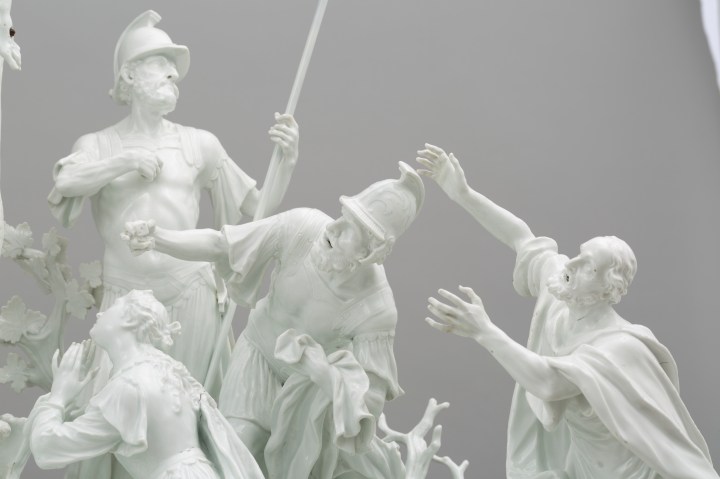
Johann Joachim Kaendler, Crucifixion Group, detail, Meissen, 1743
(Porzellansammlung, Staatliche Kunstsammlungen Dresden; photo by Adrian Sauer)
◊ ◊ ◊ ◊ ◊
Details of this conference appeared here at Enfilade several weeks ago; please note, however, that registration now includes an online option (with recordings sent out afterwards) for anyone who is interested but unable to attend on Tuesday.
Sacred Ceramics: Devotional Images in European Porcelain
Online and in-person, Victoria & Albert Museum, London, 30 September 2025
Organized by Matthew Martin and Rebecca Klarner
Was eighteenth-century European porcelain just a ceramic material to be moulded into useful objects—or could it mean more? This conference explores what European porcelain might have communicated when it was used to create devotional objects.
This conference explores the phenomenon of religious sculpture produced in European porcelain in the eighteenth century. Sculptures on religious subjects represent some of the most ambitious and complex productions in European porcelain of the period, yet they remain relatively understudied. Meissen, Doccia Vienna, Höchst, Fulda, Nymphenburg—all these factories produced devotional images in porcelain. Even factories in mid eighteenth-century Protestant England—Chelsea and Derby—produced sculptures employing Catholic devotional imagery. In each instance, cultural-political motives for the creation of these images can be reconstructed.
The 1712 letter penned by the Jesuit Father François Xavier d’Entrecolles not only conveyed to Europe first-hand knowledge of Chinese porcelain production at Jingdezhen, but it also construed access to this knowledge as a triumph of the Jesuit global mission—the successes of the Jesuits in China made the secret of kaolinic porcelain available to the Catholic princes of Europe.
Porcelain’s alchemical heritage was also not without significance: success at the alchemical enterprise had always been deemed dependent on divine favour. These factors could lead to porcelain assuming a sacral character in Catholic court contexts. Devotional images in European porcelain exploited these cultural associations of the medium itself.
This international conference will explore the religious production of European ceramic factories and consider questions such as: Who were the artists and patrons involved in these sculptures’ creation? How did these sculptures function in private and public contexts? What significance lay in the use of porcelain to create devotional images?
More information is available here»
Study Day | Drawing in 18th-C. Academies, Schools, and Private Studios
From ArtHist.net and the conference programme:
Académies, écoles et ateliers privés :
Conditions pratiques du dessin dans l’enseignement artistique au XVIIIe siècle
École des Beaux-Arts de Paris, 16 October 2025
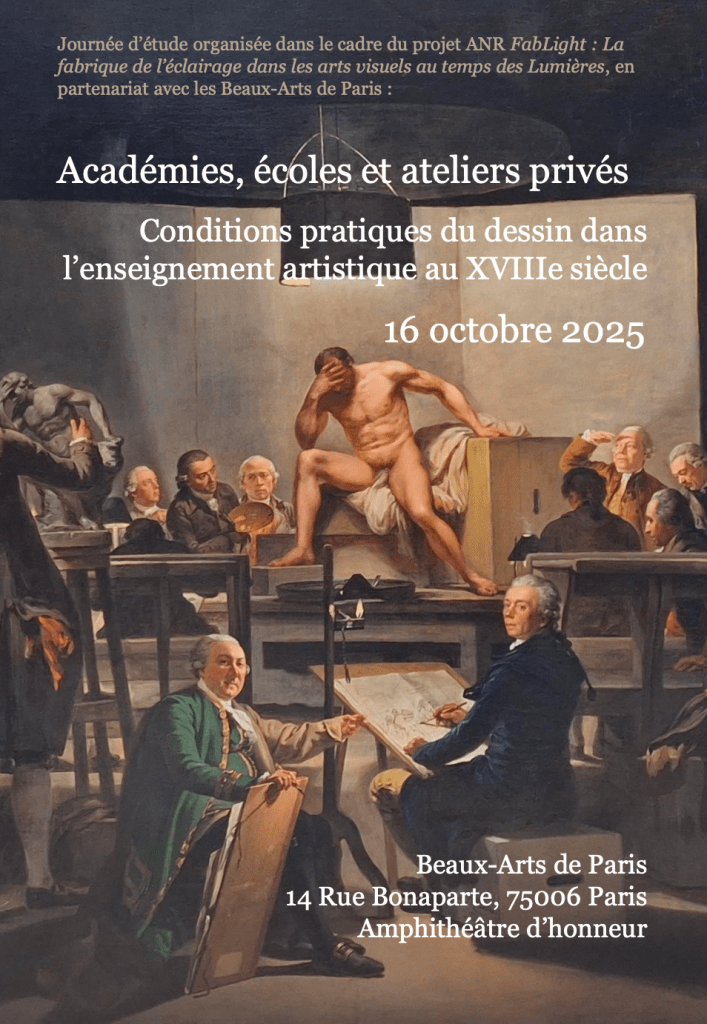 Dans le cadre de l’ANR FabLight, et en partenariat avec l’École des Beaux-Arts de Paris, Marlen Schneider (Université Grenoble Alpes/LARHRA) organise une journée d’étude intitulée Académies, écoles et ateliers privés : Conditions pratiques du dessin dans l’enseignement artistique au XVIIIe siècle.
Au cœur de la formation artistique au XVIIIe siècle, le dessin constitue une base fondamentale pour comprendre l’évolution de la peinture et de la sculpture, mais aussi d’autres formes d’art et d’artisanat. Des études récentes se sont intéressées à la diffusion des modèles au sein des réseaux des académies d’art et écoles de dessin, en France et en Europe, à la circulation des pratiques et à la constitution de collections pédagogiques servant de support à l’enseignement du dessin. La journée d’étude entend approfondir la question des conditions matérielles et de l’organisation pratique du dessin, dans une perspective comparatiste internationale et selon une approche attentive aux différents lieux de la formation artistique. Comment furent aménagés les espaces destinés au dessin, quel mobilier et quels outils étaient nécessaires à l’apprentissage ? Quels étaient leurs coûts et qui les finançait ? Que sait-on des pratiques d’éclairage, des horaires et du déroulement des séances de pose ? Pouvons-nous constater des différences entre l’enseignement académique et celui des ateliers privés ou des écoles de dessin ? Quelles furent les conséquences des conditions de travail sur la réalisation des dessins — par exemple l’emploi du clair-obscur, le choix des matériaux ou des compositions ? La journée sera consacrée à ces questions selon une perspective européenne, et à une période qui a vu naître un nombre considérable d’académies d’art et d’écoles de dessin, tout en étant marquée par des innovations technologiques importantes, notamment en termes d’éclairage.
Organisée en partenariat entre les Beaux-Arts de Paris et le projet ANR FabLight, la journée d’étude vise à faire dialoguer les recherches récentes en Histoire de l’art sur la pratique du dessin, croisant les études visuelles et matérielles avec les humanités numériques, afin d’évaluer l’apport de ces dernières pour une meilleure compréhension des conditions de travail des artistes.
Cette journée aura lieu à l’École des Beaux-Arts de Paris, 14 rue Bonaparte, le 16 octobre 2025. Les séances de l’après-midi sont ouvertes au public, sans inscription mais dans la limite des places disponibles.
p r o g r a m m e
Matinée réservée aux intervenants (visite et présentation de dessins)
14.00 Introduction — Alice Thomine-Berrada et Hélène Gasnault (Beaux-Arts de Paris), Marlen Schneider (UGA/LARHRA)
14.15 Papiers, crayons, bougies et autres fournitures utiles à l’apprentissage : les supports pédagogiques dans les écoles de dessin provinciales — Anne Perrin-Khelissa (Université Toulouse – Jean Jaurès / FRAMESPA) et Émilie Roffidal (CNRS/FRAMESPA)
15.00 Local Academy, Global Ambition: The Garemijn Booklets and Life Drawing in Bruges, c. 1770 — Thijs Dekeukeleire (Musea Brugge)
15.45 Pause
16.00 On the Conditions in Life Rooms, Their Impact, and the Agency of Drawn Academic Nudes — Susanne Müller-Bechtel (Universität Würzburg)
16.45 Lighting and Learning: Sir John Soane, Turner, and the Early 19th-Century Royal Academy of Arts, London — Rebecca Lyons (Pitzhanger Manor & Gallery, London)
17.30 Une Académie en 3D : table ronde avec des membres du projet Fablight autour d’une reconstitution numérique d’une salle de dessin académique
18.30 Conclusion
Poster Image: Martin Ferdinand Quadal, The Drawing Room of the Vienna Academy in the St. Anne Building, detail, 1787, 56 × 81 inches (Vienna: Gemäldegalerie der Akademie der bildenden Künste).
Conference | Lost Cities in a Global Perspective
From ArtHist.net:
Lost Cities in a Global Perspective:
Sources, Experience, and Imagery, 15th–18th Centuries
University of Campania ‘Luigi Vanvitelli’, Caserta, 16–17 October 2025
Organized by Giulia Ceriani Sebregondi, Francesca Mattei, and Danila Jacazzi
 In conjunction with the Research Project “The Vesuvian Lost Cities before the ‘Discovery’: Sources, Experience, and Imagery in Early Modern Period” (VeLoCi)
Many cities, all over the world, have disappeared over the centuries, abandoned—but perhaps never forgotten—destroyed by natural disasters or buried under new urban layers, re-emerging for different reasons. Fascinating historians, explorers, archaeologists, architects, and artists, the ‘lost cities’—both literally and metaphorically—have continued to exist in literary sources, descriptions, chronicles, and sometimes in iconographic representations. Starting from the case study of the Vesuvian cities, this international conference will investigate in an interdisciplinary and comparative way the material and imaginary dimensions assumed by the lost cities in a global perspective, before the birth of archaeology as a science in the 18th and 19th centuries.
The full program is available here»
t h u r s d a y , 1 6 o c t o b e r
10.00 Welcome
10.30 Session One | Textual Sources for the Reconstruction of Lost Cities
Chair: Giulia Ceriani Sebregondi (Università degli Studi della Campania ‘Luigi Vanvitelli’)
• Il territorio di Pompei in età moderna — Danila Jacazzi (Università degli Studi della Campania ‘Luigi Vanvitelli’)
• In Search of the Lost Palace: The First Attempts at an Ideal Reconstruction of Diocletian’s Palace in Split — Josip Belamarić (Institute of Art History in Split; Department of Art History, University of Split)
• Pirro Ligorio e le città vesuviane — Francesca Mattei (Università degli Studi Roma Tre)
11.30 Coffee Break
12.00 Session One, continued
• Views of Palmyra in the 17th and 18th Centuries — Gregorio Astengo (IE School of Architecture and Design, Madrid/Segovia)
• Il mito etrusco nelle narrazioni dell’origine delle città campane scomparse — Concetta Lenza (Università degli Studi della Campania ‘Luigi Vanvitelli’)
13.10 Light Lunch
14.10 Session Two | Lost Cities between Antiquarian Research and Material Exploration
Chair: Francesca Mattei (Università degli Studi Roma Tre)
• ‘Certi belli sassi et prede piccade antiquissime’: il Lapidarium quattrocentesco di Brescia — Alessandro Brodini (Università degli Studi di Firenze)
• When Were the Vesuvian Lost Cities Discovered? Traces and Evidence about Ancient Stabiae in the Early Modern Period — Giulia Ceriani Sebregondi (Università degli Studi della Campania ‘Luigi Vanvitelli’)
• La rocca Paolina di Perugia: una città sepolta che ha custodito la memoria della città medievale — Paolo Belardi (Università degli Studi di Perugia), Francesca Funis (Università degli Studi di Perugia)
15.10 Tea Break
15.40 Session Two, continued
• Beneath Resina: Traces of Herculaneum before the Excavations — Giorgia Pietropaolo (Università degli Studi della Campania ‘Luigi Vanvitelli’)
• Il luogo del convento francescano di San Gabriel a Cholula (Messico) — Daniel Fernando Macìas Parra (Università Iuav di Venezia)
• Da Corpus Civitatis a casale collinare: Distruzioni e rifondazioni della Città Nova dell’Annunziata di Massa Lubrense — Giuseppe Pignatelli Spinazzola (Università degli Studi della Campania ‘Luigi Vanvitelli’)
f r i d a y , 1 7 o c t o b e r
9.30 Session Three | Visual Culture and Cartography, Travel, and Exploration Reports
Chair: Alessandro Brodini (Università degli Studi di Firenze)
• The City of Soltaniyeh in Northern Iran — Lorenzo Vigotti (Alma Mater Studiorum, Università di Bologna)
• Percorrendo le città vesuviane di XV e XVI secolo tra narrazione e osservazione dell’antico — Giorgia Aureli (Università degli Studi Roma Tre)
• Phantom Cities of the Living Library: The Early Modern Imagining of Amazonian Urbanscapes — Juan Carlos Mantilla (King’s College London)
10.30 Coffee Break
11.00 Session Three, continued
• La presenza delle città sepolte nella produzione vedutistica cinque e seicentesca — Milena Viceconte (Universitat de Lleida)
• La morte o la sopravvivenza della città antica per eccellenza: Atene osservata da Cornelio Magni (1674), viaggiatore parmigiano nel mondo ottomano — Alper Metin (I Tatti, The Harvard University Center for Italian Renaissance Studies)
• La riscoperta delle città perdute in Abruzzo nel periodo del Grand Tour — Diletta Haberl (Università degli Studi dell’Aquila)
• La ‘riscoperta’ della città maya di Palenque: vedute e interpretazioni tra il XVIII e XIX secolo — Arianna Campiani (Sapienza Università di Roma)
12.50 Light Lunch
13.50 Session Four | Myth, Imaginary, and Cultural Memory
Chair: Milena Viceconte (Universitat de Lleida)
• Frammenti di Roma perduta: l’immagine della Domus Aurea nella prima età moderna — Federica Causarano (Università degli Studi Roma Tre)
• Hochelaga’s Transatlantic Afterlife, 1535–1678 (Canada) — Lorenzo Gatta (I Tatti, The Harvard University Center for Italian Renaissance Studies)
• Gladiators in Altera Roma: Tenochtitlan in the European Imagination (Mexico) — Delia Cosentino (DePaul University, Chicago)
14.50 Tea Break
15.20 Session Four, continued
• L’oro, le conchiglie, l’assenza: identità e memoria della Taranto ‘perduta’ negli appunti di viaggiatori europei ed eruditi tra Settecento e Ottocento — Stefania Castellana (Università del Salento)
• Costantinopoli ‘seconda Pompei’: il mito della città sepolta dai Patria Costantinopolitana alla letteratura odeporica di epoca moderna — Maria Carolina Campone (Scuola Militare ‘Nunziatella’ di Napoli)
• The Lost City of Oyo-Ile in Yoruba Cultural Memory and Identity — Adekunle Adeyemo (Redeemer’s University, Ede, Nigeria)
16.50 Closing Roundtable — Giulia Ceriani Sebregondi, Francesca Mattei, Danila Jacazzi










leave a comment