Conference | Painted Ceilings: France and Germany, 1600–1800

This week in Munich, as noted at ArtHist.net:
Eine Verflechtungsgeschichte der Deckenmalerei: Frankreich und Deutschland, 1600–1800
Une histoire croisée des plafonds peints: France-Allemagne, 1600–1800
Carl Friedrich von Siemens Stiftung, München, 12–14 March 2025
Registration due by 11 March 2025
Ziel der Tagung ist es, das historische, kulturelle, formale und technische Phänomen der Verbreitung von gemalten und skulptierten Deckenausstattungen im Europa des 17. und 18. Jahrhunderts zu erforschen. Deutschland und Frankreich bieten sich für dieses Unterfangen an: Die zahlreichen punktuellen und verstreuten Studien der letzten 20 Jahre sollen in einem umfangreichen Unternehmen systematisiert und mit aktuellen Fragestellungen verknüpft werden. Die Zeit ist günstig: Auf beiden Seiten des Rheins entstanden in den letzten Jahren Datenbankinitiativen und es besteht dringender Handlungsbedarf, um gemeinsame digitale Werkzeuge zu entwickeln und die Relevanz und Interoperabilität zu erhöhen.
Le projet propose d’étudier le phénomène historique, culturel, formel et technique qu’a constitué la multiplication des décors de plafonds, peints et sculptés en Europe aux XVIIe et XVIIIe siècles. Les terrains français et allemands se prêtent à cette enquête : ils ont fait l’objet de nombreuses études ponctuelles et différentes depuis 20 ans et appellent aujourd’hui une vaste entreprise de systématisation du corpus et d’enrichissement du questionnaire. Le moment est opportun : des bases de données naissent de part et d’autre du Rhin ces dernières années et il est urgent d’engager une réflexion afin d’adopter des outils numériques communs, afin de gagner en pertinence et en interopérabilité.
Gefördert von der Deutschen Forschungsgemeinschaft (DFG), der Agènce Nationale de Recherche (ANR) und der Carl Friedrich von Siemens Stiftung.
Eine Anmeldung unter ist erforderlich.
Weitere Informationen zum Projekt.
Deutsch-Französische Forschungsdatenbank.
Projektkennung Deutsche Forschungsgemeinschaft (DFG) – Projektnummer 469528261
m i t t w o c h , 1 2 m Ä r z
14.00 Begrüßung / Mot de bienvenue
14.05 Matteo Burioni (LMU) — Einführung : Vom Kulturtransfer zur Verflechtungsgeschichte / Introduction : D’une histoire des transferts à l’histoire croisée
Moderation: Christine Tauber (Zentralinstitut für Kunstgeschichte)
14.30 Hendrik Ziegler (Universität Marburg) — Die Spiegelgalerie von Versailles als deutsch-französischer Erinnerungsort / La galerie des glaces de Versailles comme lieu de mémoire franco-allemand
15.15 Diskussion
15.30 Pause
16.00 Ulrike Seeger (Universität Stuttgart/LMU) — Die Aeneasgalerie von Matthäus Günther im Neuen Schloss in Stuttgart / La galerie d’Énée de Matthäus Günther au nouveau château de Stuttgart
16.20 Matthieu Lett (Université Bourgogne Europe, IUF) — Jean Girardet (1709–1778), peintre de plafonds : perspectives croisées entre le duché de Lorraine, l’Italie et Saint-Empire romain germanique / Jean Girardet (1709–1778), Deckenmaler: Eine Verflechtungsgeschichte zwischen dem Herzogtum Lothringen, Italien und dem Heiligen Römischen Reich Deutscher Nation
16.40 Anne Ilaria Weiß (LMU) — Das Paradeappartement Augusts des Starken im Dresdner Residenzschloss. Zwischen dem Streben nach der Kaiserwürde, goût français und dynastischer Verflechtung mit Frankreich / L’appartement de parade d’Auguste le Fort dans le château de la résidence de Dresde. Entre aspiration à la dignité impériale, goût français et liens dynastiques avec la France
17.00 Diskussion
17.30 Pause
18.00 Olivier Bonfait (Université Bourgogne Europe, IUF) — Matthieu Lett (Université Bourgogne Europe, IUF), Sandra Bazin-Henry (Université Marie et Louis Pasteur), Plafond-3D outre Rhin / Plafond-3D jenseits des Rheins
18.30 Matteo Burioni (LMU), Elisabeth Mayer (LRZ) — Anne Ilaria Weiß (LMU), Appartement und Deckenmalerei in Schloss Rheinsberg / Appartement et plafond peint au château de Rheinsberg
d o n n e r s t a g , 1 3 m Ä r z
Projektpräsentation / Présentation du projet
Moderation: Hubertus Kohle (LMU)
9.00 Olivier Bonfait (Université Bourgogne Europe, IUF), Matteo Burioni (LMU), Maximilian Kristen (LMU), Matthieu Lett (Université Bourgogne Europe, IUF), Florian Zacherl (LMU) — Die Forschungsdatenbank: Metadaten zur Deckenmalerei in Frankreich und Deutschland / Le portail commun: données sur les peintures de plafond en France et en Allemagne
9.50 Diskussion
10.15 Sandra Bazin-Henry (Université Marie et Louis Pasteur) — Les plafonds français et la quadratura : réflexions autour de vestiges illusionnistes / Die französische Deckenmalerei und die Quadratura: Überlegungen zu illusionistischen Relikten
10.30 Marine Roberton (Université Bourgogne Europe) — Sous les ciels de Rennes. Typologie et hiérarchie des fonds des plafonds du parlement de Bretagne / Typologie und Hierarchie der Deckenmalerei im Parlament der Bretagne in Rennes
10.45 Theresa Baumann (LMU) — Künstlerischer Austausch in der Patronage von Henriette Adelaide von Savoyen / Échange artistique sous le patronage d’Henriette Adélaïde de Savoie
11.00 Diskussion
11.30 Pause
12.00 Cordula Mauss / Sandra Bucher-Fiuza (Bayerische Verwaltung der staatlichen Schlösser, Gärten und Seen) — Die Restaurierung des Festsaales von Schloss Ansbach / La restauration de la salle de fête du château d’Ansbach
12.20 Mona Hess (Universität Bamberg) — Die 3D-Vermessung im Festsaal von Schloss Ansbach / Le relevé 3D dans la salle de fête du château d’Ansbach
12.45 Diskussion
14.00 Führung Nymphenburg / Visite guidée de Nymphenburg
Produktion: Denken in der dritten Dimension / Les savoir-faire : penser en 3D
Moderation: Eva-Bettina Krems (Universität Münster)
15.00 Stephan Hoppe (LMU) — Wolf Caspar von Klengel und das Palais im Großen Garten in Dresden. Produktionsgeschichte als modulare Verflechtungsgeschichte / Wolf Caspar von Klengel et le Palais du Grand Jardin à Dresde. L’histoire de la production comme histoire croisée
15.45 Diskussion
16.00 Pause
16.30 Etienne Faisant (Musée du Grand Siècle) — L’architecte, le peintre et le plafond. De l’invention des plafonds en France au XVIIe siècle / Der Architekt, der Maler und die Decke. Von der Erfindung der Deckenmalerei in Frankreich im 17. Jahrhundert
16.45 Maxime Bray (Sorbonne Université) — Réceptions ‘en superficie’ des plafonds peints. Les expertises, un autre lieu des relations entre peintres et architectes au XVIIe siècle / Die ‘Oberflächen’ der Deckenmalerei. Begutachtungen, ein weiterer Schauplatz der Beziehung zwischen Maler und Architekten im 17. Jahrhundert
17.00 Turner Edwards (INHA, Université Bourgogne Europe) — Penser l’ensemble à l’écrit : sémantique des plafonds et du décor dans la première moitié du XVIIIe siècle / Das Gesamtkunstwerk schriftlich denken: Semantik der Deckenmalerei und der Dekorationssysteme in der ersten Hälfte des 18. Jahrhunderts
17.15 Diskussion
f r e i t a g , 1 4 m Ä r z
Die Bildmacht der Deckenmalerei / L’efficace de la peinture de plafond
Moderation: Léa Kuhn (Zentralinstitut für Kunstgeschichte)
9.00 Christian Quaeitzsch (Bayerische Verwaltung der staatlichen Schlösser, Gärten und Seen) — Rekonstruktion barocker Deckenmalereien in der Münchner Residenz – zwischen Aktualisierung und Musealisierung / Reconstruction des peintures de plafond baroques dans la résidence de Munich – entre actualisation et muséalisation
9.45 Diskussion
10.00 Pause
10.30 Anna Klug (Zentralinstitut für Kunstgeschichte) — François Lemoynes Deckenmalerei im Salon d’Hercule von Schloss Versailles und ihre Rezeption im 18. Jahrhundert / Le plafond peint par François Lemoyne au salon d’Hercule du château de Versailles et sa réception critique au 18e siècle
10.45 Vladimir Nestorov (Université Bourgogne Europe) — Depuis les cieux de Paris. Des plafonds parisiens comme modèles pour les provinces au XVIIe siècle / Deckenmalereien in Paris als Vorbilder für die Provinzen im 17. Jahrhundert
11.00 Markus Castor (Deutsches Forum für Kunstgeschichte, Paris) — Die Götter verlassen den Himmel. Zu den Folgen der Säkularisierungstendenzen für die Deckenmalerei des 18. Jahrhunderts / Les dieux quittent le ciel. Sur les conséquences des tendances à la sécularisation pour les peintures de plafond du 18ème siècle
11.15 Diskussion
Moderation: Thomas Kirchner (ehemaliger Direktor des Deutschen Forums für Kunstgeschichte, Paris)
13.30 Olivier Bonfait (Université Bourgogne Europe, IUF) — Premiers apports de la recherche en France sur les plafonds peints, 1600–1800 / Vorüberlegungen zu einer Erforschung der Deckenmalerei in Frankreich, 1600–1800
13.45. Matteo Burioni (LMU) — Austauschprozesse, Materialität und formale Lösungen. Die Deckenmalerei in Deutschland, 1600–1800 / Processus d’échange, matérialité et solutions formelles. La peinture de plafond en Allemagne, 1600–1800
14.30 Diskussion
15.00 Pause
15.30 Eva-Bettina Krems (Universität Münster) — Von Räumen und Menschen: Transgression und Grenze in der höfischen Architektur und Ausstattung / Des espaces et des personnes : Transgression et frontière dans l’architecture et le décor des cours européennes
16.15 Diskussion
16.45 Schlußworte / Conclusion
Conference | Guillaume Werniers and Tapestry-Making in 18th-C. France
From ArtHist.net:
Guillaume Werniers and Tapestry-Making in Eighteenth-Century France
Guillaume Werniers et la tapisserie dans le Nord de la France au XVIIIe siècle
Université de Lille, 1 April 2025
In 1700, Brussels-born Guillaume Werniers took over the tapestry factory founded a dozen years earlier in Lille by his father-in-law Jean de Melter. He took on local commissions (from the Etats de Flandres, churches, and convents) and specialized in tapestries depicting scenes of daily life in the manner of the Flemish painter David Teniers. These tapestries were known as ‘Tenières’ and were destined for wealthy international costumers. On the death of Werniers in 1738, his widow Catherine Ghuys took over the company until 1778, ensuring its prosperity for some forty years. This study day will bring together professionals and researchers specializing in the art of tapestry and its history (museum curators, restorers, academics, antique dealers, collectors, as well as enthusiasts) to present the latest advances in research on the subject. It will also show that tapestry occupied a place of choice in the most refined interiors during the early modern period, even though this art form is today little-known by students and the general public alike. The proceedings will be published in the Revue du Nord with the support of the Manufacture royale De Wit.
Comité scientifique
• Jan Blanc, Université de Lausanne
• Jérémie Cerman, Université d’Artois
• Anne Perrin Khelissa, Université de Toulouse
Comité d’organisation
• Pascal Bertrand, Université de Bordeaux-Montaigne
• Gaëtane Maës, Université de Lille, gaetane.maes@univ-lille.fr
• Soersha Dyon, Université de Lille
Administration
• Céline Delrue, IRHiS, ULille, celine.delrue@univ-lille.fr
p r o g r a m m e
9.30 Accueil
9.45 Ouverture — Charles Mériaux (Directeur de l’IRHiS, ULille), Soersha Dyon, Gaëtane Maës (IRHiS, ULille)
10.00 Introduction — Pascal-François Bertrand (UBordeaux Montaigne)
10.15 Context et Approche Historique de la Tapisserie Lilloise
Modérateur: Jérémie Cerman (CREHS, UArtois)
• Hélène Lobir (Musée de l’Hospice Comtesse) — La collection de tapisseries des musées de Lille
• Martine VanWelden (KULeuven, Belgique) — Contacts et comparaisons entre les centres de tapisserie de Lille et d’Audenarde
• Dominique Delgrange (Société française d’héraldique et de sigillographie) and Evrard Van Zuylen (Développeur de la base de données webaldic) — Lecture et identification des armoiries présentes dans plusieurs tapisseries de Werniers
12.00 Déjeuner
13.30 Peinture et Tapisserie
Modératrice: Juliette Singer (Palais des Beaux-Arts, Musée de l’Hospice Comtesse)
• Jean Vittet (Château de Fontainebleau) — Le peintre Arnould de Vuez (1644–1720) et la tapisserie
• Koen Brosens (KULeuven, Belgique) — Teniers, Teniers, Teniers. And Teniers. The European market for tapestries ‘à la manière de Teniers’ around 1700
• Pascal-François Bertrand (UBordeaux Montaigne) — Les Tenières de la manufacture De Melter et Werniers de Lille
15.15 Table Ronde: Autour des Attributions aux Ateliers de Lille et du Nord de La France
Modératrice: Florence Raymond (Musée de l’Hospice Comtesse)
• Guy Delmarcel (KULeuven, Belgique), les intervenants, le public
16.15 Conclusion — Gaëtane Maës (IRHiS, ULille)
Conference | CAA 2025, New York
Very warm wishes to everyone attending this week’s conference! –CH
113th Annual Conference of the College Art Association
New York Hilton Midtown, 12–15 February 2025
The CAA 113th Annual Conference will take place at the New York Hilton Midtown, New York City, 12–15 February 2025. Noted below is just a small selection of this year’s offerings, with a full schedule available here.
◊ ◊ ◊ ◊ ◊
Women Artists and the Politics of Neoclassicism
Wednesday, 12 February, 2.30–4.00, Hilton Midtown, 2nd floor, Nassau East
Chairs: Andrea Morgan (The Art Institute of Chicago) and Megan True (The Art Institute of Chicago)
• Marie-Thérèse Reboul Vien and the Emergence of Neoclassicism — Tori Champion (University of St Andrews)
• Marie-Guillemine Benoist (1768–1826): A Neoclassicism of Her Own — Jennifer Germann (Independent Scholar)
• La Créatrice in Flux: Women’s Artmaking and Ambition in Revolutionary France — Maura Gleeson (Valencia College)
• The Genre Anecdotique and Feminine Historical Consciousness in Early 19th-Century France — Marina Kliger (Harvard Art Museums)
◊ ◊ ◊ ◊ ◊
Gender, Class, and Empire: Women and the Representation of Animals in 18th- and 19th-C. Art
Thursday, 13 February 13, 11.00–12.30, Hilton Midtown, 3rd floor, Mercury Ballroom
• The Shepherdess in the Colonies: Young Women in the Pastoral Mode — Patricia Johnston (College of The Holy Cross)
• Bridging Relationships: Pet Animals as Connectors in Eighteenth-Century British Portraiture — Luba Stephania Kozak (University of Regina)
• Vincent van Gogh, Jules Michelet, and Working-Class Women — Christa Rose DiMarco (New College of Florida)
◊ ◊ ◊ ◊ ◊
The Art of Collaboration in the Long 18th Century (HECAA)
Friday, 14 February, 2.30–4.00, Hilton Midtown, 2nd floor, Nassau East
Chairs: Yasemin Diba Altun and Tori Champion
• Layers of Collaboration: The Making of Toiles de Jouy, — Melissa Percival (University of Exeter)
• Beyond the Inner Chamber?: The Making of Female ‘Elegant Gathering’ Paintings in Late 18th-Century China — Michelle Tian (Princeton University)
• Materials as Collaboration in 18th- and 19th-Century Philadelphia — Cambra Sklarz (Harvard Art Museums)
◊ ◊ ◊ ◊ ◊
Unboxing the Long 18th Century (American Society for Eighteenth-Century Studies)
Friday, 14 February, 4.30–6.00, Hilton Midtown, 2nd floor, Nassau East
Chairs: Dani Ezor and Jennifer Germann
• Machines for Naturalization: The Cajones of the Spanish Botanical Expeditions — Rebecca Yuste (Columbia University)
• Unveiling the Trans-regional Journey of Red Ginseng: Joseon Korea’s Commercial Expansion in the 18th Century — Jeffrey C. Youn (College of Charleston)
• ’Wat men veerst haelt, dat smaeket soetst’: The Pomander as a Miniature Cabinet of Curiosities — Jasper Martens (University of California Santa Barbara)
◊ ◊ ◊ ◊ ◊
HECAA@CAA Lunch
Friday, 14 February, 12.45
Join HECAA members for lunch on Friday, before the “Art of Collaboration” panel. Catch up with other HECAA members over a buy-your-own lunch at a nearby food hall. The group will meet at the lobby of the conference Hilton hotel between 12.45 and 1.00 and then head to Urban Hawker; please be in touch with Tori Champion (tc217@st-andrews.ac.uk) so we can know how many people to expect!
◊ ◊ ◊ ◊ ◊
On Prints: From Fragonard to the Legacy of the Harlem Renaissance
Hauser & Wirth, Thursday, 13 February, 6.30–8pm
Registration Required
HECAA members attending CAA are invited to attend an off-site gathering On Prints: From Fragonard to the Legacy of the Harlem Renaissance at Hauser & Wirth (443 W 18th Street). The event is organized by Michelle Foa, Tulane University, for the Association of Historians of Nineteenth-Century Art (AHNCA), who have generously extended the invitation to HECAA members to join. Speakers will include Ewa Lajer-Burcharth, Rachael DeLue, Ashley Dunn, Michelle Foa, Rena Hoisington, Meredith Martin, and Britany Salsbury. HECAA members can register and find more information here.
Conference | Nature into Art
From ArtHist.net:
Nature into Art
Schloss Nymphenburg, Munich, 11–12 February 2025
Registration due by 2 February 2025
From 26 November 2024 to 16 March 2025, the Alte Pinakothek in Munich is hosting the world’s first major monographic exhibition on Rachel Ruysch. The exhibition is a collaborative effort between the Alte Pinakothek, the Toledo Museum of Art, and the Museum of Fine Arts, Boston. Rachel Ruysch (1664–1750) has always been regarded as one of the most important flower painters in European art, but her life and work have remained insufficiently researched to date. In addition to her perfected fine painting technique, her still lifes—featuring flowers, leaves, fruits, and insects rendered in the finest detail—reflect her interest in botanical and scientific subjects.
In conjunction with the exhibition Rachel Ruysch: Nature into Art and the CODARTfocus in Munich, the workshop Nature into Art will take place February 11–12 at Schloss Nymphenburg in München. The workshop aims to deepen new perspectives gained from the exhibition, particularly regarding the interplay between art and science. The speakers represent the interdisciplinary approach of the exhibition, which are derived from different scientific fields, such as art history, conservational sciences, postcolonial studies, and gender studies, as well as researchers with a botanical focal point. The workshop is intended to sustainably deepen the network of scholars with unique scientific approaches and from different countries, universities, research institutions, and museums. Participation of students from the University of Konstanz will involve the next generation of scholars and raise awareness for current research in the field of early modern painting.
Participation in the event is free of charge, but registration is requested. For more information and to register for the workshop, please contact laura.kromer@uni-konstanz.de until 2 February 2025.
Organizers
Christopher Atkins (Center for Netherlandish Art at the Museum of Fine Arts in Boston), Robert Felfe (University of Graz), Karin Leonhard (University of Konstanz), and Thijs Weststeijn (University of Utrecht)
t u e s d a y , 1 1 f e b r u a r y
9.00 Arrival
9.30 Opening Remarks
10.00 Morning Talks
• Marlena Schneider (Doerner Institut – Bayerische Staatsgemäldesammlungen) — Art Technological Insights on Five Paintings by Rachel Ruysch from the Former Wittelsbach Electoral Collections
• Kirsten Derks (University of Antwerp) — Tried and Tested? Rachel Ruysch’s Working Methods in Her Mature and Late Works
• Larissa van Vianen (University of Amsterdam) — From Observation to Publication: Pierre Lyonet and the Art of 18th-Century Natural History
• Jaya Remond (Ghent University) — Printing Floral Imagery in Northern Europe, c. 1590–1610: Pictorial Discourses and Frames of Representation
13.30 Lunch
14.30 Afternoon Talks
• Marie Amélie Landrin (Sorbonne University) — Rachel Ruysch: Botanical Art at the Intersection of Science and Patronage
• Laura Kromer (University of Konstanz) — The Companion Pieces of Rachel Ruysch: Intertwinings of Pictorial Combination
• Catherine Powell-Warren (KU Leuven) — TBA
17.00 Closing Remarks
17.30 Reception
18.00 Judith Noorman (University of Amsterdam) — Presentation
w e d n e s d a y , 1 2 f e b r u a r y
10.00–12.00 Study day in the exhibition Rachel Ruysch: Nature into Art at the Alte Pinakothek, Munich
Students from the University of Konstanz will offer tailored guided tours.
Williamsburg Garden Symposium | Influence of Great English Gardens
From the conference website (scholarships are available, with an application deadline of 7 February). . . .
78th Annual Garden Symposium: Celebrating the Influence of Great English Gardens
Online and in-person, Colonial Williamsburg, 10–13 April 2025
 When John Custis IV created his celebrated Williamsburg Garden, it was an English garden. Join us for the 2025 Garden Symposium celebrating the influence of great English gardens with keynote lectures by British garden historian and designer Todd Longstaffe-Gowan and Troy Scott Smith, head gardener at Sissinghurst, one of England’s most romantic and iconic landscapes. Todd Longstaffe-Gowan also joins in conversation with Will Rieley (historic landscape architect on such projects as Monticello, Poplar Forest, Carter’s Grove), Colonial Williamsburg’s executive director of archaeology Jack Gary, and the Margaret Beck Pritchard Curator of Maps & Prints Katie McKinney, to discuss the influence of imported prints on Virginia’s early gardens.
Marta McDowell (acclaimed garden author and avid gardener) explores “New Ideas from English Gardens and English Authors & Their Gardens,” and Brent Heath (naturalist, author, photographer, and award-winning horticulturalist) gives insight into “Bulbs as Companion Plants for Spring Flowering Bulbs.” From the Colonial Williamsburg Department of Landscape and Horticulture, senior manager Jon Lak expands upon colonial ecosystems and what we can learn from them, while horticulturalist Andrew Holland forays into how the Age of Exploration expanded science, gardening, and landscape design in England. Historic Trades master gardener Eve Otmar speaks to a fusion of three cultures that formed a new world.
In-person and virtual attendees have access to all lectures in the Hennage Auditorium, and in-person attendees can also choose from a variety of limited-capacity walking tours and workshops for a small additional fee.
Symposium | The Art of the Dolls’ House
 .
.
The Uppark dolls’ house from 1732, currently installed at the Huguenot Museum in Rochester. The Neo-Palladian house was a gift to ten-year-old Sarah Lethieullier from her father, who acquired it fully equipped from the Covent Garden auctioneer Christopher Cock. More information is available from Tessa Murdoch’s December 2023 Apollo article.
◊ ◊ ◊ ◊ ◊
Registration for the symposium is available at Eventbrite:
The Art of the Dolls’ House: The 49th Annual Furniture History Society Symposium
Online and in-person, Victoria & Albert Museum, London, 22 March 2025
Led by Tessa Murdoch
An international roster of speakers will celebrate the earliest surviving European dolls’ houses preserved in The Netherlands and Nuremberg. That tradition developed in Britain where two beautifully furnished ‘baby’ houses treasured by Huguenot heiresses are today curated by the National Trust. The dolls’ house belonging to Petronella de la Court in Utrecht complemented her contemporary art collection. 300 years later, model maker Ben Taggart will speak about making models of historic houses. Architect-designed Queen Mary’s Dolls’ House has just celebrated its centenary whilst the installation of dolls’ houses at the Young V&A by Rachel Whiteread and the curatorial team have contributed to its celebratory position as the 2024 Art Fund Museum of the Year. The symposium will revisit these miniature homes and explore their legacy and creative inspiration as educational tools opening the eyes of successive generations through fascination with miniature worlds.
There will be an opportunity for delegates to visit the exhibition of Sarah Lethieullier’s 1730s dolls’ house at the Huguenot Museum, Rochester, Kent on Friday, 21 March 2025.
p r o g r a m m e
10.00 Registration
10.30 Welcome by Christopher Rowell (FHS Chairman)
10.35 Session 1 | The European Dolls’ House
Moderated by Christopher Rowell
• Revisiting the ‘Nuremberg Houses’: 17th-Century Miniature Households as Imperfect Windows into the Past — Heike Zech, (Deputy Director, Germanisches Museum, Nuremberg)
• At Home in the 17th Century: The Rijksmuseum Dolls’ Houses — Sara van Dijk (Curator of Textiles, Rijksmuseum, Amsterdam)
• Petronella de La Court’s Dolls’ House in Utrecht (1670–1690): Registration, Research, and Re-Installation — Natalie Dubois (Curator of Applied Art and Design, Centraal Museum, Utrecht)
• Kinnaird Castle: A Miniature Mystery — Ben Taggart (model maker of historic properties)
12.45 Lunch — Study Sessions: Demonstration of miniature furniture making by Terence Facey and looking at silver toys with Kirstin Kennedy (curator, V&A Metalwork)
2.00 Session 2 | National Trust Dolls’ Houses
Moderated by Megan Wheeler (Assistant Curator, Furniture, National Trust)
• ‘Deceptively Spacious’: The Dolls’ House and Framing Significance and Story at Nostell — Simon McCormack (Property Curator, Nostell Priory, National Trust)
• The Lethieullier Family Dolls’ House at the Huguenot Museum — Tessa Murdoch
2.55 Break for tea
3.20 Session 3 | Displaying Dolls’ Houses
Moderated by Tessa Murdoch
• Fitted up with Perfect Fidelity’: Lutyens and Queen Mary’s Dolls’ House — Kathryn Jones (Senior Curator of Decorative Arts, Royal Collection Trust)
• Dolls’ Houses from the V&A — William Newton (Curator, Young V&A)
4.25 Closing remarks
Journée d’études | Les reflets de Pierrot
Though the first day at the Louvre is by invitation only, the second day at the DFK is open to the public:
Les reflets de Pierrot, de Watteau à Deburau et Prévert et jusqu’à aujourd’hui
Musée du Louvre and Deutsches Forum für Kunstgeschichte, Paris, 21–22 January 2025
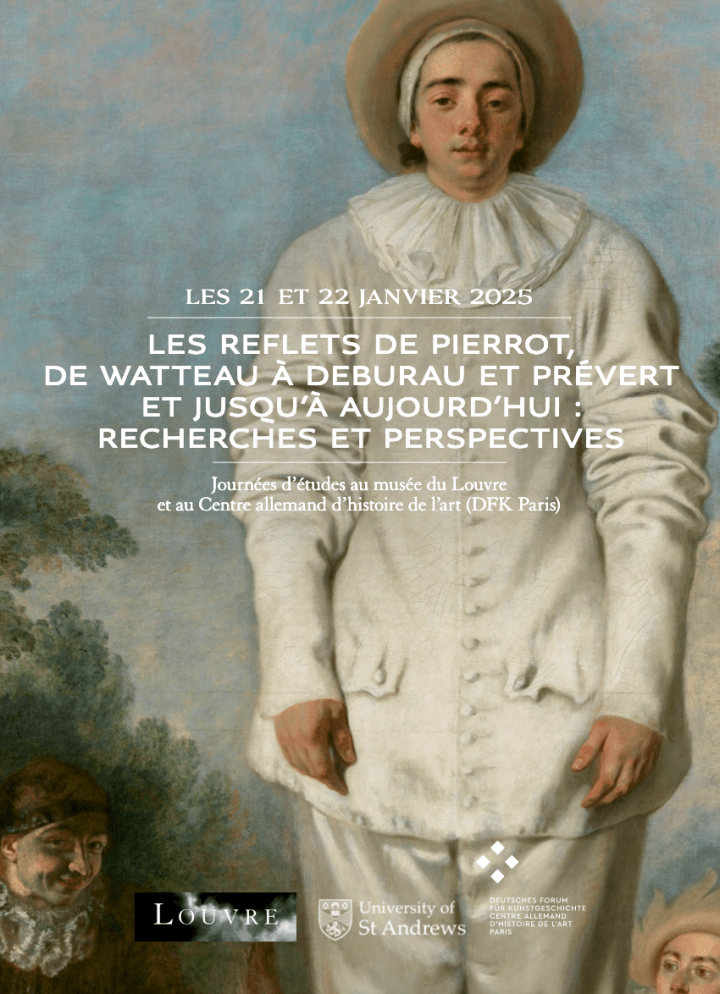 À l’occasion de l’exposition « Revoir Watteau. Pierrot dit le Gilles. Un comédien sans réplique » au musée du Louvre (du 16 octobre 2024 au 3 février 2025), dirigée par Guillaume Faroult et liée notamment à la restauration récente de la célèbre peinture attribuée à Antoine Watteau, Pierrot dit autrefois le Gilles, ces journées d’études sont organisées en collaboration par le département des Peintures du musée du Louvre et le Centre allemand d’histoire de l’art Paris, avec le soutien de l’Université de St. Andrews. Elles ont pour but d’analyser la riche histoire et les nombreuses représentations et réceptions de la figure de Pierrot dans les arts et la culture visuelle des XVIIIe au XXIe siècles. Chercheur·ses, universitaires, conservateur·rices et spécialistes de différentes disciplines ainsi que périodes sont réuni·es pour discuter de l’importance de Pierrot à partir du célèbre et énigmatique tableau du Louvre ainsi qu’en cernant le personnage visuel-théâtral-fictif dont la vogue fut considérable notamment à partir du XIXe siècle.
Pierrot était un personnage issu du répertoire de la Comédie-Italienne qui s’était fait une place sur la scène du théâtre forain, lorsqu’il retint l’attention d’Antoine Watteau au début du XVIIIe siècle. Une figure modeste, voire timide, mais récurrente dans les fêtes galantes du peintre, Pierrot est soudain représenté d’une manière monumentale sur le grand tableau du Louvre, créé probablement par Watteau dans des circonstances et pour des raisons qui restent obscures. Bien qu’aucune source de l’époque ne fasse mention de ce tableau ambitieux et singulier, il est néanmoins incontestable qu’il a participé à la fixation de la représentation de Pierrot au XVIIIe siècle dans son blanc costume et sa pose caractéristique.
L’histoire du tableau, apparu au début du XIXe siècle dans la collection de Dominique Vivant Denon, est liée à la renaissance de Pierrot en tant que personnage vedette des spectacles parisiens, récurrent tant dans d’innombrables œuvres d’art (peintures, gravures, photographies, etc.) que dans l’imaginaire littéraire ainsi que sur la scène théâtrale. Depuis le théâtre de pantomime du Paris romantique, où le personnage était incarné par le célèbre mime Jean-Gaspard Deburau, il est devenu une figure clé des spectacles « fin de siècle ». Cette mythologie vivante a reçu un hommage ultime dans le chef-d’œuvre du cinéma de l’Occupation, Les Enfants du Paradis (Marcel Carné/Jacques Prévert), sorti après la Libération de Paris. Naïf ridicule, mélancolique tuberculeux, objet de railleries ou rusé farceur — tout au long de cette histoire, l’identité de Pierrot réside autant dans sa singularité que dans sa multiplicité, et elle continue à nourrir l’imagination artistique et populaire jusqu’à l’époque contemporaine.
m a r d i , 2 1 j a n v i e r
Musée du Louvre — Session en comité restreint (sur invitation)
9.15 Accueil
10.00 Visite de l’exposition Revoir Watteau. Pierrot dit le Gilles Un comédien sans réplique
14.00 Accueil par Sébastien Allard (musée du Louvre)
14.20 Session 1
Modération Marie-Catherine Sahut (musée du Louvre)
• Pierrot : figure de l’intériorité ? — Aaron Wile (National Gallery of Art, Washington D.C.)
• À l’ombre de Pierrot, Crispin selon Watteau et ses contemporains — Guillaume Faroult (musée du Louvre)
• Pierrot et Oudry : une histoire d’identité — Hélène Meyer (musée du Louvre)
16.20 Session 2
Modération Jörg Ebeling (DFK Paris)
• « La joie du theâtre » : Pierrot dans l’œuvre de Nicolas Lancret — Axel Moulinier (Paris)
• Watteau on the Wall: The Figure of Gilles in Mural Decorations — Lars Zieke (Université d’Iéna)
• De la toile à la scène : variations pierrotiques du XIXe siècle à nos jours — Ariane Martinez (Université de Lille)
m e r c r e d i , 2 2 j a n v i e r
Centre allemand d’histoire de l’art (DFK Paris) — Session ouverte au public (dans la limite des places disponibles)
9.30 Accueil et introduction par Peter Geimer et Elisabeth Fritz (DFK Paris)
10.00 Session 3
Modération Guillaume Faroult (musée du Louvre)
• Pierrot entre deux temps : survivance, disposition, vulnérabilité, de Watteau à Édouard Manet — Marika Takanishi Knowles (University of St Andrews)
• Un petit marchand de tableaux, nommé Meunier. Commerce, brocante et œuvres d’art de la fin de l’Ancien régime au début du XIXe siècle — Oriane Lavit (musée du Louvre)
11.10 Pause café
11.30 Session 4
Modération Markus A. Castor (DFK Paris)
• Deburau Pierrot : initiateur de regards sur le Pierrot, dit Gilles de Watteau — Edward Nye (Université d’Oxford)
• Writing Watteau, Repainting Pierrot in 19th-Century Paris — Judy Sund (CUNY Emerita, New York)
12.40 Pause déjeuner
14.00 Session 5
Modération Yuriko Jackall (Detroit Institute of the Arts)
• Incarner la mélancolie : autour du Pierrot noir (1907) de Karel Myslbek — Petra Kolárová (Galerie Nationale de Prague)
• James Ensor. Pierrot au théâtre des masques — Xavier Tricot (historien d’art et commissaire des expositions à la Maison James Ensor, Ostende)
• « Le pitre sans défense ». Un écrivain regarde le Gilles (Hildesheimer/Watteau) — Peter Geimer (DFK Paris)
15.40 Pause café
16.00 Session 6
Modération Marika Takanishi Knowles (University of St Andrews)
• À la recherche du Pierrot des Enfants du paradis (1945) de Carné et Prévert — Carole Aurouet (Université Gustave-Eiffel, Champs-sur-Marne)
• Pierrot vivant. Quelques réinterprétations du motif dans l’art contemporain — Sophie Eloy (musée de l’Orangerie) et François Michaud (Fondation Louis Vuitton)
• Pierrot « to go » ? Réflexions sur une figure revenante entre introspection et projection — Elisabeth Fritz (DFK Paris)
Conference | Hand-Colouring of Natural History Illustrations, 1600–1850
From ArtHist.net:
The Hand-Colouring of Natural History Illustrations in Europe, 1600–1850
Online and in-person, University of Konstanz, 26–27 February 2025
Organized by Joyce Dixon and Giulia Simonini
This hybrid workshop will explore from different perspectives how and for what purposes printed illustrations of natural history books were hand-coloured. A special focus of the workshop will be the activities and practices of hand-colourers known also as ‘colourists’, ‘afzetters’ (in Dutch) and ‘Illuministen’ (in German), which remain until today understudied. To register, please email lea.stengel@tu-berlin.de.
w e d n e s d a y , 2 6 f e b r u a r y
9.00 Registration
9.30 Introduction / Round table
10.15 Coffee break
10.30 Panel 1 | Colourists
• Stefanie Jovanovic-Kruspel, Leah Karas, Mario Dominik Riedl (Naturhistorisches Museum Vienna) — The Role of Child Labour in Natural History Illustration
• Joyce Dixon (Independent) — ‘A School of Females’: Hand-Colourers in the Edinburgh Studio of William Home Lizars
• Luc Menapace (Bibliothèque Nationale de France) — The Hand-Colouring of Natural History Illustrations in Paris in the First Half of the 19th Century
12.45 Lunch
13.30 Panel 2 | Capturing Changeable Colours
• Cynthia Kok (Mellon Postdoctoral Fellow, Rijksmuseum) —Investigating Iridescence: Mother-of-Pearl in Early Modern Natural Illustrations
• Christine Kleiter (Deutsches Studienzentrum Venice) — How to Represent Iridescent Feathers in Hand-Coloured Prints? Colouring Practices in Pierre Belon’s L’Histoire de la nature des oyseaux (1555)
• Paul Martin (University of Bristol) — Accuracy and Consistency in Colouring of Antiquarian Ichthyology Engravings
15.30 Coffee break
15.45 Panel 3 | Colours in Botanical Illustrations
• Jessie Wei-Hsuan Chen (Royal Netherlands Academy of Arts and Sciences) — Which Color Comes First? Hand-Colouring Gradations on Plants in the 16th and 17th Centuries
• Magdalena Grenda-Kurmanow (Academy of Fine Arts Warsaw) —Ultimate Documentation: Between a Plant Illustration and a Botanical Specimen
• Eszter Csillag (HKBU Jao Tsung I Academy of Sinology) — Michael Boym’s Hand-Coloured Images in Flora sinensis (Vienna, 1656)
19.30 Dinner
t h u r s d a y , 2 7 f e b r u a r y
9.00 Keynote Address
• Alexandra Loske (Curator of the Royal Pavilion, Brighton) — Botanical Illustrator, Flower Painter, and Colour Theorist: Mary Gartside’s Path from the Figurative to the Abstract in Her Early 19th-Century Illustrated Books
10.00 Coffee break
10.15 Panel 4 | Working Processes
• Katarzyna Pekacka-Falkowska (Poznan University of Medical Sciences) — The Colours of Nature in Early 18th-Century Danzig/Gdańsk: Johann Philipp Breyne, Jacob Theodor Klein, and the Hand-Coloured Illustrations
• Cam Sharp Jones (British Library) — Colouring Seba’s Thesaurus
• Giulia Simonini (Technische Universität Berlin) — The Master Plates for August Johann Rösel von Rosenhof’s Insecten-Belustigung: A Family Enterprise
12.15 Lunch
13.00 Closing remarks and discussion
Exhibition | Keeping Time: Clocks by Boulle

Attributed to André-Charles Boulle, movement by Claude Martinot, Mantel clock with Father Time (detail), ca. 1726
(London: The Wallace Collection)
◊ ◊ ◊ ◊ ◊
From the press release for the exhibition (and note the study day on January 31) . . .
Keeping Time: Clocks by Boulle
The Wallace Collection, London, 27 November 2024 — 2 March 2025
Curated by Alexander Collins
For the first time, the Wallace Collection has brought together its clocks by André-Charles Boulle (1642–1732), one of history’s greatest designers and cabinetmakers, in a display that explores the art and science of timekeeping. Five exceptional timepieces tell the story of how Boulle took advantage of scientific discoveries to create unique clock designs, whose influence spread throughout the world and across the centuries.
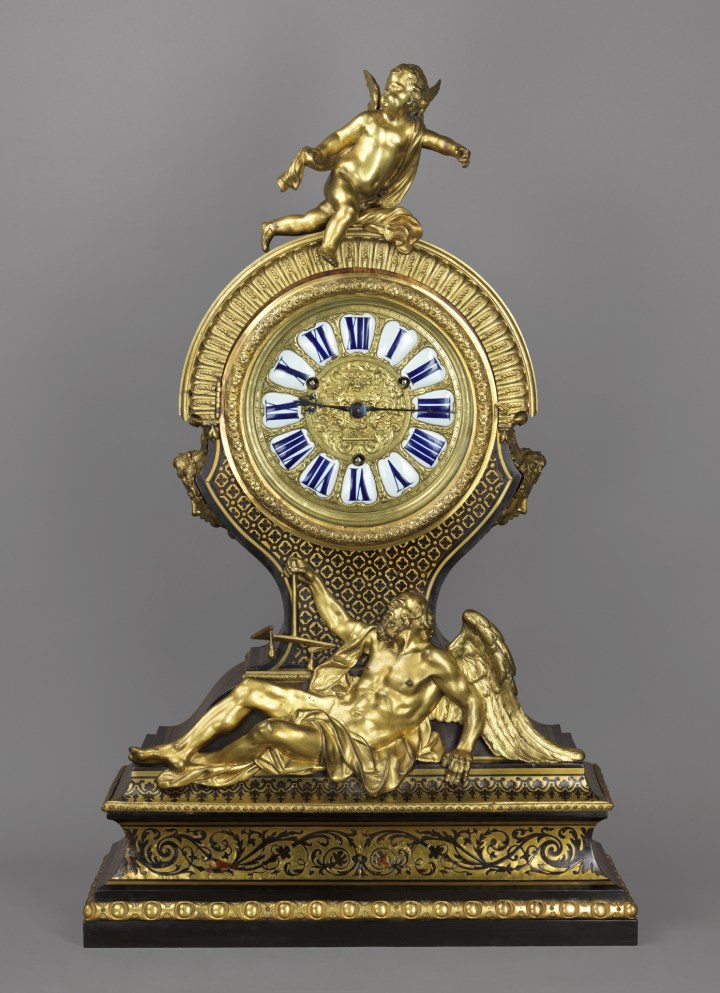
Attributed to André-Charles Boulle, movement by Claude Martinot, Mantel clock with Father Time, ca. 1726 (The Wallace Collection).
As the most famous cabinetmaker working for the court of the Sun King, Louis XIV (1638–1715), Boulle would eventually give his name to the specific style that signified the glittering spectacle of the Baroque—elaborate veneer designs incorporating turtleshell, brass, and other materials. Alongside his work as a royal furniture maker, Boulle also turned his attention to the clock, the accuracy of which had recently been revolutionised through the invention of the pendulum by Dutch scientist Christiaan Huygens (1629–1695) in 1656. As these sweeping weights called for larger clock cases, Boulle saw the opportunity to create bold and sumptuous designs.
Due to his position at court, Boulle was exempted from strict guild regulations, allowing him to work with great creative freedom. This artistic liberty was incredibly important, as the clocks not only had to demonstrate the wealth of their owners through the most luxurious materials available, but also had to show how intellectual they were. Therefore, Boulle infused his designs with narratives that chimed with scientific knowledge. Time and the natural laws of the universe are personified, for example Father Time as a bearded old man, and the Continents as figures from across the world. As well as creating innovative iconography, Boulle also reflected on the history of timekeeping by incorporating motifs such as gothic hourglasses in his clock cases.
The clocks are also products of collaboration involving the multi-disciplinary efforts of artists and craftspeople from all over 18th-century Paris. Each clock has a mechanism by a different leading clockmaker from Boulle’s time: Pierre Gaudron (died 1745), Jean Jolly (active about 1698), Claude Martinot (active about 1718), Louis Mynuël (1675–1742) and Jacques-Augustin Thuret (1669–1739). Some of these were Boulle’s neighbours in the workshops of the Louvre, as well as François Girardon (1628–1715), the king’s official sculptor, who supplied mounts of Father Time for Boulle’s clocks.
The clocks on display show the wide range of objects that Boulle turned his hand to. A monumental wardrobe from 1715 that encloses a clock, crowned with cherubs; two mantel clocks, one from around 1715 featuring Venus and Cupid, and another, from a decade later, with the figure of Father Time; as well as two extraordinary pedestal clocks.
The display opens ahead of an international conference on Boulle, to be held at the Wallace Collection in early 2025. One of the first major research events on the cabinetmaker in recent years, it will bring together specialists and conservators to consider the work of this fascinating artist, all within the same building where some of his greatest artistic achievements can be found.
Many of Boulle’s contemporaries also drew on the concept of time in their work. This will be explored in a complementary display in the museum’s Billiard Room, which is uniting two magnificent artworks: The Dance to the Music of Time (about 1634–36) by Nicolas Poussin (1594–1665), in which the Four Seasons dance to the song of Father Time, the composition of their rhythmic bodies echoing the workings of a clock movement; and The Borghese Dancers (1597–1656), where five female figures masquerade as the Hours, attendants to the goddesses of the Dawn and Moon.
Xavier Bray, Director of The Wallace Collection, says: “I am absolutely thrilled to be bringing great works of art by Boulle together for the first time. These clocks were at the cutting edge of 18th-century technology, combining exquisite artistry and mechanical expertise into a unique and innovative blend. Through Boulle’s clocks and the display, we hope visitors will be able to transport themselves into the world of Louis XIV, where luxury touched every element of the court, including something as essential and practical as timekeeping.”
Alexander Collins, Curatorial Assistant at the Wallace Collection and curator of the display, says: “Our research on these objects has revealed many unknown facets of their history, including bringing to life the multitude of artists and craftspeople who came together to make Boulle’s vision into a reality. The passage of time as a metaphor for life and death has been an important theme for artists since humanity discovered their creativity, and Boulle’s designs are important, and resonate with us today, because of this deep symbolism.”
◊ ◊ ◊ ◊ ◊
Boulle Study Day
Online and in-person, Friday, 31 January 2025
Delve into the world of baroque France and learn more about Boulle’s furniture with leading specialists, including curators and conservators from the Palace of Versailles, the Château de Chantilly, and C2RMF. You’ll explore the evolution of Boulle’s iconic designs, his materials and techniques, and his enduring legacy. This in-person event at the Wallace Collection will also be broadcast live on Zoom. Ticketholders will receive a link to a recording of the event, which will be available for two weeks. Full programme to follow: 10.00–17.00 GMT, with a drinks reception until 19.00.
Registration is available here»
Conference | Travel Narratives and the Artistic Heritage of Dalmatia
From ArtHist.net:
Travel Narratives and the Fashioning of a Dalmatian Artistic Heritage, ca. 1675–1941
The Institute of Art History – Cvito Fisković Centre, Split, 12–14 December 2024
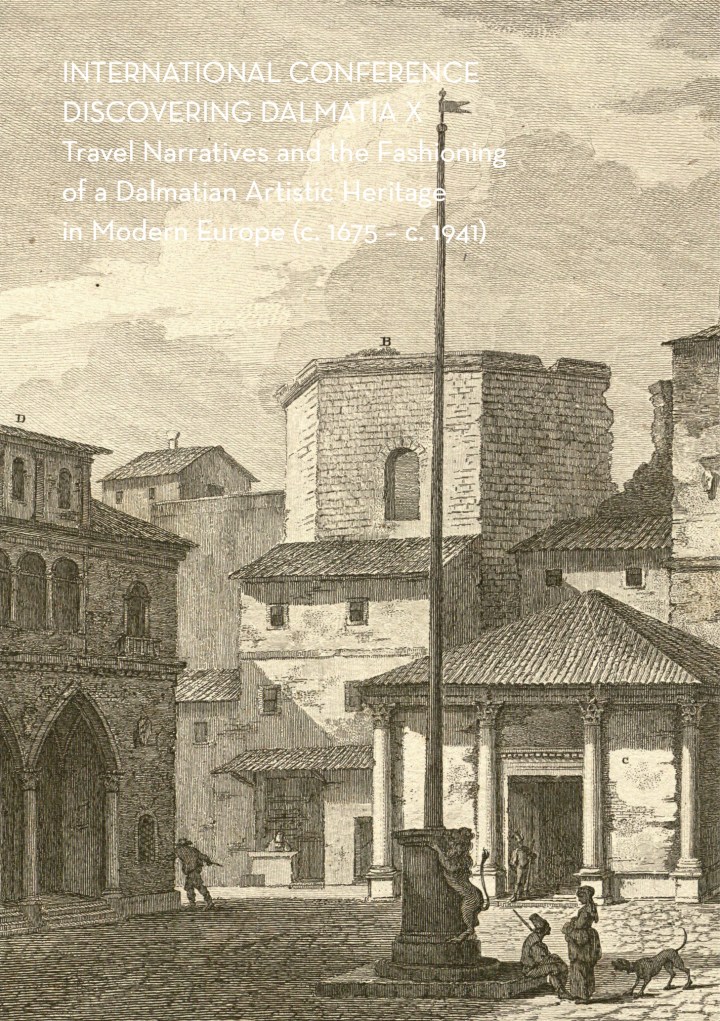 Conceived and organised as part of the Croatian Science Foundation (HRZZ) project TraveloguesDalmatia of the Institute of Art History, led by Dr Ana Šverko.
This conference brings together historians and theorists of art, architecture, urbanism, literature, anthropology, and ethnology, and other experts engaged in travel narratives. It aims to explore travel as an autonomous multidisciplinary and multimedia practice, as well as to investigate how perceptions of Dalmatia in the European imagination have been shaped through various travel narratives. These narratives span diverse genres, recording media, authorial backgrounds, and travel motivations.
t h u r s d a y , 1 2 d e c e m b e r
9.30 Introductions
• Vesna Bulić Baketić (Split City Museum)
• Ivana Vladović (Tourist Board of Split-Dalmatia County)
• Ana Šverko (Institute of Art History – Cvito Fisković Centre Split)
Conference Opening
• Renata Schellenberg: Living the Journey Twice: Travel Writing as Genre
10.30 Session 1 | Changing Perceptions of Dalmatia in Travel Narratives, 17th to the 20th Century
Moderators: Joško Belamarić and Sanja Žaja Vrbica
• Jesse Howell — Disorientation, Friction, and Anxiety in Dalmatian Travel Narratives
• Ulrike Tischler-Hofer — ‘Dalmatia Is His Majesty’s Passive Province… and Will Remain So for at Least Another 20 Years’ (1803): Mutual Perception and Rejection in Times of Transition, 1797–1815
• Mateo Bratanić — Early 20th-Century British Travel Writers in Dalmatia: The Change of Perspective
11.30 Coffee Break
12.00 Session 2 | The Evolution of Travelogues in the 18th and 19th Centuries, Part 1
Moderators: Ana Šverko and Irena Kraševac
• John Pinto — Advent’rous in the Sacred Search of Ancient Arts
• Frances Sands — Travels of the Mind: Travel Literature at Sir John Soane’s Museum
• Nataša Urošević — Dalmatian Journeys: Discovering Dalmatia on the Route of the Lloyd’s Steamers
13.30 Lunch Break
17.30 Presentation of the TraveloguesDalmatia Project
18.30 Journal Promotion — Život umjetnosti (Life of Art), Volume 113, No. 2 (2023)
f r i d a y , 1 3 d e c e m b e r
9.00 Walking Tour: Diocletian’s Palace
10.45 Introduction
11.00 Session 3 | The Evolution of Travelogues in the 18th and 19th Centuries, Part 2
Moderators: Mateo Bratanić and Mirko Sardelić
• Renata Schellenberg — Travel Reading and Travel Writing: Johann Georg Kohl’s Journey through Dalmatia (1851)
• Irena Kraševac — Arthur Rössler and Bruno Reiffenstein Discover Dalmatia on Their 1905 Journey
• Maciej Czerwiński — Competing Travel Narratives on Dalmatia: Giuseppe Modrich and Izidor Kršnjavi
12.20 Coffee Break
12.40 Session 4 | Travel Drawings: Shaping the Genre’s Definition, Part 1
Moderators: Frances Sands and Marko Špikić
• Ana Šverko — Before Spalatro: Clérisseau and Adam’s 1757 Journey from Rome to Split
• Svein Mønnesland — European Landscape Painters Discover a ‘Norwegian Fjord’, the Gulf of Kotor, 1810–1875
• Joško Belamarić — Sir John Gardner Wilkinson’s Gaze on Diocletian’s Palace
13.40 Coffee Break
14.00 Session 5 | Travel Drawings: Shaping the Genre’s Definition, Part 2
Moderators: Joško Belamarić and Ana Šverko
• Sanja Žaja Vrbica — Viennese Women Painters in the South of the Monarchy
• Elke Katharina Wittich — ‘Blue Sea and Black Mountains’: Visual Topoi in Travelogues and Guidebooks from the Mid-19th Century to the End of the First World War
• Nataša Ivanović — Genius Loci of Dalmatia in Zoran Mušič’s Oeuvre
15.30 Lunch Break
16.30 Visit to the Gallery of Fine Arts
s a t u r d a y , 1 4 d e c e m b e r
9.45 Introduction
10.00 Session 6 | Discovering Dalmatia: Identity through the Travel Narrative Lens, Part 1
Moderators: Mateo Bratanić and Elke Katharina Wittich
• Marko Špikić — Jacob Spon’s Language of Discovery of the Eastern Adriatic’s Cultural Heritage
• Frane Prpa — Maximilian de Traux and His Description of the Interior Regions of Dalmatia
• Antonia Tomić — Drniš: The Meeting Place of East and West
11.00 Coffee Break
11.20 Session 7 | Discovering Dalmatia: Identity through the Travel Narrative Lens, Part 2
Moderators: Marko Špikić and Ana Šverko
• Franciska Ćurković-Major and Boris Dundović — Professional Trip of the Society of Hungarian Engineers and Architects to Dalmatia in 1895: A Travel Account by Gyula Sándy
• Brigitta Mader — Through the Eyes of a Prehistorian: Josef Szombathy’s Photo Journeys through Dalmatia, 1898–1912
• Mirko Sardelić — Alice Lee Moqué’s Delightful Dalmatia
12.20 Discussion and Closing Remarks
13.00 Closing Reception
15.00 Visit to the Meštrović Gallery
Scientific Committee
Basile Baudez (Princeton University, Department of Art and Archaeology)
Joško Belamarić (Institute of Art History – Cvito Fisković Centre Split)
Mateo Bratanić (University of Zadar, Department of History)
Iain Gordon Brown (Honorary Fellow, National Library of Scotland)
Hrvoje Gržina (Croatian State Archives)
Katrina O’Loughlin (Brunel University London)
Cvijeta Pavlović (University of Zagreb, Faculty of Humanities and Social Sciences, Department of Comparative Literature)
Frances Sands (Sir John Soane’s Museum)
Marko Špikić (University of Zagreb, Faculty of Humanities and Social Sciences, Department of Art History)
Ana Šverko (Institute of Art History – Cvito Fisković Centre Split)
Elke Katharina Wittich (Leibniz Universität Hannover)
Organising Committee
Joško Belamarić (Institute of Art History – Cvito Fisković Centre Split)
Tomislav Bosnić (Institute of Art History – Cvito Fisković Centre Split)
Mateo Bratanić (University of Zadar, Department of History)
Ana Ćurić (Institute of Art History)
Matko Matija Marušić (Institute of Art History)
Katrina O’Loughlin (Brunel University London)
Cvijeta Pavlović (University of Zagreb, Faculty of Humanities and Social Sciences)
Ana Šverko (Institute of Art History – Cvito Fisković Centre Split)










 Enfilade
leave a comment