Conference | The Window as Protagonist

Eric Ravilious, Beachy Head Lighthouse (Belle Tout), 1939, pencil and watercolour on paper (Christie’s Images / Bridgeman Images).
◊ ◊ ◊ ◊ ◊
From the Mellon Centre:
The Window as Protagonist in British Architecture and Visual Culture
Online and in-person, Paul Mellon Centre and The Warburg Institute, London, 21–22 November 2024
Organized by Rebecca Tropp
This two-day conference will explore the multifaceted, multi-purpose nature of the window as protagonist, with an emphasis on its place in British architecture and visual culture, broadly conceived. A range of interdisciplinary papers presented by international scholars will provide a platform for dynamic and engaging discourse that forefronts the cultural and social significance of the window in its many guises as object, as boundary, as frame, and as mediator.
More information is available here»
t h u r s d a y , 2 1 n o v e m b e r
Paul Mellon Centre
Panel 1 | Visions of Light
• Benet Ge (student, Williams College) — Looked Through: Edward Orme’s Transparent Prints and Masculinizing Georgian Windows, remote
• Francesca Strobino (independent) — The Window as a Test Object: W.H.F. Talbot’s Early Photographic Experiments with Latticed Patterns, remote
• Victoria Hepburn (postdoctoral associate, Yale Center for British Art) — A ‘Luminous Framework’ but not ‘Glass of a Modern Kind’: William Bell Scott’s Painted Windows for the Ceramic Gallery at the South Kensington Museum, remote
Panel 2 | Social Relations
• Shaona Barik (assistant professor of English literature at Visva-Bharati, Santiniketan, India) — Health, Hygiene, Sanitation in Colonial Bengal: Case Study of Windows, 1860–1920, remote
• Albie Fay (writer) — Through the Broken Glass: The Window as a Symbol of Social Unrest in Britain and Northern Ireland
• Ellie Brown (PhD candidate, University of Warwick) — The Window as a Frame and Boundary in the Shopping Centre
f r i d a y , 2 2 n o v e m b e r
The Warburg Institute
Panel 1 | The Art of Display: From Museums to Shop Windows
• Laura Harris (Senior Research Fellow, University of Southampton) — Art Gallery Windows
• Naomi Polonsky (assistant curator, House and Collection, Kettle’s Yard) — ‘The Vision of the Mind’: Windows In and Out of Art at Kettle’s Yard
• Alexandra Ault (Lead Curator of Manuscripts, 1601–1850, British Library) — Re-glazing the Print Shop Window: The Impact of Glass Technology on the Commercial Display of Fine Art Prints, ca. 1850–1900
• Birgitta Huse (social anthropologist, independent researcher) — More Than a Glimpse ‘In Passing’: Reflecting on Shop Windows as Provocateurs between Art, Commerce, and Cultural Traditions
Panel 2 | Architectural Manipulation
• Steven Lauritano (lecturer in architectural history, Leiden University) — Windows of Learning: Robert Adam, William Henry Playfair, and the Old College, University of Edinburgh
• Rebecca Tropp (archivist, Crosby Moran Hall and former Research and Events Convener at the Paul Mellon Centre) — Windows and the Picturesque
Panel 3 | Transparency and Materiality
• Alice Mercier (PhD researcher, University of Westminster) — Photographic Looking before Photographs: Watching through Windows in the Early-mid Nineteenth Century, remote
• Ruth Ezra (lecturer in art history, University of St Andrews) — Muscovy Glass, from Fenestration to Demonstration
• Deborah Schultz (senior lecturer in art history, Regent’s University London) — The Window as a Lens in the Work of Anna Barriball
Panel 4 | Cinematic and Literary Horrors
• Vajdon Sohaili (assistant professor of art history and contemporary culture, Nova Scotia College of Art and Design University) — Glass, Darkly: Equivocal Windows and the Architectural Paratext in Don’t Look Now
• Francesca Saggini (professor in English literature at the Università della Tuscia) — The Horror at the Window
Conference | Sacred Silver in Southeast Europe, 15th–19th Centuries
From ArtHist.net and the conference website:
Southeast European Silversmithing: Artisans, Donors, and Piety in the Early Modern Period
Sofia, Bulgaria, 17–18 October 2024
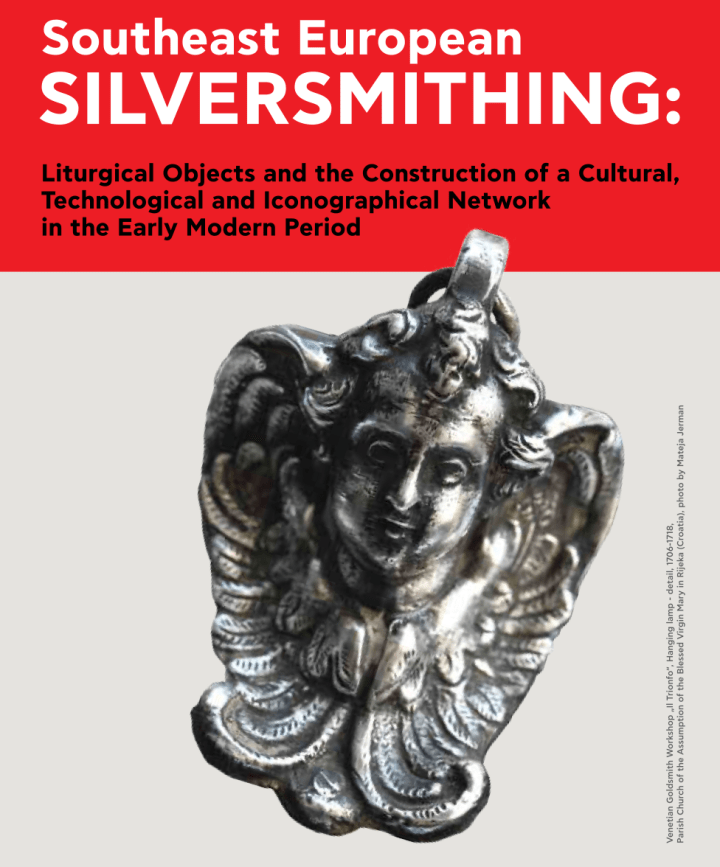 The international conference Southeast European Silversmithing: Artisans, Donors, and the Concept of Piety during the Early Modern Period will gather specialists studying sacral silver objects from the early modern period who, through their research, contribute to the field of applied arts with religious use. The scientific forum will enable the presentation of sacral silver objects still unpublished and unknown to the academic community. It will stimulate the comparative analysis of silversmiths’ works in wide geographic regions, which will also help improve the methodological means of their interpretation. A more meticulous approach to this field will represent a valuable contribution to art historical scholarship and a more comprehensive understanding of the visual culture of the early modern period.
Twenty-six specialists from prestigious organisations, universities, and cultural institutions from Austria, Armenia, Bulgaria, Greece, Italy, the Netherlands, Romania, the USA, Serbia, and Hungary will discuss issues related to the production and circulation of liturgical objects, as well as their role in shaping the pious image of the faithful in Southeastern Europe between the 15th and 19th centuries. The conference is organised within the framework of the project Liturgical Objects in the Context of Silversmiths’ Art during the Ottoman Period (Based on Materials from the Diocese of Plovdiv), funded by the Bulgarian National Science Fund, Ministry of Education and Science of the Republic of Bulgaria (contract No. КП-06-М80/2/7.12.2023).
Academic Committee
• Darina Boykina, PhD, Institute of Art Studies, Bulgarian Academy of Sciences, Bulgaria
• Mateja Jerman, PhD, Ministry of Culture and Media of the Republic of Croatia and Faculty of Humanities and Social Sciences, University of Rijeka, Croatia
• Vuk Dautović, PhD, University of Belgrade, Serbia
t h u r s d a y , 1 7 o c t o b e r
Institute of Ethnology and Folklore Studies with Ethnographic Museum, Bulgarian Academy of Sciences
9.30 Registration
10.00 Welcome
10.15 Constructing Piety
Chair: Vuk Dautović
• Dimitris Liakos — Constructing the Pious Image in Southeastern Europe at the Turn of an Era: Valuable Objects as Gifts to Athonite Monasteries from the 15th to the 16th Century
• Miljana Matić — Monks as Authors and Donors of Applied Art Objects (15th–17th Centuries) from the Serbian Orthodox Church Museum Collection
• Darina Boykina — Artisans’ Patronage: The Case of the Guild of Silversmiths in Tatar Pazardzhik during the Early Modern Period
11.30 Coffee Break
11.50 Personal and Collective Patronage
Chair: Teodor Lucian Lechintan
• Nikolaos Mertzimekis — The Silver Cover of the Gospel of Tsar Alexei Mikhailovich (1645–1676) in the Sacristy of the Iviron Monastery
• Paschalis Androudis — On a Pair of Candlesticks from the Metropolitan Church of Kastoria, 1708
• Nicoleta Bădilă — Donors’ Portraits from the Silver Liturgical Fans from Wallachia
• Nona Petkova — Examples of Faith and Community Belonging: Eucharistic Chalices from the National Church Museum of History and Archaeology in Sofia
13.30 Lunch
15.00 Influential Objects: Appearance and Morphology
Chair: Livia Stoenescu
• Mila Santova — Once Again about the Gospel Covers from the Teteven Monastery of Prophet Elijah (Teteven Gospel Covers from 1675)
• Georgi Parpulov — Two Romanian Ciboria at the Sinai Monastery
• Mariam Vardanyan — Innovative Tendencies in the Art of Armenian Book Binding: Myrophores Gospels Bindings
16.15 Coffee Break
16:30 Silver Objects as Emissary: Circulation, Diplomacy, and Gifts
Chair: Paschalis Androudis
• Mateja Jerman — Goldsmiths’ Works as Gifts to Our Lady of Trsat (Croatia)
• Milena Ulčar — Collective Patronage of St. Tryphon’s Head Reliquary in Venetian Kotor
• Arijana Koprčina — Gifts of Bishop Emerik Esterházy to Zagreb (Arch)diocese
• Francesca Stopper — La Serenissima and the Papal States: Liturgical Objects as Diplomatic Gifts in the 18th Century
f r i d a y , 1 8 o c t o b e r
Institute of Art Studies, Bulgarian Academy of Sciences
9.30 Patrons and Silversmith Creating Visual Culture
Chair: Darina Boykina
• Dragoş Năstăsoiu — Cross-confessional Artistic Negotiation: Transylvanian Saxon Silversmith Masters and Their Orthodox Patrons in 14th to 17th-Century Wallachia and Moldavia
• Teodor Lucian Lechintan — On Some Early Modern Silver Revetments of Romanian Icons: Donors, Techniques, Horizons
• Vuk Dautović — Silver Votive Offerings of 19th-Century Serbian Rulers: Shaping Church Visual Culture and their Role in Changing Cultural Models
10.45 Coffee Break
11.00 Silversmithing Centers and Production of the Liturgical Object
Chair: Mila Santova
• Stavroula Sdrolia, Paschalis Androudis — 17th-Century Goldsmiths’ Enamelled Production in Thessaly
• Barbara Kamler-Wild — Silversmithing in Vienna in the Golden Age of Empress Maria Theresia
• Livia Stoenescu — To Be Worth a Potosí: Mines, Wealth, and Global Crafting of Silver Liturgical Objects in Early Modernity
12.15 Coffee Break
12.30 Silver Embodying Sanctity
Chair: Milena Ulčar
• Konstantinos Dolmas — Like a Second Skin: The Head-Reliquary of St. Kliment of Ohrid
• Simeon Tonchev — The Reliquary from the Church ‘Mother of God the Fountain of Life’ in Svilengrad and Its Context
13.20 Lunch
15.00 Imagery and Iconography
Chair: Mateja Jerman
• Anna Mária Nyárádi — Images Between the Latin and Greek Worlds. Prints and Book Illustrations as Models for Gospel Covers
• Iglika Mishkova — Bread Stamps
• Carmen Tănăsoiu — Behold the Lamb of God: About a Certain Iconographic Type Found on Diskoi from the Collection of the National Museum of Art of Romania
• Ruth Bryant — Analyzing the Torah Shield: Understanding the Abundance of Animal Imagery through the Zohar
16.45 Closing Remarks
Conference | Marble as Device
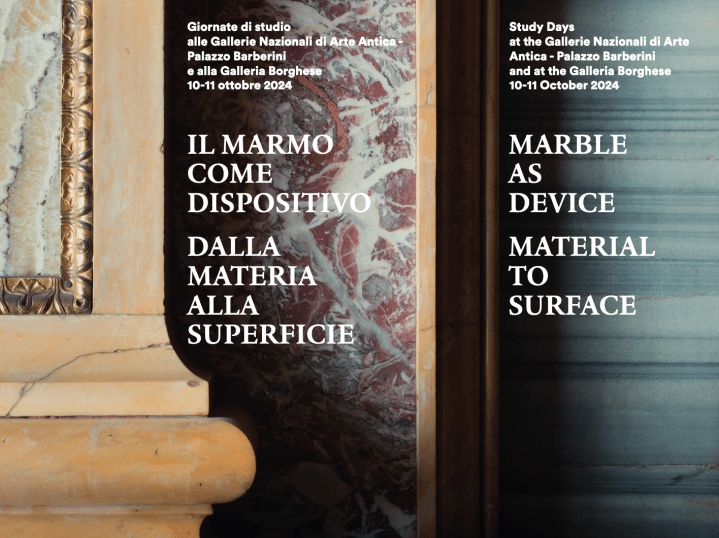
From the conference programme and ArtHist.net:
Marble as Device: Material to Surface / Il Marmo Come Dispositivo: Dalla Materia alla Superficie
Gallerie Nazionali di Arte Antica –Palazzo Barberini / Galleria Borghese, Rome, 10–11 October 2024
Organized by Adriano Aymonino, Geraldine Leardi, and Ariane Varela Braga
DAY 1 | Marble offers the ideal medium to investigate human dexterity in combining materiality and immaterial meanings. Frequently studied from various perspectives—from quarry extraction, distribution networks, and processing techniques, to aesthetic values and socio-cultural or olitical uses—more recently marble has been analysed as a powerful expressive medium straddling iconicity and aniconism, structure and ornament. Following on from the inaugural NeReMa meeting held in Rome in 2021, this study day will bring together international scholars to reflect on the theme of marble as ‘device’, a notion that allows an interdisciplinary approach to the study of this transversal artistic and architectural medium in the Mediterranean-European world: from the more concrete aspects of setting up the material components, to the intrinsic and expressive qualities of marble surfaces.
DAY 2 | ‘Device’ is a complex word, rich in possibilities, which allows broad interpretative approaches. The first part of this second study day will therefore be devoted to two less conventional subjects in the field of marble studies: ‘marbles and stones on paper’, focusing on an analysis of the famous manuscript Study of Many Stones by Pier Leone Ghezzi (1726), along with a discussion of works by contemporary artists who employ marble, or its conceptual bearings, as a ‘device’ for their creativity. The afternoon session will start with a roundtable addressing the launch of the volume La Galleria Borghese nei suoi marmi: Materia Colore Superficie (Allemandi), followed by a presentation of an ongoing digital project on ancient marbles and stones led by the Galleria Borghese. The day closes with a tribute to Raniero Gnoli, the founding father of modern studies on ancient marble, and a tour of the Galleria Borghese.
Registration is available through Eventbrite.
t h u r s d a y , 1 0 o c t o b e r
Gallerie Nazionali di Arte Antica –Palazzo Barberini
9.00 Registration
9.30 Francesca Cappelletti and Geraldine Leardi — Welcome and Introduction
10.00 Struttura e Forma / Structure and Form
Modera: Alessandro Poggio
• Rafael Rosenberg — Book-Matching: Why Are Stone Slabs Laid Symmetrically, and since When?
• Ruggero Longo — Materia e forma: Superfici marmoree nel Mediterraneo medievale
• Silvia Pedone — ‘Le parole e i marmi’: Estetica e colore a Bisanzio
11.30 Pausa Caffè
12.00 Teoria e Percezione / Theory and Perception
Modera: Daniela del Pesco
• Joris van Gastel — Le piume del pavone: Verso un’estetica della ricezione del commesso marmoreo napoletano
• Marthe Kretzschmar — „Je feiner das Korn ist, desto vollkommener ist der Marmor“: Winckelmann’s Description of Marble between Aesthetics and Mineralogy
13.30 Pranzo
15.00 Materia e Superficie / Materiality and Surface
Modera: Sara Bova
• Vitale Zanchettin — Michelangelo, le verità della pietra: Architetture oltre la superficie
• Grégoire Extermann — Importazione o continuità? Il dispositivo ‘romano’ della Casa de Pilatos a Siviglia
16.00 Pausa Caffè
16.30 Trasformazione e Display / Transformation and Display
Modera: Anna Frasca-Rath
• Christine Casey — From Mountainside to Fireside: Supplying and Working Marble for the British Interior, 1700–1770
• Ariane Varela Braga — Il marmo in mostra tra fine Ottocento e inizio Novecento
f r i d a y , 1 1 o c t o b e r
Galleria Borghese
10.00 Registration
10.20 Francesca Cappelletti and Geraldine Leardi — Welcome and Introduction
10.30 Nicola Samorì — Mal di pietra: Il corpo minerale tra geodi e fratture
11:00 Jo Stockham — Fluid Rock, Marble Stilled
11.30 Pausa Caffè
12.00 Adriano Aymonino — Rappresentare le pietre di Roma: Marmi su carta nel Settecento
12.30 Paolo Bertoncini Sabatini — Materia e significato: Il marmo in termini estetici e progettuali nell’allestimento di mostre temporanee
13.30 Pranzo
15.00 Tavola Rotonda | Presentazione del volume La Galleria Borghese nei suoi marmi. Materia Colore Superficie, a cura di Geraldine Leardi
Intervengono: Fabio Barry, Dario Gamboni, Lorenzo Lazzarini, Sophie Mouquin
17.00 Pausa Caffè
17.30 Geraldine Leardi e Adriano Aymonino — Presentazione del progetto di un database su litoteche storiche e marmi antichi
18.00 Proiezione del documentario | Le Pietre e le Parole: Ritratto di Raniero Gnoli, di Adriano Aymonino e Silvia Davoli + Q&A
18.30 Tour per conoscere i marmi della Galleria Borghese con Geraldine Leardi e Lorenzo Lazzarini
Conference | The Roman Drawings of Charles Percier
From ArtHist.net:
The Rome Drawings of Charles Percier and their Afterlife
Online and in-person, Zentralinstitut für Kunstgeschichte, München, 18–19 October 2024
Organized by Georg Schelbert and Sabine Frommel

Charles Percier, Unidentified Villa (Paris: Bibliothèque de l’Institut de France, MS 1008 fol. 2r num. 3).
Charles Percier (1764–1838) was one of the most influential architects and architectural theorists in France in the decades before and after 1800. In addition to his formative role as Napoleon’s architect, together with Pierre François Léonard Fontaine, his influence lies above all in his teaching activities, from which pupils such as J. Hittorf, P. Letarouilly, and A. de Montferrand emerged.
As in the case of many other European architects of the multifaceted 19th century, his personal experience of art and architecture in Italy was fundamental to his work. Honoured with the grand prix of the Académie royale d’Architecture, Percier stayed in Rome from 1786 to 1791, studying important architectural monuments there and in the surrounding area. He used his return journey on foot to Paris to familiarise himself with the architecture of central and northern Italy. During this time, he created a total of around 2000 drawings, a wide-ranging documentation that reflects the influence of new compositional methods and served both for his own training and as model material, and as such fulfilled a didactic function.
This largely unpublished material clearly reveals Percier’s comprehensive view, which encompasses architecture, sculpture, ornament, and gardens and spans a broad chronological horizon from antiquity to contemporary art at his time. These experiences flowed into an architectural theory that he anchored primarily in Roman palace construction. Conference contributions will shed light on various aspects of his oeuvre, primarily on the basis of drawings from his Roman period. Talks will also call attention to Percier’s European significance, which is also reflected in projects in the Polish lands and, not least, in the fact that the visual appearance of the young kingdom in Bavaria was placed in the hands of Napoleon’s architect.
The conference is part of a larger programme of work on the publication of Percier’s drawings made in Italy, most of which are in the Institut de France. The volumes Emilia e Romagna (2016) and Toscana, Umbria e Marche (2021) have already been published in the series I disegni di Charles Percier. Organized by Georg Schelbert (Zentralinstitut für Kunstgeschichte) and Sabine Frommel (EPHE-PSL, Paris), the conference will be held in English, Italian, French, and German. Please send questions to percier@zikg.eu.
The event will be broadcast in parallel via Zoom. Recording of the event or parts of the event as well as screenshots are not permitted. By participating, you accept these terms of use.
f r i d a y , 1 8 o c t o b e r
12.30 Registration
13.00 Introduction
• Sabine Frommel (EPHE-PSL, Paris) and Jean-Philippe Garric (Panthéon Sorbonne, Université Paris 1)
13.30 Section 1 | Percier in Rome — Villas and Gardens: Nature, Ornament, and Architecture
Chair: Christine Tauber (Zentralinstitut für Kunstgeschichte, Munich)
• Sabine Frommel (EPHE-PSL, Paris) — Lo sguardo del Rinascimento nei disegni di Charles Percier
• Alberta Campitelli (Vice President Associazione Parchi e Giardini d’Italia, Rome) — Ville e giardini del Grand Tour: un itinerario d’obbligo
• Alessandro Cremona (Sovrintendenza Capitolina, Rome) — Non solo ‘célèbres maisons de plaisance’: le ville e i giardini ‘minori’ nei taccuini di viaggio di Charles Percier
15.00 Coffee break
• Steffi Roettgen (Ludwig Maximilians-Universität Munich) — Zeichnungen zur Villa Albani und deren Antiken
• Susanna Pasquali (Università La Sapienza, Rome) — Roman Villas and Gardens in the Drawings by Hubert Robert, Pierre Adrien Pâris, and Charles Percier (1750–90)
• Iris Lauterbach (Zentralinstitut für Kunstgeschichte, Munich) — Les jardins de Rome vues par l’Europe: Les dessins de Percier dans leur contexte
18.15 Keynote Lecture
• Jean-Philippe Garric (Panthéon Sorbonne, Université Paris 1) — Learning by Drawing: The Albums of Charles Percier at the Institut de France
s a t u r d a y , 1 9 o c t o b e r
9.00 Section 2 | Percier and Europe
Chair: Sabine Frommel (EPHE-PSL, Paris)
• Mario Bevilacqua (Università La Sapienza, Rome) — Percier Reads and Corrects Piranesi: The Drawings of the Priorato
• Georg Kabierske (Philipps-Universität Marburg) — Drawing, Copying, and Collecting Architectural Ornaments in Rome: The Generation of Percier and Before
• Georg Schelbert (Zentralinstitut für Kunstgeschichte Munich) — Charles Percier and Prussia: Ludwig Theodor Liman
11.00 Coffee break
• Sabina de Cavi / Hélder Carita (Universidade Nova, Lisbon) — The Quinta da Praia: New Drawings by Charles Percier for a Villa in Belèm (1815)
• Pawel Migasiewicz (Instytut Sztuki, Polska Akademia Nauk, Warsaw) — Architectural Drawings by Charles Percier, Pierre François Léonard Fontaine, and Alexandre Dufour for Polish Patrons
• Hans Ottomeyer (Munich) — Das Königreich Bayern: Percier und die Folgen
13.30 End
Conference | Extra Extra! The Visually Altered Book
This weekend at The Huntington . . . with more information at this Huntington blog posting by Park and Smyth:
Extra Extra! The Material History of the Visually Altered Book
The Huntington Library, Art Museum, and Botanical Gardens, San Marino, 27–28 September 2024
Organized by Julie Park and Adam Smyth
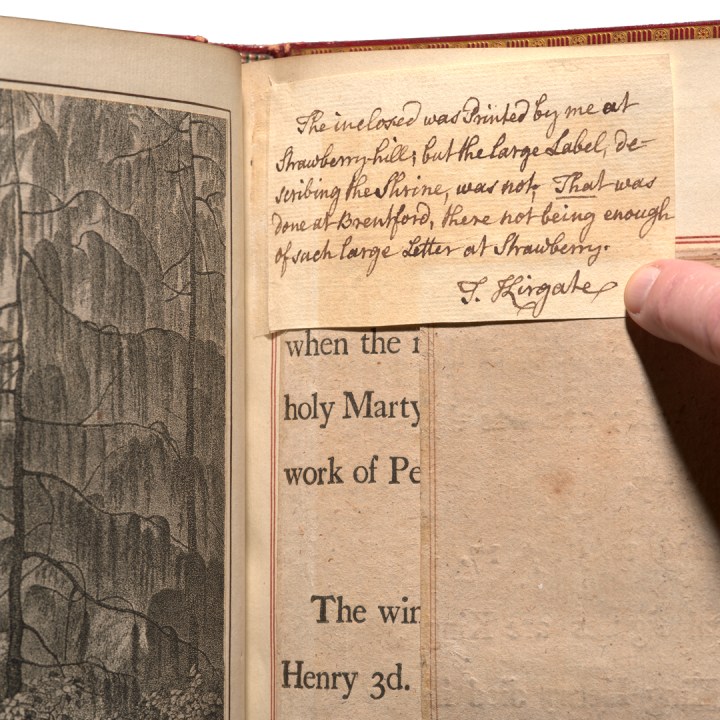
Richard Bull’s copy of A collection of the loose pieces printed at Strawberry-Hill, approximately 1750–1801 (The Huntington Library, Art Museum, and Botanical Gardens).
Join scholars in the field as they discuss extra-illustration, a historical word and image practice in which readers altered their books by adding their own visual elements to them. A book is thus physically expanded—sometimes dramatically so—and fundamental categories of book, art, and object become destabilized. As it considers extra-illustration’s flowering in late 18th- and early 19th-century England, this conference will also move back and forward in time and will venture well beyond a traditional Anglo American paradigm (through Europe, Australia, Mexico, and Japan). Working with an expansive definition of this long-standing but highly mutable practice, examples will range from modified medieval manuscripts to contemporary artists’ books and botanical books with ephemeral plants pressed inside their pages.
For questions about this event, please contact researchconference@huntington.org.
Funding provided by the Zeidberg Lecture in the History of the Book.
f r i d a y , 2 7 s e p t e m b e r
8.30am Registration and coffee
9.00 Welcome
• Susan Juster (The Huntington), Julie Park (Penn State University), and Adam Smyth (Balliol College, Oxford University)
9.15 Session 1 | Reframe / Remake
Moderator: Julie Park (Penn State University)
• Luisa Calè (Birkbeck College, University of London) — William Blake In and Out of Gibbs’ Kitto Bible: Ways of Seeing the Conversion of Paul
• Carolin Gluchowski (Oxford University) — Illuminating the Void: The Intricate Interplay of Added Illuminations in the Bodleian Library’s Manuscript Ms. e. Mus. 160
10.45 Break
11.00 Session 2 | Place / Moment
Moderator: Luisa Calè (Birkbeck College, University of London)
• Julie Park (Penn State University) — Extra-Illustrated Manuscript as Memory Palace: Archiving the House of the Walpoles
• Adam Smyth (Balliol College, Oxford University) — Extra-Illustration in England: 1650, 1777, 2013
12.30 Lunch
1.30 Session 3 | Dialogue / Discord
Moderator: Karla Nielsen (The Huntington)
• Jeanne Britton (University of South Carolina) — The Letter as Image: Illustrating the 18th-Century Correspondence of Ignatius Sancho with Laurence Sterne
• Nicole Reynolds (Ohio University) — ‘This Bomb Under My Monument’: Extra-Illustration and the War Books Controversy – Siegfried Sassoon and Robert Graves
3.30 Study Session (for speakers only)
s a t u r d a y , 2 8 s e p t e m b e r
9.30am Registration and coffee
10.00 Session 4 | Gather / Scatter
Moderator: Adam Smyth (Balliol College, Oxford University)
• Molly Duggins (National Art School, Sydney) — Cut-and-Paste Cabinet: Major James Wallis’ 1840s Album of Colonial New South Wales
• Anna Svensson (Uppsala University) — A Thistle or a Rose? Probing the Thorny Question of Pressed Plants in Printed Books from the 16th to the 20th Centuries
• Tony White (SUNY Purchase) — Frisson and Serendipity: Loose Leaves on the Loose in International Artists’ Books
12.00 Lunch
1.00 Session 5 | Business / Leisure
Moderator: Stephen Tabor (The Huntington)
• Travis McDade (University of Illinois College of Law) — Humorous Phases of the Law: Irving Browne’s Extra-Illustrated Life in 19th-Century America
• Whitney Trettien (University of Pennsylvania) — The Calculated Risk of Book Destruction: Book Collecting and Calculating Technologies in 19th-Century America
3.00 Break
3.15 Closing remarks by Julie Park and Adam Smyth
Colloquium | American Art, Empire, and Material Histories
This fall at Historic Deerfield:
Reawakening Materials: American Art, Empire, and Material Histories in Historic Deerfield’s Collection
Historic Deerfield, Deerfield, Massachusetts, 7–8 November 2024
Historic Deerfield announces Reawakening Materials: American Art, Empire, and Material Histories in Historic Deerfield’s Collection, a public colloquium focused on the institutions’ collection of paintings, works on paper, and decorative arts from Thursday, 7 November to Friday, 8 November 2024. Questions of ’empire’ emerged from an interest in scholars rethinking the American experience from the lens of global European empires (England, Spain, France, The Netherlands, etc.) and U.S. imperialism. Historic Deerfield’s collection focuses on 18th-and 19th-century American art and material culture, and it is based in a landscape tied to Indigenous communities, histories of enslaved people and free people of African descent, and settler colonialism.
The colloquium will explore relationships between empire, materials of objects, and settler colonialism in the collection, specifically asking how these art historical topics can be generative for recontextualizing Historic Deerfield’s place in the study of New England history, art, and culture. Speakers will investigate materials that reveal new ideas of empire, including: pastels, lacquer, birch, engravings on paper, and linen. The program will also workshop methods for telling these narratives through historic interiors, including objects tied to violence and absence, and opportunities to bring in stories of joy and survivance.
Keynote speaker
• Charmaine Nelson, Provost Professor, Black Diasporic Art & Visual Culture, University of Massachusetts Amherst
Additional speakers
• Megan Baker, PhD Candidate in Art History, University of Delaware and 2024–25 Smithsonian Institution Predoctoral Fellow at the Smithsonian American Art Museum and the National Portrait Gallery
• Mary Amanda McNeil, Assistant Professor, Department of Studies in Race, Colonialism, and Diaspora, Tufts University
• Lan Morgan, Associate Curator, Peabody Essex Museum
• Joseph Litts, PhD Candidate in Art History, Princeton University
• Jonathan Square, Assistant Professor of Black Visual Culture, Parsons School of Design
• Morgan Freeman, PhD Candidate in American Studies, Yale University
• Michael Hartman, Jonathan Little Cohen Associate Curator of American Art and PhD Candidate in Art History, University of Delaware
• Anthony Trujillo, PhD Candidate in American Studies, Harvard University
Online registration will be posted shortly. Please send questions to Ian Hamilton, ihamilton@historic-deerfield.org.
Symposium | Guillaume Lethière
Next week at The Clark, in connection with the exhibition:
Guillaume Lethière Symposium
The Clark Art Institute, Williamstown, Massachusetts, 27 September 2024
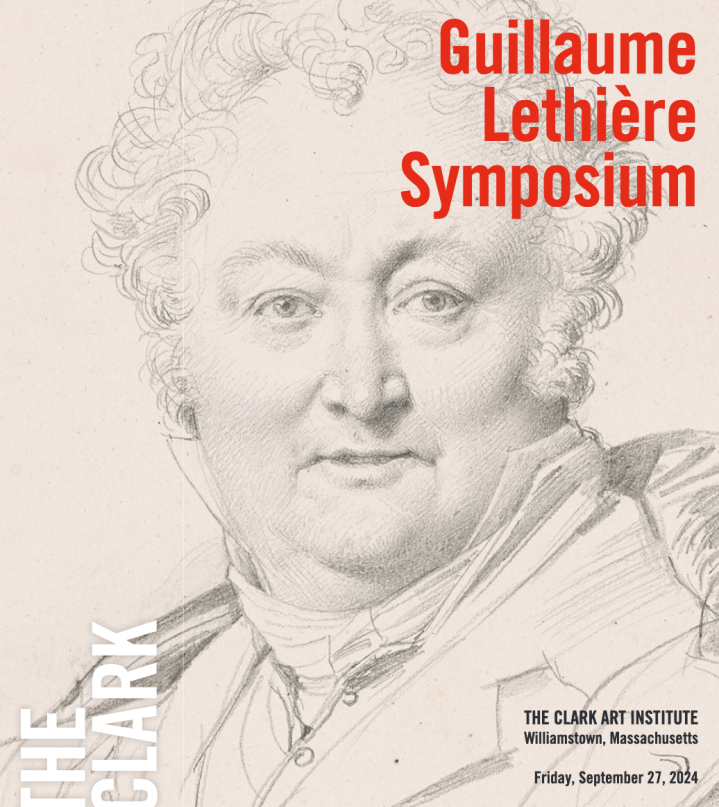 Join us for a symposium in celebration of Guillaume Lethière. The exhibition, organized in partnership with the Musée du Louvre, is the first to investigate Lethière’s extraordinary career. This one-day conference invites renowned scholars and the public to examine Lethière’s considerable body of work, as well as the presence and reception of Caribbean artists in France in the late eighteenth and early nineteenth centuries.
More information is available here»
s c h e d u l e
10.00 Director’s Welcome — Olivier Meslay, Hardymon Director, Clark Art Institute
10.05 Opening Remarks — Esther Bell, Deputy Director and Robert and Martha Berman Lipp Chief Curator, Clark Art Institute
10.25 Session One
• Guillaume Lethière: The Exceptional Trajectory of a Free Person of Color — Frédéric Régent, Maître de Conférences and Directeur de Recherche, Université Paris 1 Panthéon-Sorbonne
• Lethière’s Allegorical Confines: Indemnity, Colonialism, and African Diasporic Fantasies — C. C. McKee, Assistant Professor of the History of Art and Director of the Center for Visual Culture, Bryn Mawr College
12.05 Break and Exhibition Viewing
1.05 Session Two
• Colonial Networks: Remapping the ‘Paris’ Art World in the French Antilles — Meredith Martin, Professor of Art History, New York University and the Institute of Fine Arts
• Picturesque Plantations: Jenny Prinssay’s Construction of a French Caribbean Idyll — Remi Poindexter, The Graduate Center, CUNY, and University Fellow in Art History at the University of North Carolina Asheville
2.45 Break
3.50 Session Three
• Guillaume Lethière’s Roman Years — Francesca Alberti, Director of the Department of Art History at the Académie de France in Rome–Villa Medici and Professor of Art History at the Université de Tours and the Centre d’Études Supérieures de la Renaissance
• From Neoclassicism to Preromanticism: Lethière, the Missing Link? — Richard-Viktor Sainsily-Cayol, Multimedia Visual Artist and Urban Scenographer
4:50 Closing Remarks — Esther Bell
5.00 Reception
Symposium | A Puritan Picture
From the Yale Center for British Art:
A Puritan Picture: Vanity, Morality, and Race in Seventeenth-Century Britain
In-person and online, Hastings Hall, Yale School of Architecture, New Haven, 27 September 2024
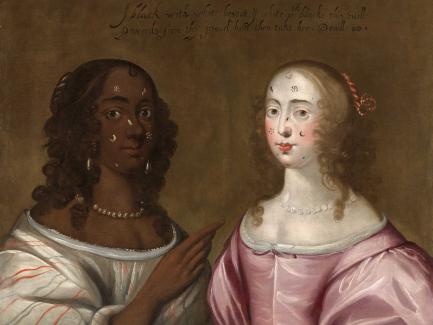
Unknown artist, Two Women Wearing Cosmetic Patches, ca. 1655, oil on canvas (Compton Verney Art Gallery and Park, Warwickshire, UK).
The YCBA, in partnership with Compton Verney, will host a symposium to increase understanding of the painting Two Women Wearing Cosmetic Patches. Topics include the painting’s provenance, attribution, and future display; the cloth trade in seventeenth-century England, Africa, and India; and evolving perceptions of beauty standards, including a keynote conversation focusing on cosmetic patches.
The middle decades of the seventeenth century in Britain were characterized by radical political, religious, and social change. In this period, an unknown artist created a remarkable painting that spoke to fears and anxieties crystallizing around a perceived increase in moral laxity, gender transgression, and the insidious influence of foreigners. The painting depicts two women side by side, each wearing a conspicuous array of beauty patches. The woman on the left reprimands her companion with the words “I black with white bespott: y[o]u white w[i]th blacke this Evill / proceeds from thy proud hart, then take her: Devill.” Text and image combine to inveigh against the sins of pride, vanity, and worldly excess. The painting reminds viewers that sinful behavior leads to the devil and exhorts them to seek salvation.
Compton Verney Art Gallery and Park in Warwickshire, England, has loaned the painting to the YCBA for conservation treatment and inclusion in the museum’s ongoing technical study of the theory and practice of painting skin tones. It will be on view at the Yale University Art Gallery from 20 August until 30 September 2024, before returning to Compton Verney. Registration for online and in-person attendance is recommended. For more information, please email jemma.field@yale.edu.
s c h e d u l e
9.20 Welcome by Jemma Field (Associate Director of Research, YCBA) and Oli McCall (Senior Curator, Compton Verney Art Gallery and Park)
9.30 Opening Talk
• A Painter for a Puritan Picture? — Edward Town (Assistant Curator of Paintings and Sculpture, YCBA)
This opening talk will provide an account of the recent history of the painting Two Women Wearing Cosmetic Patches and the research partnership between the YCBA and Compton Verney. It will present new findings about the painting’s early history and its attribution, set within the context of artistic production during the Interregnum.
9:50 Panel I | Women, Dress, and Morality
Chair: Elizabeth Cleland (Curator of European Paintings and Sculpture, Metropolitan Museum of Art)
This session will consider visual and textual ideals of female beauty and behavior in seventeenth-century England. Topics of discussion include the construction of ‘otherness’, the political and gendered value of clothing, and contemporary desires to increase control over women’s bodies and lives.
• Ad-dressing Conventions: Clothing, Gender, and Race in Two Women Wearing Cosmetic Patches — Jennifer Wu (Adjunct Professorial Lecturer, American University)
• Striped Cloth: Morality, Politics, and Gender in Interregnum England — Jemma Field (Associate Director of Research, YCBA)
• Beauty beyond Borders? English Perceptions of ‘Barbarous’ Beauty in the Seventeenth Century — Haijiao Wang (PhD student, University of Warwick)
11.05 Panel II | Bodies and Voices
Chair: Patricia Fumerton (Distinguished Professor, University of California, Santa Barbara)
This session interrogates female beauty standards, gender roles, and the concept of ‘otherness’. Drawing on an array of contemporary evidence—including emblems, anti-cosmetic polemics, travel narratives, pamphlets, and sermons—the speakers will look to further our understanding of the categories of desire, the racialization of beauty, and the development of national identities.
• ‘All your most excellent thoughts can desire’: The Transformation and Consumption of Bodies in Early Modern England — Todd Simmons (PhD student, Lehigh University)
• Body Language: Reading Text and Image in Two Women Wearing Cosmetic Patches — Jane Partner (Fellow and College Associate Professor, Trinity Hall, University of Cambridge)
• Patches, Paint, and Proto-Dermatology: The Moral Medicalization of Cosmetics in John Bulwer’s Anthropometamorphosis (1653) and John Gauden’s A Discourse of Auxiliary Beauty (1656) — Katherine Aske (Lecturer, Edinburgh Napier University)
12.20 Lunch break
2.00 Keynote Session | Cosmetics and Cultures of Beauty
Chair: Erin Griffey (Associate Professor, University of Auckland)
This keynote brings together experts on seventeenth-century beauty cultures to discuss the complexities of patching. The discussants will consider the performative aspects of the painting, including the dialogue between the subjects and the imagined viewer, as well as the overall image of adornment. Patching is then discussed from a variety of angles that include its material properties, cost, patterns of usage, and place in moral and social commentaries, to consider contemporary beauty ideals, how early moderns understood the skin, how they treated skin conditions, and how they read appearances as an index of character, physical health, and spiritual virtue.
• Jill Burke (Chair of Renaissance Visual and Material Cultures, University of Edinburgh)
• Evelyn Welch (Vice-Chancellor and President, University of Bristol)
3.30 Break
3.45 Closing Discussion | Exhibiting the Painting
Chair: Edward Town (Assistant Curator of Paintings and Sculpture, YCBA)
• Oli McCall (Senior Curator, Compton Verney Art Gallery and Park)
• Jane Simpkiss (Curator, Compton Verney Art Gallery and Park)
◊ ◊ ◊ ◊ ◊
Note (added 28 December 2024) — A recent press release notes the newly identified artist responsible for the painting: “Extensive research, including x-ray analysis,has concluded that the artist behind the painting is likely to be Father Jerome Hesketh (active 1647–1666). More than a dozen works by Hesketh feature in UK public collections today, such as Lyme Park, Sizergh Castle, and Moseley Old Hall. Comparisons between these and Two Women Wearing Cosmetic Patches offer compelling evidence they are by the same hand. . . .”
Conference | Placing China at the Courts of Europe, 1700–1800
From the conference programme:
Placing China at the Courts of Europe, 1700–1800
Historischer Gasthof ‘Zum Eichenkranz’, Oranienbaum-Wörlitz, 5–6 September 2024
Organized by Lukas Nickel and Anette Froesch
 When Leopold III Frederick Franz, Duke of Anhalt-Dessau (1740–1817), added Chinese-inspired state rooms, a pagoda, a tea house, and bridges to his sprawling garden realm, he followed a practise widely employed at courts of the German states, Austria, and across Europe. Chinoiserie was of such importance that it was used by his political allies as well as rivals, by conservative and progressive rulers, and in both Protestant and Catholic settings. While the centrality of China to elite representation of the time has been noted often, so-far its significance remains opaque. The conference, a collaboration between the Kulturstiftung Dessau-Wörlitz and the Institute of Art History, University of Vienna, aims at investigating the intentions and rationales behind the inclusion of Chinese-inspired spaces, structures, and designs into programs of representation at European courts during the 18th century.
Open to the public, the conference will be conducted in English. The fee (including catering and excursions) is €35. Registration should be sent to julia.cahnbley@gartenreich.de by 25 August 2024. Organizers plan to publish the proceedings in 2025.
t h u r s d a y , 5 s e p t e m b e r
9.30 Welcome — Harald Meller (Kulturstiftung Dessau-Wörlitz)
9.45 Greetings — Lukas Nickel (Universität Wien) and Anette Froesch (Kulturstiftung Dessau-Wörlitz)
10.15 Opening Lecture | Lukas Nickel — The Many Chinas in 18th-Century Europe
11.00 Coffee break
11.30 Stéphane Castelluccio (Centre André-Chastel) — France and China: Between Fascination and Reserve
12.00 Emile de Bruijn (National Trust) — Placing China in England: Chinese-Style Interiors and Furnishings in 18th-Century English Country Houses
12.30 Discussion
13.00 Lunch break
14.00 Anette Froesch — ‘As if he had been in Beijing all his life’: The Chinese-Style Interiors and Gardens of Prince Leopold III Friedrich Franz von Anhalt-Dessau
14.30 Cordula Bischoff (Technische Universität Dresden) — Think Big: Augustus the Strong and His Collections of Asiatica
15.00 Coffee break
15.30 Constantijn Johannes Leliveld (Berlin) — Prussian Pioneers: Shaping European Perceptions of China in the 18th Century
16.00 Maria Cinta Krahe Noblett (Universidad Autónoma de Madrid) — Placing Chinese Art during the Reign of Queen Elisabeth Farnese of Spain (r. 1714–1746)
16.30 Discussion
17.00 Excursion to Schloss Wörlitz
f r i d a y , 6 s e p t e m b e r
8.30 Excursion to Schloss and Park Oranienbaum
10.30 Coffee break
11.00 Elfriede Iby (Schloss Schönbrunn) — Chinoiserie in Schönbrunn Palace
11.30 Gyorgyi Fajcsák (Ferenc Hopp Museum of Asiatic Arts, Hungary) — Gardens in the Esterházy Palace: Chinoiserie Murals at Eszterháza/Fertöd
12.00 Filip Suchomel (Univerzita Karlova) — Oriental Interiors in Czech Aristocratic, Ecclesiastical, and Bourgeois Residences in the 18th and 19th Centuries
12.30 Discussion
13.00 Lunch break
14.00 Luca Malvicino (Castello Reale di Govone) — Chinese Wallpapers: A New Decorative Fashion and a Representation of Status in the Kingdom of Sardinia
14.30 Denise Gubitosi (Universität Wien) — Nel Gusto Cinese: The Wallpapers in the Chinese Rooms of the Castello di Racconigi
15.00 Kristel Smentek (Massachusetts Institute of Technology) — Mixed Messages: Images of China and Court Politics in Late 18th-Century France
15.30 Discussion
16.00 Concluding Remarks — Lukas Nickel
Exhibition | Living with Sculpture: Presence and Power
From the press release for the exhibition:
Living with Sculpture: Presence and Power in Europe, 1400–1750
Hood Museum of Art, Dartmouth, Hanover, New Hampshire, 23 March 2024 — 22 March 2025
Curated by Elizabeth Rice Mattison and Ashley Offill

The Hood Museum of Art presents Living with Sculpture: Presence and Power in Europe, 1400–1750, on view from 23 March 2024 until 22 March 2025. Drawing on the wealth of the Hood Museum’s permanent collection, the exhibition contributes to the field’s understanding of the role of sculpture in everyday life, historically and today. Whether given as tokens of affection, cast to memorialize important events, designed to promote faith, or used to write a letter, these sculptures engaged their spectators in dialogues of devotion, authority, and intimacy.
Living with Sculpture is curated by two scholars at the Hood Museum of Art: Elizabeth Rice Mattison, Andrew W. Mellon Curator of Academic Programming and Curator of European Art, and Ashley B. Offill, Curator of Collections. It includes 164 objects in two galleries and is accompanied by a major publication of the same title.
Sculpture enlivened private and public spaces in medieval and Renaissance Europe, contributing to presentations of identity, practices of devotion, and promotions of nationhood. Featuring objects made across the continent, this exhibition examines the significance of sculpture between 1400 and 1750, an era of profound cultural and social change. Amid war, colonization, religious conflict, academic upheaval, and social stratification, these works of art ornamented homes, altars, libraries, and collections.
The role of sculpture as a commemorative and connective tool is newly evident in today’s debates about monuments and cultural patrimony. Sculpture manipulates notions of history, forges bonds between distant places, and promotes future actions, as this exhibition shows. Bringing this often-cerebral area of study down to earth, exhibition curators Elizabeth Rice Mattison and Ashley Offill note, “In examining a group of historic objects, this exhibition highlights the way that the material things with which we surround ourselves are critical to developing our personal identities and our relationships with one another. As curators, we lived with these objects during this project, gaining insight into the works and the people who owned them. The choice of a laurel wreath or a cross on a medal was, in many ways, just as informative back then as a social media bio is today.”
Recent examinations of sculpture suggest its singular presence and power for its makers, patrons, and audiences. The dynamism of sculpture became particularly evident in the 15th and 16th centuries with the explosion of interest in purchasing mass-produced objects such as plaquettes and small-scale bronzes. Technological innovations in making sculpture allowed artists to expand their markets and create new types of artwork.
Organized thematically, this exhibition focuses on small-scale sculptures for everyday spaces. With these works, artists could enhance their status and promote their creativity. Meanwhile, useful sculptures like locks and inkwells communicated their owners’ identities and prestige. In collecting sculptures, patrons activated their social connections. Sculpture also facilitated access to the divine, through objects that focused prayer and encouraged tactile connection with God. Similarly, sculptures forged a sense of history, recording contemporary events and promoting ideas about the past. Together, the sculptures presented here attest to how objects in bronze, wood, or stone gave meaning to people’s lives in early modern Europe.
This exhibition and its corresponding catalogue are organized by the Hood Museum of Art, Dartmouth, and generously supported by the Leon C. 1927, Charles L. 1955, and Andrew J. 1984 Greenebaum Fund, and by grants from the Gladys Krieble Delmas Foundation and the Samuel H. Kress Foundation.
The catalogue is distributed by Penn State UP:
Elizabeth Rice Mattison and Ashley Offill, Living with Sculpture: Presence and Power in Europe, 1400–1750 (Hanover: Hood Museum of Art, Dartmouth, 2024), 340 pages, ISBN: 978-0944722558, $50.
The accompanying publication includes five thematic essays, extended catalogue entries for 99 objects, and an illustrated checklist of 114 additional objects from the important collection of early modern sculpture at the Hood Museum of Art, Dartmouth. The book is published by the Hood Museum of Art, distributed by The Pennsylvania State University Press, and produced by Marquand Books, Seattle.
◊ ◊ ◊ ◊ ◊
Exhibition Colloquium | Living with Sculpture
Hood Museum of Art, Dartmouth, 7 September 2024
In connection with the exhibition, this colloquium brings together scholars and curators from around the Northeast to discuss how audiences, patrons, and makers engaged with sculpture in the Middle Ages and early modern period. Ranging from twelfth-century Spain to seventeenth-century Rome, the discussion topics will offer an in-depth examination of making and living with sculpture. The day will include a tour of the exhibition led by its curators, Elizabeth Rice Mattison and Ashley Offill. Check-in opens at 9.30am, and the program will begin at 10.00. The colloquium itself is free, by registration at Eventbrite. A limited number of hotel rooms are available at the Hanover Inn under the block ‘Living with Sculpture’. Please reserve before August 7.
p r e s e n t a t i o n s
• Elizabeth Lastra (Vassar College), Threads of Power and Identity: Exploring Textile Motifs in Sculpture at the Romanesque Monastery of San Zoilo
• Kelley Helmstutler Di Dio (University of Vermont), Seeing Two Sides of the Same Coin: Leone Leoni’s Circle and their Medals in the Hood Museum
• Lara Yeager-Crasselt (Baltimore Museum of Art), François Duquesnoy’s Funerary Monument to the Painter Jacob de Hase: Untangling Flemish Expatriate Networks in Rome
• Laura Tillery (Hamilton College), The Armed Image of Olav Lorenzo Buonanno, University of Massachusetts, Boston, Living with Imaginary Sculptures
• Miya Tokumitsu (Davison Art Center, Wesleyan), Gothic to Grotesque: Sculptural Ornament in the Prints of Lucas van Leyden
• Nicola Camerlenghi (Dartmouth College), Living Sculptures in the Renaissance Streets of Rome










 Enfilade
leave a comment