Online Event | 18th-C American Furniture from The Met
From The Met:
Alyce Perry Englund | Art History Study Group: 18th-Century American Furniture
Online, Wednesday, 16 July 2025, 3–4:30 pm
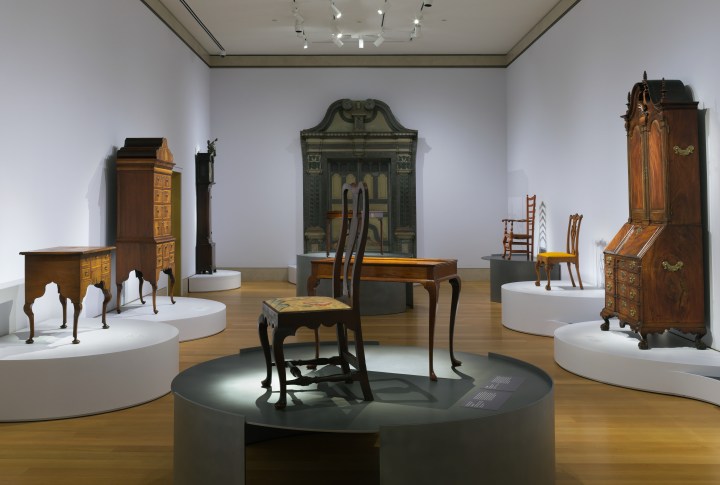 Join curator Alyce Perry Englund, Associate Curator of American Decorative Arts of the American Wing, to talk about The Calculated Curve: Eighteenth-Century American Furniture and delve into a pivotal moment in American furniture design from 1720 to 1770. Take a closer look at the materials, ergonomics, and sculptural expression embedded in furniture design during a critical age of global exchange and social stratification. This live event will take place on Zoom. Space is limited, and advance registration is required. Registration closes Tuesday, July 15, or when registration is full. Fee: $40.
Presented in conjunction with the exhibition The Calculated Curve: Eighteenth-Century American Furniture.
Exhibition | Travels: Artists on the Move

Jakob Philipp Hackert, Cestius Pyramid with German Artists at the Grave of a Companion, 1777, pen and watercolor on paper, 35 × 46 cm
(Vienna: Albertina)
◊ ◊ ◊ ◊ ◊
From the press release:
Travels: Artists on the Move / Fernweh — Künstler:innen auf Reisen
Albertina, Vienna, 27 June — 24 August 2025
Ancient buildings, sunny southern landscapes, or local mountain worlds: travel has inspired numerous artists to create new perspectives and pictorial worlds. The Albertina Museum’s summer exhibition is dedicated to this artistic wanderlust with a selection of 18th- and 19th-century masterpieces from its own collection—from Johann Wolfgang von Goethe to Caspar David Friedrich and Tina Blau.
Travels: Artists on the Move spans an arc from the ‘Grand Tour’—an educational journey through Europe lasting several years with Rome as its destination—to voyages of discovery to distant continents. What was reserved for the sons of the nobility during the Renaissance increasingly became an educational ritual for the aspiring bourgeoisie from the 18th century onwards. Important destinations included Paris, Lyon, Marseille, Florence, Pisa, and the Eternal City. Johann Wolfgang von Goethe was drawn even further south on his Italian journey, and the museum presents four views from his trip to Italy from its own collection. The exhibition draws attention to landscapes that are as diverse as they are special, the intensity of the personal experience of nature and the conditions of travel in the 18th and 19th centuries. The finest drawings and luminous watercolors bring the longing for distant places and new horizons to life.
Introduction
Traveling—indulging the longing for the unknown and for faraway lands—is a notion dating to Romanticism, but as a phenomenon it was by no means limited to this era. The desire to leave one’s familiar surroundings, to get to know new scenery and distant destinations, and capturing them in drawings and paintings for those who had stayed behind also prompted numerous artists of Neoclassicism, Biedermeier, and Realism in the 18th and 19th centuries to set off for places near and far. They did so either on their own initiative as an educational journey in order to gain inspiration for their own artistic work, or on behalf of ruling dynasties and art publishers editing compilations of the most stunning views of a particular region. Countless picturesque impressions could be gained, whether near ancient buildings in Rome, in landscapes under the southern sun and in alpine mountains, on picturesque lakes, along the Danube and the Rhine, or on journeys to foreign countries.
The Albertina’s exhibition sheds light on this artistic love of travel by presenting 18th- and 19th-century masterpieces from its own collection while illustrating the various travel routes that existed. The show ranges from the Grand Tour and the study of antiquity and the Italian landscape to the beauty of the Austrian countryside, the fascination of the mountains and romantic journeys along the Rhine, and the discovery of other continents. The focus is on the various landscapes and motifs studied, as well as the exploration of nature in the works of Johann Wolfgang von Goethe, Caspar David Friedrich, Jakob Alt, Thomas Ender, and Rudolf von Alt. Women landscapists have also conquered nature, as is proven by works by Tina Blau, Olga Wisinger-Florian, Marie Lippert-Hoerner, and Emilie Mediz-Pelikan. Precious drawings and colorful watercolors allow us to sense the hunger for new horizons and witness not only individual experiences of nature but also the travel conditions in those days. In this way, travel becomes art and art becomes a mirror of travel.
Grand Tour
While since the Renaissance the traditional educational tour of Continental Europe had been exclusively reserved for the sons of aristocratic families, from the 18th century onward it also became popular among the upper middle classes as the so called Grand Tour. With Rome as its destination, it lasted several years and was the culmination of any higher education. Time and again, the travelers were accompanied by artists who were supposed to capture the beauties of nature. Over time, routes developed that led to must-see cities. The English voyaged from London to the Channel Coast, with Paris as their first important stop. They traveled via Burgundy and Lyon to Marseille and on to Italy, where Florence was most important as a first station. Visiting Pisa and Lucca, they moved on to the much-longed-for destination of the Eternal City, where they usually spent several months. It was almost obligatory to have one’s portrait painted by a local artist. Naples was also on the itinerary, and some were even drawn as far as Sicily, including Johann Wolfgang von Goethe. The return journey was then via Verona, Padua, and Venice. However, there were also many individual routes depending on the personal interests and networks of the travelers, leading through Germany, Austria, Switzerland, and the Netherlands on the way back home.
Goethe’s Italian Journey

Johann Wolfgang von Goethe, Lakescape, 1787, brush on paper 19.5 × 31 cm (Vienna: Albertina, permanent loan of Österreichische Goethe-Gesellschaft).
Johann Wolfgang von Goethe’s account of his Italian Journey (1813–1817) makes him one of the most famous Grand Tour homecomers. During the trip he made around 850 drawings. The writer, who was already well known at the time, traveled incognito in order to be able to move around more freely. He set off for Italy in September 1786, visiting Trento and Verona and stayed in Venice for a first extended stay of a fortnight. Goethe then visited the cities of Bologna and Florence in rapid succession before finally arriving in Rome, the place he had always longed for as a child. After four months he moved on to Naples. Goethe, following in the footsteps of his father on his own Grand Tour, ventured a little further than the latter had done in 1740. In the spring of 1787, he set sail for Sicily. For his exploration of the island he also hired a travel sketch artist, Christoph Heinrich Kniep, to capture the most beautiful vistas. For over a month, the two of them drew side by side. The four views of Sicily by Goethe shown in this exhibition bear witness to this journey and to his passion for drawing. Goethe eventually returned home via Naples and Rome in the spring of 1788.
Rome and the Study of Antiquity
Once Grand Tourists had arrived in Rome after months of traveling and numerous stopovers, they stayed for a few months to familiarize themselves with the city’s art treasures as profoundly as possible. Johann Joachim Winckelmann’s History of Ancient Art (1764) played a decisive role in the emergence and spread of the enthusiasm for antiquity. The tour comprised museums, old churches, ancient monuments, and such sites as the excavations on the Palatine, one of Rome’s seven hills. The Roman Forum, the ancient marketplace, offered ample opportunity to study the architecture and sculpture of antiquity through the temples, official buildings, market and assembly halls (basilicas), and the two triumphal arches from the first centuries AD. Magnificent villas and their exquisitely landscaped gardens, among them the 17th-century Villa Ludovisi, likewise attracted visitors to Rome.
According to the rules of the Académie française, the study of antiquity was the most important element in a painter’s education and training, alongside instruction in drawing and copying models. Many artists, thus encouraged by their art academies, traveled to Rome to study the city’s ancient heritage and the way the High Renaissance revisited it as to content and form.
The Italian Landscape
The artists visiting Rome not only discovered the city’s ancient monuments but also undertook excursions to the countryside and familiarized themselves with the unique scenery of the Campagna, the impressive coast near Naples, and the enchanting island of Capri. With its outstanding light, the Southern Italian landscape made a lasting impression on countless artists that prevailed even after their return home. Artists such as father and son Alt and Thomas Ender, whose origins lay in the Austrian Biedermeier period, painted topographically meticulous landscapes effectively staging light, water, and sky in the colors of nature.
Some artists imaginatively assembled different parts of a region, adding fictitious ancient ruins and random staffage figures. They created ideal Arcadian landscapes that were modeled on antiquity and evoked a nostalgic mood for past beauty. This ideal landscape painting style harked back to the 17th-century tradition of Claude Lorrain.
Fascination of the Mountains
Until well into the 19th century, the nature of high mountains was perceived as threatening. Crossing the Alps, as some people did on their Grand Tours, was fraught with danger. There were no well-maintained paths, rivers were not regulated, and one was rather defenseless in the face of rapid weather changes. Many a traveler fell victim to avalanches or rockslides, and some even died.
In the 18th century, a genuine enthusiasm for the Alps prevailed. Literature played a quite significant role in this. Publications dealing with the Alps and Switzerland in particular enticed many travelers. Improved transportation conditions had made traveling more comfortable. The golden age of alpinism began in the middle of the 19th century, with many first ascents. Artists captured the beauty of the mountains and catered to the newly awakened interest in mountain peaks, glaciers, and wild, pristine nature.
In the Service of Archduke John
As many as about 1,400 watercolors and drawings were executed by artists in the service of Archduke John. The works of his so-called ‘chamber painters’, who were on an equal footing with court painters, were originally created in the context of his efforts to produce a systematic description of Styria, for which the artists were to provide a pictorial documentation. Ferdinand Runk was employed by Archduke John from 1795 on and later also worked for the Princes Schwarzenberg and Johann I of Liechtenstein. The commissions that went to Matthäus Loder were still connected with the purpose of documentation, but more and more often motifs from the archduke’s immediate personal life and experiences were added. Loder’s task was taken over by Thomas Ender in 1828. He traveled as far as the glacier regions for Archduke John and also accompanied him on journeys to more distant destinations. The chamber painters came from several generations of artists. Their works were created over a period of almost fifty years and represent an important contribution to the development of 19th-century Austrian landscape painting.
In the Service of Emperor Ferdinand I

Rudolf von Alt, The Dachstein in the Salzkammergut as Seen from the Vorderer Gosausee, 1840, watercolor on paper, 42 × 52.5 cm (Vienna: Albertina).
Archduke Ferdinand (from 1835 Emperor Ferdinand I of Austria) commissioned the most highly renowned artists of his time to paint the most beautiful places throughout the Austrian monarchy. It was the heyday of Austrian watercolor painting. Initially, Eduard Gurk became the archduke’s companion and chronicler. In 1830 he created the first drawings for the imperial peep box series, which could be viewed by means of an optical device, offering the illusion of a deceptively real perspective expanse. Soon, Jakob Alt was also employed by Archduke Ferdinand. He had already made a name for himself with his work as a landscape painter for the art publisher Artaria. On the peep box series he collaborated particularly closely with his son Rudolf, yet the works were all signed by Jakob Alt as principal contractor. His son Franz Alt too was a talented landscapist. The painter Leander Russ worked for Emperor Ferdinand I’s peep box series starting in 1841.
Women Landscapists
In the 19th century few women were able to pursue an artist’s career. They were not allowed to study at the Vienna Academy of Fine Arts, as women were generally assumed to lack a creative spirit in the domain of high art. It was not until 1920 that women were admitted. Before that, they had to rely on private art schools, private teachers and, above all, family support, or their father or a close relative was a painter himself. Nevertheless, there were women landscape painters who traveled with their sketchbooks or painted directly in the great outdoors. The most important practitioners in Austria were Olga Wisinger-Florian and Tina Blau, who were already successful during their lifetimes, and who were permitted to take part in exhibitions. However, as Olga Wisinger-Florian complained, the works of women were poorly hung, and the women artists were not invited to exhibition openings. There were hardly any commissions from financially strong rulers or aristocrats for whom they could travel and paint.
Romantic Rhine Journey
Towards the end of the 18th century—based on the writings of Johann Wolfgang von Goethe, Friedrich Hölderlin, and Heinrich von Kleist—a rapturous interest in the Rhine landscape developed, which was in stark contrast to the wild alpine valleys of Switzerland. The rocky Upper Middle Rhine Valley, now a UNESCO World Heritage Site, became a popular tourist destination due to its fascinating river landscape and large number of castle ruins. The classic Rhine Romanticism route essentially stretched from Cologne to Mainz, although there were also variants and extensions similar to the Grand Tour, which led to the Upper Rhine between Basel and Bingen or to the sources of the Rhine. Many artists either traveled on their own initiative or were commissioned to capture the romantic views of the Rhine in painting. The Swiss artist Johann Ludwig Bleuler, who also owned a publishing house, and the Austrian landscape painter and etcher Laurenz Janscha created important series of vedute and views of the Rhine region.
On the Move
Until the 19th century, voyaging had mainly been reserved for the nobility. It was only then, in the course of industrialization, that a wealthy middle class discovered travel as well. From 1825 on, when the first train line was put into operation in England, the railroad rapidly developed into a widely networked transport system over the decades to come, making traveling much easier, more convenient, and safer. Until then, people had traveled in horse-drawn carriages. Artists could only go on such journeys if they had sufficient funds of their own or if they were financed by wealthy patrons. However, they often also traveled on foot to sketch in nature. In 1835, an English company brought out a paint box that was easy to transport and ideal for painting en plein air. The new pocket-sized travel guides published by Baedeker and Hartleben became useful companions. Many of the places that artists wished to capture were difficult to reach. They thus carried sketchbooks with them or had a light travel easel that could easily be set up anywhere.
Traveling to Faraway Countries
The longing for endless expanses and an unbridled spirit of discovery were the driving forces behind travel in the 19th century. In most cases, however, it was solid monetary and territorial reasons that led to numerous journeys of exploration and discovery. Artists often accompanied these voyages in order to capture romanticizing impressions of the various stations in paintings and drawings. One of the most ambitious expeditions in the name of science was the circumnavigation of the world with the frigate Novara between 1857 and 1859, which was also not without economic interests. Archduke Ferdinand Maximilian, commander-in-chief of the Austrian navy, made the converted frigate Novara available to the Academy of Sciences and the Geographical Society. On board was the landscape painter Josef Selleny, who documented the journey. He produced around 2,000 watercolors, sketches, and studies, thus making a significant contribution to the success of the expedition. Another example was Leander Russ, who had already been the artistic companion of a diplomat on a trip to the Orient when he was commissioned by Emperor Ferdinand I in 1841 to produce peep box paintings with motifs from Egypt, Bethlehem, Jerusalem, Beirut, and India.
Exhibition | George Dance the Younger

George Dance, Bank of England: Record Drawing of the Wall from Lothbury Street, 1794–97
(London: Sir John Soane’s Museum, SM 12/1/2).
◊ ◊ ◊ ◊ ◊
From The Soane:
George Dance the Younger: A Bicentennial Celebration
Sir John Soane’s Museum, London, 14 January — 31 December 2025
Curated by Frances Sands
On 14 January 2025, we mark the bicentenary of the death of the architect George Dance the Younger (1741–1825). Dance is not a household name, and relatively few of his buildings survive, but during his lifetime he was an innovative and celebrated architect. Moreover, as the architectural mentor of John Soane, his influence looms large at Sir John Soane’s Museum.
Born in 1741, George Dance studied architecture in Italy from 1758 until 1764. Initially joining his father’s architectural practice on his return to London, Dance then succeeded him as Clerk of the City Works in 1768. His long and prolific career of 1764–1816 spanned the neoclassical movement and the Greek Revival and he experimented with and shaped both styles. Dance accepted apprentices into his office, shaping the careers of major architects including John Soane, who was apprenticed to Dance in 1768–71. Dance was also a founder member of the Royal Academy.
There is little surviving correspondence from Dance and almost nothing to reveal his thoughts on architecture. Moreover, few of his buildings survive. Yet his legacy is notable, thanks largely to his surviving drawings at the Soane Museum. These were the last great addition to Soane’s collection, on 18 November 1836, just weeks before Soane died. Soane’s accounts show that he paid Dance’s son, Sir Charles Webb Dance, £500 for the drawings collection. Along too came a handsome cabinet, known as ‘The Shrine’ which had been made to contain the drawings. The Shrine can be admired in the North Drawing Room at the Soane Museum and still contains the Dance collection, comprising an invaluable record of the work of George Dance the Younger, a towering figure in architectural history.
More information is available here»
Exhibition, Panels, and Talks | Trois Crayons Presents Tracing Time
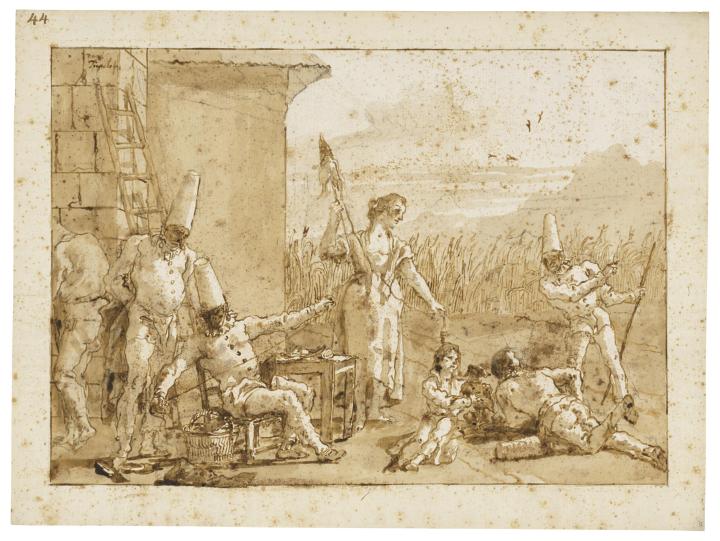
Giovanni Domenico Tiepolo, Punchinello and His Family Spinning Flax, pen and brown ink and wash, over an underdrawing in black chalk, with framing lines in brown ink; signed ‘Domo / Tiepolo f’ at the upper left and numbered 44 in the upper left margin, sheet: 345 × 464 mm (Stephen Ongpin Fine Art). More information about the drawing is available from Christie’s (Sale 21459, 4 July 2023, Lot 41).
◊ ◊ ◊ ◊ ◊
From Trois Crayons:
Tracing Time / Trois Crayons
Frieze No.9 Cork Street, London, 26 June — 5 July 2025
Trois Crayons is pleased to announce Tracing Time, a selling exhibition dedicated to drawings and works on paper held at Frieze No. 9 Cork Street this summer from 26 June until 5 July 2025. Tracing Time is the second annual exhibition hosted by Trois Crayons, an innovative platform which aims to increase the awareness, accessibility and visibility of drawings in all their forms. The exhibition will present the finest drawings and masterpieces on paper from renowned galleries and dealers which span the 15th century until the present day. Tracing Time will showcase works by artists such as Hans Rottenhammer, Giovanni Domenico Tiepolo, J.M.W. Turner, Auguste Rodin, Gustav Klimt, Jean Cocteau, and Françoise Gilot, presenting rare-to-market works.
Breaking from tradition, the Trois Crayons model includes no gallery booths; instead, all artworks are thoughtfully curated by a team of experts to create an enjoyable exhibition of the highest standard. A further deviation from the norm, the Trois Crayons model allows participants the ability to exhibit in London without the need to be physically present; dedicated and knowledgeable Trois Crayons staff will be on hand to assist visitors and buyers.
Tracing Time sees over 35 international galleries participating and more than 250 works being exhibited, doubling in size since its debut exhibition in 2024. New galleries this year include Wildenstein & Co. (New York), Rosenberg & Co. (New York), and Lowell Libson & Jonny Yarker Ltd (London), as well as a collaboration with Maak (London and Berkshire), a contemporary ceramics auction house presenting a selection of ceramic works and accompanying works on paper.
Highlights include
• Day & Faber will present a study of animals from the North Italian school that has survived more than 500 years.
• Surprising works from the world of fashion and jewellery will be presented, such as the creations of jeweller René Lalique (with Agar Marteau Fine Art) and a costume study by Antoine Caron (with Galerie Duponchel).
• John Swarbrooke Fine Art will bring a museum quality drawing by Klimt that relates to the painting Die Hoffnung I (Hope I) that hangs in the National Gallery of Canada, Ottawa.
• Works from the late 19th century to the present day from Sweden will be presented by galleries such as Clase Fine Art and Colnaghi Elliott Master Drawings, depicting the spiritual and emotional essence of Nordic art.
• Celebrating its 150th anniversary, Wildenstein & Co. will be showing a selection of French works on paper including a study for Leda and the Swan by Edmé Bouchardon and a cubist watercolour by Georges Braque.
“We have made it our mission to demystify acquiring drawings by the world’s best artists. Through our innovative presentation model, we are working to create an environment where buying drawings and works on paper is a pleasurable and straightforward experience that both established and new collectors can equally enjoy. From our installation style to our talks programme, each visitor is encouraged to engage with the medium in new and meaningful ways. Works on paper are one of the most democratic areas in the art market, and we hope to share our passion for paper with all who visit.”
–Alesa Boyle, Tom Nevile, and Sebastien Paraskevas (Founders of Trois Crayons)
◊ ◊ ◊ ◊ ◊
At Frieze No.9 Cork Street, the basement auditorium will play host to a series of talks from leaders and specialists in the field of drawings and works on paper, and Trois Crayons will offer off-site tours at The British Museum, The Courtauld Gallery, and Sotheby’s. All events are free to attend with advance registration.
o n – s i t e e v e n t s
Opening Reception (Vernissage)
25 June 2025, 6pm, rsvp@troiscrayons.art
Timeless Materials: A Conversation on Drawing with Contemporary Artists
27 June 2025, 4pm
Moderator: Annette Wickham (Former Works on Paper Curator, Royal Academy of Arts)
Panellists: Joana Galego, Nicholas C. Williams, and Pippa Young
Women Artists in Focus: Curating New Narratives
28 June 2025, 2pm
Moderator: Euthymia Procopé (Director of Development, Rediscovering Art by Women)
Panellists: Jennifer Higgie (author of The Mirror and the Palette: Five Hundred Years of Women’s Self Portraits and The Other Side: A Story of Women in Art and the Spirit World), Amy Lim (Curator of The Faringdon Collection at Buscot Park, Oxfordshire), and Rachel Sloan (Associate Curator of Works on Paper, The Courtauld Gallery)
The Drawings of John Constable
30 June 2025, 4pm
Guest speaker: Susan Owens (former Curator of Paintings at the V&A; her recent book The Story of Drawing: An Alternative History of Art won the Apollo Book of the Year award in 2024; she is currently preparing a book on Constable, to be published in 2026).
Piccadilly Jim: The Discovery of James Gibbs’s Designs for the Façade of Burlington House
1 July 2025, 4pm
Guest speaker: William Aslet (Scott Opler Fellow, Worcester College, University of Oxford)
In partnership with The Burlington Magazine
New Ways of Looking at Italian Renaissance Drawings
2 July 2025, 4pm
Moderator: Luca Baroni (L’IDEA – Testi Fonti Lessico Disegni)
Panellists: Martin Clayton (Head of Prints and Drawings, Royal Collection Trust), Rachel Hapoienu (Assistant Curator of Works on Paper, The Courtauld Gallery), Tom Nevile (co-founder, Trois Crayons), and Catherine Whistler (Research Keeper, Western Art Department, Ashmolean Museum)
In partnership with L’IDEA
The Intimate Collector: Why Drawings Thrive in the Digital Age
3 July 2025, 4pm
Moderator: Bethany Woolfall (Arcarta Vice President of Customers)
Panellists: Alesa Boyle (Co-founder, Trois Crayons, London and Gallery Director, Stephen Ongpin Fine Art, London), Gregory Rubinstein (Sotheby’s, Senior Director and Head of the Old Master Drawings Department Worldwide), and Lorna Tiller (Senior Gallery Partnerships Manager, Artsy)
In partnership with Arcarta
Between Drawings and Ceramics
4 July 2025, 4pm
A lively panel discussion exploring the parallels and contrasts in how drawings and ceramics are collected, appreciated, and understood.
In partnership with Maak
The Drawings of Jean-Antoine Watteau
5 July 2025, 2pm
Moderator: Jennifer Tonkovich (Associate Editor, Master Drawings and Eugene and Clare Thaw Curator, Drawings and Prints, Morgan Library & Museum)
Panellists: Grant Lewis (The Smirnov Family Curator of Italian and French Prints and Drawings, 1400–1880 at the British Museum and curator of Colour and Line: Watteau Drawings, British Museum) and Axel Moulinier (collaborator on A Watteau Abecedario, an online catalogue raisonné of the paintings by Antoine Watteau, and co-curator of The Worlds of Watteau, Château de Chantilly)
In partnership with Master Drawings
o f f – s i t e e v e n t s
Exhibition Visit | Colour and Line: Watteau Drawings
26 June 2025, 10.30am, The British Museum
Host: Grant Lewis (The Smirnov Family Curator of Italian and French Prints and Drawings, 1400–1880)
Auction Visit | Master Works on Paper from Five Centuries
28 June 2025, 11.00am, Sotheby’s
Hosts: Gregory Rubinstein, Cristiana Romalli, Mark Griffith-Jones, and Alexander Faber. Attendance is limited to 25 spaces.
Print Room Visit | The Courtauld Gallery’s Collection of Drawings à Trois Crayons
1 July 2025, 10.30am, The Courtauld Gallery, Somerset House
Hosts: Ketty Gottardo (Martin Halusa Senior Curator of Drawings) and Rachel Sloan (Associate Curator of Works on Paper)
Exhibition | Duplessis (1725–1802): The Art of Painting Life

From the press release for the exhibition:
Duplessis (1725–1802): The Art of Painting Life / L’art de peindre la vie
Inguimbertine, Hôtel-Dieu, Carpentras, 14 June — 28 September 2025
Curated by Xavier Salmon
From June 14 to September 28, 2025, the Inguimbertine at the Hôtel-Dieu of Carpentras hosts an exhibition dedicated to Joseph Siffred Duplessis (1725–1802), one of the most remarkable portraitists of the 18th century, in celebration of the 300th anniversary of his birth. The Hôtel-Dieu of Carpentras, magnificently restored, provides the perfect setting. Inaugurated in April 2024, this heritage site is now home to the Bibliothèque-Musée Inguimbertine. With nearly 43,000 visitors since its opening, it has established itself as a major cultural venue in the Provence-Alpes-Côte d’Azur region, immersing visitors in the history of Carpentras and the Comtat Venaissin, as well as in the world of an 18th-century library-museum and a grand fine arts gallery.

Joseph Siffred Duplessis, Portrait of Benjamin Franklin, oil on canvas, 72 × 58 cm (New York: The Metropolitan Museum of Art, The Friedsam Collection, 32.100.100).
In 2025, the Inguimbertine has the honor of celebrating a native of Carpentras, Joseph Siffred Duplessis, born 300 years ago and recognized as a master of portrait painting at the court of King Louis XVI. His works, now housed in the world’s greatest museums, attest to Duplessis’s artistic genius. The exhibition brings together around sixty paintings from the 200 he created, sourced from prestigious collections such as the Metropolitan Museum of Art in New York, the Nelson-Atkins Museum of Art in Kansas City, the National Gallery of Canada in Ottawa, the Palace of Versailles, and the Louvre Museum. The exhibition also provides the Inguimbertine with an opportunity to highlight the richness of its own collection, which includes the largest public holding of the artist’s works—22 paintings and drawings, among them the only two religious paintings he ever produced. These masterpieces allow visitors to discover or rediscover Duplessis’s remarkable skill, particularly in his role as the official portraitist of Louis XVI. This first retrospective of the master portraitist is accompanied by a catalog of his works, listing nearly two hundred paintings, published by Lienart Editions.
Duplessis had an extraordinary ability to capture the essence of his subjects with mastery and sensitivity that transcend time. Visitors will be particularly impressed by his virtuosity in rendering the complexions of faces and the textures of fabrics. Acknowledged by his contemporaries as “the greatest portrait painter in the kingdom,” his talent for portraying character and presence is being showcased through a carefully curated selection of works. For a portraitist, painting and exhibiting well-known figures was essential to gaining public recognition. In this pursuit, Duplessis worked within three spheres: men of letters, scholars, and artists. Among his most famous works are the full-length portrait of Louis XVI and two portraits that have left a lasting mark on art history: that of Austrian composer Gluck and that of the American statesman Benjamin Franklin, whose long stay in France embodied the ideals of the Enlightenment and the birth of a new world.
Curated by Xavier Salmon, curator at the Louvre Museum and a specialist in 18th-century portraiture, this exhibition promises to be a major cultural event of 2025. It offers a unique opportunity to understand why Duplessis was considered one of the greatest portraitists of his time. Visitors are able to explore his official commissions for the royal court and the ministers of Louis XVI, his clientele in both Provence and Paris, as well as his rare religious paintings, all within the stunning setting of the Hôtel-Dieu of Carpentras.
Xavier Salmon, Joseph Siffred Duplessis (1725–1802): Le Van Dyck de la France (Paris: Lienart éditions, 2025), 224 pages, ISBN: 978-2359064650, €35.
Exhibition | So Far, So Close: Guadalupe of Mexico in Spain
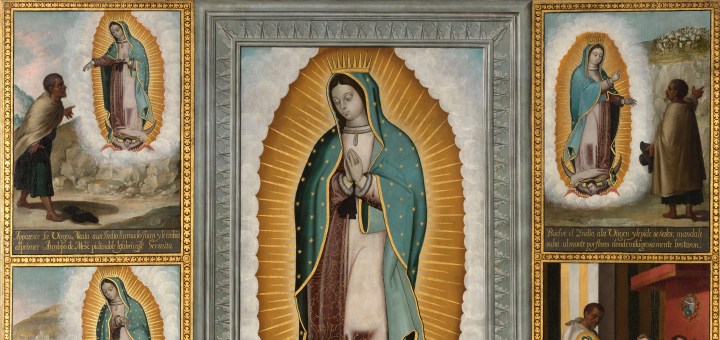
José Juárez, The Virgin of Guadalupe with Four Apparitions, detail, 1656, oil on canvas, 251 × 293 cm
(Ágreda, Soria: Monasterio de Concepcionistas Franciscanas)
◊ ◊ ◊ ◊ ◊
From the press release for the exhibition:
So Far, So Close: Guadalupe of Mexico in Spain
Museo Nacional del Prado, 10 June — 14 September 2025
Curated by Jaime Cuadriello and Paula Mues Orts
So Far, So Close: Guadalupe of Mexico in Spain casts an unprecedented gaze on the artistic dialogue between Latin America and Europe in the 17th and 18th centuries, showing how the Virgin of Guadalupe was reinterpreted, reproduced, and venerated on both continents, emerging as a transatlantic devotional and political icon. The exhibition offers a new perspective on the role of the Virgin of Guadalupe as a miraculously created image, an object of worship, and symbol of identity in the Hispanic world. Through nearly 70 works, including paintings, prints, sculptures and books, the exhibition shows how this manifestation of the Virgin, which first appeared on the Cerro del Tepeyac or Tepeyac Hill in 1531, transcended the borders of New Spain to become a powerful presence in the Spanish collective imagination. The project, curated by the Mexican professors Jaime Cuadriello (UNAM) and Paula Mues Orts (INAH), is the result of years of research and collaboration between institutions. The exhibition is structured into eleven thematic sections, combining small and large-format works that range from the earliest depictions of apparitions of the Virgin to the sophisticated vera effigies reproduced for devotional or political purposes.

Attributed to Joaquín Villegas (act. ca. 1713–53), The Eternal Father Painting the Virgin of Guadalupe, ca. 1740–50, oil on canvas (México City, INBAL/Museo Nacional de Arte, Donación FONCA, 1991).
The exhibition begins with a visual cartography that charts the surprising density of the presence of images of the Virgin of Guadalupe across all of Spain. This dissemination reflects economic, social and political factors such as trade with the Indies, mining and the movement of viceregal officials. These works reflect both devotion and the concerns of communities, artists, merchants, the nobility, and the clergy, who together made the Virgin a shared devotional cult. Themes covered in the exhibition’s different sections include the transmission of the Guadalupe story through standardised narrative and visual models; the formal genealogy of the image and its connection with European Marian icons such as the Immaculate Conception and the Tota pulchra; its status as a ‘painting not made by human hand’, which relates to the concept of the Deus pictor; and the sacredness of the Virgin’s mantle, conceived as a living relic and object of veneration. A comparison is also made with Iberian painting of the same period, revealing stylistic affinities and differences with schools such as Madrid and Andalusia.
Of particular interest are the sections dedicated to the vera effigies, which are exact copies or modified versions of the original, reproduced using specialised artistic techniques. Also notable is the presence of exotic materials, such as mother-of-pearl, ivory and brass, which arrived on the Manila Galleon, demonstrating the global reach of the cult of Guadalupe and its integration into transoceanic networks of cultural exchange. The exhibition includes masterpieces by artists from New Spain and the Iberian Peninsula, including José Juárez, Juan Correa, Manuel de Arellano, Miguel Cabrera, Velázquez, Zurbarán, and Francisco Antonio Vallejo. Together they trace an artistic and symbolic map of the cult of the Virgin of Guadalupe which lasted from the 17th to the early 19th century.
In conjunction with the exhibition, the Fundación Casa de México in Spain is collaborating on an extensive cultural programme that focuses on the symbolic and artistic dimension of the Virgin of Guadalupe. The programme includes lectures by the curators, a cycle of historical and contemporary films, informational capsules and workshops on traditional Mexican crafts taught by masters from Michoacán and Chiapas. These activities, taking place at the Museo del Prado and at the Fundación’s venue in Madrid, will offer participants a wide-ranging experience that interweaves history, art, and living tradition.
Jaime Cuadriello and Paula Mues Orts, eds., Tan lejos, tan cerca: Guadalupe de México en España (Madrid: Prado, 2025), 304 pages, ISBN: 978-8484806325, €32.
Exhibition | Women Artists: 1300–1900
Now on view, as noted at the blog Art History News:
Women Artists: 1300–1900 / Ženy, mistryně, umělkyně 1300–1900
National Gallery Prague, Waldstein Riding School Prague, 29 May — 2 November 2025
Curated by Olga Kotková

Elisabetta Sirani, Omphale, ca. 1660-61 (Dresden: Gemäldegalerie Alte Meister , Gal.-Nr. 388).
The exhibition presents the artistic work of women from the Middle Ages to the end of the 19th century. Exhibited artworks highlight the unique qualities of women’s work, particularly in painting, sculpture, drawing, and graphic art, as well as in the applied arts, revealing a lesser-known dimension within the history of art. Attention is given to the description of the environment in which female artists worked; social connections and influences shaping their work and the themes women explored in their art.
For the first time, visitors have a chance to see a comprehensive exhibition of female artists who were active in Central Europe, the Netherlands, and present-day Italy in the period 1300–1900. The exhibition is focused on this period because it marks a turning point in the status of women artists: they gradually gained access to art academies, and both aristocratic and urban women were actively engaging in art. Female artists were increasingly taking control of their careers, gradually establishing themselves professionally and socially. However, only a few were able to run an art studio like male artists. The theme of the exhibition underscores a key message: while gender influences artistic expression and has historically limited women’s opportunities for recognition and education, what truly matters is talent, skill, and the determination to succeed in a still male-dominated world.
It may come as a surprise to some that women’s daring fantasies were already manifested during the medieval period, revealing how deeply religious women, especially nuns and monastics, harboured both erotic and maternal desires. Visitors will also be captivated by the stories of female painters from the Renaissance, many of whom were victims of violence and intrigue; the cruelty they endured was often reflected in their artistic work. Many sought to match the output of their male counterparts, proving that they were just as skilled, if not more so.
In the 17th and 18th centuries, numerous talented women made their mark north of the Alps, achieving success as scientists, painters, and travellers. A very inspiring story is that of Maria Sibylla Merian, who in 1699 undertook an adventurous expedition to Suriname to study insects. In the late 18th century and the early decades of the 19th century, several prominent female painters emerged, including Angelica Kauffmann, Barbara Krafft Steiner, and Amalie von Peter. Their paths were followed by other artists. Thanks to their talent, family support, and education, they were able to fully dedicate themselves to professional artistic creation, which brought them self-fulfilment, respect, and recognition.
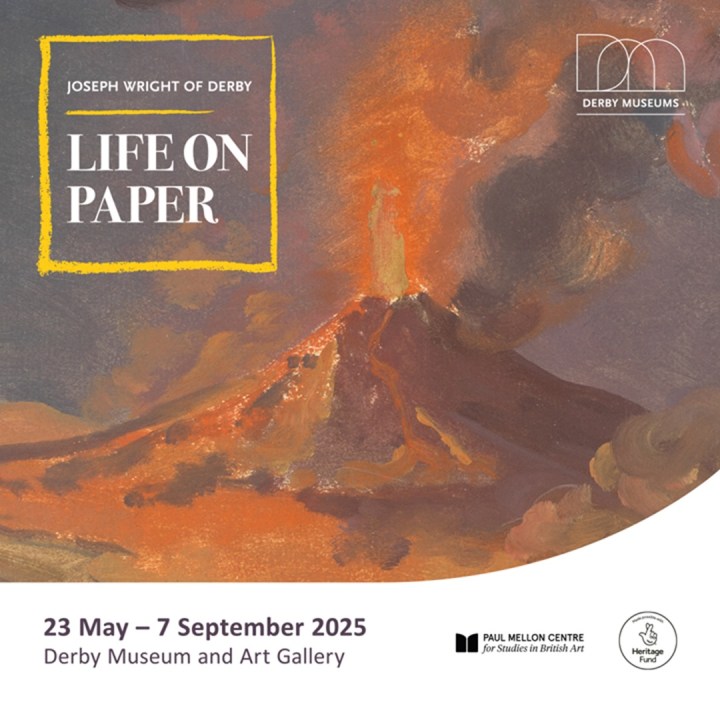
Exhibition | Joseph Wright of Derby: Life on Paper
Now on view at the Derby Museum and Art Gallery, as noted by The Art Newspaper:
Joseph Wright of Derby: Life on Paper
Derby Museum and Art Gallery, 23 May — 7 September 2025
Curated by Lucy Bamford
 In 2022, Derby Museums made its most significant acquisition in twenty years, with a remarkable self-portrait of Joseph Wright of Derby. Completed around 1772, this was the first and only occasion that Wright depicted himself as an artist. Curiously, it was with the specific trappings of a draughtsman—rather than a painter—that he pictured himself. Inspired by the self-portrait, this exhibition explores the role of drawing within the story of Wright’s life through 50 works on paper from Derby Museums’ collection. Rarely before seen outside Derby, they include early works made in training to remarkable ‘one-off’ productions, such as his self-portrait in pastel.
Studies of the works of the Old Masters and classical statuary provide a glimpse of his interests and influences. Elsewhere, illustrated letters reveal a collaborative side to his practice, as he sought advice from friends concerning subjects as diverse as chemical experiments and scenes from Shakespeare. Wright’s works on paper constituted a valuable expression of his personal, as well as professional, experience as an artist. The result is an exhibition that reveals this much-loved artist at his most experimental and exuberant, as well as his most vulnerable and human.
Image: Joseph Wright, Vesuvius in Eruption, ca. 1774, gouache on paper (Derby Museums).
Exhibition | Florence and Europe: Arts of the 18th Century

Now on view at the Uffizi:
Florence and Europe: Arts of the Eighteenth Century at the Uffizi
Firenze e l’Europa: Arti del Settecento agli Uffizi
Curated by Simone Verde and Alessandra Griffo
The Uffizi Galleries, Florence, 28 May — 28 November 2025
Masterpieces by Goya, Tiepolo, Canaletto, Le Brun, Liotard, Mengs, and other masters; spectacular views of iconic places of the Grand Tour in Italy; the monumental Mystic Marriage of St. Catherine by French painter Pierre Subleyras, restored live on display before the public’s eyes; the sensual curiosities of the Cabinet of Erotic Antiquities reconstructed according to the fashion of the Age of Enlightenment. The Uffizi Galleries bring the 18th century back to life with the exhibition Florence and Europe: Arts of the Eighteenth Century at the Uffizi, curated by the director Simone Verde and the head of 18th-century painting Alessandra Griffo. Installed in the airy, frescoed rooms on the ground floor of the museum, the exhibition includes a selection of around 150 works, including paintings, sculptures, furniture, porcelain, prints, and a large tapestry, many exhibited for the first time in the Gallery and others seen for the first time in ten years due to the museum’s extension works.
The exhibition recounts, through art, an era of crucial changes for Western thought, aesthetics, and taste, and also for the Uffizi itself, which, in the 18th century, was completely transformed from a dynastic treasure chest of royal collections into a modern museum, the first in the world. It was precisely at this time, in fact, that the pact established by the last Medici descendant, Anna Maria Luisa, certifying the end of the dynasty in 1737, bound the boundless store of works to Florence “for the ornament of the State,” and it was Pietro Leopoldo, Grand Duke of Tuscany, who in 1769 allowed citizens, on the feast day of Florence’s patron saint, St. John (24 June), to visit the museum freely. Structural changes intertwined with the great wave of political, cultural, and aesthetic transformations throughout Europe, which the Grand Dukes in Florence managed to intercept with the Uffizi Galleries, transforming the city and the museum into a microcosm where the new climate of the Continent could be felt.
Simone Verde states: “Florence and Europe aims to trace an extremely multifaceted century through its aesthetic culture, interweaving the general narrative of the context with the management of the Uffizi Galleries as Europe’s first modern museum. It’s a complex story rich in subtexts and nuances that we have constructed with patience and dedication, making works from the collection that have not been seen for many years, or have never been exhibited, available to the public.”
Alessandra Griffo states: “The works on display, besides being of great quality, have the merit of offering insights into a century that was crucial for the formation of the modern mentality, sensibility and even taste. Today, millions of people come to Florence every year, attracted by the myth of the early Renaissance: the rediscovery of this period occurred precisely during the 18th century.”
More information is available here»
Exhibition | Museum of Costume and Fashion in Florence Reopens
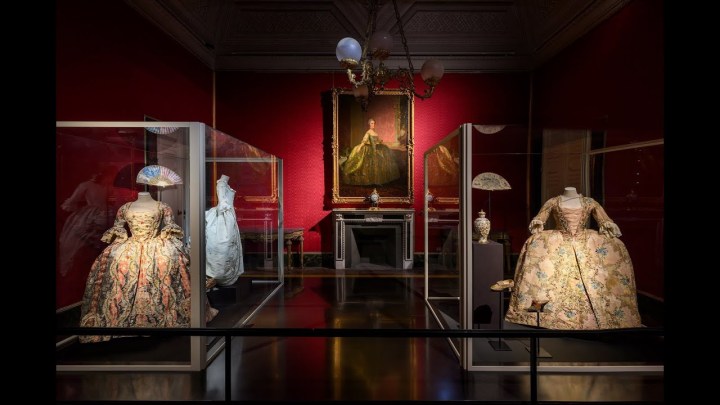
On view at the Museum of Costume and Fashion at the Pitti Palace:
New Arrangement of the Museum of Costume and Fashion
Museo della Moda e del Costume, Florence, ongoing
The history of fashion from the 18th century to the 2000s illustrated by captivating glimpses in an interplay between art and the historical environment of the Museum
After four years of renovation, the elegant historical premises of the Palazzina della Meridiana, the rooms that traditionally house the collections of the Museum of Costume and Fashion, have reopened completely. The Museum was inaugurated in 1983 at Pitti Palace—already known for being the ‘temple’ of fashion in the post-war period—and was the first Italian State museum dedicated to the history of fashion, haute couture, and the evolution of taste through the centuries. The new installation offers visitors a selection of rare and precious dresses accompanied by accessories—shoes, hats, fans, parasols, and bags—that exemplify through suggestions and samples a vast collection which in total has more than 15,000 items, and which will be put on display over time and according to rotations grouped by typologies, themes and leitmotifs, while always maintaining the criterion of the new arrangement which aims to propose a journey through the evolution of fashion and taste seen in their historical development, from the 18th century to the present day.
Another characteristic element of the new arrangement is indeed the interplay, strongly recommended by Director Simone Verde and the Museum’s curator Vanessa Gavioli, between the dresses and accessories and the most diverse forms of art, first of all painting, through the comparison between the gorgeous dresses on display and some fascinating coeval portraits and paintings, which help to make fashion also through the representations of painters such as Carle Vanloo, Laurent Pecheux, and Jean-Sébastien Rouillard, passing through the elegant portraits by the 19th-century ones such as Tito Conti, Giovanni Boldini, Edoardo Gelli, and Vittorio Corcos, to get to some of the most relevant artists of the Italian avant-garde including Massimo Campigli, Giulio Turcato, Corrado Cagli, and Alberto Burri. After all, fashion is by definition an art that has always lived in symbiosis with the most diverse disciplines, and the new arrangement of the Museum aims to recreate an ideal palimpsest in which, at a glance, one can also catch the relationships between different arts. Therefore not only between fashion and painting, but also between fashion and plastic arts (the match between the handles of porcelain vases and the sleeves of 18th-century dresses are intriguing); fashion, theatre, and sculpture (the relationship between Mariano Fortuny’s dress worn by Eleonora Duse and the actress’s face sculpted by Arrigo Minerbi is a particularly fascinating example); but also between fashion and architecture, with the dresses that stand in close connection with the historical space around, the furnishings and frescoes of the Palazzina della Meridiana; to end with a visual dialogue, virtually reconstructed thanks to the use of video screens, between the current arrangement and the historical ones, from the years in which in Florence, at Pitti Palace, in those same rooms that we can visit again today, Italian high fashion was establishing itself internationally according to a tradition that runs seamlessly to the present.










 Enfilade
leave a comment