Exhibition | Jannis Kounellis at Monnaie de Paris
From the Monnaie de Paris:
Jannis Kounellis
Monnaie de Paris, 11 March — 30 April 2016
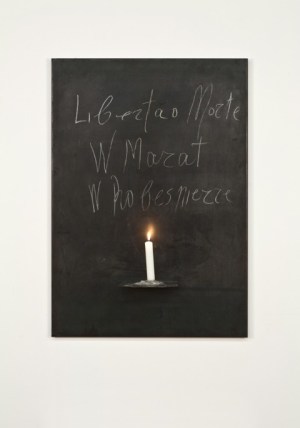
Jannis Kounellis, Libertà o Morte. W Marat W Robespierre, 1969.
At Monnaie de Paris (the Paris Mint), Jannis Kounellis has composed a dramatic sculpture throughout the thousand square metres of the 18th-century exhibition rooms of this Palace beside the Seine. Eminently present, concrete, irreducible, the new exhibition by Kounellis imposes a direct experience on visitors, without intermediaries.
“I come to Paris empty-handed, like an old painter.” This is what Kounellis said a few months ago in response to the invitation by Monnaie de Paris, which hosts this figure of contemporary art, at the origin of the Arte povera movement. As a painter, Kounellis designed his exhibition at Monnaie de Paris as a fresco. He had already, in 1972, crossed the boundaries of painting with Da inventare sul posto, a work accompanied by a dancer and a violinist.
In the 18th-century Monnaie de Paris salons, the paintings are staged through an installation of metal trestles. This army of cold metal will captivate visitors with its size and the contrast with the architecture and décor of the Palace: columns, marble, ornaments, gilt…
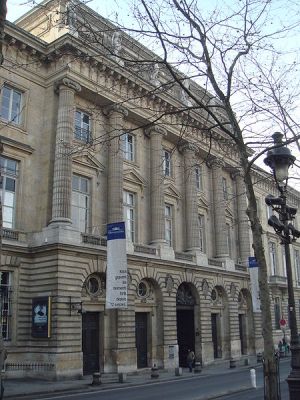
Jacques-Denis Antoine, Hôtel de la Monnaie, 1767–75
(Photo: Wikimedia Commons)
Jannis Kounellis offers a true experience to visitors. He had already positioned living energy alive, animal or human, at the centre of his work with the incomparable 12 live horses in 1969. But also in Nabucco in 1970 or quarters of hanging meat, or the Stommeln Pullheim Synagogue exhibition where fish evolved into a plate threatened with a knife in 1991.
Kounellis is inspired by Monnaie de Paris, the oldest company in the world and part of the heart of the last factory in Paris where know-how and industry intermingle to create his ‘new project’. The artist appeals to the visitor and raises the question of how a work is produced. It is in the technique, in the craft of the workshops, in the intuitive use of shapes and at the modelling stage that the artist’s project for Monnaie de Paris is born. The work Libertà o Morte. W Marat W Robespierre, 1969 will be presented in the exhibition as well as Da inventare sul posto which will echo the beating heart of the coin presses of Monnaie de Paris, embodying the strength, the rhythm, the orchestration.
A special public program will be performed by Etel Adnan with poetry and musical sessions on 17 March and 28 April at 7pm. Transmitted live on RAM Radioartemobile and broadcast on the Monnaie de Paris website, these rendez-vous will form part of a unique selection of radio archives.
Christophe Beaux, Jannis Kounellis, and Chiara Parisi, Jannis Kounellis (Berlin: Hatje Cantz, 2016), 64 pages, ISBN 978-3775741590, 30€. In French and English.
Exhibition | Ukiyo-e Tales: Stories from the Floating World
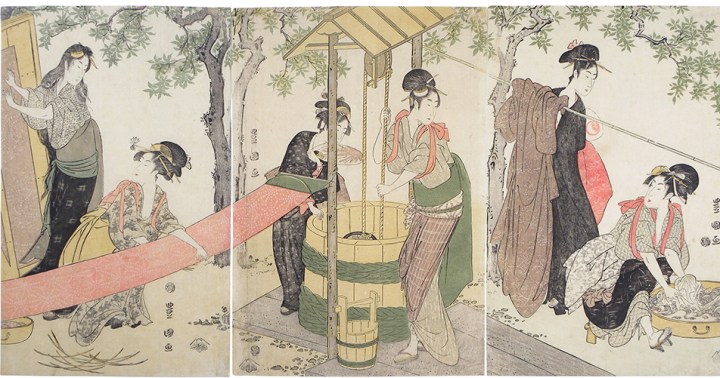
Utagawa Toyokuni I, Women Washing and Stretching Cloth, ca. 1795,
woodblock print triptych, 71.5 by 37 cm
◊ ◊ ◊ ◊ ◊
This year’s Asia Week in New York (March 10–19) offers an array of auctions, lectures, and exhibitions, including this one at Scholten Japanese Art:
Ukiyo-e Tales: Stories from the Floating World
Scholten Japanese Art, New York, 10–31 March 2016
Scholten Japanese Art participates in Asia Week 2016 with Ukiyo-e Tales: Stories from the Floating World, an exhibition focused on classic Japanese woodblock prints. The exhibition will take us back to the golden age of ukiyo-e and will feature works by some of the most important artists of the late 18th and up to the mid-19th century. We will focus predominately on images of beauties and the layers of meaning and stories that are conveyed via subtle (and sometimes not so subtle) clues found in the compositions. The exhibition will begin with works by Suzuki Harunobu (ca. 1724–70), who is largely credited with bringing together all of the elements that launched the production of nishiki -e (lit. brocade pictures), the full-color prints that we recognize today as ukiyo-e or images of the floating world. The term ukiyo (lit. ‘floating world’) references an older Buddhist concept regarding the impermanence of life, but during the prosperity of the Edo period in Japan the term began to be used to encompass and embolden everyday indulgences because of that impermanence. It was Harunobu’s designs, primarily celebrating youth and beauty, that are believed to have first launched the production of full-color woodblock printing in Japan around 1765.
One of the finest Harunobu prints included in this exhibition, Fashionable Snow, Moon, and Flowers: Snow, ca. 1768–69 depicts an elegant courtesan accompanied by her two kamuro (young girl attendants) and a male servant holding a large umbrella sheltering her from falling snow. The subject, a beautifully adorned courtesan parading en route to an assignation, and her placement within the lyrical setting of an evening snowfall, are hallmarks that define the genre of ukiyo-e. There are relatively few Harunobu prints extant, and due to their scarcity and the fragile nature of the vegetable pigments used at that time it is unusual to find a work in such good condition. Hence there are only two or three other authentic impressions of this particular design which have been recorded in public collections.
A print by a contemporary of Harunobu, Ippitsusai Buncho (fl. ca. 1755–90), titled Eight Views of Inky Water: Night Rain at Hashiba, ca. 1768–75, depicts the world from the perspective of a courtesan, without the pageantry of her parade through the pleasure quarters. Stepping out on to the verandah overlooking the Sumida River, she seems lost in thought as she adjusts the comb in her hair and looks down towards the small ferry boats navigating the dark (‘inky’) waters during a rainstorm while the passengers try vainly to protect themselves from the downpour. Streaks of rain partially obscure the view across the river where we see a figure carrying a lantern approaching a teahouse near the shore at Mukojima. While it was not uncommon to use accepted themes such as landscapes or literary subjects as a way to circumvent restrictions on overt depictions of famous actors and beauties or decadent displays of wealth, most of the time the ‘cover’ subject was relegated to an inset cartouche and the figural subject was front and center. In this composition the figure and the landscape are given equal consideration in a way that is unusual for the period because the landscape in the background tells as much of the ‘story’ as the figure in the foreground.
Another important artist well-represented in the show is Kitagawa Utamaro (1753–1806), a leading painting and print artist in his time, who practically owned the market for images of beauties in the 1790s and early 1800s, until his untimely death in 1806 shortly after a traumatizing episode when he was made to wear manacles under house arrest in punishment for having the audacity to depict the shogunate in an irreverent manner. A triptych of ‘Brine Carriers’ at a seashore was produced in happier times and visually references a classical literary subject, the sisters Matsukaze (‘Wind in the Pines’) and Murasame (‘Autumn Rain’), from the famous 14th-century Noh Drama, Matsukaze. Although the original story is about love and loss, Utamaro only barely references the cautionary legend and instead focuses on the opportunity to sidestep restrictions and depict women in revealing clothing in an everyday setting. The two sisters have been replaced by a bevy of beauties wearing grass skirts far shorter than acceptable in normal public settings, and their kimono tops are literally falling open while they wade in the surf collecting the brine.
Another story told by Utamaro is of a lovers’ quarrel. Eight Pledges at Lovers’ Meetings: Maternal Love between Sankatsu and Hanshichi, ca. 1798–99, is from a series that plays on puns referencing the classic landscape theme of Omi hakkei (‘Eight Famous Views of Omi’). This print uses the word ‘ bosetsu ‘ in the title, which can be translated as ‘a mother’s constant love,’ but also works as a pun for ‘evening snow,’ a clever reference to Hira no bosetsu (‘Evening Snow on Mount Hira’), one of the Omi hakkei subjects. But clever wordsmithing aside, what makes this print so remarkable is the tiny gesture of the woman, holding her index finger to her eye to wipe away a tear. For all of the dramas and tragedies in ukiyo-e, this small display of emotion stands out. While there are numerous visual shortcuts that artists employed to convey elements to a story, such as wisps of hair being out of place signaling excitement (good or bad), wiping away a tear is not at all common. Even more telling is the body language of her lover, who is looming over her shoulder and glaring at her. Their story is from a kabuki play (based on a true incident), in which the lovers resolve to give up their daughter and commit double suicide. Thus the ‘maternal love’ in the title suggests Sankatsu’s heartache over leaving her child, and it would seem Hanshichi is impatient with her hesitation. Utamaro, an artist known for his depictions of beautiful women of all ranks as well as erotic art, seems to convey his disapproval of their decision. Rather than feeding into the high drama in a way that romanticizes their story, Hanshichi especially is portrayed in an unflattering light.
There are several prints in the exhibition that show how young women, both in and out of the pleasure quarters, pass their time. Fashionable Five Festivals: Amusements of the Girls in the Seventh Month by Utagawa Toyokuni (1769–1825) from ca. 1796 shows a young girl struggling with writing her poetic wish for the Tanabata Festival. She sits at a writing table, brush in hand, with all the accoutrements needed, but the blank paper looms before her. On the floor are completed poems on decorative paper, rejected or not, is unclear. But a companion at her side holds open a copy of the poetry anthology, Ehon hyakunin shu (Picture Book of One Hundred Poets), ready to provide inspiration to the young poetess.
The private life of a courtesan inside the pleasure quarters is depicted by Kikugawa Eizan’s (1787–1867) Twelve Hours in the Pleasure Quarters: Daytime, Hour of the Snake, Courtesan Tomoshie of the Daimonji, ca. 1812. The so-called hour of the snake was a two-hour increment that began around 10 in the morning. Here we see the courtesan Tomoshie who is just getting up. She barely keeps her lightweight kimono closed, exposing an astounding length of leg and a deep décolletage. She seems to have just finished washing up and is using the sleeve of her robe to dry behind her ears. A young assistant holding a bowl of water is not entirely put together herself; her robe is disheveled at the collar and is opening at the legs revealing her upper thigh.
While some prints provide titles and puns to help us identify the story behind the composition, others provide only oblique clues and leave the rest to our imaginations. A stunningly well-preserved print by Keisai Eisen (1790–1848), has a curious title that seems to marry manufacturing with artistry: Modern Specialties and Dyed Fabrics: Sound of Insects at the Bank of the Sumida, ca. 1830. While the series title references a certain type of cloth dyed in a dappled pattern, the print title evokes the poetic sound of insects along the Sumida River in the summertime, and the composition itself seems to have little to do with either. The image is of a woman reading a letter by the light of a lantern which casts a dramatic beam across the room. The temperature must be uncomfortably warm because she wears her kimono very loosely, leaving the collar wide open at her chest with the sleeves pushed up, allowing it to open between her thighs to reveal a suggestive view of the red under-robe. She sits awkwardly with her knees folded at an angle, hunched over a long scroll of paper with an anguished look on her face with tell-tale wisps of hair falling forward signaling her distress. What is in the letter? Why is she so intense? Is it good or bad? We don’t know, her story is open for our interpretation.
The exhibition will feature 48 woodblock prints including works by: Suzuki Harunobu (ca. 1724–70), Katsukawa Shunsho (1726–1792), Kitao Shigemasa (1739–1820), Katsukawa Shunko (1743–1812), Kitagawa Utamaro (1753–1806), Ippitsusai Buncho (fl. ca. 1755–90), Hosoda Eishi (1756–1829), Katsukawa Shunsen (1762–ca. 1830), Utagawa Toyokuni I (1769–1825), Utagawa Toyokuni II (1777–1835), Chokosai Eisho (fl. ca. 1780–1800), Keisai Eisen (1790–1848), Kikugawa Eizan (1787–1867), and collaborative works by Utagawa Kunisada (1786–1865) and Utagawa Hiroshige (1797–1858); and one painting by Hosoda Eishi.
Gallery viewing will begin on Thursday, March 10th, and continue through Friday, March 18th. An online exhibition will be posted in advance of the opening. Scholten Japanese Art, located at 145 West 58th Street, Suite 6D, is open Monday through Friday, and some Saturdays, 11am–5pm, by appointment. For the duration of the first segment of the exhibition, March 10–18, the gallery will have general open hours (no appointment needed), 11am–5pm, and thereafter by appointment through March 31st.
Exhibition | Dutch Flowers
From The National Gallery:
Dutch Flowers
The National Gallery, London, 6 April — 29 August 2016
Curated by Betsy Wieseman
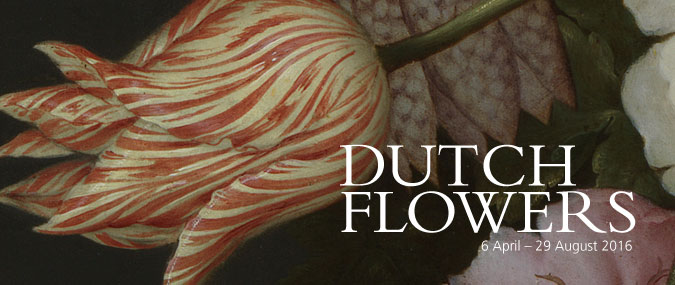
The first display of its kind in 20 years, this exhibition will explore the development of Dutch flower painting from its beginnings in the early 17th century to its blossoming in the late 18th century. Coinciding with the flower shows at Chelsea and Hampton Court, Dutch Flowers will draw connections between the development of flower painting in the Netherlands to increased interest in botany, horticulture, and the phenomenon of ‘tulip mania’. The exhibition will present an overview of the key artists active within the field and highlight the connections between them. Viewers will be invited to examine each work closely and in detail to appreciate the stylistic and technical characteristics of each artist. Works from the National Gallery Collection will be displayed alongside long-term loans from private collectors. The exhibition will include a major recent acquisition, Ambrosius Bosschaert the Elder’s A Still Life of Flowers in a Wan-Li Vase, acquired in 2010.
Note (added 5 April 2016) — The press release is available here
Exhibition | Louis-Auguste Brun, Painter to Marie-Antoinette
Now on view at the Swiss National Museum:
Louis-Auguste Brun, Painter to Marie-Antoinette: From Prangins to Versailles
Musée National Suisse, Château de Prangins, Prangins, 4 March — 10 July 2016
Curated by Martine Hart and Helen Bieri Thomson

Louis-Auguste Brun, Portrait of Marie-Antoinette on Horseback, 1783, 59 x 64.5 cm (Musée national des châteaux de Versailles et de Trianon)
From 4 March to 10 July 2016, the Swiss National Museum – Château de Prangins presents an exhibition devoted to the remarkable career of Louis-Auguste Brun, a painter from the Geneva school best known for his equestrian portraits of Queen Marie-Antoinette. Some one hundred works, together with a film recounting the surprising last years of his life as both art dealer and Vaud patriot, allow visitors to explore the life of an individual who defies easy classification. With scent-based guided tours and a Marie-Antoinette-inspired menu at the Café du Château, it’s an experience for all the senses.
A skilled draughtsman and an outstanding painter of portraits, animals and landscapes, the Swiss artist Louis-Auguste Brun (1758–1815) is today principally known for the works he produced at the French court, in particular two equestrian portraits of Marie-Antoinette. In fact, however, there is much more to his oeuvre. How did a young painter from the village of Rolle who completed his apprenticeship with a local craftsman come to enjoy the splendours of Versailles and gain an introduction to the Queen herself?
The exhibition retraces his remarkable story in around a hundred oil paintings and drawings. It highlights the decisive role of Brun’s encounters in the early stages of his career at Château de Prangins, a centre of cultural life in the Vaud region. The rest is down to Brun’s talent as an artist. Entirely at his ease depicting the diversions and carefree life of the privileged class, Brun begins producing large numbers of portraits, landscapes, hunting and horse racing scenes from the time he arrives in Paris. The exhibition also presents the works created on the shores of Lake Geneva after his return from France. It ends with a film recounting the surprising final years of his life, as an art dealer, collector and Vaud patriot.
The 16-page press packet is available as a PDF file here»
The catalogue is available from the Boutiques de musées de France:
Martine Hart and Helen Bieri Thomson, Louis-Auguste Brun, Peintre de Marie-Antoinette: De Prangins à Versailles (Paris: La Bibliothèque des Arts, 2016), 104 pages, ISBN: 978-2884531993, €29.
Exhibition | Grezler’s Choices: Work from the ITAS Collection
Now on view at the Castello del Buonconsiglio:
Grezler’s Choices: Work from the ITAS Collection, 1500–1900
Le scelte di Grezler: Opere antiche della collezione Itas al Castello del Buonconsiglio
Castello del Buonconsiglio, Trento, 5 December 2015 — 1 May 2016
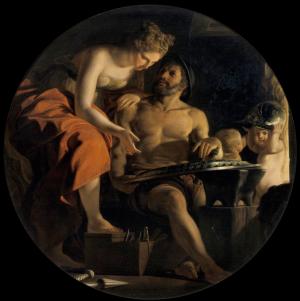
Bernardino Nocchi (previously attributed to Pompeo Batoni), Vulcan Delivering the Weapons of Aeneas to Venus, second half of the eighteenth century
Claudio Grezler, well known in Trento as having been president for over twenty years of the insurance company ITAS (Istituto Trentino Alto Adige per Assicurazioni), was also distinguished as a passionate art-lover. Over the years, this passion translated itself in the accumulation of a rich and varied personal collection of paintings. For the most part consisting of pictures by Italian and Flemish artists from the 1500s to the 1800s, his collection included outstanding works along the theme of the sacred and profane, of portraits, battles, and landscapes. By his own wish, his collection was merged with that of ITAS on his death and, in 1981, was exhibited in the prestigious setting of Buonconsiglio Castle. Claudio Grezler expressly wished that his collection, built up “with time, effort and sacrifice” should not be divided up and should instead become a public heritage.
Today, in gathering together this important patrimony, the Buonconsiglio Castle museum and ITAS have worked in harmonious synergy to pay homage to this important figure through a new initiative in appreciation of his collection. After assiduous research and a painstaking restoration process, the paintings are presented to the public in an exhibition that is further enriched by other exquisite works that Grezler, during his time as president, had added to the insurance company’s own collection.
Among the works exhibited are many that have only now, thanks to research conducted especially for this occasion, emerged from anonymity and been associated with their legitimate authors. We can, for instance, now admire Antonio Giuseppe Sartori’s baroque relief featuring the figure of Saint Florian, the patron saint of fire-fighters which is ideally suited to the insurance activities of ITAS. Present, too, is a delicate representation of Holy Conversation attributed to Nicolò de Barbari, alongside a sumptuous painting by Antonio Marini and an equally vivacious Bacchanalia from the Flemish school.
Exhibition | The Splendor of Venice
◊ ◊ ◊ ◊ ◊
From Fondazione Cariplo:
Lo Splendore di Venezia: Canaletto, Bellotto, Guardi e i Vedutisti dell’Ottocento
The Splendour of Venice: Canaletto, Bellotto, Guardi and the Vedutisti of the Nineteenth Century
Brescia, Palazzo Martinengo, Brescia, 23 January — 12 June 2016
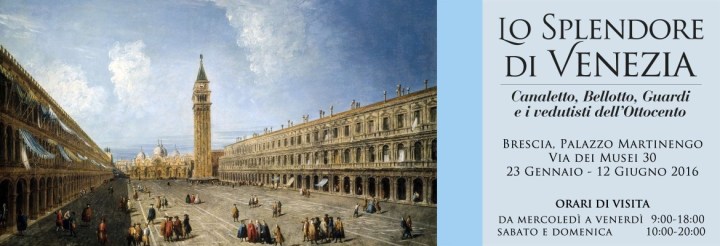
Palazzo Martinengo is hosting a new international art exhibition to celebrate the city of Venice. The Splendour of Venice shows how the city has been and still is—more than any other city—a timeless legend in the world’s collective imagination. Down through the centuries, Venice has been immortalised by Italian and foreign artists so often that it was identified as the origin of vedutismo. ‘Veduta’ in English was a successful new landscape genre that was appreciated by the rich and educated Grand Tour travellers who wanted to return to their home countries with a lovely picture of the charming sights they had seen in Italy.
To tell the public about the origins and development of the glorious season of Venetian vedute, Palazzo Martinengo presens for the first time ever a selection of over one hundred masterpieces by Canaletto, Bellotto, Guardi, and other important vedutisti from the 18th and 19th centuries. The paintings, on loan from prestigious private and public collections in Italy and Europe, have been carefully selected by an international scientific committee. This artwork demonstrates that the popularity of the genre did not end with the Republic of Venice, which came about with the Treaty of Campo Formio, signed in 1797 by the French and the Austrians, but instead continued during the entire 19th century.
The exhibition will follow an interesting chronological itinerary, divided into ten thematic sections, which all feature a selection of Murano glass objects created by master craftsmen of the 20th century. The exhibition will end with a final surprise, set up in the section ‘Venice, theatre of life’, with scenes from daily life in the squares, open spaces, streets, and canals of the city. Fondazione Cariplo is present at this event with four masterpieces from its art collection, painted by Guglielmo Ciardi and Pietro Fragiacomo.
Exhibition | Eighteenth-Century Porcelain Sculpture
Press release for the exhibition now on view at the NGV:
Eighteenth-Century Porcelain Sculpture
National Gallery of Victoria, Melbourne, 27 February — December 2016

Chelsea Porcelain Factory, London, Joseph Willems (modeller), Pietà, ca. 1761, porcelain (soft-paste), 38.5 x 28.5 x 22.8 cm (Melbourne: National Gallery of Victoria)
The NGV will present its renowned collection of eighteenth-century porcelain sculpture in an upcoming exhibition, revealing eighteenth-century baroque life and culture, from commoners and aristocrats to famous actors and musicians. Eighteenth-Century Porcelain Sculpture will showcase over eighty exquisite examples from famed European factories—including the German Meissen, French Sèvres, and English Derby factories—of intricately modelled porcelain figures, large-scale sculptural works, and celebrity portraits.
Tony Ellwood, Director, NGV, said, “The NGV holds the largest collection of porcelain sculpture in Australia, and this exhibition offers an opportunity to view a number of our rarest and most important works, including the Chelsea Porcelain Factory’s large-scale Pietà sculpture of which the NGV will present two of the only three examples in the world.”
Whilst today porcelain sculptures are often considered ‘decorative’ items, in the eighteenth century many of the finest artists of the time were drawn to the novel medium. The exhibition will include the work of key modellers such as Johann Joachim Kändler—the era’s most important ceramic sculptor and a major innovator—Franz Anton Bustelli, Johann Peter Melchior, and Giuseppe Gricci, court sculptor to King Charles VII of Naples.
The exhibition also includes rare porcelain sculptures of popular eighteenth-century London stage actors including Kitty Clive, Henry Woodward, David Garrick, and James Quinn. Collected by wealthy members of the elite, these figures give insight into the growing culture of celebrity in eighteenth-century England and demonstrate how porcelain became an important medium for the dissemination of popular imagery. Another highlight is the exceptionally rare Goffredo at the Tomb of Dudone, modelled by Giuseppe Gricci for the Neopolitan Capodimote factory, which portrays an episode from Tasso’s great Renaissance epic poem Jerusalem Liberated.
Due to the fragile nature of porcelain sculpture, NGV conservators have undertaken five months of restoration work to return many of these pieces to display. One sculpture, by the Italian Doccia factory of a shepherd and his companion, will be displayed for the first time in more than twenty years. Individual fingers no more than 2mm across were remade from porcelain and skilfully attached to the shepherd’s hand, an incredibly delicate procedure that required three attempts. Conservators have also removed discolouration from other pieces enabling them to be displayed once more in all of their original beauty.
The exhibition is accompanied by an online essay by Matthew Martin and public program offerings including floor talks which will provide unique insights into the period.
Exhibition | Jefferson and Palladio: Constructing a New World
◊ ◊ ◊ ◊ ◊
From the Palladio Museum:
Jefferson and Palladio: Constructing a New World / Come costruire un mondo nuovo
Palladio Museum, Vicenza, 23 September 2015 — 28 March 2016
Curated by Guido Beltramini and Fulvio Lenzo
Visitors are introduced to the exhibition by a mirror reflecting the busts of Palladio and Thomas Jefferson. This raises the initial question in the show: how are forms and ideas ‘reflected’? Why, in this case, was an architect from a province in Northern Italy adopted as a model for the construction of the architecture of the New World?

Thomas Jefferson, Plan of the Rotunda of the University of Virginia (Charlottesville: Special Collections, University of Virginia Library)
The answer is linked to another fundamental question: what is Thomas Jefferson (1743–1826), the man who drafted the Declaration of Independence and was the third president of the United States, doing in a museum of architecture? The reason is that he more than any other American shaped the face of the new nation through art, architecture and regional planning. Visionary but also pragmatic, he was both a man of action and an intellectual who knew Latin and Greek. And he was convinced that the New World could only be built through reason and beauty.
Jefferson and Palladio: Constructing a New World is the first-ever exhibition dedicated to the great American Palladian in Europe. It will enable visitors to explore Jefferson’s world, his art collections, architectural designs, dreams, and also his contradictions, through drawings, sculptures, precious books, architectural models, films and multimedia. The exhibition also features 36 photographs by Filippo Romano, the result of a photographic survey specifically conducted in Virginia in Spring 2014. There are also three precious original bozzetti (models) by Antonio Canova for a statue of George Washington, commissioned by Thomas Jefferson. Visitors can enhance their experience of the exhibition by downloading a free smartphone app with descriptions by the curators and so move through the rooms accompanied by their words.
The exhibition is dedicated to the memory of Mario Valmarana, the still greatly cherished professor at the University of Virginia who devoted his life to creating bridges between Palladio’s Veneto and Jefferson’s Virginia. Sponsored by Roberto Coin, the exhibition has been made possible thanks to the support of the Regione del Veneto, the Fondazione Cariverona and Dainese, and is the result of collaboration with the Fondazione Canova di Possagno and the Stiftung Bibliothek Werner Oechslin, Einsiedeln, Switzerland. The exhibition is also part of a joint project developed with the Canadian Centre for Architecture, Montreal, which in October 2014 staged the photographic exhibition Found in Translation: Palladio-Jefferson, A narrative by Filippo Romano.
The exhibition has been curated by Guido Beltramini and Fulvio Lenzo, with the support of an Advisory Committee, chaired by Howard Burns (Scuola Normale Superiore, Pisa), and composed of James Ackerman (Harvard University), Bruce Boucher (University of Virginia), Travis C. McDonald (Corporation for Jefferson’s Poplar Forest), Damiana Paternò (IUAV, Venice), Mario Piana (IUAV, Venice), and Craig Reynolds (University of Virginia). The catalogue (available in English or Italian) is published by Officina Libraria. The exhibition layout has been designed by Alessandro Scandurra.
◊ ◊ ◊ ◊ ◊
◊ ◊ ◊ ◊ ◊
The catalogue is available from Artbooks.com:
Guido Beltramini and Fulvio Lenzo, eds., Jefferson and Palladio: Constructing a New World (Milan: Officina Libraria, 2016), 176 pages, ISBN: 9788897737780, $30.
 The catalogue offers an opportunity to acquire a deeper understanding of Jefferson’s architecture and, at the same time, leads to a clearer understanding of Palladio himself. Jefferson looked to Palladio because he was the architect of one of Europe’s few republics in which administrative power was in the hands of landed gentlemen who avoided the ostentation of princely manners and spent long periods of time in the countryside.
Thomas Jefferson (1743–1826), a cosmopolitan figure with rural roots, was a master of the knowledge of his time. He drafted The Declaration of Independence (1776), and thus founded a new view of the proper relation between governed and government. Jefferson was the architect of the new America, not just in a political sense, but in a literal sense as well. Architecture had an important place in his personal and public agenda. A self-taught architect, Jefferson buildings are among America’s most famous: Monticello, the Virginia State Capitol, and the University of Virginia are the starting points of American classical architecture. Jefferson was guided by his admiration for Palladio’s Four Books on Architecture, which provided him with key architectural forms and ideas. Palladio showed him how the admired building types of the ancient Romans could be adapted to modern purposes and provide a rational, harmonious framework for living and for building a new society.
Guido Beltramini is Director of the Centro Internazionale di Studi di Architettura Andrea Palladio, Vicenza. Fulvio Lenzo is Associate Professor in the history of architecture at the Universita IUAV di Venezia, Venice.
◊ ◊ ◊ ◊ ◊
C O N T E N T S
Palladio in America, James Ackerman
Jefferson and Palladio, Guido Beltramini
Jefferson: Architecture and Democracy, Fulvio Lenzo
Photographing Jefferson, Filippo Romano
Palladianism in America Before Jefferson, Bruce Boucher
The National Survey Grid and the American Democracy, Catherine Maumi
Jefferson’s Creation of American Classical Architecture, Richard Guy Wilson
Jefferson and the First Public Statues in the United States, Giovanna Capitelli
Canova and the Monument to George Washington, Mario Guderzo
Palladio: Materials and Building Techniques Damiana, Lucia Paterno
Jefferson Builder, Travis McDonald
Enrtries for Monticello, Virginia State Capitol, President’s House, Poplar Forest, Bremo, Barboursville, University of Virginia
Bibliography
Exhibition Checklist
Display | Benjamin West at Spencer House

Benjamin West, Milkmaids in St. James’s Park, Westminster Abbey Beyond, ca. 1801, oil on panel, 100.6 × 143.5 cm
(New Haven: Yale Center for British Art, Paul Mellon Fund)
◊ ◊ ◊ ◊ ◊
From Art Daily:
Benjamin West at Spencer House
Spencer House, London, 31 January 2016 — 29 January 2017
In celebration of the 25th anniversary of the restoration of the State Rooms at Spencer House, James ‘Athenian’ Stuart’s early neo-classical interiors will showcase work of Benjamin West, a central figure in the development of neo-classical painting.
Central to the exhibition is West’s Milkmaids in St. James’s Park, Westminster Abbey Beyond (ca. 1801, oil on panel, Paul Mellon Fund), which is on special loan to the Rothschild Foundation from the Yale Center for British Art. This rare and important panel painting deals with an uncommon subject in West’s artistic practice; it shows the east area of St James’s Park near Whitehall, overlooked by Spencer House, where milk-maids kept cows from the end of the seventeenth-century. During the eighteenth century it became fashionable to visit the area in the morning to drink milk or syllabub, a mixture of milk and wine. The painting highlights West’s ability to blend landscape and genre painting and his originality in turning a popular event of everyday urban life into a pastoral scene of peace and pleasure. At the same time, West captures the skyline of central London with topographical accuracy, with the outline of Westminster Abbey clearly visible in the background.
The display unites Yale’s recent acquisition with three large history paintings by West, commissioned by George III, on loan to Spencer House from Her Majesty the Queen. Displayed in the Dining Room is West’s famous Death of Wolfe (1771) and its Renaissance and classical parallels The Death of Chevalier Bayard (1772) and The Death of Epaminondas (1773). In addition visitors will be able to see two further West paintings from The Royal Collection, shown in Lady Spencer’s Room, The Family of the King of Armenia before Cyrus (1773) and The Wife of Arminius Brought Captive to Germanicus (1773). Milkmaids in St. James’s Park, Westminster Abbey Beyond creates an interesting and illuminating comparison with these works, showing West’s versatility as an artist in demonstrating both his ability to depict historic scenes of heroic bravery and contemporary scenes of daily life in central London.
In his recent book Benjamin West and the Struggle to be Modern, Loyd Grossman describes West as “one of the most neglected and misunderstood of Britain’s eighteenth-century artists.” West arrived in England from America in 1763 and quickly established himself as the most prominent history painter in England, earning the adulatory nickname the ‘American Raphael’ from the press. By 1768, at the age of 32, he became one of the founding members of the Royal Academy of Arts—to which he was elected President in 1792—and in 1772 he was appointed Historical Painter to the King.
To complement the exhibition, a series of three lectures about Benjamin West will take place at Spencer House, followed by drinks:
• Loyd Grossman, How to Paint History: Benjamin West and the Death of General Wolfe, 14 March at 6.30pm
• Desmond Shawe-Taylor (The Surveyor of The Queen’s Pictures), Benjamin West and George III, 18 July at 6.30pm
• Lars Kokkonen (Assistant Curator of Paintings and Sculpture, Yale Center for British Art), Evaporations: Milkmaids in St. James’s Park No More, 14 November at 6.30pm
Booking information is available here»
A brief video clip from the YCBA describes the recent restoration of the painting. The accompanying text points to a recipe for syllabub here.
Exhibition | Faces of Terror: Violence and Fantasy
The exhibition closes in Paris this weekend:
Faces of Terror: Violence and Fantasy from David to Delacroix
Visages de l’effroi: Violence et Fantastique de David à Delacroix
Musée de la Vie Romantique, Paris, 3 November 2015 — 28 February 2016
Musée Municipal, La Roche-sur-Yon, 19 March — 19 June 2016
 With a collection of more than 100 paintings, drawings and sculptures by David, Girodet, Gericault, Ingres and Delacroix, Faces of Terror presents French forms of fantastical Romanticism. This darker part of 19th-century art reveals a certain strength of spirit and provides a fascinating perspective on imagination during the romantic period.
Romanticism, although often reduced to a feeling of discontentment among the people of the 18th century that was generated by the upheavals of the time, without a doubt expresses the feeling of disenchantment of a whole generation, built on the ruins of the Ancien Régime and the tumult of the French Revolution. In the overflow of extreme emotions these artists skilfully found subjects for a new kind of aesthetic, exploring the dark side of the human soul, at a time when dreams and the irrational were emerging from the latency of Reason and the spirit of the Enlightenment period.
From the end of the 18th century, the form of Neoclassicism adopted by the greatest artists depicted the death of heroes and portrayed the violence of tragedies from ancient history, simultaneously justified by both moral values and academic proprieties. Terror, political upheaval and Napoleonic war generated a much more blatant perspective of horror that was no longer the prerogative of historical paintings. During the period of the Restoration of the monarchy, the development of the mainstream press led to broadcasts of reports of bloody violence across the country, which became topical issues for artists.
The Romantic period focuses on the supernatural and sometimes morbid, and depicts—thanks to an abundant but often unknown production of works of art—a crude reality as well as the strange, dusky figures of spectres and devils from the literature and poetry of the time. This dialogue with the supernatural is notably depicted in representations of the myth of Ossian, or in the success of Dante’s work with the torment of the condemned.
Jérôme Farigoule and Hélène Jagot, eds., Visages de l’effroi: Violence et fantastique de David à Delacroix (Liénart, 2015), 288 pages, ISBN: 978-2359061475, 26€.










leave a comment