Exhibition | In Arcueil’s Leafy Groves: Drawing an 18th-Century Garden

Jean-Baptiste Oudry, Vue du parc d’Arcueil
(Musée du Louvre, dist. RMN – Grand Palais / Suzanne Nagy)
◊ ◊ ◊ ◊ ◊
From The Louvre:
In Arcueil’s Leafy Groves: Drawing an 18th-Century Garden
À l’ombre des frondaisons d’Arcueil: Dessiner un jardin du 18e siècle
Musée du Louvre, Paris, 24 March — 20 June 2016
Curated by Xavier Salmon
The Arcueil domain knew its golden age in the early 18th century. Situated near the aqueduct built for Marie de Medici between 1614 and 1624, the château was surrounded by a vast garden that included flowerbeds, woodland, covered galleries, and stairs. After the death of the Prince de Guise, the domain found a new owner, whose heirs subdivided it. When it was sold in 1752, the château and its grounds were razed under circumstances that remain unclear. Between the 19th and 20th centuries, the town of Arcueil sprang up around the aqueduct; of this substantial estate, with its sumptuous gardens and numerous outbuildings, only a few fragments now remain. Nonetheless, the memory of this historic site lives on in landscape drawings of Arcueil made by various artists in the 1740s. The goal of the exhibition is to present virtually all of these drawings for the first time.
Exhibition | We are One: Mapping America’s Road
From The Boston Public Library:
We are One: Mapping America’s Road from Revolution to Independence
Boston Public Library, 2 May — 29 November 2015
DeWitt Wallace Decorative Arts Museum, Colonial Williamsburg, 5 March 2016 — 29 January 2017
New-York Historical Society, 2017
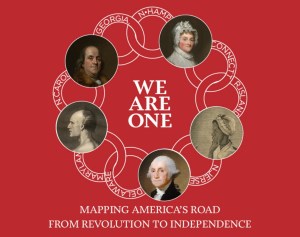 We Are One maps the American road to independence. It explores the tumultuous events that led thirteen colonies to join to forge a new nation. The exhibition takes its title from Benjamin Franklin’s early design for a note of American currency containing the phrase “We Are One.” This presaged the ‘E Pluribus Unum‘ found on the seal of the United States, adopted in 1782, and on all U.S. coins.
Using geographic and cartographic perspectives, the exhibition traces the American story from the strife of the French and Indian War to the creation of a new national government and the founding of Washington, D.C. as its home. Exhibited maps and graphics show America’s early status as a British possession: thirteen colonies in a larger trans-Atlantic empire. During and after the French and Indian War, protection of those thirteen colonies exhausted Britain economically and politically, and led Parliament to pass unpopular taxes and restrictions on her American colonial subjects. The Stamp Act, the Tea Act, and limits on colonial trade and industry incited protests and riots in Boston, as contemporaneous portrayals in the exhibition show.
When tensions between Britain and her American colonies erupted into war, British cartographers and other witnesses depicted military campaigns, battles, and their settings. These maps, drawings, and military artifacts now bring the long, bloody struggle for independence to life.
Finally, We Are One shows how, in the aftermath of the Revolution, America took stock of her new geography with surveys and maps. During this period, the Founders struggled to craft a new national government that would confederate thirteen colonies with different economic interests and cultures. European maps reflect their success by recognizing America’s triumphant new status of nationhood and her expanding territory.
More information is available here»
Exhibition | Princely Splendour: The Power of Pomp
From the Belvedere:
Princely Splendour: The Power of Pomp / Fürstenglanz: Die Macht der Pracht
Winter Palace, Vienna, 18 March — 26 June 2016

Anton von Maron, Emperor Joseph II with the Statue of Mars, 1775 (Vienna: KHM-Museumsverband)
The exhibition Princely Splendour: The Power of Pomp explores collecting in the Baroque period and uses the transformation of Prince Eugene’s Winter Palace into a modern museum as an opportunity to look back to princely splendor, Baroque galleries, and the art of order. At the heart of the exhibition are the lavish catalogues of the major European Baroque galleries, proclaiming the prestige of their creators and also marking the origins of modern exhibition and art catalogues. They document princely ideals of beautiful interiors, provide glimpses behind concepts of Baroque (re)presentation and reflect classification systems, ‘public’ accessibility, and display practices typical of the period. These original collection catalogues are combined with portraits of the princes and a selection of paintings from their collections. The exhibition is the first to explore this phenomenon from a pan-European perspective and compare the most important princely collectors from the Baroque period.
Princely Splendour demonstrates the importance that Europe’s former ruling dynasties attached to their art collections. For centuries, owning art was used as a way of flaunting power. This development was accompanied by the increasing status of artists, particularly painters, in the emerging Baroque period. Talented artists became the favourites of princes and securing their services for the court, and the exclusive rights to their work this entailed, were further ‘puzzle pieces’ in the power structure. At the height of the Baroque period outstanding talents, such as Peter Paul Rubens, could even be promoted to diplomats and enjoyed the status of ‘painter princes’.
The exhibits include Theatrum Pictorium (Theatre of Painting), published by court painter David Teniers the Younger in 1660. This lavishly illustrated work is a testimony to the Habsburg Archduke Leopold Wilhelm’s passion for collecting and represents the birth of these elaborately designed books with printed reproductions of the artworks. Also featuring in the exhibition are Jean-Baptiste Colbert’s Tableaux du Cabinet du Roi created under France’s King Louis XIV; the Dresden Galeriewerk under August III, elector of Saxony and king of Poland; as well as a Prodromus, a type of preview compiled under the Austrian Emperor Charles VI in Baroque Vienna around 1720–30 with over one thousand planned painting reproductions grouped into miniature tableaus. This pan-European show features outstanding loans from the Louvre and other museums, with the state portrait of the French Sun King from the Palace of Versailles as the exhibition’s highlight.
The Imperial Picture Gallery’s move from Vienna’s Stallburg to the Upper Belvedere presented an ideal opportunity to compile a new guide to the collection. This small-scale publication provides an insight into the concept and organization of the new hanging which, when compared with other European galleries, reveals a completely new, rationalized order. Increasingly, large albums were being replaced by more reasonably priced shorter catalogues, reflecting the public’s wishes to enjoy the collection in the form of handy guides. In the spirit of the Enlightenment, the opening of aristocratic collections to a new, wider public went hand in hand with the evolution of these gallery catalogues.
Agnes Husslein-Arco and Tobias G. Natter, ed., Fürstenglanz: Die Macht der Pracht (2016), 224 pages, ISBN: 978-3902805973, 39€.
Exhibition | The Grand Tour: Joseph Wright and the Lure of Italy
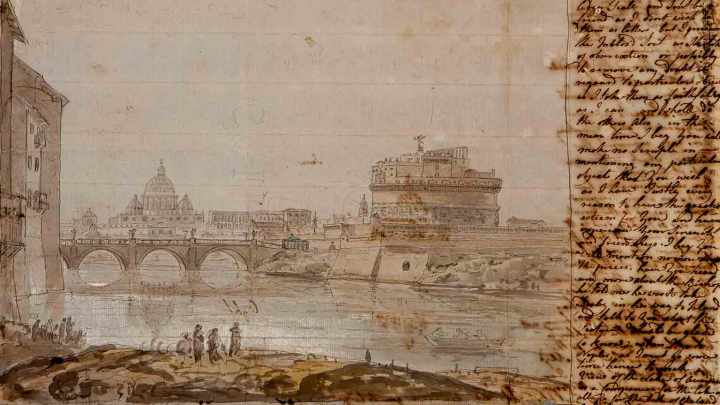
Joseph Wright, letter including sketches of Castel Saint’ Angelo and Saint Peter’s in Rome, 1774
(Derby Museums Trust)
◊ ◊ ◊ ◊ ◊
One of this year’s installments in the Grand Tour series, which explores the topic as related to people and collections in Nottinghamshire and Derbyshire:
The Grand Tour: Joseph Wright and the Lure of Italy
Derby Museum and Art Gallery, 19 March — 12 June 2016
For many wealthy Europeans, The Grand Tour, which reached its heyday in the 18th and 19th centuries, marked a rite of passage that culminated in a visit to Italy; a country rich in the remains of classical history, art, and landscape. Among these tourists were Derbyshire men and women, including the artist Joseph Wright, who made his own artistic pilgrimage between 1773 and 1775. This exhibition draws upon this formative period in Wright’s life, alongside the experiences of his fellow Derbeians abroad. Among paintings and drawings from Derby Museums’ collection are treasures gathered together from public and private collections in Derbyshire and further afield, some of which have never before been seen in Derby.
Masterpieces by Pompeo Batoni and other early Italian Renaissance artists are shown alongside examples of Wright’s highly-skilled work, revealing how his time on the continent influenced his practice. Also on display is a folio of Raphael engravings the Derbyshire artist purchased whilst in Rome in 1775.
Exhibition | A Grand Tour of The Devonshire Collection at Chatsworth
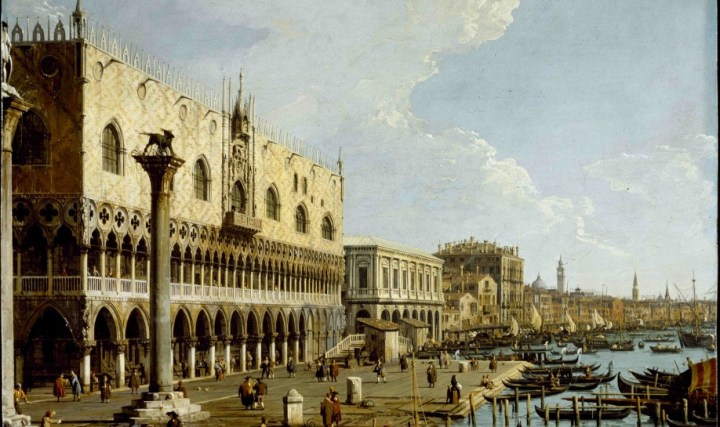
Canaletto (Giovanni Antonio Canal), Venice: A View of the Doge’s Palace and the Riva degli Schiavoni from the Piazzetta, ca.1729, oil on copper panel, 45.7 x 61 cm (Chatsworth House, Derbyshire)
◊ ◊ ◊ ◊ ◊
One of this year’s installments in the Grand Tour series, which explores the topic as related to people and collections in Nottinghamshire and Derbyshire:
A Grand Tour of The Devonshire Collection at Chatsworth
Chatsworth House, Derbyshire, 19 March — 23 October 2016
From the Grand Tour of the 2nd Earl in the company of his tutor, the famous philosopher Thomas Hobbes, to Georgiana, Duchess of Devonshire’s exile on the continent, A Grand Tour of The Devonshire Collection looks at what they saw, where they went—and what they and their contemporaries bought. The exhibition also demonstrates the impact of the Grand Tour at home through the introduction of new ideas and styles of art and architecture. This includes the overthrow of Baroque by Palladianism, triggered by the travels of Inigo Jones and later, the 3rd Earl of Burlington (father-in-law of the future 4th Duke of Devonshire).
As part of A Grand Tour of The Devonshire Collection, the Old Master Drawings Cabinet hosts displays of artists’ impressions of what Grand Tourists saw on their travels. This will start with ‘Rome in Ruins’—an evocative collection of drawings by Sebastian Vrancx, previously unseen at Chatsworth.
Exhibition | James Gillray’s Hogarthian Progresses
From The Lewis Walpole Library:
James Gillray’s Hogarthian Progresses
The Lewis Walpole Library, Farmington, CT, 6 April — 16 September 2016
Curated by Cynthia Roman
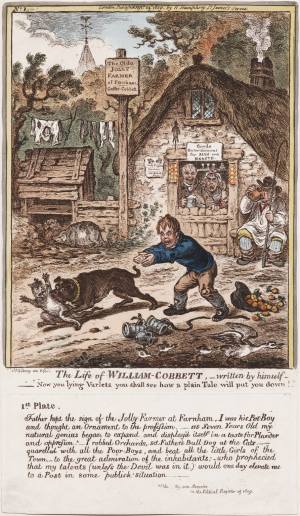
James Gillray, The life of William-Cobbett, written by himself. : Now you lying varlets you shall see how a plain tale will put you down! / Js. Gillray inv. & fec. Published in London, 29 September 1809 (Lewis Walpole Library).
Sequential narration in satiric prints is most famously associated with the ‘modern moral subjects’ of William Hogarth (1697–1764): Harlot’s Progress (1732), A Rake’s Progress (1735), Marriage A-la-Mode (1745), and Industry and Idleness (1747) among others. Less well-known is the broad spectrum of legacy ‘progresses’ produced by subsequent generations drawing both on Hogarth’s narrative strategies and his iconic motifs. James Gillray (1756–1815), celebrated for his innovative single-plate satires, was also among the most accomplished printmakers to adopt Hogarthian sequential narration even as he transformed it according to his unique vision. This exhibition presents a number of Gillray’s Hogarthian progresses alongside some selected prints by Hogarth himself.
P R O G R A M S
Study Day
James Gillray’s Experimental Printmaking
Organized by Esther Chadwick, History of Art, Yale University and Cynthia Roman, The Lewis Walpole Library, Yale University, 10 June 2016
Graduate Student Seminar
Collecting the Graphic Work of William Hogarth
Sheila O’Connell, Former Curator of Prints, British Museum, 14 June 2016
Graduate Student Seminar
Connoisseurship: Graphic Satire from William Hogarth to James Gillray
Andrew Edmunds, Collector and Dealer, 15 June 2016
Master Class for Graduate Students
A Contest of Two Genres: Graphic Satire and British History Painting in the Long Eighteenth Century
Mark Salber Phillips, Professor of History at Carleton University, Ottawa, and Cynthia Roman, Curator of Prints, Drawings, and Paintings at the Lewis Walpole Library, 22–26 August 2016
Master Class for Graduate Students
The Comic Image 1800–1850: Narrative and Caricature
Brian Maidment, Professor of the History of Print, Liverpool John Moores University
Cynthia Roman, Curator of Prints, Drawings, and Paintings at the Lewis Walpole Library, 14—16 September 2016
Exhibition | Giovanni Battista Piranesi
From The Pushkin State Museum of Fine Arts:
Giovanni Battista Piranesi: Artworks from Russian and Foreign Collections
The Pushkin State Museum of Fine Arts, Moscow, 20 September — 12 November 2016
 The Pushkin State Museum of Fine Arts is planning to host a major exhibition dedicated to the art of Giovanni Battista Piranesi (1720–1778), an Italian engraver, architect, researcher, decorator, and collector of Ancient Roman objects. The display will include more than 100 etchings by Piranesi, engravings and drawings by his predecessors and followers, plaster casts, medals, books, models from the collection of the Pushkin State Museum of Fine Arts, the Cini Foundation (Venice), the Schusev State Museum of Architecture, the Russian Academy of Fine Arts Museum, and other collections based in Russia and Western Europe.
The works of the predecessors and the followers of the Italian master will help visitors get a better understanding of how Piranesi’s artistic personality was formed, how his art influenced the following generations of artists and of the role of his legacy in Russia. Piranesi’s art inspired the architects of Catherine II’s court—Giacomo Quarenghi, Charles Cameron, Vincenzo Brenna; as well as masters of Russian Avant-garde—Ivan Leonidov, Konstantin Melnikov, Yakov Chernikhov. This art still continues to impress its admirers with its sophistication: a contemporary Russian artist Valeriy Koshlyakov will display an artwork he has created exclusively for this exhibition.
Exhibition | Idea of the Perfect Painter

◊ ◊ ◊ ◊ ◊
From The Pushkin State Museum of Fine Art:
The Idea of the Perfect Painter: Russian Academic Model
Engraving and Books for Artists from the 18th Century
The Pushkin State Museum of Fine Arts, Moscow, 20 February — 22 May 2016
The exhibition Idea of the Perfect Painter will help visitors extend their knowledge on the learning methods of the Russian academic school of the 18th century. It is no coincidence that the display is located in the Olympic hall, surrounded by plaster casts similar to those, which could be found in studios. Plaster casts constituted the second step of artistic education, while the first one was dedicated to engraved ‘models’. The exhibition will showcase drawings, engravings, and prints dating from the end of the 18th century, as well as the first European art-related manuals and books. The display will feature original works by Georg Friedrich Schmidt (1712–1775) and sheets by his scholars—Alexey Grekov, Prokofy Artemyev, and others.
Exhibition | The Empress and the Gardener
Press release from Hampton Court:
The Empress and the Gardener
Hampton Court Palace, London, 28 April — 4 September 2016
Curated by Sebastian Edwards
 A remarkable collection of watercolour paintings and drawings once owned by the Empress Catherine the Great of Russia will go on show at Hampton Court Palace this spring, as part of the nationwide commemorations marking the 300th anniversary of Lancelot ‘Capability’ Brown’s birth. Never displayed before, the exhibition of almost 60 intricately detailed views of the palace, park and gardens vividly captures Hampton Court during the time when Capability Brown served there as Chief Gardener to King George III. The intriguing history of this collection, which lay forgotten in the stores of the State Hermitage Museum in St Petersburg, Russia for over two centuries, will be explored in The Empress and the Gardener.
Arguably Britain’s most famous landscape gardener, Capability Brown served as Chief Gardener to King George III at Hampton Court Palace from 1764 to 1783. The job came with a handsome salary and residence at the palace, but Brown, who famously transformed landscapes across the country, actually did very little to change the palace’s Baroque formal gardens, choosing instead to preserve them out of respect for his predecessors. Nevertheless, by the time he moved into royal service, he was already operating a busy landscaping business, and winning international acclaim as one of the most famous proponents of the ‘English Style’ of landscape design.
Famously a voracious consumer of foreign culture, Catherine the Great was a great admirer of all things English, declaring to the philosopher Voltaire that “Anglo-mania rules my plantmania.” She built herself an ‘English Palace’ and ‘English Park’ at her palace at Peterhof, with the help of British designers but was unable to find a Capability Brown of her own. Seizing a lucrative opportunity, a figure in the shadows, John Spyers, assistant to Brown, sold two albums of his detailed drawings from Brown’s home and workplace, Hampton Court Palace, to the Empress for the huge sum of 1,000 roubles.
Quite how Spyers managed to achieve this extraordinary coup remains a mystery, but ironically the Empress found herself the possessor of an album of drawings of a palace landscape which Brown himself had barely touched. The albums, which alone had cost Catherine a tenth the price of creating her new gardens, disappeared in her collection at the Hermitage (now the State Hermitage Museum) and lay forgotten for over two centuries before being rediscovered by Hermitage curator Mikhail Dedinkin in 2002.
Today, the Spyers views are a unique survival: the richest and most revealing record of how Hampton Court gardens looked when Brown was in charge. Together they are considered one of the most complete visual records of any historic landscape ever captured before the dawn of photography. From rare glimpses of the ordinary people who lived in or visited the palace and its gardens, to evocative details of Hampton Court’s celebrated courtyards, passageways and picturesque corners, they explore an almost-forgotten period in the palace’s history in vivid detail.
The Empress and the Gardener will see these rare works go on public display for the first time, in the very setting that inspired their creation. The exhibition will also feature contemporary portraits of Capability Brown and the Empress Catherine, previously unseen drawings of Catherine’s ‘English Palace’ in the grounds of Peterhof near St. Petersburg and several pieces of the famous ‘Green Frog’ dinner service, a triumph of British design created for the Empress by Wedgwood, featuring images of some of the celebrated landscapes where Brown worked across England.
Sebastian Edwards, exhibition curator, said, “We are thrilled to be able to present this remarkable window into a forgotten Georgian era in the palace’s past, in the year when garden lovers up and down the country are celebrating the 300th anniversary of Capability Brown’s birth. We hope that after enjoying The Empress and the Gardener our visitors will follow in John Spyers’s footsteps, out into Hampton Court’s magnificent gardens and discover how they have changed over the centuries.”
◊ ◊ ◊ ◊ ◊
From Artbooks.com:
Mikhail Dedinkin and David Jacques, The Hampton Court Albums of Catherine the Great, (London: Fontanka 2016), 160 pages, ISBN: 978-1906257224, £32 / $45.
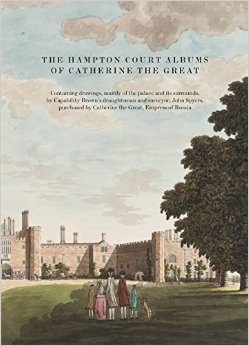
This album publishes, for the very first time, 100 hitherto unknown watercolours/drawings of Capability Brown’s designs for Hampton Court Palace gardens. These were purchased by Empress Catherine the Great of Russia through her own gardener James Meader, a disciple of Capability Brown, and then forgotten in the Hermitage stores. John Spyers, the artist to whom the albums have been attributed by Hermitage curator Mikhail Dedinkin, was Brown’s surveyor. Catherine the Great paid the huge sum of 1,000 roubles for them in the early 1780s and they were clearly bought as Capability Brown drawings. Almost no other visual material about Hampton Court and its gardens and park at the period when Lancelot ‘Capability’ Brown was the resident Royal Gardener has survived, so the importance of these views, which have never been published or on exhibition before, cannot be overstated.
Exhibition | Gravelot: Designing Georgian Britain
Now on view at Gainsborough House:
Gravelot: Designing Georgian Britain
Gainsborough’s House, Sudbury, Suffolk, 27 February — 5 June 2016
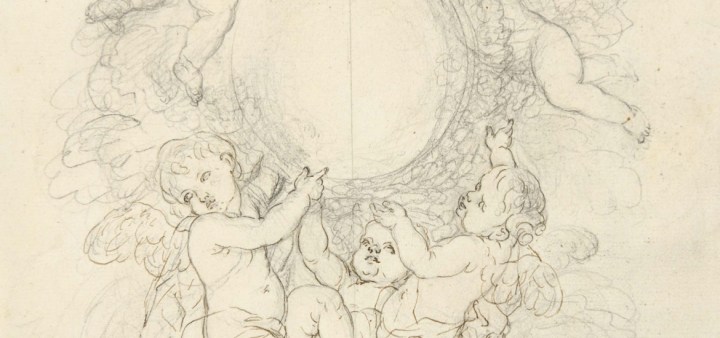
Hubert-François Bourguignon, better known as Gravelot, was one of the most influential designers of the eighteenth century. Born in Paris in 1699, he studied in Rome before returning to the French capital and working under the painter François Boucher. In 1732 he emigrated to London, where he remained until 1745. During this period he played a central role in introducing Rococo style into British art and design and was drawing master to the young Thomas Gainsborough RA.
This exhibition draws upon the impressive body of work by Gravelot in the Gainsborough’s House permanent collection. It showcases his extraordinary versatility as a draughtsman, which the eighteenth-century commentator on art George Vertue described as “a great and fruitful genius for designs.” The prints and drawings that feature in the display demonstrate Gravelot’s ability to operate across a variety of categories, producing work for a wide array of media: from book illustrations, graphic satire and printed ephemera, to snuff boxes, walking canes, silverware, medals and other forms of material culture. They also reveal the diverse sources from which Gravelot derived inspiration: from contemporary life and politics, to the natural world, historical narratives and classical literature.










leave a comment