Display | Persuading the King: A MS Petition by Gabriel de Saint-Aubin
Now on view at Waddesdon:
Persuading the King: A Manuscript Petition by Gabriel de Saint-Aubin (1724–1780)
Waddesdon Manor, Buckinghamshire, 23 March — 23 October 2016
Curated by Rachel Jacobs
 This display highlights a new addition to the collection at Waddesdon: Gabriel de Saint-Aubin’s volume, Placets de l’officier Desbans (1775). This elaborate manuscript petition (placet) was submitted to Louis XVI and Marie-Antoinette by a soldier, Edme Louis Desbans, asking for a long-promised promotion. Gabriel de Saint-Aubin was one of the greatest draughtsman of 18th-century France, and the drawings with which he brought this document to life were designed to glorify the royal couple while appealing to their artistic tastes and sensibilities. This unique work offers a glimpse into the politics of promotion and favour at the French court near the end of the Old Regime—in which the fortune of an individual depended upon the arts of persuasion. It has all sorts of resonances today, from patronage to the mysterious world of the political lobbyist.
A pdf file of the text panels is available at the Waddesdon website.
Exhibition | Freemasonry
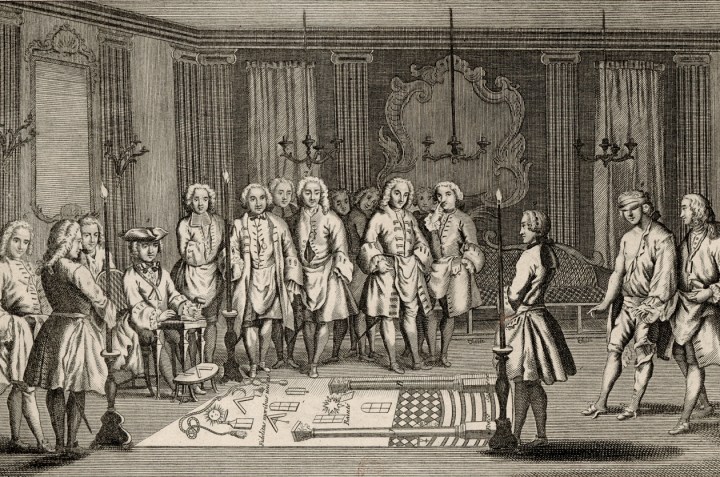
Assemblée de Francs-Maçons pour la réception des Maîtres, 1745
◊ ◊ ◊ ◊ ◊
Now on view at the BnF:
Freemasonry
Bibliothèque Nationale de France, Paris, 12 April — 24 July 2016
Curated by Pierre Mollier, Sylvie Bourel, and Laurent Portes
The Bibliothèque nationale de France, which houses one of the most important Masonic collections in the world, organizes a major exhibition dedicated to French freemasonry, in partnership with the Musée de la franc-maçonnerie. Over 450 pieces are presented, some of them for the first time ever. Some of these pieces belong either to the library’s collections or to major French obediences. Others were exceptionally lent by foreign owners. The exhibition focuses on the following issues: the origins of freemasonry, how it was founded in France, its symbols and rituals, its involvement in the political, religious, artistic and philosophical fields, the variety of associated legends… Its aim is to present freemasonry as an accessible issue.
The exhibition website is available here»
◊ ◊ ◊ ◊ ◊
Pierre Mollier, Sylvie Bourel, et Laurent Portes, La franc-maçonnerie (Paris: Bibliothèque Nationale de France, 2016), 344 pages, ISBN: 978-2717726992, 45€.
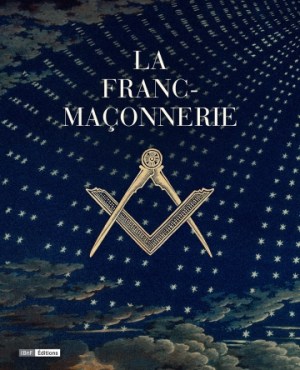 À partir du XVIIIe siècle, la franc-maçonnerie s’implante aussi profondément que durablement dans la société française. Si, de nos jours, celle-ci fait régulièrement la une des journaux, elle n’en demeure pas moins mal connue—quand elle ne nourrit pas encore d’obscurs soupçons de trafic d’influence, de complot ou d’occultisme. Publié à l’occasion de l’exposition d’une envergure sans précédent que la Bibliothèque nationale de France consacre à la franc‑maçonnerie, cet ouvrage est appelé à devenir l’une des références incontournables du domaine. Réunissant les contributions des plus grands spécialistes, il répond à la légitime curiosité dont la maçonnerie fait l’objet.
Des origines légendaires à la franc-maçonnerie moderne, dite spéculative, il retrace l’histoire de la franc-maçonnerie en faisant la part du fantasme et de la réalité. Il présente le corpus symbolique et les rites maçonniques associés à la notion, ici centrale, d’initiation. Excluant tout esprit polémique, il répertorie les réalisations politiques et sociétales de l’histoire moderne qui puisent leurs sources dans l’engagement philanthropique des maçons : les lois sur la liberté de la presse, la liberté d’association, la laïcité, l’école gratuite et obligatoire ou encore les premières bases de la protection sociale. Il relève également les inspirations maçonniques variées qui, depuis trois siècles, irriguent les arts et les lettres, de La Flûte enchantée de Mozart à Léon Tolstoï ou Rudyard Kipling, en passant, aujourd’hui, par la bande dessinée ou le roman policier. Riche par la diversité des thèmes abordés, cet ouvrage l’est enfin par son iconographie. La Bibliothèque nationale de France abrite l’un des plus importants dépôts de documents maçonniques au monde : manuscrits, estampes, livres rares y sont à la fois nombreux et d’une qualité remarquable. Ces collections exceptionnelles méritaient d’être connues et admirées au-delà du monde des chercheurs et des spécialistes ; reproduites ici, parfois pour la toute première fois, elles contribueront désormais, de manière aussi spectaculaire que documentée, à la meilleure compréhension d’une société dont les adeptes eux-mêmes reconnaissent la complexité.
Cet ouvrage est publié à l’occasion de l’exposition «La franc-maçonnerie», organisée par la Bibliothèque nationale de France et présentée sur le site François-Mitterrand, du 12 avril au 24 juillet 2016.
Exhibition | Brueghel to Canaletto: The Grasset Collection
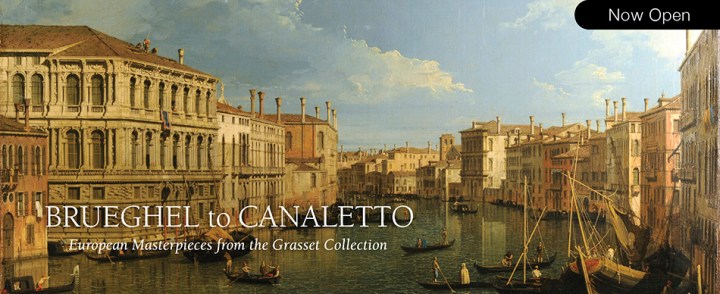
Press release (1 January 2016) from The San Diego Museum of Art:
Brueghel to Canaletto: European Masterpieces from the Grasset Collection
The San Diego Museum of Art, 2 April — 2 August 2016
The San Diego Museum of Art announced the arrival of Brueghel to Canaletto: European Masterpieces from the Grasset Collection, an exhibition featuring some of the finest still life and landscape paintings from leading Dutch, Flemish, Italian, Spanish and German artists of the 17th and 18th centuries. Made possible by a loan from a European family, of French origin with close connection to Spain, the exhibition features 40 works never before displayed publicly. The collection is on view at the Museum, the sole venue for the exhibition, from April 2 through August 2, 2016.
Spanning the years 1600 to 1750, the featured works represent a turning point in history when artwork began to be collected by those other than nobility—and the art market emerged. Grouped thematically, the exhibition begins with still lifes including floral arrangements featuring exquisite flowers imported from around the world and sumptuous banquet scenes featuring exotic fruits, cheeses, fine wine, imported silver and Chinese porcelain highly coveted in the Netherlands, reflecting the high-society influences of the time. The exhibition also includes landscapes depicting the day-to-day lives of common folk, as well as maritime scenes that became increasingly popular throughout northern Europe at the time.
Brueghel to Canaletto: European Masterpieces from the Grasset Collection brings together a rare grouping of artists from the ‘Golden Age’, including Barent Avercamp, famous for his paintings of everyday life in the Netherlands; Juan van der Hamen y León, the most important Spanish still life painter of the 17th century, whose style helped shape the development of still life through the 19th century; and Canaletto, an artist renowned for his views of the canals of Venice.
Notable works featured in the exhibition also include Floris Claesz van Dyck’s Still Life of Fruit and Olives; Osias Beert’s Still Life of Flowers in a Stone Vase; Jan Brueghel’s A Wooded River Landscape, with a Fish Market and Fishing Boats; and Esias van de Velde’s Winter Landscape with Elegant Skaters and a Woman Frying Pancakes on a Frozen Waterway.
“These paintings represent more than flowers and still lifes–they convey the ephemeral nature of life,” said Roxana Velásquez, Maruja Baldwin Executive Director of The San Diego Museum of Art. “The works in Brueghel to Canaletto: European Masterpieces from the Grasset Collection reflect a pivotal time in history as art became a more accessible commodity, and the masters of this period became more technically advanced as a result. We are thrilled to debut this exhibition in its entirety for the very first time and to share it with the San Diego community and its visitors.”
The exhibition will be accompanied by a discussion with Michael Brown, Associate Curator of European Art, who will provide a behind-the-scenes look at the reorganization and renovation of the second-floor galleries featuring Brueghel to Canaletto. Organized thematically, the other galleries will feature works of art from the Museum’s permanent collection associated with The Art of Devotion and The Art of the Portrait. After the conclusion of the exhibition, highlights of Brueghel to Canaletto: European Masterpieces from the Grasset Collection will be on display at The San Diego Museum of Art for three years, providing a rich addition of 17th-century works to the Museum’s collection.
Exhibition | Three Centuries of American Prints
From the press release (3 February 2016) for the exhibition:
Three Centuries of American Prints from the National Gallery of Art
National Gallery of Art, Washington, D.C., 3 April 3 — 24 July 2016
National Gallery, Prague, 4 October 2016 — 5 January 2017
Antiguo Colegio de San Ildefonso, Mexico City, 7 February — 30 April 2017
Curated by Amy Johnston and Judith Brodie

John Simon after John Verelst, Sa Ga Yeath Qua Pieth Tow, King of the Maquas, after 1710 (Washington, D.C.: National Gallery of Art, Paul Mellon Fund)
A new international traveling exhibition will explore major events and movements in American art through some 150 outstanding prints from the Colonial era to the present. Three Centuries of American Prints from the National Gallery of Art is the first major museum survey of American prints in more than 30 years. Timed to coincide with the National Gallery of Art’s 75th anniversary, the exhibition is drawn from the Gallery’s renowned holdings of works on paper, and features more than 100 artists such as Paul Revere, James McNeill Whistler, Mary Cassatt, Winslow Homer, George Bellows, John Marin, Jackson Pollock, Louise Nevelson, Romare Bearden, Andy Warhol, Robert Rauschenberg, Chuck Close, Jenny Holzer, and Kara Walker.
Organized chronologically and thematically through nine galleries, Three Centuries of American Prints reveals the breadth and excellence of the Gallery’s collection while showcasing some of the standouts: exquisite, rare impressions of James McNeill Whistler’s Nocturne (1879/1880), captivating prints by Mary Cassatt, a singularly stunning impression of John Marin’s Woolworth Building, No. 1 (1913), and Robert Rauschenberg’s pioneering Booster (1967).
The exhibition is bracketed by John Simon’s Four Indian Kings (1710)—stately portraits of four Native American leaders who traveled to London to meet Queen Anne—and Kara Walker’s no world (2010), which recalls the disastrous impact of European settlement in the New World. Both prints address the subject of transnational contact, a theme that runs through the history of American art.

Paul Revere, The Boston Massacre, 1770, hand-colored engraving (Washington, D.C.: National Gallery of Art, Rosenwald Collection)
Three Centuries of American Prints features works intended to provoke action, such as Paul Revere’s call for moral outrage in The Bloody Massacre (1770) and Jenny Holzer’s appeal to “Raise Boys and Girls the Same Way” in her Truisms (1977). Others lean more strongly toward visual concerns, such as Stuart Davis’s striking black-and-white lithograph, Barber Shop Chord (1931), and Richard Diebenkorn’s resplendent Green (1986). This duality between prints designed to exhort or teach and ones more weighted to artistic matters is an undercurrent of both the exhibition and the history of American prints.
Since its opening in 1941, the National Gallery of Art has assiduously collected American prints with the help of many generous donors. The Gallery’s American print collection has grown from nearly 1,900 prints in 1950 to some 22,500 prints in 2015. The collection was transformed in recent years by the acquisition of the Reba and Dave Williams Collection, the personal print archive of Jasper Johns, and some 2,300 American prints from the Corcoran Gallery of Art, along with a gift and pledge of 18th- and early 19th-century prints from Harry W. Havemeyer.
“In the past few decades the American collections at the National Gallery of Art have grown vastly in quality and scale. From 2000 until today—thanks to generous donors and acquisitions from the Corcoran Gallery of Art—the collection of American prints has almost doubled and now numbers some 22,500 works,” said Earl A. Powell III, Director, National Gallery of Art. “We are tremendously grateful to hundreds of donors, foremost among them Lessing J. Rosenwald and Reba and Dave Williams, as well as grateful to Altria Group, the Terra Foundation for American Art, and The Exhibition Circle of the National Gallery of Art for their vital support.”
The exhibition is made possible by Altria Group in celebration of the 75th Anniversary of the National Gallery of Art. This is the twelfth exhibition sponsorship by Altria Group at the Gallery. “For more than 50 years, Altria and its companies have supported visual and performing arts. Our partnership with the National Gallery of Art to share Three Centuries of American Prints is an important way that we’re bringing world-class cultural experiences to our communities,” said Bruce Gates, Senior Vice President of External Affairs for Altria Client Services. The international tour of the exhibition is sponsored by the Terra Foundation for American Art. Additional support is provided by The Exhibition Circle of the National Gallery of Art.
The curators of the exhibition are Amy Johnston, assistant curator of prints and drawings, and Judith Brodie, curator and head of the department of modern prints and drawings, both at the National Gallery of Art. The exhibition catalog is conceived and edited by Judith Brodie, with coauthors Amy Johnston and Michael J. Lewis, the Faison-Pierson-Stoddard Professor of Art History at Williams College. The Terra Foundation for American Art provided additional funding for the exhibition catalog.
Judith Brodie, Amy Johnston, and Michael J. Lewis, Three Centuries of American Prints (New York: Thames & Hudson, 2016), 306 pages, ISBN: 978-0500239520, $60.
New Book | The Mind Is a Collection
From Penn Press:
Sean Silver, The Mind Is a Collection: Case Studies in Eighteenth-Century Thought (Philadelphia: University of Pennsylvania Press, 2015), 384 pages, ISBN: 978-0812247268, $65 / £42.
 John Locke described the mind as a cabinet; Robert Hooke called it a repository; Joseph Addison imagined a drawer of medals. Each of these philosophers was an avid collector and curator of books, coins, and cultural artifacts. It is therefore no coincidence that when they wrote about the mental work of reason and imagination, they modeled their powers of intellect in terms of collecting, cataloging, and classification.
The Mind Is a Collection approaches seventeenth- and eighteenth-century metaphors of the mind from a material point of view. Each of the book’s six chapters is organized as a series of linked exhibits that speak to a single aspect of Enlightenment philosophies of mind. From his first chapter, on metaphor, to the last one, on dispossession, Sean Silver looks at ways that abstract theories referred to cognitive ecologies—systems crafted to enable certain kinds of thinking, such as libraries, workshops, notebooks, collections, and gardens. In doing so, he demonstrates the crossings-over of material into ideal, ideal into material, and the ways in which an idea might repeatedly turn up in an object, or a range of objects might repeatedly stand for an idea. A brief conclusion examines the afterlife of the metaphor of mind as collection, as it turns up in present-day cognitive studies. Modern cognitive theory has been applied to the microcomputer, and while the object is new, the habit is as old as the Enlightenment.
By examining lived environments and embodied habits from 1660 to 1800, Silver demonstrates that the philosophical dualism that separated mind from body and idea from thing was inextricably established through active engagement with crafted ecologies.
Sean Silver teaches literature at the University of Michigan. Sean Silver’s The Mind is a Collection is a two-part intellectual project featuring a virtual museum (about museums) along with his book, The Mind is a Collection, which serves as both scholarly study and an exhibit catalogue.
◊ ◊ ◊ ◊ ◊
C O N T E N T S
Preface: Welcome to the Museum
Introduction
Case 1. Metaphor
1 John Locke’s Commonplace Book
2 John Milton’s Bed
3 Mark Akenside’s Museum
Case 2. Design
4 Robert Hooke’s Camera Obscura
5 Raphael’s Judgment of Paris
6 A Gritty Pebble
7 An Oval Portrait of John Woodward
8 A Stone from the Grotto of Egeria
9 Venus at Her Toilet
Case 3. Digression
10 The Iliad in a Nutshell
11 A Full Stop
12 A Conical Roman Tumulus
13 The Reception of Claudius
14 Addison’s Walk
Case 4. Inwardness
15 William Hay’s Stone
16 Two Calculi Cut and Mounted in a Small Showcase
17 An Ampulla of the Blood of Thomas Becket
18 A Blue-Bound Copy of The Mysterious Mother
Case 5. Conception
19 A Blank Sheet of Paper (1)
20 A Folio Sheet with Two Sketches of a Single Conception
21 A Triumph of Galatea
22 Joshua Reynolds, William Hunter
Case 6. Dispossession
23 A Shilling
24 A Book of Accounts
25 A Blank Sheet of Paper (2)
26 A Ring Containing a Lock of Hair
27 The Lost Property Office
28 The Skeleton of Jonathan Wild
Conclusion
Notes
Index
Acknowledgments
Exhibition | Maria Merian’s Butterflies
From the Royal Collection Trust:
Maria Merian’s Butterflies
The Queen’s Gallery, Buckingham Palace, London, 15 April — 9 October 2016
The Queen’s Gallery, Palace of Holyroodhouse, Edinburgh, 17 March — 23 July 2017
Curated by Kate Heard
I had the plates engraved by the most renowned masters, and used the best paper in order to please both the connoisseurs of art and the amateur naturalists interested in insects and plants.
—Maria Sibylla Merian
 In 1699, the German artist and entomologist Maria Sibylla Merian set sail for Suriname, in South America. There she would spend two years studying the animals and plants which she encountered, aiming to explore the life-cycle of insects (then only partially understood). Those studies led to the publication of the Metamorphosis Insectorum Surinamensium (the Metamorphosis of the Insects of Suriname), a luxury volume which brought the wonders of Suriname to Europe.
Maria Merian’s Butterflies tells Merian’s story through her works in the Royal Collection, acquired by George III. Many are luxury versions of the plates of the Metamorphosis, partially printed and partially hand painted onto vellum by the artist herself. Over three hundred years after they were made, these meticulous, brilliant works celebrate a woman whose art and whose story are enduringly popular.
Maria Merian’s Butterflies is shown at The Queen’s Gallery, Buckingham Palace with Scottish Artists 1750–1900: From Caledonia to the Continent.
The catalogue is available in the U.S. and Canada from The University of Chicago Press:
Kate Heard, Maria Merian’s Butterflies (London: Royal Collection Trust, 2016), 192 pages, ISBN: 978-1909741317, £15.
Maria Sibylla Merian (1647–1717) trained as an artist under her stepfather in Nuremberg. Fascinated by butterflies and moths from an early age, she studied the insect life cycle through the animals she found in local fields and gardens, recording her discoveries in meticulous watercolors and prints. After she moved to Amsterdam in 1691, Merian became interested in the wildlife of Suriname, which she encountered in the collectors’ cabinets and botanical gardens in the city. Merian’s fascination with Suriname led her to undertake a trip to the country, then a Dutch colony, to study insects in their natural habitat. Between 1699 and 1701, she worked in Suriname, making expeditions around the country to collect specimens, rearing butterflies and moths and recording their eating habits and metamorphoses.
Merian’s work in Suriname was published on her return to Amsterdam as the Metamorphosis Insectorum Surinamensium, or The Metamorphosis of the Insects of Suriname. This groundbreaking book presented the insects that Merian had studied, with each insect life cycle shown on the correct host plant—an approach which has seen her described as ‘the first ecologist’. Merian’s illustrations are scientifically rigorous, but they are also beautiful, reflecting her training as an artist in the still-life tradition. Her approach to scientific illustration would be adopted by many of the natural historians who followed her.
Maria Merian’s Butterflies tells Merian’s story through her works in the Royal Collection. The core of these is a set of plates from the Metamorphosis, partially printed and partially drawn on vellum, which were acquired by George III as part of his extensive scientific library. Over three hundred years after they were made, these meticulous, brilliant works celebrate a woman whose art and whose story are enduringly popular.
Kate Heard is Senior Curator of Prints and Drawings, Royal Collection Trust. Her previous publications include High Spirits: The Comic Art of Thomas Rowlandson (2013) and she is Deputy Editor of the Journal of the History of Collections.
Exhibition | Visions of Antiquity in the Eighteenth Century
From the Dallas Museum of Art:
Visions of Antiquity in the Eighteenth Century
Dallas Museum of Art, 16 March — 23 October 2016

Hubert Robert, Hermit in the Colosseum, 1790, oil on canvas, Lent by the Michael L. Rosenberg Foundation 29.2004.2
Visions of Antiquity in the 18th Century brings together prints, drawings, and objects from the DMA’s collection that reflect the taste for all things Greek and Roman during the 18th century. This was a period of great interest in ancient civilizations, as the discovery of archaeological ruins, such as Pompeii in 1748, stimulated enthusiasm for antiquarianism. The constant stream of tourists supported a booming market for printed and drawn images of Roman views, such as the etchings by Giovanni Battista Piranesi on view in this exhibition. The interest in the style à l’antique gave rise to incredible artistic fertility in the 1700s, influencing architecture, decorative arts, painting and sculpture, fashion, festival decorations, and prints. The works displayed at the DMA provide a snapshot of this period of discovery and intense curiosity about classical antiquity.
Exhibition | Masterpieces of British Silver: Highlights from the V&A
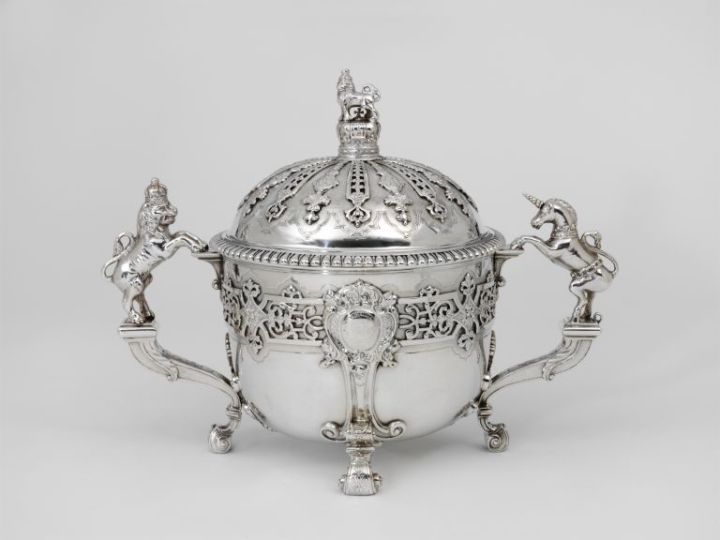
Edward Feline, Christening Cup and Cover, 1731 (The Rosalinde
and Arthur Gilbert Collection on loan to the V&A)
◊ ◊ ◊ ◊ ◊
Press release for the exhibition, via Art Daily (28 March 2016) . . .
Masterpieces of British Silver: Highlights from the Victoria and Albert Museum
Liang Yi Museum, Hong Kong, 21 March — 18 August 2016
Curated by Tessa Murdoch and Lynn Fung
Liang Yi Museum celebrated the launch of its landmark exhibition Masterpieces of British Silver: Highlights from the Victoria and Albert Museum, featuring a total of 46 historical and contemporary silver pieces from the collection of the Victoria and Albert Museum (V&A), unveiled for the first time in Asia. The show will run for six months until August 2016.
“We are thrilled to unveil our newest exhibition in collaboration with the Victoria and Albert Museum, London. Our strategic partnership represents Liang Yi’s commitment to bringing the highest quality decorative arts to Hong Kong, allowing the public to appreciate these rare and treasured objects. The significant display has been carefully curated to offer insight into the global outlook of British silver, as well as the enduring influence that contemporary design holds in our creative ecology,” said Lynn Fung, Director of Liang Yi Museum.
 The works in Masterpieces of British Silver boldly combine ancient practices with modern technological developments, reflecting trends in taste and design across continents. The exhibition begins with seven examples of historical silver from the renowned Rosalinde and Arthur Gilbert Collection, the foremost collection of its kind and currently under the stewardship of the V&A. Dating from the 16th to the early 19th century, these objects provide a visual framework to the movements, designs and techniques that inform contemporary silver. The show continues with 39 dramatic sculptural pieces from the V&A’s permanent collection, created by notable contemporary silversmiths and showcased alongside original designs and sketches. Ranging from the entirely abstract to the startlingly representative, conceptual and functional pieces by modern day masters of silver such as David Clarke, Michael Rowe, Gerald Benney and Michael Lloyd demonstrate the diverse influences from which contemporary silverwork in Britain draws inspiration—from the flowery ostentation of 18th century Rococo to the minimal simplicity of Scandinavian design.
One of the highlights of this exhibition is that it provides “a unique opportunity to see masterpieces of silver from the privately assembled Gilbert Collection before the V&A’s Gilbert Galleries reopen to the public in London in November,” says Dr. Tessa Murdoch, Head of Metalwork Collections at the V&A. Standout pieces from the exhibit include “the graceful silver swan, which epitomises Arthur Gilbert’s taste. He also collected the very best examples of historic silver from the famous London workshops of Paul de Lamerie and Paul Storr and from the most celebrated historic collections.”
Alongside Masterpieces of British Silver, Liang Yi Museum’s acclaimed exhibition, A History of Evening Bags, has been extended due to its positive reception. Providing an intimate perspective to complement the show-stopping silver exhibits, the 250 pieces of European vanities from Liang Yi’s permanent collection display techniques that parallel those used on silver. With an assemblage of haute vanities commissioned from the houses of Cartier, Van Cleef & Arpels and Boucheron among others, the two exhibitions provide a valuable opportunity to contextualise these prized objects, which embody and signify the styles and social structures of different periods.
“As we look forward to the second anniversary of Liang Yi Museum, we cannot think of a better exhibition to mark the occasion. The two shows concurrently explore the continuation of virtuoso artistry in silver and metalwork and celebrate the vision of our Museum: design, craftsmanship and heritage. The parallel collections reflect a dedicated effort to foster cross-cultural dialogue and contribute institutionally to Hong Kong’s art scene, setting a benchmark for private museum practices,” continues Fung.
Exhibition | Venice, the Jews and Europe, 1516–2016
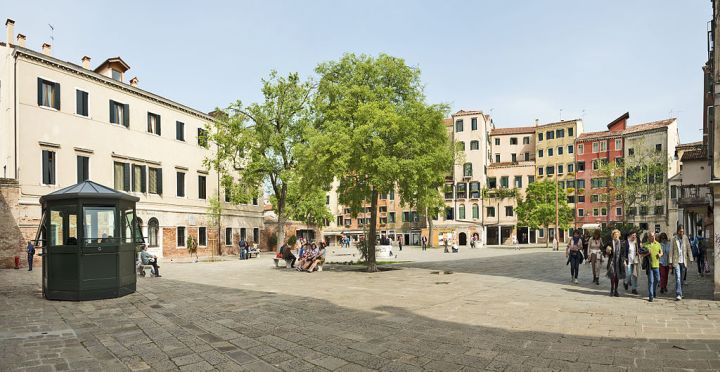
Campo de Ghetto Novo, Venezia
(Wikimedia Commons, 2013)
◊ ◊ ◊ ◊ ◊
As the Ghetto in Venice turns 500 on 29 March, the city marks the anniversary with events spread throughout the year, along with a major exhibition. David Laskin provides a preview for The New York Times (9 March 2016). From the website Venice Ghetto 500:
Venice, the Jews and Europe, 1516–2016
The Doge’s Apartments, Palazzo Ducale, Venice, 19 June — 13 November 2016
Curated by Donatella Calabi
The exhibition Venice, the Jews and Europe, 1516–2016 will be the highlight of the Quincentennial year of the Jewish Ghetto. Organized in collaboration with MUVE foundation of Venice in the prestigious venue of the Doge’s Palace, it will be a visible and symbolic event to mark this historic anniversary.
The exhibition, curated by Donatella Calabi, leading expert on the urban history of the Jewish Ghetto of Venice, aims at underscoring the wealth of relationships between the Jews and civic society throughout the history of their long residence in the lagoon, in the Veneto, and in Europe and the Mediterranean. It will recount the story of the Ghetto’s settlement, its growth, its architecture, its society, its trades, its daily life, and the relationships between the Jewish minority and the city at large, within the context of its relationships with other Jewish settlements in Europe and the Mediterranean basin.
The best of Venetian Jewish art and culture meet advanced and effective multimedia languages to show the reciprocal influence between the Jews and the society around them. (Paintings depicting biblical subjects will symbolize the age-old symbiosis between the Old Testament and the Veneto landscape). The virtual reconstruction of the Ghetto in its various historical phases will make it possible to trace the neighborhood’s development. Important, recently restored, silver ceremonial objects will help explain Jewish religious customs and traditions, fusing art and craftsmanship with culture. Books will bear witness to the extraordinary importance of Venetian Jewish printing, which was the first in Europe, through the example of the Talmud printed in Venice first and still in use today throughout the world.
Exhibition | I Am Here! Self-Portraits
Now on view at the Musée des Beaux-Arts de Lyon:
I Am Here! / Autoportraits: De Rembrandt du Selfie / Facing the World
Staatliche Kunsthalle Karlsruhe, 31 October 2015 — 31 January 2016
Musée des Beaux-Arts de Lyon, 26 March — 26 June 2016
Scottish National Portrait Gallery, Edinburgh, 16 July — 16 October 2016
Curated by Dorit Schäfer, Stéphane Paccoud, and Imogen Gibbon

Joseph Vivien, Self-portrait with Palette, 1715–20
The Staatliche Kunsthalle of Karlsruhe, the National Galleries of Scotland in Edinburgh, and the Museum of Fine Arts of Lyon established a partnership in 2011. The first exhibition to be created within this frame is on the theme of self-portraits and it will open in Lyon in spring of 2016.
The exhibition contains over 130 works from three major European museums, from the Renaissance period up to the 21st century, including paintings, drawings, prints, sculptures, photographs and videos. A specific genre in itself, self-portraits contain much information about their creators as well as their historical and social environment. At a time when selfies have become a true societal phenomenon, one that characterizes the digital era, the study of the traditions and usage of self portraits is more pertinent than it has ever been.
The exhibition offers a major chance to study the practice of self-portraits by artists in various forms that will be exhibited in seven sections
• The artist’s gaze
• the artist as a nobleman
• the artist at work
• the artist and his circle
• role-play
• the artist in his time
• the artist’s body
 Ich Bien Hier! Von Rembrandt zum Selfie (Cologne: Snoeck, 2016), 284 pages, ISBN: 978-3864421389. French and English editions will also be available.
Staatliche Kunsthalle de Karlsruhe
Pia Müller-Tamm, Director
Alexander Eiling, Curator
Dorit Schäfer, Curator, Drawings and Prints
Musée des Beaux-Arts de Lyon
Stéphane Paccoud, Chief Curator, Nineteenth-Century Paintings and Sculptures
Ludmila Virassamynaïken, Curator, Old Masters Paintings and Sculptures
National Galleries of Scotland
Michael Clarke, Director General
Imogen Gibbon, Curator










leave a comment