New Book | Antonio Bonazza e la scultura veneta del Settecento
Essays resulting from a study day held in October of 2013 in conjunction with the exhibition on Antonio Bonazza (1698–1763) were published last year by Scripta and are now available from Michael Shamansky (the exhibition was L’anima della pietra: Antonio Bonazza scultore del Settecento, on view at the Museo Diocesano di Padova, 2 May — 31 October 2013).
Carlo Cavalli and Andrew Nante, eds., Antonio Bonazza e la scultura veneta del Settecento: Atti della Giornata di studi, Padova, Museo Diocesano – Venerdì 25 Ottobre 2013 (Verona: Scripta, 2015), 208 pages, ISBN: 978-8898877416, $33.
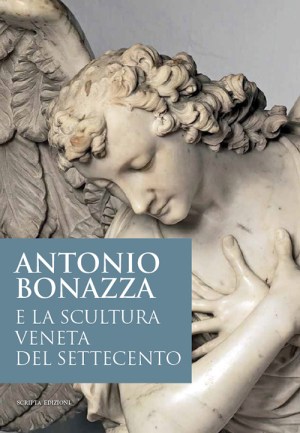 Antonio Bonazza è esponente di spicco di una delle più operose famigliedi scultori del Settecento veneto: insieme al padre Giovanni eai fratelli Francesco e Tommaso ha lavorato in moltissime chiese diPadova e del territorio, oltre che nei giardini delle ville di campagna dinobili famiglie veneziane.Le sue opere si collocano spesso ben al di sopra del livello di quelle deisuoi contemporanei, e raggiungono esiti di eleganza e leggerezza tra ipiù alti della scultura veneta del Settecento.La giornata di studi, organizzata dal Museo Diocesano di Padova inoccasione dei 250 anni dalla morte dell’artista (12 gennaio 1763), è stata occasione per aggiornare il catalogo delle opere, precisare la cronologia, mettere a fuoco la personalità umana e artistica di Antonio e i suoi rapporti con quella del padre Giovanni e dei fratelli Francesco e Tommaso, indagare modelli e fonti visive ed esplorare le relazioni tra la sua arte e quella dei suoi contemporanei.
◊ ◊ ◊ ◊ ◊
I N D I C E
• Anrea Nante, ‘L’anima nella pietra’. Ricerca e valorizzazione per la scultura del Settecento veneto
• Simone Guerriero, Giovanni e Antonio Bonazza, eredità e invenzione
• Damir Tulić, Le opere dei Bonazza sulla costa orientale dell’Adriatico
• Paolo Goi, Sui Bonazza in Friuli Venezia Giulia
• Monica De Vincenti, Antonio Bonazza e l’ingresso della ‘scultura di costume’ nel giardino della villa veneta
• Massimo De Grassi, Tra suggestioni antiquarie e cinquecentismi: fonti visive di Antonio Bonazza
• Denis Ton, I Bonazza e la pittura veneta: interazioni e scambi
• Egidio Arlango e Monica Pregnolato, L’altare dell’Addolorata nella chiesa padovana dei Servi: lettura tecnica e materica di una ‘straordinaria invenzione’
Exhibition | Picturing Prestige: New York Portraits, 1700–1860

From left to right: John Trumball, Portrait of Alexander Hamilton, ca. 1804–08 (Museum of the City of New York, 72.31.3); Nicholas Biddle Kittell, Portrait of Mr. and Mrs. Charles Henry Augustus Carter, ca. 1845 (Museum of the City of New York, 62.234.12); and George Peter Alexander Healy, Portrait of Caroline Slidell Perry Belmont (Mrs. August Belmont, Sr.), ca. 1855 (Museum of the City of New York, 51.317).
◊ ◊ ◊ ◊ ◊
Press release for the exhibition now on view at MCNY:
Picturing Prestige: New York Portraits, 1700–1860
Museum of the City of New York, 5 February — 18 November 2016
Curated by Bruce Weber
The Museum of the City of New York presents Picturing Prestige: New York Portraits, 1700–1860, an ensemble of iconic New Yorkers presented by intricate and elegant portraits, which were commissioned as status symbols and painted by the very best artists a young nation had to offer. The exhibition opened to the public on Friday, February 5, 2016.
Visitors can see familiar figures, such as the renowned John Trumbull portrait of Alexander Hamilton that inspired the image on our ten-dollar bill, and can also come face-to-face with New Yorkers like Richard Varick, of Varick Street in Greenwich Village, and the Brooks family, of Brooks Brothers fame, whose names are part of the city’s fabric but whose stories remain untold to a broad audience. This unique exhibition draws from the City Museum’s permanent collection to reveal the evolution of a dynamic city through its leading merchants, politicians and patrons, as well as the development of portraiture itself, one of New York’s oldest visual art forms.
“New York City’s distinctive character and unique personality have always come from its citizens,” said Whitney Donhauser, Ronay Menschel Director of the Museum of the City of New York. “This exhibition explores over 150 years of city life through the lives of many of history’s most celebrated New Yorkers, offering visitors an intensely engaging and deeply personal interaction with the past.”
Picturing Prestige relies on the people who shaped New York City in its formative years to tell the story of how the city grew from its colonial foundations through the Revolutionary War and blossomed into a mercantile powerhouse in the mid-19th century. The namesakes of Varick and McDougal Streets in Greenwich Village are brought to life by centuries-old paintings of Richard Varick and Alexander McDougall. Brooks Brothers is a household name in present-day America, and Picturing Prestige will display the early Brooks family in the light they wished to be shown in their own time.
The exhibition is also a study in the art of portraiture and New York City’s place as an artistic hub, showcasing over 40 oil paintings to go along with a dozen miniatures—small portraits kept as keepsakes, which were the original version of family wallet photos. The show is organized in three sections that demonstrate not only the growth and transformation of the city itself, but also the changing nature of portraiture as an art form, the city’s emergence as an artistic center, and the ways in which the city’s elite viewed itself over time:
• Colonial Foundations, 1700–1775
• Young Nationhood, 1777–1815
• The City Rises, 1815–1860
The scope of the exhibition, curated by Bruce Weber, City Museum Curator of Paintings and Sculpture, is made possible by the wealth of the City Museum’s permanent collection, offering portraits of iconic New Yorkers as painted by the leading artists of their respective generations. The artists themselves reveal nearly as much history as their subjects do, from the Duyckinck family demonstrating that the best painters in America in the 17th century were not from America, to John Singleton Copley personifying the rise of fine art in this country over one hundred years later.
“The portraits in this exhibition are works of art in and of themselves, but they are also windows into the lives and times of legendary New Yorkers,” added Weber. “In thinking about who commissioned these paintings and the artists who brought their subjects to life, we can tell the story of a city emerging from the throes of revolution to lead a young nation towards its rightful place at the vanguard of the artistic world. Today, New York City’s role as a cultural center is undisputed. Picturing Prestige helps explain how we got there.”
The conservation of many of the works and their related frames featured in Picturing Prestige: New York Portraits, 1700–1860 was made possible by a grant from the National Endowment for the Arts, as was digital photography and cataloguing of many of the paintings.

◊ ◊ ◊ ◊ ◊
From MCNY:
Hamilton and Friends: Portraiture in Early New York
Museum of the City of New York, Thursday, 11 February 2016, 6:30 pm
Alexander Hamilton was a man of many faces: politician, economist, revolutionary—and rumored philanderer. After he was killed in a duel with Aaron Burr in 1804, Hamilton’s widow, Elizabeth Schuyler Hamilton, worked tirelessly to defend her husband’s reputation. Today we are familiar with likenesses of Alexander Hamilton—including one that is on the ten dollar bill. This panel will explore how portraiture served in the decades after the American Revolution as a critical tool in shaping and canonizing the public image of leaders and notables. Join us for a conversation about how the Hamiltons and other members of the colonial New York elite commissioned portraits to use both as status symbols and a means to craft their public image. This program delves into the themes of our exhibition Picturing Prestige: New York Portraits, 1700–1860.
• William H. Gerdts, Professor Emeritus of Art History, CUNY Graduate Center
• David Jaffee, Professor and Head of New Media Research, Bard Graduate Center
• Elizabeth Mankin Kornhauser, Alice Pratt Brown Curator of American Paintings and Sculpture, The Metropolitan Museum of Art
• Brett Palfreyman, Assistant Professor, History Department, Wagner College
• Bruce Weber (moderator), Museum’s Curator of Picturing Prestige: New York Portraits, 1700–1860
Exhibition | Jean-Baptiste Huet: The Pleasure of Nature
From the Musée Cognacq-Jay:
Jean-Baptiste Huet, le plaisir de la nature
Musée Cognacq-Jay, Paris, 6 February — 5 June 2016
Curated by Benjamin Couilleaux
 Although he belonged to an important line of 18th-century artists, Jean-Baptiste Huet (1745–1811) has never before been the subject of a monographic exhibition. The Cognacq-Jay Museum will pay tribute to his alluring talent through a selection of paintings and graphic works. Jean-Baptiste Huet, who spent the majority of his career in Paris, was first trained in his family environment. He then received instruction from the animal painter Charles Dagomer and encouragement from Jean-Baptiste Le Prince, a talented student of Boucher. Benefitting from these influences, Huet developed a naturalistic and graceful style. He excelled in works of pastoral scenery depicting tales of the tender romances of shepherds, painted rustic landscapes with poetic notes and depicted the animal world with frankness and sympathy. He was admitted to the Académie in 1769, had regular exhibitions at the Paris Salon and was entrusted with decorative cycles. Huet’s art met with great success in various mediums. In 1783, Oberkampf, founder of the royal manufacture of Jouy-en-Josas, requested his services in creating printed patterns. His early creations were light, still in the Rococo style, then later gave way to straighter and more orderly shapes in the wake of Neoclassicism. Even up to his very last expressions, Huet’s work constitutes a tremendous tribute to the beauty of nature, with aspects of both reverie and fascination.
The dossier de presse de l’exposition is available as a PDF file here»
Benjamin Couilleaux, Jean-Baptiste Huet, le plaisir de la nature (Paris Musées, 2016), 176 pages, ISBN: 978-2759603145, 30€.
The Fitzwilliam Turns 200, with Exhibition and Book to Celebrate
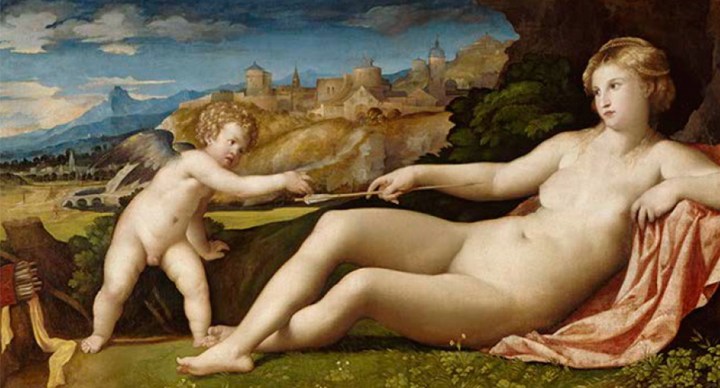
Palma Vecchio, Venus and Cupid, 1523–24 (Cambridge: The Fitzwilliam Museum). The painting was purchased by Lord Fitzwilliam from the London sale of the Duc d’Orléans collection in 1798. He first saw the collection at the Palais Royale during his visits to Paris.
◊ ◊ ◊ ◊ ◊
Press release from The Fitzwilliam:
Today (Thursday, 4 February 2016) one of the great collections of art in the UK celebrates its bicentenary. 200 years to the day of his death, the Fitzwilliam Museum has revealed previously unknown details of the life of its mysterious founder, Richard 7th Viscount Fitzwilliam of Merrion. Research for a new book has shown how his beloved library may have contributed to his death, and how his passion for music led him to the love of his life: a French dancer with whom he had two children, Fitz and Billy.
The Fitzwilliam Museum: A History is written by Lucilla Burn, Assistant Director for Collections at the Fitzwilliam. The book explores the full 200 year story of the Museum and the first chapter focuses on the founder. She comments: “Lord Fitzwilliam’s life has been described as ‘deeply obscure’. Many men of his class and period, who sought neither fame nor notoriety, nor wrote copious letters or diaries, do not leave a conspicuous record. But by going through the archives and letters that relate to him, for the first time we can paint a fuller picture of his history, including aspects of his life that have previously been unknown, even to staff here at the Fitzwilliam.”
Lord Fitzwilliam died on the 4th of February 1816, and founded the Fitzwilliam Museum through the bequest to the University of Cambridge of his splendid collection of art, books and manuscripts, along with £100,000 to build the Museum. This generous gift began the story of one of the finest museums in Britain, which now houses over half a million artworks and antiquities. Other than his close connection to Cambridge and his love of art and books, a motivation for Fitzwilliam’s bequest may have been his lack of legitimate heirs. The new details of his mistress help to explain why he never married.

Joseph Wright, The Hon. Richard Fitzwilliam, 7th Viscount Fitzwilliam of Merrion, 1764 (Cambridge: The Fitzwilliam Museum)
In 1761 Richard Fitzwilliam entered Trinity Hall, Cambridge, and in 1763 his Latin ode, ‘Ad Pacem’, was published in a volume of loyal addresses to George III printed by the University of Cambridge. He made a strong impression on his tutor, the fiercely ambitious Samuel Hallifax, who commissioned Joseph Wright of Derby to paint a fine portrait of Fitzwilliam on his graduation with an MA degree in 1764. Fitzwilliam’s studies continued after Cambridge; he travelled widely on the continent, perfecting his harpsichord technique in Paris with Jacques Duphly, an eminent composer, teacher and performer. A number of Fitzwilliam’s own harpsichord compositions have survived, indicating he was a gifted musician.
But from 1784 he was also drawn to Paris by his passionate attachment to Marie Anne Bernard, a dancer at the Opéra whose stage name was Zacharie. With Zacharie, Fitzwilliam fathered three children, two of whom survived infancy—little boys known to their parents as ‘Fitz’ and ‘Billy’. How the love affair ended is unknown, but its fate was clouded, if not doomed, by the French Revolution. We do not know what happened to Zacharie after her last surviving letter, written to Lord Fitzwilliam late in December 1790. Her health was poor, so it is possible that she died in France. However, the elder son, Fitz (Henry Fitzwilliam Bernard), his wife Frances, and their daughter Catherine were living in Richmond with Lord Fitzwilliam at the time of the latter’s death in 1816. It is not known what happened to Billy.
At the age of seventy, early in August 1815, Lord Fitzwilliam fell from a ladder in his library and broke his knee. This accident may have contributed to his death the following spring, and on 18 August that year Fitzwilliam drew up his last will and testament. Over the course of his life he had travelled extensively in Europe. By the time of his death he had amassed around 144 paintings (including masterpieces by Titian, Veronese, and Palma Vecchio), 300 carefully ordered albums of Old Master prints, and a magnificent library containing illuminated manuscripts, musical autographs by Europe’s greatest composers, and 10,000 fine printed books.
His estates were left to his cousin’s son, George Augustus Herbert, eleventh Earl of Pembroke and eighth Earl of Montgomery. But he also carefully provided for his relatives and dearest friends. The family of Fitzwilliam’s illegitimate son, Henry Fitzwilliam Bernard (‘Fitz’)—including Fitz’s wife and daughter—received annuities for life totalling £2,100 a year. On Fitzwilliam’s motivation for leaving all his works of art to the University, he wrote: “And I do hereby declare that the bequests so by me made to the said Chancellor Masters and Scholars of the said University are so made to them for the purpose of promoting the Increase of Learning and the other great objects of that Noble Foundation.”
Director of the Fitzwilliam Museum, Tim Knox commented: “The gift Viscount Fitzwilliam left to the nation was one of the most important of his age. This was the period when public museums were just beginning to emerge. Being a connoisseur of art, books and music, our founder saw the importance of public collections for the benefit of all. But we are also lucky that his life circumstances enabled him to do so—had there been a legitimate heir, he might not have been able to give with such liberality. From the records we have discovered, he appears to have been as generous as he was learned: he arranged music concerts to raise funds for charity and helped many people escaping the bloodiest moments of the French Revolution. We are delighted to commemorate our founder in our bicentenary year.”
◊ ◊ ◊ ◊ ◊
Celebrating the First 200 Years: The Fitzwilliam Museum, 1816–2016
The Fitzwilliam Museum, Cambridge, 4 February — 30 December 2016
Running throughout 2016, this exhibition will explore the Fitzwilliam’s past, present and future. A timeline of the first 200 years will introduce key themes and characters, while displays of objects will show how the collections have developed over two centuries. The exhibition runs alongside a new book The Fitzwilliam Museum: A History. For the very first time, this will tell the full 200 year story of the Museum. The triumphs and challenges of successive Directors, the changing nature of the Museum’s relationship with its parent University, and its dogged survival through the two World Wars. It will also shed light on the colourful, but previously little-known, personal life of Viscount Fitzwilliam himself.
◊ ◊ ◊ ◊ ◊
Lucilla Burn, The Fitzwilliam Museum: A History (London: Philip Wilson Publishers, 2016), 224 pages, ISBN: 978-1781300343, £25.
 The Fitzwilliam Museum: A History traces the full story from the Museum’s origins in the 1816 bequest of Richard, 7th Viscount Fitzwilliam of Merrion, up to the present day. It sets the Fitzwilliam’s individual story against the larger context of the growth and development of museums and galleries in the UK and further afield. The text and illustrations draw primarily on the rich and largely unpublished archives of the Fitzwilliam Museum, including the Syndicate Minutes, the reports of University debates published in the Cambridge University Reporter from 1870 onwards, compilations of earlier nineteenth-century documents, architectural plans and drawings, newspaper reports, letters, diaries, exhibition catalogues, photographs and other miscellaneous documents. With this material a substantial proportion of the narrative is told through contemporary voices, not least those of the Museum’s thirteen directors to date, each one a strong and influential character.
Starting with the obscure life of the 7th Viscount and concluding with a portrait of the Museum today, the narrative explores not just the Fitzwilliam’s own establishment and development, but also such wider issues as the changing purpose and character of museums and collections over the last 200 years, and in particular the role of the university museum. Many of the illustrations appear in the book for the first time, and include views of the galleries over the centuries as well as portraits of members of staff.
Exhibition | The Lavish Prince Regent
From the MFAH:
The Lavish Prince Regent
Rienzi, The Museum of Fine Arts, Houston, 5 March — 30 July 2016

Henry Bone, King George IV, 1821, enamel on gold, 9k rose gold, embossed metallic foil, and glass (Museum of Fine Arts, Houston, Rienzi Collection)
Prior to his accession to the British throne in 1821, King George IV served as Prince Regent of the nation during the mental illness and incapacitation of his father, George III. Before and during his regency, the prince led an extravagant lifestyle that held great sway over the fashions of the day, which saw him advocating new forms of leisure, style, and taste.
During this period, he built the famous Royal Pavilion in Brighton, which was an Orientalist fantasy in architecture. As with the pavilion, the ‘Regency Style’ that the prince created was a mixture of the Antique and the exotic, the gilded and the decorated—and with an interest in elegant innovation. This exhibition presents a survey of this most sumptuous of historical styles
Exhibition | À la Mode: Fashioning European Silver
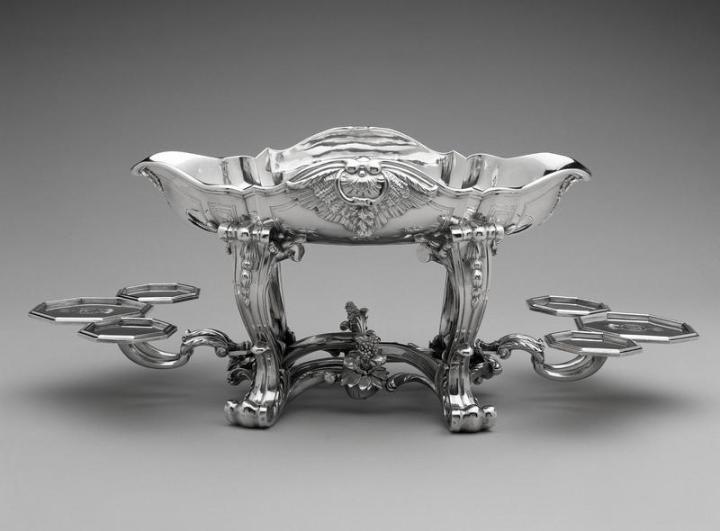
Paul Crespin, Epergne, 1742–43, sterling silver c
(Museum of Fine Arts, Houston)
◊ ◊ ◊ ◊ ◊
From the MFAH:
À la Mode: Fashioning European Silver, 1680–1825
Rienzi, The Museum of Fine Arts, Houston, 10 October 2015 — 7 February 2016
For centuries, silver was one of the most popular expressions of style and taste, with its universal appeal and powerful hold on the imagination making it the necessary luxury. Silver was designed for almost every occasion, from everyday drinking and dining to commemorating christenings and weddings.
À la Mode draws from the rich holdings of the MFAH, Rienzi, and two private collections to explore the social life of silver. The exhibition shows how prevailing attitudes and changes in fashion determined the form and function of objects, and how people thought about and lived with silver.
New Book | Companion to Glitterati: Portraits and Jewelry
The exhibition, which opened in December 2014, is on view through November 2016. The catalogue has just been published by the University of Oklahoma Press:
Donna Pierce and Julie Wilson Frick, Companion to Glitterati: Portraits and Jewelry from Colonial Latin America at the Denver Art Museum (Norman: University of Oklahoma Press, 2016), 96 pages, ISBN: 978-0914738756, $15.
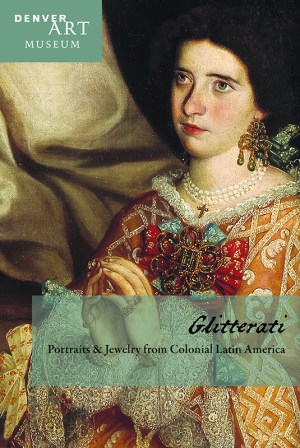 During the Spanish Colonial period in Latin America (1521–1850), precious gold and silver were crafted into elegant jewelry, then embellished with emeralds from Colombia, coral from Mexico, and pearls from Venezuela. To demonstrate their wealth and status, people were painted wearing their finest dress and elaborate jewelry. Selecting from its permanent collection, the Denver Art Museum installed the long-running exhibition Glitterati: Portraits and Jewelry in Colonial Latin America in its Spanish Colonial galleries in December 2014. This lavishly illustrated publication serves as a companion to the Glitterati exhibition and, on a larger scale, to the collection of Spanish Colonial jewelry and portraiture at the museum.
The Spanish Colonial collection at the Denver Art Museum is the most comprehensive of its kind in the United States and one of the best in the world with outstanding examples of painting, sculpture, furniture, decorative arts, silver and goldwork, and jewelry from all over Latin America during the time of the Spanish colonies. The Stapleton Foundation of Latin American Colonial Art, made possible by the Renchard family, gifted art acquired by the intrepid Daniel C. Stapleton between 1895 and 1914, when he worked in Ecuador, Colombia, and Venezuela overseeing plantations and emerald mines. Frederick and Jan Mayer worked closely with museum curators to build a collection of Mexican colonial art rich in many subjects and media, notably portrait paintings. Examples from both of these major collections are augmented by other pieces of jewelry and portraiture from the museum’s permanent collection in the Glitterati exhibition and in this volume.
Donna Pierce is Frederick and Jan Mayer Curator of Spanish Colonial Art at the Denver Art Museum and Head of the New World Department.
Julie Wilson Frick is the Mayer Center Program Coordinator and Junior Scholar in the New World Department at the Denver Art Museum.
Exhibition | Reynolds at Plymouth
Now on view in Plymouth:
The Influence of Italy
Plymouth City Museum and Art Gallery, 24 October 2015 — 27 August 2016
 Taking as its focus our newly-acquired sketchbook, which was completed by Sir Joshua Reynolds between 1750 and 1752, this display investigates what attracted the young artist to Italy and the lasting influence his tour had on his life and art. Scroll through a digital version of our sketchbook and see what caught Reynolds’s eye as he sketched his way across Rome. Discover why Italy’s art, history and landscape has had such an enduring influence on centuries of artistic imagination. Featuring works by Wilson, Guardi and Northcote, plus supporting loans from the De Pass Collection at the Royal Cornwall Museum and the Royal Albert Memorial Museum, Exeter, join us for a journey to la bella Italia.
◊ ◊ ◊ ◊ ◊
Now on view in Plymouth:
In the Frame: Plymouth’s Portraits Revealed
Plymouth City Museum and Art Gallery, 13 December 2014 — 27 August 2016

Sir Joshua Reynolds, Self-Portrait, ca. 1746 (Plymouth City Council)
Come and see an exhibition that delves more deeply into Plymouth’s portrait collection and presents characters that are new or rarely seen as well as some more familiar faces. ‘In the Frame’ features one of our most recent acquisitions—an early self-portrait by Plympton-born 18th-century artist, Sir Joshua Reynolds. This is set amongst other paintings of artists including self-portraits by James Northcote and Edward Opie.
You can come face to face with some of Plymouth’s maritime greats, too—from Hawkins and Raleigh to 18th-century admirals and George Gibbon, the Lieutenant Governor of Plymouth in the early 1700s, painted by Thomas Hudson. Important local faces and families also feature—from the Edgcumbes and the Eliots, to William Cookworthy (the founder of the Plymouth Porcelain factory) and the last town crier of Devonport.
Find out more about the research and the development that took place for this exhibition on our Museum blog.
Exhibition | The Power of Prints: The Legacy of Ivins and Mayor

Paul-César Helleu, Madame Helleu Looking at the Watteau Drawings in the Louvre, ca. 1896, drypoint, 38.8 × 51 cm (New York: The Metropolitan Museum of Art, The Elisha Whittelsey Collection, 59.599.19)
◊ ◊ ◊ ◊ ◊
Goya is the the important eighteenth-century offering here: Ivins was responsible for those acquisitions. Press release (21 January 2016) from The Met:
The Power of Prints: The Legacy of William M. Ivins and A. Hyatt Mayor
The Metropolitan Museum of Art, New York, 26 January 26 — 22 May 2016
Curated by Freyda Spira
The history of the Metropolitan Museum’s collection of works of art on paper—now one of the most important and most comprehensive in the world—began 100 years ago with the unlikely and astonishing story of its first two curators, neither of whom was trained as an art historian. Together, they challenged convention, engaged the public, and revolutionized the study of these works. Organized to commemorate the department’s centennial, the exhibition The Power of Prints: The Legacy of William M. Ivins and A. Hyatt Mayor sheds light on the fascinating careers of its founding curators and reveals how, from the very beginning, they artfully composed the print collection as a visual library: a corpus of works of art on paper—from the exceptional to the everyday. The story of this great American collection will be told through prints by Andrea Mantegna, Albrecht Dürer, Marcantonio Raimondi, Jacques Callot, Rembrandt van Rijn, Francisco de Goya y Lucientes, Honoré Daumier, James McNeill Whistler, Henri de Toulouse-Lautrec, Mary Cassatt, Edward Penfield, and Edward Hopper, among others.

Francisco de Goya y Lucientes, The Garroted Man (El agarrotado), ca. 1778–80, etching, 32.7 x 21.4 cm (New York: The Metropolitan Museum of Art, Rogers Fund, 1920, 20.22)
In 1916, William Mills Ivins (1881–1961) abandoned a successful law career to accept the job of founding curator of the Met’s Department of Prints. Although he was hired specifically to acquire the works of well-known 19th-century artists and old masters, Ivins set out instead to amass examples of technical, social, and historical interest as well. Notably, he championed the works of Goya, whose challenging and sometimes gruesome imagery was not appreciated in America at that time. Ivins first encountered these works as a student in Paris; the brutal images of war affected him profoundly and, in time, changed the course of his life. Almost all of the Met’s collection of nearly 300 Goya prints—one of the largest anywhere—was acquired by Ivins.
Before joining the Museum in 1932, Alpheus Hyatt Mayor (1901–1980) had studied modern languages, literature, and poetry, and worked as an arts critic, teacher, and occasional actor. Like Ivins, he was also an avid bibliophile with wide-ranging interests, a voracity for knowledge, and passion for social history. Brought on to assist Ivins and, eventually, to continue his legacy, Mayor expanded on Ivins’s foundational work by adding a new focus on lithography and popular prints. Pushing the boundaries of what had traditionally been collected as printed matter, he acquired for the Museum some of the most renowned American collections of popular prints. To Mayor, these items had value, because of the information they contained about all aspects of culture. He also recognized their future potential for research in diverse fields, from anthropology to urban planning.
As a result of Ivins’s and Mayor’s prescient collecting, the department now houses innumerable unique masterpieces, lauded for their exceptional artistry, as well as popular prints such as posters and trade cards that were printed in large numbers and never intended to last. By employing a conversational and colloquial tone in texts they drafted to describe these works, Ivins and Mayor transformed the way information about art objects was written. Excerpts from the writings of Ivins and Mayor will be included on labels throughout the exhibition.
To a certain extent, the history of the department is also the history of a series of extraordinary gifts and purchases of works of art. The gift of some 3,500 prints by paper manufacturer Harris Brisbane Dick led to the hiring of Ivins, to oversee them. An early gift of 10 prints by the artist Mary Cassatt came from Ivins’s friend Paul J. Sachs, assistant director at the Fogg Museum at Harvard University. (Sachs’s brother—also a friend of Ivins—gave an additional seven.) Engravings, woodcuts, and two woodblocks by Dürer entered the collection through gift and purchase from Junius Spencer Morgan, a noted collector of the artist’s works. Between 1949 and 1962, Mayor purchased more than 16,000 engravings, woodcuts, and mezzotints from Franz Joseph II, prince of Liechtenstein. The American sculptor Bessie Potter Vonnoh donated her entire collection of French and American posters of the 1890s. From Jefferson R. Burdick, the Museum received 300,000 examples of printed ephemera from the late 19th to the mid-20th century.
Just as Ivins and Mayor did, the exhibition will consider printed matter as the entrée to the information age, recognizing prints as functional objects that spread information to an ever-expanding audience and reflect a changing society. In the age of digital photography and the Internet, the power of prints, or the ability to disseminate images in identical form to a mass market, has special relevance to how we see, understand, and engage with works of art.
Arranged thematically and by technique, the exhibition has four parts. In the first section, the idea of taste is addressed in terms of Harris Brisbane Dick’s foundational gift of French, British, and American etchings and how it affected the collecting of etchings by the likes of Rembrandt and Goya. The second section considers engravings, amassed from the beginning with a focus on Renaissance artists such as Mantegna and Dürer. The third section shows the use of printed images in the spread of knowledge. Several rare early books, illustrated by woodcuts will be displayed. The books represent firsts of their kind on topics as diverse as costume, anatomy, and architecture. The final section features examples by Daumier, Toulouse-Lautrec, and other 19th-century artists whose works entered a truly mass market in the form of lithographs. Also in this section will be selected popular prints and ephemera from the late 19th and early 20th centuries.
The Power of Prints: The Legacy of William M. Ivins and A. Hyatt Mayor is organized by Freyda Spira, Associate Curator in the Metropolitan Museum’s Department of Drawings and Prints. Exhibition design is by Zoe Alexandra Florence, Exhibition Designer; graphics are by Ria Roberts, Graphic Designer; and lighting is by Clint Ross Coller and Richard Lichte, Lighting Design Managers, all of the Museum’s Design Department.
An illustrated checklist is available here»
◊ ◊ ◊ ◊ ◊
The catalogue is distributed by Yale UP:
Freyda Spira and Peter Parshall, The Power of Prints: The Legacy of William M. Ivins and A. Hyatt Mayor (New York: The Metropolitan Museum of Art, 2016), 192 pages, ISBN: 978-1588395856, $35 / £25.
 Metropolitan Museum curators William M. Ivins and his protégé A. Hyatt Mayor not only assembled a vast collection of prints, from Renaissance masterworks to ephemeral works, but also expanded the appreciation of prints as aesthetic objects, socio-historical documents, and tools of communication. More radically, by discussing these prints in accessible language, they changed our notions of how art reaches the wider public. Drawing on previously unpublished material, including personal letters and departmental records, this is the first comprehensive exploration of the lives, careers, theories, and influence of Ivins and Mayor. Also included are 120 exceptional prints that represent the breadth and depth of their acquisitions, including works by Dürer, Rembrandt, Callot, Goya, Whistler, Cassatt, and Toulouse-Lautrec.
Freyda Spira is associate curator in the Department of Drawings and Prints, The Metropolitan Museum of Art. Peter Parshall was formerly the Jane Neuberger Goodsell Professor of Art History and the Humanities at Reed College and curator and head of the Department of Old Master Prints at the National Gallery of Art, Washington, D.C.
Exhibition and Blog | Mended Ways: The Art of Inventive Repair
The exhibition closed last weekend, but anyone interested in the topic should have a look at Andrew Baseman’s blog Past Imperfect: The Art of Inventive Repair.
Mended Ways: The Art of Inventive Repair from the Collection of Andrew Baseman
The New York Ceramics and Glass Fair, 21–24 January 2016
 Before the invention of Krazy Glue, broken household items were brought back to life with flair and ingenuity. Mended Ways: The Art of Inventive Repair takes you back to a time when necessity was truly the mother of invention, as seen in Andrew Baseman’s collection of over 500 examples of 17th- to mid 20th-century mended ceramics and glassware.
A variety of early repair techniques shown will include metal staple/rivets, perfected in China by itinerant ‘china menders’; tinkers’ replaced handles, lids, and spouts on mugs, teapots and jugs; intricate and detailed silversmiths’ repairs, which only the wealthy could afford.
Extraordinary pieces include a 17th-century Dutch delft ewer with a replaced jeweled metal spout and handle; an American blown and cut crystal candlestick from the early 1900s incongruously stuck into a block of wood; a c. 1850 English lustreware creamer with tin straps and handle; and a set of six delicately painted early 18th-century Chinese export plates held together with enough hand forged metal staples to keep Frankenstein’s monster intact.
Other fascinating repairs include a Chinese Yixing teapot, c. 1700, with a magnificently carved replacement handle and engraved silver mounts; an 1830s transfer-printed jug from England with woven wicker handle; and an 18th-century Chinese export teapot with a record number of repairs including a sterling silver spout, metal rivets supporting the handle, and a replaced hand-painted lid with chain attached to handle. To illustrate what some of the pieces looked like before they took a tumble, intact examples will be shown for a side-by-side comparison.
Andrew Baseman writes the blog, Past Imperfect: The Art of Inventive Repair, which chronicles Baseman’s world-renowned collection of antique ceramics with inventive repairs, also known as ‘make-do’s’. His collection was featured in a cover story for the Home & Garden section of The New York Times. He is an expert on the subject and has lectured in the US and abroad. His lifelong passion for collecting and selling antiques began at an early age and continues to inspire his design work today.
For over 20 years, Baseman worked as a designer, decorator and stylist on diverse film and television projects including The Nanny Diaries, Eat, Pray, Love, The Americans, Gotham and The Normal Heart, working with notable directors Ryan Murphy, Bill Condon, Jane Campion, and others. In 2003, he founded Andrew Baseman Design, Inc., an interior design firm specializing in upscale residential interiors, creating luxurious homes for clients in the visual arts, including film and theatrical producers, fashion designers, and others. He is the author of The Scarf (Stewart, Tabori & Chang, 1989), the classic illustrated art book chronicling the history of the printed scarf that reflects both his expertise and love of textiles.










leave a comment