Exhibition | Hubert Robert, 1733–1808

◊ ◊ ◊ ◊ ◊
From the National Gallery of Art:
Hubert Robert (1733–1808), un peintre visionnaire
Musée du Louvre, Paris, 7 March — 30 May 2016
National Gallery of Art, Washington, D.C., 6 June — 2 October 2016
Known fondly as ‘Robert des ruines’ because of his penchant for painting ancient ruins, Hubert Robert was regarded during his lifetime as one of France’s most successful and prominent artists. In the first monographic exhibition showcasing Robert’s full achievement as a draftsman and painter, some 50 paintings and 50 drawings will chart his development in Rome and subsequent high level of accomplishment after his return to Paris. The exhibition will also focus on Robert’s lasting contribution to French visual culture and the fundamental role he played in promoting the architectural capriccio (caprice or fantasy), an art form in which famous monuments of antiquity and modernity were imaginatively combined to create striking and novel city scenes and landscapes.
◊ ◊ ◊ ◊ ◊
The English edition catalogue is published by Lund Humphries:
Margaret Morgan Grasselli with contributions from Yuriko Jackall, Guillaume Faroult and Catherine Voiriot, Hubert Robert (London: Lund Humphries, 2016), 288 pages, ISBN: 978-1848221918, £45.
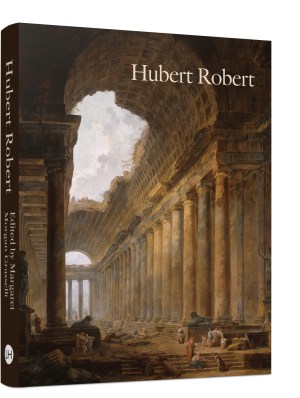 Known fondly as ‘Robert des ruines’ because of his penchant for painting ancient ruins, Hubert Robert (1733–1808) was one of France’s most successful and prominent artists during his lifetime. This outstanding publication, which accompanies the first monographic exhibition of his work, illuminates Robert’s remarkable artistic achievements and his lasting contributions to French visual culture.
Robert’s skills were manifold—he enjoyed great success as a painter, draftsman, interior decorator and garden architect. During his time in Rome, he fostered close professional bonds with artists such as Piranesi, Panini and Fragonard, while in Paris he flourished under the patronage of several wealthy French supporters including the Marquis de Marigny, brother of the famed Madame de Pompadour. Robert’s work later addressed the demise of this glittering society through both ominous scenes of disaster and representations of vandalized royalist monuments. Upon his own release from imprisonment following the French Revolution, Robert completed a series of meditative variations on the Grande Galerie of the Musée du Louvre, of which he had been appointed curator in 1784.
◊ ◊ ◊ ◊ ◊
The French edition catalogue is published by Somogy:
Guillaume Faroult, ed., Hubert Robert (1733–1808) : un peintre visionnaire (Paris: Somogy, 2016), 544 pages, ISBN: 978-2757210642, 49€.
 Hubert Robert fut l’un des créateurs les plus séduisants du siècle des Lumières. Artisan de cet art de vivre poli, galant et souriant qui paraît l’une des quintessences de l’esprit français au XVIIIe siècle, l’artiste attire d’emblée la sympathie. Il parvint à s’introduire dans les cercles les plus brillants de son temps, édifiant une carrière exemplaire dans la France de l’Ancien Régime jusqu’au règne de Napoléon.
Formé à Rome vers le milieu du siècle, en pleine fièvre antiquaire, Robert s’impose dès son retour à Paris comme « peintre d’architecture ». Le philosophe Denis Diderot célèbre aussitôt la «poétique des ruines » du jeune artiste. La production de Robert fait preuve au cours de sa carrière d’une exceptionnelle dynamique d’amplification: les œuvres, les projets, les charges y atteignent une dimension considérable. L’artiste devient très recherché pour la production de vastes ensembles de décors peints. Il se lance enfin avec succès dans une forme d’« art total » en tant que créateur de jardins, dont le parc de Méréville (de 1786 à 1793) fut sans doute le chef-d’œuvre.
Frappé par le bouleversement historique de la Révolution française, il en consigne les premières manifestations en représentant, dès l’été 1789, La Bastille dans les premiers jours de sa démolition. En 1795, il réintègre sa fonction de conservateur du «Muséum national », c’est-à-dire du musée du Louvre qui vient d’ouvrir ses portes, et dont il avait préparé activement la création. Sans aucun doute, l’œuvre de Robert est parcourue par un sens de l’écoulement inexorable du temps et, par-delà, par une conscience de la marche de l’histoire, tour à tour triomphante ou déplorable, qui en constitue l’impressionnante grandeur.
Exhibition | Mavericks: Breaking the Mould of British Architecture

William Hodges and William Pars, The Pantheon, Oxford Street, London, 1770–72, by James Wyatt, oil on canvas (Leeds Museums and Art Galleries / Temple Newsam House)
◊ ◊ ◊ ◊ ◊
Press release (8 December 2015) from the RA:
Mavericks: Breaking the Mould of British Architecture
Royal Academy of Arts, London, 26 January – 20 April 2016
Curated by Owen Hopkins
Mavericks: Breaking the Mould of British Architecture is an installation that will chart the course of British architecture from the sixteenth century to the present day through the work of twelve maverick architects: Robert Smythson, Sir John Vanbrugh, James Wyatt PRA, Sir John Soane RA, Charles Robert Cockerell RA, Charles Rennie Mackintosh, Charles Holden, H. S. Goodhart-Rendel, James Stirling RA, Cedric Price, FAT and Zaha Hadid RA.
Each of the twelve mavericks has charted his or her own course, often deliberately ignoring prevailing taste, fashion and ways of working. The installation comprises of images and photographs of these maverick architects’ work, situating their work within the broader context of architectural history, through an arresting colour-gradated design by Scott-Whitby Studio. Celebrating the original and the unorthodox, the installation will pose an intriguing alternative narrative to the history of British architecture.
◊ ◊ ◊ ◊ ◊
Owen Hopkins, Mavericks: Breaking the Mould of British Architecture (London: Royal Academy Publications, 2016), 128 pages, ISBN: 978-1910350393, £13 / $28.
The history of architecture is a story of continual innovation, and at certain points within that story come architects whose visions completely defy convention. Mavericks focuses on 12 such figures from the history of British architecture, including Sir John Soane, Charles Rennie Mackintosh, Cedric Price, and Zaha Hadid. From the stripped-back classicism of Soane’s Dulwich Picture Gallery to Hadid’s neofuturistic London Aquatics Centre for the 2012 Olympics, the architects’ work is bold, frequently controversial, and often radical. It is architecture that actively resists being pigeonholed into a particular style or period. What connects this naturally disparate group of free creative spirits is the way each has charted his or her own course, often deliberately evading conventions of taste, fashion, and ways of working. This book offers a fresh take on their creations, establishing new and sometimes surprising historical connections while proposing an intriguing alternative narrative to the history of British architecture.
Owen Hopkins is Architecture Programme Curator at the Royal Academy of Arts, London, and has written widely on architecture for The Burlington Magazine, The Architectural Review, Apollo, Dezeen, RA Magazine, C20 Magazine, The Oxonian Review, Architects’ Journal and Building Design. He is author of Reading Architecture: A Visual Lexicon (Laurence King, 2012), Architectural Styles: A Visual Guide (Laurence King, 2014) and From the Shadows: The Architecture and Afterlife of Nicholas Hawksmoor (Reaktion, 2015).
◊ ◊ ◊ ◊ ◊
E V E N T S
All events take place at the Geological Society, Piccadilly; £12 / reductions £6
Does Architecture Need Mavericks?
Thursday 4 February, 6.30–8pm
Owen Hopkins introduces the Mavericks book and installation and chairs a debate exploring the role of unorthodox approaches and original thinking in architecture.
Maverick Architects – A Thing of the Past?
Thursday 25 February, 6.30–8pm
Faced with the crushing weight of student debt and an increasingly risk-averse building industry, the panel explore if there is any future for mavericks in architecture.
After the Age of ‘Starchitects’
Monday, 7 March, 6.30–8pm
What might life be like after the signature-style, icon-obsessed—and male-dominated—age of the ‘starchitect’? The panel explores.
The Artist as Maverick Architect
Monday, 21 March, 6.30–8pm
Sean Griffiths, co-founder of FAT, one of the architects featured in Mavericks, chairs this discussion exploring the different perspectives artists can bring to the making of architecture.
Britain’s Greatest Maverick Building – The Debate
Monday, 18 April, 6.30–8pm
Do you have a favourite quirky or unusual building? Let us know on Twitter for a chance for it to be included in this debate looking for Britain’s greatest maverick building: @architecture_RA #Mavericks

New Book | Giambattista Bodoni: His Life and His World
On the occasion of the publication of Valerie Lester’s Giambattista Bodoni: His Life and His World, the first English biography of the great typographer, PRPH Rare Books and David R. Godine, Publisher invite you to an exhibit of selected Bodoni masterworks at our New York Gallery, a five-minute walk from The Grolier Club, Wednesday, January 27, 2016, 7.30–10.00pm. Light refreshments will be served. Please RSVP to news@prphbooks.com. PRPH Rare Books, 26 East 64th Street, 3rd Floor , New York, NY 10065.
A brief catalogue of nineteen items related to Bodoni is available as a PDF file here»
◊ ◊ ◊ ◊ ◊
From David R. Godine:
Valerie Lester, Giambattista Bodoni: His Life and His World (Boston: David R. Godine, 2015), 280 pages, ISBN: 978-1567925289, $40.
 A lively, lavishly illustrated biography of the great printer Bodoni, vividly describing his work, life, and times while justifying his reputation as the ‘prince of typographers’.
This is the first English-language biography of the relentlessly ambitious and incomparably talented printer Giambattista Bodoni (1740–1813). Born to a printing family in the small foothill town of Saluzzo, he left his comfortable life to travel to Rome in 1758 where he served as an apprentice of Cardinal Spinelli at the Propaganda Fide press. There, under the sponsorship of Ruggieri, his close friend, mentor, and protector, he learned all aspects of the printing craft. Even then, his real talent, indeed his genius, lay in type design and punchcutting, especially of the exotic foreign alphabets needed by the papal office to spread the faith.
His life changed when in 1768 at age 28 he was invited by the young Duke of Parma to abandon Rome for that very French city to establish and direct the ducal press. He remained in Parma, overseeing a vast variety of printing, some of it pedestrian, but much of it glorious. And all of it making use of the typefaces he personally designed and engraved.
This fine book goes beyond Bodoni’s capacity as a printer; it examines the life and times in which he lived, the turbulent and always fragile political climate, the fascinating cast of characters that enlivened the ducal court, the impressive list of visitors making the pilgrim- age to Parma, and the unique position Parma occupied, politically Italian but very much French in terms of taste and culture. Even the food gets its due (and in savory detail). The illustrations—of the city, of the press, of the types and matrices—are compelling enough, but most striking are the pages from the books he designed. And especially, pages from his typographic masterpiece, the Manuale Tipografico, painstakingly prepared by his wife Ghitta, posthumously published in two volumes, and displaying the myriad typefaces in multiple sizes that Bodoni had designed and engraved over a long and prolific career.
Intriguing, scholarly, visually arresting, and designed and printed to Bodoni’s standards, this title belongs on the shelf of any self-respecting bibliophile. It not only makes for compelling reading, it will be considered the biography of record of a great printer for years to come.
Valerie Browne Lester is an independent scholar, writer, and translator living in Boston. She is the author of Phiz: The Man Who Drew Dickens (2004), a biography of Hablot Knight Browne, Dickens’s principal illustrator who was also her great-great-grandfather. She translated Alain-Fournier’s Le Grand Meaulnes (The Magnificent Meaulnes, 2009), and has written poetry, plays, and articles.
Exhibition | China Observed
As noted at Art Daily:
China Observed: Historical Pictures by Chinese and Western Artists, 1750–1970
Hong Kong Maritime Museum, 7–14 October 2015
Mallett, New York, 21–31 January 2016

Chinese artist, late 18th century, one of a pair of paintings picturing Chinese Women Accompanied by Pipes and Pets, gouache on paper, 80 x 59 cm (London: The Martyn Gregory Gallery)
The world’s foremost expert in Chinese Export paintings, The Martyn Gregory Gallery of London, will exhibit 70 of these paintings (also known as China Coast or China Trade paintings), January 21–31, 2016, at Mallett, 929 Madison Avenue (at 74th Street). An exhibitor since 1990 at the annual Winter Antiques Show in New York, the gallery presents its first independent exhibition in the city with China Observed. These highly detailed works by Cantonese artists were bought by ships’ officers and merchants who came to trade at Canton (modern Guangzhou) in the 18th and early 19th centuries. Also on view will be paintings by Western artists who travelled to the East.
“New York has been one of the principal centers of the China Trade ever since America won its independence from Britain,” commented Martyn Gregory, “and the city still contains a wealth of China Trade pictures and keen collectors. We have always enjoyed coming to New York, and we look forward to meeting old friends and new enthusiasts in our new venue. We are bringing with us the finest collection of China Trade paintings to be found on the market at the present time, and perhaps for the foreseeable future.”
Among the most spectacular of the paintings by Chinese artists included in China Observed are detailed scenes of the ports visited by the Westerners: notably Canton, Hong Kong and Shanghai. One such example is The Hongs of Canton by an unknown Chinese artist, c. 1804. This oil on canvas (32 x 50 in.) is a large, impressive and finely detailed view of the hongs, or ‘Factories’, at Canton that commemorates the early years of direct trade between the United States and China. It also records a brief period when seven different nations (Great Britain, America, France, Sweden, Denmark, the Netherlands and Spain) were all actively trading at Canton, the only Chinese port at which Western trade was permitted.
Another large and unusually well-painted harbor painting is Hong Kong from the Harbour by an unknown Chinese artist, late 1850s (oil on canvas, 26 x 44 in.). Here, the island of Hong Kong is pictured before the erection of the signaling station on the Peak in 1861. Less than 20 years had elapsed since the British hoisted the Union Jack on the shore of Hong Kong Island, but in the intervening period, most of the waterfront between Western District and East Point had been developed. Several well-known structures are included in the landscape, including the tower of St. John’s Cathedral, which can be seen above the smaller paddlesteamer, with Government House uphill to its right. In the harbor, a great variety of vessels can be seen, including a coastal junk, Tanka boats operated by blue-robed women, covered hulks (superannuated sailing ships converted for use as naval base), small sidewheelers and three-masted sailing ships flying the flags of Britain, France and the United States. A curiosity of the painting is the presence, towards the right of the harbor, of a junk-rigged vessel with additional jib and topsails in the Western fashion.
A Panoramic View of the Bund at Shanghai, with a Regatta in Progress, an oil on canvas (16¾ x 55¾ in.) by an unknown Chinese artist, is apparently the earliest detailed view of the Shanghai Bund. The picture, which is known in several versions, would have been executed no earlier than July 1849, when the British consulate was first established on this site (far right) and not later than 1851, by which time Jardine, Matheson had replaced the Chinese-roofed building seen here (to the left of the British consulate) by a larger structure with a Western-style roof.
Also to be seen in China Observed will be remarkable Chinese export portraits of Western visitors to China and painted ‘in the Western manner’. Portrait of William Read of Philadelphia by the Cantonese artist known as Spoilum (fl. c.1774–c. 1805), an oil on canvas (24 x 20 in.) is an outstanding example of this artist’s distinctive work. The sitter, William Read (1767–1846), made several voyages to China. His father, George Read, was one of the signers of the Declaration of Independence.
Trampling Down Loose Tea in Tea Chests at Canton, a gouache by a late 18th-century unknown Chinese artist (12½ x 10 in.; 31.7 x 25.4 cm.) is another highlight of China Observed. This painting is one of a set of eight scenes illustrating the production of tea from the earliest stages—picking tea in the mountains—to the late stage seen here, in which dark-suited Westerners sample the tea as animated Chinese figures press down the tea within the chests in which it will be exported to the West.
An unusual and early pair of suave Chinese women holding long tobacco pipes—one shown with a dog and the other with a green-eyed cat—are also included in the exhibition. A Pair of Paintings of Chinese Women accompanied by Pipes and Pets by a late eighteenth-century Chinese artist (gouache on paper, each 31½ x 23¼ in.; 80 x 59 cm) depicts in each scene a woman beside a latticework shutter, as if at a window, with flowering shrubs and birds beyond. Each woman wears a fur-lined robe and flower-bedecked headdress and holds up a long tobacco pipe. One woman is accompanied by a small dog, the other by a green-eyed cat; both are placed within painted trompe-l’oeil frames of differing design. These unusual pictures are precursors perhaps of the more standardized ‘beauties’, painted in oils, which were exported in the mid-nineteenth century.
China Observed will be on view from 10:00 to 6:00 daily. During the exhibition, inquiries can be directed via Mallett at 212.249.8783.
The catalogue is available as a PDF file for download here»
◊ ◊ ◊ ◊ ◊
Martyn Gregory, the proprietor for whom the gallery is named, has been an art dealer for more than 50 years. In 1977 the gallery held its first exhibition relating to the China Trade (Catalogue 18) following the discovery of an album containing over one hundred works relating to China at the time of the Second Opium War. It was from this beginning that the gallery developed its interest in the ever-intriguing subject of the China Trade and in the many artistic connections between China and the West. In addition to Mr. Gregory, Dr. Patrick Conner is a director of the gallery. He is a historian and lecturer and former Keeper of Fine Art at the Royal Pavilion in Brighton; he is also the author of the definite work on the legendary artist of the China Coast, George Chinnery and more recently a book on the ‘Hongs of Canton’, a study of the pictorial icons of the China Trade and the merchants who traded there.
The Martyn Gregory Gallery sells works that are often both historically significant and highly decorative. At least once a year, the gallery produces illustrated and scholarly catalogues on this area of specialty. For over 40 years it has been located at 34 Bury Street, St James’s in the West End of London.
Exhibition | Trading China: Paintings of the Porcelain Production Process
From the Hong Kong Maritime Museum:
Trading China: Paintings of the Porcelain Production Process in the Qing Dynasty
Hong Kong Maritime Museum, 23 October 2015 — 1 May 2016
 This special exhibition showcases a series of 34 paintings recently acquired by the Museum that document the process of making and trading porcelain from the famous Jingdezhen kilns, from mining the clay to selling the porcelain to foreign merchants through local dealers. Painted for the Western market, these illustrations vividly capture the work of the many specialised labourers as well as the way in which the trade and transport of the finished porcelain was arranged.
From the 16th century, Western demand for Chinese porcelain, exported through Guangzhou, grew. The technique of overglaze enamel painting, which originated in the imperial workshops, was used at Jingdezhen from the early 18th century for the production of imperial, domestic and export wares, reinforcing its role as China’s largest porcelain production centre. This style was very popular and led to innovations in ceramic production in Europe.
The Hong Kong Maritime Museum is grateful to the late Susan Chen Hardy for her generous donation of this collection of paintings. Susan was a long-time supporter of the Museum and a passionate connoisseur and collector of Chinese art. She and her husband Anthony Hardy have made significant contributions to the Museum and we are very pleased to welcome this exceptional series of paintings into our permanent collection.
◊ ◊ ◊ ◊ ◊
The bi-lingual catalogue is available here
Trading China: Paintings of the Porcelain Production Process in the Qing Dynasty (Hong Kong: Hong Kong Maritime Museum, 2015), 88 pages, ISBN: 978-9881823380, HK$100.
This catalogue features a series of 34 paintings recently acquired by the Museum. The paintings document the process of making and trading porcelain from the famous Jingdezhen kilns in the 18th century. Introductory articles and appendices on surveys of Qing paintings on the porcelain production process in other collections are also included.
◊ ◊ ◊ ◊ ◊
A set of twelve Chinese pictures depicting the porcelain production process (from about 1803 and formerly belonging to Lord Grenville, Prime Minister of the United Kingdom) was shown at the Indianapolis Museum of Art as part of The Luxury of Tea and Coffee: An Exhibition of Chinese Export Porcelain from a Private Collection (April 2011 – March 2012). That set of gouaches has since been sold by Thomas Coulborn & Sons.
Exhibition | Body Image in French Art and Visual Culture
From Harvard Art Museums:
Body Image in French Art and Visual Culture, 18th and 19th Centuries
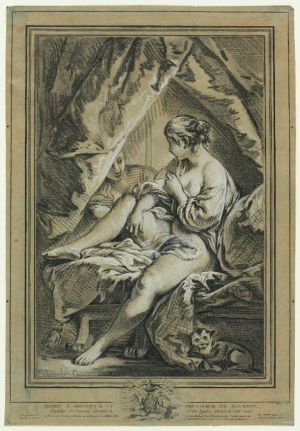
Louis-Marin Bonnet, after François Boucher, Young Woman in Bed / Figure de femme sur un lit, 1767, crayon manner etching printed in black and white on blue paper, 43.5 x 29.9 cm. Signed: L. Bonnet sculp. (Cambridge: Harvard Art Museums/Fogg Museum, M14332)
The goal of this installation is to consider the role of different artists and mediums (drawing, sculpture, print) in producing the modern understanding of the body. Spanning the period from rococo to post-impressionism, the installation addresses the issues of artistic instruction, the formation of gender and sexual identity and ethnic/racial stereotypes, the representation of history and modern life, the political and social critique, and the subjective vision. The 20 works on view include drawings by Degas and Seurat; prints by Gauguin, Manet, and Toulouse-Lautrec; and a bronze sculpture by Rodin.
This installation complements a course taught by Ewa Lajer-Burcharth, the William Dorr Boardman Professor of Fine Arts. The University Teaching Gallery serves faculty and students affiliated with Harvard’s Department of History of Art and Architecture. Semester-long installations are mounted in conjunction with undergraduate and graduate courses, supporting instruction in the critical analysis of art.
Display | A Room for Damascus
This posting is about nine months late, but the display is still on view at the V&A:
A Room from Damascus
Victoria & Albert Museum, London, 17 April 2015 — 15 April 2016
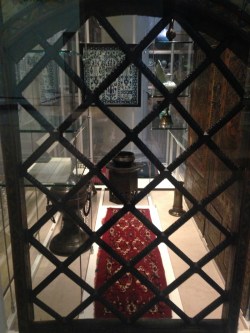 In the 18th century, the main reception rooms in Syrian upper-class houses began to be highly decorated with colourful painted wooden panelling. These rooms were the focus of hospitality, but the objects displayed there also announced a family’s wealth and status. When cities began to modernise in the late 19th century, many of these decorative interiors were removed for sale. The V&A was the earliest western collection to acquire one. This display will present some of the panelling and a selection of the objects that once dressed this room.
Mariam Rosser-Owen, the curator responsible for the Arab World collections at the V&A, provides a blog posting, available here, on the installation of the display.
Her earlier posting details the history of the room as it came to the V&A.
Exhibition | Meant to Be Shared: Prints from the Arthur Ross Collection

Giovanni Battista Piranesi, Veduta della Piazza di Monte Cavallo (View of the Piazza di Monte Cavallo [now the Piazza del Quirinale with the Quirinal Palace]), from Vedute di Roma (Views of Rome), 1750, etching (New Haven: Yale University Art Gallery, The Arthur Ross Collection).
◊ ◊ ◊ ◊ ◊
Press release (11 December 2015) from the Yale University Art Gallery:
Meant to Be Shared: Selections from the Arthur Ross
Collection of European Prints at the Yale University Art Gallery
Yale University Art Gallery, New Haven, 18 December 2015 — 24 April 2016
Samuel P. Harn Museum of Art, University of Florida, Gainesville, 29 January — 8 May 2017
Syracuse University Art Galleries, Syracuse University, 17 August — 19 November 2017
Curated by Suzanne Boorsch
The Yale University Art Gallery is delighted to announce Meant to Be Shared: Selections from the Arthur Ross Collection of European Prints at the Yale University Art Gallery, an exhibition presenting highlights of the more than 1,200 prints donated to the Gallery in 2012 by the Arthur Ross Foundation. Beginning in the late 1970s, philanthropist Arthur Ross (1910–2007) avidly collected works of art by some of the most renowned Italian, Spanish, and French printmakers of the last several centuries for his eponymous foundation. Highlights of the Arthur Ross Collection include works by Francisco Goya, the first artist whom Ross collected; Giovanni Battista Piranesi’s images of ancient and 18th-century Rome, which reflect Ross’s love of classicism and the Eternal City; and Édouard Manet’s illustrations for Edgar Allan Poe’s famous poem The Raven.
The Arthur Ross Collection comprises three major segments. The largest is a group of some 800 18th-century Italian works by Giovanni Battista Piranesi, Giovanni Antonio Canal (called Canaletto), Giovanni Battista Tiepolo and his sons, and others. A group of close to 200 prints by the Spaniard Francisco Goya includes the three intriguing and enigmatic series of etchings he made in the second decade of the 19th century, during which Spain suffered, first, Napoleon Bonaparte’s invasion, and then, with the restoration of the Bourbon monarchy, the repressive rule of King Ferdinand VII. The third segment consists of about 200 French prints by some of the greatest artists of the 19th and 20th centuries: Eugène Delacroix, Honoré Daumier, Camille Pissarro, Édouard Manet, Edgar Degas, Paul Gauguin, Henri Matisse, and Pablo Picasso.
This inaugural exhibition features 19 of Goya’s profoundly mysterious Disparates (Los proverbios) (Follies [Proverbs]) series, made around 1816 to 1819 but not published in Goya’s lifetime, for fear of the Inquisition. Ten images from the Tauromaquia (The Art of Bullfighting; 1815, published 1816) series and nine of the Desastres de la guerra (Disasters of War; ca. 1810–11, published 1863) are on display as well. The installation also highlights illustrations of great works of literature—one of the salient themes of the French work—including Delacroix’s 13 lithographs illustrating William Shakespeare’s Hamlet (1834–43) and some of his illustrations for Johann Wolfgang von Goethe’s Faust (1827, published 1828), and Manet’s truly revolutionary illustrations for Edgar Allan Poe’s The Raven (1875).
An entire gallery is devoted to views of places that might have been visited on the Italian segment of the Grand Tour, the cultural tour of Europe that was deemed an essential cap to the classical education of young gentlemen, especially those from Britain. Sparkling views of the Venetian region by Canaletto set the stage. The largest section is devoted to Rome; this part of the exhibition features a spectacular six-by-seven-foot map of the Eternal City, published in 1748, designed by the surveyor Giovanni Battista Nolli, and 20 of Piranesi’s Vedute (Views; ca. 1748–60) of Rome. The final area focuses on images of Pompeii and Paestum, in southern Italy, where in the mid-18th century rediscoveries of ancient sites excited the intelligentsia across Europe.
The title of the exhibition, Meant to Be Shared, reflects the raison d’être of the collection. Arthur Ross collected these prints for his foundation with the express purpose, in the words of his widow, Janet C. Ross, “to lend first-class prints … to educational institutions in the United States and abroad that would not otherwise have access to such objects for study and enjoyment.” In this spirit, the inaugural exhibition travels to the Samuel P. Harn Museum of Art at the University of Florida, Gainesville, in early 2017, and to the Syracuse University Art Galleries, New York, later that year. Gallery staff members have partnered with Harn Museum Director Rebecca M. Nagy and Syracuse University Art Galleries Director Domenic Iacono to plan ways to use the prints as teaching tools at each institution—including related university courses, public programs, and close-looking sessions—throughout the run of the exhibition. Suzanne Boorsch, the Gallery’s Robert L. Solley Curator of Prints and Drawings and curator of the exhibition, explains, “Far and away the most difficult aspect of preparing this exhibition was to make a selection from the abundance of riches that constitute this extraordinary donation. The possibilities that the Arthur Ross Collection offers for exhibition, research, and teaching are virtually endless, and, indeed, this inaugural exhibition and the collection catalogue are just the beginning of the rewards to be reaped by the study and enjoyment of this gift.”
The Gallery’s mission of sharing its collections broadly honors both the legacy of Arthur Ross and the value of the work he collected. Jock Reynolds, the Gallery’s Henry J. Heinz II Director, states, “We are grateful that the Arthur Ross Foundation has chosen the Gallery to be the steward of this remarkable collection, ensuring its proper care and always sharing it generously with active learners of all ages.”
◊ ◊ ◊ ◊ ◊
P R O G R A M M I N G
Gallery Talks
Wednesday, December 9, 12:30 pm
“Piranesi’s Rome: The Vision of an 18th-Century Architect and Printmaker,” Jakub Koguciuk, Ph.D. candidate in the History of Art and Renaissance Studies, Yale University
Wednesday, February 24, 12:30 pm
“Bullfighting: Audience and Perspective in Prints by Antonio Carnicero, Francisco Goya, and Pablo Picasso,” Ian Althouse, Ph.D. candidate in the Department of Spanish and Portuguese, Yale University
Wednesday, February 24, 1:30 pm
“Las corridas de toros: Audiencia y mirada en el arte de Antonio Carnicero, Francisco Goya y Pablo Picasso” (in Spanish), Ian Althouse
Wednesday, April 13, 12:30 pm
“Intensité, Obscurité, Frivolité: The Proliferation of Print Media in 19th-Century France,” Lisa Hodermarsky, the Sutphin Family Senior Associate Curator of Prints and Drawings, Yale University Art Gallery
Ryerson Lectures
Thursday, January 21, 5:30 pm
“Goya’s Prints in Context,” Janis A. Tomlinson, Director of University Museums, University of Delaware, Newark
Friday, February 5, 1:30 pm
“The Marriage of Venice and Rome, or What Makes Piranesi Great?,” Andrew Robison, the Andrew W. Mellon Senior Curator of Prints and Drawings, National Gallery of Art, Washington, D.C.
Friday, April 1, 1:30 pm
“From Paris to Tahiti: Paul Gauguin’s Innovative Prints,” Elizabeth C. Childs, the Etta and Mark Steinberg Professor of Art History and Chair of the Department of Art History and Archaeology, Washington University in Saint Louis
Performance
Thursday, March 31, 5:30 pm
Chamber Music of the 18th Century, Tiny Baroque Orchestra
Studio Programs
Friday, February 12, 1:30 and 3:00 pm
Printmaking Workshops
Inspired by the over 1,200 prints in the Arthur Ross Collection, Mauricio Cortes Ortega, M.F.A. candidate, and Caroline Sydney, SM ’16, both of Yale University, invite visitors to explore the art of printmaking. In this hands-on workshop, participants learn the basic techniques of intaglio printing and create a unique print of their own. Space is limited. Registration required; please call 203.432.9525.
◊ ◊ ◊ ◊ ◊
The catalogue is distributed by Yale UP:
Suzanne Boorsch, Douglas Cushing, Alexa Greist, Elisabeth Hodermarsky, Sinclaire Marber, John Moore, and Heather Nolin, with a foreword by Janet Ross, Meant to Be Shared: The Arthur Ross Collection of European Prints (New Haven: Yale University Press, 2016), 196 pages, ISBN: 978-0300214390, $60.
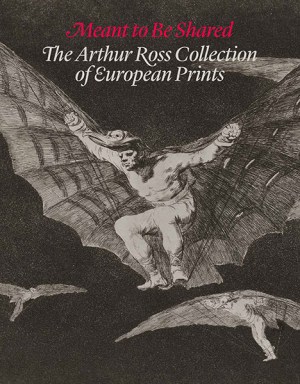 This important volume offers the first comprehensive look at the Arthur Ross Collection—more than 1,200 17th- to 20th-century Italian, French, and Spanish prints—and is published to mark the inaugural exhibition of the collection in its new home at the Yale University Art Gallery. Highlights include superb etchings by Canaletto and Tiepolo; the four volumes of Piranesi’s Antiquities of Rome, as well as his famous Vedute (Views) and Carceri (Prisons); Goya’s Tauromaquia in its first edition of 1816; an extremely rare etching by Edgar Degas; and numerous other 19th-century French prints, by Eugène Delacroix, Honoré Daumier, Édouard Manet, Paul Gauguin, Paul Cézanne, and others. The accompanying essays discuss the life of Arthur Ross, a significant philanthropist who funded several arts institutions; the formation of the collection and the art-historical significance of the works; and several thematic approaches to studying the collection, reinforcing its legacy as an important teaching resource.
Exhibition | No Cross, No Crown: Prints by James Barry
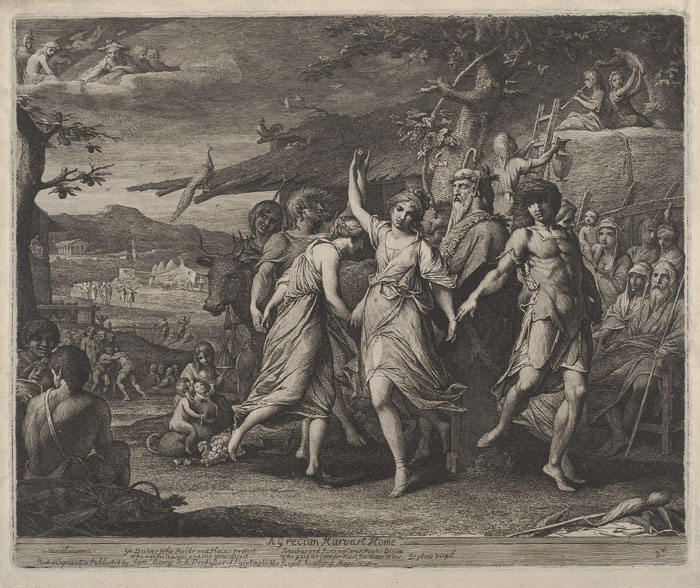
James Barry, A Grecian Harvest Home, from the series The Progress of Human Culture, 1792, etching and engraving in black ink, 17 ½ x 20 15/16 inches (Snite Museum of Art, University of Notre Dame: The William and Nancy Pressly Collection acquired with funds made available by the F. T. Stent Family, 2015.001.014).
◊ ◊ ◊ ◊ ◊
Press release (27 October 2015) from the Snite:
No Cross, No Crown: Prints by James Barry
Snite Museum of Art, University of Notre Dame, 24 January — 17 April 2016
The Snite Museum of Art will present an exhibition of 28 monumental prints by James Barry, the eighteenth-century Irish provocateur whose work challenged the British art establishment and questioned the government’s policies. The exhibition No Cross, No Crown: Prints by James Barry will be on view from January 24 through April 17, 2016.
James Barry (1741–1806) was born in Cork, made his artistic debut in Dublin, and was awarded membership in the Royal Academy in London in 1773, although he was later expelled for his belligerence and acrimony. The series of six murals he painted to decorate the Great Room of the Royal Society of Arts in Adelphi from 1777 through 1783 is his claim to fame. Included in the exhibition is a complete set of the prints he made after these grand paintings, once referred to as Britain’s answer to Michelangelo’s Sistine Chapel ceiling.
Barry’s prints are significant in the history of printmaking and eighteenth-century trans-Atlantic studies for their scale, their technical innovations, and the role they played in the artist’s creative process. These are not mere reproductive prints, but rather charts illustrating Barry’s evolving positions on hot political and artistic issues of the day. Peppering his religious and historical works with portraits of his contemporaries, such as the philosopher Edmund Burke and the politician William Pitt, the ensemble reads like a Who’s Who of British society in the late 1700s.
The Snite Museum acquired the prints in 2015 from Nancy and William Pressly, the latter being the foremost scholar on James Barry and professor emeritus of eighteenth- and nineteenth-century European art at the University of Maryland. Pressly said, “Over the years, as I looked and relooked at these prints, I was amazed at both the subtlety and richness of Barry’ process, but he never pursued virtuosity for its own sake: all is in the service of his passion to transform his audience, a transformation, however, that places great demands on his viewer.”
Pressly’s book James Barry’s Murals at the Royal Society of Arts: Envisioning a New Public Art (Cork 2015) received the William MB Berger Prize for British Art History in 2015.
The acquisition of eighteen of the prints was made possible by a generous gift from the F. T. Stent Family of Atlanta with ten additional prints donated by the Presslys. No Cross, No Crown: Prints by James Barry is made possible by the Snite Museum General Endowment.
◊ ◊ ◊ ◊ ◊
Programs
• Public reception Friday, February 12, 2016, from 5:00 p.m. to 8:00 p.m.
• Gallery Talk at 12:30 p.m., Wednesday, February 17, by Patrick Griffin, Madden-Hennebry Professor of History.
• Gallery Talk at 12:30 p.m., Friday, April 1, by William Pressly, Professor Emeritus of Art History, University of Maryland.
• Lecture, 4:00–5:30 p.m. Saturday, April 2, “An Irishman’s Address to the English Establishment: James Barry’s Murals at the Society of Arts in London” by William Pressly, Professor Emeritus of Art History, University of Maryland.
All programs are free and open to the public.
Exhibition | John Akomfrah: Vertigo Sea
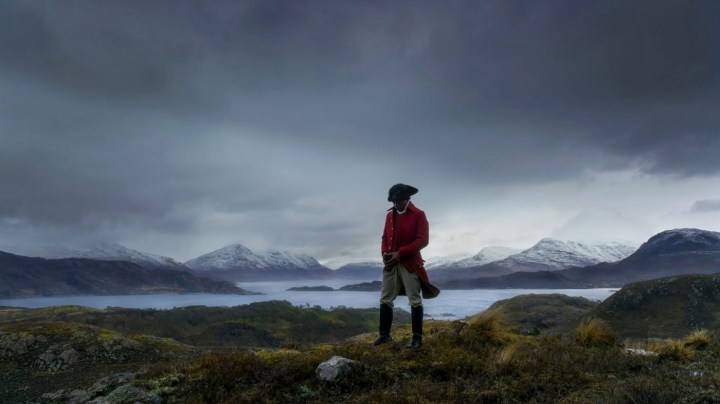
Still from John Akomfrah, Vertigo Sea, 2015; three channel HD video installation, colour, sound, 48 minutes. Smoking Dogs Films.
◊ ◊ ◊ ◊ ◊
From Arnolfini:
John Akomfrah: Vertigo Sea
Venice Biennale, 5 May — 22 November 2015
Arnolfini, Bristol, 16 January — 10 April 2016
Turner Contemporary, Margate, 8 October 2016 — 8 January 2017
The Whitworth, Manchester, TBA
Vertigo Sea, a three-screen film, first seen at the 56th Venice Biennale as part of Okwui Enwezor’s All the World’s Futures exhibition, is a sensual, poetic and cohesive meditation on man’s relationship with the sea and exploration of its role in the history of slavery, migration, and conflict. Fusing archival material, readings from classical sources, and newly shot footage, the work explicitly highlights the greed, horror and cruelty of the whaling industry. This material is then juxtaposed with shots of African migrants crossing the ocean in a journey fraught with danger in hopes of ‘better life’ and thus delivering a timely and potent reminder of the current issues around global migration, the refugee crisis, slavery, alongside ecological concerns.
Shot on the Isle of Skye, the Faroe Islands and the Northern regions of Norway, with the BBC’s Bristol based Natural History Unit, Vertigo Sea draws upon two remarkable books: Herman Melville’s Moby Dick (1851) and Heathcote Williams’ epic poem Whale Nation (1988), a harrowing and inspiring work which charts the history, intelligence and majesty of the largest mammal on earth.
As part of the exhibition, a new work Tropikos (2016) will also be shown. Set in the sixteenth century and using the writings and memoirs of a number of seafarers as its raw material, this single channel film is a Brechtian costume drama which merges Shakespeare’s The Tempest with true accounts of the journeys to and dreams of the ‘New World’. Exploring the point in history when Britain’s economic exploitation of Africa began, this work focuses on the waterways of the South West and their relationship to the slave trade, referencing larger themes of colonialism, maritime power and loss.
Shown together, these two lyrical and melancholic films propose a ‘voyage of discovery’, a meditation on water and the unconscious, referring specifically to the passage of migration into the UK. Placed in the context of Bristol, the films connect to this city’s complicated maritime history and its position as port—a point at both the start and end of epic journeys in the past and the present.
Vertigo Sea is presented in Bristol with support awarded to Arnolfini through Arts Council England’s Strategic Touring Fund. During 2016 and 2017 Arnolfini will lead a national tour of the work to venues across the UK including Turner Contemporary, Margate and The Whitworth, Manchester. Tropikos is a 70th Anniversary Commission for the Arts Council Collection, Southbank Centre London, with the River Tamar Project and Smoking Dogs Films.
John Akomfrah is an artist and filmmaker whose works are characterised by their investigations into personal and collective histories and memory, cultural, ethnic and personal identity, post-colonialism and temporality. Importantly, his focus is most often on giving voice to the experience of the African diaspora in Europe and the USA. A founding member of the influential Black Audio Film Collective, his work has been shown in museums and exhibitions around the world including the Liverpool Biennial; Documenta 11, Centre Pompidou, the Serpentine Gallery; Tate; and Southbank Centre, and MoMA, New York. A major retrospective of Akomfrah’s gallery-based work with the Black Audio Film Collective premiered at FACT, Liverpool and Arnolfini, Bristol in 2007. His films have been included in international film festivals such as Cannes, Toronto, Sundance, amongst others. He has recently been shortlisted for the Artes Mundi 7 prize.










leave a comment